A ALTO UNIVERSIT Y MAGA ZINE 27
27
OCTOBER 2020
Weak signals bring messages from the future p. 12
Alumna returns to Aalto
A spark to change the world
Glowing colours from nanocellulose
contents
Theme: Leaving a trace 2 Weak signals bring messages 1 from the future. 6 Entrepreneurs with a spark to 2 change the world. 4 Designer and materials scientist 3 walking on parallel paths.
Riikka Hopiavaara
40 Research brings precision solutions for health care.
2 / AALTO UNIVERSITY MAGAZINE 27
5 Openings – Ossi Naukkarinen mulls the traces Aalto leaves on the world. 6 Now – Brief news, big issues. Opening of academic year celebrated virtually. Major grant to bioeconomy research. 11 Oops! – Adam Foster missed the cosmology train. 12 Theme – Weak signals foreshadow changes – how can we master them? 20 Who – Ksenia Avetisova combines human elements with the virtual realm. 24 On science – Smart gloves to guide rehabilitation patients. 26 Entrepreneurship – New app spurs climate action in everyday life. 28 On the go – Alumna returns to Aalto. 34 On science – Designer and materials scientist conjure up glimmering colours out of wood. 36 Partnership – Kalevi Hyyrynen left Taavetti for Otaniemi and then Massachusetts. 38 Aalto 10 years – The fascinating story of our campus in a nutshell. 40 Collaboration – Biodesign projects create tailored solutions for health care. 44 Now – Science news in brief. 46
Theses – Mikko Kouhia and optimising the district heating network; Lotta Aho and changing the course of climate policy; Simone Haslinger and the new life of textile waste.
48 Everyday choices – Nitin Sawhney studies the interaction between humans and machines. 50 Wow! – Electric boat glides silently across the water.
Photographer Mikko Raskinen taking pictures for the Back to Aalto (p. 28) article. During the shoot, alumna Riikka-Leena Leskelä recalled that the previous time she visited the amphitheatre was in 2008, when the Helsinki University of Technology was celebrating its centenary. AALTO UNIVERSITY MAGAZINE 27 \ 3
Nita Vera
On the job
AS COMMUNICATIONS COORDINATOR,
I get to work at the point where innovation intersects with research projects that explore the new – my eyes are turned towards a better tomorrow. The openness, kindness and wisdom, which extends into so many areas of life, that our researchers display never ceases to impress me. I hope my trace arises from these valuable human encounters and powerful moments of being present. Tiina Aulanko-Jokirinne
I WANT TO keep doing things by hand in my
work as a graphic designer and illustrator. Concrete action is calming and acts as a balance to computer-heavy work. I want to leave traces of soft values in the world, to show the significance of being friendly, genuine and doing things together. In any project and work community, some of the most important driving forces are cooperation and treating others fairly and equally. Noora Typpö
PUBLISHER Aalto University, Communications EDITOR-IN-CHIEF Communications Director Jaakko Salavuo EDITORS Paula Haikarainen, Riikka Haikarainen, Riikka Hopiavaara AD/PHOTO EDITOR Liisa Seppo, Otavamedia OMA Oy ILLUSTRATIONS IN THIS ISSUE Noora Typpö TRANSLATION Ned Kelly Coogan, Annamari Typpö CONTRIBUTORS IN THIS ISSUE Jukka Alasaari, Matthew Allinson, Tiina Aulanko-Jokirinne, Tzuyu Chen,
Wisa Förbom, Heidi Hammarsten, Laura Hietala, Minna Hölttä, Iiro Immonen, Juha Juvonen, Jaakko Kahilaniemi, Kalle Kataila, Veera Konsti, Krista Kinnunen, Ive van Krunkelsven, Erwin Laiho, Hayley Lê, Eeva Lehtinen, Pihla Lemmetyinen, Jean Munck, Aleksi Poutanen, Marjukka Puolakka, Mikko Raskinen, Panu Räty, Eeva Suorlahti, Tiina Toivola, Annamari Tolonen, Nita Vera, Eren Öztekin STÖMER ÄRI KK MP
PRINTING COMISSIONED BY Unigrafia Oy PREPRESS Aste Helsinki Oy PRINTING Grano Oy, 2020 PAPER Maxioffset 190 g/m2 (covers) & 100 g/m2 (pages) PRINT RUN 3 000 (English edition), 30 000 (Finnish edition) SOURCE OF ADDRESSES Aalto University CRM Partnership and alumni data management PRIVACY NOTICES aalto.fi/services/privacy-notices ISSN 2489-6772 print ISSN 2489-6780 online
4 / AALTO UNIVERSITY MAGAZINE 27
MI
LJÖ M Ä RKT 4041 0955 Painotuote
Mikko Raskinen
I
ONLINE aalto.fi, aalto.fi/magazine EMAIL magazine@aalto.fi CHANGE OF ADDRESS alumni@aalto.fi
Y
ADDRESS PO Box 18 000, FI-00076 Aalto TELEPHONE +358 9 470 01
Openings
Traces of Aalto A wave, aalto in Finnish, flows ashore. Again, again, and again. Sooner or later, this will leave a trace. On a sandy beach, immediately, and after centuries on a rocky shore.
AALTO UNIVERSITY researchers and
other personnel, students, publications and inventions have a similar impact. It is impossible to know in advance what kinds of traces, when and where, we will leave behind, and it is not always easy to discover this through backtracking either. But our actions always have effects, and that’s why we are responsible for them. Thomas Midgley Jr. was a graduate of the famed Cornell University and an award-winning chemist. He is said to have been the most harmful scientist in world history, as he played a significant role in the discovery of CFC compounds, also known as freons, and the development of leaded petrol. Are the environmental and health problems caused by these inventions the traces of Cornell? How substantial are the traces we leave? How deep, permanent? In Otaniemi or on the other side of the world? Positive or negative – and according to whom? The variety of different traces is enormous. Some are easy to notice and we can try to measure their extent: carbon footprints, ecological footprints, water footprints... But our educational, economic, aesthetic or artistic trace – how should these be understood? In any case, they have a major and multifaceted impact on our wellbeing. The footprints of Alvar
Aalto are so diverse that it is not possible to see them from one viewpoint. At Aalto University, we have a unique opportunity to add to our understanding of various ways to influence the world. Physicists and chemists have the ability to see different things than construction technology experts, finance specialists, software researchers and film directors; bringing skills together allows you to see more. As members of the Aalto community, we have the ability and also the obligation to perform acts that have a major positive impact long into the future. Set in motion waves that will shape the Earth both here and elsewhere, at once and in the coming decades and centuries. Some of our actions amount to no more than a little splash that wanes away before anyone notices the humble beginnings of a new channel, while others can grow to an unpredictable scale. A minor act now can become something major tomorrow. This issue of Aalto University Magazine deals with the traces of Aalto and the Aalto community, focusing equally with the already-realised and the yetunborn. And with the traces the rest of the world leaves on us. I hope that this magazine leaves its trace on you, too.
Ossi Naukkarinen Vice President, Research
Now
New academic year opened in live broadcast AALTO UNIVERSITY’s 11th academic
of war competition between University management and the student union was also held, although the test of strength was pre-recorded this time. The ceremony was hosted by students Leila Arstila and Olli Kiikkilä. In addition to President Ilkka Niemelä and Aalto Student Union Chair Olli Kesseli, the Aalto community was greeted by Minister of Science and Culture Annika Saarikko. The President appointed Department of Signal Processing and Acoustics Professor Visa Koivunen an Aalto Distin-
guished Professor as recognition for his significant scientific and societal contributions. Awards voted on by Aalto community members were also handed out to various distinguished experts and enablers. Visualisations designed by students Lukasz Geratowski and Veera Krouglov brought colour to the opening ceremony. An informal warm-up session was arranged prior to the actual opening to welcome in particular new and international members of the Aalto student community.
Mikko Raskinen
year was launched virtually: the opening ceremony was arranged in a new format, taking the form of a live online broadcast from a studio built in the Harald Herlin Learning Centre. More than 2 200 viewers logged on to view the live ceremony, in addition to which a recording of the event had gathered over 1 500 views on YouTube by the end of September. Although the format was new, it retained many traditions – such as organising the ceremony in cooperation with the students. The traditional tug
6 / AALTO UNIVERSITY MAGAZINE 27
Made of copper, an antimicrobial protector that fits in a pocket
Erwin Laiho
THE SPACE KEY can be used to touch
The Space Key can be used to touch door handles.
toilet lids, turn-locks and door handles, slipping after use into a protective cover that kills possible pathogens. The tool was developed by sculptor Erwin Laiho, who works as a laboratory technician at Aalto Design Factory. After use, the protector is slid into its protective cover, where copper kills any pathogens that may have adhered to the surface. Clinical trials have shown that the destruction of viruses and microbes on the copper surface takes from a few minutes to a few hours. The cover isolates the microbes for the time required for destruction and thus prevents their spread. The product drawings are openly distributed under the CERN Open Hardware license, which allows anyone to freely manufacture and modify the model, as long as the work done is published under the corresponding license.
Black silicon photodetector breaks the 100% efficiency limit developed a black silicon photodetector that has reached above 130% efficiency. Thus, for the first time, a single photovoltaic device has exceeded the 100% external quantum efficiency limit at UV. ‘When we saw the results, we could hardly believe our eyes. Straight away we wanted to verify the results by independent measurements’, says Prof. Hele Savin, head of the Electron Physics research group at Aalto University. The independent measurements were carried out by the German National Metrology Institute, Physikalisch-Technische Bundesanstalt (PTB), which is known to provide the most accurate and reliable measurement services in Europe. The origin of the exceptionally high external quantum efficiency lies in the charge-carrier multiplication process inside silicon nanostructures that is triggered by high-energy photons. The phenomenon has not been observed earlier in actual devices since the presence of electrical and optical losses has reduced the number of collected electrons.
Wisa Förbom
AALTO UNIVERSITY researchers have
UV-light triggers electron multiplication in nanostructures. AALTO UNIVERSITY MAGAZINE 27 \ 7
Jukka Alasaari
the relationship between humans and soil by showcasing how the glass and porcelain industry as well as new technologies have left their mark on the Earth’s crust. The exhibition is curated by ceramic artist, Professor Maarit Mäkelä as well as artist, doctoral researcher Riikka Latva-Somppi from Aalto University. It is on display at Helsinki’s Design Museum until 10 January 2021. Ceramic test pieces crafted from natural clay, which was sourced in Sipoo, by designer Tzuyu Chen. The colours came from a construction site in Vuosaari, the Majvik biodynamic farm in Sipoo and an archaeological dig in Espoo.
Tzuyu Chen
THE SOIL MATTERS exhibition explores
PARTICIPANTS IN THE BIG BROTHER reality TV format are isolated from the outside world for 12 weeks. This year’s show is broadcast on Nelonen up to the end of November. The interior design of the Big Brother house is the work of Emmi Koskinen and Noora Katajalaakso as well as other students attending the Aalto Exhibition Design course. The space, which is located in Helsinki’s Redi shopping mall, is actually a civil defence shelter and thus windowless and entirely devoid of natural light. 8 / AALTO UNIVERSITY MAGAZINE 27
Now
Hayley Lê
AALTO STUDENT Ervin Latimer has
won the Young Designer of the Year 2020 contest, in which participants were tasked with designing a multipurpose hybrid garment. Latimer draws from his own background as a drag artist to design outfits that play around with gender concepts. ‘Fashion is about more than just the designer and the design. Every look is a message, and the models, photographers, stylists and other creatives with whom we collaborate are a seamless part of this message,’ Latimer says. Pictured is an outfit from the winning collection.
THE RECENTLY COMPLETED spatial art-
Artwork detail: among other things, a piece of stromatolite fossil has been embedded in the stairs.
Mikko Raskinen
work Mare Tranquillitatis is located in the spiral staircase of the School of Business, where it serves as a reminder of the significance of quietude and concentration. This subtle multi-part work is the creation of Patrik Söderlund and Visa Suonpää of art group IC-98. Its name refers to the Sea of Tranquillity on the Moon which was formed around the same time that life on Earth got started.
AALTO UNIVERSITY MAGAZINE 27 \ 9
Now
A major grant for bioeconomy development granted Aalto University EUR 10.5 million to establish a bioinnovation centre. This is one of the biggest grants the foundation has ever awarded. Aalto University will set up a multidisciplinary doctoral programme using the viewpoints of technology, art, design and economics in examining the problems of bioeconomy. To lead the programme, Aalto will recruit a professor with strong expertise in materials science and the circular economy, and an ability to network with experts in the field of bioeconomy, creative industries, and growth companies. State-ofthe-art infrastructure will be an important part of the new centre. The forest industry accounts for about one fifth of Finland’s exports of goods. According to estimates, the value of forest and agricultural biomass in Finland could be as much as doubled by 2050 if it is used for the manufacture of products of high added value. As paper consumption decreases, wood will also be available for other products. ‘For example, the price obtained for textile fibres is around 2.5 times the value of dissolving pulp. Finland could have a thriving textile industry that exploits biomaterials, which will multiply the value and employment impacts of the end products. New bio
Aleksi Poutanen
JANE AND AATOS ERKKO FOUNDATION
materials are also needed in packaging and composites. Future production processes are in line with sustainable development and products are designed so that they can be recycled,’ says Kristiina Kruus, Dean of the Aalto University School of Chemical Engineering. In recent years, members of the Aalto community have developed several promising biomaterial innovations and the new centre will also benefit from
research units already operating at Aalto University. ‘We are extremely grateful to the Jane and Aatos Erkko Foundation for the support, which will enable a great leap in the development of bioeconomy expertise. By awarding such a significant grant, the foundation is making a bold and visionary investment in sustainable development,’ says Ilkka Niemelä, President of Aalto University.
An emissions-free local energy project to start on campus agreed to modernise the heating and cooling system of a 10-building block to make it emissions-free and virtually self-sufficient. The area’s energy solution will be globally unique. In conjunction with the renovation of the Aalto University-owned building block, located in the campus area, Fortum will build a local-energy-based solution in which the heating and cooling will be produced with industrial-scale centralised air-to-water heat pumps. The heating and cooling will be distributed to the buildings via low-temperature district heating and cooling networks. At the same time, the heat generated during the cooling will be recycled for use in the area, thereby improving its energy efficiency. The self-sufficiency rate of the solution is 70-90 per cent, and, when needed, 10 / AALTO UNIVERSITY MAGAZINE 27
Helin & Co Architects / Aalto University
FORTUM AND AALTO UNIVERSITY have
renewable district heating will cover consumption peaks. The aim is to deploy the new energy solution at the beginning of 2021 and eventually expand it to other nearby buildings.
Illustration of the block to be renovated.
Oops!
Failure to launch As a student, Professor Adam Foster dreamed of studying the stars, but an over-running holiday interrupted the countdown. Text: Matthew Allinson Photo: Mikko Raskinen Illustration: Noora Typpö ‘I WAS in the final year of my undergraduate degree and
had to choose what subject to do my master’s thesis on. I was at Newcastle University and there was a really cool Californian professor who studied cosmology, and I knew that I was going to be a cosmologist. No question about it, it was sexy science with the most exciting researcher in the physics department and I was going to do his project. The way that selection for master’s theses went was that one Monday in the first term, everyone could have meetings with all the potential project supervisors and discuss the projects they wanted to do. I had already planned a long weekend visiting friends in a different city, but since I knew that it was obviously my destiny to become a world-famous cosmologist, it wouldn’t matter that I would be showing up late on the Monday. I would arrive in the afternoon to chat with the popular professor to discuss the project I was going to be doing for my master’s thesis, and that would be that. I was therefore shocked when I turned up late on the Monday to find out that the Californian professor had already agreed to take on a different student to do the project. I almost felt betrayed. In my head, it was supposed to be my project! I was left, late in the day, without any project, desperately rushing around all the other supervisors trying to find someone to take me on. I don’t want to make it seem like my supervisor was the last person left and it was a project I had no interest in – but it was computational physics with a lot of coding and about as unsexy as a project could’ve been to me at that time. This, of course, has become the research field that I now spend my whole life thinking about. Soon after starting my project I started to enjoy it, realised I found it interesting, and started to get good at it. After finishing up my master’s, I decided to move to London to do a PhD. It wasn’t a particularly well thought-out plan, but again, once I got to University College London, I found the work enjoyable and was able to turn it into my career. I think my learning from these experiences points to being flexible and adaptable as a key to success, as it can be hard to predict how things are going to go in advance, and sometimes great opportunities arise along the way.’ • AALTO UNIVERSITY MAGAZINE 27 \ 11
Theme
12 / AALTO UNIVERSITY MAGAZINE 27
Messages
from the future
Weak signals help us see the present more precisely and build better futures. Text: Panu Räty Illustration: Noora Typpö
AALTO UNIVERSITY MAGAZINE 27 \ 13
Theme
T
his year has changed our view of the world with unprecedented speed. The coronavirus shut down offices, universities and national borders as well as taught us to keep our distance from one another, disinfect our hands and handle meetings via video link. The global pandemic came across as a sudden and completely unpredictable upheaval. But was it really so surprising after all? Perhaps the consequences of the coronavirus felt so sudden because we failed to notice the weak signals that presaged the waves of sickness flowing from one country to the next. Virus researchers have been sounding warnings about diseases of animal origin that humans have no resistance to for a long time. For example, the SARS virus that appeared twenty years ago came from bats, while swine flu originated in pigs a decade ago. Trade in wild animals at Chinese food markets has been considered risky. In addition to population growth and urbanisation, the threat has grown because of mass tourism, which helps dangerous viruses travel from one country to another at the speed of a jet aircraft. In a sense, it was only a matter of time before an epidemic started spreading from a wet market selling live animals. Hints about future changes that manifest themselves in the present, but are easily overlooked, are what futurists refer to as weak signals. ‘A weak signal is the first symptom of a possible change,’ says futurist Mikko Dufva.
Weak signals stimulate thought
The best known concepts of futures studies include the megatrend, which refers to colossal changes like 14 / AALTO UNIVERSITY MAGAZINE 27
digitisation and climate warming, as well as trend, which is used to describe lesser development tendencies. Although megatrends affect both entire nations as well as individual citizens, sketching out the future relying solely on them would result in incorrect predictions. Sticking to known phenomena alone narrows our conception of the future too much. Dufva, who works as the Leading Foresight Specialist at the Finnish Innovation Fund Sitra, says that this is precisely where weak signals show their strength. They broaden our view of what kinds of building blocks reality is made of. ‘This is essential in our current age of surprises, which requires us to challenge what we consider ordinary or normal. At the same time, it enables us to keep our eyes peeled for emerging phenomena.’ As a multidisciplinary field of research, futures studies is especially helpful in outlining surprises. Its practical applications involve the methods of prediction, in which hints about possible changes are observed and analysed with the aid of, for example, weak signals. Dufva stresses that weak signals are not forecasts, but more like stimuli for thought. ‘They help us recognise different kinds of futures. Ideally, these will be of a type we could not have even imagined otherwise.’
Dumpster diving a hint of coming change
Dufva reminds us of an observation made by futurist Elina Hiltunen, who noted that, at first glance, weak signals can appear strange or even ludicrous. Dufva mentions dumpster diving as an apt practical example of this. During the last decade, the press portrayed rummaging through bins for discarded food as an eccentric
AALTO UNIVERSITY MAGAZINE 27 \ 15
Theme
Weak signals don’t always point towards positive alternatives. Many of them are portents of dangerous futures. lifestyle choice of the alternative scene. Supermarket chains also took a dim view of the independent recyclers digging through their garbage. Little by little, these attitudes changed. Nowadays, food past its best-before date is distributed free of charge to the needy, sold at a discount to knowledgeable customers in stores and even served up as dinner at zero-waste eateries. Dufva says it usually takes five to ten years for a weak signal to mature into a phenomenon. ‘In hindsight, it can be said that dumpster diving has been a weak signal. This really shows us that we should challenge our way of thinking every so often.’
Researchers a source of weak signals
Recognition of weak signals is always subjective; the same things simply don’t surprise us all. Dufva uses synthetic biology as an example. Microbes can produce biosynthetic silk, which resembles spider silk and could replace oil-based materials in consumer products. Many people would be amazed by the prototype stereo headset made by researchers from Aalto University and VTT Technical Research Centre of Finland – its soft parts were created by growing mycelium. ‘But if you’ve studied synthetic biology, this is in no way surprising, it’s rather mundane in fact,’ says Dufva. Researchers who generate fresh knowledge are quite often suitable sources of weak signals. Coming changes can just as well be foreseen by artists, NGOs that tackle social issues and various marginalised groups. When Dufva was compiling a database on weak signals for Sitra a couple of years ago, he mined, for example, news flashes, Twitter accounts and prediction16 / AALTO UNIVERSITY MAGAZINE 27
themed blogs as sources. Individual signals related to issues ranging from body-tuning biohackers to China’s citizen rating scheme and the weakening of the Gulf Stream. Dufva classified signals using so-called PESTEC categorisation, in which political, economic, social, technological, environment-related and cultural signals are divided into their own groups. Weak signals can be thought to perhaps anticipate a broader change only after a sufficient amount of observations, which point in the same direction, is accumulated in an individual category. Studies on materials produced with geneticallymodified microbes could, for example, predict a revolution in goods manufacture. Our everyday utensils may in future be grown directly out of the waste streams of households, agriculture and industry. In this way, weak signals can help us broaden our ideas about the possible directions in which our world may shape itself, Dufva thinks. ‘We can identify possibilities that we might not otherwise see.’
Insure yourself for the future
Weak signals don’t always point towards positive alternatives. Many of them are portents of dangerous futures. This is why the systematic scrutiny of weak signals can be thought of as insuring against the future, says Aalto University Professor of Systems Analysis Ahti Salo. Salo notes that many organisations have already learned to consider early recognition of possible futures important – at least on the level of speech.
Unfortunately, their talk does not always transform into action. ‘There’s awareness of how important it is to monitor weak signals, but it could be done quite a lot better in practice,’ Salo says. Salo himself contributes to the work of the Government Foresight Group appointed by the Prime Minister’s Office. The Group forms part of Finland’s official foresight system that, among other things, helps draft the Government report on the future. Systematic monitoring of weak signals could, according to Salo, alert companies to recognise, for example, rapid changes in the operating environment. Sometimes, these can foretell the upheaval of an entire sector or the erosion of a business model. In recent years, changes like this have emanated especially from platform economy firms, the bestknown of which include transport and accommodation service disruptors Uber and Airbnb.
Deal with vulnerabilities well in advance
Examining future risks through weak signals can reveal the surprising vulnerability of society. Risk is increased by mutual dependencies in the production of energy, raw materials and electronics components, for example. These can create vulnerabilities that spread through society in a chain reaction. For example, about twenty massive oil tankers cross the Gulf of Finland every day. In risk management, these tankers are seen not only as environmental hazards, but also as a potential electricity production vulnerability. ‘If a severe tanker accident were to happen on the Gulf of Finland, the oil spill might prevent power
plants from taking cooling water from the sea,’ says Salo. For its part, the coronavirus can be interpreted as a so-called wild card, i.e. a sudden, surprising and substantial change factor. Nevertheless, Salo points out that it is still possible to prepare for the risks associated with pandemics. ‘If a weak signal can be identified at the right stage, risk management and safety enhancement can fare much better. It is easier to take corrective measures in the early stages.’
Employ signals as a competitive advantage
Corporate success hinges to an ever greater degree on the ability to foresee events. Accordingly, Salo says organisations should make the systematic charting of weak signals an integral part of their foresight process. ‘For example, before outlining major strategies it would be wise to go through a process to chart weak signals in order to become, at the very least, more aware.’ The tools for this exist. One futures studies tool that suits practical foresight work is the Delphi technique. Delphi is a type of multi-stage survey in which the number of expert participants ranges from a few dozen to as many as several hundred. In the first round, participants are asked about their views on, say, future product innovations. In the next round, the query is made more detailed based on the first round of answers. Finally, the results are analysed statistically and contextually. In Elina Hiltunen’s futures windows method, the entire company is encouraged to gather weak signals. The employees take part in the futures window by snapping pictures of things they consider interesting. AALTO UNIVERSITY MAGAZINE 27 \ 17
Weak signals can grow into a significant competitive factor. The images are fitted with captions and then added to a presentation that is displayed in, for example, the company’s break room or conference space. Salo says weak signals can grow into a significant competitive factor if companies react to them more rapidly. Results can manifest themselves in improved services and product innovations. ‘Ideally, you find gold nuggets. And foresight can be implemented quite lightly.’ Prediction should not be done only by companies and other organisations, however. Salo thinks we would all be wise to stay alert when confronting information associated with both the past and the future. The necessary abilities for this can be developed by attending courses belonging to Aalto University’s futures studies minor programme. ‘We live in a continuum. Understanding this continuum is part of the sounding board against which every expert’s insight is built.’
Consolidate ideas into scenarios
Could weak signals and foresight work also help in solving humanity’s greatest challenges? As it happens, researchers more and more often ponder how information related to the future could lead to the emergence of better futures for us all. Future alternatives are also at the heart of Aalto University Professor of Sustainable Design İdil Gaziulusoy’s work. She points out that the role of design has expanded over the last few decades. 18 / AALTO UNIVERSITY MAGAZINE 27
‘Traditionally, design has been a servant of the consumer society. Part of design remains so, but our profession is taking an ever more critical view of its old role.’ Instead of physical products, a designer’s work may focus on, for example, an intangible service path, user experience or even a process to manage societal change. Gaziulusoy’s own work deals with societal transition phases from the perspective of sustainable development. ‘Among other things, we emphasise processes of participation in which designers play an important role.’ Gaziulusoy’s research project in Australia makes for a good example. While at the University of Melbourne, she studied new alternatives for South Australian cities to develop sustainable and low-carbon futures. About one hundred experts of different fields from research institutions, industry, NGOs and decisionmaking bodies took part in the futures workshops that launched the project. Based on current phenomena, the workshops envisioned a future in which climate change-curbing emission restrictions had been implemented successfully. Designers then gave the experts’ ideas concrete form by drafting them into imaginary news flashes from the year 2040. Some examples: Cycling becomes Melbourne’s most important mode of transport. Remaining cars assigned to shared use rather than being individually owned. Drones handle post and goods deliveries. Buildings now harvest solar energy and their gardens are used to produce food.
Theme
This is how you recognise weak signals The observations accumulated over the multi-year project were, in the end, condensed into scenarios that model future development paths. Among other things, they indicated that it is possible to aim for sustainable development from foundations built on entirely different sets of values. ‘In one scenario, strong government was the key actor, in the next, business dominated. In the third, communities took the lead and, in the fourth, microenterpreneurs.’ Gaziulusoy points out that the scenarios created in Australia were, above all, tools for testing differing perspectives, not agendas for the future. ‘In a world that is unbelievably uncertain and complex, it would be dangerous to commit too strongly to a defined future.’ The same idea applies to foresight work more generally. What’s important is not so much whether or not foresight hits the mark. More essential is that we learn to act smarter in the present. Perhaps we could also detect weak signals in the coronavirus. At the very least, the pandemic has made us notice that the crisis cannot be resolved through the work of virus researchers and health authorities alone. Getting through it calls for the participation of all of us, whether this means working remotely, keeping safe distances or wearing a mask. Perhaps a similar ability to cooperate could help us create a future in which even climate change has been halted. •
Recognising weak signals calls for the observer to keep an open mind, have the courage to challenge their own preconceptions and to halt when they come across curious details. The actual accumulation of signals is divided into three phases.
1. Gather signals • Utilise many kinds of sources from media monitoring to discussions, social media services and your own observations. • Pay attention especially to curious or surprising details. • Note the signals in writing complete with explanations and keywords.
2. Interpret signals • Think about the meaning of individual signals. • Consider the signals from different perspectives and also keep in mind the mutual interactions between signals. • Try and see what kinds of worlds the weak signals could point to.
3. Package signals • Arrange weak signals by, for example, dividing them into different categories. • Look for alternate future development paths in the signals. • Utilise signals also to consider what kind of future would be worth striving for.
AALTO UNIVERSITY MAGAZINE 27 \ 19
Who
20 / AALTO UNIVERSITY MAGAZINE 27
Human at the heart of technology Ksenia Avetisova moves around the virtual world as part of her job, but what brought her to Finland was a live rock gig.
T
his spring certainly was demanding,’ Ksenia Avetisova agrees in Helsinki’s Lapinlahti Park on a late summer day. Avetisova, who heads TietoEVRY’s Enhanced Reality centre of excellence, has, like so many others, worked remotely from her home office while simultaneously overseeing her children’s schooling. Interestingly, her work also involves exploring how people could work more efficiently and be more present virtually. ‘The change to full-time work from home was substantial. Conventional online meetings became more arduous, and provided little variety. That’s one of the key areas where immersive technology opens up new ways to be more present and collaborate on a deeper level while being physically distant,’ says Avetisova. Immersion refers to the user feeling completely present in the world of an application, such as a game.
Virtual spa is always open
The coronavirus spring also taught Avetisova how important the work-life balance really is, and how much harder it is to maintain it when both work and life take place from one location for a prolonged time. These insights are very relevant as input for a project she is working on. It focuses on the mental wellbeing of people engaged in expert work, and the aim is to research the use of technology in measuring stress and lowering or pre-
Text: Heidi Hammarsten Photos: Aleksi Poutanen venting it. Funded by Business Finland Avetisova’s team is analysing the effect of immersive experiences on employee’s productivity with the aid of virtual reality glasses and biofeedback sensors. ‘Wouldn’t it be nice to take a break and recharge at an exotic island, or in the mountains? Virtual reality offers limitless opportunities to take you to a different place – right when you need it the most. “Stepping out” of the workplace can really take your mind off the stressful atmosphere for a while and ultimately help you perform better,’ Avetisova says. However, the technology is still relatively new and the effects of virtual reality on the human brain are not yet sufficiently studied. ‘I see immersive technology as a tool to empower people and enhance their performance. By training with support of VR, our aim is to recreate a focused and calm state without any technology. And this makes us more resilient in any situation – we can meet it with a smile,’ Ave tisova points out. After all, research has shown that smiling has a positive influence on productivity and promotes the ability to cooperate.
Career path influenced by grandmother and HIM Avetisova comes from the city of Taganrog in the south of Russia. Her family has distinguished itself academically over several generations and in many different fields. ‘My grandmother founded the English department at a local university, and my grandad was a pioneer in remote learning
decades before it became mainstream. My mother specialised in maths and fuzzy logic, a field we’d today call artificial intelligence, while my father worked on advanced medical technology.’ Inspired by her grandmother, whom she greatly admires, Avetisova set on the path of excelling in linguistics and intercultural communication, however she did not stop there. She was among a few students from the Russian Federation awarded a scholarship for a study program at Stanford University. Surprisingly, her first contact with Finland happened thanks to the rock group HIM: she and her friends travelled to see the band’s New Year’s Eve gig in Helsinki and she fell in love with the northern city. It prompted her to choose Finland as a place to continue her academic journey. ‘Helsinki is a small city when compared to the major urban centres of Russia or the USA. It allows to connect more intimately with people and nature. Seamless blending of technology into everyday life in Finland made a lasting impression on me,’ she says.
Human elements of technology In the early 2000s, Finnish universities offered only a few English-language Master's level programmes. Luckily, the exact programme that felt right for Avetisova was one of them – the New Media Master’s programme at the University of Art and Design Helsinki. By the time she completed the degree, the school had become part of Aalto University. AALTO UNIVERSITY MAGAZINE 27 \ 21
Who
‘We explore how new technology changes our perception of time and place.’
The degree programme at Media Lab raised viewpoints that were, at the time, novel, but have gained traction since then. For example, user experience and design thinking. ‘Media Lab is an amazing creative space. I enjoyed experimenting with hardware and software tools, but kept focus on user experience and the human elements of technology. At Media Lab I also encountered virtual reality for the first time, and it was fascinating already back then, but had little practical use.’ Avetisova was also impressed by the laid-back attitude at Aalto and its lack of hierarchy compared to univer sities in Russia at that time. The freedom to choose her own learning path, mixing technology, science and art laid a strong foundation for Avetisova’s career in digital user experience design and concept development.
speaks several languages, with Finnish being a constant work in progress. She has worked in other countries during her earlier career as a digital user experience consultant and says that trying countries out will help you discover which one feels like home. Avetisova is used to frequent travel. But when she steps off the plane at Helsinki airport, she always feels happy.
Looking beyond the limitations
Having previously worked with Fjord and Accenture, Avetisova joined Tieto over 5 years ago to work with strategic innovation, which lead her to the immersive dimension. ‘We explore how new technology changes our perception of time and place, the ways in which we connect and work. Our activities lean towards the future: hardware may still have its limitations now, but we have to look beyond them.’ A weaver of networks An impactful example of the services With our lives becoming increasingly made by TietoEVRY XR is Virtual Forest, digital, the importance of personal conwhich enables forest owners to access nections plays an even more important their assets remotely using a VR headset, role. Avetisova was an active participant or a web browser. in student union activities, and a number ‘Virtual Forest supports easier deciof professional networks including those sion making, helping owners to estimate that are highlighting inclusion and equal- when and how their forest should be ity. She enjoys mentoring younger coltreated. Correct management will subleagues and at TietoEVRY she is the per- stantially increase the income generated son most likely to be put in front of stuby these privately-owned forests and dents to share her career story. have a positive overall impact on As a side project Avetisova has facilithe environment.’ tated the launch of the XR Women NorIn her work, Avetisova looks towards dic community. The network aims to the future applications of the immerbring together women who are passionsive technology across different indusate about virtual and augmented reality tries and business domains. ‘Technology in the Nordics, Russia and Baltic counis moving towards becoming ubiquitous tries. and ever-present. Though we have to ‘The vision of XR Women Nordic is to make sure that the accessibility of techprovide an opportunity to connect with nology does not pose a trade-off in terms peers to exchange knowledge, develop of privacy and ethics.’ competence and, above all, inspire and Virtual reality is unlikely to fully support each other.’ replace the feel of actually being in Avetisova, who is interested in difa specific place, Avetisova reckons. It can, ferent cultures, has travelled a lot and however, help people sharpen their hard 22 / AALTO UNIVERSITY MAGAZINE 27
Ksenia Avetisova • Heads the Enhanced Reality centre of excellence at TietoEVRY. Also involved with the company’s new digital consulting innovation centre. • Holds a Master of Arts degree from Aalto University, majoring in New Media. Also a Master in Linguistics & Cross-Cultural Communication from Taganrog State University. • Founder of XR Women Nordic network. • Lives in Espoo with her husband, two children and a dog. IS ALSO • Interested in space & science: ‘I draw inspiration from the subjects that are far from my daily life, and I love to learn new things.’ • An amateur painter: 'I feel like painting is the best way to express myself in a non-digital format.’ • Half Armenian: ‘I am Armenian by my mother’s line and I’m proud of that cultural heritage.’
and soft skills, and prepare for dangerous jobs by practicing scenarios virtually. Immersive technology is a go-to tool for empathy development – taking someone’s role, literally, and diving into experience first-hand creates a very powerful emotional response and long-lasting compassion. ‘Think about, say, climate change: if you were to experience forest fires or the rise of water levels being fully immersed in this situation, instead of merely looking at statistics on paper – that impression is hard to shake off. An experience like this can steer people to take action much more effectively.’ •
AALTO UNIVERSITY MAGAZINE 27 \ 23
On science
Technology to guide rehabilitation patients by the hand Smart gloves, virtual goggles and artificial intelligence will be part of the health care of the future. Text: Annamari Tolonen Photos: Mikko Raskinen SYMPTOMS BEGIN suddenly in the middle of a workday – the right side of the body goes numb and speech becomes slurred. A cerebrovascular obstruction diagnosis is confirmed at the hospital. Beginning treatment quickly with blood thinners saves the patient’s life, but one side of the body refuses to obey commands. Rehabilitation begins at once. The patient is supplied with a virtual rehabilitation programme designed specifically for them as well as tailored smart gloves. These guide the performing of exercises and monitor the progress of rehabilitation. This is one vision of how wearable technology could be used as an aid in health care. Professor Yu Xiao and her research group aim to make it a reality within a few years.
AI as designer
Professor Xiao heads Aalto University’s multidisciplinary Wearable Systems Lab, which develops systems that merge artificial intelligence and wearable technology. Wearable technology refers to devices that are used as textiles or accessories attached to the body. In the wake of smart watches, virtual goggles and smart clothing, wearable tech is expected to grow into a business worth tens of billions in the near future. In addition to wellbeing and entertainment, this holds lots of promise for health care as well. Cutaneous or on-skin technology can provide real-time information about a patient’s health and the effectiveness of treatments, or guide a patient performing exercises – quite literally – by the hand. 24 / AALTO UNIVERSITY MAGAZINE 27
The development work of Xiao’s research team aims to go further than just products or applications. In a justbegun project, the researchers are developing an AI-based tool. With its help, health care providers can separately tailor an individual virtual rehabilitation programme for each patient. ‘The design tool only needs a picture or video of the patient’s hand as well as data on the rehabilitation plan. It can then automatically draft a template for manufacturing the individualised smart glove and train it with a tailor-made machine learning model,’ Xiao says. Smart gloves can be used for virtual hand training exercises that improve range of motion and gripping ability as well as rehabilitate sufferers of tactile sense disorders. In order for the gloves to correctly measure even the slightest finger and hand movements, they must fit the patient’s hand precisely and have their sensors placed appropriately. ‘Manufacturing individualised smart gloves the traditional way is laborious, as you need to make prototypes, gather data and train machine learning models. With this design tool, it would be possible to have gloves in use in as little as a couple of days.’
Virtual rehabilitation provides feedback Wearable technology can answer many practical needs in rehabilitation, says neurologist Kristina Laaksonen, who is a senior physician at Helsinki University Hospital’s intense neurorehabilitation ward. Laaksonen is involved with the project’s steering group. ‘Following a stroke, the brain is in an
especially plastic state, making it imperative that rehabilitation begins without delay and exercises should be done for hours and hours each day. It is important that exercises are performed diligently in order for the patient to learn movement trajectories correctly. Virtual rehabilitation can motivate the patient to increase their amount of exercise and wearable tech provides feedback on whether the exercises are being done right,’ says Laaksonen. Cerebrovascular disorders are a significant national health issue: some 25 000 cases of these disorders are diagnosed annually in Finland and morbidity has increased among the working age population. Effective rehabilitation can significantly promote recovery. Working together with rehabilitation professionals and patients, Xiao’s team is developing VR games that used together with smart gloves can help patients develop their body control, muscles and motor skills. Laaksonen thinks a virtual environment can make exercises more meaningful for the patient, in addition to which it enables them to safely practise abilities needed in everyday life. ‘Home is without a doubt the best environment for rehabilitation. Virtual therapy can provide high-quality and effective rehabilitation at home.’
Adapting to the body in motion The computer monitor is the most common interface for interaction between humans and technology, but wearable tech offers a new, more subtle way to connect with the digital world. In rehabilitation, this can have a psychological impact
Wearable Systems Lab develops a tool to tailor individual rehabilitation for stroke patients. Smart gloves measure and control the patient’s movements. The images show the first prototypes.
on the user,” says designer and smart textile specialist Emmi Pouta. ‘Smart clothing can also fade out the notion of medical measuring equipment.’ Pouta is working on a doctoral thesis in Xiao’s research group. As part of her thesis, she is researching how textiles could measure the body’s movements or provide tactile feedback with the aid of miniscule sensors, electrically conducive wires and electronic components. ‘The better the sensors and other components are integrated into the fabric, the less the tech will be seen and felt. Technology that adapts to the body’s movements is more comfortable to use and improves measuring results.’ Pouta’s background in design is useful also in the designing of a user-driven process. Patients and health care professionals are taking part in the development and testing of the rehabilitation system from the very beginning.
An extremely technical viewpoint is often the hallmark of developing smart textiles, Pouta says. The fact that, at Wearable System Lab, technology and design professionals are gathered under one roof is enormously beneficial. ‘The collaboration has been eye-opening. All team members have learned to identify possibilities also from outside their own speciality area.’ So far, we have only scratched the surface with respect to the possibilities of wearable tech. Yu Xiao says her group is constantly looking for cooperation opportunities with companies and public sector organisations. ‘We want our research to always stem from genuine problems. We’re breaching the divide between laboratory development and real life.’•
mobilecloud.aalto.fi
The development of the tool is being performed in collaboration with Helsinki University Hospital and Kuopio University Hospital health care professionals and patients. The team consists of artificial intelligence, design, virtual reality and electronics design specialists. The project has received Business Finland funding for developing the prototypes and preparing for commercialisation. AALTO UNIVERSITY MAGAZINE 27 \ 25
Entrepreneurship
A spark to change the world In the future, personal climate action will be as natural as personal finance is today. Text: Riikka Hopiavaara Photo: Iiro Immonen NEARLY A DECADE ago, energy technol-
ogy student Amanda Rejström noticed she was thinking about one question more and more often. How much carbon dioxide emissions did her own moving, eating and electricity consumption produce? The issue kept gnawing at Rejström. These student musings eventually resulted in the birth of Spark Sustainability – a startup that helps people make climate-positive choices. The other founders include energy technology graduate Anna Eriksson and former business student Felicia Aminoff. ‘We want people to take a positive and curious attitude towards climate action. Enthusiasm and learning can help keep climate actions from feeling forced on top of our other everyday obligations,’ the founders of Spark Sustainability say. Rejström came up with the name Spark during a yoga session, thinking that it is descriptive of their desire to encourage emission reductions.
Cutting a tonne
The trio’s vision was, from the very beginning, clear. They thought about how they would go about making it a reality for quite some time, however. The decision to establish a company was made because they eventually reasoned that this approach would enable them to accomplish the most. The numbers reveal how significant an issue they are tackling. The Nordic countries are home to 30 million people who together generate some 225 megatonnes of carbon dioxide annually. 26 / AALTO UNIVERSITY MAGAZINE 27
Three like-minded people found each other over the web. Amanda Rejström (on the right) posted her thoughts on the Protect our winters Facebook group, through which she connected with Anna Eriksson (in the middle), who had studied the same field at Aalto. For her part, Felicia Aminoff has been writing a climatethemed blog for years.
‘If all of us cut our emissions by one tonne a year by changing something in our everyday lives, we would achieve an annual reduction greater than one half of Finland’s current annual emissions. And all this without difficult political decisions or expensive infrastructure investments,’ Amanda Rejström says. A thousand kilos can be cut from annual CO2 emissions by, for example, going vegan, turning your shopping dial to the minimum or by performing several small actions in your everyday life.
‘Some of the tips are connected to services and products with which users can reduce their emissions. The tips also factor in different lifestyles and alternatives are offered accordingly,’ Rejström says. For example, the app might advertise train tickets to someone who travels a lot by plane and car. Companies pay for the app to advertise their services and products to an interested target group.
Business model identified
Testers have received the first version of the mobile app well. Some 4 800 climate actions were performed already in the first nine months, reducing CO2 emissions by more than 100 tonnes. ‘The most popular and perhaps most surprising climate action from the user perspective deals with electronics,’ Aminoff notes. The app recommends using your phone for six months longer. The manufacture of electronics generates a lot of emissions, so using your devices for as long as possible benefits the Earth as well. Spark Sustainability’s founders believe that, in five years, performing climate actions will be as accepted a part of everyday life as saving or being punctual.•
For the first two first years, the trio tested various business models. They studied what got people excited and what companies would want to buy from Spark Sustainability. Finally, they found a workable model: the firm will provide climate consultation, content production, a climate calculator and cooperation on a mobile app. ‘It felt good to hear that our advisers believed in our idea and business model,’ Eriksson says. A mobile app launched in January provides users with practical tips which help make climate action easy. At the same time, they are provided with information about the emissions impact of their own choices.
Replace your phone less frequently
Spark Sustainability
The mobile app enables users to see how they can reduce emissions in their everyday lives.
• Established in 2017. • Six employees. • Attracted €250k in backing during a seed funding round last spring. • Funded by Finnish angel investors and one of Spark Sustainability’s client companies. • Advised by Tiina Zilliacus, Markus Terho and Jussi Kiviniemi. • By October 2020, 4 800 climate actions had been performed through the mobile app, helping cut carbon dioxide emissions by more than 100 000 kg.
AALTO UNIVERSITY MAGAZINE 27 \ 27
On the go
Back to Aalto
Aalto alumna Riikka-Leena Leskelä returned to the school bench to find new directions for her management work. One thing she learned was that she’d been doing exactly the right things all along.
Text: Riikka Hopiavaara Photos: Mikko Raskinen
The sea is present in many ways at social welfare and healthcare expert firm Nordic Healthcare Group’s Lauttasaari office. The conference rooms are named after Helsinki islands Kaunissaari, Pihlajasaari, Isosaari and Vallisaari. The windows open to a view of sailboats gliding over the glistening sea. The interior is decorated by a wall-sized photo of a similar seascape. 28 / AALTO UNIVERSITY MAGAZINE 27
AALTO UNIVERSITY MAGAZINE 27 \ 29
On the go
A
bout three years ago, Aalto alumna, Research Director Riikka-Leena Leskelä realised she was thinking about leadership more than ever before. ‘I need to have a better understanding, on the conceptual level, of the issues involved in leadership,’ she pondered at the time. Leskelä had been put in charge of her first personal team at Nordic Healthcare Group (NHG), a social welfare and healthcare expert company that provides planning, development and analytics services. Being a leader felt strange and Leskelä didn’t know what else it was supposed to involve other than holding annual development discussions. The idea of lifelong learning is that people learn new things throughout their life. The workplace and learning at work are the most important learning environments for adults, as it is only at work that a person really finds out what skills are actually needed. ‘The leadership courses taken during my studies weren’t relevant, as I had no contact surface with working life then,’ Leskelä says. In December 2019, a notice posted on the alumni Facebook page connected with Leskelä. Aalto University Magazine was looking to interview someone, who was willing to return to Aalto for further study, for this article. The alumnus or alumna would be allowed to pick whichever course most interested them from Aalto’s selection of supplemental studies. Leskelä grabbed at the opportunity and signed up. She decided to take two courses: one in leadership skills and the other in qualitative research methods.
Tech student by chance
Young Riikka-Leena Leskelä had no intention of applying for admission to the Helsinki University of Technology before she visited a high school friend and started a conversation with their mum. The mother in question happened to be a Professor of Industrial Engineering and Management. Without that chance encounter, Leskelä wouldn’t have even known about the existence of the IEM training programme. ‘The fact that it was so difficult to get in to study IEM attracted me.’ It was always clear to Leskelä that she would continue her education up to a doctorate, as she was thinking of a professor’s career. Both of her parents have doctorates and have spent their entire professional careers in academia. 30 / AALTO UNIVERSITY MAGAZINE 27
‘I thought that being a professor is the end point in the highest expertise and wisdom.’ Leskelä’s professorship dream was put on ice, however, after she made a crucial observation: IEM, applied mathematics or business science research wasn’t something that motivated her. ‘I realised that I’m good at a lot of things and a quick learner. I figured that working as a consultant would make the most out of both my education and my natural abilities.’ Leskelä’s career progressed at NHG, which was a very small outfit employing just a few dozen people in the beginning. Everybody did a little bit of everything, and there was no hierarchy. Over the years, Leskelä was given more responsibility while NHG grew into a firm of more than 100 professionals. Growth made it necessary to also plan and develop the management function.
A leader is present
People often think that leaders are larger-than-life charismatic characters. This was Leskelä’s conception as well. Aalto’s spring semester course, however, presented leadership as a mundane affair that happens amid the hustle and bustle of working as part of people’s daily interactions. Leadership occurs in everyday meetings and encounters on the office corridor just as much as it does in development discussions and feedback systems. And anyone can learn and develop the skills and practices associated with leadership. The course provided Leskelä with a sense of relief after she realised that she had unknowingly been doing the right things all along. ‘I’m now even more careful about sticking to the things I considered important earlier.’ One such thing is to be present. Good leadership often crystallises around this, and its significance is emphasised particularly in remote work. For example, Leskelä has joined a small group made up of some of the younger members of her team. Together, they arrange remote lunches and remote recreational activities. ‘When we were still working at the office, I tried to always be present at team meetings and after-work events. I made sure that other supervisors did so, too. It’s not that complicated.’ During the spring course, Leskelä also realised she had made a surprisingly important move eighteen months ago.
Research Director Riikka-Leena Leskelä in the open-plan office to which she made the conscious decision to move. Leskelä handles projects for which she prepared tenders or applications. Typical funders include the EU Commission, Finnish Social Insurance Institution KELA or some other national funding agency.
Place matters
Riikka-Leena Leskelä recalls that the last time she came to the amphitheatre was in 2008, when the Helsinki University of Technology celebrated it’s centenary.
At first glance, the open-plan office doesn’t seem so large – until you realise that the room continues behind the corner. This is where some 50 NHG employees do their jobs when they’re not working remotely. Eighteen months ago, Riikka-Leena Leskelä made the conscious decision to also start working in the open-plan office instead of the library room. Moving to the other side of the wall made her easier to approach. ‘I work there when I’m not in a meeting. This means I get asked all kinds of questions, which is a good thing.’ And Leskelä will always reply. Should she not know the answer, she’ll tell them who they should contact. The insight gained in an Otaniemi lecture hall taught her that, in the final analysis, leadership consists of small, simple acts that have a big impact. ‘It doesn’t have to be anything larger than life. For me, it is first and foremost about leading through example, and my approach seems to be working well.’ AALTO UNIVERSITY MAGAZINE 27 \ 31
On the go
Riikka-Leena Leskelä:
‘The discussions held at lectures were amazingly smart and beneficial’ The alumna kept a diary of her studies at Aalto. Tuesday 3.3.2020
The morning reveals itself as cloudy. I get to the lecture hall at Otaniemi’s Open Innovation House well before the start of the session. This building didn’t exist when I first started my studies. I browsed Aalto’s course catalogue over the Christmas holiday and selected two courses for the spring on subjects in which I felt deeper knowledge would benefit my work. The sixth lecture of the Leading as practice leadership course was about to commence. One thought had preoccupied me in advance: what could undergraduate stu-
dents have to say about leadership? After all, I myself had no experience of the subject when I was their age. But the lectures have included lots of lively debate of a surprisingly high quality and intelligence. It turns out that quite a few students have leadership experience from, for example, scouting or student organisations. We prepare for the lectures by reading articles, which are then discussed in small groups. Although I don’t need to have this course marked as completed, I still want to finish all the same assignments as the other students.
Friday 13.3.2020
Aalto University announces it’s moving to remote learning. I wonder what will happen with the Qualitative research methods course that was planned for May?
May 2020
I’m informed that Qualitative research methods will be arranged online via Zoom. This course meets a real need, as my background is in mathematical modelling, yet my present work has me dealing with research projects that utilise qualitative materials.
June 2020
The course was really good, and a lot of effort had been put into its preparation. In six days, I learned two hundred times more about qualitative research than I had known until then. I received a comprehensive information package about relevant books and articles that contain good examples. The course was attended by postgraduate students, and there were so few of us that the Zoom conferences worked well with everyone taking part actively. Riikka-Leena Leskelä’s fondest student memories relate to Walburgis night, pranks, community spirit, doing things together and first-year maths lectures. ‘The lectures took place in Hall C every morning at 8 from Monday to Thursday. Harri Hakula was such a good teacher that I didn’t mind the early start.’ 32 / AALTO UNIVERSITY MAGAZINE 27
Still got Onko haalari vielä overalls? tallella? your We do.löytyy. Meiltä Alumni, welcome tule kotiin.home! Alumni, Aalto.fi/TuleKotiin
On science
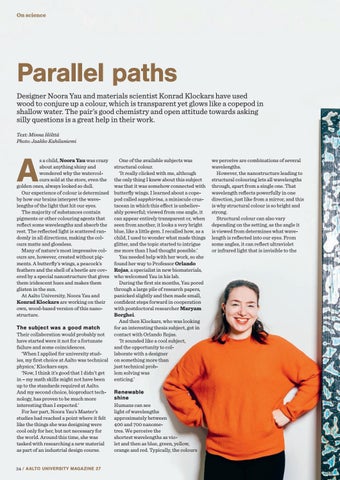
Parallel paths Designer Noora Yau and materials scientist Konrad Klockars have used wood to conjure up a colour, which is transparent yet glows like a copepod in shallow water. The pair’s good chemistry and open attitude towards asking silly questions is a great help in their work. Text: Minna Hölttä Photo: Jaakko Kahilaniemi
A
s a child, Noora Yau was crazy about anything shiny and wondered why the watercolours sold at the store, even the golden ones, always looked so dull. Our experience of colour is determined by how our brains interpret the wavelengths of the light that hit our eyes. The majority of substances contain pigments or other colouring agents that reflect some wavelengths and absorb the rest. The reflected light is scattered randomly in all directions, making the colours matte and glossless. Many of nature’s most impressive colours are, however, created without pigments. A butterfly’s wings, a peacock’s feathers and the shell of a beetle are covered by a special nanostructure that gives them iridescent hues and makes them glisten in the sun. At Aalto University, Noora Yau and Konrad Klockars are working on their own, wood-based version of this nanostructure.
The subject was a good match
Their collaboration would probably not have started were it not for a fortunate failure and some coincidences. ‘When I applied for university studies, my first choice at Aalto was technical physics,’ Klockars says. ‘Now, I think it’s good that I didn’t get in – my math skills might not have been up to the standards required at Aalto. And my second choice, bioproduct technology, has proven to be much more interesting than I expected.’ For her part, Noora Yau’s Master’s studies had reached a point where it felt like the things she was designing were cool only for her, but not necessary for the world. Around this time, she was tasked with researching a new material as part of an industrial design course. 34 / AALTO UNIVERSITY MAGAZINE 27
One of the available subjects was structural colour. ‘It really clicked with me, although the only thing I knew about this subject was that it was somehow connected with butterfly wings. I learned about a copepod called sapphirina, a miniscule crustacean in which this effect is unbelievably powerful; viewed from one angle, it can appear entirely transparent or, when seen from another, it looks a very bright blue, like a little gem. I recalled how, as a child, I used to wonder what made things glitter, and the topic started to intrigue me more than I had thought possible.’ Yau needed help with her work, so she found her way to Professor Orlando Rojas, a specialist in new biomaterials, who welcomed Yau in his lab. During the first six months, Yau pored through a large pile of research papers, panicked slightly and then made small, confident steps forward in cooperation with postdoctoral researcher Maryam Borghei. And then Klockars, who was looking for an interesting thesis subject, got in contact with Orlando Rojas. ‘It sounded like a cool subject, and the opportunity to collaborate with a designer on something more than just technical problem solving was enticing.’
Renewable shine Humans can see light of wavelengths approximately between 400 and 700 nanometres. We perceive the shortest wavelengths as violet and then as blue, green, yellow, orange and red. Typically, the colours
we perceive are combinations of several wavelengths. However, the nanostructure leading to structural colouring lets all wavelengths through, apart from a single one. That wavelength reflects powerfully in one direction, just like from a mirror, and this is why structural colour is so bright and strong. Structural colour can also vary depending on the setting, as the angle it is viewed from determines what wavelength is reflected into our eyes. From some angles, it can reflect ultraviolet or infrared light that is invisible to the
human eye, making the surface completely transparent – in other words, the colour appears to disappear completely. Humans have known how to create structural colours since the 1950s. But these glittery colourings and holograms are often made with plastics and metals, many of which contain lead or other toxic substances. Yau and Klockars make structural colour out of nanocellulose, which is created by splitting the cellulose contained in wood into nanoscale lengths. One nanometre is equal to one millionth of a millimetre. Nanocellulose is non-toxic, environment-friendly and renewable. It is used in, for example, medical applications and
composite materials. It can also form a nanostructure that yields structural colour – if you know how to process it. The colouring experiments of Yau and Klockars have extended into coating metal, plastic, wood and fabric. Their work has drawn appreciation at the Slush event in Helsinki and at the Dutch Design Week in Eindhoven, where professional interior design magazine FRAME highlighted it as one of the most interesting biomaterial innovations. Yau says combining design with materials research is gaining appreciation, but the duo are doing it in an exceptional manner. ‘Often, a materials scientist will do his or her work, and then pass it on for the designer to perform their share. Both of us of course have our own strengths, but we’re constantly working closely together to develop this thing. Instead of running a relay race, we’re progressing side-by-side on parallel paths.’ Both praise their good personal chemistry, which enables them to bounce ideas off one another naturally and provides the confidence to ask even dumb questions as many times as is needed.
Humble luxury
Following a couple of years of materials experimentation, Yau and Klockars decided to concentrate on wood. It felt right, as their goal was the creation of a real good-guy material, something that is as ecological as possible. ‘We also noticed that structural colour looked super cool on wood,’ Klockars says. Wood is a valuable and even luxurious material, but in a humble, measured and downto-earth way. How does wood,
and people’s attitude to it, change when its surface is coated with colour and shine? An amused Noora Yau notes that many share her love for glitter, although they may hesitate to admit it. ‘The presence of wood immediately makes the glitter different. Several manly men have admitted they admire the colour because it has been made for wood from wood.’ This year, Yau and Klockars have been busy with, among other things, a large wooden wall panel. The aim is to use it to showcase how the different features of their colour can be utilized in design. The piece was included in Helsinki Design Week’s exhibition Designs for a Cooler Planet, which showcases projects associated with the United Nations Sustainable Development Goals. In the future, the duo would like to see glowing, renewable and carbon-storing wood used in, for example, furniture and public buildings that aim for “wow” architecture. ‘Maybe the team of the new design and architecture museum could contact us,’ Noora Yau wonders. ‘It would be great if Finnish research could identify new ways to use wood. At the same time, I hope that the design world gains a better understanding of the significance of cross-disciplinary collaboration, and that this would lead to it being taught more than is presently the case. We can achieve so much more when we don’t have to master every single thing ourselves.’ •
Watch the video Structural Colour Studio– Shimmering Wood
Doctoral students Noora Yau and Konrad Klockars started collaborating in 2017. They named their project the Structural Colour Studio. Strong and vivid colour can be created naturally, without any pigments or dyes. The wood in the sample is turned black by a traditional Japanese scorching technique (shou sugi ban). The coating shows its brightest and most intense colours on top of dark surfaces, because of certain optical effects. AALTO UNIVERSITY MAGAZINE 27 \ 35
Partnership
Two suitcases and one man Life is a game and this – working and studying – is my way of playing it, Kalevi Hyyrynen used to say. The Aalto alumnus, who remembered his alma mater generously in his will, was keen on learning new things throughout his life. Text: Riikka Hopiavaara Photos: Kalevi Hyyrynen’s private collection
Kalevi Hyyrynen also completed a Master’s degree in Worcester, Massachusetts. This picture was taken at his US home in 1976, and on the wall is a Finnish ryijy picture tapestry. Mother Hyyrynen had one made for each of her sons.
T
he phone call from the United States came in the summer of 1970. His would-be employer was wondering why Kalevi Hyyrynen wasn’t at work. He discovered that the necessary work permit had been forgotten on the desk of the authorities for quite some time, leaving Hyyrynen just one week to sell his car, radio and other possessions before taking off. Hyyrynen packed two suitcases and went out into the world. There was no money for a taxi, so Hyyrynen himself schlepped his luggage through New York to the bus terminal. Little did he know that, later in life, he’d be packing suitcases full of silver coins to bring back.
Interested in technology and electricity Kalevi Hyyrynen was the second-oldest son of a family with four children. As a child, he skied, played soccer and built things. His hands we’re always working on some project. A soapbox turned into a functioning radio and building waste into a hut. Hyyrynen also built a crystal set, i.e. a simple radio receiver. In 1962, Hyyrynen received a muchexpected letter at home in the small South Karelian village of Taavetti. Applying for a place at the Helsinki University of Technology had been a natural choice for a young man with his interests. Despite every effort, he could not land a permanent job after graduating. One rejection letter after another popped in the mailbox, always citing lack of expe36 / AALTO UNIVERSITY MAGAZINE 27
‘Kal’ Hyyrynen (on the right) played ice hockey with his workmates, usually settling into a defender role.
rience as the reason. As a student, he’d gotten to know Finns who had moved to the United States. What if I go there for a while and build up some professional experience, he thought. His original idea had been to stay at the nuclear plant for a few years at most, but as time passed, Hyyrynen forgot about returning to Finland. The house he bought in the state of Massachusetts became his home for the rest of his life.
Soccer and ice hockey
He settled into life in his new homeland. His job made him responsible for the electrical planning design of alteration works carried out at power plants belonging to the Yankee Atomic Electric Company. He also completed a Master’s in electrical engineering at the local Worcester Polytechnic Institute alongside his professional duties. Hyyrynen, known to his American
Luumäen Lehti/Juhani Partanen.
In summer time Kalevi Hyyrynen visited Finland.
friends as Kal, is remembered as a friendly, hard-working and diligent employee, who’d hop into his red Chevy Corvette and drive to the job site when required. Hyyrynen wanted to ensure that all the details of the design and installation were carried out to a T. That car was his pride and joy, and he’d use it to take his visiting nephews for a spin – but no one else was allowed to drive it. Although Hyyrynen wasn’t much of a talker, he was not reclusive by nature. Whenever a group would gather to play on a nearby soccer field, Hyyrynen would join in, even though he knew none of the other players. He also played tennis as well as ice hockey with his workmates, usually settling into a defender role.
Apartments and investing
Growing up in humble surroundings during wartime made Kalevi Hyyrynen very careful about spending money. He’d pick the herring tin with the lowest price per kilo and he never moved from the first house he bought for himself. Its furniture was mismatched, but a stuffed blue marlin hanging on the wall did reveal that the house’s occupant had once splurged on a fishing trip. In addition to his house, Hyyrynen bought other apartments, which he, a skilled handyman, maintained in excellent condition. He never advertised his possessions. His workmate recalls once visiting a friend who lived nearby, and to
his surprise seeing Kal there. Hyyrynen had come to clear the snow out of the yard in his role as landlord-caretaker. Hyyrynen is remembered for his wry sense of humour. Once, he had come over to his nephew’s to fix the lawnmower. As he was putting on his bargain-basement sneakers, he remarked that he was likely the only person ever to have gone to see the Vienna Philharmonic wearing trainers. Hyyrynen spoke English with such a strong Finnish accent that he could be hard to understand. In time, however, his English proficiency strengthened and he started to forget some Finnish words. He enjoyed spending time at the family cottage when holidaying back home, and would pass the time by tinkering and solving crossword puzzles. He’d frequently have to ask what some word was in Finnish.
Learning and coins
In his free time, Kalevi Hyyrynen liked to read and absorb fresh knowledge. He always wanted to know all the details before reaching a decision. Upon reaching retirement, he studied the workings of the stock market for a year before making his first investment. He became a savvy investor, who’d retire to his parent’s attic to pore over market data on his laptop when holidaying in Finland. Hyyrynen learned to read sheet music as an adult after he’d joined the local
church choir. This hobby came as quite a surprise to his family because, as a child, he had refused to sing a carol to Santa Claus even though receipt of his Christmas presents hinged on doing so. But he was a gifted investor, and his fortune grew. A few years back, Hyyrynen came to visit Finland. This time, his luggage contained a bit more than a packed lunch – he’d come with a suitcase full of silver coins, which Hyyrynen stashed in his brother’s house. In time, the brother died and the house had to be vacated, but Hyyrynen, whose health was by now deteriorating, couldn’t articulate where his coins were hidden. He was able to give enough clues to direct the family to the attic, where they discovered a large haul. Fortunately, they also decided to search the rest of the house, as the metal detector beeped again in the fireplace room. Concealed in the sofa fillings were more of their American uncle’s surprises. Hyyrynen valued education and learning. If I had sons, I’d send them to the university, he used to say. He did his best to teach his nephews mathematics and also brought them university brochures to read. His high regard for education, especially the teaching of technology, is evidenced by his decision to remember his former seat of learning Aalto University, the successor of the Helsinki University of Technology, in his will. • Kalevi Hyyrynen’s brother Esa Hyyrynen, nephew Kimmo Hyyrynen and former workmate Richard Turcotte were interviewed for this article.
The solutions of tomorrow are discovered today We are renewing Finnish society and developing solutions to global challenges with research-backed knowledge, radical creativity and entrepreneurial thinking. If you value our research and education, you can support them effectively by remembering Aalto University in your will. To find out more about bequeathing an inheritance to benefit science, art and design, economics and technology, please contact Nora Rahnasto, Aalto University donor relations, tel. +358 50 362 2243, nora.rahnasto@aalto.fi.
AALTO UNIVERSITY MAGAZINE 27 \ 37
Aalto 10 years OTANIEMI, OR OTNÄS in Swedish,
is a name that dates back at least to the 15th century. The Otaniemi Manor was located where today’s Undergraduate Centre now stands. The linden lanes of the manor remain a key part of the campus landscape. Slightly further away the Hagalund manor is still standing.
THE MAIN BUILDING of the Helsinki
University of Technology was completed in 1964. Text: Eeva Lehtinen Illustration: Noora Typpö
How a manor house developed into a campus
The Aalto University campus is in Otaniemi, in Espoo, where a vibrant district that supports innovation has taken shape. Mixing valuable history with a new type of planning is one of the goals of developing the campus.
ARCHITECT ALVAR AALTO produced the original plan for the Otaniemi campus area
and designed many of its buildings. The first to be built in the area was the Teekkarikylä student housing project, whose buildings date back to 1952, when they were used as part of the Olympic village in the Helsinki Summer Olympics that year.
38 / AALTO UNIVERSITY MAGAZINE 27
IN 2018 the campus
took on a new look when the Väre and the School of Business buildings as well as the A Bloc shopping centre were completed in its centre. New buildings honour the area’s architecture and nature values.
OTANIEMI IS undergoing constant development
and renewal. The vision, which extends to 2050, emphasises well-being and sustainable development. Important elements include community spirit and quality of life, greenness, and nature, as well as innovation and creativity.
MANY OF THE CAMPUS
buildings have been renovated and modernised. Dipoli is now the main building of our university as well as a venue for key events, the main building of the former technical university has transformed into the Undergraduate Centre, and the library building has become the Harald Herlin Learning Centre.
THE FIELD OF TECHNOLOGY, which was
dominant in Otaniemi, linked up with business and art when Aalto University was formed and started operations in 2010.
METRO SERVICE between
Helsinki and Espoo started in 2017 and a Metro station opened in the midst of the new buildings. Otaniemi is also along the Rail Jokeri light rail route, which will begin service in 2024.
THE ENTREPRENEURIAL SPIRIT has
a powerful presence on the campus, with important places including the Design Factory, Startup Sauna and the A Grid startup community. AALTO UNIVERSITY MAGAZINE 27 \ 39
Collaboration
Biomaterials are gelatinous and porous, but also have solid microstructures. The strength of polypropylene lies in its mechanical properties. 40 / AALTO UNIVERSITY MAGAZINE 27
Precision solutions for healthcare Biodesign Finland projects utilise biomaterials to repair tissue damage and support the recuperation of mental health patients with environmental design. Identifying needs correctly forms the point of departure for all this. Text: Tiina Aulanko-Jokirinne Photos: Kalle Kataila, Pihla Lemmetyinen, Anu Hakola, Vera Rantalainen
‘S
tarting from the first year of elementary school, we’re taught to solve assigned problems, instead of being encouraged to find a problem worth solving,’ says Professor Heikki Nieminen, who is in charge of Biodesign projects at Aalto University. The project sends teams of researchers and students to make on-site observations at a hospital for one month. The aim is to identify needs or problematic issues that could be addressed with medical technology. ‘The difference between an actual need and what we think is a real need can be slim. The central idea of Biodesign innovation is to develop a deep understanding of a need before even considering solution options,’ says Nieminen. More than one solution can be developed for each need. They can be scrutinised from the perspective of, for example, regulatory processes, business or patenting. The regulatory process for commercialising medical technology is expensive and can take years. Once a product is complete, you can no longer question the client’s need. If the definition of the need has failed at the very beginning, there will be no second chance. Eventually, a single Biodesign project aims at addressing one single need.
Raussi-Lehto turned out to be decisive in determining the team’s choice. ‘The pelvic floor’s support structure is multifaceted and contains several thin layers of muscle. A baby’s head can just about fit through the bones of the pelvis when it rotates just right, but childbirth almost always causes damage,’ says head chief specialist, Professor Tomi Mikkola. A common treatment is to attach a mesh made from polypropylene plastic
to the vaginal wall to replace damaged tissue. The United States Food and Drug Administration has reported on problems associated with polypropylene meshes as far back as the early 2000s. The mesh can become fragile and break, which can cause the patient pain or discomfort. The material can also shrink, crack and cause inflammations. Problems are associated especially
Supporting weak tissues
The 2019 Biodesign team spent its observation period at the Women’s Hospital’s different wards and identified a total of 400 problems or needs requiring a solution. An operation to repair pelvic tissue damaged in childbirth with the aid of a prolapse mesh that was observed by researchers Jani Kuula and Eija
Rubina Ajdary’s laboratory research was interrupted for three months because of corona last spring. There were also delays in materials deliveries, but her work with biomaterials now continues. AALTO UNIVERSITY MAGAZINE 27 \ 41
Collaboration
A design by Anu Hakola and Vera Rantalanen to liven up the rooftop terrace at Peijas Hospital is founded on natural elements and a recuperative environment. The mind is at rest in places with lots of greenery and food for the senses.
From identifying a need to successful innovation • The Biodesign concept was developed at Stanford University. • The aim is to improve patient wellbeing, treatment outcomes and diagnosis accuracy. • In Finland, the concept is being implemented by Aalto University, HUS Helsinki University Hospital, University of Helsinki and Metropolia University of Applied Sciences. • By 2020, the concept has been implemented by six teams who have identified a total of 1 400 health care needs or problems. • The first technological solutions are already being introduced into patient or home use. • Four projects have received commercialisation funding from Business Finland. In all, the projects have raised €3.6M of which €2.1M is from Business Finland. • Members of Biodesign teams have founded a total of six companies. Hapekas Medical, for example, specialises in heart surgery and Koite Health in home-administered dual-light therapy, Lumoral, that kills harmful oral bacteria. • In spring 2020, researchers started looking for solutions to the corona crisis. One project, EnviroSafe, received Corona Co-Creation funding from Business Finland. The project aims to develop an intelligent, virus-destroying disinfection method. The method could enable the safe disinfection of indoor premises even when people are present at the same time.
42 / AALTO UNIVERSITY MAGAZINE 27
year. The team had just started its work and only managed to spend a short time performing observations – a week at Peijas Hospital in Vantaa and another week at the psychiatric outpatient unit in Tikkurila – before corona interrupted their work. The team noticed the bleak rooftop terrace belonging to the psychosis unit’s closed ward at Peijas Hospital. This terrace might be the only place where patients get to be outdoors during their A safer material alternative Polypropylene could be replaced by treatment period, the length of which can vary from a day up to three months. biomaterials. They are gelatinous and Sometimes an outdoor environment porous, while still having solid microcan also make it easier to discuss difficult structures. They can also be pre-treated issues, but this opportunity has not been to suit the intended use. Although the mechanical properties utilised much. ‘We wanted to make the rooftop terof biomaterials are no match for polyprorace more comfortable and make it pospylene, researchers have confidence in sible for all the patients and nursing staff their possibilities. to use it,’ says Innovation Fellow Salla ‘Biomaterials have already been sucKeränen, who lead the terrace project. cessfully utilised for various biomedi‘Understanding what the patients and cal applications, so it’s likely that they’re also suitable for prolapse mesh use,’ says nurses wanted was the starting point of our study.’ researcher Rubina Ajdary, who works Because of corona, these needs were in the group of Professor Orlando Rojas. assessed electronically, in addition to The road to achieving a finished prodwhich the initial designs were also done uct is, however, long, and the corona remotely by landscape architecture spring slowed the progress of research. students Anu Hakola and Vera RantaIf the invention ends up becoming lainen. After seeing the rooftop terrace, a product, it can significantly improve they wanted to create a more stimulating women’s quality of life and health. Hunsetting that would make it more temptdreds of thousands of gynaecological prolapse operations are performed annu- ing to spend time outdoors. ally in the western world. Most often, Fingers in the dirt the patients have given birth multiple The designers made use of the finding times and are ageing. that plants are known to liven up the senses and inspire people to observe Aiming for a recuperative environment their surroundings. This can promote recuperation in stressful and traumatic The spring was exceptional also for the Biodesign project that was launched this situations. with prolapse meshes attached via the vagina and, accordingly, their use has decreased. It has even been banned in some countries. ‘Postoperative complications can be due to a combination of the surgeon’s methodology and issues caused by the material. A key goal is to develop a better product and treatment for the patient,’ Mikkola says.
Kekkilä-BVB is one the cooperation partners of the Peijas Hospital rooftop terrace. The company especially helped with selecting plants and decorative stones. Other partners include Lehtovuori, Tikkurila and SKS Mekaniikka, which made material donations.
your shoes off and feel the different materials, like stones,’ says Vera Rantalainen. Visual communication design student Milja Komulainen designed two murals for the rooftop terrace. Familiar nature topics, tranquillity and calmness formed the starting point for her designs. The survey had indicated that lake and forest landscapes pleased the eyes of nurses and patients alike. The patients in particular hoped that her paintings would incorporate natural elements like water.
Boosting communality
The idea for the shape of Milja Komulainen’s multipart mural stems from the Chinese scroll painting tradition, in which paintings are done on long paper sheets. ‘The painting has elements on different levels, enabling the viewer to, in a sense, travel inside the picture.’
‘We usually do a lot of designs on the computer, but this project was very practical. We got to draw by hand and had our fingers in the soil planting during the final phase. Building the wooden patio and a small masonry wall made the transition from design to realisation concrete,’ Anu Hakola says. Natural elements fade out the institutional look and may support recovery. ‘We want to provide patients with sensory experiences such as along the small path, where you can sit on a bench, take
The resulting rooftop terrace design was influenced by many boundary conditions along the way. These were associated with, among other things, fire safety and load-bearing strength requirements as well as the choice of plants and furniture. All water elements, for example, were discarded from the plan in the end. ‘The rooftop terrace of a psychosis ward would be a special location even without taking corona into account,’ says Head Nurse Tuomo Töhönen from Peijas Hospital. ‘The boundary conditions and safetyrelated factors made the designing of this special environment challenging. In the end, I’m left feeling positive about being able to come up with a solution for most of the elements to soften the place,’ says Hakola. The new, more comfortable terrace makes it possible to do things together. Some patients volunteered in the construction phase by carrying stones for the masonry work, screwing boards into the wooden deck and even by serenading the students with a guitar at the end of a long day of building. ‘The stage can host art, music and relaxation groups. And should the patients want to roast sausages, we can arrange a barbecue outing on the terrace, even in winter. Our department is large, and communality is important for us,’ Töhönen says.• AALTO UNIVERSITY MAGAZINE 27 \ 43
Now Edited by Riikka Hopiavaara
Greenhouse gas emissions larger than earlier estimated PERMAFROST IS permanently fro-
ganisms breathe, they emit greenhouse gases. Plant roots in soil stimulate microbial decomposition, a mechanism called the priming effect. A recent study shows that the priming effect alone can cause emission of 40 billion tonnes carbon from permafrost by 2100.
The study was published in Nature Geoscience in July 2020.
Ive van Krunkelsven
zen ground which is a huge store of the Earth’s carbon. It stores as much carbon as all the plants on Earth and the atmosphere combined. The surface of the permafrost thaws in summer, allowing plant and soil life to thrive. When microor-
Quantum-mechanical interaction between two time crystals AN INTERNATIONAL TEAM of researchers
have demonstrated that a new phase of matter which has, until recently, been mere speculation, obeys basic quantum mechanics laws. This offers a basis to investigate the fundamental properties of time crystals further and suggests  possible applications in quantum information processing.
The study was published in Nature Materials in August 2020.
44 / AALTO UNIVERSITY MAGAZINE 27
The brightenings observed in the polar areas on solar maps (on the left) could be identified as coronal holes. A satellite photo below.
The quiet Sun is active FOR A LONG TIME, researchers have
believed that there is not much of interest going on in the Sun during the passive period, therefore not worth studying. Now, researchers at Metsähovi Radio Observatory have shown this assumption to be false. The researchers came to this conclusion by examining the solar radio maps of Metsähovi Radio Observatory and comparing them with satellite data on the same objects. The solar maps showed active areas, or radio brightenings, which can be observed on the maps as hotter areas than the rest of the solar surface. According to researchers, there are three explanations for radio brightenings. The brightenings observed in
the polar areas on the solar maps could be identified as coronal holes. Secondly, the researchers observed brightenings from which, based on other observations, ejections of hot material from the surface of the sun could be detected. In addition, radio brightenings were found in areas where, based on satellite observations, strong magnetic fields were detected. Researchers also found radio brightenings in some areas where no explanatory factor was found on the basis of satellite observations. Researchers don’t know what causes those phenomena, and must continue the research. The article was published in Solar Physics in July 2020.
Extremely waterrepellent materials
Juha Juvonen
S. Autti et al, Nature Publishing Group
A COLLABORATION BETWEEN researchers in
China and Finland has developed an armourplated superhydrophobic surface which can take repeated battering from sharp and blunt objects, and still repel liquids with worldrecord effectiveness. A new armour-plated superhydrophobic material has been developed for potential uses in medical equipment, solar panels and more. The study was published in Nature in June 2020.
AALTO UNIVERSITY MAGAZINE 27 \ 45
Theses
District heating network as energy store and making fuel out of algae Optimising the temperature of the district heating grid’s feed water increases the network’s flexibility and enables the storing of renewable energy. Could algae fuel future transports? Text: Marjukka Puolakka Photos: Nita Vera THE ENERGY INDUSTRY is undergoing a major transition. There’s a desire to do away with fossil fuels while electricity grids are utilising more and more renewable energy produced with a variety of means like wind power. MSc (Tech) Mikko Kouhia’s doctoral thesis in the field of energy technology looked at energy solutions that are more sustainable than current options. With regard to existing systems, he analysed optimising the district heating grid. A survey of microalgal biorefineries was more future-oriented. ‘Energy storage and the evening out of temporary spikes in energy generation are major issues. Storing electricity in batteries is expensive. Nowadays, however, a single process can generate both electricity and heat. In such energy cogeneration facilities, the district heating grid can be utilised for storage without additional cost,’ Kouhia says. It is possible to improve the flexibility of the district heating network by optimising the temperature of its feed water. At the same time, this cuts district heating production costs by two percent. Flexibility also enables the integration of renewable energy produced through a variety of means, such as wind and geothermal power, into the district heating network. In Helsinki, for example, electricity and heat co-generation plants use coal as fuel. If the network is dynamic, production emissions can be reduced by simply implementing some adjustment measures. ‘The generation of both electricity and heat involves consumption spikes, which are currently met by burning fossil fuels, like gas and oil. The more flexible we make the system, the less fossil fuels will be needed.’
Transport fuel from algae
The search for new ways to generate energy is intense, and one heavilyresearched alternative is algae. Mikko Kouhia employed modelling to explore the technical realisation of biorefineries 46 / AALTO UNIVERSITY MAGAZINE 27
built adjacent to pulp and paper mills to utilise their effluent. A solution where waste sludge, ash and flue gas are utilised to produce fatty acids, fertilisers and methane proved to be technologically feasible. Algae is also being looked at for alternative transport fuel solutions. ‘Energy analysis indicates that a solution in which algal biomass is used to produce biodiesel, with the surplus gasified into methane or used as ethanols, rests on the most solid foundation. What’s needed, however, is clear price incentives to make the use of such bio fuels economically viable.’
Kouhia is not afraid to tackle the energy sector’s major challenges. ‘It is important to whip society’s basic infrastructure into shape. I decided already at the start of my studies that I don’t want to spend my whole professional career drawing conduits. I’d rather put my neck out, influence things and be a part of the development of new and sustainable energy solutions.’ Mikko Kouhia 29.6.2020: Solutions for sustainable energy systems: analyses of district heat optimization and microalgal biorefineries.
ALL DOCTORAL THESES ONLINE: aaltodoc.aalto.fi; shop.aalto.fi
Climate policy in need of a radical redirection CURRENT MARKET-DRIVEN climate policy
should be discarded as soon as possible to avert a climate catastrophe. This is the conclusion arrived at in the doctoral thesis of Lotta Aho, LL.M., MSc (Econ). Her study in the field of international business analysed the emissions and
financial data of the world’s biggest oil and electricity companies over a period of several years. The energy industry’s emissions did not reduce in the reviewed period. The EU’s emissions trading regime did not cut emissions either. These findings challenge the idea that
the markets can handle the reducing of emissions in the most efficient way. A wide chasm separates emissions trading theory and reality. The political influence of major corporations in emissions trading leads to a situation where the system protects these companies’ economic interests instead of reducing emissions. Emissions trading may even be a harmful mechanism – it doesn’t reduce emissions, but its prevalent standing has effectively prevented other measures, which cut emissions radically, from gaining a foothold in climate policy. The reasons for this can be traced to the dominant neoliberal ideology, which prioritises the free market, corporate profits and economic efficiency instead of curbing climate change. Aho calls for a climate policy that, instead of prioritising constant economic growth and maintenance of the status quo, aims to radically cut emissions. Economic growth is meaningless if humanity loses its only liveable planet because of it. Lotta Aho 17.6.2020: Whose game, whose rules: Neoliberal hegemony and corporate power in climate change governance.
The new life of textile waste THE DOCTORAL THESIS of Simone
Haslinger, MSc, tackles the global problem of textile waste. The production of textiles continues to increase, yet only 13% of textile waste is recycled and less than 1% is currently converted into new textiles. Implementing a circular economy within the textile industry is complex, as one textile product can involve many different materials and chemicals. Haslinger developed a reliable NMRbased method to identify and quantify cotton and polyester in textile waste. Furthermore, the Ioncell technology was used to chemically separate cotton and polyester, with the cellulose fraction spun into new textile-grade fibers. The Ioncell process allows versatile opportunities for waste reduction as it tolerates different raw materials and impurities, such as synthetic fibers and colorants.
Haslinger indicated that dyed textile waste can be re-spun into new colored cellulose fibers without applying extensive and non-sustainable pretreatment. It was also shown that gold and silver nanoparticles can be used to introduce additional functionality, such as UV resistance and color, into textile fibers. No other toxic dyes or other chemicals are therefore needed for this. Using waste material to produce cellulose fiber may reduce consumption of cotton in the textile industry. The findings can help reduce water consumption, toxic chemicals and energy use in textile production. Simone Haslinger 5.6.2020: Towards a closed loop economy in textile industry: Separation, dyeing and re-spinning of cellulose rich textile waste. AALTO UNIVERSITY MAGAZINE 27 \ 47
Everyday choices
Nitin Sawhney, how do we cooperate in times of crisis? Professor of Practice examines the role of technology and cooperation in crisis using transdisciplinary human-centered design practices. Text: Paula Haikarainen Photo: Veera Konsti Your field of research is HumanComputer Interaction (HCI). What is most fascinating about it? I tend to think of Human-Computer Interaction in parallel with Human-Centred Design. These increasingly affect almost every facet of our lives – and of society. Human-centred design practices are embedded in most of the everyday digital appliances and services we use today. Various health and wellness applications, devices and services, like smart watches or the Koronavilkku application, released by the Finnish institute for health and welfare, are all developed using thoughtful HCI and human-centred design research. It’s inescapable that we need to make new technologies and services more evocative, engaging and better suited to our lives. The field is highly trans-disciplinary and continues to evolve: it has sociologists, anthropologists, cognitive psychologists, product designers, computational data-scientists, and AI researchers among others. This is what excites me most: collaborating with people from so many different domains, who deeply care about understanding and enhancing human experience. You cooperate with artists, activists and social scientists. Which aspects of their thinking would you like to introduce to the field of technology? Working with artists and activists is rather liberating, because it changes how we critically engage with society outside the academic ivory tower. Artists can take a visceral or emotional approach to something, but they challenge our logical assumptions while channelling their sensibilities to create very unexpected outcomes. I always tell my students that if we don’t find something unexpected then what are we really trying to do in our research? Science should always be examining the uncertainties in our lives, and that is something artists are confronting all the time. 48 / AALTO UNIVERSITY MAGAZINE 27
The role of activists is also very crucial. When there is so much injustice in the world, activists take many risks to expose these fractures in society, offering an important reality check for scientists, helping us recognise that we cannot take a neutral position. I’ve come to believe that creating technology and engaging in design is always political.
ricanes to social and economic protests; what’s extraordinary is how people who hardly know each other would quickly self-organise to take action in neighbourhoods. When there was no power in parts of the city due to flooding, grassroots communities were the first to provide relief on the ground, well before the city could effectively deploy emergency resources. Starting from your childhood, crises So, in addition to technological tools have often had an impact on your life. and infrastructures we need to nurture You have, for example, had to emisuch resilient human systems to emerge grate because of social upheavals. and thrive. Has this taught you to be prepared for surprises? When I was a child, we This summer, you organised moved from New Delhi to Tehran, and the highly topical course Humanof course, a revolution spurred in Iran Centred Research and Design in in the seventies, so we had to uproot Crisis. How did it succeed? It was ourselves and relocate again. While livoffered as an online course with a transing in the Middle East, I started to realise disciplinary approach; we invited disasthat crises are just a fact of life. There are ter management experts from the Finnmany moments that we simply find ways ish Red Cross as well as design researchto confront and build a kind of resilience, ers and data scientists. We also had gradbut we also have to recognise that we can uate students from computer science, learn something from every crisis. arts and design, and all of them were A crisis often brings out the best in engaged in thinking about the ways we humanity and helps reimagine how it can find intersections across fields in can transform us. It offers an opportudealing with crises. Just having them in nity to recalibrate society; an opportuconversation with each other, reflectnity to devise more inclusive and integra- ing on how to make sense of recent crises tive solutions, rather than just addresslike the pandemic, wildfires and social ing only one aspect. For example, during protests from very different perspectives, this global pandemic we’ve begun to pay was extraordinary. attention to the health and economic We discussed the wider ecology of disparities around the world, and our actors and stakeholders, as well as relationship to wildlife, ecology and the values, ethics and power structures the climate; all of these unfolding crises embedded in technology and design. This are inter-related. kind of political and social criticality was embraced by the students. All of the Do you have a personal toolkit for course content is available to the public crisis management? What does it (hcrdcrisis2020.wordpress.com), and we include? It varies from place to place hope others are inspired to draw on this and each context needs adapting. In any work. • crisis situation a lot of the work is in the planning and preparation. But generally, when you are in the middle of a crisis, you have to rely on good cooperation with others. Read the longer version of While living in New York City, I witnessed many crises from storms and hurthe article
Wow!
The future of boating is here The Skand electric boat is powered by solar cells and glides soundlessly through the waves.
Text: Krista Kinnunen Illustrations: Jean Munck & Laura Hietala THE INTERIOR DECORATION and roof structure of electric vehicle manufacturer Skand’s first electric-powered boat is the work of design students Laura Hietala and Jean Munck. Aalto University and Skand launched this cooperation project last spring. ‘The task was challenging, interesting and very extensive. It required us to delve deeply into the world of boating and technical boat inspection regulations. We also performed an analysis based on a user survey that we then exploited in the design,’ the young designers say. They designed a modular interior and a solar panel-equipped roof structure for the boat. Thanks to the modular design, the boat suits many different user types. The boat is designed with shared use in mind, so that as many people as possible could, in the future, enjoy marine activities without having to buy their own boat. The electric-powered boat is easy to use for short excursions to, for example, the archipelago. ‘A classical aesthetic, in which style and pleasure play the main role, formed
50 / AALTO UNIVERSITY MAGAZINE 25
the keystone of our design. As the boat’s speed is no more than 6-7 knots, we wanted its appearance to convey tranquillity, high quality, reliability and relaxation.’
Design combines accessibility and versatility The solution is based on movable furniture that also doubles as storage space: all required necessities can be stored in the boat’s modular cases. The interior can be reconfigured in line with a number of furniture fastening points on the floor. The modular interior also promotes accessibility. Once the boating season ends, the furniture is easy to remove, making it simpler to store the boat over the winter. The furniture can be manufactured cost-effectively, as expensive fibreglass moulds are not needed. The boat’s roof structure is light and easy to detach. It is fitted with integrated folding solar panels that supply electricity for navigation and the boat’s numerous USB ports. Two miniature models of the boat have
The electric boat lowers the threshold to start boating while simultaneously conserving nature and materials. Students designed the interior decoration and roof structure. Well-known boat designer Sven Ståhle is responsible for the boat's overall design.
been made, one of which was displayed at the Helsinki Design Week exhibition Designs for a Cooler Planet last September in Otaniemi. •
Get more than a degree at Aalto University. An: ‘I especially like that I get to know and make friends with students from completely different majors that my own, like students from Chemistry or Business, for example.’
Antonia: ‘During my studies I have taken part in an interesting project course, the Electrical Engineering Workshop, where a prototype of electronic components was built in a group, bringing theory to practice.’
Veeti: ‘In my first exercise sessions, I watched how the assistant helped other students, and realised that was something I also wanted to do. I have been fortunate enough to have the opportunity to work as a course assistant.’
APPLICATION PERIODS Master’s programmes 1.12.2020–4.1.2021 Bachelor’s programmes (English) 7.–20.1.2021 Bachelor’s programmes (Finnish and Swedish) 17.–31.3.2021
THIS ISSUE IS ABOUT • weak signals • naturally glowing colours • biomaterials for health care
aalto.fi