




COMMON SENSE VOICE OF THE AMERICAN ACADEMY OF EMERGENCY MEDICINE VOLUME 30, ISSUE 1 JANUARY/FEBRUARY 2023 President's Message: Joy Social Media Committee –Your Voice Matters: Ten Ways to Battle Online Trolls Page 17 3 7 Editor's Message: The Greatest Act of Forgiveness Which I Have Ever Witnessed 12 Heart of a Doctor: Quality of Life 30 AAEM/RSA President’s Message: Join Us at HPEM! 29 Young Physicians Section: ED Crowding And Boarding: A Public Health Crisis
Officers President
Jonathan S. Jones, MD FAAEM
President-Elect
Robert Frolichstein, MD FAAEM
Secretary-Treasurer
L.E. Gomez, MD MBA FAAEM
Immediate Past President
Lisa A. Moreno, MD MS MSCR FAAEM FIFEM
Past Presidents Council Representative
William T. Durkin, Jr., MD MBA MAAEM FAAEM
Board of Directors
Kimberly M. Brown, MD MPH FAAEM
Phillip A. Dixon, MD MBA MPH FAAEM CHCQMPHYADV
Al O. Giwa, LLB MD MBA MBE FAAEM
Robert P. Lam, MD FAAEM
Bruce Lo, MD MBA RDMS FAAEM
Vicki Norton, MD FAAEM
Kraftin Schreyer, MD MBA FAAEM
YPS Director
Fred E. Kency, Jr., MD FAAEM
AAEM/RSA President
Leah Colucci, MD MS
Editor, JEM
Ex-Officio Board Member
Stephen R. Hayden, MD FAAEM
Editor, Common Sense
Ex-Officio Board Member
Andy Mayer, MD FAAEM
Executive Director
Missy Zagroba, CAE
Executive Director Emeritus
Kay Whalen, MBA CAE
AAEM/RSA Executive Director
Madeleine Hanan, MSM
Common Sense Editors
Mehruba Anwar Parris, MD, Assistant Editor
Alessandra Della Porta, MD, Resident Editor
Stephanie Burmeister, MLIS, Managing Editor
Articles appearing in Common Sense are intended for the individual use of AAEM members. Opinions expressed are those of the authors and do not necessarily represent the official views of AAEM or AAEM/RSA. Articles may not be duplicated or distributed without the explicit permission of AAEM. Permission is granted in some instances in the interest of public education. Requests for reprints should be directed to AAEM, 555 East Wells Street, Suite 1100, Milwaukee, WI 53202, Tel: (800) 884-2236, Fax: (414) 276-3349, Email: info@aaem.org
AAEM is a non-profit, professional organization. Our mailing list is private.
Table of Contents
COMMONSENSE
Mission Statement
The American Academy of Emergency Medicine (AAEM) is the specialty society of emergency medicine. AAEM is a democratic organization committed to the following principles:
1. Every individual, regardless of race, ethnicity, sexual identity or orientation, religion, age, socioeconomic or immigration status, physical or mental disability must have unencumbered access to quality emergency care.
2. The practice of emergency medicine is best conducted by a physician who is board certified or eligible by either the American Board of Emergency Medicine (ABEM) or the American Osteopathic Board of Emergency Medicine (AOBEM).
3. The Academy is committed to the personal and professional well-being of every emergency physician which must include fair and equitable practice environments and due process.
4. The Academy supports residency programs and graduate medical education free of harassment or discrimination, which are essential to the continued enrichment of emergency medicine, and to ensure a high quality of care for the patient.
5. The Academy is committed to providing affordable high quality continuing medical education in emergency medicine for its members.
6. The Academy supports the establishment and recognition of emergency medicine internationally as an independent specialty and is committed to its role in the advancement of emergency medicine worldwide.
Membership Information
Fellow and Full Voting Member (FAAEM): $525* (Must be ABEM or AOBEM certified, or have recertified for 25 years or more in EM or Pediatric EM)
Associate: $150 (Limited to graduates of an ACGME or AOA approved emergency medicine program within their first year out of residency) or $250 (Limited to graduates of an ACGME or AOA approved emergency medicine program more than one year out of residency)
Fellow-in-Training Member: $75 (Must be graduates of an ACGME or AOA approved emergency medicine program and be enrolled in a fellowship)
Emeritus Member: $250 (Please visit www.aaem.org for special eligibility criteria)
International Member: $150 (Non-voting status)
Resident Member: $60 (voting in AAEM/RSA elections only)
Transitional Member: $60 (voting in AAEM/RSA elections only)
International Resident Member: $30 (voting in AAEM/RSA elections only)
Student Member: $40 (voting in AAEM/RSA elections only)
International Student Member: $30 (voting in AAEM/RSA elections only)
Pay dues online at www.aaem.org or send check or money order to: AAEM, 555 East Wells Street, Suite 1100, Milwaukee, WI 53202 Tel: (800) 884-2236, Fax: (414) 276-3349, Email: info@aaem.org
AAEM-0123-087
TM Regular Features President’s Message: Joy 3 Editor’s Message: The Greatest Act of Forgiveness Which I Have Ever Witnessed 7 Heart of a Doctor: Quality of Life 12 Young Physicians Section: ED Crowding And Boarding: A Public Health Crisis 29 AAEM/RSA President’s Message: Join Us at HPEM! 30 AAEM/RSA Editor’s Message: New Meaning for Old Questions: The Economic Impact of the Social History 31 Medical Student Council Chair’s Message: Social EM: Where Humanity Meets Medicine 33 Foundation Contributions 9 PAC Contributions 10 LEAD-EM Contributions ........................................................................................................................... 11 Upcoming Conferences 11 Board of Directors Meeting Summary: November 51 AAEM Job Bank 52 Featured Articles Academic Affairs Committee: Cotillion Lessons for EM Residents 14 Palliative Care Committee: End of Life in the Emergency Department 15 Social Media Committee: Your Voice Matters: 10 Ways to Battle Online Trolls 17 Rural Medicine Interest Group: In the Patient’s Best Interest 19 Medical Error in the Emergency Department: A Commentary on the AHRQ Report ............................. 21 Legal Committee: Understanding Your Professional Liability Policy 23 Women in Emergency Medicine Section: To Typify an Ally: Ways to be a Male Advocate for Women 24 Social EM & Population Health Committee: The Climate Crisis and Forced Displacement: Health Implications and Recommendations for Emergency Medicine Physicians 25 A Commitment to Equity is Part of the American Academy of Emergency Medicine Legacy ........... 27 Political Action Committee: 2022 Political Action Committee Report 28 Emergency Ultrasound Section: Is POCUS a Procedure or an Extension of the Physical Exam? Experts Debate 34 Operations Management Committee: Radiology Intervention: Improving Throughput For Imaging Studies in the Emergency Department 36 Critical Care Medicine Section: Post Intubate Awareness While Paralyzed and How to Avoid It ............. 38 New Medical-Legal Fellowship Launched 39 Justice, Equity, Diversity, and Inclusion Section: Leading from the Front on Justice, Equity, Inclusion, and Diversity 40 “Scope of Practice” Information to Know and Use from the American Medical Association Interim Meeting of November 11-15, 2022 41 FTC Proposes Rule to Ban Noncompete Clauses .................................................................................. 43 Oral Board Review Course: Mitchell Goldman Service Award Recipients 44 Wellness Committee: Let the Good Times Roll: Wellness at Scientific Assembly in New Orleans 45 Aging Well IG: Newest Interest Group: Aging Well in Emergency Medicine! 47 Simulation IG: Meet the Simulation Interest Group Co-Chairs 49 COMMON SENSE JANUARY/FEBRUARY 2023 2
Jonathan S. Jones, MD FAAEM

Happy New Year!
As I started writing this column the holiday season was in full swing. While I love the season, activities, fun, food, parties, and family time, it can also be a bit stressful. I am sure many of you feel the same way. That stress immediately melts away when I listened to my daughter discuss her theories on how Santa Claus can actually visit each
wonderful cards and specifically about joy. Life should be joyful. Maybe not all the time, but why not most of the time? However, right at that moment, driving to an ED shift the evening of December 25, I thought to myself that most aspects of my professional life were not joyful. Emergency medicine did not bring me joy. Learning new and interesting discoveries did not bring me joy. Interacting with colleagues
explain how I felt. It was not the simple fact that it was a holiday.
Well, I arrived at work, walked in, and saw that, surprisingly, it was not bursting at the seams. While I don’t exactly want it to be slow, this was a nice surprise. I also realized that I had left some food in my car. As I’m sure our ED is not unique, the staff had decided to bring food for tonight and I had brought some charcuterie (yes, people made fun of me too; but at the end of the night, there were plenty of left-over cookies, but no charcuterie). Walking back to my car to get it, I realized I was smiling a bit thinking how nice it was that even in an emergency department, we can do some nice things for each other.
I delivered my food to the lounge, grabbed a slice of the Barolo aged salami, some blue cheese, a couple of crackers, and some pomegranate-jalapeño jam to take back to my desk. OK, maybe I didn’t hate every aspect of my professional life.
house and why he only takes one bite of the cookie we left. Watching her school Christmas play and seeing her on Christmas morning made all the stress worth it. Why? Because these experiences brought me joy.
Whether you celebrate Christmas, another event, or no event at all, I hope that something this past month or two brought you joy.
In reviewing the cards that we received this season, there is certainly a trend. Words such as Happy, Joy, Merry, Love, Peace, Celebrate, Good Tidings, and so on appear on nearly every card. And while days, weeks, and years are difficult, and life is full of challenges, it is nice to know that so many people wish us well. And while I was able to spend Christmas morning with my family, like many of you, I did work the holiday. As I drove to work for my 7:00pm shift, I am not sure why (maybe I was subconsciously psyching myself up for a busy holiday night shift), but I thought more about all those
did not bring me joy. Even my involvement with AAEM did not bring me joy. (Spoiler alert in case you don’t feel like reading to the end: These things actually do make me happy; I was being a bit hard on myself, but all the aspects of my professional life could bring more joy.)
There are many words to describe how I felt. Burned out, depressed, dejected, angry, morally injured, quiet quitter, or perhaps just joyless. How did I go from having a wonderful day, enjoying my family and thinking about all the well wishes I had received, to thinking that my professional life was miserable? Was it simply that I had to work a holiday or was there something more?
Numerous academicians and researchers have examined causes of physician burn out and depression. While work-life balance is frequently mentioned, the act of working nights, weekends, and holidays rarely comes up. So, clearly, there had to be something more to
The first patient I saw had a complaint of “palpitations.” I looked at her EKG prior to entering the room and noted normal sinus with no PVCs, normal QT, and it really was just textbook normal. I checker her rhythm on the monitor which was also completely normal. As we know, dysrhythmias can be transient so I entered the room still highly concerned. The first thing she said was, “Doctor, I feel completely fine now.” Well, that’s good, I thought. Perhaps as she felt fine or maybe she just always liked to talk but she preceded to describe her events in detail. While at times, this can cause a bit of stress as I know there are other patients waiting to be seen, I knew I had a bit of time right now, so I listened. I interjected from time to time to clarify, and I soon realized that I was quite enjoying the conversation. I learned that she had both a history of paroxysmal atrial fibrillation and SVT. She had been feeling fine for most of the day, but then she felt palpitations as well as mild dyspnea and dizziness. She checked her pulse at home and reported that it was 180.

Joy
>> AAEM PRESIDENT’S MESSAGE
COMMON SENSE JANUARY/FEBRUARY 2023 3
How did I go from having a wonderful day, enjoying my family and thinking about all the well wishes I had received, to thinking that my professional life was miserable?
Finally, her description of events produced, “So doctor, I know this doesn’t make any sense, but my husband was driving me here and he was going a bit fast and hit a fairly big pothole and I bounced up in my seat. It’s crazy, but as soon as I did that, I felt better.”
This made me smile again as I explained that this actually could make some physiologic sense. I must admit that I quite enjoyed discussing the theory of pothole dysthymia conversion with her and her husband.
The shift proceeded fairly well from that point. Yes, the volume picked up, but it was never unbearable. I helped some patients. I laughed with a consultant as he told a patient that since the patient was getting admitted, I was no longer his doctor, and when asked for clarification, the consultant stated, “Dr. Jones left to go work on his next movie, you know, Dr. Jones, Dr. Jones.” (The patient mostly just gave a blank stare.) I enjoyed more snacks and also enjoyed watching two nurses argue about whether charcuterie was too fancy or if it didn’t really matter that it was fancy since it tasted good.
As I drove home, my thoughts returned to the same thoughts I had driving into my shift. How could I think that nothing in my professional life brought me joy? I love interacting with patients. They literally trust us with their lives. We shoulder immense responsibility, and truly, I wouldn’t want any job with less. It is a challenge to live up to this responsibility but it is an invigorating and honorable challenge.
And how amazing is the human body and human physiology? I have no idea if hitting the pothole converted my patient, but it seems like a good theory to me. I actually had time later that shift to research this a little and there are several EMS case reports of “pothole conversion.” Science is constantly making new discoveries and it is fascinating to work in a field
which still has so many unknowns. I would be bored out of my mind if every single question I had or problem I encountered had one specific and perfect answer.
And my colleagues are great. As much as I love my fellow EM physicians, we do not save and improve lives alone. Nearly every person with which we interact has deliberately chosen a difficult and at times thankless and even dangerous career. This includes other specialists, nurses, technicians, paramedics, and especially environmental services. It is a pleasure to work with dedicated people. Yes, some aren’t ideal, and some are grumpy (some days this describes me), but each one has decided that they want to make someone’s, some patient’s, life better. The vast majority of professionals in this world do not work with people such as we do.
So why had I felt so joyless several hours earlier? Simple, it’s because I really do enjoy my job, but evil people are trying to ruin that. And while this makes me sad, burned out, and maybe even depressed, in a weird way it also energizes me. Stealing a line, “I’m as mad as hell and I’m not going to take this anymore.” And it’s not just me. The entire American Academy of Emergency Medicine is as mad as hell. And we’re not taking it anymore. And we’re finally winning.
Envision’s motions to dismiss our suit failed miserably. We have started the discovery phase and will finally gain access to internal information about their true practices.
Other CMGs are struggling with debt and facing lawsuits for withholding payments to physicians and for putting profits over patients by forcing doctors to work while sick with COVID.

In just the last year, news about our lawsuit as well as other suits against CMGs were mainly only found in hospital specific newsletters or not covered at all. Now outlets from Becker’s Hospital Review, to NBC News, to NPR are covering these issues. Many AAEM members are leading the charge to educate the public. And it is working.
The Federal Trade Commission held a listening session several months back specifically to discuss the role of private equity in health care. Several AAEM members contributed. And while the federal government is notoriously slow and secretive, it is now obvious that they did indeed listen at this session. On January 5, the FTC issued a proposed rule to ban non-compete clauses in all contracts. This would apply to physician contracts. The Academy has been fighting non-compete clauses for decades and we may have finally won. >>
AAEM PRESIDENT’S MESSAGE
COMMON SENSE JANUARY/FEBRUARY 2023 4
Life is wonderful and we are blessed to live a good one and help others do the same. I can ease pain and cure afflictions. And when I can’t, then I can comfort and console.
So, while not every interaction I have with the Academy brings me joy, working hard to accomplish great things for our profession sure does.
When I finally got home the morning of December 26, while I hadn’t actually been visited by any ghosts, I did certainly think about old Ebeneezer. Life is wonderful and we are blessed to live a good one and help others do the same. I can ease pain and cure afflictions. And when I can’t, then I can comfort and console. I work with others who strive to do the same. And I get paid to do all of this. And my free time…I spend it with the most passionate and energetic emergency physicians in the world. Sure, we work, we stress, and we argue. But we also affect change and that sure brings joy.
May this new year bring you joy. And while I hope that you get joy from your family and friends, I also hope you obtain it from your patients, your colleagues, and your profession. Maybe AAEM even needs a new vision statement: To ensure that every emergency physician can find joy in their career. (OK, maybe not, but why not?)
As you read this, the holiday season will be behind us, but as I write it, I must end with the simplest sentence Dickens ever wrote: God bless us everyone!
Membership Categories
Fellow and Full Voting – FAAEM
Dues: $525 Board certified in emergency medicine or pediatric emergency medicine
Associate
Dues: $250 Graduate of an ACGME or AOA approved emergency medicine training program and not yet taken or passed your EM board Fellow-in-Training
Dues: $75 Graduate of an ACGME or AOA approved emergency medicine training program and currently enrolled in a fellowship
International Member
Dues: $150 Physicians with an interest in emergency medicine who practice outside of the United States or Canada

Emeritus Member
Member Benefits
Publications
Free subscriptions to the Journal of Emergency Medicine and Common Sense
Education
Free registration to the Annual Scientific Assembly with refundable deposit and discounted registration for other AAEM events
Members-Only Section
Access the AAEM Job Bank, your Advanced Resuscitation Expertise Card (for Full Voting members), and other academic and career-based benefits
Learn more about these and other member benefits at www.aaem.org/membership/benefits
American Academy of Emergency Medicine
555 East Wells Street, Suite 1100, Milwaukee, WI 53202-3823 (800) 884-2236 info@aaem.org www.aaem.org
Dues: $250 Full voting member who has practiced emergency medicine for 30 or more years and has been a full voting member for a minimum of 10 years -or- at least 65 years of age and have been a full voting member for a minimum of 10 years Special circumstances may lead to a request for emeritus membership and will be reviewed on a case-by-case basis. See www.aaem.org/membership for more information.
Learn more and join today at: www.aaem.org/membership
Group Membership
AAEM offers group memberships to allow hospitals/groups to pay for the memberships of all their EM board certified & board eligible physicians.
100% ED Group Membership
Criteria: All board certified and board eligible physicians at your hospital/group must be members
Discount: 10% discount on membership dues
ED Group Membership
Criteria: Two-thirds of all board certified and board eligible physicians at your hospital/ group must be members
Discount: 5% discount on membership dues
For group memberships, AAEM will invoice the group directly. If you are interested in learning more about the benefits of belonging to an AAEM ED group, please contact us at info@aaem.org or (800) 884-2236.
AAEM PRESIDENT’S MESSAGE
Join Today! www.aaem.org/membership
AAEM is the leader within our field in preserving the integrity of the physicianpatient relationship by fighting for a future in which all patients have access to board certified emergency physicians and physician rights are protected.
AAEM-0822-164 COMMON SENSE JANUARY/FEBRUARY 2023 5
How can you help?
Join your colleagues and make a gift or a pledge today.
Gifts at all levels can be paid in one year or pledged over two to five years. We encourage individuals, physician groups, and companies to help support the fight!
$50,000+ Champion Circle
$25,000 - $49,999 President’s Club
$10,000 - $24,999 Advocate
$5,000 - $9,999 Steward
$2,500 - $4,999 Ambassador
$1,000 - $2,499 Supporter
Up to $1,000 Friend
Donate Now
The AAEM Foundation
AAEM was established in 1993 to promote fair and equitable practice environments necessary to allow emergency physicians to deliver the highest quality of patient care. AAEM later established the AAEM Foundation to defend the rights of such care and the emergency physicians who provide it.
Recently, AAEM-Physician Group, a subsidiary of the American Academy of Emergency Medicine (AAEM), filed suit in the Superior Court of California against Envision Healthcare Corporation to avoid a takeover of an emergency department contract that was held by and independent group. Issues at stake include lay influence over the patient-physician relationship, control of the fees charged, prohibited remuneration for referrals, and unfair restraint of the practice of a profession.
Our specialty is in crisis. We cannot let these practices continue here and across the country.
AAEM is the only EM organization that speaks and acts against the harmful influences of the corporate practice of medicine.
Our Goal: $2.5 million by 2025
Gifts in Honor and Gifts in Memory
Gifts at all levels can be given In Honor Of or In Memory Of a program director, mentor, and/or colleague.
Notification of gifts made In Honor or In Memory will be sent to the honoree or their family and listed in our Annual Report.
Ways to Give
• Donate Online
• Scan QR Code
• Employer Matching Gift
• Return the Donation/Pledge Form
• Planned Giving
The AAEM Foundation gratefully accepts IRA distributions, contributions through donor-advised funds, planned gifts and bequests.
ACMS-0718-026
aaem.org/donate/aaem-foundation The AAEM Foundation is a 501(c)(3) non-profit organization. EIN: 20-2080841 American Academy of Emergency Medicine Foundation 555 East Wells Street, Suite 1100, Milwaukee, WI 53202 (414) 276-7390 • (800) 884-2236 • Fax: (414) 276-7390 25% 50% 75%
COMMON SENSE JANUARY/FEBRUARY 2023 6
The Greatest Act of Forgiveness Which I Have Ever Witnessed
 Andrew Mayer, MD FAAEM

mergency medicine is one of the professions where we are witnesses to both the best and the worst of human behavior. Sometimes we are participants in these human dramas and sometimes only spectators. Either way we are affected by them as people. We have all had to develop a hardened exterior to remain professional when this is absolutely required. Telling people that they have cancer or a tragic death notification requires kindness but also a level of professionalism which is not easy to obtain or maintain. Even the most hardened of us absorbs some aspect of the emotional events which we see. It is up to each of us as individuals to reconcile in our hearts and minds what we see and experience in our unique workplace. How we process what we see and feel can have huge positive or negative impacts on our psyches as well as our personal and professional wellness.
Most, if not all, of us have seen some horrific acts of violence and cruelty and the effects of these actions on the innocent. We care for the innocent victims of senseless violence. We also have to care for murderers, rapists, child molesters, and every sort of criminal imaginable. We have to clear the intoxicated driver for lockup who just killed a child in a wreck. We have to suture a laceration on a man who just killed someone in a fight. Our professional ethics appropriately require us to do our best to care for these people and also requires us to protect them from harm from individuals who feel justified in taking retribution upon them. These ethics are engrained in us so that we can act with little contemplation or moral ambiguity. I don’t think any of us doubts the intensity of emotion of a parent who has just learned their child has been abused or doubt their natural protective instinct to defend and protect their child. Who of you has interacted with a police officer whose partner has just been killed in the line of duty? These human instincts are raw with emotion and they place us as emergency
Ephysicians in the difficult role of protector for individuals who our natural instincts would be not to protect. This moral dichotomy is usually navigated with ease at least as it is happening as our training makes this instinctual. This is good and appropriate but we must process the event and realize the professionalism which this requires and its possible lingering effects on us.
One of the toughest situations to deal with is when a police officer presents to your emergency department fatally injured. Sadly, I have been involved in several such events and they are all tragic in their own way. The number of fellow police officers, ranking officers, elected officials, and press who show up can quickly overwhelm your facility. When this happens in a community hospital which is not a trauma center it is especially straining. Often, one of our main jobs is to control the situation by forcing everyone not vital to get out of your resuscitation area and department. These individuals are angry, upset, and feel that their brotherhood has been violated and they want action. Obviously, you must be calm and professional and control the room and the flow of information.
My last officer involved death was particularly tragic if there is such a scale. This officer’s death and the effect it had on me is the reason for this article. The officer involved was a young man who had recently returned from a combat tour in the military and returned to his law enforcement job. He worked nights and while driving home in the morning, he stopped at the scene of what he probably thought was an incident. He saw a woman laying by the side of the road and he stepped out of his car to check on
her. As he leaned over the body, he was shot in the back of the head. The woman’s estranged husband had chased her down and shot and killed her. The officer apparently had no idea that it was a shooting scene and just thought there was someone injured at the scene of a wreck. Unfortunately, the husband was still at the scene when this young police officer leaned over her and he became the second victim.
I became involved when he presented as a trauma code a few minutes later. Sadly, it was an asystole code without even a chance for him to even become an organ donor let alone to be saved. We all performed our roles and everyone involved knew it was hopeless. Controlling the ever increasing number of interested parties was difficult but accomplished. This was the easy part as the medical treatment was straightforward.
The notification was worse than you could imagine. I walked into our family room with the chief of police. I saw a young woman in her twenties. She was very pregnant and was holding a toddler on her lap. I did my duty with as much gentleness as possible in this impossible situation. I held her hand while she quietly
>> EDITOR’S MESSAGE
COMMON SENSE JANUARY/FEBRUARY 2023 7
Despite what we had to do and witness, our job requires us to move on.
sobbed. There was no screaming but only quiet grief. We did what we could for her and her pastor was sent for to help.
Numerous police and political officials arrived to show their support and outrage. We soon learned that the assailant had taken a taxi to the top of one of our major Mississippi River bridges which connect the city. He forced the driver to stop at the top and he got out and climbed over the side onto a large bridge support. Presumably, he intended to jump and commit suicide. However, he changed his mind and a standoff was initiated. Where he was standing caused both major bridges to be
closed which quickly paralyzed the city in traffic gridlock.


While the drama played itself out in the city, I was left needing to continue my shift and see other patients. Each of us has faced this challenge. Despite what we had to do and witness, our job requires us to move on. We learn to compartmentalize our thoughts and emotions immediately after one of these types of events because the emergency department did not stop while this one event went on. There were other patients to be seen and cared for despite the depth of human tragedy which you have just witnessed. As I walked into an angry patient’s room who had waited an extra hour for their results and disposition I could not do anything but apologize for the delay. I am sure they had no idea what was going on and their concern was themselves and their time. There would be no benefit to unburdening myself on them to make them feel guilty for their impatience.
My shift continued while the standoff on the bridge continued. The SWAT team was negotiating with the assailant on the bridge while the city’s traffic worsened. Ambulance transfers were being impacted as were thousands of peoples’ lives who were sitting stopped in traffic. The anger against this man was building. This is when an amazing thing happened. My duties required me to go through the
resuscitation area. I was a quiet witness to the most amazing act of forgiveness which I have ever seen. There stood the new young pregnant widow praying over her husband’s body with her pastor. They were praying and were forgiving her husband’s murderer and asking God to help him (the murderer) to find peace and forgiveness. It was a scene of grace and it startled me. I was very angry with this man and wanted justice. Yet, here was the widow asking God to forgive her husband’s murderer as she had just done. I realized that despite the senseless violence which had occurred and the devastating impact it would have on this young family, that there was still goodness and kindness in this world. Frankly, it humbled me and made me feel ashamed for my anger.
Eventually, my shift ended. I entered the snarled traffic which had been caused by this tragedy. I later discovered that the murderer had killed himself after hours of negotiations with the police. It took hours for the traffic to return to normal. I had time sitting in my car stuck in traffic contemplating the day. I do not ever think I will forget the scene in the trauma room or the grace projected by the young widow. I wonder about her from time to time and hope that her act of forgiveness has helped her during what I am sure have been very difficult times. I learned from this incident to try to focus on the good which can be found in almost any situation and hopefully you can do the same when you encounter such a human tragedy.
Submit a Letter to the Editor Submit a Letter to the Editor at: www.aaem.org/resources/publications/common-sense/letters-tothe-editor
What stood out to you from this issue of Common Sense? Have a question, idea, or opinion? Andy Mayer, MD FAAEM, editor of Common Sense, welcomes your comments and suggestions. Submit a letter to the editor and continue the conversation.
EDITOR’S MESSAGE COMMON SENSE JANUARY/FEBRUARY 2023 8
I REALIZED THAT DESPITE THE SENSELESS VIOLENCE WHICH HAD OCCURRED AND THE DEVASTATING IMPACT IT WOULD HAVE ON THIS YOUNG
FAMILY, THAT THERE WAS STILL GOODNESS AND KINDNESS IN THIS WORLD.”
AAEM Foundation Contributors – Thank You!
AAEM established its Foundation for the purposes of (1) studying and providing education relating to the access and availability of emergency medical care and (2) defending the rights of patients to receive such care and emergency physicians to provide such care. The latter purpose may include providing financial support for litigation to further these objectives. The Foundation will limit financial support to cases involving physician practice rights and cases involving a broad public interest. Contributions to the Foundation are tax deductible.
Levels of recognition to those who donate to the AAEM Foundation have been established. The information below includes a list of the different levels of contributions. The Foundation would like to thank the individuals below who contributed from 1/1/22 to 12/31/22
Contributions $1000 and above
Anisha Malhotra, MD
John V. Murray, MD FAAEM
Jonathan S. Jones, MD FAAEM
Megan Long, MD FAAEM
Nathan J. McNeil, MD FAAEM
Peter G. Anderson, MD FAAEM
Timothy E. Korber, MD FAAEM
Vicki Norton, MD FAAEM
William A. Berk, MD FAAEM
Contributions $500-$999
Bret M. Birrer, MD FAAEM
David A. Farcy, MD MAAEM FAAEM FCCM
David E. Ramos, MD FAAEM
Deborah D. Fletcher, MD FAAEM
Eric W. Brader, MD FAAEM
Jesse Hostetter Kropf, MD FAAEM
Kathleen P. Kelly, MD FAAEM
Lillian Oshva, MD FAAEM
Mark Reiter, MD MBA MAAEM FAAEM
Michael Luszczak, DO FAAEM
Philip Beattie, MD FAAEM
Ron Koury, DO FAAEM
Stephen H. Andersen, MD FAAEM
Vladana Aleman
William T. Durkin Jr., MD MBA MAAEM FAAEM
Contributions $250-$499
Alex Flaxman, MD MSE
Alex You, MD FAAEM
Alexander Riss, DO FAAEM
Algis J. Baliunas, MD FAAEM
Allison Zanaboni, MD FAAEM
Andy Walker, MD MAAEM
Azalea Saemi, MD FAAEM
Barbara D. Dahl, MD FAAEM
Benjamin J. Ricke, MD FAAEM
Bradley Judson, MD FAAEM
Bruce E. Lohman, MD FAAEM
Bryan K. Miksanek, MD FAAEM
Charles Chris Mickelson, MD FAAEM
Charles E. Cady, MD FAAEM FAEMS
Daniel F. Danzl, MD MAAEM
Daniel Nelson, MD FAAEM
David Thomas Williams, MD FAAEM
David W. Kelton, MD FAAEM
Domenic F. Coletta Jr., MD FAAEM
Douglas W. McFarland, MD FAAEM
Emilio G. Volz, MD FAAEM
Eric D. Ferraris, MD FAAEM
Eric D. Lucas, MD FAAEM
Felipe H. Grimaldo Jr., MD FAAEM
Francisco Jose Cordero-Rodriguez, MD
Frosso Adamakos, MD FACEP FAAEM
Garrett Clanton II, MD FAAEM
James W. Small, MD FAAEM
Jamie Kuo, MD FAAEM
Jason Reaves, MD FAAEM
John H. Kelsey, MD FAAEM
John R. Matjucha, MD FAAEM
Joseph W. Raziano, MD FAAEM
Joshua J. Solano, MD FAAEM
Justin Barrett Williams, MD FAAEM
Kathryn Kirsch, MD FAAEM
Keith Tofte, FAAEM
Kevin Allen, MD FAAEM
Kian J. Azimian, MD FAAEM
Kyle Barbour, FAAEM
Larry D. Weiss, MD JD MAAEM FAAEM
Laura J. Bontempo, MD MEd FAAEM
Lauren LaRoche, MD
Leonard A. Yontz, MD FAAEM
Leonardo L. Alonso, DO FAAEM
Marco Anshien, MD FAAEM
Matthew B. Underwood, MD FAAEM
Melanie S. Heniff, MD JD FAAEM FAAP
Nate T. Rudman, MD FAAEM
Oscar A. Marcilla, MD FAAEM
Peter B. Mishky, MD FAAEM
Phillip L. Rice Jr., MD FAAEM
Robert A. Frolichstein, MD FAAEM
Robert E. Gruner, MD
Robert Hanrahan, MD
Robert P. Lam, MD FAAEM
Robert R. Westermeyer, II, MD FAAEM
Sahibzadah M. Ihsanullah, MD FAAEM
Sara A. Misthal, MD FAAEM
Seth Womack, MD FAAEM
Teresa Camp-Rogers, MD MS FAAEM
Timothy J. Dougherty, MD FAAEM
William T. Freeman, MD FAAEM
Contributions $100-$249
Adnan Javed, MD FAAEM
Allen L. Roberts, MD FAAEM
Allie Min, MD FAAEM
Amaan Siddiqi, MD FAAEM
Amanda Dinsmore, FAAEM
Ann Loudermilk, MD FAAEM
Anthony J. Callisto, MD FAAEM
Anthony R. Rosania III, MD FAAEM
Arjun Banerjee, MD
Benjamin Rhoades, DO FAAEM
Brent R. King, MD FAAEM FACEP FAAP
Brian R. Potts, MD MBA FAAEM
Bryan Beaver, MD FAAEM
Bunmi Olarewaju, DO FAAEM
Carlos F. Garcia-Gubern, MD FAAEM
Carolina Robinson, MD
Catherine V. Perry, MD FAAEM
Chaiya Laoteppitaks, MD FAAEM
Chester D. Shermer, MD FAAEM
Christopher F. Tana, FAAEM
Clayton J. Overton III, MD MPH MSPH FAAEM
Clayton Ludlow, DO FAAEM
Dan M. Mayer, MD FAAEM FACEP
Daniel S. Medina, DO
Darin E. Neven, MD FAAEM
David Anthony Hnatow, MD FAAEM
David W. Lawhorn, MD MAAEM
Donald L. Slack, MD FAAEM
Elizabeth C. Ritz, MD FAAEM
Eric J. Muehlbauer, MJ CAE
Eric M. Ketcham, MD MBA FAAEM FASAM
Eric S. Kenley, MD FAAEM
Floyd W. Hartsell, MD FAAEM
Fred Earl Kency Jr., MD FAAEM FACEP
Gary M. Gaddis, MD PhD MAAEM FAAEM FIFEM
Gayle Galletta, MD FAAEM
Greg Hoskins, MD
H. Edward Seibert, MD FAAEM
Heather M. Mezzadra, MD FAAEM
Holly A. Gardner, MD FAAEM
Ian R. Symons, MD FAAEM
Irene Tien, MD FAAEM
Isaac A. Odudu, MD FAAEM
James A. Pfaff, MD FAAEM
James D. Hogue, DO FAAEM
James G. Sowards, MD FAAEM
James R. Gill, MD MBA FAAEM
James Webley, MD FAAEM
Jamie J. Adamski, DO FAAEM
Jeffrey A. Rey, MD FAAEM
Jeffrey John Glinski, MD FAAEM
Jorge L. Infante, MD FAAEM
Joshua A. Pruitt, MD FAAEM CMTE
Julia D. Whiting, MD FAAEM
Julianne Wysocki Broadwater, DO FAAEM
Julie A. Littwin, DO FAAEM
Justin P. Anderson, MD FAAEM
Justin Roe, MD FAAEM
Karl A. Nibbelink, MD FAAEM
Kathleen Hayward, MD FAAEM
Kathryn Getzewich, MD FAAEM
Kevin S. Barlotta, MD FAAEM
Kiran Faryar, MD MPH FAAEM
Kraftin E. Schreyer, MD MBA FAAEM
Laura Richey, MD FAAEM
Leon Adelman, MD MBA FAAEM
Liza M. Pilch, MD MBA FAAEM
Marilyn R. Geninatti, MD FACC FAAEM CWSP
Mark A. Antonacci, MD FAAEM
Mark D. Thompson, MD FAAEM
Mark E. Zeitzer, MD FAAEM
Mary Ann H. Trephan, MD FAAEM
Mary Jane Brown, MD FAAEM
Merlin T. Curry, MD FAAEM
Michael L. Blakesley, MD
Michael S. Molloy, FRCEM MCh MSc
Mike Lesniak
Nancy Conroy, MD FAAEM
Nathaniel Johnson, FAAEM
Nicholas G. Ross, MD FAAEM
Nicholas V. Thalken
Noel Mancherje, MD FAAEM
Pamela A. Ross, MD FAAEM
Patrick A. Aguilera, MD FAAEM
Patrick M. Flaherty, DO FAAEM
Paul W. Gabriel, MD FAAEM
Peter S. Pang, MD FAAEM
R. Keith Winkle, MD FAAEM
R. Sean Lenahan, MD FAAEM
Ramon J. Pabalan, MD FAAEM
Rebecca K. Carney-Calisch, MD FAAEM
Richard D. Brantner, MD
Robert Bruce Genzel, MD FAAEM
Rose Valentine Goncalves, MD FAAEM
Sabrina J. Schmitz, MD FAAEM
Sameer D. Mistry, MD CPE FAAEM
Scott Plasner, DO FAAEM
Shanna M. Calero, MD FAAEM
Steven Schmidt
Stuart M. Gaynes, MD FAAEM
Sundeep J. Ekbote, MD FAAEM
Tara Shapiro, DO FAAEM
Teresa M. Ross, MD FAAEM
Terrence M. Mulligan, DO MPH FAAEM
FACOEP FIFEM FACEP FNVSHA FFSEM HPF
Valerie Hoerster, MD
William B. Halacoglu, DO FAAEM
William K. Clegg, MD FAAEM
Contributions up to $99
Aditya Arora, MD FAAEM
Alec C. Robitaille
Alex Kaplan, MD FAAEM
Andrea C. Santoyo
Andrew DeVries, FAAEM
Andrew Leamon
Benjamin Bloom, MD
Chris Hummel, MD FAAEM
Darren A. Manthey, MD FAAEM
Erin M. Khouri, DO FAAEM
Evan T. Burdette, MS
George Robert Woodward, DO FAAEM
Ivan C. Rokos, FAAEM
Ivan Novikov
James A. Butler, MD
James Cirone, DO
James Gratton, MD FAAEM
>> COMMON SENSE JANUARY/FEBRUARY 2023 9
AAEM PAC Contributors – Thank You!
AAEM PAC is the political action committee of the American Academy of Emergency Medicine. Through AAEM PAC, the Academy is able to support legislation and effect change on behalf of its members and with consideration to their unique concerns. Our dedicated efforts will help to improve the overall quality of health care in our country and to improve the lot of all emergency physicians. All contributions are voluntary and the suggested amount of contribution is only a suggestion. The amount given by the contributor, or the refusal to give, will not benefit or disadvantage the person being solicited.
Levels of recognition to those who donate to the AAEM PAC have been established. The information below includes a list of the different levels of contributions. The PAC would like to thank the individuals below who contributed from 1/1/22 to 12/31/22
Contributions $1000 and above
William T. Durkin Jr., MD MBA MAAEM FAAEM
Contributions $500-$999
Andrew P. Mayer, MD FAAEM
Damian Liebhardt, DO FAAEM FAWM
David A. Farcy, MD MAAEM FAAEM FCCM
Eric W. Brader, MD FAAEM
Jonathan S. Jones, MD FAAEM
Lisa A. Moreno, MD MS MSCR FAAEM FIFEM
Mark D. Thompson, MD FAAEM
Robert A. Frolichstein, MD FAAEM
Sarah Eliza Dunn, MD
Scott K. Rineer, MD MPH FAAEM
Vicki Norton, MD FAAEM
William T. Freeman, MD FAAEM
Contributions $250-$499
Allison Zanaboni, MD FAAEM
Brian J. Cutcliffe, MD FAAEM
Bruce E. Lohman, MD FAAEM
Charles Chris Mickelson, MD FAAEM
David Anthony Hnatow, MD FAAEM
David W. Kelton, MD FAAEM
Eric D. Lucas, MD FAAEM
Garrett Clanton II, MD FAAEM
Garrett Sterling, MD FAAEM
John R. Matjucha, MD FAAEM
Joseph T. Bleier, MD FAAEM
Julianne Wysocki Broadwater, DO FAAEM
Kevin Allen, MD FAAEM
Lisandro Irizarry, MD FAAEM
Marianne Haughey, MD FAAEM
Peter B. Mishky, MD FAAEM
Ron Koury, DO FAAEM
Sahibzadah M. Ihsanullah, MD FAAEM
William E. Franklin, DO MBA FAAEM
William E. Hauter, MD FAAEM
Contributions $100-$249
Alberto R. Rivera, MD FACEP FAAEM
Continued from page 9
AAEM FOUNDATION CONTRIBUTORS
Contributions up to $99, cont.
Jason D. May, MD FAAEM
Jason Hine, MD FAAEM
Jennifer A. Martin, MD FAAEM
Jessica Moore, MD
Joanne Williams, MD MAAEM FAAEM
Alex You, MD FAAEM
Allen L. Roberts, MD FAAEM
Amaan Siddiqi, MD FAAEM
Amanda Dinsmore, FAAEM
Andrew Wilson
Andy Walker, MD MAAEM
Anthony J. Callisto, MD FAAEM
Anthony R. Rosania III, MD FAAEM
Benson Yeh, MD FAAEM
Brett Bechtel, MD FAAEM
Brian Charity, DO FAAEM
Brian D. Stogner Jr., FAAEM
Brian R. Potts, MD MBA FAAEM
Bryan K. Miksanek, MD FAAEM
Catherine V. Perry, MD FAAEM
Chaiya Laoteppitaks, MD FAAEM
Chester D. Shermer, MD FAAEM
Clayton Ludlow, DO FAAEM
David Touchstone, MD FAAEM
Deborah D. Fletcher, MD FAAEM
Don L. Snyder, MD FAAEM
Donald L. Slack, MD FAAEM
Elizabeth Edwards, FAAEM
Eric M. Ketcham, MD MBA FAAEM FASAM
Eric S. Kenley, MD FAAEM
Evan A. English, MD FAAEM
Felipe H. Grimaldo Jr., MD FAAEM
Floyd W. Hartsell, MD FAAEM
Gary W. Fausone, MD FAAEM
George Robert Woodward, DO FAAEM
H. Edward Seibert, MD FAAEM
Ian R. Symons, MD FAAEM
Irene Tien, MD FAAEM
J. David Gatz, MD FAAEM FACEP
James W. Small, MD FAAEM
Jason Reaves, MD FAAEM
Jeffrey A. Rey, MD FAAEM
Jeffrey Gerton, FAAEM
Jeffrey Gordon, MD MBA FAAEM
Jeffrey J. Thompson, MD FAAEM
Jonathan F. Shultz, MD FAAEM
Jordan D. Thiesen, DO FAAEM
Joseph Margheim, MD FAAEM FACEP
Joshua A. Pruitt, MD FAAEM CMTE
Justin P. Anderson, MD FAAEM
Karl A. Nibbelink, MD FAAEM
Kathleen P. Kelly, MD FAAEM
Kathryn Getzewich, MD FAAEM
Kristen A. Weibel, MBA MD
Lauren P. Sokolsky, MD FAAEM
Lawrence A. Melniker, MD MS MBA FAAEM
Leah B. Colucci, MD MS
Leonardo L. Alonso, DO FAAEM
Lillian Oshva, MD FAAEM
Mark A. Antonacci, MD FAAEM
Mark A. Newberry, DO FAAEM FACEP
Matthew B. Underwood, MD FAAEM
Matthew C. Bombard, DO FAAEM FACEP
Matthew W. Turney, MD FAAEM
Megan Long, MD FAAEM
Molly O'Sullivan Jancis, MD FAAEM
Nate T. Rudman, MD FAAEM
Owen T. Traynor, MD FAAEM
Patrick O'Toole III
Paul E. Stromberg, MD FAAEM
Penelope Goode, MD FAAEM
Peter G. Anderson, MD FAAEM
Peter M.C. DeBlieux, MD FAAEM
Philip Beattie, MD FAAEM
Phillip L. Rice Jr., MD FAAEM
Rebecca K. Carney-Calisch, MD FAAEM
Rebecca N. Mills, MD FAAEM
Rhett W. Silver, MD FAAEM
Robert Boyd Tober, MD FAAEM
Robert Bruce Genzel, MD FAAEM
Robert E. Stambaugh, MD FAAEM
Robert P. Lam, MD FAAEM
Ryan L. Tenzer, MD FAAEM
Sam S. Torbati, MD FAAEM
Sameer D. Mistry, MD CPE FAAEM
Scott P. Marquis, MD FAAEM
Scott Wiesenborn, MD FAAEM
Sean M. Abraham, DO FAAEM
Shane R. Sergent, DO FAAEM
Shireen Khan, MD
Stefan Jensen
Stuart M. Gaynes, MD FAAEM
Stuart Meyers, MD FAAEM
Sundeep J. Ekbote, MD FAAEM
Susan R. O'Mara, MD FAAEM
Teresa Camp-Rogers, MD MS FAAEM
Thomas B. Ramirez, MD FAAEM
Thomas Heniff, MD FAAEM
Timothy J. Schaefer, MD FAAEM
Tina F. Edwards, FAAEM
Tracy R. Rahall, MD FAAEM
Trisha Anest, MD FAAEM
Ugo E. Gallo, MD FAAEM
Contributions up to $99
Ahmed Mahmood, MD FAAEM
Andrew Leamon
Ann Loudermilk, MD FAAEM
Anne M. LaHue
Benjamin Bloom, MD
Charles Spencer III, MD FAAEM
Chelsea Rodenberg, FAAEM
Chris Hummel, MD FAAEM
D. Shannon Waters, MD FAAEM
Eric J. Zoog, MD FAAEM
Erin M. Khouri, DO FAAEM
Ernest H. Leber Jr., MD FAAEM
Hilary McManus
James P. Alva, MD FAAEM
Jose I. Ruiz-Quinones, MD FAAEM
Kari A. Lemme, MD FAAEM FAAP
Kevin Robert Brown, MD FAAEM
Marc D. Squillante, DO FAAEM
McKaila Allcorn, DO FAAEM
Neil Gulati, MD FAAEM
Peter Stueve, DO
Richard Burke Neville, MD FAAEM
Richard Scott Johnson, MD FAAEM
Robert E. Gruner, MD
Ruth P. Crider, MD FAAEM
Shannon M. Alwood, MD FAAEM
Sharon A. Malone, MD FAAEM
Stephen J. Lowery, FAAEM
Walter M. D'Alonzo, MD FAAEM
William J. Taylor, MD
Julia Alegria Astudillo
Kasey Gore
Kennadie P. Campbell
Kory Gebhardt, MD FAAEM
Marilyn F. Althoff, FAAEM
Neil Gulati, MD FAAEM
Peter M.C. DeBlieux, MD FAAEM
Richard Scott Johnson, MD FAAEM
Ron S. Fuerst, MD FAAEM
Ruth P. Crider, MD FAAEM
Ryan Horton, MD FAAEM
Saba A. Rizvi, MD FAAEM
Sameer M. Alhamid Sr., MD FRCPC
FACEP FAAEM
Sharon A. Malone, MD FAAEM
Sierra Cloud
Sumintra Wood, MD
Theodore B. Olson II, DO
Trecia Henriques, FAAEM
William J. Taylor, MD
COMMON SENSE JANUARY/FEBRUARY 2023 10
LEAD-EM Contributors – Thank You!
The AAEM Institute for Leadership, Education & Advancement in the Development of Emergency Medicine, Inc. (LEAD-EM) was established after the tragic and unexpected death of AAEM president, Dr. Kevin G. Rodgers.
The Kevin G. Rodgers Fund and the Institute will LEAD-EM just like Dr. Rodgers did. The funds will support important projects such as development of leadership qualities, and clinical and operational knowledge of emergency physicians with a view toward improving and advancing the quality of medical care in emergency medicine, and public health, safety and well-being overall. LEAD-EM would like to thank the individuals below who contributed from 1/1/22 to 12/31/22
Contributions $1000 and above
Jonathan S. Jones, MD FAAEM
Mercy M. Hylton, MD FAAEM
Timothy E. Korber, MD FAAEM
Contributions $500-$999
Daniel F. Danzl, MD MAAEM
Eric W. Brader, MD FAAEM
Mark Reiter, MD MBA MAAEM FAAEM
William E. Hauter, MD FAAEM
Contributions $250-$499
Alexander Riss, DO FAAEM
Anthony J. Callisto, MD FAAEM
David Anthony Hnatow, MD FAAEM
David W. Kelton, MD FAAEM
Dean Eliot Johnson, MD MS FAAEM
Domenic F. Coletta Jr., MD FAAEM
Eric D. Lucas, MD FAAEM
Fred Earl Kency Jr., MD FAAEM FACEP
Jason Reaves, MD FAAEM
Jason T. Schaffer, MD FAAEM
Joseph T. Bleier, MD FAAEM
Kailyn Kahre-Sights, MD FAAEM
Kathleen Hayward, MD FAAEM
Lillian Oshva, MD FAAEM
Melissa Ann Barton, MD FAAEM
Michael R. Burton, MD FAAEM
Robert A. Frolichstein, MD FAAEM
Sahibzadah M. Ihsanullah, MD FAAEM
Timothy J. Dougherty, MD FAAEM
William E. Swigart, MD FAAEM
William T. Freeman, MD FAAEM
Zachary Worley, DO FAAEM
Contributions $100-$249
Ann Loudermilk, MD FAAEM
Bobby Kapur, MD MPH CPE FAAEM
Brian R. Potts, MD MBA FAAEM
Carol Pak-Teng, MD FAAEM
Chester D. Shermer, MD FAAEM
Christopher Kang, MD FAAEM
Clayton Ludlow, DO FAAEM
Cory Duncan, MD FAAEM FACEP
Daniel Elliott, MD FAAEM
David W. Lawhorn, MD MAAEM
Deborah Dean, MD FAAEM
Elizabeth Weinstein, MD FAAEM FAAP
Eric S. Kenley, MD FAAEM
Floyd W. Hartsell, MD FAAEM
Frank L. Christopher, MD FAAEM
Gary M. Gaddis, MD PhD MAAEM
FAAEM FIFEM
Ian R. Symons, MD FAAEM
Jason Hine, MD FAAEM
Jeffery M. Pinnow, MD FAAEM FACEP
John R. Matjucha, MD FAAEM
Joshua A. Pruitt, MD FAAEM CMTE
Justin P. Anderson, MD FAAEM
Kathy Uy, MS CMP DES
Lisandro Irizarry, MD FAAEM
Marc D. Squillante, DO FAAEM
Mark A. Antonacci, MD FAAEM
Mark A. Foppe, DO FAAEM FACOEP
Mark E. Zeitzer, MD FAAEM
Mary Jane Brown, MD FAAEM
Megan Healy, MD FAAEM
Melanie S. Heniff, MD JD FAAEM FAAP
Michael C. Bond, MD FAAEM FACEP
Michael S. Molloy, FRCEM MCh MSc
Nate T. Rudman, MD FAAEM
Nathaniel Johnson, FAAEM
Nimish Mehta, MD FAAEM
Paul W. Gabriel, MD FAAEM
Phillip L. Rice Jr., MD FAAEM
Rebecca K. Carney-Calisch, MD FAAEM
Robert E. Gruner, MD
Robert P. Lam, MD FAAEM
Sabrina J. Schmitz, MD FAAEM
Sarah B. Dubbs, MD FAAEM
Thomas R. Tobin, MD MBA FAAEM
Contributions up to $99
Ana Maria Navio Serrano Sr., MD PhD
Benjamin Bloom, MD
Brandi Campbell
George Robert Woodward, DO FAAEM
Gerald E. Maloney Jr., DO FAAEM
Jason D. May, MD FAAEM
Jennifer A. Martin, MD FAAEM
Joshua J. Solano, MD FAAEM
Marianne Haughey, MD FAAEM
Matthew B. Underwood, MD FAAEM
McKaila Allcorn, DO FAAEM
Nancy Conroy, MD FAAEM
Neil Gulati, MD FAAEM
Peter N. Shitebongnju
Peter Stueve, DO
Robert W. Bankov, MD FAAEM FACEP
Ruth P. Crider, MD FAAEM
Sean Kivlehan, MD FAAEM
Stephanee J. Evers, MD FAAEM
Stuart M. Gaynes, MD FAAEM
Thomas G. Derenne
Upcoming Conferences: AAEM Directly, Jointly Provided, & Recommended
AAEM is featuring the following upcoming conferences and activities for your consideration. For a complete listing of upcoming conferences and other meetings, please visit: aaem.org/education/events
AAEM Events
April 21-25, 2023
29th Annual Scientific Assembly (New Orleans, LA) aaem.org/aaem23
April 22, 2023
ED Operations Certificate Course (Virtual and in-person at AAEM23) aaem.org/education/events/edocc
May 3 & 4, 2023
Virtual Oral Board Review Courses aaem.org/education/events/oral-boards
May 26-27, 2023
FLAAEM 2023 Scientific Assembly aaem.org/get-involved/chapter-divisions/flaaem/scientific-assembly
7-10 September 2023
XIIth Mediterranean Emergency Medicine Congress (Rhodes, Greece)
September 13 & 14, 2023
Virtual Oral Board Review Courses aaem.org/education/events/oral-boards
November 29 & 30, 2023
Virtual Oral Board Review Courses aaem.org/education/events/oral-boards
Jointly Provided
Re-Occurring Monthly
Unmute Your Probe: Virtual Ultrasound Webinar Series
Jointly provided by EUS-AAEM aaem.org/eus
Re-Occurring Monthly
Spanish Education Series*
Jointly provided by the AAEM International Committee aaem.org/get-involved/committees/committee-groups/international/ spanish-education-series
Recommended
May 19-21, 2023
Take Medicine Back Summit 2023 (Asheville, NC and virtual) https://bit.ly/tmbsummit22
COMMON SENSE JANUARY/FEBRUARY 2023 11
Quality of Life
Pavitra Parimala Krishnamani, MD MS

Katerina Novik was a petite woman in her mid-sixties, who I saw on my trackboard one day— she had a history of triple negative breast cancer and had previously received chemotherapy and radiation after a double mastectomy. Eventually, she progressed to investigational therapies because of how refractory her cancer was to treatment. She had finally made the decision to be on hospice when it was discovered that she had new metastases, but the primary source of her cancer could not be determined. She had come into the hospital because she was newly short of breath and had recently found out she had COVID at another hospital.
“Patient with cancer and symptomatic COVID,” I thought to myself, “We may not be in a state of pandemic, but the many times deadly virus is still very much alive and well.”
Walking over to our ante-room, I gowned up and donned my personal protective equipment. I double-masked with an N95 and surgical mask for every patient, but readjusted the fit of my N95 to make sure it was particularly snug over my nasal bridge before walking into the room. “Hi there, I’m Dr. Pavitra, I’ll be taking care of you today!” I said. My patient looked over at me with a quick nod, her short white hair styled in a bob.
After a quick greeting, she launched into what brought her in that day in a thick Russian accent, which had escaped her son who was seated next to her. “I had a pleural effusion around my lung that they drained a few days ago in another emergency department,” she said, “It was loculated, so I’m not sure how much they really got out, but the shortness of breath came right back and has gotten worse this week, so I called a friend.” She paused, catching her breath through her nasal cannula.

“Did they ask you to come in?” I asked.
“Well, yes. Well, I was at the other hospital and that’s where they found out I had COVID and also they said maybe there is some sort of cancer in my lungs.”
“Which was news to us,” her son interjected.
“You see, I have these new metastases and they never figured out where they were from,” she continued, delving further back into her history. “When they first found them, they just kind of figured it was from the breast cancer and offered another trial, but when I asked them whether the side effects would be as bad as my previous trial, they said the side effects would likely be worse. I declined.”
“I see,” I nodded along, “Is that when you decided to go on hospice?”
“Yes,” she paused and let out a deep sigh. “I’m a hospitalist,” she continued, “And, the last trial they had me on was very difficult. The side effects were gruesome. I expected to be nauseous all the time, but to be so nauseous that I couldn’t keep from vomiting constantly? Between that and the diarrhea, I was practically living in the bathroom. And it got much worse. At one point, there was blood coming out of my ears, blood from my nose.” Her son looked down at his arms, which were folded together as if to give himself a warm embrace. “And, to what end? To prolong my life with terminal cancer? To prolong my life like that?” Dr. Novik asked. “I couldn’t…Where was the quality of life in that?”
Her question reverberated throughout the room and continued to ring in my ears for the rest of the day, reminding me of countless attendings I have worked with who have honored a patient’s wish to “do everything” only to come back to our workspace after an intubation and lament the patient’s poor prognosis. Like many of them, when I have been faced with loss and grief, I have been astutely reminded that life is just the period of time that happens between birth and death.
Dr. Novik’s son had earlier pulled the curtains for privacy, shielding her from the fluorescent hue that lit the department’s hallways. As a result, the dim warm lighting in the room bounced off her face, deepening the shadows that creased her wrinkles. She looked concerned and exhausted. The exertion from speaking had temporarily brought her oxygen
HEART OF A DOCTOR
>>
COMMON SENSE JANUARY/FEBRUARY 2023 12
WHEN I HAVE BEEN FACED WITH LOSS AND GRIEF, I HAVE BEEN ASTUTELY REMINDED THAT LIFE IS JUST THE PERIOD OF TIME THAT HAPPENS BETWEEN BIRTH AND DEATH.
saturation down to the 80s. I silently turned up her oxygen. “Take some deep breaths mom,” her son encouraged kindly.

“I understand,” I said, “and I understand why you didn’t want to pursue another trial,” I said holding her hand.
“My dad is a gastroenterologist,” her son spoke up, continuing his mother’s story as she took deep breaths to help her oxygen saturation recover. “Their friend is a pulmonologist here and asked her to come in so they could run diagnostics on the pleural effusion. We’d like to take her out of hospice so that if they find anything treatable, like a new lung cancer that these metastases are coming from, she can get therapy.”
Dr. Novik was looking down at her knees with an expression that seemed to say she had been wronged by fate and destiny. “I knew I would get short of breath, but I didn’t think I’d get so short of breath so quickly while on hospice. I can hardly do anything. If they won’t run diagnostic studies on the pleural fluid if I’m still in hospice, I’d like to be full code for the time being. If there isn’t anything worth treating, I’ll go back to hospice.”
Conventionally, when we think about saving lives, we think about quantity of life, not quality of life. Yet, as physicians, we care for people at their worst moments. We see illness on a scale and continuum that is bound to influence how we plan our own ends.
Never was this truer than during the COVID-19 pandemic, when chronically ill patients often required and desired intubation despite being advised that the chances of extubation were slim to none. “Man, if I were ever in that position, just let me go,” became a common refrain in the emergency room “doc box.”
However, the decision to stop trying to prolong life when there is an alternative medical intervention available can be terrifying. This is particularly

true because medicine can rarely provide prognoses with 100% certainty. Though we can tell our patient what the probabilities of recovery look like, medical outcomes are heterogenous and almost always subject to a small element of chance. As a result, many patients may wonder what they may be missing out on if deciding not to pursue advanced therapies and family members may wonder how their loved ones could “give up” so easily.
There is no easy answer for this conundrum, but perhaps a cultural shift to discussing how patients want to live rather than how they want to die is in order. Delving into a conversation about the quality of life we would like from an early age might prove helpful, allowing for the medical community to rally around our patients and help them achieve wellness goals throughout their lives. Revisiting this conversation yearly with new medical information may help a patient create for themselves a personalized wellness strategy built to evolve over time.
For patients facing the decisions that Dr. Novik had to make, this method of building a common understanding through destigmatized conversations may help facilitate difficult end-of-life conversations by putting these decisions in the context of a person’s overall life goals. If life is a terminal condition in which our only certainty is death, our patients should be encouraged to think about the difference between living life and simply being alive: everyone should be empowered to determine the quality of life they find acceptable for themselves.
HEART OF A DOCTOR
COMMON SENSE JANUARY/FEBRUARY 2023 13
IF LIFE IS A TERMINAL CONDITION IN WHICH OUR ONLY CERTAINTY IS DEATH, OUR PATIENTS SHOULD BE ENCOURAGED TO THINK ABOUT THE DIFFERENCE BETWEEN LIVING LIFE AND SIMPLY BEING ALIVE.
Cotillion Lessons for EM Residents
Mary Claire O’Brien, MD FAAEM
grew up in Philadelphia—what, do you have a problem with that? Philadelphians are direct and out-spoken. “Say what you think, mean what you say.”
Imagine the consternation of my Philadelphiaborn but Southern-grown daughters when I forced them to attend “Cotillion.”
Of course I made them go!
Dear Mrs. Francis O’Brien (sic), The National League of Junior Cotillions, Winston-Salem Chapter, requests the pleasure of your daughter’s company at their Annual Spring Ball.

Philadelphia Mother’s response: “Hell, yeah!”
Winston-Salem Mother’s response: “Miss O’Brien accepts with pleasure the kind invitation of the Junior Cotillion to attend the Spring Ball.”
Yes, I made my daughters wear knee-length party dresses, white gloves, and black patent leather shoes, so they could learn to say, “Good evening, Mrs. Featherbottom. May I present my mother, Dr. O’Brien? Mother, this is Mrs. Featherbottom, my astrophysics instructor.”

Who doesn’t want their kid to learn that? Give your young people the verbal and physical skills they need to get along, whatever they do.
IEmergency medicine faculty, here are a few Cotillion Lessons for your residents.
FIRST IMPRESSIONS COUNT!
Patients in crisis are bewildered and frightened by the emergency department. Sometimes trainees who are trying to put them at ease will say casually, “Hi! I’m Jesse, your resident!” Not cool. A) The patient might not know what a “resident” is, and B) Jesse looks so young! Is this hipster actually in charge of my emergency? Isn’t there a (real) doctor in the house?
Jesse would be better off to say, “Hello, I’m Dr. Brown.”
DRESS FOR THE OCCASION.
Medicine is a profession and residents are physicians. Understandably, they wear their scrubs to conference both before and after their shifts. We welcome them in jeans and T-shirts when they come to conference on a non-clinical day. But if they are presenting at conference, there is an expectation of professional business dress. Faculty members should model the same.
STAND UP STRAIGHT!
I will never forget riding up the elevator in 1989, Chicago O’Hare Marriott Hotel, minutes before my ABEM Oral Board exam. Perfectly competent emergency physicians were hunched in the corners, flipping through index cards and mumbling ACLS algorithms. What is that? The proper stance prior to a certification exam is: Wonder Woman! Hands on hips, feet placed shoulder distance apart, chin up, standing straight. “Your body language shapes who you are,” says Dr. Amy Cuddy, a famous social psychologist, author, and speaker. Dr. Cuddy has a wonderful TED talk on “expansive” versus “contractive” postures. Her research while at the Harvard Business School demonstrated that subjects who stood for two minutes in a “power pose” had lower salivary levels of cortisol and higher salivary levels of testosterone, compared to those who adopted “contracted” postures.
Independent of any physiologic changes, expansive poses have been shown to cause people to feel more powerful. The Wonder Woman posture is an excellent adjunct whether or not it actually changes the hormone levels in your saliva. Tell your residents to try it the next time they have to take an exam, give a presentation before a crowd, or have a “challenging conversation” with someone. Standing in this posture for two minutes beforehand actually helps.
Explain to your residents how to use “contracted” postures with patients who are frightened or in pain. Tell them, if you can’t sit down, bend down. Keep your arms close to your body. Speak softly. Dr. David Wagner is one of the founding fathers of emergency medicine. He taught us, “The patient will remember the five minutes you sat in a chair better than the 20 minutes you stood at the bedside.”
ACADEMIC AFFAIRS COMMITTEE
Independent of any physiologic changes, expansive poses have been shown to cause people to feel more powerful.
Countinued on page 18 >> COMMON SENSE JANUARY/FEBRUARY 2023 14
End of Life in the Emergency Department


 Maggie Putman, DO FAAEM, Jessica Fleischer-Black, MD FAAEM, and Bruce Gutierrez, MD
Providing compassionate care for patients in their final hours of life is a critical skill for emergency physicians. This article is the first in a series presented by the Palliative Care Committee on end of life care in the emergency department. We will provide you with a simple framework to relieve suffering and provide dignity to patients dying in the ED. You have already had the hard conversations to understand the patient’s values and goals. The decision to transition to intensive comfort-focused treatment has been made. Here is what you can do next.
SETTING. Try to have the patient in a quiet and private space in the ED. Make sure there are chairs for loved ones, tissues, and water. You can either take the patient off the monitor or turn off the screen in the patient’s room.
RESOURCES. If you have a social worker, chaplain services, or spiritual care, offer them to the patient and family. They can be a resource for psychological and/or spiritual distress and also aid in next steps.
Symptom Management
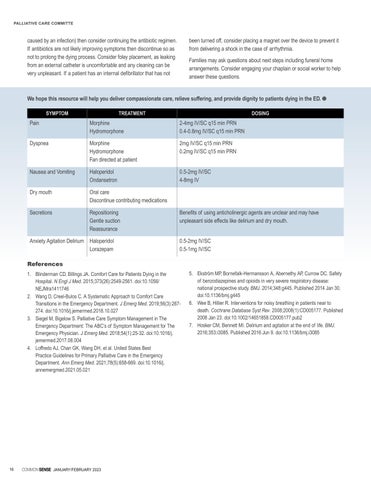
PAIN. Opioids are the mainstay of pain management. For patients with an IV, 2-5mg IV morphine every 15 minutes as needed is a good starting dose. Hydromorphone 0.4-0.8mg every 15 minutes as needed is preferred if a prolonged prognosis is anticipated and in patients with poor renal function. If analgesia is inadequate with the first dose, increase by 50-100%. In patients without an IV, opioids can be administered subcutaneously. The potency is considered the same as IV (give the same dose) but the time to peak effect is slightly longer, therefore space repeated doses out to every 30 minutes as needed. Reassessment is necessary to optimize symptom control. Nursing staff, social workers, and family members can be helpful to let you know if pain is adequately controlled.
DYSPNEA. Treating dyspnea can significantly alleviate suffering in dying patients and their families. Opioids are first line and considered safe when used appropriately. Lower doses are typically required when compared to treating pain, starting with morphine 2mg every 15 minutes as needed. Titrate until respiratory rate and accessory muscle use are improved. Patients with renal failure will have accumulation so hydromorphone 0.2mg can be used if the patient is expected to live longer than a few hours. Fentanyl is an option if a patient has both liver and renal failure but is very short acting. A fan directed at the patient can improve the sense of dyspnea. Supplemental oxygen fixes hypoxia but not typically symptoms, so you can consider a trial and only continue if it improves the
patient’s sense of dyspnea or work of breathing. Be aware that supplemental oxygen tubing is a tether which may further agitate some patients. Treatment should be aimed at relieving the patient’s symptoms, not correcting numbers on the monitor.
NAUSEA AND VOMITING. Consider the underlying cause of nausea and vomiting when choosing the best agent. Serotonin receptor antagonists such as ondansetron are first line for chemotherapy induced nausea and vomiting. Haloperidol, a dopamine receptor antagonist, is also frequently recommended in palliative care, at 0.5-2mg IV. Both serotonin receptor antagonists and dopamine receptor antagonists are effective at treating nausea and vomiting mediated by the chemoreceptor trigger zone and the GI tract. Both have potential to prolong the QT interval so consider the benefit of symptom burden versus risk of adverse effects.
DRY MOUTH. We recommend oral care and discontinuing unnecessary medications that may worsen xerostomia.
SECRETIONS. Noisy breathing is common at the end of life secondary to the patient’s inability to cough and clear secretions leading to turbulent airflow. This is often referred to as the “death rattle.” There is not clear evidence that medications such as anticholinergics (e.g., glycopyrrolate, atropine, or scopolamine) are useful, and they can cause side effects such as dry mouth and delirium. Consider repositioning, gentle suction, and reassurance to family members and team members. Counseling family members that noisy breathing and secretions are an expected part of the dying process and does not cause the patient any distress may be helpful.
ANXIETY/DELIRIUM/AGITATION. These symptoms are commonly seen in the final days of life. Consider potential causes including dyspnea, pain, and constipation, and offer support for spiritual or psychosocial distress. When medication is needed, haloperidol 0.5-2mg IV is most commonly considered the first line agent. For severe agitation, a patient may also require a benzodiazepine in addition to an antipsychotic. Consider lorazepam 0.5-1mg IV if needed.
OTHER CONSIDERATIONS. We recommend discontinuing IV fluids. IV fluids will not provide symptom relief, may prolong the dying process, and may potentially cause worsening dyspnea secondary to fluid overload. Antibiotics should be considered on a case by case basis. If antibiotics are thought to be providing some symptom relief (for example reducing secretions secondary to pneumonia, providing some pain relief
>>
PALLIATIVE CARE COMMITTEE
COMMON SENSE JANUARY/FEBRUARY 2023 15
caused by an infection) then consider continuing the antibiotic regimen. If antibiotics are not likely improving symptoms then discontinue so as not to prolong the dying process. Consider foley placement, as leaking from an external catheter is uncomfortable and any cleaning can be very unpleasant. If a patient has an internal defibrillator that has not
been turned off, consider placing a magnet over the device to prevent it from delivering a shock in the case of arrhythmia.
Families may ask questions about next steps including funeral home arrangements. Consider engaging your chaplain or social worker to help answer these questions.
We hope this resource will help you deliver compassionate care, relieve suffering, and provide dignity to patients dying in the ED.
1. Blinderman CD, Billings JA. Comfort Care for Patients Dying in the Hospital. N Engl J Med. 2015;373(26):2549-2561. doi:10.1056/ NEJMra1411746
2. Wang D, Creel-Bulos C. A Systematic Approach to Comfort Care Transitions in the Emergency Department. J Emerg Med. 2019;56(3):267274. doi:10.1016/j.jemermed.2018.10.027
3. Siegel M, Bigelow S. Palliative Care Symptom Management in The Emergency Department: The ABC’s of Symptom Management for The Emergency Physician. J Emerg Med. 2018;54(1):25-32. doi:10.1016/j. jemermed.2017.08.004
4. Loffredo AJ, Chan GK, Wang DH, et al. United States Best Practice Guidelines for Primary Palliative Care in the Emergency Department. Ann Emerg Med. 2021;78(5):658-669. doi:10.1016/j. annemergmed.2021.05.021
Benefits of using anticholinergic agents are unclear and may have unpleasant side effects like delirium and dry mouth.
5. Ekström MP, Bornefalk-Hermansson A, Abernethy AP, Currow DC. Safety of benzodiazepines and opioids in very severe respiratory disease: national prospective study. BMJ. 2014;348:g445. Published 2014 Jan 30. doi:10.1136/bmj.g445
6. Wee B, Hillier R. Interventions for noisy breathing in patients near to death. Cochrane Database Syst Rev. 2008;2008(1):CD005177. Published 2008 Jan 23. doi:10.1002/14651858.CD005177.pub2
7. Hosker CM, Bennett MI. Delirium and agitation at the end of life. BMJ 2016;353:i3085. Published 2016 Jun 9. doi:10.1136/bmj.i3085
PALLIATIVE CARE COMMITTE
SYMPTOM TREATMENT DOSING Pain Morphine Hydromorphone 2-4mg IV/SC q15 min PRN 0.4-0.8mg IV/SC q15 min PRN Dyspnea Morphine Hydromorphone Fan directed at patient 2mg IV/SC q15 min PRN 0.2mg IV/SC q15 min PRN Nausea and Vomiting Haloperidol Ondansetron 0.5-2mg IV/SC 4-8mg IV Dry mouth Oral care Discontinue contributing medications
Repositioning Gentle suction Reassurance
Secretions
Anxiety Agitation Delirium Haloperidol Lorazepam 0.5-2mg IV/SC 0.5-1mg IV/SC
References
COMMON SENSE JANUARY/FEBRUARY 2023 16
Your Voice Matters: Ten Ways to Battle Online Trolls
 Matthew Zuckerman, MD FAAEM
As physicians, we frequently find ourselves advocating for our patients and our colleagues on social media. This can include messages about public health, vaccination, corporate practice of medicine, overdose, and the health impacts of racism. Increasingly, we are confronted with social media trolls who seem filled with hate as they seek to silence our voice. It’s important to remember that their goal is to distract from your message and intimidate you. This article will include important tips for combatting twitter trolls and getting your message out.
Almost a quarter of physicians report being attacked on social media.1 The intention is to gain notoriety as well as draw you into an argument. Fruitless arguments can disrupt the social media conversation you’re trying to create. Signs that you’re being trolled include blindness to evidence, name calling, topic redirects, condescending tone, and over exaggerating.2 Trolls are frequently attracted to certain issues (e.g., vaccines, gun control, abortion, smoking). Beyond that, the attackers seek to personally bully and harass physicians. This can involve racist or sexist attacks, doxing of personal information, and even, in some cases, threats of violence and sexual assault.
It’s important to be familiar with the community standards of the social media platform you’re on, as most of them have policies about such harassment.3 Reporting trolls to social media platforms is an important part of monitoring and preventing habitual behavior. Messages that include threats of violence and assault may also violate state and federal laws regarding cyber stalking and harassment.4 Short of that, it’s important to know strategies for dealing with online trolls.
1. Fight Fire with Ice Cream
Increasing social media participation can reduce the relative importance of negative online reviews.5 This is often much easier and more effective than getting a negative online review taken down.
2. Pulse Check
The first pulse to check is your own. Responding angrily is frequently what a troll wants and gives up the high ground that physicians generally hold.
3. Don’t Feed the Trolls
On social media, responding to a comment can increase its impact. Trolls want public recognition and an opportunity to increase their network. Ignoring negative messages takes away their power and discourages further trolling. Think about that agitated patient from your last shift and what strategies you used to de-escalate them. Sadly, no ketamine on Twitter.
4. Sleep on It
Though many of us experience social media in real time, there is nothing wrong with responding tomorrow. Like that angry email you never sent, saving a draft and reviewing the next day is often the best option.
5. Fight the Fight, Not the Fighter
Keep the discussion focused on facts despite trolls’ use of personal attacks. Physicians are much more likely to remain professional and provide evidence online, and it works to our advantage. The fight isn’t to convince the troll (who will usually insist you “prove me wrong”), but educate all of the other people who are watching.
6.
Sidestep Response
Consider addressing the troll without engaging them. This can include sharing a screenshot (that doesn’t link back to the troll) or sending out a separate message addressing the issue. You may think there’s no point in arguing about mercury in vaccines with AntiVax666, but that doesn’t mean everyone is where you are at.
SOCIAL MEDIA COMMITTEE
Responding angrily is frequently what a troll wants and gives up the high ground that physicians generally hold.
>> COMMON SENSE JANUARY/FEBRUARY 2023 17
7. Mute vs. Block vs. Report
It’s totally reasonable to mute a troll to get them out of your headspace. Blocking goes a step further by preventing them from seeing your messages. Reporting inappropriate messages is generally easy, even if it doesn’t always result in our intended outcome.
8. Call on Community
The best feeling is watching a friend defend you online so you don’t have to engage with a troll. Consider reaching out via a DM or even IRL. This kind of support is important and can help put things in perspective when you’re fired up.
9. Three Rounds and You’re Out
KevinMD suggests limiting these types of arguments to three rounds (one is their response, two, your response, three, their response).6 If it’s not productive by round three then consider leaving the conversation.
10. Consider Kindness
Several years ago, the comedian Sarah Silverman made news by engaging with a troll about his chronic pain.7 Her kindness ultimately resulted in a GoFundMe campaign and connection to local health care providers. Though this is the exception, we should remember there are people on both sides of these arguments, often people in pain.
In summary, don’t let a troll push you out of the conversation. We manage agitated people every day, and can use our skills to make sure that our message continues to be heard.
References
1. Pendergrast TR, Jain S, Trueger NS, Gottlieb M, Woitowich NC, Arora VM. Prevalence of Personal Attacks and Sexual Harassment of Physicians on Social Media. JAMA Intern Med. 2021;181(4):550-552. doi:10.1001/ jamainternmed.2020.7235
2. McCoy J. 10 Effective Tactics to Defeat Internet Trolls. Search Engine Journal. Published October 7, 2021. Accessed July 14, 2022. https://www. searchenginejournal.com/defeat-online-trolls/323439/
3. The Twitter rules: safety, privacy, authenticity, and more. Accessed July 13, 2022. https://help.twitter.com/en/rules-and-policies/twitter-rules
4. Colorado cracks down on harassment of healthcare workers. McKnights Home Care. Published May 24, 2021. Accessed July 13, 2022. https:// www.mcknightshomecare.com/colorado-cracks-down-on-harassment-ofhealthcare-workers/
5. Widmer RJ, Shepard M, Aase LA, Wald JT, Pruthi S, Timimi FK. The Impact of Social Media on Negative Online Physician Reviews: an Observational Study in a Large, Academic, Multispecialty Practice. J Gen Intern Med. 2019;34(1):98-101. doi:10.1007/s11606-018-4720-3
6. How physicians can handle online trolls. KevinMD.com. Published May 14, 2015. Accessed July 6, 2022. https://www.kevinmd.com/2015/05/howphysicians-can-handle-online-trolls.html
7. Beck K. Sarah Silverman responded to a troll with kindness and it was beautiful. Mashable. Published January 6, 2018. Accessed September 28, 2022. https://mashable.com/article/sarah-silverman-troll
Continued from page 14
ACADEMIC AFFAIRS COMMITTEE
Patients interpret our body language before we open our mouths to say hello. Tell residents, when speaking with patients, do not cross your arms in front of your chest. It makes you look angry. Do not put your hands behind your back. You are not hiding anything. Do not put your hands on your hips. You are not a drill sergeant. Do not grab your coat lapels with your hands. You are not a parliamentarian. And do not put your hands in your pockets! You just touched a patient and now you’re putting MRSA over your cell phone? Yuk!
SIT DOWN PROPERLY!
Residents will find this hard to believe, but when they are very upset, the best thing for them to do is to sit down in a chair, extend their forearms, and open their hands. This posture feels unnatural when you are angry or being criticized, because it is not defensive. That’s the whole idea! Enlighten the young people: the first rule of swimming with the sharks is, don’t bleed. You can’t project vulnerability when you are sitting in a completely defenseless position.
It takes a great deal of composure to sit back comfortably in a chair, keeping your arms and hands open while you say, “Help me understand what you mean by that.” A defenseless posture communicates to everyone around you that you are not afraid. Best case scenario, you will be forced to be calm and circumspect. Worse case, you will decide you don’t want to sit there. And you can say, raising your index finger to interrupt (not the other one!) “We will need to finish this conversation later. Excuse me.”
DO UNTO OTHERS.
Faculty should offer every emergency medicine resident this lasting lesson in deportment: the opportunity to lie down flat on an empty ED stretcher and have a Big Masked Doctor (you) looming over the head of the bed, shouting at them during an ersatz trauma code. “Sir! What’s your name! Airway’s intact!”
It will change their practice.
SOCIAL MEDIA COMMITTEE
COMMON SENSE JANUARY/FEBRUARY 2023 18
In the Patient’s Best Interest
Robyn Hitchcock, MD FAAEM, Founder and Chair of Rural Medicine Interest Group
I'm working at a critical access facility, and shortly after my 7:00am shift started, a 36-year-old woman rolled in the door complaining of sudden onset of right-sided abdominal pain and a syncopal episode at home. She’s gray, diaphoretic, and a little groggy. Blood pressure is 88/40, heart rate 128. Looks sick, looks shockey.


some pain medicine and some serious convincing she finally allowed me to do a cath with some local gel for anesthetic. I did the cath and ran the specimen to the lab myself demanding results “yesterday.”
We can get serum pregnancy tests but they take much longer. I can get a urine test in minutes—if I can get urine. So of course the urine test is positive—we’ve got a ruptured ectopic. We do not have obstetrics or gynecology at my hospital so I called the hospital 70 miles away for a transfer. 16 minutes later despite calling the stat line they get gynecology on the phone who basically refuses to take the patient because she’s unstable. She insists a general surgeon can take her to the operating room and take care of this. I call my general surgeon and he says, “I cannot operate on a ruptured ectopic but will come in and see her.” I call gynecology back letting them know I don’t want to delay her transfer and by this time I know the helicopter isn’t flying because of weather so they’re an hour and a half away by ground.
She doesn’t think she is pregnant and is using condoms for birth control. Denies any symptoms until the sudden onset of pain. The pain started at 1:00am but she didn’t come in until after 7:00. Physical exam reveals peritonitis diffuse abdominal pain worse in the lower abdomen then she quickly begins complaining of pain in the right shoulder and pain with taking a deep breath. She starts hyperventilating and having panic attacks because of the shoulder and back pain and worsening abdominal pain.
I did a quick point-of-care ultrasound which showed her abdomen to be full of free fluid, presumably blood. Two large bore IVs and aggressive volume resuscitation. She flat out refused straight cath for a urine sample (and rapid pregnancy test) to the point of hysteria and was actually kicking and screaming. Of course she couldn’t pee. After
“I’m just trying to do what’s in the best interest of the patient,” she says, therefore implying that I am not. General surgery arrives while I am trying to explain to gynecology that in critical access facilities sometimes we have to send unstable patients. If I have somebody with a head bleed or an aortic dissection I have to send them to a neurosurgeon or cardiothoracic surgeon. We have to send heart attacks to the cath lab, etc. We do our best to stabilize them but transferring unstable patients is something we do on a regular basis. As we’re getting into the risk benefit discussion the surgeon walked in and she is telling me, “I can walk the surgeon through the procedure if need be.” I hand the phone to him saying that gynecology wants to talk to him and step outside the office.
RURAL MEDICINE INTEREST GROUP
I’m just trying to do what’s in the best interest of the patient,’ she says, therefore implying that I am not.
>> COMMON SENSE JANUARY/FEBRUARY 2023 19
The surgeon briefly examined the patient, I let him know that the pointof-care showed that the abdomen was full of fluid, probably blood, and he pulled me aside. He tells me, “I don’t like your tone, and you’re being condescending.” He goes on to mansplain to me, “You’re new here so let me explain to you how things work. At this facility it’ll take at least two hours to get the operating room going. Even if it was reasonable for me to do this, you haven’t ordered a formal ultrasound so we don’t even have a diagnosis.”
Fun fact. If this patient was presented to me during an oral board exam and after seeing free fluid in her belly and an unstable hypotensive tachycardic patient who is pregnant, if I ordered a formal ultrasound as my next step I would fail my boards. The next step is the operating room and that is how we are taught and that is how I proceeded. I don’t need a confirmatory diagnostic test because if she doesn’t need to go to the operating room for a ruptured ectopic, she damn well needs to go for something and it’s not anything I can fix or stabilize, other than giving blood, in the emergency department.
The blood arrives just as her blood pressure starts tanking. I see anesthesia at the bedside so I guess general surgery has decided they can take her to the operating room. (Which of course he never bothered to communicate to me…) Since it took a little while to get the OR going— more like 30 minutes than two hours however—we did have time to get a formal ultrasound which confirmed the diagnosis (non-specific findings in the right ovarian area, empty uterus, and abdomen full of fluid presumed blood).
In the end after further discussion with gyn the general surgeon did take the patient to the operating room. She did fine. One would think I might get appreciation for all my hard work in expediting her care.
Nope.

The surgeon tells me I need an attitude adjustment and then goes on to mansplain how operating rooms work. The gynecologist reported me to upper level administration for negligence and trying to transfer an unstable patient. I wonder what she would have said on a Saturday or Sunday or a weekday evening when we don’t have surgery on call which is often the case at this facility. The ED director (a family physician, like most of our doctors) has already been by to let me know the case is being reviewed. Our CMO is a family physician too. Nobody reviewing my case has my training.
I always have the patient’s best interest in mind. People at receiving hospitals don’t understand what it’s like to be at a place with no resources. Sometimes you’re caught between a rock and a hard place and all of your options are not great but you always do your best by the patient. It is soul crushing to be accused otherwise.
I like to think that I always have my patients’ best interest in mind. I certainly did in this case. At the end of the day, she got taken care of. And she was okay. And that’s what matters.
RURAL MEDICINE INTEREST GROUP
One would think I might get appreciation for all my hard work in expediting her care. Nope.
COMMON SENSE JANUARY/FEBRUARY 2023 20
Medical Error in the Emergency Department: A Commentary on the AHRQ Report
 Kraftin E. Schreyer, MD MBA FAAEM
By now, many of you have likely read the Association for Healthcare Research and Quality’s (AHRQ) systematic review of medical errors in the emergency department (ED).1 While the report itself has inherent flaws, the concept of identifying and reducing medical error merits ongoing attention and discussions. Medical errors are widespread and have significant impacts to patients, providers, and the health care system. When active failures and latent system failures align, medical errors lead to harm to patients, potentially resulting in morbidity and/or mortality. In addition, providers can suffer from second victim syndrome and the U.S. health care system incurs further costs.
Medical error is notoriously difficult to define. The National Academy of Medicine (NAM) defines diagnostic error as “the failure to (a) establish an accurate and timely explanation of the patient’s health problem(s) or (b) communicate that explanation to the patient.”2 The Institute of Medicine defines an error in medicine to be the “failure of a planned action to be completed as intended (i.e., error of execution) and the use of a wrong plan to achieve an aim (i.e., error of planning) [commission].”3 Pat Croskerry, the guru of ED cognitive bias, limits the definition of medical error in the ED setting to “preventable adverse events.”4 There are further debates about the agreement or discrepancy between medical error, diagnostic error, and misdiagnosis. The Society for Academic Emergency Medicine held a consensus conference to develop a definition of error, but no consensus definition was able to be reached.5 While the NAM definition can more readily be applied to other fields of medicine, the practice and nature of emergency medicine (EM) is both variable and unique, and therefore, poorly suited for this definition of medical error, which was the one employed by the AHRQ in their report. Emergency care is less about arriving at the final diagnosis, and more about real-time identification and treatment of life-threatening conditions. In many cases, this involves only a preliminary diagnosis or symptomatology, knowing that other care teams will have more time and resources to determine the underlying final diagnosis. Additionally, emergency providers make medical decisions under significant time constraints, and those decisions are also made without an ongoing relationship with each patient, without full knowledge of each patient, and amidst a plethora of interruptions and distractions. Furthermore, feedback on patient care, a key tool to identifying and addressing preventable errors, is often lacking in EM. These unique operating characteristics,
which make EM prone to medical errors, mandate a unique definition of medical error for additional study.
Medical errors can be classified in many ways based on the outcome in which they result or the driving forces behind them. For example, errors of commission involve an introductory action, whereas errors of omission indicate a key process of the care continuum was left out. In terms of the harm they generate, medical errors can range from near-misses to preventable adverse events to sentinel events. Perhaps the most relevant classification of errors to the ED, though, are active versus latent (passive) errors. Active errors are typically skill-based, rule-based, or knowledge-based, and typically require individual provider coaching to correct. Latent errors, the more common type, are system failures that often require additional time and resources to remediate. Systemic improvement efforts must start from the ground up, with reporting from front-line staff. Error reporting, including of near-misses, should be always encouraged and embraced through a just culture. Reported errors should then be reviewed in detail and addressed through performance improvement methodologies that target the root cause, not a simplified explanation of the error. Ideally, errors would be catalogued in a databank and timely feedback would be provided to those on the front lines. Eventually, efforts should be put toward identifying errors before they occur, through a proactive approach based on a preoccupation with failure. Ultimately, through improved communication strategies within the

>> COMMON SENSE JANUARY/FEBRUARY 2023 21
Emergency care is less about arriving at the final diagnosis, and more about realtime identification and treatment of life-threatening conditions.
interprofessional health care teams, preventable errors can be reduced. Only then could health care become a high reliability organization—one that is highly complex and high risk, but with a low error rate.
Unfortunately, while the AHRQ report draws needed attention to medical errors, the conclusions are poorly founded. Error rates were derived from studies performed outside the U.S., where comparable EM training does not exist, and from malpractice data, which was numerator-only data. Malpractice data further biases the findings towards active individual errors, whereas it is well established that most medical errors are system related.6 The AHRQ acknowledges that, despite the challenges of working in an ED, diagnostic error rates are in line with many other clinical settings, which implies that those working in the ED are more successfully mitigating medical errors, compared to those in other medical settings. Patients, though, may not read it that way. Beyond the incorrectly derived rates, further assertions regarding possible preventable deaths are derived from a faulty foundation. These extrapolated figures may have the opposite of the intended effect of improving patient care and increasing patient safety. Derivations like these may, in fact, paradoxically result in greater harm, by encouraging patients to not seek emergency care when it is indicated.
In summary, medical error is a pervasive condition that does merit attention and requires ongoing resources to diagnose and treat. We in the ED must be aware of medical error and continually work with our colleagues and institutions to reduce error and potential resultant harm to patients.
References
1. Newman-Toker DE, Peterson SM, Badihian S, Hassoon A, Nassery N, Parizadeh D, Wilson LM, Jia Y, Omron R, Tharmarajah S, Guerin L, Bastani PB, Fracica EA, Kotwal S, Robinson KA. Diagnostic Errors in the Emergency Department: A Systematic Review. Comparative Effectiveness Review No. 258. (Prepared by the Johns Hopkins University Evidencebased Practice Center under Contract No. 75Q80120D00003.) AHRQ Publication No. 22(23)-EHC043. Rockville, MD: Agency for Healthcare Research and Quality; December 2022. DOI: https://doi.org/10.23970/ AHRQEPCCER258
2. Hall KK, Shoemaker-Hunt S, Hoffman L, et al. Making Healthcare Safer III: A Critical Analysis of Existing and Emerging Patient Safety Practices [Internet]. Rockville (MD): Agency for Healthcare Research and Quality (US); 2020 Mar. 1, Diagnostic Errors. Available from: https://www.ncbi.nlm. nih.gov/books/NBK555525/
3. Committee on Diagnostic Error in Health Care; Board on Health Care Services; Institute of Medicine; The National Academies of Sciences, Engineering, and Medicine; Balogh EP, Miller BT, Ball JR, editors. Improving Diagnosis in Health Care. Washington (DC): National Academies Press (US); 2015 Dec 29. 3, Overview of Diagnostic Error in Health Care. Available from: https://www.ncbi.nlm.nih.gov/books/ NBK338594/
4. Croskerry, Pat; Sinclair, Douglas CJEM : Journal of the Canadian Association of Emergency Physicians; Pickering Vol. 3, Iss. 4, (Oct 2001): 271-6.
5. Vincent C, Simon R, Sutcliffe K, Adams JG, Biros MH, Wears RL. Errors conference: executive summary. Acad Emerg Med 2000;7:1180-2.
6. Institute of Medicine (US) Committee on Quality of Health Care in America. To Err is Human: Building a Safer Health System. Kohn LT, Corrigan JM, Donaldson MS, editors. Washington (DC): National Academies Press (US); 2000. PMID: 25077248.

MEDICAL ERROR IN THE EMERGENCY DEPARTMENT: COMMON SENSE JANUARY/FEBRUARY 2023 22
Understanding Your Professional Liability Policy

 Melanie Heniff, MD JD and Malia Moore, MD
Have you read your policy?
Most physicians have not. Please add this to your to-do list or New Year’s resolutions if you are one of the many physicians who are not familiar with your malpractice insurance coverage. It’s important to be informed about what type of policy you have, what is covered, what is not, as well as what your rights and responsibilities are as an insured physician. Ask for a copy of the Certificate of Insurance (COI), which is a summary of your policy and request a copy of the policy itself. Keep both in your files indefinitely. In most states, the statute of limitations (SOL) in which a claim can be brought is two years, however, this exists from when the injury is known or should be known. Therefore, the SOL can be extended much longer in the case of pediatric patients or when an alleged injury is discovered many years later. A typical example of a claim outside the statute would be where a lung nodule was noted on an x-ray, but the patient was not made aware, and five years later was diagnosed with a late-stage cancer. In this situation, the SOL starts when the patient first discovered the alleged malpractice, five years after the nodule was “missed,” not on the date the nodule was first noted.
Do you have a “claims-made” or an “occurrence” policy? What is the difference?
A claims-made policy will only provide coverage if the policy was in effect both at the time the alleged malpractice took place and when the claim is made. Claims-made policies are the most common type of coverage and tend to be less expensive than occurrence policies, but once the policy ends, a physician will need to have “tail” or “nose” coverage for claims that are made after the policy is no longer in effect. Tail coverage can be purchased to provide coverage for claims that are made after the claimsmade policy ends (such as when a physician relocates or retires), and typically cost one and a half to three times the amount of the annual premium. Nose coverage can also be purchased from a subsequent insurer to cover claims that occur after the claims-made policy ends.
Occurrence coverage policies cover alleged malpractice that occurs during the time the policy was in effect, regardless of when the claim is made. These policies are less common and more expensive than claimsmade policies but offer the advantage of long-term protection and avoid the need for tail or nose coverage.
What is covered?
The amount and details of your coverage may vary depending on your policy and state laws. Typically, coverage includes attorneys’ fees, court costs, arbitration and settlement costs, medical damages, and punitive and compensatory damages. Medical malpractice insurance does not cover EMTALA or HIPAA violations, or liability arising from sexual
misconduct or criminal acts. Policies may or may not cover volunteer work or administrative roles. Often separate policies are needed to cover work outside the scope of clinical care in the emergency department such as an EMS medical director role.
What are my rights and responsibilities as an insured physician?
Your policy may or may not allow you ultimate control over the decision of whether to settle a claim or proceed to trial. While you, your insurer, and your defense attorney are generally on the same team, working together toward resolution of the case, you may not always agree on settling a claim or taking the case to trial. Some policies include a clause that makes you personally liable for a jury award that exceeds a settlement offer that you rejected.
In terms of your responsibility as an insured physician, your policy will usually state that you are required to report any claims or potential claims against you soon after you are aware of the allegation of malpractice. Your policy will also require you to cooperate with the defense of your claim and failure to do so could lead to denial of coverage. For example, failing to work with your defense attorney or not showing up for a deposition or hearing could mean your malpractice insurer may not be obligated to provide coverage.
The AAEM Legal Committee is interested in hearing from members about what legal topics you would like to see covered in Common Sense and future Scientific Assemblies. Please contact Melanie Heniff, MD JD at mheniff@comcast.net or Malia Moore, MD at mjm18@iu.edu with any input.

LEGAL COMMITTEE
COMMON SENSE JANUARY/FEBRUARY 2023 23
Your policy may or may not allow you ultimate control over the decision of whether to settle a claim or proceed to trial.
To Typify an Ally: Ways to be a Male Advocate for Women
Deanna Margius, MD

peaking with an older generation of female colleagues has allowed me to understand the noteworthy progress that has been made in emergency medicine for women. The 2019 statistics for EM physicians are 72% male, and 28% female, compared to 78.5% and 21.5% in 2008.1 Our male allies can help us to continue the momentum of the progress in our field. What exactly is an ally? To quote Dr. Frederick Davis, an administrator at Hofstra Northwell-LIJ hospital: “[an ally is] someone who is part of that majority or position seen as authority. [He/ she/they] can be a valuable voice in the fight for equity. The ally is that person on the ‘inside’ who can get the attention and has the voice that will get others to listen and act in collaboration to change. Great teams are formed by being able to have a level of comfort that everyone can speak their concerns. You have to work to create that environment.” Allies exist to support diversity of race, ethnicity, gender identity, sexual orientation, and religion. As an ally, it is important to have the courage to engage in difficult discussions. This is the first step to learning another person’s perspective and his/ her/their ideas for system-wide change and the allies' role in that plan. After interviewing my male colleagues about the topic of allyship, I have summarized some ideas for positive change.
Men in all roles can take action to support women in real time. Patients may mislabel a female resident or attending as a nurse. A male ally can correct this mislabeling to reaffirm
Sthe female physician’s role and her position of authority. Similarly, male allies should respond in real-time to admonish sexist comments. Men can also seek out opportunities for mentorship for female medical students, residents, and young attendings. This mentorship can be especially valuable in pipeline programs or leadership programs.
Residents and clinical attendings can be allies through flexibility with scheduling. They can acknowledge scheduling conflicts that arise with pregnancy and caretaking of children and elderly family members. Women historically have taken primary ownership of these family responsibilities. However, supporting both male and female colleagues to have time off to accomplish these tasks can continue the momentum of this modern paradigm shift.
Residency program leadership can be effective allies through recruiting and creating diverse leadership teams. Aside from setting the tone of education and practice, they can institute deliberate change aimed at addressing gender gaps. Program director Dr. Tom Perera took over a predominantly male residency at Hofstra Northwell-LIJ. He then actively recruited female faculty and residents. The composition of the residency leadership achieved gender equality in 2020. The female residency leaders have been instrumental in the group’s progress. Additionally, the residency leadership team committed
to interviewing and ranking a larger number of female applicants. The class of 2024 is 60% female, compared to significantly lower numbers in previous years. In addition, the program supported the Women in EM interest group, dedicated conference time to gender equality, and ensured that invited grand rounds speakers were more equally represented. A program that is committed to matching a diverse residency
class needs a leadership team who actively recruits minority and female candidates, which can include diversity and inclusion networking events for candidates to engage with future mentors. If a program consistently does not match a diverse class, leadership should create an action plan for change.
Administration faculty can be allies by having an awareness about job-tasking, recruitment, and transparency of pay and policies. While teams of leaders work together to accomplish goals for the benefit of one or many departments, tasks may not be equally distributed. The concept of office housework describes non-promotable work—these are tasks that are necessary but undervalued, unlikely to lead to promotion, and disproportionately assigned to women. These tasks include taking minutes

WOMEN IN EMERGENCY MEDICINE SECTION
Countinued on page 26 >> COMMON SENSE JANUARY/FEBRUARY 2023 24
While women can work to be self-advocates, sponsors and mentors for younger generations, and supporters of our own rights, we cannot accomplish the goals of equity and inclusion without support from our male colleagues.
The Climate Crisis and Forced Displacement: Health Implications and Recommendations for Emergency Medicine Physicians
Salma Yusuf, MS4, Tai Donovan, MS4, and William Mundo, MD MPH


When asked what some of the biggest threats to public health are, climate change is not the first answer that comes to mind but it continues to affect millions around the world and is one of the greatest known risks to global health. Climate change has the capability to indirectly impact health outcomes for vulnerable populations in the U.S. and worldwide in a myriad of ways. From the risk of extreme heat events, flooding and storms, and increased risk of respiratory illness, to the spread of infectious disease, climate change not only creates new public health challenges but exacerbates those that already exist.
One of the greatest consequences of global warming is migration and displacement. According to the U.N. Refugee Agency, by the end of 2020, the world’s forcibly displaced population was at a record high, with 82.4 million individuals being displaced worldwide due to persecution, conflict, violence, or human rights violations. Migration, especially when sudden and involuntary, adds a layer of complex determinants to health connected to acculturation, access to care, pre-existing health, the mode of travel, and legal status. In the United States, if migrants can overcome the multiple challenges of receiving care, the emergency department may be the first and only contact they may have with a physician. This creates a new dimension of challenges for the ED physician while putting a strain on an already limited health care system. Our goal is to examine the clinical impact and challenges that climate change influenced migration places on emergency physicians and our health care system while identifying opportunities for improvement.
Strain on ED and ED Physicians

The number of immigrants increased around the globe from 150 million in 2000 to 214 million in 2010, and this number is said to be able to reach 405 million by 2050 with a dramatic increase seen in refugees, undocumented, and asylum seekers. Undocumented status is a completely unique social determinant in that it’s modifiable. Most immigrants use the emergency department as their first point of care and in lieu of a primary care physician due to lack of health insurance. Because of this, the ED is often used for lower acuity health issues. Further, the effects of displacement, income inequalities and poverty, and immigration policies contribute to barriers to health. Emergency medicine physicians’ experiences in caring for underserved populations are tangible to promote health equity for the undocumented population.

Morbidities Experienced by Migrant Populations
While the majority of the migrant population is healthy upon arrival, some, especially refugees, asylum seekers, and unaccompanied minors, suffer from disproportionate morbidity. Undocumented immigrants face a unique risk for accessing tuberculosis care and rely on ED for life-threatening conditions such as hemodialysis for ESRD and cancer chemotherapy. While other health risks include heat-related disorders, exacerbation of respiratory illness due to air pollution, the prevalence of vector-borne diseases, and gastrointestinal diseases.
SOCIAL EM & POPULATION HEALTH COMMITTEE
Climate change not only creates new public health challenges but exacerbates those that already exist.
>> COMMON SENSE JANUARY/FEBRUARY 2023 25
How ED Physicians Can Help Bring Quality Care to Migrant Populations
In the United States, there are about 11 million undocumented immigrants. This population is one of the most vulnerable in the country as they do not have access to health care and are afraid due to their immigration status. The native language of most undocumented people is a language other than English, an additional barrier to health care. As physicians, we can care for our patients by educating them that immigration status is protected. We need to consider the emotional and physical risks, the inherent limitation to follow-up and specialty care, and ethical issues relating to ICE, associated with caring for undocumented immigrants. We can advocate for these patients by learning about organizations that serve migrants in your area and getting involved in advocacy at local or state levels by joining the United States Climate Alliance. The Inflation Reduction Act of 2022 (IRA), H.R. 5376, was signed into law in August 2022. To date, the funding and policies enacted through the IRA are the most comprehensive effort designed to mitigate the causes and effects of climate change1 (ACEP, 2022).
References
*Windsor University School of Medicine
†Windsor University School of Medicine
‡Denver Health
at meetings, new hire training, and organizing social events. In the book “The No Club: Putting a Stop to Women’s Dead-End Work,” Babcock and her colleagues describe statistics about office housework. “Independent of rank, the median female employee spent 200 more hours per year on non-promotable work than her male counterparts. To put that into perspective: Women spent an additional month on dead-end assignments.”2 As EM leaders, it is essential to develop a system for fair distribution of tasks. Recruitment of diverse candidates at the executive level has a large impact on new clinical hires. Additionally, it is important to hire leaders who express a commitment to diversity and inclusion. Dr. Eric Cruzen, executive director of Northwell’s EM service line, describes the importance of standardized interview questions
1. American College of Physicians. (2022, October 3). Toolkit: Climate change and health. ACP. Retrieved December 5, 2022, from https://www. acponline.org/advocacy/advocacy-in-action/toolkit-climate-change-andhealth
2. Clayton, S. (2021). Urgent need to address mental health effects of climate change, says report. American Psychological Association. Retrieved December 5, 2022, from https://www.apa.org/news/press/ releases/2021/11/mental-health-effects-climate-change
3. Ghazali, D. A., Guericolas, M., Thys, F., Sarasin, F., Arcos González, P., & Casalino, E. (2018, July 1). Climate change impacts on disaster and emergency medicine focusing on Mitigation Disruptive Effects: An international perspective. MDPI. Retrieved December 5, 2022, from https://www.mdpi.com/1660-4601/15/7/1379
4. Sorensen, C. J., Salas, R. N., Rublee, C., Hill, K., & Bartlett, E. (2020, August 1). Shibboleth authentication request. Shibboleth Authentication Request. Retrieved December 5, 2022, from https://www-clinicalkey-com. ezp1.lib.umn.edu/#!/content/playContent/1-s2.0-S019606442030192X?ret urnurl=null&referrer=null
5. Virchow, R. (2019, August 12). Undocumented patients in the Emergency Department: Challenges and opportunities. The Western Journal of Emergency Medicine. Retrieved December 5, 2022, from https://westjem. com/articles/undocumented-patients-in-the-emergency-departmentchallenges-and-opportunities.html
to evaluate candidates fairly, and to include questions about diversity and inclusion. A diverse committee with representation from men, women, and underrepresented minorities should be involved in candidate selection. Department leadership should be committed to transparency about salaries in order to prevent gender income inequality. Additionally, maternity and paternity leave policies should be available to all employees.
While women can work to be self-advocates, sponsors and mentors for younger generations, and supporters of our own rights, we cannot accomplish the goals of equity and inclusion without support from our male colleagues. Allies should utilize their positions of authority to create positive change for women through many actions. They should learn about unique perspectives through self-directed research and
difficult discussions with female colleagues, with particular awareness of the unique experiences of underrepresented women in medicine. Furthermore, they should take action and identify further areas of improvement. We’ve made significant progress as a field, and yet so much work remains to be done. Now is the time to talk, to listen, to act, to change.
Resources
1. “Active Physicians by Sex and Specialty, 2019.” AAMC, https://www.aamc.org/datareports/workforce/interactive-data/activephysicians-sex-and-specialty-2019. Accessed 22 Nov. 2022
2. Babcock, Linda, et al. The No Club: Putting a Stop to Women’s Dead-End Work. First Simon&Schuster hardcover edition, Simon & Schuster, 2022.
SOCIAL EM & POPULATION HEALTH COMMITTEE
COMMON SENSE JANUARY/FEBRUARY 2023 26
Continued from page 24 WOMEN IN EMERGENCY MEDICINE
A Commitment to Equity is Part of the American Academy of Emergency Medicine Legacy
L.E. Gomez, MD MBA FAAEM
Our academy asserts that we are the specialty society of emergency medicine, a democratic organization committed to six principles as per the opening line of our mission statement.1 As with most organizational mission statements, ours is aspirational. We now have a diversity of voices on our board and are learning how to create a safe space so that all are equally heard without fear of retaliation or censure. Towards that end, we have made a commitment to racial bias training and are empowering our ethics committee to review our integrity around this goal.
With over 8,000 members, we may not be the largest, but we have become more representative of the range of backgrounds and political opinions evident throughout our membership. Over the past year our PAC contributions have become equitably split between political parties and an oversight task force has been assigned to ensure it remains that way. We have divested from unchecked index funds to socially responsible investment products. We have updated our mission statement to clearly reflect these commitments to our principles, the first of which includes unencumbered access for all and are working on more succinct language to maximize impact. We are an increasingly powerful group.
Our AAEM-PG vs. Envision Lawsuit is testament to our pledge to protect the integrity of the physician patient relationship so that we can continue to advocate for our patients unencumbered by the influences of private equity backed interests. We are a force to be reckoned with within the realm of professional medical specialty organizations and right on the heels of others affirming a strategic commitment to inclusion. As is well known to all of us, the American College of Emergency Physicians (ACEP) is much larger, with over 40,000 members. To their credit, they filed an amicus brief in the lawsuit that sides with a physician’s right to autonomy in medical decision-making.2 It is worth noting that despite their same stated commitment to diversity, their evolution in leadership has not kept pace with ours.3,4
We all know that AAEM grew out of need to address concerns of emergency physicians that other professional organizations failed to address. Our negative experiences with establishment corporate, organized emergency medicine being central, but not exclusive among those concerns. Our first president, James Keaney, MD MPH FAAEM, author of a remarkable book entitled “The Rape of Emergency Medicine,” detailed many of the causes of failures to protect patients from injury and inequitable care that included protecting the sanctity of the physician-patient relationship. The book is remarkable in that it not only gives concrete examples of how corrupt corporate practice leads to neglect and unfair treatment of patients directly because of unchecked profit driven care but includes admissions that racial bias leads to inequitable care. On page 134 of the book Dr. Keaney includes an episode that commonly plays out in the
ED but is forgotten by readers. An ambulance brings in a combative, burly, young, 6-foot-5 black man assumed drunk by paramedics and restrained who nurses beg to have sedated before a properly trained emergency physician follows protocol, sets aside prejudice, and diagnoses acute delirium secondary to severe hypoglycemia.
Unsurprisingly, our first president has been committed to equitable care throughout his career.4 All of our presidents have paid it forward in the effort to realize more equitable care, but none more than our recent presidents. Dr. David Farcy’s president’s messages were strongly oriented to following the lead of Dr. Keaney and others calling attention to the existence of health disparities and ethnic discrimination in medical practice. Dr. Lisa Moreno who followed is largely responsible for diversity in our leadership, and we can now be proud to count six female members on our board of directors. Last, but not least, our current president, Dr. Jonathan Jones has joined Dr. Italo Brown, our Chair of the Justice, Equity, Diversity, and Inclusion Section, in the All-EM Diversity Equity and Inclusion Task Force. We should all be proud that our tradition is being carried on with oversight in trustworthy hands.
Finally, we are firmly committed to transparency in emergency medicine. As your Secretary-Treasurer, I implore you to become engaged and share your thoughts on everything from increasing membership to improving our bottom line, to improving our evolving mission, so that we can better serve you and all our patients. In keeping with that commitment, it is my hope that in the future we will have greater transparency in all our activities and in the interim invite every member to review Article X of our bylaws on accountability.6 The “minutes of the meetings of the board and books of account” are open to any member of the Academy. We are here to serve all members equitably.
References
1. AAEM Mission Statement. 2022: https://www.aaem.org/about-us/ourvalues/mission-statement?_ga=2.237010112.1771233662.16697253601654053551.1645716505
2. ACEP Files Amicus Brief in CA Lawsuit on Physician Practice. https:// www.acep.org/news/acep-newsroom-articles/acep-files-amicus-brief-inca-lawsuit-on-physician-practice/

3. ACEP BOD. 2022. https://www.acep.org/who-we-are/leadership/board/

4. AAEM History. 1992: https://www.aaem.org/about-us/our-values/history
5. List of past AAEM Presidents: https://www.aaem.org/about-us/leadership/ aaem-past-presidents
6. AAEM Bylaws. Revised 2022. https://www.aaem.org/about-us/our-values/ bylaws
COMMON SENSE JANUARY/FEBRUARY 2023 27
2022 Political Action Committee Report
Andy Walker, MD MAAEM FAAEM, Treasurer, AAEM Political Action Committee
irst, a bit about the Academy's Political Action Committee itself. Our PAC is directed by a treasurer who is appointed by AAEM's president, and overseen by a four-member PAC Advisory Committee consisting of an assistant treasurer, a member of AAEM's Board of Directors, another full voting member of the Academy, and a representative of the Resident and Student Association (RSA). The PAC's purpose is to promote the vision and mission of AAEM by supporting elected officials and candidates for office who share the Academy's values.
Those values that are particularly relevant to the world of politics include protecting the sanctity of the doctor-patient relationship, the professional autonomy of emergency physicians, and ensuring fair treatment in the workplace for emergency physicians so that we may render the best possible care to our patients without outside interference, consistent with the highest traditions of medical ethics. All other political considerations are irrelevant.
My personal politics, those of AAEM's president, those of the PAC Advisory Committee, party loyalty, and anything else that doesn't directly affect the practice of emergency medicine and the well-being of emergency physicians plays no role whatsoever in guiding the PAC's contributions. If you are passionate about global warming, abortion, border security, gun control, election integrity, voting rights, environmental protection, a political party, etc., there are plenty of ways for you to channel that passion and influence politics and government
Foutside of AAEM and its PAC. AAEM's PAC is nonpartisan and sticks to protecting the interests of emergency physicians and the patients we care for. We have a reputation on Capitol Hill for non-partisanship, strong ethics, and putting patients first. That reputation is a force-multiplier and allows us to punch far above our weight. We must protect it.
During the last congressional session (20212022) our PAC made 26 contributions to the campaigns of 25 politicians, 11 Democrats and 14 Republicans, for a total of $114,000 ($49,500 to Democrats and $64,500 to Republicans). The candidate who received two donations is a Democrat from California and a physician who was making his first run for office (the House). There is a saying in politics that “money talks, and early money screams.” Thus we chose to support this physician-candidate early, with one contribution before his party primary and another after the primary. Although he survived the primary, he did not win the general election. Despite our early support, an AAEM

member running for the House from Missouri lost his Republican primary. 22 of our 25 candidates were ultimately successful and are in the 118th Congress. 11 of those we supported are physicians and another is a podiatrist.
Since we support politicians who support our values, many of those we support are physicians, as you can see. Most physicians in Congress are Republicans (14 out of 17 in the 117th Congress), and physicians who run for office have tended towards conservatism and the Republican Party. Despite that, AAEM PAC donations are nearly evenly divided between the two parties. That is because former PAC treasurers, as well as myself and Matt Hoekstra of Williams & Jensen (our professional representatives in D.C.), have worked diligently to be nonpartisan and to make sure our PAC donations stay focused on issues that have a major effect on the working lives of emergency physicians and our ability to take good care of our patients. As long as I am PAC treasurer, I assure you that will remain so.

POLITICAL ACTION COMMITTEE
We have a reputation on Capitol Hill for nonpartisanship, strong ethics, and putting patients first.
COMMON SENSE JANUARY/FEBRUARY 2023 28
ED Crowding And Boarding: A Public Health Crisis
 Jennifer Rosenbaum, MD FAAEM

More and more often, emergency physicians find themselves on shift counting the number of patients in the waiting room and wondering where they will fit. Physically—where can they be treated? Is there a makeshift exam area between the patients waiting for an inpatient bed or transfer? Can they be managed in the waiting room? Emergency departments (EDs) across the country are getting crushed. Lately, EDs are experiencing record levels of overcrowding and patient boarding, a crisis that puts public safety at risk. So how did we get here? What can we do? And who should be involved in the fix?
ED crowding is not a new issue. In 2006, the Institute of Medicine (IOM) studied U.S. emergency care services and detailed a report describing the national epidemic of overcrowded EDs.1 The problem of ED crowding is closely tied to ED boarding, a term that describes the practice of holding admitted patients in the ED due to lack of available inpatient beds. In multiple surveys, the majority of ED medical directors and department chairs agree that ED crowding and boarding is a problem.2
The problem poses real risks to physicians and their patients. The Joint Commission identifies boarding as a patient safety risk that should not exceed four hours. This is because crowding and boarding are associated with medical errors, treatment delays, reduced patient privacy, and increased ambulance diversion.3 A recent study demonstrated that when ED occupancy reached its peak, the rate of inpatient death doubled from 2.6 to 5.4%.4 ED crowding is also associated with a high rate of physician and nurse burn out and increased workplace violence towards staff.5 The pandemic has led to significant health system downsizing which has only exacerbated overcrowding. While hospitals lost revenue, unprecedented levels of health care workers have left their positions due to heavy patient loads and burn out. In particular, a nursing shortage has meant that many inpatient beds are open but unstaffed. Hospital expenses rise when nurses leave their positions, as the price to recruit and train increases. Hospitals increasingly rely on traveling nurse agencies which are costly. These departures have led to increased inefficiency. Additionally, both adult and pediatric mental health conditions have risen dramatically since the pandemic, and EDs often board psychiatric patients for long periods of time.ED leaders have tried to address overcrowding with departmental initiatives but it is clear that crowding and boarding are whole-hospital problems. They are also public health problems that may require government intervention. Hospital systems must be designed with some flexible capacity to adapt to crisis and their
workers must be valued. Notably, private equity investments in health care are increasing and often their incentives are misaligned. Private equity is pressured to demonstrate profits for their shareholders, often by leaning on short term forms of revenue rather than investing in more sustainable and safe systems. There are also misaligned incentives in how health care is financed. It is difficult to solve the problem of ED boarding when hospitals benefit financially from elective transfers and surgical admissions. These misaligned incentives are a structural aspect of the health care system that can lead to worsen this crisis.
Emergency physicians need to understand the problem in order to advocate for change. You can read more in the letter AAEM recently signed addressed to the Biden administration asking for a summit of health care leaders to carry out urgent collective action to address this crisis.
References
1. IOM report: The Future of Emergency Care in the United States Health System. Academic Emergency Medicine. 2006;13(10):1081-1085. doi:10.1197/j.aem.2006.07.011
2. Pines J, Isserman J, Kelly J. Perceptions of emergency department crowding in the Commonwealth of Pennsylvania. Western Journal of Emergency Medicine. 2013;14(1):1-
3. Trzeciak S. Emergency department overcrowding in the United States: An emerging threat to patient safety and public health. Emergency Medicine Journal. 2003;20(5):402-405. doi:10.1136/emj.20.5.402
4. Hsuan C, Segel JE, Hsia RY, Wang Y, Rogowski J. Association of Emergency Department crowding with inpatient outcomes. Health Services Research. 2022. doi:10.1111/1475-6773.14076
5. Medley DB, Morris JE, Stone CK, Song J, Delmas T, Thakrar K. An association between occupancy rates in the emergency department and rates of violence toward staff. The Journal of Emergency Medicine 2012;43(4):736-744. doi:10.1016/j.jemermed.2011.06.131
YOUNG PHYSICIANS SECTION
COMMON SENSE JANUARY/FEBRUARY 2023 29
ED leaders have tried to address overcrowding with departmental initiatives but it is clear that crowding and boarding are whole-hospital problems.
Join Us at HPEM!
Leah Colucci, MD MS

What is HPEM
HPEM is the Health Policy in Emergency Medicine Symposium. This event provides you a crash course in activism, all while allowing you to network and engage with state legislators. It focuses on grassroots advocacy through experiential learning. You will acquire practical experiences and leave the day with a better idea of what impacts you as an emergency physician.
I personally am excited about HPEM, because residents need to equip themselves with the tools to fight for our specialty. I want them to be encouraged that although there are issues we are facing, we can take part in the solutions.
Where is It
This will be a preconference course at AAEM Scientific Assembly 2023 in Louisiana. We will be taking you to Baton Rouge and the Louisiana State Capitol for hands-on learning!
What to Expect at HPEM

No prior hill experience is required to get the most out of HPEM! You will get an introduction on the advocacy process from AAEM’s lobbyist. Here you will learn about AAEM’s lobbying efforts and become more effective at lobbying yourself. Next you will get the 411 on how to be a part of grassroots advocacy in your state. This will be followed by legislation you need to know—both local legislation and national laws that can and will be impacting your career as an emergency medicine physician.
You will take part in mock legislative meetings with staffers to practice the skills you learned in the morning. This session is to help create a better understanding of how to sell your viewpoint about the legislation you are hoping to encourage or block. Lunch will be followed by a tour of the Louisiana State Capitol.
An advocacy day would not be complete without education on scope creep and a refresher about what we can do to address it in our home states! Throughout the day there will be a focus on what you can start doing right now in order to enact change in our specialty. The day will be summed up with specific items you can put on your to do list to kickstart your own advocacy work.
We will close out the day with an unwind social event alongside the AAEMLa Chapter. There will be wine, snacks, and prime opportunities to network.
Being an EM Physician puts you in a unique position to be an advocate for our patient populations and against the tragedy we see daily. The skills you learn at HPEM will be applicable to almost any topic you want to address for yourself or your patients.
Cost
There will be a very small registration fee to cover the cost of breakfast, lunch, transportation, and the social event. You will get all of this for less than the cost of an uber ride. The good news is the earlier you sign up the better the rates!
This event will be for AAEM and AAEM/RSA Members only.
I hope you register, and I look forward to seeing you at Scientific Assembly!
AAEM/RSA PRESIDENT’S MESSAGE
COMMON SENSE JANUARY/FEBRUARY 2023 30
Being an EM Physician puts you in a unique position to be an advocate for our patient populations and against the tragedy we see daily.
New Meaning for Old Questions: The Economic Impact of the Social History
Alessandra Della Porta, MD

From a medical perspective, the “social history” is a culmination of the patient’s behavior, lifestyle, and interpersonal relationships. It is a broad term, encompassing anything from occupation and frequency of exercise, to sexual practices and drug use. In the emergency department, in the era of curtain “walls” and hallway beds, it can be time consuming in the best of circumstances, and uncomfortable for patients and physicians at worst.
Despite the inopportune setting for disclosure, a focused social history can be key in guiding a differential and predicting the ease of compliance with a proposed treatment plan. As a medical student rotator, I nearly missed a case of alcoholic ketoacidosis by failing to take a social history, delaying diagnosis and appropriate treatment. While some may argue it is the responsibility of a patient to be forthcoming with their own social history, they may not be aware of the relevance to their presentation, or may understandably be hesitant to disclose such intimate details, in a hallway, to a stranger. Similar to how we approach the rest of a history of present illness, it is not the patient’s job to tell us what is wrong with them, just to answer as honestly as they are able when we ask the right questions.
It is likely that none of this information is new to you. As medical students we are all trained on the importance and the “correct way” to take a comprehensive social history. Despite this nearly ubiquitous curriculum, the social history still makes up a very small portion of the overall information that we gather from a patient and is often whittled down to the three quick questions (Do you smoke? Do you drink? Do you do drugs?), added the workload of overburdened nurses as they complete screening questionnaires, or relegated to the realm of social work. However, the importance of a social history to emergency medicine physicians cannot be understated, as the patients we serve are both medically and socially complex. For example, does the disposition for a patient who needs next day orthopedic follow up change if we discover that they
are undomiciled? Or does a history of many missed clinic appointments deserve more consideration in a setting of limited English proficiency and lack of access to reliable transport? As Dr. Ranjana Srivastava writes in the New England Journal of Medicine, “Every patient is a person, and illness occurs in the context of multifaceted lives. We need to listen to our patients with the recognition that the most important information they can give us about their illness often lies in the folds of their social circumstances.”
The social history still makes up a very small portion of the overall information that we gather from a patient and is often whittled down to the three quick questions: Do you smoke? Do you drink? Do you do drugs?

If you are not yet convinced of the importance of a social history for patient care, you may be interested to know it will soon impact something we all are conscious of—the bottom line. As we transition to the 2023 E/M coding model, there is new meaning for social history as an important component of medical decision making (MDM). These new guidelines assign coding levels based on complexity of a patient’s presentation, as opposed to a prior emphasis on documentation items in the history and physical. Starting in January of 2023, there are three elements within the medical decision making that coders will take in to consideration:
• Complexity and numbers of problems addressed
• Complexity and amount of data reviewed
• Risk of complications, morbidity, and mortality to the patient
Each one of these elements has several levels, and a certain amount of points must be received to move to a higher level, generating a higher code and therefore increasing the billing, reimbursement, and revenue. While this may seem confusing now, it is something we will all be asked to quickly master. As opposed to ensuring we examined enough systems to receive “full credit” from our coders, our efforts will now be redirected towards documenting how critically we thought about a patient, and how multifaceted was our medical decision making.
AAEM/RSA EDITOR’S MESSAGE
>> COMMON SENSE JANUARY/FEBRUARY 2023 31
Documentation of the impact of a patient’s social determinants of health (SDOH) is one of the many ways we can demonstrate a thoughtful consideration of the patient’s risk of complications, morbidity, and mortality. To quote directly from the American Medical Association, documentation of “any economic or social condition, such as food or housing insecurity, that may significantly limit the diagnosis or treatment of a patient’s condition” can help to identify a patient as moderate risk. As an example, let’s consider the patient I previously described with missed clinic appointments secondary to social determinants of health. A MDM that stated “Patient has had difficulty connecting to outpatient specialty care given his lack of access to reliable transportation and limited English proficiency, therefore, will obtain specialist consultation for possible intervention while in the emergency department” in combination with a basic laboratory analysis, would likely earn enough points to allow coders to bill at a level four. In summary, documentation of the direct effect, not just mere presence, of a SDOH on diagnosis and treatment not only improves the care we provide to patients, but is one of the many ways we ensure E/M coding that reflects this quality of care.

Finally, it is important to remember that tying social determinants of health, and thus the social history, to the economics of health care will have many effects. First, it will motivate emergency physicians to continue inquiring about what social determinants of health may be impacting the patient’s we serve. Second, as we identify new social needs at an increasing rate, it will place an additional responsibility on emergency departments, physicians, and allied staff to ensure that these social
determinants are addressed to the best of our abilities and resources. For example, documentation of substance use disorder as a precipitating factor for abscesses requiring admission for intravenous antibiotics, will increase the complexity of an MDM and satisfy the new E/M guidelines, however, without a resultant consultation to addiction medicine, referral to harm reduction resources, or discussion of medication assisted treatment, it will ultimately not be clinically meaningful. While the time spent taking a social history may be limited, its impact on patients is anything but.
References
* AAEM Social Media & Publications Committee, University of Cincinnati Medical Center, Emergency Medicine, PGY-1
1. McKenzie DA. 2023 Emergency Department Evaluation and Management Guidelines. ACEP. https://www.acep.org/administration/reimbursement/ reimbursement-faqs/2023-ed-em-guidelines-faqs/. Published October 2022. Accessed December 12, 2022.
2. Warner M. Account for social determinants of health when Coding Office visits. AAPC Knowledge Center. https://www.aapc.com/blog/52108account-for-social-determinants-of-health-when-coding-office-visits/?fbclid =IwAR2NgC1QcIEAjvvDU37dE7qupR73JcctxC2SA7YL1wF5CNg0cU2zR iS4ckA. Published December 11, 2020. Accessed December 12, 2022.
3. Srivastava R. Complicated Lives — Taking the Social History. New England Journal of Medicine. 2011;365(7):587-589.
4. CPT® Evaluation and Management (E/M) Office or Other Outpatient (99202–99215) and Prolonged Services (99354, 99355, 99356, 99XXX) Code and Guidelines Changes – effective Jan. 1, 2021, AMA, ©2019: www.ama-assn.org/system/files/2019-06/cpt-office-prolonged-svs-codechanges.pdf
AAEM/RSA EDITOR’S MESSAGE
COMMON SENSE JANUARY/FEBRUARY 2023 32
Social EM: Where Humanity Meets Medicine
Mary Unanyan, OMSIV
Social determinants of health (SDH) are the non-medical economic and social factors that influence health outcomes. They are the conditions in which people are born, grow, live, work, and age as well as the wider set of systems that shape daily life. SDH play a major role in people’s health, quality of life, and medical outcomes—often contributing to the health disparities and inequities seen across different demographics today. For example, people who live in food deserts, defined as an urban area where it is difficult to buy fresh food, are less likely to have good nutrition. Subsequently, these people are at increased risk for conditions like heart disease, diabetes, and obesity and even have lower life expectancies compared to people who have access to healthy food.
Social Emergency Medicine (EM) is the emerging branch of EM that is aimed at addressing these important SDH and reducing health disparities. It focuses on the social factors affecting our patients’ health, such as the social needs contributing to disease and the emergency department’s potential role in addressing them. As EM physicians, we hold a unique role where we often act as the safety net for vulnerable, at-risk popula-
utilize a “social EM approach” demonstrated improved awareness of SDH and increased confidence in knowledge of community resources and ability to connect patients to these resources. In addition, such an approach has the potential for significant cost savings. Lastly, social EM is intrinsically a patient-centered methodology that allows a physician increased ability to connect with patients and foster effective change; this benefit can improve physician burnout and dissatisfaction.
Social EM places the patient and their health at the focal point of clinical care. It keeps the patient’s best interests at the forefront of our medical decision making versus the interests of other parties such as administration, oversight, and corporations. As emergency departments become increasingly overutilized and overextended, social EM serves as an important perspective and tool to help mitigate and alleviate strain. Incorporating a social EM approach within medical education and clinical practice will allow emergency physicians to better serve and advocate for their patients in a meaningful and more holistic way.
References
1. Healthy People 2030. “Social Determinants of Health.” Office of Disease Prevention and Health Promotion, U.S. Department of Health and Human Services, https://health.gov/healthypeople/priority-areas/socialdeterminants-health.
2. Losonczy, Lia Ilona, et al. “The Highland Health Advocates: A Preliminary Evaluation of a Novel Programme Addressing the Social Needs of Emergency Department Patients.” Emergency Medicine Journal, BMJ Publishing Group Ltd and the British Association for Accident & Emergency Medicine, 1 Sept. 2017, https://emj.bmj.com/content/34/9/599. long.
3. Shufflebarger, Erin, et al. “The Social Emergency Medicine MiniCurriculum: A Novel, Multifaceted Immersive Approach to Resident Education in Social Em.” Western Journal of Emergency Medicine: Integrating Emergency Care with Population Health, UC Irvine Department of Emergency Medicine, 29 Aug. 2022, https://escholarship. org/uc/item/2872r0vj.

tions. We see the downstream effects of the current policies and existing structures of our health care system. For example, there are times when we discharge patients back to a living situation that we recognize is not conducive to healthy living—occasionally even anticipating their unfortunate bounce back admission. Social EM aspires to improve situations like these and provide solutions to addressing social, and by consequence health, disparities.
Some emergency departments have already begun implementing social support programs which have resulted in a reduction in ER visits, bounce backs, and readmissions. Physicians who were instructed on how to

4. Tam, Vivian, and Elisha Targonsky. “Social Emergency Medicine: A Way Forward for Training: Canadian Journal of Emergency Medicine.” Cambridge Core, Cambridge University Press, 8 Apr. 2020, https://www. cambridge.org/core/journals/canadian-journal-of-emergency-medicine/ article/social-emergency-medicine-a-way-forward-for-training/765EFE12A 3DF330612D0E2D24925A352.
5. Urquhart, Sara, and Megan Healy. “Social EM: What It Is and Why It Matters.” Common Sense, American Academy of Emergency Medicine, https://www.aaem.org/UserFiles/file/CS20_SepOct_ SocialEMandPopulationHealth_v1.pdf.
6. World Health Organization. “Social Determinants of Health.” Health Topics, World Health Organization, https://www.who.int/health-topics/ social-determinants-of-health#tab=tab_1.
MEDICAL STUDENT COUNCIL CHAIR
COMMON SENSE JANUARY/FEBRUARY 2023 33
Social EM is intrinsically a patientcentered methodology that allows a physician increased ability to connect with patients and foster effective change.
Is POCUS a Procedure or an Extension of the Physical Exam? Experts Debate
Joshua Guttman, MD FRCPC FAAEM and Yash Chavda, DO FAAEM

OCUS is not a part of the physical examination
P- Yash Chavda, DO FAAEM
There is nothing more irksome to an ultrasound director than to hear people equivocate point-of-care ultrasound (POCUS) to physical examination or a stethoscope of the future. A stethoscope enhances our already existing senses such as hearing, they do not give us an internal view of a person as ultrasound does. This false equivalence is becoming even more prominent with the advent of portable ultrasound devices. I urge extreme caution to patient care facilities to ensure that POCUS remains what is supposed to be—a diagnostic procedure like other imaging studies.
POCUS is a procedure that needs to be learned, with risks, benefits, and alternatives just as any diagnostic procedure. Careless use of POCUS can lead to worse patient care and resource utilization. These include misinterpreted images and of finding or missing incidentalomas. Examples observed are false negative FAST exams, false negative exams for lung sliding, and false positive cardiac ultrasounds for pericardial effusions. Other examples include missed complex renal cysts requiring patient follow-up and bowel misidentified as gallstones prompting unnecessary surgical consultation. I have also seen physicians carrying their own pocket devices to perform POCUS, never save any images, briefly document their findings, and make medical decisions off those findings. Who verifies those images? What happens when there is a complication? Furthermore, I have seen confidence in POCUS skills in those who were not adequately trained lead to complications such as not visualizing needle position leading to a pneumothorax during central line placement. Yes, findings can be missed on physical examination as well, but the risk is significantly greater for POCUS.
Obviously, the convenience of POCUS in trained and responsible hands is undeniable, but there needs to be a process for educating, credentialing, image retention, quality assurance, and remediation. All emergency physicians should be able to perform POCUS, if they go through the process of being credentialed and perform it appropriately. Just as physicians train for intubation, tube thoracostomies, and other procedures, they must be trained in POCUS and recognize its value as a procedure. Additionally, POCUS is case-specific as opposed to the physical exam which is performed on every patient. POCUS should be limited to specific applications for the identification of limited pathology, often with yes/ no answers. Hospitals also benefit as they can be reimbursed for procedures separately performed from history and physical examination if they choose to, thus increasing revenue. If the physician took the time to perform POCUS and interpret the findings, it should be reimbursed. We must stop this false equivalence of POCUS as a component of physical examination to reduce risk, improve patient, safety, and ensure a high level of quality.
POCUS can be an extension of the physical exam
- Joshua Guttman, MD FRCPC FAAEM

In a 2018 special communication in JAMA Cardiology, Narula et al. argued that “insonation” should be added as the fith pillar of the physical examination. The authors state that there has been a diminishing focus on physical examination, given the understanding of its limitations in the context of modern diagnostic imaging. Adding POCUS as a pillar of the physical examination both modernizes bedside clinical examination and would spur more enthusiasm in bedside clinical diagnosis. Specialties such as internal medicine, critical care, and anesthesiology are increasingly embracing POCUS as a useful bedside diagnostic and procedural tool.
Arguments for POCUS to be considered a separate procedure note how it is a distinct skill that is done apart from history and physical exam as opposed to concurrently with it. Other arguments include that this is a procedure done by those with specialized training using specialized equipment and not taught as part of the physical exam taught to all medical students. However, this is not always the case. The use of handheld doppler to check
>> EMERGENCY ULTRASOUND SECTION
COMMON SENSE JANUARY/FEBRUARY 2023 34
Adding POCUS as a pillar of the physical examination both modernizes bedside clinical examination and would spur more enthusiasm in bedside clinical diagnosis.
for the presence and characterization of a pulse also uses technology and its interpretation is not taught as part of the physical exam but is not considered a separate procedure. Endotracheal intubation is considered a procedure, even when video assistance is not utilized.
While POCUS is necessarily a limited exam, POCUS experts generally agree that specific POCUS modalities require several images in different planes to be considered complete. However, at times it is not necessary to perform all these images and instead augment the clinical exam. For example, if a patient with suspected pneumonia has crackles in the right lower lobe but has clear lungs otherwise, a POCUS of only the right lower lobe could be performed, augmenting this physical exam finding.
Making POCUS a separate, billable procedure necessitates image archiving and a report. To streamline this for the busy physician, the department needs to have purchased appropriate archiving software, have the physician write a report, and have a quality assurance program set up. While this can be accomplished without the use of software, it is more cumbersome. If it is required with every POCUS, a physician may simply not perform the POCUS which can be a detriment to patient care as there may be a delay in discovering a critical diagnosis. This is akin to throwing the baby out with the bathwater.
From a reimbursement standpoint, it has traditionally been more profitable to have POCUS as a separate procedure, as this would generate an additional professional and facility fee, outside of the main professional charge for a clinical encounter. The 2023 changes to emergency physician reimbursement may alter this dynamic. With the ED visit level now solely dependent on the medical decision making (MDM) portion of the note (outside of critical care billing), a POCUS could conceivably increase the complexity of the MDM, pushing a level four visit to a level five visit. The increase in RVUs by increasing the visit level could lead to a larger reimbursement for the POCUS than a separate procedure note
will. Whether this will bear out practically is unknown at the time of this writing in November 2022.
Overall, including POCUS with the physical exam could result in increased usage by physicians, especially those who are uncomfortable documenting it as a separate procedure. Increasing use of POCUS should be encouraged as it can ultimately lead to improvements in patient care.
References
1. Narula J, Chandrashekhar Y, Braunwald E. Time to Add a Fifth Pillar to Bedside Physical Examination: Inspection, Palpation, Percussion, Auscultation, and Insonation. JAMA Cardiol. 2018 Apr 1;3(4):346-350. doi: 10.1001/jamacardio.2018.0001.

EMERGENCY ULTRASOUND SECTION
POCUS is a procedure that needs to be learned, with risks, benefits, and alternatives just as any diagnostic procedure.
COMMON SENSE JANUARY/FEBRUARY 2023 35
Radiology Intervention: Improving Throughput For Imaging Studies in the Emergency Department


s Emergency Department (ED) patient volumes and crowding continue to increase nationwide, every aspect of ED operations has come under renewed scrutiny. The ED is a complex environment where multiple services, including clinical and ancillary, converge and impact the care of our patients. When combined with the inherent nature of ED volume—one with no control or limit on the input into the system—it is no wonder that emergency departments feel the impact of every inefficiency or operational problem in the hospital or system. While all ancillary services such as environmental, transport, lab, and radiology are important to the efficient functioning of an ED, there is perhaps none that impacts our patients and their outcomes as intimately as radiology. Radiology is perhaps unique among the ancillary services in that it is also, quite clearly, a clinical service as well. While the same may be said of laboratory services, the complexity and very human-dependent nature of radiology services makes them stand out as a prime service which is ripe for improvements and innovation.
Radiology is uniquely important to all emergency departments as well as overall hospital operations. Many clinical pathways, such as stroke and trauma, rely heavily on the rapid, accurate, and efficient delivery of advanced imaging services. At the same time, the ED is a source of a plethora of less emergent, but still urgent, forms of imaging, both basic and advanced. When a stroke patient who is potentially a thrombolysis candidate enters the ED, literally every minute to imaging counts. At the same time, the “golden hour” of trauma relies upon the prompt recognition of injuries that may only be discernable through computed tomography (CT) imaging. As may often be seen at many large institutions, these services and their needs for finite resources often end up in direct conflict—putting ED and radiology leaders at the center of difficult triage decisions regarding the use of imaging for critical and/ or potentially critical patients.
Radiologists and emergency medicine (EM) physicians, in particular medical directors and those is operational leadership, are important partners in the development of efficient and timely radiology processes. All too often, EM physicians may end up at odds with our radiology colleagues regarding clinical operations. Worse yet, there are times when
AEM may not be involved at all in the development of ED radiology policies and processes. Due to the critical relationship between the ED and radiology, it is essential that emergency department leadership is deeply involved in such decisions and in improvements related to these processes.
What is it that makes radiology processes so complicated and difficult to improve upon? In considering this, it may be helpful to make a comparison to laboratory services. In contrast to what many of us may believe, lab services are often not a major problem nor major bottleneck in the system. When looking closely at the impact of lab turnaround times and processes on ED operations, there is likely far less variability than as compared to radiology services. To understand this, one merely needs to understand the nature of lab services—while they involve humans, they are for the most part automated. They also involve a logistics chain that does not involve transporting a patient, thus eliminating the added complexity that such processes bring. The use of pneumatic tube transports, automated lab scanning and processing, and the automated nature of many modern analyzers allows for fairly tight control of laboratory turnaround times with limited bottlenecks or interruption. Indeed, the major portion of the overall lab process involving the most human influence, and thus variability, is the actual collection activity in the ED.
In contrast, radiology processes are by their very nature human depen-
dent from beginning to end. First, we are transporting a human patient— one who may be critically ill, and thus requires dedicated equipment and personnel to be transported to the study. In addition, their medical needs, such as ongoing infusions or airway management, must be constantly tended to. Furthermore, the very act of transferring a patient
OPERATIONS MANAGEMENT COMMITTEE >>
Akiva Dym, MD FAAEM and Anthony Rosania, MD MHA FAAEM
COMMON SENSE JANUARY/FEBRUARY 2023 36
Contrary to popular belief, there is more to obtaining CT imaging than merely pushing a button.
and performing an imaging study requires extensive human input and interaction on the part of radiology technicians and nursing staff. Lastly, the interpretation of imaging studies involves the direct input of a radiologist. This extensive web of human interaction introduces complexity, and such complexity—especially human complexity—creates variability. As a result, this complex system, and thus highly variable system, can therefore lead to radiology turnaround times (TAT) that are not only longer, but also highly variable in nature. As such, these complex and potentially highly variable processes may be ideal for a Lean Six-Sigma approach to problem solving and system improvement.
Lean Six-Sigma (LSS) is in reality a combination of two separate process improvement strategies developed by different institutions and industries. Lean process improvement initially originated at Toyota as part of the Toyota Production System (TPS) and is focused on the reduction of waste. Some aspects of waste in a system include transport, waiting, unused skill, and extra processing. In contrast, Six-Sigma originated with the Motorola corporation and has its focus on a reduction in defects, i.e., a reduction in variability. While it is outside the scope of this work to delve into details of either of these approaches or LSS overall, the use of LSS can improve process performance by reducing the amount of resources wasted on non-value added portions of a process and on reducing variability in the process to prevent extreme outliers or errors. Most importantly for the reader, it is the authors’ experience that many processes in modern emergency departments are so rife with error and variability, that it often does not require intensive LSS training to address them. While we believe formal LSS training has value, we also feel that a basic understanding that waste and variability are drivers of inefficiency is all that is required to begin analyzing and improving processes in the ED.

With these concepts in mind, it is not unexpected that many institutions see improvements as they add additional human resources to radiology processes. In terms of waste, there is clearly waste of movement and time that are poorly managed in many modern health care institutions. One of the least addressed wastes is the “waste of skills,” also referred to as “people not operating at the level of their license or skill.” Perhaps the largest focus on this has been nursing, with nurses often performing tasks that can be completed by phlebotomists, technicians, clerks, and transporters. In contrast, the performance of advanced imaging by trained technicians is
a skill which only they can perform. Contrary to popular belief, there is more to obtaining CT imaging than merely pushing a button. Study protocolization, contrast-timing, dosing, and other study parameters need to be set prior to scanning, and many newer imaging techniques, especially those for trauma and stroke imaging, require post-scanning imaging processing. Prioritizing the ability for CT technicians to remain focused on the work that only they can perform is therefore important to efficient radiology process. Thus, the addition of dedicated transporters and assistants to the CT team are bound to reap benefits, not only in transport efficiency, but for the TAT of study performance and post-scanning processing.
For those fortunate enough to have an opportunity to design an ED CT suite, such optimization of technician time becomes of paramount performance. By placing a skilled and efficient technician in a setting where multiple scanners are located around a common control room, that single technician is able to rotate scans and maintain a high level of efficiency without becoming overloaded. This form of design allows for a reduced cost of technical personnel, while allowing for the addition of lower cost transport and assistive personnel. This form of CT suite design also helps deal with one of the common issues which many face at their institution, which is load balancing across CT scanners that are remote to one another. This can lead to waste through underutilization of one of the CT scanners while potentially overloading another scanner, thus introducing inefficiency into the system.
It is also quite evident that transporters are integral to the radiology process in order to reduce waste of skill and time. By integrating dedicated transporters within the ED, waste and thus inefficiency can be reduced by improving transport times, reducing waiting, and reducing wasted skills (e.g., nurses acting as transporters). One question that often comes up when developing transporter processes is regarding “push vs. pull,” i.e., to have patients “pushed” from the ED on the ED schedule or be “pulled” from the ED to radiology suite on the radiology schedule. Pull systems will be more efficient because they will prevent the accumulation of patients outside of congested radiology suites. However, a transport system that is based in the ED, if acting off of triggers based on CT availability, is effectively a “pull” processes. Basing your transporters in the ED but providing them with insight into the state of radiology, allows them to effectively run a pull process while maintaining sensitivity to the triage demands on the emergency department.
In order to further reduce variability, it is not enough to merely address the overall mean or median times to CT. One must address the outliers and try and reduce all CT scan times to under a threshold amount. This is a Six-Sigma style approach that will insure that your system is not plagued with delays despite an acceptable average turnaround time. To truly see the impact and nature of this problem,
OPERATIONS MANAGEMENT COMMITTEE
Countinued on page 55 >> COMMON SENSE JANUARY/FEBRUARY 2023 37
This extensive web of human interaction introduces complexity, and such complexity—especially human complexity—creates variability.
Post Intubate Awareness While Paralyzed and How to Avoid It
Kirstin Acus, MD,* Cara Gardner, MS, † and David Gordon, MD ‡
Apatient’s hospital course upstairs is heavily impacted by the care they received downstairs. Countless studies—from the LOV-ED trial, which showed that implementation of lung protective ventilatory strategies in the emergency department (ED) led to improved patient outcomes of ventilator-associated complications and decreased mortality to a recent trial published in 2022 that revealed that performing fascia iliaca blocks in the ED led to decreased overall opioid consumption, hospital length of stay, and hospital readmission rates for patients suffering from hip fractures—have proved this time and time again.1,2 The purpose of this article is to investigate how the quality of sedation a person receives in the ED affects their outcomes and outline protective strategies for sedation in the ED.
Sedation depth in the ED has a clear influence on patient outcomes and what happens upstairs. A 2017 observation study found that deep sedation in the ED can mean taking 48 hours to get to the appropriate sedation level in the ICU, and is associated with an increase in mortality.3 However appropriate depth sedation is attainable in the ED, with minimal intervention. A recent prospective multicenter pilot trial, which included 415 patients, evaluated patients in a before and after fashion of reinforcing in-house sedation procedures. Simply through this reinforcement, the rate of sedation documentation in the ED increased 64.8% to 88.6% (P<0.01), RAAS increased from -3 to -2, deep sedation decreased from 60.2% to 38.8% (P<0.01), light sedation increased from 49.2% to 69.1% (p<0.01), ventilator-free days increased from 19.9 to 22.0 (P=0.03), ICU days went from 18.1 to 20.8 (P<0.01), and mortality decreased from 20.4% to 10.0% (P<0.01) (though the pre-intervention cohort was sicker; all of this with an increase of only 1 inadvertent extubation, none (2 in the pre- intervention versus 3 in the post- intervention group), none of which needed to be intubated. What makes this even more impressive is that overall the frequency of drugs used did not change much (though ketamine was used less), but cumulative doses of fentanyl and ketamine both increased when used. Surprisingly, Midazolam was used roughly 20% of the time and was continued in the ICU, though at the site where it was used most frequently it was used only as a bolus. Additionally, while day one deep sedation in the ICU did not statistically differ between the two groups, day two deep sedation was less common in the intervention group 32.1% vs 22.3% (p=0.04). Of course, as the authors of this study remind us, this is only a pilot trial, but does it does hint that a more mindful approach to our sedation practices can have a big impact on patent’s ICU care and outcomes.4
In addition, every emergency provider needs to be aware of the potentially devastating impact of not providing adequate sedation to patients post-intubation—awareness while paralyzed (AWP). Using the Brice Modified Questionnaire, the 2021 EM-Awareness study found that 2.6%
of their patient population experienced AWP.5 A similar rate of AWP was found in an apriori pre-planned secondary analysis of the ED-SED trial using the same methodology as the EM-Awareness study, AWP was found in 13 out of 388 patients for a rate of 3.4%.6 Rocuronium was the most notable risk factor in both studies.5,6 Patients who experience AWP are at a high risk of developing long-term detrimental psychological outcomes including post-traumatic stress disorder, complex phobias, and clinical depression.7
In order to avoid both over and under sedation moving forwards, we must take a thoughtful and individualized approach to sedation. First, sedation should be part of the set-up preparation for intubating patients, especially if using rocuronium. In regards to choice of agents, a bolus dose of midazolam will provide both amnesia and is likely hemodynamically neutral. For analgesia, a fentanyl drip or a bolus of hydromorphone are reasonable options. Following the Midazolam, an infusion of precedex, propofol, or ketamine is reasonable and should be available immediately after intubation. Continuous infusion of benzodiazepines has fallen out of favor due to concerns for increased delirium.8 When it is clear that paralytics have worn off, sedation should be targeted to a Richmond Agitation Sedation Scale (RASS) of 0- -2 (between alert but calm and lightly sedated). While some patients may not require sedation, the immediate post-intubation sedation should be started and the need to be reassess when patient is stabilized. Agents should be chosen to address that patient’s individual needs and if a no sedation approach is taken, analgesia may need to be increased.9 Getting the appropriate sedation in the ED, only requires minimal effort as long as a conscious effort and preparation is made. Practicing evidence-based medicine regarding post intubation sedation will lead to major improvement for patient outcomes in the ED, ICU, and even after discharge.
References
* Hartford Hospital
† Kirksville College of Osteopathic Medicine
‡ Medstar Washington Hospital Center
1. Fuller, Brian M., Ian T. Ferguson, Nicholas M. Mohr, Anne M. Drewry, Christopher Palmer, Brian T. Wessman, Enyo Ablordeppey, et al. “LungProtective Ventilation Initiated in the Emergency Department (LOV-ED): A Quasi-Experimental, Before-After Trial.” Annals of Emergency Medicine 70, no. 3 (September 2017): 406-418.e4. https://doi.org/10.1016/j. annemergmed.2017.01.013.
2. Kolodychuk, Nicholas, John Collin Krebs, Robert Stenberg, Lance Talmage, Anita Meehan, and Nicholas DiNicola. “Fascia Iliaca Blocks Performed in the Emergency Department Decrease Opioid Consumption and Length of Stay in Patients with Hip Fracture.” Journal of Orthopaedic Trauma 36, no. 3 (March 1, 2022): 142–46. https://doi.org/10.1097/ BOT.0000000000002220.
CRITICAL CARE MEDICINE SECTION
>> COMMON SENSE JANUARY/FEBRUARY 2023 38
New Medical-Legal Fellowship Launched
Joseph P. Wood, MD JD MAAEM FAAEM

Abrazo Emergency Medicine Residency with Arizona State University Sandra Day O’Connor College of Law will initiate a 1-year Medical-Legal Fellowship Starting in July 2023.
The Fellowship will be led by Joseph P. Wood, MD JD. Dr. Wood is a board-certified emergency physician and attorney. While practicing emergency medicine for 40 years, he also taught health care law at Northern Illinois University College of Law and will be joining the ASU faculty. Many physicians have an interest in pursuing leadership positions in health care organizations. The practical experience in hospital issues and the ASU Masters of Legal Studies earned during the fellowship, will provide physicians with the training and credentials to pursue non-clinical career paths.
Health care is one of the most regulated fields in our society. The sphere of regulations stretches from local control to state and federal statutes.
Additionally, non-governmental bodies, such as the Joint Commission on Accreditation of Healthcare Organizations (JCAHO) and Medical Specialty Boards exert significant authority and influence health care practices. Essentially all aspects of health care delivery are regulated, including employment, licensing, medication and medical device approval, hospital privileging, and peer-review. Fundamental knowledge of contract law, torts, administrative regulations, employment law, and antitrust are essential for physicians and other providers who are interested in pursuing leadership positions in health care organizations or policy-making positions in the government. Physicians interested in an academic career may pursue research and medical-legal teaching opportunities on the faculty of medical schools and residency training programs.
For information on this fellowship, contact Natasha Brocks at: EMresidency@abrazohealth.com
3. Stephens, Robert J., Enyo Ablordeppey, Anne M. Drewry, Christopher Palmer, Brian T. Wessman, Nicholas M. Mohr, Brian W. Roberts, Stephen Y. Liang, Marin H. Kollef, and Brian M. Fuller. “Analgosedation Practices and the Impact of Sedation Depth on Clinical Outcomes Among Patients Requiring Mechanical Ventilation in the ED: A Cohort Study.” Chest 152, no. 5 (November 2017): 963–71. https://doi.org/10.1016/j. chest.2017.05.041.
4. Fuller, Brian M., Brian W. Roberts, Nicholas M. Mohr, Brett Faine, Anne M. Drewry, Brian T. Wessman, Enyo Ablordeppey, et al. “The Feasibility of Implementing Targeted SEDation in Mechanically Ventilated Emergency Department Patients: The ED-SED Pilot Trial.” Critical Care Medicine 50, no. 8 (August 1, 2022): 1224–35. https://doi.org/10.1097/ CCM.0000000000005558.
5. Pappal, Ryan D., Brian W. Roberts, Nicholas M. Mohr, Enyo Ablordeppey, Brian T. Wessman, Anne M. Drewry, Winston Winkler, et al. “The ED-AWARENESS Study: A Prospective, Observational Cohort Study of Awareness With Paralysis in Mechanically Ventilated Patients Admitted From the Emergency Department.” Annals of Emergency Medicine 77, no. 5 (May 2021): 532–44. https://doi.org/10.1016/j. annemergmed.2020.10.012.
6. Fuller, Brian M., Ryan D. Pappal, Nicholas M. Mohr, Brian W. Roberts, Brett Faine, Julianne Yeary, Thomas Sewatsky, et al. “Awareness With Paralysis Among Critically Ill Emergency Department Patients: A Prospective Cohort Study.” Critical Care Medicine, July 22, 2022. https://doi.org/10.1097/ CCM.0000000000005626.
7. Prince, Elizabeth, Ted Avi Gerstenblith, Dimitry Davydow, and Oscar Joseph Bienvenu. “Psychiatric Morbidity After Critical Illness.” Critical Care Clinics 34, no. 4 (October 2018): 599–608. https://doi.org/10.1016/j. ccc.2018.06.006.
8. Stollings, Joanna L., Michelle C. Balas, and Gerald Chanques. “Evolution of Sedation Management in the Intensive Care Unit (ICU).” Intensive Care Medicine, July 29, 2022. https://doi.org/10.1007/s00134-022-06806-x.
9. Olsen, Hanne T., Helene K. Nedergaard, Thomas Strøm, Jakob Oxlund, Karl-Andre Wian, Lars M. Ytrebø, Bjørn A. Kroken, et al. “Nonsedation or Light Sedation in Critically Ill, Mechanically Ventilated Patients.” The New England Journal of Medicine 382, no. 12 (March 19, 2020): 1103–11. https://doi.org/10.1056/NEJMoa1906759.
CRITICAL CARE MEDICINE SECTION
COMMON SENSE JANUARY/FEBRUARY 2023 39
Leading from the Front on Justice, Equity, Inclusion, and Diversity
 Italo M. Brown, MD MPH, JEDI Section Chair

As leaders in emergency medicine, it is imperative that we continue to cultivate interest in justice, diversity, equity, and inclusion. In recent years, we have seen a dedicated focus on DEI, particularly its impact on the physician workforce and work environment. While this is a formidable start, it is difficult to gauge how much the needle has effectively moved. One significant hurdle is that our specialty-wide approach lacks collective oversight and an accountability structure. This begs the question: How do we push ourselves (and our specialty) to be stewards of this seemingly new investment if these structures aren’t cemented?
Partial buy-in (to JEDI and health equity) impedes progress within the specialty of emergency medicine. To fully embrace our roles and responsibilities, we must acknowledge that these issues are more than a social agenda—they are inextricably linked to health outcomes in our departments. In fact, awareness is only the tip of the iceberg. In the same way we hunt for diagnoses and etiologies of medical problems, we should seek in-depth understanding of root causes of inequity and the forces that widen health disparities.

We must also deeply analyze the way that our actions (and inaction) propagate (or dismantle) systems of oppression. Most of all, we have to continually center our patients knowing that they come from diverse backgrounds, exist along various points of the socio-economic spectrum, have varying degrees of health literacy, and experience very unique challenges when engaging the health care ecosystem. This is caring for the complete patient. Moreover, this is how we live up to the expectations of the modern emergency physician.
The ultimate demonstration of leadership in medicine is knowing when and how to go against the grain. And given the preceding 60 years where issues of diversity, equity, inclusion, and justice were under-prioritized, now is the perfect opportunity to try something new. We should double down on our initial investment (of time, energy, resources, and human potential) and champion the development of specialty-wide systems of oversight and accountability. Bear in mind that this will not happen overnight, and will require rounds of fine-tuning to get it right.
By fostering partnerships among EPs across all areas of interest and leveraging our collective talents, emergency medicine can accomplish something that no other medical specialty has done. We are capable, it is our motivation and drive that must be rekindled.

JUSTICE, EQUITY, DIVERSITY, AND INCLUSION SECTION
COMMON SENSE JANUARY/FEBRUARY 2023 40
The ultimate demonstration of leadership in medicine is knowing when and how to go against the grain.
“Scope of Practice” Information to Know and Use from the American Medical Association Interim Meeting of November 11-15,
Gary M. Gaddis, MD PhD FAAEM MAAEM FIFEM

ave you had it with the endless advocacy by some members of the nurse practitioner (NP) community, lately joined by some members of the physician assistant (PA) community, asserting a right and an ability to practice their craft without oversight by a physician? (Note, I purposely used the word “craft” rather than the inaccurate term “profession,” in this context.)
To be sure, many perceptive NPs and PAs welcome the opportunity to practice alongside a physician, who is able to provide appropriate clinical supervision for the care they provide. These valued NP and PA teammates understand their roles, their strengths and their limitations, as they function as important members of the health care team. However, there are those misguided souls among our nation’s NP and PA communities who fail to comprehend that the vast deficit of their pre-clinical and clinical training, when compared to the training received by a physician, leaves them inadequately prepared and unfit to provide medical care independently. Thus, they are among those who are leading efforts to gain or continue in the opportunity to engage in an unsupervised practice medicine, without the benefit of having attended medical school or residency. In the physician community, we use the term “scope creep” to characterize these efforts.
This issue of “scope creep” was directly addressed by a “Scope of Practice Summit” at the November 2022 Interim Meeting of the American Medical Association (AMA), held in Honolulu. I attended AMA-Interim as an alternate delegate, representing the AMA’s Academic Physicians Section, because of the learning opportunity the summit offered. Further, several members of the Governing Council of the APS believe that we have a duty to expand beyond our traditional “lane,” and work to enhance the practice environment into
Hwhich we send our trainees after they leave the academic medical center.
You will be heartened to know that to fight “scope creep” is also one of the five pillars of “The AMA Recovery Plan for America’s Physicians.” I believe most AAEM members will find all of these pillars to be agreeable, so I will review them.
The five main themes of “The AMA Recovery Plan for America’s Physicians” include:
Reforming Medicare Payment
Did you know that the AMA helped lead the successful efforts during 2022 to reverse the nearly 10% pay cut that had been slated to be implemented for all physicians, under the planned Medicare reimbursement schedule for 2023? Most health insurers with which emergency physician groups contract have physician reimbursement rates pegged to a multiple of the Medicare rates, so a 10% reduction of Medicare rates would also be reflected in the payments we receive from all health insurers. Are you glad not to receive a 10% pay cut in 2023? If so, among those you should thank includes the AMA.
Fixing Prior Authorization
Although as emergency physicians, we are not impacted by requirements to obtain prior authorization for insurer approval of needed therapies and diagnostics, almost every other specialty is subjected to this burden. The requirement for “prior authorization” consumes much doctor time but does not seem to result in meaningful cost savings. The AMA is working toward extensive reforms of current prior authorization processes.
Fighting Scope Creep
The AMA is strongly committed and well-resourced for this effort. Some of these AMA resources are detailed below. These resources included printed and graphic materials that can be used in conversations with legislators and their aides, to help us establish various truths, such as:
• The degree of difference between physicians and non-physicians as regards their pre-clinical and clinical training is a large gulf. AMA materials illustrate this clearly.
• The NP community claims that they are the logical solution to rural America’s “access to care” disparities. This fable is not backed by truth. AMA has resources to share with legislators, their aides, or journalists that show that NPs locate in the same places with approximately the same frequency as physicians (this matter is detailed further below).
Reducing Burnout
Prior AMA resolutions, passed previously by the AMA House of Delegates, have led to AMA advocacy that has had useful results. Numerous (but not all) state licensure boards have removed stigmatizing questions about mental illness from state licensure applications and re-applications. A resolution that I introduced to the House of Delegates via the Academic Physicians Section, which was slightly modified and then passed by the AMA House of Delegates, will mandate as a “Directive to Take Action” that the AMA extend these advocacy efforts to also reduce burdens encountered during physicians’ hospital and insurer credentialing.
Supporting Telehealth
The AMA helped secure telehealth flexibilities that became broadly employed beginning in the time of COVID through 2023 and into 2024, to help deliver telehealth care more conveniently to patients and to the doctors who serve those patients.
Emergency Medicine figured strongly in the Scope of Practice Summit. Its featured speakers included not only Kimberly Horvath, JD, the Senior Attorney for the AMA’s Advocacy Resource Center, but also several speakers from our specialty. The
2022
>> COMMON SENSE JANUARY/FEBRUARY 2023 41
American College of Emergency Physicians’ “Scope of Practice” campaign was represented by Sue Sedory, MA CAE, Executive Director of ACEP, by Laura Wooster, MPH, the Senior VP for Advocacy and Practice Affairs at ACEP, and by Chris Kang, the recently-elected President of ACEP.
This group gave an overview of ACEP’s efforts to fight “scope creep,” including some selected victories. They noted the results of a recent study conducted in emergency departments within the Veterans Administration system, which found that although NPs work at a lower wage rate, NPs ordered more tests and provided more expensive care than that provided by physicians. This result is concordant with a study published earlier this year in the journal of the Mississippi Medical Association, detailing how relatively unsupervised care provided by PAs and especially by NPs in Hattiesburg, MS resulted in more tests, more charges, more specialty consultations, and more emergency department referrals.1
I left this session believing that if AAEM seeks to have a similarly prominent place in the “Stop Scope Creep” efforts as is enjoyed by ACEP, AAEM should consider hiring someone with training and background similar to that of Ms. Wooster, who is employed by and works for ACEP. A person with Ms. Wooster’s capabilities and work portfolio could make the efforts of the current AAEM Workforce Group, of which I am a member, more comprehensive and effective. If AAEM does not pursue this course, because as regards “Scope Creep” AAEM and ACEP are more alike than they are different, it is my belief that our specialty’s interests would be best served by unifying ACEP’s and AAEM’s efforts in these efforts.
I will close by communicating that Ms. Horvath reminded attendees of several key AMA resources that can be useful for engaging legislators, their assistants, or members of the print or electronic media. It would be worth your time to explore these resources if you would like to become involved in “Stop Scope Creep” efforts. These resources include:
• The AMA Health Workforce Mapper - Our AMA maintains maps of each of the 50 states, at the county level, as compiled in 2013, 2017 and 2020. These maps show where physicians and other clinicians have located to practice. They show very clearly that nurse practitioners’ claims that they have been locating to rural areas in meaningful proportions, and thus are in a position to solve rural America’s access to care disparities, are simply a widely disseminated lie. If you become engaged politically at the state level by reaching out to your state senator or state representative, and in doing so, you wish to make your points with data that NPs are NOT doing what their advocates claim, these maps should be obtained and shared, as a highly useful resource. One can obtain a map for your state through Kimberly Horvath.2
• The AMA Scope of Practice Data Series Modules - These data series modules highlight 10 non-physician health care provider groups and they detail for each group their educational path to completion of their terminal degree, their other training, their licensure, and their qualifications. These are designed for use solely in regulatory and legislative arenas. These modules are fact-based, with extensively-cited research findings. A large portion of the research findings have been gleaned from data obtained by non-physicians. The modules also include tables and statutory references, cited where appropriate in significant detail.
• The AMA Media Toolkit - This kit is a resource with user-friendly graphics and design, compelling stories and data, and suitable for sharing with members of the print or electronic media, or with legislators or their aides. The kit’s contents can be deployed to establish the need for the primacy of physicians in clinical care teams.
• Responses to surveys conducted or commissioned by the AMA - When asked, patients overwhelmingly express a preference that physicians are at the head of the teams that provide their care. The AMA engaged a firm to survey 1000 American voters between January 27 and February 1, 2021. This
poll found that 95% of US voters say it is either “Very Important” or “Important” for physicians to be involved, not excluded, when diagnosis and treatment decisions are made. Further, 65% who self-identified as “Republican,” and 71% who self-identified as “Democrat,” as well as 64% of “Independents,” stated that it is “Very Important” for physicians to be involved in these decisions. The margin of error in this poll was approximately ± 3.5% at the 95% Confidence Interval. Only 3% of voters said that it was not important for a physician to be involved in specific treatments, such as provision of anesthesia, performance of surgery, or execution of invasive medical procedures. Among US voters, 62% believe that patients are most likely to become harmed if non-physicians succeed in obtaining their desired “scope of practice” changes. This includes 66% of Republicans, 57% of Democrats, and 64% of Independents. Only 9% of the voters surveyed perceived a benefit to what we know as “Scope Creep.”
In summary, the AMA’s “Stop Scope Creep” resources represent a useful and clearly-designed adjunct for anyone’s efforts to engage usefully in advocacy with your state’s legislators. The tool kit contains attention-getting graphics and stories that can be left with legislators for their review, long after you have returned to your home. I hope that this story has whetted your appetite for learning more about the AMA and its “Stop Scope Creep” efforts, one of the five key focus areas of its “AMA Recovery Plan for America’s Physicians.” And, I hope I have persuaded many of you to consider joining the AMA, if not just joining it outright!
References
1. To learn more about the Hattiesburg experience, go to https://www.ama-assn. org/practice-management/scope-practice/ amid-doctor-shortage-nps-and-pas-seemedfix-data-s-nope
2. Email: Kimberly.horvath@ama-assn.org. Phone: (312) 464-4783. Ask her to provide or arrange assistance for you to obtain a Workforce Mapper for your state and to customize it to suit your needs.
SCOPE OF PRACTICE COMMON SENSE JANUARY/FEBRUARY 2023 42
FTC Proposes Rule to Ban Noncompete Clauses
 Melanie Heniff, MD JD

The Federal Trade Commission (FTC) has proposed a new rule that would ban employers from imposing noncompete clauses on their workers. The proposed rule would make it illegal for an employer to enter or attempt to enter a non-compete with a worker and would require employers to rescind existing noncompetes. As currently written the proposed rule is broad in scope and would apply to all industries and all categories of workers (from low-wage employees to CEOs). It’s possible that the final rule could have exceptions for some professions, so it is especially important for emergency physicians (EPs) to advocate for our specialty to make sure we are included if noncompetes are banned. The FTC is seeking public comments, but the deadline to submit comments is March 20, 2023. AAEM recently sent out an email with links to the proposed rule and comments so now is our chance to speak up about why non-competes are wrong for EPs and our patients.
Before the deadline, please go to ftc.gov/news-events/news/press-releases/2023/01/ftc-proposes-rule-ban-noncompete-clauses-which-hurtworkers-harm-competition or scan the QR code at the end of the article and comment about why you believe noncompetes should be banned, specifically for EPs. AAEM leaders are actively involved in putting together a formal response on behalf of the Academy, but individual responses to the FTC are meaningful. If you have been personally affected by a noncompete, please tell your story to the FTC. It should only take few minutes, and below are some ideas to include in your comments. At the time this is being written there are well over 4,000 comments and many are interesting to read.
Why noncompete clauses should be banned for emergency physicians
• Patients suffer when EPs are afraid to speak up about patient safety and quality of care issues. Being terminated for speaking up when working under a noncompete usually means an EP will have to uproot his or her family and leave a community where they have close ties.
• Noncompetes can put patients at risk by removing a doctor from a hospital or geographic area where they have significant experience and have developed close working relationships to know how best to work within the hospital system to provide the best care for their patients—this can truly save lives.
• EPs should be able to change jobs for any reason, but especially if they feel that the hospital is not supporting quality care, such as through safe staffing levels. When working under a noncompete, the physician wishing to change jobs must move out of the area and sometimes to another state. Applying for a medical license and hospital privileges in another state can take a long time and usually means months of lost income.
• Compared to other specialties, EM physicians lead in rates of burnout, and noncompetes add to that stress because of the threat of needing to leave the area if the ED contract changes hands, or the physician is terminated.
• Far too many emergency physicians are forced to sign contracts with non-compete clauses, and this unfairly limits our employment options. Hospitals and contract management groups (CMGs) have no legitimate business interest that justifies restricting the personal and economic liberty of EPs. Unlike some specialties, EPs don’t take their patients with them when they change practice locations.
Scan to Submit Comments
COMMON SENSE JANUARY/FEBRUARY 2023 43
The proposed rule would make it illegal for an employer to enter…a non-compete with a worker and would require employers to rescind existing noncompetes.
Mitchell Goldman Service Award Recipients
AAEM recognizes Oral Board Review Course faculty annually for their leadership to train colleagues and uphold AAEM’s value of the practice of emergency medicine as best conducted by a specialist in emergency medicine. AAEM proudly defines a specialist in emergency medicine as a physician who has achieved, through personal dedication and sacrifice, certification by either the American Board of Emergency Medicine (ABEM) or the American Osteopathic Board of Emergency Medicine (AOBEM). Many members have taken the AAEM Oral Board Review course and celebrate their board certification today by proudly adding FAAEM to their designation.
Each year at the annual Scientific Assembly, the Mitchell Goldman Service Award is presented to AAEM Oral Board Review Course examiners for their participation in ten course increments. Dr. Mitchell Goldman’s influence is one of the reasons that AAEM is acknowledged as a leader in emergency medicine education. After starting as a volunteer examiner when the Oral Board Review Course launched in 1996, he soon championed the course and led the expansion to additional sites—recruiting hundreds of examiners over the years. When he stepped down after 20 years in 2016, Dr. Goldman had been personally responsible for organizing a nationally renowned course that prepared more than 4,400 physicians to take the ABEM Oral Certification Examination. Many of those physicians became members of AAEM because of their excellent experience with the Oral Board Review Course. Dr. Goldman received AAEM's highest award, the designation of MAAEM in 2022.
AAEM proudly recognized the following recipients of the 2021 Mitchell Goldman Service Award at the 28th Annual AAEM Scientific Assembly in Baltimore on April 23-27, 2022. AAEM would like to extend its sincerest thank you and appreciation to the Oral Board Review Course faculty for preparing over 600 EM physicians to take the ABEM or AOBEM Oral Board exam in 2021.

10 Courses
Amanda C. Rodski, MD MBA FAAEM
Brian S. Drummond, MD FAAEM
Daniel J. Hornyak, MD MBA CPE FAAEM
Gary M. Gaddis, MD PhD FAAEM MAAEM FIFEM

George C. Willis, MD FAAEM
Hillary Harper, MD FAAEM FACEP
Kevin A. O'Toole, MD MPH FAAEM
Matthew N. Graber, MD PhD FAAEM
Michelle Blanda, MD FAAEM
Richard E. Daily, MD FAAEM
Steven J. Portouw, MD FAAEM
Veronica Sikka, MD PhD MHA MPH FAAEM
20 Courses
Edmundo Mandac, MD FAAEM
Edward Fieg, DO FAAEM FACEP
Ian McKelvey Moorhead, MD FAAEM
Lisa Comperatore, MD PhD
Marilyn R. Geninatti, MD FACC FAAEM CWSP
Martin A. Makela, MD FAAEM FACHE
Michael C. Bond, MD FAAEM FACEP
Michael D. Owens, DO MPH CEM FAAEM
Michael J. Matteucci, MD FAAEM FAWM
Rika N. O'Malley, MD
Robert R. Westermeyer, MD FAAEM
30 Courses
Terence J. Alost, MD MBA FAAEM
40 Courses
Frank L. Christopher, MD FAAEM
2023 Course Dates
• Wednesday, May 3
• Thursday, May 4
• Wednesday, September 13
• Thursday, September 14
• Wednesday, November 29
• Thursday, November 30
Become an Examiner!
Interested in becoming an award winner yourself? We are looking for someone like you to join us as an examiner! Please visit the course webpage for more information and to submit examiner interest at the “Volunteer” tab: aaem.org/education/events/oral-boards/schedule
Thank you! The AAEM Oral Board Review Course would not be possible without your generosity!
2023 AAEM Oral Board Review

ORAL BOARD REVIEW COURSE
COMMON SENSE JANUARY/FEBRUARY 2023 44
Let the Good Times Roll: Wellness at Scientific Assembly in New Orleans
Allie Min, MD FAAEM †, Al’ai Alvarez, MD FAAEM ‡, and Robert Lam, MD FAAEM §
Scientific Assembly (SA) 2023 is fast-approaching and the Wellness Committee has been busy planning events to help our members get engaged, including opportunities to reconnect with old friends and make new ones. Below is the lineup of events we have planned.*
New Attendee Reception
Is this your first time attending a SA? If so, come get to know all the other new attendees along with the leaders of AAEM and the AAEM Committees at our New Attendee Reception on Sunday, April 23 from 7:30am-8:00am. We’ll connect you with members who share your interests, help you explore how you can be more involved in AAEM, and provide tips on how to have a great time at SA.

Airway
We all have stories to tell! The Airway gathering has been our signature storytelling event at SA for the past several years. Join us and listen to colleagues share stories of our lives as emergency physicians. We laugh, cry, cheer, and connect through our experiences. This year, the event is hosted by Dr. Christopher Colbert and we have some fun surprises planned. Spend some time with us on Sunday, April 23 from 7:00pm to 9:00pm. Here’s your opportunity to also share a story. Let us know when register-
Wellness Room
The Wellness Room at SA is a designated space to relax, recharge, and meet up with friends. Our amazing RSA Wellness crew led by Drs. Zoe Cole and Nahal Nikroo furnish this room with activities to enhance your wellbeing, feel inspired, and provide space for meditation and prayer.
Fun Run
Our 5K Fun Run/Walk this year will be on Sunday, April 23 from 6:30am to 7:45am. Race finishers will earn fun AAEM beads and bragging rights to sport all weekend! We’ll share meet up and course information as we get closer to the SA date.


Yoga
The Wellness Committee hosts a morning yoga session every year at SA. Dr. Ashley Flannery will lead a session on Monday, April 24 from 6:30am to 7:30am. Mats will be provided.
Paint-N-Sip
We are bringing back this popular event from last year. Dr. Neha Bhatnagar will once again bring out our inner painters and help our creativity blossom as we create some art, sip on some wine, and spend time with new and old friends. Come paint with us on Monday, April 24 from 7:30pm to 9:30pm.

F3 Meals
“Food, Friends, and Fun” are hosted by a Wellness Committee member during SA to bring people together over a meal. This year we are planning a dinner on Saturday, April 22 and lunch on Sunday, April 23.
Our vision is to help make SA a retreat where you can leave with some new knowledge and new friends from your AAEM family. We have plenty of opportunities to connect, engage, and get to know AAEM members and the Wellness Committee. Hope to see you in New Orleans!
If you’d like to know more about the Wellness Committee, please email the Committee Chair, Dr. Allie Min at mina@arizona.edu.
*Events, dates, and times are subject to change. Please visit aaem.org/aaem23/program for up-to-date information.
†Chair, AAEM Wellness Committee; Associate Dean, Career Development, Office of Faculty Affairs, Professor, Emergency Medicine, University of Arizona College of Medicine – Tucson; @allieminMD

‡Vice-Chair, AAEM Wellness Committee; Stanford Emergency Medicine, Director of Well-Being; @alvarezzzy

§AAEM At-Large Board Member; Director of Physician Wellness, UCHealth South Region; @doclam01

WELLNESS COMMITTEE
COMMON SENSE JANUARY/FEBRUARY 2023 45

COMMON SENSE JANUARY/FEBRUARY 2023 46
Newest Interest Group: Aging Well in Emergency Medicine!
Marianne Haughey, MD FAAEM

It is with the greatest of pleasure that we are here to announce the newest AAEM interest group, Aging Well in Emergency Medicine (AWiEMIG). At the most recent AAEM meeting several of us realized there were life and work concerns that we felt might best be handled with sharing information we had each learned. In the same way that there are specific topic areas that are of particular interest to the young physician section, we identified issues and concerns that are specific to aging well within our specialty. During subsequent online meetings we further defined our vision and mission. We plan on regular AWEMIG meetings, which will be held on the third Wednesday at 7:00pm ET, every other month. All AAEM members are welcome, as we recognize that the issues we noted don’t necessarily have an absolute age limit, but in fact can affect different people at different times of life.
Vision: The AAEM Aging Well in EM Interest Group will be the “go-to” source of information useful to emergency physicians of all ages as they advance through their lives and careers and encounter new challenges.
Mission: The Mission of the AAEM Aging Well in EM Interest Group will be to inform AAEM members regarding available career adaptations and/or transitions to accommodate and maximize their personal and career satisfaction, toward enhancing members’ health and wellness. Membership will be open to any AAEM member who wishes to leverage the experience and advice of successful late-career physicians toward a more rewarding future.
Areas of Focus—Work Groups, Leads
As a group, we identified several areas of concern that can affect the wellness of emergency physicians (generally) as they enter the second half of their career.
Financial planning. Education is needed about the financial concerns as one enters retirement. How doers one draw down from retirement funds? How much is needed to retire comfortably? What other financial issues need to be addressed? How about issues regarding estate planning? What are the tax implications of drawing from retirement accounts?
Career transition. How can a practicing EM physician effectively and with planning step away from one role to another—perhaps still within the department or perhaps in hospital administration or at the medical school? How can succession and transfer of important information to the successor best be achieved? Or perhaps a career transition will be to another clinical venue, like telemedicine, obesity medicine, wound care, or mission/international work. Another option is to transition outside of medicine to something completely different. What are effective strategies others have used to transition? What creative approaches and options for transitions we could all learn from that others have considered or done?
Illness and caregiving for family members. Illness in those around us is not limited to any particular age group, but the challenges of caregiving can certainly become more common as we add decades to our lives. Ill or frail parents, spouses, or family members can put strain and stress into anyone’s life. If you add the challenges of an emergency medicine schedule it can seem overwhelming. How have others in AAEM managed these challenges? What tips might they have to share?
The interest group discussed areas of focus and named the following work groups with leadership:
Financial Planning
Dr. Gaddis and Dr. Pabalan (Work Group Leads)
Transitioning in Career
Dr. Hoyer and Dr. Haughey (Work Group Leads)
Challenges with Heath Issues/ Caregiving of Family Members
Dr. Barata (Work Group Lead)
Challenges - Adult Children with Special Needs
Dr. Swisher (Work Group Lead)
How to Leave a Legacy: Mentorship and How It Helps Resilience
Dr. Peter Gruber and Dr. Josh Silverberg (Work Group Leads)
Health and Wellness
Dr. David Crutchfield (Work Group Lead)
We had a lovely small gathering of those who also attended MEMC and are planning another in person meeting for the Scientific Assembly in New Orleans.
Planning for adult children with special needs. Not all children seamlessly make the transition from childhood to college to living alone. What type of planning tips can others in the group help suggest? What considerations about where the adult child lives, works, has financial and medical support need to be considered? What legal planning is important and what are trusts? We would like to collect and promote resources for AAEM members for whom this information would be useful.
AGING WELL IN EMERGENCY MEDICINE INTEREST GROUP
COMMON SENSE JANUARY/FEBRUARY 2023 47
How do we approach leaving a legacy? What do we want to have as a result of our impact on the field, or in our departments? How can we mentor effectively and how can we reach those who can use the mentoring?

Health and wellness. How can we age gracefully and well? What about our specialty can be modified so that we can continue to practice as long as we want to and are useful? How can we advocate for what we bring to the table as a benefit if, for instance, we want to modify our schedules or advocate for change? And how about personal illness? We are not invincible though we might think and act as if we are. How have our brethren and sisterhood dealt with the emotional and physical challenges of their own illnesses?
We identified work groups for each of the above topics. We gladly welcome your involvement in any topic you find interesting. We also welcome group think to come up with other topics that are of interest to those in the interest group. We are also interested in collaborating with any other groups which might have overlap with the above topic areas (e.g., YPS and mentoring or WiEM and planning for children with special needs). We want to explore these topics with conversation and plan on producing at least an article per topic in upcoming Common Sense publications, as well as other products to develop resources.
Our group will be stronger with input from as many perspectives as possible. Please join the Aging Well in Emergency Medicine Interest Group (AWEMIG) by submitting the brief online form at https://www.aaem.org/get-involved/interest-groups
Upcoming Meetings
February 15, 2023 | 7:00pmET
April 19, 2023 | 7:00pmET
(This date may be adjusted due to AAEM23, April 21-25 in New Orleans.)
June 21, 2023 | 7:00pmET
August 16, 2023 | 7:00pmET
October 18, 2023 | 7:00pmET
December 20, 2023 | 7:00pmET
AGING WELL IN EMERGENCY MEDICINE INTEREST GROUP
COMMON SENSE JANUARY/FEBRUARY 2023 48
Meet the AAEM Simulation Interest Group Co-Chairs
Afrah A. Ali, MBBS FAAEM, and Rose Goncalves, MD FAAEM
r. Afrah Ali: I am an Assistant Professor at the Department of Emergency Medicine, University of Maryland School of Medicine. I completed my medical school from Gulf Medical University, UAE. I graduated from an emergency medicine residency at University of Mississippi Medical Center, following which I completed a Clinical Simulation fellowship at the University of Maryland Medical Center. I serve as the course co-director for various medical student’s educational courses and as one of the simulation faculty. My area of interests includes simulation education, critical care, psychiatric, and dermatologic emergencies.

DWhat will AAEM SIM IG offer?
AA: We would like to foster a group of sim enthusiasts to discuss simulation-based education, training, and assessment. The purpose of this community is to educate members on best simulation practices, research, debriefing techniques, and operations.
RG: A safe place for sim enthusiasts and educators to share ideas and collaborate on projects to help advance EM medical simulation. Provide a platform for young faculty to publish innovative research pertaining to EM medical simulation education.
What are the short-term plans for the IG?
AA: We would like to recruit more members to engage in our IG activities. We plan to have three different work groups: simulation based education, research, and operations. We hope to collaborate with other sections and communities for educational projects.
RG: Build our sim interest group. Monthly newsletters on a sim topic. Provide workshops during AAEM annual conference for people interested in sim on topics such as how to start a curriculum, how to build low fidelity models, and how to engage the difficult learner.
What is your favorite part about simulation?
AA: My favorite part about simulation is writing an imaginative scenario and visualizing the learner’s response to it. I thoroughly enjoy the debriefing process after the scenario as well. Discussing the various learners thought process and helping build critical thinking skills is vital during this process.
RG: My favorite part about simulation is writing a scenario and watching it unfold and play out. I feel like a movie director. It is such a fun way to teach learners valuable skills in a low-risk environment. Medical simulation provides irreplaceable tools to train learners.
Dr Rose Goncalves: I attended Northeastern University in MA and graduated with a degree in Biology and a minor in Spanish. I continued my medical education at Drexel University in PA. Upon graduation, I interned at the Naval Hospital in San Diego and served as a General Medical Officer in the United States Navy. I then specialized in emergency medicine and graduated from York Hospital, PA. I have worked as an emergency medicine physician for the past 12 years from rural setting to tertiary care centers. I am currently Assistant Professor at Florida State University College of Medicine in the emergency medicine department and work full time clinically. I am the co-director of the simulation lab for the emergency residency program at Sarasota Memorial Hospital. My areas of interests included medical simulation education, public health, disaster medicine, and global health. I enjoy globetrotting, relaxing at the beach, reading, and spending time with my family.

Can the AAEM Simulation IG help implement DEI topics in EM resident education?
AA: Yes, we intend to form a develop scenarios to teach DEI topics. RG: Develop a simulation curriculum in DEI topics with goals of having a positive impact on both workplace and patient care. Provide a platform to share lessons learned via Q and A forums.
Where is medical simulation going in the future?
AA: The technology is always changing. We saw many innovative ways of using simulation for education during the COVID pandemic. Virtual reality is gaining momentum in teaching different scenarios in various specialties including emergency medicine.
RG: Simulation technology is rapidly evolving to develop more anatomically correct mannequins with improved physiologic responses to virtual reality medical simulation. This is the way of the future.

SIMULATION INTEREST GROUP
COMMON SENSE JANUARY/FEBRUARY 2023 49
The purpose of [the Simulation IG] is to educate members on best simulation practices, research, debriefing techniques, and operations.



COMMON SENSE JANUARY/FEBRUARY 2023 50
November Board of Directors Meeting Summary
November Board of Directors Meeting Summary


The members of the AAEM Board of Directors met in-person at in Tampa, FL, on November 16, 2022, to discuss current and future activities. The members of the board appreciate and value the work of AAEM committee, section, interest group, and chapter division members and chairs as they strive toward the AAEM mission and to be the specialty society of emergency medicine. Over the course of the meeting, a number of significant decisions and actions were made. Here are the highlights:
Presentations
President Jonathan S. Jones, MD FAAEM, presented his President’s report which highlighted the many activities that he and other leaders have been involved in including reviewing online comments submitted by members.


Treasurer L. E. Gomez, MD MBA, reported on AAEM and AAEM subsidiaries financial performance through September 30, 2022 and presented the 2023 draft budget.


Board Actions
The Board set forth the following actions during the meeting including:
• The Board approved a bylaws change to require a supermajority approval for important issues that affect the Academy such as position statements, partnering with other organizations, and large budget changes.


• All goal statements submitted by committees were approved.
2022-2023 Elected Board of Directors
• The Operations Management Committee Statement on the Nursing Staff Shortage was approved.
• The AAEM Statement on the Corporate Practice of Medicine was approved.
• The EUS-AAEM AEMUS Program Requirement Edits were approved.
Miscellaneous
The board approved the recommendations of the election task force on the campaigning rules for future Board elections to encourage campaigning by candidates.
The Next Board of Directors Meeting
When February, 1, 2023
Where Grand Hyatt | Dallas/Fort Worth, TX
COMMON SENSE JANUARY/FEBRUARY 2023 51
AAEM Job Bank Service
Promote Your Open Position
To place an ad in the Job Bank: Equitable positions consistent with the Mission Statement of the American Academy of Emergency Medicine and absent of restrictive covenants, will be published (upon approval). All ads run for a six month period or until canceled and will appear in the AAEM member magazine Common Sense and online. For pricing and more information visit www.aaem.org/membership/benefits/ job-bank.
Complete a Job Bank registration form, along with the Criteria for Advertising Section, and submit payment. If you are an outside recruiting agent, the Job Bank Criteria for Advertising must be downloaded and completed by a representative from the recruiting hospital/group.
Direct all inquiries to: www.aaem.org/membership/benefits/job-bank or email info@aaem.org.
Positions Available
For further information on a particular listing, please use the contact information listed.
Section I: Positions in full compliance with AAEM’s job bank advertising criteria, meaning the practice is wholly-owned by its physicians, with no lay shareholders; the practice is equitable and democratic; due process is guaranteed after a probationary period of no more than one year; there are no post-employment restrictive covenants; and board certified emergency physicians are treated equally, whether they achieved ABEM/AOBEM/RCPSC certification via residency training or the practice track.
Section II: Positions that cannot be in full compliance with AAEM’s job bank criteria, because they are employee positions with hospitals or medical schools and the practice is not owned by its emergency physicians. Thus there may not be financial transparency or political equity.
Section III: Positions that cannot be in full compliance with AAEM’s job bank criteria, because they are government or military employee positions. The practice is not owned by its emergency physicians, and there may not be financial transparency or political equity.
Section IV: Position listings that are independent contractor positions rather than owner-partner or employee positions.

SECTION I: POSITIONS RECOGNIZED AS BEING IN FULL COMPLIANCE WITH AAEM’S JOB BANK CRITERIA
SECTION II: POSITIONS NOT RECOGNIZED AS BEING IN FULL COMPLIANCE WITH AAEM’S JOB BANK ADVERTISING CRITERIA (Below are hospitals, non-profit or medical school employed positions.)
ARIZONA
Residency Program Director, Emergency Medicine Chandler, Arizona Dignity Health Medical Group – Arizona (DHMG-AZ) seeks an experienced leader and visionary to serve as the Founding Program Director, Emergency Medicine in East Valley Phoenix at Chandler Regional Medical Center and Mercy Gilbert Medical Center. This is an exciting opportunity to help establish, build, and lead a new residency program from the ground up. The ideal candidate will have strong experience in administrative, educational, and clinical services, BC in Emergency Medicine, an unrestricted Arizona medical license, and 3+ years of educational experience. Send CV to providers@dignityhealth.org or call (888) 5997787. dignityphysiciancareers.org (PA 1917)
Email: providers@dignityhealth.org
Website: https://dignityphysiciancareers.org/ SepOct, NovDec, JanFeb
COLORADO
The Emergency Medicine Residency at Denver Health Medical Center is recruiting for a Program Director to lead our Emergency Medicine Residency Program. The following position description outlines the specific duties of the Denver Health Residency in Emergency Medicine Program Director necessary to meet the requirements of the ACGME Next Accreditation System (NAS). The Program Director has authority and accountability for the operation of the program and has broad responsibilities that encompass every aspect of postgraduate medical education training. This includes oversight of: · Curriculum and evaluation as well as the learning environment · Faculty as teachers, coaches, mentors, advisors and role models · Supervision of residents and fellows, including duty hours, and · Program management (e.g., program evaluation and improvement, communications, ACGME accreditation, program resources). The Program Director must ensure continuing accreditation of the program by being familiar with and complying with the ACGME Institutional Requirements Common Program Requirements(CPR) and Emergency Medicine Program Requirements, as well as ACGME and Review Committee Policies and Procedures and the CU SOM GME Policies and Procedures. The Program Director should monitor his or her specialty Review Committee activities, and be familiar with the ACGME Program Directors’ “Virtual Handbook” Minimum
Qualifications Experience: Minimum of 3-5 years of participation as a core faculty member in an ACGME-accredited emergency medicine residency program and graduate medical education administrative and leadership experience. Applicants should submit CV and cover letter/statement of interest to: Aaron Ortiz, Manager Provider Recruitment aaron.ortiz@dhha.org P: 303602-4992 (PA 1932)
Email: aaron.ortiz@dhha.org
Website: https://www.denverhealth.org/services/emergencymedicine
CONNECTICUT
Trinity Health Of New England seeks BC/BE EM Physicians to join our emergency medicine teams at Mercy Medical Center in Springfield, Massachusetts, Saint Francis Hospital and Medical Center in Hartford, Connecticut and Saint Mary’s Hospital in Waterbury, Connecticut. Our practice model empowers our physicians to work at their highest level, while allowing time for professional development and family life. Whether you are focused on providing outstanding patient-centered care or driven to grow into a leadership role, you will thrive at Trinity Health Of New England. To learn more visit our provider portal at www. JoinTrinityNE.org (PA 1939)
Email: dhowe@TrinityHealthofNE.org
Website: https://www.jointrinityne.org/Physicians
INDIANA
The Indiana University School of Medicine (IUSM) Department of Emergency Medicine seeks a strong academic leader to serve as the Program Director for the IUSM Emergency Medicine Residency Program. Our residency program is one of the largest three-year ACGME accredited training programs in the country with 73 residents between the categorical EM and combined EM/Peds training programs. IUSM has long been regarded as one of the premier training programs for emergency medicine and continually seeks to improve the educational experience for our residents through a continuous improvement mindset. Demonstrated leadership ability in medical education is essential. Experience working in a culturally diverse environment is highly preferred. The IUSM EM Residency is led by a collaborative team of faculty to include the Program Director (PD), Associate Program Director and multiple Assistant Program Directors. The PD will represent the department as a
leader in graduate medical education. Responsibilities and expectations for the PD include but are not limited to: · Maintain an effective educational environment allowing our residents to be educated across all ACGME competencies · Comply with all ACGME training requirements for all clinical and didactic educational experiences · Educational innovation for curriculum development and implementation · Professional development of the residency leadership team · Demonstrate a commitment to Diversity, Equity and Inclusion with vision to increase the representational diversity in the residency program to improve care for our patient population · Use a scholarly approach in the administration of the residency program and disseminate innovations and outcomes in internal, external and peer-reviewed presentations and publications. · Annual strategic planning and continuous quality improvement · Resident assessment, mentorship and improvement plans · National presence in Emergency Medicine organizations · Accreditation monitoring and preparation. The Program Director reports to the Vice Chair of Education and the Chair in the Department of Emergency Medicine. The Department of Emergency Medicine includes a statewide network of emergency departments striving to set new standards of training for medical students, residents, fellows and pre-hospital providers while providing quality care for a diverse patient population. The Department is ranked in the top 15 for NIH funded research nationally in Emergency Medicine and is home to one of the oldest residency programs in the country. We work in an environment that has rich research infrastructure, including the highest-ranked Clinical and Translational Science Institute (CTSI) in the United States and a nationally ranked medical bio-informatics institution. Candidates must have an MD or DO and be board certified in Emergency Medicine with the ability to obtain a license to practice medicine in Indiana. All candidates must also have educational leadership experience with experience and knowledge of the Electronic Residency Application Service (ERAS) and National Residency Matching Program (NRMP) match process. Doctorate or terminal degree required. Interested candidates should attach a letter of interest addressed to the attention of Peter Pang, MD, MS, FACC FACEP, Rolly McGrath Chair and Professor, Department of Emergency Medicine, Indiana University School of Medicine. (PA 1913)
Email: kimgibso@iu.edu
Website: https://indiana.peopleadmin.com/postings/12938
SepOct, NovDec, JanFeb
None Available at this time. 52
MISSOURI
Mercy Clinic is seeking an Emergency Medicine Physician to work in a state-of-the-art emergency department on campus of Mercy Hospital in Washington, MO (near St Louis, MO). Mercy Clinic is a physician-led and professionally managed multi-specialty group. With over 2,500 primary care and specialty physicians, Mercy Clinic is the fourth largest integrated physician organization in the country. The Position Offers: • Competitive hourly rate with productivity bonus • Ability to moonlight at other Mercy Hospitals in St. Louis and surrounding area • Comprehensive benefits including health, dental, vision and CME • Relocation assistance and professional liability coverage • System-wide EPIC EMR
About Mercy Hospital Washington: • 187-bed acute care hospital • Only Level III Trauma Center between St. Louis and Jefferson City • Close to 40,000 Emergency visits annually • Mercy offers an experienced medical staff that is specially trained in trauma care. • Medical Director for eight EMS communities (PA 1919)
Email: emily.feuerstein@mercy.net
Website: https://careers.mercy.net
SepOct, NovDec, JanFeb
MISSOURI
Centerpoint Medical Center is seeking an Emergency Medicine Program Director for their new residency program in Independence, Missouri. Qualified Candidates: - Board certified in emergency medicine with a minimum of three years’ experience - Previous experience as an Associate Program Director, Core Faculty member, or Department Chair is requiredAvailable to begin work in spring 2023 - Ability to obtain Missouri licensure - Excellent interpersonal and communication skills
Duties and Responsibilities: - Work on obtaining initial ACGME accreditation through submission of application. - Recruit and select candidates for the residency program through the National Residency Matching Program. - Provide accurate statistical and narrative information in accordance with the requirements of the ACGME and the ACGME’s Review Committee for Emergency Medicine. - Maintain current knowledge of the accreditation and operational requirements of the residency program, including monitoring current trends and anticipating changes. - Assure that faculty meet research and scholarly activity requirements of the program.
Incentive/Benefits Package: - Competitive W2 compensation - Robust benefits include medical, dental, vision and 401k - A-rated professional liability insurance (PA 1947)
Email: amie.murphy@hcahealthcare.com
Website: https://careers.hcahealthcare.com/jobs/10681698emergency-medicine-residency-founding-program-directoropportunity-in-independence-missouri
JanFeb, MarApr, MayJun
NEW YORK
Bon Secours Charity Medical Group has an excellent opportunity for a BC/BE emergency department Assistant Medical Director to provide administrative support and medical care to patients of all ages presenting to the Emergency Department. In this role, you will also develop short/long term plans for on-going improvement of the clinical, operational, and administrative quality of the department. In addition to current New York State license to practice medicine, active unrestricted DEA license to prescribe medications, ideal candidates will have: • Prior emergency medicine leadership experience or completion of fellowship training in emergency department administration. • Proficiency in all procedures, techniques and skills listed in the delineation of privileges for emergency department physicians.
• Completion of at least three years of post-graduate training in emergency medicine. A great place to live and work. In addition to an excellent salary and comprehensive benefits package, the Hudson Valley offers magnificent scenery, historic mansions, cultural treasures, and unique attractions. From great restaurants to beautiful gardens and performing arts, creativity thrives amid inspiring landscapes. For your enjoyment, farm-totable cuisine is created at country inns and the world-famous Culinary Institute of America by legendary chefs. With abundant farmers markets, award-winning wineries, craft-breweries and food festivals, Hudson Valley dining is legendary. If great schools are top of mind, the Hudson Valley is the place to be. Good Samaritan Hospital in Suffern, NY, is a 286-bed hospital providing emergency, medical, surgical, obstetrical/gynecological, and acute-care services to residents of Rockland and southern Orange counties in New York; and northern Bergen County, NJ. The hospital is home to a recognized cardiovascular program, comprehensive cancer-treatment services, the area’s leading Wound and Hyperbaric Institute and outstanding maternal/ child services that includes a Children’s Diagnostic Center. Good Samaritan Hospital also provides social, psychiatric, and
substance-abuse services and its certified home-care agency supports residents of the Hudson Valley and beyond. Bon Secours Charity Medical Group part of Bon Secours Charity Health Systems (BSCHS), a regional network of more than 120 primary care physicians and specialists from a broad array of medical specialties. BSCHS, a member of the Westchester Medical Center Health Network (WMCHealth), includes Good Samaritan Hospital in Suffern, NY, Bon Secours Community Hospital in Port Jervis, NY, and St. Anthony Community Hospital in Warwick, NY. WMCHealth is an Equal Opportunity Employer. It is the policy of Westchester Medical Center Health Network to provide equal employment opportunities without regard to race, color, religion, gender, national or ethnic origin, sex, sexual orientation, gender identity or expression, age (40 or older), marital status, genetic information or carrier status, disability (mental or physical), citizenship status, pregnancy, military service or veteran status, arrest or criminal accusation, domestic violence victim status or any other status protected by federal, state, or local law. (PA 1946)
Email: claire@fusionideas.com
NORTH CAROLINA
Wake Forest Emergency Providers is currently seeking to add to our team of exceptional patient-centered emergency physicians in the Blue Ridge Mountains due to our continued expansion and growth. We offer a unique employment model inclusive of salary, RVU based incentive, paid malpractice, benefits, CME allowance and relocation. Our physicians have local influence on practice decisions, and a strong provider voice in care delivery. These positions are located in Boone, North Carolina, a beautiful town in the Blue Ridge Mountains with a booming local economy, friendly people, thriving arts and food cultures and a wide variety of indoor and outdoor recreational activities in both the community and on the campus of Appalachian State University. Boone is 84 miles from Asheville, 100 miles to Charlotte and 87 miles to the Piedmont Triad. (PA 1927)
Email: michael.ginsberg@wakehealth.edu
Website: http://www.wakehealth.edu
SepOct, NovDec, JanFeb
NORTH CAROLINA
Wake Forest Emergency Providers is seeking to add to our team in the Greensboro NC metro region. We are the contracted service provider for Cone Health Emergency Medicine. These full-time (144 hours/month) positions rotate across all of Cone Health’s hospitals, including a 628-bed teaching hospital with a Level 2 Trauma Center and community hospitals of 238 beds, 175 beds and 80 beds. We offer a unique employment model inclusive of salary, RVU based incentive, paid malpractice, benefits, CME allowance and relocation. Our physicians have local influence on practice decisions, and a strong provider voice in care delivery. Greensboro is in North Carolina's Piedmont Triad region and features a moderate climate with all four seasons and housing costs ˜38% below the national average. Residents enjoy a vibrant restaurant scene, a wide variety of indoor and outdoor recreational opportunities and close proximity to the Appalachian Mountains and Atlantic Coast beaches. (PA 1928)
Email: michael.ginsberg@wakehealth.edu
Website: http://wakehealth.edu
SepOct, NovDec, JanFeb
NORTH
CAROLINA
Wake Forest Emergency Providers is currently seeking to add to our team of exceptional patient-centered emergency physicians in the Blue Ridge Mountains due to our continued expansion and growth. We offer a unique employment model inclusive of salary, RVU based incentive, paid malpractice, benefits, CME allowance and relocation. Our physicians have local influence on practice decisions, and a strong provider voice in care delivery. These positions are located in Boone, North Carolina, a beautiful town in the Blue Ridge Mountains with a booming local economy, friendly people, thriving arts and food cultures and a wide variety of indoor and outdoor recreational activities in both the community and on the campus of Appalachian State University. Boone is 84 miles from Asheville, 100 miles to Charlotte and 87 miles to the Piedmont Triad. (PA 1941)
Email: michael.ginsberg@wakehealth.edu
Website: http://www.wakehealth.edu
NORTH CAROLINA
Wake Forest University School of Medicine’s Department of Emergency Medicine has a unique opportunity to join our faculty as an Assistant or Associate Professor with a scholarly focus on Diversity, Equity, and Inclusion. This position will be an integral
part of our ongoing EM DEI initiatives. The successful candidate will have career development and leadership opportunities within our active DEI committee. Our ED includes a Level 1 trauma center, accredited chest pain center, stroke center, and a burn centers. Our clinical affiliate physicians staff 18 EDs across the state, providing services to >500,000 patients annually, with patient acuity in the 95th percentile and an admission rate of 30 percent. In 2020, Wake Forest Baptist Health and Atrium Health joined together in a strategic partnership to operate as a single enterprise. As part of this new enterprise, Atrium Health has announced $3.4 billion in planned investments in our health system and the communities we serve. The growth of the school of medicine, including the building of a new medical school campus in Charlotte, will expand existing academic research capabilities and opportunities for clinical trials across a large, diverse market with some of the nation’s leading medical experts. (PA 1944)
Email: michael.ginsberg@wakehealth.edu
Website: http://www.wakehealth.edu
ONTARIO
Located in beautiful Windsor, Ontario, Canada, our client, Windsor Regional Hospital (WRH), is situated directly across the border from Detroit, Michigan. WRH is the regional provider of advanced care in complex trauma, renal dialysis, cardiac care, stroke and neurosurgery, and intensive care. WRH is seeking fulltime or part-time Emergency Medicine Physicians to contribute to the top tier care provided in the Department of Emergency Medicine. Pathway licensure is available for US Board Certified Physicians through WRH and the College of Physicians of Ontario. Please forward a CV in confidence to: Robb Callaghan, E-mail: rcallaghan@medfall.com Tel: 289-238-9079 (PA 1921)
Email: medfall@medfall.com
Website: https://www.medfall.com/
SepOct, NovDec, JanFeb
PENNSYLVANIA
WellSpan Health’s vision is to reimagine healthcare through the delivery of comprehensive, equitable health and wellness solutions throughout our continuum of care. As an integrated delivery system focused on leading in value-based care, we encompass nearly 1,900 employed providers, 220 locations, eight award-winning hospitals, home care and a behavioral health organization serving South Central Pennsylvania and northern Maryland. Our clinically integrated network of 2,600 aligned physicians and advanced practice providers provide the highest quality and safety, inspiring our patients and communities to be their healthiest. Position Highlights: Looking for a board certified/eligible emergency medicine physician for York, Pennsylvania This position is designed to have split responsibilities which would include 40% Clinical and 60% administrative Successful candidate will possess considerable clinical, resident teaching and leadership experience York Hospital (YH) is a Level 1 Regional Resource Trauma Center serving an annual volume of over 80,000+ visits per year York Hospital is designated as a Comprehensive Stroke Center Work with a team of physicians, advanced practice providers and 38 residents Support includes lab turnaround in an hour or less, a large hospitalist team to facilitate admissions, two digital imaging exam rooms & two 128 CT Scanners WellSpan Emergency department is a busy department seeing an average of 240 patients per day In 2017 a renovation was completed to incorporate WellSpan’s own helipad and branded helicopter
Our Commitment to You: Competitive Compensation Signing bonus 6 weeks of Scheduled Time Off Relocation Retirement Savings Plan Full Malpractice Coverage Including Tail About the Community: Conveniently situated within a short drive of major cities like Philadelphia, Baltimore and Washington, D.C., WellSpan Health’s service area is made up of a diverse mix of welcoming communities that you will love to call home. South Central Pennsylvania offers an idyllic blend of unique cities and towns including Lancaster, York, Gettysburg, Lebanon, Chambersburg and Waynesboro. For Confidential Consideration Contact: Tammie Chute, Provider Recruitment WellSpan Health tchute@wellspan.org Office (717) 267-7780 (PA 1929)
Email: jsteffen4@wellspan.org
Website: https://www.joinwellspan.org/jobs/Emergency_ Medicine_-_Chair/York_Pennsylvania/100/290719/
VIRGINIA
Chair, Department of Emergency Medicine The University of Virginia School of Medicine invites applications and nominations for the position of Chair, Department of Emergency Medicine. Founded in 1819 as just the 10th medical school in America,
SECTION II: POSITIONS NOT RECOGNIZED AS BEING IN FULL COMPLIANCE WITH AAEM’S JOB BANK ADVERTISING CRITERIA
COMMON SENSE JANUARY/FEBRUARY 2023 53
(Below are hospitals, non-profit or medical school employed positions.)
the University of Virginia School of Medicine (UVA School of Medicine) – with 21 clinical departments, 8 research departments, and 6 research centers – consistently attracts some of the nation’s most prominent researchers to develop breakthrough treatments to benefit patients around the world. Those research efforts are backed by more than $230 million in grant funding. UVA Health is a world-class academic medical center and health system with a level 1 trauma center, a NCI comprehensive cancer center, and UVA Children’s Hospital. Its footprint encompasses 4 hospitals and 2 physician groups with an integrated network of primary and specialty care clinics throughout Charlottesville, Culpeper, and Northern Virginia.
In September of 2021, Dr. Melina Kibbe began her tenure as Dean of the School of Medicine and Chief Health Affairs Officer. With this new leadership, the UVA School of Medicine is poised to undertake new directions in all four missions, including clinical strategy and growth, expansion of research in collaboration with other UVA schools, the promotion of educational programs of the highest caliber, and developing partnerships within the community. Integral to the success of this vision will be the recruitment of a dynamic and aspirational leader to serve as Chair, Department of Emergency Medicine. The Chair of Emergency Medicine will be an outstanding leader, communicator, and skilled physician, widely recognized in the field with a strong track record of program building and innovation. The Chair will be responsible for clinical, academic, and administrative activities of the Department and therefore they must have a deep knowledge of clinical practice; a strong commitment to training and career development in research and clinical care; and demonstrated leadership and administrative ability in complex clinical enterprise. The Chair must bring vision to the task of drafting the Department’s future, coupled with an ability to communicate in a fashion that inspires others to follow. The Chair will be a consensus builder, while also capable of serving as an agent for change. The Chair will evaluate the current strengths of the Department, and identify areas for productive growth in clinical, educational, and research
programs. From that assessment, they will establish a strategic overarching long-term plan for the Department. The Chair must demonstrate a passion for mentoring and development of faculty and fellows, including interpersonal skills that will assure successful relationship building with a variety of internal and external stakeholders. The Chair will work with leadership to foster a collective and collaborative culture within the Department and beyond, bringing together the multidisciplinary people and programs with a shared vision and purpose, and thereby enhancing faculty engagement and development. Korn Ferry is assisting the University of Virginia School of Medicine with this important search. Please forward, as soon as possible, applications or nominations of appropriate candidates, in confidence, to: c/o Alana Aisthorpe, Korn Ferry Email: alana. aisthorpe@kornferry.com (PA 1940)
Email: alana.aisthorpe@kornferry.com
Website: https://med.virginia.edu/
WASHINGTON
Virginia Mason Franciscan Health is seeking an emergency medicine residency-trained BC BE physician to join our group in beautiful Seattle, Washington. Virginia Mason, established in 1920 in Seattle, WA, is internationally recognized as a preeminent health care organization focused on delivering quality services to our patients. We have a 336-bed hospital in Seattle and multispecialty medical group practice with more than 450 physicians. With a network of primary, specialty, neighborhood clinics and regional medical centers; you will find our culture is the very definition of best practices and a model that is the benchmark for other medical organizations. Join us, and find out how many ways Virginia Mason offers you the chance to focus on what really matters—your patients. Highlights of position 0.5 FTE with opportunities to increase. Competitive compensation and benefits package. Exceptional specialty support. Annual volume 24,000. Shifts 8-10 hours. No night shifts. Admission rate 28%. Comprehensive Stroke Center with onsite Neurohospitalist. Regional hyperbaric medicine referral center. Qualifications
ABEM or AOBEM BC/BE Ability to obtain a medical professional license in the State of WA Ability to obtain a DEA with full prescriptive authority needed for specific practice ACLS PALS Diversity, Equity and Inclusion at Virginia Mason
We commit to fostering an equitable, diverse and intentionally inclusive environment – we strive for all to feel valued, respected and that they belong. Our unique life experiences and backgrounds make our patient care extraordinary. Our diversity fuels our culture of innovation and transformative health care. Our differences are our strengths and inspire a promising future. About Virginia Mason Franciscan Health Virginia Mason Franciscan Health brings together two award winning health systems in Washington State – CHI Franciscan and Virginia Mason. As one integrated health system with the most patient access points in western Washington our team includes 18,000 staff and nearly 5,000 employed physicians and affiliated providers. At Virginia Mason Franciscan Health you will find the safest and highest quality of care provided by our expert, compassionate medical care team at 11 hospitals and nearly 300 sites throughout the greater Puget Sound region. Our integrated health system has nearly 1,500 hospital beds including Bailey-Boushay House, the first skillednursing and outpatient chronic care management program in the United States designed specifically to meet the needs of people with HIV/AIDS; Benaroya Research Institute, internationally recognized for autoimmune disease research; and Virginia Mason Institute, a teaching organization which coaches health care professionals and others around the world in the Virginia Mason Production System, an innovative lean management method for improving quality and safety. (PA 1930)
Email: stephanie.collins-russell@virginiamason.org
Website: https://www.commonspirit.careers/job/seattle/ emergency-medicine-downtown-seattle/35300/33248729232
SepOct, NovDec, JanFeb
SECTION III: POSITIONS NOT RECOGNIZED AS BEING IN FULL COMPLIANCE WITH AAEM’S JOB BANK ADVERTISING CRITERIA
(Below
None
SECTION IV: POSITIONS NOT RECOGNIZED AS BEING IN FULL COMPLIANCE
(Below are independent contractor positions.)
CALIFORNIA
Seeking EM Physician for democratic two-hospital group in Berkeley/Oakland Berkeley Emergency Medical Group (BEMG) is a democratic EM practice serving two Sutter Health hospitals in the San Francisco Bay Area. We are seeking an EM Physician candidate to serve our diverse patient population at Alta Bates Summit Medical Center’s two emergency departments in Berkeley and Oakland. Combined volumes of 85,000/year. BEMG employs 45 Physicians. The group has outstanding staffing, flexible schedules, and paid occurrence malpractice coverage. In addition, we offer competitive compensation and a flexible benefits package. Send CV and cover letter to jobs@ bayem.org . (PA 1924)
Email: admin@bayem.org
Website: http://bemg.org/ SepOct, NovDec, JanFeb
CALIFORNIA
EMERGENCY MEDICINE PHYSICIANS Full-Time and Per Diem opportunities in Southern California Southern California Permanente Medical Group (SCPMG) is an organization with strong values, which provides our physicians with the resources and support systems to ensure they can focus on practicing medicine, connecting with one another, and providing the best possible care to their patients. In Southern California, you'll enjoy amazing recreational activities, spectacular natural sceneries, and an exceptional climate. SCPMG is proud to offer its physicians: • An organization that has served the communities of Southern California for more than 65 years • A physician-led practice that equally emphasizes professional autonomy and cross-specialty collaboration • Comprehensive administrative support • An environment that promotes excellent service to patients • A fully implemented electronic medical record system
WITH AAEM’S JOB BANK ADVERTISING CRITERIA
Full-time: partnership eligibility after 3 years, malpractice insurance and tail coverage provided, comprehensive benefits package, and excellent salary. Contact Michael Truong at 800-541-7946 or Michael.V.Truong@kp.org. Per Diem: flexible schedule, malpractice insurance and tail coverage provided, and non-benefitted. Must have CA medical license and paid DEA certificate. Contact Quan Nguyen at 800-541-7946 or Quan.D.Nguyen@kp.org. For consideration or to apply, visit https://scpmgphysiciancareers.com/emergency-medicine/. We are an AAP/EEO employer. (PA 1943)
Email: Michael.V.Truong@kp.org
COLORADO
SDG in Colorado is hiring a full time EM physician to join our group this fall. We staff Platte Valley Medical Center in Brighton, CO. Both our hospital and community are rapidly expanding and we are hiring to accommodate increasing volumes. We are a close-knit group with very little turnover; this is a rare opportunity for the Denver metro area. Pay and benefits are very competitive for Colorado and our group places high value on work life balance. Please contact candace.harrod@bcephealth.com and ryan.klemt@bcephealth.com for more information, as well as to provide CVs. (PA 1911)
Email: candacemd11@yahoo.com
Website: http://bcephealth.com
OREGON
We believe in giving physicians what they need to succeed! Summit Health is actively recruiting for an experienced board certified/board eligible Family Medicine, Internal Medicine or Emergency Medicine Physician to work with our dedicated team of Clinical professionals in our Urgent Care Centers. Summit Health includes more than 150 providers and 30 specialties and
services providing care to over 50,000 attributed lives in Central Oregon and is launching the community’s first full spectrum Accountable Care Organization (ACO) in 2022. Summit Health is Central Oregon’s largest multispecialty group and is a for-profit, physician led/professionally managed practice with multiple locations in Bend, Redmond, and Sisters. Health is committed to maintaining a full-service Urgent Care for our community in Central Oregon including Bend, Redmond, Mt. Bachelor (limited in scope during the ski season) and currently looking to expand into additional locations. Summit Health will further advance our group’s mission of lowering the total cost of care for all patients in Central Oregon by continuing to offer and expand outpatient services throughout the community. You will be joining a team of 150 Providers within Summit Health and a total catchment area of 250,000 people throughout four locations within the group. As part of our team, you’ll enjoy: Physician led and professionally managed medical group. Market competitive rates with high earning potential and a quality bonus program. Shareholder opportunity. Team based approach focused on patient centered care. An established and growing integrated multispecialty medical practice. Comprehensive administrative and clinical support. Easy access to resources. Located east of the Cascade Mountains, Bend enjoys 300 days of sunshine and a wonderful high desert climate. World class skiing, renowned fishing and amazing golf, water sports, cycling and trail running are all part of a quality lifestyle for Central Oregon residents. Our community also offers excellent schools, a variety of cultural activities, great food, and entertainment, and is noted as one of the best places to live for outdoor activity by Sunset Magazine, Bike Magazine, CNN, Newsweek, and Golf Magazine. We offer competitive compensation, comprehensive benefits package, and a dynamic practice experience. (PA 1937)
Email: slameira@summithealth.com
Website: https://smgoregon.com
SECTION
II:
POSITIONS NOT RECOGNIZED AS BEING IN FULL COMPLIANCE WITH AAEM’S JOB BANK ADVERTISING CRITERIA, CONTINUED
(Below are hospitals, non-profit or medical school employed positions.)
are military/government employed positions.)
Available at this time.
COMMON SENSE JANUARY/FEBRUARY 2023 54
TENNESSEE
Middle TN Emergency Physicians is a private, physician owned democratic group staffing seven hospitals of the Ascension St. Thomas Health system in middle Tennessee. After over 35 years staffing the core urban hospitals of Saint Thomas, the two premier private democratic emergency groups in the area merged with a shared vision of providing the highest quality emergency care in the dynamic middle Tennessee area centered around Nashville. Our success offered the ability to expand our vision to the four regional facilities further advancing opportunities for emergency physicians in the area. We are currently seeking motivated BC/ BE physicians to serve as independent contractors at the St. Thomas River Park, St. Thomas DeKalb, St. Thomas Highlands, St. Thomas Stones River and St. Thomas Westlawn hospitals. Highly competitive pay is commensurate with volume at each individual facility with a bonus of no state income tax. Send CV to MTEPJobs@gmail.com. (PA 1948)
Email: brad.w.russell@gmail.com
JanFeb, MarApr, MayJun
TEXAS
Victoria Emergency Associates (VEA) is an established private group of EM, PedsEM and HM physicians, servicing 19 hospital locations in South Texas. VEA is one of the few physician-owned and managed practices in TX. We have solid relationships and steady growth with our partner facilities, and achieve high physician retention by sustaining a culture reflective of our values: compassion, quality, community, accountability, and transparency. Our goal is to offer physicians a meaningful career, not just a job. We are seeking dedicated FT/PT BC EM and/or BC/FP/IM w/ED physicians for our San Antonio and surroundings areas. "Compassion Is Our Specialty" (PA 1942)

Email: april@victoriaemergency.com
Website: https://www.victoriaemergency.com/
Continued from page 37
OPERATIONS MANAGEMENT COMMITTEE
it is important that your data analysts look at the distribution of TATs, usually by presenting them on a histogram, and that they report out a percent of studies above threshold and not merely an average. This method of data analysis will change the focus to variability control and inject a more Six-Sigma mindset into your team and processes. This form of adept awareness of the state of the system is typical of Six-Sigma processes and is where a dedicated radiology track board can become a critical part of the process. A central radiology track board can provide a real-time snapshot of the state of the system. A common mistake however is to use the track board as a tool to simply view total numbers of patients awaiting imaging, which is not a control process. Instead, managers should be trained to analyze the track board data and assess which delays are nearing or passing acceptable thresholds of delay. This would then act as a trigger for pre-determined mitigation processes, such as opening of additional imaging suites, dedication of additional resources or personal, and other such measures. By using the track board in such a manner, it converts the track board from a mere ‘score card’ into a useful tool for true control process and is highly reflective of a Six-Sigma
approach.
ED radiology processes are a part of a large, complex, and highly variable system, and are therefore susceptible to many sources of waste and system inefficiency. As such, radiology services within an ED are often plagued with countless delays and can be challenging to address with any quick fixes. The human element of radiology services adds a level complexity which is not present in all ED processes, and one that requires a high level of engagement for any process improvement to be successful. However, by identifying sources of waste, and thus variability, within your radiology processes, one can then begin to develop performance improvement with the aid of a Lean Six-Sigma approach. By dedicating additional resources to reduce waste of skills, waiting, transport, and other such waste within the system, a significant impact can be made to improve ED radiology performance and throughput. In turn, this can lead to improved radiology turnaround time and improve overall ED system efficiency.
SECTION IV:
(Below are independent contractor
POSITIONS NOT RECOGNIZED AS BEING IN FULL COMPLIANCE WITH AAEM’S JOB BANK ADVERTISING CRITERIA
positions.)
COMMON SENSE JANUARY/FEBRUARY 2023 55

COMMONSENSE 555 East Wells Street / Suite 1100 Milwaukee, WI 53202-3823 PRSRT STD U.S. POSTAGE PAID MILWAUKEE, WI PERMIT NO. 0188 Register Now! aaem.org/aaem23