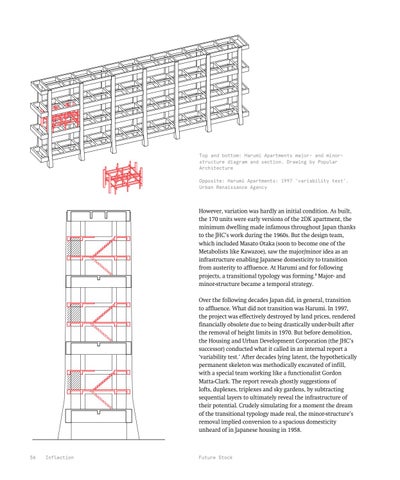
Top and bottom: Harumi Apartments major- and minorstructure diagram and section. Drawing by Popular Architecture Opposite: Harumi Apartments: 1997 'variability test'. Urban Renaissance Agency
However, variation was hardly an initial condition. As built, the 170 units were early versions of the 2DK apartment, the minimum dwelling made infamous throughout Japan thanks to the JHC’s work during the 1960s. But the design team, which included Masato Otaka (soon to become one of the Metabolists like Kawazoe), saw the major/minor idea as an infrastructure enabling Japanese domesticity to transition from austerity to affluence. At Harumi and for following projects, a transitional typology was forming.8 Major- and minor-structure became a temporal strategy. Over the following decades Japan did, in general, transition to affluence. What did not transition was Harumi. In 1997, the project was effectively destroyed by land prices, rendered financially obsolete due to being drastically under-built after the removal of height limits in 1970. But before demolition, the Housing and Urban Development Corporation (the JHC’s successor) conducted what it called in an internal report a ‘variability test.’ After decades lying latent, the hypothetically permanent skeleton was methodically excavated of infill, with a special team working like a functionalist Gordon Matta-Clark. The report reveals ghostly suggestions of lofts, duplexes, triplexes and sky gardens, by subtracting sequential layers to ultimately reveal the infrastructure of their potential. Crudely simulating for a moment the dream of the transitional typology made real, the minor-structure’s removal implied conversion to a spacious domesticity unheard of in Japanese housing in 1958.
56
Inflection
Future Stock