localmatters
Do Divorcing Vermont Couples Get ‘Ownership’ or ‘Custody’ of the Family Pet? B Y K e n P i car d
06.25.14-07.02.14 SEVEN DAYS 16 LOCAL MATTERS
Luke Howard
SEVENDAYSvt.com
S
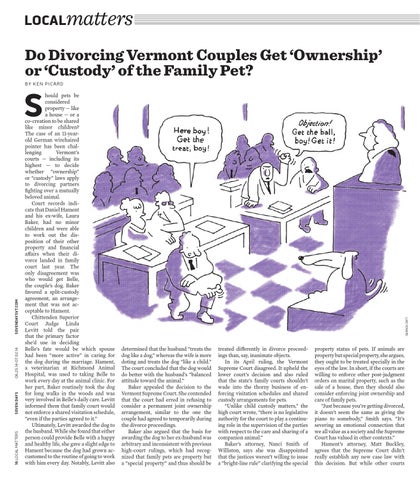
hould pets be considered property — like a house — or a co-creation to be shared like minor children? The case of an 11-yearold German wirehaired pointer has been challenging Vermont’s courts — including its highest — to decide whether “ownership” or “custody” laws apply to divorcing partners fighting over a mutually beloved animal. Court records indicate that Daniel Hament and his ex-wife, Laura Baker, had no minor children and were able to work out the disposition of their other property and financial affairs when their divorce landed in family court last year. The only disagreement was who would get Belle, the couple’s dog. Baker favored a split-custody agreement, an arrangement that was not acceptable to Hament. Chittenden Superior Court Judge Linda Levitt told the pair that the primary factor she’d use in deciding Belle’s fate would be which spouse had been “more active” in caring for the dog during the marriage. Hament, a veterinarian at Richmond Animal Hospital, was used to taking Belle to work every day at the animal clinic. For her part, Baker routinely took the dog for long walks in the woods and was very involved in Belle’s daily care. Levitt informed them that family court would not enforce a shared visitation schedule, “even if the parties agreed to it.” Ultimately, Levitt awarded the dog to the husband. While she found that either person could provide Belle with a happy and healthy life, she gave a slight edge to Hament because the dog had grown accustomed to the routine of going to work with him every day. Notably, Levitt also
determined that the husband “treats the dog like a dog,” whereas the wife is more doting and treats the dog “like a child.” The court concluded that the dog would do better with the husband’s “balanced attitude toward the animal.” Baker appealed the decision to the Vermont Supreme Court. She contended that the court had erred in refusing to consider a permanent joint ownership arrangement, similar to the one the couple had agreed to temporarily during the divorce proceedings. Baker also argued that the basis for awarding the dog to her ex-husband was arbitrary and inconsistent with previous high-court rulings, which had recognized that family pets are property but a “special property” and thus should be
treated differently in divorce proceedings than, say, inanimate objects. In its April ruling, the Vermont Supreme Court disagreed. It upheld the lower court’s decision and also ruled that the state’s family courts shouldn’t wade into the thorny business of enforcing visitation schedules and shared custody arrangements for pets. “Unlike child custody matters,” the high court wrote, “there is no legislative authority for the court to play a continuing role in the supervision of the parties with respect to the care and sharing of a companion animal.” Baker’s attorney, Nanci Smith of Williston, says she was disappointed that the justices weren’t willing to issue a “bright-line rule” clarifying the special
property status of pets. If animals are property but special property, she argues, they ought to be treated specially in the eyes of the law. In short, if the courts are willing to enforce other post-judgment orders on marital property, such as the sale of a house, then they should also consider enforcing joint ownership and care of family pets. “Just because you’re getting divorced, it doesn’t seem the same as giving the piano to somebody,” Smith says. “It’s severing an emotional connection that we all value as a society and the Supreme Court has valued in other contexts.” Hament’s attorney, Matt Buckley, agrees that the Supreme Court didn’t really establish any new case law with this decision. But while other courts