LOCALmatters
Emails Reveal Tensions, Doubt as Burlington School Budget Deficit Emerged
EDUCATION
B Y ALI CI A FR EESE
16 LOCAL MATTERS
SEVEN DAYS
06.11.14-06.18.14
SEVENDAYSVT.COM
I
n math, it’s customary to “show your work.” That’s because the calculations en route to a solution may reveal more about the student than his or her final answer. The same could be said of the Burlington School District, but officials skipped over some key steps when explaining its recent budget crisis. In mid-April, as news about the district’s finances grew more alarming, Patrick Halladay, the school board chair, ordered superintendent Jeanne Collins to stop talking to the media. By mid-May, Collins agreed to resign, effective June 30, but she and the board also signed a legal vow of silence. The resignation of her finance director, David Larcombe, the following day generated no more information about the situation. In search of a fuller and unscripted account of what went awry, Seven Days asked for emails dating back to December exchanged among Collins, Larcombe and four key board members: current chair Patrick Halladay, former chair Alan Matson, current finance committee chair Miriam Stoll and Keith Pillsbury, the former finance chair, who is also resigning on June 30. The roughly 3,300 pages Seven Days received provide a behindthe-scenes view of this year’s budget planning process, during which calculations changed daily and various conflicts arose. Shortly after voters rejected the first budget proposal, the public learned that it had been calculated incorrectly. Last week, a higher budget that corrects for those errors passed by 68 votes; a recount determined the final margin was 71 votes. There’s no smoking gun or “gotcha” moment in the emails, but they illustrate the breakdown in relations between Collins and the board. Tensions between them predated the discovery of the fiscal year 2014 deficit and the errors contained within 2015 budget proposal. In an email from early January, Matson posed what turns out to be the $2.5 million question.
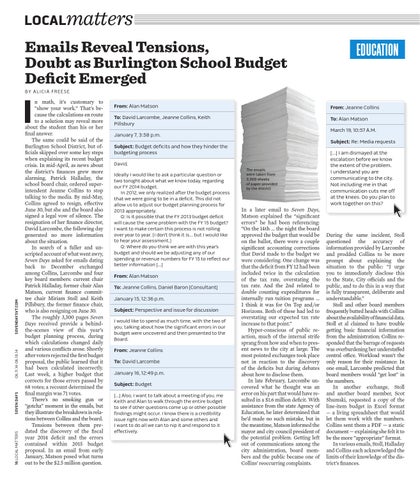
From: Alan Matson
From: Jeanne Collins
To: David Larcombe, Jeanne Collins, Keith Pillsbury
To: Alan Matson March 19, 10:57 A.M.
January 7, 3:58 p.m.
Subject: Re: Media requests
Subject: Budget deficits and how they hinder the budgeting process David, Ideally I would like to ask a particular question or two tonight about what we know today, regarding our FY 2014 budget. In 2012, we only realized after the budget process that we were going to be in a deficit. This did not allow us to adjust our budget planning process for 2013 appropriately. Q: Is it possible that the FY 2013 budget deficit will cause the same problem with the FY 15 budget? I want to make certain this process is not rolling over year to year. (I don’t think it is… but I would like to hear your assessment.) Q: Where do you think we are with this year’s budget and should we be adjusting any of our spending or revenue numbers for FY 15 to reflect our better information […]
From: Alan Matson To: Jeanne Collins, Daniel Baron [Consultant] January 15, 12:36 p.m. Subject: Perspective and issue for discussion I would like to spend as much time, with the two of you, talking about how the significant errors in our budget were uncovered and then presented to the Board.
From: Jeanne Collins To: David Larcombe January 16, 12:49 p.m. Subject: Budget […] Also, I want to talk about a meeting of you, me Keith and Alan to walk through the entire budget to see if other questions come up or other possible findings might occur. I know there is a credibility issue right now with Alan and some others and I want to do all we can to nip it and respond to it effectively.
The emails were taken from 3,300 sheets of paper provided by the district
In a later email to Seven Days, Matson explained the “significant errors” he had been referencing: “On the 14th ... the night the board approved the budget that would be on the ballot, there were a couple significant accounting corrections that David made to the budget we were considering. One change was that the deficit from FY 12 had been included twice in the calculation of the tax rate, overstating the tax rate. And the 2nd related to double counting expenditures for internally run tuition programs ... I think it was for On Top and/or Horizons. Both of these had led to overstating our expected tax rate increase to that point.” Hyper-conscious of public reaction, much of the internal strife sprang from how and when to present news to the city at large. The most pointed exchanges took place not in reaction to the discovery of the deficits but during debates about how to disclose them. In late February, Larcombe uncovered what he thought was an error on his part that would have resulted in a $1.6 million deficit. With assistance from the state Agency of Education, he later determined that he’d made no such mistake, but in the meantime, Matson informed the mayor and city council president of the potential problem. Getting left out of communications among the city administration, board members and the public became one of Collins’ reoccurring complaints.
[…] I am dismayed at the escalation before we know the extent of the problem. I understand you are communicating to the city. Not including me in that communication cuts me off at the knees. Do you plan to work together on this?
During the same incident, Stoll questioned the accuracy of information provided by Larcombe and prodded Collins to be more prompt about explaining the situation to the public: “I urge you to immediately disclose this to the State, City officials and the public, and to do this in a way that is fully transparent, deliberate and understandable.” Stoll and other board members frequently butted heads with Collins about the availability of financial data. Stoll et al claimed to have trouble getting basic financial information from the administration; Collins responded that the barrage of requests was overburdening her understaffed central office. Workload wasn’t the only reason for their resistance: In one email, Larcombe predicted that board members would “get lost” in the numbers. In another exchange, Stoll and another board member, Scot Shumski, requested a copy of the line-item budget in Excel format — a living spreadsheet that would let them work with the numbers. Collins sent them a PDF — a static document — explaining she felt it to be the more “appropriate” format. In various emails, Stoll, Halladay and Collins each acknowledged the limits of their knowledge of the district’s finances.