PHOTOS COURTESY OF NOMAD AIRSTREAM
Silver Bullet
Plattsburgh’s Nomad Airstream is king of the customized travel trailers BY KEN PI CA RD
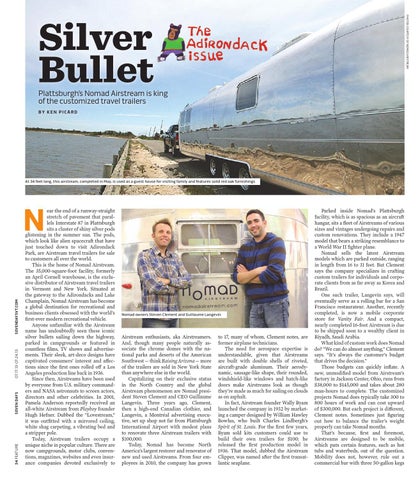
At 34 feet long, this airstream, completed in May, is used as a guest house for visiting family and features solid red oak furnishings
34 FEATURE
SEVEN DAYS
07.17.13-07.24.13
SEVENDAYSVT.COM
N
ear the end of a runway-straight stretch of pavement that parallels Interstate 87 in Plattsburgh sits a cluster of shiny silver pods glistening in the summer sun. The pods, which look like alien spacecraft that have just touched down to visit Adirondack Park, are Airstream travel trailers for sale to customers all over the world. This is the home of Nomad Airstream. The 35,000-square-foot facility, formerly an April Cornell warehouse, is the exclusive distributor of Airstream travel trailers in Vermont and New York. Situated at the gateway to the Adirondacks and Lake Champlain, Nomad Airstream has become a global destination for recreational and business clients obsessed with the world’s first-ever modern recreational vehicle. Anyone unfamiliar with the Airstream name has undoubtedly seen these iconic silver bullets sailing down the highway, parked in campgrounds or featured in countless films, TV shows and advertisements. Their sleek, art-deco designs have captivated consumers’ interest and affections since the first ones rolled off a Los Angeles production line back in 1936. Since then, Airstreams have been used by everyone from U.S. military commanders and NASA astronauts to screen actors, directors and other celebrities. In 2001, Pamela Anderson reportedly received an all-white Airstream from Playboy founder Hugh Hefner. Dubbed the “Lovestream,” it was outfitted with a mirrored ceiling, white shag carpeting, a vibrating bed and a stripper pole. Today, Airstream trailers occupy a unique niche in popular culture. There are now campgrounds, motor clubs, conventions, magazines, websites and even insurance companies devoted exclusively to
Nomad owners Steven Clement and Guillaume Langevin
Airstream enthusiasts, aka Airstreamers. And, though many people naturally associate the chrome domes with the national parks and deserts of the American Southwest — think Raising Arizona — more of the trailers are sold in New York State than anywhere else in the world. Capitalizing on their exclusive status in the North Country and the global Airstream phenomenon are Nomad president Steven Clement and CEO Guillaume Langevin. Three years ago, Clement, then a high-end Canadian clothier, and Langevin, a Montréal advertising executive, set up shop not far from Plattsburgh International Airport with modest plans to renovate three Airstream trailers with $100,000. Today, Nomad has become North America’s largest restorer and renovator of new and used Airstreams. From four employees in 2010, the company has grown
to 17, many of whom, Clement notes, are former airplane technicians. The need for aerospace expertise is understandable, given that Airstreams are built with double shells of riveted, aircraft-grade aluminum. Their aerodynamic, sausage-like shape, their rounded, windshield-like windows and hatch-like doors make Airstreams look as though they’re made as much for sailing on clouds as on asphalt. In fact, Airstream founder Wally Byam launched the company in 1932 by marketing a camper designed by William Hawley Bowlus, who built Charles Lindbergh’s Spirit of St. Louis. For the first few years, Byam sold kits customers could use to build their own trailers for $100; he released the first production model in 1936. That model, dubbed the Airstream Clipper, was named after the first transatlantic seaplane.
Parked inside Nomad’s Plattsburgh facility, which is as spacious as an aircraft hangar, sits a fleet of Airstreams of various sizes and vintages undergoing repairs and custom renovations. They include a 1947 model that bears a striking resemblance to a World War II fighter plane. Nomad sells the latest Airstream models which are parked outside, ranging in length from 16 to 31 feet. But Clement says the company specializes in crafting custom trailers for individuals and corporate clients from as far away as Korea and Brazil. One such trailer, Langevin says, will eventually serve as a rolling bar for a San Francisco restaurateur. Another, recently completed, is now a mobile corporate store for Vanity Fair. And a compact, nearly completed 16-foot Airstream is due to be shipped soon to a wealthy client in Riyadh, Saudi Arabia. What kind of custom work does Nomad do? “We can do almost anything,” Clement says. “It’s always the customer’s budget that drives the decision.” Those budgets can quickly inflate. A new, unmodified model from Airstream’s factory in Jackson Center, Ohio, runs from $38,000 to $145,000 and takes about 280 man-hours to complete. The customized projects Nomad does typically take 300 to 800 hours of work and can cost upward of $300,000. But each project is different, Clement notes. Sometimes just figuring out how to balance the trailer’s weight properly can take Nomad months. That’s because, first and foremost, Airstreams are designed to be mobile, which puts certain features, such as hot tubs and waterbeds, out of the question. Mobility does not, however, rule out a commercial bar with three 50-gallon kegs