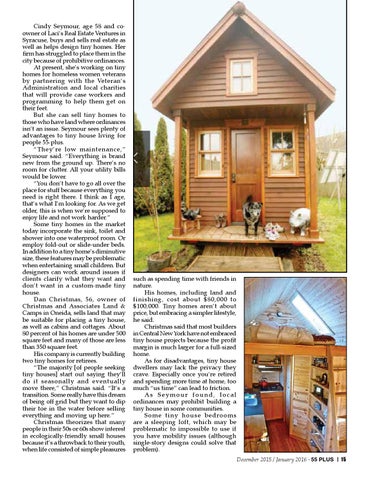
Cindy Seymour, age 58 and coowner of Laci’s Real Estate Ventures in Syracuse, buys and sells real estate as well as helps design tiny homes. Her firm has struggled to place them in the city because of prohibitive ordinances. At present, she’s working on tiny homes for homeless women veterans by partnering with the Veteran’s Administration and local charities that will provide case workers and programming to help them get on their feet. But she can sell tiny homes to those who have land where ordinances isn’t an issue. Seymour sees plenty of advantages to tiny house living for people 55-plus. “They’re low maintenance,” Seymour said. “Everything is brand new from the ground up. There’s no room for clutter. All your utility bills would be lower. “You don’t have to go all over the place for stuff because everything you need is right there. I think as I age, that’s what I’m looking for. As we get older, this is when we’re supposed to enjoy life and not work harder.” Some tiny homes in the market today incorporate the sink, toilet and shower into one waterproof room. Or employ fold-out or slide-under beds. In addition to a tiny home’s diminutive size, these features may be problematic when entertaining small children. But designers can work around issues if clients clarify what they want and don’t want in a custom-made tiny house. Dan Christmas, 56, owner of Christmas and Associates Land & Camps in Oneida, sells land that may be suitable for placing a tiny house, as well as cabins and cottages. About 80 percent of his homes are under 500 square feet and many of those are less than 350 square feet. His company is currently building two tiny homes for retirees. “The majority [of people seeking tiny houses] start out saying they’ll do it seasonally and eventually move there,” Christmas said. “It’s a transition. Some really have this dream of being off grid but they want to dip their toe in the water before selling everything and moving up here.” Christmas theorizes that many people in their 50s or 60s show interest in ecologically-friendly small houses because it’s a throwback to their youth, when life consisted of simple pleasures
such as spending time with friends in nature. His homes, including land and finishing, cost about $80,000 to $100,000. Tiny homes aren’t about price, but embracing a simpler lifestyle, he said. Christmas said that most builders in Central New York have not embraced tiny house projects because the profit margin is much larger for a full-sized home. As for disadvantages, tiny house dwellers may lack the privacy they crave. Especially once you’re retired and spending more time at home, too much “us time” can lead to friction. As Seymour found, local ordinances may prohibit building a tiny house in some communities. Some tiny house bedrooms are a sleeping loft, which may be problematic to impossible to use if you have mobility issues (although single-story designs could solve that problem). December 2015 / January 2016 - 55 PLUS
15