the demolition does not need to take place when the circular economy model is used.
236
Circular Economy
This percentage is set to cover the different ‘retrieve’ percentage for the different parts i.e. 60% for slab elements, 90% for columns etc. The ‘market value’ of this ‘saving’ due to the reduced amounts of building that has to be demolished traditionally has been determined by adding the same overhead costs as above. Based on these prerequisites, the ‘market value’ of these savings is about DKK 5.8 million (see table 02).
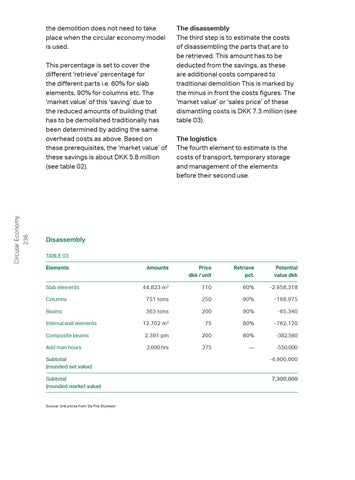
The disassembly The third step is to estimate the costs of disassembling the parts that are to be retrieved. This amount has to be deducted from the savings, as these are additional costs compared to traditional demolition This is marked by the minus in front the costs figures. The ‘market value’ or ‘sales price’ of these dismantling costs is DKK 7.3 million (see table 03). The logistics The fourth element to estimate is the costs of transport, temporary storage and management of the elements before their second use.
Disassembly TABLE 03 Elements
Amounts
Price dkk / unit
Retrieve pct.
Potential value dkk
44,823 m 2
110
60%
-2,958,318
Columns
751 tons
250
90%
-168,975
Beams
363 tons
Slab elements
Internal wall elements Composite beams Add man hours Subtotal (rounded net value) Subtotal (rounded market value) Source: Unit prices from ‘De Fire Styrelser’
200
90%
-65,340
2
75
80%
-762,120
2,391 pm
200
80%
-382,560
2,000 hrs
275
—
-550,000
12,702 m
-4,900,000 7,300,000