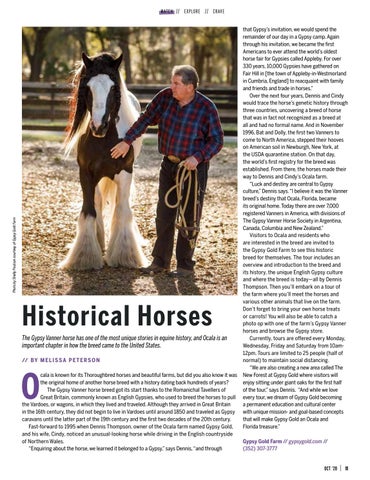
Photo by Shelly Paulson courtesy of Gypsy Gold Farm
WATCH // EXPLORE // CRAVE
Historical Horses The Gypsy Vanner horse has one of the most unique stories in equine history, and Ocala is an important chapter in how the breed came to the United States. // B Y M E L I S S A P E T E R S O N
O
cala is known for its Thoroughbred horses and beautiful farms, but did you also know it was the original home of another horse breed with a history dating back hundreds of years? The Gypsy Vanner horse breed got its start thanks to the Romanichal Tavellers of Great Britain, commonly known as English Gypsies, who used to breed the horses to pull the Vardoes, or wagons, in which they lived and traveled. Although they arrived in Great Britain in the 16th century, they did not begin to live in Vardoes until around 1850 and traveled as Gypsy caravans until the latter part of the 19th century and the first two decades of the 20th century. Fast-forward to 1995 when Dennis Thompson, owner of the Ocala farm named Gypsy Gold, and his wife, Cindy, noticed an unusual-looking horse while driving in the English countryside of Northern Wales. “Enquiring about the horse, we learned it belonged to a Gypsy,” says Dennis, “and through
that Gypsy’s invitation, we would spend the remainder of our day in a Gypsy camp. Again through his invitation, we became the first Americans to ever attend the world’s oldest horse fair for Gypsies called Appleby. For over 330 years, 10,000 Gypsies have gathered on Fair Hill in [the town of Appleby-in-Westmorland in Cumbria, England] to reacquaint with family and friends and trade in horses.” Over the next four years, Dennis and Cindy would trace the horse’s genetic history through three countries, uncovering a breed of horse that was in fact not recognized as a breed at all and had no formal name. And in November 1996, Bat and Dolly, the first two Vanners to come to North America, stepped their hooves on American soil in Newburgh, New York, at the USDA quarantine station. On that day, the world’s first registry for the breed was established. From there, the horses made their way to Dennis and Cindy’s Ocala farm. “Luck and destiny are central to Gypsy culture,” Dennis says. “I believe it was the Vanner breed’s destiny that Ocala, Florida, became its original home. Today there are over 7,000 registered Vanners in America, with divisions of The Gypsy Vanner Horse Society in Argentina, Canada, Columbia and New Zealand.” Visitors to Ocala and residents who are interested in the breed are invited to the Gypsy Gold Farm to see this historic breed for themselves. The tour includes an overview and introduction to the breed and its history, the unique English Gypsy culture and where the breed is today—all by Dennis Thompson. Then you’ll embark on a tour of the farm where you’ll meet the horses and various other animals that live on the farm. Don’t forget to bring your own horse treats or carrots! You will also be able to catch a photo op with one of the farm’s Gypsy Vanner horses and browse the Gypsy store. Currently, tours are offered every Monday, Wednesday, Friday and Saturday from 10am12pm. Tours are limited to 25 people (half of normal) to maintain social distancing. “We are also creating a new area called The New Forest at Gypsy Gold where visitors will enjoy sitting under giant oaks for the first half of the tour,” says Dennis. “And while we love every tour, we dream of Gypsy Gold becoming a permanent education and cultural center with unique mission- and goal-based concepts that will make Gypsy Gold an Ocala and Florida treasure.” Gypsy Gold Farm // gypsygold.com // (352) 307-3777 OCT ‘20
11