WATCH // EXPLORE // CRAVE
Photos courtesy of Florida State Parks
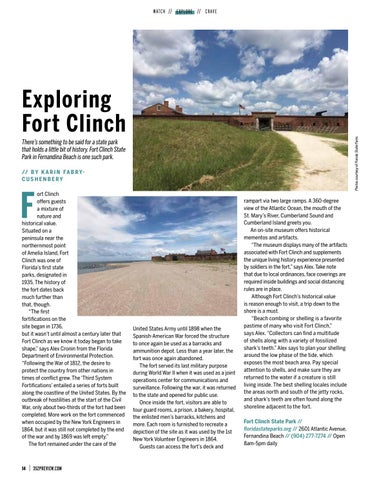
Exploring Fort Clinch There’s something to be said for a state park that holds a little bit of history. Fort Clinch State Park in Fernandina Beach is one such park. // B Y K A R I N F A B R YCUSHENBERY
F
ort Clinch offers guests a mixture of nature and historical value. Situated on a peninsula near the northernmost point of Amelia Island, Fort Clinch was one of Florida’s first state parks, designated in 1935. The history of the fort dates back much further than that, though. “The first fortifications on the site began in 1736, but it wasn’t until almost a century later that Fort Clinch as we know it today began to take shape,” says Alex Cronin from the Florida Department of Environmental Protection. “Following the War of 1812, the desire to protect the country from other nations in times of conflict grew. The ‘Third System Fortifications’ entailed a series of forts built along the coastline of the United States. By the outbreak of hostilities at the start of the Civil War, only about two-thirds of the fort had been completed. More work on the fort commenced when occupied by the New York Engineers in 1864, but it was still not completed by the end of the war and by 1869 was left empty.” The fort remained under the care of the
14
352PREVIEW.COM
United States Army until 1898 when the Spanish-American War forced the structure to once again be used as a barracks and ammunition depot. Less than a year later, the fort was once again abandoned. The fort served its last military purpose during World War II when it was used as a joint operations center for communications and surveillance. Following the war, it was returned to the state and opened for public use. Once inside the fort, visitors are able to tour guard rooms, a prison, a bakery, hospital, the enlisted men’s barracks, kitchens and more. Each room is furnished to recreate a depiction of the site as it was used by the 1st New York Volunteer Engineers in 1864. Guests can access the fort’s deck and
rampart via two large ramps. A 360-degree view of the Atlantic Ocean, the mouth of the St. Mary’s River, Cumberland Sound and Cumberland Island greets you. An on-site museum offers historical mementos and artifacts. “The museum displays many of the artifacts associated with Fort Clinch and supplements the unique living history experience presented by soldiers in the fort,” says Alex. Take note that due to local ordinances, face coverings are required inside buildings and social distancing rules are in place. Although Fort Clinch’s historical value is reason enough to visit, a trip down to the shore is a must. “Beach combing or shelling is a favorite pastime of many who visit Fort Clinch,” says Alex. “Collectors can find a multitude of shells along with a variety of fossilized shark’s teeth.” Alex says to plan your shelling around the low phase of the tide, which exposes the most beach area. Pay special attention to shells, and make sure they are returned to the water if a creature is still living inside. The best shelling locales include the areas north and south of the jetty rocks, and shark’s teeth are often found along the shoreline adjacent to the fort. Fort Clinch State Park // floridastateparks.org // 2601 Atlantic Avenue, Fernandina Beach // (904) 277-7274 // Open 8am-5pm daily