LEAP occupies a unique position in the legal software market as it includes traditional practice management and legal accounting attributes, document assembly and management, as well as many of the traditional legal publishing assets all in one solution.
Everything you need to run a law firm.
Final Call
When I took over as Editor of the Parchment in March 2009, the economic crash had shaken the country to its core. In my first editorial, I commented: “For younger members of the profession like myself, times are indeed uncertain. I am one of the approximately one thousand solicitors who are currently out of work. However, there is already an upturn in the number of new jobs coming available and as hope springs eternal, God willing – this trend will continue.” That trend did not continue.
By September 2009, the official number of legal professionals on social welfare was 1,522 and then thankfully the tide turned.
The legal landscape looked very different then. So did the world. We were emerging from recession, smartphones were only finding their way and the social media platforms that now dominate discourse were still in their infancy. The pace of change since then has been extraordinary, and the profession has not been immune to it. Firms have grown larger, practice areas have multiplied, technology has reshaped expectations, and the demographics of the profession have shifted dramatically. Through all of this evolution, The Parchment has remained a constant voice, sometimes outspoken but always rooted in the needs and experiences of Dublin solicitors. It has been the privilege of my career to help shape that voice.
In 2010, I returned to my native Mayo and opened my own practice in Castlebar. With no clients and no supports, my late mother joked that the only way from there was up. Thankfully, she was right. The practice has grown organically year on year, and today I have the privilege of serving as Managing Partner of a seven-solicitor firm looking after clients right across the country. However, balancing the demands of a very busy practice with the responsibilities of Editor has become increasingly challenging, and the time has come to pass the baton on.
A publication like this is, at its heart, a community project. Whatever small credit may come my way for its success belongs equally to the many people who have contributed tirelessly over the years. Columns, articles, interviews, practice notes, court reports, photographs, layout, proofreading, distribution, none of it happens in isolation. My role, more often than not, was to keep things moving, keep the content and the tone right and keep the magazine connected to its readers.
I owe particular thanks to our contributors, who have never hesitated to offer expert insights, challenging viewpoints and thoughtful analysis. Many have become fixtures of the magazine, and their voices will continue to be essential as the Parchment navigates its next chapter. The DSBA Council and committees over the past 16 years have been unwavering in their support, always recognising the value of a publication that reflects the realities of
practice in the capital.
Of course, no farewell would be complete without acknowledging the unique and talented committee that have stood with me over those years. Particular thanks to Keith Walsh, Stuart Gilhooly, Kevin O’Higgins, Justin McKenna, Gerry O’Connell, Aine Hynes, Julie Doyle, Joe O’Malley and Killian Morris. Their writings have pushed boundaries, provoked conversation, and ensured that the Parchment remained relevant, brave and willing to speak plainly when the profession needed it. For all of that, and for the many laughs along the way, I am sincerely grateful.
I would like to particularly thank Karen Hesse and Layla Hogan of 256 Media, who are the real architects behind the design and production of the Parchment. Their creativity, patience and unfailing professionalism have elevated every edition, and it has been a pleasure to work with them. The amazing Maura Smith at DSBA HQ has been a tremendous support to me and this publication over the years and she deserves a special mention.
As I step back, it would be remiss not to reflect on the broader question facing all traditional publications: what does the future look like in a digital world? The truth is that magazines like ours must continue to adapt. Whether read in print or on a phone, the value of the Parchment has never been merely in its format but in its content, its willingness to champion solicitors, to highlight challenges, to celebrate achievements and to hold a mirror up to the profession we all share. That mission remains as vital as ever.
I leave with enormous pride in what we have built together: a magazine that has earned national recognition, fostered debate, and at its best, given a voice to solicitors who too often feel unheard. Sixteen years feels like a long shift, but it has passed quickly, filled with great people and fulfilling work. I am honoured to have played my part. Whilst I am stepping away as Editor, I hope to continue to contribute to the Parchment as a writer and I look forward to undertaking future interviews and articles.
And to you the reader - thank you. For turning the pages, for stopping me at events to comment (favourably or otherwise), for caring about the issues, and for reminding me why this magazine matters. It has been a pleasure. It has been a privilege. And now, as all editors must eventually do, I turn the page.
John Geary jvgeary@gmail.com
Back row (left to right) –Patrick Longworth, Zoe Hughes, Cliona Costelloe, Darren Gray, Stefan O’Connor, Aine Gleeson, Jessica Hickey, Aileen Curry and Susan O’Halloran
Front row (left to right) –Niall Cawley, Avril Mangan, DSBA President Paul Ryan, Joan Doran, Ciara O’Kennedy, Eimear O’Doherty. MissingMarcus Hanahoe
COUNCIL 2025/2026
STEFAN O’CONNOR Vice Chair of Practice Management
EDITOR John Geary PARCHMENT COMMITTEE
Gerard O’Connell
Keith Walsh SC
Áine Hynes SC
Julie Doyle
Kevin O’Higgins
Stuart Gilhooly SC
Joe O’Malley
Killian Morris
COPYRIGHT The Dublin Solicitors Bar Association
PUBLISHED BY
The Dublin Solicitors Bar Association, Unit 206, The Capel Building, Mary’s Abbey, Dublin 7
DSBA OFFICE, T: 01 670 6089
F: 01 670 6090
E: maura@dsba.ie
DX 200206 Capel Building W: www.dsba.ie
ADVERTISING
ENQUIRIES Sharon Hughes T: 086 871 9600
The DSBA, its contributors and publisher do not accept any responsibility for loss or damage suffered as a result of the material contained in the Parchment.
DISCLAIMER
Advertisements are accepted at the discretion of the magazine which reserves the right to alter or refuse to publish any item submitted. Publication
of an advertisement in the Parchment does not necessarily signify of cial approval by the DSBA, and although every effort is made to ensure the correctness of advertisements, readers are advised that the association cannot be held responsible for the accuracy of statements made or the quality of the goods, services and courses advertised. All prices are correct at
time of going to press. Views expressed are not necessarily those of the DSBA or the publisher. No part of this publication may be reproduced in any form without prior written permission from the publishers.
DARREN GRAY Council Member
AILEEN CURRY Chair of Mental Health & Capacity Committee
MARCUS HANAHOE Chair of Litigation Committee
EIMEAR O’DOHERTY Honorary Secretary & Chair of In-House Committee
PAUL RYAN DSBA President
JOAN DORAN DSBA Vice President
CIARA O’KENNEDY Treasurer
AVRIL MANGAN Programmes Director/ Chair of the Practice Mgt Committee
ÁINE GLEESON Chair of Property Committee
ZOE HUGHES Council Member
SUSAN O’HALLORAN Council Member
JESSICA HICKEY Chair of Commercial Law Committee
CLIONA COSTELLOE Chair of Family Law Committee
PATRICK LONGWORTH Vice Chair of Litigation Committee
Employers’ Festive Playbook
December is always a busy time for employment lawyers and the organisations they advise. With preparations in full swing for the festive season, Melanie Crowley reviews the typical workplace issues encountered by employers and suggests 10 top tips for dealing with them successfully
1. Christmas party and liability for employers
Tip: Employers should ensure that employees understand that just because they are attending the Christmas party offsite, it does not mean that normal rules around appropriate workplace behaviour do not apply. Employees should be reminded that the Christmas party venue is treated as an extension of the workplace, meaning all dignity at work and bullying/ harassment policies remain in force.
2. You have been tagged
Tip: Not everyone wants their image shared on social media, whatever the intention of the poster. Employees should be reminded accordingly and warned against posting anything that could damage the employer’s reputation. Most employers cover this in their social media policy, but it’s always worth repeating.
3. The morning after the night before
Tip: Employers have an obligation to provide a safe place of work. Employers should inform all employees of their expectations that, should they report for work the day after the Christmas party, they must not be under the influence of alcohol or drugs.
4. ‘Secret Santa’
Tip: While ‘Secret Santa’ in the office is often seen as a bit of fun, the anonymity involved can sometimes
result in inappropriate, and even offensive, gifts being exchanged between colleagues. Employees should be encouraged to consider in advance of selecting a gift whether their choice might cause offence or be construed as bullying or harassment.
5. Religious and cultural differences
Tip: Not all employees are Christian and not all employees celebrate Christmas. Food offerings should, in so far as it is possible, provide for choice; and mocktails and non-alcoholic beverages should be as freely available as the alcoholic variety.
6. Deck the halls
Tip: Employers should ensure that Christmas trees and decorations do not block fire escape routes or exits, are not hazardous, and that any novelty lighting is checked for defects.
7. Public holidays
Tip: Full time employees are entitled to a paid day off on the public holiday, an additional day of annual leave, an additional day’s pay, or a paid day off within a month of the public holiday. Part time employees’ entitlements are different and should be checked.
8. Snow days
Tip: While the weather is still relatively mild, employers have an opportunity to put measures in place now to prepare for adverse weather in the coming months.
9. Sick days
Tip: Sometimes the excesses of the season can lead to an increase in sickness absence – some genuine, some self-inflicted. Employees are now entitled to be paid sick pay for the first 5 days of sick leave in any rolling 12 months period. This is subject to the requirement on the employee to provide a medical certificate from a registered medical practitioner and sick pay is capped at 70% of the employee’s daily rate or €110, or whichever is greater. The exception to this is a situation where an employer’s sick pay scheme, taken as a whole, is better than the statutory sick pay entitlement.
10. Inclusivity and accessibility
Tip: Ensure offsite locations are accessible to all employees and any guests who may be attending the event. Consider the impact on those with cognitive impairments. Consider language, signage and sign language.
Melanie Crowley is a partner and Head of Employment Law and Benefits at Mason Hayes & Curran
18 24 30
Employers’ Festive Playbook
Melanie Crowley reviews the typical workplace issues encountered by employers and suggests 10 top tips for dealing with them successfully
End of an Era
Stuart Gilhooly SC pays tribute to a tenure marked by steady leadership and sharp editorial judgment as Editor John Geary retires after 16 years leading the Parchment
Remote Working in Practice
Zoe Hughes assesses recent caselaw and says that it is important that employers are cognisant of the rights and obligations created by the Work Life Balance and Miscellaneous Provisions Act 2023
Custodian of a Legacy
John Geary interviews Valerie Peart who reflects on a family firm dating to the 19th century and why she still loves the work
DSBA Solicitors’ League
This years’ season is reviewed, which saw the first nonsolicitors team win the coveted annual cup!
Domestic Violence in the Courts
Keith Walsh SC highlights the scale of domestic violence currently before the civil courts and briefly considers some of the pros and cons of criminalisation of domestic abuse/violence
With the Law Society standards work and the next generation ready to lead, I’m confident for our clients and our colleagues page 18
CUSTODIAN OF A LEGACY... VALERIE PEART
34
DSBA Annual Conference 2025
The DSBA held a very successful annual conference in Rome, Italy from 18-21 September 2025. Check out some of the photos!
Victims’ Compensation Overhaul?
Gavan Carty examines the significant implications of the recent CJEU ruling which challenges longstanding limitations in Ireland’s Criminal Injuries Compensation Scheme
Redefining Nervous Shock
Kevin Kelly BL reviews the current position, examines the leading caselaw and reflects on the implications for practitioners
Delay at your peril
Kate Lyttle summarises two recent High Court judgments that provide helpful guidance and clarification on the application of the Kirwan test in practice
Landlord Alert: Major Rental Reforms Ahead
Colm Farrell outlines the proposed major reforms to Ireland’s rental laws, with new rules applying to tenancies starting on or after 1 March 2026
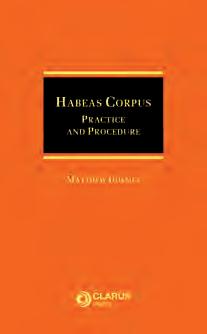
Habeas Corpus: Practice and Procedure
Susan Martin reviews this timely examination of habeas corpus, emphasising its function as a critical protection when an individual’s liberty is curtailed
Message from the President
Looking Ahead
Welcome to this winter edition of The Parchment, and to this, my first message as the newly elected President of the Dublin Solicitors Bar Association.
This edition is a significant one, as it marks the final edition from our editor, John Geary. After 16 years of exemplary service, dedication, and invaluable stewardship of this magazine, he is stepping down. On behalf of myself and the entire Association, I extend our deepest gratitude to John for his lasting contribution.
I also want to pay tribute to my predecessor, Niall Cawley. His work and focus and dedication to the Association have always been very much appreciated, and like his predecessors Niall has generously agreed to continue to contribute to the Association as immediate Past President.
A special thanks must also go to our office staff, Maura, Anna and Antoinette, for their wonderful work in our office. Without them, we could not put on all of our events throughout the year or manage the day-today running of the Association. Furthermore, my sincere thanks go to all members of our Association, our Council, and our committees for all of their voluntary work. Your dedication and time are invaluable to the work of the DSBA.
As I begin my term as President of the Dublin Solicitors Bar Association, I am deeply conscious of the honour of serving an organisation that has supported Dublin solicitors for ninety years. Since its founding in 1935, the DSBA has stood for collegiality, professional excellence, and mutual support – values that feel more important today than ever.
The practice of law is changing at a pace none of us could have predicted even a decade ago. AI and automation are reshaping how we research, draft, and communicate. Hybrid and remote working have altered how we relate to colleagues and clients. The growth of in-house roles, new regulatory obligations, and the pressures of constant connectivity add new layers of complexity to our daily practices. These developments present both opportunities and challenges, and our profession must continue to adapt with purpose and confidence.
In this environment, creativity is an essential skill for the modern solicitor. Creativity in the law is not about abandoning rigour or precedent; it is about applying our knowledge and judgment in fresh and
imaginative ways. It is the ability to find room to negotiate where others standoff, to find a practical path through a difficult dispute, or to see solutions where none appear obvious. Creativity is simply problemsolving with curiosity – and it lies at the very heart of good legal practice.
I firmly believe that one of the best ways to nurture your legal creativity is through participation in the DSBA. Whether you attend our CPD seminars and events, contribute to Committee work, help produce practical precedent documents or write for The Parchment, you are engaging with ideas and perspectives beyond the four walls of your own office. That cross-pollination of experience is invaluable for everyone. It keeps our thinking sharp, our practice adaptable, and our profession vibrant.
Collegiality is central to who we are. In an era of remote work and dispersed teams, staying connected to our professional community is both grounding and energising. The DSBA provides that connectionthrough events, education, publications, and, importantly, through our Consult a Colleague helpline, where solicitors generously support one another in moments of professional difficulty.
This year the Association continues to maintain a robust programme of education
while at the same time focusing on promoting collegiality among our members. The Association also continues to advocate strongly on behalf of the profession. Our committees prepare considered submissions to government and regulatory bodies and engage constructively with the Law Society, the LSRA, and the Courts Service. This work is done quietly but tirelessly by volunteers whose commitment strengthens the profession for all.
As we look toward the DSBA’s centenary in 2035, we have an opportunity not just to celebrate our past but to shape our future. Over the coming year, I hope to begin the conversation with as many members as possible about what the next century of the DSBA should look like - how we can continue to lead, support, and innovate in service of our colleagues and the rule of law.
It is a privilege to serve as President, and I look forward to a year of connection, creativity and collaboration. Our profession has always risen to meet change with resilience and ingenuity. With the continued commitment of our members, the future of the DSBA - and of Dublin solicitors - is bright.
Paul Ryan DSBA President
LAW SOCIETY DIPLOMA CENTRE
SAVE THE DATE!
Next year’s DSBA Annual Conference will take place in Munich, Germany, from Thursday 10th September - Sunday 13th September 2026. Brochure will be launched in early Spring 2026.
End of an Era
As John Geary retires after 16 years as editor of the Parchment, Stuart Gilhooly offers a heartfelt tribute to a tenure marked by steady leadership, sharp editorial judgment, and a magazine that evolved with a rapidly changing profession
Sixteen years. There are murderers serving life sentences who got out in less. John Geary though, always willing, never flustered, did it on his back. It’s traditional on these occasions to look back at the times we lived in to illustrate the longevity of his time at the helm of the Parchment and this column has never been one to pass up a well-worn cliché.
So here goes. In 2009, when Keith Walsh (his immediate predecessor and successor) – the John O’Shea of Parchment editors – stepped down to concentrate on his sanity, the world was a very different place. Donald Trump was still a pantomime reality TV star whose chief claim to fame apart from the Apprentice was a cameo in Home Alone 2, Brexit was not even a literary abomination, Simon Harris had not yet been elected a TD and Manchester United were the best team were in Europe. On the other hand, Putin was still terrorising the world and the Irish football team were finding ways to nearly get to the World Cup but not quite manage it so maybe some things don’t change.
The legal profession has changed immeasurably since then and, with it, the Parchment magazine has grown and evolved. A glimpse at the first edition will see the
concentration on what we might now term small firm specialities such as conveyancing, probate and personal injuries.
They remain existentially important for the large number of 1-5 solicitor firms all over the country but these firms have dwindled in percentage terms and a new landscape has emerged.
Dublin now boasts at least 20 firms/institutions with over 80 solicitors. Over two-thirds of all practising solicitors are based in Dublin and over 20% countrywide are working in-house.
Well over half of all solicitors are female and this trend will continue upwards for the foreseeable future as the numbers qualifying continue to dwarf their male counterparts.
John has watched the trends like a hawk and the magazine has moved with the times. The articles are diverse and more centred towards a multi-speciality profession. Of course, most readers still just look at the pictures which remain staples of the front and back of the magazine.
John’s stewardship also saw the magazine take up a regular December slot at the Irish Magazine Awards where it was invariably shortlisted for the magazine of the year and I was frequently nominated as journalist of the year. The IMAs are sadly casualty of the global
On many occasions, I tested his patience by pushing the boat way beyond where most conservative editors would tolerate. John took a view that as long we weren’t insulting or libelling anyone, it was fair game
decline in magazine readership but for nearly ten years, we punched way above our weight. This was a direct consequence of John’s light touch leadership. On many occasions, I tested his patience by pushing the boat way beyond where most conservative editors would tolerate. John took a view that as long we weren’t insulting or libelling anyone, it was fair game.
For far too long, the legal profession played nicely. We put a stop to that and said what we thought and needed to be heard. Our members expect us to speak out and not always be the fall guys for the latest populist stunt by the insurance industry or the government who know we are whipping boys no one tires of seeing under the cosh.
needs to stand up for our rights. How we do this in the digital age is a challenge and it may be time for a rethink. With nearly two-thirds of the profession under the age of 50, the time is fast approaching where magazines will be obsolete. How many people reading this today will do so on paper? I fear a lot fewer than 16 years ago. And in 16 years’ time, no one will. In six years’ time, maybe no one will.
Nothing lasts forever and John did remarkably well to last as long as he did. A very busy and successful practitioner in Mayo, it’s miraculous that his show stayed on the road for so long. Keith Walsh takes over the reins temporarily, but he remains the enigma that seems to cram more work into a week than there are hours so that can’t last.
The DSBA, and the legal profession in general, need to decide how we are communicating with our members under 40, millennials who have lived their adult lives on smart phones and don’t ever buy magazines or newspapers. For the time being, Instagram and Tik Tok will entertain them. Soon, it will be something else.
The profession remains on the back foot and the DSBA, through the voice of its flagship magazine, P
In the meantime, here is to the finest editor this magazine has seen, by some distance. We were lucky to have him for so long and we will miss him greatly. We won’t see his like again.
Stuart Gilhooly, John Geary (centre) and Dr Günther Grun (AKA Comedian Barry Murphy) at the Irish Magazine Awards
Above: The Parchment tastes success at the Irish Magazine Awards. Pictured L-R: Gerry O’Connell, John Geary, Stuart Gilhooly, Maura Smith, Eamonn Shannon and Keith Walsh
Remote Working in Practice
Remote working remains a significant feature of the workplace in Ireland. Zoe Hughes assesses recent caselaw and says that it is important that employers are cognisant of the rights and obligations created by the Work Life Balance and Miscellaneous Provisions Act 2023
The Central Statistics Office Labour Force survey for Q2 2025 records that 2,818,100 people aged 15 and over were in employment in Ireland in Q2. Of those, 35.9% of the work force confirmed they either usually or sometimes work from home. Reflective of this, a recent search on LinkedIn’s job search platform shows 28,521 jobs listed for Ireland with 5,657 of those advertised as being remote and 6,570 as being hybrid (a combined total of 42.9%).
In view of the prevalence of remote working, it is important that employers are fully aware of the parameters of the legal framework and the emerging case-law, which will be examined in turn below.
The Law
Part 3 of the Work Life Balance and Miscellaneous Provisions Act 2023 (“the Act”), which came into force on 6 March 2024, governs the making of requests for remote working arrangements (“RWA”) by employees. What the Act does not do is create a right to work remotely. Rather, it creates a right to request an RWA and provides for a formal framework, including relevant timeframes, within which such requests should be processed by an employer.
The WRC has prepared a detailed Code of Practice on the Right to Request Flexible Working and the Right to Request Remote Working (“the Code”). The Code is given a statutory footing under s 31(5) of the Act and S.I. No. 92 of 2024. The stated purpose of the Code is to provide guidance to employers and employees in relation to how requests for RWAs are made and handled. In addition, the Code provides a template to aid employers in developing a work-life balance policy and a template application for remote working.
What is an RWA?
An RWA is defined in the Act as an arrangement where some or all of the work ordinarily carried out by an employee is provided at a location other than the employer’s place of business and without change to their ordinary working hours or duties (section 16). As such, it would incorporate an arrangement where an employee works fully remotely or a hybrid arrangement. It appears this would also capture a situation where an employee worked fully/partly from a hub that was not the employer’s place of business. The relevant provisions of the Act apply equally to full, parttime and fixed-term employees and it is not possible to contract out of the rights established by the Act.
Employee’s right to request an RWA
Section 20 of the Act entitles employees to request approval from their employer for an RWA. An employee must have six months continuous employment prior to the commencement of an RWA. The request by the employee must:-
a) Be in writing and signed by the employee;
b) Specify the details of the proposed RWA, including the commencement date and, if applicable, the expiration date;
c) The reasons for the request;
d) Contain information on the suitability of the proposed location. In this regard, the Code details a list of matters that should be addressed by the employee, including, where relevant, confirmation that the work-station would be suitable having regard to requirements around health and safety, privacy/confidentiality, data protection, etc. The request must be submitted no later than eight weeks before the proposed commencement date. An employee who has submitted a request is required to
provide such further information as the employer may reasonably require.
Employer’s obligation to consider the request
Section 21 provides that, on receipt of a request for a RWA, the employer must consider the request, having regard to:-
a) The employer ’s business needs;
b) The employee’s needs;
c) The requirements of the Code. In this respect, the Code sets out a series of non-exhaustive matters the employer might consider, for example:-
a) In respect of the role: the type of work and key duties of the employee; if they can be performed remotely; if face-to-face meetings with clients/ customers are required; any impact on service quality or organisational operations.
b) In respect of the employee: if they have the necessary IT skills to work remotely; the level of supervision they require; if they have met performance standards and attendance requirements; if they need to be on-site for professional development or collaboration with colleagues.
The employer must respond to the employee, in writing, no later than four weeks after receipt of the request. The response must:-
1. Confirm approval of the request and include an agreement to be signed and retained by the employer and employee which sets out the details of the RWA; or
2. Confirm refusal of the request and set out the reasons for same; or
3. Notify the employee that further time is required to consider the request. The total period cannot exceed eight weeks.
Employers should note that the Code provides further detailed guidance as to how to consider requests for RWAs and it would be advisable to be aware of same in dealing with these requests.
Termination of an RWA
Section 22 provides that where an RWA is in place, an employer may terminate it (thereby requiring the employee to return to their original working arrangement) if the RWA would or is having a substantial adverse effect on the operation of the business, profession or occupation, due to:-
a) seasonal variations in the volume of the work;
b) the unavailability of a person to carry out the duties of the employee in the employer’s place of business, c) the nature of the duties of the employee in the employment, or d) any other matters relevant to the substantial adverse effect on the operation of his or her business, profession or occupation.
In effecting any termination, the employer is required to have regard to the employer’s needs, the employee’s needs, and the requirements of the Code, as discussed above. The employer must give a minimum of four weeks’ notice where the RWA did not already have an expiration date.
Before giving notice of termination of the RWA, the employer must first notify the employee in writing of the proposal to terminate the RWA and this notice should:-
a) Contain a statement in summary form of the grounds for terminating the RWA;
b) Contain a statement that the employee may, within seven days of the receipt of the notice, make representation to the employer in relation to the proposal.
Zoe Hughes is a solicitor working at the Chief State Solicitor’s Office
In case of a finding against an employer in respect of any other entitlements of an employee under Part 3 of the Act, an Adjudicator may award compensation to an employee to a maximum of four weeks’ remuneration
The Code stresses that an employer should consider any representations by the employee and ensure that any decision to terminate an RWA is objective, fair and reasonable.
Alteration of an RWA
Section 23 provides for changes to RWAs to be made by agreement between the employer and employee.
Return to original working arrangement
Section 24 makes provision for the employee to request a return to their original working arrangement and that the employer must consider such a request and respond to the employee within four weeks after receipt of the request.
Abuse of an RWA
Where so many employees are engaged in some degree of remote working, it is important to consider the protections for employers in the Act where there is abuse of those arrangements. Section 25 provides that an RWA is subject to the condition that the employee continues to discharge all of their duties of employment in accordance with the agreement for an RWA.
Where an employer has reasonable grounds to believe the employee is not discharging all of their duties, the employer is entitled to terminate the RWA. It is important to note that section 25 and the Code set out what process must be followed before a final decision in relation to terminating an RWA is made. In these circumstances, the employer must firstly notify the employee of the proposal to terminate the RWA. This notice must:-
a) Contain a statement of the grounds for terminating the RWA;
b) Contain a statement that the employee may, within seven days of the receipt of the notice, make representation to the employer in relation to the proposal.
The employer must consider any representations made by the employee prior to making a final decision to issue a termination notice. Any termination notice must:-
a) Be in writing;
b) Contain a statement of the grounds for terminating the RWA;
c) Specify the date on which the employee must return to work on site (at least seven days’ notice must be given to the employee).
Protection against Penalisation
Section 26 prohibits an employer from penalising an employee for exercising their rights under the Act.
Redress
Section 27 of the Act deals with Redress. Where an Adjudicator finds a breach of section 21 or 24 of the Act, they are empowered to direct an employer to comply with their obligations to consider a request; to notify the employee of the approval or refusal of the request; and/or to award compensation to the employee (with a maximum of four weeks’ remuneration). In case of a finding against an employer in respect of any other entitlements of an employee under Part 3 of the Act, an Adjudicator may
award compensation to an employee to a maximum of four weeks’ remuneration.
It is important to note that an Adjudicator and the Labour Court are expressly prohibited from assessing the merits of the employer’s decision following their consideration of a request for an RWA; decision to terminate an RWA; or refusal of a request to return to a prior working arrangement.
Requirement to keep records
Pursuant to section 28, an employer is required to keep records of approved RWAs for three years. It is an offence under the Act to fail to do so.
The Case Law
Having considered the legislation, it is also important to look at how the WRC is applying the Act in practice.
The WRC published its Report on Complaints under the Work Life Balance and Miscellaneous Provisions Act, 2023 updated as of 17 November 2025. By that date, the WRC had received 60 complaints seeking adjudication under the Act. Of those 60 cases, 36 were resolved as follows:-
• Rejected: 11
• Upheld: 1
• Resolved by mediation: 5
• Withdrawn: 19
Complaints to the WRC
At the time of writing, the WRC has published 13 decisions in respect of a complaint under the Act. It is notable that in 10 of the 13 cases, the WRC deemed the claim to be ‘not well founded’. In four of these, the employee did not attend the hearing and the Adjudicator consequently determined the complaint to be not well founded due to lack of evidence. In one case, the Adjudicator determined the matter not well founded as the employee made the request for an RWA prior to the commencement of the Act. In another case, the claimant withdrew their complaint under the Act mid-hearing. The other seven decisions of the WRC are discussed in turn below.
In Alina Karabko v TikTok Technology Ltd, ADJ00051600, 24 July 2024, the employee worked fully remotely during the Covid-19 pandemic. She joined TikTok in January 2022 and her contract stipulated her place of work was in Dublin but due to the pandemic she may have to work from other locations including her own home. TikTok subsequently implemented a return to office policy requiring employees to work in office at least three days a week. When the employee failed to return to office a disciplinary process commenced and she was issued with a verbal warning. Subsequently, she submitted a request to work fully remotely as it would reduce her daily commute and carbon footprint; improve her quality of life; and due to a lack of suitable accommodation in Dublin for her and her cat. Having considered the request and return to office policy, the employer rejected it as they believed in-person presence is crucial for team engagement and effective training. In its decision, the Adjudicator noted TikTok engaged in an objective decision-making process and issued a reasoned outcome. In addition, the Adjudicator noted that the Act limits their role to assessing whether an employer considered a request for remote working in line with section 21 and in
accordance with the Code; accordingly, they are not empowered to investigate the merits of the employer’s decision. The complaint was dismissed.
In Rafael Andrade Jorge v Centric Mental Health, ADJ-00051008, 9 October 2024, the employee’s contract was amended to permit a fully remote working arrangement. He relocated to Tralee while his office was based in Dublin. Thereafter, as business needs had changed, the employer required support staff to attend the office two days per week. Following consultation, the employer was willing to accept one day in the office per month. Noting the contract permitted a change to the terms following consultation, the Adjudicator found the Employer had the legal right to change the contract term and that a requirement to work one day a month in the office was reasonable. In determining that the complaint was not well founded, and in line with the position in Karabko, the Adjudicator noted, “The task before me is to look at the process followed by the Company in refusing the request and not the merits of that decision… In all respects the Company has met the requirements in the Act relating to assessing business needs and the employee’s needs and communicating in writing to him about the reason for not approving full remote working at home.”
Highlighting the need for employees to follow the procedural rules set out in the Act, in Dienifer Taylor v Microchip Technology Ireland Limited, ADJ-00053037, 1 November 2024, the Adjudicator determined the complaint was not well founded as the employee had failed to submit a request for increased remote working in writing as is required in section 20. Consequently, the employer was not in receipt of a written application which they would have been obliged to consider and respond to. Although not directly relevant to the case, the Adjudicator reiterated that the WRC has no role in deciding on the merits of an application for an RWA; rather the role of the WRC is to ensure that the relevant processes contained in the Act have been followed by both parties. Whilst not making any finding against the employer, the Adjudicator was critical of the fact that they had no written policy in place setting out how requests for RWAs should be made.
In Javier Osorio v Cognizant Technology Solutions Ireland Limited, ADJ-00052414, 2 December 2024, the employee requested an RWA to work a maximum of two days a week in office so that he could balance the responsibilities of his job with caring for his 10-yearold daughter. Following a process of consideration and consultation, the request was rejected. The Adjudicator upheld the right of the employer to refuse the request where it has been properly considered by the employer, including considering the needs of the employee and the employer. The Adjudicator noted the employer’s failure to inform the employee that they needed additional time to consider the request. However, there were exceptional circumstances as 72 of the 380 employees applied for an RWA and it was necessary to consult a client company to consider the requests thus rendering it inevitable that it would take time to consider all of the requests. In the circumstances, notwithstanding the technical contravention of the four-week timeframe in the Act, the Adjudicator made no finding against the employer.
In Zaurbek Musaev v TikTok Technology Limited, ADJ-
00052437, 8 April 2025, the employee made a request for an RWA against a background which included a serious road traffic accident, which he was fortunate to survive. He stated the commute from Monaghan to the office in Dublin was very stressful for him and triggered traumatic recollections of the accident. The Adjudicator noted there was considerable engagement between the employer and employee in respect of his request and that once proper consideration is given to a request the statutory obligations of an employer are met. In the circumstances, the claim was dismissed.
In Thomas Farrell v Salesforce, ADJ-00052842, 9 April 2025, following implementation of a return to office policy requiring in office attendance of 3-4 days a week, the employee made a request to work fully remotely. He cited reasons including relocation due to his partner’s employment; in office attendance would entail a 550km round trip; he had proven performance in a remote capacity; and the return to office policy was inconsistently applied. The employer responded just over four weeks later to state they required more time to consider the request. A substantive decision issued six weeks and four days after the request was made rejecting the request and citing reasons including the need to promote collaboration/learning; the need for in-person meetings; and alignment with the employer’s global hybrid working strategy. The Adjudicator noted the employer gave no compelling reason for failing to respond in writing within four weeks’ as required under the Act, simply citing human error. As there was a failure to consider the request within the four-week deadline under the Act, the Adjudicator deemed the complaint to be well founded. In view of the minor nature of the delay, the Adjudicator awarded the employee €1,000 in compensation.
In Varvara Gintaliene v Cognizant Technology Solutions Ireland Limited, ADJ-00053903, 17 June 2025, the Adjudicator also found a technical breach of section 21 of the Act as the employer issued the refusal some five weeks after they received the request for an RWA. Notwithstanding the breach, the Adjudicator determined it did not merit any redress. In this respect, they noted it occurred at the time the employer was processing a large volume of applications; the employee’s proposed remote working start date was some weeks away and so the additional week taken to make the decision did not prejudice her; the employee did not raise the issue of delay in the internal appeal process indicating it had not been an obvious concern.
Conclusion
What is clear from the Act, and affirmed in the decisions of the WRC, is that an Adjudicator cannot compel an employer to grant a request for a remote working arrangement nor can it assess the merits of an employer’s decision in respect of such requests.
Cases in which the WRC has found against an employer involve technical breaches of the Act where the employer has failed to comply with a requirement to give a written decision/notice or the prescribed timeframe for same. In this respect, employers should ensure they have a clear procedure in place to deal with requests for RWAs as well as situations where termination or alteration of an RWA or abuse of an RWA may arise and that those procedures are in line with the Act and the Code. P
This article does not constitute legal advice. Any views or opinions expressed are personal to the writer and do not reflect the views or opinions of or advice from the Chief State Solicitor’s Office.
Custodian of a Legacy
Well into her fifth decade as a solicitor in Dublin, Valerie Peart has practised law in the capital since 1980. A leading conveyancer and probate adviser, she is perhaps best known as the Matriarch of Pearts Solicitors & Town Agents. In conversation with Parchment editor John Geary, she reflects on a family firm dating to the 19th century, stepping away to rear a family and then returning to the law, the changing rhythms of practice, and why she still loves the work
Law in the blood
Ask Valerie how she became a solicitor and she starts not with university, but with summer jobs. “I came into Pearts before I even started in UCD,” she recalls. “My Dad was the principal here, so there was a rite of passage. The minute I left school I was in here doing the work.”
She began her BCL in UCD in 1974, but in those days, she notes, the apprenticeship and Law Society exams, rather than the degree, was the direct path to qualification. “I had actually qualified as a solicitor before I concluded my BCL,” she says with a smile. She started in Pearts as a solicitor in 1980 and was married the same year.
The early years were busy, but life soon rebalanced. “By 1984, with a second child on the way, I left Pearts and set up on my own. Valerie Wade, Solicitor - a sole practice while I reared my four children.” Even then, she never quite left. “Town Agency is in the DNA. I’d come in on Mondays to do the
My Dad was the principal here, so there was a rite of passage. The minute I left school I was in here doing the work
Common Law lists and help during holidays. I kind of never really left Pearts, even though I physically left.”
Business model before its time
Pearts’ lineage is older than the State and stretches back to 1883, founded by Valerie’s Great Grandfather, Richard MacNamara. His daughter later married John R. Peart, a barrister who became a solicitor and took over the practice. Valerie’s father then entered practice with John R. and, crucially, saw the Dublin Town Agency as its own business.
“Dad built the Agency,” Valerie says simply. “He loved the country colleagues. Back in the 1940s he’d be in Central Office and spot other solicitors lodging papers as a favour. He’d say, ‘If you want to give me that, I’m here anyway — I’ll look after it.’ He realised there was a business in it. Not a sideline.”
By the time Valerie joined in the 1970s, the Agency was well established, her brother
The
satisfaction is making the difference. Getting the keys to a first-time buyer by Friday; holding a bereaved family’s hand and getting them through a probate they can’t face. It’s a privilege that comes with the job
Michael was already a solicitor in the firm, and the client ledger of ‘country colleagues’ ran into the hundreds. “He had about 600 country solicitors on the books,” Valerie notes. “We’ve grown that. The office today is still a busy place.”
A sudden call to lead
If there was a family assumption that Michael would one day lead the practice, judicial appointment rewrote the script. “I never had an expectation I would be principal,” she says. “Then Michael became a High Court judge in 2002 and there was a call to action. When you’re family, you don’t say no.” Within about ten days, she stepped in as principal of Pearts Solicitors.
Her own small practice came with her. “It all became Pearts again,” she says. Her husband, Gerard Wade, an accountant, joined as financial director. “Gerry was a
great asset. I couldn’t do the accounts, he couldn’t do the legal, and together we ran the business. He retired in January this year. I miss having him around the office. He made a great cup of tea and we’d chat about everything.”
Valerie’s voice warms most when speaking of her father. “I used to come in as a teenager; I loved being in the office around him. As an apprentice, I was with him daily, seeing him with clients. He made people feel better about their day. He didn’t flap. He was down-to-earth. He loved meeting the country colleagues — no frills, no fancy. He was a general practitioner — conveyancing and probate with a little litigation. While Town Agency meant understanding the personal attendances of a different Dublin: Dublin Castle, the Land Registry counters. He understood all of it,” she says.
Law then and now
“Everything has changed,” Valerie says of practice since 1980. “Digitisation, auto-everything, AI. We have to keep up. Technology has streamlined processes but it has introduced a new pressure – the instant expectation.
“You get an email at 4.45pm on a Friday and the client expects an answer. Instant communication isn’t necessarily better; it’s just quicker. You still have to think it out properly.” She laughs at a parenting analogy she once heard: when teenagers demand an immediate answer, the wisest response is often, ‘If you need the answer now you probably know it; if you let me think, I might have a better solution.’ “Clients can be similar,” she says. “A quick answer isn’t always the right one.”
Choosing identity
Valerie practised for years under her married name, “Valerie Wade”, a conscious choice. “People asked why I didn’t use Peart. I wanted people to choose me because it was me, not because I was a Peart.” When she returned as principal in 2002, she reverted to Peart for continuity. “It was important that the firm’s family continuity was visible. Same family but a different person at the helm.”
As for bias in the early 1980s? “There were fewer women, certainly, but I had
Photography: Bryan Meade
the confidence of my background and the freedom to chart my path. I stepped out when I needed to raise a family, then stepped back in when needed.”
People and Purpose
The present-day Pearts employs 25–30 people. The Town Agency client base, Valerie says, is “across the country and across Dublin.” She wants Dublin city firms to know the model is as useful to them as to rural practices: ‘You can be in your office earning fees rather than sitting in the Master’s Court waiting on one motion.’
She is frank about today’s pressures on small and medium-sized firms. Staffing, costs, PI insurance and relentless timelines. But she returns again and again to purpose: “The satisfaction is making the difference. Getting the keys to a first-time buyer by Friday; holding a bereaved family’s hand and getting them through a probate they can’t face. It’s a privilege that comes with the job.”
Sage advice
Asked what she tells trainees or young solicitors, Valerie borrows the counsel offered by a senior colleague many moons ago - go back to the statute. “Get it right. Look it up. Take the trouble to read the Act. What does it actually say?” Her own trainees
know to expect the red pen. “A quick answer isn’t necessarily the right one. Take the time to research. Get it right.”
She also counsels realism. “Don’t assume it will come easy. If law is right for you, make it the best it can be. Every career has pressure. Our work matters because it changes a day, sometimes a life - for someone. That’s vocational.”
The Law Society
Valerie joined the Law Society Council in 2009 after realising she felt disconnected from the body she belonged to. “I paid my practising certificate, but I didn’t know what they did. I thought: Don’t just complain — fix it. So I stood for Council.”
Since then, she has vice-chaired and chaired Education, and Guidance & Ethics, and now helps steer the Legal Services Excellence Standard, the new quality framework for practices. “We wrote the standard and handed it over to be promoted and rolled out. It took years. I’m proud of that piece of work.”
There’s a pleasing symmetry to her Council service. “My great-grandfather, Richard MacNamara, was President of the Law Society in 1909,” she notes. “I only realised that after I joined Council in 2009, almost 100 years on.” She recently served as
Junior Vice-President and is on the pathway to the presidency in two years time. “I’ve learned so much and met so many fascinating people. It’s been one of the best decisions I ever made.”
Town Agency, explained
For readers unfamiliar with the model, Town Agency is the quiet machinery that keeps litigation matters moving for firms countrywide, including Dublin. Issuing, lodging, attending lists, liaising with counsel, and smoothing the procedural edges that drain time from local client work. Pearts has done that since Valerie’s grandfather’s day, and today the agency supports hundreds of firms.
“Rural and regional Ireland face real challenges,” she says of closures and retirements. “As a Dublin Agent, we don’t give legal advice in Mayo or Kerry; we support the practices there so they can keep serving their clients. We’re an extension of their office. We take the pressure off for them.”
She stresses that Dublin firms can benefit too. “There’s work to do in the city. Many smaller practices in the suburbs don’t have the people to sit in a long list or wait at a counter. An agent can do that while the practitioner stays with their client and it frees up their staff to do the pressure of work in an office.”
There’s
work to do in the city. Many smaller practices in the suburbs don’t have the people to sit in a long list or wait at a counter. An agent can do that while the practitioner stays with their client and it frees up their staff to do the pressure of work in an office
Succession secured
Valerie lights up when speaking of the next generation. The town agency company is now run by Valerie's son-in-law James Clarke (married to her youngest daughter, Jennifer) as Managing Director, together with her daughter Niamh who qualified at the Bar and later cross-qualified as a solicitor in 2024. “James and Niamh are natural leaders. James brings his knowledge from previous employment in IBM and Ernst & Young, and Niamh, while she didn’t start out in law and worked in journalism, marketing and events now has a 360 view of all sides of litigation and practice and procedure. It’s great to have that breadth of experience.”
Valerie remains principal of the private practice which runs parallel to the town
agency, focusing on conveyancing and probate with the support of trainee solicitor Darren Reilly. “I’d be lost without him,” she adds.
Is the future secure? “Yes. The younger staff are enthusiastic, energetic, brave. They don’t freeze at new tech; they take it on. The legacy doesn’t end with me. It’s moving on with people who are capable and willing to meet whatever comes.”
Being a custodian
had to drive the ship.” She sees herself as a custodian. “My job is to hand it over in good shape. I still enjoy it; I do the hours that suit at this stage, but I’m never far away if someone needs me.”
There is a tenderness, too, in the way she describes the ordinary miracles of practice. “A bereaved client will often arrive not knowing where to turn. You just hold their hand through it, sort it, and let them go when it’s done. That’s a privilege.”
Looking ahead
Valerie is realistic about the headwinds: tighter budgets than the boom years, the pressure of constant email, staff retention and other practice headaches. Yet she is optimistic, because the work still matters and because the profession adapts.
What keeps her going after forty-five years? “I’m proud to be part of a longstanding legal family,” she says. “I didn’t go looking for it. I was happy paddling my own canoe in Foxrock (as Valerie Wade Solicitor) and then suddenly I P
“We’ll pivot as change comes,” she says. “We’ve done it before. With the Law Society standards work and the next generation ready to lead, I’m confident for our clients and our colleagues.” She pauses, then adds a line that could have come from her father: “In the end, your job is to make someone’s day a little better and do it right.”
DSBA Solicitors’ League – the 2025 Season in Review
History was made in the DSBA Solicitors’ League this year as for the very first time, it was won by a team of non-solicitors. But at least it wasn’t the barristers!
Kefron, who provide document storage and records management services to a range of solicitor firms across Dublin and have been playing in the Solicitors’ League for over 10 years, got their first win in the 2025 tournament. After the final finished 1-1, Kefron went on to win 6-5 on penalties. Goalkeeper Daniel McGarry was the hero as he saved 2 penalties in the shoot-out.
Kefron’s opponents in the final were the Criminal Fraternity, an amalgamated team made up of criminal practitioners from a number of different firms including KOD Lyons, Michael French Solicitors, Powderly Solicitors and CKT. It was the Criminal Fraternity’s first appearance in the final since 2018 when they beat fan favourites McCann FitzGerald 2-0 (before McCanns famously went on to enjoy great success in the following years).
In winning this year, Kefron avenged their defeat in last year’s final (also on penalties) to Arthur Cox. The 2024 win was Arthur Cox’s third in a row after they beat HF & Co in 2022, and Mason Hayes & Curran in 2023. Arthur Cox in fact succeeded another great 3-in-a-row team in McCann FitzGerald. McCanns won the 2019 League on the pitch, and 2020 and 2021 on paper after the main organiser of the League, McCann FitzGerald’s Patrick Longworth, decided it would be only fair to award them the title by default for those 2 years when the tournament didn’t go ahead due to Covid-19.
Match report
Although low-scoring, this year’s final was an entertaining and dramatic match. The score was 0-0 at half time before Kefron’s Mark Nataro scored a stunning volley from 20 yards after a Kefron free kick was only partially cleared early in the second half.
For the rest of the half, the Criminal Fraternity put them under huge pressure and drew a string of impressive saves from McGarry in goals. With just a couple of minutes left on the clock, the Criminal Fraternity got a free kick just inside their own half and sent nearly everyone forward.
Midfielder Lee Cummins sent a great ball into the box which Michael French headed in first time at the Blackhall Place end to spark scenes of jubilation and raucous celebration from the mostly 40+ year-old men on the sideline.
The match ended in a draw and went to an equally dramatic penalty shoot-out where Kefron had a chance to win it with their fifth penalty, which they missed, before eventually winning out 6-5.
Overview of the 2025 tournament
The Solicitors’ League is an 11-a-side soccer tournament organised by the DSBA which takes place each summer on the pitch at the back of Blackhall Place.
This year there were 17 teams who played a total of 51 matches across three months. The final tables for each of the three round robin groups showing all this year’s participants are opposite:
Patrick Longworth is a partner at McCann Fitzgerald. He is a Council member of the DSBA and Vice-Chair of the Litigation Committee
Group A
PlayedWinsLossesDrawsPoints
Group B
PlayedWinsLossesDrawsPoints
Group C PlayedWinsLossesDrawsPoints
Part of what makes the Solicitors’ League so enjoyable is that it’s extremely competitive, and results are completely unpredictable. This year, that was evidenced by the fact that both the finalists lost games in the group stage; knock-out places in all 3 groups went down to the last round of fixtures; and none of the 3 group winners (or last year’s champions) ended up making it to the final. So there really is hope for everyone, and it makes it almost impossible to pick a winner with any confidence at the start of each year.
All of that said, although they crashed out in the preliminary quarter finals this season, next year could be McCann FitzGerald’s year…
Runners-up, ‘The Criminal Fraternity’, an amalgamated team made up of criminal practitioners from a number of different firms including KOD Lyons, Michael French Solicitors, Powderleys Solicitors and CKT
Saluting Maura’s Legacy
After 21 years of invaluable service to the DSBA, we pay tribute to Maura Smith, our esteemed DSBA Administrator. As she embarks on the next chapter of her life, we take a moment to reflect on the immense impact she has had on our Association and its members
From her desk at the DSBA office, Maura was the linchpin that kept the Association running smoothly. For decades, she has been the first point of contact to the DSBA; indeed her email address has been our primary point
of contact for countless queries and communications. Maura is always ready with a kind word, institutional knowledge, and a solution to any problem. Her unwavering dedication, professionalism, and warm presence have been the bedrock of our operations.
A Reliable Resource and a Familiar Face
Maura’s in-house knowledge is the stuff of legend. She could recall the specifics of a Council from decades ago or locate a crucial document in seconds. Her efficiency was matched only by her warmth, making her a familiar and trusted face to countless DSBA members who contacted the office.
Service and Dedication
Maura’s career at the DSBA has spanned numerous changes in the legal profession, and generations of legal professionals. While governing DSBA Councils, Presidents and Officers and Committees have come and gone, Maura’s commitment to the Association’s mission remained constant. She helped streamline processes, supported countless young professionals navigating their early careers, and ensured seamless operations for all our events and initiatives. Her hard work and attention to detail have left a lasting mark on every aspect of the Association’s work.
In recognition of her extraordinary service and profound contribution over so many years, the DSBA was proud to award Maura an Honorary Life Membership at our recent Annual General Meeting. This is a testament to the high regard in which she is held by the entire DSBA community, acknowledging her commitment that extended beyond the typical duties of her role.
Wishing Her the Very Best
As Maura retires, she leaves behind a legacy of professionalism, kindness, and dedication. While we will deeply miss her presence in the DSBA office, we are thrilled for her to enjoy a well-deserved retirement.
Maura, we wish you joy, relaxation, and wonderful new adventures. We hope you enjoy spending time with family and friends and, of course, travelling.
Thank you for everything. The DSBA family wishes you the very best.
P
Paul Ryan
Merry Christmas to one and all from everyone at the DSBA
Domestic Violence in the Courts
Keith Walsh Solicitor, SC highlights the scale of domestic violence currently before the civil courts and briefly considers some of the pros and cons of criminalisation of domestic abuse/ violence. He also sets out current and future challenges facing those seeking domestic violence protective orders
While the cases of James Ryan and Natasha O’Brien focused attention on how violence against men and women is dealt with in the criminal courts, apart from recent court reporting of the District Court there has been much less debate on how domestic violence/abuse is dealt with in the civil courts and whether it should remain in the civil courts.
Both Men’s Aid and Women’s Aid have reported significant increases in disclosures of domestic abuse and that abuse included emotional abuse, physical violence, sexual abuse, and economic control, many combining to constitute coercive control, with increases in both physical violence and economic abuse compared to the previous year.
There is currently no definition of domestic violence or abuse in Irish law and no offence of domestic violence or abuse. Those who have suffered domestic violence or intimidation must bring an application to their local District Court for a protection order, safety order, interim barring order, barring order or emergency barring order pursuant to the Domestic Violence Act, 2018 to protect them from the alleged perpetrator, who usually lives with them.
In Ireland, the onus is on the victim of domestic violence seeking protection to bring an application to a civil court, which may be contested. There may be an appeal. It is only when the order is obtained, and if it is breached, that this breach may amount to a criminal offence. A new type of protective order – a civil restraining order which is intended to act as an anti-stalking measure and to assist victims of stalking or harassment – was introduced in September 2024 and although it is mainly intended for victims of stalking it may also assist victims of domestic violence.
Based on the latest Court Service figures available, there were 25,270 court applications for Domestic Violence protective orders in 2024, 25,563 in 2023, 23,536 in 2022, 22,596 in 2021, 22,970 in 2020, 20,501 in 2019 – compared with 15,227 applications in 2016. In the years 1998 to 2015 the figures fluctuated between 11,713 in 1998, dropping to a low of 9,521 in 2005 before rising to 11,394 in 2007 and then reducing again until 2010 when there were 9,743 applications. The applications started to increase every year from then to date, except when they dropped very slightly in 2021. The percentage increase from the low base in 2010 to the latest figures in 2022 is 41.4 %.
While the behaviour leading to the need to apply
Keith Walsh is a practising solicitor specialising in family law in Dublin. He was appointed a Senior Counsel solicitor in 2021 and is co-author with Sonya Dixon B.L. of Domestic Violence Law and Practice in Ireland published by Bloomsbury Professional in 2024
for a domestic violence order is not an offence under the Domestic Violence Act 2018, this behaviour may amount to an offence under the Non-Fatal Offences Against the Person Act 1997 or another criminal law statute which means the victim has to make a separate complaint to An Garda Siochana to progress any criminal element.
Domestic violence or abuse is itself is not accorded the status of a crime worthy of prosecution. As Professor Louise Crowley wrote in 2019, this “normalisation of a civil-based response to an act of domestic violence suggests deliberately or otherwise, that an act of violence in the domestic setting is regarded as a lessor form of assault than that committed outside that context”. The Committee on the Elimination of Discrimination against Women in its concluding observations on the combined sixth and seventh periodic reports of Ireland recommended the criminalisation of domestic violence.
In 2021 Northern Ireland introduced a specific statutory offence of domestic abuse and introduced a sentencing aggravation (leading to more serious consequences/sentences if convicted) concerning domestic abuse and made rules as to procedure for giving evidence in criminal cases involving domestic
abuse. Scotland created a specific statutory offence of domestic abuse in 2018 and made a number of associated changes to criminal procedure, evidence and sentencing in domestic abuse cases. Susan Leahy wrote in 2023 that “a bespoke offence [of domestic abuse in Ireland] would serve an important symbolic and educative function, providing the ultimate formal recognition of the public wrong of domestic abuse” and “if the criminal justice system is to effectively prosecute and punish domestic abuse, a bespoke offence which captures all forms of abusive behaviour is required”. Leahy advocates for the adoption of the Scottish offence of domestic abuse as a suitable template for Ireland.
However, there are arguments against a specific offence of Domestic Abuse/Violence, namely that this offence may be more difficult to successfully prosecute than a single incident offence such as assault or that the penalty for a pattern of behaviour such as Domestic Violence/ Abuse may be less than that handed down if the perpetrator was convicted of several separate individual offences. An offence of Domestic Violence/Abuse would be different to the offence of Coercive Control which was introduced in the Domestic Violence Act 2018.
Defining Domestic Violence and/ or Abuse and Coercive Control in law would be an important next step in combating domestic violence, followed by a debate about the pros and cons of criminalising Domestic Violence and overhauling the Domestic Violence Act 2018
The absence of a definition of Domestic Violence/ Abuse or Coercive Control is a problem, as Villena Rodo pointed out: “domestic violence – and especially coercive control – is not a universally understood issue warranting no definition or guidance. Far from it, the absence of such will very likely contribute to an inconsistency in the implementation of the offence”. There appears to be no obstacle to a definition of Domestic Violence and Coercive Control being included in an amendment to the Domestic Violence Act 2018.
Another immediate concern for those dealing with Domestic Violence cases on a regular basis is the need for greater appreciation of the requirements of victims of Domestic Violence in the new Family Courts Act 2024. While the Act is generally welcome and provides much needed reform, it needs to be examined again to ensure that access to the Family Courts is more accessible, that delays are removed and that increased resources are provided to deal with new Family Courts.
Given the continuing increase in Domestic Violence applications in the District Court, many of those involved in the Family Justice system are concerned at the proposal to direct more cases such as divorce into an already overcrowded District Court which will create a greater problem than it solves for those seeking Domestic Violence protective orders. As Cliona Sadleir of RCNI said in 2024, the Family Court Bill’s “proposed solution to utilise the District Courts more is concerning given the volume and complexity of family cases that will be transferred to it. We can see many risks in this proposal alongside highly uncertain wins.” In addition to reducing delays in the District Court system, which is the frontline for Domestic Violence protective orders, one very simple change that would greatly assist the efficiency and effectiveness of the District Court as well as the victims’ experience, and which, subject to resources, could be implemented, would be to ensure the same Judge deals with the case each time it appears before the Court.
There is more happening currently in the area of Domestic Violence than ever before with the recent launch of CUAN: The Domestic, Sexual and GenderBased Violence Agency and Zero Tolerance: Third National Strategy on Domestic, Sexual and Gender Based Violence 2022-2026; however, there are still many areas that require consideration. The Report on the Intersection of the Criminal Justice, Private Family Law and Public Law Child Care Processes in Relation to Domestic and Sexual Violence highlighted the fact that there needs to be a much more victim-centred, collaborative approach adopted by the various legal processes a victim of domestic violence must navigate while at the same time balancing the rights of the alleged perpetrator in the criminal and civil processes.
However, the lower standard of proof for civil orders, rather than the criminal standard, may permit earlier intervention by those affected by the behaviour.
Additional protection is provided by permitting applications for civil orders at the same time that a court is hearing applications under the Domestic Violence Act 2018 without the necessity for the institution of proceedings. This link with the Domestic Violence Act 2018 is likely to provide greater protection to victims of domestic violence as it broadens the remedies available to them to include civil orders.
The relevant District Court Rules came into operation on 2nd September 2024 in S.I. 364/2024 and inserted a new Order 96C into the District Court Rules and created new District Court forms.
The General Scheme of the Criminal law (Sexual Offences, Domestic Violence and International Instruments) Bill 2025 was published in October 2025 and provides for the creation of a register of judgments in relation to Domestic Violence for indictable offences. The Domestic Violence (Amendment) Bill 2024, which is not a Government Bill, provides for breaches of Barring, Interim Barring, Safety, Protection and Emergency Barring Orders pursuant to s33 of the Domestic Violence Act 2018 to be made indictable offences – they are currently summary only – and provides for a fine or a term of imprisonment of up to five years on conviction and to consider the presence of a child when the offence was committed as an aggravating factor. If breaches are made indictable offences they could be included in the register of judgments.
Time has moved on since the introduction of the Domestic Violence Act over six years ago; society has evolved; domestic violence is not to be tolerated in the way it was in the past. Laws, in addition to regulating society, also send out a clear message to society about what is acceptable and not acceptable.
Defining Domestic Violence and/or Abuse and Coercive Control in law would be an important next step in combating domestic violence, followed by a debate about the pros and cons of criminalising Domestic Violence and overhauling the Domestic Violence Act 2018. A road map has been provided for the re-examination of civil and criminal laws and processes from the viewpoint of a victim of domestic violence while balancing the rights of the alleged perpetrator, in the Report on Intersection of the Criminal Justice, Private Family Law and Public Law Child Care Processes in Relation to Domestic and Sexual Violence, and this awaits full implementation.
Civil Restraint Orders – civil court orders to protect victims of stalking and unwelcome conduct – were new measures introduced on 2nd September 2024 which enable victims of stalking behaviour to seek civil orders restraining another person from certain behaviour by making application to the District Court. The grounds for the civil orders mirror the grounds which constitute the recently created offence of stalking contained in section 10 of the Non-Fatal Offences Against the Person Act 1997 as inserted by section 23 of the Criminal Justice (Miscellaneous Provisions) Act 2023. P
Speaking in 1976, in a debate on the Family Law (Maintenance of Spouses and Children) Act, 1976 that contained the first domestic violence orders, Mrs. Eileen Desmond TD said that without legal aid a bill of rights is no good. That remains as true today as it was almost 50 years ago and our civil legal aid system needs proper resources and restructuring under the leadership of the Legal Aid Board to ensure that legal rights mean something and can be enforced. There is also a role for the Legal Aid Board along with the Citizens Information Centre and the legal profession in promoting awareness of rights and remedies for citizens in the family law, employment law and other areas of civic society.
Fig. 1
–
Domestic Violence Act applications in the District Court 1999-2024
The Domestic Violence Act, 2018 came into effect on 1st January 2019 but prior to its introduction numbers of applicants were steadily rising. It is worth setting out the number of applications in the District Court for the past 27 years; the figures refer to the total number of applications for any given year for relief under the applicable domestic violence act:
22,596 2020 22,970 2019 20,501 ********* introduction of Domestic Violence Act 2018 on 1st January 2019
2018 18,572 ********* abolition of minimum financial contribution for civil legal aid on 1st January 2018
2017 15,962
2016 15,227
2015 14,374
2014 13,287
2013 13,275
2012 12,655 2011 10,652 2010 9,743
*********** Judgment delivered by Supreme Court in D.K. v Crowley, Ireland, the AG and others 09 October 2002 which found that the lack of a prescribed fixed period for an interim barring order to remain in force deprived the respondent of their constitutional right to fair procedures. The Domestic Violence (Amendment) Act, 2002 remedied this problem and was commenced on 19th December 2002.
From 1998 it was apparent that applications pursuant to the Domestic Violence Act 1996 were rising but there was a sense in 2002 that the Supreme Court had remedied a perceived problem with the over-availability of interim barring orders and it was thought by practitioners at the time that this sense of a correction or slight break being put on the Domestic Violence Act 1996 may have led to the reduction in applications under the Domestic Violence Act. The numbers only returned to their 2002 level again in 2007 but then reduced again from 2008-2011 inclusively which matches the worst years of the economic crash.
Fig. 2 – Family Law applications in the District Court 1999-2024
Time has moved on since the introduction of the Domestic Violence Act. Laws, in addition to regulating society, also send out a clear message to society about what is acceptable and not acceptable
DSBA Annual Conference 2025 Rome, Italy
The DSBA held a very successful annual conference in Rome, Italy from 18-21 September 2025. The Rome Bar Association very kindly hosted our business session in their offices at the Ministry of Justice in Rome. DSBA members and guests enjoyed a gala dinner in the historic Palazzo Brancaccio
Peter Kelly, Ciara O’Kennedy, John Hennessy, Mary Mulchrone, Avril Mangan and Kevin O’Higgins
Aine Hynes, Joan Doran and Katherine Kelleher
Paul Ryan, Niall Cawley, Deirdre Walsh, Tony O’Sullivan
Nora McCarthy, Phil McCarthy, Eamon Harrington, Liz Dowling and Mary McCarthy
Pat Crowley, Frank Egan, Patrick Groarke, Orla Coyne, Kevin O’Higgins
Kearrey Graham and Clare Downes
Clare Feddis, Alexis Mina, Cliona Costelloe and Carol McGuinness
Margaret McGinley, Megan Clarke, Dympna Gallinagh and Kyran McGinley
Victims’ Compensation Overhaul?
Gavan Carty examines the significant implications of the recent CJEU ruling which challenges longstanding limitations in Ireland’s Criminal Injuries Compensation Scheme, particularly the exclusion of awards for pain and suffering
Background
In a previous article, from the Spring 2025 edition of The Parchment, I examined potential deficiencies in the Irish scheme for the compensation of victims of criminal injuries. Recent decisions have led to important guidance for practitioners.
In Blanco v Criminal Injuries Compensation Tribunal & Ors [2024] IEHC 171, the Plaintiff was dissatisfied with the award he received from the Criminal Injuries Compensation Scheme and issued proceedings in the High Court seeking a declaration that the Scheme was incompatible with the State’s obligations under Council Directive 2004/80/EC, relating to the compensation for victims of crime. The crux of his complaint was that the State had failed to provide a “fair and appropriate” level of compensation since the Scheme arbitrarily excluded any compensation for pain and suffering. The Court noted that there were (at that time) seventeen similar cases before the Irish Courts.
Analysis at First Instance
Ms Justice Egan examined related cases both in the Irish and EU courts, including a particularly important ruling in Presidenza del Consiglio del Ministri v BV (Case C129/19). In that case, the EU Court of Justice had held that the Italian scheme of compensation which mandated a fixed sum of €4,800 to be paid in respect
of pain and suffering did not constitute “fair and appropriate compensation” as required under Article 12(2) of the Directive. While the CJEU had recognised, applying the principle of subsidiarity, that an individual member state had a discretion to formulate a scheme appropriate for its jurisdiction, it held that a fixed sum could not be appropriate in all cases and so the Italian scheme of compensation was not adequate in meeting the requirements of the Directive.
Faced with the continued uncertainty, as a matter of EU Law, in applying the BV principles to the Irish scheme, Ms Justice Egan made a formal referral to the Court of Justice framing five relevant questions which can be summarised as follows:
(1) Does the obligation imposed on Member States by Article 12(2) of Directive 2004/80/EC to provide fair and appropriate compensation require that a victim should be compensated for both material and non-material loss?
(2) What form of loss falls within the scope of “non-material loss”?
(3) Does pain and suffering fall within this scope?
(4) What relationship should “fair and appropriate” compensation bear to the damages in tort that would be awarded against a tort-feasor?
(5) Can the compensation under the established Irish scheme be regarded as “fair and appropriate” if a victim is awarded €646.65 as compensation for a serious eye injury?
Response of the EU Court of Justice (CJEU)
In responding to the Irish referral (C-284/24) the CJEU enunciated several important principles relating to the requirements of the Directive including:
(1) Compensation under Article 12 is not necessarily required to ensure the complete reparation of material and non-material loss suffered by the victim of crime. The national court must determine what sum is “fair and appropriate” having regard to the seriousness of the damage suffered by the victims.
(2) Following the ruling of the Court in Burdene (C-126/23) a victim refers to a natural person who has suffered harm, including physical, mental, or emotional harm or economic loss, which was directly caused by a criminal offence. This definition is clearly intended to include pain and suffering endured by the victims.
(3) It follows that compensation provided for in Article 12(2) of Directive 2004/80 “must be capable, where appropriate, of contributing to the reparation of any non-material harm, including harm relating to pain and suffering”.
(4) The Court of Justice noted that “a violent criminal assault such as that suffered by LD (sic. The CJEU refers to the Irish Plaintiff throughout its response as LD but in fact his name is Allejandro Blanco) may give rise to serious consequences, in respect of both material harm and
non-material harm, inter alia by reason of pain and suffering, which must be reflected in the amount awarded.”
(5) “Thus, in the present case, compensation for the harm suffered by LD (sic) cannot, subject to verification by the referring court, constitute fair and appropriate compensation.”
(6) The Court ruled that Article 12(2) of Council Directive 2004/80/EC must be interpreted as precluding a national scheme on compensation to victims of violent intentional crimes which, as a matter of principle, excludes, as regards nonmaterial harm, any compensation for pain and suffering endured by such victims.
Consequences of the CJEU Ruling
Armed with the ruling, in due course Ms Justice Egan will formulate her judgment in respect of the Blanco case. Given the terms of the ruling, however, the Government will likely be required to reformulate the CICT Scheme in accordance with the CJEU ruling. It will also need to reconsider the funding model of the CICT which is currently funded by a retrospective levy of annual cash grants. The Law Reform Commission Consultation Paper on Compensating Victims of Crime (LRC CP67-2022) recommended that it should be moved to a full statutory basis of funding.
Gavan Carty is managing partner at Kent Carty Solicitors
In claims where victims of crime may not traditionally have had recourse to awards for compensation it is now important that clients be notified of their rights under the CICT Scheme to make a claim for both material and non-material loss, subject to the strict 3-month time limits under the Scheme
The CJEU judgement is of great interest to personal injury lawyers in several respects. In claims where victims of crime may not traditionally have had recourse to awards for compensation it is now important that clients be notified of their rights under the CICT Scheme to make a claim for both material and non-material loss, subject to the strict 3-month time limits under the Scheme. Failure on the part of a solicitor to properly notify the client may have serious repercussions and give rise to a claim in negligence.
The CICT Scheme does not allow for payment of legal fees. However, it may now be necessary for lawyers to consider the Victims Compensation Directive in tandem with the Charter and the case law of the courts in determining what is fair and appropriate compensation for non-material loss. Given the exclusion of recovery of legal fees, clients should be warned that the legal fees for representation will give rise to additional fees and allow that client the option of running such claims as a litigant in person.
The CICT Scheme in its present format allows deductions in order to factor in any sums recovered in a civil action. However, oftentimes a litigant may not make a full recovery for a multitude of reasons such as lack of insurance or under-insurance of the perpetrator or contributory negligence arguments. In those circumstances, there may be further scope to seek recovery of such shortfalls under the CICT Scheme. By way of analogy, the compensation that might be awarded in a situation such as the Blanco case (i.e. loss of sight of an eye) is identified under the Personal Injury Guidelines (the Guidelines) as ranging from minor but permanent impairment of vision (compensatable in the range €15,000- €45,000) up to total blindness (compensatable by an award of €400,000- €500,000).
In addition, the CJEU have also recognised that non-material damage will also include elements of psychiatric injury. Again, by way of analogy, the quantum identified in the Guidelines ranges from minor psychiatric injuries (between €5,000€15,000) and severe psychiatric injuries (between €80,000- €170,000).
Whilst recognising that any future CICT Scheme need not provide compensation commensurate with the sum that might be available in tort for the victims, the CJEU emphasised that awards must be fair and appropriate.
The most recent annual report for the Criminal Injuries Compensation Tribunal in 2024 noted that the Scheme paid out awards of €14.148 million and had operational costs of €974,133. It paid fees to Tribunal members of €227,168. It is likely that its annual budget will need to be significantly increased.
Department of Justice Response
The Department of Justice has issued a press release referring to the CJEU judgment, noting that “the Department of Justice, Home Affairs and Migration are giving careful consideration to the judgment ... It is intended that existing and new applicants to the Scheme will be contacted by the CICT Secretariat with an update on this matter as soon as possible.”
In the light of the CJEU judgment, the CICT scheme will require an overhaul. Given that parties before the CICT may argue that the existing Scheme should be given a ‘conforming interpretation’ by the CICT itself (that is, should be automatically interpreted by the CICT as incorporating the terms of the CJEU judgement) the Department of Justice will no doubt be considering this very closely.
Dublin Solicitors Bar Association, Unit 206, The Capel Building, Mary’s Abbey, Dublin 7, Ireland.
Tel: 01 670 6089 • E-Mail: info@dsba.ie • Update your personal details online at:
Tel: 01 670 6089 • E-Mail: info@dsba.ie • Update your personal details online at: www.dsba.ie
DSBA –Our Benefits
The Dublin Solicitors Bar Association (“DSBA”) is the largest bar association in Ireland, having been established in 1935. It is a representational and not a regulatory organisation, existing to promote the welfare and interests of its members who are solicitors. The DSBA aims to promote a vibrant and up-to-date
profession and collegiality amongst solicitors. The DSBA offers the following benefits to members:
DSBA CPD Events – Preferential rates for members for top quality CPD [Continuing Professional Development] events held all year round. The DSBA is committed to providing a series of
conferences and seminars in the next 12 months to meet the ongoing educational and information needs of its members.
DSBA Precedents – Precedent publications area available on topics including solicitors’ partnerships, residential tenancies, share purchase and sale agreements and family law and separation agreements. All of these are in constant and daily use by practitioners.
DSBA Parchment Magazine – Our award-winning quarterly magazine which will keep you up to date with the profession and practice.
DSBA Sports Events – Golf, tag rugby, soccer, cricket, tennis – events to promote collegiality and friendship amongst solicitors.
DSBA Social Events – Events for solicitors throughout the year and our notto-be-missed annual conference.
DSBA Submissions – Our committees and council work hard to represent solicitors and their interests; there is a current DSBA taskforce on the Legal Services Regulation Act.
The Consult a Colleague Helpline is available to confidentially assist every member of the profession nationwide with any problem whether personal or professional free of charge. The volunteers on the panel who provide the service are all solicitors of considerable experience, www.consultacolleague.ie.
DSBA Younger Members’ Committee represents the interests, both professionally and socially, of the younger and most recently qualified members of our profession, from newly qualified up to five years PQE. The Younger Members’ Committee of the DSBA organises low-cost CPD events, lectures and other events for young solicitors.
DSBA Management Tools such as – CORT – Computerised Objections and Requisitions on Title.
DSBA Website – www.dsba.ie. See our regularly updated website for information on all of the above.
For renewal and new membership please complete the form (right) in full and return it together with a cheque/bank draft/ postal order for the appropriate fee to Maura Smith, DSBA, Unit 206, The Capel Building, Mary’s Abbey, Dublin 7; DX 200206 Capel Building or call 01 6706089 to pay by credit/debit card.
GROUP
MEMBERSHIP FEE 2025
One member €115
2nd to 5th members €110 each
6th to 10th members €105 each
11th to 20th members €100 each
21st to 50th members €90 each
51st to 100th members €85 each
101st to 150p members €80 each
151 plus members €75 each
Year admitted to the roll:
Enclosed please find *cheque/bank draft/postal order for € for * new membership/renewal
Michael Nuding - An Appreciation
The words integrity, decency and honesty were scattered like confetti at the funeral of our dear colleague Michael Nuding who passed away on the 26th of July 2025
Michael grew up in Rathfarnham with his three siblings in a loving home which was the foundation of all his achievements. Michael attended Terenure College before studying Law in UCD and it was at a party during his time there that he met his future wife Helen Prendergast, a sparkling nurse from Waterford to whom he was utterly devoted until her passing in 2020. They shared four children and their home was a lively, swarming place full of warmth and welcomes for all lucky enough to cross its threshold.
The son of an English father and a Kerry mother, he held a special place in his heart for both places, even daring to support England during Euro 96! He maintained a particularly special attachment to Kerry where he spent time every summer in his mother’s homeplace of Cromane, trips that he truly treasured.
Michael joined Denis I Finn Solicitors in 1987 and quickly made his mark with his work ethic and organisational skills. He was an early adopter of technology within the firm and this along with his commitment to high standards meant his services were highly sought after by clients. He rose through the ranks eventually succeeding Denis Finn as Managing Partner in 2022 until his diagnosis last year.
Never one to take an easy option, Michael was a season ticket holder for the Irish football team as well as being a long-suffering QPR supporter. One of his claims to fame was that he himself donned the green jersey when he represented Ireland in a Kettlebell competition in Serbia in 2016, an achievement of which he was justly proud. Another claim to fame was that he racked up €8,000.00 in roaming charges on the same trip, an achievement he was slightly less proud of.
Michael treated all he came across with fairness and compassion; he was very driven but empathy came easily to him. The true character of the man was plain for all to see in 2022 when whilst driving to work listening to Joe Duffy he heard the tale of a Ukrainian family who had recently fled Ukraine following the Russian invasion and found themselves seeking suitable accommodation. Michael was live on the airwaves within minutes offering them a place to
stay with him in his home in Rathfarnham where they remained until his passing in perfect symbiosis.
He will be deeply missed by his huge number of friends and acquaintances, by all his colleagues at Denis I Finn Solicitors, his many friends in the legal profession including Judge Tony Hunt, Joe Stanley and John Griffin, but above all by his four children, Anne, Claire, Andrew and Matthew, and his three grandchildren.
Redefining Nervous Shock
The
law of negligence continues to evolve incrementally in the Irish Courts, and nowhere is this more evident than in claims for psychiatric injury. Kevin Kelly BL reviews the current position, examines the leading
caselaw and reflects on the implications for practitioners
While the UK Supreme Court decision in Paul v Wolverhampton NHS Trust [2024] UKSC 1 has completely excluded medical crises from the nervous shock paradigm, it does not appear that the Irish courts will follow suit. The High Court’s decision in Germaine v Day [2024] IEHC 420, considered alongside the Supreme Court’s analysis in Barlow v Minister for Communications, Marine and Natural Resources [2025] IESC 14, has renewed focus on the circumstances in which a duty of care may be owed to the relatives of injured patients.
The Framework in Kelly v Hennessy
The modern law of nervous shock in Ireland is anchored in Kelly v Hennessy [1995] 3 IR 253, wherein Hamilton CJ identified five conditions in order to establish nervous shock: (1) the plaintiff must suffer a recognised psychiatric illness, (2) it must be shock-induced, (3) it must be caused by the defendant’s negligence, (4) it must arise from fear of injury to self or another, and (5) the defendant must owe the plaintiff a duty of care. These conditions remain the touchstone, though the fifth requirement has often proven the most contentious.
Courtney v Our Lady’s Hospital: Liability
Admitted
In Courtney, a mother who witnessed the traumatic death of her child in hospital recovered damages for psychiatric injury. Crucially, however, liability was admitted by the defendant. The High Court therefore focused on assessing damages rather than determining
whether a duty of care existed. Therefore, while Courtney demonstrates that such claims are possible, it is not authority for the proposition that clinicians owes a duty of care to a parent. The duty question remains unresolved.
Germaine v Day: Defining the Boundaries Germaine brought the issue squarely before the High Court. The plaintiff claimed psychiatric injury from witnessing her husband’s deterioration after a missed diagnosis. Egan J accepted that she suffered a recognised condition, but found it was not “shockinduced” in the sense required by Kelly insofar as there was no sudden and calamitous event but rather a gradual decline. Causation was also absent, since the decline would have occurred even if the diagnosis had been made earlier.
Despite dismissing the claim on these grounds, Egan J engaged with the duty issue in obiter dicta. She rejected the argument that doctors assume responsibility to relatives merely because they are foreseeably distressed by adverse outcomes. To impose such a duty, she reasoned at [139], would risk “wide and uncontrolled liability”. The Court contrasted the facts with Courtney, describing that case as being “on the other end of the spectrum”, where there was a sudden event with a direct causal link between negligence and trauma suffered by both the patient and the mother as a result.
Most strikingly, Egan J observed at [121] that the requirement of a sudden shocking event may act as both the “perimeter of liability” and the “gateway” to
nervous shock claims. In doing so, she consciously contoured the boundaries of the debate without closing it down entirely.
Barlow: Methodology Clarified
In Barlow, the Supreme Court clarified the proper approach to duty of care. The first step is always to ask whether binding precedent already governs the situation. If so, that authority dispenses of any need to consider the Glencar three-stage test. Only where there is no such authority should the court undertake a full analysis of proximity, reasonable foreseeability and policy. This represents a restatement of principle, emphasising incremental development and careful reliance on caselaw as a means of establishing a duty of care. It also confirms that Glencar is not a rigid test to be applied mechanically but an indicator of the features that must be present when extending liability to new situations. This decision therefore raised a debate as to whether the Courtney decision thus circumvents the need to refer to Glencar when assessing whether clinicians owe a duty of care to the parents of relatives. However, for the reasons set out above and below, that does not appear to be the case.
Implications for Practice
For practitioners, the following several points emerge as takeaway points.
a) Courtney does not establish a duty as a matter of binding authority, it shows only that damages can be recovered where liability is admitted.
b) Germaine underscores the strictness of the Kelly
criteria and the reluctance to extend duty to relatives absent a sudden traumatic event caused by negligence.
c) Barlow provides the methodological framework: precedent first, analysis second, and with incremental development throughout. Claims for relatives in clinical negligence cases will therefore remain difficult. Plaintiffs must prove a sudden shocking event directly caused by negligence. Defendants can point to Germaine as authority that gradual decline and lack of forewarning do not suffice, and that wider policy militates against expansion as to avoid a multiplicity of actions arising from the same set of facts.
Conclusion
Germaine illustrates not only judicial caution but judicial craft. By describing the sudden-shock requirement as both the perimeter and the gateway, Egan J has marked the boundaries within which future claims must be argued. Barlow has reinforced the methodology for developing the law incrementally, while Courtney reminds us that not every successful claim answers the duty question. The scope of liability to relatives in clinical negligence actions remains limited but not closed. For practitioners, the message is clear: the ground is still shifting, but its contours are becoming defined. The challenge is to therefore navigate this terrain with precision and authority, through grounding arguments firmly in Kelly, anchoring them to existing precedent and considering the wider policy considerations which shape the law’s boundaries.
For practitioners, the message is clear: the ground is still shifting, but its contours are becoming defined
Kevin Kelly BL is a practising barrister in the area of general practice, administrative law and tort/personal injury
Delay at your peril
The Supreme Court’s landmark decision in Kirwan v Connors [2025] IESC 21 (“Kir wan”) reformulated how the Irish courts deal with applications to dismiss proceedings for want of prosecution and/ or delay. Kate Lyttle examines two recent High Court judgments that provide helpful guidance and clarification on the application of the Kirwan test in practice
The Reformulated Test
Before Kirwan, the test for dismissal for want of prosecution was governed by Primor plc v Stokes Kennedy Crowley [1996] 2 IR 459, which focused on whether the delay was inordinate, inexcusable and whether the balance of justice favoured dismissal. In Kirwan, the Supreme Court shifted the focus to the passage of time and introduced a new four-tier test based on defined periods of inactivity.
Murphy v Aer Lingus Group plc & Anor [2025] IEHC 589
In Murphy, the High Court (Court) granted the defendants’ application to dismiss the plaintiff’s claim for want of prosecution. The proceedings, which commenced over 12 years previously, concerned a claim by the plaintiff that, in the course of her employment as cabin crew, she sustained injuries when an aircraft “landed heavily” on a flight from Dublin to Birmingham.
Persistent delays occurred throughout the case, with the plaintiff failing to progress proceedings at multiple stages despite reminders from the defendants. In August 2024, the defendants issued a motion to dismiss the claim for want of prosecution.
The Court was conscious that the Chief Justice in Kirwan cautioned against the application of the test for dismissal in a “mechanical manner”, and looked to the particular facts of the case. The Court observed that the defendants had not acquiesced; rather, they had made repeated efforts to prompt the plaintiff into taking action. It held that the cumulative delay for which the plaintiff was exclusively responsible far exceeded seven years and therefore fell within the fourth category of the Kirwan test. In such circumstances, the Court may dismiss the proceedings
unless it is satisfied that there is a pressing exigency of justice requiring the case to continue. The Court considered the three broad categories of exceptional situations set out by O’Donnell CJ in Kirwan, where such an exigency of justice requires the case to be permitted to proceed to trial. Noting that these categories are intended as guidance and not an exhaustive list, the Court held that no such exigency of justice existed in this case.
While the fourth category of the reformulated test does not require the defendants to demonstrate proof of prejudice, the Court observed that the potential for prejudice in this case was obvious. It found that a trial judge would be expected to make findings of fact based on witness recollection of events that occurred over 14 years ago. As the trial would involve oral evidence from a range of parties, the extensive passage of time alone was sufficient to undermine the integrity of the trial process. The Court concluded that the only just outcome was to grant the relief sought by the defendants and dismiss the proceedings.
Doyle v Commissioner of An Garda Síochána & Ors [2025] IEHC 591
In Doyle, the Court dismissed proceedings brought by a former Garda who claimed that he had been unlawfully dismissed in 1998. The chronology revealed extensive delay. Proceedings commenced in 2003, and the defendant entered an appearance in February 2003. However, a Statement of Claim was not delivered until July 2018, over 15 years later. The defendants issued their Notice for Particulars in December 2018, to which replies were not furnished until January 2021, almost 25 months later.
The judgment is notable for addressing two
material questions on how the Kirwan test operates in practice. The Court considered:
• Whether a two-year period of inactivity must immediately precede the application to dismiss for want of prosecution, or whether it is sufficient that there has been a two-year period of inactivity at some point during the proceedings? and
• Whether the period of four or five years of inactivity, applicable in categories three and four of Kirwan, must immediately precede the application to dismiss?
Clarification of Periods of Inactivity
In relation to the first question, applying the majority judgments in Kirwan, the Court discussed whether there must be a two-year period of inactivity immediately before any application to dismiss for delay. While the two-year rule is described as a “critical milestone” in Kirwan, it was never expressly stated by the majority that the two-year period is a precondition in the same manner as it is under Order 122, Rule 11 of the Rules of the Superior Courts. The Court observed that such a rigid rule would be inconsistent with its inherent jurisdiction to dismiss proceedings for delay.
In relation to the second question, the Court held that there does not have to be a solid period of four or five years of total inactivity for a case to fall within the third or fourth category of the Kirwan test. Noting the Supreme Court’s use of the words “cumulative period” in Kirwan, the Court stated that it must have regard to separate periods of inactivity, provided there was a solid block of two years of inactivity at some stage over the course of the proceedings. Therefore, it follows that it is not necessary for a four or five-year period of inactivity to precede the application to dismiss.
Ultimately, the Court held that the proceedings should be dismissed. It rejected arguments that engagement with external processes excused the delay. The plaintiff failed to establish compelling reasons or pressing exigencies of justice requiring the case be permitted to continue to trial. The Court was satisfied that the delay was inexcusable and inordinate.
Conclusion
The reformulated test in Kirwan has brought clarity and str ucture to applications for dismissal on grounds of delay, placing the passage of time at the centre of a Court’s analysis. With regard to the cases mentioned above,
• Murphy demonstrates that prolonged inactivity will likely lead to dismissal unless an exceptional exigency of justice exists.
• Doyle shows that although the Court did not have to answer this question based on the facts of the case before it, it opined that the majority judgments in Kirwan appeared to impose a general rule requiring two years of inactivity immediately before an application to dismiss, however this rule is not absolute. There may be exceptional circumstances in which a shorter period may be sufficient to engage the jurisdiction and, when taken with the overall progress of the case, to warrant an order dismissing the proceedings. The Court also clarified that a continuous four- or five-year block of inactivity is not essential for a case to fall within the third and fourth categories of Kirwan; and cumulative periods of delay will suffice. These decisions provide welcome guidance on the application of the Kirwan principles and reinforce the critical importance of proactive case management.
The
Court also clarified that a continuous four- or fiveyear block of inactivity is not essential for a case to fall within the third and fourth categories of Kirwan; and cumulative periods of delay will suffice
Kate Lyttle is a trainee solicitor at William Fry
David Walley (centre) receiving his Lifetime Membership Award from DSBA President Niall Cawley and DSBA’s Joan Doran at the Association’s annual conference in Rome, Italy in September
David Walley
DSBA Lifetime Membership Award Recipient
Pursuant to the provisions of the Constitution of the Dublin Solicitors Bar Association, the Council of the DSBA by unanimous resolution on the 16th July 2025, noting his outstanding service to the Solicitors Profession and to the DSBA, resolved that David Walley be made an Honorary Life Member of the DSBA.
David qualified as a Solicitor in 1978 and following the establishment of his own firm he has gained over 46 years’ experience as a practising solicitor and David’s work as a professional is well-known and wellregarded within the profession.
David joined the DSBA and subsequently the Council of the DSBA, and in 1991 David became our President.
David has always been an advocate of collegiality and a champion of support for his colleagues throughout his career.
Recognising a need within our profession, in the early days of computerisation, David helped found CORT, initially software tailored to solicitors working in Conveyancing.
In due time, the CORT software company expanded to address the growing needs of the legal
profession by further developing Legal Accounts and Case Management software and while the market may well have a number of players in it now, David’s firm was a forerunner for so many of them and a boon to his colleagues in the profession and CORT retains a prominent position with that market.
Through CORT David has, for many years, made a substantial financial contribution to the DSBA on an annual basis.
The express purpose of that contribution is to enable the DSBA to operate a bursary to assist successful applicants in defraying the costs of FE1 fees, law school fees and living expenses. The Trustees of the bursary make all decisions relating to the bursary independent of the DSBA.
The DSBA wishes to honour our Past President, honour his ground-breaking work on assisting colleagues with legal software and honour the invaluable contribution that has made over the years to the bursary and through it to aspiring members of our profession by awarding an Honorary Life Membership, which I believe is well deserved.
Niall Cawley
Beauchamps Housing Conference
Beauchamps hosted a Housing Conference at the Dublin Royal Convention Centre on the 5th September 2025. Pictured are Conference Chair Fidelma McManus,
Partner & Head of Housing, Beauchamps, and Minister for Housing, Local Government and Heritage, James Browne T.D.
DSBA Goes West
DSBA President Paul Ryan represented the Association at the Mayo Solicitors Bar Association 2025 Annual Dress Dance which was held in Westport on the 29th November last. Almost 250 guests were in attendance where the Attorney General Rossa Fanning SC was the guest of honour.
is DSBA President Paul Ryan with former President of Ireland, Mary Robinson. She was in attendance on the night as her brother Adrian P. Bourke (a former President of the Law Society) was honoured on the night by his local bar association.
DSBA Litigation committee Practice Updates
1. Modernisation update: The family law portal is now open. It launched in November. Practitioners can register online. This will enable them to issue proceedings online. The family law legal diary is up and running where you can search under your firm’s name and it will bring up every case you have and it also deals with future listings.
2. Christmas opening hours for the District, Circuit Court, Central Office and Court of Appeal and Supreme Court are as follows: All offices will close at lunchtime on Christmas Eve the 24th of December and will remain closed until the 2nd of January 2026 when they will reopen at 10 AM.
3. Access cards are going to be phased out and replaced by new smart cards which will not have photos or the Four Courts written on them. This is for security purposes so that if one is lost, it can’t be used by any member of the public to gain access to the building. All existing cards continue to operate.
4. It is hoped to launch the probate portal in February of 2026. It is currently operating on an experimental basis and the first grant was issued within 10 days of receipt of the application.
Barra O’Cochlain, DSBA Litigation Committee
(L to R) Mr. Mark Boland (NI Law Society President), Paul Ryan (President DSBA), Martina Moran (President Galway Solicitors Bar Association), Gary Mulchrone (President Mayo Solicitors Bar Association), Rosemarie Loftus (President Law Society of Ireland), Rossa Fanning (Attorney General), Jonathan Lynam (President Southern Law Association)
Pictured
Landlord Alert: Major Rental Reforms Ahead
The Government has outlined major reforms to Ireland’s rental laws, with new rules applying to tenancies starting on or after 1 March 2026. The proposals introduce separate regimes for small and large landlords, ne w six-year minimum-duration tenancies and updated rent-control mea sures. Colm Farrell explains the key changes and what to expect
The Government recently published an update on the proposed changes to the residential landlord and tenant legislation. According to the update, the new policies will: “...strengthen rent controls and tenancy protections for new tenancies created from 1 March 2026.”
However, while the Government update is helpful, we still have not seen the wording of the legislation.
The Government has also recently published its updated housing plan entitled Delivering Homes, Building Communities 2025–2030, which will also have an impact on the sector.
The stated purposes of the proposed changes are:
1. To protect tenants nationwide by ensuring all tenants benefit from rent protection.
2. To improve security of tenure for tenants by restricting “no fault evictions.” A no fault eviction is when a landlord ends a tenancy without the tenant having done anything wrong - that is, not due to rent arrears, anti-social behaviour or another breach of the lease.
3. To increase supply - Ireland is facing a shortage of rental homes, especially apartments. The reforms aim to encourage investment and development, which will encourage the building of new rental apartments. It will also slow down rent increases and moderate rent levels over time.
4. To create a fairer system which will better balance tenant protections with landlords’ needs. It remains to be seen whether these aims will be achieved.
As with the existing residential landlord and tenant legislation, the changes will apply to private rented accommodation. These settings include:
• HAP (Housing Assistance Payment) and RAS (Rental Accommodation Scheme)
• Student-specific accommodation
• Approved housing body (AHB) accommodation, and
• Cost rental tenancies
As is the current position, where a renter shares the property with the owner, the Residential Tenancies Act 2004 Act does not apply. That will not change under this new scheme.
Distinction between large & small landlords
The recent publication has confirmed the following, which we understood to be the position following the previous Government announcement on 10 June 2025:
• A “Large” landlord is one with four or more tenancies, and
• A “Small” landlord is one with three or fewer tenancies.
Generally, there is a distinction between tenancy and dwelling and it should be remembered that, depending on the facts, it is possible to have more than one tenancy in a building. Different rules, particularly around terminations, will apply depending on which category a landlord falls within.
Tenancies of minimum duration
When the legislation in this area was originally introduced back in 2004, it created Part IV Tenancies, i.e. a recurring four-year cycle. This was subsequently revised to a six-year recurring cycle and more recently a gain to the concept of a tenancy of unlimited duration.
However, the new legislation provides for tenancies of minimum duration, or “TMDs”, for tenancies commenced on or after 1 March 2026 The “old r ules” will continue to apply to tenancies created before that date.
A TMD will be a rolling six-year term during which a landlord can only terminate the tenancy in certain limited circumstances.
A tenancy will become a TMD in the following circumstances:
• The tenant has lived in the property for at least six months, and
• The landlord has not served a valid notice of termination during that time.
This is the same test as the current Part IV regime which will continue for tenancies created prior to 1 March 2026.
While a landlord is restrained from terminating a TMD save only in limited permitted circumstances, a tenant will be entitled to end a TMD at any time provided the correct notice period is complied with.
Circumstances where large landlords can terminate TMDs
Large landlords will only be able to terminate a TMD in the following circumstances:
• The tenant is in breach of their obligations, or
• A property is no longer suitable for the tenant. In simple terms, the concept of “no fault” terminations will no longer apply to large landlords in the context of tenancies created on or after 1 March 2026. These circumstances, for instance, include where a landlord:
• Requires the property back for him/herself or a family member
• Intends to sell, or
• Intends to substantially refurbish or change the use of the property.
Circumstances where small landlords can terminate TMDs
The circumstances for small landlords are less strict. They are permitted to terminate a TMD during the six-year period if the following arise:
• Hardship
• Homelessness
• The property is required for an immediate family member
• Returning from abroad
• Breach of tenant obligations
• The property no longer suitable.
We expect that these requirements will be elaborated on in the legislation once introduced.
After each six-year term, a small landlord may end a TMD for broader reasons, namely the following:
• Selling
• Substantial refurbishment/renovation
• Landlord/family member use
• Change of use.
Changes to rent increase rules
The changes proposed include a scheme of nationwide rent control whereby:
• Rent increases will be linked to inflationaccording to the Consumer Price Index (CPI), and
• A 2% increase cap will apply during periods of high inflation.
Importantly, newly built apartments and studentspecific accommodation will not be subject to the 2% cap and will follow the CPI only.
When can rents be reset to market value?
Landlords will be entitled to reset rents where the following apply:
• A tenant leaves the property voluntarily
• A tenant breaches their obligations
• The property no longer meets the needs of the tenant, or
• At the end of each six-year tenancy.
Importantly, resetting rents will not be allowed after “no fault” evictions meaning that landlords cannot terminate a tenancy in an effort to circumvent rent increase rules.
Will landlords be able to sell property subject to a TMD?
As is the case at the moment, all landlords are permitted to sell a property subject to a tenancy. However, under the new legislation, large landlords will no longer be able to rely on the grounds of sale as a reason to terminate a tenancy.
Small landlords will be permitted to sell their property with vacant possession at the end of a TMD for a limited period, as yet undefined, before the property rolls into another TMD
In addition, small landlords will be permitted to terminate a tenancy on the grounds of sale if they satisfy the as yet undefined circumstance of “financial hardship”.
Conclusion
Tenancies starting on or after 1 March 2026 will fall under the new rules. This means there will now be two layers of distinction: one between small and large landlords, and another between pre- and post-1 March 2026 tenancies. Introducing these parallel regimes is likely to complicate an already complex framework and, in our view, will lead to more disputes.
Incidentally and unsurprisingly, in recent months, we have seen landlords who have four or more tenancies issuing termination notices on the grounds of sale.
Introducing these parallel regimes is likely to complicate an already complex f ramework and, in our vie w, will lead to more disputes
Colm Farrell is a partner in the Dispute Resolution Team at Mason Hayes & Curran
The AGM of the Dublin Solicitors Bar Association took place at the Westbury Hotel on the 22nd October 2025. The AGM was well-attended as it signalled the end of Niall Cawley’s year as President with Paul Ryan taking over the reins at the helm of the DSBA.
New Council members elected at the AGM were Susan O’Halloran and Darren Gray. Joan Doran is the new DSBA Vice President with Ciara O’Kennedy the new Treasurer and Avril Mangan installed as Programmes Director for the year ahead.
Front row (left to
– Niall Cawley, Avril Mangan, DSBA President Paul Ryan, Joan Doran, Ciara O’Kennedy, Eimear O’Doherty. Marcus Hanahoe missing from photograph
Left: Niall Cawley and Helen Sheehy Far left: Paul Keane in conversation
Left: Back row (left to right) – Patrick Longworth, Zoe Hughes, Cliona Costelloe, Darren Gray, Stefan O’Connor, Aine Gleeson, Jessica Hickey, Aileen Curry and Susan O’Halloran.
right)
President Paul Ryan
Far
Smith
Far
Photography: Mark Harrison
Left: Aileen Curry, Zoe Hughes and Jessica Hickey Far left: Tony O’Sullivan and Tom Marren
Left: Paul Ryan, Mark Curtin and Justin McKenna Far left: Joan Doran and Ciara O’Kennedy
Right: Avril Mangan and Susan O’Halloran
right: Lisa
Tyndall and Darren Gray
Right: Outgoing DSBA President Niall Cawley and new DSBA
right: Niall Cawley and Maura
Habeas Corpus: Practice and Procedure
by Matthew Holmes, Clarus Press, 2025
Susan Martin reviews this timely examination of habeas corpus, emphasising its function as a critical protection when an individual’s liberty is curtailed
Most legal practice takes place within a structured and deliberate timeframe. Practitioners ordinarily have the opportunity to take instructions, gather evidence, analyse the facts, apply the law, and advise clients before initiating proceedings. Popular portrayals on TV and film reinforce this image.
There are, however, situations where immediate action is required. Certain circumstances demand urgent intervention: a deathbed will, an emergency injunction, or the sudden curtailment of personal liberty. In this context, habeas corpus assumes its most potent form. It is one of the most critical safeguards in any functioning democracy, and its significance is heightened where the rule of law is fragile or under strain. It operates as a direct and uncompromising check on executive power, requiring the State to justify detention before an independent court. In times of political instability, emergency governance, or expanding state authority, habeas corpus functions not merely as a procedural device but as a constitutional sentinel, reaffirming that liberty is grounded in law rather than expediency.
A notable feature, usefully explored by the author, is that habeas corpus, despite its association with criminal detention, remains a civil remedy. Its invocation engages the High Court in an inquisitorial role, departing from the traditionally adversarial model of Irish civil procedure. The court is not confined to adjudication between opposing parties but is actively required to inquire into the lawfulness of the detention itself. This procedural characteristic underscores the exceptional nature of habeas corpus.
Matthew Holmes’ Habeas Corpus: Practice and Procedure addresses a deceptively simple but legally complex question: what constitutes detention, and how can it be challenged? The title understates the breadth of the work. While it provides comprehensive guidance on the practice and procedure governing habeas corpus applications, it also delivers a robust and coherent exposition of the substantive law underpinning this jurisdiction. The result is a text that equips the reader not only to bring an application but to understand the constitutional and case law that informs it.
The book is structured into nine chapters, supported by useful appendices. Chapters 2, 4, 5, 6 and 9 concern Article 40 applications, addressing procedure, grounds, evidential considerations and
defences. Chapter 3, devoted to the concept of detention, stands out for its depth and practical relevance.
In this chapter, the author explores the wide spectrum of circumstances capable of constituting detention, from physical imprisonment to more nuanced forms of deprivation of liberty, including administrative detention and restrictions which fall short of incarceration. Holmes examines detention through legal lenses, including Irish constitutional law and the European Convention on Human Rights. This approach reinforces the book’s value as a practical resource. The treatment is detailed without becoming unwieldy, and the use of illustrative case law allows the practitioner to site theoretical principles within realworld scenarios likely to arise in practice.
Particularly welcome is the chapter on costs. This is an area frequently overlooked in public law texts, yet of critical importance to practitioners advising clients in urgent and high-stakes proceedings. Holmes provides clear guidance on likely cost consequences, procedural considerations, wasted costs orders and the risks attendant on unsuccessful applications. This practical focus enhances the book’s utility and allows practitioners to give realistic, informed advice at an early stage, distinguishing the text from more purely academic treatments of habeas corpus.
The chapter on appeals and case stated is similarly valuable. It addresses the procedural aftermath of habeas corpus proceedings with clarity and precision, ensuring that the text does not treat the remedy as a legal cul-de-sac but situates it within the broader framework of judicial review and appellate oversight. This reinforces the work’s position as a complete procedural guide rather than a narrow snapshot of first-instance applications.
The physical presentation of the book is worthy of mention. The bright orange cover is visually striking and impossible to ignore. It functions almost as a legal fire alarm: in cases of questionable detention, break glass. It is a subtle but effective reminder that when liberty is imperilled, this is a text intended for immediate recourse.
Overall, Habeas Corpus: Practice and Procedure succeeds as both an authoritative legal analysis and a practical manual for frontline practitioners. It will be of value to solicitors, barristers, and judges alike and merits a place in the library of any practitioner likely to encounter issues of unlawful detention or constitutional liberty.
Susan Martin is principal of Martin Solicitors She is a former President of the DSBA
Rosemarie is new Law Society President
The Parchment extends its congratulations to Rosemarie Loftus who has become the new President of the Law Society
Born and raised in Ballina, Co Mayo, Rosemarie qualified as a solicitor in 1991 and has worked in her family practice, Bourke Carrigg and Loftus, throughout her career. Legal practice runs deep within the family with four of six siblings becoming solicitors, and the tradition now stretches to a fourth generation with her nephew recently qualifying.
Reflecting on that heritage, she noted that Mayo has played a remarkable role in the leadership of the Law Society for more than 60 years: “A rural county, miles from the ‘Big Smoke’, we have made our voice heard and have fought to protect rural practices for the betterment of our members.”
In her presidential term, Rosemarie intends
to champion the challenges faced by rural solicitors and the communities they serve. She highlighted the emergence of “legal deserts”, warning that declining solicitor numbers, the lack of trainees, rising operational costs, and difficulties around succession are threatening access to justice across rural Ireland. “With the ever-growing decline in legal services… the consequences are the failure and decline of access to justice in rural Ireland. These issues are becoming more acute, so we must strive to achieve change for our members.”
In assuming the role, Rosemarie becomes the seventh President from Co. Mayo, the first female solicitor from Mayo to hold the office, and only the seventh woman ever to serve as President of the Law Society.
DSBA Mansion House Meeting
The DSBA held their Council meeting at the Mansion House on the 3rd December 2025.
DSBA President Paul Ryan presented Lord Mayor of Dublin Paul McAdam with a
cheque on behalf of DSBA for the Mansion House Fuel Fund.
The Mansion House Fuel Fund was set up by Sir John Arnott in 1891. It was originally set up to assist the needy during the cold
50+ years in Practice
winter. The Fund distributes cash grants through a number of Charitable Societies, without any distinction of creed. It was one of the first truly Ecumenical Charities in Dublin.
A lunch was hosted by the DSBA in honour of Dublin Solicitors who are 50 years (or more) in practice on the 17th October 2025 at Elm Park Golf Club, Dublin 4. There was a large attendance to mark this very special occasion.
DSBA President Paul Ryan presents donation to the Lord Mayor of Dublin Paul McAdam for the fuel fund charity
President of the DSBA Paul Ryan with the full Council of the DSBA at their recent meeting at the Mansion House
The DSBA Mental Health and Capacity Committee hosted a seminar on the 21st October 2025. The seminar addressed the implications of the Assisted Decision-Making (Capacity) Act 2015 and other areas of the law. The speakers were Margaret Walsh (Sheil Solicitors), Keith Walsh SC (Keith Walsh Solicitors), Emma Slattery BL and Aine Hynes SC (St. John Solicitors).
DSBA Mental Health and Capacity Seminar
Left: Paula Cullinane and Emma Slattery Far left: Hilda O’Shea and Peter Connolly
Left: Susan O’Halloran, Niall Cawley and Aileen Curry Far left: Kevin Florea and Jim Downing
Right: Sighle Duffy, Aine Hynes and Mary Henry Far right: Mary Cantrell and Anne Healy
Photography: Mark Harrison
Left: Speakers Keith Walsh SC, Emma Slattery BL, Margaret Walsh and Aine Hynes SC with DSBA President Niall Cawley
The DSBA Practice Management Committee hosted a seminar on the 9th December 2025. The seminar dealt with a range of issues in practice including cyber-crime, AML risk assessments, due diligence, auto enrolment and succession.
Left: Emma Fleming and Lisa Tyndall
Far left: Brian O’Brien and Matt O’Donohoe
Left: Michael Kennedy and Shay Fleming
Far left: Eadaoin McLoughlin and Ciara McQuillan
Right: Annmarie James and Charlie Gilmartin
Far right: Susan O’Halloran and Avril Mangan
Left: The speakers were Susan Martin (Susan Martin Solicitors), Ciara McQuillan (Law Society), Rory O’Neill (Law Society), Brendan Dillon (Dillon Solicitors), Sorcha Hayes (Law Society), Fiona Egan (IBEC) and Niall Cawley (Niall Cawley Solicitors)
Photography: Conor Healy
Left: Nuala Eustace and Clareana Cunha Far left: Stephen Fleming and DSBA President Paul Ryan
Right: Brendan Dillon and Clifford Sullivan
Far right: Fiona Egan and Susan Behan
The DSBA Golf Society held an outing at Palmerstown Stud Golf Club on the 2nd September 2025. Our thanks to KLDiscovery who helped sponsor the event. The Society is open to all members of the DSBA and their guests and our outings provide a fun and relaxing way of meeting with colleagues outside of the work environment. If you would like to join the DSBA Golf Society and enjoy some outings later in the year, contact Eamonn Shannon on 01 5397231.
Left: David Walley, Mary Molloy, Patricia Walley, Richard Bennett Far left: Stephen Fleming, Robert Connolly, Tim Hughes
Left: Michael Knightly, Shea Cullen, Ken Knightly
Far right: DSBA Golf Supremo Eamonn Shannon
Left: Simon Manton, John Bourke, Brian O’Brien, Caolan Doyle
Photography: Mark Harrison
Left: Michael Quinlan, Jnr., John Healy, Michael O’Sullivan Far left: Patricia Walley
Left: Pat Coady Far left: Robert Connolly
Right: Hugh O’Neill, Pat Coady, Jim Malone
Far right: Tim Hughes
Right: Nicole Ahern, Caitlinn Gilmartin, Sheila
O’Brien, Cian Kiely
Far right: Eoghan McKenna, Paul Moylan, Colin Mitchell, Gareth Prior
A lunch was hosted by the DSBA in honour of Dublin Solicitors who are 50 years (or more) in practice on the 17th October 2025 at Elm Park Golf Club, Dublin 4. There was a large attendance to mark this very special occasion.
Left: Patrick White, Joan Passi, Bryan O’Flaherty and Louise Peart Far left: Daragh Buckley, Marie Collins and Orlaith Traynor
Left: Michael O’Shea, DSBA’s Maura Smith and John Spanner O’Malley Far left: David Martin, Kieran O’Brien and Richard Bennett
Right: Paul McCormack, Ronald Lynam and John Rochford Far right: Geraldine Pearse and Thomas O’Connor
Left: Finbarr Crowley, Michael White, Raymond Moran and Michael Traynor
Photography: Mark Harrison
Left: Brian Gallagher, Rory O’Donnell and Justin McKenna
Far left: Susan Nolan and Mary Cantrell
Left: Brendan McArdle, Patrick McMahon and Pat McCarten
Far left: Eric Brunker and Alan McCrea
Right: Petria McDonnell, Rosemary Ryan and Hugh Fitzpatrick
Far right: Martin
Ceillier and John Dunne
Right: Michael O’Hanrahan, DSBA
President Niall Cawley and Sean
Patrick Corrigan
Far right: Agnes
Crean and Gerard Doyle
DSBA Seminar
The DSBA Practice Management Committee hosted a seminar on the 9th December 2025. The seminar dealt with a range of issues in practice including cybercrime, AML risk assessments, due diligence, auto enrolment and succession.
Pictured back row (l to r): Avril Mangan (Chair of the DSBA Practice Management Committee); Fiona Egan (IBEC); Rory O’Neill (Law Society); DSBA President Paul Ryan; Brendan Dillon (Speaker). Front row (l to r); Susan O’Halloran (DSBA Council); Susan Martin (Speaker and Past President of the DSBA) and Ciara McQuillan (Law Society). See further photos on pages 58-59.
DSBA Rome Conference
The Business Session of the DSBA 2025 Annual Conference in Rome was held at the Palace of Justice in the Italian capital and was kindly hosted by the Rome Bar Association on Friday, 19th September.
Avril Mangan gave a presentation on the status of prenuptial agreements now and in the future.
Áine Gleeson gave an Irish property law update. Ciara O’Kennedy talked about the new mandatory auto-enrolment pension scheme.
Niall Cawley, Paul Ryan and Matthew Kenny formed the “Presidents Forum” discussion panel.
The Business Session also heard presentations from local attorneys Francesco Ascione, Agostino Papa and Carmen Chierchia of DLA Piper in Rome, who discussed the opportunities and challenges of residential real estate as an investment asset class in Italy, discussing market-standard deal structures
and key planning and building law considerations.
Photographed above are Alessandro Graziani (President of the Council of the Rome Bar Association - Ordine degli Avvocati di Roma), Avril Mangan (Mangan & Co. Solicitors), Áine Gleeson (AMOSS LLP), Ciara O’Kennedy (Byrne Wallace Shields LLP), Niall Cawley (then President DSBA), Paul Ryan (then Vice President DSBA), and Matthew Kenny (Past President DSBA).