62nd Festival
23 October – 3 November 2013
Production Sponsor
Nino Rota (1911–1979)
IL CAPPELLO DI PAGLIA DI FIRENZE
{23} {26} {29} Oct | {1} Nov 20:00
(THE FLORENTINE STRAW HAT)
Farsa musicale in four acts to a libretto by Nino and Ernesta Rota after Eugène Labiche and Marc-Antoine-Amédée Michel’s vaudeville Un chapeau de paille d’Italie
The performance will last approximately 2 hours and 30 minutes. There will be a 30-minute interval after Act 2.
Fadinard Davide Giusti Nonancourt Salvatore Salvaggio Beaupertuis Filippo Fontana Lo zio Vézinet Aled Hall Emilio Owen Gilhooly Felice Leonel Pinheiro Elena Claudia Boyle Anaide Eleanor Lyons La Baronessa di Champigny Asude Karayavuz Achille di Rosalba Leonel Pinheiro La modista Samantha Hay Un caporale delle guardie Nicholas Morris Una guardia Ronan Busfield Minardi Feilimidh Nunan Minardi’s Pianist Richard Barker Supernumeraries Alessandro Filippa, Quinzio Quiescenti, Fausto Lo Verde, Massimo Vinti
A short introductory talk will take place in the Jerome Hynes Theatre one hour prior to the performance. Speaker: Roberto Recchia
Conductor Director Assistant Director
Sergio Alapont Andrea Cigni Roberto Catalano
Designer Lighting Designer Stage Manager Chorus Master Répétiteurs Surtitles
Lorenzo Cutùli Paul Keogan Amy Thompson Errol Girdlestone Richard Barker, Greg Ritchey Jonathan Burton
First performance: Teatro Massimo, Palermo, 21 April 1955 Sung in Italian
By permission of Casa Ricordi SRL, Milan. By arrangement with G Ricordi & Co (London) Ltd. This production is also made possible with the generous support of The Bravura Friends of Wexford Festival Opera.
CHORUS OF WEXFORD FESTIVAL OPERA ORCHESTRA OF WEXFORD FESTIVAL OPERA Fionnuala Hunt, Leader
Proudly presented in association with Italian Institute of Culture – Dublin. Il Cappello di paglia di Firenze
27
Poster for the film version of the original French vaudeville upon which Il Cappello di paglia di Firenze is based.
28
Il Cappello di paglia di Firenze
Synopsis Act One It is Fadinard’s wedding day in Paris. As he hurries home in his carriage, to make sure that all the preparations are being carried out smoothly for his marriage to Elena, his whip gets entangled in a tree. While he is disentangling it his horse fills in the time with a little snack – a lady’s straw hat. Unfortunately the lady who owns the straw hat is behind the tree, and even more unfortunately for the smooth-running of Fadinard’s wedding day, she is a married lady called Anaide who is with her lover Emilio. They arrive at Fadinard’s house, Anaide anxious and upset because the straw hat
was bought for her in Florence by her jealous husband who will ask very awkward questions if she goes home without it. Fadinard sends his servant out to buy a replacement hat and Anaide and Emilio are forced to hide as the wedding party arrives: the bride-to-be Elena, her grotesquelycomic father Nonancourt, and guests who create confusion wherever they go. Fadinard’s servant is unsuccessful in his efforts to find another hat, and as Emilio threatens Fadinard with a duel if he does not replace it, Fadinard decides that he must go out to obtain one.
Act Two Carrying the remains of the maltreated straw hat, Fadinard goes to a milliner’s shop where he learns that the last Italian straw hat has been sold to the Baronessa di Champigny. He rushes to her villa and is mistaken for Minardi, the famous violinist who is to give a recital and be the baronessa’s guest of honour at a dinner. Fadinard is anxious
to remain in the house and obtain the straw hat, so he does not correct the mistaken identity. The baronessa says that she gave the hat as a gift to one of her friends, the wife of Beaupertuis, and when the wedding party arrives, causing trouble and confusion, Fadinard decides to make a quick getaway in pursuit of the baronessa’s hat.
Act Three Fadinard’s luck continues to run out when he is told that Beaupertuis’ wife is not at home. Beaupertuis complains about his wife’s lateness; she went out that morning to visit her cousin and has not yet returned. Fadinard tells him his story and his quest for a hat and begins to search the house thoroughly for the straw hat given by the
baronessa. Meanwhile, Fadinard’s father-in-lawto-be, Nonancourt, and the wedding party arrive, looking for the bridegroom and having drunk a great deal of the baronessa’s champagne. Fadinard discovers that Beaupertuis’ wife is actually Anaide, and Beaupertuis is so enraged that he grabs a pistol and runs off to look for his faithless wife.
Act Four Everything is upset and it appears that the wedding of Fadinard and Elena will have to be called off. The wedding party has got lost in Paris and arrested; Beaupertuis still wants to kill his wife; Nonancourt wants to cancel the marriage and take Elena home. But a hat is discovered – actually the hat that the bride’s uncle, Vézinet, had brought as a wedding
gift at the beginning of these events – and it is given to Anaide in time to convince her husband that since she has a hat she must be innocent. Fadinard is able to get free of the wedding party and other hindrances, and can begin to enjoy his life with Elena.
Il Cappello di paglia di Firenze
29
Nino Rota – Musical Chameleon by Alexandra Wilson
O
musical soirées at the family home, which were pera has, from the earliest days of attended by such musical luminaries as Puccini, cinema, made its influence felt upon Toscanini, Leoncavallo and even Stravinsky and music composed for film. Film scores, Ravel. The young Rota started playing the piano from the early talkies through the Hollywood at the age of four and composing at the age of Golden Age and up to the blockbusters of the eight; his first oratorio was premiered when he was present, have often emulated a lush, Romantic twelve. After studying in Milan with Ildebrando sound that owes much to nineteenth-century Pizzetti, a key figure in early Italian modernism, opera. Operatic settings also regularly form he moved to Rome in 1926 to study with Alfredo the backdrop for seminal film scenes – think, Casella. America beckoned and Rota transferred for instance, of Julia Roberts and Richard Gere to the Curtis Institute in at the opera in Pretty Philadelphia in 1931–1932, Woman or the prisoners where he became friends listening to Così fan with Aaron Copland and tutte over a loudspeaker Samuel Barber. in The Shawshank Redemption – while The pieces that Rota film scores are often composed upon his return peppered with operatic to Italy were predominantly excerpts. But for one of serious concert works, but the most famous of all the eclectic influences he film composers, Nino had assimilated during his Rota, the relationship time in the United States between opera and soon began to make their film music was an mark upon his aesthetic. unusually symbiotic These influences ranged one: opera influenced from popular song and jazz his film scores, but film Nino Rota conducting the Philharmonic Orchestra to the orchestral works of music also influenced at the Royal Albert Hall on October 13th 1973. Tchaikovsky and Dvořák, Nino Rota Archive, Giorgio Cini Foundation, Venice.* his operas. then composers whose music was little known in Italy. Rota continued Rota is, of course, best remembered for his film music to write instrumental and orchestral music after and in particular for his collaborations with Federico the Second World War, although a growing gulf Fellini (including La dolce vita and Amarcord) and between his style and that of his Italian avantFrancis Ford Coppola (the first two Godfather films), garde contemporaries such as Luigi Dallapiccola yet opera composition was also an important part and Goffredo Petrassi led to accusations of of his career. He wrote ten operas in all, between the anachronism. From 1942, however, Rota’s career 1940s and the 1970s, and his youthful output in the took an interesting new turn, when he signed a 1930s was dominated by chamber and orchestral contract with the Lux Film Company, ushering works. Indeed, there was a widespread perception in in what was to become a stellar career as a film Italy that Rota had ‘sold out’ when film music began music composer. Rota reached the pinnacle of his to dominate his career after the Second World War. productivity between the late 1940s and mid 1950s, But those who devalued Rota for his concentration when he wrote scores for most of the big-box-office upon ‘popular’ music were blind to the fact that the Italian star vehicles of the era. cross-fertilisation between musical genres was a deliberate strategy on Rota’s part. It is from this busy period that Il Cappello di paglia di Firenze dates. Indeed, Rota’s hectic schedule Nino Rota was born in Milan in 1911 to a well-toduring this time of his life led to a prolonged hiatus do and highly musical family. His parents held
30
Il Cappello di paglia di Firenze
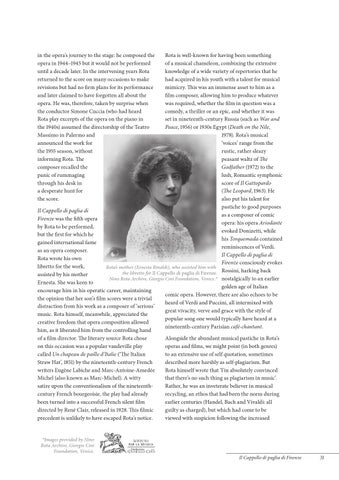
Rota is well-known for having been something of a musical chameleon, combining the extensive knowledge of a wide variety of repertories that he had acquired in his youth with a talent for musical mimicry. This was an immense asset to him as a film composer, allowing him to produce whatever was required, whether the film in question was a comedy, a thriller or an epic, and whether it was set in nineteenth-century Russia (such as War and Peace, 1956) or 1930s Egypt (Death on the Nile, 1978). Rota’s musical ‘voices’ range from the rustic, rather sleazy peasant waltz of The Godfather (1972) to the lush, Romantic symphonic score of Il Gattopardo (The Leopard, 1963). He also put his talent for pastiche to good purposes Il Cappello di paglia di as a composer of comic Firenze was the fifth opera opera: his opera Ariodante by Rota to be performed, evoked Donizetti, while but the first for which he his Torquemada contained gained international fame reminiscences of Verdi. as an opera composer. Il Cappello di paglia di Rota wrote his own Firenze consciously evokes libretto for the work, Rota’s mother (Ernesta Rinaldi), who assisted him with the libretto for Il Cappello di paglia di Firenze. Rossini, harking back assisted by his mother Nino Rota Archive, Giorgio Cini Foundation, Venice.* nostalgically to an earlier Ernesta. She was keen to golden age of Italian encourage him in his operatic career, maintaining comic opera. However, there are also echoes to be the opinion that her son’s film scores were a trivial heard of Verdi and Puccini, all intermixed with distraction from his work as a composer of ‘serious’ great vivacity, verve and grace with the style of music. Rota himself, meanwhile, appreciated the popular song one would typically have heard at a creative freedom that opera composition allowed nineteenth-century Parisian café-chantant. him, as it liberated him from the controlling hand Alongside the abundant musical pastiche in Rota’s of a film director. The literary source Rota chose operas and films, we might point (in both genres) on this occasion was a popular vaudeville play to an extensive use of self quotation, sometimes called Un chapeau de paille d’Italie (‘The Italian described more harshly as self-plagiarism. But Straw Hat’, 1851) by the nineteenth-century French Rota himself wrote that ‘I’m absolutely convinced writers Eugène Labiche and Marc-Antoine-Amedée that there’s no such thing as plagiarism in music’. Michel (also known as Marc-Michel). A witty Rather, he was an inveterate believer in musical satire upon the conventionalism of the nineteenthrecycling, an ethos that had been the norm during century French bourgeoisie, the play had already earlier centuries (Handel, Bach and Vivaldi: all been turned into a successful French silent film guilty as charged), but which had come to be directed by René Clair, released in 1928. This filmic viewed with suspicion following the increased precedent is unlikely to have escaped Rota’s notice. in the opera’s journey to the stage: he composed the opera in 1944–1945 but it would not be performed until a decade later. In the intervening years Rota returned to the score on many occasions to make revisions but had no firm plans for its performance and later claimed to have forgotten all about the opera. He was, therefore, taken by surprise when the conductor Simone Cuccia (who had heard Rota play excerpts of the opera on the piano in the 1940s) assumed the directorship of the Teatro Massimo in Palermo and announced the work for the 1955 season, without informing Rota. The composer recalled the panic of rummaging through his desk in a desperate hunt for the score.
*Images provided by Nino Rota Archive, Giorgio Cini Foundation, Venice.
Il Cappello di paglia di Firenze
31
emphasis that was placed upon the originality of a work of art during the nineteenth century. A consequence of this attitude in Rota’s case was the fact that the film score for the first Godfather movie was refused an Oscar nomination because of its reuse of earlier music. In Il Cappello di paglia di Firenze Rota exhibited his customary selfreferentiality and intermixing of musical genres, reusing copious music from his film scores of the 1940s and early 1950s. Some of the themes used in Il Cappello di paglia di Firenze had even been employed by Rota on two previous occasions. Excerpts from the 1952 Fellini romantic comedy Lo Sceicco bianco (‘The White Sheik’), for instance, were redeployed in a very different Fellini film, the neo-realist La Strada (1954), before finding a home in Il Cappello di paglia di Firenze. Given the snobbery about Rota’s music in post-War Italy, the composer was surprised when Il Cappello di paglia di Firenze turned out to be a hit on its first performance in Palermo in 1955. The opera was programmed by Cuccia alongside other works then regarded as curiosities, such as Monteverdi’s Il Combattimento di Tancredi e Florinda and
Mozart’s Il Schauspieldirektor – a bold move at an opera house that liked its repertory works. But Sicilian audiences took to Il Cappello di paglia di Firenze without hesitation. The singer chosen for the role of Fadinard was Nicola Filacuridi, then a highly popular tenor in Italy, particularly wellknown from opera performances on Italian radio and television. The performance was conducted by Jonel Perlea, who had championed Rota’s earlier radio opera I due timidi. This also was based on a play by Labiche and anticipates the musical language of Il Cappello di paglia di Firenze. Rota’s opera was swiftly taken up elsewhere. It featured in the 1957–1958 and 1958–1959 seasons at the Piccolo Scala in Milan, directed by Giorgio Strehler and staged by Francesco Siciliani, and further performances were staged in Genoa in 1966 and Treviso in 1973. The work reached the United States in 1977, when it was performed at the Santa Fe Opera Festival. A critic for Opera magazine wrote: ‘The score is beautifully written, in an idiom that is cheerful, adept and incontinently facetious. Every imaginable musical joke is there, and if you miss it first time, there is no need to worry, as
Above and above right: costume sketches and set designs for the original 1955 production of Il Cappello di paglia di Firenze. The sketches, by Umberto Zimelli and Emma Calderini for the first performance of the opera, are from Fondazione Teatro Massimo (Palermo, Italy) Archive.
32
Il Cappello di paglia di Firenze
you may be sure of catching it three or four times later in the course of the evening’. The opera attracted further attention the following year in a student production at the Manhattan School of Music. The first productions of Il Cappello di paglia di Firenze were staged in late nineteenth-century dress, all bustles, big hats, tight breeches and tailcoats. This was a world to which Rota and Italian opera audiences would have looked back with nostalgia: a world in which beautiful melodies – prohibited in serious musical circles by the mid twentieth century – had been embraced without the slightest embarrassment. The present production, directed by Andrea Cigni and designed by Lorenzo Cutùli, looks back a similar number of decades from the present day, with the action being transferred to what has become, in the contemporary imagination, a nostalgic era of lost innocence. Costumes, stage sets and props evoke a sentimental, picture-postcard image of 1950s Paris, a concept that is encapsulated by the fact that the stage itself is an enormous postcard. Characters take on the guise of actors in a film, an intertextual reference to Rota’s day job. But the present production also strikes another chord. Since the turn of the new millennium a noticeable trend has emerged in the staging of Italian comic operas. Works such as Donizetti’s L’Elisir d’amore (set in the late eighteenth century), Verdi’s Falstaff (set in the Elizabethan era) and Puccini’s Gianni Schicchi (set in the year 1299) are now routinely transplanted from their intended historical periods to the mid twentieth century. The 1950s has become a reified
decade in opera productions, just as it has more generally in contemporary popular culture. The current 1950s nostalgia might be attributed in part to the cosy childhood memories of a baby-boomer generation, yet what now strike us as the kitsch qualities of the fashions and designs of the era also appeal to the current moment’s fascination with all things ‘retro’. 1950s-style opera productions, complete with Vespas, evoke a vision of mid-twentieth-century Italy as filtered through the lens of classic cinema. The director Laurent Pelly, for instance, wrote of the influence of the film Amarcord, with its music by Nino Rota, upon his recent production of L’Elisir d’amore for the Royal Opera House. Given this current vogue in the staging of comic opera, the time seems ripe for a renewal of interest in Nino Rota’s Il Cappello di paglia di Firenze. Here we have a bona fide 1950s Italian comic opera composed by the master of midtwentieth-century film music. There is an affinity between the ironic humour of Italian comic opera and a fantasised, filmic 1950s world that makes this interpretation of Rota’s opera work perfectly.
Alexandra Wilson is Reader in Music at Oxford Brookes University, where she leads the MA programme and co-directs the OBERTO opera research unit. She is the author of two books: The Puccini Problem: Opera, Nationalism, and Modernity (Cambridge University Press, 2007) and Opera: A Beginner’s Guide (Oneworld, 2010).
Il Cappello di paglia di Firenze
33
Production Supporter
{24} {30} Oct, {2} Nov 20:00 {27} Oct 17:00 THÉRÈSE Drame musicale in two acts to a libretto by Jules Claretie First performance: Monte Carlo, Opéra, 7 February 1907 Sung in French LA NAVARRAISE Episode lyrique in two acts to a libretto by Jules Claretie and Henri Cain after Claretie’s short story La cigarette First performance: London, Covent Garden, 20 June 1894 Sung in French The performance will last approximately 2 hours and 30 minutes. There will be a 30-minute interval after Thérèse. A short introductory talk will take place in the Jerome Hynes Theatre one hour prior to the performance. Speaker: Elizabeth Drwal By permission of Éditions Heugel ET CIE/ United Music Publishers Ltd. This production is also generously supported by Peter and Nancy Thompson in memory of Jerome Hynes.
JULES MASSENET (1842–1912)
THÉRÈSE / LA NAVARRAISE (DOUBLE BILL) THÉRÈSE Thérèse Armand de Clerval André Thorel Morel Un Officier municipal Un Officier Un autre Officier Une Voix d’Homme Une Voix de Femme
Nora Sourouzian Philippe Do Brian Mulligan Damien Pass Jamie Rock Raffaele d’Ascanio Padraic Rowan Koji Terada Christina Gill
LA NAVARRAISE Anita Araquil Garrido Remigio Ramon Bustamente Un Soldat Flamenco Dancer Supernumeraries
Nora Sourouzian Philippe Do Brian Mulligan Damien Pass Peter Davouren Koji Terada Joe Morgan Nathalie Moyano González Susan Anderson, Sean Banfield, Justin Carroll, Martin Conway, Michael Conway, Michael Doyle, Mary Forde, Zsuzsa Forgeteg, Catherine Gaul, Heather Hadrill, Fiona McDermott, Hugh McGinley, Sam O’Shea, Dara Pierce, Lisa Pierce, Geraldine Roche
Conductor Director Assistant Director Designer Lighting Designer Stage Manager Chorus Master Répétiteurs Surtitles
Carlos Izcaray Renaud Doucet Sophie Motley André Barbe Paul Keogan Theresa Tsang Errol Girdlestone Adam Burnette, Janet Haney Richard Dearsley
CHORUS OF WEXFORD FESTIVAL OPERA ORCHESTRA OF WEXFORD FESTIVAL OPERA Fionnuala Hunt, Leader Thérèse / La Navarraise
35
Poster for the premiere of Thérèse at the Opéra-Comique, 19 May 1911, featuring Lucy Arbell in the title role. Opera Rara Archive, opera-rara.com
36
Thérèse
Synopsis Act One Clagny, near Versailles, France. October 1792. André Thorel and his wife Thérèse have recently bought the chateau at auction after the flight of the owner, Armand, Marquis de Clerval. André’s father was the marquis’ steward and André and Armand have had a close friendship since their childhood. Armand feels his divided loyalties keenly, because he is a man of the people and a Girondist revolutionary representative, but he honours his friendship and sympathises with Armand’s plight. He had, in fact, bought the chateau in order one day to return it to Armand. Unbeknownst to André, his wife had formerly loved Armand, and her feelings toward her husband are more of kindness and duty than passionate love. Thérèse tells André of her fears that his duties as a Girondist representative, a moderate
political group, may cause him to fall victim to the fury of the revolutionaries. André suspects that Thérèse is unhappy about something else, but she says that she could not be so ungrateful as not to love him, and her duty is to ensure his happiness. He tells her that she is the source of his happiness and that he desires only to die for his country or to live by her side. Left alone, Thérèse recalls her love for Armand and their farewell the previous summer before he fled France. Armand appears, still in love with Thérèse, and tries to persuade her to rekindle their love. She rebuffs him, for she owes everything to her husband and her duty is to him. André welcomes his old friend Armand and offers to conceal him in his house.
Act Two Paris, June 1793. The political situation has become much worse and Thérèse is deeply affected by having to live amongst such horror. King Louis XVI was executed five months earlier and the Girondists are falling out of favour; increasing numbers of people are being tried by the revolutionary court and sentenced to death. André continues to protect Armand and secures a safe conduct pass for him so he can leave the country. André joins the Girondists in the street and Armand tries to persuade Thérèse to
leave with him. She hesitates but finally agrees to his entreaties. Then comes news that André has been arrested and sentenced to death. Thérèse sees her husband in the tumbril on the way to the guillotine and tells Armand that she will join him shortly. Determined to remain true to her sense of duty to her husband, she deliberately cries out ‘Vive le roi’, which of course infuriates the revolutionaries. They arrest her and she is taken with her husband to be executed.
Thérèse
37
Poster for the 1895 performances of La Navarraise at the OpĂŠra-Comique, featuring Emma CalvĂŠ in the role of Anita. Opera Rara Archive, opera-rara.com
38
La Navarraise
Synopsis Act One Civil war has torn Spain into factions of bloody and bitter hatred. One side, led by Zuccaraga, has taken the city of Bilbao. Garrido, the opposing general, stops in a village with his troops and explains to his forces that only Zuccaraga stands between them and success. One of his men, Sergeant Araquil, is in love with Anita, a young woman from Navarre. She comes looking for him and the two are joyfully reunited, Anita convinced that her little lead statue of the Virgin Mary has protected him. However, Araquil’s rich father, Remigio, appears. He looks down on the foreign and humbly-born Anita, all of whose relatives have been killed in the war, and says that before he will allow his son to marry her, she must give him a dowry of two thousand
duros – knowing perfectly well that Anita cannot possibly raise that sum of money. Anita sings a song of lament and Garrido, the commander, sings of his hatred of his enemy Zuccaraga who has killed Garrido’s friend Ortéga. Garrido will gladly give a fortune to the soldier who kills Zuccaraga in battle. Anita hears this and tells Garrido that she will kill Zuccaraga if he will give her two thousand duros, but no-one must know about it. As she slips away she is seen by Araquil’s friend Ramon. Ramon tells Araquil that Anita has gone to the enemy camp asking to see Zuccaraga and suggests that she is a spy. Araquil indignantly refutes this, but then thinks that perhaps she has gone to see a secret lover.
Act Two After an orchestral interlude Anita appears, wounded and with her clothing torn. She has stabbed Zuccaraga with her knife and then raced back through the night, dodging gunfire, protected by her little statue of the Holy Virgin. She manages to convince Garrido that she has killed Zuccaraga and he insists that she must tell no-one. He gives her the money and she believes that now her dreams of happiness with Araquil will come true. But Araquil is brought in, having been mortally wounded as he searched for Anita to try to prevent her from meeting her supposed lover Zuccaraga. She cannot tell him the truth and when he sees the
money he accuses her of having prostituted herself. His father and Ramon appear and tell him that the church bells are tolling for Zuccaraga who has been assassinated. Horrified, Araquil realises the truth and dies. Anita tries to find her knife to kill herself and brings out the statue of the Virgin, which could not protect her beloved Araquil. She hears the bells and, thinking they are wedding bells, turns to the dead Araquil and tells him that the dowry is there, the church is full and they can get married. The crowd falls back in horror as she laughs wildly and collapses senseless onto Araquil’s body.
La Navarraise
39
Massenet and Women : A Love Story by Sylvia L’Écuyer
T
he career path of Jules Massenet was picture-perfect. Admitted to the Paris Conservatoire in 1853 at the age of eleven, at twenty he was awarded the Grand Prix de Rome, and at twenty-five was invited to write a one-act opera for the Opéra-Comique. In 1878, he became the youngest person ever to be elected a member of the Académie des Beaux-Arts and in the same year began teaching composition at the Conservatoire,
memoirs, My Life (translated by Rosamond Gilder, New York, Arno Press, 1977). ‘His witticisms were widely quoted, his epigrams passed from mouth to mouth. He was agreeable, entertaining, a charming individual and a true Frenchman’. The distorted perception of his music as either saccharine or insipid, propagated under the influence of the Franckistes, d’Indystes and Wagnerian circles, is now slowly fading away. The fierce intensity of the two short operas presented this season in Wexford, Thérèse and La Navarraise, will surely serve to rectify this blanket assessment of Massenet’s extremely diverse production.
There is no doubt that Massenet was a ladies’ man. The titles of almost half of his twenty-six operas consist only of female names: Hérodiade, Manon, Esclarmonde, Thaïs, La Navarraise, Sapho, Cendrillon, Grisélidis, Ariane, Thérèse, Cléopâtre. These works offer a wildly diverse gallery of feminine portraits, from the seductive and intimate to the tragic and grandiose. Before becoming the most prolific lyric composer of his time – and one of the most frequently performed – Massenet had been inspired by a trio of female religious figures to compose three oratorios which contributed to his early success in the 1870s: Marie-Madeleine, Eve Portrait of Massenet, drawing by Rudolf Lehmann. British Museum, London and La Vierge. a post he held until his death in 1912. During his lifetime his operas were produced all over Europe and the Americas, but after his death the majority of his works almost disappeared from the repertoire. Unsympathetic critics accused him of merely writing to please and seduce a female audience. ‘Massenet was a very popular figure in his day’, writes famed soprano Emma Calvé in her 1922
40
Thérèse / La Navarraise
Even when he names an opera after a male character, a woman almost always steals the show. What aria in Le Cid is more famous than Chimène’s ‘Pleurez, pleurez mes yeux?’ The most complex and endearing character in Werther is Charlotte, and I would even go so far as to suggest that the Virgin Mary is the central character in Le Jongleur de Notre-Dame, an opera set in a monastery with an all-male cast. The voice of Mary is never heard but the off-stage voices of
Lucille, Horsace and Camille Desmoulins. Lucille was guillotined in 1793, eight days after her husband Camille. Lucille was one of the female inspirations for the title character of Thérèse. Painting by Jacques-Louis David, 1792.
two angels convey her message as she brings the play to its conclusion by accepting the prayer of the humble juggler. Thérèse and Anita (la Navarraise) are both strong and passionate women, deeply loving but also courageous, and imbued with a sense of duty and sacrifice. These roles, like those of almost all of Massenet’s heroines, were created with specific performers in mind. As a young composer he was lucky enough to have the undisputed star of the Opéra-Comique, Célestine Galli-Marié – the first Carmen and the first Mignon – perform the role of Lazarille in his Don César de Bazan in 1872. In the 1880s the American sensation Sybil Sanderson created and perfectly embodied the seductive roles of Manon and Thaïs. In 1893, the reigning Carmen, mezzo-soprano Emma Calvé, asked Massenet to write La Navarraise, which he did in record time, and went on to write Sapho, which was premiered
in 1897 and became one of Calvé’s most successful creations. During his last creative period, he created a number of roles —Thérèse, Perséphone in Ariane, Queen Amahelli in Bacchus, Dulcinée in Don Quichotte, Postumia in Roma, and Colombe in Panurge – for the deep and sensual mezzo voice of Lucy Arbell, described by the contemporary press and by Massenet himself as a tragédienne lyrique. Massenet’s profound understanding of the feminine psyche, his astute sense of dramatic construction, and his skilful choice of librettos contributed as much to his success as did his melodic invention and mastery of orchestration. The two works on the programme were written more than twelve years apart: La Navarraise was premiered at the Royal Opera House, Covent Garden in June 1894, while Thérèse was first performed in Monte Carlo in February 1907. Jules Claretie wrote the two librettos, collaborating on
Thérèse / La Navarraise
41
La Navarraise with Henri Cain, another frequent associate of Massenet’s. Both feature a mezzosoprano as the central and only female character, and both use a small cast. They are as close to Italian verismo as French music gets.
had been a witness at her wedding. In 1875 Massenet’s librettist Jules Claretie had published a weighty study of the affair entitled Camille Desmoulins, Lucille Desmoulins: Étude sur les Dantonistes. The link between the young woman executed in 1793 and Thérèse is made very clear in Massenet’s Mes Souvenirs when he tells of his visit in 1905 to the former Carmelite convent where Lucille had been incarcerated. Massenet was accompanied by mezzo-soprano Lucy Arbell who was moved to tears when painter and historian Georges Cain recalled the young woman’s tragic fate.
In his far from hagiographic article on Massenet for The New Grove Dictionary of Music and Musicians, Martin Cooper observed that Thérèse lives through her emotions, torn between two men, ‘of whom one stirs her admiration and the other her love’. He quotes Massenet as saying ‘Thérèse is my heart, Jongleur my Ms Arbell was clearly faith’, a curious remark, the other inspiration given the choice that for the character of Thérèse makes. She Thérèse. Born Georgette chooses André, in a Wallace, granddaughter gesture of fidelity and of Sir Richard Wallace, respect for his ideals, Bt, Ms Arbell was over Armand, the enjoying a brilliant sweetheart of her youth career at the Opéra when whom she still loves. If Massenet wrote for her we include La Navarraise the role of Perséphone in the comparison, in Ariane, which was we observe that it is premiered at the Palais Anita’s passionate love Garnier in 1906. For for Araquil that leads Lucy Arbell as Persèphone in Massenet’s Ariane. Along her to commit a violent with Lucille Desmoulins, she was one of the female the first performance inspirations for the title character of Thérèse. of Thérèse in Monte crime without any Carlo, Massenet consideration for her insisted that the decor in the first act should safety or for her political ideals. It is Anita, then, be a faithful reproduction of Bagatelle, a small who follows her heart while Thérèse is guided by pavilion in the Bois de Boulogne which was in her moral principles. Lucy Arbell’s family. Built in 1777 by the Comte Thérèse takes place during the Terror (1793–94), d’Artois, younger brother of Louis XVI, Bagatelle the darkest period of the French Revolution, and had narrowly escaped destruction during the two women inspired the character of Thérèse. Revolution, after which it was bought and restored The first, Lucille Desmoulins, was guillotined in by the Marquis of Hertford in the 1830s. His 1793, eight days after her husband, the lawyer and natural son Sir Richard, Lucy’s grandfather, lived journalist Camille Desmoulins. The execution there until his death in 1890. It was sold to the city order had been signed by a revolutionary of Paris in 1904 and in May 1906, Massenet visited committee which included Robespierre, who
42
Thérèse / La Navarraise
the beautiful gardens, perhaps in the company of Ms Arbell. The powerful drama of La Navarraise, like that of Thérèse, is set against a backdrop of violent civil unrest: the third Carlist war (1872–1876), a deadly episode in the long conflict over the Spanish succession to the throne. After the overthrow of Queen Isabella II (in Spanish, Isabel II), who was in exile in France at the time Massenet was writing his opera, an Italian prince, Amadeo of Savoy, was crowned King of Spain. This was a blow to the supporters of the pretender Carlos VII, a traditionalist faction based mainly in Catalonia, Navarre and the Basque country. Anita, being Navarraise, is deemed to be on the side of the Carlist rebellion against the army of General Garrido under which her lover Araquil is fighting. When she agrees to become a paid assassin and kill the Carlist leader Zuccaraga, it is not for political reasons. All she wants is the two thousand duros for her dowry so that she can marry Araquil. Tragically, when he is told that Anita was asking to see Zuccaraga, ‘who is said to be very flirtatious’, Araquil tries to follow her. Mortally wounded, he dies thinking that she has been unfaithful. In a fit of madness, Anita imagines the bells ringing
the knell of the Carlist leader to be celebrating her wedding to Araquil, and she dies, slumped over his body. Such a strong character was perfectly suited to the indomitable temperament of Emma Calvé. After her triumph in the French première of Cavalleria rusticana at the Opéra-Comique in 1891, where her apparently spontaneous and outrageously realistic interpretation shocked but finally won over critics and audience alike, she took an extended trip to Spain where she prepared for her next great success: Carmen. It is she who wrote to Massenet from London in 1893, sending the libretto for La Navarraise and asking him to write this short, dramatic tragedy that she would perform at Covent Garden, to counter the monopoly of Italian composers at that institution. ‘Would you be ready in June?’ she asks. The opera was written and orchestrated in the south of France between 7 November and 9 December and the premiere, on 28 June 1894, brought an enthusiastic ovation from a public unprepared for what they saw on stage. Thérèse and La Navarraise, with seventy-two and forty-eight minutes of music respectively, are charged with such intense realism that their tight twoact dramatic structure allows for no side story, no accessory characters, no divertissements. The most violent moments in these operas – the execution of André and the murder of
Thérèse / La Navarraise
43
neglect in the repertoire. In this production at Wexford the two stories sit for a dual portrait, a dramatic pairing that is underscored by a shared set decor. The operas are not presented in order of composition but rather in an emotional crescendo that follows the chronology of the historical events to which they are linked. The set transforms itself from a studio in the Louvre where art restorers are working on an exhibition about the French Revolution, to the Atelier des GrandsAugustins where Picasso painted his Guernica. The impact of Picasso’s vision, combined with that of Massenet’s music, is overwhelming. In both works Reviewing a Massenet’s orchestra performance of brings a sense of Thérèse in 1911, urgency to the drama. Gabriel Fauré Its forceful presence himself made the is felt especially link between Thérèse in the overture to and La Navarraise La Navarraise in Emma Calvé, the originator of the role of Anita in La Navarraise. when he observed Photo by William J. Kuebler, Jr. Library of Congress. which a tragically that these two works heart-wrenching ‘are similar not only melody is punctuated by the sound of military in their brevity, but also in their fast-moving, drums, castanets, hand-clapping, bugle calls, bells, passionate, violent, intense plot’. and shots from rifles and handguns. The return of These operas are not for the faint-hearted. this theme in the final scene of the opera leaves us as mesmerised today as was the audience of 1894. Sylvia L’Écuyer is a Equally evocative are the sober meditative tone of musicologist and broadcaster. the prelude to Thérèse and the nocturne that opens Music producer for Radiothe second act of La Navarraise. The intimate scene Canada since 1985, she has in which Thérèse and Armand recall the minuet been host and producer of they danced when they declared their love is l’Opéra du Samedi since 2007. sung recto tono, delicately accompanied by only a She is also Associate Professor harpsichord and pizzicato strings. at Université de Montréal. Her writings on music have been published in many languages. She was Clearly, the brevity of these works, and the fact awarded the title of Chevalier des Arts et des that they rely more on skilful dramatic acting Lettres by the French Government. than spectacular singing, accounts for their Zuccaraga – are not seen on stage. Bustamente’s song at the campfire the night before the battle is far from a relief from the drama. Songs and dances are intrinsic to the Spanish soul, and the sombre refrain ‘Et vivent les chansons pour consoler des morts!’ ends the first act with a sense of impending doom. In the opening scene of the second act of Thérèse two voices off-stage sing a lovely romance, ‘Il pleut, il pleut bergère’. This innocent nursery song also conveys a sense of doom, since its author, the playwright and political activist Fabre d’Églantine, was said to have been singing it as he marched to the guillotine in 1794.
44
Thérèse / La Navarraise
Production Notes
Guernica by Pablo Picasso, in the collection of Museo Reina Sofia, Madrid
T
hrough the individual stories of Thérèse and La Navarraise we try to explore the influence of painting on life. Thérèse, set in a museum’s restoration workshop, shows us how historical subjects can come to life centuries after they happened, by means of a series of eighteenth century paintings about the French revolution before the Terror. Using Picasso’s painting Guernica for La Navarraise shows us how the artist transcends historical subjects and events to make an important political and social statement. Massenet’s opera is given a new perspective by setting it in the Spanish Civil War’s most famous artistic response, Picasso’s Guernica.
Like the painter, our work as an opera creative team of stage director and designer is to engage the senses of the audience, sometimes by intensifying reality and sometimes by presenting it in the abstract. Like the artist, we use Life as our subjectmatter. Art has to be grounded in the real world and must enhance our ways of seeing. This involves a constant questioning of our assumptions about the nature of art and the way it represents life. The artist’s picture does not need to be an accurate representation of his subject, and we think that it is the same for every form of art. In a period when art funding is a struggle, a painting like Guernica is more relevant than ever, and shows us how art can sometimes change the way we look at the world. — André Barbe, Designer & Renaud Doucet, Director
Set models for Wexford Festival Opera’s 2013 productions of Thérèse and La Navarraise.
Thérèse / La Navarraise
45
Jacopo Foroni (1825–1858)
{25} {28} {31} Oct 20:00 {3} Nov 17:00 Historical-lyrical drama in five parts and three acts to a libretto by Giovanni Carlo Casanova First performance: Stockholm, Mindre Theatre, 19 May 1849 Sung in Italian The performance will last approximately 3 hours. There will be a 30-minute interval after Act 1 and a 20-minute interval after Act 2. A short introductory talk will take place in the Jerome Hynes Theatre one hour prior to the performance. Speaker: Roberto Recchia By permission of Anders Wiklund This production is made possible with the generous support of The American Friends of Wexford Opera.
CRISTINA, regina di svezia
(christina, queen of sweden)
Cristina Helena Dix Maria Eufrosina Lucia Cirillo Axel Oxenstjerna David Stout Erik Oxenstjerna Patrick Hyland Magnus Gabriel de la Gardie (Gabriele) John Bellemer Carlo Gustavo Igor Golovatenko Arnold Messenius Thomas Faulkner Johan Messenius Daniel Szeili Un Pescatore Joe Morgan Voce Interna Hannah Sawle Supernumeraries Isobel Foyle, Nicky Kehoe, Shonagh McCurt, Ella Trappe, Aoife Walsh
Conductor Director Assistant Director Set Designer Lighting Designer Choreographer Stage Manager Chorus Master
Andrew Greenwood Stephen Medcalf Conor Hanratty Jamie Vartan Paul Keogan Paula O’Reilly Ray Bingle Errol Girdlestone
Répétiteur Surtitles
Andrea Grant Elizabeth Drwal
CHORUS OF WEXFORD FESTIVAL OPERA ORCHESTRA OF WEXFORD FESTIVAL OPERA Thérèse Timoney, Leader
Proudly presented in association with Italian Institute of Culture – Dublin.
Cristina, regina di Svezia
47
SÊbastien Bourdon (1616–1671), Queen Christina Photo@Nationalmuseum, Stockholm
48
Cristina, regina di Svezia
Synopsis Act One Part 1: Love Queen Cristina and her court have assembled to celebrate the return of the chancellor Axel Oxenstjerna and his son Erik, who have brokered peace between the states of Europe. Amidst the rejoicing, the chancellor makes the formal announcement that hostilities are over. As a token of her gratitude the queen gives her cousin Maria to Erik as his bride. But the queen’s favourite, Gabriele, and Maria herself, are both dismayed, since they are secretly in love with each other. The queen’s sworn enemies, Arnold and Johan Messenius, guess at Gabriele’s feelings and see in him a potential ally.
Escaping the festivities, Gabriele tries to persuade Maria to elope, but she cherishes her honour and suggests instead that they appeal to Cristina. Gabriele is only too aware that the queen is still in love with him and that she will never give in to their entreaties.
Part 2: Marriage The wedding ceremony is about to begin when Maria can no longer control her feelings and refuses to go through with the marriage to Erik. Maria is forced to reveal that she is in love with Gabriele. Blinded by jealousy, Cristina insists that the marriage will go ahead and that, deprived of Maria, Gabriele will endure suffering that is equal to hers.
Act Two Part 3: Conspiracy Convinced that Cristina is ruining the country the brothers Messenius have organised a meeting of conspirators on a deserted island just off the coast. They have persuaded the embittered Gabriele to join them. Carlo Gustavo, Cristina’s cousin and obvious successor, has been invited to join the rebellion and he arrives on the island. The conspirators gather to plan their crime: they will murder the queen and place Carlo Gustavo on the throne. The loyal Gustavo is in love with Cristina and he pretends to go along with the plot in order to confound it.
Part 4: Disillusion Cristina reflects on the vanity of the court. Power is meaningless if it denies her the possibility of love
or even true friendship. Oxenstjerna urges her to strengthen her position by approving the match between Gabriele and Maria and marrying Carlo Gustavo instead. Cristina agrees not to stand in the way of the lovers, but reveals her intention to abdicate and let Carlo Gustavo rule alone. Oxenstjerna begs her to abandon this whim, but she is implacable. A fire breaks out in the palace signalling the beginning of the rebellion. Panic ensues but Carlo Gustavo has foiled the plot and the traitors are quickly rounded up. When Cristina discovers that Gabriele is among the conspirators she is devastated and vows to have him executed. The Council are summoned to a meeting to decide the fate of the prisoners.
Act Three Part 5: Abdication
up the crown for the sake of the people.
Cristina addresses the invisible spirit of the nation. She asks that all she has achieved for her country as Queen be remembered by history, but that now she be allowed as a woman to step down from the throne and depart for Italy where she will live an ordinary life.
Lead by Oxenstjerna, the Council condemns the prisoners to death. Cristina makes her final public appearance. She pardons the traitors and announces her abdication, nominating the reluctant Carlo Gustavo as her successor.
She orders Carlo Gustavo to prepare himself to succeed her, but he is not interested in the throne unless he can rule with her by his side. She begs him to forget their youthful infatuation and to take Cristina, regina di Svezia
49
A Queen Returns to the North by Anders Wiklund
1849
was a remarkable year in Swedish music: it was then that Jacopo Foroni went to Sweden. In fact, he should not have gone there at all. During the years 1847-8 Vincenzo Galli’s opera company made a tour of Scandinavia. Before going to Sweden they had performed at the Royal Theatre in Copenhagen, where the conductor was Paolo Sperati. The company also included the baritone
the consequence that the theatres too had become increasingly deserted. The company crossed into Sweden and gave a number of performances in Malmö, Ystad, Kristianstad, Karlshamn and Karlskrona. Among the operas they had performed, with great success, were Donizetti’s L’Elisir d’amore and Don Pasquale. When the company reached Stockholm they based themselves at Anders Lindeberg’s Mindre Teatern (The Smaller Theatre). The Italians proved to be a great hit with the public, and to a significant extent tempted audiences away from the Royal Theatre. The Royal Opera’s directors considered it prudent to start working with the Italians, and from October 1848 until April 1849 they placed the Royal Theatre’s premises at their disposal. But very soon – by the end of November – the relationship was in crisis. All sorts of temperamental outbursts (principally from Casanova), coupled with the court conductor Johan Fredrik Berwald’s incompetence in Italian repertoire and his inflexible attitude to the Italians, brought the collaboration with the Royal Opera to an end. Galli’s company returned to Mindre Teatern in January 1849. By that time the conductor Paolo Sperati had already left the company, and Galli had called in a young maestro named Jacopo Foroni, who arrived in Stockholm in December 1848. Foroni hailed from an important
Christina, Queen of Sweden as Diana (based on a painting by Guercino), Attributed to Giovanni Domenico Cerrini (1609–1681) family of musicians in Verona, and
Gian Carlo Casanova, the soprano Rosina Penco, and the tenors Ettore Caggiati and Francesco Ciaffei. Owing to political events – in the form of an uprising in Schleswig-Holstein – Copenhagen had been emptied of royals and aristocrats, with
50
Cristina, regina di Svezia
had quickly earned the reputation of being a talented and eminent conductor and musician. In the teeming world of Italian opera in the 1840s he was one of many promising talents (Verdi was another) whose task it was to inherit Donizetti’s mantle. Verdi had already
The royal castle Tre Kronor in Stockholm where Christina was born. Most of Sweden’s national library and royal archives were destroyed when the castle burned in 1697. Painting by Govert Dircksz Camphuysen.
taken the reins, but had yet to make the decisive breakthrough that came around 1850; by then Foroni was already in Sweden and had turned his back on a career in Italy. In 1848 Foroni already had one opera to his name: Margherita, which had been performed at the Teatro Re in Milan (March 1848) with great success. His musical education – his teachers included his father Domenico and Alberto Mazzucato – was more directed towards central European music, with composers such as Beethoven and Bach as his role models, and this becomes readily apparent in Foroni’s music for the theatre. After the premiere of Margherita Mazzucato wrote an interesting article about the talented young composer in the Gazzetta Musicale di Milano. The article (quoted by Tajani) is also an absorbing analysis of the world of Italian opera, its loss of direction after Donizetti, and how central European influences should be dealt with vis-à-vis the great Italian tradition. This debate, initiated by Mazzucato, was to escalate during the nineteenth century and reach its zenith with the ‘Puccini problem’ at the end of the century. In January 1849, while conducting a varied repertoire of recent Italian operas – works such as Donizetti’s Parisina, Linda di Chamonix, Lucrezia Borgia and Lucia di Lammermoor, Bellini’s Beatrice
di Tende, Rossini’s Barber of Seville and Verdi’s Il Lombardi – Foroni also started working on an opera of his own about Queen Christina of Sweden: Cristina, regina di Svezia. This was primarily a means of introducing himself to Swedish audiences, but was also a tribute to a monarch who had abdicated, converted to Catholicism and left her homeland for Italy. The music was dedicated to King Oscar I and the libretto to the Queen Mother Désirée. The opera was premiered on 19 May 1849. Hans Christian Anderson was present and described the performance enthusiastically in his autobiography. The work is about Cristina’s abdication and tells the story in five parts: Love, Marriage, Conspiracy, Disillusion, Abdication. In true nineteenth-century fashion the cause of the abdication is not her conversion to Catholicism, but rather a story of her love – partly for Magnus Gabriel de la Gardie (Gabriele), who was forbidden to marry his beloved Maria Eufrosina, and partly for the future King Carlo Gustavo. Foroni has a firm grasp of the musical and dramatic expressions in the opera. His music drives the action forward effectively, principally owing to his catchy melodic invention, in the spirit of Verdi.
Cristina, regina di Svezia
51
Dispute of Queen Cristina Vasa and René Descartes 1884, Nils Forsberg (1842–1934) after Pierre-Louis Dumesnil the Younger (1698–1781)
If Foroni had chosen to pursue his career in Italy, Verdi would certainly have had a worthy rival. Foroni’s instrumentation reveals the influence of a more central European orchestral sound than was usual in Italy at the time, with refined orchestral colours and far more counterpoint than we find in Italian orchestral music of the period. Even if his roots are in the early nineteenth century, his works nevertheless show an awareness of the new music that was gaining ground in central Europe, by such composers as Mendelssohn, Schumann and Liszt. Even in the overture to Cristina, Foroni shows his knowledge of European music from beyond Italy’s borders, but he also elegantly doffs his hat to his new audience. In the introduction to the piece he quotes Näckens polska in a refined instrumental guise. In the nineteenth century Europeans associated this melody with Sweden and Scandinavia (the best-known example of this is its use in Ophelia’s scene in Act IV of Thomas’s
52
Cristina, regina di Svezia
Hamlet, written for Christina Nilsson). There are different versions of this polka (polska) in Sweden, but – unlike La Folia – it is unlikely to feature in other folk music cultures. During the first half of the nineteenth century this polka was performed by student choirs who often used the melody in various arrangements at concerts in Sweden and internationally. The German-Danish composer Friedrich Kuhlau used the melody not only in his incidental music to Elverhøj but also in a set of variations for two flutes. Foroni may well have come across concerts by student choirs in Stockholm after his arrival there in December 1848; moreover, he was probably familiar with Kuhlau, partly through his studies under Mazzucato in Milan and partly as a result of the tours he had undertaken in central Europe with various orchestras in the years 1845–1846. Cristina, regina di Svezia was also performed in Italy at the Teatro Grande in Trieste in 1850. To this
end Foroni revised the opera, making additions and also some cuts. The manuscript in the Archivo Ricordi, now kept at the Biblioteca Braidense in Milan, contains both versions of the opera. A reconstruction of the 1849 Stockholm version is also possible on the basis of a copy of the score preserved in the Swedish State Music Collections in Stockholm, which was the reference copy used at the Mindre Teatern. It is this original version of Cristina that is recorded here. This edition was prepared for a concert performance at the Vadstena Academy in 2007, which also represented the first modern performance of the piece. In the 1850 revised version for Trieste, changes include the transposition of the concerto in the introduction to Act I (No. 1) from D major to C major. In the original version the duet between Maria and Magnus Gabriel (No. 2) was entirely logical, as in the previous number Cristina had forbidden their marriage; it provided a deeper insight into their love, which in the rest of the opera is rather obscured. In 1850, however, Foroni decided to focus more closely on Cristina herself: he uses the original introduction to the duet with Maria, but then Cristina appears unexpectedly, dismisses Maria (who then leaves); an arrangement is then reached between Cristina and Magnus, her former lover. This new duet is based on material from the earlier version, but is more flexible and organic. Act III of the Stockholm version begins with a big duet for Cristina and Carlo Gustavo. In the 1850 version Foroni retained this number but prefaced it with a magnificent solo aria for Carlo Gustavo, which is both a meditation and also a tender declaration of his love for Cristina. The music is on a grand scale, but the proportions of the act are badly skewed by having two such weighty numbers at the very beginning. This – and the long-ago events in a remote Nordic country, which were a theme alien to the Italians – may have coloured its reception: despite good reviews, the opera never really established itself and it was soon dropped from the repertoire. The fact that a reallife Queen Christina was well-known in Italy was evidently of no help in this regard.
Foroni’s work in Stockholm, on the other hand, was far more successful. He was appointed court conductor in 1849, thereby assuming an important position in Stockholm’s musical scene. He performed several symphonies by Beethoven – including the Eroica in 1851 – and Schumann (1853, including the Second Symphony, dedicated to King Oscar I), and also Mendelssohn’s Elijah (1854). In 1856 he performed Wagner’s music for the first time – the overture to Tannhäuser – and at the Royal Theatre Foroni introduced new repertoire from both Italy and France. All the contemporary sources emphasise Foroni’s extrovert and charming personality. But he was evidently a demanding conductor who tolerated no half measures when it came to rehearsals. Without doubt he was a badly-needed injection of vitality into Swedish music, and expectations of the young Italian were high. Over the years he composed a series of scores for the theatre (this was one of his duties as conductor), both for plays and for pièces d’occasion. He soon learned Swedish (he is said to have been something of a polyglot, who spoke six languages), and his letters – for example, to his friend August Blanche – are linguistic gems. In 1858, a few months before the performance of his first and only opera in Swedish, Advokaten Pathelin, Foroni died suddenly of cholera. His contemporaries were stunned, and he was buried in an impressive grave in the Norra kyrkogården (Northern Cemetery) in Stockholm. Anders Wiklund, Professor of Music Drama at Gothenburg University, Sweden, is a specialist in musical philology and has published a number of critical editions (Donizetti, Rossini, Simone Mayr and operas from nineteenth century Sweden) in an acclaimed national series of complete editions of composers’ works. He was Artistic Director of the Vadstena Academy (1992–2000), is a member of the editorial board of the Giovanni Simone Mayr Werkausgabe and a member of the Royal Swedish Academy of Music.
Cristina, regina di Svezia
53
Christina, Queen of Sweden by Bo Lindberg
Q
ueen Christina (1626–1689) was a remarkable woman with a dramatic life story, great talent, wide-ranging interests and an enigmatic character. Her father, Gustavus Adolphus II, died in battle – fighting the Catholics in Germany – when she was only six. While she was still heiress presumptive, the country was governed by a Royal Council, but in the late 1640s she took over the task of governing a country that was now a major power, the guarantor of freedom for the Lutherans in Europe. She held her own vis-à-vis her former guardians, and ruled strongly. But she did not wish to marry, and dismayed those around her when she decided to abdicate. In 1654 she left the country, and when soon afterwards she converted to Catholicism and based herself in Rome, the scandal was total: the queen of Lutheran Sweden, daughter of Gustavus Adolphus the Great, had abandoned her father’s religion and sided with the enemy. The Catholics were jubilant. Scholars have never really succeeded in casting light on what caused her conversion. She had received clandestine visits in Stockholm from Jesuits, but religious conviction can hardly have been the primary motivation. It is more likely to have been dissatisfaction with religious intolerance, and with the confined, meagre intellectual climate in Sweden. It was not only in matters of faith that Christina overstepped the line. It was already a departure from the norm for a woman to become monarch, but it was one that had to be accepted if the dynasties were not to risk losing their realms. As a woman, however, she did not correspond to the ideal of the time regarding beauty and attire, and as queen she took far greater interest in culture and knowledge than was fitting for a person of her rank. She invited a whole series of eminent intellectuals from continental Europe to Stockholm, foremost among them the philosopher Descartes. They conversed with her, discussed with her, arranged her books, plotted against each other and created an aura of culture surrounding ‘the Minerva of the North’. In Rome she continued in the same vein, becoming a generous patron of the arts and sciences.
54
Cristina, regina di Svezia
Jeremias Falck after David Beck, Christina of Sweden as Minerva Engraving, 1649, Graphische Sammlung: Düsseldorf Kunstmuseum, Düsseldorf
Inquisitive by nature and lacking in prejudice, she took an interest in nonconformist and controversial ideas and phenomena: pansophism, milleniarianism, epicureanism, Judaism and alchemy. But Christina was not an intellectual who guarded her power and sought refuge in culture. She became ‘Christina Alexandra’, a royal figure with a commensurate requirement for power and prestige. In 1656 she tried to become Queen of Naples, and had the man who betrayed her plans executed. Later she sought the Polish crown; yet another of her projects was to unite Europe against the Turks. The role of queen may have been a straitjacket for a person of such unusual talents, but it was also a precondition for her ability to rise above the limitations and barriers of her era. Bo Lindberg is Professor of History of Science and Ideas at Gothenburg University, Sweden
Production Notes
T
he historical figure, Queen Christina, was a fascinating and eccentric character who lived through extraordinary times. Casanova’s libretto, however, is more myth than history: it ignores controversial aspects of the Queen’s personality and concentrates on her abdication, which according to the narrative of the opera is primarily motivated by the loneliness of her existence as a monarch. Surrounded by flatterers and burdened by royal obligations, rejected by the handsome Gabriele in favour of her beautiful cousin Maria, she despairs of ever finding love or even true friendship. The opera is set during momentous times – war and rebellion cast a shadow over the whole proceedings – and yet the principal characters all seem prepared to sacrifice ambition and public duty on the altar of love. It is finally left for Carlo Gustavo – himself utterly devoted to the Queen – to take up the succession, even though he would far rather have Cristina’s heart than her throne. Maxims of Queen Christina of Sweden:
“A prince must think of himself as a slave crowned by the people”
The theme of the opera is the Queen’s struggle to subjugate her personal feelings to her state responsibilities – and its central thesis is that love is ultimately incompatible with power. As the opera begins with the Chancellor returning from mainland Europe with a promise of peace, continues with a royal wedding and concludes with an abdication speech, we could not help but be struck by the resonances with events in Britain before the Second World War. This has inevitably set us thinking about the imagery and atmosphere of this time and place in history: a world which has recently been brought more into the public consciousness by a succession of films dealing with Edward VIII’s love affair and George VI’s stammer; a world which is familiar to us through old news reels and black and white movies, and is one which we can begin to understand. Certainly our notions of Swedish Court life at the end of the Thirty Years War in the seventeenth century are rather vaguer! We have also been seduced by Greta Garbo in the 1933 film Queen Christina, which so charmingly and eloquently brings both of these worlds together. — Stephen Medcalf, Director & Jamie Vartan, Designer
“The man is worth nothing who does not prefer duty to pleasure” “To obey no one is a greater happiness than to command the whole world” Cristina, regina di Svezia
55
ShortWork | la traviata giuseppe verdi (1813–1901)
LA TRAVIATA {24} {26} {28} October, {1} November 15:30 {31} October, {3} November 11:00 JEROME HYNES THEATRE, WEXFORD OPERA HOUSE This production is made possible by the generous support of The Lord Magan of Castletown
In celebration of the 200th anniversary of the birth of one of the greatest opera composers of all, this year’s daytime production of a classic opera from the standard repertoire is Verdi’s La Traviata (‘The Woman who Strayed’). Based on La dame aux camélias, the tragedy of Violetta and Alfredo’s love story is told through some of Verdi’s most heartbreaking and beautiful music. Their happiness is destroyed by ingrained society attitudes, emotional blackmail and a fatal illness, against which even Violetta’s self-sacrificing nobility cannot prevail. Although now regarded as a great opera, La Traviata was not a success at its first performance in Venice in 1853 but rather a brilliant fiasco. This was not on account of the music but lay with the singers and their casting, particularly of the soprano heroine. Not only was she a poor actress, but she was ‘afflicted with enormous stoutness’, so when the doctor declared that consumption had wasted her away and she had only a few hours to live, the audience roared with laughter. Happily, when the opera was performed again a year later it had a marked success and soon made a triumphal tour throughout Europe.
Violetta
Anna Jeruc-Kopec
Alfredo
Daniel Szeili
Germont
Jonathan Sells
Soprano Ensemble
Rachel Croash
Mezzo Ensemble
Alexandra Cassidy
Tenor Ensemble
Leonel Pinheiro
Baritone Ensemble
Music Director
Ashley Mercer
Greg Ritchey
Director
Stefania Panighini
Designer
Sarah Hearnden
Lighting Designer Stage Manager Technical Manager Props Assistant
John Crudden Emma Doyle Conor Mullan Nessa O’Brolchain
Additional information on our ShortWork operas including artist biographies and director’s notes can be found in our ShortWorks Daytime Programme Book, available for purchase at each ShortWork venue and our box office.
56
La Traviata
ShortWork | the sleeping queen MICHAEL WILLIAM BALFE (1808–1870)
THE SLEEPING QUEEN {25} {31} October 15:30 {28} October 11:00 THE AUDITORIUM, PRESENTATION SECONDARY SCHOOL, SCHOOL STREET This production is made possible by the generous support of The Lord Magan of Castletown
Dublin-born Balfe was the most successful composer of English operas in the nineteenth century. He was a professional violinist in London and then an opera singer in Paris and Italy. He was performing in Palermo in 1830 when a dispute between the chorus and the management resulted in him being commissioned to compose a short opera (without chorus) in order for an opera performance to take place. His growing success as an opera composer led to his return to London where The Siege of Rochelle received a triumphant seventy-three performances at Drury Lane in 1835. His reputation was further enhanced by the astonishing success and popularity of his 1843 opera The Bohemian Girl. His 1864 one-act operetta The Sleeping Queen, in which a young queen finds that her unmarried state can be used to powerful advantage, is set in Spain c.1620. The style of plot foreshadows WS Gilbert and involves royal power, love, war, misunderstandings, a memorable dream and a happy ending. This will be the first staged production in Ireland in very many years.
Maria Dolores
Johane Ansell
Donna Agnes
Christina Gill
Philippe D’Aguilar
Ronan Busfield
The Regent
Padraic Rowan
Music Director
Janet Haney
Director
Sophie Motley
Designer
Sarah Bacon
Lighting Designer
Pip Walsh
Stage Manager
Colin Murphy
Technical Manager
Conor Mullan
Costume Supervisor
Frances White
Props Assistant Design Intern
Nessa O’Brolchain Emily Mahon
Additional information on our ShortWork operas including artist biographies and director’s notes can be found in our ShortWorks Daytime Programme Book, available for purchase at each ShortWork venue and our box office.
The Sleeping Queen
57
ShortWork | l’elisir d’amore GAETANO DONIZETTI (1797–1848)
L’eliSir d’amore {26} October, {2} November 11:00 {29} October 15:30 THE AUDITORIUM, PRESENTATION SECONDARY SCHOOL, SCHOOL STREET This production is made possible by the generous support of The Lord Magan of Castletown
L’Elisir d’amore (‘The Elixir of Love’) is one of Donizetti’s most frequently-performed operas. It was the first Donizetti opera to be performed at Wexford, and that 1952 production has been followed by performances of a further fifteen of his operas. In honour of the original plot, the action takes place in a Basque village, but it could be any Italian village, with its four stock characters of the bluff man-of-the-world recruiting sergeant, the itinerant quack doctor, the learned, rich and beautiful (female) landowner, and finally the little nobody, Nemorino, who gets the better of them all. When Adina agrees to marry Sergeant Belcore, Nemorino asks for Dulcamara’s help. He wants a love elixir to win over Adina’s heart in Tristan und Isolde style. But the elixir is very expensive, and the only way he can raise enough money is by joining Belcore’s army. Adina is moved by Nemorino’s extreme action and redeems the contract, giving him back his freedom. But Nemorino furiously rejects her offer: freedom without her love is not freedom. At this point Adina surrenders and decides to marry Nemorino. Her fickleness is contrasted with Nemorino’s constancy – and the result boosts the reputation of the elixir-maker.
Nemorino Adina Belcore Dr Dulcamara
Patrick Hyland Jennifer Davis Ian Beadle Thomas Faulkner
Gianetta
Hannah Sawle
Soprano Ensemble
Samantha Hay
Mezzo Ensemble
Emma Watkinson
Tenor Ensemble
Raffaele d’Ascanio
Baritone Ensemble
Music Director
Jamie Rock
Richard Barker
Director
Roberto Recchia
Designer
Sarah Bacon
Lighting Designer Stage Manager
Pip Walsh Aisling Fitzgerald
Technical Manager
Conor Mullan
Costume Supervisor
Frances White
Props Assistant Design Intern
Nessa O’Brolchain Emily Mahon
Additional information on our ShortWork operas including artist biographies and director’s notes can be found in our ShortWorks Daytime Programme Book, available for purchase at each ShortWork venue and our box office.
58
L’Elisir d’amore
ShortWork | losers richard wargo (b. 1957)
losers {27} October 11:00 {30} October, {2} November 15:30 THE AUDITORIUM, PRESENTATION SECONDARY SCHOOL, SCHOOL STREET This production is made possible by the generous support of The Lord Magan of Castletown
In 2010 Winners, the first opera in Richard Wargo’s two-opera work Ballymore, was performed to great acclaim as a ShortWork at Wexford. This year it is the turn of the second work, Losers, to receive its Irish premiere at Wexford. Ballymore was inspired by Brian Friel’s pair of one-act plays called Lovers, in two parts, Winners and Losers.
Andy Tracy Nicholas Morris
Losers is set in the town of Ballymore in County Tyrone, Northern Ireland in the 1960s and begins one evening in early spring as Hanna prepares her mother’s ‘invalid tray’. The scrape of burnt toast gives way to a rumba rhythm and Hanna’s expression of hope that the evening might yield a marriage proposal from her beau.
Music Director
Adam Burnette
Director
Conor Hanratty
Designer
Sarah Bacon
Six months later, in the middle of a dark stormy night, Hanna, heartsick at Andy’s unexplained disappearance, keeps watch while her mother and the Cassidys from next door pray ardently to St Philomena. Andy suddenly appears, drunk and elated, with unexpected news from the Vatican.
Hanna Wilson-Tracy Mrs Wilson Kate Cassidy Cissy Cassidy
Lighting Designer
Cátia Moreso Eleanor Lyons Kristin Finnegan Chloe Morgan
Pip Walsh
Stage Manager
Danny Erskine
Technical Manager
Conor Mullan
Costume Supervisor
Frances White
Props Assistant Design Intern
Nessa O’Brolchain Emily Mahon
The third scene is set six months later. Everything has changed since that fateful stormy night, but Andy resolves somehow, someway to ‘win his Hanna back’! Additional information on our ShortWork operas including artist biographies and director’s notes can be found in our ShortWorks Daytime Programme Book, available for purchase at each ShortWork venue and our box office.
Losers
59
Concerts, Recitals, Lectures
(call number MU-vc-34)
Irish Heritage at Wexford
I
Images reproduced courtesy of the National Library of Ireland
rish Heritage at Wexford, curated by pianist and Irish music specialist Una Hunt, is a new venture designed to highlight and showcase the music of Ireland. While little is known about many of Ireland’s musical creators, there is much to discover in the fascinating details of the lives of these often neglected historic composers. And, as the music is largely unavailable and rarely performed or recorded, many gems may await discovery. Over the next three years, the programmes of Irish Heritage at Wexford will include many modern world premieres as well as providing the potential to interact with Ireland’s rich musical heritage.
Vincent Wallace, a copy of which is held in the National Library, was reproduced in 2012 as a centenary commemoration, together with a CD, and featured in concerts Una gave at Wexford Festival Opera in 2012.
Una Hunt has given many first performances of newly-composed and long-forgotten works by Irish composers and has assembled an unrivalled discography of sixteen CDs of world premiere recordings of Irish interest. In 2001 and 2004, she undertook extensive surveys of the music at the National Library of Ireland and supported the Music Library project, aimed at improving access to hitherto unknown music in the Library’s collections. She was artistic director of the concert series Musical Reflections and Gems of Irish Opera held at the Library between 2006 and 2009, and recorded for the RTÉ Lyric fm label a CD of nineteenth century piano music from the National Library’s collections: Fallen Leaves from an Irish Album (2006). She also led the establishment of the first digital archive of music from the National Library with the National Archive of Irish Composers (2010) www.naic.ie, a collaboration between the National Library, DIT Digital Media Centre and the Conservatory of Music and Drama. A volume of vocal and solo piano music by the Irish opera composer William
Irish Connections is a concert of music by two nineteenth century composers and two from the twentieth century, performed by the Irish piano trio Triantán, and explores the connections between them. Dublin-born Balfe was friendly with Limerick-born Osborne, particularly when they both lived in Paris. Moeran was born in England but felt at home in Ireland, living in Kenmare where the Kerry coastline inspired his music. Like Moeran, Enniskillen-born Trimble was influenced by Irish folk song and the pastoral revival of the early twentieth century.
Image Courtesy of The National Library of Ireland
Una is also an experienced broadcaster and has made many documentaries devoted to Irish composers and the music of Ireland for RTÉ. One of this year’s Irish Heritage at Wexford concerts features music by Irish composers for piano trio, while the other gives us a glimpse of music that would have been enjoyed by passengers on Titanic.
Back to Titanic features four singers of the Festival Company and pianist Una Hunt in a programme that showcases music from the playlist of the White Star Line and tells the story of popular music in the early part of the twentieth century. In Titanic’s First and Second class lounges the band played music from the White Star Line songbook. Legend has it that the hymn Nearer my God to Thee was played as the great ship sank.
Irish Heritage at Wexford
61
Irish Heritage at Wexford: Back to Titanic
st iberius church Thursday {24} October – 13:05 Wednesday {30} October – 11:00 JEROME HYNES THEATRE, WEXFORD OPERA HOUSE Saturday {2} November – 11:00 Tickets €15 Kelley Lonergan (Soprano) Laura Murphy (Mezzo-soprano) Ronan Busfield (Tenor) Cormac Lawlor (Baritone) Introduced by Una Hunt (Piano)
1912 is forever associated with one of the greatest marine disasters, the sinking of the luxury liner Titanic, which was built for the White Star Line in the Belfast shipyards. Back to Titanic tells the story of popular music in the early years of the twentieth century. In the First and Second class lounges the band played music from the White Star Line song book, music that would have been performed in upper middle-class drawing rooms. Below deck the Third class passengers might have heard popular pieces and pseudo-Irish songs from the music halls. Macushla JV Rowe / Dermot MacMurrough
Will you Love me in December as you do in May? JJ Walker / Ernest R Ball
It’s a long way to Tipperary Jack Judge / Harry Williams
The Glow Worm Lilla Cayley Robinson / Paul Lincke
Scenes that are brightest Alfred Bunn / WV Wallace Ah! Sweet Mystery of Life Rida Johnson Young / Victor Herbert Songe d’Automne (valse) (piano solo) Archibald Joyce Indianerständchen (Silver Heels) (piano solo) Neil Moret Asleep in the Deep Arthur J Lamb / HW Petrie The Man on the Flying Trapeze George Leybourne / Alfred Lee
62
Back to Titanic
Kashmiri Song Amy Woodforde Finden Seaside Girls Harry B Norris Somewhere a Voice is Calling Eileen Newton / Arthur F Tate The Lost Chord Adelaide Proctor / Arthur Sullivan White Wings Banks Winter Medley from Babes in Toyland Glen MacDonough / Victor Herbert
Irish Heritage at Wexford: Irish Connections
Clockwise from top left: Michael William Balfe, EJ Moeran, George Alexander Osborne, Joan Trimble.
The connections between these four composers, all of whom were born or lived in Ireland, are explored in this concert of their piano trios. Balfe and Osborne were friends in Paris and each was an acclaimed performer as well as a composer. Ernest John Moeran spent much of his early life in Norfolk and in later life lived in Kenmare, Co Kerry. He declared that the ‘wild seaboards’ of County Kerry were his principal inspiration, and his response to these landscapes and to the folk music he collected, informed his own compositions. The music of Enniskillen-born pianist and composer Joan Trimble, who had a famous piano duo partnership with her sister Valerie, reflects her love of late English romanticism and is imbued with Irish melodic and rhythmic idioms.
JEROME HYNES THEATRE, WEXFORD OPERA HOUSE Friday {25} October – 11:00 Tickets €15 Triantán Piano Trio Ruxandra Colan (Violin) William Butt (Cello) Una Hunt (Piano)
Michael William Balfe (1808–1870) Trio in A major (First movement) EJ Moeran (1894–1950) Trio in D major Joan Trimble (1915–2000) Phantasy Trio George Alexander Osborne (1806–1893) Trio No. 3 in G major, Op. 52 (Fourth movement) Irish Connections
63
Photo: paula malone carty
Lunchtime Recitals
ST IBERIUS CHURCH 13:05 Friday {25}, Saturday {26}, Monday {28}, Tuesday {29}, Wednesday {30}, Thursday {31} October
Principal singers from the Festival Company make solo appearances in eight lunchtime recitals. Each performance lasts approximately fifty minutes. The schedule of singers is posted at the Opera House Box Office, on the announcement board outside St Iberius Church and at www.wexfordopera.com
Friday {1}, Saturday {2} November
Photo Š ger lawlor
Tickets â‚Ź15
64
Lunchtime Recitals
Photo: Rob Moore
Dr Tom Walsh Lecture
Rodney Milnes
Geoffrey Wheatcroft
This year’s Dr Tom Walsh Lecture, given by two influential distinguished opera critics, Rodney Milnes and Geoffrey Wheatcroft, will be a remarkable and unique event in recent Wexford Festival history. Between them they have an impressive record of attendances at Wexford, totalling nearly ninety years. Their recollections will be encouraged by a former Artistic Director, Elaine Padmore, who, like them, knew Dr Tom.
Elaine Padmore
whites hotel Saturday {26} October – 15:00* Tickets €10 Rodney Milnes and Geoffrey Wheatcroft in conversation with Elaine Padmore
Rodney Milnes is a musicologist and music critic with a particular interest in opera. He was editor of Opera from 1986 to 1999 and was awarded the OBE in 2002. Geoffrey Wheatcroft is a journalist, author and historian who has been an editor and features writer for many British and American newspapers and periodicals. Elaine Padmore was Artistic Director of Wexford Festival from 1982 to 1994. She was Director of Opera at the Royal Opera House, Covent Garden until her retirement in 2012 and was awarded the OBE in the Queen’s Jubilee Honours. Dr Tom Walsh (1911–1988) was one of the founders of the Wexford Festival of Music and the Arts and its first Artistic Director, from 1951 to 1966. In 1950 he had set up the Wexford Opera Study Circle and invited Sir Compton Mackenzie to give the inaugural address. Mackenzie suggested that they put on an opera themselves, and so an operatic legend was born.
Dr Tom Walsh (1911–1988)
Restoring an old Wexford practice, we invite you to join us after the lecture for afternoon tea and the opportunity to meet the speakers. Kindly supported by Victoria Walsh-Hamer *Please note that the scheduling of the Dr Tom Walsh Lecture means it is not possible to also attend the performance of La Traviata on 26 October.
Dr Tom Walsh Lecture
65
Photo: derek speirs
Gala Concert
wexford opera house 21:00 Sunday {27} October Tickets from €50
The Gala Concert is one of the highlights of the Wexford Festival Opera calendar. Featuring party pieces from members of the Festival Company, it is a very special opportunity to see and hear the stars of the opera stage display some of their many – sometimes surprising – talents. The annual Gala Concert is a grand tradition of Wexford Festival Opera. Singers donate their services for the occasion and all proceeds go towards supporting the development of Wexford Festival Opera.
Sponsors of The Gala Concert
66
Gala Concert
Music from the Movies
DUAL in concert Trumpeters Dan Newell (principal trumpet, WFO) and Andy Crowley Be excited – feel heroic – be moved to tears – laugh out loud. Music brings films to life. Be dazzled by Dan and Andy’s virtuosity as they bring life to the music in a concert of favourite movie tracks, performed by two of the finest players in the world of film music.
church of the immaculate conception, rowe street Tuesday {29} October – 11:00 Family Ticket €40 Adult Ticket €18 Child Ticket €10
Also featuring principal string players of the Orchestra of Wexford Festival Opera: Lynda O’Connor and Paul O’Hanlon (Violins), Beth McNinch (Viola), Robert Truman (Cello), Joe Csibi (Double bass)
Music from the Movies
67
Artist Biographies
68
Sergio Alapont Conductor
Raffaele d’Ascanio Tenor
Richard Barker Répétiteur / Minardi’s Pianist
Il Cappello di paglia di Firenze
Thérèse / La Navarraise L’Elisir d’amore
Il Cappello di paglia di Firenze
Artistic Director of Opera Benicàssim Festival, Artistic Director and Principal Conductor of Orquesta Manuel de Falla and JOSC Orchestra, Sergio Alapont is one of the leading conductors of his generation. He has conducted the Orchestra del Teatro di San Carlo of Naples, Orchestra Sinfonica Nazionale della RAI, Orchestra del Maggio Musicale Fiorentino in Florence, I Pomeriggi Musicali in Milan, Royal Scottish National Orchestra, Orchestra of Scottish Opera, Danish National Symphony Orchestra, Orquesta Internacional de Madrid, to name just a few. He has recorded for Spanish National Radio and Television and RAI. In September 2008 he made his debut at Vienna Musikverein with Jove Orquestra Simfònica de Castelló. His future plans include Il Barbiere di Siviglia in Ferrara and Treviso, and concerts in Valencia, Granada and Palermo. Born in Benicàssim, Spain he has studied orchestral conducting in New York with Marco Armiliato and in Italy with Donato Renzetti.
Between 1990 and 2000 Raffaele D’Ascanio studied at the Conservatory L D’Annunzio in Pescara. He has also studied in Florence. In 2013 he sang the role of Duca di Mantova/Borsa in Verdi’s Rigoletto in Belgium. He has performed a wide range of operatic roles throughout Italy, including Acis and Galatea (Handel), La Semiramide (Rossini), I Quattro Rusteghi (Wolf-Ferrari), Snow White (Zaninelli), Il Raccondo del Flauto Magico (version of Die Zauberflöte), L’Atenaide (Vivaldi) and Gianni Schicchi (Puccini). He sang the role of Alfredo in La Traviata (Verdi), Don Ottavio in Don Giovanni (Mozart), Il Cavaliere Errante (Traetta), as well as singing in concerts in St Petersburg, and in performances of Haydn’s Stabat Mater in Fiesole and Florence.
Richard Barker was born in London and began his music studies at the King’s School, Worcester, and specialised in piano at the Giuseppe Verdi Conservatory in Milan. Since 1997 he has been teaching at the Accademia di Perfezionamento of the Teatro alla Scala. He works as a freelance coach and accompanist at the Teatro alla Scala and at many other theatres and festivals in Italy and abroad. He has been regularly invited to the Rossini Opera Festival in Pesaro and has also participated in the festivals at Glyndebourne, Wexford, Edinburgh, Schwetzingen, Jerusalem, Sofia and Houston (Texas). As a recital accompanist he has performed with Renato Bruson, Leo Nucci, Katia Ricciarelli, Sara Mingardo, Carmen Oprisanu and many others. He has also accompanied international singing competitions, including the Madama Butterfly singing competition in Tokyo and the Bicentennial Mozart Competition at the Wiener Staatsoper.
Artist Biographies
Barbe & Doucet André Barbe – Designer, Renaud Doucet – Director
John Bellemer Tenor
Thérèse / La Navarraise
Cristina, regina di Svezia
After separate beginnings in dance, theatre, television and opera, Renaud Doucet, stage director and choreographer, and André Barbe, set and costume designer, joined forces in 2000. Since then their partnership has created over thirty new opera productions.
In 2012/2013 John Bellemer made his debut with the Chamber Music Society of Lincoln Center; sang at Florence’s Maggio Musicale as Male Chorus in The Rape of Lucretia; as Alfredo in La Traviata with Florida Grand Opera; and Nebuchadnezzar in Britten’s The Burning Fiery Furnace and Herold in Grassl’s Tassilo with Festival Mattseer Diabelli Sommer (Austria). In summer 2013 he returned to Berkshire Choral Festival in Britten’s Spring Symphony. Other highlights include Sali in Delius’ A Village Romeo and Juliet with Wexford Festival Opera; Riccardo in Donizetti’s Maria di Rohan at Buxton Festival; Sandy/Officer One in Davies’ The Lighthouse with Boston Lyric Opera; Don José in Carmen with Opera Birmingham; and soloist in Dvořák’s Stabat Mater and Filas’ Song of Solomon with Oratorio Society of New York. He is featured in the Academy Award-nominated film Lincoln as Gounod’s Faust. When not in production, John enjoys cycling 100+ miles per week.
André Barbe received a Bachelor of Fine Arts degree from Concordia University, Montreal, then studied at the National Theatre School of Canada under the tutelage of designer François Barbeau. He has designed over 300 productions for theatre, television and opera. In 2005 he received the Irish Times Irish Theatre Award for Best Set Designer for the production of Pénélope at Wexford Festival Opera. In 2011 he received the Rolf-Mares Prize for Best Sets and Costumes for the production of La Cenerentola at the Hamburgische Staatsoper. Trained musician Renaud Doucet began his performing career as a solo dancer, ballet master and choreographer in international dance companies. He was introduced to the opera world as a baroque choreographer and baroque gesture specialist. He has also worked as a television and film actor. Their work as a team gained recognition with their opera productions in Austria, Germany, France, Canada, the USA, and at Wexford (Si j’étais roi, 2000 and Pénélope, 2005). More recent productions include the entire 2009/2010 season for Florida Grand Opera (Lucia di Lammermoor, I Pagliacci, Suor Angelica, Il Barbiere di Siviglia and Carmen), followed by La Cenerentola at the Hamburgische Staatsoper and Turandot at Seattle Opera. They created Die Feen by Wagner for the bicentennial celebrations ‘Wagnerjahr 2013’ for Oper Leipzig as a co-production with Bayreuther Festspiele. Their forthcoming productions include Turandot (Minnesota and Cincinnati), Thérèse and La Navarraise (Wexford), Manon (Malmö), Don Pasquale (Scottish Opera), The Wizard of Oz (Volksoper Wien), and La Belle Hélène (Hamburgische Staatsoper).
Artist Biographies
69
Claudia Boyle Soprano
Adam Burnette Répétiteur
Ronan Busfield Tenor
Il Cappello di paglia di Firenze
Thérèse / La Navarraise
Il Cappello di paglia di Firenze The Sleeping Queen
Claudia Boyle is a native of Dublin and graduated from the Royal Irish Academy of Music with first class honours. She was subsequently an Opera Theatre Company Young Artist and a member of the prestigious Young Singers Project at the 2010 Salzburg Festival.
Since his debut in 2008, Adam Burnette has conducted the National Symphony Orchestra at the Kennedy Center and the Wexford Festival Opera Orchestra in Ireland. As a finalist for assistant conductor he conducted the Seattle Symphony Orchestra. He has been a guest conductor in Halifax, Nova Scotia with the Dalhousie Symphony Orchestra. He has led productions of Dido and Aeneas and La Tragédie de Carmen at the Banff Centre in Banff, Alberta, La Calisto at the Royal Conservatory of Music in Toronto, and Dido and Aeneas, Comedy on the Bridge, and Sweeney Todd at Dalhousie University in Halifax, Nova Scotia.
Ronan studied at the Alexander Gibson Opera School at the Royal Conservatoire of Scotland, where he performed Male Chorus (The Rape of Lucretia), Don Jerome (Betrothal in a Monastery, Scottish Opera/ RCS), Mayor (Albert Herring) and Woodpecker (The Cunning Little Vixen, Scottish Opera/RCS). As a Scottish Opera Emerging Artist he performed Gastone/Giuseppe and Alfredo (cover) (La Traviata), Flute (A Midsummer Night’s Dream), Brühlmann (Werther), Chorus and Frederic (cover) (The Pirates of Penzance) and First Triplet (cover) in James Macmillan’s Clemency. Other roles include Mayor (Albert Herring, Britten-Pears Young Artist Programme), Male Chorus (The Rape of Lucretia, cover, British Youth Opera), Macbeth (Okavango Macbeth, Delphian Records/ Edinburgh Studio Opera), Orpheus (Orpheus Down Under, Unexpected Opera), and Tamino (The Magic Flute, Park Opera). Ronan is looking forward to performing Britten’s Serenade for tenor, horn and strings with the City of London Sinfonia in the Queen Elizabeth Hall.
Claudia has appeared at the Wexford Opera Festival as La Comtesse (La Cour de Célimène), at Komische Oper Berlin as Konstanze (Die Entführung aus dem Serail) and with the Philharmonia Orchestra as Hanna Glawari (The Merry Widow). With Teatro dell’Opera di Roma she has appeared as Cunegonde (Candide), as Konstanze (Die Entführung aus dem Serail), and most recently in A Midsummer Night’s Dream. Future plans include Elena Dede (Bernstein’s A Quiet Place) with Ensemble Modern and Lucia (Lucia di Lammermoor) with Danish National Opera. She was awarded both First Prize and the Critics’ Prize at the 2012 Concorso Maria Callas Verona.
70
Artist Biographies
As a pianist he tours and has recorded with two-time Grammy Award-winning soprano, Sylvia McNair. He has also given recitals with baroque violinist Monica Huggett and tenor Adrian Thompson. He has held positions on the music staff of Wexford Festival Opera, Opera Theatre of St Louis, and Bard Summerscape.
Roberto Catalano Assistant Director
Andrea Cigni Director
Lucia Cirillo Mezzo-soprano
Il Cappello di paglia di Firenze
Il Cappello di paglia di Firenze
Cristina, regina di Svezia
Roberto Catalano was born in Palermo and began working in the theatre in his early teens as a dancer and mime artist. When he was seventeen he took his first steps in direction and writing at his mother’s dance school, and wrote and directed many shows in Palermo, Syracuse and Catania. He gained a degree in philosophy and ethics in 2008 and continued his work in theatre, and as an assistant director at theatres in Palermo and Bari.
Andrea Cigni graduated from the University of Bologna and worked in drama, mime and dance. As an assistant director he worked on productions in several opera houses, and in 2006 he made his debut at the Teatro Ponchielli in Cremona with a music and dance performance entitled Buenos Aires Madrigals, which was followed by his directing Vivaldi’s opera Andromeda Liberata. His subsequent productions throughout Italy include L’Orfeo, Paride and Elena, La Medium, Gianni Schicchi, La Figlia del Reggimento, La Traviata and Roméo et Juliette. In 2011, Rota’s centenary year, he directed Il Cappello di paglia di Firenze in Florence and Norma in Sassari. Recent productions include Ernani and Madama Butterfly in Palermo and Don Pasquale for a French tour.
Lucia Cirillo sings the Baroque, classical and bel canto operatic repertoire, including Mozart, Rossini, Bellini and Donizetti and twentieth century German repertoire. She is an accomplished lieder singer. She sings for leading European baroque orchestras and has recorded DVDs of L’Incoronazione di Poppea, La Cenerentola and L’Amour des trois oranges.
In 2011 he became assistant to the director Andrea Cigni and has worked in several productions including Tosca and Madama Butterfly (2011 Palermo), Norma (2011 Sassari) and Ernani (2012 Cremona). In March 2012 he directed Pollicino by Hans Werner Henze (Palermo). In 2013 he was assistant director of Nabucco (directed by Saverio Marconi) and Il Barbiere di Siviglia (directed by Francesco Micheli), both at Teatro Massimo in Palermo.
Andrea Cigni teaches Stage Arts, Poetic Literature, Drama, and Law and Legislation for Performing Arts at the Claudio Monteverdi Music Institute for Academic Studies in Cremona.
Lucia studied in Italy and Switzerland, gaining the highest honours in her conservatory diplomas and winning several prestigious competitions. Her operatic debut was at the Circuito Lirico Toscano in Il Cappello di paglia di Firenze as the Baronessa di Champigny followed by the title role in La Belle Hélène. She has performed in operas throughout Europe, including Bologna, Venice, Paris, Montpellier, Madrid, Treviso, La Scala Milan, Glyndebourne, Antwerp, Berlin, Warsaw, Valencia, and at Wexford where she sang in Gianni di Parigi in 2011. Sponsored by anonymous donors
Artist Biographies
71
Lorenzo Cutùli Designer
Peter Davouren Tenor
Helena Dix Soprano
Il Cappello di paglia di Firenze
La Navarraise
Cristina, regina di Svezia
Lorenzo Cutùli was born in Ferrara, Italy, and graduated as a set and costume designer from the Academy of Fine Arts, Bologna. He also studied History of Art at the University of Ferrara. He has collaborated in many artistic and theatrical projects with Claudio Abbado, Jonathan Miller, Peter Greenaway, Lindsay Kemp, and others.
Peter was awarded the Dr Ralph Kohn Scholarship to study at the Royal Academy of Music under the tutelage of Neil Mackie. During his time at the Academy he was a member of Song Circle, performing at the Oxford Lieder Festival and Wigmore Hall, as well as collaborating with Michael Chance, Roger Vignoles, and Felicity Lott. He was a finalist in the Richard Lewis competition, and had public masterclasses with Angelika Kirchslager and Dennis O’Neill.
Australian-born Helena Dix won the Wagner Society’s Bursary Competition and was selected to sing in the Bayreuth Stipendiatenkonzert, thus establishing herself as one of the UK’s up-and-coming Wagnerian sopranos. Helena’s operatic highlights include Gioconda in La Gioconda, Valladolid, Flowermaiden (Parsifal, English National Opera), Rosalinde (Die Fledermaus) and Hanna Glawari (The Merry Widow, Scottish Opera), Elettra (Idomeneo, Lübeck Opera), Fiordiligi (Così fan tutte), Donna Anna (Don Giovanni) and Nella (Gianni Schicchi, Opera Project), Li-Li (Greed, Glyndebourne YAP) and covering Ariadne (Ariadne auf Naxos, Garsington Opera). As a concert artist Helena has performed in a variety of vocal and orchestral works in major venues, including the Royal Albert Hall, the Barbican and Westminster Abbey.
In 2008 he taught Staging and Production Design at the University of Ferrara. As a painter and sculptor he has participated in various exhibitions in Italy and abroad for major artistic events. He made his debut as a theatre designer in 1990 for productions of Il Combattimento di Tancredi e Clorinda and Don Quixote for theatres in Ferrara and Cesena, and went on to develop his career as a set, costume and video designer. Among his many productions are his set designs for Une Éducation manquée and La Cambiale di matrimonio at Wexford in 2009.
72
Artist Biographies
Peter then moved to the Netherlands, to study at the Dutch National Opera Academy and performed as Nemorino (L’Elisir d’amore), Le Journaliste (Les Mamelles des Tirésias) and Florville (Il Signor Bruschino). Past engagements include regular performances with the Monteverdi choir, (including his BBC Proms debut 2010), Jupiter (Semele), Messiah with the Black Dyke Brass Band and his Opera Holland Park debut as Goro (Madama Butterfly) as part of the Christine Collins’ Young Artist Programme.
Forthcoming engagements include Elettra (Idomeneo, Lübeck), Elisabeth (Don Carlos, Valladolid), Strauss Songs (St John’s Smith Square), Britten’s War Requiem and Mahler’s Rückert Lieder with Northampton Symphony.
Philippe Do Tenor
Thomas Faulkner Bass
Filippo Fontana Bass-baritone
Thérèse / La Navarraise
Cristina, regina di Svezia L’Elisir d’amore
Il Cappello di paglia di Firenze
Born in France of Vietnamese origin, Philippe Do has been acclaimed for the beauty of his voice and the purity of his style. He has sung at La Scala in Milan, Mariinsky in St Petersburg, and the Opéra-Bastille in Paris, under such conductors as Georges Prêtre, Evgeny Svetlanov, Gennady Rojdestvensky, and Michel Plasson. Recent appearances include Fra Diavolo (Vienna), Carmen (Zurich), Roméo et Juliette (La Fenice), Don Giovanni (Rome), Les Pêcheurs de Perles (Moscow) and Robert le Diable (Sofia). Future projects include Il Mondo della Luna in Monte Carlo, La Bohème and Rigoletto at the Prague National Theatre and La Traviata in Paris.
Thomas studied at Cambridge University and the Royal Academy of Music. This year’s highlights have included Sarastro in Kit Hesketh-Harvey’s critically acclaimed The Magic Flute, a return to Glyndebourne, and work on Superintendent Budd (Albert Herring) with Mid Wales Opera. Next year he makes his debut with Scottish Opera as Banquo in their touring production of Macbeth. Other recent roles include Sarastro for Wexford Festival Opera, Commendatore (Don Giovanni) in southern France, Death (The Emperor of Atlantis), Bartolo (Le Nozze di Figaro) for British Youth Opera, and Second Armed Man (The Magic Flute) for Garsington Opera. He is also a busy concert soloist and recitalist in a wide repertoire, from early baroque German motets to Puccini and Britten, with a particular focus on Bach. He has sung in the Spitalfields and Bregenz festivals, St Johns Smith Square, the Queen Elizabeth Hall, many of England’s Cathedrals, and on BBC radio.
He was born in Udine, Italy, where he graduated in Multimedia Science and Technology at Udine University. In 2009–2011 he continued his singing studies at Accademia del Teatro alla Scala. He made his debut at Teatro alla Scala in Le Convenienze ed inconvenienze teatrali (Donizetti), and also sang there in L’Occasione fa il ladro and L’Italiana in Algeri (Rossini). He won first prize at 62nd Concorso dell’AsLiCo for the role of Beaupertuis in Nino Rota’s Il Cappello di paglia di Firenze at Lombard Theatres.
His rich discography includes Don Giovanni, Carmen, Lodoiska (Cherubini) and Clovis et Clotilde (Bizet), which was an Editor’s Choice in Gramophone magazine. Philippe Do holds an MBA from ESSEC Business School. He won the Toti dal Monte competition in 2001. He is studying with Mirella Freni.
His recent performances in France and Italy include L’Inganno felice (Rossini), L’Elisir d’amore, Il Viaggio a Reims, Don Giovanni, Il Matrimonio segreto and Un Giorno di regno. Future engagements include L’Inganno felice at La Fenice. He has performed in concerts in Italy, Spain, Russia, England, Greece and Germany and with I Cameristi della Scala.
Artist Biographies
73
Owen Gilhooly Baritone
Christina Gill Mezzo-soprano
Il Cappello di paglia di Firenze
Thérèse The Sleeping Queen
Owen Gilhooly trained in Limerick with Jean Holmes before studying at the Royal College of Music and the National Opera Studio in London. In 2007 he represented Ireland in the BBC Cardiff Singer of the World Competition. Recent operatic highlights include Ivan in Rimsky-Korsakov’s Kashchei the Immortal and Bailiff in Sibelius’ The Maiden in the Tower (Buxton Festival), Shepherd (Tristan und Isolde, Wide Open Opera), Escamillo (Carmen, Opera Theatre Company), Rigoletto (Rigoletto, Opera in the Open), Ferryman (Curlew River, Nova Music Opera) and Count Almaviva (Lismore Music Festival).
Originally from New York, Christina Gill currently resides in London. She holds bachelors and masters degrees in voice from the University of Cincinnati CollegeConservatory of Music, and from the Eastman School of Music. While in the UK she has performed the roles of Carmen with New Devon Opera, Suzuki at the Kings Head Theatre, Donna Elvira at the Soho Theatre, and Maddalena with Opera Brava. Previous roles include title roles in Carmen, Thérèse, and Babette’s Feast; Charlotte (Werther), Rasha (The Blackamoor Angel), Sorceress (Dido and Aeneas), Zaida (The Turk in Italy), Hippolyta (A Midsummer Night’s Dream), Tisbe (La Cenerentola), Zandra (Jerry Springer the Opera) and Margaret (Margaret Garner).
Previous roles at Wexford include King Louis XVI (The Ghosts of Versailles), Lord Salt (The Golden Ticket), Elder Ott (Susannah), Tooley (The Mines of Sulphur) and Bob (The Old Maid and the Thief). Owen has also appeared with Scottish Opera, Opera North, Grange Park Opera, The Opera Group, Opera Ireland, Lyric Opera, Les Azuriales, English Touring Opera and Musikwerkstatt Wien.
74
Artist Biographies
Christina was a two-time winner in the Corbett Opera Competition and received the Samuel Adams Award for outstanding operatic performance. Concert credits include Les Noces, Duruflé and Mozart Requiems, Brahms’ Alto Rhapsody, and Vivaldi’s Gloria.
Errol Girdlestone Chorus Master
Born in England, Errol Girdlestone studied at Oxford University, after which he won a British Council award to study conducting in Warsaw. He worked as a professional singer in London, as a member of the choir of St Paul’s Cathedral and of other well-known vocal ensembles, including the Hilliard Ensemble, of which he was a founder member. He was on the music staff at English National Opera and then spent four years in South Africa with the Opera in Cape Town where he conducted his first operas and began to build up a symphonic repertoire. He returned to ENO before being contracted as a member of the music staff/ conductor/chorus master with the Amsterdam, Oslo and Nice Opera companies. This last posting led to him becoming resident in France, where he works as an opera, symphonic and choral conductor. He is also a composer, and has written several symphonic and choral works.
Davide Giusti Tenor
Igor Golovatenko Baritone
Nathalie Moyano González Dancer
Il Cappello di paglia di Firenze
Cristina, regina di Svezia
La Navarraise
Davide Giusti, born in Civitanova Marche, Italy, graduated with honours from the GB Pergolesi Music Conservatory in Fermo. He is currently continuing his education at the Accademia Santa Cecilia in Rome. He has won awards in a number of international competitions, including second prize in the Renata Tebaldi Lyric Contest.
Vocal awards include St Petersburg ‘Three Centuries of Classical Romance’ international competition and second prize in the Competizione dell’Opera in Dresden. Since his debut in the 2006 Russian premiere of Delius’ Eine Messe des Lebens with the Russian National Philharmonic Orchestra, Igor has rapidly made a name for himself on the concert and operatic stage.
Born to Andalusian parents, Nathalie grew up in Southern France where she studied ballet and other forms of dance, including flamenco, before moving to Ireland in 2002. In Dublin she has been teaching flamenco to beginners since 2008. Nathalie continues her own training in parallel with teaching and travels to Spain regularly to study further and keep up to date with the new flamenco trends.
In 2009 he made his debut as Tamino in Die Zauberflöte at the Teatro Pergolesi Spontini in Jesi. In 2010 he performed Don Basilio in Le Nozze di Figaro at the Reate Festival, and Ferrando in Così fan tutte at the Auditorium Parco della Musica in Rome. His plans include Il Cappello di paglia di Firenze at Wexford Festival Opera, I Pagliacci and Gianni Schicchi at the Teatro Regio in Parma, Petite Messe Solennelle in Saint-Etienne, Il Medico dei Pazzi in Nancy, and Die Lustigen Weiber von Windsor at the Opéra Royal de Wallonie in Liège.
He has been a guest soloist at the Bolshoi Theatre of Moscow since 2010 and at Novaya Opera since 2007. His performances include L’Elisir d’amore, La Traviata, Il Barbiere di Siviglia, Capriccio, Iolanta and the title role of Eugene Onegin. Last season he made his debut at the Opéra national de Paris in Philippe Fénelon’s La Cerisaie. His concert performances include The Bells, Peer Gynt, La Traviata and Eugene Onegin. Highlights of the 2012/13 season include Un ballo in maschera (Rovigo and Savona), Il Corsaro (Trieste), Rigoletto (Savona) and Il Trovatore and Aida (Moscow).
Nathalie’s involvement in the Irish flamenco scene goes beyond her activities as an aficionado of flamenco dancing. In July 2009, she co-founded Peña Flamenca El Indalo, a non-profit organisation with a reputation for bringing the finest flamenco professionals to Ireland during their annual Dublin Flamenco Festival: ‘In promoting flamenco in Ireland, I am not just bringing Spanish culture to Ireland, I am also sharing my appreciation of Ireland and its culture with the Spanish professionals I work with.’
Artist Biographies
75
Andrea Grant Head of Music Staff/ Répétiteur Cristina, regina di Svezia Andrea is a full time member of the music staff of the University of Toronto’s Opera Division, a member of the music staff of Opera Theatre of Saint Louis, and a faculty member of the Banff Centre’s ‘Opera as Theatre’ programme. As a freelance collaborative pianist and vocal coach she works in recital, opera and musical theatre. She has given a recital at the Hong Kong International Arts Festival, toured with the Canadian Opera Company, and given recitals throughout Ontario, Alberta, British Columbia and Nova Scotia. Andrea has been involved in the development and production of new works with various companies, including the Opera Theatre of St Louis, and has worked with opera and musical theatre companies throughout Canada. She received her BMus (Hons) in Piano Performance from Wilfrid Laurier University, a Master of Music degree in Collaborative Piano from the University of Western Ontario, and a Diploma in Operatic Performance from the University of Toronto.
76
Artist Biographies
Andrew Greenwood Conductor
Aled Hall Tenor
Cristina, regina di Svezia
Il Cappello di paglia di Firenze
Andrew was educated at Manchester Grammar School and read music at Clare College, Cambridge. He joined the music staff of the Royal Opera House, Covent Garden at the age of twenty-two, and subsequently was appointed Chorus Master of Welsh National Opera. His professional conducting career began with WNO and since that time he has conducted around sixty different operas with leading companies, including English National Opera, Cologne Opera and the Royal Danish Opera.
Born Pencader; studied at the University College of Music, Aberystwyth, London Royal Schools’ Faculty Opera School and National Opera Studio.
For over six years he was Music Director of English Touring Opera, and recently spent a highly successful five year period as Artistic Director of the Buxton Festival, where he programmed and conducted Der Wildschütz, Mignon, Luisa Miller and a trio of Donizetti operas, Roberto Devereux, Lucrezia Borgia and Maria di Rohan. Last year he conducted Raymond Gubbay’s spectacular Royal Albert Hall production of Aida, and this autumn he conducts Anna Bolena for WNO.
Roles include Don Basilio (Le nozze di Figaro, WNO, Garsington, Opera Holland Park); Don Curzio (Le nozze di Figaro, Aix en Provence, Tokyo, Baden Baden, WNO, OHP); Remendado (Carmen, WNO, Raymond Gubbay); Scaramuccio (Ariadne auf Naxos, WNO); Mr Upfold (Albert Herring, Salzburg Landestheater); Monostatos (Die Zauberflöte, WNO, Scottish Opera); Danilowitz (L’Étoile du Nord) and Ippia (Saffo, Wexford), Brundibar (Brundibar, WNO); Goro (Madame Butterfly) and Spoletta (Tosca, Raymond Gubbay); Bardolph (Falstaff ) and Frisellino (Le Pescatrici, Garsington Opera); L’Abate (Andrea Chenier, Scottish Opera, OHP); Chekalinsky (The Queen of Spades); Borsa (Rigoletto); Isèpo (La Gioconda); Lord Cecil (Roberto Devereux) and Gastone (La Traviata). Plans include Facio in Offenbach’s Fantasio at RFH for Opera Rara.
Janet Haney Répétiteur
Conor Hanratty Assistant Director
Samantha Hay Soprano
Thérèse / La Navarraise
Cristina, regina di Svezia Director Losers
Il Cappello di paglia di Firenze L’Elisir d’amore
Janet Haney graduated from the Birmingham Conservatoire and continued her postgraduate studies at the Guildhall School of Music and Drama. She has performed at many of Britain’s festivals and concert halls and has given recitals in Spain, Russia, Qatar, New York and Reykjavik. She is the accompanist on the album Silent Noon (2012) with the Opera Babes.
Conor Hanratty is from Dublin. He has an MFA in directing Theatre and Opera from UCLA. He trained in Dublin at the Samuel Beckett Centre and as part of SEEDS programme (Rough Magic), and also studied in London and Tokyo.
Samantha Hay studied at the Royal College of Music and Birmingham Conservatoire.
She has worked as a répétiteur/ coach at Wexford Festival Opera, Welsh National Opera, English Touring Opera, Harvey Goldsmith Productions, European Chamber Opera, Travelling Opera, Opera Project, Longborough Festival Opera and Opera Holland Park. She has regularly coached at Dennis O’Neill’s Cardiff International Academy of Voice and for the Kiri Te Kanawa Foundation. She has worked on opera productions in South Africa, Iceland, Japan and the Philippines as répétiteur and vocal coach. Janet is also a visiting Music Director at the Birmingham Conservatoire where she plans, casts, coaches and plays for their opera scenes.
Opera productions include Maria de Buenos Aires (Cork Opera House), Opera Briefs – Short Works by Monteverdi, Menotti and Barber (The Lir and RIAM), and Flatpack (Ulysses Opera Theatre – nominated for Best Opera Production, Irish Times Theatre Awards). Assisting work includes Dialogues des Carmélites and Flight in Los Angeles. Theatre work includes Postscript (New Theatre), Romeo and Juliet (Second Age), The Fever (98.6 Productions), Pains of Youth, Much Ado About Nothing and The Persians, all at UCLA, and Caligula, (Rough Magic SEEDS3 – nominated for Best Production, Best Costume Design, Irish Times Theatre Awards.)
Roles performed include Queen of the Night for Heritage Opera, Merry Opera and cover for Welsh National Opera; Pit Soprano in the UK staging premiere of Wagner Dream for WNO; Zerlina (Don Giovanni) and has covered Musetta (La Bohème), Angel (Jephtha), Alice Ford (Falstaff ), Echo (Ariadne auf Naxos), Karolka (Jenůfa) and High Priestess (Aida), all for WNO. Other roles include Lucia (Rape of Lucretia) for Opera Europe, First Lady (The Magic Flute) for Kentish Opera, and Elsie Maynard, YumYum and Josephine for D’Oyly Carte. In spring 2013 she covered Manon (Boulevard Solitude), for WNO. Samantha is very pleased to be appearing in her first season with Wexford Festival Opera.
Conor is a participant in Six in the Attic, a resource-sharing initiative at the Irish Theatre Institute.
Artist Biographies
77
78
Patrick Hyland Tenor
Carlos Izcaray Conductor
Asude Karayavuz Mezzo-soprano
Cristina, regina di Svezia L’Elisir d’amore
Thérèse / La Navarraise
Il Cappello di paglia di Firenze
Patrick Hyland commenced his studies with Dr Veronica Dunne in 2006 at the Royal Irish Academy of Music. Operatic roles include Tamino (The Magic Flute, Wexford Festival Opera), Jupiter (Semele, RIAM), Rinuccio (Gianni Schicchi, RIAM), Ernesto (Don Pasquale, OSMM). He was a member of the Glyndebourne Opera Festival Company Chorus (2012 and 2013) and has taken part in productions with Wexford Festival Opera, Opera Ireland and Lyric Opera. Solo concert performances include the National Concert Hall, Áras an Uachtaráin, Dublin Castle, the Mansion House, and Bishopsgate, London. He is a multiple Feis Ceoil and Sligo Feis Ceoil winner and is a recipient of a Count John McCormack Society bursary. He was a member of Opera Theatre Company’s Young Associate Artists’ Programme 2012/13. 2013 engagements include Billy Budd (Brooklyn Academy of Music, New York, Glyndebourne Festival Opera) and Wexford Festival Opera. Patrick also has an honours degree in history and politics (UCD).
Widely praised by the international press, Spanish-Venezuelan Carlos Izcaray won prizes at the 2007 Aspen Music Festival and the 2008 8th Toscanini International Conducting Competition. He works as a conductor throughout the USA, Europe, Latin America, and Asia. A distinguished cellist prior to his conducting career, he is a composer, chamber musician, speaker and educator.
Turkish mezzo-soprano Asude Karayavuz was born in Istanbul and studied flute, piano and voice, making her operatic debut at the Istanbul State Theatre as Marcellina in Le Nozze di Figaro. From 2007 until 2009 she was a member of the Accademia del Teatro alla Scala where she was taught by Leyla Gencer, Mirella Freni, Luciana Serra, Luigi Alva, Renato Bruson, Vincenzo Scalera, Antonio Albanese and Marco Gandini.
Artist Biographies
Recent opera highlights: Virginia (Wexford Festival Opera 2010), La Cour de Célimène (Wexford 2011), Carmen (Opera Theatre of Saint Louis 2012). Orchestral: Symphony Orchestras of Bangkok, Malmö and Porto; Filarmonica Arturo Toscanini, Orchestre de Chambre de Lausanne, Chamber Orchestra of San Antonio, National Symphony Orchestra of Colombia, amongst many others. Future engagements: Carmina Burana (St Louis Symphony Orchestra and Chorus), Simón Bolívar Symphony Orchestra of Venezuela, Macedonian Philharmonic Orchestra, London Schools Symphony Orchestra (Barbican), Cambridge University Music Society.
She has performed at festivals in Italy, Spain and Austria and in opera productions in Turkey and Buenos Aires. She has appeared as Cherubino (Le Nozze di Figaro), Mércèdes (Carmen), Isabella (L’Italiana in Algeri), Flora (La Traviata), Maddalena (Rigoletto) and Brangäne (Tristan und Isolde), as well as roles in I due Figaro (Mercadante) and Aureliano in Palmira (Rossini). Her plans for 2014 include singing Sesto (La Clemenza di Tito) in Modena, Carmen (Carmen) in Ankara and Rosina (The Barber of Seville) in Oviedo, Spain.
Paul Keogan Lighting Designer Il Cappello di paglia di Firenze Thérèse / La Navarraise Cristina, regina di Svezia
Eleanor Lyons Soprano
Stephen Medcalf Director
Il Cappello di paglia di Firenze Losers
Cristina, regina di Svezia
Born in Ireland, Paul studied Drama at Trinity College Dublin and Glasgow University. His designs for Wexford Festival Opera include Rusalka, Susannah, Maria de Rohan, Pénélope, Snegurochka, Maria Padilla, Une Éducation manquée, The Mines of Sulphur and Transformations.
A native of Australia, Eleanor Lyons studied at the Sydney Conservatorium of Music, later pursuing her studies at the Mariinsky Academy for Young Singers, Russia and the Royal Northern College of Music, graduating in 2012.
Stephen Medcalf’s current and future engagements include new productions of Eugene Onegin and Der Fliegende Holländer (Grange Park Opera), Foroni’s Cristina, regina di Svezia (Wexford Festival Opera), Mascagni’s Iris (Buxton Festival), The Burning Fiery Furnace and Grassl’s Tassilo (Diabelli Sommer), La Finta Giardiniera (Landestheater Niederbayern), as well as Die Zauberflöte and Manon Lescaut (Palau de les Arts Reina Sofía, Valencia). In 2012 he directed Delius’s A Village Romeo and Juliet at Wexford. In 2005 he was awarded the coveted Premio Abbiati Italian critics’ prize as ‘Director of the Year’. As Director of Productions at English Touring Opera for over six years, he produced Don Giovanni, The Magic Flute, Orfeo and Eurydice, Rigoletto, The Marriage of Figaro and L’Elisir d’amore. He was head of opera production at the Guildhall School of Music and Drama for over ten years, where he was awarded the Queen’s Medal for education in 2007.
Other recent designs include Maria de Buenos Aires (Cork Opera House); I Puritani, Les Dialogues des Carmélites, Eugene Onegin, Idomeneo, Queen of Spades (Grange Park Opera); The Misanthrope, A Streetcar Named Desire, Tartuffe (Liverpool Playhouse); Molly Sweeney (Gate Theatre); Pénélope (Druid Theatre); Drum Bell (Abbey Theatre); The Taming of the Shrew (Royal Shakespeare Company); Harvest (Royal Court Theatre); Angel/Babel (Operating Theatre, Dublin); The Makropulos Case, Der Fliegende Holländer (Opera Zuid, Netherlands); Die Zauberflöte (National Opera of Korea); The Barber of Seville (Cork Opera House); Lady Macbeth of Mtensk, The Silver Tassie, Dead Man Walking (Opera Ireland).
A finalist in the ARD International Singing Competition in Munich, Ms Lyons’ recent highlights include First Woman Farmer in Chabrier’s Le Roi malgré lui and Zweite Dame in Die Zauberflöte at Wexford Festival Opera (2012); The Clown/ Lady Sue in Malcolm Fox’s Sid the Serpent for Opera Australia/Oz Opera; gala concerts at the World Economic Forum, the ‘Avante Garde to Today’ festival in St Petersburg, for Clonter Opera, and with the Orchestra of the Bolshoi. Future engagements include Anaide in Rota’s Il Cappello di paglia di Firenze (WFO), and concerts with the Konzerthausorchester Berlin. Sponsored by Beverly Sperry in memory of Martin Meehan
Artist Biographies
79
Joe Morgan Tenor
Nicholas Morris Baritone
Sophie Motley Assistant Director
Cristina, regina di Svezia La Navarraise
Il Cappello di paglia di Firenze Losers
Thérèse / La Navarraise Director The Sleeping Queen
Joe Morgan graduated from GSMD having studied with David Pollard.
Nicholas trained at the Royal Scottish Academy of Music and Drama. On stage he has appeared as the Forester (Cunning Little Vixen), covered Pollux in Castor and Pollux and Walt Disney in Perfect American for English National Opera; played Junius (The Rape of Lucretia), Dancairo and Escamillo (Carmen), Peter (Hänsel und Gretel), Count Almaviva (Le Nozze di Figaro), Denisov (War and Peace in Scotland and Russia), Lindorf (Les Contes d’Hoffmann), and Tcheli (L’amour des trois Oranges). He made his debut at the Buxton Festival with Bampton Classical Opera as Antonio in The Marriage of Figaro and appeared as Emperor Überall in The Emperor of Atlantis at Grimeborn. In 2013 he made his debut at Glyndebourne as Gunner’s Mate (Billy Budd). He began his singing career as a chorister at Peterborough Cathedral and read history and philosophy of science at Jesus College, Cambridge. He was a member of King’s College Choir.
Wexford is Sophie’s opera directing debut. She has recently created Mice Will Play with musicians Caoimhin Ó Raghallaigh and Nic Gareiss for Dublin Fringe Festival. Sophie is Associate Director of Rough Magic Theatre Company and co-Artistic Director of WillFredd Theatre. Theatre credits include Follow, Farm and The Truth of the Moon (WillFredd Theatre), Man On Bicycle ’73, Burger Burger Death Burger (Manchester, Miniaturists, Arcola and Soho Poly Festival), Plaza Suite (Rough Magic), Vincent River, The Water Harvest (Prime Cut, Belfast), The Party, Corners (ANU), Extremities (SparkToAFlame), The Gleaming Dark (Old Vic Productions) and Pilgrims of the Night (Rough Magic SEEDS3).
Previous roles include Pluto in Orpheus in the Underworld with Unexpected Opera, Nemorino in L’Elisir d’amore with Opera at Bearwood and Pop-up Opera, Jupiter in Semele with Opera in Space, Paris, and Ajax 1 in La Belle Hélène, Alfredo in La Traviata and Tamino in The Magic Flute, all with Merry Opera; The Defendant in Trial by Jury with Opera Minima, First Armed Man (cover) and Second Priest (cover) in The Magic Flute with Garsington Festival Opera, Dr Caius in Falstaff with Opera Berbiguieres, Pinkerton in Finding Butterfly with The Opera Machine, and First Officer in Dialogues of the Carmelites and Lieutenant D’Azincourt in Fortunio, both with Grange Park Opera. Future engagements include Tamino with Opera Minima plus an exciting new production with Merry Opera. In his spare time Joe enjoys attending carriage driving competitions.
80
Artist Biographies
She is Staff Director at English National Opera, and was Resident Assistant Director at the Abbey Theatre in Dublin. Forthcoming projects include Care and Jockey with WillFredd Theatre, The Sunken Garden for ENO at Luminato, Toronto and Opera Lyon, and touring Up Close by Michel van der Aa.
Brian Mulligan Baritone
Feilimidh Nunan Violin (Minardi)
Paula O’Reilly Choreographer
Thérèse / La Navarraise
Il Cappello di paglia di Firenze
Cristina, regina di Svezia
Brian Mulligan appears regularly with the world’s leading opera companies and orchestras. Brian begins the 2013–2014 season with a debut at the Wexford Opera Festival in a double bill of the Massenet operas Thérèse and La Navarraise. He continues his season singing Prospero in Thomas Adès’s The Tempest for his debut at Oper Frankfurt, and then Yeletsky in a new Robert Carsen production of Tchaikovsky’s Pique Dame for his debut with the Opernhaus Zürich. Past performances include Valentin in Faust at The Metropolitan Opera, the title role in Nixon in China at San Francisco Opera and Enrico in Lucia di Lammermoor at Lyric Opera of Chicago, English National Opera and Canadian Opera Company. A graduate of the Juilliard School, Brian Mulligan is a recent 1st Place winner of the International Belvedere Vocal Competition in Vienna. He holds dual citizenship with the United States and Ireland.
Feilimidh Nunan was born in Dublin and spent his early childhood in Wexford. He studied the violin in the Brussels Conservatory of Music.
Originally from Co Kildare Paula trained in Sallynoggin College of Further Education on the Dance Performance Course and at Coláiste Dhulaigh on the Theatre Studies Course. Founding member and works creator of awardwinning company ponydance (www.ponydance.com) (winners BANKSA Best Dance Adelaide Fringe 2012), Paula has toured nationally and internationally for the last six years performing in some of the world’s major arts festivals in Ireland, England, Scotland, Australia and New Zealand.
Sponsored by Mark Villamar & Esther Milsted
He lives and works in Dublin. As an orchestral musician he has enjoyed a long working relationship with the RTÉ National Symphony Orchestra, RTÉ Concert Orchestra and the Orchestra of Wexford Festival Opera, and he has worked with all the principal orchestras in Ireland, including the Irish Chamber Orchestra, Orchestra of Saint Cecilia, Lyric Opera and Irish Film Orchestra. As well as devoting part of his time to teaching, Feilimidh takes an active interest in other types of music. He has played in a jazz group for several years and now sings with the successful award-winning chamber choir, New Dublin Voices. He gained some acting experience when he appeared as a doctor in the second run of the RTÉ television production, The Clinic.
Paula first joined Wexford Festival Opera in 2008 as a dancer in Snegurochka. In 2011 she made her choreographic debut into opera at Wexford for La Cour de Célimène. Last year she was the choreographer for Le Roi malgré lui, A Village Romeo and Juliet, and The Magic Flute. Paula has choreographed for and worked with Fluxus Dance Company, The Performance Corporation, Siamse Tíre, THISISPOPBABY, The Rubberbandits and The Dublin Super Cup event in the Aviva Stadium.
Artist Biographies
81
Damien Pass Baritone
Leonel Pinheiro Tenor
Greg Ritchey Répétiteur
Thérèse / La Navarraise
Il Cappello di paglia di Firenze La Traviata
Cristina, regina di Svezia
In 2013–2014, Damien Pass joins Festival d’Aix-en-Provence as soloist in the premiere of Fabian Panisello’s monodrama L’officina della resurrezione. He sings Junius in Britten’s The Rape of Lucretia with Le Balcon at the Théâtre de l’Athénée (Paris), and Masetto in Don Giovanni with Opera de Toulon. He also appears in concert in Les Nuits du Château de la Moutte (St. Tropez), at Le Festival du Périgord Noir, Savignyle-Temple, and in Paris. Recent highlights include Lucifer in Handel’s La Resurrezione, Don Inigo in Ravel’s L’Heure espagnole, Frank Maurrant in Weill’s Street Scene, Lucas in Dauvergne’s Les Troqueurs, and the Marquese in Martinů’s Mirandolina with Paris Opera. He was awarded First Prize for Voice in the 2012 AROP Paris Opera Competition, among many other prizes. From an Australian sheep farm to Paris, Damien loves travel and new experiences.
Leonel Pinheiro was born in Braga, Portugal. He graduated with distinction from the Opera Course at Guildhall School of Music and Drama under Susan McCulloch. He currently studies with David Pollard.
Greg Ritchey is Assistant Conductor and Chorus Master at Palm Beach Opera and Assistant Conductor at Opera Theatre of St Louis. He was Chorus Master for the European premiere of Peter Ash’s The Golden Ticket at Wexford Festival Opera (2010), Principal Coach for the American premiere of Rudolf Schecter’s Der Ferne Klang at Bard Music Festival and for Dallas Opera. He has held music staff positions with Central City Opera, Virginia Opera, Sarasota Opera and Kentucky Opera. He has been guest conductor for Chamber Symphony of the Metrocrest, Southwest Opera Company, Assistant Conductor for El Paso Opera, Conductor/Coach for Des Moines Metro Opera and Opera North. As a recital pianist he has performed with flautist Susan Milan in the US and with soprano Lynn Eustis in the Czech Republic. He has performed as a concert pianist in Scandinavia, throughout Europe and the United States.
Sponsored by Sandra Mathews
82
Artist Biographies
Operatic roles include: Gherardo (Gianni Schicchi, Opera Holland Park, Christine Collins Young Artists), Clem/Alfred (The Little Sweep, Haddo House), Borsa (Rigoletto, Clonter Opera), Giovanni D’Aire (L’Assedio di Calais), Mr Upfold (Albert Herring, GSMD), Don José (Carmen, Kentish Opera), Alfredo (La Traviata, European Chamber Opera/Bangkok Grand Opera), Il Messaggero (Aida, R. Gubbay, Royal Albert Hall), Luigi (Il Tabarro, Grimeborn Opera Festival), Don Basilio/Curzio (Le Nozze di Figaro, Woodhouse Opera), Showman (A Village Romeo and Juliet, Wexford Festival Opera). During 2013 Leonel will be singing Don José in Carmen for Riverside Opera, Shrewsbury Music School, Regents Opera, Garden Opera and Woodhouse Opera.
Jamie Rock Baritone
Padraic Rowan Baritone
Salvatore Salvaggio Bass-baritone
Thérèse L’Elisir d’amore
Thérèse The Sleeping Queen
Il Cappello di paglia di Firenze
Irish baritone Jamie Rock is equally at home in opera, concert and recital repertoire. His opera roles include Le Nozze di Figaro, Albert Herring, The Magic Flute, La Bohème, Carmen, Hänsel und Gretel, Rape of Lucretia, Riders to the Sea, Madama Butterfly and Maria (WFO, 2011). Recitals include the RSAMD Song Studio, Young Songmakers Almanac and St Martin-in-the-Fields, and he is a member of the vocal ensemble Quartet.
Padraic Rowan has recently completed a Masters degree in Music Performance at the Royal Irish Academy of Music, having previously studied International Relations at Dublin City University. Recent awards include the Dramatic Cup and €4,000 Tony Quigley Award at the 2013 Feis Ceoil in Dublin, and the 2013 €2,000 Irene Sandford Award for Singers at the RIAM. He was a semi-finalist in the 2013 Veronica Dunne International Singing Competition. He is a 2012 alumnus of the Opera Theatre Company Young Associate Artists’ Programme.
Salvatore Salvaggio specialises in repertoire for basso comico and graduated with maximum marks from the Musical Institute V Bellini of Caltanissetta. Whilst continuing his training in Italy he won several international opera competitions. He made his debut aged only twenty in the role of Gaspare in Rita (Donizetti) and won the Award Premio Infantino. He has given numerous concerts and recitals throughout Italy and in Belgium, England, Greece, Canada and Germany.
He studied at the Royal Irish Academy of Music (Irene Sandford MBE, Kathleen Tynan), then the Royal Academy of Music and the RSAMD (RCS) Alexander Gibson Opera School. He is an alumnus of the OTC Young Artist Programme (Dublin), Wexford Opera Young Artist Programme, Leeds Lieder and Young Artists, and Josephine Baker Trust. Jamie is extremely grateful for the support of the Arts and Humanities Research Council, Bloxham Stockbrokers, Derek Hill Foundation, Sir James Caird Travelling Scholarship and the Arts Council of Ireland.
Padraic was a member of the 2012 Wexford Festival Opera Chorus, performing in all three mainstage productions. Recent operatic engagements include Sailor (Billy Budd), Chorus (Falstaff and Don Pasquale, Glyndebourne Festival Opera), Mr Gedge (Albert Herring), Somnus (Semele, RIAM) and Pastore (Orfeo, Opera Theatre Company). Forthcoming engagements include Glyndebourne in New York next February for Billy Budd at the Brooklyn Academy of Music.
He has sung solo roles in Il Viaggio a Reims (Rossini), The Secret Marriage (Cimarosa), Cinderella (Rossini), Tosca (Verdi), L’Elisir d’amore (Donizetti), The Barber of Seville (Rossini) and La Serva padrona (Pergolesi). He performed the role of Nonancourt in Il Cappello di paglia di Firenze (Rota) in Florence in 2011, conducted by Sergio Alapont, and has performed in Japan and Russia. In 2006 he made his debut in Italy as director and producer in La Serva padrona (Pergolesi).
Artist Biographies
83
Hannah Sawle Soprano
Nora Sourouzian Mezzo-soprano
David Stout Baritone
Cristina, regina di Svezia L’Elisir d’amore
Thérèse / La Navarraise
Cristina, regina di Svezia
Hannah studied at Chetham’s School of Music, the GSMD and on ENO’s Opera Works Course. At Guildhall she won awards for English and Contemporary Song and has been guest soloist on BBC World Service, Radio 3 and Radio 4. Solo recordings include Respighi’s La Pentola Magica with the BBC Philharmonic Orchestra.
French-Canadian Nora Sourouzian has performed all over Europe, Canada and Japan. She studied at McGill University, Montreal and was a member of the Young Artists’ Programme of the Internationaal Opera Centrum Nederland in Amsterdam. She studied in Kassel and was a member of the ensemble at Staatstheater Kassel, performing in Idomeneo, I Capuleti ed I Montecchi, Der Rosenkavalier and Die Zauberflöte.
David Stout regularly appears at the Bregenz Festival and at ENO and Welsh National Opera. He studied with Rudolf Piernay on the opera course at the GSMD, where he received the Principal’s Prize. As well as a large repertoire of operatic roles, he has an extensive concert and song repertoire. Recent recordings include the NMC Songbook with Iain Burnside, Haydn’s Creation (New College, Oxford), and Mahler’s Lieder eines fahrenden Gesellen (Orchestra of the Swan).
Roles include Slim Girl (A Village Romeo and Juliet), Lady Dunmow (A Dinner Engagement), Trio Soprano (Trouble in Tahiti) and Premiere Adolescent (La Cour de Célimène) for Wexford; Tsarevna (cover) (Kashchei the Immortal) for Buxton; Nedda (I Pagliacci) and Mademoiselle Silberklang (The Impresario) for Garden Opera; Fiordiligi (Così fan tutte) for Jackdaws; Pamina (Die Zauberflöte), Adina (L’Elisir d’amore) and Elletra (Idomeneo) for Hampstead Garden Opera. In 2013 she performed with English Touring Opera and as a young artist at Buxton, covering Serpetta (La Finta Giardiniera) and Lena (La Princesse jaune).
84
Artist Biographies
She won major competitions in Canada and was a finalist of the Hans Gabor Belvedere Wettbewerb in Vienna. As result she was invited by the Opéra National du Rhin in Strasbourg to sing the roles of Comtesse de Coigny and Madelon (Andrea Chenier). Closely associated with the title role of Carmen, which she has performed many times, her repertoire includes roles in Pénélope, La Damnation de Faust, Phaedra, Jackie O, Giulio Cesare, Ariadne auf Naxos, The Rape of Lucretia, Così fan tutte and Le Nozze di Figaro.
Engagements last season included his Wexford debut as The Dark Fiddler in Delius’ A Village Romeo and Juliet, Mikado (ENO), Cunning Little Vixen and Wagner Dream (WNO) and The Merchant of Venice (Bregenz Festspiele). David’s engagements in 2013/14 include Axel Oxenstjerna in Cristina, regina di Svezia for Wexford, scenes from Falstaff with the Hallé, his debut with the Bournemouth Symphony Orchestra, Carmina Burana in Italy, Don Quichotte (Grange Park Opera) and Rigoletto (ENO).
Daniel Szeili Tenor
Koji Terada Baritone
Jamie Vartan Designer
Cristina, regina di Svezia La Traviata
Thérèse / La Navarraise
Cristina, regina di Svezia
Born in Rosenheim, Bavaria, Daniel studied singing in Vienna, Berlin and Kansas City, USA. He made his professional debut as Tamino in The Magic Flute at the Heidenheim Festival in 2006 and then his Italian debut at the Teatro Carlo Felice in Genoa, also as Tamino.
Koji Terada was born in Japan. He graduated from the opera course at the GSMD where he studied with Prof Rudolf Piernay. He has also studied at the Opera Studio Netherlands. He was awarded third prize in the 7th Elena Obraztsova International Competition, the 2011 Clonter Opera Prize and an audience prize. He won the 2012 Les Azuriales Opera Competition.
Jamie has worked extensively as a designer in opera and theatre in Europe. He represented the UK at the Prague Quadrennials in 1999, 2007 and 2011. Opera designs include A Village Romeo and Juliet (Wexford 2012, awarded Best Set Design, Irish Times Theatre Awards), Ariadne auf Naxos (Salzburg Festspielhaus), The Queen of Spades (La Scala, Milan), Death in Venice (Salzburg Landestheater), The Pirates of Penzance (Scottish Opera), Manon Lescaut (Teatro Regio, Parma), Aida and Carmen (Premio Abbiati Award, Best Production 2006, Teatro Lirico di Cagliari), La Statira (Teatro San Carlo, Naples), Der Zwerg (Teatro Comunale, Florence), La Traviata (Malmö Opera), La Vestale (Wexford), Il Pirata (Opera Marseille), L’isola disabitata (Royal Opera House), Carmen (Teatro Sao Carlos, Lisbon), and Falstaff (Teatro Farnese, Parma).
From 2008–2013 he was a member of the ensemble at Theater Lübeck, where his roles included Jenik (The Bartered Bride), Lensky (Eugene Onegin), Fenton (Falstaff ), Italian Singer (Der Rosenkavalier), Belmonte (Abduction from the Seraglio), Macduff (Macbeth) as well as Ferdinand in the German premiere of Thomas Adès’s The Tempest. He has also performed in Bern, Bremen, Leipzig, Münster, Vienna and Krakau. In May 2013 he made his debut with Mahler’s Das Lied von der Erde with the Filarmonica Arturo Toscanini at the Teatro Regio di Parma. Future engagements include the title role in Idomeneo in Lübeck and Lucia di Lammermoor in Neustrelitz.
His opera appearances include Guglielmo (Così fan tutte), understudy of Schaunard (La Bohème), excerpts from Le Nozze di Figaro (Saito Kinen Festival, Fiorello and Ufficiale), Il Barbiere di Siviglia, understudy of Dancaïre (Carmen), Figaro (Le Nozze di Figaro), Gil (Il Segreto di Susanna), Marcello (La Bohème, BYO), Le Baron (Chérubin), Mr Gedge (Albert Herring), Arsenio (Spinalba), Le marquis de la Force (Dialogues des Carmélites) and Robert (Iolanta, GSMD), Enrico (Lucia di Lammermoor, Clonter Opera) and Cover-Cast Malatesta (Don Pasquale) at Glyndebourne Festival Opera.
Recent theatre work includes Misterman at Galway Arts Festival (Best Set Design, Irish Times Theatre Awards 2012), New York (St Anne’s Warehouse) and London (National Theatre).
Artist Biographies
85
PHOTOs © ger lawlor
Orchestra of Wexford Festival Opera
1st VIOLINS
TROMBONES
Ríona O’Duinnín, Principal Marie Comiskey Kieran Moynihan
Ross Lyness, Principal Jonathan Clifford Paul Frost
PICCOLO
BASS TROMBONE
2nd VIOLINS
COR ANGLAIS
Paul O’Hanlon, Principal Nicola Cleary, Co-principal Aoife Dowdall Justyna Dabek-Liebig Rachel Du Deirdre Reddy Robert Mahon Catherine Humphreys VIOLAS
Beth McNinch, Principal Robin Panter, Co-principal Triona Milne Carla Vedres Catriona Lightfoot Margaret Lynch CELLOS
Robert Truman, Principal Paul Grennan, Co-principal Siobhan Lynch Grainne Hope Delia Lynch DOUBLE BASSES
Joe Csibi, Principal Maeve Sheil, Co-principal Paul Stephens Chris Long
86
FLUTES
Fionnuala Hunt, Leader Thérèse Timoney, Leader Anita Vedres, Co-principal Lynda O’Connor Anne-Marie Twomey Roisín Walters Katie O’Connor Lidia Jewloszewicz-Clarke Larissa O’Grady Rachel Grimes Feilimidh Nunan
Orchestra of Wexford Festival Opera
Marie Comiskey
Paul Frost
OBOES
TUBA/CIMBASSO
Matthew Manning, Principal Ruth Berresford Rebecca Halliday
Mike Levis, Principal TIMPANI
Noel Eccles, Principal Ruth Berresford CLARINETS
Conor Sheil, Principal Suzanne Brennan John Forde BASS CLARINET
Suzanne Brennan BASSOONS
Paul Boyes, Principal Cliona Warren John Hearne CONTRABASSOON
Cliona Warren HORNS
Jocelyn Lightfoot, Principal Ruth O’Reilly Joseph Ryan Liam Daly David Carmody, Assistant TRUMPETS
Dan Newell, Principal David Collins Christopher Dowdall
PERCUSSION
Bernard Reilly, Principal Caitríona Frost Angela Dakin HARPS
Dianne Marshall, Principal Aisling Ennis KEYBOARDS
Adam Burnette Greg Ritchey ORCHESTRA MANAGER
Joe Csibi
ASSISTANT ORCHESTRA MANAGER
Bernard Reilly LIBRARIAN
Sarah Burn
photo © clive barda/arenapal
Chorus of Wexford Festival Opera
CHORUS MASTER & CONDUCTOR Errol Girdlestone SOPRANOS
MEZZO-SOPRANOS
TENORS
BASSES
Johane Ansell Rachel Croash Jennifer Davis Samantha Hay Anna Jeruc-Kopec Kelley Lonergan Eleanor Lyons Chloe Morgan Hannah Sawle Aimee Toshney
Alexandra Cassidy Kristin Finnigan Christina Gill Cátia Moreso Leila Moreso Laura Murphy Natalie Sinnott Emma Watkinson
Raffaele D’Ascanio Ronan Busfield Peter Davoren Richard Hansen Adam Kowalczyk Stuart Laing Joe Morgan Leonel Pinheiro Richard Shaffrey
Ian Beadle Cormac Lawlor Ashley Mercer Nicholas Morris Jamie Rock Ryan Ross Padraic Rowan Jonathan Sells Koji Terada
CHORUS MANAGER Elenor Bowers-Jolley
CHORUS répétiteur Janet Haney
Gerald Barry
The Importance of Being earnest the hIlarIous new opera Based on oscar wIlde’s play all-Ireland tour 26th octoBer – 9th novemBer 2013
Performances october 26, 7.30pm – millennium forum, Derry~Londonderry tickets from £16 - £29.50.* Box office: 028 7126 4455 www.millenniumforum.co.uk october 30, 7.30pm – Grand opera House, Belfast tickets from £16 - £30.** Box office: 028 9024 1919 www.goh.co.uk november 2, 8.00pm – cork opera House tickets from €26 - €41.** Box office: 021 427 0022 www.corkoperahouse.ie november 8 and 9, 8.00pm – Gaiety Theatre, Dublin tickets from €25 - €45.** Box office: 0818 719388 www.gaietytheatre.ie *Includes Development Donation **Booking fees may apply www.niopera.com • www.wideopenopera.com
This production of The Importance of Being Earnest is generously supported by Sarasin & Partners LLP
Chorus of Wexford Festival Opera
87
photo © GER LAWLOR
Supporting Wexford Festival Opera
P
hilanthropy lies at the heart of Wexford Festival Opera. Founded by a group of dedicated volunteers who gave freely of their time, talent and treasure, Wexford Festival Opera grew to become what it is today, a national and international leader in the opera and music world. Today, a new generation of philanthropists continue to support their proud tradition enabling forgotten and neglected works to be brought to life, supporting emerging national and international operatic talent, and investing in and enriching the cultural life of Ireland and the world.
How to Support Us There are many ways, and numerous levels of giving, by which you can support Wexford Festival Opera and enable it to do even better what it does best: • Become a Friend: — Prelude Friends – €80 — Ensemble Friends – €185 — Aria Friends – €500 — Bravura Friends – €2,000 • Become a Cast Sponsor – €5,000 • Become a ShortWork Producer – €10,000 • Join the President’s Circle – gifts of €25,000, €50,000 and €100,000 and beyond, which can transform a production, a season and the future of Wexford Festival Opera.
102
Supporting Wexford Festival Opera
To support Wexford Festival Opera as a Friend, please contact Lucy Durack, Membership Development Executive: lucy@wexfordopera.com, or visit www.wexfordopera.com/friends To avail of corporate giving opportunities please contact Eamonn Carroll, Corporate Development Executive: eamonn@wexfordopera.com To learn more about major gifts and transformational giving, please contact David McLoughlin, Chief Executive: dml@wexfordopera.com or Christopher Massi, Strategic Development Executive: christopher@wexfordopera.com For further information on all the giving opportunities and ways to support your Opera Festival please visit www.wexfordopera.com/support Donors can avail of tax relief on their gifts via our UK and North American Trusts. The tax advantage on gifts given to our Irish Trust directly benefits Wexford Festival Opera, making your gift go even further.
Damien Pass
Brian Mulligan
Lucia Cirillo
Eleanor Lyons
Cast Sponsorship
T
he Cast Sponsorship Programme allows Wexford Festival Opera to uphold its artistic integrity by enabling the Artistic Director to cast some of the great opera singers of today and of the future, in true Wexford Festival Opera tradition. Friends and supporters can choose their cast member to sponsor in consultation with Artistic Director David Agler and receive accreditation in the official Festival programme, an official photograph with the cast member and complimentary Festival tickets. A lunch or dinner engagement with the cast member will also be arranged. If you are interested in Cast Sponsorship at the 2014 Festival, please contact Eamonn Carroll: +353 53 916 3527 or eamonn@wexfordopera.com. Sandra Mathews (Sponsoring Damien Pass)
Sandra is a long-time and wholehearted Friend of the Festival. Choral music is one of her special interests and several times over the past few years she has presented performances of the Prague Chamber Choir in her home town of Portarlington. Sandra hopes that her sponsorship will inspire others to support the Festival in a similar manner.
Mark Villamar & ESTHER MILSTED (Sponsoring Brian Mulligan)
Esther and Mark are Irish-Americans who have been Friends of the Festival for many years and have a special affection for it. They look forward to hearing exciting young singers here and have noted that many have gone on to major international careers. Their participation in this programme makes them feel that they are not just spectators, but also part of the Festival. Anonymous Donors (Sponsoring Lucia Cirillo) Beverly Sperry – In memory of Martin Meehan (4 August 1953–6 April 2012). (Sponsoring Eleanor Lyons)
In tribute to her late husband, Martin, Beverly Sperry generously supported Wexford Festival Opera in 2012 with a donation which facilitated a concert in his memory, enabling Wexford audiences to further experience and enjoy the unique performing talents attracted to Wexford, and which also celebrated the central role Wexford Festival Opera played in their marriage. We are delighted and deeply grateful that Beverly has renewed her special and vital support for this year’s Festival.
Supporting Wexford Festival Opera
103
Photo: Patrick BOWNE
Lord and Lady Magan of Castletown and Sir Peter Moores
The President’s Circle
Legacy Gifts
eadership gifts to The President’s Circle fund, the Festival’s ambitious artistic programme. The Lord Magan of Castletown, a longtime supporter of the Festival, is leading the campaign and working in conjunction with Wexford Opera’s development team to help ensure its success.
exford Festival Opera is delighted and honoured to have received a number of legacy gifts in 2013 and would like to extend our most sincere thanks to the individuals involved and their families for their generosity.
L
Your gift to the President’s Circle can be targeted towards identifiable performances and activities of your choice which are central to our mission. Your gift will provide essential funding for projects such as: • • • • •
Main Stage Opera Productions Festival ShortWorks Productions The Orchestra of Wexford Festival Opera The Chorus of Wexford Festival Opera Festival Education and Community Access Projects • Any other donor-advised performance, project or activity For further information on The President’s Circle please contact David McLoughlin (+353 53 916 3521, dml@wexfordopera.com) or Christopher Massi (christopher@wexfordopera.com).
104
Supporting Wexford Festival Opera
W
Wexford Festival Opera continues to rely heavily on the support of those who care deeply about its present, and in particular its future, success. Those individuals who remember the Festival in their wills can have a transformative effect on the lives of future generations, and their generosity will never be forgotten by the Festival community. If you would like further information on leaving a legacy through your will or estate plan, please contact David McLoughlin in confidence +353 53 916 3521).
Photo: James Higgins
Development Initiatives
Soprano Angela Meade, American Friends of Wexford Opera Honorary Patron Loretta Brennan Glucksman, and honoree of the inaugural Wexford Opera Patron of the Arts Award Dr T Pearse Lyons, President and Founder of Alltech.
American Friends of Wexford Opera Inaugural New York Dinner Gala
I
n 2013, 18 September was a truly historic date in Wexford Festival Opera’s illustrious sixtytwo-year history, for it marked the date of the inaugural American Friends of Wexford Opera New York Dinner Gala. It was a significant and proud moment for the entire Wexford Opera family as it established for the first time Wexford’s presence in the United States. This initiative is a crucial part of Wexford’s ambitious development strategy, which is aimed at expanding and enhancing the US profile, audience and donor-base of what has been voted the third most popular opera festival in the world and a finalist at the recent International Opera Awards. Crucially, the annual US Gala aims to provide an additional and sustainable source of funding to enable Wexford Festival Opera to continue its unique contribution to the global opera world and to Ireland’s cultural, economic and community life, and to enhance Wexford’s essential role of nurturing emerging and established Irish and international operatic talent. The many donors who supported the Gala are enabling us to realise these ambitions, and to set a new course for Wexford’s future funding and security – a major groundbreaking achievement for Ireland’s leading and longest-established cultural event.
The honoree at the inaugural Gala was Dr T Pearse Lyons, President and Founder of Alltech, who received the Wexford Opera Patron of the Arts Award from the American Friends of Wexford Opera Honorary Patron Loretta Brennan Glucksman. The award was made in recognition of his enduring support for the performing arts, particularly for the development of emerging operatic talent – a mission shared by Wexford – through his support of the Alltech Vocal Scholarship Program at the University of Kentucky Opera Theatre. The special guest performer at the Gala was a leading Wexford alumna, Angela Meade, who appeared courtesy of The Metropolitan Opera. One of the outstanding singers of her generation, Angela made her European debut at Wexford in 2010 and since then has performed numerous leading roles in other major opera houses and festivals around the world. The Second American Friends of Wexford Opera New York Dinner Gala is scheduled for 10 September 2014. For further details please contact David McLoughlin, Chief Executive: (dml@wexfordopera.com)
Development Initiatives
105
Photos: James Higgins
AFWO Inaugural New York Dinner Gala – Donors: Maestro Sponsor Loretta Brennan Glucksman, Chairman, The American Ireland Fund Bravura Sponsors The American Ireland Fund Shane Naughton, President Inundata Denis O’Brien, Chairman Digicel Ensemble Sponsors John Fitzpatrick, President and CEO, Fitzpatrick Hotel Group NA Brendan and Claire Hickey Father John Kamas, SSS Lissner Charitable Fund Esther Milsted and Mark Luis Villamar, Pegasus Real Estate Solutions The O’Driscoll Family, Wexford and Rye, NY PriceWaterhouseCoopers LLP Friends of Wexford Hany Ahmed John Brown Jerry and Karen Callaghan Mr and Mrs Laurence J Carroll Maryon Davies Lewis Eugene Ferretti Mr and Mrs Yong Hahn
James Harper Dr and Mrs Frederic Harwood Paul and Angela Hennessy Scott Barnes and Brian Kellow Donald R Keough Ger and Laura Lawlor Dolores Lenane David Agler and Miles Linklater Mason, Hayes & Curran MC Electrical NY Inc David and Miriam McLoughlin Mr and Mrs Angus Miller Mary Ellen Mulcahy Mr and Mrs Peter Muldowney Mr and Mrs John Murphy Trish Murphy Mr and Mrs Carlos P Naudon Mr and Mrs John FM O’Donoghue Sheila O’Malley and R Joseph Fuchs Judith Ann Rice Mary Jo Rice Sarah CF Rogers John and Helen Sharkey Mr and Mrs Dick Soderquist Beverly Sperry University of Kentucky Opera Theatre
American Friends of Wexford Opera Committee Honorary Patron Loretta Brennan Glucksman Chairman Shane Naughton Committee Members David Agler Scott Barnes Carla Capone Laurence Carroll Paul Hennessy Fr John Kamas, SSS
106
Development Initiatives
Martin Kehoe Ger Lawlor Michael Londra David McLoughlin Peter Muldowney John Murphy Conor O’Driscoll Judith Rice Mary Jo Rice Beverly Sperry Mark Villamar
Wexford Festival Foundation In 2004 the Board of Wexford Festival established the Wexford Festival Foundation and gave it the task of raising the private funding element of the cost of constructing Wexford Opera House. Launch of European Friends of Wexford Opera, Brussels, April 2013. Left to right: Ger Lawlor, Chairman of Wexford Festival Trust; Mr Liam Aylward, MEP for Ireland East; Ms Mairead McGuinness, MEP for Ireland East; His Excellency Mr Rory Montgomery, Permanent Representative of Ireland to the European Union; Wexford Festival Opera CEO, David McLoughlin.
Wexford Festival Opera CEO David McLoughlin speaking at the launch of the European Friends of Wexford Opera.
Launch of the European Friends of Wexford Opera In April 2013 Wexford Festival Opera launched a new and exciting expansion of the Friends’ Membership Programme: the European Friends of Wexford Opera. This was the organisation’s first official event in continental Europe and took place in the European Parliament Building in Brussels. Launched by Ambassador Rory Montgomery, Permanent Representative of Ireland to the European Union, who is also the Official Patron of the European Friends of Wexford Opera, this initiative is the beginning of Wexford Festival Opera establishing a foothold in Europe and is aimed at increasing our Friends’ membership base and enhancing our audience base and profile in continental Europe. We look forward to developing and expanding our European Friends’ Chapter in 2014.
As the Foundation is now completing its task, the Festival Board and Executive wish to record their deep gratitude to all Foundation members for their commitment, generosity, support and dedication during the last few years, and in particular to Liam Healy for his astute and unswerving leadership. Wexford Festival Opera recognises the outstanding contribution of the following to Wexford Festival Foundation: Liam and Eithne Healy Michael and Giancarla Alen-Buckley Lewis and Loretta Brennan Glucksman Sir David Davies The Desmond Family Independent News & Media plc Frank A and Ursula Keane Carmel Naughton Tony and Chryss O’Reilly Peter D Sutherland SC Wexford County & Borough Councils Wexford Festival Foundation would like to thank sincerely the following for their contribution to the Foundation Fund: Dame Vivien Duffield DBE The Clore Duffield Foundation Bill Kelly John and Patricia Mellon Danone Nutricia BNY Mellon PwC Philip and Paula Stafford The American Ireland Fund Dr Michael and Ruth West Wexford Creamery Wexford Festival Trust UK Ltd Tony and Breda Wright Wexford Festival Foundation also acknowledges the additional individual and corporate donations vital to its capital fundraising endeavours. For a full list of contributors please visit www.wexfordopera.com/foundation
Development Initiatives
107
New Sponsors
Peter and Nancy Thompson
We extend the warmest welcome to our three new sponsors Elavon, Energia and S.Pellegrino. Their commitment to support our work provides an outstanding example of the myriad of possibilities which arise through private investment in the arts. We also express a sincere thank you to all our funders, sponsors and partners for their continued confidence in, and endorsement of, our Festival. To discuss the corporate sponsorship and philanthropy opportunities and initiatives Wexford Opera offers, please contact Eamonn Carroll, Corporate Development Executive: eamonn@wexfordopera.com.
Peter and Nancy live in Hong Kong and have been coming to Wexford for the last seventeen years. During the last few years they have supported the Cast Sponsorship Programme at the Festival as they believe it is important to support the development of young singers. In 2013 Peter and Nancy are providing generous support to help make possible the production of the Massenet double bill, Thérèse and La Navarraise. They wish to make their gift to the Festival in honour of their great friend, the late Jerome Hynes, Chief Executive of Wexford Festival Opera from 1988 to 2005.
Education & Community Initiatives
Gerard Arnhold Award
(donated by Anthony Arnhold in memory of his father)
Wexford Festival Opera’s 2013 Interns.
Anna Jeruk-Kopec, recipient of the 2012 Gerard Arnhold Award, flanked by Anthony Arnhold and his wife Mayca.
This award, generously donated by Anthony Arnhold in memory of his father, will be announced by Artistic Director David Agler on the closing night of the Festival. Gerard Arnhold, a long-time patron and supporter of Wexford Festival Opera, died in 2010 after a long and fulfilling life. Wexford Festival Opera is most grateful to Anthony and the Arnhold family for providing this award in his father’s memory. In 2012 the winner of the award was a member of the Chorus of Wexford Festival Opera, soprano Anna Jeruk-Kopec from Poland. She performs in this year’s Festival as a member of the Chorus in Cristina, regina di Svezia and as Violetta in La Traviata.
108
Development Initiatives
As part of its Promising Ireland campaign, The Ireland Funds continue their support for Wexford Festival Opera’s Community Partnership and Education Projects. These initiatives form part of our commitment to making the Festival easily accessible to students and younger people, with a distinct focus on the promotion of cultural awareness and understanding. Exposing students and younger people to the Festival will also assist in the development of the next generation of leaders in the Festival community. Through the Philanthropy Initiative for Arts and Arts-in-Education projects, the Department of Arts, Heritage and the Gaeltacht is providing important funding towards our Schools and Education Programme. There are three strands to this Programme:
• Based on the Festival’s commitment to make a distinctive contribution to arts education, Wexford Festival Opera makes available over 1,000 free tickets for a dress rehearsal performance of the Festival ShortWorks exclusively to secondary school students in the Wexford region. • As part of a developing partnership with the Royal Irish Academy of Music, Wexford Festival Opera has launched the ‘Next Generation Artists and Audiences Programme’. This initiative will complement the RIAM’s education and learning programmes, exposing students to the artistic, practical and educative elements of Wexford Festival Opera, in addition to the life-enhancing pleasure to be derived from a high-quality arts experience. • In 2013 the Orchestra of Wexford Festival Opera begins a programme of education workshops and family concerts in the town of Wexford and surrounding schools in the county given by the Orchestra’s principal players.
gathering. They will also be able to attend opera performances in Wexford Opera House, which is an excellent and recent example of a major Irish cultural infrastructure development. Opera Europa, which is based in Brussels, is the sole representative organisation for all opera houses, companies, festivals and opera professionals throughout Europe and beyond. The conference in Wexford will provide a unique opportunity to further promote Wexford Festival Opera at an international level, showcasing it as a leading cultural tourism destination for opera and music lovers from all around the world, and will reconfirm its significant position in the global opera and cultural community. This was most recently illustrated by the fact that Wexford was a finalist in the Best Opera Festival category at the inaugural International Opera Awards in London in April 2013. This unique endeavour forms a major part of Wexford Opera’s contribution to the Gathering Ireland 2013 initiative. We are very grateful to our partners who made this highly significant event possible, including Wexford County and Borough Councils, Fáilte Ireland and Greenacres.
Arts Council RAISE Initiative
Opera Europa Conference 2013 Wexford Festival Opera is honoured to have been chosen, after a highly competitive bidding process last year, as the host venue for the prestigious Opera Europa Conference from 28 to 30 October 2013. This major international cultural conference, which will be held during this year’s Festival and for the first time in Ireland, will involve senior European and international cultural leaders in the opera world from c.35 countries attending their annual
The Arts Council launched the RAISE: Building Fundraising Capacity pilot initiative in 2012. Following a rigorous application and assessment process, out of fifty-four applicants Wexford Festival Opera was chosen as one of only seven leading Irish arts organisations to be accepted for the scheme. This will enable it to receive professional one-to-one strategic support over a two-year period through a tailored fundraising capacity building programme. The project is guided by a team composed of the specialist not-for-profit consultancy, 2into3, and Kingsley Aikins of Networking Matters. As a direct consequence of the initiative we are delighted to announce the appointment of Christopher Massi as our new Strategic Development Officer.
Development Initiatives
109
Photo: paula malone carty
Friends’ Membership
Wexford Festival Opera has flourished for over sixty years due to pride, passion and patronage. It simply could not continue without the generous support of our Friends. As our most loyal supporters, the Friends are at the heart of our sixtyplus years of growth and development, and are the backbone of our continued success. By becoming a Friend you directly play your part in the development of opera in Ireland, and ensure the future of Wexford as a major international opera destination.
Ensemble Friend – €185 Become an Ensemble Friend and be at the centre of the activity. This group of passionate opera lovers bring a warmth and camaraderie to Wexford Festival Opera, making it a social occasion unlike any other. Join us at a range of complimentary Friends’ events during the Festival and enjoy access to the best seats during priority booking, exclusive access to the creative teams, opportunity to join the annual overseas opera tour, invitations to intimate Friends events throughout the year and much more! Become an Ensemble Friend and enjoy an unforgettable festival experience.
Aria Friend – €500 Aria Friends directly support our work by providing opportunities for young singers, from the recently formed Chorus of Wexford Festival Opera through to the principal singers, with the Aria Friends of Wexford Festival Opera Bursary being awarded to a chosen singer each year. The additional support you provide by becoming an Aria Friend ensures the continued enhancement and development of
110
Friends’ Membership
emerging Irish and international talent, securing the future of Wexford Festival Opera as one of the world’s leading opera festivals.
Bravura Friend – €2,000 Wexford has a long and proud history of performing unjustly neglected operas to the highest standard to audiences from all over the world. In becoming a Bravura Friend you are providing philanthropic support for one opera production each year. The additional support you provide by becoming a Bravura Friend will ensure that the quality and excellence of our programming continues into the future. Through these generous gifts Bravura Friends directly influence the future of the Festival and play a vital role in our success.
Prelude Friend – €80 We are committed to making Wexford Festival Opera accessible to a new generation. Anyone under the age of thirty-five can become a Prelude Friend and will receive two complimentary main stage tickets for a performance of their choice in selected seating areas, along with a host of other benefits.
Becoming our Friend See our Friends Brochure for more information about the different benefits on offer. If you have any questions visit the Friends’ Lounge, Friends’ Reception Desk or Box Office in Wexford Opera House; contact Lucy Durack at +353 (0)53 916 3525 or email friends@wexfordopera.com. Save time by renewing online at www.wexfordopera.com.
Friends of the Festival Life Friends: Liam and Eithne Healy, in recognition of their exceptional support and friendship. We would like to thank all of our Friends for the extraordinary support they have shown Wexford Festival Opera in 2013.
Bravura Friends: Mrs Ann Corcoran, Mr Malcolm Herring, Mr & Mrs Frank A & Ursula Keane, Ms Judith Lawless & Mr Kevin Egan, Mrs Patricia Mellon, Mr & Mrs James & Sylvia O’Connor, Ms Eileen Partington, Mr & Mrs Michael & Ruth West, Apex Associates City Limited
Ms Emer O’Kelly, Mr & Mrs Finbarr & Mary O’Neill, Mr & Mrs Eddie & Mary Pat Shaw, Rev John-Paul Sheridan, Mr Philip Smyth, Mrs Beverly Sperry-Meehan, Mr Michael Steen, Mr & Mrs Peter & Nancy Thompson, Countess (Ulrike) Walderdorff-Artramon Farm, Mr Stanley Warren, Mr & Mrs Pat & Jacqui Whelan, Mr Bruce Wright, Mr Ernest Zillekens The Aria Friends are the kind supporters of the Aria Friends of Wexford Festival Opera Bursary and the Chorus of Wexford Festival Opera.
This year’s production of Il Cappello di paglia di Firenze is made possible with the generous support of the Bravura Friends of Wexford Festival Opera.
Ensemble Friends:
Aria Friends:
Dr ASK Abraham, Ms Marian Ahern, Mr & Mrs John & Pamela Aldrich, Mr Rodger Alexander, Mr Patrick Allen, Mr Patrick Annesley, Mrs Patricia Archer, Mr & Mrs Leslie & Marie Auchincloss
Mr David Agler, Mr & Mrs Thomas & Monica Agler, Mr Jose Alvarez, Mr & Mrs Ate & Jannie Atema, Mr James & Lady Emma Barnard, Mrs Jackie Bolger, Mr Anthony Boswood, Mr Roger Bramble, Mr Flannan Browne, Mr & Mrs David & Dorothy Byers, Mr Paul Cleary, Mr & Mrs Pearse & Mary Colbert, Mr & Mrs Eamonn Conlon, Mr Thomas P Crotty, Ms Jean Delaney, Mr Brian Dickie, Ms Tara Doyle, Mrs Kate Dugdale, Mrs Constance Dowling, Prof Patrick & Dr Grace Dowling, Mr Roger Epsztajn, Ms Barbara FitzGerald, Mr & Mrs Maurice & Maire Foley, Mr & Mrs Mike & Kathy Gallagher, Mr Peter Gerrard, Dr James A Glazier, Mr Jim Golden (d. 15 June 2013), Mr John Haines, Mr Dennis Hearn, Mr & Mrs Paul & Angela Hennessy, Mrs Hilary Henry, Dr Heinz Hockmann & Ms Marcia MacHarg, Mr & Mrs Stephen & Leila Hodge, Mrs Geraldine Karlsson, Mr & Mrs Paul & Joyce Kelly, Mrs J Thomas Kenneally, Mr Timothy King, Mrs & Mr Laura & Ger Lawlor, Mr Lyndon Mac Cann, Ms Maeve Mahony, Mrs Jean M Marsden, Mr Janek Matthews, Mr & Mrs Aidan & Lynette McCullough, Ms Kathleen Mere, Ms Claudine Murphy, Mr & Mrs Con & Eimear Murphy, Mr & Mrs Terence & Marjorie Neill, Mr Dermot O’Brien Dermot O’Brien Associates, Mr Eddie O’Connor,
A
B
Ms Catherine Bainbridge, Ms Karen Banks, Rev & Mrs Victor & Anthea Barley, Mr Donal Barrington, Ms Marisa Barron & Ms Daniela Simmons, Mr Desmond Barry, Drs Joseph & Siobháin Barry, Prof Terry Barry, Mr Paul Batchelor, Mr & Mrs Dick & Leonie Bates, Prof Ray Bates, Mrs Valerie Beatty, Mr Michael Bennett, Ms Moira Bennet & Anne-Marie Woods, Mr & Mrs William & Ann Bennett, Ms Caroline Bergin, Mr John Berns, Ms Paula Best, Mr David Bewers, Dr Thomas & Dame Beulah Bewley, Mr Jean-Jacques Beyer-Weiss, Mr Alan Bigley, Misses Caroline & Jane Blunden, Mr Matthew Boggan, Mrs Deirdre Bolger, Mr E John Bourke, Mr Martin P Bourke, Mrs Mary Bowe, Ms Diane Boylan, Dr Margaret Brady, Ms Patricia Brannigan, Mr Derek & Dr. Jane Brauders, Mr Malcolm Bremner, Mrs Mary Breslin, Mrs Maria Broderick, Mr & Mrs B J Brooke-Smith, Mr John Browne, Mr Mark Edward Browne, Mrs Maureen Browne, Mr & Mrs David & Caroline Buchler,
Friends of the Festival
111
Ms Jane Buckley, Mr Noel Buckley, Mrs Rosemary Buckley, Mrs Aileen Bunyan, Dr Anita Bunyan, Ms Mary Bunyan, Mr Derek Burke, Dr Henry Burke, Mr Harry Burke, Mrs Noreen Butler, Dr Joan Byrne, Ms Joyce Byrne, Dr Michael & Patricia Byrne, Mr Daniel Byrne, Mrs Valerie F Byrne-Cook C
Mr & Mrs Dermot & Fionnuala Cahillane, Ms Jennifer Caldwell, Dr Una Callaghan, Prof Bruce Campbell, Ms Margaret Cannon, Mrs Emily Carey, Mr Ray Carey, Dr Thomas & Mrs. Maura Carey, Dr Sylvia Carlisle, Mr Peter Carpenter, Mr Thomas Carr, Ms Deirdre Carroll, Dr Jim Carson, Mrs Mary Casey, Mr & Ms Renato & Lanna Castellano, Ms Mary Caulfield, Mr Patrick Caulfield, Mr & Mrs Ann & David Charles, Mr Mark Charnock, Mr Paul Cheeseright, Mrs Frances M Chisholm, Ms Elizabeth Clancy, Mr & Mrs Sean & Eileen Clancy, Mr Tom Clancy, Dr Ciaran Clarke, Mr John Clarkson, Mr Liam Clifford, Mr & Mrs P Clifton Brown, Ms Ellen & Ms Mary Cody, Mrs Mary Cody, Ms Angela Coffey, Mr John Coleman, Mr Eoin Colfer, Mr & Mrs Michael & Jane Collins, Mr Trevor Collins, Mr & Mrs Louis & Cara Collum, Mr Seamus Concannon, Ms Monica Condron, Mr Phil Coney, Ms Marian Conneely, Mr Kerry Constant, Ms Anne Cooke, Mr Andrew R Cooper, Ms Yvonne Copeland, Mr Bernard Corbally, Ms Mary Corcoran, Ms Sally Corcoran, Ms Antoinette Corrigan, Mr Massimo Corsini, Ms Pat Cosgrave, Ms Barbara Costigan, Mr Jerome Cotter, Dr Paule Cotter McGrath, Mrs Eileen E Cottis, Mr Antony Cotton, Ms Suzanne Creagh, Mr Jeremy Crouch, Comtesse Henri de CrouyChanel, Mr & Mrs Richard & Una Crowe, Mr & Mrs Ciaran & Triona Culleton, Mrs Joy Cunningham, Mr Brian Dean Curran, Dr & Mrs David & Ann Marie Curtis, Ms Mary Rose Curtis, Dr Tom Curtis D
Ms Emer Daly, Dr Joan Daly, Mr John Daly, Mr Marcus Daly, Mrs Ursula Daly, Ms Sarah Daniel, Ms Caroline Daszewska, Mr Colin Davis,
112
Friends of the Festival
Ms Elizabeth Davies, Ms Francoise Davison, Mrs Mary H De Garmo, Mr Michael de Navarro, Ms Helen Deane, Lord Marcus Decies, Mr Anthony Delamothe, Mrs Cathleen Delaney, Mr Kingsley Dempsey, Mr Tom De Vesci, Mr Jaques Dewied, Mrs Irene Dixon, Mr & Mrs Tom & Diana Donnelly, Ms Veronica Donoghue, Mr & Mrs James & Patricia Doolan, Mrs Dorothy Dowling, Mr & Mrs Frank & Terry Dowling, Ms Mary Dowling, Mrs Ann Downes, Mr & Mrs John & Geraldine Doyle, Ms Eileen Doyle, Ms Helen Doyle, Mr & Mrs John & Geraldine Doyle, Dr Kevin Doyle, Mrs Nancy Doyle, Ms Lindy Duff, Ms Derval Duggan, Fr Iain Duggan, O.F.M., Mr & Mrs Eamon & Ann Dundon, Mr Joseph Dundon, Mr & Mrs Des & Aine Dunne, Ms Anne Dunne, Ms Elizabeth Dunne, Ms Robyn Durie E
Mr & Mrs Willian & Catherine Earley, Ms Mary Egan, Dr Gary Ellison, Mrs Sheena Eustace, Eustace Patterson Ltd, Mr & Mrs Brian & Christine Evans F
Mr Paschal Fahy, Mr Damian Fannin, Mr Robin Farquharson, Mr Ronald Farrants, Mr Matt Farrelly, Ms Helen Faulkner, Mr & Mrs Arnold & Eleanor Fear, Dr G S Feggetter, Mr Michael Fenlon, Mr & Mrs Nial & Maedhbháine Fennelly, Ferrybank Motors, Dr Judy Fielding, Mrs Mary Finan, Sir Adrian Fitzgerald, Mr John Fitzgerald, Mr Giles Fitzherbert, Mr Gerard Flannery, Mr Aubrey Flegg, Mr Feargus Flood, Dr Noleen Foley, Ms Barbara Forde, Mr Dominic Forde, Mr & Mrs Joe & Brenda Fox, Mr & Mrs Peter & Noreen Fox, Prof J & Dr C Fraher, Mrs Deirdre M Frame, Dr Ian M Franklin, Mrs Valerie Freeman G
Mr Armin Gabriel, Ms Delia Gaffney, Mr & Mrs Robert & Sue Gaisford, Ms Ann Gallagher, Mr & Mrs John & Meave Gallagher, Ms Louise Gallagher, Ms Mary Gallagher, Mr & Mrs Brigitte & Francois Gardeil, Mr & Mrs David & Chantal Gardiner, Mrs Tricia Gardom, Mr & Mrs Raymond & Judith Gay, Mr & Mrs Stephen & Elizabeth Geer,
Mr & Mrs Hugh & Mary Geoghegan, Mrs Mary P Geoghegan, Mr & Mrs Peter & Anne Gilleran, Mrs Janet Gooberman, Mr & Mrs Paul & Eileen Good, Mr Anthony Gore-Grimes, Mr & Mrs Liam & Breda Gorman, Ms Grainne Gormley, Mrs Catherine A Gough, The Gowan Family, Rev Ron & Mrs Valerie Graham, Mrs Margaret Grant, Mr & Mrs John & Jane Griffiths, Mr Patrick Groarke, Ms Susanne Gruber, Mrs Jennifer Guiness H
Ms Dympna Hackett, Mr Gareth Hadley, Mrs V H Hamer, Ms Mary Jo Hanlon & Mr Malachy McDaniel-Stone, Mr & Mrs Martin & Angela Hanrahan, The Hanton/Mulcahy Family, Mrs Lillian Harpur, Mr Stewart Harrington, Mr Tim Harris, Mr Charles Harriss, Mr & Mrs Robert & Avril Harvey, Mrs Margaret Hassett, Mr Keith Hatchick, Ms Moira Hayes, Mr & Mrs John & Yvonne Healy, Mr & Mrs Ciaran & Anne Hearne, Mrs Miriam Hederman O’Brien, Ms Maura Hegarty, Mr & Mrs Shields & Carol Henderson, Ms Louise Hennen, Mrs Monika Herbst-Murray, Mrs Eileen Herlihy, Declan & Joan Hickey, Ms Pamela Jean Hickey, Ms Irene Hickey, Mr Aidan Hicks, Mr Alan Hoaksey, Mr David HS Hobbs, Mr John A Hockin, Dr & Mrs David & Romy Hogan, Mr Seamus Homan, Mr Charles Hooker, Mr Michael Horgan, Mr Noel Horgan, Mr & Mrs Michael & Joan Houlihan, Ms Jennifer Howard, Mrs Jacqueline Howe, Mr Brendan Howlin TD, Mr & Mrs Ted & Mary Howlin, Mr & Mrs Bob & Soo Kyoung Huddie, Dr Pauline Hughes Ward, Ms Sheila Hunt, Mr Gerard Hurl, Dr Helena M Hurley, Mr Patrick Hurley, Mr & Mrs Derry & Gemma Hussey, Mr & Mrs James & Dympna Hutchinson, Ms Katheryn Hutton, Mr Derek G Hyde, Mr Harry Hyman, Mrs Alma Hynes I
Dr Peter & Mrs J M Iredale J
Mrs Marianne Jackman, Mr Trevor Jacobs, Mr Gerald H Jarvis, Mrs Irene Patricia Jeffares, Ms Marilyn Jeffcoat, Mrs Mary Jennings, Sir Derek Johns, Ms Jenny Josselyn, Mr & Mrs Brian & Peggy Joyce
K
Mr Kyran W S Kane, Ms Rosario Kealy, Ms Elizabeth Keane, Ms Ada Kelly, Prof Deirdre Kelly, Ms Eileen Kelly, Ms Geraldine Kelly & Co Solrs, Ms Máire Kelly, Ms Mary Kelly, Ms Louise Wilson & Mr Paul Kennan, Mr Courtney Kenny, Mr & Mrs John & Mary Kenny, Mr John Keogan, Mr Ramon W P Kerrigan, Dr Lisbet Kickham, Mr & Mrs Patrick & Sara Kickham, Dr Edward King, Mr Nicholas H King, Ms Morette Kinsella, Mr Peter Knowles, Mrs Catherine Kullmann, Dr Iain M Kyles L
Mr Eamonn Lacey, Mr Benno Laggner, Mr Michael Lambarth, Ms Deirdre Lamont-Doyle, Ms Daphne Lane, Mr Robert Laporte, Ms Carole Lavelle, Ms Barbara Law, Ms Philomena Leach, Mrs Róisín Leahy, Ms Maura Leavy, Ms Miriam Leech & Mr Paul D Walsh, Ms Genevieve Leloup, Ms Caroline Lenehan, Mr & Mrs Colm & Marroussia Lennon, Ms Clare Leonard (Lett), Mr & Mrs Geoffrey Lewis, Mr Thomas A Linehan, Mr & Mrs Michael & Freddie Linnett, Mr Richard Lister, Mr Barry Lock, Mr & Mrs Charlie & Breda Logan-Mooney, Ms Maria Loomes, Mr & Mrs Don & Liz Love, Ms Vickie Love, Mr & Mrs Richard & Ros Lovell, Ms Bernice Lynch, Mr & Mrs David & Gillian Lyons M
Dr Joan MacCarthy, Mr & Mrs Ann & James MacDonald, Ms Caitriona Mac Kernan, Mr Brian MacManus, Ms Bernadette Madden, Dr Paul Magnier, Mr James J Maguire, Mr & Mrs Martin & Celia Maguire, Mr & Mrs Alexis Maitland Hudson, Ms Anne Makower, Prof Anthony R & Dr Joan M Manning, Ms Oonagh Manning, Mr & Mrs Martin & Elizabeth Mansergh, Dr Noel Marshall, Ms Sandra Mathews, Mr & Mrs Elli and Elmar Mathier, Ms Elizabeth McBratney, Mr R John McBratney, Mr Roderick McCaffrey, Ms Geraldine McCarter, Ms Annette McCarthy, Ms Mary McCarthy, Ms Mary McCormack, Mr James G McCormick, Mr Denis McDonald, Ms Mary McDonald, Ms Petria McDonnell, Mr & Mrs G R McDowell, Mr Ciarán McGahon, Ms Mary McGarry, Ms Trudie McGee, Mr John McGerty,
Friends of the Festival
113
Ms Marguerite McGillycuddy, Mr & Mrs Charles & Rita McGoey, Ms Helen McGovern, Mr Paul McGowan, Mr Peter D McGuire, Dr Valentine McHardy, Mr & Mrs Michael & Margaret McIntyre, Ms Fiona McKay, Mr & Mrs Paul & Patricia McKee, Ms Glenna McKenna, Ms Nuala McKenna, McKeon & Quinn, Ms Elizabeth McKiernan & Mr Craig Becker, Dr & Mrs Paddy & Eileen McKiernan, Mr & Mrs David & Miriam McLoughlin, Mr James McLoughlin, Ms Anne McManus, Mrs Brigid McManus, Mr Seamus McMenamin, Mr & Mrs Raymond & Máire McSherry, Dr Kenneth Mealy & Ms Cliona O’Farrelly, Mr Brian Meaney, Dr John Patrick Meehan, Mr & Mrs Stephen & Barbara Mennell, Mr Patrick Merissert-Coffinieres, Ms Kathleen Mernagh, Ms Ita Minogue, Mr David M Mitchell, Peter & Lois Moderate, Mr & Mrs Michael & Valerie Moloney, Mr & Mrs John & Helen Molony, Mr Bart Mooney, Ms Catherine Moore, Mr & Mrs David & Lynda Moore, Ms Sarah Moorhead, Ms Margaret Moran, Mr & Mrs John Morgan, Dr & Mrs Ivan F & Mary C T Moseley, Ms Mary Ellen Mulcahy, Mr Eamonn Mullan, Mr Manuel Munoz Moya, Ms Mary V Mullin, Mr & Mrs Barry & Caitriona Murphy, Mr Eiven C Murphy, Dial M for Music Cyril Murphy, Mr & Mrs James & Gladys Murphy, Mr & Mrs Joe & Louise Murphy, Mr John F Murphy, Mr Liam Murphy, Miss Marie Murphy, Mrs Muriel Murphy, Mr & Mrs Oliver & Joanna Murphy, Mr & Mrs Anthony C Myer N
Mr & Mrs Robert & Mary Neill, Mrs Julie Neuberger, Dr Mealla Ní Ghiobúin, Mr Robert Niven Baird, Mr John Nolan, Ms Marie Nolan, Dr Patricia Norman, Hon Lizzie Norton O
Mr & Mrs Conall & Maura O’Brien, Mr & Mrs F X & Pat O’Brien, Ms Iseult Catherine O’Brien, Ms Mary Noble & Helen O’Brien, Ms Theresa O’Brien, Dr Tony O’Brien, Ms Deirdre O’Callaghan, Mrs Helen O’Cearbhaill, Ms Anne O’Connor, Mr Brian O’Connor, Ms Catherine O’Connor & Mr. Senan O’Reilly, Mrs Malak O’Connor, Mr & Mrs Matt & Pipa O’Connor, Mr & Mrs John & Dympna O’Donnell, Ms Margaret O’Donnell, Dr Frances O’Donovan,
114
Friends of the Festival
Ms Maureen O’Donovan, Mr Seamus O’Flaherty, Mrs Denise O’Flynn, Mr Michael O’Gorman, Professor Deirdre O’Grady, An tAthair Deasún Ó Grógáin, Mr Brian O’Hagan, Mr John O’Hagan, Mr Michael O’Halloran, Dr Patricia O’Hara, Mr & Mrs Francis & Deirdre O’Keeffe, Ms Ann O’Kelly, Ms Eve O’Kelly, Mr Denis O’Leary, Mr & Mrs John & Amelia O’Leary, Mr James O’Mahony, Mrs Patricia O’Mahony, Mrs Terry O’Rahilly, Mr & Mrs Brian O’Riordan, Dr Michael O’Shea, Mr & Mrs Stephen & Oonagh O’Shea, Ms Marie Ostinelli, Dr Catriona O’Sullivan, Ms Deirdre O’Sullivan, Ms Liosa O’Sullivan, Mrs Siobhán O’Sullivan, Dr Brian Otridge, Dr Eileen M Ouellette MD P
Mr & Mrs Michael & Eileen Paget, Dr Richard Parish, Mr Richard Parry, Mrs Joyce Parsons, Mr & Mrs Frank & Maire Pearson, Mr John C Pearson, Mr Michael Pearson, Mr & Mrs Bill & Cel Phelan, Ms Caroline Phelan, Mr John M Pierce, Ms Catherine Pike, Ms Melanie Pine, Mr Christian Poilvet, Mrs Celine Pomeroy, Ms Louise Pomeroy, Ms Jenny Porter, Mr Donnie Potter, Mr Brendan Power, Mrs Maureen Power, Mr & Mrs Peter & Madeleine Prendergast, Mr Tony Prendergast, Mr & Mrs Patrick & Susan Prenter, Mr Seamus Puirseil Q
Mr & Mrs Colm & Mary Quigley, Ms Margaret Quigley, Dr Kevin & Marian Quinn R
Mr P J Radcliff, Ms Philomena Rafferty, Dr Eleanor Rashleigh-Belcher, Mr Peter Raven, RDS Members, Ms Sheila Reck, Dr & Prof Barry & Bairbre Redmond, Dr Raymond Rees, Mr Philip Regan, Mr Michael Francis Reid, Mr & Mrs John & Sinead Reynolds, Mr Gordon Richards, Ms Susan Ricketts, Ms Trish Robinson, Prof Sarah Rogers, Mr Michael Rolt, Mr Lionel Rosenblatt, The Earl of Rosse, Mr David Rowe, Mr & Mrs Jim & Frances Ruane, Mrs Jean Ruddock, Mrs M J Rumney, Dr A Ryan, Mr Jim Ryan, Mr Simon Ryan & Ms Anne Leech, Mr & Mrs Richie & Mairead Ryan, Mr Timothy RG Ryland
S
W
Mr Alan Sainer, Mr & Mrs Jurgen & Helga Sassmannshausen, Ms Linda Scales & Mr Michael Durack, Mrs Noeline Scales, Mrs Eithne Scallan, Mr John Schlesinger, Ms Anne Tobin & Mr Tom Schnittger, Ms Barbara Scott, Mr & Mrs Joe & Selina Scott, Mr & Mrs James & Angela Sellick, Servier Ireland Industries, Mr & Mrs John & Helen Shackleton, Mr & Mrs David & Victoria M Shankland, Ms Ricky Shannon, Dr Sheila Sheerin, Dr Mary Sherry, Mr & Mrs John & Nancy Sherwood, Mrs Marie Sherwood, Mr Nigel Silby, Mr & Mrs David & Mairead Sinnott, Ms Geraldine Skinner, Ms Anna Skrine, Mr & Mrs Martin & Shirley Slocock, Mr John M A Sly, Mrs Helen Smith, Mr Jim Smith, Mr Michael D Smith, Dr Anthony Smoker, Dr Beatrice Sofaer-Bennett, Mr Richard Southwell QC, Mr & Mrs Trevor & Sheila Spalding, Mr Hammy Sparks, Dr Reggie Spelman, Ms Vina Spiehler, Mr & Mrs Philip & Paula Stafford, Mr & Mrs Jonathan & Gillian Staunton, Ms Carol Ann Stearns, Mr Michael Stevenson, Mr Philip Stopford, Ms Gillian Stormonth-Darling, Mr & Mrs Brendan & Siobhan Supple, Ms Anne Sweeney, Ms Joyce Byrne & Mr Edward Sweeney, Mr Billy Sweetman, Mr John Dean Symon
Mr John Waddell, Mr & Mrs David and Jenni Wake-Walker, Ms Irene Walker, Ms Anne Wallace, Mr & Mrs Sean & Colette Wallace, Mrs Anne M Walsh, Mr Anthony J Walsh, Mr Liam Walsh, Dr & Mrs Mark & Ruth Walsh, Dr & Mrs Martin Walsh, Ms Maureen Walsh, Ms Winnefride Walsh, Mr David Warren, Mrs Diana Warwick, Mr J A A Watt, Dr K Watters, Mr Michael Waugh, Ms Brenda Weir, Mr & Mrs Richard & Elizabeth Westrup, Mr & Mrs Conor & Jean Whelan, Mr & Mrs Enda & Maura Whelan, Mr John A Whelan, Mr & Mrs John & Una Whelan, Ms Eithne White, Ms Eleanor White, Mr Paul White, Dr Mark Whitty, Dr Robert Wilkins, Dr Jane Williams, Mrs Marie Williams, Mrs Valerie Willoughby, Ms Rachelle Wilmott, Mr & Mrs Leslie & Alma Wolfson, Mr & Mrs J & E Woods, Mr & Mrs Nicholas & Fiona Woolf, Mr Laurence J F Wrenne, Mr & Mrs Michael & Bernie Wright, Dr Peter Wykes, Mr Gordon Wyllie
T
Ms Peta Taaffe, Dr Pru Tatham, Mrs Alison Thorman, Mr & Mrs Eamon & Niamh Tierney, Ms Mary Tierney, Mr Peter Steward Tilley, Ms Margaret Tinsley, Mr Colm Tóibin, Mr Kieran Tobin, Mr Henry Toner QC, Mr Volka Tosta, Mrs Mary J Tubridy, Ms Mary Tucker, Mr John D. Turley KC*HS, Mr & Mrs Michael Tussaud, Mr & Mrs Brendan & Patricia Twomey, Mr & Mrs Brendan & Valerie Twomey, Mrs Doris Tyrrell, Mr James Tyrrell, Ms Sheila Tyrrell U
Mr & Mrs Max Ulfane, Mrs Eileen Underwood V
Mr & Mrs Francis & Janet Valentine, Ms Mary‑Claire Van Leunen, Mr Michael Veale, Prof Graham Venables, Mr Emilio Venturi, Mr Mark Villamar
Z
Mrs June Zahid, Ms Charlotte Zimmerman, Mrs Sybella Zisman
Prelude Friends: Ms Margaret Bridge, Mr Richard Bridge, Ms Emily Ann Byrne, Ms Helen Carroll & Ms Antonia McTaggart, Ms Emily Collins, Mr & Mrs Harry & Angelique Corry, Ms Sarah Cullen, Ms Melrona Doyle, Flynn Architects, Ms Laura-Anne Furlong, Mr Ciaran Dunne Lyons, Ms Karma El Shawa & Ms Emma Loughney, Ms Ciara Fogarty & Mr Padraig Barron, Ms Clara Hamer, Ms Anna Hayes, Mr Ben Hennessey, Mr Bill Hennessey, Ms Anna Hickey, Mr James Horan, Ms Elizabeth Igoe-Dockery & Ms Robyn Kelly, Ms Mary Rose Kelly, Mr Andy Mahoney, Mr Mark Mahoney, Mr Ruben Marcus, Ms Roisin McGuire, Mr Robert Modler, Mr John Paul Moran, Ms Tracey Morris, Ms Emma Moynihan, Mr Gerard M Mulhall, Mr Des Mullett, Mr Barry Murphy, Mr Gary Murphy, Mr Neil Murphy, Mr Stephen Murphy, Ms Roisin Nic Coil, Ms Jill O’Driscoll, Mr Conor O’Neill, Ms Róisín & Ms Sinéad O’Reilly, Ms Áine Quinn, Ms Gemma Sexton, Ms Orla Sherwood, Ms Mary Theresa Ryan, Ms Aoife Traynor, Mr John Walsh, Mr James Warren Friends of the Festival
115
Seat Endowments Endow a seat in the stunning Wexford Opera House and dedicate your seat with a plaque in your own name or that of a loved one. Seats can be endowed in a family name or in the name of a spouse, parent, sibling, child or grandchild. Typically, seats are endowed in memory of a life well-lived or used as the perfect, enduring gift.
B 8
Peter & Sarah Scallan
B 9
Peter & Sarah Scallan
B 10
Oonagh McCaffrey
B 11
Anna McCarthy
Your chosen name will be etched on a specially-designed plaque on the seat, commemorating your involvement. Seat endowments also make the ideal Christmas or corporate gift. If you would like to endow a seat please contact Eamonn Carroll on +353 53 9163527, eamonn@wexfordopera.com.
B 12
Denis McCarthy
B 13
Anna Naughton
B 14
Conor Lysaght
B 15
Laura Lysaght
B 16
Seán Lysaght
B 17
Liam Lysaght
B 18
Austin Channing
B 19
Finnuala Channing
B 20
Eoin Channing
B 21
Frank & Noreen Butler & Family
Wexford Festival Foundation would like to record the following dedications to the Seat Endowment Programme at Wexford Opera House
Founders Circle
AA 1 Denis Cremins
A 1
Marjorie Neill
AA 2 Grainne Cremins
A 2
Terence V Neill
AA 3 Christina White
B 22
A 3
In memory of Mary Golden
A 4
Cyril & Liz Murphy
AA 4 Bishop Noel V Willoughby, Patron of WFO 1980–1997
Frank & Noreen Butler & Family
B 23
Ann Corcoran
M and K Gallagher
AA 5 Dr Michael West
B 24
A 6
M and K Gallagher
AA 6 Ruth West
Mayor and Members – Wexford Borough Council
A 7
Matt and Pipa O’Connor
AA 8 Jim Golden
B 25
A 8
Aislinn, Enna and Amy O’Connor
AA 9 John Pearson
David Agler and Miles Linklater
AA 10 Valerie Beggs
B 26
Bruce Munro Wright
Brian and Jane O’Connor
AA 11 Dr John A Haines
B 28
A 11 Tara Naughton
AA 12 John A Sinnott & Co Solicitors, Enniscorthy
In memory of Dr Des Ffrench
B 29
Brian Modler
A 12 Martin Naughton
AA 14 George Valentine Maher
C 1
Mafra O’Reilly
A 13 Dr T J Walsh, Founder
AA 15 Niall King
C 2
Tom Lawless
A 14 Sir A J O’Reilly
AA 16 Redwood Castle
C 3
James J Whelan
A 15 Lady O’Reilly
AA 17 Clive and Suzanne Holmes
C 4
Rita Doyle
A 16 Joan & Tony McLoughlin
AA 18 Clive and Suzanne Holmes
C 5
Mr Matt Farrelly
A 17 Margaret McLoughlin
AA 19 Clive and Suzanne Holmes
C 6
Dr John & Pam Aldrich
A 18 F Gerard Stafford Kerlogue
AA 20 Clive and Suzanne Holmes
C 7
Lady Decies
A 19 Philip J & Paula Stafford Drinagh House
AA 21 Tom & Jo Hassett
C 8
Lord Decies
C 9
Joe & Louise Murphy
A 20 Anna McCarthy
AA 22 The Logan Mooney Family, Dublin
A 21 Denis McCarthy
AA 23 Catherine Moore
C 11 Jean Ruddock
A 22 John Small
AA 24 Eiven C Murphy
C 12 Pat & Mary Geoghegan
A 23 Ann Small
B 1
Max Sweetman
A 24 Szabolcs Vedres
B 2
Billy & Ceara Sweetman
C 13 Dr & Mrs Peter and Camilla Wykes
A 25 Clodagh Vedres
B 3
Mena Sweetman
C 14 Harry Toner
A 26 Dr Colm & Mary Quigley & Family
B 4
Gerald & Helen Roche
C 15 Eleanor Quilty
B 5
M Tierney
C 16 Bob Quilty
A 27 Liam Healy
B 6
Jerome Hynes
C 17 Dennis Jennings
A 28 Eithne Healy
B 7
Alma Hynes
C 18 Valerie Beatty
A 5
A 9
A 10 Fionn Lysaght
116
Seat Endowments
C 10 Rev Norman Ruddock
Stalls A 9
Martin Meehan Together Always
C 17 Con O’Sullivan
E 15
Herman & Olive
C 18 Artramon Farm
E 16
Mr & Mrs Jeremy and Marika Taylor
C 19 Festival Antique Dealers
A 10 Beverly Sperry Together Always
C 20 Festival Antique Dealers
E 17
Dr Grace Dowling
D 1
Prof M J O’Kelly
E 18
A 12 Joseph A G Smyth Esq
D 2
Mrs Claire O’Kelly
(in memory of) Lilian Neuberger
A 13 Gerard P Smyth
D 3
Mary Evelyn Smyly
E 19
Amelia
B 1
Eileen & Peter Cottis
D 4
Anita Rossiter
E 20
Rachel Patton
B 2
Primrose Browne
D 5
Alexis FitzGerald 1916–1985
E 21
Anne
B 3
Bill Browne
D 6
Malcolm Herring
E 23
B 4
Marie Whelan
D 7
Francoise Davison
Alec & Angela Fitzgerald O’Connor
B 5
Adrian Poole
D 8
Bob & Mary Cantwell
E 24
Dr Patricia O’Hara
B 6
Christopher Charles Wright “If music be the food of love play on”
D 9
Marguerite McGillycuddy
E 25
Mary Underwood White
F 1
Philip Smyth
F 2
Philip Smyth
F 3
Donal Gallagher
F 4
Ita and Bridie
F 5
Pauline & Joe O Rourke 1st June 2009
F 6
Johnny Reck
F 7
Marie Sherwood
F 8
Seamus & Marie O’Rourke
F 9
Seamus & Mary T O’Rourke
F 10
Jimmy Sturrup
F 11
Cliodna O’Riordan
F 12
Alyne Healy
F 13
Liosa O’Sullivan
F 14
Brendan & Patricia Twomey
F 15
Peter and Madeleine Prendergast
F 16
Cathleen Delaney
F 17
Valerie Freeman
B 7
Denis Mortell
B 8
Festival Antique Dealers
B 9 Nicholas & Mairead Furlong B 10
The Lords of Love
B 11
The Lords of Love
B 12
Caitriona Walsh
B 13
Mary T Carberry
B 14
Richard D Carberry
B 15
Dean & Mario Carberry
B 16
In honour of Wexford Festival Opera Sylvia L’Écuyer & David Lemon
C 1
Alex Collinson, Répétiteur 1991–1994
C 2
The Drury Family
C 3
Dr Iain Fletcher
C 4
Angela Fletcher
C 5
Dr Iain Fletcher (from the X Ray Department)
C 6
Dedicated to Sabrina my love
C 7
The McBratneys
C 8
Jarlath Mullen 1940–1988
C 10 Michael J Doran C 12 Fr Tomás O’Neill C 14 Wexford Festival Antique Dealers C 15 Wexford Antiques Fair C 16 Marie Slowey
D 10 Rotary Club of Wexford D 11 Patric Schmid D 12 S & L Hodge D 13 The Scallan Family D 14 Breffni & Jean Byrne D 15 Garrett & Terry Hickey D 16 Pat Caulfield D 17 Mary Caulfield D 21 Leo Willis (RIP) D 22 Ben Hennessy D 23 Bill Hennessy D 24 Tony Hennessy E 1
Cllr John D Turley KCHS & Gerard M Lawler KCHS
E 2
Michael Sweetman 1935–1972
E 3
Dr Siobhán Barry
E 4
Prof Joe Barry
E 5
Jim & Christina Jenkins
E 6
Tom and Diana Donnelly
E 7
Mary and Eamon Timoney
E 8
The Lambarth Family
E 9
Emelie FitzGibbon
E 10
The Lacey Family
E 11
Shirley & Nathan Sperry (in loving memory)
E 12
Jean Marsden
E 13
Comtesse Henri de Crouy-Chanel
E 14
Comte Henri de Crouy-Chanel
F 18 Nicholas Cadogan F 19
David H S Hobbs
F 20
Marcia Wrixon
F 21
Mrs Joyce Parsons
F 22
Dennis Hearn
F 23
Brian & Chris Evans
F 24
Sheila Reck
G 1
In memory of Captain Frank O’Connor by his wife Malak
G 2
John & Angela Doocey
G 3 Niven Baird G 4
Jannie Atema
Seat Endowments
117
G 5 Noreen Colfer
H 20 Timothy King
J 15
Gerard A Hurl
G 6
The late Donal O’Buachalla
H 21 Mary Canning
J 16
Sr Mary Walsh
G 7
Julia O’Buachalla
H 22 Miss Justice Mella Carroll
J 17
Dr Amalia Liguori
G 8
Elizabeth Bicker MBE
H 23 Bridie Browne (née Hess)
J 18
Eva J H Atema
G 9
Anthony Lester
H 24 Stephen Hayes
J 19
Jackie Bolger
G 10 Agnes Gardeil
I 1
Caroline Blunden
J 20
Oliver & Richard Culleton
G 11 Louise Gardeil
I 2
Jane Blunden
J 21
Fedra Venturi
G 12 Nancy Mallon (Bowe)
I 3
Levin Tours
J 22
Wexford Historical Society
G 13 Scott Barnes & Brian Kellow
I 4
Ingrid & Hans-Günter Schnittger
J 23
Breda Mulcahy
J 24
Jeremy Roffey
G 15 Ursula Keane
I 5
Moira & Tom Tobin
K 1
Anne & Jim Berry
G 16 Ciarán and Anne Hearne
I 7
David Mere
K 2
John & James J Corry
G 18 Kevin & Katherine Lewis
I 8
Kathleen Mere
K 3
Don Carlos Stelling
G 19 Cairenn Nic An Bhard agus Seán De Cantúail
I 9
Eamon & Heather Lalor
K 4
Violeta Stelling de Alvarez
I 10
Max Ulfane
K 5
Jose Alvarez Stelling
G 20 Derry and Gemma Hussey
I 11
Joy Ulfane
K 6
Anni Matthews
G 21 Valerie & Brian O’Riordan
I 12
Irene Patricia Jeffares
K 7
G 22 Benjamin Barnard
I 15
Arthur West Joined June for the second act after a short interval, Died 28.01.12
Ethne Sinnott & Eamon McCarthy
K 8
Mairead & Bill McCarthy
I 16
In memory of my dear wife June West, died 6.10.08
K 9
Eileen Conway
K 10 Aidan Conway
I 17
Patric Schmid
I 18
Ken Mealy
K 11 Endowed in honour of Lally Scallan by the Sinnott Family
I 21
Mgt M Crotty
K 12 Con and Éimear Murphy
I 22
T P Crotty
K 13 Patric Schmid
I 23
Mina Smyth, Waterford
I 24
Eamonn Walsh
K 14 In memory of Bernard Coughlan
I 25
Geraldine Walsh
K 15 Denis Mee 2011
G 14 Frank A Keane
G 23 Arthur Barnard G 24 Lady Emma Barnard G 25 James Barnard H 1
Aubrey Kreike
H 2
Esther Kreike
H 3
Eileen & Bernard Doyle
H 4
Twins: Laura and Theresa Mahoney
H 5
Éanna McKenna
H 6
Veronica & David Rowe
H 7
Mrs Terry Dowling
H 8
Gowan Family
J 1
Jim Monaghan
K 16 Flannan Browne
H 9
John & Gemma O’Connor, Oxford
J 2
Kay Monaghan
K 17 Frank A & Ursula Keane
J 3
Martin & Liz Mansergh
K 18 Eilis and John Ryan
H 10 Brian Joyce
J 4
J A G Barrett
K 19 The Harveys of Kyle
H 11 Peggy Joyce
J 5
Oliver & Jules Reck
K 20 The Harveys of Kyle
H 12 Festival Antique Dealers
J 6
Breda Broaders Tobin
K 21 Kathleen Tóibín
H 13 D & I Kallinikos Sydney Australia
J 7
Maeve McCarthy
K 22 Brid Tóibín
J 8
Sophie & Brian McCarthy
K 23 John & Peggie Lowney
H 14 Dr Donald H Robertson
J 10
Anthony & Suzanne Graham-Dixon
K 24 County Wexford Solicitors
H 16 Fay Harbour
J 11
Maureen Delaney
L 2
Cunningham Family
H 17 Fay Harbour
J 12
Seamus Quaid
L 3
Brigid Roden
H 18 John F Fielding
J 13
Miriam Hederman O’Brien
L 4
Eileen M Clancy
H 19 The Cranley Family
J 14
Aoife O’Brien
L 5
Sean C Clancy
H 15 Joan Roberts 1919–1995
118
Seat Endowments
K 25 Nicholas Quaife
L 12
Bill Fiske
L 15
Tom Lawless 1925–1992 Much Missed
L 16
Eileen Lawless 1927–2012 Much Missed
L 18
Arthur O Atema
L 19
Ate J.T. Atema
L 20 Nieck BO Helmink L 21
Rutger G Atema
L 22
Thom PE Helmink
M 1
In Remembrance of a Good Life and Happy Days Eileen Murphy. Waterloo Road. 1923–2011
M 2
To Malak from your family who love you
M 6
For my opera loving friends Hilary
M 7
In memory of J M (Mollie) Barton
M 8
Ted Rose
M 9
Aileen Mulcahy
M 10 Mary Bunyan M 11 Charlotte Hendrick M 19 Ellen Mary O’Connor Partington N 1
Dr M O’Beirne
N 2
Helen Marie Antoinette Barry
N 3
Dr John Curran
N 4
Dr Eamonn Maher
N 5
Dr Kieran MacCormack
N 6
Dr Robin Foyle
N 7
Dr John Cox Mrs Mary Cox
N 8
Dr Gráinne & Eric Pinaqui
N 9
Dr Liam Twomey
N 10 Dr Elizabeth O’Sullivan Twomey N 20 RD Fluskey 1927–2009 O 1
Remembering Cora Carey
P 1
Sean Banfield
Circle
B 10
Mary Colbert
B 11
R V Morgan
A 3
Bunny O’Connell
A 4
James A O’Connell
B 12
Brendan Corish
A 5
Jack & Ann Murphy, St Helens
B 13
Maurice Geary
B 14
Ita Hackett
A 6
Mary & Leslie Tucker
B 15
Peter & Imelda Cannon
A 7
Gerald Leahy
B 16
Cathal O’Gara
A 8
Dan & Joan Leavy
B 17
A 9
Róisín & Sinéad
Dr Patrick McKiernan, Wexford
B 18
Michael and Jane Collins
B 19
The Snell Family
B 20
Jimmy Donovan
A 13 Mairead Cahillane
B 21
A 14 Helen & Diarmuid O’Cearbhaill
Pat & Viv Gordon, Kew, Vic (Australia)
B 22
Joe and Selina Scott
B 23
Deirdre Lawlor
B 24
Bill Cunningham
A 17 Liam Lynch
B 25
John Scallan
A 18 Mary Josephine (Milly) Hederman
B 26
Mary Tubridy
B 27
O’Connor-Walsh Family, Oughterard, Co Galway
B 28
Wexford Parish
A 21 Patrick & Patricia Hunt
B29
Dr Raymond (Ted) Holmes
A 22 Aidan & Lynette McCullough
B30
Tessa Holmes
C 1
Alexandre Grillet
A 23 (in loving memory of) Mrs Patricia Herin
C 2
Agnes Canonne-Grillet
C 3
Judy Thomas. Sydney Australia April 2012. Love from Dockeray and Wilding Families
C 4
2 into 3
A 29 E St Clare Barfield Italian trained Bel Canto Leading Birmingham tutor 1920s to 1960s
C 5
2 into 3
C 6
O’Driscoll Family
C 7
Jürgen and Aislinn (little stars)
B 3
Andrew & Margaret Nolan, Fortview
C 8
Séan and Jurgen (never doubt yourself)
B 4
Antoni & Caroline Daszewski
C 9
Mervyn & Frederick Godkin
B 5
Bruce Flegg
C 10 Patric Schmid
B 6
Máirín Flegg
C 11 Sara Kickham
B 7
Allen Sangines Krause
C 12 Patrick J Kickham
B 8
Lorena Krause
C 13 John & James J Corry
B 9
Pearse Colbert
C 14 Joanne Breen
A 10 Dr M Coleman A 11 Dr F O’Donovan A 12 Fr John-Paul Sheridan
A 15 John Shackleton A 16 Bernice Lynch
A 19 Georgina Gaul & Sean Bates A 20 Patrick & Patricia Hunt
A 24 Mrs Brigid Molloy A 25 William Goldsmith A 26 Gloria Goldsmith A 27 The Molloy Family
Seat Endowments
119
Photo: frazer ashford
C 15 James G O’Connor
D 5
Frank & Máire Pearson
C 16 Paula M O’Connor
D 6
Dermot P Kinlen RIP
C 17 James J O’Connor
D 7
Michael P Houlihan
C 18 Patrick S O’Connor
D 8
Joan C Houlihan
C 19 Louise E O’Connor
D 10 Nessa Tuite
D 20 Mary Bowe
C 20 Tendai D O’Connor
D 12 Patrick (Whacker) Mahoney, Corish Park, Wexford
D 23 Gerry Moriarty
C 21 James & Mabel O’Connor C 22 James J O’Connor C 23 Sylvia O’Connor C 24 Patrick O’Connor C 25 Fintan O’Connor
120
D 1
Sean Kelly Nancy Kelly
D 2
Patricia Horgan
D 3
Gemma & Emily Riordan
Seat Endowments
D 13 Patric Schmid
D 18 In honour of Greeley Co Nebraska Mary Ellen Mulcahy USA 2009 D 19 Diocese of Ferns D 22 Dermot Murphy D 24 Remembering Ronnie Moriarty
D 14 Kurt and Catherine Kullmann
E 1
Timothy King
E 2
Laura & Ger Lawlor
D 15 Frank Walsh
E 21
William Earley
D 16 Marie & Maurice Foley
I 12
Aidan & Joan Murphy remember Seamus O’Dwyer
D 17 Deirdre O’Sullivan
photo © clive barda/arenapal
Thank You
The People of Wexford
Frank Keane
Sophie Blaney
Tara Kerry, Fáilte Ireland
Gary Breen, Fáilte Ireland
Noel Kilkenny, Consul General of Ireland to the United States of America
The Canadian Opera Paul Cleary Pat Collins, Town Clerk, Wexford Borough Council
Lowneys Furniture
Jeremy Commons
Rob McCormack, REA McCormack, Auctioneers & Valuers
Contemporary Music Centre, Dublin
Kieran McLoughlin, The American Ireland Funds
Barry Conway, The Lir, National Academy of Dramatic Art
Martin Marley, Dún Laoghaire Institute of Art, Design and Technology
Cormac Conway Jimmy Deenihan TD, Minister for Arts, Heritage and the Gaeltacht Grainne Doran, Festival Archive, Wexford County Council
Alzbeta Matlova, The National Theatre, Prague Patricia Mellon Dinah Molloy
Adrian Doyle, County Manager, Wexford County Council
H.E. Rory Montgomery, Ambassador of Ireland to France
Dublin Institute of Technology, Vocal Department
Pat Moylan, Chairman, The Arts Council
Brett Egan, The DeVos Institute at the Kennedy Centre
H.E. Dan Mulhall, Ambassador of Ireland to the United Kingdom
Fireworks Sub-Committee of Wexford Borough Council
Mary V Mullin
Ian Fox Fionnuala Hanrahan, County Librarian, Wexford County Council
Claudine Murphy, Boosey & Hawkes, London National Library of Ireland Shane Naughton
Darragh and Florence O’Connell, Kilwex Civil Engineering – Main Contractors and Project Supervisors Dennis O’Connor and Pauline Farrelly, 2into3 Jeremy O’Sullivan, European Commission Representation in the UK Nicholas Payne and Audrey Jungers, Opera Europa Victor Quirke, MJ Flood Maurizio Roi, Fondazione Arturo Toscanini, Parma Simon Taylor, National Concert Hall, Dublin Floriana Tessitore, Teatro Massimo, Palermo Eimear Thomas Colm Tóibín Giada Viviani, Istituto per la Musica, Fondazione Giorgio Cini, Venice Victoria Walsh-Hamer Avril Waters Michael Waugh Keith Williams Bruce Wright, Vancouver Opera Foundation Thank You
121
In Memoriam | jim golden (1935–2013) by the Artistic Directors of Wexford Festival Opera Jim Golden
Thompson Smillie
Born Kilkenny, 6 July 1935 Died Wexford, 15 June 2013
3rd Artistic Director: 1974–1978
Photo: Jim Campbell
Member of Wexford Festival Council and Board of Directors, 1975–2003 Chairman of Wexford Festival Trust, 1980–1985
Victoria Walsh-Hamer Daughter of Dr Tom Walsh 1st Artistic Director: 1951–1966
Jim Golden was held in the highest esteem by my late father, the Founder and first Artistic Director of the Festival, Dr Tom Walsh. Dr Tom always considered Jim to be astute and wise. Jim could convey perfectly by his expression when he thought something should happen (or not happen!) and in spite of being self-deprecating, he had that way of making everyone not want to let him down. Jim would often discuss the future of the Festival with my father and always had in his mind the high standards expected of the Festival. He was warm and welcoming. My father respected Jim and knew that he was utterly dependable and a person of integrity who held honest opinions, and who always asked the incisive question – characteristics eminently suitable for a godfather of Dr Tom’s granddaughter, Clara!
Brian Dickie 2nd Artistic Director: 1967–1973
Oh dear Jim – they said I should not make you a saint. But you are – the most selfless dedicated ‘volunteer’ I have encountered in my long career in our beloved opera business. From those early days in the 1960s when you put in sub-human hours in charge of the Box Office, right through your ‘career’ with the Festival as you rose meteorically to the top job, you set an example of leadership. Your love and humour affected all whom you touched. You were a shining light in what must have taken in many dark and difficult moments. God bless you St Jim – RIP in the sure knowledge that you made a difference.
122
In Memoriam
I cannot tell you how sad I was to hear of the passing of dear Jim Golden; for me, and for decades of visiting artists, the soul and essence of the Festival. Beneath that gruff exterior there beat a heart every bit as gruff, but his essence manifested itself in a wonderfully iconoclastic sense of the ridiculous. He loved his brushes with the highest in the land and could be the soul of kindness to the rest of us. Wise, thoughtful, taciturn, except when he wasn’t, he might be said to have embodied all the qualities that made Wexford unique and very special: warmth, humour, grace, decency and kindness. We shall not see his like again. With love to you and all who mourn him.
Elaine Padmore 5th Artistic Director: 1982–1994
I first met the stern gaze of Jim Golden in 1973 when as a young BBC Producer I came to Wexford to take care of the live Radio 3 broadcast of Prokofiev’s The Gambler. He handed my tickets through the box office window and scowled. Quite when the scowling man switched on his twinkling smile and became one of my dearest friends I cannot say, but it happened progressively over the following forty years. Repeat annual visits for the BBC led to closer relations with both the Festival and Jim, and when the job of Artistic Director became vacant in 1982 he as Chairman invited me to take it on. We were a good team. He was my guide, my adviser, my touchstone of local opinion, my no-holds-barred critic and my strongest supporter. He also had a wicked sense of humour, whatever his message, and I relished the post-performance chats in his flat next to White’s Hotel where he served up tea, sympathy and admonitions along with barn brack, smoked salmon sandwiches and drink, as required by whoever came calling, until late into the night. I left the Festival in 1994 and ever since have returned annually, Jim’s flat always the first mecca for a full, frank and funny account of how things stood. He paid thrice-yearly visits to London where we’d
Luigi Ferrari 6th Artistic Director: 1995–2004
I made many friends in Wexford, and with several of them the connection is still alive and strong. But when I look back on my Irish adventure, three of those faces stand out. They are those of John Small, John O’Connor and, of course, of Jim Golden. About twenty years ago, in a converted office in a Kensington Hotel, these three had the task of interviewing me for the position of Artistic Director of the Festival. We know how that interview ended. In the months and years that followed, in conversations more and more frequent and cordial, John Small and John O’Connor told me more than once how they simply trusted ‘intuition’ in choosing me. Not their own intuition, but the intuition of Jim Golden. It is no secret that the entire Board depended on Jim for the artistic guidance of the Festival for at least four decades. But the impact of his leadership, manifest in his withering sarcasm, his legendary reserve, his vision, his fidelity to the spirit of the founders and, above all, his deep and sincere goodness, remained stubbornly hidden from most until his final retirement a few years ago. Through the passing of the years I learned to see and appreciate the generosity of spirit and the beautiful human qualities in the three men who appointed me. In other words, I learned to love them. Eventually though, I had to mourn the loss of all three. Jim was the last to leave the scene. For me, and I believe for others who had the honour and privilege of knowing him, Jim was an inexhaustible font of advice, admonition, constructive criticism and encouragement. And later, every time I came back to Wexford as a mere spectator, Jim proved a true friend, always finding time to meet and talk.
My accomplice in so many good conversations, Jim was as intriguing as he was incredulous, ever ready to share news, hopes, beliefs and predictions on a vast array of topics. Above all he never missed an opportunity to talk about the past, present and future of the creature he never ceased loving (and rightly considered his own): the Festival.
David Agler 7th Artistic Director: from 2005
Reading the reflections of my predecessors I am struck by the commonality of our individual relationships with Jim Golden. I too suffered the tart rebuke as well as being warmed with extravagant praise and encouragement. His methodical tutoring in the history of the Festival and, indeed, Irish history, assisted me fundamentally as the Festival moved into the future as represented by the new Opera House. Jim’s affection for all the Artistic Directors was fierce and true. Even though in recent years Jim was not involved in the daily affairs of the Festival his home remained a mecca for members of the Festival Company. He lived for the Festival weeks. Jim knew what his vocation was here on earth and lived it fully for the betterment of his students, his community and, most passionately, the Festival. It was a true privilege to have been his friend. Come, labour on. No time for rest, till glows the western sky, Till the long shadows o’er our pathway lie, And a glad sound comes with the setting sun, “Well done, well done!” — Jane Borthwick (1813–1897) Photo: pÁdraig grant | www.padraiggrant.com
meet to eat and trade updates, and he’d improve my knowledge of British royal history. I came to visit him a few days before he died and was glad to have those last good hours of friendship, of words of wisdom and shared memories. Wexford without him will be a sadly changed place for me.
In Memoriam
123
In Memoriam | peter ebert (1918–2012)
P
eter Ebert, who died on 25 December 2012 aged ninetyfour, played a significant role in establishing the reputation of Wexford Opera Festival during its early years. He directed fourteen operas at Wexford between 1952, which was only the second year of the Festival, and 1965; works by Donizetti, Bellini, Rossini, Verdi, Ponchielli, Stanford and Mozart. In 1965 he directed Verdi’s La Traviata and Mozart’s La Finta Giardiniera, for which the costumes and sets were designed by his daughter Judith Ebert. The 1965 Festival also included Massenet’s Don Quichotte, which was produced by Peter’s father Carl Ebert (1887–1980). Carl Ebert was asked by John Christie, founder with Audrey Mildmay of the Glyndebourne Festival in 1934, to produce its first opera, Le Nozze di Figaro, with Fritz Busch as conductor. Carl was Artistic Director at Glyndebourne until 1959. Peter wrote a moving book about his father, called In This Theatre of Man’s Life. Jim Golden was a voluntary worker in the props department at the early Festivals in Wexford and recalled how ‘a producer like Peter had to work with practically a total voluntary workforce. Nevertheless, they all worked to the highest professional standards. This was the atmosphere and setup in which Peter worked, and he thrived on it, winning the loyalty and trust of all who worked there.’ Eithne Scallan also remembers Peter Ebert at Wexford and the indelible impression he made on the Festival. He had a natural charm and the ability to get on with everybody without ever sacrificing his artistic commitment to producing the best with the material to hand. She said Ebert ‘was clearly happy in Wexford and I could see that Artistic Director Dr Tom Walsh and he were, after several successful years, really good friends. His smiling and gracious manner did not prevent him from being a meticulous, strict and inspired director and he must have learned much of the skill which took him through his long career in world opera from the challenge of handling splendid opera
productions in the opera house conditions at Wexford, which were almost primitive.’ Peter Ebert was born in Frankfurt and moved to Britain with his family in 1933. Although his work for the fledgling opera festival in Wexford is held in high regard, he is perhaps best-known as one of the founders of Scottish Opera in 1962, with Alexander Gibson and Peter Hemmings. Ebert was director of productions at Scottish Opera from 1965 to 1976 and was general administrator until 1980. In retirement he lived in Umbria and then in Sussex, near Glyndebourne. He had ten children, eight with his second wife, the dancer Silvia Ashmole.
Peter Ebert (with Bryan Balkwill) addressing the cast of Don Pasquale, 1953
Don Pasquale, 1953
La Figlia del reggimento, 1957
I Puritani featuring Mirella Freni, 1957 124
In Memoriam
Victoria Walsh-Hamer, the daughter of Dr Tom Walsh, knew Peter Ebert since she was a small child. She has written this tribute to Peter and his Wexford years for Wexford Festival Opera.
Peter Ebert, Dr Tom Walsh, Dr Des Ffrench and Elvina Ramella during Rehearsals, 1952
From the time I was about six, when as a child I sat in on his rehearsals, I have been privileged to have known Peter as a friend. Peter loved Wexford, and Wexford loved Peter. The performers loved him and he was able to encourage the best out of them all. One can see this spark by looking at photos of Peter directing the chorus at rehearsals. Peter was an integral part of Wexford, frequently spoken about around the town. In my own home he was constantly within the Walsh psyche. Peter Ebert was an ongoing producer of magic on the tiny stage of Wexford. Peter was so good for the Festival; he did marvellous work, which was absolutely crucial to the success of Wexford in the early days. His skill lay in getting what came off the stage to hold the audience, so much so that all these years later, people who saw La Finta Giardiniera in 1965 – which had all of three
performances – still rave at the memory of this jewel of a production by him. The affection in which he was held by the town was such that when he came back to Wexford in 2000 to give the ‘Dr Tom Walsh Lecture’ he had so much to say about his time in Wexford that he was asked back again the following year to continue all his memories and anecdotes. Peter was always delighted that when he returned to Wexford people still remembered him and came up to him and gave him the Wexford welcome. He had such a fun, jokey side, which may be why he was such a good producer in getting people to perform on stage – he had the knack of engaging them with fun and twinkle and charm. Peter was good for Wexford. Victoria Walsh-Hamer
All photos on these pages © Wexford Festival Archive In Memoriam
125
All art is in the invisible by Tom Mooney
A
visiting journalist at her first Wexford Festival Opera concluded that the music world’s most creative thinking often occurs in unlikely spots far from the madding crowd. She obviously thought that Wexford Festival Opera was one such spot, which, together with the Festival Fringe, helps to wake the scent from the town in its autumnal slumber. What I admire about the three artistic directors whose reign at Wexford segues the year of my first opera – 1989 – with the present, is the flair and experimentation of their daytime programming, introducing a rattle bag of less well known composers and compositions to satiate the hunger of the curious, like myself.
pattered, depending on the night before, on a Brother 210 typewriter, which I still have, and ferried to copy-setters in Enniscorthy by train. It seems to me that the passing of the baton from an English artistic director to an Italian in 1996 was quite a revolutionary move by an Irish Festival with a hitherto anglicised outlook, and it mirrored the topographical changes afoot in the town, some of which came about overnight and others following a beleaguered labour.
Gone are the Barn and the original White’s Hotel, the Theatre Royal, the crumbling Woodenworks, the Crown Bar festooned with the Kelly family’s armoury, suspended from the ceilings like bats, which opened when others closed, the Thomas Moore The Barn in White’s with the peat fire during Elaine in the corner and Padmore’s time – not Juan Diego Florez and Darina Takova in the 1996 Wexford the snug at the rear, dissimilar to the Festival Opera production of Meyerbeer’s L’Étoile du Nord. Cavern in Liverpool – Photo: Amelia Stein and gone too is the autumnal pleasure was where I received of watching leaves fall from the stately trees in my initiation in lieder and piano recitals. This was Selskar, which spanned a century and were felled in the Festival at its most intimate and tactile, when a morning. one would emerge from the hotel’s underground an hour later, headier and wiser, into the afternoon’s Luigi Ferrari’s first Festival was akin to the dawning diminishing liquid light. of technicolour in The Wizard of Oz. Names that would become familiar to Wexford audiences over Padmore’s era, specifically the late 1980s, was a the years – chorus master Lubomír Mátl, Rosetta different country: live classical music was not Cucchi, Anatoly Lochak, Giuseppina Piunti, and performed in Wexford outside the Festival season, a young conductor from America, David Agler – Lyric FM didn’t exist and the only accessible portal helped expand considerably the Wexford repertoire, to concert halls was listening to the BBC via a and this extended to the programming of short transistor in a garden shed. works and concerts, including a lunchtime recital There was no internet, e-mail, fax machine or in St Iberius by a twenty-three-year-old Juan Diego mobile phone: my Festival copy was battered or
126
All art is in the invisible
Florez, making his European debut in a principal role in L’Étoile du Nord.
Centenary Stores, famous, of course, for its coffee and other libations.
The new Festival troika of Artistic Director Ferrari, Chief Executive Jerome Hynes and Chairman John O’Connor, made Wexford adventurous, and High Street bustled with Latin va-va-voom, their considerable aesthetic horse power purring from the old lady, the Theatre Royal.
1998 was also memorable for the premiere of Šarlatán in the Theatre Royal, with a marathonesque performance by Luca Grassi, its first outing since Brno sixty years earlier, and fifty-four years after the murder of its composer, Pavel Haas, at Auschwitz. Šarlatán marked the beginning of Wexford commendably staging a series of operas by composers ostracised or persecuted by Goebbels and his goons.
Thereafter, Wexford’s extra-curricular events included the shock of the new: where else could you be late for a date having Juggling the artistic spent an afternoon remit to satisfy the in the company Festival Board and of Zdenek Lukas, visiting audiences, Vytautas Miskinis, who assume a Virgilio Ranzato or proprietorial grasp Emmerich Kalman? on Wexford without I recall a Sunday which their autumn morning in the would not be the same, Barn (Luigi’s idea is a thankless task. of a dawn chorus) at a programme of Occasionally, as operetta arranged Ferrari discovered Josef Calleja pictured in the Centenary Stores. and directed by the Photo: Jim Campbell at a press conference irrepressible Cucchi, the morning after a featuring twenty premiere, more than just clarity of vision is lost in songs by Italian composers: one number had the translation. However, if reviewers were subjected semblance of familiarity, and a mere three writers to consistency tests, none of us would escape rang a bell. If ignorance is bliss, I couldn’t have whipping. Ferrari too had many special moments been happier. on the fringes. It was also in the Barn, two years after the Ermonela Jaho’s star crossed lover in I Capuleti e i unearthing of Florez, that Joseph Calleja got up Montecchi in the Barn; the Prague Chamber Choir close and personal with an audience for the first performing Arvo Pärt’s Nunc dimittis, illuminated time, as a strapping Don José opposite a sultry by rotating columns of October light in St Iberius Tea Demurishvili in a threadbare but electric Church; Enrico Marabelli in Il Barbiere di Siviglia Carmen. From what we have come to expect and the unveiling of the unheralded Lana Kos, with of Calleja, imagine that voice at full throttle a voice that could strip the chrome from your car. in the Barn’s womb. When asked by myself to Ferrari departed, after a ten-year residency, with a select a venue for an interview, Calleja chose The valedictory swansong, a duo of recitals bookended
All art is in the invisible
127
photo © derek speirs
Pénélope by Gabriel Fauré, Wexford Festival Opera, 2005
by two sorrowful colossi: Pergolesi’s Stabat Mater and Rossini’s Petite messe solennelle. David Agler’s tenure began with a baptism of fire: he will go down in history as the only artistic director to stage four consecutive Festivals in four entirely contrasting venues: nineteenth century music hall (Theatre Royal), Town Hall (Dún Mhuire), marquee (Johnstown Castle) and purpose-built venue (Wexford Opera House), a Herculean feat of administrative and artistic ingenuity, expanding the repertoire while steadfast to the essence of the Festival. The Dún Mhuire, in the absence of the Theatre Royal in 2006, was transformed for an opera which polarised opinion like no other, but which I loved, the transmutation of Anne Sexton’s poems into Conrad Susa’s Transformations, a worthy manifestation of new artistic director Agler’s quest to broaden the horizons of the Festival by pushing open the doors to the New World. When Roberto Recchia was asked to direct Menotti’s The Medium at Dún Mhuire a year earlier, he had never heard of the opera. He was
128
All art is in the invisible
not alone. But Agler set about blending the old and the new, and was adept at finding the cast and crew he required. He brought in the experienced Frances McCaffery, who created the role of Yeta Zimmerman in Sophie’s Choice (conducted by Simon Rattle at the Royal Opera House) alongside young Wexford soprano Sinead Campbell. Menotti’s theatre-music, and the intense acting, was the ideal underlay for Campbell’s elevation to the Princess in Transformations a year later, a good example of Agler’s willingness to fish bravely in stormy waters, for The Medium proved that the dark mutation of Susa’s opera could operate in a confined theatre. Wexford’s take on Transformations, not the standard Wexford Festival fossil, was not nearly as important as Agler’s seismic decision to choose it in the first place. It was the third time, after short works by Menotti and Floyd, that Agler had transferred contemporary American opera to Wexford: if Floyd’s Susannah and Menotti’s The Medium probed the oppression and paranoia of
Cold War America, Transformations was a Freudian journey into the heart of darkness. It was, as they say, the talk of the town, which, incidentally, was becoming awash with composers and librettists in the flesh: Carlisle Floyd, Conrad Susa, John Corigliano and William M Hoffman (The Ghost of Versailles), Donald Sturrock and Peter Ash (The Golden Ticket) and Richard Wargo (Winners). What also defines Agler as an artistic director, aside from the courage to mount epic productions – Rusalka at Johnstown Castle and The Golden Ticket at Wexford Opera House – is his intuitive skill in coalescing the diverse talent that an art form as multifarious as opera requires, especially with the ShortWorks.
And Agler continues to keep Wexford on its toes by slipping in the unfamiliar: Winners by Richard Wargo, La Voix humaine by Francis Poulenc, A Dinner Engagement by Lennox Berkeley, The Old Maid and the Thief by Menotti and a sumptuous Suor Angelica by Puccini. This year’s The Sleeping Queen by Balfe is the first staged production in Ireland in living memory, and Wargo returns with Losers. Wexford cannot avail of the concession of familiarity to engage an audience from the outset: there is not a hummable line in Transformations or Stravinsky’s Pulcinella, thus Wexford must take a longer, orbital path toward developing some common ground between the performers and the audience. One doesn’t judge a mosaic by the hue of a single pebble. Perhaps all true art is in the invisible, but Wexford’s ability to extract a narrative from the weft of the implausible and the incredible is its raison d’être, whether with the old or the new.
photo © derek speirs
For Le Tragédie de Carmen, Agler needed a contemporary version of a young Peter Brook to realise his vision of opera within a play, and brought on board Andrew Steggall, garlanded for his direction of Over Gardens Out by Peter Gill. Once word of mouth – the Gospel in Wexford – spread after the premiere, not a seat was to be found for the remaining five performances.
The Golden Ticket by Peter Ash & Donald Sturrock, Wexford Festival Opera 2010
Artistic directors like Elaine Padmore, Luigi Ferrari and David Agler have ensured that while opera works by illusion, the pleasure derived is far from illusory.
Tom Mooney, author of All the Bishops’ Men (Collins Press), is Editor of the Wexford Echo Group of Newspapers. His latest book, Dust Motes Dancing in the Sunbeams, is published in November.
All art is in the invisible
129
photos © clive barda/arenapal
Repertoire by Year 1951–2013
1951
The Rose of Castile – Balfe
1952
L’elisir d’amore – Donizetti
1953
Don Pasquale – Donizetti
1954
La sonnambula – Bellini
1955
Der Wildschütz – Lortzing Manon Lescaut – Puccini
Don Quichotte – Massenet La traviata – Verdi La finta giardiniera – Mozart
1966
Fra Diavolo – Auber Lucrezia Borgia – Donizetti
1967
Otello – Rossini Roméo et Juliette – Gounod
1968
1956
La Cenerentola – Rossini Martha – Flotow
La clemenza di Tito – Mozart La Jolie Fille de Perth – Bizet L’equivoco stravagante – Rossini
1957
1969
La figlia del reggimento – Donizetti L’Italiana in Algeri – Rossini
1958
Anna Bolena – Donizetti I due Foscari – Verdi
1959
La gazza ladra – Rossini Aroldo – Verdi
1960
Theatre closed for reconstruction
1961
Ernani – Verdi Mireille – Gounod
1962
L’amico Fritz – Mascagni I puritani – Bellini
1963
Don Pasquale – Donizetti La Gioconda – Ponchielli The Siege of Rochelle – Balfe
1964
Lucia di Lammermoor – Donizetti Il Conte Ory – Rossini Much Ado About Nothing – Stanford 130
1965
Repertoire by Year 1951–2013
L’infedeltà delusa – Haydn Luisa Miller – Verdi
1970
1976
Giovanna d’Arco – Verdi The Merry Wives of Windsor – Nicolai The Turn of the Screw – Britten
1977
Hérodiade – Massenet Orfeo ed Euridice – Gluck Triple Bill: Il maestro di cappella – Cimarosa La serva e l’ussero – Ricci La serva padrona – Pergolesi
1978
Tiefland – d’Albert Il mondo della luna – Haydn The Two Widows – Smetana
1979
Albert Herring – Britten Lakmé – Delibes L’inganno felice – Rossini Il giovedì grasso – Donizetti
L’amore dei tre re – Montemezzi La vestale – Spontini Crispino e la comare – Ricci Brothers
1971
1980
1972
1981
Les Pêcheurs de perles – Bizet La rondine – Puccini Il re pastore – Mozart Oberon – Weber Il pirata – Bellini Kát’a Kabanová – Janácek
1973
Edgar – Puccini Orlando – Handel Of Mice and Men – Floyd I gioielli della Madonna – Wolf-Ferrari Zaide – Mozart Un giorno di regno – Verdi
Ivan Susanin – Glinka The Gambler – Prokofiev L’ajo nell’imbarazzo – Donizetti
1982
1974
1983
Medea in Corinto – Mayr Thaïs – Massenet Der Barbier von Bagdad – Cornelius
1975
Eritrea – Cavalli Le Roi d’Ys – Lalo La pietra del paragone – Rossini
Sakùntala – Alfano L’isola disabitata – Haydn Grisélidis – Massenet Hans Heiling – Marschner La vedova scaltra – WolfFerrari Linda di Chamounix – Donizetti
1984
Le Jongleur de Notre-Dame – Massenet Le astuzie femminili – Cimarosa The Kiss – Smetana
1985
La Wally – Catalani Ariodante – Handel The Rise and Fall of the City of Mahagonny – Weill
1986
Königskinder – Humperdinck Tancredi – Rossini Mignon – Thomas
1987
La straniera – Bellini La cena delle beffe – Giordano Cendrillon – Massenet
1988
The Devil and Kate – Dvořák Elisa e Claudio – Mercadante Double Bill: Don Giovanni Tenorio – Gazzaniga Turandot – Busoni
1989
1993
2004
1994
2005
1995
2006
Cherevichki – Tchaikovsky Il barbiere di Siviglia – Paisiello Zampa – Hérold The Demon – Rubinstein La bohème – Leoncavallo Das Liebesverbot – Wagner Saffo – Pacini Mayskaya noch’ – RimskyKorsakov Iris – Mascagni
2008
Elena da Feltre – Mercadante Rusalka – Dargomïzhsky La fiamma – Respighi
1998
Fosca – Gomes Šarlatán – Haas I cavalieri di Ekebù – Zandonai
1999
Orleanskaya deva – Tchaikovsky Si j’étais roi – Adam Conchita – Zandonai
1992
Il piccolo Marat – Mascagni Gli equivoci – Storace Der Vampyr – Marschner
2007
1997
1990
L’assedio di Calais – Donizetti La Rencontre imprévue – Gluck Der Widerspenstigen Zähmung – Goetz
Don Gregorio – Donizetti Transformations – Susa
Parisina – Donizetti L’Étoile du Nord – Meyerbeer Šárka – Fibich
Die Königin von Saba – Goldmark Straszny dwór – Moniuszko Siberia – Giordano
1991
Maria di Rohan – Donizetti Pénélope – Fauré Susannah – Floyd
Der Silbersee – Weill Double Bill: Pulcinella – Stravinsky Arlecchino – Busoni Rusalka – Dvorák
1996
Der Templer und die Jüdin – Marschner Mitridate, re di Ponto – Mozart The Duenna – Prokofiev Zazà – Leoncavallo The Rising of the Moon – Maw La Dame blanche – Boieldieu
La vestale – Mercadante Eva – Foerster Prinzessin Brambilla – Braunfels
2000
2001
Alessandro Stradella – Flotow Jakobín – Dvorák Sapho – Massenet
2002
Il giuramento – Mercadante Mirandolina – Martin Manon Lescaut – Auber
2003
Die Drei Pintos – Weber/ Mahler María del Carmen – Granados Švanda dudák – Weinberger
Snegurochka – RimskyKorsakov The Mines of Sulphur – Bennett Tutti in maschera – Pedrotti
2009
The Ghosts of Versailles – Corigliano Double Bill: Une Éducation manquée – Chabrier La Cambiale di matrimonio – Rossini Maria Padilla – Donizetti
2010
Virginia – Mercadante The Golden Ticket – Ash & Sturrock Hubička– Smetana
2011
La Cour de Célimène – Thomas Maria – Statkowski Gianni di Parigi – Donizetti
2012
L’Arlesiana – Cilèa Le Roi malgré lui – Chabrier A Village Romeo and Juliet – Delius
2013
Il Cappello di paglia di Firenze – Rota Double Bill: Thérèse – Massenet La Navarraise – Massenet Cristina, regina di Svezia – Foroni
Repertoire by Year 1951–2013
131
photos © clive barda/arenapal
Repertoire by Composer 1951–2013
Adam
Cilèa
d’Albert
Cimarosa
Si j’étais roi – 2000
Floyd
Of Mice and Men – 1980 Susannah – 2005
Il maestro di cappella – 1977 Le astuzie femminili – 1984
Foerster
Corigliano
Foroni
Cornelius
Gazzaniga
Fra Diavolo – 1966 Manon Lescaut – 2002
Dargomïzhsky
Giordano
Balfe
Delibes
Tiefland – 1978
Alfano
Sakùntala – 1982
Ash & Sturrock
The Ghosts of Versailles – 2009
Auber
Der Barbier von Bagdad – 1974
The Golden Ticket – 2010
The Rose of Castile – 1951 The Siege of Rochelle – 1963
Bellini
La sonnambula – 1954 I puritani – 1962 Il pirata – 1972 La straniera – 1987
Bennett
The Mines of Sulphur – 2008
Bizet
La Jolie Fille de Perth – 1968 Les Pêcheurs de perles – 1971
Boieldieu
La Dame blanche – 1990
Braunfels
Prinzessin Brambilla – 2004
Britten
Albert Herring – 1970 The Turn of the Screw – 1976
Busoni
Turandot – 1988 Arlecchino – 2007
Rusalka – 1997 Lakmé – 1970
La cena delle beffe – 1987 Siberia – 1999
Glinka
Orfeo ed Euridice – 1977 La Rencontre imprévue – 1991
L’elisir d’amore – 1952 Don Pasquale – 1953 La figlia del reggimento – 1957 Anna Bolena – 1958 Don Pasquale – 1963 Lucia di Lammermoor – 1964 Lucrezia Borgia – 1966 Il giovedì grasso – 1970 L’ajo nell’imbarazzo – 1973 Linda di Chamounix – 1983 L’assedio di Calais – 1991 Parisina – 1996 Maria di Rohan – 2005 Don Gregorio – 2006 Maria Padilla – 2009 Gianni di Parigi – 2011
Dvořák
The Devil and Kate – 1988 Jakobín – 2001 Rusalka – 2007
Fibich
Chabrier
Flotow
Repertoire by Composer 1951–2013
Don Giovanni Tenorio – 1988
Donizetti
A Village Romeo and Juliet – 2012
Cavalli
Une Éducation manquée – 2009 Le Roi malgré lui – 2012
Cristina, regina di Svezia – 2013
Ivan Susanin – 1973
Fauré
Eritrea – 1975
Eva – 2004
Delius
Catalani
La Wally – 1985
132
L’Arlesiana – 2012
Pénélope – 2005 Šárka – 1996 Martha – 1956 Alessandro Stradella – 2001
Gluck
Goetz
Der Widerspenstigen Zähmung – 1991
Goldmark
Die Königin von Saba – 1999
Gomes
Fosca – 1998
Gounod
Mireille – 1961 Roméo et Juliette – 1967
Granados
María del Carmen – 2003
Haas
Šarlatán – 1998
Handel
Orlando – 1980 Ariodante – 1985
Haydn
L’infedeltà delusa – 1969 Il mondo della luna – 1978 L’isola disabitata – 1982
Hérold
Zampa – 1993
Humperdinck
Königskinder – 1986
Janáček
Kát’a Kabanová – 1972
Lalo
Le Roi d’Ys – 1975
Leoncavallo
Mozart
La finta giardiniera – 1965 La clemenza di Tito – 1968 Il re pastore – 1971 Zaide – 1981 Mitridate, re di Ponto – 1989
Nicolai
The Merry Wives of Windsor – 1976
Zazà – 1990 La bohème – 1994
Pacini
Lortzing
Paisiello
Der Wildschütz – 1955
Marschner
Hans Heiling – 1983 Der Templer und die Jüdin – 1989 Der Vampyr – 1992
Saffo – 1995 Il barbiere di Siviglia – 1993
Pedrotti
Tutti in maschera – 2008
Pergolesi
Martin
La serva padrona – 1977
Mascagni
La Gioconda – 1963
Mirandolina – 2002 Il piccolo Marat – 1992 Iris – 1995
Massenet
Ponchielli Prokofiev
The Gambler – 1973 The Duenna – 1989
Don Quichotte – 1965 Thaïs – 1974 Hérodiade – 1977 Grisélidis – 1982 Le Jongleur de Notre-Dame – 1984 Cendrillon – 1987 Sapho – 2001 Thérèse – 2013 La Navarraise – 2013
Puccini
Maw
Ricci Brothers
Mayr
Rimsky-Korsakov
The Rising of the Moon – 1990 Medea in Corinto – 1974
Mercadante
Elisa e Claudio – 1988 Elena da Feltre – 1997 Il giuramento – 2002 La vestale – 2004 Virginia – 2010
Meyerbeer
L’Étoile du Nord – 1996
Moniuszko
Straszny dwór – 1999
Montemezzi
L’amore dei tre re – 1979
Manon Lescaut – 1955 La rondine – 1971 Edgar – 1980
Respighi
La fiamma – 1997
Ricci
La serva e l’ussero – 1977 Crispino e la comare – 1979 Mayskaya noch’ – 1995 Snegurochka – 2008
Rossini
La Cenerentola – 1956 L’Italiana in Algeri – 1957 La gazza ladra – 1959 Il Conte Ory – 1964 Otello – 1967 L’equivoco stravagante – 1968 L’inganno felice – 1970 La pietra del paragone – 1975 Tancredi – 1986 La Cambiale di matrimonio – 2009
Rota
Il Cappello di paglia di Firenze – 2013
Rubinstein
The Demon – 1994
Smetana
The Two Widows – 1978 The Kiss – 1984 Hubička– 2010
Spontini
La vestale – 1979
Stanford
Much Ado About Nothing – 1964
Statkowski Maria – 2011
Storace
Gli equivoci – 1992
Stravinsky
Pulcinella – 2007
Susa
Transformations – 2006
Tchaikovsky
Cherevichki – 1993 Orleanskaya deva – 2000
Thomas
Mignon – 1986 La Cour de Célimène – 2011
Verdi
I due Foscari – 1958 Aroldo – 1959 Ernani – 1961 La traviata – 1965 Luisa Miller – 1969 Giovanna d’Arco – 1976 Un giorno di regno – 1981
Wagner
Das Liebesverbot – 1994
Weber
Oberon – 1972
Weber/Mahler
Die Drei Pintos – 2003
Weill
The Rise and Fall of the City of Mahagonny – 1985 Der Silbersee – 2007
Weinberger
Švanda dudák – 2003
Wolf-Ferrari
I gioielli della Madonna – 1981 La vedova scaltra – 1983
Zandonai
I cavalieri di Ekebù – 1998 Conchita – 2000
Repertoire by Composer 1951–2013
133
Artists 1951–2012 Sopranos
Jennifer Adams, Mariella Adani, Karola Agai, Lucia Aliberti, Giselle Allen, Ludmilla Andrew, Mariella Angioletti, Mercedes Arcuri, Rosemary Ashe, Ekaterina Bakanova, Elena Bakanova, Silvia Baleani, Alida Barbasini, Maria Bayo*, Daniela Bechly, Anna Benedict, Nina Bernsteiner, Gemma Bertagnolli, Lada Biriucov, Alison Black, Anne Marie Blanzat, Andrea Bolton, Maddalena Bonifaccio, Juliet Booth, Hanneke von Bork, Claudia Boyle, Horiana Branisteanu, Yvonne Brennan, Daniela Bruera, Evelyn Brunner, Trina Bulych, Norma Eleonora Buratto, Norma Burrowes, Amy Burton, Joanna Burton, Sinead Campbell, Ann Cant, April Cantelo, June Card, Jessica Cash, Pervin Chakar, Christine Cheateau, Anna Maria Chiuri, Ljuba Chuchrova, Kristine Ciesinski, Patrizia Cigna, Mary Clarke, Sarah Coburn, Monica Colonna, Constance Cloward, Magdalena Cononovici, Marilyn Cotlow, Zsuzsanna Csonka, Maria Cucchio, Majella Cullagh, Lauren Curnow, Doreen Curran, Renata Daltin, Iris dell’Acqua, Monica Di Siena, Helen Dixon, Mattiwilda Dobbs, Renee Doria*, Kiera Duffy, Sandra Dugdale, Veronica Dunne, Denise Dupleix, Christiane Eda-Pierre, Claire Egan, Serena Farnocchia, Angela Feeney, Mirella Freni, Elizabeth Futral, Elizabeth Gale, Isobel Garcisanz, Lesley Garrett, Miriam Gauci, Angela Gheorghiu*, Danna Glaser, Jill Gomez, Virginia Gordoni, Rebecca Goulden, Martene Grimson, Andrea Guiot, Eglise Gutierrez, Theresa Hamm, Patricia Hammond, Eilene Hannan, Alison Hargan, Heather Harper, Dinah Harris, Eiddwen Harrhy, Elizabeth Harwood*, Anne Mari Heimdal*, Nancy Hermiston, Beverly Hoch, Elaine Hooker, Iwona Hossa, Alexandra Hunt, Heather Hunter, Lee Hyung-Soo, Rosamund Illing, Christine Isley, Ermonela Jaho, Kishani Jayasinghe, Angela Jenkins, Iveta Jirikova, Renza Jotti, Sena Jurinac*, Maria Kanyova, Helena Kaupova, Lucia Kelston, Mariette Kemmer, Yvonne Kenny*, Virginia Kerr, Margaret Kingsley, Victoria Klasicki, Brigitte Lafon, Aideen Lane, Rosemarie Landry, Sunny Joy Langton, Irma Lasareva, Carmen Lavani, Soo-Bee Lee, Marina Levitt, Josella Ligi, Elizabeth Lindermeier, Elaine Linstedt, Laureen Livingstone, Marina Lodygensky, Elena Lo Forte, Felicity Lott*, Frances Lucey, Eleanor Lyons, Morag MacKay, Carla Maney, Silvana Manga, Jane Manning, Alessandra Marc, Zuzana Markova, Vivian Martin, Elizaveta Martirosyan, Emiko Maruyama,
134
Artists 1951–2012
Daria Masiero, Marketa Matlova, Tereza Matlova, Pumeza Matshikiza, Fiona McAndrew, Helen McArthur, Patricia McCaffrey, Patricia McCarty, Roisin McGibbon, Angela Meade, Mani Mekler, Joan Merrigan, Marina Mescheriakova, Doriana Milazzo, Mary Mills, Maria Miró, Tatiana Monogarova, Angharad Morgan, Ekaterina Morozova, Jessica Muirhead, Fiona Murphy, Miriam Murphy, Niamh Murray, Pamela Myers, Michie Nakamaru, Regina Nathan*, Inga Nielsen, Morag Noble, Birgit Nordin, Lena Nordin, Karen Notate, Carmel O’Byrne, Angela O’Connor, Fiona O’Reilly, Marie-Claire O’Reirdan, Olga Orolinova, Catherine O’Rourke, Cara O’Sullivan, Felicity Palmer, Ann Panagulias, Alesandra Panaro, Marina Panova, Jungwon Park, Anne Pashley, Carmel Patrick, Nathalie Paulin, Francesca Pedaci, Hannah Pedley, Alexandrina Pendatchanska*, Iria Perestrelo, Jeanette Pilou, Giuseppina Piunti, Marie Plette, Sarah Power, Claire Primrose, Sarah Pring, Emily Pulley, Barbara Quintiliani, Megan Radder, Elvina Ramella, Agnete Munk Rasmussen, Eugenia Ratti, Patricia Reakes*, Ursula Reinhardt-Kiss, Esther Rethy, Susanna Rigacci, Margherita Rinaldi, Inka Rinn, Elena Rossi, Patricia Rozario, Irina Samoylova, Malmfrid Sand, Anna Raquel Satre*, Marit Sauramo, Zuleika Saque, Hannah Sawle, Graziella Sciutti, Nicola Sharkey, Kim Sheehan, Mariangela Sicilia, Cyndia Sieden, Marie Slorach, Jennifer Smith, Anita Soldh, Maureen Springer, Hilary Straw, Rachel-Louise Stonehouse, Kristy Swift, Daring Takova, Halinkade Tarczynska, Enriqueta Tarrés, Lina Tetruashvilli, Pauline Tinsley, Daphne Touchais, Katia Trebeleva, Kathleen Tynan, Korliss Uecker, Alberta Valentin, Svetelina Vassileva, Silvia Vazquez, Elmira Veda, Diana Veronese, Gisela Vivarelli, Marina Vysvorkina, Louise Walsh, Marcella Walsh, Emily Ward, Lillian Watson, Janice Watson*, Jane Webster, Angela Whitringham, Catherine Wilson, Janet Williams, Annalisa Winberg, Christian Wismann, Elizabeth Woods, Elizabeth Woollett, Caroline Worra, Chloe Wright, Patricia Wright, Nicoletta Zanini, Sherry Zannoth, Barbara Zechmeister, Elena Zelenskaja
Mezzo-sopranos and Contraltos
Jean Bailey, Elizabeth Bainbridge, Anne Baker, Janet Baker, Daniela Barcellona, Patricia Bardon*, Elizabeth Batton, Elena Belfiore, Jennifer Berkebile, Agata Bienkowska, Amy Black, Pauline Bourke, Pamela Bowden, Sandra Browne, Alison Browner, Anna Burford, Luretta Bybee, Dorothy Byrne, Johanna Byrne, Joanna Campion, Maria Casula, Sona Cervena, Valentina Cherbinina, Lucia Cirillo, Cynthia Clarey, Anne Collins, Elizabeth Connell, Fiorenza Cossotto, Kathryn Cowdrick, Rosanne Creffield, Doreen Curran, Magali Damonte, Joan Davies, Leslie Davis, Tea Demurishvili, Anita Dobson, Irina Dolzhenko, Margreta Elkins, Therese Feighan, Marian Finn, Maureen Forrester*, Francesca Franci, Elena Gabouri, Annie Gill, Julie Gossage, Yvonne Fuller, Eleanor Jean Greenwoord, Bernadette Greevy, Ekaterina Gubanova, Elena Guschina, Ruth Halvani, Hadar Halevy, Denisa Hamarova, Regina Hanley, Enid Hartle, Emily Hastings, Cornelia Helfricht, Maijke Hendriks, Mae Heydorn, Aafje Heynis*, Margareta Hillerud, Paula Hoffman, Annabel Hunt, Anne Howells, Janet Hughes, Barbara Howitt, Katerina Jalvocova, Patricia Johnson, Niamh Kelly, Patricia Kern, Ketevan Kemoklidze, Gillian Knight, Larisa Kostyuk, Kathleen Kuhlmann, Gloria Lane, Susan Lees, Claire Livingstone, Ruth Maher, Stefani Malugu, Claudia Marchi, Sophie Marilley, Lina Markeby, Frances McCafferty, Kate McCarney, Collette McGahon, Alexandra Mercer, Ivana Mixova, Cinzia de Mola, Cátia Moreso, Fiona Murphy, Ann Murray, Paula Murrihy, Natela Nicoli, Abigail Nims, Anne-Marie Owens, Paola Pelliciari, Reni Penkova, Mariana Pentcheva, Johanna Peters, Robynne Redmon, Anna Reynolds, Gabriella Ristori, Lorena Scarlata Rizzo, Elizabeth Rose-Browne, Laura Sarti, Candra Savage, Marit Sauramo, Constance Shacklock, Rebecca Sharp, Mary Sheridan, Monica Sinclair, Annika Skoglund, Denisa Slepkovska, Anna Sollerman, Nora Sourouzian, Frederica von Stade*, Ingrid Steger, Pamela Helen Stephen, Kate Symonds-Joy, Krisztina Szabo, Caroline Tatlow, Anita Terzian, Elena Traversi, Annie Vavrille, Annunziata Vestri, Viktoria Vizin, Laura Vlasak Nolen, Delia Wallis, Nellie Walsh, Eliska Weissova, Sabina Willeit, Nuala Willis, Dorothy Wilson, Melody Wilson, Jutta Winkler, Kim-Marie Woodhouse, Agnieszka Zwierko
Counter Tenors
Paul Esswood, John Angela Messana, John York Skinner, Kevin Smith, David Trudgen Tenors
Darren Abrahams, Filippo Adami, Christopher Adams, Glenn Alamilla, Dante Alcala, Juri Alexeev, Eduardo Alvares, Kostyantyn Andreyev, Giacomo Aragall, Paul Arden-Griffith, Fabio Armiliato, Ayan Arda, Dominic Armstrong, Maurice Arthur, Eric Ashcraft, Peter Baillie, Lawrence Bakst, Janos Bandi, Antonio Barasorda, Richard Barnard, Richard Barrett, Alfonz Bartha, David Bartleet, Rafał Bartminski, Frederick Bateman, John Bellemer, Ugo Benelli, Peter Berger, Luigi Boccia, Nico Boer, Thomas Booth, Giovanni Botta, Pietro Bottazzo, Bonaventura Bottone, Kevark Boyaciyan, Dennis Brandt, Jean Brazzi, Ennio Buoso, Nicholas Buxton, Mark Calkins, Joseph Calleja, Mario Carlin, Cesare Catani, Brendan Cavanagh, Ivan Choupenitch a Davide Cicchetti, Sean Clayton, Brad Cooper, Joseph Cornwell, Stefano Costa, Charles Craig*, Philip Creasy, David Curry, John Daniecki, Maldwyn Davies, Ryland Davies*, Bernard Dickerson, Murray Dickie, John Dobson, Philip Doghan, Nigel Douglas, Jean Dupouy, Thomas Edmonds, Simon Edwards, Francis Egerton, Ladislav Elgr, Alasdair Elliott, Renato Ercolani, Simeon Esper, Vicenc Esteve, Joseph Evans, Thomas Faulkner, Paul Featherstone, Kevin Ferguson, Jason Ferrante, David Fieldsend, Jeremy Finch, Juan Diego Florez, Rupert Oliver Forbes, Bruce Ford, Cato Fordham, Michael Forest, Danilo Formaggia, John Fryatt, Petr Frybert, Jean-Pierre Furlan, Peter Furlong, Robert Gardiner, Donald George, Raul Gimenez, Massimo Giordano, Guiseppe Gismondo, Simon Gleeson, Dmitry Golovnin, Adriano Graziani, Ernesto Grisales, Vsevolod Grivnov, Gunnar Gudbjornsson, Walter Gullino, Aled Hall, Gary Harger, Paul Harrhy, Maxwell Harrison, Christopher Hux, Patrick Hyland, Bryan Hymel, Gianni Jaia, Alberto Jannelli, Valentin Jar, Neil Jenkins, Julian Jensen, Keith Jones, Brandon Jovanovich, Daniel Joy, Frank Kelley, Declan Kelly, Paul Austin Kelly, John Kentish, Miroslav Kopp, Pavel Kozel, Tyrone Landau, Philip Langridge, Michal Lehotsky, Jeong Won Lee, Robert Lee, Jorge de Leon, William Lewis, Angelo Loforese, Veriano Luchetti, Ludovit Ludha, Neil Mackie, Walter MacNeil, Tony Madden, Alexander Magri, Ivan Magri, Yeghishe Manucharyan, Angelo Marenzi,
Artists 1951–2012
135
Suso Mariategue, Stefan Margita, Riccardo Massi, William McDonald, William McKinney, Neil McKinnon, John Matthew Myers, Davide Menezes, Keith Mikelson, Kevin Miller, Riccardo Mirabelli, Carlo del Monte, Nicola Monti, Amedeo Moretti, Angelo Mori, Thomas Morris, Peter Munteanu, Andrew Murgatroyd*, James Drummond Nelson, Matthew Nelson, Harry Nicholl, Mauro Nicoletti, Nicola Nicolov, Juraj Nociar, Carlos Nogueira, Daniel Norman, Antoine Normand, Peter O’Leary, Denis O’Neill, Simon O’Neill, Alexander Oliver, Sergio Panajia, Mark T. Panuccio, Paulo Paolillo, David Parker, Angel Pazos, Claude-Robin Pelletier, Ingus Peterson, Luigi Petroni, Adrian de Peyer, Julian Pike, Leonel Pinheiro, Valerij Popov, Patrick Power, Gerard Powers, Benjamino Prior, Huw Priday, William Pugh, Salvatore Puma, Howard Raskin, Curtis Rayam, Samuel Read Levine, Arley Reece, Huw Rhys-Evans, Bruno Ribeiro, Patrick Ring, Edgardo Rocha, Sean Ruane, Jurgen Sacher, Alessandro Safina, Luciano Saldari, John Sandoz, Kjell Magnus Sandve, Valery Serkin, Nicholas Sharratt, Eric Shaw, Grant Shelley, Martin Shopland, Heikki Siukola, Theodore Spencer, Mario Spina, Dariusz Stachura, John Stewart, Noah Stewart, Peter Svensson, Alexander Swan, Robert Swensen, Leszek Swidzinski, Nicola Tagger, Manrico Tedeschi, Lawrence Thackeray, Adrian Thompson, Martin Thompson, Massimiliano Tonsini, Josef Traxel, Roman Tsymbala, Ragnar Ulfung, Fernando del Valle, Alain Vanzo, Eduardo Velazco, Carlo Ventre, Milan Voldrich, Dario Volonte, Eddie Wade, John Wakefield, Wjacheslav Weinorovski, Robert White, Kip Wilborn, Bradley Williams, Malcolm Williams, John Winfield, Lee Winston, Finbar Wright, Alexander Young, No Zidek, Renzo Zulian Baritones
Roberto Accurso, Walter Alberti, Pascal Allen, Alberto Arrabal, Alex Ashworth, Norman Bailey, Marco Bakker, Pavel Baransky•David Barrell, David Beavan, Giovanni Bellavia, Robert Bickerstaff, Christopher Blades, Liam Bonner, Paolo Bordogna, Jean Borthayre, Antonio Boyer, Sesto Bruscantini, James Busterud, Ian Caddy, Roberto De Candia, Adam Cannedy, Bruno Caproni, Paul Carey Jones, Marco Caria, John Cashmore, Alan Cemore, Victor Chernomortzev, John Cimino, Ian Comboy, Lawrence Cooper, David Crawford, Davide Damiani,
136
Artists 1951–2012
Geoffrey Davidson, Derick Davies, Roland Davitt, Karl Morgan Daymond, Giuseppe Deligia, Carlo Desderi, Walter Donati, Brian Donlan, Malcolm Donnelly, Patrick Donnelly, Wojciech Drabowicz, Johannes von Duisburg, Brent Ellis, William Elvin, Octav Enigarescu, Geraint Evans, Christopher Feigum, John Fletcher, Massimiliano Gagliardo, Jake Gardner, Eric Garrett, Philip Gelling, John Gibbs, Adam Gilbert, Owen Gilhooly, Luis Giron May, Vladimir Glushchak, Thomas Goerz, Frédéric Gonçalvès, Manuel Gonzales, Alessandro Grato, Luca Grassi, Gwyn Griffiths, Greer Grimsley, Henri Gui, Philip Guy-Bromley, Stuart Harling, Quentin Hayes, Thomas Hemsley, Roger Howell, Iain Stuart Hunter, Jorma Hynninen*, Byron Jackson, Neil Jansen, Ales Jenis, Dalibor Jenis*, Stephen Kechulius, Brian Kemp, Stewart Kempster, John Kitchener, Ladko Koresec, Zenon Kowalski, Adam Kruszewski, Quirijn de Lang, Keith Latham, Guido LeBron*, Matthieu Lecroart, Victor Ledbetter, Luis Ledesma, Sergei Leiferkus, Michael Lewis, Peter Lightfoot, Richard Lloyd-Morgan, Anatoly Lochak, Alessandro Luongo, Benjamin Luxon*, Peter McBrien, Tom McDonnell, Thomas McKinney, John McNally, Zbigniew Macias, Hugh Mackey, Pierre-Yves Le Maigat, Christopher Maltman, Dino Mantovani*, Enrico Marabelli, Jacques Mars, Donald Maxwell, Simon Meadows, Leigh Melrose, Eftimios Michalopoulos, Lajos Miller, Gianfranco Montresor, Igor Morosov, George Mosley, Herbert Moulton, Julian Moyle, Marco Nistico, Noel Noble, Frank O’Brien, Kurt Ollmann, Padraig O’Rourke, Alan Opie, William Parcher, John Packard Peter Paul, Paolo Pedani, Balazs Poka, Afro Poli, Vittorio Prato, Aldo Protti, Lino Puglisi, Anthony Ransome, Howard Reddy, Kenneth Reynolds, Nigel Richards, Gavan Ring, Matjaz Robavs, Christopher Robertson, Simon Robinson, Jamie Rock, Marko Rothmuller, Peter Christoph Runge, Hugh Russell, Luca Salsi, Gordon Sandison, Roberto Serville, Patrick Sheridan, Cozmin Sime, Bruno de Simone, Gerard Souzay*, Terence Sharpe, Gianni Socci, Roy Stevens, William Stone, David Stout, Jesus Suaste, Saran Suebsantiwongse, Richard Sutliff, Krzysztof Szumanski, Bruno Taddia, Igor Tarassov, Arturo Testa, Damian Thantrey, Julian Tovey, Christopher Trakas, Gino Vanelli, Jonathan Veira, Ljubomir Videnov, George von Bergen, Malcolm Walker, Alan Watt, Owen Webb, Markus Werba, Patryk Wroblewski, Andrea Zaupa, Richard Zeller
Bass-Baritones
Child Singers
Colin Brockie, Scott Brooks, Luca Dall’Amico, Andrew Greenan, Krzystof Szumanski, Wayne Tigges
Stephanie Kinsella, Robin McWilliam, James Maguire, Michael Kepler Meo, Jack Power
Basses
Michael Cooney, Paul Doyle, Emma Fitzgerald, Ana Maria Garcia Perez, Carl Harrison, Laidain Herriott, Paula O’Reilly, Alessandro Riga, Cathy Walsh
Dancers
Nicola Alaimo, Simone Alberghini, Eldar Aliev, Trevor Anthony, Andrei Antonov, John Ayldon, Wolfgang Babl, Brian Bannatyne-Scott, Ayhan Baran, Davide Baronchelli, Tomas Bartunek, Fernand Bernadi, D’Arcy Bleiker, Leonid Boldin, Oliver Broom, Gianluca Buratto, Armando Caforio, Franco Calabrese, Miroslav Cangalovic, Teodor Ciurdea, Plinio Calabassi, Andre Cognet, Ulrik Cold, Nicolas Courjal, Richard Crist, David Cumberland, James Cuthbert, Cristiano Dallamangas, Glyn Davenport, Federico Davià, Martin Dempsey, Mattia Denti, Arnold Dworkin, Elfego Esparza, Alan Fairs, Thomas Faulkner, Enrico Fissore, Sergio Foresti, Andrew Gallacher, Jose Garcia, Marcin Gesla, Richard Golding, Andrew Greenan, Ugo Guagliardo, Alessandro Guerzoni, Robert Holzer, Plamen Hidjov, Jaroslav Horacek, Guus Hoekman, John Holmes, Robert Holzer, Colin Iveson, Jacek Janiszewski, Gunter von Kannen, Roderick Kennedy, Ingo Kolonerics, Jurij Kruglov, Mikhail Krutikov, Jan Kyzlink, Michael Langdon, Thomas Lawlor, Nigel Leeson-Williams, Carlo Lepore, Kurt Link, Peter Loehle, Maurizio Lo Piccolo, Alexander Malta, Alvar Malta, David Marsh, Tigran Martirossian, Vladimir Matorin, Richard McKee, Maxim Mikhailov, Sean Mitten, John Molloy, Gabriele Monici, Paolo Montarsolo, Lorenzo Muzzi, Victor de Narke, Piotr Nowacki, David Nykl, Gerard O’Connor, John O’Flynn, Vladimir Ognev, Frank Olegario, Silvanio Pagliuca, Mirco Palazzi, Andrea Patucelli, Vincent Pavesi, Valentin Pivovarov, Max Proebstl, Jiri Prudic, Marko Putkonen, John Rath, Michael Redding, Lawrence Richard, Stefano Rinaldi-Miliani, Richard Robson, Marco Romano, Joseph Rouleau, Gidon Saks, Matti Salminen, Petteri Salomaa, Georgi Selesnev, Bradley Smoak, Juan Sournagnas, Roger Soyer, Alessandro Spina, Bjorn Stockhaus, Alessandro Svab, Giorgio Taddeo, Alexander Teliga, Steven Timoner, Giancarlo Tosi, Ugo Trama, Barseg Tumanyan*, Nicola Ulivieri, Richard Van Allan, Stephen Varcoe*, Franco Ventriglia, Jiri Vinklarek, Lieuwe Visser, Curtis Watson, Richard Weigold, Dennis Wicks, Simon Wilding, Max Wittges, Matthew Young, Frantisek Zahradnicek, Leonid Zimnenko
Children’s Chorus
Gavin Burn, Orlaith Farrell, Sue Fox, Alex Innes, Freya Innes, Sophie Innes, Jenna Kennedy, Sarah Rochford, Tanya Rochford, Jennifer Scully, Alison Tierney, Mark Walsh, Sarah White, Conor Wilson Conductors
Yves Abel, David Agler, Antonio de Almeida, David Angus, Alexander Anissimov, Bruno Aprea, Paolo Arrivabeni, David Atherton, Mathias Barnett, Max Bragado-Darman, Bryan Balkwill, Daniele Belardinelli, Guy Barbier, John Barbirolli*, Gabriele Bellini, Maurizio Benini, Roderick Brydon, Daniele Callegari, Stephan Cardon, Aldo Ceccato, Michael Christie, Nicholas Cleobury, Alan Curtis, Jacques Delacote, Carla Delfrate, Oliver von Dohnanyi, Gyorgy Fisher, Christopher Franklin, Myer Fredman, Riccardo Frizza, Henri Gallois, Hans Gierster, Jane Glover, Marco Guidarini, Theodor Guschlbauer, Leonard Hancock, Richard Hickox, Milan Horvat*, Robert Houlihan*, Carlos Izcaray, Newell Jenkins, Emmanuel Joel, Simon Joly, David Jones, James Judd, Wladimir Jurowski, Dimitri Jurowski, Courtney Kenny, Jaroslav Kyzlink, Jan Latham-Koenig, Christopher Larkin, David Lloyd-Jones, Rory Macdonald, Charles Mackerras, Paul Magi, Leone Magiera, John de Main, Michele Mariotti, Lubomír Mátl, Enrique Mazzola, Kenneth Montgomery, Michael Moores, Eimear O Broin*, Arnold Oestman, Prionnsias O’Duinn*, Dermot O’Hara, Colman Pearce, Jean Perisson, Evelino Pido, Roberto Polastri, André Prieur*, John Pritchard, Timothy Redmond, Julian Reynolds, Bruno Rigacci, Stewart Robertson, Albert Rosen, Marcello Rota, Guido Johannes Rumstadt, Giacomo Sagripanti, Claude Schnitzler, Mark Shanahan, Gunnar Staern, Robin Stapleton, Pinchas Steinberg, Rudolf Schwartz*, Tomasz Tokarczyk, Antonio Tonini, Jean-Luc Tingaud, Yan Pascal Tortelier, Frantisek Vajnar, Alexander Voloschuk, Leonardo Vordoni, Israel Yinon
Artists 1951–2012
137
Actors
Marco Alemanno, Philip Connaughton, Francesca di Modugno DIRECTOrs
John Abulafia, Giovanni Agostinucci, Jean-Claude Auvray, Lucy Bailey, Frith Banbury, Michael Barker-Caven, Michael Beauchamp, Dimitri Bertma, Anthony Besch, Lee Blakeley, Frans Boerlage, Sesto Bruscantini, Adam Burnette, Robert Carsen, Roger Chaplan, Jean-Philippe Clarac & Olivier Deloeuil, John Copley, Douglas Craig, Michael Crochot, John Cox, Rosetta Cucchi, Paul Curran, Lucio Dalla, John Lloyd Davies, Thomas de Mallet Burgess, Corrado D’Elia, Declan Donnellan, Renaud Doucet, Carl Ebert, Peter Ebert, Charles Edwards, David Fielding, John Fulljames, Sonja Frisell, Jack Furness, Michael Gandini, Massimo Gasparon, Michael Geliot, Michael Gieleta, Pauline Grant, Charles Hamilton, Giles Havergal, Jamie Hayes, Andy Hinds, Julian Hope, Tim Hopkins, Nicholas Hytner, Stefan Janski, Richard Jones, Wilfred Judd, Dieter Kaegi, Denis Krief, Inga Levant, Patrick Libby, Powell Lloyd, Patrick Mailler, Yefim Maizel, Lorenzo Mariani, Patrick Mason, Dennis Maunder, Michael McCaffery, Seamus McGrenera, Stephen Medcalf, Damiano Michieletto, Michael Hadji Mischev, Beni Montresor, Guus Mostart, Kevin Newbury, Reto Nickler, Steven Pimlott, Peter Potter, David Pountney, Roberto Recchia, Franco Ripa di Meana, Toby Robertson, James Robinson, Joseph Rochlitz, Michael Shell, Ceri Sherlock, Adrian Slack, Fabio Sparvoli, Ian Strasfogel, Jeremy Sutcliffe, Stewart Trotter, Timothy Tyrrell, Gabriele Vacis, Sergio Vela, Graham Vick, Stefano Vizioli, Wolf-Siegfried Wagner, Keith Warner, Francesca Zambello, Michal Znaniecki
*Appeared in concerts or recitals only
138
Artists 1951–2012
Designers
Christopher Akerlind, Robin Archer, Steve Almerighi, Bernard Arnould, Cristiana Aureggi, Richard Aylwin, Silvia Aymonino, Sarah Bacon, Ciaran Bagnall, Maurizio Balo, Andre Barbe, Valeria Donata Bettella, Federico Bianchi, Dick Bird, Huguette Barbet-Blanchard, Susan Blanc, Maria Bjornson, Jane Bond, Roger Butlin, John Bury, Francesco Calcagnini, Joseph Carl, John Cervenka, Alison Chitty, Franco Colavecchia, Kandis Cook, Simon Corder, Russell Craig, Bernard Culshaw, Lorenzo Cutúli, Elizabeth Dalton, Peter J. Davison, John Lloyd Davies, Marouan Dib, Fotini Dimou, Giuseppe di Iorio, Judith Ebert, Charles Edwards, Paul Edwards, Greg Emetaz, Johan Engels, Michael Eve, David Fielding, John Fraser, Massimo Gasparon, Ariane Gastambide, Italo Grassi, Lucia Goj, Andrzej Goulding, Greco, Kate Guinness, Wendall Harrington, Dermot Hayes, Douglas Heap, Richard Hudson, Neil Peter Jampolis, Paul Keogan, Kevin Knight, Denis Krief, Osbert Lancaster, Graham Large, Jane Law, Marie-Jeanne Lecca, Guido Levi, Hilary Lewis, Kenny MacLellan, James Macnamara, Nick Malbon, Julian McGowan, Micheál MacLiammóir, John McMurray, James Macnamara, Ulderico Manani, Alison Meacher, Alan Moyer, Anna Hadji Mischev, Bettina Munzer, Ruari Murchison, Conor Murphy, Ferdia Murphy, Patrick Murray, Rupert Murray, Igor Nezny, Francis O’Connor, Nick Ormerod, John Otto, Martin Pakledinaz, Fabrizio Palla, Paul Pallazzov, William Passmore, Claudia Pernigotti, Adam Pollock, Dacre Punt, Declan Randall, Vincenzo Raponi, Robin Rawstorne, Tim Reed, Alex Reid, Brigitte Reiffenstuel, Giorgio Ricchelli, Peter Rice, Violeta Rojas, Edoardo Sanchi, Tiziano Santi, James Schuette, Bruno Schwengl, Di Seymour, Jason Southgate, Paul Steinberg, John Stoddart, Annena Stubbs, Maria Rosaria Tartaglia, Mauro Tinti, Fabio Toblini, Tatyana Tulubieva, Mattie Ullrich, Joe Vanek, Jamie Vartan, Jan Venables, Simon Vincenzi, Michael Waller, Tom Watson, Reginald Woolley
Personnel David Agler
David McLoughlin
Breda Cashe
ARTISTIC ADMINISTRATION
Geraldine O'Rourke Anne Wilde Box Office
Miles Linklater (24pt Helvetica) Graphic Designer
Artistic Director
Rosetta Cucchi Associate to the Artistic Director Nora Cosgrave Artistic Administrator Giuliano Guernieri Company Manager Nicky Kehoe Assistant Company Manager Joe Csibi Orchestra Manager Elenor Bowers-Jolley Chorus Manager OPERATIONS & FINANCE
Aisling White Head of Operations Denise Kavanagh Financial Controller Patricia Bonham Corcoran Financial & Procurement Administrator Mairead Power Finance & Accommodation Assistant Christina Cahill Administration Assistant Pip Walsh Interim Technical Manager Nicky Pender Facilities Assistant Rory Harpur Facilities Intern Eddie O'Brien Duty Manager
Chief Executive
Stargaze Productions Box Office Supervision Services Fiona Grant Phyllis McCarthy James O'Rourke Terry White Stage Door DEVELOPMENT
Eamonn Carroll Corporate Development Executive Christopher Massi Strategic Development Executive Lucy Durack Membership Development Executive MARKETING & COMMUNICATIONS
Seamus Redmond Marketing Officer Stephen Doyle Marketing Intern Elizabeth Rose-Browne Media Relations Executive Jane O'Faherty Media Relations Intern Claudine Murphy Press Office Liaison Joanna Townsend UK Press Consultant Gerry Lundberg Public Relations ROI Media Consultants Sarah Burn Publications Editor Clive Barda Company Photographer
Commercial Director
Highwind Films Video Production MUSIC
Andrea Grant Head of Music Staff Errol Girdlestone Chorus Master Richard Barker Adam Burnette Dearbhla Collins Janet Haney Greg Ritchey Répétiteurs PRODUCTION
David Stuttard Technical Director Bradley Vernatter Production Manager STAGE MANAGEMENT
Ray Bingle Amy Thompson Theresa Tsang Stage Managers Jean Hally Laura Jarvis Kate Porter Chris Tuffin Clive Walsh Assistant Stage Managers Mary Kilduff* Stage Management Intern CREW
Nic Rée Technical Crew Manager Paul Gregory Master Carpenter
* in partnership with The Lir (National Academy of Dramatic Art, Trinity College, Dublin) + in partnership with IADT, Dún Laoghaire Institute of Art, Design & Technology
Personnel
139
Sean Wright Deputy Master Carpenter Carlo Fieldwick Flyman Graeme Doyle Assistant Flyman Paul Allen Dennis Grasse Puppy Mulcahy Sylva Parizkova Alex Perry Steve Wilson Stage Crew Nathan Gaynor Stage Crew Intern* Daniel Cunningham Paul Ffrench Conall Geoghegan Eddie Milbourne Patrick Brennan Casual Crew Andrea de Micheli Set Supervisor, Il Cappello di paglia di Firenze ELECTRICS
Didier Barreau Chief Electrician Paul Hyland Deputy Chief Electrician Eoin McNinch Board Operator Lisa Mahony
WARDROBE
SCENIC ARTISTS
Jeni Roddy Head of Costume
Liz Barker Brian Hegarty Jason McCaffrey Paul Murphy David Redmond Louise Roche
Anne Reck Wardrobe Mistress Veronica Pattuelli Costume Supervisor, Il Cappello di paglia di Firenze Maria Tapper Costume Supervisor, Thérèse/La Navarraise
Emma Doyle Danny Erskine Aisling Fitzgerald Colin Murphy Stage Managers
Elaine McFarlane Costume Craft/Dyer
Frances White Costume Supervisor
Saoirse Wadding-Hayes Costume Craft/Dyer Assistant
Nessa O'Brolchain Props Assistant
Helen McGinty + Hazel Williams+ Wardrobe Interns
Peter Boyle Carpenter
WIGS & MAKEUP
Carole Dunne Head of Wigs & Makeup Stephanie Metzner Marion O'Toole Zehre Rushby Wigs & Makeup Assistants Caoimhe Duignan+ Wigs & Makeup Intern PROPERTIES
Pip Walsh Stage Electrician
Maggie Nottage Props Supervisor
Tom Warren Audio Visual Technician
Martin Cahill Noeleen Dempsey Lizzie Marshall Props Assistants Sasja Ekenberg Props Run Crew Fiona Patten + Props Intern
* in partnership with The Lir (National Academy of Dramatic Art, Trinity College, Dublin) + in partnership with IADT, Dún Laoghaire Institute of Art, Design & Technology
140
Personnel
Conor Mullan Technical Manager
Margaret Lynagh Tara Mulvihill Djbrilla Sidibe Stitchers
Donal McNinch
Neal Sherrin* Electrics Intern
SHORTWORKS
Emily Mahon+ Design Intern SURTITLES
Elizabeth Drwal ORCHESTRA TECHNICAL STAFF
Éamonn Conway Technical Supervisor Damien O’Rourke Orchestra Porter
Volunteers Backstage and Technical
Manager: Vivian Crofton
photo © Patrick Browne
Lorraine Byrne, Anne Cunningham, Ger Keeling, John Kirwan, Dave Martin, Dave Martin Jnr, Frank Reck, Tony Reck, Dave Vaughan, Terry White, Steve Wilson Bar
Manager: Tom Murphy Assisted by: Susan Eustace and Pauline Roche Doreen Atkinson, Maria Bolger, Billy Brennan, Jackie Brennan, Phillip Broaders, Ann Brown, Noel Butler, Mary Carragher, Grainne Cooney, Eithne Coulter, Anne-Marie Curtis, Rita Cussen, Margaret Donnelly, Mary Doyle, Susan Eustace, Frank Foley, Lorraine Foley, Collette Gilligan, Noleen Goggin, Graham Grant, Judi Grey, Anne Gubbins, Margaret Gurhy, Sandra Harris, Marie Hayes, Marie Hussey, Lorna Kearney, Phil Keeling, Jake Kehoe, Jason Kehoe, Lolo Lazaro, Frances Madders, Gertrude Madders, Phyllis McCarthy, Yvonne McGuire, Elaine McMahon, Marianne Moran, Diarmuid North, Fergal O’Brien, Ciaran O’Faherty, Susan O’Neill, Celine Pons, Pauline Roche, Helen Scahill, Selina Scott, Meghan Sinnott, Angie Thompson Cloakroom
Managers: Liz D’Arcy, Anne Fitzharris Camilla Amirhrnov, Eimear Bell, Patricia Bent, Niamh Butler, Crona Carew, Antonette Carley, Bea Claydon, Susan Crosbie, Sarah
Vivian Crofton is awarded the second Wexford Festival Opera Volunteers Award sponsored by Zurich Insurance.
Culleton, Ruth Deignan, Katie Dempsey, Sandra Dempsey, Aimee Donovan, Yvonne Doris, Desmond Fegan, Eithne Fitzpatrick, David Gormley, Sasha Hill, Caoimhe Kenneally, Odile le Bolloch, Catherine Malone, Fiona McCoole, Sarah McDonnell, Antoinette Mitchell, Derbhla Moore, Chloe Murphy, Clare Murphy, Eimear North, Helen O’Riordan, Rachel Robinson, April Roche, Sarah Roche, Hannah Rossiter, Margaret Rutledge, Ann Sills, Brenda Stuart, Mary Tynan, Siobhan Tynan, Tricia Walsh, Helen White, Ashling Whitty Drivers
Manager: David Lynch Nick Bowie, Michael Connolly, Thomas Conway, Brian Dempsey, Colm Dunne, Denise Fanning, Martin Flynn, Bernard Gavin, Ray Heffernan, Simon Hussey, Mary Kuhn, Terry McCabe, Michael McGinley, Pat Morrin, Joe Murphy, John Rackard, David Sherwood, Eamonn Tierney, Mary Waddell, KC Whelan
Festival Tours
Manager: Nicky Furlong Bernard Browne, Monica Crofton, Frances Furlong, Jarlath Glynn, Jim Hurley, Ian Hearne, Brian Matthews, Patrick McKiernan, Peter Pearson, Eithne Scallan Front of House
Manager: Albert Lacey Assisted by: Paul Cleary, Edel Fitzmaurice, Fiona Grant, Kevin Lewis, John McCormack, John Mullins, Tony O’Brien, David Sinnott Tom Banville, Ann Barrett, Vincent Brady, Connor Brett, Joe Campbell, Pat Carberry, Paul Cleary, Robbie Connolly, Olga Conway, Brian Coulter, Fleur Creed, Tim Cummings, David Curtis, Francoise Davison, Keiran Donohoe, Shane Donohoe, Chris Doyle, Roger Duggan, Eamon Dundon, Gareth Flood, Seamus Flood, Paddy Foley, Johnny Furlong, Lorraine Galvin, John Galvin, Oliver Gargen, Gordon Gray, Gerard Hartigan, Philip Hatton, David Hession, David Higgins, Peter Hussey, Tony
Volunteers
141
Hynes, Feargal Hynes, Robbie Hynes, Denise Kehoe, Uwe Kuhn, Padraic Larkin, Claire Larkin, Tom Leahy, David Lloyd, Bernie Lloyd, Brian MacGonagle, Luke Maguire, David Maguire, Colette Mahon, James Maloney, Donal Moran, Eamonn Murphy, Conall O’Brien, Frank O’Brien, Cathal O’Gara Jnr, Senan O’Reilly, Philip Quigley, Jack Quinn, Pat Reck, Jim Reidy, Liam Riordan, Larry Roche, Anita Ryan, Joe Ryan, Peter Scallan, Stephen Scallan, Joe Scott, David Sinnott, Dom Stafford, Billy Sweetman, Ian Wardlaw, Suzanne Wylde Green Room
Manager: Liz Foley Kate Bolger, Brenda Byrne, Conor Byrne, Irene Carty, Moira Coffey, Helen Cunningham, Angela Cunningham, Joan Doyle, Eamonn Foley, Mary Fox, Margot Gaul, Sandra Harris, Lorraine Hynes, Verona McEvoy, Mary McGillick, Mary Morris, Susan O’Neill, Christine Roche, Kitty Roche, Kathy Shortle, Catherine Whelan FRIENDS’ HOspitality
Manager: Alma Hynes Ann Barrett, Pauline Breen, Caroline Carson, Pat Collins, Eithne Coulter, Brian Coulter, Ann-Marie Curtis, Eileen Doyle, Eithne Fitzpatrick, Anne Gubbins, Rosemary Hayes, Mary Horan, Ted Howlin, Sarah Howlin, Peter Hussey, Marie Hussey, Phil Keeling, Mary Kerr, Bernie Lloyd, Phil Lynch,
142
Volunteers
Catherine Malone, Sandra Matthews, Louise Murphy, Clare Murphy, Betty O’Brien, Susan O’Neill, Eileen Paget, Selina Scott, Dairine Sheridan, Mairead Sinnott, David Sinnott, Kate Whitty, Marie Williams Programmes
Manager: Belle Fitzgerald Mags Bolger, Nuala Byrne, Catherine Carmody, Joanne Crofton, Ann Dempsey, Una Doherty, Mary Donohoe, Mary Doyle, Mary G Doyle, Therese Farrell, Stasia Fortune, Irene Furlong, Eilis Hayes, Geraldine Kelly, Mary Lynch, Barbara Mantripp, Carmen McDonald, Bobby Modler, Tom Molloy, Mary Murrary, Kay Nixon, Clare Nolan, Laura Nolan, Helena O’Brien, Sheila O’Neill Fahy, Ann Roche, Gabrielle Roche, Eleanor Ryan, Ethna Ryan, Liz Sinnott, Hilda Stafford, Eleanor White Recitals
Manager: Liz Murphy Ann Barrett, Helen Burrell, Nora Byrne, Marian Campbell, Joe Campbell, Caroline Carson, Eileen Coman, Finola Costello, Mary Cotter, Moira Cowman, Susan Crampton, Francoise Davison, Eamon Dundon, Therese Farrell, Ailsa Flynn, Mary Furlong, Helen Gaynor, Anne Gubbins, Brigid Ann Hayes, Eileen Herlihy, Bernadette Honohan, Heike Huelswitt, Patricia Hyland, Michael Kavanagh, Bernie Lloyd,
Ann Logan, Bernadette Lovett, Phil Lynch, Karen Lynott, Marguerite McGillycuddy, Niall McGuigan, Mary McGuigan, Hugh McGuire, Eanna McKenna, Ann McMorris, Valerie Morris, Marjorie Mulligan, Mary Nolan, Pauline Norrison, Betty O’Brien, Helena O’Brien, Ann O’Neill, Susan O’Neill, Michael O’Reilly, Ann O’Sullivan, Eileen Paget, Colin Poldan, Judy Pomeroy, Madeline Prendergast, Michelle Roche, Patty Roche, Ethna Ryan, Sibylle Schmidt, Daniela Simmons, David Sinnott, James White, Kate Whitty, Marie Williams, Ann Young Theatre Tours
Manager: Rosemary Hayes Ann Barrett, Dave Corcoran, Francoise Davison, Helen Doyle, John Duggan, Anne Fitzharris, Eithne Fitzpatrick, Dermot Gowan, Patricia Howlin, Peter Hussey, Mary Kerr, Padraic Larkin, Claire Larkin, Kevin Lewis, Phil Lynch, Brian MacGonagle, Catherine Malone, John McCormack, Betty O’Brien, David Pearce, Bernie Riordan, Peter Scallan, Billy Sweetman Wardrobe
Manager: Marie Brady Helena Baker, Manon Cooke, Louise Duggan, Julie Hogan, Dolores Kavanagh, Antoinette McCarthy, Michelle O’Kennedy, Anne Reck, Sinead Reck, Cassie Sloly, Bride Tynan, Frances White, Allison White
photo © derek speirs
Wexford Festival Opera Tours
The Wexford Festival Opera Tours are organised by Nicholas Furlong on behalf of Wexford Historical Society. They are led by expert guides and are open to everyone. There is no charge but we ask drivers to help by offering seats in their cars to visitors. The tours leave the Talbot Hotel car park at 10:30 sharp. All tours are scheduled to return to Wexford at 13:00. Thursday 24 October
Ballinvegga, site of a ferocious battle in 1643 during the Great Rebellion, and a visit to St Mullins in the valley of the MacMurrough kings, with author Bernard Browne (round trip 60 km).
Friday 25 October
Tintern’s Cistercian abbey ‘De Voto’ and the walled gardens, with Brian Matthews, Chairman of Wexford Historical Society (round trip 40 km).
Saturday 26 October
The public statues and memorials of Wexford town, including the bronze masterpieces. A walking tour with teacher Monica Crofton.
Friday 1 November
Wexford in sickness and in health. The captivating story of County Wexford’s health services, from the twelfth century Mary Magdalene leper hospital to the present day. With Dr Patrick McKiernan (round trip 5 km approx).
Saturday 2 November
From Wexford Barracks to the Westgate, the town’s walls have existed for some 1,200 years. Teacher John McCormack has made a lifelong study and takes the walking tour on a new inspection.
WEXFORD OPERA HOUSE TOURS
Monday 28 October
Take in the award-winning architecture of Wexford Opera House while sampling the exceptional acoustics of its two diverse performance spaces, the O’Reilly Theatre and the Jerome Hynes Theatre.
Tuesday 29 October
During the 2013 Festival guided tours of Wexford Opera House will take place on
The peculiarities in Wexford town’s architecture. A walking tour with Jarlath Glynn, author of Wexford: Then and Now. The mysteries of Enniscorthy’s Pugin cathedral, town and suburbs, with Nicholas Furlong (round trip 40 km).
Wednesday 30 October
A peaceful scenic walk around Lady’s Island, a place of pagan and Christian pilgrimage and a site of international importance for wildlife, with naturalist Jim Hurley (round trip 35 km).
Thursday 31 October
The coloured Mitchell print of Wexford composed in Ferrybank in 1820. Everything that moved that day is recorded, as the free copies will indicate. Artist Peter Pearson conducts a walking tour in a unique study of Wexford port.
Thursday 24 October Sunday 27 October Thursday 31 October Friday 1 November Tours commence at 09:30, starting at the Box Office, Wexford Opera House. Children under sixteen years of age must be accompanied by an adult. Booking closes fifteen minutes before the tour start time. No admission without a valid ticket. Ticket €5 Wexford Festival Opera Tours
143