Shallow Minds, continued from page 27 mation in brain.” Effect of Low Level Microwave Radiation Exposure on Cognitive Function and Oxidative Stress in Rats. Deshmukh. 2013. The author highlights the exponential increase in wireless communication devices we are exposed to. He evaluated the effects of cell phone radiation on oxidation in tissues, in addition to cognition in rats. They subjected rats to 900 MHz EMF for two hours per day, five days a week, for 30 days, with an unexposed control group. “Results showed significant impairment in cognitive function and increase in oxidative stress, as evidenced by the increase in levels of MDA (a marker of lipid peroxidation) and protein carbonyl (a marker of protein oxidation) and unaltered GSH content in blood. Thus, the study demonstrated that low level MW radiation had significant effect on cognitive function and was also capable of leading to oxidative stress.”
The Internet Can Damage Teenage Brains
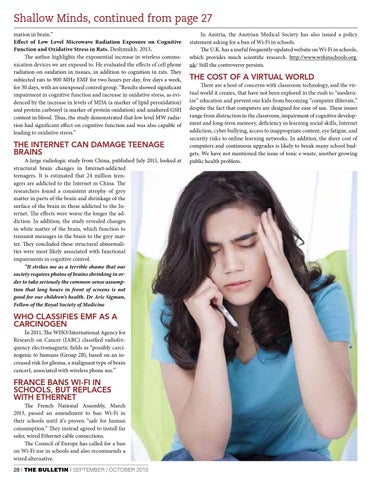
A large radiologic study from China, published July 2011, looked at structural brain changes in Internet-addicted teenagers. It is estimated that 24 million teenagers are addicted to the Internet in China. The researchers found a consistent atrophy of grey matter in parts of the brain and shrinkage of the surface of the brain in those addicted to the Internet. The effects were worse the longer the addiction. In addition, the study revealed changes in white matter of the brain, which function to transmit messages in the brain to the grey matter. They concluded these structural abnormalities were most likely associated with functional impairments in cognitive control. “It strikes me as a terrible shame that our society requires photos of brains shrinking in order to take seriously the common-sense assumption that long hours in front of screens is not good for our children’s health. Dr Aric Sigman, Fellow of the Royal Society of Medicine
WHO Classifies EMF as a Carcinogen
In 2011, The WHO/International Agency for Research on Cancer (IARC) classified radiofrequency electromagnetic fields as “possibly carcinogenic to humans (Group 2B), based on an increased risk for glioma, a malignant type of brain cancer1, associated with wireless phone use.”
France Bans Wi-Fi in Schools, But Replaces With Ethernet
The French National Assembly, March 2013, passed an amendment to ban Wi-Fi in their schools until it’s proven “safe for human consumption.” They instead agreed to install far safer, wired Ethernet cable connections. The Council of Europe has called for a ban on Wi-Fi use in schools and also recommends a wired alternative. 28 | THE BULLETIN | SEPTEMBER / OCTOBER 2013
In Austria, the Austrian Medical Society has also issued a policy statement asking for a ban of Wi-Fi in schools. The U.K. has a useful frequently-updated website on Wi-Fi in schools, which provides much scientific research. http://www.wifiinschools.org. uk/ Still the controversy persists.
The Cost of a Virtual World
There are a host of concerns with classroom technology, and the virtual world it creates, that have not been explored in the rush to “modernize” education and prevent our kids from becoming “computer illiterate,” despite the fact that computers are designed for ease of use. These issues range from distraction in the classroom, impairment of cognitive development and long-term memory, deficiency in learning social skills, Internet addiction, cyber bullying, access to inappropriate content, eye fatigue, and security risks to online learning networks. In addition, the sheer cost of computers and continuous upgrades is likely to break many school budgets. We have not mentioned the issue of toxic e-waste, another growing public health problem.