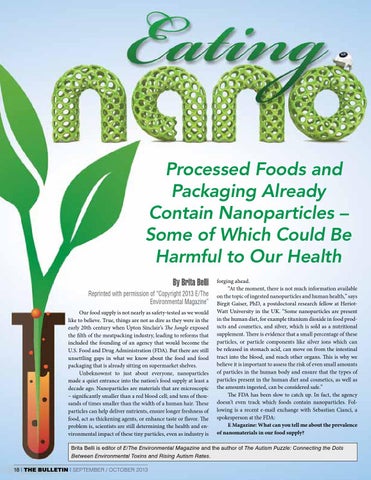
Processed Foods and Packaging Already Contain Nanoparticles – Some of Which Could Be Harmful to Our Health By Brita Belli Reprinted with permission of “Copyright 2013 E/The Environmental Magazine” Our food supply is not nearly as safety-tested as we would like to believe. True, things are not as dire as they were in the early 20th century when Upton Sinclair’s The Jungle exposed the filth of the meatpacking industry, leading to reforms that included the founding of an agency that would become the U.S. Food and Drug Administration (FDA). But there are still unsettling gaps in what we know about the food and food packaging that is already sitting on supermarket shelves. Unbeknownst to just about everyone, nanoparticles made a quiet entrance into the nation’s food supply at least a decade ago. Nanoparticles are materials that are microscopic – significantly smaller than a red blood cell; and tens of thousands of times smaller than the width of a human hair. These particles can help deliver nutrients, ensure longer freshness of food, act as thickening agents, or enhance taste or flavor. The problem is, scientists are still determining the health and environmental impact of these tiny particles, even as industry is
forging ahead. “At the moment, there is not much information available on the topic of ingested nanoparticles and human health,” says Birgit Gaiser, PhD, a postdoctoral research fellow at HeriotWatt University in the UK. “Some nanoparticles are present in the human diet, for example titanium dioxide in food products and cosmetics, and silver, which is sold as a nutritional supplement. There is evidence that a small percentage of these particles, or particle components like silver ions which can be released in stomach acid, can move on from the intestinal tract into the blood, and reach other organs. This is why we believe it is important to assess the risk of even small amounts of particles in the human body and ensure that the types of particles present in the human diet and cosmetics, as well as the amounts ingested, can be considered safe.” The FDA has been slow to catch up. In fact, the agency doesn’t even track which foods contain nanoparticles. Following is a recent e-mail exchange with Sebastian Cianci, a spokesperson at the FDA: E Magazine: What can you tell me about the prevalence of nanomaterials in our food supply?
Brita Belli is editor of E/The Environmental Magazine and the author of The Autism Puzzle: Connecting the Dots Between Environmental Toxins and Rising Autism Rates. 18 | THE BULLETIN | SEPTEMBER / OCTOBER 2013