The Noble Oath By Eleanor Martinez, MD
President, Santa Clara County Medical Association
ELEANOR MARTINEZ, MD
MESSAGE FROM THE
SCCMA PRESIDENT
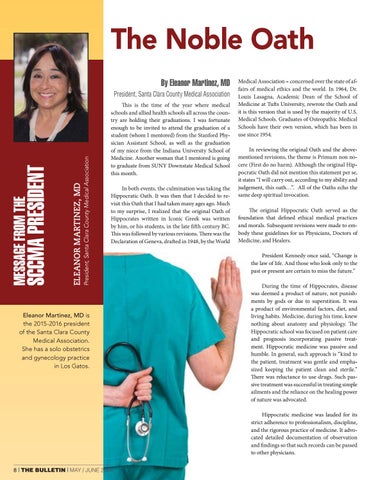
President, Santa Clara County Medical Association This is the time of the year where medical schools and allied health schools all across the country are holding their graduations. I was fortunate enough to be invited to attend the graduation of a student (whom I mentored) from the Stanford Physician Assistant School, as well as the graduation of my niece from the Indiana University School of Medicine. Another woman that I mentored is going to graduate from SUNY Downstate Medical School this month. In both events, the culmination was taking the Hippocratic Oath. It was then that I decided to revisit this Oath that I had taken many ages ago. Much to my surprise, I realized that the original Oath of Hippocrates written in Iconic Greek was written by him, or his students, in the late fifth century BC. This was followed by various revisions. There was the Declaration of Geneva, drafted in 1948, by the World
Eleanor Martinez, MD is the 2015-2016 president of the Santa Clara County Medical Association. She has a solo obstetrics and gynecology practice in Los Gatos.
Medical Association – concerned over the state of affairs of medical ethics and the world. In 1964, Dr. Louis Lasagna, Academic Dean of the School of Medicine at Tufts University, rewrote the Oath and it is this version that is used by the majority of U.S. Medical Schools. Graduates of Osteopathic Medical Schools have their own version, which has been in use since 1954. In reviewing the original Oath and the abovementioned revisions, the theme is Primum non nocere (First do no harm). Although the original Hippocratic Oath did not mention this statement per se, it states “I will carry out, according to my ability and judgement, this oath…”. All of the Oaths echo the same deep spiritual invocation. The original Hippocratic Oath served as the foundation that defined ethical medical practices and morals. Subsequent revisions were made to embody these guidelines for us Physicians, Doctors of Medicine, and Healers. President Kennedy once said, “Change is the law of life. And those who look only to the past or present are certain to miss the future.” During the time of Hippocrates, disease was deemed a product of nature, not punishments by gods or due to superstition. It was a product of environmental factors, diet, and living habits. Medicine, during his time, knew nothing about anatomy and physiology. The Hippocratic school was focused on patient care and prognosis incorporating passive treatment. Hippocratic medicine was passive and humble. In general, such approach is “kind to the patient, treatment was gentle and emphasized keeping the patient clean and sterile.” There was reluctance to use drugs. Such passive treatment was successful in treating simple ailments and the reliance on the healing power of nature was advocated. Hippocratic medicine was lauded for its strict adherence to professionalism, discipline, and the rigorous practice of medicine. It advocated detailed documentation of observation and findings so that such records can be passed to other physicians.
8 | THE BULLETIN | MAY / JUNE 2016