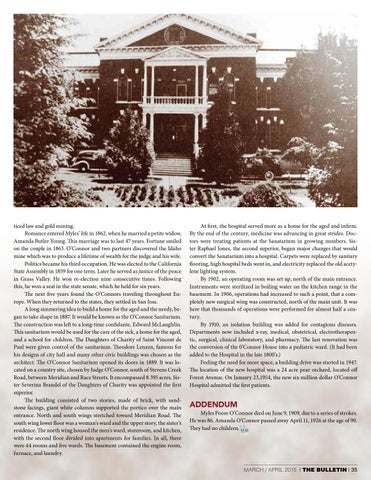
ticed law and gold mining. Romance entered Myles’ life in 1862, when he married a petite widow, Amanda Butler Young. This marriage was to last 47 years. Fortune smiled on the couple in 1863. O’Connor and two partners discovered the Idaho mine which was to produce a lifetime of wealth for the judge and his wife. Politics became his third occupation. He was elected to the California State Assembly in 1859 for one term. Later he served as justice of the peace in Grass Valley. He won re-election nine consecutive times. Following this, he won a seat in the state senate, which he held for six years. The next five years found the O’Connors traveling throughout Europe. When they returned to the states, they settled in San Jose. A long simmering idea to build a home for the aged and the needy, began to take shape in 1887. It would be known as the O’Connor Sanitarium. The construction was left to a long-time confidante, Edward McLaughlin. This sanitarium would be used for the care of the sick, a home for the aged, and a school for children. The Daughters of Charity of Saint Vincent de Paul were given control of the sanitarium. Theodore Lenzen, famous for his designs of city hall and many other civic buildings was chosen as the architect. The O’Connor Sanitarium opened its doors in 1889. It was located on a country site, chosen by Judge O’Connor, south of Stevens Creek Road, between Meridian and Race Streets. It encompassed 8.395 acres. Sister Severina Brandel of the Daughters of Charity was appointed the first superior. The building consisted of two stories, made of brick, with sandstone facings, giant white columns supported the portico over the main entrance. North and south wings stretched toward Meridian Road. The south wing lower floor was a woman’s ward and the upper story, the sister’s residence. The north wing housed the men’s ward, storeroom, and kitchen, with the second floor divided into apartments for families. In all, there were 44 rooms and five wards. The basement contained the engine room, furnace, and laundry.
At first, the hospital served more as a home for the aged and infirm. By the end of the century, medicine was advancing in great strides. Doctors were treating patients at the Sanatarium in growing numbers. Sister Raphael Jones, the second superior, began major changes that would convert the Sanatarium into a hospital. Carpets were replaced by sanitary flooring, high hospital beds went in, and electricity replaced the old acetylene lighting system. By 1902, an operating room was set up, north of the main entrance. Instruments were sterilized in boiling water on the kitchen range in the basement. In 1906, operations had increased to such a point, that a completely new surgical wing was constructed, north of the main unit. It was here that thousands of operations were performed for almost half a century. By 1910, an isolation building was added for contagious diseases. Departments now included x-ray, medical, obstetrical, electrotherapeutic, surgical, clinical laboratory, and pharmacy. The last renovation was the conversion of the 0’Connor House into a pediatric ward. (It had been added to the Hospital in the late 1800’s.) Feeling the need for more space, a building drive was started in 1947. The location of the new hospital was a 24 acre pear orchard, located off Forest Avenue. On January 23,1954, the new six million dollar O’Connor Hospital admitted the first patients.
ADDENDUM
Myles Poore O’Connor died on June 9, 1909, due to a series of strokes. He was 86. Amanda O’Connor passed away April 11, 1926 at the age of 90. They had no children.
MARCH / APRIL 2015 | THE BULLETIN | 35