EACH MIND MATTERS CAMPAIGN Primary Care Physicians: The Front Lines of Mental Health Care and the Fight Against Stigma
By Lisa Smusz
WHY PRIMARY CARE PHYSICIANS ARE THE FRONT-LINE OF MENTAL HEALTH CARE:
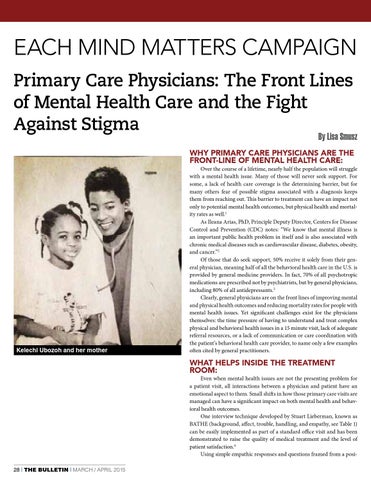
Kelechi Ubozoh and her mother
Over the course of a lifetime, nearly half the population will struggle with a mental health issue. Many of those will never seek support. For some, a lack of health care coverage is the determining barrier, but for many others fear of possible stigma associated with a diagnosis keeps them from reaching out. This barrier to treatment can have an impact not only to potential mental health outcomes, but physical health and mortality rates as well.1 As Ileana Arias, PhD, Principle Deputy Director, Centers for Disease Control and Prevention (CDC) notes: “We know that mental illness is an important public health problem in itself and is also associated with chronic medical diseases such as cardiovascular disease, diabetes, obesity, and cancer.”2 Of those that do seek support, 50% receive it solely from their general physician, meaning half of all the behavioral health care in the U.S. is provided by general medicine providers. In fact, 70% of all psychotropic medications are prescribed not by psychiatrists, but by general physicians, including 80% of all antidepressants.3 Clearly, general physicians are on the front lines of improving mental and physical health outcomes and reducing mortality rates for people with mental health issues. Yet significant challenges exist for the physicians themselves: the time pressure of having to understand and treat complex physical and behavioral health issues in a 15 minute visit, lack of adequate referral resources, or a lack of communication or care coordination with the patient’s behavioral health care provider, to name only a few examples often cited by general practitioners.
WHAT HELPS INSIDE THE TREATMENT ROOM:
Even when mental health issues are not the presenting problem for a patient visit, all interactions between a physician and patient have an emotional aspect to them. Small shifts in how those primary care visits are managed can have a significant impact on both mental health and behavioral health outcomes. One interview technique developed by Stuart Lieberman, known as BATHE (background, affect, trouble, handling, and empathy, see Table 1) can be easily implemented as part of a standard office visit and has been demonstrated to raise the quality of medical treatment and the level of patient satisfaction.4 Using simple empathic responses and questions framed from a posi28 | THE BULLETIN | MARCH / APRIL 2015