tremely low frequencies, power lines or certain high frequency waves used in the fields of radar, telecommunications, and mobile telephony, appear to have more or less potentially harmful, non-thermal, biological effects on plants, insects, and animals, as well as the human body, even when exposed to levels that are below the official threshold values.” The Council calls for a number of measures to protect humans and the environment, especially from highfrequency electromagnetic fields. One of the recommendations is to “take all reasonable measures to reduce exposure to electromagnetic fields, especially to radio frequencies from mobile phones, and particularly the exposure to children and young people who seem to be most at risk from head tumors”. (37)
IN FRANCE: A NEW NATIONAL LAW BANS WI-FI IN NURSERY SCHOOLS
In January 2015, France passed a landmark law that calls for precaution with wireless devices for children and the general public. (34)(35) It calls for: 1. Wi-Fi banned in nursery schools. 2. Wi-Fi routers should be turned off in school when not in use. 3. Schools are informed when new tech equipment is installed. 4. Citizens will have access to environmental cell tower radiation measurements near homes. 5. There will be continued research conducted into health effects of wireless communications. 6. Information on reducing exposure to EMF radiation is mandatory in the contents of the cell phone package. 7. Wi-Fi hotspots are labeled.
ISRAELI MINISTRY OF EDUCATION ISSUE GUIDELINES TO LIMIT WI-FI IN SCHOOLS
On August 27, 2013, the Israeli Ministry of Education issued new guidelines regarding Wi-Fi use in schools. (33) The guidelines will: 1. Stop the installation of wireless networks in classrooms in kindergarten. 2. Limit the use of Wi-Fi between first and third grades. In the first grade, students will be limited to use Wi-Fi to study for one hour per day and no more than three days per week. Between the first and third grades, students will be limited to use Wi-Fi up to two hours per day for no more than four days per week. 3. To limit unnecessary exposure teachers will be required to turn off mobile phones and Wi-Fi routers when they are not in use for educational purposes. 4. All Wi-Fi equipment be tested for compliance with safety limits before and after installation in an Israeli school. 5. Desktop computers and power supplies be kept at least 20 cm from students.
2012 THE RUSSIAN COMMITTEE ON NON-IONIZING RADIATION PROTECTION
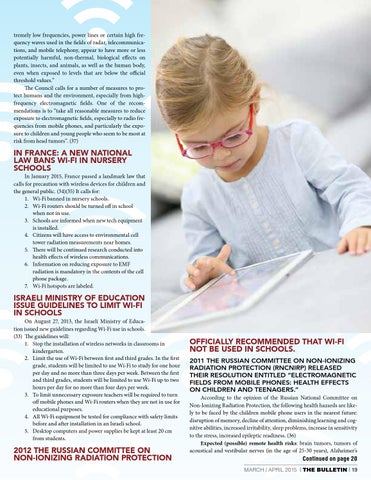
OFFICIALLY RECOMMENDED THAT WI-FI NOT BE USED IN SCHOOLS. 2011 THE RUSSIAN COMMITTEE ON NON-IONIZING RADIATION PROTECTION (RNCNIRP) RELEASED THEIR RESOLUTION ENTITLED “ELECTROMAGNETIC FIELDS FROM MOBILE PHONES: HEALTH EFFECTS ON CHILDREN AND TEENAGERS.” According to the opinion of the Russian National Committee on Non-Ionizing Radiation Protection, the following health hazards are likely to be faced by the children mobile phone users in the nearest future: disruption of memory, decline of attention, diminishing learning and cognitive abilities, increased irritability, sleep problems, increase in sensitivity to the stress, increased epileptic readiness. (36) Expected (possible) remote health risks: brain tumors, tumors of acoustical and vestibular nerves (in the age of 25-30 years), Alzheimer’s
Continued on page 20 MARCH / APRIL 2015 | THE BULLETIN | 19