President, Santa Clara County Medical Association
SCOTT BENNINGHOVEN, MD
MESSAGE FROM THE
SCCMA PRESIDENT
O
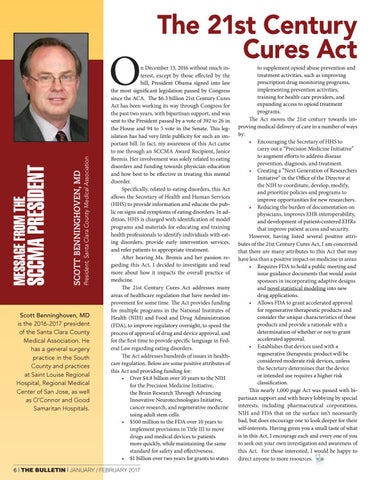
Scott Benninghoven, MD is the 2016-2017 president of the Santa Clara County Medical Association. He has a general surgery practice in the South County and practices at Saint Louise Regional Hospital, Regional Medical Center of San Jose, as well as O’Connor and Good Samaritan Hospitals.
The 21st Century Cures Act
n December 13, 2016 without much interest, except by those effected by the bill, President Obama signed into law the most significant legislation passed by Congress since the ACA. The $6.3 billion 21st Century Cures Act has been working its way through Congress for the past two years, with bipartisan support, and was sent to the President passed by a vote of 392 to 26 in the House and 94 to 5 vote in the Senate. This legislation has had very little publicity for such an important bill. In fact, my awareness of this Act came to me through an SCCMA Award Recipient, Janice Bremis. Her involvement was solely related to eating disorders and funding towards physician education and how best to be effective in treating this mental disorder. Specifically, related to eating disorders, this Act allows the Secretary of Health and Human Services (HHS) to provide information and educate the public on signs and symptoms of eating disorders. In addition, HHS is charged with identification of model programs and materials for educating and training health professionals to identify individuals with eating disorders, provide early intervention services, and refer patients to appropriate treatment. After hearing Ms. Bremis and her passion regarding this Act, I decided to investigate and read more about how it impacts the overall practice of medicine. The 21st Century Cures Act addresses many areas of healthcare regulation that have needed improvement for some time. The Act provides funding for multiple programs in the National Institutes of Health (NIH) and Food and Drug Administration (FDA), to improve regulatory oversight, to speed the process of approval of drug and device approval, and for the first time to provide specific language in Federal Law regarding eating disorders. The Act addresses hundreds of issues in healthcare regulation. Below are some positive attributes of this Act and providing funding for: • Over $4.8 billion over 10 years to the NIH for the Precision Medicine Initiative, the Brain Research Through Advancing Innovative Neurotechnologies Initiative, cancer research, and regenerative medicine using adult stem cells. • $500 million to the FDA over 10 years to implement provisions in Title III to move drugs and medical devices to patients more quickly, while maintaining the same standard for safety and effectiveness. • $1 billion over two years for grants to states
6 | THE BULLETIN | JANUARY / FEBRUARY 2017
to supplement opioid abuse prevention and treatment activities, such as improving prescription drug monitoring programs, implementing prevention activities, training for health care providers, and expanding access to opioid treatment programs. The Act moves the 21st century towards improving medical delivery of care in a number of ways by: • Encouraging the Secretary of HHS to carry out a “Precision Medicine Initiative” to augment efforts to address disease prevention, diagnosis, and treatment. • Creating a “Next Generation of Researchers Initiative” in the Office of the Director at the NIH to coordinate, develop, modify, and prioritize policies and programs to improve opportunities for new researchers. • Reducing the burden of documentation on physicians, improves EHR interoperability, and development of patient-centered EHRs that improve patient access and security. However, having listed several positive attributes of the 21st Century Cures Act, I am concerned that there are many attributes to this Act that may have less than a positive impact on medicine in areas: • Requires FDA to hold a public meeting and issue guidance documents that would assist sponsors in incorporating adaptive designs and novel statistical modeling into new drug applications. • Allows FDA to grant accelerated approval for regenerative therapeutic products and consider the unique characteristics of these products and provide a rationale with a determination of whether or not to grant accelerated approval. • Establishes that devices used with a regenerative therapeutic product will be considered moderate risk devices, unless the Secretary determines that the device or intended use requires a higher risk classification. This nearly 1,000 page Act was passed with bipartisan support and with heavy lobbying by special interests, including pharmaceutical corporations, NIH and FDA that on the surface isn’t necessarily bad, but does encourage one to look deeper for their self-interests. Having given you a small taste of what is in this Act, I encourage each and every one of you to seek out your own investigation and awareness of this Act. For those interested, I would be happy to direct anyone to more resources.