– Most commercial publishers charge authors between EUR 1 500 and 2 000 to publish a scientific article in Open Access, says Niels Stern. This may be prohibitive for young researchers seeking to make their knowledge available, not to mention for researchers in developing countries, who face major problems both with publishing their own knowledge and with accessing that of others.
Open Acces and innovation Ill: Commando Group
So there is still progress to be made. Several studies have shown that only about 25 per cent of all scientific articles published are open access from their date of publication. When it comes to scientific books the figure is probably lower. So although most people basically agree that open access is the future, there is still a long way to go from policy to action. The concept of open access begs the question: Can something be given away for free and still be sold? Mr Stern strongly believes that it can, and points to examples where this is already the case. – You can download a free PDF file, for example, but you have to pay for a printed version or an e-book, both of which are value-added products that certain readers want and are willing to pay for. This model is sometimes called ‘freemium’ – giving one version away while offering a premium product at a price. – But regardless of the business model, the issue is essentially about providing free access to the published knowledge funded by the Nordic Council of Ministers. In this way we are joining a worldwide, democratic project that has not yet succeeded fully, but to which we as an international organisation can make a positive contribution.
Access to knowledge more limited for small and medium-sized enterprises DELTA is an Approved Technological Service Institute (called a GTS institute in Denmark) whose researchers work closely to help companies innovate when developing high-tech products. Senior Technology Specialist Jørn Johansen believes that small and medium-sized enterprises (SMEs) have a difficult time staying informed about the latest research results because journal subscriptions are so costly. – In the Innovation Consortia projects I’ve headed, I have seen that the researchers generally have access to all the relevant articles they need through their universities. This enables them to play a major role in product development. But the SMEs have a clear problem in that they do not necessarily have the same knowledge at their disposal. Companies would most certainly be able to contribute more if they had the same access. – Many articles are produced in Innovation Consortia projects. They are presented at conferences or submitted to journals.
65
It’s hard for companies to understand why they don’t have the same access to articles from the projects they themselves are part of. – I am fully convinced that access to the knowledge being generated should be more open. This would be of great value for the countries funding the research, as companies could more readily apply the results. Large companies can afford to pay for access, but SMEs in particular often don’t have that same capacity.
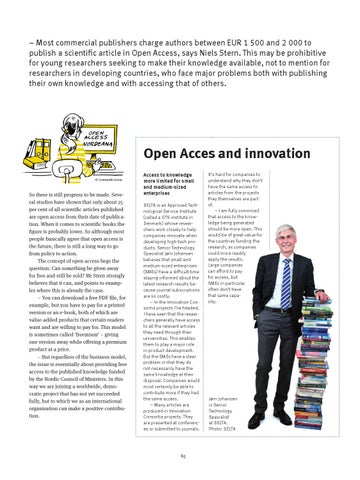
Jørn Johansen is Senior Technology Specialist at DELTA. Photo: DELTA