Balance leads to quality
– Gender balance improves the quality of research and research cooperation, says Director of NordForsk Gunnel Gustafsson. NordForsk recently adopted a policy for gender equality.
Several studies have shown that a genderbalanced research group is more successful than one comprised of only men or women. Higher quality in research and research cooperation is also the reason why the NordForsk Board decided to introduce a gender equality policy. Memorandum of Understanding with the EU – We have followed gender balance principles for a long time, but now we have also put them down on paper and adopted them as a policy, says Director of NordForsk Gunnel Gustafsson. The decision comes as a result of a Memorandum of Understanding between NordForsk and the European Commission. Gender equality and gender perspectives in research are among the key elements of this MoU.
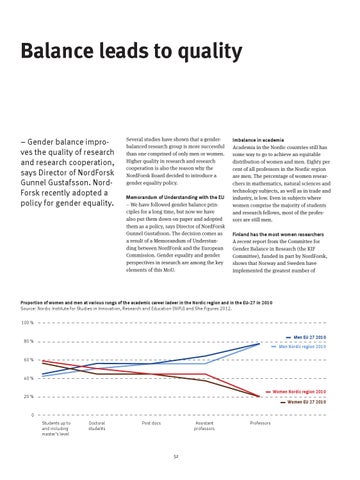
Imbalance in academia Academia in the Nordic countries still has some way to go to achieve an equitable distribution of women and men. Eighty per cent of all professors in the Nordic region are men. The percentage of women researchers in mathematics, natural sciences and technology subjects, as well as in trade and industry, is low. Even in subjects where women comprise the majority of students and research fellows, most of the professors are still men. Finland has the most women researchers A recent report from the Committee for Gender Balance in Research (the KIF Committee), funded in part by NordForsk, shows that Norway and Sweden have implemented the greatest number of
Proportion of women and men at various rungs of the academic career ladeer in the Nordic region and in the EU-27 in 2010 Source: Nordic Institute for Studies in Innovation, Research and Education (NIFU) and She Figures 2012. 100 % Men EU 27 2010
80 %
Men Nordic region 2010
60 %
40 % Women Nordic region 2010
20 %
Women EU 27 2010
0 Students up to and including master’s level
Doctoral students
Post docs
Assistant professors
52
Professors