What role will research and innovation play in the future development of Nordic cooperation?
What are the most important results achieved during the term of the outgoing Council Director?
Mr Enestam: It should play a more significant role than it does today, and we should not be satisfied until a research group from the Nordic countries receives a Nobel Prize. However, priority is often given to coope ration with the US and other countries instead of building critical mass in a Nordic context. There are niches in which we can clearly become world leaders. NordForsk can promote and cultivate such research and increase our competitiveness. Ms Bohlin: There is strength in the capability of our five countries to develop effective crisis communication. This is an extremely challenging area, and more knowledge and good communication solutions are critical. Although we have different systems and social structures, we have so much in common that we can achieve a lot! Mr Enestam: Yes, and our differences can be complementary rather than competing. We can benefit greatly from each other’s best practice. Another strength is that we can act together in the international arena, where we are noticed. We are unique in that we cooperate at the regional level, while at the same time maintaining different forms of affiliation to NATO and the EU.
Mr Enestam: Everything has been important! But to highlight a few things, the Council’s focus on theme sessions, particularly defence policy and foreign policy themes, has been important. The Council has given a parliamentary dimension to Nordic defence and foreign policy cooperation. It is also exciting to see the international interest in Nordic cooperation and the Nordic welfare model. Visiting groups from many countries wish to learn more about the Nordic region. Our achievements garner attention, despite the fact that our common history has been characterised by war and conflict. The Nordic Council is a strong organisation, and we strive to work efficiently and submit interesting issues rapidly as recommendations for the Nordic Council of Ministers. We see that there is great interest in Nordic cooperation among the Nordic
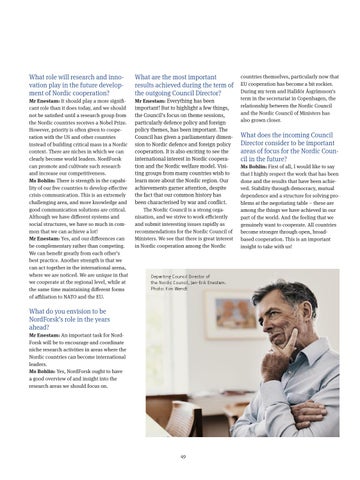
Departing Council Director of the Nordic Council, Jan-Erik Enestam. Photo: Kim Wendt
What do you envision to be NordForsk’s role in the years ahead? Mr Enestam: An important task for NordForsk will be to encourage and coordinate niche research activities in areas where the Nordic countries can become international leaders. Ms Bohlin: Yes, NordForsk ought to have a good overview of and insight into the research areas we should focus on.
49
countries themselves, particularly now that EU cooperation has become a bit rockier. During my term and Halldór Ásgrímsson’s term in the secretariat in Copenhagen, the relationship between the Nordic Council and the Nordic Council of Ministers has also grown closer.
What does the incoming Council Director consider to be important areas of focus for the Nordic Council in the future? Ms Bohlin: First of all, I would like to say that I highly respect the work that has been done and the results that have been achieved. Stability through democracy, mutual dependence and a structure for solving problems at the negotiating table – these are among the things we have achieved in our part of the world. And the feeling that we genuinely want to cooperate. All countries become stronger through open, broadbased cooperation. This is an important insight to take with us!