Disasters and accidents do not stop at national borders NordForsk has issued a funding announcement under the new interdisciplinary programme for societal security research. What will be the biggest challenge facing the Nordic countries?
To what extent are we prepared to tackle security challenges, and in what ways can a Nordic research programme help to ensure that the Nordic countries remain a safe place to live?
Mr Enestam: Geographical issues and the Arctic can pose major challenges with regard to preparedness and rescue capacity. Increased shipping traffic and petroleum recovery in vulnerable Arctic areas can lead to accidents with a major impact on both human health and the environment. Nordic cooperation enables us to use our collective resources and achieve effective task distribution, which in turn allows us to get more out of the resources we have. Ms Bohlin: I agree, and I think that climate challenges can become particularly pressing. The impacts of climate change must be viewed in a global perspective – food and water shortages affect us too. We will have to put our lifestyle under scrutiny. The UN’s Intergovernmental Panel on Climate Change makes that abundantly clear.
Ms Bohlin: In many ways. We will need a variety of tools for our common use. One example is the collaborative project between Trøndelag counties in Norway and Jämtland county in Sweden to draw up a joint map for preparedness and accidents. Earlier maps stopped at national borders, but disasters and accidents do not. Mr Enestam: Yes, and at the same time it is important to identify gaps – and close them. Dynamic networks between Nordic researchers are essential for establishing adequate critical mass.
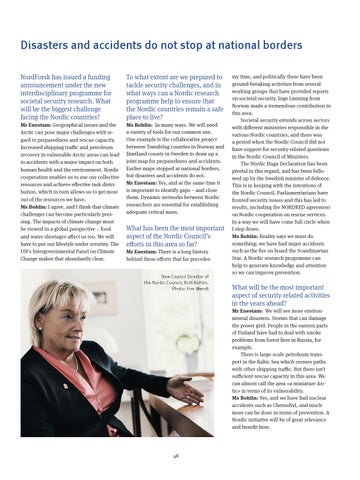
What has been the most important aspect of the Nordic Council’s efforts in this area so far? Mr Enestam: There is a long history behind these efforts that far precedes New Council Director of the Nordic Council, Britt Bohlin. Photo: Kim Wendt
my time, and politically there have been ground-breaking activities from several working groups that have provided reports on societal security. Inge Lønning from Norway made a tremendous contribution in this area. Societal security extends across sectors with different ministries responsible in the various Nordic countries, and there was a period when the Nordic Council did not have support for security-related questions in the Nordic Council of Ministers. The Nordic Haga Declaration has been pivotal in this regard, and has been followed up by the Swedish minister of defence. This is in keeping with the intentions of the Nordic Council. Parliamentarians have fronted security issues and this has led to results, including the NORDRED agreement on Nordic cooperation on rescue services. In a way we will have come full circle when I step down. Ms Bohlin: Reality says we must do something; we have had major accidents such as the fire on board the Scandinavian Star. A Nordic research programme can help to generate knowledge and attention so we can improve prevention.
What will be the most important aspect of security-related activities in the years ahead? Mr Enestam: We will see more environmental disasters. Storms that can damage the power grid. People in the eastern parts of Finland have had to deal with smoke problems from forest fires in Russia, for example. There is large-scale petroleum transport in the Baltic Sea which crosses paths with other shipping traffic. But there isn’t sufficient rescue capacity in this area. We can almost call the area «a miniature Arctic» in terms of its vulnerability. Ms Bohlin: Yes, and we have had nuclear accidents such as Chernobyl, and much more can be done in terms of prevention. A Nordic initiative will be of great relevance and benefit here.
48