T
here are many world-class researchers behind every climate report. - The relevance of the work we do is consistently being confirmed by the results of our research, states Dr Christensen. As project manager for the Nordic Centre of Excellence DEFROST, he is seeing first-hand that ice, snow and permafrost – in short, all forms of frozen water on the Earth’s surface – are sensitive to very slight temperature changes. – It is frightening given current climate predictions, he states. Nobel Peace Prize Laureate After publishing its assessment report in 2007, the IPCC and former US Vice President, Al Gore, were jointly awarded the Nobel Peace Prize. As a contributor to the report, Dr Christensen was also one of the recipients. – Hundreds of others were also involved, he adds modestly in reference to his contribution to the prize, – But it is obvious that this has helped to raise awareness of how crucial the work is. Interest in learning more about climate mechanisms increased in many areas, and several research programmes focusing on climate issues were launched. When the Top-level Research Initiative was launched at a high political level the following year, Professor Christensen and his colleagues had the opportunity to target their efforts on these issues even more. – We are very aware that our research has to be relevant, he states, and we provide knowledge to the IPCC to contribute to the best possible common understanding of climate issues. A self-reinforcing mechanism The concentration of greenhouse gases in the atmosphere affects the temperature on Earth. The greenhouse effect is a natural process, but increased emissions of greenhouse gases lead to global warming. Snow, ice and permafrost play pivotal roles in the global climate system. As the climate grows warmer, more greenhouse gases will be released from the sea and from permafrost on the ocean floor and on land, thereby causing further climate change. It is a selfreinforcing mechanism, and it is happening at a much faster pace than previously thought.
We don’t know what we’re doing The climate system is like an engine, Dr Christensen says. – Certain integral parts are being started but we don’t know how the engine works. It is hard to predict what the consequences of our actions will be. These consequences are precisely what Dr Christensen and his research colleagues at the DEFROST centre are working to shed more light on. Researchers from a wide range of different fields are working together to address the same questions, but from different perspectives. Some scientists are studying the tundra under what Dr Christensen refers to as «relatively comfortable conditions».Some are working with ice and sea ice, some are mostly in laboratories while others spend their days in front of their office computers. Together they all complement each other, and make it possible to view the situation from different perspectives. Building bridges between fields The whole idea is to bring together the best people in the Nordic region, says Dr Christensen enthusiastically, on the interdisciplinary cooperation. This is particularly evident in the link between researchers working with sea ice and researchers on land. Traditionally there has been very little interaction between these groups, and, in many ways, they have spoken «different languages». According to Dr Christensen, this has changed since the DEFROST centre was launched. – Now that we’ve begun talking together and cooperating on the same project, we are learning many new things and getting new perspectives in our own fields as well. We are gaining greater insight into how things are connected, he continues. – We mustn’t be afraid to ask each other questions. The mysteries of sea ice Sea ice is what Dr Christensen finds most exciting about joint sea and land research. – Sea ice of course plays a vital role in the exchange of CO2 at sea, but it is also important in what happens on land. It is something we know very little about. Close to one-fourth of today’s CO2 emissions are assimilated by the seas. We know very little about how CO2 uptake will be affected when sea ice recedes due to climate change.
43
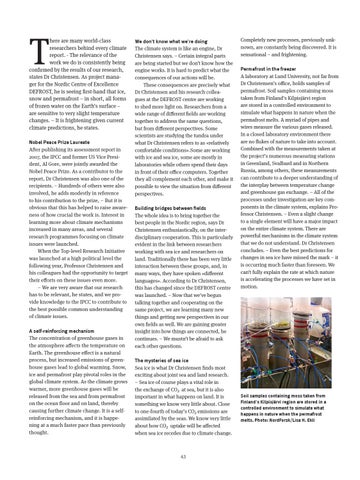
Completely new processes, previously unknown, are constantly being discovered. It is sensational – and frightening. Permafrost in the freezer A laboratory at Lund University, not far from Dr Christensen’s office, holds samples of permafrost. Soil samples containing moss taken from Finland’s Kilpisjärvi region are stored in a controlled environment to simulate what happens in nature when the permafrost melts. A myriad of pipes and wires measure the various gases released. In a closed laboratory environment there are no flukes of nature to take into account. Combined with the measurements taken at the project’s numerous measuring stations in Greenland, Svalbard and in Northern Russia, among others, these measurements can contribute to a deeper understanding of the interplay between temperature change and greenhouse gas exchange. – All of the processes under investigation are key components in the climate system, explains Professor Christensen. – Even a slight change to a single element will have a major impact on the entire climate system. There are powerful mechanisms in the climate system that we do not understand. Dr Christensen concludes. – Even the best predictions for changes in sea ice have missed the mark – it is occurring much faster than foreseen. We can’t fully explain the rate at which nature is accelerating the processes we have set in motion.
Soil samples containing moss taken from Finland’s Kilpisjärvi region are stored in a controlled environment to simulate what happens in nature when the permafrost melts. Photo: NordForsk/Lisa H. Ekli