In the Nordic countries we all live in the Arctic
If Dr Kullerud is not out fishing for lobsters in-season near his home in Arendal, Norway, or sailing his traditional wooden boat, he may be found at Lake Baikal or Ulan-Ude, or perhaps in Longyearbyen, Iqaluit, Kilpisjärvi or Arkhangelsk. He is quite the Arctic adventurer and, as listeners quickly sense, a well-spring of captivating stories and clear opinions. All one needs to do is ask. The reason Dr Kullerud often finds himself at places with names that are so hard to spell is that he is president of the decentralised organisation UArctic, which is dedicated to strengthening research and education in the Arctic. His experience with Nordic research cooperation is extensive, both as a researcher and an administrator.
What is our biggest challenge in researching the Arctic? – The most important thing is to find a way of organising its different societies in order to preserve what is valuable in traditional cultures while at the same time modernising society overall, making it a good place to live for many generations to come. It may not be a good move to construct downscaled copies of large European cities in the Arctic; perhaps we need to find another way. This poses a major challenge. Much of current policy is based on national and traditional expectations that local solutions should be copies of centralised solutions. In my opinion we need to think creatively within an interdisciplinary perspective to find workable solutions for the North. – There is potential in Nordic cooperation. I think our biggest advantage in the Nordic countries is that we live here. Almost everyone who lives in the world’s northernmost reaches lives in the Nordic countries. If you draw a line at the southernmost point of Denmark, there are very few people, from a global perspective, living north of that line. While a person who lives just north of Stockholm may not feel that he or she lives in the Arctic, he or she does live much farther north than almost everyone else on Earth. And those of us who live here find it natural to live with snow and ice, so we have experience that is parallel to that of northern Canada or Siberia, where almost no people live. That knowledge is the biggest advantage
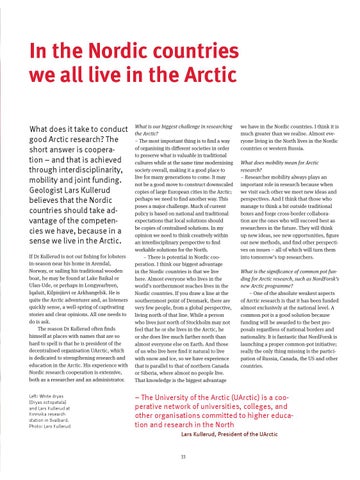
Left: White dryas (Dryas octopetala) and Lars Kullerud at Kinnvika research station in Svalbard. Photo: Lars Kullerud
– The University of the Arctic (UArctic) is a cooperative network of universities, colleges, and other organisations committed to higher education and research in the North
What does it take to conduct good Arctic research? The short answer is cooperation – and that is achieved through interdisciplinarity, mobility and joint funding. Geologist Lars Kullerud believes that the Nordic countries should take advantage of the competencies we have, because in a sense we live in the Arctic.
we have in the Nordic countries. I think it is much greater than we realise. Almost everyone living in the North lives in the Nordic countries or western Russia. What does mobility mean for Arctic research? – Researcher mobility always plays an important role in research because when we visit each other we meet new ideas and perspectives. And I think that those who manage to think a bit outside traditional boxes and forge cross-border collaboration are the ones who will succeed best as researchers in the future. They will think up new ideas, see new opportunities, figure out new methods, and find other perspectives on issues – all of which will turn them into tomorrow’s top researchers. What is the significance of common pot funding for Arctic research, such as NordForsk’s new Arctic programme? – One of the absolute weakest aspects of Arctic research is that it has been funded almost exclusively at the national level. A common pot is a good solution because funding will be awarded to the best proposals regardless of national borders and nationality. It is fantastic that NordForsk is launching a proper common-pot initiative; really the only thing missing is the participation of Russia, Canada, the US and other countries.
Lars Kullerud, President of the UArctic
33