1
2
Tools for Investigating Climate Change at High Northern Latitudes (eSTICC)
Ensemble-based Methods for Environmental Monitoring and Prediction
1
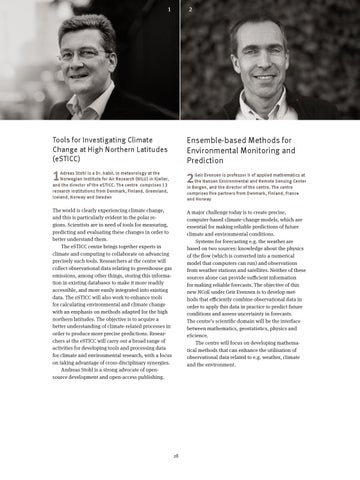
Adreas Stohl is a Dr. habil. in meteorology at the Norwegian Institute for Air Research (NILU) in Kjeller, and the director of the eSTICC. The centre comprises 13 research institutions from Denmark, Finland, Greenland, Iceland, Norway and Sweden
2
The world is clearly experiencing climate change, and this is particularly evident in the polar regions. Scientists are in need of tools for measuring, predicting and evaluating these changes in order to better understand them. The eSTICC centre brings together experts in climate and computing to collaborate on advancing precisely such tools. Researchers at the centre will collect observational data relating to greenhouse gas emissions, among other things, storing this information in existing databases to make it more readily accessible, and more easily integrated into existing data. The eSTICC will also work to enhance tools for calculating environmental and climate change with an emphasis on methods adapted for the high northern latitudes. The objective is to acquire a better understanding of climate-related processes in order to produce more precise predictions. Researchers at the eSTICC will carry out a broad range of activities for developing tools and processing data for climate and environmental research, with a focus on taking advantage of cross-disciplinary synergies. Andreas Stohl is a strong advocate of open-Â source development and open-access publishing.
A major challenge today is to create precise, computer-based climate-change models, which are essential for making reliable predictions of future climate and environmental conditions. Systems for forecasting e.g. the weather are based on two sources: knowledge about the physics of the flow (which is converted into a numerical model that computers can run) and observations from Âweather stations and satellites. Neither of these sources alone can provide sufficient information for making reliable forecasts. The objective of this new NCoE under Geir Evensen is to develop methods that efficiently combine observational data in order to apply this data in practice to predict future conditions and assess uncertainty in forecasts. The centre’s scientific domain will be the interface between mathematics, geostatistics, physics and eScience. The centre will focus on developing mathematical methods that can enhance the utilisation of observational data related to e.g. weather, climate and the environment.
Geir Evensen is professor II of applied mathematics at the Nansen Environmental and Remote Sensing Center in Bergen, and the director of the centre. The centre comprises five partners from Denmark, Finland, France and Norway
28