Invisible pathways to carry research forwards What exactly is e-Infrastructure? – In the 1500’s astronomer Tycho Brahe mapped the stars as we know them today. He studied all the orbits of all the plants and stars, and observed their movements. But what did Michael Grønager, Chief he use all this Operating Officer for knowledge for? Payward Inc., and former Not much, actudirector of the NDGF. ally. Several years later, Johannes Kepler looked at Brahe’s work, analysed it and showed that the planets move in elliptical orbits. Brahe compiled the data, Kepler performed the research. And that is a good analogy for what takes place today. Michael Grønager, Chief Operating Officer for Payward Inc., and former director of the NDGF, tells the story of Brahe and Kepler to explain what e-Infrastructure is. He fast forwards to today: – At CERN there is an enormous machine that can make particles collide, generating random numbers, producing data. This data is then processed by computers to find out what happened. You need a special set-up – an electronic infrastructure – to read and process the data. This can be compared to a road network and everything in it: traffic lights, roundabouts, motorways and bicycle paths. You can get where you’re
going much more quickly if you have the right infrastructure in place. The aim is transparency Ebba Hvannberg, professor of computer science at the University of Iceland, emphasises another aspect in her explanation: – I work with making e-Infrastructure accessible so that other researchers don’t have to worry about it. Ultimately good e-Infrastructure should be transparent. It should be a research tool that the researcher does not see, but simply uses. e-Infrastructure includes computers and databases, and like physical infrastructure, you shouldn’t have to spend too much time thinking about it. The pathways should ideally be invisible but easy to traverse. – One of the advantages of e-Infrastructure is that it makes it easier to collaborate on data. Nordic cooperation makes very good sense because together we can tailor e-Infrastructure solutions and at the same time ensure that we have sufficient critical research mass and the resources needed to utilise them.
Ebba Hvannberg, professor of computer science at the University of Iceland.
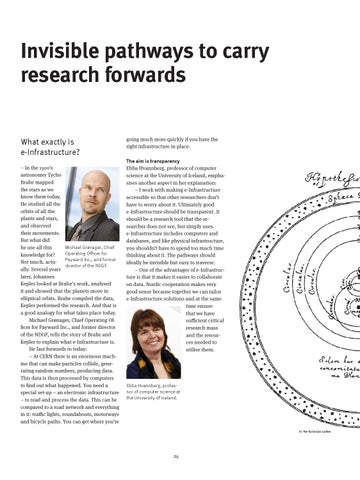
Ill: The Tychonian system
24