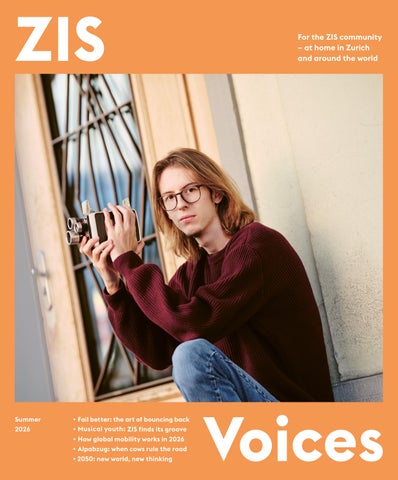
ZIS
Summer 2026
• Fail better: the art of bouncing back • Musical youth: ZIS finds its groove • How global mobility works in 2026 • Alpabzug: when cows rule the road • 2050: new world, new thinking
For the ZIS community – at home in Zurich and around the world
Voices
Summer 2026 CHIEF ADVANCEMENT OFFICER EMMA ZIGAN ezigan@zis.ch EDITOR
CATHRIN GUTWALD ON THE COVER
DINO HLADECEK (p29) PHOTOGRAPHED BY KATE PETERS LETTERS AND ENQUIRIES
ZURICH INTERNATIONAL SCHOOL ADVANCEMENT STEINACHERSTRASSE 140 8820 WÄDENSWIL SWITZERLAND ADVERTISING ENQUIRIES voices@zis.ch
UNSUBSCRIBE
zis.ch/address-update Zurich International School (ZIS) was formed in 2001 through the merger of the American International School of Zurich (AISZ) and the International Primary School of Zurich (IPSZ).
For the ZIS community – at home in Zurich and around the world
12
02 News
How to fail Talking about resilience is easy, but actually having it? That’s the challenge.
05 From the Director Elsa Hernández-Donohue 06 Global Community 09 The future of... Global mobility Andrew Vincett 10 Connections Claire Matern and Perry Ryan
11 24 hours in Maui Sharon Gutenberg
22
16
Teaching the future Today’s students need future thinking now – and teachers are on the case. The opinions expressed in ZIS Voices are those of the contributors and not necessarily those of Zurich International School or YBM ZIS Voices is produced on behalf of ZIS by YBM
ybm.co.uk
29 My passion Dino Hladecek 30 Canton Alpabzug
32 My working day Maria Claudia Prieto
In perfect harmony Why music at ZIS is about way more than simply showing up for class.
Voices
News
Socials
Join the ZIS Global Network globalcommunity.zis.ch A dedicated networking platform for the whole ZIS community.
#ZISExperience #ZISLearns #ZISCares #ZISAlumni #ZISTalks Facebook zurichintschool
Instagram zurich-international-school LinkedIn zurich-international-school YouTube ZurichIntS Speech, debate and acting
Student success at NESDA
ZIS students showcased their talent and composure at the New European Speech, Debate and Acting Association (NESDA) tournament in Rome this spring, one of Europe’s most prestigious competitions of its kind. Competing across five events, participants from Grade 9 and Grade 11 not only achieved impressive results but also demonstrated the confidence, resilience and clarity of thought that define strong communicators. A highlight of this year’s tournament was a rare all-ZIS debate final. Alice, Abhinav and Felix secured gold – marking their second consecutive victory – while William and Elisabeth earned silver. Alice also claimed gold in Original Oratory. Several students successfully advanced to the semi-finals, including Elisabeth (Original Oratory), Marija, William and Abhinav (Impromptu Speaking), Nicolas and Owen (Impromptu Duet Acting), and Alice (Oral Interpretation). NESDA challenges students to step beyond their comfort zones, collaborate under pressure and develop confident, persuasive voices – skills that extend far beyond the stage. And at ZIS, this journey begins early, with communication and critical thinking nurtured from an early age onwards. 2
Getting to school
60% of our students travel independently to ZIS.
With a goal of 80 per cent, we encourage all families to use ZIS Village Liners, buses, public transport, carpooling or walking to build independence, support sustainability and reduce campus traffic.
ZIS Voices
Science
The ZIS Science Club was proud to host the Swiss Young Naturalists Tournament in March, made even more special as this inspiring event was celebrating its 10th anniversary.
Students aged 12 to 16 explored a range of scientific questions – from spider web construction to sound resonance – and impressed with creative experiments, thoughtful analysis and confident debate, demonstrating teamwork, discovery and a shared passion for science. Learning
New learning environments to help inspire students
ZIS is partnering with award-winning interior design company Rosan Bosch Studio to enhance some of our spaces and elevate learning, collaboration, wellbeing and community. Starting this summer, the first phase of the project will focus on redesigning the two cafeteria areas on the Adliswil Campus into flexible social and learning hubs. Further developments are also planned for the Wädenswil Campus, including new learning and community spaces for Grades 5 and 6, as well as a multipurpose gym. The project is guided by the school’s new Strategic Framework and insights from the NEASC re-accreditation process, and reflects our belief that the physical environment is an important part of the learning experience.
Adliswil Campus
Farewell to David...
After seven years as the Grade 9 to 12 Principal, we bid farewell to David Markus, who leaves us to pursue his next steps in leading a school. “My experience at ZIS over the past seven years has been one of the most enriching and rewarding I have had in my 30-year career,” says David. “As I leave, I am grateful for the support of parents, the inspiration I get from interactions with students and the dedication of the faculty, staff and leadership. I have felt so privileged to work in those partnerships to create an educational experience that makes a difference in the lives of all in the community. I will miss ZIS greatly.” As we wish David all the very best for the future, school Director Elsa Hernández-Donohue adds: “While we will miss his leadership and many contributions, we are also proud to see ZIS leaders aspire to the headship and take the next step in their professional journeys.”
... and to JJ too!
After a year leading Grades 6 to 8 through a period of transition, Principal JJ Akin also leaves this summer. His dedication and unwavering commitment have ensured a smooth and seamless experience for students before the Adliswil Campus is led by a single Principal from the next school year. His leadership has not only supported the students’ growth and wellbeing but also strengthened the faculty, fostering a positive environment where everyone feels empowered to thrive. “This year has meant so much to me, both professionally and personally,” says JJ. “I’ve been continually inspired by the way our students, faculty and families have shown respect, humility, courage and joy in both big and small moments. “I am incredibly grateful for the relationships built and the trust shared, making this year truly special. The ZIS community will hold a meaningful place in my journey.” Annual Fund
Your support helps us go further, faster
FOR ILLUSTRATION PURPOSES ONLY: ROSAN BOSCH STUDIO.
News
An incredible CHF 230,190 and $74,011 have been raised through the Annual Fund this year, helping accelerate the school’s ability to deliver on strategic initiatives and, by empowering teachers, invest in students. The total value is up on last year’s figure, and we’re also grateful to record an increase in the number of donors year on year. This total includes donations gifted via the ZIS Foundation, a U.S. non-profit organisation that supports education, and ZIS in particular. Priorities for the Fund include AI preparedness, adaptive teaching, developing confidence in language learning, and safer, more supportive classrooms. 3
From the Director
Our mission focuses on delivering positive impact, so it’s vital we can measure and communicate the progress students make across all competencies. • Photography Maren Kindler
A
s I write this, I’m looking at a photo of eight delighted ZIS students who won first prize in a speech and debate conference in Rome. Their success demonstrates the concepts we set out in our new mission: curiosity, critical thinking, high expectations and positive impact. But, of course, this win didn’t just happen in isolation. These concepts – along with complex competencies like collaboration, communication and quality thinking – don’t just develop by themselves. They need to be designed intentionally into our curriculum. That’s why it’s vital not to just have a mission, but to measure its impact. As a community, we have set out what we value in our mission. We need to deliver on that promise – and as educators, we should make sure that we are doing our best to instil these aspirations in our students’ hearts and minds. Of course, academic outcomes matter. But they only tell one part of the story – because the future will reward not only what students know, but also how they think, collaborate and act in a complex world. To that end, we create opportunities for students to demonstrate their thinking through exhibitions, portfolios and complex tasks that require analysis and creativity. We also look at how students engage in learning: are they asking thoughtful questions? Are they able to collaborate effectively? Are they managing their learning with increasing independence? That’s why we need a holistic measurement framework that helps make the intangibles more visible. It helps us see how our students are developing as thinkers, collaborators and self-directed learners. We also use perception data to understand the experience for students, teachers and parents – because engagement, curiosity and challenge are felt as much as they are observed. Our goal is not a single score. The future will reward not only Rather, it’s a rich picture of what students know, but also learning that reflects a student’s achievement and how they are how they think, collaborate developing the core skills that and act in a complex world will matter for the future. This complex and considered work demands deep expertise, and we are delighted to be a part of the University of Melbourne’s New Metrics International Schools Program, which aims to provide a structured framework for schools seeking to strengthen the assessment, reporting and credentialing of complex competencies. As this work continues, we will also examine how we share our learning with students – looking at ways to communicate not only academic progress but also growth in areas like thinking, collaboration, communication and quality thinking. These intangibles matter so much as we broaden our definition of what success really means. Finding new ways to measure and communicate them will help us see the people our students are becoming – not just what grades they achieve. Z
Elsa Hernández-Donohue
My term in culture I have been reading... ... Mattering: The Secret to a Life of Deep Connection and Purpose by Jennifer Breheny Wallace. It connects strongly to our ongoing work around belonging and to ensuring our learners not only achieve but also feel a genuine sense of purpose. I have been spending time... ... with students, listening closely to when they feel most engaged, most stretched and most valued. I particularly love the seventh-grade advisory group I am co-advising... a truth-telling squad! I have been learning... ... about the central role that knowledge and competencies play in shaping the future of learning, success and impact. This has reinforced for me that deep understanding and transferable skills must go hand in hand if we are to prepare learners for a complex world.
5
Global Community
Got something to share? Tell us your news by emailing: alumni@zis.ch
Graduation speaker in ‘full-circle’ moment We were proud to welcome Gil Glasenberg, Class of 2012 (2001-12) back to campus in June as our 2026 Graduation speaker. Gil has built a global career at the intersection of music, entrepreneurship and hospitality. A graduate of NYU and USC, he is a DJ and producer with more than 20 million streams and Billboard chart success, and an entrepreneur leading ventures focused on sustainability and innovation. “Returning to ZIS felt like a full-circle moment,” says Gil. “In 2012, I was in the audience listening to a guest speaker, never imagining that one day I’d be here myself to inspire the next generation.”
Trailblazing alumna Sophia makes Olympic history The ZIS community was glued to its screens earlier this year, proudly supporting Sophia Velicer, Class of 2016 (2013-16), as she competed at the Winter Olympics in Milano Cortina. Sophia made history as the first Taiwanese woman ever to qualify for the Olympics in cross-country skiing. And as she returned to school to present her racing singlet, she reflected on the “big and surreal” moment, crediting the people and experiences along her journey for helping her navigate uncertainty and tackle new challenges with confidence. According to ZIS cross-country coach Brook Mullens, who coached Sophia during her time at school: “Seeing Sophia grow as an athlete has been inspiring. She has worked incredibly hard, and it’s exciting to watch her race on the Olympic stage.” 6
Marten Hoekstra steps down It’s been 25 years since Marten Hoekstra first joined ZIS as a parent, with four children, Sybren, Anneke, Pieter and Katerina, attending the school between 2001 and 2006. During this time, he and his wife Val dedicated themselves to the community in volunteer roles. And this summer, Marten steps down from his role on the board of the ZIS Foundation, our charitable 501(c)(3) organisation in the United States. “Marten’s unwavering dedication and deep belief in our mission have been instrumental in shaping our progress over the past 20 years,” says ZIS Director Elsa Hernández-Donohue. “His impact is enduring and felt across every part of our community. We are profoundly grateful for the difference he has made.” ZIS Voices
Science speakers inspire students It was great to have Max van Diepen, Class of 2016 (2002-16) back on campus recently as part of Dr Marie Perri’s Alumni Science Speaker Series. Max, now a PhD candidate at Erasmus University in Rotterdam, taught a science class on trauma surgery, and reflected on how his passion for science and medicine was first sparked at ZIS, where he was always eager to explore the workings of the human body. We are grateful to Max, and other alumni speakers such as Giorgia Greter, Class of 2013 (2006-13); Sylvie Spiesshofer, Class of 2019 (2011-19); and David Schlessinger, Class of 2009 (2001-09), for their time and expertise.
ZISMeets around the globe The latest ZISMeets events in New York, Amsterdam and Zurich brought our cross-generational alumni network together – and were a powerful reminder that no matter where life leads, the sense of belonging formed at AISZ, IPSZ and ZIS endures. We look forward to more connections around the world at future ZISMeets events. For help planning your own event contact: alumni@zis.ch
ZIS Foundation NYC The ZIS Foundation Board of Directors held their annual in-person meeting in New York City, to connect, discuss ways to increase alumni engagement, and align on philanthropic priorities in supporting the student experience beyond tuition.
Lions Rock! Lions Rock!, the school’s rock band, welcomed an appearance from alumnus Dominic Wieland, Class of 2025 (2021-25), during this year’s Battle of the Bands. Dominic credits music teacher Dr Clinton Haycraft and ZIS’s music programs for giving him the confidence to start his own band. “That confidence now carries into the real world,” he says, “where I feel comfortable playing at different venues with my band and handling interviews with ease.” Global Community
First Club Awards We were delighted to be joined on campus by Karl Molvidson, Class of 2022 (2014-22), as the keynote alumnus speaker for the first annual Club Awards and Recognition Evening. His presence added to the celebration of student-led initiatives, highlighting the role of alumni in supporting current students. 7
The future of... Andrew Vincett, ZIS parent and Head of Global Mobility Services at KPMG International, says working across borders is exciting – but needs careful planning. • Interview Peter Watts • Illustration Elena Pancorbo
T
Global mobility
Andrew’s top tips to make the most of overseas work Seize the day The most rewarding moments of my career have come when I worked outside the UK, my home country. It has made me a different person, so grab every opportunity you can.
Broaden your horizons Compare things with ‘back home’, but resist concluding whether they are better or worse. They are neither – they’re just different and provide a variety of experiences to enjoy. The more places I visit and live, the more I try to just make the most of what each place offers. Go international An international school is a great environment for a child to experience during their education. It sets up a view of the world that encourages future mobility.
he global matrix has certainly had its fair share of disruption recently – economic, health and geopolitical shocks – and we’ve all seen the effect that has on the movement of people. But global mobility is unpredictable at any time, regardless of geopolitics and economics, and it’s up to everyone to be prepared. Providing services for global mobility programs is about ensuring companies maintain compliance when they send their staff across borders, whether that’s relocation or just a short business trip. There are employee and employer obligations, but it isn’t just about tax. It’s also important to consider whether the company is acting in the most strategic way. Is it supporting the future leadership pipeline in the right way? Is it sufficiently cost conscious? Global mobility should be proactive and intentional. One approach is to devise working policies by reverse engineering. What is the culture you are seeking to create? What do you want to provide for your employees? How are you differentiating yourself from your competitors? Then it’s about devising the policies and guidelines that allow a company to achieve the objectives they have set. Away from very recent big world events, the biggest transformation has been the work-from-anywhere culture post Covid, which isn’t likely to change. Traditionally, employees moved abroad with their families on assignments, but many people no longer necessarily want to relocate in the same way: can the employee take up the career opportunity without having to uproot family? Looking ahead, the big unknown is productivity. Are people more productive at home or in the office? It’s an almost impossible equation because how do you determine the value of a chance conversation by the water cooler or, on the flip side, the added value of having a leading expert in your team who is only able to work from home? Then there’s the impact of technology and AI. Essentially, that is about using technology to enhance how we interact with clients on a human level: it’s about leveraging technology but not delegating to technology. When we support a family with their On the face of it, global mobility immigration and services appear to be about tax returns tax compliance, we are interacting and visas, but it’s just as much about with people at an trust and making people feel safe incredibly stressful time in their lives – new jobs, new language, new schools – and the last thing we want is for them to think their taxes are being handled by a machine. So although on the face of it, global mobility services might appear to be about tax returns and visas, actually it’s just as much about trust and making people feel safe and confident that their compliance obligations are met. Laws and locations and technology might change, but people and their fundamental needs will not change. It’s tax – but it’s really about people. Z 9
Connections – Sleepovers and ballet: the perfect foundation for lifelong friendship
Claire Matern and Perry Ryan were only at school together for 12 months, but their experiences sparked a 25-year friendship. • Words Frances Hedges
S
Claire Matern, Class of 2008 (1999-2000), and Perry Ryan, Class of 2008 (1999-2005). 10
leepovers – no actual sleep required – are the bedrock on which many close friendships are built, and for Claire Matern and Perry Ryan, they remain one of their fondest shared memories. “Do you remember that one time we stayed over for your birthday when we were kids?” asks Claire. “None of us slept. I think it must have been six the next evening when I eventually crashed.” The two American former classmates, who are now based in New York City, have stayed in touch for 25 years and counting, despite only having overlapped at AISZ for about 12 months while they were in Grade 4, aged around 10. Perry, Class of 2008 (1999–2005), had a twin sister, Charlotte, who was in the same year as Claire, Class of 2008 (1999–2000), and the three girls regularly spent time socialising at each other’s houses – not least because they were among the few students not yet fluent in German. Perry and Claire also shared a passion for ballet – or, at least, for the treats that came along with it. “I remember us going to a friend’s house for our beloved ‘mac’n cheese’ before the class,” says Claire with a laugh.
In the summer of 2000, Claire’s family left Switzerland for New York, but the pair remained loyal pen pals. And although their academic paths diverged – Perry completed her education at the American School in London, then studied communications at New York’s Hamilton College, while Claire initially embarked on a journalism course at the London College of Fashion, before travelling to Costa Rica for a year and ending up back in the Big Apple at the Fashion Institute of Technology – the duo managed to reconvene in person throughout. “There was that time in 2011 when we were both in London over the summer and we hung out – we’d go to Ben’s Cookies, or to Snog in South Kensington for frozen yoghurt,” says Claire. “You took me to Borough Market and Spitalfields,” remembers Perry fondly, “and that was also the year when there were painted elephants all over town – we ran around posing for photos in front of them!” Since 2012, both women have been back in New York, where Perry is senior director of brand partnerships for a social media publisher, and Claire has been freelancing across both fashion and food, including working for New York Fashion ZIS Voices
24 hours... in Maui
Sharon Gutenberg and her family fell in love with this Hawaiian island, moving there in 2025 for a two-year adventure. Here’s her perfect day on the “rainbow factory”.
03.00 Watch the sunrise from the top of a volcano Dodge the jetlag and wake up early to skip the line for Haleakalā, a massive dormant volcano. Enjoy some world-class stargazing then nap while you wait for the sunrise. Make sure you are there before 3am or you will need to apply for a slot to enter the national park. Next stop is Makawao. This little town is where the Hawaiians like to shop – and everything is homecrafted.
Week. She has just launched her own non-alcoholic drinks brand, Joni, after a stint working in her family’s cheese shop showed her the potential of the unfermented ingredient verjus. Naturally, Perry was happy to help her friend with the recipedevelopment process, offering her services as tasting guinea pig as Claire developed the product. Outside work, too, the pair have been there for each other: during the global pandemic, they kept each other company on a New York-based ‘walking marathon’ of their own invention (“I took a cab to Claire’s at six in the morning and we’d set off through Brooklyn and Manhattan with our masks on,” says Perry), and two years ago, Claire was one of the first to come and visit Perry after she gave birth to her son. Between motherhood and work engagements, it’s not always easy to find time for a social life, but the two women still make an effort to meet up, whether at the recent ZISMeets alumni event in New York or informally for weekend catch-ups. If there’s one thing their school years taught them, says Claire, it was how to be “agile and adaptable” – which means that chances are, they’ll still find a way to fit each other into their lives, wherever in the world they may be. Z Connections
11.00 Surf with the pros at Hoʻokipa beach Turtles walk the sand here, too, but keep your distance as they are protected. Then join the locals and the tourists in the queue at Paia to get one of Fish Market’s world-famous fish burgers. 14.00 Head down the Hana Road to the bamboo forest This secret spot is very special. On a windy day, and there are many on Maui, you can hear the music of the bamboo. Keep walking and you’ll find a stunning series of ever-increasing waterfalls.
The friends on a day out in London in the summer of 2010. Claire was visiting friends and Perry was on a summer abroad program.
18.30 Drive north for a stunning Hawaiian sunset The drive to Ocean Vodka on the North Shore takes just over an hour, but it’s worth it. You can book a table, but we like to bring our own blanket and sit on the grass. Order pūpūs (an appetizer, usually tuna poke), listen to the live music and watch the sun go down.
#ZISTravels
11
12
ZIS Voices
w hO
T “
Talking about why resilience is important is easy, but actually acquiring it? That’s hard. Which is why research suggesting it can be taught – to both young people and adults – is so intriguing. • Words Clare Thorp • Illustration Worry Lines
ry again, fail again, fail better,” said Samuel Beckett, while Barack Obama implored us to “let your failures teach you”. For Winston Churchill, “it is the courage to continue that counts”, and for Maya Angelou, it’s the chance to “know who you are and what you can rise from”. Failure means many things to different people, but for the far-sighted, it’s about one key thing: building resilience. “When I hear the word resilience, I think of being able to get up or to persevere, even when things don’t go the way we’d like them to,” says Katie Richardson, Grade 9 to 12 counsellor at ZIS. “It’s about learning along the way and figuring out what you have to adjust to keep going.” Everyone will suffer setbacks in life: to be human is to experience heartbreak, failure and disappointment, after all. But resilience is about what comes after those difficult moments. For Professor Dr Manu Kapur, Director of the Singapore-ETH Centre (SEC) and author of Productive Failure, resilience happens when we adapt to a ‘rupture’ in our lives. “That adaptation leads to restructuring and reorganisation, and you should come out even stronger. That is resilience.” The process begins very early in our lives, but at that point we’re comfortable with the concept of struggle. As we learn to walk, we frequently fall, picking ourselves up and trying again. We stumble over sentences as we try to talk. We flounder in the water as we learn to swim. But as we get older, a fear of failure creeps in. Then at school, the stakes suddenly feel higher. “Students want to be very good at things right away,” says Katie. “I feel like there’s less and less willingness to fail.” She thinks a rapidly changing world has left students craving security. “They gravitate towards wanting to control things, but, unfortunately, that makes you more rigid when you actually need to be flexible. More and more, kids have this idea that everything should be linear. If I do this, then this will be the outcome. But that’s not really what life is like. There’s going to be all kinds of twists and turns that you don’t know are coming yet.” Part of her job is helping students to see the bigger picture. “It’s a process,” she says. “It’s planting seeds of ‘What does success really mean?’. Resilience can mean getting back up or it can be being brave enough to explore new ideas.”
How to fail
13
Productive failure with Dr Manu Kapur
Tips for turning struggle into success:
#1
Take the scenic route If your goal is to learn, then resist the impulse to get to the correct information and knowledge in the most efficient way. Build that capability to resist convenience and instead try things by yourself.
Everybody wants growth without failure. But taking risks is important if you want to get somewhere Adults can play a crucial role in normalising life’s speed bumps. “By sharing our experiences of when things went wrong, what we learned, and the amazing things that came out of something that initially went badly, we can encourage them to try again.” It’s why ZIS often invites specific alumni back to school to talk about their unconventional career paths, showing that life doesn’t always go the way you first expected. “Being a little honest and vulnerable can go a long way.” Dr Kapur understands why students are scared of getting things wrong, but says a fear of failure can actually hinder learning. “If you’re overly focused on success when you’re first learning something new, that kind of mindset is actually detrimental for learning.” In the era of AI, the value of learning has become even more pertinent. “Today you can just go straight to the source and get the answers or explanations, but you will not have learned much,” says Dr Kapur. “You will not have learned in a way that you deeply understand, because you didn’t go through that sense making, meaning making, and struggle.” He has developed a model of teaching that encourages short-term failure, harnessing it to foster creativity, learning and growth. Called Productive Failure, it creates a safe space for learning, where students are allowed – and even encouraged – to struggle and fail at solving a problem first, before they are taught the correct method. The result, he says, activates prior knowledge, exposes gaps in your understanding, makes you more ready to understand the correct solution later, and leads to better long-term learning, even if performance looks worse at first. “We designed these carefully curated, challenging problems that are very intuitive, yet when students try to solve them, they won’t get to the correct answer. That expectation of failure is made very clear to them.” Once students have experimented themselves, they’re then given instruction, leading to a deeper understanding. “Every attempt at solving the problem reveals something interesting, especially when your solution does not work.” 14
ZIS Voices
Of course, life will go on to throw much bigger curveballs than struggling to solve a maths problem or getting a disappointing test result. But Dr Kapur is hopeful that this introduction to resilience can help prepare students for bigger challenges. “If you’ve experienced failure in a safe way, and you’ve seen the productive part of it, and you’ve normalised struggle and pain a little bit, I don’t see how that will not prepare you to better deal with the bigger failures.” Tobi Klein, Class of 1999 (1993-99), agrees that while problems and setbacks are inevitable, it’s how you deal with them that counts. For him, resilience is about having a positive mindset. “I think it’s also important that you don’t fear failure,” he says. “Everybody wants growth without failure. Everybody wants solutions without problems. But taking risks is important if you want to get somewhere.” Tobi is the HR director at a financial services company, and when he’s hiring, he’s looking at mindset as much as he is hard skills. “I want people who take accountability, own their mistakes, and focus on solutions,” he says. “People who learn every time they stumble, and then grow and progress. Self-reflection is a very important part of that.” Resilience is often equated with toughness – some think that to be resilient is to let adverse events simply bounce off you, as if you are clad in armour – but Katie actually thinks it’s the opposite. “You have to really sit with what’s happened and ask: ‘OK, what am I going to do now?’” For Tobi, resilience can also involve taking the time to define your values, making sure your career and life are aligned with them. “You can always get up and keep running, right? But you have to know what it is you’re running after.” This authenticity is something Katie focuses on with students, helping them to ground themselves in who they are and what values are important to them. “It’s really important to try to help them identify that because that will help them then get back up again – because they’re still who they are, no matter what happens.” Z
#3
Shake up your routine While we all need routines, we should add some variables to our everyday life, like learning a new skill or trying out a new hobby. It forces adaptation and keeps us flexible.
#2 How to fail
Get comfortable with being uncomfortable Change your mindset to one that expects discomfort. If you’re trying to learn something new and you’re not struggling, ask yourself: what’s happening here?
15
I N
P E R F E C T
ON FRENCH HORN
Huw Sellars (Class of 2026) and Noe Solano Mangili (Class of 2026)
Huw is fascinated by late romantic pieces like H. Neuling’s Bagatelle, while Noe’s favourite solo is Tastes Like Chicken by Kris Berg. 16
ZIS Voices
H A R M O N Y
From playing spooky keyboards in a pit band to rocking out to classic albums, music at ZIS is about way more than simply showing up for class. • Words Abi Millar • Photography Kate Peters
The curtain comes up, the spotlights hit the stage and the actors take their places. So far, so ordinary. But this is no run-of-the-mill performance: it’s 2022, and after two years of Covid-19 restrictions, this version of The Theory of Relativity, performed in ZIS’s largest theatre, will mark an emotional return to normality – a sign that the hills are alive with the sound of music once more. “The Theory of Relativity is a really small, unknown, one-act musical, but I just love it,” says music teacher Tracy Sons, who remembers feeling “choked up” as the opening act unfolded. “We had a small cast, with 14 students and a live orchestra. We had had to persevere through so many things. We had cancellations and we couldn’t sing, and we had to wear masks, and then finally we were allowed to perform live. It was so exciting to come through this difficult situation and still be able to impact an audience and create a deep emotional response.” It’s a rallying cry for an activity that has traditionally been a central part of school life. “Choir died under my watch, so I felt like it was my responsibility to get it back,” says Dr Clint Haycraft, a music teacher at ZIS since 2020. “We’re finally running it as a class again. It’s very small, but everyone there is in it to win it. There’s something about singing together that just contributes to the greater good, and I wanted that for the students.” Today, music at ZIS is going from strength to strength, with an established curricular programme at every stage, alongside an array of extracurricular options. Students take a general music curriculum through Grade 3, involving everything from singing to ukeleles. The idea is to develop an understanding of rhythm, melody and other foundations that will support them in their future music studies. Through Grades 4 and 5, and at least one semester of Grade 6, they study either band, strings or choral. After that, music becomes elective – although many students, says Tracy, choose to continue. Once they reach the higher grades, they can also study composition. And that’s just the curricular stuff. Outside the timetable, students play in the Lions Jazz Club and the Lions Rock Club – after-school clubs that meet once a week and play regular lunchtime concerts. “This year, we did our first classic album,” notes Clint. “We performed Pink Floyd’s The Dark Side of the Moon in its entirety.” In perfect harmony
17
Kieran Naoura, Class of 2025 (2011-25), was one of the first members of the Lions Rock Club. Although he is first and foremost a trumpet player – now studying classical trumpet in Rotterdam – he relished the opportunity to turn his hand to other instruments, including keyboard and bass guitar. “Dr Haycraft is a rock instrumentalist himself and did that professionally for a while,” says Kieran. “So it was really cool to get that perspective and feel like you were playing in an actual band.” Two highlights of the musical calendar are Bands Together and String Fling, which bring the Grade 6 to 12 students together to showcase their skills. As Tracy says: “These concerts have impacted hundreds of alumni and their families over the years, and parents often say they are their favourite event.” Then there are the musicals, a treasured feature of school life. “My first experience at ZIS was to play in the pit band for Grease,” recalls Clint. “I played guitar and Tracy was conducting. It was just a blast, and that was my first taste of the music culture here.” Based on his experience at other international schools, Clint thinks the pit band is unusual – most schools, he says, simply use a backing track. And it’s certainly a draw for the students who get involved. Rose Churchill, Class of 2025 (2023-25), is an accomplished classical pianist who is now studying piano and physics at the University of Colorado. She has fond memories of playing keyboards in an especially spooky production. “I came to ZIS in Grade 11, which is pretty late, but it would have been a much harder transition without the music,” she explains. “Before I even came to the campus, Ms Sons emailed me and asked if I wanted to be in the pit for The Addams Family. I’d never played in pit before, so it was a really interesting experience doing the keyboard.” Clint admits the musicals are a labour of love, but wouldn’t have it any other way. “We all say ‘never again’ after they’re done, because it’s so much work. But then, of course, we do it again because they’re such a source of joy for the students and for ourselves.” One of the best parts of his job, he says, is watching the more introverted students start to blossom. Many of them start out wracked with nerves and scared to perform. But after they’ve been on stage a few times, they walk through the school halls with a little more swagger. “For certain students,
ON FLUTE
Freja Palmquist (Grade 11) and Joy Choi (Grade 11)
Freja enjoyed playing Romeo and Juliet with the SGIS Symphony this year, while Joy’s favorite piece is Concertino in D major, Op. 107. 18
ZIS Voices
You hear things like ‘I’m tone deaf’ or ‘I can’t sing’, but anybody who can form a sentence can sing. Part of my job is to invite the students to figure out what they’re good at and make the most of that
the rock band is their vehicle for becoming a celebrity among their peers,” he says. Huw Sellars, Class of 2026 (2022-26), plays French horn in several ZIS musical ensembles, including the Lions Jazz Band, and says he feels exhilarated every time he plays. His confidence has soared since his first time playing with the jazz band in Grade 10. “Back then, I was so self-conscious about my improvisation I’d stop playing mid solo,” he recalls. “But now I feel much more confident because of these music programmes, and the many opportunities I’ve had at ZIS to practise and improve my skills.” For those students who really take to music, there is the opportunity to audition for the prestigious AMIS (Association of Music in International Schools) Festival. Kieran describes the auditioning process as this “huge, really vulnerable thing”, where students prepare two pieces and work on them all summer. He recalls getting the email to say he had a place, and screaming with excitement. “It was so cool to feel like a part of something bigger than yourself through music,” he says. “You get the perks of being an international school student and seeing these people from all over the world. I have done AMIS stuff every year since then and I still wish I could recreate how amazing that first band conference was for me in Grade 6.” As for the students who don’t see themselves as musically inclined, Clint is keen to dispel myths about musicality and help them play to their strengths. “You hear things like ‘I’m tone deaf’ or ‘I can’t sing’, but anybody who can form a sentence can sing, because we all have these melodies in our speech,” he points out. “Part of my job is just to invite the students to figure out what they’re good at and make the most of that.” Tracy notes that, in some ways, learning music provides a unique challenge. “Music is one of the few classes left where kids really just have to produce something themselves,” she says. “They don’t have a computer to look things up. They can’t ask AI. It’s just you and your instrument, you and your voice, and you have to practise and slow down and learn.” This process is often laborious – and tends to push students out of their comfort zones, she says. There can also be frustrations associated with finessing a new skill; shyness and stage fright to overcome when performing in front of peers. But the rewards are there for all to see – and hear. In perfect harmony
19
ON VIOLIN AND CELLO Su Yeon Kim (Grade 10) and Ihita Bhattacharya (Grade 9)
Su Yeon has been working hard on Haydn’s Cello Concerto No. 1 in C major, and Ihita loves to play Vivaldi’s baroque masterpiece Violin Concerto in A minor.
We all say ‘never again’ after the musicals are done. But then, of course, we do it again because they’re such a source of joy for the students and for ourselves In perfect harmony
“As uncomfortable as they are, these experiences are very important,” says Clint. “Most students are not going to go on to become professional musicians, but the act of performing and taking that risk and becoming vulnerable, that’s a transferable skill. We’re teaching them life skills through music.” So whether it’s a Wädenswil Campus student performing in the Singing Christmas Tree at Werdmühleplatz, a Grade 7 student discovering their passion for their chosen instrument, or a senior student wowing their peers in Battle of the Bands, music is about making memories for life. “Sometimes former students connect years later and talk about all the wonderful and inspiring experiences they had at ZIS in music,” recalls Tracy. “Whether they’re playing or not playing at that point, that nostalgia is really special.” Z 21
22
ZIS Voices
T E A C H I N G T H E
F U T U R E
New technology. New global standards. New world. Tomorrow’s leaders and entrepreneurs are in school right now. Who is thinking hard about whether they have the skills they’ll need? Their teachers. • Words Lucy Jolin • Illustration Chiara Ghigliazza
What will life be like in 2030? Or 2040? OK, and how about 2055? If that seems an impossible question, be in no doubt that there is one group of professionals who are always thinking about 2055. Who are they? Teachers. Because in 2055, today’s Kindergartners will be 30 years old. And today’s 12th Graders will be approaching middle age – they will be senior managers, leaders and entrepreneurs. They won’t just need knowledge, but also values and mindsets that will help them navigate the next 30 years and beyond. That’s why their current teachers at ZIS are thinking, researching, planning and collaborating to gain a clearer picture of the future – because today’s students need future thinking now. In fact, that future might be here even sooner than we think, says ZIS Director Elsa Hernández-Donohue. “If you have been an educator or a leader in the past 20 years, you will have thought about how the world is changing. But what is different nowadays is the pace of change and the fact that it is today’s reality. With the advent of AI, it’s here. So my answers could just as well apply to the schools of 2030 or 2055.” Indeed, in 2040, schools may well look pretty much like the schools of today – but, she says, they are likely to feel different, particularly in terms of what they choose to prioritise. “I think that schools Teaching the future
will continue to be deeply personalised, with a student’s strengths, needs and aspirations front and centre. But that personalisation will focus on learning shaped around each student’s strengths, needs and aspirations.” For Doline Ndorimana, Director of Teaching and Learning, educating students to thrive in the future is as much about what will stay the same as it is about what will change. “We will still be social beings. And particularly in a fast-paced, multilingual, multicultural AI-driven world, we will still need a community to thrive. We will still need to collaborate clearly and understand different perspectives.” That’s why ZIS is making plans to deliver learning experiences where students can intentionally practise these human competencies every day. Schools, points out Doline, tend to be carefully structured to help students be successful – which, sadly, does not always reflect the outside world. “What excites me is designing learning experiences where we bring authenticity into classrooms. Students will learn, through experience, what collaboration, communication and agency really look like and they will hopefully become comfortable with failure.” Will subject knowledge still play a vital part in an AI-driven world? Elsa says yes – but what those subjects look like may be very different. 23
“The boundaries between the subjects are becoming far more blurred, with students spending more time working on complex, real-world challenges that require them to think critically, collaborate meaningfully – and to communicate with clarity.” This doesn’t mean that knowledge itself will take a back seat – quite the contrary. “Do we know for certain that we will need every piece of content we teach in the future?” says Doline. “No, we don’t know that. But we do know that skills come from knowing things. You cannot think critically about nothing. You cannot solve problems without knowledge. Content still matters, because knowledge is what allows students to do things, to create things and make informed decisions.” Technology will be seamless and ever present, but not dominant, suggests Elsa. “We’re already seeing much less of ‘we’re all about the technology.’ What matters is how well students can make sense of complexity, regulate their own learning, and act with a sense of responsibility toward themselves and others.” Education is becoming less about innovation for its own sake and more about clarity, she adds – on
the skills that matter most, and the discipline to design learning around them. “We’ve been very intentional about anchoring everything in our mission – to inspire curiosity, critical thinking and high expectations for learning so that students can have a positive impact.” But whatever the ZIS of 2040 might look like, says Doline, it will be the result of careful thinking and planning that is happening right now. Great teaching and learning, she emphasises, is not about chasing the latest new thing. “It’s about being clear about who we are, what we stand for and making strategic decisions that deepen impact over time. For me, whenever something new emerges, the first question I ask is: what problem are we trying to solve? Is this addressing a real need in our own context? How will this meaningfully improve student learning, and how is it different from what we’re already doing?” So how are teachers putting these ideas and predictions into their current practice? It might sound counter-intuitive, but science teacher Eirini Boulinaki has taken a deep dive into history – the history of science.
It’s about being clear about who we are, what we stand for and making strategic decisions that deepen impact over time
25
26
ZIS Voices
The ZIS Annual Fund: Invest in Students by Empowering Teachers
Every year, the ZIS community comes together to donate to strategic projects across the school through the Annual Fund. This year’s theme – Invest in Students by Empowering Teachers – supported teachers with vital professional development to be future-ready educators. Teachers could train in four areas of impact: helping students to think critically about technology, creating adaptive classrooms, building confidence for language learners, and developing safer, supportive classrooms. This enhanced professional development will support students as they develop the skills they’ll need to thrive in a world shaped by rapidly evolving technologies. To find out more about the impact of philanthropy, visit zis.ch/support/annual-fund
At its core, this is about creating learning environments where students are not just acquiring knowledge but actively developing the skills they will need to thrive “In doing that, we can see that scientific advances follow the same pattern, and you always need critical thinking and creativity,” says Eirini. “Whether you are doing science in 1926, 2026 or 2056, if you have those characteristics and are a good thinker, you can do good science.” She is excited by AI but emphasises that it’s just another tool – and one that needs careful handling. “And in the future, we will need to put much more emphasis on proper evaluation of sources.” But the exciting developments, she believes, are around developing those skills that make learning possible – and identifying how learning itself can help students build resilience, be comfortable with failure and feel empowered to discover. “In physics, you have to stay with the problem. You have to ask for help. And your teacher should believe in you and make you feel trusted.” Teacher learning and development is playing a big part in her thinking, she says: she recently undertook Cultivating Compassion training, which explains how the brain requires safety to learn effectively. It’s helped her think about learning in
Teaching the future
a completely different way. “I recently taught an introductory lesson on forces using a meditation session. I asked students to close their eyes, breathe slowly and be aware of the forces surrounding them. Yes, we could explain it by drawing an arrow pointing downwards. But actually feeling those forces helps you remember and understand the concept.” Right now, says Elsa, ZIS is at the beginning of an exciting journey to 2030 and beyond, redesigning learning experiences – and even the school’s schedule – to allow for deeper thinking, meaningful collaboration and sustained inquiry. It also means investing in teachers, enabling them to design learning that develops not just knowledge, but also communication, self-management and ethical engagement. “At its core, this is about creating learning environments where students are not just acquiring knowledge but actively developing the skills they will need to thrive,” she points out. “Importantly, we are beginning to align how we define success with these broader outcomes – so that we design for and measure what we know matters.” Z 27
My passion
Filmmaker Dino Hladecek (Class of 2026) has big dreams. Could Hollywood be next? • Words Lucy Jolin • Photography Kate Peters
W
atch out Hollywood, Galdino Hladecek, Class of 2026 (2016-26), is coming for you. Galdino – known as Dino – already has two short films under his belt, and he’s got big plans. “The dream is to become a film producer,” he says. “That, to me, is the coolest job in the world.” Dino’s family love watching movies, so making his own just seemed natural. He’s a fan of action and comedy – namechecking Andy Samberg and the Marvel series as some of his favourites. “The best films are the serious ones but with jokes that hit at just the right time. The Marvel movies do that so well.” His first short, To Get to the Other Side, follows a businessman who’s trying to get to work. “Every time he steps on the street, a car comes and he taps his foot. It almost turns into a dance number.” It inspired him to think big for his next project, black comedy Stephanie Sucks – which was part of his AP independent study project. “For Stephanie Sucks I needed a group of actors and a crew, so friends and family helped out,” he says. “It’s about a bunch of friends who go to a cabin for the weekend, and one of the girls is so annoying that everyone separately decides to kill her – and they all think they’re the only one. “We rented an Airbnb and spent the weekend there filming. It was so much fun. I love that community feeling of being on set. And it taught me so much about just how many hats I need to wear, and how many little jobs there are to do. I also learned that special effects are not my thing!”
My passion
Being allowed to make a film as his independent study project has enabled him to dive deep and learn so much more, he says. “All my teachers have been super supportive. For example, when I needed to shoot in the gym, I reached out to Mr Hart and he arranged it. The Drama department allowed me to borrow props, and I’ve learned about cinematography and photography.” And as head editor on The Lion’s Roar, ZIS’s multimedia news programme, he’s also been exposed to another side of filmmaking. “I’ve learned the more technical side: how to direct, to operate a camera and to lead a team of editors – and, most importantly, how to work in a team with other creatives. Everything I know about lighting and editing I learned from The Lion’s Roar. It’s also helped me become much more confident – and to be aware that without a team, the show wouldn’t exist. You can’t do it on your own.” Dino is now looking forward to his next creative challenges: focusing on screenwriting for his next independent study project; writing a feature film treatment; and producing a short film. After graduation, he’s planning to study filmmaking at college, then start at the bottom as a production assistant. “We need creative people,” he says. “We’re the ones who speak to people, give them an escape from reality and inspire them. Having ZIS encourage my filmmaking has been so valuable – because creativity is also an important character trait. It’s always important to think creatively, no matter what your job is.” So don’t forget, folks: Dino Hladecek. You heard the name here first… Z 29
Alpabzug
Caution: cows crossing. The annual Désalpe Festival sees the descent of cattle from mountain to valley, and there’s nothing low key about it. • Words Frances Hedges
ASSOCIATED PRESS / ALAMY
30
ZIS Voices
“
T
he cows, of course, have right of way,” says André Tremblay, Class of 1974 (1969–74), describing the moment the annual Alpabzug festival brings life in the mountains to a standstill. As the cattle are driven down from high mountain pastures to spend winter in the valleys beneath, you can forget trying to drive anywhere fast. “The roads are closed and the farmers block off cars from travelling the same route as the herd,” says André. “You’ll be looking out at this backdrop of mountains, hills, glaciers – and then all of a sudden, there are 40 or 50 cows marching across the road in front of you. It’s an experience, for sure!” Alpabzug, also known as the Désalpe Festival in French-speaking Switzerland, usually takes place in September or October across the Alpine region, marking the end of the summer grazing season. It’s a lively affair where cows are decorated with bells and floral crowns, the size denoting each animal’s age or stature within the herd (the ‘queen cow’ wears the most spectacular headdress and is treated with special care during the ceremony). Leading the procession are the farmers and their families, dressed in traditional costumes. “The women are in long skirts and flowing aprons, and the men march down in wooden clogs, sometimes carrying ancient swords,” says André, who remembers being thrilled by the scene as a student. “There’s a real festival atmosphere, though it does come with a bit of friendly rivalry, as prizes are awarded for the best costumes worn by both cattle and their owners.”
MARCEL GROSS / ALAMY
Canton
Canton
Food and music are essential components of the festivities, which also offer the opportunity to celebrate regional crafts such as cheesemaking, with stalls set up on the mountainside for passers-by to purchase fresh produce from the farms. “People can come along and eat raclette and fondue, and toast each other with local wines,” says André. “If their barns are big enough, the farmers will open them up to the public and set out large tables where people can talk and listen to music – three-piece bands, yodellers or local instruments like the alphorn – with the cattle all around them.” There’s a feeling, he adds, that the cows are sacred animals – “almost part of the soul of the mountains”. For André – who lives part time in Villars sur Ollon and is a member of the Swiss Alpine Club, returns often and has a strong sense of belonging – the chance to participate in community rituals of this kind is invaluable. “I think the Swiss are very proud of their national identity and work hard to preserve certain aspects of their culture,” he says. “It’s wonderful to be able to see and to share in their traditions.” Z
ASSOCIATED PRESS / ALAMY
André Tremblay, Class of 1974 (1969–74), has been enjoying the spectacle of Alpabzug since his AISZ days. 31
My working day Maria Claudia Prieto, Class of 2003 (2001-03), Head of Private Equity at Constanter Foundation. • Interview Philly Byrde • Photography Kate Peters
W
hat surprises most people is that my job isn’t trading floors and computer screens. It’s all driven by relationships. With private equity, you’re investing in companies that aren’t traded on a stock exchange, so there’s very little data. To get information, you need to talk to entrepreneurs and operators across industries. What’s their vision? Who’s on their team? And are we the right partner to invest in them? So whether I’m at Constanter’s office in Zug, on the road or Zooming from home, my days are shaped by conversations. I’ve just been in California, meeting venture capital investors. On the one hand, it’s exciting to see the ideas that will be improving our lives in 10 years’ time. On the other, there’s careful thinking about the risks. What kind of world are we leaving for our kids? Constanter is a multigenerational family foundation, focusing on social and environmental philanthropy. We take the long view, and that’s what gets me up in the morning – the challenge of investing to ensure that the work continues. To keep making strong returns through changing market conditions, so the foundation can support itself in perpetuity. To keep my thinking fresh, I surround myself with a team that’s diverse in outlook and experience. It’s something that’s continued from my time at ZIS, which was completely eye-opening. I encountered different cultures and ways of thinking. And in my career, it’s so important to have a worldview beyond your immediate surroundings. My family moved from Colombia, where studies were more focused on maths and science, but ZIS broadened my outlook. The liberal arts are under a lot of pressure today, but you pick up
32
so many life skills from studying them. My job isn’t a maths and spreadsheet exercise. I’m a History and Statistics grad. Humanities taught me to have good, creative conversations: to listen, contextualise what someone’s telling you and consider their biases critically. ZIS and Switzerland have also taught me to appreciate the outdoors. ‘Free time’ is an overstatement with two young kids, but I love hiking, running and all things outdoors. In my day-to-day, I’m bombarded with information, ideas and opinions. So it’s nice to take a step back and have space to think. And a busy family life actually gives me structure. Our investment office – which invests the foundation’s endowment – started five years ago, so we’ve been on something of a startup footing ourselves. At work, the days can feel chaotic with global time zones at play, but commitments like school pickups mean I have to make work fit our lives. Compared to the short-termism of public markets, private equity is all about patience. I often reflect on the fact that it wasn’t until my final semester at Yale, when I took a class with the heads of the Yale Endowment, David Swensen and Dean Takahashi, that I knew I was heading for the world of finance. Private equity had driven much of the endowment’s recent investment returns, and I learned the extent of the financial aid and operating costs it was supporting. As a scholarship recipient myself, it was compelling to see how a pool of capital invested for profit could change lives – and learning – on a generational timescale. On a longer arc, it’s fulfilling to create a team, build our portfolio and sow the seeds of strong returns that keep the foundation thriving. That’s what I love – a good day at work reveals itself years down the line. Z ZIS Voices