Z O O L O G I C A L
S O C I E T Y
O F
M I L W A U K E E
SEPT-OCT 2026
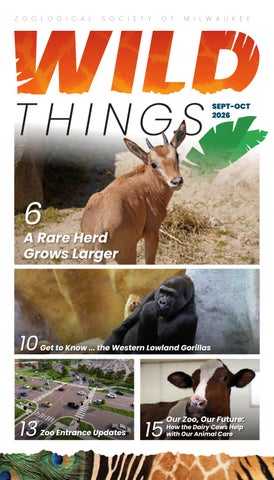
6
A Rare Herd Grows Larger
10
13
Get to Know ... the Western Lowland Gorillas
Zoo Entrance Updates
15
Our Zoo, Our Future: How the Dairy Cows Help with Our Animal Care
OCT
3
NOV
7
DEC
5
A FANTASTIC DAY OF FREE FUN
MEMBERANDA
Zoo hours: Now through Sept. 7 – 9:30 a.m.-5 p.m. Sept. 8 through Oct. 31 – 9:30 a.m.-4:30 p.m. Zoological Society office hours: Now through Sept. 7 – 8:30 a.m.-5 p.m. Sept. 8 through Oct. 31 – 8:30 a.m.-4:30 p.m. Please Note: The following areas close before the posted Zoo closing time: Zoo admission (45 minutes prior) and animal buildings (15 minutes prior). Zoo Pass admission: Please remember to have your Zoo Pass and identification ready when you arrive at the Zoo’s admissions. If you’ve lost your card, replacement cards may be purchased for $5. Zoo Pass admission is valid for regular daytime Zoo hours and many events.
Who can use member cards? The person(s) named on the Zoo Pass is the owner of the card, and benefits are not transferable to anyone else. We need to have the number of minor children/ grandchildren in your household reflected in your membership records for the Zoo’s admissions. Foster children are covered on your membership. Day-care providers for children: Your Zoo Pass membership does not cover children for whom you provide baby-sitting or day-care services. The Society and the Zoo retain the right to invalidate any membership being used inappropriately.
Sponsored by Tri City National Bank & FOX6 Every trip to the Zoo makes for a great day, but it’s an even better day when you can visit the Zoo for free! Come on out to the Zoo for the first Family Free Day of the season on Oct. 3, where all guests will receive free admission for the day.* If it’s been a while since you last visited the Zoo, this is the perfect time to stop by and see some of the new Zoo babies that were born this year, like Yashi, Yaji and Zaman the scimitar-horned oryx and Bosede the greater kudu. *Regular parking and attraction fees still apply. Zoo Pass and Platypus Circle members get free parking.
8
We value your relationship with the Zoological Society of Milwaukee. The Society does not sell member/donor information to third parties but may share limited information with the Milwaukee County Zoo for the purpose of confirming membership status.
Reciprocal zoos and aquariums: We update our list of zoos and aquariums that offer reduced or free admission to our members with the Association of Zoos & Aquariums in spring each year. We only reciprocate with AZA-accredited facilities and reserve the right to not reciprocate with zoos and aquariums located within close proximity of the Milwaukee County Zoo. Please be sure to contact the zoo you plan to visit prior to your travels.
Family Free Day
GRAB THE CREW AND HAVE A BREW
OCT
Zoo Brew 7-10 p.m. | VIP entry at 6 p.m. 21+ It’s that time of year once again to grab a pilsner by the penguins or a hoppy IPA by Happy the hippo! Zoo Brew, the Society’s beloved beer and food tasting event brings the best foods in Milwaukee together with your favorite local breweries and microbreweries. This 21+ event at the Zoo is an unforgettable evening in a truly wild setting.
Zoo Pass Members & Guests:
Non-Members:
VIP: $70
VIP: $85
General: $60
General: $75
1-hour early entry + exclusive Zoo Brew tasting glass
1-hour early entry + exclusive Zoo Brew tasting glass
Designated Driver Admission:
Enjoy all food, music and experiences without alcohol. Plus, all designated drivers will receive entries into a raffle for a chance to win a Zoo admission package. VIP: $30 (1-hour early entry!)
|
General: $20
For tickets, vendor info and full event details, visit ZOOSOCIETY.ORG/ZOOBREW
WILD THINGS
Issue No. 179, Sept.-Oct. 2026 Wild Things is a membership newsletter published by the Zoological Society of Milwaukee five times a year.
Editor & Writer: Michael Grennell Designers: Courtney Lein & Mac Bronnson Photos taken by Carolyn Lewis or Michael Grennell, unless otherwise noted. Contact the Zoological Society at: 10005 W. Bluemound Rd., Milwaukee, WI 53226 Phone: 414-258-2333 Web: zoosociety.org Contact the Milwaukee County Zoo at: 10001 W. Bluemound Rd., Milwaukee, WI 53226 Phone: 414-771-3040 Web: milwaukeezoo.org
Photos by: Carolyn Lewis, Michael Grennell and Mac Bronnson unless otherwise noted.
2
Printed on recycled paper.
Special thanks to entertainment sponsor Molson Coors. 3
BIG BONES, BIG BITES
O
ctober is just around the corner, which means it won’t be too long before you start to see classic Halloween decorations like bats, jack-o-lanterns and skeletons throughout your neighborhood. But over at Florence Mila Borchert Big Cat Country, Halloween isn’t the only time of year that you might see some bones lying around! All of the carnivorous animals at Big Cat Country are given bones once a week as an enrichment activity, according to Big Cats area supervisor Sheri Guay. Each animal will receive a bovine femur or knuckle bone that comes from an ethicallysourced, Wisconsin-based vendor. “Providing bones helps promote natural chewing behaviors, supports dental health, strengthens jaw muscles and provides mental enrichment by encouraging species-appropriate feeding behaviors,” Guay said.
Want to know when you can see your favorite animal biting down on some bones? Guay says that the animal care team has a weekly schedule that they typically follow, with a couple species receiving bones each day. • Fridays: Amur tigers and jaguars • Saturdays: Lions and hyena • Sundays: Cheetahs, snow leopards and serval
DID YOU KNOW?
TAKE CONSERVATION ACTION: LEAVE THE LEAVES T
here is nothing more symbolic of autumn than the colorful, crisp carpet of fallen leaves that cover everything around you. But these leaves are more than just a satisfying cacophony of crunches or a vibrant backdrop for fall-time adventures — they are also the life-preserving shelter that critical pollinators need to survive through the winter!
When you Leave the Leaves, you are accomplishing one of the easiest yet most impactful conservation acts that you can do. By simply letting the leaves lay where they fall throughout the winter, you can provide critical shelter for many of the key pollinators and other wildlife that live in your yard — like our beloved lightning bugs, who spend most of their lives nestled in that leaf litter. By giving them a warm, safe place to survive through the winter, you will be treated to a wonderful, natural light show during your summer evenings!
Learn more about how to take part in Leave the Leaves!
Relative to their size, jaguars have the most powerful bite out of all other big cat species. This allows jaguars to also hunt animals like turtles and armadillos, as they are able to bite through their prey’s hard shells.
MAINTAIN THE DRAINS
O
4
ne of the biggest actions you can take this fall in addition to leaving the leaves is to monitor your nearby storm drains and keep them clear of debris. When there are too many leaves in the street, it can clog the storm drains which could in turn potentially lead to flooding after a heavy rain. In the city of Milwaukee, residents this year are being asked to either bag all their leaves or rake them to the curb for pickup. Want to know an even better option for your leaves? Rake them up into your flowerbeds or gardens! Not only will you be supporting pollinators and lowering the chances of your storm drains getting clogged, but as the leaves decay, it will provide a natural, nutrient-rich mulch for your plants.
Want to do even more to support your neighborhood? You can “adopt” your nearby drain at the Southeastern Wisconsin Watersheds Trust website. By signing up to adopt a nearby drain, you can commit to helping make sure the drain remains clean and free of leaves. Follow the Society on social media for Leave the Leaves updates, yard sign pick-up details and more glowing ideas! Show your support by picking up a Leave the Leaves yard sign! Contact conservation@zoosociety.org for more information. 5
A RARE HERD GROWS LARGER E
arlier this year, the Milwaukee County Zoo announced the births of three scimitar-horned oryx calves: a boy, Zaman, and two girls, Yashi and Yaji. As everyone celebrated these new Zoo babies and visited them at the African Waterhole habitat, what many people may not have realized was that these calves were more than just new additions to the Zoo family — they were part of the latest chapter in one of the great conservation successes in recent history.
A RETURN TO THE WILD
The scimitar-horned oryx once roamed throughout parts of northern Africa, but in the year 2000, they were declared Extinct in the Wild by the International Union for Conservation of Nature (IUCN) due to overhunting and habitat loss. While the species was Extinct in the Wild, there were still many individuals of the species living in zoos and privately-owned animal preserves around the world. In 2008, Sahara Conservation began the process of reintroducing the scimitar-horned oryx back into the wild in Chad through partnerships with these other organizations. The Milwaukee County Zoo has been a partner organization — assisting in funding only — for the Sahara Conservation Scimitar-horned Oryx Reintroduction Project since 2022. Because of this shared global effort, in 2023 the IUCN officially upgraded the scimitar-horned oryx from Extinct in the Wild to Endangered. It’s estimated that the wild population reintroduced to Chad now consists of more than 600 oryx.
population. When animals do go extinct in the wild, we have these animals to do these kind of reintroduction projects. That’s a lot of what we try to get people to understand is that these zoo populations are important backups for wild animals,” Wild said.
MEET THE ZOO’S HERD
Today there are seven oryx that call the African Waterhole habitat their home. Babe, Zahara and Moza were the first three oryx to arrive at the Zoo, coming here from The Wilds conservation center in Ohio in 2022. Mercutio arrived next at MCZ from Wildlife Safari in 2024 as part of a breeding recommendation. And then in the span of seven days, the herd expanded this year with the births of Zaman (March 22), Yaji (March 25) and Yashi (March 29). “The calves are best buds. They had their own little gang going right from the get-go. They were zooming around, cuddling up together while sleeping — they are good together,” Winter Quarters area supervisor Danielle Faucett said. Zaman is the most easy-going of the calves, according to Faucett, and seems to get along well with everyone. Yashi is very independent and outgoing, and Yaji is adventurous as she will run around and explore her habitat space. When Yaji was first born, she had difficulties nursing from her mother, Babe, which meant she wasn’t receiving the critical antibodies that she needed from
BABE
her mother’s milk for her immune system. But thanks to the animal care team, the Animal Health Center and the Zoo’s dairy cows, Yaji was able to get the antibodies she needed and is now thriving in the herd. Turn to Page 15 to learn more about how the Zoo provided her with this important care! WANT TO LEARN MORE ABOUT THE ORYX? Scan the QR code to check out the expanded version of this article on our website!
ZAHARA
MOZA
Large Mammal Curator Tim Wild has worked with scimitar-horned oryx at MCZ and at the Kansas City Zoo. To him, these reintroduction efforts are not only a conservation success story, but they also highlight the importance of the work done by zoos around the world. “I think the AZA population with this species is a great example of a reserve
MERCUTIO
YAJI
6
Named after a spice blend found in the North African region where oryx are from.
ZAMAN
Name is of Arabic origin meaning “keeper of time”.
YASHI
Name comes from the Hausa language and means “sand” or “sandy”. 7
OCT
16-17
OCT
23-24
GHOSTS, HAY BALES AND
CANDY BAR TRAILS
OCT
22
HALLOWEEN IS NOT JUST FOR KIDS
Spooky Safari 5:30-9:30 p.m. 21+ Get ready for some trick-or-treat fun just for the adults! This year the Milwaukee County Zoo will host a brand-new Halloween event for guests ages 21 and older. Grab your friends and put on your best costumes as you will enjoy music and live entertainment while you visit your favorite animals after hours. Don’t miss out on trick-or-treating around Adventure Africa and take part in the costume contest featuring fun prizes for the best outfits.
Boo At The Zoo Presented by Prairie Farms Dairy
Tickets are $30 per person, and parking for this event is free. Zoo Pass and Platypus Circle Members receive 15% off Spooky Safari admission. Tickets will be available for purchase on the Zoo’s website.
Friday, Oct. 16 and 23: 4:30-9 p.m. Saturday, Oct. 17 and 24: 9:30 a.m.-9 p.m If you want to spend more time enjoying Halloween at the Zoo, or wish you could bring your little ones before it gets dark, Boo at the Zoo is making changes just for you. This year, on two Saturdays, Boo at the Zoo will take place all day, giving you more opportunities to enjoy this special event. On Friday, Oct. 16 and 23, Boo at the Zoo will be a ticketed, evening-only event. Guests looking for more time and extended hours can attend the ticketed event anytime between 9:30 a.m. and 9 p.m. on Saturday, Oct. 17 and 24. Zoo Pass and Platypus Circle Members receive 15% off Boo at the Zoo admission. Tickets will be available for purchase on the Zoo’s website.
WHAT IS BOO AT THE ZOO?
Boo at the Zoo is a Halloween celebration for guests of all ages. Enjoy trick-ortreating, festive decorations, live music, professional pumpkin carvers transforming pumpkins into amazing animal-themed artwork, a hay maze and much more. This year, members can also enjoy an exclusive members-only activity. Due to the next phase of construction around the Zoo’s front entrance (see page 13), offering Boo at the Zoo all day on these two Saturdays will provide a better guest experience and help minimize traffic congestion.
PLEASE NOTE: Zoo Pass and Platypus Circle memberships cannot be used for free admission on Saturday, October 17 and October 24, as the Zoo will be operating as a special ticketed event on those days. 8
A PEWTER PEACOCK FOR THE HOLIDAYS
E
verywhere you look at the Zoo, there are animals all around you. But there is only one animal that you can find yourself walking alongside as you explore the Zoo. Each year, the Zoological Society picks an animal to feature for our holiday ornament. This year, we’re fanning out our tail feathers and strutting our stuff as our ornament will feature your favorite fellow Zoo pedestrian — the peacock!
As you see them walking around the Zoo, you might have referred to these bird as “male peacock” — the ones with the brightly-colored tail feathers — or “female peacocks.” But actually, this bird species is known formally as peafowl, with the males being peacocks and the females peahens. Here at the Zoo, you can see common peafowl (also known as Indian peafowl) just about everywhere you go — whether it’s walking on the paths alongside guests, perching up in trees or even sometimes walking around other animals’ outdoor habitats. This year’s ornament showcases the iconic fan spread of a peacock’s tail feathers. Local artist Andy Schumann handcrafts each year’s ornament in clay before turning the mold into a beautiful pewter ornament. This is the 35th ornament in the Society’s collection. Each ornament is $16 including tax, shipping and handling. Visit zoosociety.org/ornaments for a look at available options. 9
9
GET TO KNOW ... THE WESTERN LOWLAND GORILLAS M
oving like shadows through the mountains and forests of Central Africa, gorillas are the largest of the great apes. Eastern gorillas live in mountain forests in Central and East Africa. Western gorillas live in tropical rainforests and swamps in Central and West Africa. Both species are Critically Endangered because they are losing the forests they call home. The Milwaukee County Zoo is home to five western lowland gorillas.
T
he western lowland gorilla is one of two subspecies of western gorilla. The other subspecies, the Cross River gorilla, is restricted to highly fragmented mountainous regions along the borders of Cameroon and Nigeria. The gorillas here at the Zoo live in two groups: the family group and the bachelor group. Here’s everything you need to know about the gorillas at the Milwaukee County Zoo!
THE FAMILY GROUP
THE BACHELOR GROUP
AZIZI
HODARI
Born: Dec. 4, 2003, at Louisville Zoo
Born: March 21, 1995, at Cincinnati Zoo
Arrived at MCZ: Jan. 10, 2024, from Lincoln Park Zoo in Chicago
e
by
lwa uke eC
o un t y Z o o
Personality: Zookeeper Dawn Kruger says that Azizi is very intelligent, which makes him excel during positive reinforcement training sessions with the animal care team.
d
e
Mi
id ov pr
id ov pr
d
DOTTY
Born: April 17, 2004, at Columbus Zoo Arrived at MCZ: April 20, 2021, from Columbus Zoo Physical Characteristics: Of the two females in the family group, Dotty is slightly bigger (202.8 pounds in May) than Nadami (179.5 pounds) and has shorter hair on her head and upper arms. Personality: Kruger says that Dotty can have a very assertive personality, and can be a bit more vocal at times. Dotty also tends to hold her ear — a behavior that she learned over time. One of Dotty’s favorite enrichment items are the tubs in her habitat. “She loves her tubs,” Kruger said. “Often you will see her sleeping in a tub or up on one of the tree branches.”
NADAMI
Born: Sept. 29, 2010, at Columbus Zoo Arrived at MCZ: April 20, 2021, from Columbus Zoo Physical Characteristics: Nadami is slightly smaller than Dotty and can be identified by longer, wispy hair around her face. Personality: Kruger says that Nadami tends to be very playful in general and will bring out playful behaviors from even the more stoic Dotty.
10
Physical Characteristics: Hodari is the largest gorilla at MCZ, weighing 404.3 pounds in May. One way to tell Hodari apart from his half-brother, Maji Maji, when they are together is that Hodari’s right pectoral muscle is not as well defined as Maji Maji’s.
to Pho
to Pho
Physical Characteristics: Azizi is the leader of the family group. He is easy to spot because of his larger size and the silver hair on his back.
Arrived at MCZ: Sept. 12, 1997, from Cincinnati Zoo
by
Mi
lwa uke eC
Personality: Kruger said that Hodari is very special to her because she has been able to work closely with o u nt y Z o o him over the last 10 years. He is very playful and engaging with the animal care team. Hodari also prefers quieter environments, which is why guests will typically only see him in the outdoor habitat when the observation desk is closed.
MAJI MAJI
Born: Aug. 6, 1991, at Cincinnati Zoo Arrived at MCZ: June 1, 1994, from Cincinnati Zoo Physical Characteristics: Maji Maji has a more pronounced brow ridge than Hodari. Visitors will typically see him alone in the indoor habitat, but he may be seen occasionally in the outdoor habitat with Hodari. He and Hodari will also spend time together during non-visitor hours. Personality: Kruger describes Maji Maji as a little more stoic than his half-brother. He can be playfully silly and very engaging when one-on-one with his care team.
“
I love training with them.
They are very intelligent, so it’s amazing to see when things “click” and they start to understand what is being asked of them. They are so willing to learn and participate and it’s fun building that rapport with them. Every day as a caretaker is unique, challenging, and special. — Zookeeper Dawn Kruger on what she enjoys most about working with the gorillas. 11
OPEN WIDE FOR TOOTH TIME
T
aking care of your teeth is important! That’s why we brush them, floss them and use mouthrinse to keep our teeth and mouths clean and healthy. Taking care of teeth is also important for the animals at the Zoo, like Happy the hippo!
“The main goal is to round out some of the sharp edges; otherwise it’ll cut up his gums and his lips, and we don’t want any of that,” Marsho said. Rasping is the process in which an animal — like a hippo or a horse — has a file run across their teeth. While the idea of filing teeth may sound painful to a human, Marsho says that Happy does not appear to mind the dental work.
Adventure Africa zookeeper Steve Marsho says that in a hippo’s native range, they will spend more time grazing or rubbing against trees and branches in order to smooth out any sharp points that occur on their tusks. While Happy has the ability to participate in these natural behaviors in his habitat, Marsho says that he doesn’t always choose to do so. That is why the animal care team will give Happy a helping hand by rasping his tusks about once a week.
“I would think of (the feeling of teeth rasping) more like filing your nails,” Marsho said. “He does it willingly. At any point he can walk away from the session and decide that he’s not going to do it. But he doesn’t. He stands with his mouth open and we do the rasping.”
So how does a rasping session with Happy go? Here is the process:
Step 1: Signal
The zookeeper uses a verbal signal and a hand motion to have Happy open his mouth.
Step 2: Feel
1
While Happy keeps his mouth open, the zookeeper runs their hand over Happy’s tusks to look for sharp or rough edges.
2
Step 3: Rasp
The zookeeper takes the file and runs it back and forth over the tusk to smooth out the surface.
3
Step 4: Reward
4
The zookeeper will rasp one spot at a time, so after a few passes with the file, they toss a favorite food, like melon chunks, into Happy’s mouth for him to eat.
The zookeeper and Happy will repeat this process until either the zookeeper determines there are no more sharp spots, or until Happy chooses to no longer participate in the session. 12
ENTRY CHANGES AS CONSTRUCTION PROGRESSES T
he next phase of construction for the new front entrance starts right after Labor Day. This project will give guests a faster and smoother way to enter and exit the Zoo, without long lines on Bluemound Road or difficult left turns when leaving. But before that, there are a few more steps. Starting Sept. 8, When using the front entry, the exit lanes will be turned into an entrance and exit. Guests will make a right-hand turn in the designated lane at the exit. The current entrance you are familiar with will be closed for the next phase, which involves tearing up some of the road and removing the ticket booths. When exiting the Zoo, guests will only be able to make a right-hand turn. This is only during the construction. When the project is done guests will not only be able to turn left again, they will have a traffic light making the turn easier, faster and safer.
SEPT
20
Parking rules remain the same, meaning all guests need to scan the QR code and either enter their Zoo Pass member number or pay.
The front entrance may be closed intermittently after Labor Day. In those instances, the West End parking lot near the Modern Woodmen Otter Passage will be open.
For more information about the construction project, parking and what to expect during the process, scan the QR code.
ROLLING AROUND THE ZOO
Ride on the Wild Side 7 a.m.-1 p.m.
Grab your helmet and get ready to ride by the rhinos and cruise past the caribou. Ride on the Wild Side is the once-ayear chance you get to ride your bike around the Milwaukee County Zoo. Whether you challenge yourself on the 13-, 20- or 30-mile routes that start and end at the Zoo, or you take a relaxing roll inside the Zoo on the 1.5-mile Critter Caravan Zoo Ride, you are sure to have a wild time!
For more information, scan the QR code or visit zoosociety.org/bike.
All participants receive a long-sleeved event T-shirt, breakfast snacks to fuel their ride, lunch and some fun Kids Zone activities you won’t want to miss! This event also includes admission and parking to the Zoo for the day. Don’t miss out on your Ride on the Wild Side T-shirt! You must register by Sept. 14 to guarantee you’ll receive this unique memento to commemorate your wild ride.
13
Our Zoo, Our Future
AN UPGRADED MEMBERSHIP
Elevate your Zoo Pass with a Platypus Circle Membership. Both Corporate and Individual Platy members get a transferable membership card, which means they can give a card to a friend, family member or anyone they know to enjoy a day at the Zoo. Up to eight people can visit on one card, plus, you get a personal behind-the-scenes tour and invitations to special events. For more information visit BeAPlaty.org. We would like to thank the following individuals and businesses who became new Platy members between June 1, 2025, and May 31, 2026.
Anonymous (5)
The Allard Family
Anderson Packaging LLC Margaret & Alan Bloom Dickson Hollow
Susan & Thomas Doyle Alexandra Hanson
Diane Kollenbroich Justin Kuehl & Trisha Smith Lake Geneva Public Library
Regan & Darrell Lemke
Natalie & Justin Maciolek
HellermannTyton
Mayville School District PTA
Thomas E. Hoye Family
Angela Mulcahy
The Home Depot West Allis
Christopher C. Janisch
MPS Office of Psychological Services
Kimberly & Todd Jones
Michael & Elizabeth Nolte Family
Jason & Jamie Koehler
Sonia & Mitchell Ost
John & Debra Kissinger
Oshkosh Public Library
Darren Ostmeyer & Dean Cabral
Redeem & Restore Center James & Susan Rink St. Charles Youth & Family Services
Stepping Stones Community Services
Sun Prairie Public Library Kelly Treharne
Aina Vilumsons
Wisconsin Community Services - Waukesha The Woods
Yutka Fence
Michael D. Zaddack
SEE OUR ZOO OUT IN OUR COMMUNITY T
here is so much work done at the Milwaukee County Zoo to help protect wildlife and wild spaces both here in Wisconsin and around the world. This work is so important that here at the Zoological Society, we make it a priority to share knowledge about this mission throughout our local communities. The “Our Zoo Series” program brings bite-sized, engaging talks by our passionate Zoo Pride volunteers. These talks provide workplaces and community groups with firsthand insights and a peek behind-the-scenes into the Zoo’s transformational work in animal care and conservation. These talks last up to an hour and include time for questions and interactions with unique items brought from the Zoo. There are limited number of bookings available year-round. For more information, visit zoosociety.org/in-the-community
UDDER-LY AMAZING ANIMAL CARE O
ne of the core missions of the Zoological Society is to support the Milwaukee County Zoo. Donations to our Annual Appeal help us fund top-of-the-line care to the animals here at the Zoo — like the care that was provided earlier this year to scimitarhorned oryx calf, Yaji, shortly after she was born. Winter Quarters area supervisor Danielle Faucett said that when Yaji was born, she had difficulties that prevented her from nursing from her mom, Babe. This meant that she was not able to get the colostrum, or “first milk,” that carried important antibodies from her mother that Yaji’s immune system needed. While there are other medical means and substitutes that zoos can utilize to provide their animals with colostrum when it’s needed, the Milwaukee County Zoo has a unique option available to the animal care staff: our dairy cows! “They took (Yaji) to the Animal Health Center. They treated her, gave her supportive care, and gave her colostrum from our dairy cows,” Faucett said. “Thankfully she really started to perk up. We were able to reintroduce her to Babe,
This is just one example of the many ways that our Zoo provides the best possible care to our beloved animals. Every day, the Zoo and Society work together to Care, Connect and Conserve as we advance our bold vision: bringing people, wildlife and wild places together to inspire action and build a better future for all. You can be a difference-maker today with a donation to our 2026 Annual Appeal: Our Zoo, Our Future. Visit zoosociety.org/appeal to learn more.
Photo provided by Milwaukee County Zoo
and sure enough, even though we were still bottle-feeding her, overnight we found video footage that she actually started nursing.” Northwestern Mutual Family Farm assistant curator Bridget Carpenter said that ruminant (or cudchewing) animals — like cows, sheep, giraffes, deer and antelopes — get no active antibody transfer from the mother while still in the womb. Instead, their initial antibodies come from the colostrum they drink in the first 24 hours after birth. So, when a ruminant animal here at the Zoo is not receiving enough colostrum, like with Yaji, the animal care team is able to utilize a “colostrum bank” at the Animal Health Center — courtesy of the dairy cows. “The dairy cows make much more milk than the calves can drink,” Carpenter said. “So we milk them on the machine, we collect as much as we need to feed the calves, and then we collect the rest in milk jugs and send it to the Animal Health Center where they then pasteurize it and freeze it. The calves get the colostrum from their moms when we bottle feed them, and then the rest is used for any ruminants in the Zoo that may need it.”
EVERY DOLLAR MAKES A DIFFERENCE! DONATE TODAY AND
MOLSON COORS BEVERAGE CO. WILL MATCH A PORTION OF YOUR DONATION! Donations of $100 or more will be recognized on an electronic sign at the Zoo.
A gorilla’s nose can do more than just sniff; it can be used for identification! Each gorilla has their own unique noseprint.
DATED MATERIAL PLEASE DELIVER PROMPTLY
Zoological Society of Milwaukee 10005 W. Bluemound Rd. Milwaukee, WI 53226-4383
Learn more about the gorillas at the Zoo on Page 10.
WHAT’S HAPPENING September 20
Ride on the Wild Side (pre-register)
PLEASE NOTE:
October 3
Zoo Pass and Platypus Circle membership cannot be used for free admission on Oct. 17 and Oct. 24 due to special ticketed event.
Family Free Day, sponsored by Tri City National Bank & FOX6*
October 8 Zoo Brew (pre-register)
October 16, 17, 23 & 24 Boo at the Zoo, presented by Prairie Farms Dairy (pre-register)
October 22 Spooky Safari (21+ night)
November 7
See Page 8 for more details.
Family Free Day, sponsored by Tri City National Bank & FOX6*
November 11 Member priority registration for Spring Zoo Class
*A Zoo Pass includes free parking for one vehicle per membership per day.
CONNECT WITH US! CONNECT WITH US!
Sept/Oct-26
Photo by Garrett Hopkins
PAID
Milwaukee, WI Permit No. 4073
Nonprofit Organization U.S. Postage
QUICK FACT:
@ZooPass
@ZooSocietyMKE
@ZooSocietyMKE
@ZooSocietyMKE
The Zoological Society is proud to bear Charity Navigator’s highest rating of four stars.