PRINCIPLES AND RECOMMENDATIONS
Nature-based solutions for climate and disaster resilience
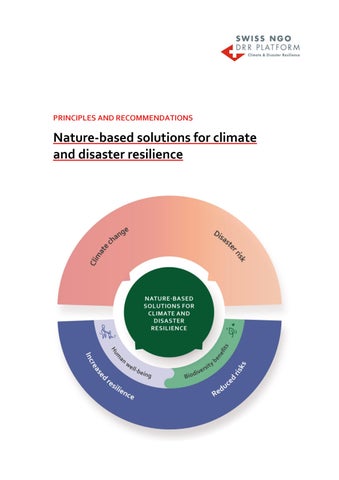
Why NbS for climate and disaster resilience? Nature-based Solutions (NbS) provide multiple benefits and address a number of societal and environmental challenges simultaneously, including disaster risk management and climate change adaptation and mitigation. NbS can prevent and mitigate the impact of natural hazards, act as natural buffers against the increasing frequency and intensity of extreme weather events while at the same time conserving biodiversity, improving water and soil conditions, and strengthening livelihoods and the resilience of local populations. NbS offer – alone or in combination with conventional infrastructure – cost-effective, resilient, and sustainable approaches to build resilience against disasters and climate change impacts.
What are Nature-based Solutions? The Swiss NGO DRR Platform views Nature-based Solutions not as an end in themselves, but as an approach connecting diverse stakeholders, perspectives, and needs. According to the United Nations Environment Assembly definition, Nature-based Solutions are understood as “actions to protect, conserve, restore, sustainably use and manage natural or modified terrestrial, freshwater, coastal and marine ecosystems which address social, economic and environmental challenges effectively and adaptively, while simultaneously providing human well-being, ecosystem services, resilience and biodiversity benefits” (UNEA Resolution 5, 2022).
Why principles and recommendations? Although a clear definition of Nature-based Solutions exists, the concept remains broad, and objectives can be framed in different ways. This has sometimes led to unrealistic expectations of what NbS can deliver and where they add value. In addition, member organisations of the Swiss NGO DRR Platform have expressed a need for more practical guidance on NbS implementation. The following five principles and recommendations aim to address these challenges for project managers, practitioners, and advisors across thematic areas.
Principles and recommendations 1. Adopt a framework for implementation that suits your organisation Various guidelines and criteria aiming to provide clarity and standardisation on the concept of Nature-based Solutions have evolved to address concerns about ambiguity and inconsistent definitions. Several normative frameworks have been developed, including: • • • •
IUCN Global Standard for NbS Nature-based Solutions Initiative Guidelines World Bank NbS Principles (focused on flood reduction) WWF NbS Principles
2
These guidelines converge on key principles, including ecosystem integrity, biodiversity conservation, social safeguards, and active engagement of Indigenous Peoples and Local Communities through co-design and co-implementation. While all frameworks aim to clarify the concept of NbS, they cater to different audiences: • • • •
The IUCN Global Standard and the World Bank NbS Principles focus on practical NbS implementation. The Nature-based Solutions Initiative Guidelines emphasise overarching policy. The IUCN Global Standard further aims to promote financial flows by defining what qualifies as NbS. The WWF NbS principles explicitly address key concerns such as ensuring NbS are not used as a substitute for necessary emissions reductions.
The Swiss NGO DRR Platform recommends the use of: •
•
The IUCN Global Standard for NbS (2020) to guide NbS design, implementation, and monitoring to the extent possible. With 28 indicators embedded within eight core criteria, it is the most comprehensive framework for NbS and highlights the NbS role in delivering benefits for both people and biodiversity, promotes equity and fairness and strives to promote the flow of finance by making clear what counts as NbS. The Swiss NGO DRR Platform Valuation Guidance (2025) to support the participatory valuation of NbS across five dimensions (economic, social, environmental, governance, climate and disaster resilience), comparing the benefits and costs of NbS vs. non-NbS (e.g. infrastructure-based solutions). Designed for practical use, the guidance is accessible to development projects with limited financial, human, and time resources. Beyond outcomes, the inclusive valuation process also aims to raise awareness among a diverse range of stakeholders, including communities, about the multiple benefits of NbS.
The two guidelines are not either/or options but complement each other.
2. Be conscious of various NbS positions and narratives Various NbS positions and narratives addressing societal challenges such as biodiversity loss, climate change and sustainable development exist. These can be largely grouped into four primary narratives: •
Conservation narrative: The conservation narrative views NbS as a way to support biodiversity and protect ecosystems, putting nature at the heart of solutions. It emphasises that NbS should primarily help conserve and restore the environment, while also offering benefits for people and the climate. The conservation narrative encompasses a range of narratives on the human-nature relationship and the inherent vs monetised value of nature.
•
Mitigation narrative: The mitigation narrative generally frames NbS as opportunities to reduce greenhouse gas emissions, particularly through carbon markets and corporate sector emissions offsetting. Actors upholding this narrative frame NbS as global solutions for global issues with the potential to be cost-effective tools. There is also a strong emphasis on voluntary carbon market mechanisms to offset private sector greenhouse gas emissions. The mitigation narrative generally emphasises the 3
importance of clear definitions of NbS and specific metrics to evaluate NbS quality and effectiveness. According to this narrative, clear metrics are crucial in evaluating NbS quality and effectiveness, in attracting potential investors and in tackling climate change. •
Vulnerability narrative: The vulnerability narrative frames NbS mostly in terms of vulnerability reduction and resilience for local communities, focusing on reducing disaster risk and the effects of climate change. As opposed to the mitigation narrative, the vulnerability narrative highlights disaster risk reduction and climate change adaptation as the main concern for NbS. The primary focus is on reducing vulnerability and exposure to climate change and other natural hazards, and on promoting resilient livelihoods. According to the vulnerability narrative, NbS need to be adapted to local circumstances to be effective, drawing on traditional ecological knowledge, social cohesion, and collective governance rather than clear metrics.
•
Critical narratives: Critical justice and rights-based narratives argue that NbS reinforce power inequalities between the Global North and marginalised local populations in the Global South through the potential commodification of nature in their landscapes and by prioritising carbon offsets over systemic change. These perspectives raise concerns about land grabbing, exclusion from decision-making, and eco-colonial practices that undermine customary rights and local autonomy. Proponents of this narrative further argue that the effectiveness of NbS is uncertain, as ecosystem benefits take time to materialise and remain vulnerable to climate change.
The Swiss NGO DRR Platform places emphasis on the vulnerability narrative, ensuring NbS are leveraged for adaptive solutions that contribute to building climate and disaster resilience. When engaging with other stakeholders, we aim to achieve mutual understanding of each stakeholder’s view on NbS and how potential conflicts of goals and interests can be mitigated.
3. Value local perspectives and engage with diverse ways of knowing The effective implementation of NbS requires an inclusive and participatory process that values the knowledge systems and cultural worldviews of local populations. This includes: • •
•
Recognising that there are no one-size-fits-all solutions. NbS must be tailored to ecological, social, cultural, and governance contexts to be effective. Understanding and valuing local perspectives on the human-nature relationship. In securing the just and equitable design and implementation of NbS, local voices should not be sidelined by international discourses and “global knowledge”. Integrating relational and more-than-human worldviews in NbS design and implementation. Indigenous and local conceptualisations of the human-nature relationship are often based on interconnectedness rather than a dualistic notion.
4
4. Promote systemic and holistic thinking A systemic approach to NbS implementation is essential in maximising impact and effectiveness. This involves: •
•
•
•
Adopting holistic, cross-sectoral strategies that integrate NbS within broader environmental, social, and economic frameworks. This includes coordinating across sectors, aligning with relevant policies, and engaging diverse stakeholders to ensure that NbS are embedded in broader planning and implementation processes. Defining system boundaries to determine which societal and ecological challenges are being addressed. This means identifying the geographic, ecological, and social context (for example a watershed, a coastal zone or urban neighbourhood) in which NbS are applied, in order to define the specific challenges being addressed and to guide the scale, scope, and stakeholders involved in implementation. Ensuring long-term sustainability and adaptability of NbS projects through continuous monitoring, learning, and adaptive management. This includes assessing and re-assessing objectives and outcomes throughout the lifecycle of the NbS to ensure ongoing functionality and effectiveness. Understanding trade-offs and co-benefits across multiple dimensions to inform decisions on NbS, including in comparison with non-NbS.
5. Uphold a human rights-based approach A human-rights-based approach to NbS implementation ensures ethical and equitable outcomes and protects local communities or community members from displacement or marginalisation. Specifically, this includes: •
•
Respecting customary land rights, resource access, and the responsibilities of different stakeholders (aligned with IUCN Standard Criterion 6.2). For example, map and recognise land and resource use rights, even if not formalised legally, and integrate them into project planning. Equitable distribution of benefits and participation in decision-making processes (aligned with IUCN Standard Criterion 5). For example, involve marginalised groups (e.g. women, youth, ethnic minorities) in the design, implementation, and monitoring of NbS activities.
The Swiss NGO DRR Platform is convinced that aligning NbS implementation with these principles will enhance NbS effectiveness in reducing vulnerability and building climate and disaster resilience for local communities, tackling climate change and biodiversity loss, and ensuring social equity and livelihoods.
5
Useful resources on how to put NbS guidelines into practice •
•
• • • • • • • •
Valuing and Promoting Nature-based Solutions in Development Projects for Climate and Disaster Resilience: Valuation Guidance and Rapid Valuation Tool, Swiss NGO DRR Platform (2025). Where people and their land are safer: A Compendium of Good Practices in Disaster Risk Reduction. Bern and Lucerne, Switzerland: Centre for Development and Environment (CDE), University of Bern, and Swiss NGO Disaster Risk Reduction (DRR) Platform (2017). The Nature Navigator. A handbook for disaster risk management practitioners, IFRC (2022). Words into Action: Nature-based Solutions for Disaster Risk Reduction, UNDRR (2021). Nature-based Solutions for Comprehensive Disaster and Climate Risk management, UNDRR and UNU-EHS (2023). Online Self-Assessment Tool, IUCN. Sphere Unpacked Guide: Nature-based Solutions for Climate Resilience in Humanitarian Action, Sphere, FEBA, PEDRR, EHAN and IFRC (2023). Good Practices for Designing Effective, Inclusive, and Sustainable Nature-based Solutions for Adaptation, IISD (2024). Unpacking Methods for Integrated Assessments of Nature-based Solutions: Guideline for the European Investment Bank and public authorities, IISD (2025). Nature-based Solutions. Evidence for Hazard Risk Reduction and Ecosystem Services, IDA (2024).
About the Swiss NGO DRR Platform The Swiss NGO DRR Platform is a network of professionals from non-governmental organisations (NGOs) dedicated to increasing the resilience of women and men, communities, and governments through disaster risk reduction and climate change adaptation. It strives to enhance the quality of services delivered by Swiss NGOs related to disaster risk and climate change, promotes the development of know-how and experience, provides guidance to increase effectiveness and advocates for risk-informed development, disaster risk reduction and climate change adaptation in order to increase resilience. Under the Swiss NGO DRR Platform’s 2019–2025 work programme, a working group on Nature-based Solutions (NbS) has been operating since 2020 with the aim of enhancing the understanding and improving the practices of NbS. Swiss NGO DRR Platform | November 2025 | www.drrplatform.org
With financial contribution from:
6