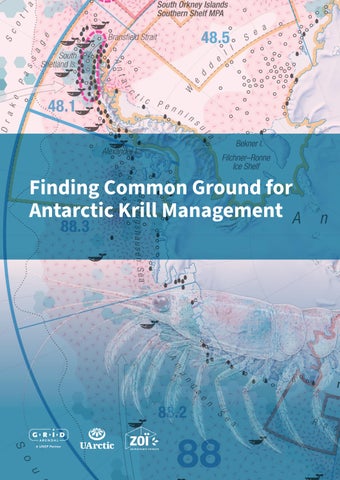
Finding Common Ground for Antarctic Krill Management
ANTARCTIC KRILL
Krill in Space and Time Antarctic krill (Euphausia superba) are individually small, about the size of a thumb, but collectively they account for the largest biomass of any wild animal on Earth 1. Antarctic krill are crucial for the long-term resilience of the Southern Ocean providing a critical food source for animals higher up the food chain, such as penguins, seals and whales 2. Krill play an equally crucial role in the ocean’s carbon, nitrogen and iron cycles, transporting carbon and nutrients from surface waters to the deeper ocean 3. Krill are social animals and live in large schools or swarms 4. While these swarms occur all around Antarctica, there is a concentration in a relatively small region to the north of the Antarctic Peninsula and in the Scotia Sea, which accounts for about 30% of the total biomass 1. This is also the region where many of their predators live and breed and where most krill fishing occurs 5, 6. These swarms, however, are rarely horizontally interconnected 7. The total amount of Antarctic krill can vary considerably in space and time, with peaks about every 5 years, but without showing a decline over time 8. This agrees with the results of two large scale surveys in 2000 and 2019, suggesting that there is a relatively stable overall krill biomass 9, 10, although krill movement and replenishment are not fully understood.
Antarctic krill belong to a complex ecosystem with many unknowns, and monitoring and data collection are both geographically and financially demanding. Uncertainties remain about the cumulative effects of fishing and climate change, both on krill and their predators. What we do know, however, is that changes in krill abundance, regional distribution, size, or nutritional condition may have consequences far beyond the species itself 12. Many predators depend heavily on krill during breeding or feeding seasons, including species facing serious conservation challenges. In 2026, for example, both the emperor penguin and the Antarctic fur seal were listed as endangered 13. Antarctic krill management is not just about how much is caught, but also when and where so as to avoid intensive fishing in critical areas and potential local depletion of krill. Spatial and seasonal management, including restricted areas or marine protected areas (MPAs), can help address these risks.
While our understanding of Antarctic krill continues to grow, we still know surprisingly little about krill biology. For example, only recently, gravid Antarctic krill (female krill carrying developing eggs) were found near hydrothermal vents at great depths 11. While it is unclear what role these vents play in the krill reproductive cycle, if any, these deepwater habitats may also need protection.
1980
1982
1987
1991
1980 - CCAMLR was established through the 1980 Convention on the Conservation of Antarctic Marine Living Resources. 1982 - CCAMLR entered into force. 1987 – The CCAMLR Ecosystem Monitoring Program (CEMP) was established to monitor selected marine predators and other ecosystem indicators, with the aim of detecting changes in the Antarctic marine ecosystem and distinguishing changes resulting from harvest and those caused by environmental variability. CEMP includes monitoring of penguins, seals, and seabirds.
4
2009
1991 - CCAMLR Conservation Measure 51–01 (CM 51-01) established: a total krill precautionary catch limit of 1.5 million tonnes for CCAMLR area 48, with 620,000 tonnes set as a trigger level for additional catch limits in Subareas 48.1, 48.2, 48.3 and 48.4. 2009 – Conservation Measure 51-07 (CM 51-07) established the spatial distribution of the 620,000 t trigger level: no more than 25% could be taken from Subarea 48.1 (155,000 t), 45% from 48.2 (279,000 t), 45% from 48.3 (279,000 t), and 15% from 48.4 (93,000 t). The percentages deliberately total more than 100% to allow for some flexibility in the fishery while avoiding concentration of catches in any one subarea.
ANTARCTIC KRILL
Krill in Control The Commission for the Conservation of Antarctic Marine Living Resources (CCAMLR) manages fisheries in the Southern Ocean fisheries, including the Antarctic krill fishery. The krill fishery has returned to catch levels last seen in 1987, although the vessels used today are larger. Unlike in the past, the fishery now operates entirely in CCAMLR Area 48. CCAMLR’s consensus-based approach gives genuine value to its decisions, but the decision-making process is slow. Scientific knowledge of krill and their ecosystem continues to advance, but reaching consensus on new management measures takes time. The fishing industry is already taking some voluntary measures (e.g. restricting fishing around penguin colonies during summer, when most species breed), but whether they are sufficient remains to be seen. The Antarctic krill fishery is currently managed using mass-based quotas that are largely based on historical levels rather than a fully data-driven, regularly updated management strategy. At present, the krill fishery in CCAMLR Area 48 is subject to a precautionary catch limit of 5.61 million tonnes per fishing season (CCAMLR Conservation Measure (CM) 51–01), with a much lower “trigger level” of 620,000 tonnes, a catch threshold that activates additional management measures.
When crossed, the trigger level prompts a management system that divides the region into smaller areas. In 2009, CM 51-07 established a spatial distribution of catch limits across the four subareas of Area 48. The trigger level was a temporary measure and was reviewed and renewed six times, but in 2024 the CCAMLR parties did not reach consensus, and CM 51-07 expired. As a result, the 1991 trigger level per fishing season is still in place, but all 620,000 t of krill can be taken across the four subareas, without subarea allocations and subject only to existing restrictions on where fishing is permitted. In both 2025 and 2026, the 620,000 t trigger level was reached in August, bringing fishing to a halt for the season. However, the fishery operates on an “Olympic” basis, with vessels competing to catch krill until the trigger level is reached. In the absence of agreed spatial distribution of catches, fishing has become concentrated in two relatively small areas, north of the Antarctic Peninsula and around the South Orkney Islands, with catches around the Antarctic Peninsula more than doubled 14. This concentration of fishing raises concerns about potential competition with penguins, seals and whales for krill in key foraging areas. The extent of any resulting ecosystem impacts requires further investigation, but the concentration of fishing underscores the need for precautionary spatial management. With Conservation Measure 51-07 having lapsed, the challenge for CCAMLR Members is to agree on and implement a new spatial distribution of catches. One possible area of common ground is the need to avoid excessive concentration of fishing in particular regions and periods. Distributing catches in space and time could help address this, while allowing management to respond to local krill concentrations and predator needs within an agreed overall catch limit.
2010
2024
2010 – CM 51-01: based on acoustic survey data, the precautionary level is updated to 5.61 million tonnes. The 620,000 t trigger level, based on historical catches, remains in place. 2024 – CCAMLR failed to reach consensus on extending CM 51-07, so the spatial subarea limits therefore expired at the end of the 2024 fishing season. 1 August 2025 - The Antarctic krill fishery reached the 620,000 t trigger level earlier than in previous years, with catches concentrated in two relatively small areas (mainly covering the Bransfield Strait in area 48.1 and directly north of the South Orkney Islands in area 48.2).
1 August 2025
October 2025
12 August 2026 October 2026
October 2025 – CCAMLR had not yet agreed to a new spatial management framework. 12 August 2026 - Antarctic krill fishery reached the 620,000 t trigger level, catches concentrated in the same areas as in 2025. October 2026 - The 45th annual meeting of the Commission for the Conservation of Antarctic Marine Living Resources (CCAMLR).
5
ANTARCTIC KRILL
Until CCAMLR has agreed on a distribution of the precautionary catch limit between smaller management units, the total combined catch will continue to be limited to the trigger level of 620,000 t per fishing season. However, a long-term framework would need to be supported by the best available science and closely linked to monitoring of both krill biomass and the ecosystem that depends on it. CCAMLR Members may have different interests and perspectives on how the krill fishery should be managed. A shared interest, however, is maintaining a healthy and productive Southern Ocean ecosystem while enabling a well-managed fishery. A management approach that takes into account both the overall amount of fishing and its distribution in space and time could provide a practical basis for bridging different perspectives and building consensus. The challenge is therefore not only to decide how much krill can be caught, but to develop a management framework that is precautionary, ecosystem-based and workable for all Members. Continued dialogue, supported by the best available science and effective monitoring, can help CCAMLR move towards such a shared framework.
References
CCAMLR The Convention on the Conservation of Antarctic Marine Living Resources, or CCAMLR, is an independent agreement under the Antarctic Treaty System, which provides for the peaceful use of Antarctica and freedom of scientific research and cooperation. One of the main reasons that CCAMLR was established was concern that future increases in krill fishing could affect other animals that depend on krill. CCAMLR’s mandate is the conservation of Antarctic marine living resources, including their rational use, based on an ecosystem approach that takes account of the ecological relationships among species and the wider Antarctic marine ecosystem. Management decisions must therefore be based on scientific evidence and take account of the wider ecosystem 6.
Atkinson et al., 2009 - https://doi.org/10.1016/j.dsr.2008.12.007 Trathan & Hill, 2016 - https://doi.org/10.1007/978-3-319-29279-3_9 3 Cavan, E. L. et al., 2019 - https://doi.org/10.1038/s41467-019-12668-7 4 Hofmann et al., 2004 - https://doi.org/10.1016/j.icesjms.2004.03.028 5 Vaughan et al., 2003 - https://link.springer.com/content/pdf/10.1023/A:1026021217991.pdf?utm_source=wiley&getft_integrator=wiley 6 CCAMLR (accessed September 2026) - https://www.ats.aq/e/related.html 7 Gallagher et al., 2023 - https://doi.org/10.1038/s41598-023-39105-6 8 Steinberg et al., 2015 - http://dx.doi.org/10.1016/j.dsr.2015.02.009 9 Watkins et al., 2004 - https://doi.org/10.1016/j.dsr2.2004.06.010 10 Krafft et al., 2021 - https://doi.org/10.1093/jcbiol/ruab046 11 Bernard et al., 2026 - https://doi.org/10.1038/s42003-026-10780-1 12 Kawaguchi et al., 2024 - https://doi.org/10.1038/s43017-023-00504-y13 IUCN, 2026 – https://www.iucnredlist.org 14 CCAMLR Secretariat, 2026. - https://fishdocs.ccamlr.org/FishRep_48_KRI_2025.pdf 1 2
8
Finding Common Ground for Antarctic Krill Management Authors & Contributors Lars Kullerud, University of the Arctic Tiina Kurvits, GRID-Arendal Tina Schoolmeester, GRID-Arendal Kristina Thygesen, GRID-Arendal Cartography: Matthias Beilstein, Zoï Environment Network Copy-edit: Guendalina De Luigi, GRID-Arendal Review: Miles Macmillan-Lawler, GRID-Arendal. We would like to thank and recognise the contributions of three anonymous external reviewers Layout & Illustrations: Rob Barnes, GRID-Arendal
Disclaimer The views and interpretations in this publication are those of the author(s). They are not attributed to GRID-Arendal, the University of the Arctic, or Zoï Environment Network, and do not imply the expression of any opinion concerning the legal status of any country, territory, city or area of authority, or concerning the delimitation of frontiers or boundaries, or the endorsement of any product.
Recommended citation: GRID-Arendal, 2026. Finding Common Ground for Antarctic Krill Management. GRID-Arendal, UArctic, and Zoï Environment Network. DOI: https://doi.org/10.61523/ERQR1096
Copyright © GRID-Arendal, UArctic, Zoï Environment Network
Acknowledgements: This publication and the maps are available electronically at www.grida.no
The Antarctic krill illustrations were generated using an AI imagegeneration tool from text descriptions of krill anatomy and the report’s visual style. These are interpretive illustrations, not drawings of documented specimens. www.grida.no www.uarctic.org www.zoinet.org