CASE STUDY SYNTHESIS
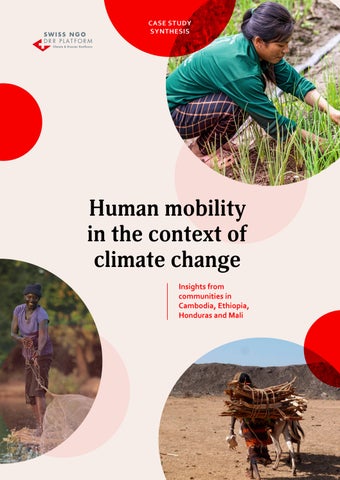
Human mobility in the context of climate change Insights from communities in Cambodia, Ethiopia, Honduras and Mali
1
Setting the scene One of the ways people have always adapted to environmental and climatic changes is by moving. Communities have used temporary or permanent migration to diversify livelihoods, manage risk, and respond to changing seasons or weather patterns. Evidence across the globe indicates, however, that these adaptive options are narrowing, while the number of those in need for adaptation is increasing.1 As climate change is accelerating, households and people who depend on reliable temperatures, predictable rainfall, and healthy ecosystems are increasingly struggling to sustain their livelihoods. Worldwide, 200–500 million people rely on pastoralism or fishery and close to 2 billion people live in over 600 million smallholder farming households.2 Their existing structural vulnerabilities are altered as are their mobility choices and the constraints surrounding them.
education and assets, and reduce exposure to climate hazards by leaving affected areas. But when mobility is forced, unsafe, or unsupported, it can deepen precarity and undermine well‑being – particularly for marginalised groups – and amount to forced displacement.
WHY THIS DOCUMENT? Humanitarian and development practitioners need nuanced, context‑specific approaches that bridge disaster risk reduction, climate adaptation, and migration governance and that put the people in the centre. Numbers make the headlines, but human mobility is shaped by manifold individual and collective stories that go beyond the measurable. These case studies highlight stories to help us understand how in areas with long migration histories not only is the climate changing, but how insights on migration patterns and outcomes need to complement the compilation of numbers. From the Swiss NGO DRR Platform, we look beyond numbers and emphasise people’s perceptions and experiences. We firmly believe that understanding the root causes, fears and aspirations of people considering migration is crucial to formulating approaches. Our programming must recognise migration in the context of climate change as a cross-sectoral, human strategy that both contributes to adaptation and potentially creates new risks. Learning from the field can help us strengthen conditions that allow people to migrate safely and with dignity, while simultaneously supporting those who wish – or are forced – to remain.
The members of the Swiss NGO DRR Platform work in some of the most climate-vulnerable areas of the world. With this overview we share practical and people-centred insights from four case studies.
HUMAN MOBILITY IN THE CONTEXT OF CLIMATE CHANGE The connections between climatic conditions, extreme events and human mobility are largely uncontested, yet the conclusions drawn at policymaking and decision-making levels vary. Climate-related mobility occurs along a continuum: from short distance, temporary or seasonal movements to long-term relocation or cross-border migration, while most of the movements remain domestic. Displacements occur due to rapid-onset events such as floods and storms, as well as gradual movements linked to droughts, land degradation, and sea-level rise. Most people, however, remain in place, whether voluntarily or involuntarily (trapped populations). These different mobility outcomes are typically shaped simultaneously by environmental change, economic opportunities, governance, social connectivity and levels of peace and stability. Climate change acts as a risk multiplier: it compounds existing fragilities and alters incentives and capacities for people to move or stay.3 Under the right conditions, mobility can enhance resilience by enabling households to diversify income, invest in
2
The case studies APPLIED METHODOLOGY impacted by climate change. The interviews mainly occurred in rural areas of origin, complemented by conversations with displaced persons in their new homes and interviews with staff members from Swiss NGO DRR Platform members and partners. Some areas simultaneously act as origins, transit stops, and destinations. These circumstances allowed us to draw broad conclusions. Based on the findings, the Swiss NGO DRR Platform seeks to understand commonalities that can inform future programming that addresses the climate change and human mobility nexus in an integrated manner.
To look behind the numbers and rankings, we collected qualitative data from Cambodia (Banteay Meanchey Province), Ethiopia (Borana Region), Honduras (Choluteca Department), und Mali (Ségou Region).4 In all four regions migration is an established strategy for adaptation to challenging living conditions, but changes in migration patterns can be observed. The areas were selected based on high levels of climate risk, coupled with the presence and ongoing work of Swiss NGO DRR Platform members and/or partner organisations. Through a combination of reviewing secondary data, qualitative interviews and focus group discussions with local stakeholders, the case studies shed light on the human faces and strategies of people
ND-GAIN Index scores and climate-related hazards for case study countries. The ND-GAIN Country Index summarises a country’s vulnerability to climate change and other global challenges in combination with its readiness to improve resilience. A higher score reflects lower vulnerability combined with higher readiness. 3
What we learned In all four case study countries, the changing climate is affecting people, by predominantly negative effects on income-generating opportunities. Their existing livelihoods are exposed to intensifying extremes or changing precipitation. With living conditions also linked to worsening economic and political factors, people become more inclined to consider leaving their homes temporarily or for good. At the same time, climate change is affecting livelihoods and reshaping how and when people are able to move, with mobility becoming more reactive and increasingly constrained across locations. Significantly different outcomes of migration: A range of interconnected factors, often exacerbated by climate change, determine the outcomes of migration. In Honduras, Mali and Cambodia the community members and experts we interviewed perceive the remittances as a predominantly positive factor for the communities. They ensure the food security of families, pay for health expenses, provide funds to construct or improve housing or to establish local businesses, and ultimately, improve well-being. Remittances, however, can also create dependencies, add pressure on those sending them, and reinforce the permanence of migration for those abroad. In Honduras for example, widespread migration alters the situation for people staying put by reducing the workforce. This puts pressure on the elderly to continue working, but has the potential to empower women. All four case studies, however, found that migration decisions are becoming increasingly fraught, as people seek ways to cope with deteriorating living conditions. In situations of severe vulnerability, such as where livelihoods collapse, as in Borana (Ethiopia), people may still manage to buffer immediate existential threats through migration or relocation, but often at a high social and cultural cost, including loss of dignity, weakened social structures, and a sense of powerlessness. The importance of on-site adaptation and local seasonal mobility: Leaving one’s home is generally not the first or the only adaptation strategy, but rather a more drastic decision after initial adaptations have failed or become less effective over time.
4
My family’s rice crops were affected by both drought and excessive rainfall during the rainy season. As a result, yields were poor, reducing income from our main source of livelihood. Taking loans from a bank or microfinance institution only added to the burden. In the end, we decided to migrate in the hope of securing a more stable income.” Female Interview Partner, Cambodia
Out of ten households, around eight receive remittances from migrants. Migration is seen as an option for mitigating the impacts of change, and while it has its advantages, it also has major drawbacks.” Male Interview partner, Ségou Region, Mali
In the places where we work, individuals often rely on a combination of on-site adaptation strategies – such as income diversification and testing different seed and crop varieties – and traditional mobility strategies such as moving seasonally to work in other fields or moving temporarily to the next town. Mobility strategies, including moving permanently if necessary have been key adaptation strategies in many livelihood systems. While eight in ten families have migrant family members in Mali’s Ségou region, for instance, the majority of those who stay focus on on-site adaptation and resilience measures. Seasonal and resource-based movements have enabled communities to respond flexibly to variability in rainfall, water availability, and pasture conditions, particularly in pastoral systems, but this adaptive function of mobility is increasingly constrained. Climate change and environmental degradation, combined with factors such as land-use change, resource competition, and governance challenges, are limiting access to key resources and mobility corridors. As a result, mobility is shifting from a proactive and strategic adaptation practice to a more reactive and, in some cases, distress-driven coping mechanism. The increased frequency of adverse extremes further shortens recovery periods and limits both local coping options and the effectiveness of mobility-based adaptation strategies.
5
increasing number of women on the move. This shift exposes women to specific risks, particularly related to safety, security, and the type of work available to them. For women staying behind, outmigration of male family members can increase their workload and responsibilities. At the same time, it may increase their empowerment and decision-making power.
The limitations of migration as a climate change adaptation strategy: In order for migration to make a meaningful contribution to adaptation, it needs to be voluntary, planned and safe. In none of the four case studies, all three criteria could be fulfilled as pressures on the livelihood systems mount and terms of trade as well as market dynamics shift. An early, planned decision to leave the area of origin may yield economic prosperity, but it requires the necessary resources. The more dramatic the pressure on livelihoods becomes – as in Borana, Ethiopia – the more people migrate. This dynamic leads to dwindling demand for the workforce and heightened risks of being exploited or precarious working conditions, which in turn limit the economic benefits of migration.
Migration as an intergenerational challenge: If predominantly young and able-bodied people are leaving their homes to find work and income elsewhere, the remaining chores are left to the elderly, women, children and persons with disabilities, negatively affecting well-being and productivity. A diminished workforce can also lead to reduced investments in education for children, if support for education depends on the local workforce. Whole age groups leaving can also contribute to new dynamics – such as grandparents taking care of children in Bantheay Meanchey province, Cambodia – and can weaken social cohesion and intergenerational support systems.
Unequal access to migration: People without financial means, social networks and human capital remain involuntarily stuck and continue facing the hardships of the affected livelihoods. Gender also plays an important role. Traditionally, young men are the first to migrate, but the case studies found an
In the past, our main sources of income were animal husbandry and farming activities. The recent drought killed all our animals, and crops failed which forced us to drop out of agro-pastoralism. That is why we settled here fearing that we may die of hunger in our village.” Female Interview Partner in the Internally Displaced Persons (IDP) settlement of Dubuluq town, Ethiopia
6
We had to switch from growing maize and beans that require a lot of workforce to watermelons that can be cultivated by the older people as so many young people have left the community.” Male Interview Partner from Municipio San Isidro, Choluteca Department, Honduras
7
Actionable recommendations As humanitarian and development practitioners, we believe that these cases help us understand how and why people migrate, the aspirations and constraints that drive their decisions, and what type of support can enhance their resilience in their area of origin, in transit, at the new destination. Our findings confirm and complement previous overviews of entry points for programming at the nexus of climate change and human mobility.5 By highlighting the individual and community perspectives, we provide ideas for future programming and interventions for colleagues from the Swiss NGO DRR Platform, as well as other humanitarian and development practitioners.
Better understanding of complex and intertwined migration motives: • Conduct research or assessments to identify the drivers and consequences of migration in areas of origin, transit, and destination. • Use findings to inform policy and interventions.
Right to decide whether to stay or move: • Promote the right to decide whether to stay or move. • Develop awareness campaigns on the risks associated with staying or migrating for those aiming to move. • Provide livelihood diversification programmes for those choosing to stay. • Provide access to weather, water, and climate services to support better planning of planting and harvesting, as well as real-time information on pasture conditions.
8
Safe, secure, and regular migration pathways: • Facilitate safe, secure, and regular migration pathways for individuals who decide to move. • Expanding access to labour mobility schemes, humanitarian visas, regional free-movement arrangements, and other legal channels, while ensuring protection, adequate information on risks and rights, and support services along the migration journey.
Access to information for informed mobility decisions: • Enable people to understand what information they need, how they can access it, and how to act upon it. • Provide timely and locally relevant information on safe migration routes, both domestically and internationally, support services, structures, and reliable contacts in destination areas or along the way.
Integration of migrants in urban settings: • Include migrants in urban planning processes. • Ensure access to services (housing, health, education, social protection) to reduce vulnerability and build resilience. • Strengthen social cohesion between host communities and newly arriving populations, considering both groups’ needs.
Assessing the social impacts of migration: • Conduct community-level social impact assessments of migration. • Design tailored interventions to support marginalised groups and enhance community resilience.
Context-specific policies and regulations: • Advocate and support the creation of context-specific policies and regulations that address the challenges faced by those most exposed to climate impacts. • Include working on conflicts over land use between private and communal rangelands, as well as environmental and economic drivers.
With increasing negative impacts of climate change, extreme events, and environmental degradation, migration patterns will further evolve. Our case studies show that these patterns further shape urbanisation and population density, with impacts on the areas of destination. This has implications for our programming, traditionally focused on areas of origin. Climate change is reshaping how people plan their futures, yet individuals and communities continue to exercise agency in deciding whether to remain and adapt locally, or pursue mobility as one of several strategies. Effective action should therefore focus on expanding the options available to people by strengthening resilience for those who wish to stay, supporting adaptive capacities for those who face increasing risks, and ensuring that mobility, when chosen, is safe and dignified. Ultimately, climate related programming must respect and reinforce people’s ability to shape their own pathways in the face of environmental change.
9
SELECTED FURTHER READING • SDC Networks Climate, DRR & Environment and Migration & Forced Displacement SDC Thematic Network, Thematic Integration Brief (TIB) – Climate, DRR & Environment… and Migration and Displacement, 2025. • Mixed Migration Centre, Climate change, environmental stressors and mixed migration – Insights and key messages drawn from a decade of MMC research and 4Mi data collection, 2022. • Caritas Switzerland, Migration and Climate change - Caritas’ holistic understanding and approach, 2023. • Helvetas, Guidance Paper - Understanding and responding to migration in the context of climate change, 2024. • Swiss NGO DRR Platform, Case Studies Climate Change and Migration: - Ethiopia, 2024 - Mali, 2024 - Honduras, 2024 - Cambodia, 2024
Borana, Ethiopia: Herders with their livestock in 2024. Many households lost their livelihoods during the 2020–2022 drought and turned to migration as a coping strategy.
Endnotes 1
Hoffmann, R., Abel, G., Malpede, M. et al. Drought and aridity influence internal migration worldwide. Nature Climate Change, 2024.
2
FAO, Small family farmers produce a third of the world’s food, 2021.
3
SDC, Nexus Brief: Climate Change & Environment – Migration, 2016.
4
Swiss NGO DRR Platform, Case Studies Cambodia, Ethiopia, Honduras and Mali, 2024.
Author: Jana Junghardt (Helvetas) Contributors: Johanna Zwahlen (Zoï Environment Network), Sarah Estermann (Caritas Switzerland), Helen Gambon (Swiss Red Cross), Régis Blanc (Helvetas), Arabela Philipona (HEKS/EPER) Graphic design: Julia Rende (Zoï Environment Network) Photo credits: Caritas / Nicolas Honoré (Cambodia, 2025; front cover top right and pp. 4–5); Helvetas / Fatoumata Tioye Coulibaly (Mali, 2020; front cover bottom left); Helvetas (Ethiopia; front cover bottom right) Helvetas / Franz Thiel (Ethiopia, 2023; p. 6), Swiss Red Cross / Florian Kopp (Honduras; p. 7); HEKS/EPER / Nafkot Gebeyehu (Ethiopia, 2024; p. 10), HEKS/EPER / Nathanael Frew (Ethiopia, 2025; back cover)
About the Swiss NGO DRR Platform The Swiss NGO DRR Platform is a network of NGO professionals dedicated to increasing the resilience of women and men, communities and governments to all aspects of disaster risk reduction and climate change adaptation. It strives for enhanced quality of Swiss NGO services related to disaster risk and climate change, promotes the diversity of know-how experience, provides guidance for increased effectiveness and advocates for the importance of risk-informed development, disaster risk reduction and climate change adaptation. A working group on migration and climate change of the Swiss NGO DRR Platform has been operating since 2020, with the aim of guiding the platform’s learning journey on migration and climate change. This publication is an output of that journey.
With financial contribution from: