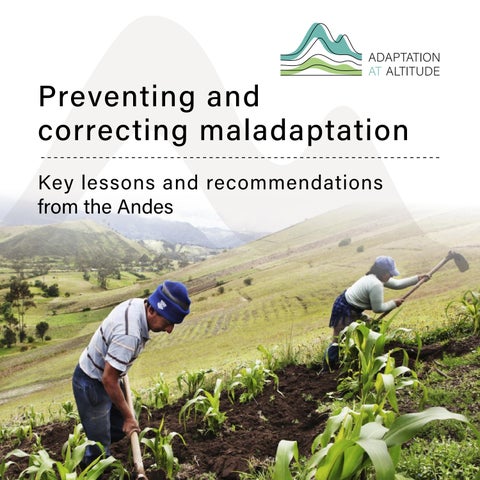
Preventing and correcting maladaptation Key lessons and recommendations from the Andes
The aim of climate change adaptation is to reduce vulnerability and strengthen resilience, but poorly designed interventions can unintentionally create new risks and negative impacts, particularly when they are disconnected from local realities. This brief summarises lessons from a 2025 Adaptation at Altitude study that evaluated five climate change adaptation solutions implemented across the Andes. That evaluation found no evidence that the solutions themselves generated significant maladaptive outcomes, instead, it found that their design and implementation incorporated several characteristics that helped minimise risks and increase the likelihood of lasting benefits.
Cover photo The Ecuadorian Andes region is known as La Sierra and includes the Andes Mountains, Ecuador. © Dieter Telemans / Panos Pictures
Andes, Argentina. © Lina Rodriguez
Use a science-based design
Maintain flexibility
Adaptation takes place in the context of changing social, environmental, and climatic conditions. Solutions that are designed to remain adaptable to further climate change adjust to new conditions and avoid the costs of being locked in to an initial course. In Colombia, sustainable tourism activities provide alternatives to less sustainable practices while allowing local organisations to adapt and expand the initiative over time. on
sson 3 - K
- Key less
le
Involve stakeholders from the start
Multi-actor co-design that engages with communities, public agencies, and specialists, helps reduce the risk that interventions benefit some groups at the expense of others. Local farmers, municipal authorities, and technical agencies worked together in Chile to develop and implement sustainable mountain grazing practices.
2 - Key le s son
3
ey
- Key less
le
le s son
on
ey
2
sson 2 - K
Adaptation solutions are more likely to avoid unintended consequences when they are based on sound understanding of climate risks, ecosystems, and socio-economic conditions. In the Santa River basin, in Peru, scientific research and community-based vulnerability assessments informed hazard maps, evacuation routes and an early warning system.
3 - Key
Correct practices that contribute to maladaptation
- Key less
le
le s son
Pay attention to the post-project period
The greatest remaining risks were not found in the original solutions themselves, but in how they were maintained, expanded or replicated. In Ecuador, the replication of much larger greenhouses for farmer associations may shift the intervention away from the small-scale household model on which the original solution was based, potentially changing its environmental and social effects. In Peru, an early-warning station dismantled due to community opposition illustrates that community awareness-raising must be expanded beyond the directly affected population to include downstream or surrounding communities within a wider area of project influence. on
ey
5
sson 5 - K
Adaptation can go beyond avoiding new risks – it can also help reverse practices that increase vulnerability. Argentina provides the clearest example, where restoring sustainable water management practices addressed the degradation caused by artificial watering holes, and improved ecosystem conditions.
5 - Key
on
sson 4 - K
- Key less
le
le s son
4
ey
4 - Key
Maladaptation risks and measures across the five solutions Prior or latent maladaptive practice
Preventive or corrective measures
Residual risks or remaining challenges
Colombia (AICCA)
Tourism activities without environmental protocols risked disturbing bird habitats at Lake Tota.
Guided birdwatching tours adopt strict observation-without-disturbance protocols; community leaders trained as expert guides continue applying these practices.
Lack of official regulation could see sustainable birdwatching numbers exceeded. Beneficiaries remain concentrated in one community association; no evidence of spread to other tourism operators.
Ecuador (AICCA)
Subsistence farming and livestock rearing degraded national park buffer zones.
Greenhouses and drip irrigation designed on the basis of climate-risk data and sustainable land-use criteria; improved livestock practices reduced herd density while raising productivity, easing pressure on protected areas.
Mass replication of greenhouses, with the consequent modification of the landscape and intensification of land use, and a potential improper disposal of plastic coverings.
Peru (Glaciares+)
Limited engagement with downstream communities contributed to misconceptions about the GLOF early warning station, including the belief that it caused drought. Community opposition subsequently led to the station being dismantled.
Best-available glacial science guided the DRM-IWRM integration model; CBVA methodology and women-led awareness campaigns improved community ownership. A manual for guiding the design of multi-purpose projects was produced for public agencies.
Awareness-raising was not incorporated early enough in the project cycle. The Palcacocha EWS is now reportedly inactive due to maintenance failures—highlighting persistent post-project risk.
Chile (GEF-Montaña)
No specific prior maladaptive practice identified by interviewees. The dependency on economically or technically inaccessible solutions risked perpetuating existing vulnerabilities.
The Sustainable Mountain Cattle Ranching model was co-designed with communities, incorporating traditional knowledge and adapted to each municipality’s context ensuring flexibility, relevance, and ownership.
The San José de Maipo environmental unit faces operational and financial constraints that limit the roll-out of the territorial governance model beyond the pilot area.
Argentina (Conserving Wetlands)
Emergency responses to drought—particularly the excavation of artificial watering holes—temporarily eased water shortages but structurally damaged wetland function and accelerated ecosystem degradation.
The programme explicitly targeted this maladaptive practice. Azudes (check dams) restored natural riverbed hydrology; rotational grazing with fencing allowed wetland and pasture recovery; solar pumps provided safe water access without environmental harm.
Mining activity and overgrazing remain structural pressures in the basin. The solution’s long-term reach depends on political will and the continuation of community training beyond project cycles.
Solution
Recommendations for designing and implementing adaptation initiatives
1.
3.
Identify and explicitly assess potential maladaptive practices during project design. This transforms maladaptation prevention from a checklist criterion into a project objective by integrating evidence on livelihood impacts, institutional arrangements, and environmental trade-offs into the design logic.
Monitor how adaptation solutions are replicated and adapted over time, as scaling-up can unintentionally alter the design principles that originally helped avoid maladaptation.
4.
2.
Define the areas of influence of projects using an approach that incorporates socio-economic, cultural, environmental, and political considerations, and use this delineation to target awareness-raising, coordination, and risk-reduction activities both within and beyond the immediate intervention zone.
5.
Plan for long-term monitoring and follow-up beyond project completion. Continued monitoring can identify emerging maladaptation risks, support adaptive management, and help assess whether adaptation benefits are maintained over time.
Plan for post-project maintenance. Strengthen local ownership and maintenance capacity so that beneficiaries can sustain adaptation measures after external project support ends.
Further resources • Detailed descriptions of the five assessed solutions Argentina, Chile, Colombia, Ecuador, Peru. • Climate change adaptation in the Andes: Key lessons and recommendations Summarises lessons drawn from the finve assessed solutions • Adaptation at Altitude Solutions Portal Includes 100+ solutions that address a wide array of climate impacts • IPCC AR6 Cross-Chapter Paper 5: Mountains Gives the latest scientific assessment of climate change in mountains – impacts, risks, and adaptation • The Leave No Mountain Behind Solution Synthesis Series Provides insights and good practice examples on finance, transboundary adaptation, Indigenous knowledge, and ecosystem restoration
About Adaptation at Altitude Adaptation at Altitude, a collaborative programme launched and co-supported by the Swiss Agency for Development and Cooperation, is dedicated to increasing the resilience of mountain communities and ecosystems to climate change. It aims to improve the availability and use of data and knowledge, strengthen science-policy platforms and dialogues, and build capacity and resource mobilisation for the evidence-informed formulation and implementation of effective climate change adaptation policies and institutional measures at the national, regional, and global levels. Reducing climate-induced risks and adapting to climate change in mountainous regions is a global concern. All countries of the world are in one way or another affected by climate impacts in the mountains. Temperatures in mountainous areas are rising faster than the global average, water resources are increasingly affected by variable climate patterns, and disasters related to natural hazards – including the downstream consequences – are becoming more frequent and severe, placing some of the world’s most vulnerable areas at greater risk. This summary is based on the following report: Salas-Bourgoin, A. et al. (2025). Evaluation of climate change adaptation solutions in the Andes. CONDESAN / University of Geneva. Prepared under the framework of the Adaptation at Altitude Programme. Authors
Simon Allen (University of Geneva) Julia J. Aguilera Rodríguez (University of Geneva) Contributors
Andreina Salas Bourgoin (University of the Andes) Lina Rodriguez Molano (University of Geneva and United Nations University) Luis Daniel Llambí (CONDESAN) Graphic design
Carolyne Daniel (Zoï Environment Network) With financial support from:
Suggested citation
Adaptation at Altitude (2026): Preventing and correcting maladaptation Key lessons and recommendations from the Andes, Geneva. http://doi.org/10.5281/zenodo.21808655 Unless otherwise stated, all content is licensed under Creative Commons CC BY 4.0