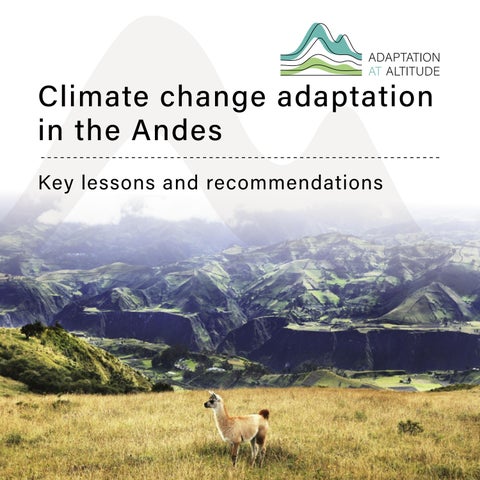
Climate change adaptation in the Andes Key lessons and recommendations
With climate change accelerating across the Andes, the identification of adaptation approaches that are both effective and sustainable has become an urgent priority. This summary of lessons from five climate change adaptation solutions – in Argentina, Chile, Colombia, Ecuador and Peru – highlights some of the factors that enable adaptation benefits to endure and offers recommendations for strengthening the design and implementation of future initiatives. While these solutions differ in their objectives, sectors and stakeholders involved, a comparative analysis reveals key lessons that can inform the design and implementation of more effective and sustainable adaptation efforts.
Cover photo The Ecuadorian Andes region is known as La Sierra and includes the Andes Mountains, Ecuador. © Dieter Telemans / Panos Pictures
Local resident operating a solar-powered water pump, Laguna de los Pozuelos, Argentina. © Elides Sulbarán (2025) 2
The five solutions at a glance Location
Project (funder)*
Solution
Stakeholders
Maturity stage
Colombia Lake Tota basin, Boyacá
AICCA-Colombia (GEF)
Sustainable tourism combined with a bird-phenology monitoring network; tourist routes of strategic ecosystems and local cuisine; training for hospitality and tourism operators.
8 tourism operators in the basin, plus workers in hospitality, gastronomy and river transport.
In progress
Ecuador Cuyuja & Papallacta, Napo
AICCA-Ecuador (GEF)
Mobile greenhouses with drip irrigation plus training in agricultural practices to diversify income and shield crops from frost and intense rainfall.
42 farming families (one per greenhouse); improved food security for about 1,600 people.
Maturing
Peru Santa River basin, Ancash
Glaciares+ (SDC; Care Peru & U. Zurich)
Preventive disaster risk and integrated water resource management around hazards from retreating glaciers and new glacial lakes.
70,000+ people living downstream reached indirectly via public agencies in Huaraz and Carhuaz.
Uncertain (early)
Chile San Jose de Maipo
GEF-Montana (GEF; MMA & UNEP)
Municipal sustainable land use and landscape management model combined with a sustainable mountain cattle-ranching scheme.
San Jose de Maipo municipal officials and the Fundo Maitenes ranchers’ group; wider project reached 36 municipalities.
In progress
Argentina Laguna de los Pozuelos
Conserving Wetlands (Wetlands International)
Restoring high-Andean meadows and wetlands (vegas and bofedales) and improving grazing, including re-establishing traditional water structures (azudes).
150 Kolla shepherd families around the lagoon; grazing plan now spans about 40 farms (~20,000 ha).
In progress
*The solutions assessed represent selected activities or components of larger projects.
3
Colombia — Sustainable tourism and bird monitoring, Lake Tota (AICCA-Colombia) income, protect crops, and curb the spread of cattle ranching into sensitive zones. Interviewees describe the solution as highly effective: virtually all installed greenhouses remain operational, and both the local communities and the parish-level governments have installed new greenhouses. Low cost, simplicity and a tangible benefit led to strong community ownership.
Facing projected shifts in rainfall and temperature in a basin that supplies water to 250,000 people and where spring onion farming dominates the local economy, AICCA-Colombia sought to diversify livelihoods by combining sustainable tourism with bird phenological monitoring. It trained tourism operators, established the UAQUE Association, and developed tourist routes of strategic ecosystems and local cuisine. While the initiative took root among motivated individuals and the local association, it has not yet spread to the wider community, as the economic dominance of onion farming and limited institutional support have constrained broader uptake.
Peru — Disaster risk and water management, Santa River basin (Glaciares+) With Peru home to most of the world’s tropical glaciers and facing growing glacial lake hazards, the Glaciares+ project sought to strengthen public agency capacity for preventive disaster risk management and integrated water resource management in the Santa River basin. It established early warning systems, technical training, and coordination mechanisms, but challenges in institutional coordination, staff turnover among public sector partners, and resource constraints limited the after-project follow-up and led to post-project risk. Management appears to remain focused on response and recovery.
Ecuador — Greenhouses and improved agricultural practices, Cuyuja & Papallacta (AICCA-Ecuador) Where intense rainfall and frost threaten food security in the buffer zones of two national parks, this project installed mobile greenhouses with drip irrigation and trained farmers on agricultural practices to diversify
4
Chile — Sustainable landscape management, San José de Maipo (GEF-Montaña) In a biodiverse Mediterranean ecoregion under increasing drought and development pressure, the GEF-Montaña project promoted a Local Environmental Management (LEM) model, sustainable land-use planning and sustainable mountain cattle ranching. It supported the establishment of a municipal environmental unit, a municipal nature reserve, and a sustainable mountain grazing management plan. While the grazing component has advanced the furthest, the LEM and land-use planning components remain affected by operational and budgetary constraints.
and public bodies, operates within a biodiversity reserve governance framework, and has generated notable results in pasture and wetland recovery. It is the only solution still under the direct responsibility of its implementing organisation, which continues to update plans and train beneficiaries in new practices.
Argentina — Wetland restoration and grazing, Laguna de los Pozuelos (Conserving Wetlands) Implemented by Wetlands International within the Laguna de los Pozuelos Biosphere Reserve, this solution promotes improved grazing practices and the restoration of high-altitude wetlands through the re-introduction of azudes (traditional small earthworks). The solution has the support of communities
5
Adaptation is a long-term process Climate change adaptation is a long-term process that extends beyond the timeframe of individual projects. While implementing organisations can establish the foundations for adaptation, lasting outcomes depend on the stakeholders and institutions that sustain, adapt and scale up solutions over time. The evaluation therefore places each solution on a maturity continuum – primary, in progress, and maturing – rather than judging it simply as a success or failure. The differences among cases reflect how far each project advanced implementation and created conditions for continuity, not the inherent quality of the solutions themselves.
Figure 1: Five adaptation solutions at different stages of maturity Still run by the foundation; plans being updated
Municipal unit set up; operational and budget limits
Argentina Pozuelos wetlands
Chile San José de Maipo
Status uncertain activities weakened Peru Santa River basin
PRIMARY Conceptualisation, designed and implemented Community-targeted solution
Local association owns it, Communities run and expand but not yet scaled the greenhouses Colombia Lake Tota
Ecuador Cuyuja and Papallacta
IN PROGRESS
MATURING
Operational but not autonomous; depends on external support Public-institution-targeted solution
6
Self-sufficient and resilient; run autonomously; sparks new initiatives uncertain
greater autonomy
Adaptation succeeds when context and implementation align
Contextual factors – territorial characteristics, institutional environments, and stakeholder capacity and willingness to engage – shape the circumstances in which solutions operate. Implementation factors – methodologies, long-term engagement, integration of local knowledge, and trust-based relationships – determine how effectively solutions respond to those circumstances. The effectiveness and sustainability of adaptation solutions depend on the interaction between the contextual and implementing factors that organisations can influence. on
sson 2 - K
- Key less
le
le s son
2
ey
2 - Key
Contextual factors A favourable territorial context, activities of reduced complexity, and stakeholders with the capacity and opportunity to adopt and keep activities all help. In these five cases, simpler community-focused solutions generally showed greater continuity after project support, while more complex multi-agency initiatives faced greater institutional and coordination challenges. The decisive condition then varies by target: communities act when a climate impact is already felt and the benefit is visible and near-term (Ecuador’s greenhouses against frost; Argentina’s restored grazing), whereas diffuse, long-term benefits attract only motivated individuals (Colombia’s tourism). Moreover, public-agency solutions need sustained political will that survives staff turnover. Chile’s stable career public servants, for example, helped the solution persist and replicate, while electoral turnover in Peru was a barrier to the sustainability and success of the solution.
Implementation factors Across all five solutions, four practices recur: sound methodologies for working with people (“learning by doing”, Community-Based Vulnerability Assessment); building local ownership and the knowledge, skills, and funds needed for beneficiaries or institutions to sustain activities on their own; active use of local and traditional knowledge (the revived “cordoneo” in Chile, the azudes in Argentina); and trusted, supportive relationships that motivate lasting commitment, even to the point that implementers often keep supporting beneficiaries after the project officially ends. 7
Figure 2: Aligning context and implementation
Effective and sustainable solutions Vulnerability reduced Resilience strengthened Maladaptation avoided Quality of life and ecosystems improved
Contextual factors
Implementation factors
Territorial context – social, institutional, cultural and environmental conditions
Methodologies for working with people
Complexity of the solution
Local ownership and capacity (including financial capacity) for continuity
Stakeholder capacity and opportunities to adopt activities and sustain them going
Active use of local and traditional knowledge in design and delivery
A felt climate impact and a visible, near-term benefit (for communities)
Trusted, supportive relationships that motivate lasting commitment
Sustained political will across changes in leadership (for public agencies)
Solutions that produce visible benefits and maintain support after funding ends
8
Lasting adaptation requires ownership and resources
Well-designed adaptation initiatives can generate multiple benefits by reducing vulnerability, strengthening resilience, improving well-being and supporting ecosystem health. Beyond addressing climate risks, the evaluated community-based solutions also generated broader social benefits, including strengthening the role of women in Ecuador, restoring a sense of dignity among pastoral communities in Argentina, and revitalising local traditions and knowledge. on
sson 3 - K
- Key less
le
le s son
3
ey
3 - Key
However, ensuring that these benefits continue beyond the project period remains a major challenge. Across the cases, monitoring and evaluation systems are limited, making it difficult to quantify changes in ecosystems, livelihoods and well-being. Long-term sustainability depends on local institutions, organisations or public bodies with the mandate, capacity and resources to maintain and expand activities. It also depends on beneficiaries having access to financing and the skills needed to mobilise and manage resources independently, highlighting the importance of planning for long-term financing from the outset.
9
Recommendations for designing and implementing 6. Provide mechanisms for adaptation initiatives
1.
3.
Assess enabling and limiting factors for sustainability at the design stage and take early action to address potential obstacles before project closure.
Identify and train a community organisation or local public body to assume responsibility for continuing and, ideally, expanding, the solution’s activities when the project ends. Training areas should include leadership, planning, resource mobilisation and management, and monitoring.
2.
maintaining infrastructure – maintenance funds or material reserves – that allow beneficiaries to sustain adaptation investments during the years immediately following project completion.
Develop monitoring and evaluation plans that track not only activity implementation but also the evolution of benefits, new challenges encountered, and lessons learned. This supports transition toward collaborative adaptive management.
5.
4.
Strengthen the ability of beneficiaries, both communities and agencies alike, to identify and access funding sources and overcome the financial limits that often constrain sustainability. 10
Reinforce foundational design principles before scaling or replication to prevent unintended consequences or maladaptive outcomes.
A note on the evidence
Further resources
The evaluation applied a common analytical framework to assess the effectiveness and sustainability of the five climate change adaptation solutions. Effectiveness was assessed across four dimensions: achievement of objectives, contribution to reducing vulnerability to climate change, strengthening of resilience, and prevention of maladaptation. Sustainability was assessed by examining whether benefits are being maintained and scaled, whether beneficiaries have taken ownership, whether the capacities and financial resources required for continuation exist, and whether the partnerships and coordination mechanisms underpinning the solutions endure.
• Detailed descriptions of the five assessed solutions Argentina, Chile, Colombia, Ecuador, Peru. • Preventing and correcting maladaptation: Key lessons and recommendations from the Andes Summarises lessons on maladaptation drawn from the five assessed solutions • Adaptation at Altitude Solutions Portal Includes 100+ solutions that address a wide array of climate impacts • IPCC AR6 Cross-Chapter Paper 5: Mountains Gives the latest scientific assessment of climate change in mountains – impacts, risks, and adaptation
Evidence was gathered through 36 interviews with project beneficiaries, implementers and public officials, complemented by field observations in Colombia and Argentina. Importantly, the findings rely primarily on stakeholder perceptions rather than measured changes. While these qualitative insights provide valuable evidence on perceived outcomes and longterm processes, strengthening ex-post monitoring and evaluation would enable future assessments to complement stakeholder perspectives with quantitative evidence on the magnitude, distribution and persistence of adaptation benefits, thereby strengthening the evidence base for climate change adaptation in the Andes.
• The Leave No Mountain Behind Solution Synthesis Series Provides insights and good practice examples on finance, transboundary adaptation, Indigenous knowledge, and ecosystem restoration
11
About Adaptation at Altitude Adaptation at Altitude, a collaborative programme launched and co-supported by the Swiss Agency for Development and Cooperation, is dedicated to increasing the resilience of mountain communities and ecosystems to climate change. It aims to improve the availability and use of data and knowledge, strengthen science-policy platforms and dialogues, and build capacity and resource mobilisation for the evidence-informed formulation and implementation of effective climate change adaptation policies and institutional measures at the national, regional, and global levels. Reducing climate-induced risks and adapting to climate change in mountainous regions is a global concern. All countries of the world are in one way or another affected by climate impacts in the mountains. Temperatures in mountainous areas are rising faster than the global average, water resources are increasingly affected by variable climate patterns, and disasters related to natural hazards – including the downstream consequences – are becoming more frequent and severe, placing some of the world’s most vulnerable areas at greater risk.
This summary is based on the following report: Salas-Bourgoin, A. et al. (2025). Evaluation of climate change adaptation solutions in the Andes. CONDESAN / University of Geneva. Prepared under the framework of the Adaptation at Altitude Programme. Authors
Simon Allen (University of Geneva) Julia J. Aguilera Rodríguez (University of Geneva) Contributors
Andreina Salas Bourgoin (University of the Andes) Lina Rodriguez Molano (University of Geneva and United Nations University) Luis Daniel Llambí (CONDESAN) Graphic design With financial support from:
Carolyne Daniel (Zoï Environment Network) Suggested citation
Adaptation at Altitude (2026): Climate change adaptation in the Andes Key lessons and recommendations, Geneva. http://doi.org/10.5281zenodo.21808767 Unless otherwise stated, all content is licensed under Creative Commons CC BY 4.0