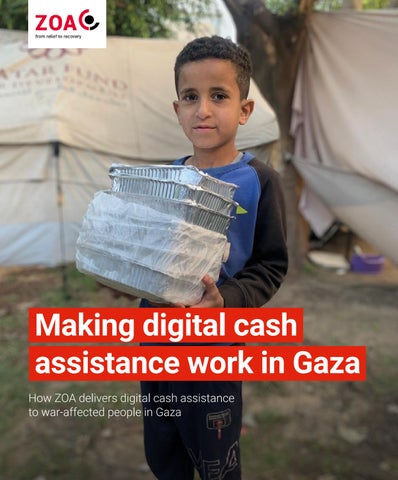
Making digital cash assistance work in Gaza How ZOA delivers digital cash assistance to war-affected people in Gaza
Table of contents 1. Introduction
3
2. ZOA’s approach
4
3. The impact of digital cash assistance
6
4. Lessons Learned
8
5. What’s next
10
The story of Naheda Wajdi Mohammad Abd El-Salam 13
1. Introduction
ZOA is an international humanitarian organization that supports people affected by conflict and disasters in fragile contexts around the world by providing life-saving assistance, helping communities to recover, and strengthening their resilience in the face of crises. Recognizing that cash assistance is one of the most effective, efficient, and recipient-preferred forms of support, ZOA prioritizes cash as a modality where feasible to enable crisis-affected households to meet their most urgent needs in a timely matter with dignity, choice, and flexibility.
Context1
Following the escalation of conflict in October 2023, the humanitarian situation in Gaza deteriorated quickly. Widespread displacement, civilian casualties and largescale destruction of homes and critical infrastructure left nearly the entire population of Gaza, approximately 2.1 million people, in need of humanitarian assistance. Limited access to food, water, healthcare, and other essential services continue to place immense strain on affected populations, while the loss of livelihoods further erodes households’ ability to meet their basic needs. Despite reduced hostilities following the peace agreement of October 2025, the operating environment remains highly volatile, marked by ongoing insecurity, movement restrictions and humanitarian access constraints.
Drawing on ZOA’s experience in Gaza, this paper presents ZOA’s approach to digital cash assistance in Gaza, highlighting key findings, best practices, lessons learned, and recommendations from a program implementation perspective. 2
We are here.
3
ZOA Palestine
Since the escalation of the conflict in October 2023, ZOA has provided life-saving assistance to conflict-affected people in Gaza. Starting with in-kind food and water related support, ZOA soon shifted its focus to digital cash as the main modality, enabling families to address their most urgent needs in a flexible and dignified manner. Despite severe humanitarian access restrictions, ongoing insecurity, large-scale displacement and liquidity shortages, ZOA successfully piloted and scaled digital multipurpose cash assistance (MPCA) in Gaza using RedRose’s digital integration with local financial service provider PalPay. Starting with 18 households in the pilot phase, the programme expanded to reach over 1,200 households to date. In doing so, ZOA demonstrated the feasibility, scalability, efficiency and effectiveness of digital cash assistance in Gaza’s highly challenging humanitarian context.
Reach of ZOA’s Cash Assistance Programme in Gaza 1 Beit Lahia 2 Jabalya 3 Tuffah 4 Turukman 5 Al-Daraj 6 Sabra 7 Al-Zaytun 8 Shejaiya 9 Gaza City 10 Rimal 11 Nuseirat Camp 12 Bureij Camp 13 Braje Camp 14 Maghazi 15 Deir al-Balah 16 Kahn Younis 17 Abasan al-Kabira 18 Al Mawasy Camp 19 Rafah
9
10
2 4
5 6
3 8
7
12
11
15
1
14
13
16 18
17
19
• Humanitarian Situation Report | 5 June 2026 | United Nations Office for 1
the Coordination of Humanitarian Affairs - Occupied Palestinian Territory • UNRWA Situation Report #227 on the Humanitarian Crisis in the Gaza Strip and the Occupied West Bank, including East Jerusalem | UNRWA • Occupied Palestinian Territory | OCHA • Palestine* - European Civil Protection and Humanitarian Aid Operations • Gaza Market Monitor May 2026 • Gaza: Israel’s shelter restrictions force nearly a million people to endure summer heat in tents | NRC
4
We are here.
5
3. ZOA’s approach
Community & household identification based on vulnerability
Digital registration, verification, deduplication and selection
Digital cash transfers through the PalPay/ RedRose integration
Households spend cash
Real-time & Post Distribution Monitoring
Information sharing and Feedback, Complaint and Response Mechanisms
Community & household identification based on vulnerability
Working closely with camp management and community representatives, and following the guidance of the Cash Working Group (CWG), ZOA’s local team of enumerators identifies conflict-affected households experiencing heightened vulnerability and increased barriers to meeting their basic needs. These include, among others, displaced families living in inadequate shelters, femaleor child-headed households, elderly, persons with disabilities or chronic illnesses, pregnant and lactating women, and caregivers of young children.
Digital registration, verification, deduplication and selection
Eligible households are registered in person by ZOA’s local enumeration team using the digital RedRose application. To help ensure assistance reaches the right people, the securely uploaded data is verified against established vulnerability criteria and subjected to both internal and inter-agency deduplication checks before the final selection of project participants is confirmed.
6
We are here.
Digital cash transfers through the PalPay/RedRose integration
The cash assistance is transferred digitally to the selected households through RedRose via its integration with PalPay, a widely used local financial service provider in Gaza. Within seconds, they receive the transferred amount directly in their mobile PalPay e-wallets on their phones, enabling them to access support quickly and safely. A notification message is sent to all recipients through the platform to ensure accountability.
Households spend cash
Once transferred, households can immediately access and use the funds in their PalPay e-wallets, giving them the flexibility to decide how to best meet their most urgent needs. Thanks to PalPay’s extensive agent and vendor network, they can choose to pay digitally for essential goods and services, withdraw the assistance in physical cash, or make digital transfers.
Real-time & Post Distribution Monitoring
All payments are digitally monitored on the RedRose platform in real time, and potential payment issues are followed up proactively. To give people the opportunity to share their experiences, raise concerns, and help improve the assistance, a digital Post-Distribution Monitoring (PDM) survey is sent through the RedRose platform two weeks after each cash transfer and complemented by follow-up phone-calls. The PDM data gives valuable insight into the use, relevance and effectiveness of the assistance, as well as local market information.
Information sharing and Feedback, Complaint and Response Mechanisms
ZOA’s Feedback, Complaint and Response Mechanism (FCRM) helps to continuously improve the quality and responsiveness of the assistance. Information about the programme and accessible feedback and complaint channels are available in Arabic for targeted populations and stakeholders throughout the project cycle.
ZOA & REDROSE
A fruitful private partnership Since 2016, ZOA works together with RedRose to develop, test, use, and scale innovative and contextualized digital solutions to deliver large-scale cash assistance in complex humanitarian settings globally. After the escalation of the conflict in Palestine, ZOA and RedRose joined forces to test the remote and bulk delivery of cash assistance in Gaza. With most people in Gaza having access to phones and using digital payment systems like PalPay - a well-established digital payment company in Palestine - digital cash assistance proved to be a viable modality. By integrating the digital systems of both RedRose and PalPay, it was possible to deliver cash assistance, from registration up to reconciliation, within one system. With major humanitarian access barriers and widespread humanitarian needs, this approach allows ZOA to deliver support to people in need, while ensuring speed, scalability and high programme quality. 7
Ability to use the cash received in PalPay E-Wallets
3. The impact of
Recipients are able to use digital cash effectively
While severe liquidity shortages limit the availability of physical cash, there is an increasing reliance on digital payment systems. PDM data shows that 99.6% of surveyed cash recipients was able to use the cash assistance effectively. Most households (92%) made digital payments to purchase goods and services from local vendors close to their homes, stimulating the recovery of local markets. Occasionally, funds were transferred to other e-wallets or bank accounts, while conversion to hard cash is extremely rare (only 1%). These findings confirm the accessibility of digital cash systems and widespread acceptance of digital payments among local vendors and service providers, making e-transfers an efficient and effective support modality.
digital cash assistance
FIG. 1 / Ability to use the cash received in PalPay E-Wallets
Digital cash enables households to prioritise their most urgent needs
PDM findings furthermore show that the cash assistance enables households to address multiple urgent needs with flexibility and dignity. Respondents report spending the assistance on essential needs, particularly food (97%), medical care (77%), transport (65%) and clothes (60%). Other common expenditures include hygiene and household items, water, shelter and communication amongst others. The diversity of spending patterns highlight the value of the digital cash assistance in allowing households to prioritize according to their specific needs.
89%
Spending Patterns of Household's Multipurpose Cash Assistance
PROJECT PARTICIPANT SATISFACTION
97%
De bt R
gs
3% Sa vin
4% Ed uc at io n
en t
4%
ep ay m
cit y
11%
El ec tri
13% Fu el
17%
m un ic at io n
r
26%
Co m
32%
Sh el te
ar tic le s…
pr od uc ts
Cl ot
or t
he s
Hy gi en e
POTENTIAL FOR RAPID SCALING OF TIMELY ASSISTANCE
34%
er
46%
STRONG PREFERENCE FOR CASH ASSISTANCE
W at
60%
old
65%
Ho us eh
77%
Tr an sp
While assistance is primarily provided through e-wallets, a small number of households unable to open a PalPay account, for example due to expired documentation or not having access to a mobile phone, received support through voucher codes instead to withdraw the cash assistance at local PalPay vendors against a small fee. This group represents approximately 5% of all supported households, but declined from 50% to less than 1% in the most recent projects, as alternative solutions were found, including offering support with PalPay account registration, registering another eligible adult household member with or able to open an account instead, or by simply resolving issues related to incorrect beneficiary data that had led to failed transactions.
Electronic payment to a local vendor or service provider 92%
HIGH VENDOR ACCEPTANCE OF DIGITAL PAYMENTS
ca re …
To date, 99.5% of all digital cash transfers to the 1,240 targeted households were successfully completed, demonstrating that the RedRose/PalPay system remains highly functional and reliable despite the challenging operating environment in Gaza.
TRANSFER SUCCESS RATE
M ed ica l
Digital transfers achieve near-universal delivery
99.5%
Fo od
ZOA’s experience with digital cash assistance in Gaza demonstrates that even in a highly constrained operating environment, essential humanitarian support can be delivered remotely, safely and at scale within seconds. Insights from registration and PDM data are summarised below.2
Money transferred to personal bank account 2% Money exchanged into hard cash 1%
Money transferred to a different ewallet or bank account 5%
FIG. 2 / Spending patterns of household’s multipurpose cash assistence
Findings presented in this paper are based on transfer data from 2
1.240 households from February 2025 until August 2026, and PDM data from 295 programme participants collected between June and July 2026.
We are here.
9
9
Cash remains the preferred assistance modality
ZOA continuously assesses the feasibility of cash assistance in Gaza based on (secondary) market assessment initiatives and PDM data. While still fragile, there are signs that local markets in Gaza are slowly recovering with more availability of goods and lower prices compared to the situation before the ceasefire (though still far from pre-conflict levels).
Despite the volatile market, 79% of the PDM respondents confirm the items and services they needed were mostly or partly available in their preferred market, while 21% indicated limited availability. Moreover, there is a strong overall preference for cash-based assistance, with 88% favouring cash assistance and 11% cash-combined modalities with physical Availability of needed goods and services in the goods or services.
Three-quarters (73%) of the PDM respondents found ZOA’s cash assistance easy to access, while 8% indicated having faced challenges accessing the assistance (19% neutral), including few people that presumably did not link ZOA to the cash received when filling in the PDM survey. Most cited barriers related to not understanding the registration or cash out process, technical issues such as network problems, and electricity cuts.
local market
Modality preference Physical goods or services 1%
Digital cash assistance is considered safe and accessible
Cash combined with physical goods and services 11%
In addition, 88% of the respondents considered that ZOA’s cash assistance reached the people who needed the assistance most, while only a few people (2%) raised concerns about vulnerable families who were not targeted while needing the assistance. Furthermore, 88% felt safe and 6% somewhat safe, receiving and spending the digital cash assistance. Only 1% felt unsafe because of a fear that their digital account would be hacked by criminals and 5% did not answer.
Partly available 24% mostly available 55%
Cash 88%
FIG. 3 / Modality preference
Do you think the project reached those who needed cash assistance the most? Somewhat 4%
Don't know/no answer 6%
Not really/not at all 2%
Completely or mostly 88%
FIG. 5 / TARGETING OF THOSE MOST IN NEED Do you think the project reached those who needed cash assistance the most?
limited availability 21%
Level of Satisfaction
Recipients value digital cash assistance
FIG. 4 / Availability of goods and services in the local market
The vast majority of recipients (90%) were (very) satisfied with ZOA’s cash assistance, while only 2% reported dissatisfaction. The main concern raised was that the transfer amount was not sufficient to cover household needs due to high prices or the limited number of transfer rounds. A small number of respondents expressed dissatisfaction about not having received funds from ZOA. Follow-up calls confirmed that some had misunderstood the source of the assistance, as transfers were displayed as coming from ‘RedRose’ rather than ‘ZOA’ in their e-wallet notifications. Therefore they had not linked the cash transfer directly to ZOA when filling in ZOA’s PDM survey.
Dissatisfied 2%
Don't know/no answer 5%
Neutral 3%
Satisfied 90%
FIG. 6 / Level of satisfaction
We are here.
11
11
4. Lessons Learned → Digital cash assistance is feasible, relevant and effective in Gaza: As digital payment systems have become increasingly embedded in daily life, digital cash assistance has emerged as a viable and recipient-preferred modality, enabling conflict-affected households to meet their most urgent needs with dignity, flexibility, and choice. Building on systems people already use and trust, assistance can be delivered remotely, quickly and discreetly, reducing the need for large-scale physical distributions and associated movement and protection risks. → Digital wallets are widely accessible, but vulnerable groups may still face barriers: A wide majority of households can access and use e-wallets effectively. However, specific target groups remain excluded due to missing, expired, or lost identification documents, highlighting the need for tailored support mechanisms and referral pathways for those unable to access digital financial services. → Strong monitoring and verification systems remain essential: In a context characterized by significant humanitarian access constraints, an integrated digital system supports efficient programme management and oversight. It enables real-time tracking of registrations, verification, payments, reconciliation, and PDM surveys sent directly to registered households via SMS. This should, however, be complemented by in-person verification visits and follow-up phone calls conducted by a local MEAL officer to strengthen accountability and reduce inclusion and exclusion errors. → Market monitoring remains critical for informed cash programming: Given the volatility of Gaza’s markets, continuous monitoring of commodity availability, prices, and vendor functionality is essential to ensure cash assistance remains appropriate and responsive 12
We are here.
to evolving conditions. As there is already a coordinated market monitoring system in place, it is essential to contribute and support this monitoring system. ZOA is actively coordinating with others working in Gaza through amongst others the cash working group. → Clear communication reinforces trust and visibility: It is essential that people understand who is providing the support for what purpose, and to walk along vulnerable populations to support where needed. Some recipients did not immediately recognize the assistance as originating from ZOA because transfer notifications displayed RedRose as the payment platform. Clear and consistent communication before, during, and after distributions, as well as accessible and safe feedback channels, are essential to strengthen transparency and accountability. → Cash assistance remains highly valued, but (cashrelated) needs continue to exceed available support: Cash transfers are widely valued and critical in helping households address their most urgent needs. However, transfer values for multipurpose cash are generally insufficient to cover a household’s essential needs for a full month, with most recipients reporting that the assistance lasts no more than two weeks. Likewise, the unpredictability of the assistance can limit households’ ability to plan and support their recovery. More predictable and sustained assistance over multiple consecutive months can help households not only meet immediate needs, but also regain a degree of stability. On the other hand, when a household’s primary need is to repair a damaged house or apartment for example, a higher one-off cash transfer may be more effective. This highlights the importance of tailoring transfer values, frequency, and duration to the specific needs and circumstances of the targeted individual, household, or group. 13
5. What’s next ZOA’s digital cash assistance is fast and scalable
The digital MPCA approach is fast and highly scalable, enabling ZOA to reach large numbers of conflictaffected households in a context where humanitarian needs are immense. Once funds are transferred from ZOA’s bank account to RedRose, conversion processes and administrative checks by authorities take up to three weeks. Through the RedRose integration with PalPay, ZOA can then deliver cash directly to selected households’ PalPay mobile wallets within seconds. Building on the achievements in Gaza, ZOA aims to further scale digital cash assistance to address people’s most urgent needs. Based on current capacity and the ability to increase daily registration capacity, ZOA has the potential to reach thousands of households (i.e. 5,000) and deliver millions of cash assistance (i.e. 2 million USD) directly in the hands of recipients, while maintaining quality, oversight, and accountability standards.
THE STORY OF NAHEDA WAJDI MOHAMMAD ABD EL-SALAM (37)
Supporting locally-led action
ZOA also started investing in locally-led action through piloting Group Cash Transfer (GCT) assistance in Gaza, based on its global experience and best practice using this mode of assistance.3 GCT brings an (existing) community group together to come up with local solutions for local problems. They are invited to develop plans and, after approval, receive tailored grants to implement their ideas with ZOA supporting participating groups to manage their own projects the best way possible. Just like MPCA, GCT grants can be transferred digitally through the RedRose/ PalPay integration. Through this approach a wide range of community needs is flexibly covered by communities themselves. Some examples from other contexts have been the creation new waterpoints bringing clean water closer to community homes in Yemen or the support for community kitchens in Sudan. Experience furthermore teaches that the GCT can contribute towards improved social cohesion due to its focus on locally-led community collaboration.
Cash for Shelter
Digital cash assistance also has the potential to be expanded to other sectors. As shelter needs are immense in Gaza and support is rather limited, ZOA explores expanding its digitial cash assistance to cover key shelter needs of most vulnerable populations.
3 ZOA’s Best practice papers on the Group Cash Modality:
“ In a split second, I became a widow”
B
efore the escalation of the conflict in Gaza, my husband, six children and I lived in a residential apartment in Al-Maghazi. My husband worked in Civil Defense and earning a modest salary that was not enough to cover all of our family’s needs. To improve our income, he purchased a motorcycle in instalments and started working in delivery services. Thanks to his efforts, we were able to live comfortably. We had a home, a stable income, and our family was together. When the war began, the shelling was intense, and the destruction was everywhere. “We fled our area and took shelter with relatives. At the beginning of the conflict, our home was bombed. After that, we were displaced multiple times and endured constant movement, instability, and the fear of shelling and destruction. One day, during the famine period, my husband went out to an aid distribution point in search for food and flour for our family. He was killed there, leaving us behind. In a split second, I became a widow. Today, my children and I live in a tent in Al-Ikhwa Displacement Camp in Al-Bureij, Gaza. Life in the tent is difficult. During the winter, rainwater leaks inside and the cold is hard to bear. In the summer, the heat becomes overwhelming. We are exposed to mosquitoes and insect bites, and rodents are everywhere. Each day, I struggle to provide enough food and water for my chil-
dren, while my children help collect water in jerrycans for drinking and fill buckets for washing clothes, cleaning dishes, and bathing. To meet our daily needs, we rely on humanitarian assistance from aid organizations and community members. When I received the monetary assistance from ZOA in my PalPay account, it brought a much-needed relief. The support helped ease part of the burden and allowed me to meet some of my children’s immediate needs. With the money received, I was able to buy clothes, diapers, fruit, and other food items. I also purchased the doctor-prescribed milk my daughter requires. My greatest hope for the future is to find a suitable source of income that will allow me to support my children and provide them with the food, water, and other essentials they need to live a dignified and safe life.
• Group Cash Transfer in Uganda - Community Groups in the Lead | ZOA; • Group Cash Transfer in Yemen - Local solutions with lasting impact | ZOA; • Group Cash Transfer in Ukraine - The currency of community | ZOA
14
We are here.
15
ZOA Sleutelbloemstraat 45, Apeldoorn PO Box 4130, 7320 AC Apeldoorn The Netherlands T +31 (0)55 366 3339 I www.zoa-international.com E info@zoa.ngo Contact Elias Elnajar Country Representative ZOA Palestine e.elnajar@zoa.ngo Henry Bos Global Cash Specialist ZOA h.bos@zoa.ngo © Copyright ZOA 2026 The information contained in this report may be reproduced, with the exception of the photos, provided that ZOA is informed in advance and that this publication is cited as the source. ZOA would like to receive a copy of the publication.
We are here.