
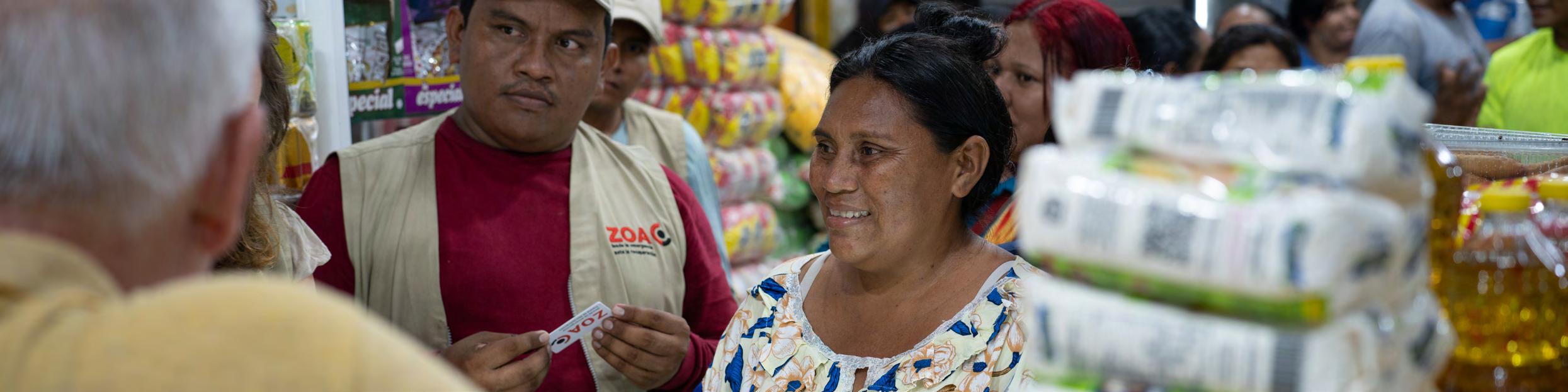
Between 2022 and 2025, ZOA supported 51,204 Venezuelan people on the move (‘caminantes’) with emergency protection assistance along the main migration routes in Colombia. This was achieved through an innovative approach that delivers rapid multi-sectoral voucher assistance within 30 minutes after identification and enables a flexible and dignified response for people in need. ZOA collaborated with more than 80 local businesses throughout the country.
Since 2022, ZOA has partnered with Zero Hunger Lab at Tilburg University to improve the quality of its food security interventions. Zero Hunger Lab applies data science to global food security initiatives, contributing to SDG 2: Zero Hunger. Zero Hunger Lab specialises in analysing real-world data and translating analytics into actionable recommendations for NGOs, the private sector, and government institutions.
ZOA Colombia has been collaborating with Zero Hunger Lab to analyse data from its Cash and Voucher Assistance (CVA) programme. ZOA used this data to improve the quality of its support to vulnerable Venezuelan and mixed migrants travelling through and within Colombia. Through this partnership, ZOA was able to transform data into models and tools that helped ZOA design better programs, choose the right partners, and serve people on the move more effectively.
Our collaboration with Zero Hunger Lab produced seven research projects specifically linked to Colombia. This brief zooms in on three main research projects which are part of a broader research project led by Claire Tan, PhD researcher, and Dr. Thomas Breugem, Associate Professor at Zero Hunger Lab.
Through the development of a predictive model in collaboration with Zero Hunger Lab, ZOA gained insights into how people on the move prioritise their voucher expenditure.
• Specific needs influence voucher usage: data demonstrates that certain characteristics and vulnerabilities influence people’s spending behaviour. For example, pregnant women are more likely to prioritise access to pharmacies. This underlines the importance of selecting vendors that can meet diverse needs.
• Importance of store availability & proximity: the research also found store availability and proximity affect spending choices. When preferred store types are not within walking distance, people on the move are more likely to use their vouchers on less preferred but more easily accessible goods and services. To address this, ZOA selected vendors close to transport terminals –the centres of project assistance.
• Programmatic adjustment: in response to the findings, ZOA adjusted the project to place greater emphasis on vendor’s geographic location to ensure better access to preferred items for people on the move. This project is part of the PhD research by Claire Tan and dr. Thomas Breugem and has already been presented at major international conferences (POMS, MIT-SCALE).
Determining the ideal mix of local vendors
This study addressed a practical question: If ZOA could expand its vendor base, which types of stores should be prioritised to maximise impact?
Using advanced optimisation models, Zero Hunger Lab found that:
• Supermarkets are the most effective vendors, offering a large variety of goods to meet the diverse needs of people on the move.
• Clothing stores, in contrast, were the least utilised.
• Expanding the number of vendors does improve choice, but after a certain point, the added value diminishes.
• There is a consistent trade-off between variety (ensuring access to a broad range of goods and services) and efficiency (providing the high-in demand items quickly).
The research project (as presented in the MSc thesis of Lotte Croonen, October 2024) informed ZOA’s vendor strategy, and helped maintain the balance between accessibility and efficiency.
Comparing means across the nr. of children

Managing suppliers in humanitarian programmes
This project examined how ZOA’s Supplier Relationship Management (SRM) practices influence the sustainability of CVA programmes for people on the move. Two MSc theses –by Tijs Jansen and Angelica Lazo – provided complementary insights:
• Small vendors are hesitant to participate due to slow payment processes, distrust of digital systems, and xenophobia.
• Recommendations to address these concerns included enabling faster payments, work on peer-to-peer trust, and launching anti-xenophobia campaigns.
• In response, ZOA engaged vendors by highlighting the economic and social benefits of working with people on the move. ZOA also enabled flexible bulk payment thresholds to enable smaller vendors to participate in the programme.
• Vendors respond positively to ZOA’s training, frequent visits, and responsiveness.
• Recommendations to further strengthen collaboration included facilitating dialogue, adapting SRM practices to local contexts, and using inclusion messages.
• ZOA acted on these recommendations by systematising SRM practices to ensure consistent quality across all project locations.
These studies demonstrate that building strong, trust-based relationships with vendors are essential to support people on the move effectively. If vendors feel supported and engaged, this significantly contributes to a strong, sustainable, and scalable CVA programmes.
The collaboration between ZOA and Zero Hunger Lab underlines how data analysis can strengthen project implementation and quality, and how partnerships with academia can bridge the gap between project realities and data-driven decisions. Using predictive models and evidence-based guidance and strategies, ZOA can timely and effectively support people on the move.
Want to know more?
Henry Bos, ZOA Global Cash Specialist: h.bos@zoa.ngo
Mike Boomer, Former Country Director ZOA Colombia: m.boomer@zoa.ngo Milou de Bruijne, ZOA Strategic Learning and Policy Advisor: m.debruijne@zoa.ngo