Index of Content Content
Page
Introduction
2
Vision, and Goal, and Mission
3
Structure
4
Standing Committee on Exchange
5
Standing Committee on Public Health
7
Standing Committee on Reproductive Health and AIDS 9 Standing Committee on Medical Education
11
Standing Committee on Rights and Peace
13
Capacity Building and Training Support Division
15
Projects’ Support Division
16
Research Division
17
Publication and New Technologies Division
18
Additional Teams
19
Photo Gallery
20
Contacts
21
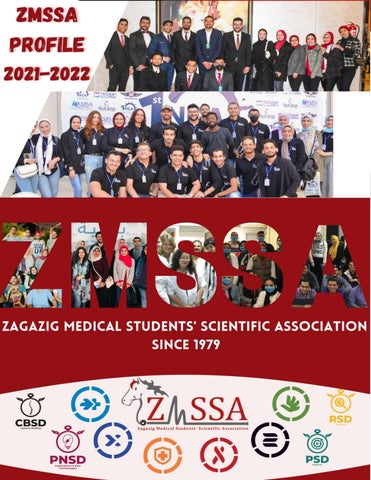
Introduction About ZMSSA: Zagazig Medical Students’ Scientific Association (ZMSSA) is Non-Profit, Nonreligious, Non-Political, Student-Run organization. It was founded in 1979 By Dr.Mohamed Othman Al-Hayeg. ZMSSA Is Full member in International Federation of Medical Students’ Association in Egypt (IFMSA-Egypt) Which is Also a Full member in International Federation of Medical Students’ Association (IFMSA).
About IFMSA-Egypt: IFMSA Egypt is a registered NGO at the Ministry of Social Solidarity with the Registration Number: 3115-Alexandria. IFMSA-Egypt was established in 1969 and it currently include more than 27 Local Committees in Faculties of medicine all around Egypt.
About IFMSA: IFMSA-Egypt is a full National Member Organization of the International Federation of Medical Students’ Associations (IFMSA) which is the official body of Medical Students worldwide, it was founded in May 1951 and currently it is made up of 133 National Member Organizations from more than 123 Countries spanning the 6 continents. IFMSA is officially recognized as a non-governmental organization within the United Nations (UN) and it is also recognized by the World Health Organization (WHO) as the official international forum for medical students.
Vision: Help Medical students in Zagazig university to become future professional healthcare providers equipped with all skills to be efficient part of the society.
Goals: 1- Provide all medical students with extra curriculum knowledge and skills that they need in their work and life. 2- Make medical students’ part of the society and have role in advocacy and problem solving of society problems. 3- Organize exchange programs for medical students. All Goals are aligned with the Sustainable Developmental Goals (SDGs) and 2030 Agenda of the UN, and also aligned with Egypt vision for 2030.
Missions: 1- Conduct workshops, events and training for students to enhance their skills. 2- Help Medical students in Zagazig to achieve more in the research field. 3- Provide exchange opportunities to medical students in Zagazig. 4- Advocate for Health issues that matters the community. 5- Help to promote the medical education in Zagazig.
Structure To achieve all our desired goals, ZMSSA implement its work through strict construction as follows: Executive Board (EB): Supervise all the activities that is done by ZMSSA Consist of: 1- President 2- Vice President 3- Secretary General Team Of Officials (TO): Include all responsible officers of ZMSSA, each one responsible for a specific committee which implement specific area of work. Consist of: Local officer on Research and Professional Exchange (LEO/LORE) Local officer on Public Health (LPO) Local officer on Reproductive Health and HIV/AIDS (LORA) Local officer on Medical Education (LOME) Local officer on Rights and Peace (LORP) Capacity building division director (CBSDD) Projects division director (PSDD) Research Division director (RSDD) Publication and New technologies division director (PNSDD)
1. Standing Committee on Professional and research Exchange
Our vision Is no one should be denied access to high-quality healthcare because of their ethnic origin, culture, or background. We envision a society in which all healthcare workers are welcoming of and understanding of others' differences. A world where you may get the same level of healthcare from anybody, anywhere, as if it were provided by your own skin. We believe that medical students and physicians have a responsibility to act as angels of mercy in times of tragedy and peacekeepers in times of war.
Our objective Is to assist our fellow medical students in fulfilling that responsibility by assisting them in being more understanding of other cultures and open-minded to the diversity of others. We view student exchange to be one of the greatest tools that can help achieve that, by hosting medical students from all over the world and enabling our colleagues to travel to many different countries. In our annual outgoing campaign, we provide medical students at our facility with the option to visit one of our 133 National Member Organizations, which span six continents and represent over 123 countries. They can participate in a professional exchange or a research exchange program. Professional exchange allows you to do a clinical clerkship in another country, whereas Research Exchange allows you to intern on a research project in another country. we supervise the selection of exchange Candidates go through an exam, an interview, and then the entire paperwork process before being exchanged. We host international students in many departments within our faculty and hospitals throughout our annual incoming campaign. We organize their stay and ensure that they will have the greatest possible experience. That means it's part of our job to prepare our exchange team members to deal with foreigners and understand how to make their stay as comfortable as possible.
2. Sanding Committee on Public Health
Vision Medical Students attain the optimal skills and knowledge to contribute to their full potential towards the making of healthier communities in their capacity as medical students and as future healthcare providers.
Mission Promotion of the development of medical students regarding Public Health issues through an international sharing knowledge network, projects management, community-based learning, capacity building, advocacy, exchanges placements and access to external learning opportunities to share and explore new ideas regarding these issues. Objectives • Prevention of diseases. • Promotion of health and education. • Raising awareness about global public health issues. • Advocating for health policies. • Developing skills and knowledge of medical students as the future health professionals. • Working as an international team and collaborating with external public health organizations to use the potential of over one million worldwide medical students. • Collaborate with other fields as medical education, human rights, and reproductive health. Projects •Mental health: increase awareness about mental health and provide emotional support to medical students, and all people in our community. •Antimicrobial Resistance (AMR): when bacteria, viruses, fungi, and parasites change over time and no longer respond to medicines. We increase awareness about this disaster and how to stop it. •Post pandemic recovery: as result of COVID-19 Pandemic, all health facilities have been consumed. Now, we focus on recent ways to make health facilities work again with maximum efficiency. •Universal Health Coverage (UHC): Health system recommended by UNGA; it’ll be implemented in Zagazig in 2030 according to ministry of health plan. •Non-Communicable Diseases (NCDs): Increase awareness about most common NCDs in our community and their risk factors. •Climate change: Human activities have been the main driver of climate change. So, to live in a healthier community we must change our behavior and we advocate any change which can make a healthier community.
•
Standing Committee on Reproductive Health and AIDS
Our vision: Is that every individual knows and is ensured all reproductive rights regardless of racism and stigma. Our mission: is empowering medical students in their reproductive life and increasing their awareness regarding topics - repressed by ignorance since forever- in a way that aligns with our oriental principles. The process of empowerment is enacted by interactive workshops or awareness campaigns held physically or on social media platforms. The projects: 1.Population Control and family planning: This topic is a national priority at the moment and is carried out in collaboration with the country’s efforts. Egypt is considered the most populated country in the Middle East. And the importance of counseling as well as determining the intervals between each pregnancy. And the importance of the matters above to the health of women and children. 2. Female Genital Mutilation: A crime punishable by law; however, up until this day and according to recent studies has reached 87.3% in Egypt and is mostly committed by doctors. And here comes our role as future healthcare providers to learn the impact of this act and how to handle it to limit its detrimental consequences. 3.Gender Based Violence: From our contributions to society is our role to shed light on the growing dilemma of our society whether it may be harassment, workplace or cyber blackmailing, domestic violence, underage marriage, and honor crimes and seek equality in all aspects of life to achieve sustainable development in collaboration with the WHO. 4. (HIV) and AIDS: In the lives of many doctors, it is very likely that they’ll encounter a person living with HIV and it is just as likely that most of these medical professionals- if not all of them-will panic; and that is due to the lack of knowledge regarding its modes of transmission and protective precautions when encountering it as well as the stigma resulting from the rudimentary ideas about its mode of transmission. And that is exactly where our role comes in spreading awareness, learning how to properly take care of people living with HIV, guiding them, and informing them of their rights in collaboration with the UNAIDS.
5.Reproductive Health: Raising awareness about genital tract infections and different kinds of cancers like breast cancer, prostate cancer, and testicular cancer; as well as acceptance and ownership of one’s body, the concept of consent, and all kinds of reproductive rights in general. 6. maternal and Women’s Health: Whether it may be before, during, or after pregnancy and her rights during labor. We will discuss menstruation and the critical changes that occur during it.
7.Adolescents’ health, puberty, parental exemplar, and human relationships.
3. Standing Committee on Medical Education
We have a vision and mission which through them we reach better healthcare worldwide. Our vision: our priority is medical students and their development through many aspects but mainly (personally and professionally). Our mission: “What we do”, here we take steps to reach our main goal. In SCOME, we help medical students to share and learn everything can make them better future doctors.
Projects: and topics we care and work on. They all target mainly medical students and medical education. 1- Evidence based medicine (EBM) Definition: the conscientious, explicit, judicious and reasonable use of modern, best evidence in making decisions about the care of patients. practice of EBM is a process of life long, self-directed and problem-based learning which every medical student must learn about. Aim: It’s a movement that aims to increase the use of high-quality clinical research in clinical decision making by integrating individual clinical expertise and patient values with best available external clinical evidence from systematic research to determine appropriate treatment plan. 2- First aid for all project: this is one of the most important projects we have in SCOME, in which we teach medical students how to deal with emergency situations and provide first aid according to the latest guidelines, and this is divided into two main topics 1- Basic life support: In which we learn how to deal correctly in cases of cardiac arrest - which has been widespread among young people for the last period - or breathing issues and proper posture of the body and how to perform cardiopulmonary resuscitation
2- first aid: This includes the right handling of all emergency cases of poisoning, burns, fractures, fainting and many others... In which, we will learn how to help someone and not to be the cause of deteriorating his condition, even though we were trying to help.
3-PGO “post-graduate Opportunities”: It’s a major event in which we help medical students to know how to deal with their life after graduation as future doctors.
4- Better medical education: In this project we help medical students to participate in medical education as our main priority, and that’s through many activities we do together.
In SCOME we aim to reach every medical student and to help them by different ways.
4. Standing Committee on Rights and Peace
The Standing Committee on Refugees was established in 1983 with the goal of paying attention to the challenges encountered by the displaced population and assisting in relief efforts. Vision: SCORP intends to create a peaceful world in which all people have full and equal access to their human rights, no one is left behind, persons are given priority, and the entire society, including medical students and health workers, works together to protect vulnerable groups. Mission: To empower and motivate medical students to actively promote and protect their rights and peace through advocacy; capacity building; awareness-raising; and by supporting the students in carrying out activities and projects that contribute to creating a fair and peaceful world.
Projects: 1. Together against stigma campaigns: Increased awareness medical students about stigma against medical practitioners in healthcare facilities, daily struggles they face, Also, reflecting on stigma and discrimination surrounding patients in healthcare settings, their right to equal treatment opportunities 2. Doctors and patient rights campaigns 3. Orphan Day: falls on the first Friday of April and has become a national celebration since its inauguration in 2004. To raise awareness of orphaned children in Egypt, 4. People living with disabilities campaign: we celebrate on 3rd of December with those people to give them the insurance that we all care about them and support them 5. Blood donation campaign: World Blood Donor Day takes place on 14 June each year. The aim is to raise global awareness of the need for safe blood and blood products for transfusion and of the critical contribution voluntary, unpaid blood donors make to national health systems. 6. Let the sign shine campaign related to the deaf and those with hearing problems. 7. Extra chromosome Extra love campaign related to Down syndrome. 8. Cool yard campaign related to bullying issues.
5. Capacity Building and Training Support Division
Vision: CBSD stands for capacity building support division, its vision is to build an efficient capacity for the members that will be able to conduct their roles in the best way either in their medical career or in their roles in the different activities. This is achieved by offering the members with the most needed skills and trainings in order to empower their capabilities and ensure that they are able to make a valuable actions and participation in their committees. The skills needed ranged from the basic soft skills to the advanced ones.
Mission: As mentioned, the skills offered by the capacity building support division are conducted through workshops, trainings and different activities following each workshop in order to ensure that the trained members got the most benefits from the sessions. Moreover, the division trainers are always available for members to offer them with the skills needed in their steps in applying for different activities.
Activities: We work in the form of training sessions, and each includes many soft skills. Such as: Communication & presentation skills, Time management, Conflict management, Professional files, Leadership & team building, Advocacy, Innovation, Monitoring & evaluation, Fundraising, Project management, Stress management, Problem solving, Planning skills. And many other soft and hard skills that we provide to medical students upon their needs.
6. Projects Support Division
Vision: This division ensures the quality of the various projects in the association, their effectiveness and success, and their timeline. Objectives: First: This division aims to make local coordinators able to manage projects until reaching the best possible goals by training them to plan well, then manage the project, continuously analyze all the phases of the project, and deal with any possible problems until they reach their primary goal. Second: This division aims to create a continuous communication between the local and national level to deliver any opportunities to members of the association, thus ensuring the quality of the various projects. Third: This division aims to collect all the different data on the projects throughout the year through continuous reports collected from the local coordinators to ensure the quality of the projects.
7. Research Division
The Research Support Division is responsible for the collection, processing, and assessment of data from ZMSSA projects. By collecting data, they construct a powerful database of our work within the association. Their mission is to build a powerful entity to engage medical students in ZMSSA in research work. They provide them with educational opportunities covering all research skills and methodologies. They develop research projects covering all ZMSSA committees’ topics. Implemented by ZMSSA members, these projects help improve their research skills. This is showcased in the annual scientific poster fair within IFMSA-Egypt.
There is also another, more clinical or academic aspect to research, that aims to provide its members with the knowledge and skills needed to later on be able to take part in research papers in their professional life and that is through local and national workshops and seminars that could be with wellestablished partners in the field.
8. Publication and New Technologies Division
Goal: Maintain the association’s social media and promotional materials, and Increase members skills in different technological tools. Objectives: • •
Increase members skills in Marketing, and publications, and social media. Conduct courses to teach members hard skills such as photoshop and using different technological tools as: Microsoft office, Google Workspace tools, ZOOM and other essential tools to be up to date.
9. Additional Teams •
Public Relation teams: Responsible for representing ZMSSA Infront of externals
•
Organizing Team: Responsible for organizing and planning any major events and conferences and campaigns.
•
Fundraising Team: Responsible for enhance the members managerial and financial skills and contact sponsors for ZMSSA activities.
•
Human Resources Team: Responsible for creating system and tracing members and score them and chose best members to reward them, and also to ensure the respect between all members.
•
Monitor and Evaluation Team: Responsible for ensure the sustainability of all ZMSSA projects and activities.
All teams held regular sessions and workshops to increase members skills in respective fields.
Photo Gallery
Contacts Info of ZMSSA Teams of Officials 2021 position
Name
Number
President
Ahmed Adel
01022585216
Zmssa.president@gmail.com
Vice president
Rana Ayman
01063301053
Zmssa.vp@gmail.com
Secretary General
Ahmed Fatouh
01119896771
Zmssa.secgen.treasurer@gmail.com
LEO/LORE
Hussein Youssef
01068866727
Zmssa.leo.lore@gmail.com
LPO
Ahmed Sedky
01001209088
Zmssa.lpo@gmail.com
LORP
Fares Elsayed
01016018255
Zmssa.lorp2@gmail.com
LORA
Hend Tolpa
01114889970
Lora.zmssa@gmail.com
LOME
Henzada Ibraheem
01155597108
Lome.zmssa@gmail.com
PSDD
Khaled Abu-Al Kheir
01002839869
Zmssa.psdd@gmail.com
CBSDD
Reem Maysara
01113145321
Zmssa.tsdd2@gmail.com