How to Understand Why Ocean Tides Rise and Fall
Have you ever visited a beach and noticed that the water level was different at different times of the day? Sometimes the sea reaches close to the shore, covering parts of the beach that were previously dry. At other times, the water moves back and leaves more sand and rocks visible. This regular movement is called a tide. Tides are a natural part of life near oceans and coastlines, and they happen because of the gravitational forces of the Moon and the Sun. Although tides may look like simple movements of seawater, there is an interesting process behind them. The Moon has the strongest influence on Earth's tides because it is much closer to our planet than the Sun. The shape of coastlines, the depth of the ocean, and local weather can also affect what people observe at the shore. Learning about tides can help you understand coastal environments and make more sense of the changing sea.
What Are Ocean Tides? Ocean tides are the regular rise and fall of sea levels. When the water level rises and reaches its highest point, it is called high tide. When the water moves back and reaches its lowest point, it is called low tide. These changes happen in cycles, although their exact timing varies from one coastal location to another.
At high tide, more of the beach may be covered by water. Areas where people could previously walk or explore may become submerged. During low tide, the water moves farther away from the shore, exposing sand, rocks, and sometimes small pools of seawater. These exposed areas can provide a chance to observe shells, crabs, and other coastal life. Tides are different from ordinary waves. Waves usually move across the water surface because of wind or other disturbances. Tides involve a much larger movement in sea level that affects coastlines over wide areas. Both can happen at the same time, but they are caused by different processes.
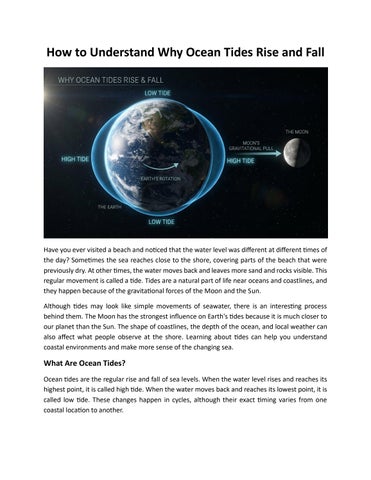
How the Moon Affects the Ocean The Moon plays the main role in creating Earth's ocean tides. Its gravity pulls on the water in the oceans. Because the Moon is relatively close to Earth, its gravitational effect on the planet's oceans is strong enough to produce noticeable changes in sea level. The water on the side of Earth facing the Moon is pulled slightly toward it. This contributes to a bulge of water, which is associated with high tide. Another high tide generally forms on the opposite side of Earth. As Earth rotates, different coastal areas move through these regions of higher and lower water levels. This movement helps explain why many coastal locations experience two high tides and two low tides during a lunar day. A lunar day is about 24 hours and 50 minutes, so the timing of tides usually shifts from one day to the next. The exact pattern depends on the location and local ocean conditions.
Learn More About Natural Ocean Processes Understanding tides is one way to explore how the Moon influences Earth. If you want to keep useful educational videos about oceans, beaches, and natural science, SnaPtik can help you save supported TikTok videos for later viewing. Short explanations and visual demonstrations can make scientific ideas easier to follow, especially when they show how water levels change over time. You can also connect what you learn with real observations. When visiting a coastline, notice how far the water reaches at different times. A simple record of the time and water level can help you see that tides follow a repeating pattern. Remember that local conditions can affect the timing and height of the water, so observations from one beach may not match those from another.
Why the Sun Also Affects Tides The Moon is the main influence on tides, but the Sun also has an important role. The Sun has a very large gravitational force because of its size. However, it is much farther from Earth than the
Moon. For tidal effects, distance matters greatly, which is why the Moon has a stronger influence on ocean tides. The positions of the Sun, Moon, and Earth affect how their gravitational influences work together. When the Sun, Moon, and Earth are aligned, their tidal effects combine. This usually produces a larger difference between high tide and low tide. These stronger tides are known as spring tides. Spring tides do not happen only during the spring season. The word describes the stronger movement of the sea level. They occur around the new Moon and full Moon, when the Sun, Moon, and Earth are arranged in a nearly straight line. During these periods, high tides may be higher than usual and low tides may be lower than usual.
What Are Neap Tides? Neap tides happen when the Sun and Moon are positioned at right angles relative to Earth. During this arrangement, their tidal influences partly work against each other. As a result, the difference between high tide and low tide becomes smaller. Neap tides usually occur around the first quarter and third quarter phases of the Moon. During these periods, high tides are not as high as they are during spring tides, while low tides are not as low. The sea still rises and falls, but the overall range is reduced. The difference between spring and neap tides is useful for understanding why the sea does not behave in exactly the same way every day. The Moon's changing position affects the tidal pattern over the month. If you compare observations across several weeks, you may notice that the distance between high and low water changes.
How Coastlines Change the Tide Pattern The timing and height of tides are not identical everywhere. The shape of a coastline can affect how tidal water moves into and out of an area. A wide bay, a narrow inlet, or a shallow coastal region may experience a different tidal range from an open coastline. The depth and shape of the ocean floor also matter. Underwater features can slow, guide, or concentrate the movement of tidal water. In some bays, the water level can rise much higher than it does along nearby open beaches. This is one reason why local tide information is important for people who work or spend time near the sea. Weather can also change the water level that people observe. Strong winds may push seawater toward the coast or move it away from the shore. Changes in air pressure can affect sea level as well. These weather-related changes are not the same as astronomical tides, but they can make the actual water level higher or lower than expected.
Use Videos to Understand Changing Water Levels Tides can be easier to understand when you see them in action. Educational videos may show a beach during high tide and then show the same location during low tide. Comparing the two scenes makes it easier to notice how much of the coastline can become covered or exposed as the water level changes. A save video tiktok jernih can help you keep supported educational videos for later reference. You can paste a TikTok video link into the website and use the available download option. If an HD download without a watermark is available for a supported video, you may be able to select it. The service works through a browser, so there is no need to install an app or create an account. When choosing a video, look for clear explanations that distinguish tides from waves and weather-related changes in sea level. A useful educational video should explain the role of the Moon and Sun without making the subject confusing. Saving a video does not give permission to repost it or use it commercially, so always respect the creator's rights and platform rules.
Why Understanding Tides Is Useful Knowing about tides is useful for people who visit, live near, or work along coastlines. Beach visitors can use local tide information to plan activities and avoid areas that may become covered by rising water. A path that is easy to walk during low tide may be difficult or unsafe when the sea rises. Tides are also important for fishing, boating, and shipping. People who operate boats need to understand water depth, especially in shallow harbors and coastal channels. A change in sea level can affect whether a vessel can safely enter or leave a particular area. Coastal wildlife is influenced by tidal movement too. Some animals live in areas that are covered by seawater during high tide and exposed during low tide. Crabs, small fish, shellfish, and other organisms have adapted to these changing conditions. Tides help shape the environments where these creatures find food and shelter.
Simple Ways to Observe Tides You do not need special scientific equipment to begin observing tides. If you live near a safe coastal area or visit one, check a reliable local tide timetable before going. Choose a location where you can observe the water from a safe distance without standing on slippery rocks or entering dangerous areas. Record the time when the water appears to be at its highest and lowest points. Repeat your observations on another day and compare the results. You may notice that high tide does not
happen at exactly the same clock time every day. This is connected to the Moon's movement and the length of a lunar day. You can also compare two coastal locations by checking their local tide tables. One place may experience a large difference between high and low tide, while another may have a smaller range. These observations show how the same natural forces can create different local patterns.
Frequently Asked Questions 1. What causes ocean tides? Ocean tides are mainly caused by the gravitational pull of the Moon, along with the influence of the Sun. These forces contribute to changes in ocean water levels, creating regular periods of high tide and low tide. 2. How many high tides happen each day? Many coastal locations experience two high tides and two low tides during a lunar day of about 24 hours and 50 minutes. However, some places have different tidal patterns depending on their location and ocean conditions. 3. What is the difference between spring tides and neap tides? Spring tides have a larger difference between high and low water levels. They happen around the new and full Moon. Neap tides have a smaller difference and occur around the first and third quarter Moon phases. 4. Does the Sun affect ocean tides? Yes. The Sun's gravity also influences tides. Its effect combines with the Moon's influence, producing stronger or weaker tidal ranges depending on the positions of the Sun, Moon, and Earth. 5. Are tides the same as ocean waves? No. Waves are commonly caused by wind moving across the water surface, while tides are regular changes in sea level linked mainly to the gravitational forces of the Moon and Sun.