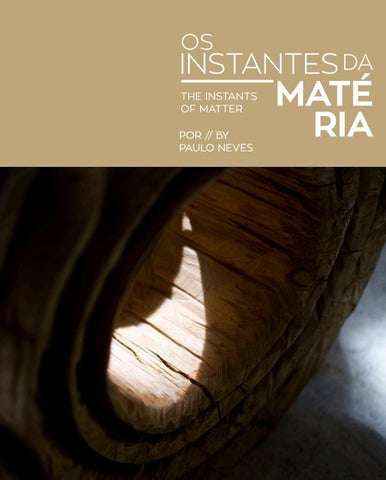
OS
INSTANTES DA THE INSTANTS OF MATTER POR // BY PAULO NEVES
MATÉ RIA
5 DE MAIO A 24 DE JUNHO MAY 5 TO JUNE 24
OS INSTANTES DA MATÉRIA
| 01
TECHNICAL INFORMATION
Os Instantes da Matéria The Instants of Matter Exposição // Exhibition 5 maio a 24 junho 2018 may 5 to june 24 2018
Artista // Artist Paulo Neves Curadoria // Chief Curator Helena Mendes Pereira Apoio à Curadoria // Curatorial support: Cláudia Cibrão Comunicação e Produção Executiva // Communication and Executive Production Catarina Martins Apoio à Comunicação e Produção Executiva // Communication and Executive Production Support Vanessa Ribeiro
// Photography and Video
// Catalog Print
300 exemplares 02 | THE INSTANTS OF MATTER
OS
INSTANTES DA POR PAULO NEVES
MATÉ RIA
Troncos, anéis, escadas, rebentos, ninhos, anjos, painéis, santas, rodelas. Em Paulo Neves tudo é aquilo que parece: escultura e matéria. (Será?) Às vezes poesia, iconografia das emoções: biografias, energia, nascimento e morte, céu e inferno. A matéria em instantes, em sulcos, golpes de transpiração, a mão do artista, o seu suor, força e resistência que fazem transbordar a tal poesia, que foge da nomenclatura, para o exercício das formas e da composição. Nada é singular. Tudo é plural e série, porque experimental e imaginado para interpelar o espaço, para o ocupar, não em caos mas em ordem. Sempre o belo inevitável e uma certa espiritualidade que faz do escultor um homem com fé mas de pés na terra, votado à responsabilidade e ao compromisso com a escultura. E a escultura é a sua forma de intervir no mundo, de enviar mensagens pelo mar de pergaminhos dentro de garrafas de vidro. Paulo Neves escreve com a simbologia das suas formas. Escreve bem. A obra de Paulo Neves (n.1959) estabeleceu desde sempre uma relação com a natureza, criando um vocabulário formal e compositivo que se mantém nas obras em madeira, pedra, ferro e nas variações em materiais plásticos e sintéticos, conferindo-lhe uma coerência e constância enquanto escultor que o catapultam para o lugar de um dos melhores da sua geração.
A personalidade artística de Paulo Neves cruza-se com o que conhecemos da sua biografia. Natural de Cucujães, freguesia do concelho de Oliveira de Azeméis, fez sempre questão de se manter ligado à terra e é no silêncio do carvalhal da sua propriedade que a imaginação e a transpiração dão azo a uma produção intensa e regular que já é marca do espaço público em Portugal continental e ilhas, mas também de Angola, integrando coleções das mais prestigiadas em Portugal, Angola, Espanha, Bélgica, Brasil, Itália e Alemanha, destacando-se o Museum Biedermann, pela afirmação e crescimento da Alemanha como player fundamental do mercado de arte contemporânea do século XXI. Exposições são mais de uma centena, com a primeira individual em 1980 e a primeira coletiva em 1985. Curiosamente, Paulo Neves frequentou, não a licenciatura em Escultura, mas em Pintura da Escola Superior de Belas Artes do Porto (hoje FBAUP) e entre 1978 e 1981 conviveu e trabalhou com diversos artistas em vários países da Europa. Estes três anos de viagens e aventuras foram determinantes na sua construção enquanto indivíduo e na descoberta do seu eu artístico. Mas formas não provêm da natureza, mas da imaginação, ainda que a obra nasça da intimidade com a natureza e da ânsia de descobrir os mistérios da matéria, do suporte: madeira, pedra, ferro, plástico. Tudo. O que interessa e o que importa é fazer nascer sonhos, de mãos que desenham floras e geometrias de ondas e círculos no ar. Custa-nos compreender a dimensão de bela metáfora de Paulo Neves e só lhe amamos a obra, talvez, depois de o descobrirmos no seu habitat, tempo e espaço abertos ao bosque das virtudes, à negritude labiríntica da floresta onde o homem, o OS INSTANTES DA MATÉRIA
| 03
homem-escultor faz erigir vida. Arquiteto de formas, aprendeu cedo a ler as entrelinhas do meio e da matéria, em instantes de criatividade e domínio da força gravítica, porque nos custa a compreender a perfeição daqueles sulcos, daquelas arestas, a compreender como distinguimos emoções naqueles rostos dos anjos. Paulo Neves não tem complexos e talvez seja por isso que muito cedo o seu trabalho galgou fronteiras, geográficas e de apreensão pelos públicos. É belo à disposição. Antes Arte que qualquer outra inutilidade. Nesse descomplexo consegue-se viver da Arte, fazer carreira, construir um nome e fazer vingar uma ideia: a do artista como intérprete da natureza. Regra geral, há um respeito pelas propriedades naturais da matéria, nomeadamente nas obras em madeira e pedra mas também há esculturas em que a cor toma lugar, numa paleta viva de variação entre as cores primárias e as mais associadas à pop art. Com a cor, as composições escultóricas adquirem características instalativas e aumentam as nossas possibilidades de vinculação, ora aos rostos de sinais expressivos, ora às formas abstratizantes que resultam da manipulação experimental do material. A arte de Paulo Neves tem sobretudo preocupações formais e tecnológicas que o levam, nos últimos anos, a diversificar os materiais explorados mantendo a incisão (que itinera com os relevos) de velaturas e arestas, em movimento simétrico e repetitivo de rigor geométrico que nos cria labirintos ilusórios à perceção do olhar. Contudo, Paulo Neves acumula também no seu percurso obras em que foi capaz de interpretar temáticas social e politicamente delicadas, somando-lhes um quadro concetual e narrativo de enorme amplitude e intensidade. A exemplo, a obra inaugurada a 8 de agosto de 2017 no Funchal para assinalar o luto um ano depois dos terríveis incêndios que assolaram a ilha. Em “Aflição” Paulo Neves criou um conjunto escultórico recorrendo às árvores “que morreram de pé”, como me confidenciou. Desta série, a galeria shairart dst, interpela os públicos, à chegada, com um tronco de madeira de eucalipto queimado. Paulo Neves não é nem nunca será indiferente à natureza, aos seus paraísos e infernos. Limbo é que não, porque a Arte vive nos extremos.
Os extremos são o que mais perto está da paixão.1 Na última década aproximou-se das temáticas religiosas e tem produzido um conjunto de obras que fazem uma interpretação iconográfica, por um lado, do ideário católico, como também inovam nas possibilidades estéticas dos elementos eucarísticos. Quando lhe falei da exposição e da ideia de a sua escultura invadir Braga, imediatamente me falou do tema do sagrado que entretanto lhe interessara e da vontade que tinha de aumentar o número de intervenções em espaços de culto, prática que marca o seu currículo nos últimos anos. Mostrou-me a Capela da Senhora das Neves que ergueu na sua propriedade e preencheu de objetos seus: Cristos à sua maneira, ironias de confessionários, mágicas pias batismais e púlpitos onde até apetece ouvir das Escrituras. Paulo Neves torna, com as suas mãos e o seu olhar de escultor, ideais todos os nossos instantes de contemplação. Questionamo-nos sobre como torna poesia toda a matéria, sem precisar dos tais artifícios de titulação e abominando a construção sinóptica própria sobre a sua obra. “A crítica é que tem que falar”, diz-me sempre. É um fazedor. O trabalho é a sua respiração, o barulho do desbaste da matéria a sua música, quer esteja mergulhado no verde do seu atelier da pedra, quer ande em redor das suas árvores, das suas madeiras, ou nas experiências do ferros e dos sintéticos. O mundo de Paulo Neves, o seu atelier e propriedade, lembram-me sempre o cenário que imagino para a relação de Charlotte e Edward, os protagonistas d’ As Afinidades Electivas de 1
04 | THE INSTANTS OF MATTER
GOETHE, Johann Wolfgang – As Afinidades Electivas. Lisboa: Bertrand Editora, 2017. Página 141.
Johann Wolfgang Goethe (1749-1832) onde se explora o predomínio da paixão sobre o comportamento racional tendo por analogia o conceito químico de afinidade. Poderia ser ali, naquele bosque encantado de Paulo Neves, onde a escultura brota da terra, ainda que sempre com registos de vanguarda e contemporaneidade, que encontramos na construção formal das instalações e nos detalhes simbólicos e de simbiose de materiais.
Não gostamos de nos privar de hábitos aparentemente insignificantes, mas só em circunstâncias graves começamos a sentir dolorosamente essa privação.2 O cerne conceptual de Paulo Neves será a ideia de privação do belo-natural a que permanecemos indiferentes. Entretanto deslumbramo-nos com a natureza na possibilidade de exploração das suas componentes, respeitando e prevendo limites. A obra de Paulo Neves grita esse alerta, faz-se dessa afinidade. E ainda que as matérias sejam sempre robustas e que o quadro simbólico esteja no domínio do comum, somos mais leves, por um lado, e estranhamente complexos nos sonhos quando a pausa do nosso dia é numa obra deste escultor. Conhecemo-nos em 2013, no seu atelier, em Cucujães. Apaixonei-me por tudo aquilo que via e esperei quase cinco anos pela possibilidade de lhe organizar uma exposição individual com a pompa que me pareceria merecida. Não nos conhecíamos mas fomos ficando amigos. O Paulo acorda cedo, como eu. É das manhãs e das horas. É dos convívios à mesa e da simplicidade. E é escultor de fábulas perdidas. Em Cucujães escreve resenhas com as suas obras que se deslindam no surreal, mas hiper-real, da imaginação de cada um, na disposição para ver. Impressionou-se aquele cubo de tronco sobre tronco, como uma escultura em macro escala cheia de mundos dentro. Compreendi que não era possível conhecê-lo sem mergulhar no seu universo onde, honestamente, me apetece sempre estar. Foi desses mundos que quisemos invadir Braga numa exposição individual de Paulo Neves, nem antológica, nem retrospetiva, nem de produção recente, mas antes o transporte, a transladação, do que havia no atelier para a cidade. Excluímos a pedra pois em Braga já o encontramos em pedra e interessava mostrar as dimensões menos conhecidas, talvez menos comerciais, em que se evidencia a dimensão cenográfica da sua obra e, também, o seu alfabeto formal, revestido de um pleno domínio técnico. Paulo Neves é escultor. Não poderia ser outra coisa. Quisemos que este escultor fosse o circuito de Arte Contemporânea de Braga, pelo menos por uns instantes, por umas semanas. O jardim do Museu Nogueira da Silva acolhe as esculturas em ferro, a Basílica dos Congregados acolhe um Cristo e uma iconografia limpa que associamos a imagens de Santas e a galeria shairart dst cobre-se das madeiras, numa seleção de obras que vem de 1991 e chega às mais recentes, com caminhos para o céu, convites a espreitar por entre as rodas e anéis, sugestões de mandalas e conjuntos escultóricos com detalhes em bronze que nos arrancam suspiros. O espectador deve percorrer a mostra como se de uma pista de obstáculos se tratasse. É o belo sobre as paredes brancas e a luz homogénea do espaço de exposição, é a simplicidade do figurativo sobre as artimanhas e o exagero do barroco e é a robustez do ferro na delicadeza do jardim ordenado que se esconde no museu. Três estruturas da cidade: o grupo dst, a Igreja e a Universidade. Um artista: Paulo Neves. Um dos poucos, talvez, capaz de unir vontades, verdades e diferenças. Helena Mendes Pereira 2
GOETHE, Johann Wolfgang – As Afinidades Electivas. Lisboa: Bertrand Editora, 2017. Página 145. OS INSTANTES DA MATÉRIA
| 05
06 | THE INSTANTS OF MATTER
OS INSTANTES DA MATÉRIA
| 07
THE
INSTANTS OF BY PAULO NEVES
MATTER Trunks, rings, stairs, shoots, nests, angels, panels, saints, slices. In Paulo Neves everything is what it seems: sculpture and matter. (Could it be?) Sometimes poetry, iconography of emotions: biographies, energy, birth and death, heaven and hell. The matter in instants, in furrows, blows of perspiration, the artist’s hand, his sweat, strength and resistance that make overflowing such poetry, which escapes from nomenclature, for the exercise of forms and composition. Nothing is singular. Everything is plural and series, because experimental and imagined to interpellate space, to occupy it, not in chaos but in order. Always the beautiful inevitable and a certain spirituality that makes the sculptor a man with faith but with both feet firmly on the ground, devote for the responsibility and the commitment with the sculpture. And sculpture is his way of intervening in the world, of sending messages through the sea of scrolls inside glass bottles. Paulo Neves writes with the semiology of his forms. He writes well. The work of Paulo Neves (n. 1959) has always established a relationship with nature, creating a formal and compositional vocabulary that remains in the works in wood, stone, iron and in the variations in plastic and synthetic materials, giving him a coherence and constancy as a sculptor who catapults him to the place of one of the best of his generation. The artistic personality of Paulo Neves crosses with what we know of his biography. Born in Cucujães, a parish in the municipality of Oliveira de Azeméis, he always made a point of staying connected to the land and it is in the silence of the oaks trees of his property that imagination and sweat give way to an intense and regular production that is already a mark of the public space in mainland Portugal and islands, but also in Angola, integrating the most prestigious collections in Portugal, Angola, Spain, Belgium, Brazil, Italy and Germany, highlighting the Museum Biedermann, through the growth of Germany as a fundamental market player of 21st century contemporary art. Exhibitions are more than a hundred, with the first individual in 1980 and the first collective in 1985. Curiously, Paulo Neves attended, not a degree in Sculpture, but in Painting at Escola Superior de Belas Artes do Porto (now FBAUP) and between 1978 and 1981 he lived and worked with several artists in several countries in Europe. These three years of travels and adventures were decisive in their construction as an individual and in the discovery of their artistic self. But forms do not come from nature, but from imagination, although the work is born of intimacy with nature and of the eagerness to discover the mysteries of matter, of support: wood, stone, iron, plastic. Everything. What is relevant and matters is to make dreams come true, from the hands that draw floras and geometries of waves and circles in the air. It is difficult for us to understand the dimension of the beautiful metaphor of Paulo Neves, and we only love the work, perhaps, after discovering him in his habitat, time and space open to the grove of virtues, to the labyrinthine negritude of the forest where the man, the sculptor-man, gives rise
08 | THE INSTANTS OF MATTER
to life. An architect of forms, he learned early how to read between the lines of medium and matter, in instants of creativity and domination of the gravitational force, because it is difficult for us to understand the perfection of those grooves, of those edges, to understand how we distinguish emotions on those angels faces. Paulo Neves does not have complexes and perhaps that is why his work, very soon, has crossed geographical borders and apprehension by the public. It is beautiful at disposal. Rather Art than any other uselessness. In this lack of complexes, it is possible to make a living from Art, to make a career, to build a name and revenge an idea: the artist as an interpreter of nature. As a rule, there’s respect for the natural properties of matter, namely in wood and stone works, but there are also sculptures in which color takes place, in a vivid palette of variation between primary colors and those associated with pop art. With color, sculptural compositions acquire installation characteristics and increase our possibilities of linkage, sometimes to the faces of expressive signs, or to the abstract forms that result from the experimental manipulation of the material. The art of Paulo Neves has mainly formal and technological concerns that take him, in the last years, to diversify the materials explored, maintaining the incision (which intercalates with the reliefs) of woodstains and edges, in a symmetrical and repetitive movement of geometric rigor that creates in us illusory labyrinths to the perception of the look. However, Paulo Neves also accumulates in his journey works in which he was able to interpret social and politically delicate themes, adding to them a conceptual and narrative picture of enormous amplitude and intensity. For example, the work inaugurated on August 8, 2017 in Funchal to mark the grief a year after the terrible fires that devastated the island. In “Aflição”, Paulo Neves created a sculptural ensemble resorting to the trees “who died standing”, as he confided to me. In this series, the Gallery shairart dst, addresses the public, upon arrival, with a trunk of burned eucalyptus wood. Paulo Neves is not and will never be indifferent to nature, its paradises and hells. It cannot be a Limbo, because Art lives in extremes.
The extremes are what is closest to passion.1 In the last decade he has approached religious themes and has produced a set of works that makes an iconographic interpretation, on one hand, of the Catholic ideology, but also innovates in the aesthetic possibilities of the Eucharistic elements. When I told him about the exhibition and the idea of his sculpture invading Braga, he immediately told me about the theme of the sacred that had interested him and the desire to increase the number of interventions in places of worship, a practice that has marked his curriculum in the last years. He showed me the Capela da Senhora das Neves that he built on his property and filled with objects of his own: Christs in his own way, ironies of confessionals, magical baptismal fonts and pulpits where you even want to hear from the Scriptures. Paulo Neves makes, with his hands and his sculptor’s eyes, all the moments of contemplation ideal. We wonder how he makes all matter look like poetry, without needing such tricks of titling and abhorring the own synoptic construction of his work. “It’s the Critics who have to talk”, he always tells me. He is a doer. Work is his breathing, the noise of the thinning of matter is his music, whether he is immersed in the green of his stone atelier, or walking around his trees, his woods, or the experiences of irons and synthetics. 1
GOETHE, Johann Wolfgang – As Afinidades Electivas. Lisboa: Bertrand Editora, 2017. Page 141. OS INSTANTES DA MATÉRIA
| 09
The world of Paulo Neves, his atelier and property, always reminds me of the scenario I imagine for the relationship between Charlotte and Edward, the protagonists of Elective Affinities, by Johann Wolfgang Goethe (1749-1832), which explores the predominance of passion over rational behavior having by analogy the chemical concept of affinity. It could be there, in that enchanted forest of Paulo Neves, where sculpture sprouts from earth, although always with records of vanguard and contemporaneity, which we find in the formal construction of the installations and in the symbolic details and symbiosis of materials.
We do not like to deprive ourselves of apparently insignificant habits, but only in grave circumstances we begin to feel painfully this privation.2 The conceptual core of Paulo Neves will be the idea of the natural-beauty deprivation to which we remain indifferent. However, we are dazzled by nature in the possibility of exploring its components, respecting and predicting limits. The work of Paulo Neves shouts this alert, it is made of this affinity. And although the material is always robust and the symbolic framework is in the domain of the common, we are lighter, on one hand, and strangely complex in dreams when the break of our day is in a work of this sculptor. We met in 2013, in his atelier, in Cucujães. I fell in love with everything I saw and waited almost five years for the possibility of organizing an individual exhibition, with the pomp that would seem to me deserved. We did not know each other but we were becoming friends. Paulo wakes up early, like me. He’s a person of mornings and hours; of meetings around the table and simplicity; and he’s a sculptor of lost fables. In Cucujães he writes reviews with his works that closes themselves in the surreal, but hyperreal, of the imagination of each one, in the disposition to see. It struck that trunk cube on trunk, like a macro-scale sculpture filled with worlds inside. I understood that it was not possible to know him without immersing myself in his universe, where honestly, I feel like I always want to be. We wanted to invade Braga with these worlds in an individual exhibition of Paulo Neves, neither anthological, nor retrospective, nor with recent production, but rather the transportation, the translation, of what he had in the studio. We exclude the stone because in Braga we already found him in stone, and it was interesting to show the lesser known dimensions, perhaps less commercial, in which the cenographic dimension of his work is underline, as well as his formal alphabet, covered with a full technical mastery. Paulo Neves is a sculptor. He couldn’t be anything else. We wanted this sculptor to be the circuit of Contemporary Art in Braga, at least for a few moments, for a few weeks. The garden of Museu Nogueira da Silva host the iron sculptures, the Basílica dos Congregados welcomes a Christ and a clean iconography that we associate with images of female Saints, and the Gallery shairart dst is covered with woods, in a selection of works that comes from 1991 and arrives to the most recent ones, with paths to the sky, invitations peeking through the wheels and rings, suggestions of mandalas and sculptural sets with bronze details that pull us sighs. The spectator must walk the show as if it were an obstacle course. It is the beautiful on the white walls and the homogeneous light of the exhibition space, it is the simplicity of the figurative about the tricks and the exaggeration of the baroque and it is the sturdiness of the iron in the delicacy of the ordered garden that hides in the museum. Three structures of the city: dst group, Church and University. An artist: Paulo Neves. One of the few, perhaps, able to unite wills, truths and differences. Helena Mendes Pereira 2
10 | THE INSTANTS OF MATTER
GOETHE, Johann Wolfgang – As Afinidades Electivas. Lisboa: Bertrand Editora, 2017. Páge 145.
SHAIRART
OS INSTANTES DA MATÉRIA
| 11
12 | THE INSTANTS OF MATTER
Os Melómanos | The music lovers 2012 Pastel de óleo sobre papel fabriano montado em suporte rígido Oil pastel on fabriano paper mounted on a hard support 110 x 150 cm OS INSTANTES DA MATÉRIA
| 13
Série Anéis | Rings Series, 2015 Madeira de faia | Beech wood 140 cm (diâmetro / diameter) x 40 cm (espessura / thickness) 14 | THE INSTANTS OF MATTER
Série Anéis | Rings Series, 2015 Madeira de faia | Beech wood 70 x 62 x 13 cm OS INSTANTES DA MATÉRIA
| 15
16 | THE INSTANTS OF MATTER
OS INSTANTES DA MATÉRIA
| 17
18 | THE INSTANTS OF MATTER
OS INSTANTES DA MATÉRIA
| 19
Série Ninhos | Nest series, 2016 Madeira de cedro | Cedarwood Medidas várias | Variable dimensions 20 | THE INSTANTS OF MATTER
Série Ninhos, 2016 Madeira de cedro Medidas várias OS INSTANTES DA MATÉRIA
| 21
Modos do Sentir – Parte II Ways of feeling – Part II 2012 Pastel de óleo sobre papel fabriano montado em suporte rígido Oil pastel on fabriano paper mounted on a hard support 28 x 75 cm 22 | THE INSTANTS OF MATTER
Modos do Sentir – Parte III Ways of feeling – Part III 2012 Pastel de óleo sobre papel fabriano montado em suporte rígido Oil pastel on fabriano paper mounted on a hard support 28 x 75 cm
Modos do Sentir – Parte IV Ways of feeling – Part IV 2012 Pastel de óleo sobre papel fabriano montado em suporte rígido Oil pastel on fabriano paper mounted on a hard support 28 x 75 cm OS INSTANTES DA MATÉRIA
| 23
Série Rodas | Wheels series, 2010 Madeira de mogno | Mahogany wood 127 cm (diâmetro / diameter) x 20 cm (espessura / thickness) 24 | THE INSTANTS OF MATTER
Série Rodas | Wheels series, 2010 Madeira de mogno | Mahogany wood 130 cm (diâmetro / diameter) x 21 cm (espessura / thickness) OS INSTANTES DA MATÉRIA
| 25
26 | THE INSTANTS OF MATTER
Rodelas | Slices, 2004 Madeira de ferro | Iron wood 104 x 110 x 45 cm (2 objetos / objects) OS INSTANTES DA MATÉRIA
| 27
28 | THE INSTANTS OF MATTER
A Confissão da Sombra The Shadow’s confession 2012 Pastel de óleo sobre papel fabriano montado em suporte rígido Oil pastel on fabriano paper mounted on a hard support 110 x 150 cm | 29
Detalhes de | Details from Sem título, sem data | Untitled, undated Madeira de cedro gravada e policromada Polychrome and engraved cedarwood Dimensões variáveis | Variable dimensions 30 | THE INSTANTS OF MATTER
Série Escadas para o céu Stairs to heaven series 2008 Madeira de Carvalho | Oak wood 182 x 47 x 50 cm
Série Escadas para o céu Stairs to heaven series 2008 Madeira de Carvalho | Oak wood 206 x 60 x 60 cm OS INSTANTES DA MATÉRIA
| 31
32 | THE INSTANTS OF MATTER
Nascimento e morte | Birth and death,, 1991 Madeira de mogno | Mahogany wood Sete objetos de dimensões variáveis Seven objects with variable dimensions Dimensões totais / Overall dimensions: 210 x 210 x 60cm OS INSTANTES DA MATÉRIA
| 33
Rebentos | Corms, 1990 Madeira de cedro e bronze Cedarwood and bronze 278 x 100 x 100 cm 34 | THE INSTANTS OF MATTER
OS INSTANTES DA MATÉRIA
| 35
36 | THE INSTANTS OF MATTER
Energia | Energy, 2017 Madeira de cedro com bronze Cedarwood and bronze 277x54x48cm
Impressões, sem data | Prints, undated Madeira de cedro policromado, grafite e espelho | Polychrome cedarwood, graphite and mirror 174x174x15cm Coleção Particular | Private collection OS INSTANTES DA MATÉRIA
| 37
38 | THE INSTANTS OF MATTER
Série Biografias | Biographies series, 2011 Madeira de cedro policromado Polychrome cedarwood 30x50x27 cm
Série Biografias | Biographies series, 2011 Madeira de cedro policromado Polychrome cedarwood 33x90x24 cm OS INSTANTES DA MATÉRIA
| 39
Anjo | Angel, 2018 Fundição em bronze | Bronze foundry 190x67x57cm 40 | THE INSTANTS OF MATTER
Anjo | Angel, 2009 Madeira de mogno | Mahogany wood 190x67x57cm OS INSTANTES DA MATÉRIA
| 41
Flores, sem data | Flowers, undated Madeira de carvalho | Oak wood 125 x 135 x 50 cm (2 objetos / objects) 42 | THE INSTANTS OF MATTER
MUSEU NOGUEIRA DA SILVA
OS INSTANTES DA MATÉRIA
| 43
O Bordado do Filósofo The Embroidery of the Philosopher 2012 Pastel de óleo sobre papel fabriano montado em suporte rígido Oil pastel on fabriano paper mounted on a hard support 60 x 72cm 44 | THE INSTANTS OF MATTER
OS INSTANTES DA MATÉRIA
| 45
Série Esculturas em ferro | Iron sculptures series 2013 Ferro policromado a alcatrão| Polychrome Iron with tar 66 x 66 x 20 cm 46 | THE INSTANTS OF MATTER
Série Esculturas em ferro | Iron sculptures series 2013 Ferro policromado a alcatrão| Polychrome Iron with tar 125 x 180 x 63 cm
Série Esculturas em ferro | Iron sculptures series 2013 Ferro policromado a alcatrão| Polychrome Iron with tar 103 x 170 x 56 cm OS INSTANTES DA MATÉRIA
| 47
Em versos | In verses 2017 Óleo sobre papel Oil on paper, 20 x 20 cm 48 | THE INSTANTS OF MATTER
Caligrafia da consciência Consciousness calligraphy 2017 Óleo sobre papel Oil on paper, 20 x 20 cm
OS INSTANTES DA MATÉRIA
| 49
50 | THE INSTANTS OF MATTER
BASILICA DOS CONGRE GADOS OS INSTANTES DA MATÉRIA
| 51
“Caríssimos, agora já somos filhos de Deus, mas não se manifestou ainda o que havemos de ser. O que sabemos é que, quando Ele se manifestar, seremos semelhantes a Ele, porque o veremos tal como Ele é”. ( 1 Jo 3, 2). Em pleno Tempo Pascal, a Basílica dos Congregados — em parceria com o Museu Nogueira da Silva e a DST — une-se à exposição “Instantes da Matéria” acolhendo duas peças do consagrado artista Paulo Neves. Fá-lo por um motivo. As mãos de Paulo Neves movem-se no não saber, do que ainda não se manifestou, ao mesmo tempo que desvelam e antecipam uma realidade última em gestação para a qual Deus nos criou. Convido a quantos vêem estas obras a colocarem as mãos nas mãos do Paulo e a deixarem-se conduzir. Pe. Paulo Terroso Reitor
Dearly beloved, we are now children of God, but we have not yet manifested what we shall be. What we do know is that, when he manifests himself, we will be like him, because we will see him as He is.” (1 Jo 3, 2). In the middle of Easter Season, the Basílica dos Congregados - in partnership with Museu Nogueira da Silva and DST - joins the exhibition “Instants of matter “, hosting two pieces by the renowned artist Paulo Neves. Does it for a reason. The hands of Paulo Neves move in the not knowing, of what has not yet manifested itself, at the same time that unveil and anticipate a final reality in gestation to which God created us. I invite all those who see these works to place their hands in Paul’s hands and let themselves be led. Father Paulo Terroso Dean
52 | THE INSTANTS OF MATTER
OS INSTANTES DA MATÉRIA
| 53
Série Santas | Holy series, 2012 Madeira de cedro | Cedarwood 200x28x26cm 253x50x57cm 207x40x27cm 54 | THE INSTANTS OF MATTER
OS INSTANTES DA MATÉRIA
| 55
Horário // Opening time 14:00 | 19:00 · segunda a sábado (exceto feriados) Outros horários mediante marcação 2:00 pm to 7:00 pm – monday to saturday (except holidays) Other schedules by appointment
Contactos // Contacts info@shairart.com (+351) 253 116 620 www.shairart.com
Morada // Address Rua do Raio, 175 4710-923 Braga Portugal
Co-organizadores
56 | THE INSTANTS OF MATTER