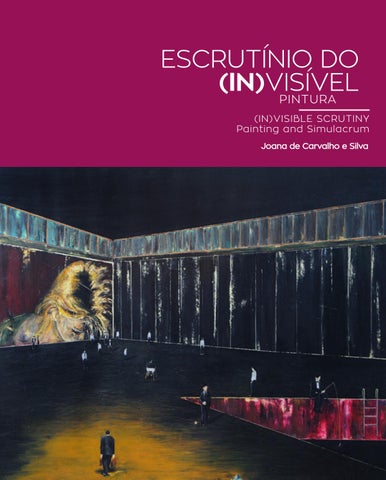
ESCRUTÍNIO DO (IN)VISÍVEL PINTURA (IN)VISIBLE SCRUTINY Painting and Simulacrum Joana de Carvalho e Silva
E SIMULACRO
ESCRUTÍNIO DO (IN)VISÍVEL PINTURA
(IN)VISIBLE SCRUTINY Painting and Simulacrum
Joana de Carvalho e Silva 3 DE MARÇO A 28 DE ABRIL MARCH 3 TO APRIL 28
ESCRUTÍNIO DO (IN)VISÍVEL – PINTURA E SIMULACRO
| 01
TECHNICAL INFORMATION
Escrutínio Do (In)Visível – Pintura E Simulacro (In)Visible Scrutiny – Painting And Simulacrum Exposição // Exhibition 3 março a 28 abril 2018 march 3 to april 28 2018
Artista // Artist Joana de Carvalho e Silva Curadoria // Chief Curator Helena Mendes Pereira Comunicação e Produção Executiva // Communication and Executive Production Catarina Martins Apoio à Comunicação e Produção Executiva // Communication and Executive Production Support Vanessa Ribeiro
// Photography and Video
// Catalog Print
200 exemplares
02 | (IN)VISIBLE SCRUTINY – PAINTING AND SIMULACRUM
joana de carvalho e silva é uma fonte inesgotável de paralelismos e identificações A finalidade das coisas é, precisamente, esse movimento que trazem em si, essa tendência, nascida da contradição entre a sua natureza finita e o que as transporta para lá delas próprias, para o infinito, […] identificando-se com o real na sua totalidade, ou se se quiser, com Deus.1 Este texto tem um tempo antes e um tempo depois e uma estória que interessa contar. A descoberta da obra de Joana de Carvalho e Silva (n.1988) dá-se num encontro ocasional com dois dos seus pastéis de óleo sobre papel (Dicionário Prático do Ofício e A Confissão da Sombra, ambos de 2012) que estão em depósito na galeria shairart dst, em Braga. Do encontro à eterna memória da emoção estética, ter-se-ão passado frações de segundo suficientes para a inquietação se tornar insegurança e dúvida, não pela qualidade do trabalho da jovem artista plástica bracarense, mas pela fonte inesgotável de paralelismos e identificações que deixa em cada um de nós. Os processos contemporâneos de curadoria, se considerarmos inclusive algumas teorias mais recentes sobre o papel do curador como substituto do crítico de arte, quase em extinção, (independentemente do enquadramento institucional do curador), não são alheios ao gosto e à intuição. À primeira vista, à segunda, à terceira e em todas as que se seguiram, uma exposição individual de Joana de Carvalho e Silva enquadrava-se na estratégia curatorial da shairart, quer pelo sentido de missão de dedicarmos parte da nossa programação ao apoio, não só a jovens artistas, como também a artistas naturais da região, quer pela dimensão conceptual e poética que a sua obra integra e que se cruza com o processo de comprometimento do projeto com o pensamento contemporâneo, em diálogos multidisciplinares e abertos. Joana de Carvalho e Silva sempre pintou. Contudo, resistiu inicialmente à vocação e optou por se licenciar em Psicologia pela Universidade do Minho (2006-2009). O mestrado em Pintura levou-a à Faculdade de Belas-Artes da Universidade do Porto (2010-2012), onde defendeu 1
GARAUDY, Roger – La pensée de Hegel. Bordas, 1996, páginas 29 a 34. In SANTOS, Maria Helena Varela; LIMA, Teresa Macedo – Textos de Filosofia. Curso Complementar. Volume 1. Porto: Porto Editora, 1977, página 221. ESCRUTÍNIO DO (IN)VISÍVEL – PINTURA E SIMULACRO
| 03
tese intitulada “O Teatro de que somos lugar: Pintura e Simulacro”. Atualmente encontra-se a frequentar o Doutoramento em Arte e Design, também na FBAUP. A amplitude da sua formação académica, dos seus interesses e a sensibilidade que coloca em cada palavra e em cada gesto, associam-se a uma elevada maturidade intelectual e a um exercício de reflexão sobre a sua produção plástica que dão coerência ao que nos propõe. Expõe, regularmente, desde 2010 e uma das suas criações (De Porcelana, 2011) integra a coleção do Centro de Arte Moderna José de Azeredo Perdigão, da Fundação Calouste Gulbenkian. As suas imagens deambulam, em termos de referencial histórico, entre as de Dominguez Alvarez (1906-1942) e as de Edward Hopper (1882-1967). São próximas do cinema de Jacques Tati (1907-1982) e, sobretudo, reportam-nos para o universo do teatro de Augusto Boal (1931-2009), de conflito humano interno e externo: “Mas nem só de aplausos vive o artista. Vive também de tiroteios. Suas relações com o público podem ser de comunhão, duelo ou guerra.”, escreveu o dramaturgo brasileiro, inventor da estética do oprimido, em Aplausos e Tiroteios. Depois, além das viagens que a obra de Joana de Carvalho e Silva proporciona (e que a tornam rica, informada e intemporal) há o pastel, o domínio da técnica e a subtileza, às vezes raiva, que a artista empenha na relação de tensão entre composição, cor e mensagem que a sua obra consubstancia. O que nos aproxima e inquieta na pintura de Joana de Carvalho e Silva é o jogo que retira significantes ao quotidiano, com recurso à ironia e à melancolia, talvez mesmo o estado de depressão geral disfarçada em que todos nos encontramos e que, na sua pintura, Joana de Carvalho e Silva explora, sugestiona, convidando-nos a um processo de imersão sistémica. E este é o tempo do antes, o tempo antes da imersão sistémica no seu mundo e de contacto com as suas múltiplas referências, que vão da pintura de Rembrandt (1606-1669) ao pensamento filosófico de Jean Baudrillard (1929-2007), nomeadamente pela dissecação do conceito de simulacro, passando pelo cinema e, muito em particular, pelo universo teatral e literário das obras de Manoel de Oliveira (1908-2015). No tempo depois, curadora e artista partilharam as suas emoções estéticas e encontraram-se em Vale Abraão (1993), filme do realizador portuense com Leonor Silveira, Luís Miguel Cintra, Rui de Carvalho, entre tantos outros, que parte de uma adaptação da obra homónima de Agustina Bessa-Luís (n.1922), por sua vez um exercício literário inspirado em Madame Bovary (1857) de Gustave Flaubert (1821-1880). Depois de umas horas de conversa com Joana de Carvalho e Silva, não sei quantas vezes revi o filme e os livros (o de Agustina e o de Flaubert) e vi em Ema, a personagem de Oliveira e Agustina, mesma fonte inesgotável de paralelismos e identificações, personificadas em duas mulheres: uma virada para o fascínio ilusório do mundo, a outra para a transcendência, para a poesia de uma ética romântica, onde o amor deve ser como um deus muito respeitável, ou seja, a síntese do simulacro pictórico de Joana de Carvalho e Silva. No Vale Abraham, lugar do Homem chamado inutilmente à consciência do seu orgulho de vergonha, de cólera, passavam-se e passam-se coisas que pertencem ao mundo dos sonhos, o mundo mais hipócrita que há.2 2
OLIVEIRA, Manoel de – Vale Abraão, com Leonor Silveira, Luís Miguel Cintra, Ruy de Carvalho. Portugal/França/Suíça, 1993, 187mn (versão integral 203mn), DVD, Madragoa filmes. 04 | (IN)VISIBLE SCRUTINY – PAINTING AND SIMULACRUM
O título Vale Abraão coloca a ênfase no contexto. O vale do Douro, com os seus rituais vinhateiros e o mundo dos sonhos, desejos imaginários, é o centro ficcional do filme. Vemo-lo apresentado e sacralizado pela voz do narrador e, em termos imagéticos, enquadrado desde o início por um travelling a partir do interior do comboio, que o penetra, deixando transparecer o fascínio documentarista sempre presente na obra de Manoel de Oliveira. A ausência do espaço citadino atribui ao vale do Douro uma importância primordial, revelando um universo de camponeses, burgueses, vindimadores, patrões e empregados domésticos. Contudo, na primeira informação que o narrador concede sobre o Vale, somos logo introduzidos num universo algo misterioso e propiciador de problemas, um “mundo dos sonhos, o mundo mais hipócrita que há”. As considerações do narrador sobre os primórdios do vale e do seu patriarca Abraão – que usou ignominiosamente a sua mulher Sara como objeto de sedução para resolução dos seus problemas e teve percalços extraconjugais3 - introduzem “lugares de sombra” nos espaços deste vale, cheios de memórias de um passado conturbado, em que os descendentes arrastam agora uma vida passiva e recatada, deixando transparecer a visão decadente de uma burguesia arruinada. Contudo: Ema não iludia ninguém. Não tinha tática. Tinha só o sentido do espetáculo. Vestia-se e agia, como se tivesse de conquistar Holofernes no seu arraial, mas na realidade, não passava de um erotismo tabelado pela utopia do poder e da importância social.4 A antítese patente nas composições de Joana de Carvalho e Silva, com recurso à manipulação simbólica da escala, fazem-nos distinguir o enquadramento arquitetónico, de perspetiva ilusória e labiríntica, os aglomerados humanos indistintos que o povoam em versão micro e as figuras, geralmente femininas, que ocupam os lugares do edificado à escala publicitária, mas mais próxima do real. Num exercício cromático perfeitamente definido, não obstante a fisicalidade e densidade com que usa a matéria, a artista cria superfícies planas, em que ensaia jogos de claro-escuro, que combina com uma sensibilidade para o desenho e para a representação delicada e expressiva da figura humana. Torna-se inevitável a referência aos ambientes de Manoel de Oliveira, bem como aos seus jogos de câmara lenta e atenção ao detalhe. É o tudo e o nada, na ilusão dos contrários (o vazio e o cheio, a luz e a sombra, a solidão e a companhia, o rosto em detalhe e os corpos indiferenciados, o quente e o frio, a calma e o caos, o palco e a plateia), em imagens de leituras múltiplas e infinitas. Cheguei ao fim desta minha apologia do romance como grande rede. Poder-se-á objetar que quanto maior for a tendência da obra para a multiplicação dos possíveis mais se afasta do unicum que é o self de quem escreve, a sinceridade interior, a descoberta da sua própria verdade. 3
Segundo o relato bíblico, era costume na época os governantes poderosos confiscarem para si as mulheres atraentes com a consequente morte dos maridos. Sara era uma mulher muito bela e Abraão, nas suas errâncias para espalhar descendência, a fim de se proteger e ser bem aceite nesses locais, fazia passar Sara por sua irmã. Abraão recebia muitos bens e riquezas pelo dote de Sara, mas quando os senhores descobriam que Sara era casada, os homens dos reinos sofriam castigos, sendo um deles a esterilidade de todas as mulheres. 4
OLIVEIRA, Manoel de – Vale Abraão, com Leonor Silveira, Luís Miguel Cintra, Ruy de Carvalho. Portugal/França/Suíça, 1993, 187mn (versão integral 203mn), DVD, Madragoa filmes.
ESCRUTÍNIO DO (IN)VISÍVEL – PINTURA E SIMULACRO
| 05
Pelo contrário, respondo eu, quem somos nós, quem é cada um de nós senão uma combinação de experiências, de informações, de leituras, de imaginações? Cada vida é uma enciclopédia, uma biblioteca, um inventário de objetos, um catálogo de estilos, onde tudo pode ser continuamente remexido e reordenado de todas as maneiras possíveis.5 Sobre a exposição, que a galeria shairart dst acolhe de 3 de março a 28 de abril, Escrutínio do (In)visível – Pintura e Simulacro, a autora diz-nos tratar-se de um “projeto pictórico centrado na temática do simulacro e configurado na relação entre espaço cinematográfico e espaço da pintura”. Apresentam-se perto de quatro dezenas de obras produzidas entre 2010 e 2017 e, sobretudo, revela-se a artista que é, sob todas as formas, a sua obra. Há entre nós uma estima mútua, que se situa no imponderável. Nem ela, se falasse, saberia explicar. Foi dedicada e íntegra, em absoluto. Entre mim e ela criou-se esta ligação, não sei bem dizer, vegetal. Sei que foi uma mulher que dedicou uma vida inteira ao trabalho, por devoção, sem que lho exigissem.6 Helena Mendes Pereira
5
CALVINO, Ítalo – Seis propostas para o novo milénio. Tradução de José Colaço Barreiros. Lisboa: Editorial Teorema, 1990, página 145. 6
OLIVEIRA, Manoel de – Vale Abraão, com Leonor Silveira, Luís Miguel Cintra, Ruy de Carvalho. Portugal/França/Suíça, 1993, 187mn (versão integral 203mn), DVD, Madragoa filmes. 06 | (IN)VISIBLE SCRUTINY – PAINTING AND SIMULACRUM
joana de carvalho e silva and an endless source of parallelisms and identifications The purpose of things is, precisely, this movement that they bring in themselves, this tendency, born of the contradiction between their finite nature and that which transports them beyond themselves, into the infinite, [...] identifying themselves with reality in its entirety, or rather, with God.1 This text has a before and after and a story deserving to be told. The discovery of Joana de Carvalho e Silva’s (n.1988) work happens during a chance encounter with two of her oil pastels on paper [Dicionário Prático do Ofício (Practical Dictionary of the Trade) and A Confissão da Sombra (the Shadow’s confession), both from 2012] that are stored in the shairart dst gallery, in Braga. Split seconds must have gone by from this encounter to the eternal remembrance of the aesthetic emotion, but it was enough to allow a restlessness to become uncertainty and upheaval. Not because of the quality of the work of the young Bracarian artist; but because of the inexhaustible source of parallelisms and identifications that it leaves in each one of us. The contemporary processes of curatorship, according to more recent theories about the curator’s role as a substitute for the art critic (who is almost extinct, regardless of the curator’s institutional background), is not extraneous to taste and intuition. At the first (and at the second) glance, it was clear that an individual exhibition of Joana de Carvalho e Silva’s works fit into shairart’s curatorial strategy. First, because of the sense of mission that inspires us to dedicate part of our programme not only to the support of young artists, but also of local artists. Second, because of the conceptual and poetic dimension that her work incorporates and that intersects with the project’s commitment with contemporary thinking through open, multi-disciplinary dialogues. Joana de Carvalho e Silva has always painted. Still, she resisted her calling at first, and chose to study Psychology at the University of Minho (2006-2009). A Master in Painting took her to 1
GARAUDY, Roger – La pensée de Hegel. Bordas, 1996, pages 29 to 34. In SANTOS, Maria Helena Varela; LIMA, Teresa Macedo – Textos de Filosofia. Curso Complementar. Volume 1. Porto: Porto Editora, 1977, page 221. ESCRUTÍNIO DO (IN)VISÍVEL – PINTURA E SIMULACRO
| 07
the Faculty of Fine Arts of the University of Porto (FBAUP) (2010-2012), where she defended her thesis entitled “O Teatro de que somos lugar: Pintura e Simulacro”. She is currently doing a PhD in Arts and Design, also at the FBAUP. The scope of her academic background and interests, as well as the sensibility she shows in each word and gesture, indicate a high degree of intellectual sophistication and suggest a permanent reflection exercise about her artistic production that give consistency to what she proposes. She has been exhibiting her work regularly since 2010, and one of her creations [De Porcelana (In Porcelain), 2011] is part of the collection of the Centro de Arte Moderna José de Azeredo Perdigão, of the Fundação Calouste Gulbenkian. Her images roam, in terms of historical reference, between those of Dominguez Alvarez (19061942) and those of Edward Hopper (1882-1967). They are reminiscent of Jacques Tati’s cinema (1907-1982) and, above all, they transport us to the macrocosm of Augusto Boal’s (1931-2009) theater, characterized by human conflict, both internal and external: “But the artist does not live on applause alone. He also lives on gunfire. He may commune, duel or war with the public.”, wrote the Brazilian playwright, inventor of the aesthetics of the oppressed, in Aplausos e Tiroteios. Moreover, beyond the journeys that Joana de Carvalho e Silva’s work provide (which make them rich, informed and timeless), there’s the pastel, the mastery of the technique and the subtlety, sometimes the rage, that the artist employs in the strained relationship between composition, color and message that her work embodies. What brings us closer to – and disturbs us in – Joana de Carvalho e Silva’s paintings is the game of drawing signifiers from everyday life, using irony and melancholy, perhaps even the overall, disguised state of depression in which we all find ourselves. Joana suggests it and explores it in her work, inviting us to embark on a process of systematic immersion. And this is the “before” – the time before this systematic immersion in her world, and before the contact with her multiple references, ranging from Rembrandt’s painting (1606-1669) to Jean Baudrillard’s (1929-2007) philosophical thinking, from the dissection of the concept of simulacrum to the cinema and, specially, the theatrical and literary universe of Manoel de Oliveira’s works (1908-2015). In the “after”, curator and artist shared their aesthetic emotions and found themselves in Vale Abraão (Abraham’s Valey) (1993), a film by the Portuense director, with Leonor Silveira, Luís Miguel Cintra, Rui de Carvalho, among many others. It derives from an adaptation of Agustina Bessa-Luís’ (n.1922) work of the same name; the latter, in turn, is a literary exercise inspired by Gustave Flaubert’s (1821-1880) Madame Bovary (1857). During my conversation with Joana de Carvalho e Silva, which lasted a few hours, I lost count of how many times I saw the film and read the books again (Agustina’s and Flaubert’s). I also saw in Ema, Oliveira and Agustina’s character, the same inexhaustible source of parallelisms and identifications, personified in two women. One is turned to the illusory fascination of the world; the other is turned to the transcendent, to the poetry of a romantic ethic, where love must resemble a very respectable god – in other words, the synthesis of the pictorial simulacrum in Joana de Carvalho e Silva’s work. In Abraham’s Valey, place of the Man vainly summoned to the awareness of his pride of shame, of anger, things happened and things happen, things that belong to the dream world, the most hypocrite world there is.2 2
OLIVEIRA, Manoel de – Vale Abraão, with Leonor Silveira, Luís Miguel Cintra, Ruy de Carvalho. Portugal/França/Suíça, 1993, 187mn (full version 203mn), DVD, Madragoa filmes. 08 | (IN)VISIBLE SCRUTINY – PAINTING AND SIMULACRUM
The title Vale Abraão (Abraham’s Valey) emphasizes the context. The Douro Valley, with its winemaker rituals, its dream world and imaginary desires, is the fictional center of the film. It is presented and sacralized by the voice of the narrator and, in imagery terms, framed from the beginning by a travelling shot from the inside of the train, which penetrates it, showing the documentary fascination ever-present in Manoel de Oliveira’s work. The absence of the urban space gives a paramount importance to the Douro Valley, revealing a universe of peasants, bourgeois, grape harvesters, masters and servants. However, the first information that the narrator gives us about the Valley introduces us to a somewhat mysterious and problematic universe, a “dream world, the most hypocrite world there is”. The narrator’s considerations about the beginnings of the Valley and about its patriarch, Abraham (who ignominiously used his wife Sara as an object of seduction for his own benefit, and who had extramarital mishaps3 ) cast shadows in the Valley. It is filled with memories of a troubled past, and the descendants now lead an apathetic and modest life, revealing a decadent vision of a ruined bourgeoisie. Nevertheless: Ema did not deceive anyone. She had no tactics. She only had had the sense of spectacle. She got dressed and she acted, as if she had to conquer Holofernes in her camp, but in reality, it was nothing more than a kind of eroticism tabulated by the utopia of power and social importance.4 The patent antithesis in Joana de Carvalho e Silva’s compositions, which resort to the symbolic manipulation of scale, causes us to discern the architectural frame, of illusory and labyrinthine perspective; the indistinct human clusters that inhabit it, in micro version; and the figures, usually female, that occupy the building to an advertising scale, but closer to real life. In a perfectly defined chromatic exercise, despite the physicality and density with which she uses the material, the artist creates flat surfaces, in which she experiments with sets of chiaroscuro, that she combines with a certain sensitivity discernable in her drawings and in the delicate and expressive representation of the human figure. Referencing the atmosphere created by Manoel de Oliveira, as well as his slow-motion shots and his attention to detail, becomes inevitable. It is all and nothing, in the illusion of the opposites (empty and full, light and shadow, loneliness and company, a close-up on the faces and undifferentiated bodies, hot and cold, calm and chaos, stage and audience), and in images of multiple and endless readings. I have come to the end of my apology of romance as a great network. One could object that the greater the tendency of the work to the multiplication of what is possible, the more it departs from the unicum that is the self of the one who writes, the inner sincerity, the discovery of its own truth. On the contrary, I say, who are we, who is each one of us but a combination of ex3
According to the Bible, it was customary at the time for the powerful rulers to confiscate the attractive women for themselves, killing their husbands afterwards. Sara was a very beautiful woman and Abraham, in his wanderings to spread offspring, to protect himself and to be wellcome in those places, claimed Sara was his sister. Abraham received many goods and riches for Sara’s dowry, but whenever the rulers discovered that Sara was a married woman, they were punished; one of the punishments was making all women infertile. 4
OLIVEIRA, Manoel de – Vale Abraão, with Leonor Silveira, Luís Miguel Cintra, Ruy de Carvalho. Portugal/França/Suíça, 1993, 187mn (full version 203mn), DVD, Madragoa filmes.
ESCRUTÍNIO DO (IN)VISÍVEL – PINTURA E SIMULACRO
| 09
periences, of information, of readings, of imaginations? Each life is encyclopedia, a library, an inventory of objects, a catalog of styles, where everything can be continually shuffled and rearranged in every possible way 5 About the exhibition, which shairart dst gallery hosts from March 3rd until April 28th, (In) visible Scrutiny – Painting and Simulacrum, the author tells us that it is a “pictorial project centered on the theme of the simulacrum and configured in the relationship between cinematographic space and painting space”. Nearly 40 works produced between 2010 and 2017 are shown; but, above all, the artist who is, in every way, her work, is revealed. There is between us a mutual esteem, which lies in the imponderable. She would not be able to explain it, even if she could speak. She was completely devoted and upright. Between me and her, this vegetative – I cannot quite define it – connection was formed. I know that she was a woman who dedicated her whole life to her work, for the sake of devotion, without it being asked of her 6 Helena Mendes Pereira
5
CALVINO, Ítalo – Seis propostas para o novo milénio. Translated by José Colaço Barreiros. Lisboa: Editorial Teorema, 1990, page 145. 6
OLIVEIRA, Manoel de – Vale Abraão, with Leonor Silveira, Luís Miguel Cintra, Ruy de Carvalho. Portugal/França/Suíça, 1993, 187mn (full version 203mn), DVD, Madragoa filmes. 10 | (IN)VISIBLE SCRUTINY – PAINTING AND SIMULACRUM
JOANA DE CARVALHO E SILVA
ESCRUTÍNIO DO (IN)VISÍVEL – PINTURA E SIMULACRO
| 11
12 | (IN)VISIBLE SCRUTINY – PAINTING AND SIMULACRUM
Escrutínio do (in)visível Pintura, Cinema e Simulacro A pintura sempre foi uma prática cujos contextos se inscrevem em múltiplas relações com o simulacro e em que a distinção entre arte, realidade e vida quotidiana se dilui na imagem. Tal como avisa Didi-Huberman (2012: 191), no processo de criação e leitura da imagem há que considerar a dialética da imagem, pois “se ignorarmos esse trabalho dialético das imagens, corremos o risco de não compreender nada e de confundir tudo”. A relação de semelhança dialética com o real é uma das condições necessárias para se conhecer e pensar a imagem. O que significa que a associação da imagem com o real é indissociável do seu contexto ou da sua origem. Assim, o conhecimento de uma imagem dá-se por intermédio de outras imagens, outras fontes, e com outros contextos. O cinema a pintura são os primeiros e mais privilegiados meios que constroem esta dialética das imagens. A migração da pintura para o cinema e desta para a pintura pode ser pensada como modelo de referência e iden-
tidade pelo qual uma imagem adota ou empresta similitudes de outros contextos e imagens. Não por acaso, o conceito de montagem que ao longo da História de Arte percorreu (e percorre) o processo de criação da imagem (Warburg, 2010) vem provar que uma imagem não se refere apenas a ela própria. E entre o cinema e a pintura há todo um mundo de remissões mais ou menos clarividente com o que já foi feito ao longo da história das imagens. Por outro lado, a reflexão sobre o diálogo entre pintura e cinema é também uma interrogação sobre os modos de operar a imagem, ou seja, os processos que geram e criam as imagens. Quer no cinema quer na pintura o fazer da imagem é sempre um ato disruptivo. Uma das estratégias disruptivas é o dialogo com as oposições esperar/agir, cheio/vazio, juntar/separar. Nestas antíteses há um entendimento do espaço como cenário onde se constrói um acontecimento, entre luz e sombra, plano e enquadramento. Essa relação implica que num só plano pictórico e/ou cinematográfico existam recortes de tempos e ESCRUTÍNIO DO (IN)VISÍVEL – PINTURA E SIMULACRO
| 13
de espaços. É no seu cruzamento que reside o olhar do espectador. Nesta fronteira entre espaço do espectador e espaço da imagem desenha-se uma fronteira: uma impactante linha de sombra e com ela uma fissura entre o visível o (in)visível. Ao tomarmos consciência dessa fronteira estamos, não apenas a transformar as imagens em objeto de pensamento, mas sobretudo a permitirmo-nos aproximar da inquietação do real. Numa sociedade onde todos os conceitos são questionados, assiste-se a uma maior problematização em termos de (re)avaliações e (re)validações no domínio do real. Vivemos numa época voltada para cada um e imperturbavelmente afastados de nós mesmos. Lipovetsky (1989), constatando que o valor principal da cultura pós-moderna é o individualismo, propõe o processo de personalização de passagem de um individualismo limitado para o individualismo total. Nessa passagem abrimos uma possibilidade de escolher entre o ver e o olhar. É nesta escolha que nos expomos ao real, olhando o que de mais essencial há na procura da consciência de nós mesmos. A importante abordagem filosófica e sociológica de Baudrillard (1991) sobre a simulação parte de uma distinção crucial entre simulação e dissimulação. Segundo Baudrillard (1991: 10), simular refere-se a uma ausência, ao fingir ter o que não se tem, ao passo que dissimular é uma presença, porque é fingir não ter o que se tem. Tratando-se então a simulação de uma ausência, não existe relação possível com o real, apenas porque “ela é o seu próprio simulacro puro” (Baudrillard, 1991: 10). A partir daqui, poderá afirmar-se que a realidade não esconde nada, já que ela é o próprio simulacro. Confrontar a realidade é sempre um fragmento avulso que a faz acontecer. É um confronto inscrito numa vontade de ultrapassar os limites, de exceder o estipulado; uma vivência que se faz de fábulas e 14 | (IN)VISIBLE SCRUTINY – PAINTING AND SIMULACRUM
mitos e alterna entre o êxtase e a depressão. O simulacro oculta-nos, confortavelmente, a verdade – a verdade de que não existe verdade. Ironicamente somos armadilhados pela nossa própria consciência, a qual é por nós simulada ao escolhermos a ilusão. A realidade torna-se efabulação. A vida é, por isso, como uma ideia. Uma ideia é apenas uma ideia antes de se tornar realidade. Assim, a nossa fragilidade é tão grande que nos tornamos atores da nossa própria vida. Vivemos e defendemo-nos com autocelebração da velocidade. Na emergência do tempo nem reparamos na expansão do que pode ser o registo da banalidade. Confrontar a realidade implica, afinal, um conflito com o descortinar da ilusão e, assim, uma outra forma de manifestação, outra forma de se inserir dentro da própria realidade. O meio exterior passa, pois, a ser apenas um ponto de partida para a (re)descoberta de um outro território – e este território será com certeza imaterial. Só assim, por detrás das nossas mascaradas cenografias, podemos ver olhando. E pouco a pouco percebemos que o olhar é uma dor que se descobre. É, porém, nessa descoberta que podemos perscrutar o que há para além do visível: o rumor dos nossos passos. Assim podemos confrontar a realidade e tê-la como a verdade que nos faz acontecer. Anunciá-la é fazê-la no tempo, e é na memória que ela sobrevive. Como salienta Eco (2008), “Mesmo que se encontre os critérios técnico-estruturais, deve e pode-se reencontrar uma relação emotiva e intelectual, descobrir uma visão do mundo e do homem”. Neste quadro conceptual, a par de uma permanente dúvida e inquietação, está, pois, o ato de criação. “A imaginação não é, como frequentemente acreditamos, abandono às miragens de um único reflexo, mas construção e montagem de formas plurais colocadas em correspondência” (Didi-Huberman, 2012: 155).
No seu processo, há aspetos que ficam por dizer, memórias revividas, imagens passadas, momentos que não se recuperam. É esta tentação de encenação do verdadeiro que me move no fazer da pintura. Afirmá-la é percorrer o mundo do que não se vê, do que não se compreende. Na violência e na dureza do gesto que imprimo na pintura há interesses existenciais, impulsos, dúvidas, anseios, todos interligados numa recíproca luta entre o espaço da pintura e o meu espaço interior. Atrito, fricção, repetição. É uma afirmação sob forma de gesto e, por isso, interna à própria representação. Ao repetir, recalco, simulo e escondo revelando. A pintura vela revelando o que deixa para trás. É à pintura que dirijo este meu pensamento, quando me proponho a ela trazendo como marca da sua força o ato de confessionamento do meu próprio eu. Nesta entrega acredito encontrar uma resposta ao entendimento de mim e do mundo. É à pintura que me dirijo quando é ela que me dá a oportunidade de decidir quem sou e quem escolho ser. Apenas porque preciso dela. Joana de Carvalho e Silva
Referências Braudillard, Jean (1991). Simulacros e Simulação. Lisboa: Relógio D’ Água. Didi-Huberman, Georges (2012). Imagens apesar de tudo. Lisboa: IMAGO. Eco, Umberto (2008). A Definição da Arte, Lisboa: Arte & Comunicação. ESCRUTÍNIO DO (IN)VISÍVEL – PINTURA E SIMULACRO
| 15
(In)visible Scrutiny Painting, Cinema and Simulacrum Painting has always been a practice whose contexts embrace in multiple relations with the simulacrum and in which the distinction between art, reality and everyday life is diluted in the image. As Didi-Huberman reminds us (2012: 191), during the creation and interpretation process of the image, we have to consider the dialectic of the image because “if we ignore this dialectic work of the images, we risk not understanding anything and confusing everything”. The relationship of dialectic resemblance with reality is one of the necessary conditions to get to know and to think the image. This means that the association of the image with reality is inseparable from its context or origin. Thus, the knowledge of an image happens by means of other images, other sources, and other contexts.
of these disruptive strategies is the dialogue with the opposites: wait/act, full/empty, unite/separate. In these antitheses, there is an understanding of space as scenery where an event is built, between light and dark, shot and framing. This relationship implies the existence of clippings of times and spaces in a single pictorial and/or cinematographic shot. It is in their intersection point that the viewer’s gaze resides. In this boundary between the space of the spectator and the space of the image, a frontier is drawn: a striking line of shadow and, with it, a gap between the visible and the invisible. As we become aware of this frontier, we are not only transforming the images in object of thought, but also, above all, allowing ourselves to approach the restlessness of reality.
Film and painting are the first and more privileged means that build this dialectic of images. The migration from painting to film, and from film to painting may be thought as a reference and identity model by which an image adopts or borrows similarities from other contexts and images. It is not by chance that the concept of montage, that has traversed (and still does) the creation process of the image (Warburg, 2010) throughout the History of Art, proves that an image does not refer only to itself. Moreover, between cinema and painting there is a whole world of references more or less farsighted with what has already been done throughout the history of images. Still, the reflection on the dialogue between painting and film is also a question about the ways of operating the image, that is, the processes that generate and create those images. Whether in film or in painting, the making of an image is always a disruptive act. One
In a society where all concepts are questioned, there is a greater problematization in terms of (re)assessments and (re)validations in the domain of reality. We live in a time of introversion, imperturbably away from ourselves. Lipovetsky (1989), noting that main value of postmodern culture is individualism, proposes a process of personalization going from a limited form of individualism to total individualism. During this transition, we open a possibility of choosing between seeing and looking. It is in this choice that we expose ourselves to reality, when we look at what is most essential in the search for self-awareness.
16 | (IN)VISIBLE SCRUTINY – PAINTING AND SIMULACRUM
Baudrillard’s important philosophical and sociological approach of simulation (1991) is part of a crucial distinction between simulation and dissimulation. According to Baudrillard (1991: 10), to simulate relates to an absence, by pretending to have what one does not have, while
to dissimulate is a presence, because it is pretending not to have what one does have. Thus, because simulation is an absence, there is no possible relationship with reality, just because “it is its own pure simulacrum” (Baudrillard, 1991: 10). Therefore, one could say that reality does not hide anything, since it is the simulacrum itself. Confronting reality is always a loose fragment that makes it happen. It is a conflict enclosed in a will to overcome limits, to surpass what has been stipulated; an experience that is made of fables and myths, and alternates between ecstasy and depression. The simulacrum conceals, comfortably, the truth from us – the truth that there is no truth. Ironically, we are trapped by our own conscience, which we simulate when we choose the illusion. Reality becomes fabulation. Because of this, life is like an idea. An idea is just an idea before it comes true. Thus, our fragility is so great that we become actors of our own lives. We live and we defend ourselves with autocelebration of speed. In the emergence of time, we do not even notice the expansion of what can be the account of banality. Confronting reality implies, after all, a conflict with the unveiling of illusion and, thus, another form of expression, another way of inserting oneself within reality itself. The outer environment is therefore only a starting point for the (re)discovery of another territory – and this territory will certainly be immaterial. Only in this way, behind our masked scenographies, can we see looking. And little by little we realize that the gaze is a pain that one discovers. It is, however, in this discovery that we can examine what is beyond the realm of the visible: the sound of our steps. Then, we can confront reality and have it as the truth that makes us happen. To announce it is to materialize it in time, and it’s in our memory that it survives. As Eco (2008) points out, “Even if the technical-structural criteria are met, an emotional and intellectual relationship must and can be rediscovered, to discover a vision of the world and of man”.
It is in this conceptual framework, along with a permanent doubt and restlessness, that the act of creation lies. “Imagination is not, as we often believe, an abandonment to the mirages of a single reflection, but construction and assembling of plural forms placed in correspondence” (Didi-Huberman, 2012: 155). In its process, there are aspects left unsaid, reminiscent memories, past images, moments that cannot be recovered. The temptation of staging what is true is what drives me when I paint. To maintain it is to go through the world of what cannot be seen, of what cannot be understood. In the violence and toughness of the gesture that I imprint in my paintings, there are existential interests, impulses, doubts, longings, all interconnected in a reciprocal struggle between the space of painting and my personal space. Conflit, friction, repetition. It is a statement in the form of gesture and, therefore, internal to the representation itself. When I repeat, I simulate and I conceal by revealing. The painting conceals by revealing what it leaves behind. It is to the painting that I direct this thought of mine, whenever I offer myself to it, bringing as a token of its strength the act of confession of my own self. In this surrender, I think I can find an answer to the understanding of myself and of the world. It is to the painting that I address myself whenever it gives me the opportunity to decide who I am and who I choose to be. Only because I need it. Joana de Carvalho e Silva References Braudillard, Jean (1991). Simulacros e Simulação. Lisboa: Relógio D’ Água. Didi-Huberman, Georges (2012). Imagens apesar de tudo. Lisboa: IMAGO. Eco, Umberto (2008). A Definição da Arte, Lisboa: Arte & Comunicação. Lipovetsky, Gilles (1989). A Era do Vazio. Lisboa: Relógio d’Água. Warburg, Aby (2010). Atlas Mnemosyne. Madrid: Ediciones Akal. ESCRUTÍNIO DO (IN)VISÍVEL – PINTURA E SIMULACRO
| 17
18 | (IN)VISIBLE SCRUTINY – PAINTING AND SIMULACRUM
Os Melómanos | The music lovers 2012 Pastel de óleo sobre papel fabriano montado em suporte rígido Oil pastel on fabriano paper mounted on a hard support 110 x 150 cm ESCRUTÍNIO DO (IN)VISÍVEL – PINTURA E SIMULACRO
| 19
Allegoria 2011 Pastel de óleo sobre papel fabriano montado em suporte rígido Oil pastel on fabriano paper mounted on a hard support 110 x 150 cm 20 | (IN)VISIBLE SCRUTINY – PAINTING AND SIMULACRUM
Tempos Fluviais | Fluvial Times 2011 Pastel de óleo sobre papel fabriano montado em suporte rígido Oil pastel on fabriano paper mounted on a hard support 110 x 150 cm ESCRUTÍNIO DO (IN)VISÍVEL – PINTURA E SIMULACRO
| 21
Incompletude 2011 Pastel de óleo sobre papel fabriano montado em suporte rígido Oil pastel on fabriano paper mounted on a hard support 110 x 150 cm 22 | (IN)VISIBLE SCRUTINY – PAINTING AND SIMULACRUM
Aphorismos 2012 Pastel de óleo sobre papel fabriano montado em suporte rígido Oil pastel on fabriano paper mounted on a hard support 56 x 76cm ESCRUTÍNIO DO (IN)VISÍVEL – PINTURA E SIMULACRO
| 23
Modos do Sentir – Parte I Ways of feeling – Part I 2012 Pastel de óleo sobre papel fabriano montado em suporte rígido Oil pastel on fabriano paper mounted on a hard support 28 x 75 cm 24 | (IN)VISIBLE SCRUTINY – PAINTING AND SIMULACRUM
ESCRUTÍNIO DO (IN)VISÍVEL – PINTURA E SIMULACRO
| 25
Modos do Sentir – Parte II Ways of feeling – Part II 2012 Pastel de óleo sobre papel fabriano montado em suporte rígido Oil pastel on fabriano paper mounted on a hard support 28 x 75 cm 26 | (IN)VISIBLE SCRUTINY – PAINTING AND SIMULACRUM
Modos do Sentir – Parte III Ways of feeling – Part III 2012 Pastel de óleo sobre papel fabriano montado em suporte rígido Oil pastel on fabriano paper mounted on a hard support 28 x 75 cm
Modos do Sentir – Parte IV Ways of feeling – Part IV 2012 Pastel de óleo sobre papel fabriano montado em suporte rígido Oil pastel on fabriano paper mounted on a hard support 28 x 75 cm ESCRUTÍNIO DO (IN)VISÍVEL – PINTURA E SIMULACRO
| 27
Crónicas de uma Viagem Chronicles of a journey 2012 Pastel de óleo sobre papel fabriano montado em suporte rígido Oil pastel on fabriano paper mounted on a hard support 56 x 76cm 28 | (IN)VISIBLE SCRUTINY – PAINTING AND SIMULACRUM
Transporte Fluvial do Pensamento Fluvial transportation of the thought 2012 Pastel de óleo sobre papel fabriano montado em suporte rígido Oil pastel on fabriano paper mounted on a hard support 110 x 150 cm ESCRUTÍNIO DO (IN)VISÍVEL – PINTURA E SIMULACRO
| 29
Dicionário Prático do Ofício Practical dictionary of the trade 2012 Pastel de óleo sobre papel fabriano montado em suporte rígido Oil pastel on fabriano paper mounted on a hard support 110 x 150 cm 30 | (IN)VISIBLE SCRUTINY – PAINTING AND SIMULACRUM
Esculpir a Sombra e deixá-la fugir Sculpt the shadow and let it escape 2012 Pastel de óleo sobre papel fabriano montado em suporte rígido Oil pastel on fabriano paper mounted on a hard support 110 x 150 cm ESCRUTÍNIO DO (IN)VISÍVEL – PINTURA E SIMULACRO
| 31
32 | (IN)VISIBLE SCRUTINY – PAINTING AND SIMULACRUM
A Confissão da Sombra The Shadow’s confession 2012 Pastel de óleo sobre papel fabriano montado em suporte rígido Oil pastel on fabriano paper mounted on a hard support 110 x 150 cm | 33
Fingir não estar onde se está Pretending not to be where you are 2010 Pastel de óleo sobre papel fabriano montado em suporte rígido Oil pastel on fabriano paper mounted on a hard support 110 x 150 cm 34 | (IN)VISIBLE SCRUTINY – PAINTING AND SIMULACRUM
O Maestro | The maestro 2010 Pastel de óleo sobre cartão Oil pastel on cardboard 78 x 107 cm ESCRUTÍNIO DO (IN)VISÍVEL – PINTURA E SIMULACRO
| 35
Em volta do Esquecimento Around oblivion 2011 Pastel de óleo sobre papel fabriano montado em suporte rígido Oil pastel on fabriano paper mounted on a hard support 110 x 150 cm 36 | (IN)VISIBLE SCRUTINY – PAINTING AND SIMULACRUM
Ainda sem Nome | Still untitled 2010 Pastel de óleo sobre cartão Oil pastel on cardboard 57 x 78 cm ESCRUTÍNIO DO (IN)VISÍVEL – PINTURA E SIMULACRO
| 37
O Bordado do Filósofo The Embroidery of the Philosopher 2012 Pastel de óleo sobre papel fabriano montado em suporte rígido Oil pastel on fabriano paper mounted on a hard support 60 x 72cm 38 | (IN)VISIBLE SCRUTINY – PAINTING AND SIMULACRUM
Empresta-me um cenário Borrow me a scenario 2017 Óleo sobre papel Oil on paper, 20 x 20 cm ESCRUTÍNIO DO (IN)VISÍVEL – PINTURA E SIMULACRO
| 39
Uma disponibilidade indistinta 2015 Óleo sobre tela Oil on canvas 40 x 33 cm 40 | (IN)VISIBLE SCRUTINY – PAINTING AND SIMULACRUM
Ensaio do tempo 2015 Óleo sobre telaw Oil on canvas 40 x 33 cm ESCRUTÍNIO DO (IN)VISÍVEL – PINTURA E SIMULACRO
| 41
Em versos | In verses 2017 Óleo sobre papel Oil on paper, 20 x 20 cm 42 | (IN)VISIBLE SCRUTINY – PAINTING AND SIMULACRUM
Caligrafia da consciência Consciousness calligraphy 2017 Óleo sobre papel Oil on paper, 20 x 20 cm
As penas do pensamento Thought feathers 2017 Óleo sobre papel Oil on paper, 20 x 20 cm
Retrato da arbitrariedade Portrait of arbitrariness 2017 Óleo sobre papel Oil on paper, 20 x 20 cm ESCRUTÍNIO DO (IN)VISÍVEL – PINTURA E SIMULACRO
| 43
Simplesmente | Simply 2017 Óleo sobre papel Oil on paper, 20 x 20 cm 44 | (IN)VISIBLE SCRUTINY – PAINTING AND SIMULACRUM
Mainomenos 2016 Técnica mista sobre tela Mixed media on canvas 50 x 70 cm
ESCRUTÍNIO DO (IN)VISÍVEL – PINTURA E SIMULACRO
| 45
Fabulare | Fabulare 2017 Óleo sobre papel Oil on paper, 20 x 20 cm 46 | (IN)VISIBLE SCRUTINY – PAINTING AND SIMULACRUM
ESCRUTÍNIO DO (IN)VISÍVEL – PINTURA E SIMULACRO
| 47
Horário // Opening time 14:00 | 19:00 · segunda a sábado (exceto feriados) Outros horários mediante marcação 2:00 pm to 7:00 pm – monday to saturday (except holidays) Other schedules by appointment
Contactos // Contacts info@shairart.com (+351) 253 116 620 www.shairart.com
Morada // Address Rua do Raio, 175 4710-923 Braga Portugal
48 | (IN)VISIBLE SCRUTINY – PAINTING AND SIMULACRUM