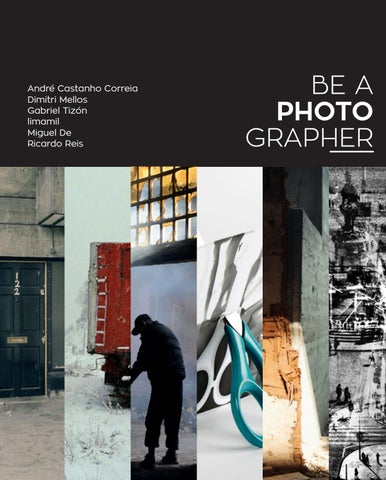
André Castanho Correia Dimitri Mellos Gabriel Tizón limamil Miguel De Ricardo Reis
BE A PHOTO GRAPHER
BE A PHOTO GRAPHER
André Castanho Correia (PT) Dimitri Mellos (EL) Gabriel Tizón (ES) limamil (PT) Miguel De (PT) Ricardo Reis (PT) 20 janeiro a 24 fevereiro 2018 january 20 to february 24 2018
BE A PHOTOGRAPHER
| 01
Be a photographer Exposição Internacional International Exhibition 20 janeiro a 24 fevereiro 2018 january 20 to february 24 2018
Artistas // Artists André Castanho Correia Dimitri Mellos Gabriel Tizón limamil Miguel De Ricardo Reis Curadoria // Chief Curator Helena Mendes Pereira Comunicação e Produção Executiva // Communication and Executive Production Catarina Martins Apoio à Comunicação e Produção Executiva // Communication and Executive Production Support Vanessa Ribeiro Curadoria de BE A PHOTOGRAPHER // BE A PHOTOGRAPHER curated by: Helena Mendes Pereira Catarina Martins
// Photography and Video
// Catalog Print
250 exemplares 02 | BE A PHOTOGRAPHER
T-E-R-R-I-T-Ó-R-I-O-S
BE A PHOTO GRAPHER
o/acidentais
Permitir-me-á o leitor a derivação linguística e a apropriação de uma tendência plástica neofuturista de usar a palavra como imagem, na ponte poética com a mensagem política desta exposição, mais uma, na galeria shairart dst (Braga), que se pretende como ponto de partida, não tanto para juízos de crítica de arte, mas para uma reflexão sobre o contemporâneo, sobre o tempo e o território global que é o nosso. Politicamente, o termo território define-se como o espaço físico sobre o qual um Estado exerce o seu poder soberano, ou seja, é o âmbito de validade da ordem jurídica estatal. De acordo com as teorias gerais de Estado, diplomacia, relações internacionais e nacionalidade, o território é uma das condições para a existência e reconhecimento de um país (sendo os outros dois a nação e o Estado). Por isso, existem determinados casos de entidades soberanas que não são consideradas países, mas Estados sem território (a Autoridade Nacional Palestina e a Ordem Soberana dos Cavaleiros de Malta, por exemplo) ou nações sem território (como são exemplo os ciganos). A delimitação territorial dos Estados modernos foi consequente dos conflitos que marcaram toda a Idade Média. O conceito de território é, portanto, de natureza ocidental e não contempla as factualidades e fatalidades acidentais. Recentemente, Donald Trump desativou a paz entre Israelitas e Palestinianos, reacendendo as diferenças entre o Estado de Israel e a Autoridade Nacional Palestiniana, um Estado sem território. Continuando para levante, desde 2013, o autoproclamado Estado Islâmico transformou a Guerra Civil na Síria num contexto de absoluto terror que culminou na maior crise de refugiados de que há memória desde a II Guerra Mundial. Cidadãos sem terra e sem teto, rejeitados aqui e ali, gente como nós. A Europa, nas suas grandes cidades e capitais, como na sua História, é território feito de migrações, de aculturações e de integrações. O mesmo se pode dizer dos EUA, cuja génese e desenvolvimento partiu de grandes fluxos de migrantes europeus anglo-saxónicos e escandinavos, mas também, como terra de Liberdade e sonhos, sempre acolheu as gentes vindas de todas as partes do mundo, nomeadamente da América Latina. Donald Trump encabeça agora a missão de distinguir entre americanos de primeira e americanos da segunda (como existiam no Portugal do Estado Novo, os portugueses de primeira e os portugueses de segunda, referindo-me aos nativos das ex-colónias, denominação que aliás estava explícita nos bilhetes de identidade da época) e pretendendo, não apenas restringir o acesso à cidadania americana, como promover um movimento de retornados, nunca antes visto, e que ascenderá aos BE A PHOTOGRAPHER
| 03
milhões de casos e a um flagelo social sem precedentes. Quem migra, na generalidade dos casos, fá-lo na busca da oportunidade de uma vida melhor. Negar a opção é atirar a matar pelas costas, à traição. Do ponto de vista geopolítico, mas também simbólico, a questão do território, havendo tantos outros exemplos passíveis de redação, é central no contemporâneo, verificando-se um retrocesso em matéria de respeito pelos Direitos Humanos, a grande conquista do pós-guerra. BE A PHOTOGRAPHER surge, por um lado, da necessidade de ampliação de expressões artísticas destacadas curatorialmente e, por outro, do desafio da integração na agenda da candidatura de Braga como Cidade Criativa da UNESCO na área das Media Arts, que se veio a verificar como aprovada. A nomeada é um call to action, que se cola no verbo ao slogan da shairart, e que persegue o princípio de contacto democrático com o objeto artístico, sob o ponto de vista de criação e de consumo. Na casa de partida, espírito aberto e ausência de tema de convergência conceptual. Era a fotografia que nos interessava. O T-E-R-R-I-T-Ó-R-I-O foi consequência do confronto ocasional com a série Europa Século XXI, da autoria do espanhol Gabriel Tizón (n.1973), e que se apresenta, na relação do conceito com a expografia e com as características arquitetónicas da galeria shairart dst, como o corpo central de uma seleção de artistas e obras de arte que pretende, em arranque de novo ano, colocar-nos na pele do outro. E se fosse comigo? E se fosse com os meus? O grego Dimitri Mellos (n.1970), radicado desde há vários anos em Nova Iorque, traz-nos o tema, na beleza da diversidade, a partir, precisamente dos EUA. André Castanho Correia (n.1988), por sua vez, manifesta especial interesse por registar paisagens (urbanas ou outras) em estados de transição e/ou de abandono. Em o outro espaço procura refletir sobre a configuração espacial e estado de conservação de diferentes áreas de habitação social, ora de tutela do Estado, ora autoconstruídas. Inclui três contextos locais (Enguardas, Santa Tecla e Picoto, em Braga), um nacional (Bairro 6 de Maio, Amadora) e um internacional (Robin Hood Gardens, Londres). Há nações sem território nos quadros imagéticos de André Castanho Correia. Não conseguimos, até aqui, ficar indiferentes ao poder da fotografia. Aquilo que a Fotografia reproduz até ao infinito só aconteceu uma vez: ela repete mecanicamente o que nunca mais poderá repetir-se existencialmente. Nela, o acontecimento nunca se transforma noutra coisa: ela remete sempre o corpus de que necessito para o corpo que vejo: ela é o Particular absoluto, a Contingência necessária soberana, impenetrável e quase animal, o Tal (tal foto e não a Foto), em suma, a Tyche, a Ocasião, o Encontro, o Real, na sua infatigável expressão.1, escreveu Roland Barthes (1915-1980). A fotografia, enquanto inovação de caráter científico, coincide com os factos próprios da Revolução Industrial e é em 1826 que o francês Nicéphore Niépce (1765-1833) realiza o que se convencionou como a primeira fotografia: uma natureza morta. Algum tempo mais tarde, repete a experiência, fotografando uma paisagem. 2 A história da fotografia é, de resto, a de uma expressão, que a dada altura se constitui como artística, que se compõe de géneros herdados da pintura: natureza mor1 2
04 | BE A PHOTOGRAPHER
BARTHES, Roland – A câmara clara. Nota sobre a fotografia. Lisboa: Edições 70, 2008. Página 12 BAURET, Gabriel – A Fotografia. História, Estilos, Tendências, Aplicações. Lisboa: Edições 70, 2006. Página 18.
ta, paisagem, retrato, nu. A cumplicidade entre pintores (ou, se quisermos, em campo mais alargado, artistas plásticos e fotógrafos) manteve-se ao longo do século XIX e a primeira exposição independente dos ditos impressionistas inaugurará a 15 de abril de 1874 no estúdio do fotógrafo Félix Nadar (1820-1910), na Boulevard des Capucines, no centro das Grands Boulevards, em ponto de encontro de referência da elite intelectual parisiense. A apropriação da fotografia como Arte é gradual e será em Nova Iorque, no pós II Guerra Mundial, sob direção de Edward Stein (1879-1973), pintor, fotógrafo e curador, que se desenvolveu de forma mais significativa o departamento de fotografia no MoMA. Será também na capital cultural norte-americana que veremos surgir a street photography que, inversamente, irá influenciar pintores como, por exemplo, Edward Hopper (1882-1967). A rua é como a cena de um teatro que fascina o espectador-fotógrafo; nela se representam, de dia como de noite, toda a espécie de dramas, tristes ou alegres, dramas em que se misturam personagens de toda a espécie. (…) A rua torna-se rapidamente, na história da fotografia, um espaço privilegiado, que se presta às mais diversas composições. Como se a vida moderna, tal e qual se revela na cidade, não tivesse encontrado na pintura uma tradução apropriada. 3 A proposta de Ricardo Reis (n.1981) combina o trabalho de observação da rua, na sua paleta de preto e branco, com as potencialidades de edição da imagem que o século XXI permite, apresentando-nos quadros de ilusão, fantasia e sonho, não deixando de nos reportar para o real de memória comum. A proposta de Miguel De (n.1992) é de uma viagem a territórios interiores, através de uma relação entre o corpo humano masculino, do ponto de vista formal e compositivo, e as paisagens que fazem a biografia do autor. O corpo enquanto corpo. A fotografia na possibilidade de comunicação da mimesis do olhar. limamil (n.1973) devolve-nos ao conceito e ao call to action, numa proposta que se enquadra nas vanguardas dos anos 60 e 70 do século XX, de desafio à participação dos públicos. Para além da contemplação a que a obra de arte nos induz, somos chamados a concluir o processo criativo, interagindo com o objeto imaginado pelo autor. limamil não se limita a usar a máquina para a produção de imagens, explorando as possibilidades técnicas dos aparelhos fotográficos e seus acessórios, integrando-os em construções plásticas tridimensionais. BE A PHOTOGRAPHER, mais do que uma exposição coletiva internacional de fotografia, é uma ação pública e cívica. Um alerta. Deambula entre as possibilidades da fotografia enquanto expressão artística e o seu potencial documental sobre os nossos dias. Neste segundo domínio, a seleção é dura e objetiva. Não podemos ficar indiferentes. Helena Mendes Pereira
3
BAURET, Gabriel – A Fotografia. História, Estilos, Tendências, Aplicações. Lisboa: Edições 70, 2006. Página 29. BE A PHOTOGRAPHER
| 05
o/accidental
T-E-R-R-I-T-O-R-I-E-S The reader will consent me the linguistic derivation and the appropriation of a neofuturistic plastic tendency to use the word as image, in the poetic bridge with the political message of this exhibition, one more, at gallery shairart dst (Braga), which is intended as a starting point, not so much for judgments of art criticism, but for a reflection on the contemporary, on time and on the global territory that is ours. Politically, the term territory is defined as the physical space on which a state exercises its sovereign power, meaning, it is the scope of validation of the state legal order. According to the general theories of state, diplomacy, international relations and nationality, territory is one of the conditions for the existence and recognition of a country (the other two being the nation and the state). As a result, certain cases of sovereign entities that are not considered countries, but states without territory (the Palestinian National Authority and the Sovereign Military Order of Malta, for example) or nations without territory (such as gypsies). The territorial delimitation of the modern states was a consequent of the conflicts that marked The Middle Age. The concept of territory has, therefore, a Western nature and does not contemplate accidental facts nor fatalities. Very recently, Donald Trump deactivated peace between Israelites and Palestinians, rekindling the differences between the State of Israel and the Palestinian National Authority, a landless state. Since 2013, the self-proclaimed Islamic State has transformed the Civil War in Syria into a scenario of absolute terror that as culminated in the largest refugee crisis ever since the World War II. Landless and homeless citizens, rejected here and there. People like us. Europe, in its great cities and capitals, as in its history, is a territory made up of migrations, acculturation and integration. The same applies to the United States of America, whose genesis and development was mainly based on large flows of European Anglo-Saxon and Scandinavian migrants, but also, as a land of Liberty and dreams, has always welcomed people from all over the world, specially from Latin America. Donald Trump now heads the mission of distinguishing first-class Americans from second-class Americans (as the Portuguese were distinguished during the Estado Novo period, being the natives of the former colonies referred to as second-class, a denomination explicit on their ID’S) as seeking not only to restrict access to American citizenship, but also to promote a movement of returnees, never seen, which will end up as an unprecedent social scourge. Those who migrate, in most cases, are seeking for better opportunities to improve their quality of life. Denying this option is treason. From a geopolitical point of view and from a symbolic one, the question of territory, with so many other writable examples, is central to the contemporary, with a visible setback in respect for Human Rights, the greatest achievement of the post-war. BE A PHOTOGRAPHER arises not only from the need for an increase in outstanding artistic expressions highlighted curatorially, but also from the challenge of integration in the agenda of the application of Braga as a UNESCO Creative City in Media Arts, which was approved. The nominee is a call to action, which adheres itself to the shairart slogan and pursuits the principle of democratic contact with the 06 | BE A PHOTOGRAPHER
artistic object, from the point of view of the creation and consumption. The starting point, open spirit and absence of a conceptual convergence theme. It was the photography that interested us. T-E-R-R-I-T-O-R-Y was a consequence of the occasional confrontation with the series Europe XXI Century, by the Spanish artist Gabriel Tizón (1973-), which is presented, in the relation with the expografy and with the architectonic characteristics of gallery shairart dst, as the central body from a selection of artists and artworks which intends, at the start of the new year, to put us in the skin of others. What if it was me? What if it was with those I love? The Greek Dimitri Mellos (1970-), living in New York for several years, brings us the theme, as the beauty of diversity, from, precisely, the USA. André Castanho Correia (1988-), expresses a special interest in registering landscapes (urban or other) in transitional state and/or abandonment. In another space seeks the reflection of the space configuration and conservation status of different areas of social housing them being foster care or self built. It includes three local contexts (Enguardas, Santa Tecla and Picoto, in Braga) a national one (Bairro 6 de Maio in Amadora) and an international context (Robin Hood Gardens in London). There are nations without territory in the imagery frames of André Castanho Correia. We have not yet been able to remain indifferent to the power of photography. What the Photography reproduces to infinity has occurred only once: the Photograph mechanically repeats what could never be repeated existentially. In the Photography, the event is never transcended for the sake of something else: the Photography always leads the corpus I need back to the body I see; it is the absolute Particular, the sovereign Contingency, matte and somehow stupid, the This (this photograph, and not Photography), in short, what Lacan calls the Tuché, the Occasion, the Encounter, the Real, in its indefatigable expression.1 Photography, while a scientific innovation, matches with the facts of the Industrial Revolution and is in 1826 that the French Nicéphore Niépce (1765-1833) performs what is called as the first picture: a still life. Later, he repeats the experience, photographing a landscape 2. The history of photography is, moreover, of an expression, which at a certain point is instituted as artistic and composed of genres inherited from painting: still life, landscape, portrait, nude. The complicity between painters (or, if we want, plastic artists and photographers) was maintained through the 19th century and the first independent exhibition of the so-called Impressionists would inaugurate on April 15, 1874 in the studio of the photographer Felix Nadar (1820-1910), on the Boulevard des Capucines, in the center of the Grands Boulevards, a reference meeting point for the Parisian intellectual elite. The appropriation of photography as Art is gradual and will be in New York, after World War II, under the direction of Edward Stein (1879-1973), painter, photographer and curator, who developed in a more significant way the department of photography in MoMA. It will also be in the North American cultural capital that we will see the emergence of street photography, which, conversely, will influence painters such as Edward Hopper (1882-1967). 1 2
BARTHES, Roland – A câmara clara. Nota sobre a fotografia. Lisboa: Edições 70, 2008. Page 12 BAURET, Gabriel – A Fotografia. História, Estilos, Tendências, Aplicações. Lisboa: Edições 70, 2006. Page 18. BE A PHOTOGRAPHER
| 07
The street is like the scene of a theater that fascinates the spectator-photographer; in it are represented, day and night, all sorts of dramas, sad or happy, dramas in which are mixed characters of all kinds. (...) The street quickly becomes, in the history of photography, a privileged space, that lends itself to the most diverse compositions. As if modern life, as it is revealed in the city, had not found in the painting an appropriate translation.3 The suggestion of Miguel De (1992-) is a trip to interior territories, through a relationship between the male human body, from the formal and compositional point of view, and the landscapes that make the biography of the author. The body as a body. Photography in the possibility of communication of mimesis eye. limamil (1973-) makes us return to the concept and call to action, in a proposal that fits the vanguards of the 60s and 70s of the 20th century, challenging public participation. Beyond the contemplation to which the artwork induces us, we are called to complete the creative process, interacting with the object imagined by the author. limamil is not limited by using the machine to produce images, exploring the technical possibilities of photographic devices and their accessories, integrating them into three-dimensional plastic constructions. BE A PHOTOGRAPHER, more than a collective international exhibition of photography, is a public and civic action. An alert. It wanders between the possibilities of photography as an artistic expression and its documentary potential on our days. In this second domain, the selection is hard and objective. We cannot remain indifferent. Helena Mendes Pereira
3
08 | BE A PHOTOGRAPHER
BAURET, Gabriel – A Fotografia. História, Estilos, Tendências, Aplicações. Lisboa: Edições 70, 2006. Page 29.
ANDRÉ CASTANHO CORREIA
1988
VIANA DO CASTELO 1981 PORTUGAL
BE A PHOTOGRAPHER
|9
Robin Hood Gardens, Londres, 14 de outubro de 2017. Impressão glicée em papel Harman Matt Cotton Smoth 300g (1/5) Print on glicée paper Harman Matt Cotton Smoth 300g (1/5) 60,5 x 50 cm. 10 | BE A PHOTOGRAPHER
Bairro Social de Santa Tecla, Braga, 29 de julho de 2017. Impressão glicée em papel Harman Matt Cotton Smoth 300g (1/5) Print on glicée paper Harman Matt Cotton Smoth 300g (1/5) 50 x 50 cm BE A PHOTOGRAPHER
| 11
Bairro Social de Santa Tecla, Braga, 25 de julho de 2017. Impressão glicée em papel Harman Matt Cotton Smoth 300g (1/5) Print on glicée paper Harman Matt Cotton Smoth 300g (1/5) 50 x 50 cm 12 | BE A PHOTOGRAPHER
Bairro Social de Santa Tecla, Braga, 29 de julho de 2017. Impressão glicée em papel Harman Matt Cotton Smoth 300g (1/5) Print on glicée paper Harman Matt Cotton Smoth 300g (1/5) 50 x 50 cm
Bairro 6 de Maio, Amadora, 4 de novembro de 2017. Impressão glicée em papel Harman Matt Cotton Smoth 300g (1/5) Print on glicée paper Harman Matt Cotton Smoth 300g (1/5) 80 x 80 cm
Bairro 6 de Maio, Amadora, 4 de novembro de 2017. Impressão glicée em papel Harman Matt Cotton Smoth 300g (1/5) Print on glicée paper Harman Matt Cotton Smoth 300g (1/5) 50 x 50 cm
Bairro 6 de Maio, Amadora, 4 de novembro de 2017. Impressão glicée em papel Harman Matt Cotton Smoth 300g (1/5) Print on glicée paper Harman Matt Cotton Smoth 300g (1/5) 60 x 60 cm BE A PHOTOGRAPHER
| 13
Bairro Social de Santa Tecla, Braga, 25 de abril de 2017. Impressão glicée em papel Harman Matt Cotton Smoth 300g (1/5) Print on glicée paper Harman Matt Cotton Smoth 300g (1/5) 50 x 50 cm 14 | BE A PHOTOGRAPHER
DIMITRI MELLOS 1970
ATENAS GRÉCIA
BE A PHOTOGRAPHER
| 15
Série Immigrants all Impressão lambda (1/5) Lambda print (1/5) 50 x 75 cm 16 | BE A PHOTOGRAPHER
Série Immigrants all Impressão lambda (1/5) Lambda print (1/5) 50 x 75 cm
Série An Illustrated Guide to Greece, 2007 Impressão lambda (1/5) Lambda print (1/5) 50 x 75 cm
Série An Illustrated Guide to Greece, 2007 Impressão lambda (1/5) Lambda print (1/5) 50 x 75 cm BE A PHOTOGRAPHER
| 17
18 | BE A PHOTOGRAPHER
Série Oblivious city, 2012 Impressão lambda (1/5) Lambda print (1/5) 50 x 75 cm BE A PHOTOGRAPHER
| 19
Série Immigrants all Impressão lambda (1/5) Lambda print (1/5) 50 x 75 cm 20 | BE A PHOTOGRAPHER
Série Immigrants all Impressão lambda (1/5) Lambda print (1/5) 50 x 75 cm
GABRIEL TIZÓN 1973
FERROL ESPANHA
BE A PHOTOGRAPHER
| 21
Série Europa Século XXI, 2017 Impressão direta em dibond (1/9) Direct print on dibond (1/9) 40 x 60 cm 22 | BE A PHOTOGRAPHER
Série Europa Século XXI, 2017 Impressão direta em dibond (1/9) Direct print on dibond (1/9) 40 x 60 cm
Série Europa Século XXI, 2017 Impressão direta em dibond (1/9) Direct print on dibond (1/9) 40 x 60 cm
Série Europa Século XXI, 2017 Impressão direta em dibond (1/9) Direct print on dibond (1/9) 40 x 60 cm BE A PHOTOGRAPHER
| 23
Série Europa Século XXI, 2017 Impressão direta em dibond (1/9) Direct print on dibond (1/9) 40 x 60 cm 24 | BE A PHOTOGRAPHER
Série Europa Século XXI, 2017 Impressão direta em dibond (1/9) Direct print on dibond (1/9) 40 x 60 cm
Série Europa Século XXI, 2017 Impressão direta em dibond (1/9) Direct print on dibond (1/9) 40 x 60 cm
Série Europa Século XXI, 2017 Impressão direta em dibond (1/9) Direct print on dibond (1/9) 40 x 60 cm BE A PHOTOGRAPHER
| 25
Série Europa Século XXI, 2017 Impressão direta em dibond (1/9) Direct print on dibond (1/9) 60 x 40 cm 26 | BE A PHOTOGRAPHER
LIMAMIL 1973
PORTO PORTUGAL
BE A PHOTOGRAPHER
| 27
limograma 003 Técnica mista sobre gelatina prata Mixed media on gelatina silver Dimensão variável | Variable size 28 | BE A PHOTOGRAPHER
limograma 002 Técnica mista sobre gelatina prata Mixed media on gelatina silver Dimensão variável | Variable size
limograma 001 Técnica mista sobre gelatina prata Mixed media on gelatina silver Dimensão variável | Variable size
limograma 004 Técnica mista sobre gelatina prata Mixed media on gelatina silver Dimensão variável | Variable size BE A PHOTOGRAPHER
| 29
limograma 005 Técnica mista sobre gelatina prata Mixed media on gelatina silver Dimensão variável | Variable size 30 | BE A PHOTOGRAPHER
Queda de mota escultura ciano Técnica mista de cianotipia sobre pano-cru Mixed cyanotype technique on crude cloth Dimensão variável | Variable size BE A PHOTOGRAPHER
| 31
transfotografia #01 Técnica mista | materiais usados: gira-discos, vinil, camara fotográfica, candeeiro, calha e tubo de ferro, cabo elétrico, corda, pelicula fotográfica Mixed media | used materials: record player, vinyl, camera, lamp, rail and iron tube, electric cable, rope, photographic film Dimensão variável | Variable size: 1 m x 1,30 m x 1,80 m (aprox.) 32 | BE A PHOTOGRAPHER
MIGUEL DE 1992
OVAR PORTUGAL
BE A PHOTOGRAPHER
| 33
Adolfo ao telem처vel, Outubro 2017; Tecto de uma igreja, Maio 2017 Impress찾o em papel Hahnem체hle FineArt Photo Rag Bright White 310g (1/5) Print on paper Hahnem체hle FineArt Photo Rag Bright White 310g (1/5) 73 cm x 50 cm (x 2) 34 | BE A PHOTOGRAPHER
O pé de Adolfo, Outubro 2017; Oceano em ondas, Outubro 2017 Impressão em papel Hahnemühle FineArt Photo Rag Bright White 310g (1/5) Print on paper Hahnemühle FineArt Photo Rag Bright White 310g (1/5) 73 cm x 50 cm (x 2) BE A PHOTOGRAPHER
| 35
36 | BE A PHOTOGRAPHER
Bruno em êxtase, Agosto 2017; Rio descendente, Maio 2017 Impressão em papel Hahnemühle FineArt Photo Rag Bright White 310g (1/5) Print on paper Hahnemühle FineArt Photo Rag Bright White 310g (1/5) 73 cm x 50 cm (x 2) BE A PHOTOGRAPHER
| 37
Bruno de costas, Fevereiro 2017; Um caminho no monte, Novembro 2016 Impressão em papel Hahnemühle FineArt Photo Rag Bright White 310g (1/5) Print on paper Hahnemühle FineArt Photo Rag Bright White 310g (1/5) 73 cm x 50 cm (x 2) 38 | BE A PHOTOGRAPHER
RICARDO REIS 1981
BARREIRO PORTUGAL
BE A PHOTOGRAPHER
| 39
People Everywhere, Everyone’s Alone, 2009 Impressão em fine art map fiber (1/25) Print on fine art map fiber (1/25) 40 x 60 cm 40 | BE A PHOTOGRAPHER
People Everywhere, Everyone’s Alone, 2009 Impressão em fine art map fiber (1/25) Print on fine art map fiber (1/25) 40 x 60 cm
PAG 42 e 43 A Day In London 21, 2010 Impressão em fine art map fiber (1/25) Print on fine art map fiber (1/25) 40 x 60 cm BE A PHOTOGRAPHER
| 41
Descanso 2014 Óleo sobre tela Oil on canvas 81 x 116 cm 42 | BE A PHOTOGRAPHER
Elena, 2014 Óleo sobre tela Oil on canvas 81 x 100 cm BE A PHOTOGRAPHER
| 43
Urban Landscape, 2008 ImpressĂŁo em fine art map fiber (1/25) Print on fine art map fiber (1/25) 40 x 60 cm 44 | BE A PHOTOGRAPHER
Urban Landscape, 2014 ImpressĂŁo em fine art map fiber (1/25) Print on fine art map fiber (1/25) 40 x 60 cm
A Fotografia na Arte
BE A PHOTO GRAPHER
Há um ano atrás pensámos a fotografia como matéria que sabíamos ser necessária elevar. A inquietude característica das práticas fotográficas coincidia com a audácia que nos invadia ao ter a galeria shairart dst em branco. Uma ação contínua entre procura e encontro de talento devolveu-nos ao nome, então, criado: BE A PHOTOGRAPHER. A shairart engrandece-se na sua primeira Exposição Coletiva Internacional de Fotografia, através do percurso de seis autores: André Castanho Correia, Miguel De, limamil, Dimitri Mellos, Gabriel Tizón e Ricardo Reis. “In 1989, 150 years after Fox Talbot’s announcement of ‘photographic drawing’ (the calotype), the Royal Academy, London, mounted his first ever photography exhibition, The Art of Photography. (…) The first major photography show at the Tate (Tate Modern, London), titled Cruel and Tender, was not until 2003.” 1 O título da referida exposição remete para uma caracterização do corpo de trabalho do fotógrafo documental Walker Evans (1903-1975), atribuída ao fundador do New York City Ballet, Lincoln Kirsten (1907-1996): “tender cruelty”. O percurso histórico de conquista do lugar pela Fotografia em espaço expositivo eliminou vários estereótipos: de evidenciar o do registo fotográfico como o culminar de uma espera pelo instante perfeito, exaltando a espontaneidade e eliminando a possibilidade da uma (pré) encenação (quer conceptual, quer física). Este sentimento de pertença foi acompanhado da mudança de paradigma no qual o ato de fotografar se desloca do campo da arte, em minúsculas, para o âmbito da Arte, em maiúsculas, previsto em 1988: “It must be admitted by the most determined opponent of photography as fine art that the same object represented by different photographers will produce different pictorial results and this invariably not only because the one man uses different lenses and chemicals than the other but because there is something different in each man’s mind which somehow gets communicated to his fingers’ ends and thence to his pictures”. 2 Distintas motivações de criação detêm um espaço próprio no mundo da Arte, da graciosidade da fotografia pictórica à capacidade de reportar da documental. A leitura do espaço da galeria e dos espaços representados, através da imagem, é uma oportunidade de encontro com o nosso próprio referencial: levados a espaços desabitados ou em abandono, transportados 1
WELLS, Liz – Photography; A Critical Introduction. Glasgow: Routledge, 2004. Terceira Edição. Página 248. HARKER, Margaret – The Linked Ring: The Secession Movement in Photography in Britain, 1892-1910. Londres: Heinemann, 1988. Página 46. 2
BE A PHOTOGRAPHER
| 45
para lugares de e em transição, remetidos para práticas de quotidianos que não os nossos, mas que nos remetem para a experiência individual. Todas as identidades registadas em imagem poderiam ser de outros, poderiam ser as nossas, se nascidos em outros locais, identificados em distintas etnias ou em novas circunstâncias sociais. O circuito internacional de bairros sociais desenhado por André Castanho Correia aproxima-os pelo conceito de transformação, na sua maioria em processos de demolição, abandono e requalificação. É ultrapassada a própria fronteira formativa da arquitetura e deparamo-nos com uma estética neutra, de detalhada resolução e de enquadramento cuidado, próprios da fotografia de médio formato, reinstaurando o exercício do estudo, observação e inserção aprofundada nas comunidades registadas. Sem possibilidade de distração, é negada a possibilidade de entretenimento por possíveis contrastes ou saturação dos tons, sendo evidenciados os elementos simbólicos do território, como barreiras, entradas, escadas ou arte urbana. A brutalidade do edificado - quer de imponência, quer de carência - contextualiza o espectador na dualidade tempo-espaço, criando área imaginativa para infinitas narrativas domésticas. O presente projeto fotográfico é a estreia de Miguel De como fotógrafo em espaço expositivo físico: houve um percurso até se encontrar em “A Body of Land”, série composta por dípticos que unem figura humana - real ou simulada - a paisagem - natural ou construída. As formas de uma são as de outra: naturais, belas e clássicas. Cada conjunto revisita momentos que, em uníssono, se transformam num único poema, a uma voz. Como se de uma escrita minimalista e cuidada se tratasse, é traduzida a beleza do corpo masculino, aqui enobrecida, e da natureza em uma única forma comum, gerando um gesto em luz partilhada, embora fotografada em ocasiões diferentes. O elogio das formas físicas é ampliado na exaltação da intimidade, onde não é dissimulada a ausência de pudor do fotografado perante o fotógrafo. Transversal à galeria, em termos físicos, e à própria Fotografia, no seu campo de possibilidades, os objetos da autoria de limamil atravessam as diferentes séries fotográficas expostas, enquadrando-se e/ou questionando, desafiando o visitante a participar no processo fotográfico. Ao conceito de maquinaria e operacionalidade é contraposto o elogio da beleza originário na simplicidade das linhas. No campo infinito da reprodução fotográfica destaque para a introdução da cianotipia, técnica alternativa ao tradicional processo de obtenção de cópias baseado em sais de prata. O ciano é o elemento que importa a cor para a presente seleção, em uma das únicas peças cuja designação não é personalizada pelo seu nome artístico. Desloca o tradicional conceito da fotografia impressa e colocada em parede branca, guiando-nos pelas óticas da funcionalidade e representatividade de cada obra de arte. Dimitri Mellos impregna a sua visão dos conhecimentos das áreas de estudo: psicologia e filosofia. Criam-se narrativas que possam dar resposta à possível ligação das personagens: se por mera casualidade, se por uma vida a dois; se pela presença da câmara ou pela coincidência de uma manifestação. A condensação da cor transporta-nos, mesmo após deixarmos de olhar a imagem, para um universo cinematográfico que ultrapassa a fronteira do fotojornalismo como 46 | BE A PHOTOGRAPHER
referência original. O consolidado percurso do autor é alimentado por uma insaciável curiosidade na figura do outro: maioritariamente em trânsito, ótica que o fascina, mas com abertura para a fotografia de paisagem, na qual é constante o elemento humano. De um mar de possível população indistinta, é elevado um rosto, dignificando as respetivas particularidades. Gabriel Tizón retrata o entretanto. Em mar e terra onde poderiam pousar os nossos pés e família (ou pairar a ausência dela), não há fronteiras territoriais que contenham a atualidade registada, na qual impera a bússola da sobrevivência. A imagem não gera respostas ou soluções – levanta questões, dá voz às dúvidas e destapa o encoberto. Esta insurgência contra os momentos de transição forçada, de viagem involuntária, que, por um momento nos fazem suster a respiração juntamente com os fotografados, dão corpo e cara à atualidade que nos chega em avalanche de informação, maioritariamente indiscriminada Ricardo Reis, em percurso de inspiração em referenciais cinematográficos e jornalísticos, sustenta a possibilidade de representação simultânea de movimento e pausa: a fotografia a preto e branco como possibilidade de ordenação em plena urbe caótica. Parte de espaços inseridos na rotina da maioria e reveste-os de um novo significado, como se a fotografia nos compelisse a ver novamente. Sem abandonarmos lugares comuns, ganhamos uma nova perceção, como se de outros se tratassem: centros de outras cidades, baixas de capitais longínquas, periferias que não as que nos circundam. As múltiplas exposições afastam o nosso olhar de uma primeira leitura óbvia e situam-nos na pluralidade de possibilidades inseridas em uma única obra de arte. A capacidade de revisitar topografias já conhecidas aproximar-nos-á da habilidade de olhar verdadeiramente os espaços que habitamos. A Fotografia, em particular, e a Arte, em geral, interligam criadores e públicos. Celebramo-las na sua reinvenção contínua e pensamos a shairart como inovação em permanência, que devolve à comunidade o que de melhor se cria na contemporaneidade. O espaço em branco referido no início da presente reflexão – sentido na reestruturação da shairart, pleno de potencial – foi preenchido, também, pela nova vaga de programação da cidade onde nos sediamos. Em sistema de rede, associamo-nos aos diversos projetos da Braga Media Arts, cujo desafio lançado à cidade faz emergir potenciais que intersectam linguagens analógicas e digitais. Esta dualidade caracteriza a nossa ação: recuperamos os catálogos impressos, em fascículos de edição limitada; criamos conteúdo diário em plataformas online, reunindo o poder da imagem com a força da palavra; ultimamos com a presença física e virtual dos shairart’ists: dentro ou fora da galeria, mas com a sua essência captada em vídeo, nas nossas redes. Um ano depois, ainda revestidas a coragem, somos um trio (com início no grupo dst, pautadas pela sua história e amparadas por tantos) que encontra inspiração nos artistas que emergem e se consolidam, ciclicamente. Resta-nos criar espaço, diariamente, para que cada um dos que a shairart representa – em Fotografia, Pintura, Escultura, Ilustração e Desenho; dentro e fora de Portugal - trace caminho em pista própria. Catarina Martins BE A PHOTOGRAPHER
| 47
Photography in Art A year ago, we thought of photography as matter that we knew needed to be elevated. The characteristic restlessness of photographic practices matched with the audacity that invaded us when having the gallery shairart dst as a blank space. A continuous action between talent search and encounter returned got us back to the original exhibition’s name: BE A PHOTOGRAPHER. shairart is enhanced in its first International Collective Photography Exhibition, through the course of six authors: André Castanho Correia, Miguel De, limamil, Dimitri Mellos, Gabriel Tizón and Ricardo Reis. “In 1989, 150 years after Fox Talbot’s announcement of ‘photographic drawing’ (the calotype), the Royal Academy, London, mounted his first ever photography exhibition, The Art of Photography. (…) The first major photography show at the Tate (Tate Modern, London), titled Cruel and Tender, was not until 2003.” 1 This exhibition’s title refers to a characterization of the body of work of documentary photographer Walker Evans (1903-1975), attributed to the founder of the New York City Ballet, Lincoln Kirsten (1907-1996): “tender cruelty.” The historical path of conquest of place by Photography in exhibition sites eliminated several stereotypes: highlight the the photographic record as the culmination of a wait for the perfect moment, exalting the spontaneity and eliminating the possibility of a (pre) staging (either conceptual or physical). This sense of belonging was accompanied by a paradigm change, in which the photographing act shifts from the field of art, in lowercase to the scope of Art, in capital letters, predicted in 1988: “It must be admitted by the most determined opponent of photography as fine art that the same object represented by different photographers will produce different pictorial results and this invariably not only because the one man uses different lenses and chemicals than the other but because there is something different in each man’s mind which somehow gets communicated to his fingers’ ends and thence to his pictures”. 2 Different motivations for creation have their own space in the Art world, from the grace of pictorial photography to the capacity to report of the documentary genre. Reading the gallery’s space and the spaces represented through the images is an opportunity to meet our own frame of reference: taken to spaces uninhabited or abandoned, transported to places of and in transition, sent to daily practices that are not our own, but which bring us back to individual experience. All the identities recorded in one image could be of others, could be ours, if born in other places, identified in different ethnic groups or in new social circumstances. The international circuit of social neighborhoods designed by André Castanho Correia brings them together through the concept of transformation, mostly in demolition, abandonment and requalification processes. The formative frontier of architecture is surpassed and we come across a neutral aesthetic, 1
WELLS, Liz – Photography; A Critical Introduction. Glasgow: Routledge, 2004. Terceira Edição. Page 248. HARKER, Margaret – The Linked Ring: The Secession Movement in Photography in Britain, 1892-1910. Londres: Heinemann, 1988. Page 46. 2
48 | BE A PHOTOGRAPHER
detailed resolution and careful framing, typical of medium-format photography, reinstating the exercise of study, observation and deep insertion in the registered communities. Without any opportunity for distraction, it is denied the possibility of entertainment by potential contrasts or tone saturation, being evidenced the territory’s symbolic elements, such as barriers, entrances, stairs or urban art. The brutality of the buildings - whether of grandeur or lack of them - contextualizes the spectator in the time-space duality, creating an imaginative area for infinite domestic narratives. The present photographic project is the debut of Miguel De as a photographer in a physical exhibition space: there was a journey until finding himself at “A Body of Land”, a series composed by diptychs that unite human figure - real or simulated - to landscape - natural or constructed. The forms of one are those of another: natural, beautiful and classic. Each set revisits moments that, in unison, become a single poem, a voice. As if it was a minimalist and careful writing, it translates the beauty of the male body, here ennobled, and of nature, in a single common form, generating a gesture in shared light, although photographed on different occasions. The praise of physical forms is amplified in the exaltation of intimacy, where it is not concealed the absence of modesty of the photographed before the photographer. Transversal to the gallery, in physical terms, and to the Photography itself, in its field of possibilities, objects of the authorship of limamil cross the different photographic series exposed, framing themselves and/or questioning, challenging the visitor to participate in the photographic process. The concept of machinery and operability is contrasted by the praise of the beauty in the simplicity of lines. In the infinite ground of photographic reproduction, highlight to the introduction of cyanotype, an alternative technique to the traditional process of obtaining copies based on silver salts. Cyan is the element that inserts the color for the present selection, in one of the only pieces whose designation is not personalized by its artistic name. It shifts the traditional concept of printed photography into a white wall, guiding us through the optics of the functionality and representativeness of each artwork. Dimitri Mellos permeates his vision with the knowledge from the areas of study: psychology and philosophy. Narratives are created so that can give answer to the possible connection of the characters: if by chance, if by a life together; whether by the presence of the camera or by the coincidence of being on a rally. The condensation of color transports us, even after we stop looking at the image, to a cinematographic universe that goes beyond the frontier of photojournalism as an original reference. The consolidated author’s path is fed by an insatiable curiosity on the other: mostly in transit, an optic that fascinate the author, but with openness to landscape photography, in which the human element is constant. From a sea of possible indistinct population, a face is raised up and their particularities dignifyed. Gabriel Tizón portrays the meanwhile. At a sea or in land, where our feet and family could stand (or hover in the absence of it), there are no territorial boundaries that contain the recorded present time, in which the compass of survival reigns. The image does not generate answers or solutions – it raises questions, gives voice to doubts and uncovers the what is hidden. This insurgency against the moments of forced transition, of an involuntary journey, which, for a moment, make us hold our breath along with those photographed, gives body and face to the current situation that arrives at us in an avalanche of information, mostly arbitrary. Ricardo Reis, on a path of inspiration in cinematographic and journalistic references, sustains the possibility of simultaneous representation of movement and pause: black and white photography as a BE A PHOTOGRAPHER
| 49
possibility of order in the chaotic city. He starts on spaces included in the majority’s routine and coats them with a new meaning, as if the photograph compelled us to see again. Without abandoning common places, a new perception is gained, as if they were others: centers of other cities, downtowns of distant capitals, suburbs that are not those which surround us. The technique of multiple exposures takes our eyes from an obvious first reading and situates us in the plurality of possibilities inserted in a single artwork. The ability to revisit already known topographies will bring us closer to the ability to truly look at the spaces we inhabit. Photography, in particular, and Art, in general, interconnects creators and audiences. We celebrate them in their continuous reinvention and we think shairart as innovation in permanence, that returns to the community what is best created nowadays. The blank space referred to at the beginning of the present reflection – felt at shairart’s restructuring, full of potential - was also filled by the new wave of the city’s programming where we are based. In a network system, we associate ourselves with the various projects of Braga Media Arts, whose challenge launched to the city emerges potential that intersects analog and digital languages. This duality characterizes our action: we retrieve printed catalogs, in limited editions; we create daily content on online platforms, bringing together the power of the image with the power of the word; we finalize with the physical and virtual presence of the shairart’ists: inside or outside the gallery, but with its essence captured in video, in our networks. A year later, still filled with bravery, we are a trio (with beginning at dst group, guided by its history and supported by so many people) that finds inspiration in artists who emerge and consolidate, cyclically. What remains for us is to create space, daily, so that each of the shairart represents - in Photography, Painting, Sculpture, Illustration and Drawing; inside and outside of Portugal - trace path on own track. Catarina Martins
50 | BE A PHOTOGRAPHER
BE A PHOTOGRAPHER
| 51
Horário // Opening time 14:00 | 19:00 · segunda a sábado (exceto feriados) Outros horários mediante marcação 2:00 pm | 7:00 pm · monday to saturday (except holidays) Other schedules by appointment
Contactos // Contacts info@shairart.com (+351) 253 116 620 www.shairart.com
Morada // Address Rua do Raio, 175 4710-923 Braga Portugal
52 | BE A PHOTOGRAPHER