www.tribalart.de
Zemanek-Münster
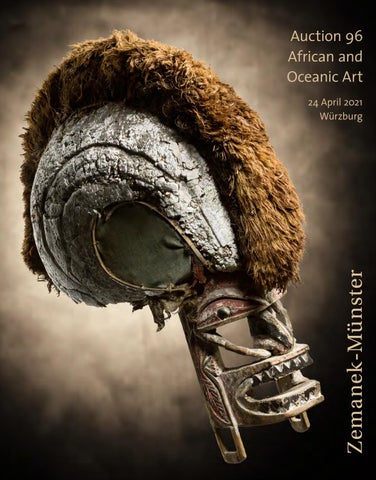
Auction 96 African and Oceanic Art
Zemanek-Münster 24 April 2021
Würzburg Zemanek-Münster
Auction 96 African and Oceanic Art 24 April 2021 Würzburg
–2–
Zemanek-Münster 96 Auction
African and Oceanic Art (Auction 212)
Auktion
Auction
Vorbesichtigung
Preview
COVID-19 Hinweis: Bitte vereinbaren Sie Ihren Besuchsterrmin zur Vorbesichtigung. Um Sitzplatzreservierung zur Auktion wird gebeten.
COVID-19 notice: Please make an appointment to visit the preview. We kindly ask you to reserve a seat for the auction.
Würzburg, Auktionshaus 24 April 2021 – 14 Uhr
12 bis 23 April 2021 täglich von 10 bis 17 Uhr
Wurzburg, Auction House 24 April 2021 – 2 pm
12 to 23 April 2021 daily from 10 am to 5 pm
Ansprechpartner / Contact
Dr. David Zemanek
Eva Rübig
Karin Zemanek-Münster
Ernst Zemanek
Petra Felder
Sabine Reis
Bren Heymans
Howard Nowes
Geschäftsführung Ethnologe / Auktionator Afrika / Ozeanien
M.A. Kunstgeschichte Redaktion / Marketing
Geschäftsführung Online-Redaktion
M.A.Kunstgeschichte Katalogbearbeitung
Geschäftsführung Auktionatorin
Repräsentant Belgien/ Niederlande Berater für Ethnographie
Kunstauktionshaus Zemanek-Münster 97070 Würzburg Hörleingasse 3 - 5 / Schildhof 2 Tel. +49 9 31 1 77 21 / Fax. +49 9 31 1 77 36 info@tribalart.de / www.tribalart.de
Inhaber / Owner
Dr. David Zemanek e.K. Öffentlich bestellter und vereidigter Kunstauktionator für außereuropäische Kunst
Impressum
Redaktion / Editor: Petra Felder M.A. Photos: Thomas Lother & Volker Thomas, Nürnberg Layout: Beatrix Radke, design & art, Gerbrunn Print: bonitasprint, Würzburg Umschlag/cover: Lot 49, Lot 47
–4–
Geschäftsführung Auktionator
Master History of Art Präkolumbien / Antiken
Repräsentanten / Representatives
Belgien & Niederlande Tel. 0032 (0)475 965 220 USA Zemanek-Münster c/o Ancient Art – Art of Eternity 303 East 81st Street, New York City, NY 10028
Bankverbindung / Bank details IBAN DE06 7905 0000 0000 0366 99 SWIFT (BIC) BYLADEM1SWU
klimaneutral
natureOffice.com | DE-204-246A71U
gedruckt
Content / Inhalt [Lots / Lose] China.............................................. 1,2
The Collection of
Angola................................... 354-357
India................................................... 3
Piet Lepelaar .......................... 68-145
Ethiopia................................. 358,359
Indonesia.....................................4-12
Kenya............................................360 West Africa..................................146
Tanzania................................361-364
Liberia..................................... 147,148
Mozambique.............................. 365
Papua New Guinea............... 22-49
Sierra Leone.................................149
South-East-Africa...................... 366
Salomon Islands...................... 50,51
Guinea-Bissau....................... 150,151
Namibia........................................367
Austral Islands..............................52
Mali.........................................152-164
South Africa........................368-370
Fidji Islands.............................. 53-55
Burkina Faso........................ 165-169
Easter Islands................................56
Côte d‘Ivoire ......................170-200
ONLINE:
Ghana....................................201-205
The Collection of African
Literature: Africa.......................206
Weapons - Dieter Schaffner
Nigeria...................................207-261
............................................... 371-603
Philippines..................................13-21
Australia...................................57-63 Europe............................................ 64
Cameroon Grasfield......... 262-265 Cameroon........................... 266,267
Inuit.......................................... 65,66
Gabon................................... 268-274
South America..............................67
D.R. Congo............................ 275-353
Hinweis: Mit (*) gekennzeichnete Lose betreffen CITESpflichtige Objekte bzw. Objekte, die dem Kulturgüterschutzgesetz (KGS-Gesetz) unterliegen. Bitte beachten Sie, dass ein uneingeschränkter Handel nur innerhalb der Europäischen Gemeinschaft erlaubt ist. Ein Versand in Drittländer ist zur Zeit nicht möglich.
Please note: Some items of this offer can be marked with an asterisk (*) . This objects are subject to CITES resp. to the UNESCO Cultural Heritage Protection Act. Please note that all objects that are subject to CITES can only be sent within the European Community. At the present time export in third countries is prohibited.
CITES-pflichtige Objekte erfüllen die Bestimmungen des Art. 2w der Verordnung (EG) Nr. 338/97 des Europäischen Rates vom 09.12.1996 (Antiquitäten aus artengeschützten Materialien) sowie die Bestimmungen der Resolution Res.10.10.10 Rev. CoP 15 (http://www.bfn.de – http://www.cites.org).
Objects liable to CITES fullfil the requirements of the european regulation EU 338/97 Art. Art. 2 w, dated 09.12.1996 as well as the requirements of the resolution Res. 10.10.10 Rec. CoP 15 (http://www.bfn.de – http://www.cites.org).
Objekte der Offerte stammen ausschließlich von ethnischen Volksgruppen und sind für die Verwendung innerhalb der Ethnie gefertigt worden; Objekte der Colon sowie Auftragswerke sind in die frühe Zeit zu verorten.
All items have been made by the ethnic group and for use in the ethnic group. Figures of the Colon as well as commissened art works are classified as objects of the early period.
–5–
ASIA Wohnung / Home Ludwig Leicher, Berlin (Photo: Private Archive)
CHINA
CHINA
1 Bodhisattva Guanyin auf Drachen sitzend Bronze, Farb- und Pigmentreste, übermalt, Sockel
2 Traumstein schwarzes, stellenweise poliertes Gestein, Sockel
Bodhisattva Guanyin sitting on dragon bronze, paint and pigment residues, painted over, base H: 32,5 cm Provenance Ludwig Leicher, Berlin, Germany € 2.000 - 4.000
Dream stone black stone, polished in places, base H: 18 cm € 600 - 1.200
INDIA, NAGA 3 Schurz eines Kriegers „nei shou“ Baumwolle, Wolle, Kaurischnecken Warriors waist cloth „nei shou“ cotton, wool, cowrie shells L: 47 cm; B: 14 cm Vgl. Lit.: Kunz, Richard, Naga, Basel 2008, p. 116, ill. 158 € 400 - 800
–4–
Lot 1
–5–
OCEANIA
INDONESIA - BORNEO 4 Grabstele Holz, Flechtenbewuchs, Verwitterungsspuren, Sockel Tomb stela wood, lichen growth, traces of weathering, base H: 114 cm € 1.000 - 2.000
INDONESIA - BORNEO 5 Grabstele Holz, Flechtenbewuchs, Verwitterungsspuren, Sockel Tomb stela wood, lichen growth, traces of weathering, base
13 Weiblicher Gedenk- oder Grabpfosten „sunduk“ Eisenholz, Flechtenbewuchs, Verwitterungsspuren, Sockel Die prachtvoll ornamental verzierten „sunduk“ dienen als Schmuck für die Gräber Verstorbener. Sie sind in der Regel aus Holz, manchmal aus Stein und seltener aus Koralle gefertigt. Die Toten wurden mit dem Blick gen Mekka, also nach Nordwesten hin ausgerichtet beigesetzt und die „sunduk“ am Kopfende platziert. „Sunduk“ sind Zeugen einer harmonischen Synthese aus dem Glauben und den Bräuchen der Vorfahren mit den orthodoxen Vorschriften des sunnitischen Islams, der von arabischen Kaufleuten und Missionaren auf die Inseln gebracht worden war.
Figural crowning of a ritual pole wood, base
Female memorial post or grave marker „sunduk“ iron wood, lichen growth, traces of weathering, base The splendidly ornamented „sunduk“ serve as ornaments for the graves of the deceased. They are generally carved in wood, sometimes in stone and more rarely in coral. They were placed at the head of the dead facing Mecca, which means towards the North-West. They are a harmonious blend of ancestral beliefs and customs with the orthodox Sunni islam precepts imported by arabian merchants and missionaries from the 10th century.
H: 13 cm
H: 88 cm
Provenance Aalderink, Amsterdam, The Netherlands
Vgl. Lit.: Le Dauphin, Cedric, Sunduk, Soul carriers - Beauty reminders, Esy sur Eure 2003, ill. 18
€ 800 - 1.600
€ 1.000 - 2.000
H: 83,5 cm € 1.000 - 2.000
INDONESIA - BORNEO, DAYAK 6 Figurale Bekrönung eines Ritualstabes Holz, Sockel
7ff s. Seite/page 8ff –6–
SOUTHERN PHILIPPINES, SULU ARCHIPEL AGO
Lot 4
Lot 5
Lot 13 –7–
Die Menschen auf Nias glaubten,
George Pitt-Rivers (1890-1966) und dessen Ehefrau Stella Howson-Clive (Pitt-Rivers) über. Das Museum wurde 1964 geschlossen und die Sammlung wurde verkauft.
sche Kräfte besäßen und in der Lage seien, die Lebenden positiv oder negativ zu beeinflussen. Deshalb wurden diese Figuren aus Holz „adu zatua“ geschaffen, um den
Publ. in Rethinking Pitt-Rivers, The database for Pitt-Rivers‘s „Second“ Collection, Vol. 4, p. 1343, Cambridge University Library (MS Add. 9455)
Geistern der Verstorbenen eine Heimstatt zu bieten. Die Figuren wurden verehrt und erhielten Opfergaben. Sie dienten als Medium, um mit den Ahnen in Verbindung treten zu können. Kleine „adu zatua“ - Figuren, wie
INDONESIA - NIAS
die vorliegende, wurden auf Holzleisten aufgebunden, die im Hauptraum des Hauses an der Wand befestigt wurden. Immer wenn ein Mitglied der Familie starb, wurde ein neues Abbild hinzugefügt, so daß ganze Figurenreihen entstanden. Am Todestag eines jeden von ihnen, wurden dem Ver-
Photo: N.N., Trustees of the British Museum, Courtesy of: Waterfield / King, 2007
storbenen Opfergaben dargebracht.
W. D. Webster (1863-1913)
–8–
7 Männliche Ahnenfigur „adu zatua“ Holz, Stoff, altes Sammlungsetikett „Sumatra. BT. OF Webster. 1896. P. 1343.“, Sockel In den alten Inventarverzeichnissen des Pitt Rivers Museums findet sich eine Zeichnung der vorliegenden Figur mit dem Vermerk „1896. Bought of Webster“. (Rethinking Pitt-Rivers, The database for Pitt-Rivers‘s „Second“ Collection, Vol. 4, p. 1343, Cambridge University Library (MS Add. 9455) W. D. Webster (1863-1913) begann seine Sammlertätigkeit in den frühen 1890er Jahren. Er wurde zum Händler für ethnographische Antiquitäten und publizierte die Objekte mit lithographischen Zeichnungen erstmals in eigenen Katalogen. Augustus Henry Lane-Fox Pitt-Rivers (1827-1900) begann bald nach 1897 mit dem Erwerb ethnographischer Objekte. Einen Großteil davon brachte er in einem großen Museum auf seinem privaten Anwesen in Farnam, in Dorset, England unter. Die Sammlung ging durch Erbfolge über seinen Sohn, Alexander Lane Fox Pitt-Rivers auf dessen Enkel Captain
Male ancestor figure „adu zatua wood, fabric, old collection label „Sumatra. BT. OF Webster. 1896. P. 1343.“, base In the old inventories of the Pitt Rivers Museum there is a drawing of the present figure with the note „1896. Bought of Webster“. (Rethinking PittRivers, The database for Pitt-Rivers‘s „Second“ Collection, Vol. 4, p. 1343, Cambridge University Library (MS Add. 9455) W. D. Webster (1863-1913) started collecting in the early 1890s. He became a dealer in ethnographic antiquities and published the objects with lithographic drawings in catalogues for the first time. Augustus Henry Lane-Fox Pitt-Rivers (1827-1900) began collecting ethnographic objects soon after 1897. A large part of them he bought for inclusion in a large museum on his
Photo: Pitt Rivers Museum, South Parks Road Oxford
dass die Geister der Toten überirdi-
A. Henry Lane-Fox Pitt-Rivers (1827-1900)
private estate at Farnam, Dorset, England. The collection passed by descent through his son, Alexander Lane Fox Pitt-Rivers to his grandson, Captain George Pitt-Rivers (1890-1966) and his wife Stella Howson-Clive (PittRivers). The museum closed in 1964 and the collection was sold.
Provenance William Downing Webster, Bicester, England Pitt Rivers Museum, Farnam, Dorset, England (1896) H: 20,5 cm € 3.500 - 7.000 –9–
The people of Nias believed that the spirits of the dead possessed supernatual powers and wer capable of influencing the living in a positive or a negative way. Therefore, these wooden „adu zatua“ figures were created to provide a home for the spirits of the deceased. The figures were revered and received offerings. They served as a medium to get into contact with the ancestors. Small „adu zatua“ figures, like this one, were lashed to horizontal supporting bars, which were fixed to the wall in the main room of the house. Whenever a member of the family died, a new image was added, so that rows of figures were created. On the anniversary of the death of each of them, offerings were made to the deceased.
INDONESIA - NIAS
INDONESIA - NIAS
8 Männliche Ahnenfigur „adu zatua“ Holz, Farbe, Pigmente, Riss (Rückseite)
9 Ahnenfigur „adu zatua“ Holz, Fehlstelle (Basis)
Male ancestor figure „adu zatua wood, paint, pigments, crack (back) H: 28 cm Provenance Old Dutch Collection € 2.000 - 4.500
– 10 –
Ancestor figure „adu zatua wood, missing part (base) H: 28,5 cm Provenance Döring, Cologne, Germany € 900 - 1.800
Lot 8
Lot 9
– 11 –
INDONESIA - NIAS 10 Sitzende männliche Ahnenfigur Leichtholz, 5-tlg., Pigmente, Rindenund Baumwollstoff, rest., Sockel Seated male ancestor figure light wood, five-piece, pigments, bark cloth, cotton fabric, rest., base H: 26,5 cm Provenance Old French Collection € 900 - 1.500
– 12 –
Photo: E. Modigliani
INDONESIA - NIAS 11 Schild „baluse“ Holz, Rattan Shield „baluse“ wood, rattan H: 140 cm; B: 37 cm Provenance German Private Collection Vgl. Lit.: Nias, Tribal Treasures, Cosmic reflections in stone, wood and gold, Delft 1990, p. 291 € 2.000 - 4.000
– 13 –
12 s. Seite/page 16 13 s. Seite/page 6
PHILIPPINES - IFUGAO
PHILIPPINES - IFUGAO
PHILIPPINES - IFUGAO
14 Ritualbehälter „punamhan“ Holz, zweitlg., dick verkrustete Opferpatina Diese Art von Behältnis wurde von Priestern der Ifugao bei Ernteritualen verwendet und diente zur Aufbewahrung diverser Gegenstände, die mit Reisfeldern in Zusammenhang standen.
16 Kleine zoomorphe Schale „kinahu“ Holz, schöne satte Patina
18 Tragevorrichtung für Körbe Holz, Sockel Diese Holzlatte wurde quer über die Schultern gelegt und diente zum Tragen schwerer Lasten. Die Körbe wurden an beiden Enden eingehängt.
Ritual box „punamhan“ wood, two-part, thick encrusted sacrificial patina This type of container was used by Ifugao priests during harvest rituals and served to store various objects associated with rice fields. H/B/T: 17,5 cm x 29,5 cm x 16 cm (box); B: 54 cm (with zoomorphic heads) Provenance Tadashi Morita, Tokyo, Japan Vgl. Lit.: Moltzau-Anderson, Eric, In the shape of tradition, Leiden 2010, p. 151 € 1.500 - 3.000
PHILIPPINES - IFUGAO 15 Ritualbehälter mit Deckel „punamhan“ Holz, krustierte Patina, Fehlstellen Ritual box with lid „punamhan“ wood, encrusted patina, missing parts B: 69 cm; H: 20 cm Vgl. Lit.: Moltzau-Anderson, Eric, In the shape of tradition, Leiden 2010, p. 150 f. € 1.000 - 2.000
– 14 –
Small zoomorphic bowl „kinahu wood, beautiful rich patina D: 14 cm; H: 6,5 cm Provenance American Private Collection Vgl. Lit.: Anderson, Eric Moltzau, In the shape of tradition, Leiden 2010, p. 175 f. € 500 - 1.000
PHILIPPINES - IFUGAO 17 Vogel-Skulptur „pun-pule“ Holz Diese Vogelfigur gehörte vermutlich einst zum Inhalt eines Ritualbehälters „panggamngan“. Bird sculpture „pun-pule“ wood This bird figurine was probably once part of the contents of a „panggamngan“ ritual container. H: 18 cm Provenance Tadashi Morita, Tokyo, Japan Vgl. Lit.: Moltzau-Anderson, Eric, In the shape of tradition, Leiden 2010, p. 169, ill. 252 € 400 - 800
Carrier for baskets wood, base This wooden slat was placed across the shoulders and was used to carry heavy loads. The baskets were hung at both ends. L: 176 cm; B: 6,5 cm Provenance Maria Closa / Rudolf Kratochwill, Manila, Philippines (ca. 1988) € 1.000 - 2.000
19f s. Seite/page 16f
PHILIPPINES - LUZON, KALINGA PROVINCE 21 Kampfschild Holz, Rattan, schwarze Farbe War shield wood, rattan, black paint H: 87 cm; B: 25,5 cm Provenance American Private Collection Vgl. Lit.: Moltzau-Anderson, Eric, In the shape of tradition, Leiden 2010, p. 353, ill. 661 € 2.000 - 4.000
Photo: Courtesy of the Field Museum, Chicago, Illinois
– 15 –
PHILIPPINES - IFUGAO 19 Reisgott „bulul“, 19. Jh. Holz, rest. Rice god „bulul“, 19th century wood, rest. H: 41,5 cm
INDONESIA - SUM ATRA, BATAK 12 Ahnenfigur „debata idup“ Holz, Miniaturglasperlen, Sockel Diese Figur war ursprünglich Teil eines Ahnenfigurenpaares „debata idup“, die in Gestalt der Gründungsahnen eines Clans oder Dorfes geschnitzt wurden. Wie die kunstvollen Zauberstäbe wurden sie meist von den „datu“ Priestern angefertigt. Sie wurden auf Gestellen im Inneren des Hauses platziert, wo sie regelmäßig „gefüttert“ und gesalbt wurden. Sie spielten eine wichtige Rolle bei Fruchtbarkeitsritualen für kinderlose Paare. Ancestor figure „debata idup“ wood, miniature glass beads, base This figure was originally part of a pair of ancestor figures „debata idup“, which were carved in the image of the founding ancestors of a clan or village. Like the elaborate magic wands, they were usually made by the „datu“ priests. – 16 –
Provenance Italian Private Collection Bruce Frank, New York, USA Vgl. Lit.: Moltzau-Anderson, Eric, In the shape of tradition, Leiden 2010, p. 99 ff. € 2.000 - 4.000
Lot 12 They were placed on racks inside the house where they were regularly „fed“ and anointed. They played an important role in fertility rituals for childless couples. H: 23 cm Vgl. Lit.: Sibeth, Achim & Bruce W. Carpenter, Batak Sculpture, Singapore 2007, p. 138 € 1.500 - 2.500
PHILIPPINES - IFUGAO 20 Reisgott „bulul“ Holz, Beopferungsspuren Rice god „bulul“ wood, sacrificial traces H: 35 cm Provenance Tadashi Morita, Tokyo, Japan € 1.500 - 3.000
Lot 20 Die Ifugao sind eine altmalaiische
The Ifugao are an ancient Malay
Ethnie, die in den schwer zugängli-
ethnic group living in the hard-to-
chen Philippinischen Kordilleren
reach Philippine Cordilleras on
auf Nord-Luzon lebt und zu den
northern Luzon and belong to the
Igorot gehört.
Igorot.
Mittelpunkt ihrer Kultur ist der
The focus of their culture is the
Reis-Anbau auf künstlich angeleg-
cultivation of rice on artificial
ten Terrassen-Feldern. Zur Förde-
terraced fields. To promote and
rung und Sicherung ihrer Reis-
secure their rice harvest, they
Ernte schnitzen sie Figuren wie die
carve figures like this one. „Bulul“
vorliegende. „Bulul“ werden von
are „charged“ with magical power
Priestern mit magischer Kraft „auf-
by priests, ceremonially sacrificed
geladen“, zeremoniell beopfert und
and placed in the rice stores to
in den Reis-Speichern zum Schutz
protect the harvest.
Lot 19
der Ernte aufgestellt. – 17 –
Lot 23
PAPUA NEW GUINEA, WEST PAPUA 22 Figural beschnitzter Stab Holz, Kalk Figurally carved staff wood, lime H: 125 cm € 400 - 800
PAPUA NEW GUINEA, ABEL A M 23 Geld- / Schmuckring „pal yua“ Muschel („Tridacna Gigas“), Sockel „Yua“ bedeutet in der Sprache der Abelam „Muschelring“, mit „pal“ wird der Nashornvogel bezeichnet. Sein Schnabel gilt als Vorbild für die Einkerbungen am äußeren Rand des Muschelringes, die die Zahl der Transaktionen anzeigen, die sein jeweiliger Besitzer getätigt hat. Das können – 18 –
Schweinefeste, ritueller Tausch oder auch eine Heirat gewesen sein. Die Abelam messen ihren Reichtum an solchen Ringen und verwenden sie als Brautpreis. Der Preis für eine Ehefrau variiert von einem bis zu sechs Ringen, je nach ihrem Rang. Currency / ornament ring „pal yua“ clamshell („Tridacna Gigas“), base „Yua“ means „clam shell ring“ in the language of the Abelam people and „pal“ is their name for the hornbill. His beak served as model for the notches engraved on the outer rim of the clam shell rings, indicating the number of transactions of its respective owner (e.g. pig sacrifices, ritual trades or marriage). The Abelam measure their wealth in such rings and use them for bride price. The price of a wife varies from one to six rings depending on her rank.
PAPUA NEW GUINEA, ABEL A M, M APRIK HILLS 24 Rückenschmuck „kara-ut“ Pflanzenfaser, roter und gelber Ocker, Eberhauer, Nassaschnecken, Federn, dazu: Sepik Brustschmuck mit Cymbium-Muschelschale, Nassa- und Kaurischnecken, Federn, Stoff Back ornament „kara-ut“ plant fibre, red and yellow ochre, boar tusks, nassa snails, feathers, in addition: Sepik breast ornament with cymbium shell, nassa and cowrie snails, feathers, fabric L: 34 cm & 40 cm Provenance Ben Hirsch, Maastricht, The Netherlands
H: 23,5 cm; B: 24,5 cm; D: 9 cm (central opening)
Vgl. Lit.: Heermann, Ingrid & Ulrich Menter, Schmuck der Südsee, München 1990, p. 79, ill. 26
€ 1.000 - 2.000
€ 400 - 800
PAPUA NEW GUINEA, ABEL A M 25 Knochendolch Kasuarknochen, Pigmente, Sockel Bone dagger cassowary bone, pigments, base H: 30 cm Provenance Michael Kremerskothen, Dortmund, Germany
Photo Lot 26: Studio R.Asselberghs-Frederic Dehaen, Brussels
€ 600 - 1.200
PAPUA NEW GUINEA, ASM AT 26 Männliche Ahnenfigur „kawe“ Holz, Pigmente, Sockel Male ancestor figure „kawe“ wood, pigments, base H: 71,5 cm Provenance German Private Collection Vgl. Lit.: Helfrich, Klaus u.a., Asmat, Berlin 1996, p. 179 € 900 - 1.800
Lot 26 – 19 –
PAPUA NEW GUINEA ASTROL ABE BAY, RAI COAST 28 Schmuckornament Rattan, Faserschnur, Pigmente, Nassaschnecken, Sockel Ornament rattan, fibre cord, pigments, nassa snails, base H: 21,5 cm; B. 21,5 cm € 300 - 600
PAPUA NEW GUINEA GEELVINK / CENDERAWASIH-BAY 30 Stabamulett „korwar“ Holz, Pigmente, Stoff Stick amulet „korwar“ wood, pigments, fabric L: 25 cm € 700 - 1.500
PAPUA NEW GUINEA, EAST SEPIK, BOIKEN
PAPUA NEW GUINEA, ASM AT
29 Große Speiseschale Holz
27 Großer Kampfschild „yemes“ Mangrovenholz, vollständig überzogen von dunkler Patina, das stilisierte Gesicht am oberen Ende stellt einen Rochen „puru“ dar, der Rumpf zeigt Embleme, die mit der Kopfjagd in Verbindung stehen (Flughund „tar“- und „bipane“- Motive); am Rand finden sich Perforationen für Zierquasten, die Rückseite ist bemalt Die Beziehung zwischen Schild und Besitzer war sehr eng und die Schilde waren von hohem symbolischen und emotionalem Wert. Verstarb der Eigentümer, wurde der Schild der Länge nach in zwei Teile gebrochen und damit der in Matten gehüllte und zur Bestattung aufgebahrte Leichnam bedeckt. Alternativ konnte der Schild auch an den Sohn des Verstorbenen weitergegeben werden.
Big war shield „yemes“ mangrove wood, completely covered with dark patina, the stylized face at the top represents the stingray „puru“, the corpus carries emblems that are related to head hunting (flying fox „tar“ and „bipane“ motifs); perforations for decorative tassels on the rim, the back is painted The relationship between shield and owner was very close and the shields were of high symbolic and emotional value. When the owner died, the shield was split into two pieces lengthwise, covering the corpse wrapped in mats and laid out for burial. Alternatively, the shield could also be passed on to the son of the deceased.
Vgl. Lit.: Helfrich, Klaus u.a., Asmat, Berlin 1996, p. 143
Provenance Lempertz, Brussels, June 2016, Lot 32 Alfons Bermel, Berlin, Germany
Large food bowl wood D: 64 cm / 66 cm Provenance Georg Höltker, Bonn, Germany (1930s) Steyler Missionaries, St. Johann, Blönried, Germany Loed van Bussel, Amsterdam, The Netherlands € 500 - 1.000
H: 176 cm; B: 70 cm
€ 2.000 - 4.000 – 20 –
Lot 27 – 21 –
Photo: Frank Hurley, Courtesy of the Australian Museum, Sydney
Die Meinungen der Forschung, ob die
Researchers‘ opinions differ as to whe-
ter repräsentieren, gehen auseinander.
ancestral spirits or spirits of the bush.
„gope“- Bretter Ahnen- oder BuschgeisAuch ihre Funktion ist nicht eindeutig
geklärt. Zum Einen sollen sie für die
Kriegsführung wichtig gewesen sein. Die ihnen innewohnenden Geister wur-
den angerufen und sollten die in die
Schlacht ziehenden Männer schützen
und die Feinde verwirren. Zum anderen sollen sie auch für das Jagdglück eine Rolle gespielt haben. Sie waren in jedem Falle von großer magischer Bedeutung und hatten schützende Funktion.
Je nach der Golf-Region aus der sie stammen, tragen die Ahnenbretter
unterschiedliche Namen. Bei den Elema werden sie „hohao“ genannt, im Purari
Delta „kwoi“ und weiter westlich „kaiamuni“.
Sie wurden in den Langhäusern aufbe-
wahrt, in denen jeder Familienklan eine eigene Nische besitzt. Durch rituelle Bemalung mit rotem Ocker wurden die
Bretter aufgeladen mit magischen Kräften „imunu“, durch das Beiseitestellen von Ahnenschädeln und den
Lot 31
– 22 –
Alterungsprozess an sich wurden diese Kräfte noch verstärkt.
ther the „gope“ boards represent Their function has also not been clearly defined. On the one hand, they
are said to have been important for warfare.It was told that spirits of such
boards would go into battle with men who whorshipped it - both protecting
them and causing confusion amongst
the enemy. Furtheron the magical powers still had relevance to success-
ful hunting. In any case they were of great magical significance and had a protective function.
Depending on the Gulf region they
come from, the ancestral boards have
different names. Among the Elema
they are called „hohao“, in the Purari Delta „kwoi“ and further west „kaiamuni“.
They were kept in the longhouses,
where each family clan has its own niche. The painting of the carved
boards with red ochre confered „heat“, menace, or dangerous power
„imunu“ on these objects, and the addition of skulls, and age itself, increased „imunu“.
PAPUA NEW GUINEA - GOLF, ERA RIVER AREA 31 Geisterbrett „gope“ Holz, Pigmentereste Spirit board „gope“ wood, pigment remains H: 109 cm
Photo Lot 32: Studio R.Asselberghs-Frederic Dehaen Brussels
€ 1.500 - 3.000
PAPUA NEW GUINEA - GULF OF PAPUA, ERA RIVER DELTA AREA 32 Geisterbrett „gope“ Holz, Pigmente, Fehlstelle Spirit board „gope“ wood, pigments, missing part H: 124 cm; B: 34 cm Provenance Philip Goldman, London, Great Britain Franco Ignazio Castelli (1970) Vgl. Lit.: Hamson, Michael, Red Eye of the Sun, Los Angeles 2010, p. 24 ff. € 7.000 - 12.000
Lot 32
– 23 –
PAPUA NEW GUINEA, SOUTHERN HIGHL ANDS, M ALIBU KAGUA REGION, KEBABI
PAPUA NEW GUINEA, SOUTHERN HIGHL ANDS, M ALIBU KAGUA REGION, KEBABI
36f s. Seite/page 26f
33 Zeremonialhut „rimbu“ Schilfrohr, Kalk, Sockel Diese geflochtenen Kopfbedeckungen aus Schilfrohr wurden bei zeremoniellen Festen von den Kebabi der Malibu Kagua Region verwendet.
34 Kleiner Zeremonialhut „rimbu“ Schilfrohr, Kalk, roter Ocker, Sockel
PAPUA NEW GUINEA, SAWOS
Ceremonial hat „rimbu“ reed, lime, base These braided reed headdresses were used at ceremonial festivals by the Kebabi of the Malibu Kagua region. D: 44 cm € 800 - 1.500
Small ceremonial hat „rimbu“ reed, lime, red ochre, base D: 29,5 cm / 30 cm € 400 - 800
PAPUA NEW GUINEA, EASTERN HIGHL ANDS, MOROBE PROVINCE, KUKUKUKU 35 Ananas-Steinkopfkeule Holz, Rattan Pineapple stone war club wood, rattan L: 8,5 cm (stone head); 79 cm (whole length) Provenance coll. in situ in the 1970s € 600 - 1.200
– 24 –
38 Figuraler Flötenstöpsel, um 1900 Holz, Pigmentreste, Muschelschale, Fehlstellen, Sockel Figural flute stopper, around 1900 wood, pigment remains, shell material, base H: 54 cm Provenance Bruce Frank, New York, USA Sam & Sharon Singer, San Francisco, USA Michael Hamson, Palos Verdes, California, USA Vgl. Lit.: Meyer, Anthony J.P., Ozeanische Kunst, Vol. I, Köln 1995, p. 227, ill. 238 € 3.000 - 5.000
Photo: Olaf Wipperfürth
Laut Michael Hamson ist dieser stein-
According to Michael Hamson,
geschnitzte Flötenstöpsel der Sawos-
this stone-carved flute stopper of
Kultur in eine Zeit vor dem ersten
the Sawos culture is pre-contact,
Kontakt mit den Europäern, in das
stone-carved and has obviously
19. Jahrhundert zu verorten. Seine
had a rough existence in the field
lange Verwendung im Kult hat
prior to collection.
Spuren hinterlassen, die das seltene
Great bamboo flutes are amongst
Objekt zusätzlich adeln.
the most sacred and important
Große Bambusflöten gehören zu den
objects of the clan. They are the
heiligsten Gegenständen einer Sippe.
voice of the spirits and must never
Sie sind die Stimme der Geister und
be seen by women or uninitiated
weder Frauen noch uninitiierten
men. Flute stoppers were used to
Männern ist es erlaubt sie zu sehen. Flötenstöpsel wurden verwendet, um die Geister der Ahnen zu bändigen,
Lot 38
contain the ancestral spirits residing in the ceremonial bamboo flutes.
die in den zeremoniellen Bambusflöten wohnten.
– 25 –
PAPUA NEW GUINEA, MIDDLE SEPIK, IATMUL
Photo: Olaf Wipperfürth
„Mwai“ Masken werden an großen
„Mwai“ masks are attached to
kegelförmigen Gestellen befestigt,
large cone-shaped frames covered
die mit bemalten Palmblattschei-
with painted palm leaf sheaths
den ummantelt und üppig mit
and lavishly decorated with fea-
Federn, Blättern und allerlei Verzie-
thers, leaves and all kinds of orna-
rungen geschmückt sind. Am unte-
ments. At the lower part of the
ren Teil des Gestells ist ein Fransen-
frame a fringed apron is tied,
schurz befestigt, der den Körper des
which is supposed to hide the body
Tänzers verbergen soll.
of the dancer.
Die Masken treten immer paar-
The masks always appear in pairs,
weise auf, sie stellen Sippenahnen
portraying clan ancestors in the
in Gestalt von Bruder und Schwes-
form of brothers and sisters.
ter dar. Die Kostüme werden von
The costumes are worn by
jüngeren, neu initiierten Männern
younger, newly initiated men who
getragen, die unter dem Gestell ver-
hide under the rack, singing in
borgen, in „Brüllrohre“ singen.
howler pipes.
Frauen umtanzen die Masken und
Women dance around the masks
versuchen an den Beinen die Identi-
and try to recognize the identity of
tät des Maskenträgers zu erkennen.
the mask wearer by the legs. Thus,
So dienen die Auftritte auch der
the performances also serve the
Annäherung der Geschlechter und
approach of the sexes and the love
dem Liebeszauber.
spell.
– 26 –
36 Maske „mwai“ („mvai“ / „mwei“) Holz, Pigmentreste, Muschelringe, altes Sammlungsetikett: „2703 Sepik River Totemic Mask 22“ PSW ‚58“ „Powte“, Sockel Mask „mwai“ („mvai“ / „mwei“) wood, pigment remains, shell rings, old collection label: „2703 Sepik River Totemic Mask 22“ PSW ‚58“ - „Powte“, base H: 55 cm Provenance American Private Collection (1958) Michael Hamson, Palos Verdes, California, USA Vgl. Lit.: Meyer, Anthony J.P., Ozeanische Kunst, Vol. I, Köln 1995, p. 224, ill. 234 Craig, Barry (ed.), Living spirits with fixed abodes, Honolulu 2010, p. 206 € 10.000 - 20.000
– 27 –
PAPUA NEW GUINEA, LOWER SEPIK, MURIK 37 Maske eines „brag“- Geistes Holz, Pigmente, Fehlstellen, rest. „Brag“- Geister werden als männlich und kriegerisch charakterisiert. Bei Initiationsriten verschlingen sie die jungen Initianden, um sie anschließend wieder auszuspeien, ein symbolischer Akt, der die Transformation von Knaben in erwachsene Männer versinnbildlicht. Sie wurden auch bei anderen wichtigen Gelegenheiten angerufen, beispielsweise beim Bau eines Kulthauses oder Kanus und wurden vor Beutezügen der Kopfjäger konsultiert. Nach erfolgreicher Jagd wurde der abgetrennten Kopf des Opfers über die Maske gerieben, so dass sie „sein Blut trinken“ konnte. Auch die jungen Männer tranken das Blut des Opfers um Stärke und Unverwundbarkeit zu erlangen. „Brag“ spirit mask wood, pigments, missing parts, rest. The „brag“ spirit is characerised as male and warlike, seducing women and devouring young initiates before spitting them back to their mothers as adult men. The spirits of these masks are evoked during important occasions such as the building of a cult house or canoe. They were even consulted before headhunting raids. – 28 –
Provenance German Private Collection After a successful raid, the severed head of the victim was rubbed on the masks so they could „drink the blood“; the young men likewise „drank the blood“ of the severed head to make them strong and fearless in battle. L: 46,5 cm
Vgl. Lit.: Craig, Barry (ed.), Living spirits with fixed abodes, Honolulu 2010, p. 210 ff. € 1.500 - 5.000
38 s. Seite/page 24f
PAPUA NEW GUINEA, EAST SEPIK PROVINCE, BOIKEN,YANGORU / WINGEI 39 Männliche Figur eines Ahnengeistes „wapinyan“ Holz, roter und gelber Ocker, weißes und schwarzes Pigment, Sockel Die beiden Nashornvogelköpfe, die die Figur überragen, sind Klanembleme und Symbole der Kopfjagd. Die Figuren wurden im Kulthaus aufbewahrt. Male ancestor spirit figure „wapinyan“ wood, red and yellow ochre, black and white pigment, base The two hornbill heads peering over the top of the figure are clan emblems and head-hunting symbols. The figures were kept in the cult house. H: 127 cm Vgl. Lit.: Hamson, Michael, Art of the Abelam, Palos Verdes, 2015, p. 77, fig. 20 € 2.000 - 4.000 – 29 –
PAPUA NEW GUINEA - SEPIK 40 Ahnengeistmaske Holz, Muschelscheiben, Pigmente Ancestor spirit mask wood, shell discs, pigments H: 52 cm Provenance Ben Hirsch, Maastricht, The Netherlands € 400 - 800
PAPUA NEW GUINEA LOWER SEPIK, MURIK L AKES REGION / SAWOS 41 Männliche Ahnenfigur Holz, Pigmente, Riß / Fehlstelle, alte Reparaturstellen (Nägel) Male ancestor figure wood, pigments, crack / missing part, old repairs (nails) H: 51,5 cm € 600 - 1.200
PAPUA NEW GUINEA, MILNE BAY PROVINCE, D‘ ENTRECASTEAUX ISL ANDS 42 Halskette „soulava“ Muschelschalen divers (rote Spondylus Muschel), Fasern divers, importierte Glasperlen Necklace „soulava“ various shells (red Spondylus shell), various fibres, imported glass beads L: ca. 29 cm Provenance Michael Hamson, Palos Verdes, California, USA Ben Hirsch, Maastricht, The Netherlands Vgl. Lit.: Roger Neich & Fuli Pereira, Pacific Jewelry and Adornment, o.O. 2004, p. 81 € 500 - 1.000
PAPUA NEW GUINEA, TROBRIAND ISL ANDS, M ASSIM 43 Drei Kalkspatel Holz, Kalk Three lime spatulas wood, lime L: 30 cm - 35,5 cm Provenance Ben Hirsch, Maastricht, The Netherlands € 250 - 500
– 30 –
PAPUA NEW GUINEA WASHKUK HILLS, KWOM A 45 Rindenmalerei Sago-Palmblattscheide, Pigmente, auf samtbezogener Platte Bark painting sago palm leaf sheath, pigments, on velvet-covered plate H: 158 cm; B: 46 cm Vgl. Lit.: Bowden, Ross, Bark Painting in the Washkuk Hills of North New Guinea, Melbourne 2006, p. 10 ff. € 1.500 - 3.000
PAPUA NEW GUINEA, PRINCE ALEX ANDER MOUNTAINS, BOIKEN AREA, YANGORU VILL AGE 46 Zeremonielle Währung „talipun“ große Meeresschnecke, Pflanzenfaser, Lehm, Pigmente, Kasuar-Federn, Auch heute noch gelten sie, in Kombination mit modernem Geld, als wertvolle Tausch-Objekte. Ceremonial currency „talipun“ large sea snail, plant fibre, clay, pigments, cassowary feathers, Even today, in combination with modern money, „talipun“ are considered valuable objects of exchange. H: 34 cm € 800 - 1.500
PAPUA NEW GUINEA UPPER SEPIK, WASHKUK AREA, NUKUM A 44 Stabmaske „yena“ Holz, Farbpigmente, Sockel Durch prunkvolle Zeremonien sollte eine reiche, gute Yamswurzelernte gesichert werden. Dazu gehörte das „yena-ma“- Fest, bei dem Stabmasken, wie die vorliegende, in Haufen von aufgeschichteten Yamsknollen zuoberst eingesteckt wurden. Nach Meyer stellt das „yena“ einen Geist „sikilowas“dar. Bar mask „yena“ wood, colour pigments, base Pompous ceremonies should ensure a rich, good yam harvest. This included the „yena-ma“ festival, during which staff masks, such as this one, were placed on top of piles of yam tubers. According to Meyer, the „yena“ represents a spirit „sikilowas“. H: 81 cm Provenance Joseph Krone, Ambunti, Papua New Guinea Vgl. Lit.: Meyer, Anthony J.P., Ozeanische Kunst, Vol. I, Köln 1995, p. 269 € 1.500 - 3.000 – 31 –
Ein von der Gestaltung her
sehr ähliches Exemplar, das 1899 gesammelt wurde,
befindet sich in den Staatli-
chen Museen zu Berlin, Eth-
nologisches Museum, Inv. Nr. VI 17405 (abgebildet in: Kaufmann, 2002, S. 131, Abb. 38).
48 Schöpfkelle mit verziertem Griff, spätes 19. / Anfang 20. Jh. Holz, Kokosnuß, Kittmasse, kleine Fehlstelle, rest. Nevermann berichtet, dass es üblich war, den Gästen bei großen Festen solche kunstvollen Löffel als Gastgeschenk zu überreichen.
elaborate spoons as a gift at great festivities.
Ladle with decorated handle, late 19th / early 20th century wood, coconut shell, putty mass, minor missing part, rest. Nevermann reports that it was customary to present guests with such
Vgl. Lit.: Kaufmann, Christian & Christin Kocher Schmid et. al., Admirality islands, Museum Rietberg Zürich 2002, p. 130, ill. 38
– 32 –
H: 22 cm; D: 11,5 cm Provenance Private Collection Stuttgart, Germany (before 1960)
€ 1.500 - 3.500
A specimen very similar in
design, collected in 1899, is in
the Staatliche Museen zu Berlin, Ethnologisches Museum,
inv. no. VI 17405 (see ill.: Kaufmann, 2002, p. 131, fig. 38). Photo: Claudia Obrokki, Martin Franken, Ethnologisches Museum Berlin
PAPUA NEW GUINEA - BISM ARCK ARCHIPEL AGO ADMIRALIT Y ISL ANDS, M ANUS ISL AND
PAPUA NEW GUINEA MIDDLE YUAT (BIWAT) RIVER, MUNDUGUMOR 47 Kriegsschild Holz, Rattan, Pigmente, Kokosnußfasern, Fehlstelle Das Schild ist im Relief beschnitzt mit fünf Gesichtern. Sie alle zeigen markante spitz vorspringende Nasen, die an der Spitze mit Quasten aus Kokosnußfasern versehen sind. Das Design wird belebt durch Kreise und gezahnte Linien. Der massive Griff besteht aus zwei vertikalen Graten, die duch Querstreben verbunden sind. Schilde dienten nicht nur zum Schutz gegen Pfeile und Speere, ihre besondere Bedeutung bestand vielmehr darin, dass in ihnen die schützende und zugleich bedrohliche Macht der Ahnen gebunden war, die durch die eingeschnitzten Gesichter repräsentiert wurden. Jeder Schild war nach einem bestimmten Ahnen benannt, der seinem Träger Kraft und Mut verleihen sollte.Ein Feind sollte durch den Anblick des Schildes und durch die Macht des „Ahnen“ so eingeschüchtert werden, dass er sich vor Schreck ergab oder floh. Als die Schilde noch wirklich in Gebrauch waren, fühlte sich ein Dorf besonders stark, wenn es viele Schilde besaß. Vgl. Lit.: Beran, Harry & Barry Craig (ed.), Shields of Melanesia, Honolulu 2005, p. 99 Peltier, Philippe et.al., Tanz der Ahnen, Zürich 2015, Kat. 197
War shield „pakei“ wood, white, pigments, coconut fibre, missing part The shield is carved in relief with five faces representing powerful ancestral spirits. They all show prominent pointed noses with tassels of coconut fibres at the tip. The design is enlivened by circles and serrated lines. The solid handle consists of two vertical ridges connected by crossbars. Shields are used in battle as physical protection against arrows and spears but their greatest power and threatening quality comes through the ancestors symbolized on the shields. The dead person after which a shield is named bestows onto the carrier the strength, the courage and the will to fight. The enemy will be so intimidated by the sight of the shield and will be so startled that his only chance of escape will be through flight. At the time when shields were still in use, a village felt powerful when it possessed a large number of shields. H: 176 cm; B: 37 cm Provenance Alex Vömel, Düsseldorf, Germany (1950s) € 4.000 - 12.000
– 33 –
– 34 –
PAPUA NEW GUINEA WBISM ARCK ARCHIPEL AGO NEW IREL AND 49 Helmmaske „tatanua“ Lindenholz (Alstonia Scholaris), Kokosnußschale, Rattan, Rindenstoff, Pflanzenfaser, Stoff, Kalk, Pigmente (rot, schwarz), Opercula, Inventarnummer „87L162“, rest., Sockel Helmet mask „tatanua“ lime wood (Alstonia Scholaris), coconut husk, rattan, bark cloth, plant fibre, fabric, lime, pigments (red, black), opercula, inventory no. „87L162“, rest., base H: 44 cm Provenance Loudmer, Paris, 25 June 1992, Lot 104 German Private Collection € 5.000 - 12.000
Photo: Louise Lincoln
Frühere Ethnologen waren der
und mit Kalk bestrichen wurde.
„malagan“ eingebunden sind.
Ansicht, dass „tatanua“- Masken die
„Tatanua“ wurden in der Öffentlich-
Ungefähr sechs Wochen vor einer
Seelen oder Geister („tanua“) Ver-
keit getanzt, entweder paarweise
dieser groß angelegten Trauerfei-
storbener verkörpern. Neuere Befra-
oder in Gruppen von Männern, die
ern, zogen die Männer sich zurück.
gungen von Bewohnern Neuirlands
in Reihen Aufstellung nahmen.
In dieser Zeit durften sie keinerlei
deuten jedoch darauf hin, dass sie
Richard Parkinson veröffentlichte
Kontakt mit dem weiblichen
idealisierte Darstellungen von
1907 die Beschreibung einer Zere-
Geschlecht pflegen, auch durften
lebenden Personen und zwar von
monie, der er bei einem Besuch in
sie bestimmte Speisen, wie Fisch
jungen Männern sind.
Neu Irland beigewohnt hatte. Die
oder geschälten Taro nicht zu sich
Charakteristisch für diesen Masken-
maskierten Tänzer traten auf,
nehmen. Die Abstinenz sollte
typus ist die Kammfrisur, wie auch
begleitet von Trommeln, und tru-
bewirken, dass sie all ihre Kraft für
die Tatsache, dass die Haube auf
gen Girlanden aus Blättern und ein
den Tanz sammelten. Sollte sich
jeder Seite des Kammes anders ver-
Blattgewand, das den Unterkörper
einer der Tänzer nicht daran halten,
ziert ist. Vorliegendes Exemplar
bedeckte.
so hieß es, würde die Maske ihn
zeigt eine Frisur, wie sie junge Män-
Der „tatanua“ ist einer der vielen
strafen, indem sie sich so fest
ner als Zeichen der Trauer trugen,
Tänze und Ritualkomplexe, die in
zusammenzieht, bis Blut von Schlä-
bei der das Haar teilweise rasiert
die groß angelegten Totenfeiern
fen und Nase des Tänzers rinnt.
– 35 –
Earlier ethnologists believed that „tatanua“ masks were representations of the spirit or soul („tanua“) of dead people. Today this idea is rejected by New Irelanders, who say that „tatanua“ masks are idealized representations of living individuals, namely young men. Characteristic of this mask type is the crested hairstyle, as well as the fact that the bonnet is decorated differently on each side of the comb. The present example is idecorated to represent the hairstyle worn by young men as a mark of bereavement, in which the hair was partially shaved and coated with lime. „Tatanua“ were danced in public, either in pairs, or in groups or lines of men. In 1907 Richard Parkinson published a description of a ceremony that he witnessed on a visit to New Ireland. The masked dancers performed, accompanied by drum– 36 –
ming, wearing garlands of leaves
house. During this time they
and a leaf garment covering the
practice a form of abstinence in
lower body.
order to develop male „strength“ for
The „tatanua“ is one of the many
the performance. Not only are phy-
dances and rital complexes incorpo-
sical contacts with women taboo,
rated in the large-scale mortuary
the men may not eat peeled taro
celebrations called „malagan“.
and fish. Should a dancer fail to
Some six weeks before one of these
develope this male capability
large-scale mortuary celebrations
through abstinence, the mask will
took place, the dancers begin slee-
constrict his head, causing blood to
ping and eating within the sponsors
run from his temples and nostrils.
50f s. Seite/page 38
AUSTRAL ISL ANDS, RA‘IVAVAE 52 Paddel, 19. Jahrhundert Holz, Pigment, kleinere Fehlstellen, Sockel Dieses Paddel besticht durch die Eleganz der Form und das filigrane kleinteilige Schnitzmuster, mit dem es vollständig überzogen ist. Diese aufwändig gearbeiteten Stücke wurden nicht im herkömmlichen Sinne verwendet. Vielmehr sollen sie bei Tänzen und bei wichtigen Staatsanlässen zum Einsatz gekommen sein, wenn etwa ein Stammeshäuptling einem anderen einen Besuch abstattete. Diese Paddel sind bereits seit der ersten Hälfte des 19. Jahrhunderts begehrte Sammlerstücke. Paddle, 19th century wood, pigment, minor missing parts, base This paddle captivates with the elegance of its form and the delicate chip-carved patterns covering the whole object. These elaborately crafted objects were not used in the conventional sense. Rather, they are said to have been used in dances or on occasions of state when one chief visited another. These paddles have been coveted collectors‘ items already since the first half of the 19th century. H: 98,5 cm Provenance German Private Collection Vgl. Lit.: Hooper, Steven, Pacific Encounters, Norwich 2006, p. 216 € 1.200 - 2.500 – 37 –
Lot 53
SOLOMON ISL ANDS 50 Konvolut Ohrschmuck 6 Paar, Muscheln divers, Zähne vom Schweinswal, Holz, importierte Glasperlen, Fasern, Orchideenbast, zwei Paar Ohrringe, San Christobal, aus Canarium-Nußschalen mit Nautilusmuschel-Einlagen; vier Paar auf Sockel Convolute ear jewellery 6 pairs, various shells, porpoise teeth, wood, imported glass beads, fibres, orchid bast, two pairs of ear ornament, San Christobal, canarium nutshells with nautilus shell inlay; four pairs mounted on base L: 6 cm - 9,5 cm
SOLOMON ISL ANDS SANTA CRUZ ISL ANDS 51 Nasenring Schildpatt, Sockel Traditionell von älteren Männern mit hohem Status getragen. Nose ring turtle shell, base Traditionally worn by senior men of high status. H: 5 cm; B: 4 cm Provenance Ben Hirsch, Maastricht, The Netherlands € 200 - 400
Provenance Ben Hirsch, Maastricht, The Netherlands € 800 - 1.500
– 38 –
52 s. Seite/page 37
FIDJI ISL ANDS 53 Kava Schale „tanoa“ Holz, Riß, kleinere Fehlstellen Diese schöne Schale mit Alters- und Gebrauchsspuren war für den alltäglichen Gebrauch bestimmt. „Kava“ ist ein traditionelles Getränk, das im ganzen westpazifischen Raum verbreitet ist. Es wird aus der „Piper Methysticum“ Pflanze (auch „Rauschpfeffer“ genannt) gewonnen. Kava bowl „tanoa“ wood, crack, minor missing parts This beautiful bowl with signs of age and usage was intended for everyday use. „Kava“ is a traditional drink consumed throughout the Pacific Ocean cultures of Polynesia. It is made from the „Piper Methysticum“ plant (also known as „intoxicating pepper“).
Lot 54
Provenance Old English Collection
Provenance Old French Collection
Vgl. Lit.: Hooper, Steven, Fiji, Norwich 2016, p. 216 ff.
Vgl. Lit.: Kaeppler, Adrienne, Polynesia, Honolulu 2010, p. 229, ill. 80
M: 11,5 cm x 35 cm x 24 cm
€ 1.500 - 3.000
Barkcloth „masi bolabola“, before 1920 paper mulberry (Broussonetica papyrifera) To make these cloths, the inner bark of the paper mulberry is stripped from the stem, soaked, beaten and felted.
€ 1.500 - 3.000
M: 230 cm x 44 cm
FIDJI ISL ANDS
FIDJI ISL ANDS
Provenance Günther & Ursula Hartmann, Berlin, Germany
54 Klassische Kopfstütze „kalibitu“ Bambus, Holz, Kokosnußfasern
55 Rindentuch „masi bolabola“, vor 1920 Papiermaulbeere (Broussonetica papyrifera) Zur Herstellung dieser Tücher wird die innere Rinde der Papiermaulbeere vom Stängel abgestreift, eingeweicht, geschlagen und gefilzt.
Classic headrest „kalibitu“ bamboo, wood, coconut fiber H: 13 cm B: 24 cm
Vgl. Lit.: Hooper, Steven, Fiji, Norwich 2016, p. 158 ff. € 800 - 1.500
– 39 –
EASTER ISL ANDS 56 Männliche Figur „moai kavakava“ („Rippenfigur“) Holz, Pigment, Sockel Wie die Bedeutung der mysteriösen Steinkolosse, der „moai“, so sind auch die Holzfiguren der alten Rapa Nui Zivilisation bis heute rätselhaft. Über ihre Bedeutung und Verwendung wurde viel spekuliert. Naheliegend scheint ein Zusammenhang mit Auszehrung und Hungersnot. Auch die Verkörperung einer „Vogelmensch“- Gottheit, die in der Mythologie Rapa Nuis eine große Rolle spielt, wurde in Erwägung gezogen. Am wahrscheinlichsten jedoch ist, daß diese ausgemergelten männlichen Figuren die Geister der Toten darstellen, wie die Menschen Rapa Nuis sie sich bei ihrer Wiederkunft aus dem Totenreich vorstellten. Durch Aufzeichnungen eines Fregattenkapitäns aus dem Jahr 1882, weiß man, daß die Figuren um den Hals hängend getragen wurden. Es wird berichtet, dass sich die Bevölkerung zu wichtigen Zeiten der Ernte, des Eiersammelns und des Fischens versammelte und führende Männer diese Holzfiguren bei sich trugen.
– 40 –
Male figure „moai kavakava“ („rib figure“) wood, pigment, base Like the meaning of the enigmatic giant stone statues, the „moai“, the wooden figures of the ancient Rapa Nui civilisation are still mysterious today. There has been much speculation about their meaning and use. A connection with emaciation and famine seems obvious. The embodiment of a „bird-man“ deity, who was an important figure in Easter Island mythology, was also considered. Most likely, however, these emaciated male figures represent the spirits of the dead, as the people of Rapa Nui imagined them, when they reappeared to the living as ghosts. Through records kept by a frigate captain in 1882, it is known that the figures were worn hanging around the neck. It is reported that during imortant harvesting, egg gathering, and fishing times, the population gathered together and leading males brought with them the wood images showing them suspended from their bodies.
Provenance Old British Collection, Wales H: 42 cm Vgl. Lit.: Kaeppler, Adrienne, Polynesia, Honolulu 2010, p. 362 Wardwell, Allen, Island Ancestors, Oceanic Art from the Masco Collection, Fort Worth 1994, p. 256 f. € 10.000 - 15.000
– 41 –
AUSTRALIA
WESTERN AUSTRALIA 57 Parierschild „wunda“ Holz, Kalk, roter Ocker „Wunda“ wurden zum Schutz gegen Speere und Bumerangs verwendet. Sie wurden aber auch in rituellen Zusammenhängen getragen, vor allem bei der Nachstellung bestimmter Episoden aus der Traumzeit. Parrying shield „wunda“ wood, lime, red ochre „Wunda“ were used in fighting for protection against spears and boomerangs. They were also carried by performers in ritual contexts, especially when reenacting specific episodes from the Dream Time. L: 61 cm Provenance Willem Zwiep, Amsterdam, The Netherlands € 2.000 - 4.000
AUSTRALIA 58 Heilige Tafel „tjuringa“ („churinga“, „tjurunga“), 19. / 20. Jahrhundert Holz, Pigmente, Sockel „Tjuringas“ dienen den Ältesten dazu, den Novizen bei Initiationszeremonien die Traditionen und Legenden der Traumzeit zu erläutern. Die linearen Gravuren können auf eine beliebige Anzahl von Menschen, Mythen, Fabelwesen aus der Traumzeit, Teile des Himmels oder der Landschaft, Pflanzen und Tiere, sowie deren Fußspuren verweisen. Zusätzlich kann jedes einzelne – 42 –
Lot 57
Photo Lot 58: Studio R.Asselberghs - Frédéric Dehaen, Brussels
Motiv viele unterschiedliche Bedeutungen haben, weshalb es unmöglich ist, den Sinngehalt eines „tjuringas“ ohne Erklärung des eigenen Besitzers, zu entschlüsseln. Sacred board „tjuringa“ („churinga“, „tjurunga“), 19th / 20th century wood, pigments, base „Tjuringas“ were displayed at initiations by elders to explain traditions and legends to novices. The linear incisions might refer to any number of beings, myths, fabulous beings of the Dreamtime, parts of the heavens or the landscape, plants, and animals and their tracks. Because any of these motifs can be used to represent many different things, the meaning of a single „tjuringa“ is impossible to interpret without information from its owner. H: 74,5 cm; B: 12 cm Provenance Serge Schoffel, Brussels, Belgium Publ. in Schoffel, Serge, „Dreamtime Records, An Early Art of the First Australians“, Brussels 2020, p. 24, Ill. 4. € 6.000 - 12.000
Lot 58
– 43 –
Die Nyikina des Fitzroy River Beckens hingen Perlmuscheln an Schnüren aus menschlichem Haar an einem Gestell auf. Man glaubte, dass die sich im Wind drehenden Perlmuscheln durch ihr Blinken, den Blitzen gleich, regenbringende Wolken herbeiziehen würden. The Nyikina of the Fitzroy River basin suspend pearl shell by hair belts or cords from a frame. It is believed that the shells, flashing lightning as they rotate in the breeze, attract rain-bearing clouds.
Ill.: Butcher Joe Nangan, Broome, WA, in: Akerman
AUSTRALIA, WESTERN AUSTRALIA, KIMBERLEY REGION
AUSTRALIA, WESTERN AUSTRALIA, KIMBERLEY REGION
AUSTRALIA, WESTERN AUSTRALIA, KIMBERLEY REGION
59 Perlmuschel-Ornament „riji“ oder „jakoli“ Muschel (meist „Goldlippe“ - Pinctada maxima), roter Ocker, menschliches Haar
60 Perlmuschel-Ornament „riji“ oder „jakoli“ Muschel (meist „Goldlippe“ - Pinctada maxima), schwarzes Pigment, Pflanzenfaser, handschriftl. beschriftet: „Nordaustralien 1956“
61 Perlmuschel-Ornament „riji“ oder „jakoli“ Muschel (meist „Goldlippe“ - Pinctada maxima), roter Ocker, menschliches Haar
Pearl-shell ornament „riji“ or „jakoli“ shell (mostly „gold lip“ - Pinctada maxima), red ochre, human hair H: 15 cm; B: 10 cm Provenance German Collection (1950s) Vgl. Lit.: Akerman, Kim & John Stanton, Riji and Jakuli: Kimberley Pearl Shell in Aboriginal Australia, o.O. 1993, p. 22 f. € 600 - 1.200 – 44 –
Pearl-shell ornament „riji“ or „jakoli“ shell (mostly „gold lip“ - Pinctada maxima), black pigment, plant fibre, handwritten inscription: „Nordaustralien 1956“ H: 13 cm; B: 12 cm Provenance German Collection (1950s) € 600 - 1.200
Pearl-shell ornament „riji“ or „jakoli“ shell (mostly „gold lip“ - Pinctada maxima), red ochre, human hair H: 17 cm; B: 13 cm Provenance German Collection (1950s) € 600 - 1.200
Lot 63
Lot 62
Lot 59
Lot 60
Lot 61
AUSTRALIA, WESTERN AUSTRALIA, KIMBERLEY REGION
AUSTRALIA, WESTERN AUSTRALIA, KIMBERLEY REGION
62 Perlmuschel-Ornament „riji“ oder „jakoli“ Muschel (meist „Goldlippe“ - Pinctada maxima), roter Ocker, menschliches Haar, Riss, rest.
63 Perlmuschel-Ornament „riji“ oder „jakoli“ Muschel (meist „Goldlippe“ - Pinctada maxima), Pigment, Harz, menschliches Haar
Pearl-shell ornament „riji“ or „jakoli“ shell (mostly „gold lip“ - Pinctada maxima), red ochre, human hair, crack, rest.
Pearl-shell ornament „riji“ or „jakoli“ shell (mostly „gold lip“ - Pinctada maxima), pigment, black resin, human hair
H: 17,5 cm; B: 11,5 cm
L: 14,5 cm; B: 3,5 cm
Provenance German Collection (1950s)
Provenance German Collection (1950s)
€ 600 - 1.200
€ 400 - 800 – 45 –
EUROPE
EUROPE, ALPINE 64 Alte Maske („Larve“) Holz, Farbe Old mask („Larve“) wood, paint H: 23,5 cm € 600 - 1.200
AMERICA
Lot 64
– 46 –
EAST GREENL AND, A MM ASSALIK DISTRICT, INUIT 65 Männliche Kultmaske Treibholz, Ruß, Knochen, Sockel Diese Masken waren mit besonderen Kräften ausgestattet Sie wurden von den Schamanen „ankakoq“ getragen und sollten ihnen die Verwandlung in ein Geister-Medium ermöglichen, mit dessen Hilfe sie mit den Geistern der Ahnen in Kontakt treten konnten. Sie traten aber auch bei großen Festen im Rahmen von Trommeltänzen und Gesangsduellen auf. Male cult mask driftwood, soot, bone, base The mask, which was animated by unique strengths and had the power of metamorphosis, was designed to assist the „angakoq“ (shaman) when he stepped forward to identify with
the medium through which he sought to establish contact with the powers above. The mask was also used after feasts when the Eskimos indulged in more mundane activities like drum dances and song duels. H: 31 cm Provenance Danish Collection Jan Lundberg, Malmö, Sweden Vgl. Lit.: Holmstedt, Leif Birger, Magic masks and figures from Greenland, Kopenhagen 2008, p.64 ff. € 3.000 - 5.000
AL ASKA, BERING SEA, KING ISL AND, INUPIAT (INUPIAQ) 66 Zeremonialmaske „kiinauq“ Holz, Farbe, Knochen, Federreste, rest. Diese Maske stellt eine Frau dar, die ihr Haar zum Flechten von Zöpfen in der Mitte gescheitelt hat. Möglicherweise wurde sie für einen zeremoniellen Tanz („competition dance“) verwendet, bei dem Männer weibliche Masken und Kleidung trugen und Frauen umgekehrt, als Männer verkleidet tanzten. Ceremonial mask „kiinauq“ wood, paint, bone, feather remains, rest. This mask represents a woman, with her hair parted for braids. It may have been used for a ceremonial dance („competition dance“) in which men wore female masks and clothing while women vice versa danced dressed as men.
Lot 66
H: 20,7 cm Provenance British Collection € 1.500 - 3.000
ECUADOR, SHUAR 67 Fünf Giftpfeilbehälter und Deckelkorb Bambus, Balsaholz, Kokosnuß, Baumwollfaser, Grasfaser, Palmblätter Five containers for poisoned arrows and basket bamboo, balsa wood, coconut, cotton fibre, grass fibre, palm leaves H: 34 cm / D: 29 cm (basket); 31 cm - 33 cm (bamboo containers) € 450 - 900
Lot 65 – 47 –
Objekte aus der Kunstsammlung Objects from the art collection of
Photos: Private Archive
Piet Lepelaar, Leiden
– 48 –
Piet Lepelaar, Jahrgang 1963, ist Künstler und Designer. Sein Arbeitsmaterial ist das, was man gerne „unbrauchbar“ nennt. Was dem Einzelnen ausgedient hat, verwendet er und wandelt es in robotische Skulpturen, Masken und Konstruktionen. Auf den ersten Blick wirken sie humorvoll, und genau das ist seine Absicht. Denn obwohl seine Phantasiegebilde manchmal eine traurige oder ernste Geschichte haben, zaubern sie ein Lächeln auf das Gesicht des Betrachters. Piet Lepelaar selbst hält sich für „een beetje een vreemde eend“ – schon irgendwie einen „komischen Vogel“, „Sonderling“ – vor allem unter den Designern des jährlichen Dutch Design Month Festival, zu dem er 2019 eingeladen wird und das Motto: „Creating a cleaner world“ trägt – was so gesehen seine Teilnahme gar nicht so sonderbar macht. Anregung für seine Kunst findet Lepelaar in den erstaunlichen Formen und Farben der traditionellen Skulpturen und Schilde Ozeaniens; das Kraftvolle und Ausdrucksstarke in den afrikanischen Masken und Figuren. Werke, die „ich bei meinen regelmäßigen Besuchen des ethnologischen Museums meiner Heimatstadt Leiden bewunderte, die mich schon als jungen Mann faszinierten und meine Phantasie anregten, und mich später zum Sammler traditioneller Tribal Art machten“. In seiner Sammlung finden sich vor allem ozeanische Werke Indonesiens und der Asmat Kulturen, neben Masken und Figuren der zentralafrikanischen Kongo-Regionen und Angolas. Werke, die ihn auf eine „ganz eigene ästhetische Ebene“ ansprechen. Nicht zuletzt auch, weil jedes seine ganz eigene Geschichte erzählt.
Piet Lepelaar, born 1963, is an artist and designer. His working material is what people like to call „unusable“. What an individual finds obsolete, he uses and transforms it into robotic sculptures, masks and constructions. At first glance, they seem humorous, and that is his intention. Because although his imagination sometimes has a sad or serious story, they conjure a smile on the face of the beholder. Piet Lepelaar himself considers “een beetje een vreemde eend” - somehow a “strange bird”, “eccentric” - especially among the designers of the annual Dutch Design Month Festival, to which he was invited in 2019 under the motto: “Creating a cleaner world ”- which, seen in this way, doesn‘t make his participation that strange. Lepelaar finds inspiration for his art in the astonishing shapes and colours of the traditional sculptures and shields of Oceania; the powerful and expressive in the African masks and figures. Works that “I admired on my regular visits to the ethnological museum in my hometown of Leiden, which fascinated me as a young man and stimulated my imagination, and which later made me a collector of traditional tribal art”. His collection mainly includes Oceanic works from Indonesia and the Asmat cultures, alongside masks and figures from the Central African Congo regions and Angola. Works that appeal to him on a “very own aesthetic level”. Not least because each one tells its own story.
„een beetje een vreemde eend“ – 49 –
INDONESIA - BORNEO, KALIM ANTAN (KENYAH OR KAYAN) 68 Rituelle Tanzmaske „hudoq“ oder „hudo“ Holz, dreitlg., polychrom bemalt, Grasfaser, rest. Diese Masken wurden von verschiedenen Dayak-Völkern in Zentral- und Ost-Borneo (Kenyah, Kayan, Modang und Bahau) bei Tanzfesten getragen, bei denen die Götter angerufen wurden, den Menschen eine gute und ertragreiche Reisernte zu bescheren. Vorliegende Kompositmaske, die Merkmale von Drache und Nashornvogel vereint, gilt als die prestigeträchtigste der „hudoq“- Masken. – 50 –
Ritual dance mask „hudoq“ or „hudo“ wood, three-part, polychrome painted, grass fibre, rest. These masks were worn by various Dayak peoples in Central and East Borneo (Kenyah, Kayan, Modang and Bahau) at dance festivals, invoking the gods to give the people a good and bountiful rice harvest. This composite mask, which combines features of dragon and hornbill, is considered the most prestigious of the „hudoq“ masks.
Provenance Dutch Collection Piet Lepelaar, Leiden, The Netherlands H: 35 cm Vgl. Lit.: Wentholt, Arnold, Nusantara, Highlights from Museum Nusantara Delft, Delft 2014, p. 33 € 500 - 1500
– 51 –
INDONESIA - BORNEO, DAYAK 69 Fünf Amulettfiguren Holz, Pigmente, Nassaschnecken, einzeln gesockelt Five amulet figures wood, pigments, nassa snails, each mounted on base H: 8 cm - 15 cm Provenance Jeroen Bosch, The Netherlands Piet Lepelaar, Leiden, The Netherlands € 500 - 1.000
INDONESIA - BORNEO, DAYAK 70 Drei Amulettfiguren Holz, Pigment, Sockel Diese Amulettfiguren sollten ihren Träger vor Krankheiten schützen.
INDONESIA - MOLUCCAS LETI ISL AND
INDONESIA - MOLUCCAS LETI ISL AND
71 Kleine Ahnenfigur „iene“ Holz Auf der Insel Leti in den südöstlichen Molukken wurden kurz nach dem Tod einer Person Holzfiguren in sitzender Position geschnitzt, die „iene“ genannt wurden und die als Heimstatt für die Seele des Verstorbenen dienten. Mit Gebeten und Speiseopfern geehrt, dienten die „iene“ als Bindeglied zwischen der Welt der Ahnen und der Welt der Lebenden.
72 Amulett-Figürchen Holz, Pigmente
Small ancestor figure „iene“ wood On Leti in the Southeast Moluccas, seated images called „iene“ were carved shortly after a persons death to serve as a receptacle for the departed spirit. Honored with offerings of food and prayers, „iene“ bridged the spirit world and the realm of the living.
Amulet figurine wood, pigments H: 6,7 cm Provenance Piet Lepelaar, Leiden, The Netherlands € 600 - 1.200
INDONESIA - SUM ATRA, TOBA - BATAK 73 Hockfigur Holz, Pigmente, Sockel Squatting figure wood, pigments, base
Three amulet figures wood, pigment, base Such statuettes should protect their owner from diseases.
H: 12,7 cm
H: 17,3 cm
Provenance Piet Lepelaar, Leiden, The Netherlands
H: 8,3 cm - 9,8 cm
Vgl. Lit.: Capistrano-Baker, Florina, Art of Island Southeast Asia, New York 1994, p. 95
Provenance Robert van der Heijden, Amsterdam, The Netherlands Piet Lepelaar, Leiden, The Netherlands
Provenance Piet Lepelaar, Leiden, The Netherlands € 250 - 500
– 52 –
€ 1.200 - 2.500
€ 250 - 500
Lot 73
Lot 71
Lot 72
Lot 70
INDONESIA - SUM ATRA, BATAK 74 Figural beschnitzter Stöpsel Holz, Pigment, Sockel Diese Stöpsel dienten zum Verschließen von Medizinbehältern „perminaken“, in denen die Zauberpriester „datu“ verschiedene Medizinen und magische Substanzen aufbewahrten. Figurally carved stopper wood, pigment, base These stoppers were used to close medicine containers „perminaken“,
Lot 74
Lot 75
INDONESIA - SUM ATRA in which the magic priests „datu“ stored various medicines and magic substances. H: 10,7 cm
75 Kris-Griff (*) Elfenbein, Sockel Kris hilt (*) ivory, base
Provenance Martin van Straaten, Den Haag, The Netherlands Piet Lepelaar, Leiden, The Netherlands
H: 6,3 cm
€ 300 - 600
€ 250 - 500
Provenance Piet Lepelaar, Leiden, The Netherlands
– 53 –
Zauberstäbe „tungkot malehat“ und „tunggal panaluan“ gehören zu den wichtigsten Utensilien der „datu“ Priester. In geheimen Ritualen mit magischen Substanzen „pupuk“ aufgeladen, werden sie zu Objekten von großer Macht, die zum Wohlergehen der Gemeinschaft eingesetzt werden. Sie dienten zur Bekämpfung böser Geister und wurden als Hilfsmittel zur Förderung der Heilung oder zur Beeinflussung des Wetters eingesetzt. Auch in Staatsangelegenheiten können sie eine Rolle spielen, sie können als Garant für Waffenstillstände Photo: P. Wirz, ~ 1925
Magic wands „tungkot malehat“ and „tunggal panaluan“ are among the most important utensils of the „datu“ priests. In secret rituals charged with magical substances „pupuk“, they become objects of great power used for the well-being of the community. They are used to fight evil spirits and were employed as aids to promote healing or to affect the weather and they can also play a role in affairs of state, can act as a guarantor for truces and agreements.
und Vereinbarungen fungieren.
INDONESIA - SOUTH SUM ATRA, L A MPUNG
INDONESIA - SUM ATRA, TOBA / KARO - BATAK
INDONESIA - SUM ATRA, TOBA / KARO - BATAK
76 Zeremonialrock für Frauen „tapis“ Seide, Baumwolle, golddurchwirkte Fäden
77 Zauberstab „tungkot malehat“ Holz, Farbreste, Zinn, Tierhaar
78 Zauberstab „tungkot malehat“ Messing, Holz, Tierhaar, Baumwollfaser Der „tungkot malehat“ wird üblicherweise von einer einzelnen männlichen Figur (meist auf einem „singa“ oder Pferd reitend) bekrönt, der Stab selbst ist unverziert.
Womans Ceremonial Skirt „tapis“ silk, cotton, gold-wrapped thread L: 185 cm; B: 43,5 cm Provenance Piet Lepelaar, Leiden, The Netherlands Vgl. Lit.: Totton, Maey-Louise, Wearing Wealth and styling Identity: Tapis from Lampung, South Sumatra, Indonesia, London 2009, p. 99 € 250 - 500
Magic staff „tungkot malehat“ wood, pigment remains, tin, animal hair L: 168,5 cm Provenance Piet Lepelaar, Leiden, The Netherlands Vgl. Lit.: Sibeth, Achim & Bruce W. Carpenter, Batak Sculpture, Singapore 2007, p. 64 ff. € 800 - 1.500
Magic staff „tungkot malehat“ brass, wood, animal hair, cotton The „tungkot malehat“ is usually dominated by a single carving of a large male figure (mostly riding a „singa“ or horse) at the very top of the staff, and the body of the staff is left plain. L: 116 cm Provenance Piet Lepelaar, Leiden, The Netherlands € 500 - 1.000
– 54 –
INDONESIA - SUM ATRA, TOBA / KARO - BATAK 79 Zauberstab „tunggal panaluan“ Holz, Textilfasern, Tierhaar, Zinn „Tunggal panaluan“ - Stäbe zeichnen sich dadurch aus, daß sie in nahezu ganzer Länge mit Figuren beschnitzt sind. Ihre reiche und kraftvolle Bildsprache kombiniert menschliche und tierische Figuren, geordnet in einer Hierarchie, die durch das esoterische Wissen der „datu“ - Priester bestimmt ist. Magic staff „tunggal panaluan“ wood, textile fibres, animal hair, tin, „Tunggal panaluan“ wands are characterised by the fact that nearly the entire staff is elaborately carved with figures. Their rich and powerful imagery combines human and animal figures, ordered in a hierarchy strictly determined by the esoteric knowledge of the „datu“ priests. H: 175 cm Provenance Piet Lepelaar, Leiden, The Netherlands
Lot 79
Lot 77
Lot 78
€ 500 - 1.000 – 55 –
„Adu zatua“ dienten als Mittler
„Adu zatua“ served as mediators
zwischen den Menschen und der
between the supernatural and
jenseitigen Welt. Durch sie konnten
natural world of humans, by which
Ahnen, Götter und Geister beein-
the islands inhabitants communi-
flusst werden, was hauptsächlich
cated with and influenced the
aus zwei Gründen geschah: um
ancestors, gods, and spirits for two
Wohlstand zu erlangen und um
main purposes: to secure prosperity
sich gegen Krankheit und jegliches
and blessings and to protect
Unheil zu schützen.
against disease and disaster.
INDONESIA - NIAS
INDONESIA - NIAS
INDONESIA - NIAS
80 Schutzfigur „adu hörö“ Holz, Pigment, Sockel Diese arm-und beinlosen Brettfiguren mit gabelförmigem Kopfaufsatz werden „adu hörö“ genannt. Sie dienten zum Schutz vor Krankeit, bzw. dazu Krankheiten zu heilen.
81 Ahnenfigur „adu zatua“ Holz, Pigment, Sockel
82 Ahnenfigur „adu zatua“ mit Palmblattkrone Holz
Protective figure „adu hörö“ wood, pigment, base This arm- and legless plank figures with forked projections are called „adu hörö“. They were used to protect from, or to heal illnesses.
Provenance Yann Ferrandin, Paris, France Zemanek-Münster, 21. März 2015, Lot 7 Piet Lepelaar, Leiden, The Netherlands
H: 33 cm
€ 1.500 - 3.000
Vgl. Lit.: Nias, Tribal Treasures, Delft 1990, p. 24
H: 29,5 cm Provenance Piet Lepelaar, Leiden, The Netherlands Vgl. Lit.: Nias, Tribal Treasures, Delft 1990, S. 240, ill. 96 € 1.500 - 3.000
– 56 –
Ancestor figure „adu zatua“ wood, pigment, base H: 23 cm
Ancestor figure „adu zatua“ with palm leaf crown wood
Provenance Piet Lepelaar, Leiden, The Netherlands
€ 1.500 - 3.000
Lot 81
Lot 82
Lot 80
– 57 –
Watercolor by C.B. Hermann von Rosenberg, in: Mentawai-eilanden en Hunne Bewoners, Batavi 1853; Photo: C. B. Nieuwenhuis, Courtesy of K.I.T. Koninklijk Institut voor de Tropen
Jerome Feldman bemerkte zu „koraibi“- Schilden: „Bei Kriegszügen und Kopfjagd tritt der voll bewaffnete Mentawai-Krieger in Erscheinung, der selbst eine großartige Darbietung verschiedener Kunstformen ist. Er ist tätowiert, bemalt, mit Federn und Perlen geschmückt und mit Rüstungen ausgestattet, die einen einzigartigen Sinn für Design haben“. Jerome Feldman remarked on „koraibi“ shields: „Warfare and headhunting utilize the fully-armed Mentawai warrior, himself a great display of diverse art forms. He is tattooed, painted, ornamented with feathers and beads, and equipped with armaments that have a unique sense of design“.
INDONESIA - SUM ATRA (WEST), MENTAWAI ISL ANDS 83 Seltenes Kriegsschild „koraibi“ („kurabit“) leichtes Holz, rotes und schwarzes Pigment, Kokosnußschale, Fehlstellen (Längsseiten) Schilde der Mentawei zeichnen sich durch ihre ungewöhnliche Form aus, schmal, leicht gewölbt und nach unten hin spitz zulaufend. Sie sind meist beidseitig bemalt, v. a. mit spiralförmigen Motiven („patogalik“), ergänzt von Echsen und menschlichen Figuren im Stil von Felszeichnungen. Typisch ist ein kreisförmiger Ausschnitt im Bereich der Griffzone, der durch Kokosnußschale verschlossen ist.
Rare war shield „koraibi“ („kurabit“) lightweight wood, red and black pigment, coconut shell, missing parts (long sides) Mentawei shields are characterised by their unusual shape, narrow, slightly curved and tapering towards the bottom. They are usually painted on both sides, especially with spiral motifs („patogalik“), complemented by lizards and human figures in „rock painting style“. A typical feature is a circular cut-out in the area of the handle, which is closed by coconut shell.
H: 117 cm
Provenance Piet Lepelaar, Leiden, The Netherlands
Vgl. Lit.: Wiggers, Frank & Bruce Carpenter, Mentawai Art, Singapore 1999, p. 30 f. – 58 –
€ 800 - 1.500
INDONESIA - WESTPAPUA, LOWER DIGUL RIVER 84 Kriegsschild Holz, Kalk, roter Ocker, mit geometrischen Motiven bemalte Rückseite, rest. (Griff). Ein sehr ähnliches Exemplar, das 1916 als Schenkung in das Australian Museum in Sydney gelangte, abgebildet bei Beran, p 163, Fig. 6.11. War shield wood, lime, red ochre, backside painted with geometrical motifs, rest. (handle). A very similar specimen, donated to the Australian Museum in Sydney in 1916, illustrated in Beran, p. 163, Fig. 6.11 Provenance Piet Lepelaar, Leiden, The Netherlands Vgl. Lit.: Beran, Harry & Barry Craig (ed.), Shields of Melanesia, Honolulu 2005, p. 163, Fig. 6.11 H: 143,5 cm € 1.500 - 3.000
Photo: Barry Craig, Courtesy of Australian Museum, Sydney
– 59 –
„Korwar“- Figuren wurden kurz nach dem Tod einer hochrangigen Person, nach fest vorgeschriebenem Ritual geschnitzt und im Haus der Familie aufgestellt. Sie dienten als Wohnstatt
Ein vergleichbares Objekt
für die Seele des Verstorbenen und als
1897 von W.D.Webster
Verbindung zwischen den Lebenden
erworben.
und den Toten. Die Figuren wurden
A comparable object
mit rituellen Opfergaben geehrt und
acquired in 1897 from
vor jeder wichtigen Unternehmung,
W.D.Webster.
wie z.B. einem Kriegszug, der Jagd oder dem Fischfang konsultiert. Alte
Photo: Pitt-Rivers Archive
„korwar“, besonders die von weniger ranghohen Vorfahren, wurden nach einigen Jahren in Felsengräber verbracht, um Platz für neue Ahnenfiguren zu schaffen, die für die kürzlich Verstorbenen hergestellt wurden. „Korwar“ were carved shortly after the death of a high ranking individual, according to prescribed ritual, and placed in the family house.They served as a dwelling place for the soul of the deceased and as a link between the living and the dead. The korwar was honored with ritual offerings and consulted before any important undertaking, such as a war expedition or an extended fishing trip. Old „korwar“, particularly those of lesser-ranking ancestors, were transferred after several years to cliff burials to make room for new images carved for the more recently deceased .
– 60 –
INDONESIA - WEST NEW GUINEA - CENDERAWASIH BAY, WANDA MMEN PENINSUL A 85 Ahnenfigur „korwar“ helles Holz, schwarze Farbe, alte Beschriftung „Voorouderbeeld N. Guinea / Wandamen-kust - geenkin tanden“, rest. (li. Bein, re. Arm), Bruchstelle (Plinthe/ re. Unterschenkel), Altreparaturen mit Kork als Füllmaterial Auffallend raumgreifend angelegte Figur mit stark gelängtem Kopf dessen halbkugelförmiges Ende die typische Frisur der Menschen in diesem Gebiet wiedergeben soll. Charakteristisch für Wandamman „korwar“ist zudem das flache Gesicht mit pfeilförmiger Nase und breitem Mund mit angedeuteter Zahnreihe. Ancestor figure „korwar“ light wood, black paint, old inscription „Voorouderbeeld N. Guinea / Wandamen-kust - geenkin tanden“, rest. (left leg, right arm), fracture (plinth/ right lower leg), old repairs with cork as filling material
Strikingly expansive figure with a strongly elongated head whose hemispherical end is supposed to reflect the typical hairstyle of the people in this area. Another characteristic of Wandamman „korwar“ is the flat face with an arrow-shaped nose and wide mouth with a suggestion of a row of teeth. H: 43,5 cm T: 21 cm Provenance Old Dutch Collection Piet Lepelaar, Leiden, The Netherlands Vgl. Lit.: Corbay, Raymond, Korwar, Northwest New Guinea ritual art according to missionary sources, Leiden 2019, Fig. 118 - 128 € 5.000 - 10.000
– 61 –
INDONESIA - WEST NEW GUINEA - CENDERAWASIH BAY (GEELVINK BAY) 86 Ahnenfigur „korwar“ Holz, polychrome Farben, Pflanzenfaser, Tierhaar, rest.
Lot 86
Ancestor figure „korwar“ wood, polychrome paint, plant fibre, animal hair, rest. H: 25 cm Provenance Old Dutch Collection Piet Lepelaar, Leiden, The Netherlands Vgl. Lit.: Capistrano-Baker, Florina, Art of Island Southeast Asia, New York 1994, p. 93, ill. 45 € 2.500 - 5.000
– 62 –
Lot 87
Lot 88
INDONESIA - WEST NEW GUINEA - CENDERAWASIH BAY (GEELVINK BAY)
INDONESIA - WEST NEW GUINEA - CENDERAWASIH BAY (GEELVINK BAY)
87 Ahnenfigur „korwar“ fragmentarisch, Holz, Muschelschale, Stoff, Sockel
88 Zwei Ahnenfiguren „korwar“ mit Schild Holz, Insektenfraß, rest.
Ancestor figure „korwar“ fragmentary, wood, shell, fabric, base
Two ancestor figures „korwar“ with shield wood, insect caused damage, rest.
H: 18,5 cm Provenance Ton Loning, The Netherlands Piet Lepelaar, Leiden, The Netherlands € 1.500 - 3.000
H: 21 cm & 22 cm Provenance Piet Lepelaar, Leiden, The Netherlands € 1.200 - 2.500
– 63 –
„Korwar“ amulets represent ancestral spirits. They were dedicated by the magic priests, i. e. furnished with
secret powers and were used for the most diverse purposes. By using
certain types of wood and attaching beads, their spiritual powers were supposed to be further enhanced.
The „korwar“ were sacrificed with a mass of chewed areca nuts, betel leaves and lime, which was also
applied to the forehead and arms of the man wearing the amulet.
Watercolor by Jules-Louis Lejeune (1804-1851), ill. in Bibliothèque du Ministère de la Marine, France
Photo: Photographic Archive of the Zendingshuis Oegstgeest, Het Utrechts Archief
„Korwar“- Amulette repäsentieren
INDONESIA - WEST NEW GUINEA - CENDERAWASIHBAY (GEELVINK BAY)
INDONESIA - WEST NEW GUINEA - CENDERAWASIHBAY (GEELVINK BAY)
89 Zwei „korwar“ Stab-Amulette Holz, Stoff, türkisfarbene Perlen,
90 Spatel mit „korwar“ - Figur Holz, altes Sammlungsetikett „Sago - Lepel. Geschenk van Papoea Ds. Koiboer. Nieuw-Guinea. November 1962.“
Ahnengeister. Sie wurden von Zauberpriestern geweiht, dh. mit geheimen
Kräften ausgestattet und wurden zu
den vielfältigsten Zwecken eingesetzt. Durch die Verwendung bestimmter Holzarten und das Anhängen von
Perlen sollten ihre spirituellen Kräfte
Two „korwar“ stick amulets wood, fabric, turquoise trade beads,
wurden mit einer Masse aus gekauten
H: 22,5 cm & 39 cm
beopfert, die auch auf Stirn und Arme
Provenance Piet Lepelaar, Leiden, The Netherlands
noch gesteigert werden. Die „korwar“
Areca-Nüssen, Betelblättern und Kalk des Mannes aufgetragen wurde, der das Amulett trug.
Vgl. Lit.: Corbay, Raymond, Korwar, Northwest New Guinea ritual art according to missionary sources, Leiden 2019, p. 249 € 1.800 - 3.500
Spatula with „korwar“ figure wood, old collection label „Sago - Lepel. Geschenk van Papoea Ds. Koiboer. Nieuw-Guinea. November 1962.“ L: 52,5 cm Provenance Piet Lepelaar, Leiden, The Netherlands Vgl. Lit.: Corbay, Raymond, Korwar, Northwest New Guinea ritual art according to missionary sources, Leiden 2019, p. 367 € 250 - 500
– 64 –
Lot 89
Lot 90
– 65 –
PHILIPPINES - LUZON, IFUGAO, TAGILING WORKSHOP 91 Reisgottheit „bulul“ Holz Naturalistische Details (Augen, Ohren, Schlüsselbein), sowie Gesichts-und Körperbildung dieser Figur zeigen Anklänge an das Werk Tagilings. Tagiling, der im ersten Viertel des 20. Jahrhunderts im Dorf Kababuyan in Nord-Luzon tätig war, ist einer der wenigen Ifugao-Künstler die namentlich bekannt sind. Rice deity „bulul“ wood Naturalistic details (eyes, ears, collarbone), as well as the face and body shapes of this figure show echoes of Tagiling‘s work. Tagiling, who worked in the village of Kababuyan in northern Luzon in the first quarter of the 20th century, is one of the few Ifugao artists known by name. H: 54,5 cm Provenance Dutch Collection Piet Lepelaar, Leiden, The Netherlands € 600 - 1.200
– 66 –
PAPUA NEW GUINEA, ASM AT 92 Männliche Ahnenfigur „kawe“ Holz, Kalk, roter Ocker, schwarzes Pigment, Fehlstellen, Sockel Diese Figuren stellen gewöhnlich kürzlich verstorbene Personen dar, deren Namen sie auch tragen. Sie dienten dazu die unsichtbare Präsenz der Verstorbenen für die Hinterbliebenen greifbar zu machen und die Gemeinschaft daran zu erinnern, daß ihr Tod gerächt werden muß. In übergeordnetem Sinne dienten sie auch als Verbindung zu den Ur- oder Gründungsahnen aus weit zurückliegender Zeit. Sie wurden früher offenbar in Zusammenhang mit dem großen Kultfest anläßlich der Errichtung eines neuen Männerhauses angefertigt, dort an die Wandung gelehnt oder an ein Stangengerüst gebunden aufgestellt und hatten dieselbe Funktion wie die Ahnenpfosten und „bis“-Pfähle. War ihr ritueller Zweck erfüllt, also die durch sie angemahnte Blutrache vollzogen, wurden sie zerbrochen und die Bruchstücke in die Sagogründe gebracht, um ihre Kraft auf die Sagopalmen zu übertragen und deren Fruchtbarkeit zu fördern.
Male ancestor figure „kawe“ wood, lime, red ochre, black pigment, missing parts, base These figures usually represent recently deceased individuals, whose names they also bear. They served to make the invisible presence of deceased tangible for their bereaved relatives and to remind the community that their deaths must be avenged. In a superordinate sense, they also served as a link to the ancestral or founding ancestors of a far past. In the past, they were apparently made in connection with the great cult festival on the occasion of the erection of a new men‘s house, where they were placed leaning against the wall or tied to a pole scaffold and had the same function as the ancestor posts and „bis“ poles. When their ritual purpose was fulfilled, i.e. when the blood revenge was carried out, they were broken and the fragments brought to the sago-grounds to allow their power to transfer into the sago. While themselves rotting away the figures gave nourishment to the sago-palms.
Provenance Piet Lepelaar, Leiden, The Netherlands
H: 109 cm € 1.500 - 2.500
– 67 –
VANUATU 93 Maskenkopf „temes maur“ Baumfarnwurzel, vegetabile Masse, roter Ocker, Wildschweinhauer, Spinnennetzgewebe Diese Masken sind Verkörperungen der Seelen Verstorbener und sind aufs engste verknüpft mit Begräbnisritualen „nalawan nemasien“ oder „masien“. Sie tragen unterschiedliche Namen („temes maur“, „nani“, „nato“, „maux“) und werden regional unterschiedlich eingesetzt. Bei Begräbnisritualen konnten sie wie eine Maske getragen werden, wobei dem Tänzer ein Schleier aus Spinnennetzmaterial das Sehen ermöglichte. Andere Maskenköpfe wurden auf Stöcke aufgesteckt und rund um die Totenbahre platziert, wo sie die Ahnen repräsentierten. Bei Totenerinnerungsfeiern sollen sie als bewegte Puppen über einer Sichtblende aus Blattmaterial erschienen sein. Vgl. Lit.: Howarth, Crispin, Kastom, Art of Vanuatu, Canberra 2013, p. 101
– 68 –
Mask head „temes maur“ tree-fern root, vegetable clay, red ochre, boar tusks, spider web material These masks are embodiments of the souls of the deceased and are closely linked to funeral rituals „nalawan nemasien“ or „masien“. They bear different names („temes maur“, „nani“, „nato“, „maux“) and their use differs in each community. During funeral rituals, they could be worn like a mask, with a veil made of spider-web material allowing the dancer to see. Other mask heads were mounted on sticks and placed around the funerary bier, where they represented the ancestors. At ceremonies to remember the dead, they are said to have appeared as moving puppets above a screen of leaf material. H: 11,3 cm (head) / 44,5 cm (with beard) Provenance Glerum, Amsterdam, December 2010 Piet Lepelaar, Leiden, The Netherlands Photo: Alanna Bishop
€ 1.200 - 2.500
PAPUA NEW GUINEA, ASM AT 95 Kampfschild „yamasj“ Mangrovenwurzelholz, Kalk, roter Ocker, Kohle, Sagoblattfasern, Wasserflecken rückseitig Der typische zapfenartige Fortsatz „cemen“ mit kleinem Ahnenköpfchen beschnitzt, ein weiteres am Schildkorpus unterhalb. Der Rumpfteil im Hochrelief verziert mit vier großformatigen Motiven (Flughund). Zierquasten aus Sagoblattstreifen am Rand größtenteils erhalten.
Suspension hook with anthropomorphic face wood, base
War shield „yamasj“ mangrove root wood, lime, red ochre, charcoal, sago leaf fibre, water stains on the back The typical cone-like projection „cemen“ carved with a small ancestor‘s head, another one below. The shield corpus in high relief decorated with four large-scale motifs (flying fox). Decorative tassels of sago leaf strips on the rim largely preserved.
H: 41 cm
H: 172 cm
Provenance Tom Stappers, Den Haag, The Netherlands Piet Lepelaar, Leiden, The Netherlands
Provenance Michel Thieme, Amsterdam, The Netherlands Piet Lepelaar, Leiden, The Netherlands
€ 800 - 1.600
€ 2.000 - 6.000
PAPUA NEW GUINEA SEPIK 94 Aufhängehaken mit anthropomorphem Gesicht Holz, Sockel
– 69 –
M ALI, DOGON 96 Figurales Fragment Holz, krustierte Patina, Sockel Figural fragment wood, encrusted patina, base H: 27 cm Provenance Piet Lepelaar, Leiden, The Netherlands € 600 - 1.200
– 70 –
Lot 144
Lot 98
M ALI, DOGON
BURKINA FASO, LOBI
97 Schöner Messergriff in Form einer sitzenden weiblichen Figur Holz, Pigmente, min. best., Sockel
98 Zwei kleine Schutzfiguren „bateba ti puo“ und „bateba phuwe“ Holz, Pigmente, jeweils auf Sockel montiert a) Figur mit ausgebreiteten Armen, „bateba ti puo“ („gefährliche Person“); (b) Figürchen mit akzentuierten Bauchnabel, „bateba phuwe“ („gewöhnliche bateba“)
Beautiful knife handle in the shape of a seated female figure wood, pigments, slightly dam., base H: 14,7 cm Provenance Piet Lepelaar, Leiden, The Netherlands € 300 - 600
Two small protective figures „bateba ti puo“ and „bateba phuwe“ wood, pigments, each mounted on base
Lot 97
(a) figure with outstretched arms, „bateba ti puo“ („dangerous person“); (b) figurine with accentuated navel, „bateba phuwe“ („common bateba“) H: 17,5 cm & 13,5 cm Provenance Anuschka Menist, Brussels, Belgium (a) Aart Bos, The Netherlands (b) Piet Lepelaar, Leiden, The Netherlands € 400 - 800
– 71 –
GHANA, AKAN 101 Stehende Figur mit übergrossen Händen Holz, Pigmente, Fehlstelle, Sockel Schön ausgearbeitete Figur. Besondere Sorgfalt wurde auf die Augen und die übergroßen Hände verwandt. Möglicherweise war sie einst Teil eines Figurenensembles, das einen Sprecherstab bekrönte. Standing figure with oversized hands wood, pigments, missing part, base Beautifully carved figure. Particular care was taken with the eyes and the oversized hands. Possibly she was once part of an ensemble of figures crowning a speaker‘s staff. H: 22 cm Provenance Laurent van Ham, Rotterdam, The Netherlands Piet Lepelaar, Leiden, The Netherlands Vgl. Lit.: Cole, Herbert M. & Doran H. Ross, The Arts of Ghana, Los Angeles 1977, fig. 10 € 500 - 1.000
– 72 –
Lot 145
Lot 101
CÔTE D‘IVOIRE / GUINEA, DAN / KONO 99 Anthropomorphe Gesichtsmaske mit Hörnern Holz, krustierte Patina, Silberblech, Nägel, Stoff, Sockel Masken mit Widderhörnern, Metallzähnen und roter Stoffverkleidung im Augenbereich wurden von Holas als Kriegsmasken „nyomou kpman hine“ klassifiziert.
Sie wurden im Haus des obersten Kriegsführers des Dorfes aufbewahrt und nahmen nach dem Sieg bei der Aufteilung der Kriegsbeute teil. Anthropomorphic face mask with horns wood, encrusted patina, silver metal sheet, nails, fabric, base
Masks with ram‘s horns, metal teeth and red fabric around the eyes were classified by Holas as war masks „nyomou kpman hine“. They were kept in the house of the military commander of the village and participated after victory in sharing spoils of war. H: 23,5 cm Provenance Piet Lepelaar, Leiden, The Netherlands Vgl. Lit.: Bohumil Holas, „Les masques Kono“, Paris: Geuthner, 1952, Fig. 11 c compare AHDRC 0064749 € 450 - 900
Lot 99
CÔTE D‘IVOIRE, BAULE 100 Gesichtsmaske „kplekple bla“ der „goli“- Gruppe Holz, Farbpigmente, rest., Sockel Face mask „kplekple bla“ of the „goli“ group wood, colour pigments, rest., base H: 43 cm Provenance Piet Lepelaar, Leiden, The Netherlands € 1.000 - 2.000 Lot 100
– 73 –
NIGERIA, IGBO 102 Schreinfigur „ikenga“ Holz, Pigmente, Farbe, alter Sammlungsaufkleber (Bodenplatte), rest. Diese Figur gehört zur Gruppe der naturalistischen „ikenga“. Das charakteristische Hörnerpaar ist Ausdruck für männliche Stärke und Kraft. Die typischen Attribute von Messer und Trophäenkopf symbolisieren Überlegenheit und Erfolg in der Kriegsführung. Shrine figure „ikenga“ wood, pigments, paint, old collection label (base plate), rest. This figure belongs to the group of naturalistic „ikenga“. The characteristic pair of horns is an expression of male strength and power. The typical attributes of knife and trophy head symbolise superiority and success in warfare. H: 30,5 cm Provenance Adam Prout, Worcestershire, Great Britain Piet Lepelaar, Leiden, The Netherlands € 1.000 - 2.000 – 74 –
Lot 103
Lot 104
Lot 105
NIGERIA, YORUBA, IGBOMINA, OMU ARAN
NIGERIA, YORUBA, IGBOMINA, IL A ORANGUN
NIGERIA, YORUBA
103 Männliche Zwillingsfigur „ere ibeji“ Holz, Pigmente, Metall, Kokosscheibchen
104 Weibliche Zwillingsfigur „ere ibeji“ Holz, Farbpigmente, Rotholzmehl, Glasperlen
105 Ein Paar Ritualstäbe „edan ogboni“ Bronze / Gelbguß, Eisen, Sockel
Male twin figure „ere ibeji“ wood, pigments, metal, coconut discs
Female twin figure „ere ibeji“ wood, colour pigments, camwood powder, glass beads
H: 28 cm Provenance Piet Lepelaar, Leiden, The Netherlands Vgl. Lit.: Chemeche, George, Ibeji, The Cult of Yoruba Twins, Milan 2003, p. 217, ill. 181 € 300 - 600
H: 30 cm Provenance Piet Lepelaar, Leiden, The Netherlands
Pair of ritual staffs „edan ogboni“ bronze / brass, iron, base H: 20,5 cm Provenance Piet Lepelaar, Leiden, The Netherlands € 800 - 1.600
Vgl. Lit.: Polo, Fausto, Enzyklopädie der Ibeji, 2008, ill. 558 € 300 - 600 – 75 –
NIGERIA, YORUBA 106 Handgelenkschmuck für den „eshu“- Kult (fig. s. Seite/page 87) Holz, schwarze Farbe, Diese Objekte wurden von Anhängern des „eshu“- Kultes bei Tänzen und Prozessionen am Handgelenk getragen, wo sie mit Lederriemen befestigt waren. Wrist pendant for the „eshu“ cult wood, black paint Devotees of „eshu“ have figures like this attached to their wrists with leather thongs while dancing and during processions. H: 8,3 cm Provenance Ton Loning, The Netherlands Piet Lepelaar, Leiden, The Netherlands Vgl. Lit.: Witte, Hans, A Closer Look, Berg en Dal 2004, p. 137 Lot 109
€ 300 - 600
CA MEROON, M A MBIL A 107 Miniaturfigur Holz, Pigmentreste, Sockel Miniature figure wood, pigment remains, base H: 11,5 cm Provenance Aart Bos, The Netherlands Piet Lepelaar, Leiden, The Netherlands € 300 - 600
– 76 –
CA MEROON GRASSFIELDS, WORKSHOP OF THE FUNGOM REGION OR WUM 109 Maske „mabuh“ Holz, Pigmente, Sockel Masken „mabuh“ waren Eigentum der „kwifon“- Gesellschaft, die bei Begräbnissen und Gedenkfeiern wichtiger Bundmitglieder auftraten, wo sie die Ankunft der schreckenerregenden „nkock“- Masken ankündigten.
important society members, where they announced the arrival of the terrifying „nkock“ masks.
Mask „mabuh“ wood, pigments, base Masks „mabuh“ were the property of the „kwifon“ society, who performed at funerals and memorial services of
Vgl. Lit.: Homberger, Lorenz (Hg.), Kamerun, Kunst der Könige, Zürich 2008, p. 231
H: 35 cm Provenance Piet Lepelaar, Leiden, The Netherlands
€ 1.000 - 2.000
Diese Figuren wurden zusammen mit anderen Paraphernalien der Suàgà-Gesellschaft in speziellen Hütten aufbewahrt. These figures were kept in special huts together with other paraphernalia of the Suàgà society.
Photo: N.N., in: Nancy Schwartz, Nancy, Mambilla, Milwaukee 1972
NIGERIA / CA MEROON, M A MBIL A 108 Stehende männliche Figur „tadep“ Holz, weißes Pigment, Fehlstellen, rest., Sockel Standing male figure „tadep“ wood, white pigment, missing parts, rest., base H: 54,5 cm Provenance Piet Lepelaar, Leiden, The Netherlands € 2.000 - 4.000 – 77 –
Lot 110
Lot 111
GABON, PUNU
GABON, GALOA
110 Weibliche Gesichtsmaske „okuyi“ oder „mukudji“ Holz, weiße Kaolinerde „pemba“, Sockel
111 Anthropomorphe Gesichtsmaske „okukwè“ Holz, Kaolin, rotes Pigment, Sockel Diese Masken, von denen Frobenius schon im Jahr 1898 berichtete, werden „okukwe“ („okoukoué“) genannt und wurden bei wichtigen Übergangszeremonien getanzt, beispielsweise bei Beerdigungen wichtiger Personen, bei Initiationsriten oder Zwillingsgeburten.
Female face mask „okuyi“ or „mukudji“ wood, white kaolin clay „pemba“, base H: 28 cm Provenance Piet Lepelaar, Leiden, The Netherlands € 900 - 1.800
– 78 –
Anthropomorphic face mask „okukwè“ wood, kaolin, red pigment, base These masks, reported by Frobenius as early as 1898, are called „okukwe“ („okoukoué“) and were danced at important
transition ceremonies, such as funerals of important people, initiation rites or twin births. H: 26 cm, AHDRC: 0125021 Provenance Bert Garrebeek, Beersel, Belgium Alfons Bermel, Berlin, Germany Zemanek-Münster, 19. Juni 2010, Lot 379 Kevin Conru, London, Great Britain Piet Lepelaar, Leiden, The Netherlands Vgl. Lit.: Perrois, Louis, Arts du Gabon, Paris 1979, p. 241, ill. 255 € 1.500 - 3.000
D. R. CONGO, BA ALI 112 Seltenes Flechtschild „ngubo / „ngabo“ Rattan, Pflanzenfaser, Holz (Griffplatte), Schild von ungewöhnlicher Größe mit aufwändig verzierter Griffplatte. Large wicker shield „ngubo / „ngabo“ rattan, plant fibre, wood (grip board), Shield of unusual size with elaborately decorated grip board. H: 150 cm; B: 59 cm Provenance Piet Lepelaar, Leiden, The Netherlands Vgl. Lit.: Baur, Ivan & Jan Elsen, Guba, Vol. 1, Brussels 2002, p. 209 € 3.000 - 5.000
Ein vergleichbares Exemplar gelangte 1916 in die Bestände des Afrikamuseums Tervuren (Inv. no. EO.0.0.19590). Ein weiteres abgebildet bei Elsen (2002), S. 209 (AHDRC 0034934). A comparable example entered the holdings of the Africa Museum Tervuren in 1916 (Inv. no. EO.0.0.19590). Another one illustrated in Elsen (2002), p. 209 (AHDRC 0034934) (Photo: N.N.)
– 79 –
D. R. CONGO, BAKONGO
D. R. CONGO, GOM A
D. R. CONGO, SONGE
113 Madonna (*) Elfenbein, natürlich gemasert, dunkles Pigment, hellbraune Patina Vom Typus der „Madonna von Lourdes“, nach europäischem Vorbild gearbeitet.
114 Stehende männliche Figur Holz, stellenweise geschwärzt, Sockel
116 Kleine Fetisch-Figur „nkisi / nkishi“ Holz, Pigmente, Tierhorn, Sockel
Madonna (*) ivory, naturally grained, dark pigment, light brown patina Type of the „Madonna of Lourdes“, worked according to the European model.
Standing male figure wood, blackened in places, base H: 22,5 cm Provenance Belgian Collection Piet Lepelaar, Leiden, The Netherlands € 500 - 1.000
Vgl. Lit.: Thiel, Josef Franz & Heinz Helf, Christliche Kunst in Afrika, Berlin 1984, ill. 349 & 354 € 500 - 1.000
D. R. CONGO, LUBA COMPLEX, ZEL A 115 Weibliche Halbfigur auf zugespitzem Pflock Holz, Pigmente, Stoff, Kupferdraht, Sammlungsnummer „144D 7-99“, Sockel Female half figure on pointed stake wood, pigments, fabric, copper wire, collection number „144D 7-99“, base H: 24,5 cm Provenance Piet Lepelaar, Leiden, The Netherlands € 400 - 800
– 80 –
H: 13,5 cm Provenance Tom Stappers, Den Haag, The Netherlands Piet Lepelaar, Leiden, The Netherlands € 300 - 600
H: 12,2 cm Provenance Ton Loning, The Netherlands Piet Lepelaar, Leiden, The Netherlands
Small power figure „nkisi / nkishi“ wood, pigments, animal horn, base
D. R. CONGO, SONGE 117 Kleine Fetisch-Halbfigur „nkisi / nkishi“ Holz, Massereste, Tierhaut, Sammlungsnummer „...498“, Sockel Small power half figure „nkisi / nkishi“ wood, mass remains, animal skin, collection number „...498“, base H: 13 cm Provenance Ludwig Bretschneider (1909-1987), Munich, Germany Piet Lepelaar, Leiden, The Netherlands € 500 - 1.000
Lot 118
Lot 117
D. R. CONGO, ZEL A 118 Schrein-Figurenpaar Holz, Farbpigmente, jeweils auf Sockel montiert Nach M. L. Felix sind paarweise (männlich-weiblich) auftretende Figuren der Zela Verkörperungen des Urahnenpaares. Das Motiv wurde vielfältig verwendet. Es findet sich an Karyatidenhockern, Nackenstützen, Kämmen, Würdestäben, bei Musikinstrumenten etc.
Lot 118
Lot 115
Pair of shrine figures wood, colour pigments, each mounted on base According to M. L. Felix, figures of the Zela appearing in male-female couples are representations of the primal ancestors. The motif was used in many ways. It is found on caryatid stools, neck rests, combs, dignitary staffs, musical instruments, etc. H: 23,5 cm & 25 cm
Lot 116
Lot 114
Provenance Jean-Marc Desaive, Soumagne, Belgium Srdjan Sremac, The Hague, The Netherlands Piet Lepelaar, Leiden, The Netherlands Vgl. Lit.: Felix, Marc L., 100 Peoples of Zaire and their Sculpture, Brussels 1987, p. 204 € 900 - 1.800
– 81 –
D. R. CONGO, YAKA
D. R. CONGO, SUKU
D. R. CONGO, YAKA / SUKU
121 Zauberfigur „phuungu“ Holz, Tierhaut, Stoff, Pflanzenfaser, Sammlungsnummer „L.E.750-S.“, Sockel Die Figur war einst reich ausgestattet mit magischer Ladung. In die Stoffsäckchen waren ursprünglich kleine Bündel aus Federn oder Holzstäbchen eingesteckt. Dieser Figurentypus wurde von Bourgeois als „phuungu“ klassifiziert. Die Figuren sollten Schutz bieten gegen Hexerei und sonstige feindliche Kräfte und wurden meist im Inneren der Wohnhäuser aufgestellt.
120 Stehende weibliche Zauberfigur „yiteke“ („biteke“) Holz, Pigmente, Sockel Die Yaka und Suku schnitzten unterschiedliche Arten von Zauberfiguren, die mit diversen magischen Substanzen versehen und durch Zaubersprüche und spezielle Riten aktiviert, die unterschiedlichsten Funktionen inne hatten. Vorliegende Figur weist diverese Öffnungen zum Einfügen von Medizinen auf und war möglicherweise mit weiteren magischen Zutaten behängt.
122 Zauberfigur „phuungu“ Holz, Stoff, Schnur, Masse, Sockel
Power figure „phuungu“ wood, animal skin, fabric, plant fibre, collection number „L.E.750-S.“, base The figure was once richly equipped with magical charge. Small bundles of feathers or wooden sticks were originally inserted into the cloth bags. This type of figure was classified by Bourgeois as „phuungu“. Their primary function was to protect against witches and other enemies and for this purpose they were often placed on the wall near the roof supports in the interior of a dwelling. H: 26 cm Provenance Piet Lepelaar, Leiden, The Netherlands € 600 - 1.200
– 82 –
Standing female power figure „yiteke“ („biteke“) wood, pigments, base The Yaka and Suku carved different types of magical figures, which were provided with various magical substances and activated by spells and special rites, and had the most diverse functions. This figure has various openings for inserting medicines and may have been hung with other magical ingredients. H: 28,5 cm Provenance Piet Lepelaar, Leiden, The Netherlands € 450 - 900
Power figure „phuungu“ wood, fabric, cord, mass, base H: 17,5 cm Provenance Piet Lepelaar, Leiden, The Netherlands Vgl. Lit.: Bourgeois, Arthur P., The Yaka and Suku, Leiden 1985, p. 110 € 450 - 900
Lot 121
Lot 122
Lot 120
Lot 119
D. R. CONGO, HOLO 119 Magische Figur Holz, Pigment, Metall, Sockel Nach M.L. Felix tragen die zwischen 20 bis 30 cm großen Figuren der Holo unterschiedliche Namen („kingana“, „vundji“) und stehen meist mit der Heilung diverser Krankheiten (Rheuma, Lungenentzündung etc.) in Verbindung.
Magical figure wood, pigment, metal, base According to M.L. Felix, the Holo figures, which are between 20 and 30 cm tall, have different names („kingana“, „vundji“) and are usually associated with the healing of various diseases (rheumatism, pneumonia, etc.).
Provenance Piet Lepelaar, Leiden, The Netherlands Vgl. Lit.: Felix, Marc Leo, Ritual Figures in Congo, Hong Kong 2018, p. 182 H: 26,5 cm € 900 - 1.800
– 83 –
D. R. CONGO, HOLO / SUKU
D. R. CONGO, LUBA
123 Schöne weibliche Zauberfigur Holz, Kaolin, Rotholzmehl, Miniaturglasperlen, Grasfaser, alter Sammlungsaufkleber „Pende, ca. 1930“, Sockel Die Figur mit weiß und rot eingefärbten Gesichtshälften weist diverse Öffnungen zum Einfügen magischer Substanzen auf. Ihre Stirn wird von einer vertikalen Narbe, ihr Körper von geometrischen Skarifikationen geziert.
124 Zauber-Halbfigur „kakudji“ leichtes Holz, Pigmente, Sockel Durch das Beifügen magischer Ingredienzen wurde den Figuren magische Kraft gegeben, der Zauberpriester lud damit die Geister ein, das Gefäß zu bewohnen und ihm dann bei bestimmten Aufgaben mit ihren Kräften beizustehen.
Beautiful female power figure wood, kaolin, camwood powder, miniature glass beads, grass fibre, old collection label „Pende, ca. 1930“, base The figure with white and red coloured face halves has various openings for insertion of magical substances. Her forehead is adorned by a vertical scar, her body by geometric scarifications.
Für ein Werk desselben Künstlers siehe AHDRC 0028560.
H: 28,5 cm Provenance Willem Minderman (1910 -1985), The Hague, The Netherlands Minderman was a visual artist of the New Hague School. He was known for Still life painting Piet Lepelaar, Leiden, The Netherlands € 800 - 1.600
Photo: Courtesy of Pace Primitive
Power half figure „kakudji“ light wood, pigments, base By enhancing the object with magical substances, the ritual specialist invites the spirit to inhabit the receptacle, which can then be used to assist with particular tasks. For a work by the same artist see AHDRC 0028560.
– 84 –
Provenance Jean-Marc Desaive, Soumagne, Belgium Piet Lepelaar, Leiden, The Netherlands H: 21,5 cm € 800 - 1.500
D. R. CONGO, LUBA / ZEL A 125 Stehende weibliche Figur Holz, Pigmente, Sockel Die Arme dieser Figur sind verkehrt herum angeordnet, ein ungewöhnliches Detail, das sie in den Bereich von Zauberei und Magie rückt. Standing female figure wood, pigments, base The arms of this figure are arranged upside down, an unusual detail that transports it into the realm of sorcery and magic. H: 31 cm Provenance Werner Cocquyt, Ghent, Belgium Jean-Marc Desaive, Soumagne, Belgium Frédéric Lombardi, Belfort, France Piet Lepelaar, Leiden, The Netherlands € 600 - 1.200
Lot 123
Lot 126
Lot 124
Lot 125
D. R. CONGO, PENDE 126 Stehende weibliche Figur „kangulungu“ Holz, Pigmente, Sockel Diese Figuren wurden in einer Kammer im Innersten des Kulthauses aufbewahrt, wo sie als Machtobjekte dienten, die sowohl zum Schutz als auch zur Disziplinierung des Stammesoberhauptes eingesetzt wurden.
Standing female figure „kangulungu“ wood, pigments, base Such free-standing sculptures in the round were kept in the inner chamber of the chief‘s ritual house, where they served as power objects used both to protect and discipline the chief.
Provenance Piet Lepelaar, Leiden, The Netherlands H: 38,5 cm Vgl. Lit.: Strother, Z.S., Pende, Mailand 2008, p. 108, pl. 40 € 800 - 1.600
– 85 –
D. R. CONGO, KUBA
D. R. CONGO, LUBA
D. R. CONGO, LULUA (LULUWA)
127 Trinkbecher für Palmwein Holz, Pigmente Becher von vergleichbarer Form finden sich in den Sammlungen des Museums für Völkerkunde Leipzig (AHDRC 0024451) oder im Rautenstrauch-Joest Museum für Völkerkunde in Köln (AHDRC 0024439).
128 Anthropomorphe Gesichtsmaske „La belle Madeleine“ Holz, Kaolin, schwarze Farbe, Fehlstellen (rückseitig am Rand), Sockel Derartige Masken wurden von den Einheimischen „La belle Madeleine“ genannt und sollen vermutlich eine katholische Nonne oder aber „Mama Maria“ - die Jungfrau Maria - darstellen.
129 Kleine Zauberfigur „lupingu“ oder „(m)bulenga“ Holz, Pigmentreste, krustierte Patina, Diese kleinen Zauberfiguren hatten unterschiedliche Funktionen. Sehr häufig wurden sie von dem „bwanga bwa bwimpe“- Kult eingesetzt, dessen vorrangige Aufgabe es ist die Fruchtbarkeit der Frauen zu fördern und die Gesundheit von Neugeborenen zu schützen.
Palm wine drinking cup wood, pigments Cups of comparable shape can be found in the collections of the Museum für Völkerkunde Leipzig (AHDRC 0024451) or in the RautenstrauchJoest Museum für Völkerkunde in Cologne (AHDRC 0024439). H: 16 cm Provenance Piet Lepelaar, Leiden, The Netherlands € 150 - 300
– 86 –
Anthropomorphic face mask „La belle Madeleine“ wood, kaolin, black paint, missing parts (backside at the rim), base Such masks were called „La belle Madeleine“ by the locals and were probably meant to represent a Catholic nun or „Mama Maria“ - the Virgin Mary. H: 25 cm Provenance Piet Lepelaar, Leiden, The Netherlands
Small power figure „lupingu“ or „(m)bulenga“ wood, pigment remains, encrusted patina These small power figures had different functions. Very often they were used by the „bwanga bwa bwimpe“ cult, whose primary task is to promote female fertility and protect the health of newborns. H: 11 cm
Vgl. Lit.: Felix, Marc L., Beauty and the beasts, Brussels 2003, p. 98 f.
Provenance Piet Lepelaar, Leiden, The Netherlands
€ 450 - 900
€ 450 - 900
Lot 130
Lot 106
Lot 131
D. R. CONGO, LULUA (LULUWA)
D. R. CONGO, TEKE
130 Hockende menschliche Figur Holz, Pigmente, Sockel
131 Fein geschnitzte Fetischfigur „biteke“ in Miniaturform Holz, Pigmente, Sockel Bei vorliegendem Figürchen könnte es sich um eine persönliche Schutzfigur „nkumi“ handeln.
Squatting human figure wood, pigments, base H: 7,5 cm Provenance Willem Zwiep, Amsterdam, The Netherlands Piet Lepelaar, Leiden, The Netherlands Vgl. Lit.: Felix, Marc L., 100 Peoples of Zaire and their Sculpture, Brussels 1987, p. 88
Finely carved miniature fetish figure „biteke“ wood, pigments, base This figurine could be a personal protective figure „nkumi“.
Lot 129
Provenance Michel Thieme, Amsterdam, The Netherlands Piet Lepelaar, Leiden, The Netherlands Vgl. Lit.: Felix, Marc L., 100 Peoples of Zaire and their Sculpture, Brussels 1987, p. 172 f. € 500 - 1.000
H: 9,5 cm
€ 400 - 800 – 87 –
D. R. CONGO, PENDE (EAST) 132 Schöne alte Maske „pota“ Holz, Farbpigmente, Sockel Nach Strother erscheint der Maskentypus „pota“ bei einer Fülle von Gelegenheiten, oft zusammen mit anderen Maskentypen. „Pota“ übernimmt oft Aufgaben von „giphogo“, so daß sie unter den Dorfmasken als „Erster Minister“ bezeichnet wird. Beautiful old „pota“ mask wood, colour pigments, base According to Strother, „pota“ performs with great variety and often executes manoevres associated with other masks. „Pota“ often takes over duties from „giphogo“ so that it is described as „first minister“ among the village masks. H: 38 cm Provenance Gijs Donkers, Leiden, The Netherlands Piet Lepelaar, Leiden, The Netherlands Vgl. Lit.: Strother, Z.S., Pende, Mailand 2008, p. 104, pl. 3 € 300 - 600
– 88 –
D. R. CONGO, PENDE 133 Anthropomorphe Maske „mbuya“ Holz, Pigmente, Pflanzenfaser, Raffiabast, Die Pende verfügen über eine Vielzahl an Masken“mbuya“. Sie treten im dörflichen Bereich rein zur Unterhaltung und bei den Initiationszeremonien der „mukanda“- Männergesellschaft auf. Die Maskengestalten repräsentieren unterschiedliche Charaktere und Rollenbilder der Pende-Gesellschaft. Es finden sich Verkörperungen von Häuptlingen („fumu“), weisen alten Männern mit langem Bart („giwoyo“ oder „muyombo“), Henkern („pumbu“), Wahrsagern („nganga ngombo“) und verhexten Personen „mbangu“, bis hin zu Darstellungen von Clowns „tundu“ und Prostituierten „ngobo“. Anthropomorphic mask „mbuya“ wood, pigments, plant fibre, raffia bast The Pende have a variety of mask „mbuya“. They perform in the village area purely for entertainment and at the initiation ceremonies of the „mukanda“ men‘s society. The mask figures represent different characters and role models of Pende society. There are embodiments of
chiefs („fumu“), wise old men with long beards („giwoyo“ or „muyombo“), executioners („pumbu“), fortune tellers („nganga ngombo“) and bewitched persons „mbangu“, up to representations of clowns „tundu“ and prostitutes „ngobo“.
Provenance Danish Collection Piet Lepelaar, Leiden, The Netherlands
H: 23 cm
€ 1.500 - 3.000
Vgl. Lit.: Schädler, Karl-Ferdinand, Encyclopedia of African Art and Culture, Munich 2009, p. 499
– 89 –
Photo: C. Lamote, 1950, MRAC Tervuren
Traditionell gehören Masken der
Traditionally, masks of the Salam-
Salampasu zu einem breiten Spekt-
pasu belong to a broad range of
rum an Männergesellschaften und
male societies and associated ini-
den damit verbundenen Initiati-
tiation sub-societies.
onsbünden. Vorliegende Maske ist
This mask is probably of the
wohl dem Typus „kasangu“ zuzu-
„kasangu“ type, which was the
ordnen, die Eigentum der Krieger-
property of the warrior society
gesellschaft „mu(n)gongo“ war.
„mu(n)gongo“.
Das Haupt der Tänzer wurde von
The heads of the dancers were
üppigem Federschmuck bekrönt.
crowned by luxuriant feather
Dazu trugen sie ein netzartiges
ornaments. They wore a net-like
Kostüm aus Raffifasern, einen
costume made of raffia fibres, a
Rock aus Grasfasern oder Tierhäu-
skirt made of grass fibres or ani-
ten und hielten ein Schwert in
mal skins and held a sword in
Händen.
their hands.
– 90 –
D. R. CONGO, SAL A MPASU 134 Anthropomorphe Gesichtsmaske Holz, Kaolin, Grasfaser, Sockel Anthropomorphic face mask wood, kaolin, grass fibre, base H: 30 cm Provenance Poekelien Lingbeek, Baarn, The Netherlands Piet Lepelaar, Leiden, The Netherlands Vgl. Lit.: Fagaly, William, Ancestors of Congo Square, New Orleans 2011, p. 320 € 1.200 - 2.500
– 91 –
D. R. CONGO, TEKE 135 Konvolut Miniaturfiguren 7 Stk., Holz, Pigmente, fünf Figuren gesockelt, zwei Figürchen nebeneinander mit Schnur fixiert Group of miniature figures 7 pcs., wood, pigments, five figures mounted on base, two figurines side by side fixed with cord H: 6,5 cm Provenance Piet Lepelaar, Leiden, The Netherlands € 450 - 900
D. R. CONGO, VILI 136 Maternité (*) Elfenbein, geschwärzte Pupillen Sehr schöne Figur mit fein ausgeschnitzten Gesichtszügen. Frühe Autragsarbeit ! Maternité (*) ivory, blackened pupils Very beautiful figure with finely carved facial features. Early remittance work ! H: 12,5 cm Provenance Piet Lepelaar, Leiden, The Netherlands
Standing female figure „kaponya“ oder „hamba“ wood, pigments H: 35 cm Provenance Piet Lepelaar, Leiden, The Netherlands Vgl. Lit.: Petridis, Constantine, Art and Power in the Central African Savanna, Brussels 2008, p. 96 ff. € 600 - 1.200
ANGOL A, CHOKWE / LWENA (LUENA) 138 Stehende Figur „kaponya“ oder „hamba“ Holz, Pigmente, Sockel Standing figure „kaponya“ or „hamba“ wood, pigments, base H: 30 cm Provenance Hans Petereit, Cologne, Germany Zemanek-Münster, 22 September 2007, Lot 579 Piet Lepelaar, Leiden, The Netherlands AHDRC: 0000443 € 500 - 1.000
€ 200 - 400
ANGOL A, CHOKWE / LWENA (LUENA) ANGOL A, CHOKWE 137 Stehende weibliche Figur „kaponya“ oder „hamba“ Holz, Pigmente
139 Stehende weibliche Figur Holz, Farbpigmente, Sockel Standing female figure wood, colour pigments, base H: 21 cm
– 92 –
Provenance Piet Lepelaar, Leiden, The Netherlands € 500 - 1.000
ANGOL A, CHOKWE / LWENA (LUENA) 140 Stehende weibliche Figur Holz Standing female figure wood H: 15,5 cm Provenance Bren Heymans, Antwerp, Belgium Piet Lepelaar, Leiden, The Netherlands € 400 - 800
ANGOL A, CHOKWE / LWENA (LUENA) 141 Stehende weibliche Figur Holz, Pigmente, Metall, ein Ohrloch ausgebrochen Standing female figure wood, pigments, metal, one ear hole broken out H: 20 cm Provenance Piet Lepelaar, Leiden, The Netherlands € 400 - 800
ANGOL A, CHOKWE / LWENA (LUENA) 142 Kleine weibliche Figur Holz, Pigmente, Risse, Sockel Wohl ehemals einen Würdestab bekrönend.
Lot 138
Lot 143
Kleine weibliche Figur wood, pigments, cracks, base Probably once crowning a dignitary staff. H: 12,5 cm Provenance Swiss Collection, um 1900 David Norden, Antwerp, Belgium Zemanek-Münster, 21 Februar 2004, Lot 496 Hans van Houwelingen, Amsterdam, The Netherlands Piet Lepelaar, Leiden, The Netherlands € 400 - 800
Lot 141
Lot 139
Lot 142
Lot 140
Lot 137
ANGOL A, CHOKWE / SONGO 143 Zauberfigur mit Hüftuch Holz, rotes Pigment, Stoff, Glasperlen, Masse, Fehlstelle, Sockel Die Figur ist reich geschmückt mit magischem Beiwerk. An Brust und Rücken finden sich Stücke von verspiegeltem Glas; Fußgelenk und Hals sind mit Metallobjekten behängt; eine Öffnung im Kopf ist mit Metallnagel und Masse verschlossen. Power figure with waist cloth wood, red pigment, fabric, glass beads, mass, missing part, base
The figure is richly decorated with magical accessories. On the chest and back there are pieces of mirrored glass; the ankle and neck are hung with metal objects; an opening in the head is closed with metal nail and mass. H: 25 cm Provenance Piet Lepelaar, Leiden, The Netherlands € 600 - 1.200
– 93 –
144 Kleine weibliche Figur (fig. s. Seite/page 71) Holz, Miniaturglasperlen, Sockel In Form der traditionellen „mwana hiti“ Rumpffiguren, vermutlich einst einen Würdestab bekrönend. Small female figure wood, miniature glass beads, base In the form of traditional „mwana hiti“ trunk figures, probably once crowning a dignitary staff. H: 16,5 cm Provenance Anuschka Menist, Brussels, Belgium Piet Lepelaar, Leiden, The Netherlands € 250 - 500
SOUTH AFRICA, NORTHERN NGUNI / TSONGA 145 Maternité (fig. s. Seite/page 72) Holz, satte dunkelbraune Patina Figur mit kompakten, schematisierten Körperformen. Ohr-und Augenöffnungen sind auffallend tief ausgehöhlt, bei einem Auge ist die Einlage erhalten. Maternité wood, rich dark brown patina Figure with compact, schematised body forms. The ear and eye openings are strikingly deeply hollowed, the inlay of one eye is preserved. H: 19,5 cm Provenance Piet Lepelaar, Leiden, The Netherlands € 300 - 600
– 94 –
AFRICA
TANZANIA, KWERE
WEST AFRICA 146 Haarnadeln 16 Stk., Metall, diverse Formen und Größen, gesockelt Hairpins 16 pcs, metal, of various forms and sizes, on bases L: 7 cm - 27 cm Provenance Dieter Schaffner, Groß-Gerau, Germany € 300 - 500
Mask „geh-naw“ wood These masks were bound on a rattan frame and worn diagonally on the head. Head and upper body were hidden under cloth, the lower body was wrapped in luxuriant grass fiber skirts. H: 26 cm Provenance Old British Collection (coll. in the 1960s/1970s) Vgl. Lit.: Meneghini, Mario, Collecting African Art in Liberia and Neighboring Countries 1963 - 1989, o.O. 2006, p. 59 ff.
SIERRA LEONE, KISSI 149 Hockende männliche Figur „pomdo“ oder „nomoli“ Steatit (Speckstein) Squatting male figure „pomdo“ or „nomoli“ steatit (soapstone) H: 16,5 cm Provenance UK Collection € 600 - 1.200
€ 600 - 1.200 150 s. Seite/page 96
LIBERIA, BASSA
LIBERIA, DAN
GUINEA-BISSAU, BIDJOGO
147 Maske „geh-naw“ Holz Diese Masken wurden auf ein Rattangeflecht gebunden und schräg auf dem Kopf getragen. Kopf und Oberkörper waren unter Stoff verborgen, der Unterkörper in üppige Grasfaserröcke gehüllt.
148 Anthropomorphe Gesichtsmaske Holz, Metall
151 Männliche Kolonfigur in Uniform Holz, Brandzier
Anthropomorphic face mask wood, metal
Male Colon figure in uniform wood, pokerwork
H: 25 cm
H: 43 cm
Provenance Old British Collection (coll. in the 1960s/1970s)
€ 1.000 - 2.000
€ 1.000 - 2.000
– 95 –
GUINEA-BISSAU, BISSAGOS ISL ANDS, BIDJOGO 150 Seelenbehälter- Figur „iran otibago“ Holz, krustierte Patina, rotes Pigment Diese Figuren dienen als Heimstatt für die Seelen verehrter Verstorbener. Sie bieten den Lebenden die Möglichkeit sowohl mit den Ahnen, als auch mit der höchsten Gottheit („orrebuco-ocoto“) in Verbindung zu treten. Die „iran otibago“ können Besitz eines Einzelnen oder eines ganzen Dorfes sein. Sie werden regelmäßig beopfert um in einem breiten Spektrum an persönlichen und gemeinschaflichen Belangen Hilfe zu erlangen. Die „iran“ wurden angerufen bei Krankheiten, bei Zivilstreitigkeiten, zur Ermittlung und Bestrafung von Hexerei oder zur Bestätigung eines Dorfoberhauptes. Es wird berichtet, daß dem „iran“ vor jeder ackerbaulichen Aktivität Tieropfer dargebracht und nach der Ernte ein Teil des Ertrages geopfert werden mußte. Die Figuren wurden in einem traditionellen Schrein „candjamo“ aufbewahrt und wurden von einer Priesterin („oquinca“) betreut.
– 96 –
Provenance Private Collection Photo: Danielle Gallois Duquette, Courtesy of Art d‘Afrique Noire, 1976
Soul container figure „iran otibago“ wood, encrusted patina, red pigment These figures serve as homes for the souls of revered deceased. They provide the living with a means of cummunicating with the ancestors as well as with the surpeme deity („orrebuco-ocoto“). An „iran otibago“ can belong to an individual or to an entire village. In either instance it is given offerings and appealed to for a wide range of personal and communal concerns. The „iran“ were called in case of illness, civil disputes, to investigate and punish witchcraft or to confirm a village chief. It is reported that before each arable activity animal sacrifices were offered to the „iran“ and after the harvest a part of the yield had to be sacrificed to him. „Iran otibago“ figures are stored in a traditional „candjamo“ shrine maintained by a female priest („oquinca“).
Exhibited Neuchâtel, Switzerland: „Arts africains dans les collections privées neuchâteloises“, Fondation Le GrandCachot-De-Vent, 8 June-11 August, 1985 H: 37,5 cm AHDRC: 0056632 € 5.000 - 10.000
Publ. in
Savary, Claude, Arts africains dans les collections privées neuchâteloises, Fondation Le Grand-Cachot-De-Vent 1985, cat. 30, Photo: Joël von Allmen
– 97 –
Lot 152
M ALI, BA M ANA
M ALI, BA M ANA
Photo: Courtesy of Sotheby Parke Bernet, New York, 1967
152 Antilopen-Helmmaske „n‘gonzon koun“ Holz, Metall, Sockel Seltene Version eines „tjiwara“ Antilopen-Tanzaufsatzes. Das auf Kopf und Hals reduzierte Tier ist auf eine helmförmige Kalotte aus Holz gearbeitet.
Ein vergleichbares Exemplar abgebildet bei Colleyn, S. 229, Kat. 223 (AHDRC 0078355). – 98 –
Antelope helmet mask „n‘gonzon koun“ wood, metal, base Rare version of a „tjiwara“ antelope dance crest. The animal, reduced to head and neck, is worked on a helmetshaped calotte made of wood. A comparable example illustrated in Colleyn, p. 229, cat. 223 (AHDRC 0078355). H: 36 cm; L: 66,5 cm AHDRC: compare 0078352 & 0128880 Vgl. Lit.: Colleyn, Jean Paul (Hg.), Bamana, Zürich 2001, p. 229, ill. 223 € 1.800 - 3.500
154 Antilopentanzaufsatz „tjiwara“ mit menschlicher Figur Holz, Pigmentreste, rest. an mehreren Stellen Ein Werk derselben Werkstatt abgebildet bei Davis, 1981, S. 31 (rechte Abb.). Antelope headdress „tjiwara“ with human figure wood, pigment residues, rest. in several places A work by the same workshop illustrated in Davis, 1981, p. 31 (right fig.). H: 54 cm Vgl. Lit.: Davis, Charles B., The Animal Motif in Bamana Art, New Orleans 1981, p. 31 € 500 - 1.000
M ALI, BA M ANA 153 Antilopentanzaufsatz „tjiwara“ Holz, Gelbguß, Insektenfraß, rest., Sockel Dieser Kopfaufsatz in Form einer Antilope repräsentiert ein mythisches Wesen, das die Bamana der Legende nach, die Kunst des Ackerbaues lehrte. „Tji“ bedeutet Arbeit und „wara“ bedeutet Tier. Bei landwirtschaftllichen Wettbewerben, bei denen der tüchtigste Bauer ermittelt werden soll, treten die „tjiwara“ zur Unterhaltung auf. Dabei erscheinen sie stets paarweise männlich und weiblich, als Anspielung auf Fruchtbarkeit, sowohl der Menschen, als auch der Ackerböden. Antelope headdress „tjiwara“ wood, brass, insect caused damage, rest., base The „tjiwara“ society members use a headdress representing, in the form of an antelope, the mythical being who taught men how to farm. The word „tji“ means work and „wara“ means animal, thus “working animal.” They perform at farming contests that recognize a champion farmer. Always performing together in a male and female pair, the coupling of the antelope masqueraders speaks of fertility and agricultural abundance. H: 91 cm Provenance Enrico Prometti, Bergamo, Italy € 3.000 - 6.000 – 99 –
M ALI, BA M ANA / BOZO Lot 155
M ALI, BA M ANA 155 Hyänenmaske „suruku“ des „korè“ - Bundes Holz, Sammlungsnr. „A209“, rest. Die Initianten des „korè“ werden in verschiedene Gruppen eingeteilt, von denen eine jede ein bestimmtes Tier als Totem erhält. Diese werden durch entsprechende Masken verkörpert. Neben der Hyänenmaske „suruku“ treten u. a. Löwenmasken „jaraw“ und Affenmasken „sulaw“ auf. H: 47,5 cm – 100 –
Hyaena mask „suruku“ of the „korè“ society wood, collection no. „A209“, rest. The initiates of the „korè“ are divided into different groups, each of which receives a certain animal as a totem. These are represented by appropriate masks. Aside of the hyaena mask „suruku“, lion masks „jaraw“ and monkey masks „sulaw“ appear. € 2.000 - 3.000
156 Weibliche Marionette „merekun“ Holz, Pigmente, Sockel Diese Figuren treten beim Marionenettentheater „sogo bò“ auf, sie verkörpern unterschiedliche Charaktere. Female marionette „merekun“ wood, pigments, base These figures perform in the puppet theatre „sogo bò“, they embody different characters. H: 74 cm Vgl. Lit.: Colleyn, Jean Paul (Hg.), Bamana, Zürich 2001, p. 77 ff. € 2.000 - 2.500
M ALI, BA M ANA 157 Stehende weibliche Figur „jo nyeleni“ Holz, Metall, Fehlstellen durch Insektenfraß, Sockel „Nyeleni“ Figuren sind Eigentum der „jo“ (auch „dyow“) - Gesellschaft. Sie werden bei den Initiationsfeierlichkeiten „numu jo“ verwendet, die nur alle sieben Jahre stattfinden. Dabei erfahren die Initianten ihren symbolischen Tod und werden wiedergeboren als voll ausgebildete Männer „jodenw“ - „Kinder des jo“. Standing female figure „jo nyeleni“ wood, metal, insect caused missing parts, base „Nyeleni“ figures are property of the „jo“ (also „dyow“) - society. They are used during „numu jo“ initiation performances that take place every seven years. During the performance, the initiate children are „killed“ and fully formed men are „reborn“ into the community as „children of jo“ („jodenw“). H: 36 cm Provenance Merton Simpson, New York, USA Olivier Castellano, Paris, France € 5.000 - 12.000 – 101 –
Lot 159
M ALI, BA M ANA
M ALI, DOGON
158 Reiterfigur Eisen, Sockel
159 Skultpur eines Hundes „tou wala ganamba“ Holz, Pigmente, leicht klebrige Opferpatina, beschriftet „Dogon 6070“, Risse, Fehlstellen (Insektenfraß)
Equestrian figure iron, base
Provenance Dieter Schaffner, Groß-Gerau, Germany
Dog sculpture „tou wala ganamba“ wood, pigments, slightly sticky sacrificial patina, inscribed „Dogon 6070“, cracks, missing parts (insect caused damage)
€ 200 - 300
H: 9 cm; L: 24,5 cm
H: 25 cm, L: 24 cm
Provenance Allan Stone, New York, USA James Willis, San Francisco, USA € 1.800 - 3.500 – 102 –
M ALI, DOGON 160 Skulptur eines Hundes „tou wala ganamba“ mit magischem Metallobjekt Holz, Metall (korrodiert), die Skulptur ist von einer dick verkrusteten Opferpatina überzogen, Sockel Die Ikonographie des Hundes ist mit den historischen Wanderbewegungen des Dogon-Volkes eng verbunden. Jean Laude (1973, ill. 54) berichtet von einer Legende, nach der die nassen Pfoten eines Hundes die Dogon am Bandiagara Cliff zu lebenswichtigen Wasserstellen führten. Erst dadurch wurde es ihnen möglich in der unwirtlichen Gegend zu überleben, die dort ansässigen Tellem zu vertreiben und das Gebiet für sich in Besitz zu nehmen.
Darstellungen von Hunden sollen an dieses wichtige Ereignis erinnern.
Depictions of dogs commemorate this important event in Dogon history.
Dog sculpture „tou wala ganamba“ with magic metal object wood, metal (corroded), the sculpture is covered by a thick encrusted sacrificial patina, base The iconography of the dog is linked with the historic Dogon migration. Jean Laude (1973, ill. 54) reports about a legend, according to which the wet paws of a dog led the Dogon to vital water points at the Bandiagara cliff. Only then was it possible for them to survive in the inhospitable area, to drive away the Tellem that lived there and to take possession of the area for themselves.
H: 32,5 cm; L: 57,5 cm Provenance collected in situ (1960) French Industrial Collection Pierre Dartevelle, Brussels, Belgium Zemanek-Münster, 11 November 2017, Lot 201 German Private Collection AHDRC: 0147847 Vgl. Lit.: Laude, Jean, African Art of the Dogon, New York 1973 € 3.000 - 6.000 – 103 –
Lot 164
M ALI, DOGON 161 Anthropomorphe Miniaturfigur Holz, stark krustierte Patina, Sockel Wohl aus dem Besitz eines Zauberpriesters stammend. Anthropomorphic miniature figure wood, strongly encrusted patina, base Presumably from the possession of a magic priest. H: 8,5 cm Provenance Carl Otto Hultén, Malmö, Sweden € 400 - 800
– 104 –
M ALI, TÉNENKOU (TÉNENKUN) 164 Seltene zoomorphe Terrakotta-Skulptur gebrannter roter Ton / Keramik, Ténenkou ist ein kleiner Bezirk in der Nähe von Mopti, Mali, westlich des Binnendeltas. In seiner Nähe wurde eine Anzahl von Terrakottafiguren gefunden, deren Entstehungszeit in das 12. bis 16. Jahrhundert datiert wird und die man offenbar erst etwa 1990 entdeckt hatte. Rare zoomorphic terracotta sculpture fired red clay / ceramic, Ténenkou is a small district close to Mopti, Mali, west of the Inland Delta.
A number of terracotta figures were found in its vicinity, dating from the 12th to the 16th century, and apparently discovered only around 1990. The Ténenkou culture can be regarded as roughly contemporaneous with the other major cults of this archaeological centre, such as Djenné or Bankoni. H: 34 cm; L: 40 cm Provenance Lothar Heubel, Cologne, Germany (before 2007) Vgl. Lit.: Schädler, Karl-Ferdinand, Erde und Erz, München 1997, p. 62 f. € 1.200 - 2.000
Lot 162
M ALI, M ALINKE / BA M ANA
M ALI, M ALINKE
162 Stehende weibliche Figur „flanitokele“ oder „jo nyeleni“ Holz, schwarze Masse, Sockel
163 Hocker mit Figurenpaar, um 1910/20 Holz, Pigmente, Glasperlen, handschriftl. aufgebrachte Inventarnr.: „1959.44“, eine zweite geschwärzte Nummer „48...“ (unleserl.) Vermutlich die Darstellung eines Urahnenpaares, die ursprünglich an einem Schrein Aufstellung fand.
Standing female figure „flanitokele“ or „jo nyeleni“ wood, black mass, base H: 45 cm Provenance French Private Collection € 2.500 - 5.000
Stool with a pair of figures, around 1910/20 wood, pigments, glass beads, handwritten inventory no.: „1959.44“, a
Lot 163 second blackened number „48...“ (unreadable) Probably the representation of a primordial couple, originally placed on a shrine. H: 45 cm; D: 25 cm (seat) Provenance American Private Collection € 2.500 - 5.000 – 105 –
BURKINA FASO, BOBO 165 Anthropomorphe Helmmaske „bolo“ Holz, rotes und weißes Pigment, Baumwollfasern, rest., Sockel Diese „bolo“- Maske zeigt außer dem charakteristischen Scheitelkamm einen ungewöhnlich hohen Aufbau mit diversen Tierdarstellungen (Chamäleon, Tukan). Masken vom „bolo“ - Typus sind beliebte Unterhaltungsmasken bei öffentlichen Vorführungen, wie Begräbnissen, Initiations- und Erntefesten. Sie sind Eigentum der Schmiede. Anthropomorphic helmet mask „bolo“ wood, red and white pigment, cotton fibre, rest., base Apart from the characteristic crest, this „bolo“ mask shows an unusually high superstructure with various animal representations (chameleon, toucan). „Bolo“ type masks serve as popular entertainment masks at performances that are open to the public such as funerals, initiations, harvest festivals and other celebrations. They were made and worn by blacksmiths. H: 82 cm € 4.500 - 8.000 – 106 –
Eine stilistisch sehr ähnliche Figur,
vermutlich aus derselben Werkstatt abgebildet bei Fischer / Homberger, S. 192, ill. 263.
A stylistically very similar figure,
probably from the same workshop, illustrated in Fischer / Homberger, p. 192, ill. 263.
BURKINA FASO, NAKO REGION, LOBI / PWA/ PUGULI (POUGOULI)/ JA A 166 Weibliche Schreinfigur Holz, rest., Sockel Diese Figur kann dem sogenannten „Kelkoa-Stil“ zugeordnet werden. Charakteristisch dafür sind vor allem die markanten Augen, die von konzentrischen Ringen umgeben sind. Dieses Merkmal trug den Bildwerken die etwas flapsige Bezeichnung „Brillen-Lobi“ ein. Laut vor Ort gesammelter Informationen, soll diese besondere Form der Augen den Gesichtsausdruck eines Besessenen wiedergeben (Fischer / Homberger 2014, S. 189). Female shrine figure wood, rest., base This figure can be assigned to the so-called „Kelkoa style“. Characteristic for this style are especially the prominent eyes, which are surrounded by concentric rings. This characteristic gave the sculptures the somewhat flappy name „Lobi with glasses“. According to information collected on site, this special form of the eyes is said to reproduce the facial expression of a possessed person (Fischer / Homberger 2014, p. 189).
Provenance Enrico Prometti, Bergamo, Italy Exhibited Milan, Italy: „A Hidden Heritage, Sculture africane in collezioni private italiane“, Galleria Dalton Somaré, 2004 Publ. in Carini, Vittorio, „A Hidden Heritage, Sculture africane in collezioni private italiane“, Milano 2004, ill. 50 H: 45 cm Vgl. Lit.: Fischer, Eberhard & Lorenz Homberger, Afrikanische Meister, Kunst der Elfenbeinküste, Zürich 2014, p. 192, ill. 263 Meyer, Piet, Kunst und Religion der Lobi, Zürich 1981, ill. 42 f. € 4.000 - 8.000
– 107 –
BURKINA FASO, MOSSI 168 Ahnenfigur „niande“ Holz, kleine Reparaturstelle, Sockel Diese Figur dürfte dem Typus der „niande“- Figuren zuzuordnen sein, die Eigentum der „nakomsé“, der herrschenden Klasse waren. Sie repräsentieren Ahnen königlicher Herkunft und wurden vielfältig eingesetzt. Allein der Besitz der Figuren legitimierte den Herrschaftsanspruch des Königs. Ancestor figure „niande“ wood, small place of repair, base This figure probably belongs to the type of „niande“ figures, which were the property of the „nakomsé“, the ruling class. They represent ancestors of royal origin and were used in many ways. The very ownership of the figures confirmes the chief‘s right to rule. H: 42,5 cm Provenance Jan Lundberg, Malmö, Sweden Vgl. Lit.: Fagaly, William, Ancestors of Congo Square, New Orleans 2011, p. 84 € 3.000 - 5.000
BURKINA FASO, LOBI 167 Expressive Figur „bateba duntundara“ vom Typus „ti puo“ Holz, krustierte Patina, Sockel Besonders bemerkenswert an dieser Figur ist ihre Zweigeschlechtlichkeit, als auch die angedeutete Rippenstruktur des Oberkörpers. – 108 –
Photo: Studio R.Asselberghs-Frédéric Dehaen Brussels
„Ti puo“ („gefährliche Person“) zeigen entweder eine ausdrückliche Abwehrhaltung wie hier, oder sie breiten die Arme waagrecht aus und versperren den Zugang ins Haus. Expressive figure „bateba duntundara“ of the „ti puo“ type wood, encrusted patina, base Particularly remarkable about this figure is its bisexuality, as well as the rib structure indicated on the upper part of the body. „Ti puo“ („dangerous person“) either show an explicit defensive posture as we can see here, or they spread their arms horizontally and thus block enemies from entering the house. H: 32 cm Provenance Serge Schoffel, Brussels, Belgium Belgian Private Collection AHDRC: 0181647 Vgl. Lit.: Meyer, Piet, Kunst und Religion der Lobi, Zürich 1981, p. 88, ill. 83 € 2.000 - 4.000 – 109 –
BURKINA FASO, MOSSI 169 Antilopentanzaufsatz „zazaigo“ Holz, Pigmente, Baumwollgewebe, Pflanzenfaser, Kaurischnecken, Sockel Antelope dance crest „zazaigo“ wood, pigments, cotton fabric, plant fibre, cowry snails, base H: 19 cm; 63 cm (whole length) Provenance Henricus Simonis, Düsseldorf, Germany € 500 - 1.000
CÔTE D‘IVOIRE, BAULE 170 Anthropomorphe Gesichtsmaske „kpan“ Holz
Lot 170
Anthropomorphic face mask „kpan“ wood H: 40 cm Provenance Old British Collection (coll. in the 1960s/70s) € 2.000 - 3.500
– 110 –
CÔTE D‘IVOIRE, BAULE 171 Gesichtsmaske „kplekple bla“ der „goli“- Gruppe Holz, Pigmente, Sockel „Goli“- Maskentänze wurden bei Begräbnissen wichtiger Persönlichkeiten und in Zeiten der Gefahr aufgeführt, in jüngerer Zeit auch rein zur Unterhaltung. In einer steng festgelegten Reihenfolge erscheinen vier männlich / weibliche, rot und schwarz bemalte Maskenpaare. Die „kple kple“-bMasken sind das erste Maskenpaar, das bei „goli“ Feiern auftritt. Sie repräsentieren die Altersstufe der jungen Männer und erscheinen um die Ankunft von „goli glin“ und „kpwan“ anzukündigen. Die Masken werden von Knaben getragen, die wilde Tänze aufführen und Jungen und Mädchen quer durchs Dorf jagen. H: 34 cm
Face mask „kplekple bla“ of the „goli“ group wood, pigments, base „Goli“, a day-long celebration, can be performed both for the funerals of important men and for entertainment. Baule „goli“ performances consist of four red and black, male / female dance mask pairs appearing in a pre-defined order. „Kple kple“, the first set of masks to appear during „goli“ celebrations, represent the junior male society and
are used to announce the arrival of „goli glin“ and „kpwan“. Worn by young boys, „kple kple“ dances are said to be one of the easiest to perform; the masqueraders chase boys and girls around the village and perform lively dances to music. Provenance Michel Renaudeau, Paris, France € 3.000 - 5.000 – 111 –
„Blolo bla“ figures are the embodiment of a „spouse from the otherworldly world“, whom the Baule believe that they can influence the fortunes of the living. These figures were usually kept on a small altar in the bedroom, and sacrifices such as coins or eggs were offered to them.
Photo: Philip Ravenhill
„Blolo bla“ Figuren verkörpern die „Ehepartner in der jenseitigen Welt“, von denen die Baule glauben, dass sie die Geschicke der Lebenden beeinflussen können. Sie wurden gewöhnlich an kleinen Altären im Schlafzimmer aufbewahrt, und es wurden ihnen Opfer wie Münzen oder Eier dargebracht.
CÔTE D‘IVOIRE, BAULE 172 Stehende weibliche Figur „blolo bla“ Holz, Sockel Diese Figur besticht durch ihre zierliche grazile Erscheinung, die schlanken, frei gearbeiteten Arme und besonders fein ausgearbeitete Details, wie die filigranen Zöpfe und die kleinen Hände. Mit ihrer aufwändigen Frisur und den reichen Skarifikationsmalen entspricht sie dem idealisierten Frauenbild der Baule. Provenance Henri Schouten (1940-2012), Amsterdam, The Netherlands / Los Angeles, USA German Private Collection (1982) H: 35 cm
– 112 –
Standing female figure „blolo bla“ wood, base This figure captivates with its delicate, graceful appearance, the slender, free worked arms and particularly finely worked details, such as the filigree braided plaits and the small hands. She wears an elaborate hairstyle and is lavishly decorated with scarification marks on her face and body. According to the Baule‘s sense of beauty, this figure is the idealised representation of a woman. Vgl. Lit.: Lunsford, John, The Gustave & Franyo Schindler Collection of African Sculpture, Dallas Museum of Fine Arts, 1975, p. 76, ill. 23 € 4.500 - 9.000
– 113 –
CÔTE D‘IVOIRE, BAULE 173 Stehende weibliche Figur „blolo bla“ Holz, Pigmente, Sockel Standing female figure „blolo bla“ wood, pigments, base H: 37 cm Provenance Maria Wyss, Basel, Switzerland Wolfgang Nerlich, Munich, Germany € 2.500 - 5.000
CÔTE D‘IVOIRE, BAULE 174 Stehende männliche Figur „blolo bian“ Holz, schwarze Farbreste Standing male figure „blolo bian“ wood, remains of black paint
Lot 175 – 114 –
CÔTE D‘IVOIRE, BAULE / GURO 175 Weibliche Figur „waka sona“ Holz, schwarze Glanzpatina, Beopferungsspuren, rest. (beide Unterschenkel) Die Figur zeigt sehr schöne und fein ausgearbeitete Gesichtszüge und Frisur. Die Körperhaltung ist sehr ungewöhnlich. Die Beine sind übermäßig stark abgewinkelt, wodurch die Gelängtheit des nach vorn geneigten Oberkörpers noch akzentuiert wird. Die eng angelegten Arme wiederum erscheinen stark verkürzt. Female figure „waka sona“ wood, black shiny patina, sacrificial traces, rest. (both shanks) The figure shows very beautiful and finely elaborated facial features and hairstyle. The posture is very unusual. The legs are excessively bent, which further accentuates the elongation of the upper body. The tight arms, in turn, appear greatly shortened. H: 42,5 cm
H: 41 cm
Provenance Manfred Emil Georg Schwarz (19141980), Munich, Germany
€ 2.000 - 4.000
€ 1.500 - 3.000
Lot 174
Lot 173 – 115 –
CÔTE D‘IVOIRE, BAULE 176 Sitzende männliche Figur „asie usu“, vor 1910/20 Holz, Pigmente Zwischen Figur und Sitzfläche ist ein Hohlraum ausgeschnitten, durch den ein Lendenschurz aus Stoff gezogen werden konnte (dies findet sich laut Vogel nur bei älteren Skulpturen und wurde später durch geschnitzte Schürze ersetzt). Seated male figure „asie usu“, before 1910/20 wood, pigments A hole cut between the figure and the seat that permits a real loincloth to be put on it (according to Vogel this is found on older sculptures and later was replaced by a carved loincloth). H: 50,5 cm Provenance French Collection € 2.500 - 5.000 – 116 –
CÔTE D‘IVOIRE, BAULE 177 Stehende weibliche Figur „asie usu“ Holz, Kaolin, Sockel Die ausgefallene Frisur, sowie die üppige Ausstattung mit Skarifikationsmalen verleihen dieser Figur einen sehr individuellen Charakter. Sie ist vollständig mit Kaolin eingefärbt und die an manchen Stellen verkrustete Struktur zeugt von wiederholter Beopferung. Standing female figure „asie usu“ wood, kaolin, base The fancy hairstyle, as well as the luxurious equipment with scarification marks give this figure a very individual character. It is completely dyed with kaolin and the encrusted structure in some places testifies to repeated sacrifice. H: 41,5 cm Provenance Ulrich Klever, St. Georgen, Germany € 3.000 - 5.000
Publ. in Klever, Ulrich, Bruckmann‘s Handbuch der afrikanischen Kunst, München 1975, p. 129, ill. 111 – 117 –
CÔTE D‘IVOIRE, BAULE 178 Webrollenhalter mit anthropomorphem Kopf „konantre“ Holz, beschriftet „VOG 51“, rest. (schalenförmiger Aufsatz), Sockel Heddle pulley with anthropomorphic head „konantre“ wood, labeled „VOG 51“, rest. (bowlshaped head crest), base H: 21 cm Provenance Susan & Jérome Vogel, New York City, USA € 1.200 - 2.500
Lot 178
CÔTE D‘IVOIRE, BAULE / GURO 179 Webrollenhalter mit anthropomorphem Kopf „konantre“ Holz, Sammlungsnr. „372“, alte Reparaturstelle, Sockel Heddle pulley with anthropomorphic head „konantre wood, collection no. „372“, old place of repair, base H: 19 cm Provenance Thomas L. McNemar, Lexington, Virginia, USA € 800 - 1.500 – 118 –
CÔTE D‘IVOIRE, BÉTÉ 180 Maske „n‘gré“ oder „glé“ Holz, Ziernägel, Tierhaut, Pflanzenfaser, Sockel Dieser Maskentypus mit ausgreifenden, dem Gesicht vorgeblendeten Fortsätzen, soll mächtige Buschgeister repräsentieren. Es wird angenommen, dass die Bete diese Maskentradition von ihren westlichen Nachbarn den Wè (unter
Einschluß des Wobé, Kran, Sapo Komplexes) übernommen haben. Die Masken wurden in einer Vielzahl von Kontexten eingesetzt, einschließlich der Beilegung von Streitigkeiten, der Übermittlung von moralischen Botschaften und der Kriegsführung. Ihr wildes Äußeres legt nahe, dass sie auch schützende Funktion hatten und aggressiven, negativen Kräften, Zauberei und Krankheiten entgegenwirken sollten.
Mask „n‘gré“ or „glé“ wood, decorative nails, hide, plant fibre, base Masks of this type, characterized by bold volumes and projecting forms are believed to embody powerful spiritual forces associated with the forest. Scholars suggest that the tradition of masking among the Bete was introduced to the region by their western neighbors, the Wè (with the complex also including the Wobé, Kran, and Sapo). The masks perform in a variety of contexts, including the settlement of disputes, communication of moral messages, and warfare. Their wild appearance suggests that they also had a protective function and should counteract aggressive, negative forces, sorcery and diseases. H: 26 cm
Lot 180
Provenance Michel Gaud, Saint Tropez, France € 3.500 - 5.000 – 119 –
CÔTE D‘IVOIRE, DAN 181 Anthropomorphe Gesichtsmaske „deangle“ oder „tankagle“ Holz, Metall, menschliches Haar, Pflanzenfaser, Füllmaterial, Sockel Diese Maske besticht durch die Expressivität ihrer Gesichtszüge, die fast ins Manierierte übersteigert sind. Die sichelförmig durchbrochenen Augen werden von rund aufgewölbten Lidern überfangen, die von konzentrischen Rillen geziert sind. Der Mund ist groß, die Lippen rautenförmig abgeflacht. Die Wangenknochen sind besonders hervorgehoben. Zwei weitere Masken, die diese Merkmale zeigen und damit – 120 –
möglicherweise demselben Künstler zugeordnet werden können, publiziert im AHDRC 0066958 und 0066962. Beide Masken wurden erstmals 1977 publiziert. Vorliegende Maske kann dem „deangle“- oder dem „tankagle“- Maskentypus zugeordnet werden. „Deangle“ gehört zu den Beschneidungslagern der Knaben und Mädchen. „Tankagle“ bedeutet soviel wie pantomimisch tanzende Maskengestalt und tritt auschließlich zur Unterhaltung auf.
Anthropomorphic mask „deangle“ or „tankagle“ wood, metal, human hair, plant fibre, filling material, base This mask captivates with the expressiveness of its facial features, which are almost exaggerated in their manner. The pierced sickle-shaped eyes are surmounted by round bulging eyelids, which are adorned with concentric grooves. The mouth is large, the lips flattened into a diamond shape. The cheekbones are particularly accentuated. Two other masks showing these features, and thus possibly attributable to the same artist, pu-
blished in AHDRC 0066958 and 0066962. Both masks were first published in 1977. Present mask can be attributed as „deangle“ or „tankagle“ mask type. „Deangle“ masks belong to the circumcision camps („mbon“) of young boys and girls. „Tankagle“ means pantomimic dancing
mask figure and exclusively performs for entertainment. H: 29 cm Provenance American Private Collection € 8.000 - 15.000 – 121 –
Lot 182
Lot 183
CÔTE D‘IVOIRE, DAN
CÔTE D‘IVOIRE, DAN-TOURA
182 Gesichtsmaske „tankagle“ Holz, Silberblec
183 Gesichtsmaske mit Stirnhörnchen Holz, Pigmente, Metall, alter Sammlungsaufkleber „88“
Face mask „tankagle“ wood, silver metal sheet H: 28 cm Provenance Old British Collection (coll. in the 1960s/70s) € 1.500 - 3.500
Face mask with forehead horns wood, pigments, metal, old collection label „88“ H: 23 cm Provenance Old British Collection (coll. in the 1960s/70s) € 1.000 - 2.000
– 122 –
CÔTE D‘IVOIRE, DAN OR WÈ-GUÉRÉ 184 Anthropomorphe Gesichtsmaske Holz, Metall, Stoff, Tierhaar Anthropomorphic face mask wood, metal, fabric, animal hair H: 25 cm Provenance Old British Collection (coll. in the 1960s/70s) € 600 - 1.200
CÔTE D‘IVOIRE, DAN YACOUBA 185 Sitzende männliche Figur „lü mä“ Holz, schwarze Farbe, Metall, aufwändige Originalreparatur (Kammfrisur), Risse, Sockel „Lü mä“ („Holzperson“) sind Porträts, meist von lebenden Personen, die dann auch den Namen des oder der Dargestellten tragen. Porträt ist damit nicht im Sinne unseres westlichen Kunstverständnisses zu begreifen. Es handelt sich vielmehr um typisierte Figuren, die durch bestimmte Merkmale (Skarifikationsmale, eine besondere Frisur etc.) zu einem bestimmten Individuum werden. Der Besitz von Figuren galt bei den Dan als Statussymbol und war mit dem Ausrichten eines großen Festes für die Gemeinschaft verbunden. Seated male figure „lü mä“ wood, black paint, metal, elaborate original repair (crested hairstyle), cracks, base „Lü mä“ („wooden person“) are portraits, mostly of living people, whose name the figures bear. Portraits are not to be understood in the sense of our western understanding of art. Rather, they are typified figures that become a specific individual through certain features (scarification marks, particular hairstyle, etc.). Owning figurines was considered a status symbol by the Dan and was associated with hosting a big feast for the community. H: 61 cm Provenance Michel Gaud, Saint Tropez, France € 5.000 - 10.000
– 123 –
Photo: Hans Himmelheber, 1955, Courtesy of Fischer & Homberger, 2014
CÔTE D‘IVOIRE, GURO 186 Anthropomorphe Gesichtsmaske „gu“ Holz, Pigmente, Fehlstellen im Randbereich, rest. (Kamm), Sockel „Gu“ zeigt ein auffallend schmales, gelängtes Gesicht. Anthropomorphic face mask „gu“ wood, pigments, missing parts in the border area, rest. (comb), base „Gu“ shows a strikingly narrow, elongated face. H: 42 cm Provenance Carl Otto Hultén, Malmö, Sweden Exhibited Magins Hjärta, Galleri Astley, Uttersberg, Sweden 1997 € 4.000 - 8.000 – 124 –
Das Haar ist oben auf dem Kopf zu einem Chignon zusammengebunden, und mit Amulettbeuteln befestigt. Diese Beutel enthielten Verse aus dem Koran. The hair is tied up in a bunch, a high chignon adorned with amulet pouches around it which held verses of the Koran.
CÔTE D‘IVOIRE, GURO 187 Anthropomorphe Gesichtsmaske „gu“ Holz, dunkelrotes Pigment, indigoblaue Farbakzente, Sockel „Gu“ zeigt ein schönes weibliches Maskengesicht. Sie gilt als Frau der Maskengestalt „zamble“. Anthropomorphic face mask „gu“ wood, dark red pigment, indigo blue colour accents, base „Gu“ shows a beautiful female mask face. She is considered to be the wife of „zamble“. H: 38 cm Provenance American Private Collection € 5.000 - 10.000
– 125 –
CÔTE D‘IVOIRE, GURO
Photo: Eberhard Fischer, 1984
„Zuzu“ sind unsichtbare Geistwesen,
„Zuzu“ are invisible spirit beings
die in der Lage sind das Haus und
who are able to protect the house
seine Bewohner vor bösen Mächten
and its inhabitants from evil forces
und drohenden Gefahren zu schüt-
and impending dangers. The small
zen. Die kleinen Holzfiguren gelten
wooden figures are mediators bet-
als Vermittler zwischen den „zuzu“
ween the „zuzu“ and the humans.
und den Menschen. Als Gegenleis-
In return, small pots of freshly
tung müssen ihnen regelmäßig
cooked food have to be provided
kleine Töpfchen mit frisch gekoch-
regularly to keep them well-dispo-
ten Speisen bereit gestellt werden
sed. They are purchased on the
um sie bei Laune zu halten.
advice of a diviner. They are called
Die Figuren werden auf Anraten
„mi iri nä“ - „small wooden person“.
eines Wahrsagers angeschafft. Sie
According to Fischer, they belong to
werden „mi iri nä“ - „kleine Holz-
the cult objects called „zu“ or
menschen“ genannt. Laut Fischer
„zuzu“, which were placed at shrines
gehören sie zu den „zu“ oder „zuzu“
bearing the same name.
genannten Kultgegenständen, die an gleichnamigen „zuzu“- Schreinen Aufstellung fanden.
– 126 –
188 Stehende weibliche Figur „mi iri nä“ Holz, Kaolin, Glasperlen, Sockel Figuren der Guro sind keine Porträts, stellen weder eine bestimmte Person, noch einen Verstorbenen oder einen unsichtbaren Partner aus der jenseitigen Welt dar, wie es etwa bei den Baule üblich ist. Sie haben mit Ahnenverehrung nichts zu tun. Standing female figure „mi iri nä“ wood, kaolin, glass beads, base Figures of the Guro are not meant as portraits, neither do they depict an individual, nor a deceased or an invisible partner from the other world, as is the case with Baule „blolo“ figures. They have nothing to do with the veneration of ancestors. H: 39 cm, AHDRC: 0058431 Provenance Maria & Paul Wyss, Basel, Switzerland (1985) Private Collection (Jappert?), Basel, Switzerland (2014) Koller, Geneva, 12 November 2014, Lot 109 Tao Kerefoff, Paris, France Philippe Ratton, Paris, France
Publ. in Fischer, Eberhard. & Homberger, Lorenz, „Die Kunst der Guro, Elfenbeinküste“, Zürich, Museum Rietberg 1985, p. 233, fig.138
Photo: Courtesy of P. Fröhlich / Wyss Archive
Exhibited Zurich, Switzerland: „Die Kunst der Guro, Elfenbeinküste“, Museum Rietberg, 11 May-13 October 1985 € 10.000 - 20.000
– 127 –
CÔTE D‘IVOIRE, GURO 190 Webrollenhalter mit anthropomorphem Kopf „kono“ Holz, schwarze Farbe, Fasern, alte Reparaturstelle, Sockel Heddle pulley with anthropomorphic head „kono“ wood, black paint, fibres, old place of repair, base H: 17 cm Provenance Patrik Fröhlich, Zurich, Switzerland € 1.200 - 2.500 Lot 190
CÔTE D‘IVOIRE, GURO / BÉTÉ 191 Anthropomorpher Webrollenhalter „kono“ Holz, Sammlungsnr. „4015“, alte Reparaturstelle, Sockel Anthropomorphic heddle pulley „kono“ wood, collection no. „4015“, old place of repair, base H: 22,5 cm – 128 –
Provenance Thomas L. McNemar (1931-2020), Lexington, Virginia, USA McNemar came into contact with African art by chance when he was doing research for his doctoral thesis at the British Museum in London. It was here that he met William Fagg, „the man who was to change his life“. From then on, he became intensely involved with African art. In the late
1960s, he ran a gallery in New York and later in San Francisco. He spent 20 years in West Africa and amassed an extensive collection of African art. 150 African sculptures from his collection were donated to the North Dakota Museum of Art (2012-2013). € 1.000 - 2.000
CÔTE D‘IVOIRE, GURO 189 Sitzende weibliche Figur Holz, rotes Pigment, schwarze Farbe, Kaolin, Sockel Seated female figure wood, red pigment, black paint, kaolin, base H: 39 cm Provenance Old British Collection (coll. in the 1960s/ 70s) Vgl. Lit.: Fischer, Eberhard & Lorenz Homberger, Die Kunst der Guro, Elfenbeinküste, Zürich 1985, p. 227 f. € 2.500 - 5.000
– 129 –
CÔTE D‘IVOIRE, LIGBI, BONDOUKOU REGION 192 Gesichtsmaske der „do“Gesellschaft Holz, Pigmente, Sockel Diese ausgesprochen schöne Maske besticht durch ein großflächiges Gesicht mit ebenmäßigen, fein ausgearbeiteten Gesichtszügen, ihre aufwändige Frisur und den Einsatz bunter Farbpigmente. Sie dürfte der Gruppe der „do“- Masken muslimischer Tradition aus der Bondoukou-Region zuzuordnen sein. Diese Masken traten bei den „do“- Zeremonien während des „Id al-Fitr“ Festes auf, einem der wichtigsten Feste des muslimischen Religionskalenders. Diese Masken werden als Werke der Freude beschrieben, als Dinge, die das Auge erfreuen sollen. Vor jeder Aufführung wurden sie nach menschlichen Vorstellungen verschönert, wurden mit Ölen, bunten Farbpigmenten und mit Henna bestrichen, um eifersüchtige Geister abzuwehren. Bisweilen wurden sie mit Gold- und Silberschmuck geschmückt.
Face mask of the „do“ society wood, pigments, base This extremely beautiful mask captivates with a large face with even, finely worked facial features, its elaborate hairstyle and the use of colourful pigments. It is one of the „do“ group masks belonging to the Bondoukou region‘s Muslim tradition. The „do“ ceremony took place during the „Id al-Fitr“ festivities, one of the most important celebrations of the Muslim religious calendar. These masks are described as works of joy, things that delight the eye. Before every performance this masks would have been elaborated and prepared in purely human terms through the use of oils, cosmetic paints, touches of henna on the hair and face to ward off jealous spirits. Sometimes they were decorated with gold and silver jewellery.
Vgl. Lit.: Barbier, Jean Paul (ed.), Art of Côte d‘ Ivoire, Vol I, Genève 1993, p. 121
Provenance Alfons Bermel, Berlin, Germany
H: 32 cm
€ 10.000 - 20.000
– 130 –
– 131 –
CÔTE D‘IVOIRE, LIGBI 193 Gesichtsmaske der „do“Gesellschaft Holz, Pigmentreste, Riß, rest., Sockel Die Innenseite der Maske ist kunstvoll mit Leder ausgekleidet, das vernäht, bzw. mit kleinen Nägeln und Lederstreifen fixiert wurde. Die Ligbi integrierten künstlerische Elemente ihrer Nachbarn, der Kulango, Jimini und Senufo in ihre Werke. Die seitlichen Fortsätze erinnern an die „kpélié“ Masken der letzgenannten Gruppe.
– 132 –
Face mask of the „do“ society wood, pigment residues, crack, rest., base. The inside of the mask is artfully lined with leather, which has been sewn or fixed with small nails and leather strips. The Ligbi integrated artistic elements of their neighbours, the Kulango, Jimini and Senufo, into their works. The
lateral extensions are reminiscent of the „kpélié“ masks of the latter group. H: 39 cm Provenance French Private Collection € 2.500 - 5.000
CÔTE D‘IVOIRE, SENUFO, ATELIER OF CUT FACES 194 Männlich - weibliches Figurenpaar Holz Ein Werk derselben Werkstatt, mehrfach publiziert und ausgestellt, befand sich in der Sammlung Paul Guillaume (AHDRC 0072040 ). Ein weiteres wurde am 25. November 2006 als Lot 131 bei Zemanek-Münster verauktioniert (AHDRC 0071406). Male and female figure pair wood A work by the same workshop, often published and exhibited, had been in the Paul Guillaume collection (AHDRC 0072040 ). Another was auctioned on 25 November 2006 as lot 131 at Zemanek-Münster (AHDRC 0071406) Provenance Jan Schneider, Buchbach, Germany H: 30,5 cm & 32 cm € 3.000 - 6.000
– 133 –
CÔTE D‘IVOIRE, SENUFO 195 Reiterfigur „syonfolo“ „Herr des Pferdes“ Holz, Pigmente, Sockel Die Herstellung von Reiterdarstellungen soll auf die einst in das Land einfallenden Reiterhorden des Samori Touré zurückzuführen sein und auf das Trauma, das sie bei den Senufo auslösten. Reiter und Pferd verbanden die Senufo fortan mit Macht und Gewalt, mit Führungsanspruch und Wehrhaftigkeit, später auch mit Wohlstand. Nach Glaze werden Reiterdarstellungen auch „fanhafolo“ genannt, was soviel wie „Besitzer von Macht“ bedeutet. Reiterfiguren wurden bei der Wahrsagerei eingesetzt. Sie galten auch als Symbol für die Buschgeister „tugubele“. Equestrian figure „syonfolo“ wood, pigments, base The reason for the production of equestrian representations was the trauma caused to the Senufo by the hordes of horsemen of Samori Touré who once invaded the country. From then on, riders and horses were associated with power and violence, with a claim to leadership, with fortitude, and later also with wealth. – 134 –
Provenance French Private Collection
According to Glaze, equestrian figures are also called „fanhafolo“, which means „owner of power“. Equestrian figures were used for divination. They were also considered a symbol for the bush spirits „tugubele“.
Vgl. Lit.: Burkhard, Gottschalk, Senufo - Unbekannte Schätze aus privaten Sammlungen, Düsseldorf 2009, p. 65
H: 31,5 cm
€ 2.500 - 5.000
Lot 198
Lot 197
CÔTE D‘IVOIRE, SENUFO
CÔTE D‘IVOIRE, SENUFO
CÔTE D‘IVOIRE, SENUFO
196 Kleine weibliche Figur „tugubele“ Holz, Pigmente, Sockel
197 Webrollenhalter mit Vogelkopf „kwora-ti-kotolo“ Holz, Metall, komplett mit Spule, Sockel
Small female figure „tugubele“ wood, pigments, base H: 15 cm Provenance Old English Collection € 800 - 1.500
Heddle pulley with bird head „kwora-ti-kotolo“ wood, metal, complete with bobbin, base H: 17 cm
198 Originelles Gefäß mit figural beschnitztem Deckel Holz, 2-tlg., Pigmente, kleine Fehlstelle, rest. Original vessel with figurally carved lid wood, two-part, pigments, minor missing part, rest. H: 41 cm; D: 21 cm Provenance Old British Collection (coll. in the 1960s / 70s)
Provenance Old French Collection
€ 2.000 - 5.000
€ 1.200 - 2.500
199 s. Seite/page 138 – 135 –
CÔTE D‘IVOIRE, YAURE
Photo: E. Winizki
200 Anthropomorpher Löffel Holz, Pigment, kleiner Riß (Stiel), Sockel Äußerst feine Schnitzarbeit von herausragender Qualität. Das Stielende des kleinen Löffels ist mit einer fein ausgeschnitzten Maske beschnitzt, die einen Widder „bla“ darstellt. Solch kunstvoll verzierte Löffel waren in früherer Zeit stets im Besitz bedeutender und wohlhabender Männer.
Photo: W. Evans
Ein stilistisch und in der Feinheit der Ausarbeitung sehr ähnlicher Löffel, der möglicherweise von der gleichen Werkstatt stammen könnte, abgebildet bei Homberger, Zürich 1990, S. 49, Abb. 23.
Anthropomorphic spoon wood, pigments, small crack (handle), base Extremely fine carving of outstanding quality. The handle end of the small spoon is carved with a finely carved mask representing a ram „bla“. Such elaborately decorated spoons were always owned by important and wealthy men in earlier times.
In diesen Formenkanon läßt sich ein Löffel aus der Sammlung Félix Fénéon einordnen, der bereits vor 1935 gesammelt wurde (AHDRC 0062299). A spoon with a very similar stylistic and delicacy of workmanship, which could possibly have come
Provenance Private Collection, Paris, France Marceau Rivière / Galerie Sao, Paris, France Galerie Éric Hertault, Paris, France Exhibited Paris, France: „Yaouré. Visages, du Sacré“, Galerie Éric Hertault, June 2019 AHDRC: 0164093 H: 18,3 cm Vgl. Lit.: Homberger, Lorenz (Hg.), Löffel in der Kunst Afrikas, Zürich 1990, p. 49, ill. 49 Sweeney (James Johnson), „African Sculpture“, Princeton, N.J.: Princeton University Press,1970: fig.54 (AHDRC 0062299) € 5.000 - 10.000
ted in Homberger, Zurich 1990, p. 49, fig. 23. In this canon of forms, there is a spoon from the Félix Fénéon collection, which was already collected before 1935 (AHDRC 0062299).
– 136 –
Photo: V.Girier Dufournier
from the same workshop, depic-
Publ. in
Galerie Éric Hertault: „Yaouré. Visages, du Sacré“, Paris, 2019, p. 70-75
– 137 –
Lot 199
CÔTE D‘IVOIRE, WÈ / WOBÉ / GUÉRÉ 199 Anthropo- / zoomorphe Maske mit Röhrenaugen Holz, Pigmentreste, rest., Sockel Das „wilde“ Erscheinungsbild dieser Masken führte dazu, dass sie meist als Kriegsmasken bezeichnet wurden. In der neueren Forschung ist man allerdings der Meinung, dass sie hauptsächlich bei Begräbnissen und zur Ermittlung von Straftätern eingesetzt wurden. H: 26 cm
– 138 –
GHANA, AKAN / ASHANTI Anthropo- / zoomorphic mask with tubular eyes wood, pigment remains, rest., base The ferocious aspect of this masks accounts for their identification as „war“ masks but, according to some newer researchers, they are worn primarily during funerals and, in a „detective“ capacity, to single out guilty persons.
202 Schwertornament „gyata“ (Löwe) Metall (korrodiert) Sword ornament „gyata“ (lion) metal (corroded) L: 20,5 cm; H: 15 cm
Provenance Jan Lundberg, Malmö, Sweden
Vgl. Lit.: Cole, Herbert M. & Doran H. Ross, The Arts of Ghana, Los Angeles 1977, p. 152, Fig. 318
€ 3.500 - 5.000
€ 800 - 1.600
GHANA, AKAN, FANTE 201 Weibliche Schreinfigur mit Kalebasse Holz, Pigmente, Glasperlen, rest. (Holzstücke stellenweise wieder eingesetzt / ergänzt), Sockel Female shrine figure holding a calabash wood, pigments, glass beads, rest. (pieces of wood reinserted / added in places), base H: 44cm Provenance Old British Collection (coll. in the 1960s/70s) € 1.000 - 2.000 – 139 –
GHANA, ASHANTI
GHANA, ASHANTI
GHANA, FANTE
203 Fruchtbarkeitspuppe „akua ba“ Holz, Miniaturglasperlen, Sockel Schönes, fein gearbeitetes Exemplar mit zarten Gesichtszügen und geometrischem Ritzdekor am Hinterkopf.
204 Fruchtbarkeitspuppe „akua‘ ba“ Holz, Sockel
Fertility doll „akua ba“ wood, miniature glass beads, base Beautiful finely worked specimen with delicate facial features and geometric incised ornamentation on the back of the head.
H: 14,5 cm
205 Fruchtbarkeitspuppe „akua‘ba“ Holz, Kaolin, Miniaturglasperlen, schöne Gebrauchspatina Diese Puppe weist auf Brusthöhe ungewöhnlicherweise eine flache Eintiefung auf. Vermutlich sollte dem Objekt durch Einfügen magischer Ingredienzien noch mehr Macht verliehen werden.
Fertility doll „akua‘ ba“ wood, base
Provenance Danish Collection (coll. in situ, before 1975)
Provenance David Norden, Antwerp, Belgium Jan Kusters, Waalre, The Netherlands
Fertility doll „akua‘ba“ wood, kaolin, miniature glass beads, beautiful used patina This doll unusually has a shallow depression at chest level. Presumably, the object was to be given even more power by inserting magical ingredients.
€ 2.000 - 4.000
H: 25 cm
H: 27,5 cm
€ 500 - 1.000
Provenance Alex Vömel, Düsseldorf, Germany € 450 - 900
– 140 –
Lot 205
Lot 203
– 141 –
NIGERIA, LOWER NIGER
206 Die Benin-Sammlung des Reichsmuseums für Völkerkunde in Leiden ...beschrieben und mit ausführlichem Prolegomena zur Geschichte der Handelswege und Völkerbewegungen in Nordafrika, E. J. Brill, Leiden 1913. Veröffentlichungen des Reichsmuseums für Völkerkunde in Leiden, Serie II, Nr. 7. Teil 1: Prolegomena, 367 Seiten - Teil 2: Beschreibung der Sammlung, 85 Seiten, 14 Tafeln (Phototypie, Emrik & Binger, Haarlem), zwei gefaltetete Landkarten, 31 Textillustrationen, leinengebunden, mit Rückengoldprägung
207 Fragment einer anthropomorphen Kopfglocke Bronze, Sockel Dieses Fragment einer im Wachsausschmelzverfahren gegossenen Glocke, kann dem Stil der „Lower Niger Bronze Industry“ zugeschrieben werden. Diese Bezeichnung wurde 1959 von William Fagg geprägt, als Sammelbegriff für eine große Anzahl an Bronzegüssen, die um 1909 am Forcados-River im westlichen NigerDelta südwestlich von Benin-Stadt ausgegraben wurden.
Die Benin-Sammlung des Reichsmuseums für Völkerkunde in Leiden ...beschrieben und mit ausführlichem Prolegomena zur Geschichte der Handelswege und Völkerbewegungen in Nordafrika, E. J. Brill, Leiden 1913. Veröffentlichungen des Reichsmuseums für Völkerkunde in Leiden, Serie II, Nr. 7. part 1: Prolegomena, 367 pages - part 2: Description of the collection, 85 pages, 14 plates (phototype, Emrik & Binger, Haarlem), two folded maps, 31 text illustrations, linen bound, with gold embossing on spine M: 33 cm x 27,5 cm € 400 - 800
– 142 –
Photo: K.C. Murray
M ARQUART, JOS.
Die Gußstücke sind vielfältig in Bezug auf formale Qualitäten, Ikonographie und technische Raffinesse und passen nicht in den Kanon des Kupferlegierungsgusses in den großen Zentren (d.h. in den Yoruba- und Benin-Königreichen und in Igbo Ukwu). Die genaue Funktion der Bildnisglocken ist unbekannt. Viele wurden in oder an Schreinen gefunden, wo sie zur Beschwörung von Ahnen und Gottheiten verwendet wurden. Die Tatsache, dass die Glocken aus einem dauerhaften Material bestehen, technisch anspruchsvoll sind und komplexe Bilder darstellen, lässt vermuten, dass sie für Führer oder Personen von hohem soziopolitischem Rang hergestellt wurden, vielleicht für Könige oder Häuptlinge, in deren Namen sie anlässlich der Machtübergabe oder als Teil der königlichen Regalien verwendet wurden.
Fragment of a humanoid bell head bronze, base This fragment of a bell cast in the lost-wax process can be attributed to the style of the „Lower Niger Bronze Industry“, a designation coined by William Fagg in 1959 as a catchall attribution for a hoard of bronze castings excavated around 1909 on the Forcados River in the western Niger Delta southwest of Benin city. The castings are diverse in terms of formal qualities, iconography, and technical sophistication and do not fit within the canons of copper alloy casting in the major centers (i.e. the Yoruba and Benin kingdoms and at Igbo Ukwu). The precise function of effigy bells is unknown. Many have been found in or on shrines, where they were used to summon ancestors and divinities. That the bells are made of a durable material, are technically sophisticated, and depict complex imagery suggest they were made for leaders or persons of high sociopolitical rank, perhaps kings or chiefs on whose behalf they were used on the occasion of the transfer of power or as part of the royal regalia. H: 13 cm Provenance Patrick Caput, Paris, France Publ. in Paris, Galerie Éric Hertault, „Paris Tribal“, 11-14 April 2018 AHDRC: 0152135 Vgl. Lit.: Peek, Philip M., The Lower Niger Bronzes, New York, London 2021, p. 129 ff. € 1.200 - 2.000
Lot 217
Lot 209
Lot 207
Lot 260
Lot 208
NIGERIA, LOWER NIGER 208 Anthropomorphe Kopfglocke („Birmingham bell“) Bronze, mit Klöppel Im späten 19. Jahrhundert, als Nigeria eine britische Kolonie war, wurden Bildnisglocken in England (Birmingham) hergestellt und im Nigerdelta gehandelt. Bei vorliegendem Exemplar dürfte es sich um eine solche „Birmingham bell“ handeln. Ein Vergleichsstück abgebildet bei Peek, 2021, S. 142, Fig. 11.4. Vgl. Lit.: Peek, Philip M., The Lower Niger Bronzes, New York, London 2021, p. 142, Figure 11.4
Humanoid bell head („Birmingham bell“) bronze, with clapper During the late 19th century, when Nigeria was a British colony, effigy bells were made in England (Birmingham) and traded in the Niger Delta. The present specimen is probably a „Birmingham bell“. A comparative piece is illustrated in Peek, 2021, p. 142, Fig. 11.4. H: 16 cm Photo: Mark Clayton
Provenance Gert Stoll, Berchtesgaden, Germany € 800 - 1.500 – 143 –
Vergleichbare Glocken, von denen fünf nebeneinander an einer Ledertasche befestigt waren, abgebildet bei Peek, 2021, S. 135, Fig. 11.2. Comparable bells, five of which were attached side by side to a leather bag, illustrated in Peek, 2021, p. 135, Fig. 11.2.
Photo: Keith Nicklin
NIGERIA, LOWER NIGER / CROSS RIVER AREA 209 Glocke (fig. s.Seite/page 143) Kupferlegierung (Bronze, Messing), Korrosion, Fehlstelle Bell (fig. s.Seite/page 143) copper alloy (bronze, brass), corrosion, missing part H: 17,5 cm AHDRC: compare 0178670 Vgl. Lit.: Peek, Philip M., The Lower Niger Bronzes, New York, London 2021, p. 135, Fig. 11.2 € 800 - 1.600 211ff s. Seite/page 146ff
– 144 –
NIGERIA, IGAL A / IGBO 217 Glocke „okpogo ilo“ („Igala bell“) (fig. s.Seite/page 143) Kupferlegierung (Bronze, Messing), kleine Fehlstelle im Guß, Risse, rest. Dieser Glockentypus ist aufgrund historischer Berichte und mündlicher Überlieferungen als „Igala“ Glocke bekannt, als Hinweis auf das Königreich Igala, mit dem sie eng verbunden scheint. Die Glocke wurde dazu verwendet, die Ahnen herbeizurufen und ihre Hilfe in bestimmten Angelegenheiten zu erbitten. Noch heute finden sich im Schatz des Königs („Ata“) von Idah ähnliche Glocken. H: 23 cm
Bell „okpogo ilo“ („Igala bell“) (fig. s.Seite/page 143) copper alloy (bronze, brass), small missing part in the cast, cracks, rest. Based on historical references and oral testimony, this bell type is known as the „igala“ bell, referring to the Igala Kingdom. The elliptical bell was associated with royalty and high status. It was often employed to „call“ the ancestors and petition their aid for some human need. Today the regalia of the („Ata“) of Idah includes bells, at least two of which typify the „Igala“ bell. Vgl. Lit.: Berns, Marla C. et. al., Arts of the Benue River Valley, Los Angeles 2011, p. 203 € 1.200 - 2.500
NIGERIA / REPUBLIC OF BENIN, YORUBA-ANAGO 210 Orakelschale „agere ifa“ mit gehörnter Schlange, vor 1920 Holz, Pigmente „Agere ifa“-Schalen dienten zur Aufbewahrung der sechzehn heiligen Palmnüsse, die bei Wahrsageritualen eingesetzt wurden. Bei der gehörnten Schlange handelt es sich vermutlich um eine Darstellung von „Aydo Hwedo“, der Regenbogenschlange, die im Schöpfungsmythos der Fon in Benin (ehem. Königreich Dahomey) eine wichtige Rolle spielt. Divination bowl „agere ifa“ with horned snake, before 1920 wood, pigments „Agere ifa“ bowls were used to store the sixteen sacred palm nuts used in divination rituals.
The horned snake is probably a representation of „Aydo Hwedo“, the rainbow serpent, which plays an important role in the creation myth of the Fon in Benin (formerly the Kingdom of Dahomey). H: 23 cm Provenance French Collection
compare: AHDRC 0179686 (l.), 0128545 (r.) Photos: Musée du quai Branly - Jacques Chirac, Paris (l.), Limoges, 2014 (r.)
€ 600 - 1.200
– 145 –
NIGERIA, GOEM AI, AZUME CIRCLE 211 Weibliche Figur mit Hüftrock, vor 1940 gebrannter Ton / Keramik, Farbe, Inventarnr. „GH / G / 10“, Fehlstelle Female figure with waist skirt, before 1940 fired clay / ceramic, paint, inventory no. „GH / G / 10“, missing part H: 22,5 cm Provenance Old British Collection € 500 - 1.000
NIGERIA, HAUSA 212 Ein Paar Reitstiefel Leder, Glatt- und Wildlederstreifen im Wechsel, verziert mit Applikationen in grün und ockerbraun eingefärbtem Leder, sowie mit Lederstickerei Pair of riding boots leather, smooth and suede stripes alternating, decorated with applications in green and ochre brown colored leather, and leather embroidery L: 97 cm Provenance Old German Colonial Collection, before 1920 € 800 - 1.600
– 146 –
Lot 213
NIGERIA, IBIBIO 213 Anthropomorphe Gesichtsmaske Holz, alte Bruch- und Reparaturstelle, starker Farbabrieb, Fehlstellen Anthropomorphic face mask wood, old fracture and place of repair, strong abrasion of paint, missing parts
Provenance Patrick van de Velde, Brussels, Belgium (1978) H: 45 cm AHDRC: 0083320 € 800 - 1.600
SOUTHEASTERN NIGERIA, IBIBIO - ANANG 214 Anthropomorpher Tanzaufsatz „mami wata“ Holz, Rattan, rest., Sockel Anthropomorphic dance crest „mami wata“ wood, rattan, rest., base H: 41,5 cm Provenance Michel Gosse, Caen / Paris, France Vgl. Lit.: Drewal, Henry John, Mami Wata, Los Angeles 2008, p. 118 € 2.000 - 4.000
– 147 –
Photo: Sarah Travis Cobb
Das Puppenspiel findet traditionell nachts statt,
The puppet performance traditionally takes
wobei zwischen neun und sechzehn Puppenfi-
place at night, when between nine and
guren über einer ca. drei Meter hohen Leinwand
sixteen puppet characters appear on top of a
aus Stoff erscheinen, die sowohl die Puppenspie-
twelve-foot-high screen of cloth that hides
ler als auch die Musiker verdeckt. Die Figuren
both the puppeteers and the musicians.
werden mit Stöcken und Schnüren manipuliert.
The puppets are manipulated by sticks and
Die Stimmen werden mit einem kleinen Stück
strings. Their voices are created by using a
Bambus erzeugt, das mit einer dünnen Memb-
small piece of bamboo covered with a thin
ran aus Fledermausflügeln bedeckt ist und die,
membrane of bat‘s wing, which when blown
wenn sie geblasen wird, wie ein Papierkamm
sounds like a paper-and-comb.
klingt. Die „Bedienung“ der Puppen erfolgt aus-
The „manipulation“ of the puppets is done
schließlich durch Mitglieder der „ekong“- Gesell-
exclusively by members of the „ekong“ soci-
schaft und erfordert eine spezielle Ausbildung.
ety and requires special training.
Die Puppen verkörpern verschiedenste mensch-
The puppets embody a wide variety of
liche Charaktere - männlich und weiblich, jung
human characters - male and female, young
und alt, reich und arm, vernünftig und unsozial.
and old, rich and poor, sensible and antiso-
Ihr Spiel wird zu erzieherischen Zwecken einge-
cial. Their play is used for educational purpo-
setzt, bot aber auch die Möglichkeit, die Gemein-
ses, but also provided a socially approved
schaft und ihre Führer zu kommentieren und zu
way of commenting and criticizing the com-
kritisieren.
muntiy and its leaders. Nowadays it is most
In jüngerer Zeit treten die Puppen meist bei
often performed at funeral celebrations for
Begräbnisfeierlichkeiten wichtiger Personen auf.
an important personage.
– 148 –
NIGERIA, IBIBIO 215 Sitzende weibliche Marionettenfigur Holz, dreitlg., Nägel, Farbe, beschriftet „18 03 ...(64?)“, Sockel Marionettenfiguren der Ibibio waren Eigentum der männlichen „ekong“ („ekon“) - Gesellschaft. Seated female puppet figure wood, three-part, nails, paint, inscribed „18 03 ...(64?)“, base Puppet figures of the Ibibio were the property of the male „ekong“ („ekon“) society. H: 70,5 cm Provenance Helmut Gernsheim, London / Castagnola-Lugano, Switzerland Arendt Oetker, Berlin, Germany Joaquin Pecci, Brussels, Belgium AHDRC: 0093593 Vgl. Lit.: Anderson, Martha G., Ways of the Rivers, Los Angeles 2002, p. 290, ill. 9.22 € 3.500 - 8.000
– 149 –
NIGERIA, IDOM A, OCHAI OF OTOBI OR OJIJI IGUM ALE
Photo: Roy Sieber, Courtesy of F. Neyt, 1985
216 Kopfförmger Aufsatz „oglinye“ Holz, Kaolin, Pflanzenfaser, Sockel Vorliegender Aufsatz weist große Übereinstimmungen mit zwei „oglinye“ Köpfen auf, die in einer Abhandlung Kasfirs über Künstler der Idoma abgebildet sind (vgl. Berns, 2011, S. 91, A.8). Einer dieser Köpfe wurde 1958 von Roy Sieber fotografiert und dem Künstler Ochai von Otobi (um 1950 verst.) zugeschrieben. Kasfir dagegen, schreibt beide Köpfe dem Künstler Ojiji Igumale (verst. 1984) zu. Letzterer war der jüngere der beiden und soll die Arbeiten Ochais gekannt haben, denn auch er lebte in dem Dorf Otobi. H: 27 cm
Photo: Sidney Littlefield Kasfir, 1976
– 150 –
Provenance Pierre Harter, Paris, France
Headdress „oglinye“ wood, kaolin, plant fibre, base The present headdress shows great similarities with two „oglinye“ heads depicted in a treatise by Kasfir on Idoma artists (cf. Berns, 2011, p. 91, A.8). One of these heads was photographed by Roy Sieber in 1958 and attributed to the artist Ochai of Otobi (deceased around 1950). Kasfir, on the other hand, attributes both heads to the artist Ojiji Igumale (deceased 1984). The latter was the younger of the two and is said to have known Ochai‘s work because he also lived in the village of Otobi. Vgl. Lit.: Berns, Marla C. et. al., Arts of the Benue River Valley, Los Angeles 2011, p. 91, A.6 - A.8 € 4.000 - 6.000
– 151 –
217 s. Seite/page 144
NIGERIA, IGBO
NIGERIA, CROSS RIVER, IGBO / IZZI / EJAGHA M
219 Weiße Gesichtsmaske Holz, polychrom gefasst
218 Janusförmige Helmmaske Holz, Pigmente, Insektenfraß, Fehlstellen, rest., Sockel Diese Maske besticht durch ihre Größe, den aufwändig gestalteten Aufbau, sowie das Wechselspiel von schwarz und weiß eingefärbten Flächen. Neben henkel- und scheibenförmig durchbrochenen Elementen ist sie nach jeder Seite hin bekrönt von Figuren: eine männliche Figur mit Gewehr und eine weibliche Figur mit Kind, jeweils mit separat gearbeiteten Gliedmaßen. Vergleichbare Helmmasken publiziert im AHDRC 0156640 und 0095082.
White face mask wood, polychrome painted H: 28 cm Provenance Old British Collection (coll. in the 1960s/70s) € 800 - 1.600
NIGERIA, IGBO 220 Schreinfigur „ikenga“ Holz, Pigmente, krustierte Patina, rest., Sockel Shrine figure „ikenga“ wood, pigments, encrusted patina, rest., base H: 44,7 cm Provenance Old British Collection (coll. in the 1960s/70s) € 600 - 1.200
– 152 –
Lot 220
Janus shaped helmet mask wood, pigments, insect caused damage, missing parts, rest., base This mask captivates by its size, the elaborately designed superstructure and the interplay of black and white coloured surfaces. In addition to openwork elements in the shape of bows and discs, it is crowned on each side by figures: a male figure with a rifle and a female figure with a child, each with separately worked limbs. Comparable helmet masks published in AHDRC 0156640 and 0095082.
Provenance Wolfgang Hahn, Cologne, Germany Henricus Simonis, Düsseldorf, Germany (before 1983) Lempertz, Brussels, 22 January 2013, Lot 79 Publ. in Expo cat.: „Afrikanische Kunst“, Düsseldorf: Galerie Simonis, n.d. H: 61 cm AHDRC: 0094773 € 3.000 - 5.000
– 153 –
NIGERIA, NUPE Lot 221
221 Ovaler Armreif (*) Elfenbein, Metall (Einlagen) Oval bracelet (*) ivory, metal (inlay) H: 8,5 cm; B: 7,5 / 4,8 cm; D: 7 cm (inside) € 450 - 900
NIGERIA, IGBO 222 Ein Paar Armstulpen Kupferlegierung Pair of arm cuffs copper alloy H: 17 cm; D: 6 / 8 cm Provenance German Collection € 400 - 800 – 154 –
NIGERIA, ISHAN (ESAN)
NIGERIA, JEKRI
224 Schreinfigur „ikenga“ Holz, Pigmente Ishan ist die anglizierte Form von „Esan“, wie Angehörige dieses Volkes sich ursprünglich nannten und was abgeleitet sein soll von „e san fua“ „die, die geflohen sind“.
226 Zeremonial-Paddel Holz, elaboriert geschnitzt, Sockel
Shrine figure „ikenga“ wood, pigments, Ishan is the anglicised form of „Esan“, that people of this community originally called themselves. The name is derived from „e san fua“ - „those who have fled“.
Provenance Dieter Schaffner, Groß-Gerau, Germany
Ceremonial paddle wood, elaborately carved, base H: 143,5 cm
€ 250 - 500
H: 26 cm € 700 - 1.200
225 s. Seite/page 156
NIGERIA, IJAW 223 Wassergeist-Kopfaufsatz Holz, weißes Pigment Vorliegende Maske ist die Verkörperung eines Wassergeistes „owu“, wie er bei Maskentänzen der Männergesellschaften „ekine“ und „sekiapu“ getragen wird. Die Aufsätze vereinen stets menschliche Züge mit Merkmalen von Wasserwesen, oft mit der langen Schnauze eines Krokodils. Die Vorführungen der „ekine“- Gesellschaft waren bunte Spektakel mit hohem Unterhaltungswert und sollten die Wassergeister dazu animieren, die Menschen in den verschiedensten Belangen zu unterstützen. Water spirit headdress wood, white pigment This mask is the embodiment of a water spirit „owu“, as it is worn in mask dances of the male societies „ekine“ and „sekiapu“. The headdresses always combine human features with those of aquatic creatures, often with the long snout of a crocodile. „Ekine“ performances constitute a highly appreciated form of entertainment and invoke local water spirits for assistance and guidance in various matters. L: 61 cm Provenance Michel Gosse, Caen / Paris, France Helmut Zake, Heidelberg, Germany (1978) Ketterer, Munich, 30 April 1988, Lot 404 Vgl. Lit.: Cole, Herbert M., Invention and Tradition, Munich, London, New York 2012, p. 71 f. € 2.000 - 4.000 – 155 –
Photo: Jerry L. Thompson
Der Geist des „iphri“ wird durch das abstrakte Phantasiewesen mit weit aufgerissenem zähnezeigendem Maul symbolisiert. Um seine Unterstützung zu erlangen muß das „iphri“ alle vier Tage rituell gefüttert werden. Denn wenn dies aus Nachlässigkeit versäumt wird, könnte es „hungrig“ werden und vielleicht Ärger machen. Am häufigsten wurden Kreide („oorhe“), Kolanüsse („evwe“) und Gin („udi“) angeboten. The spirit of the „iphri“ is symbolized by the abstract beast with wide open teethrevealing snout. To gain its support the „iphri“ must be ritually fed every four days. For if this is neglected out of carelessness, it could become „hungry“ and perhaps cause trouble. Most commonly offered were chalk („oorhe“), cola nuts („evwe“) and gin („udi“).
Photo: Gerald Jones
Ein stilistisch ähnliches Werk, möglicherweise derselben Werkstatt, abgebildet bei Wittmer, 1978, ill. 100. A stylistically close work, possibly from the same workshop, illustrated in Wittmer, 1978, ill. 100.
– 156 –
Lot 225
NIGERIA, ISOKO / URHOBO 225 Männliche Aggressionsskulptur „iphri“ Holz, Kaolin, rest. Statue for male aggression „iphri“ wood, kaolin, rest. H: 63,5 cm Provenance Old British Collection (coll. in the 1960s/70s) Vgl. Lit.: Wittmer, Marcilene K. & William Arnett, Three Rivers of Nigeria, Atlanta 1978 € 2.500 - 5.000
226 s. Seite/page 154
NORTH-EAST NIGERIA, JOS PL ATEAU, KORO 227 Figurales Trinkgefäß „(n)gbene“ Holz, satte Patina, Sockel Diese Art von Gefäß wurde bei Opferzeremonien und Bestattungsriten verwendet, um Bier oder Palmwein zu trinken. Figural drinking cup „(n)gbene“ wood, rich patina, base This type of cup was used during ceremonial sacrifices and funeral rites to drink beer or palm wine. H: 41,5 cm Provenance Jean-Paul Agogué, Champigny-surMarne, France AHDRC: 0166503 € 2.000 - 5.000
Lot 227
– 157 –
Lot 228
NIGERIA / CA MEROON, M A MBIL A 228 Miniaturform eines Tanzaufsatzes „suah dua“ Holz, Pigmente, alte Reparaturstelle, Sockel Miniature form of a „suah dua“ dance crest wood, pigments, old place of repair, base L: 20 cm; H: 8 cm Provenance Pierre Dartevelle, Brussels, Belgium € 1.500 - 3.000
NIGERIA, MONTOL 230 Stehende männliche Figur Holz, Pigmente, stellenweise krustierte Opferpatina, Sockel Figurale Skulpturen der Montol sind Eigentum des Männerbundes „komtin“. Standing male figure wood, pigments, encrusted sacrificial patina in some places, base Figural sculpture of the Montol belongs to the mens society „komtin“. H: 39 cm Vgl. Lit.: Berns, Marla C. et. al., Arts of the Benue River Valley, Los Angeles 2011, p. 282 € 1.200 - 2.000
– 158 –
NIGERIA / KA MERUN, M A MBIL A PL ATEAU, M A MBIL A 229 Stehende weibliche Figur „tadep“ Holz, Pigmente, Sockel Diese Figuren wurden in der Literatur meist als Ahnen- oder Wächterfiguren bezeichnet. Viel eher jedoch scheinen sie von einer speziellen Vereinigung, der „suàgà“-Gesellschaft, für rituelle Heilungszeremonien verwendet worden zu sein. Standing female figure „tadep“ wood, pigments, base These figures were usually called ancestor or guardian figures in literature. Much more likely, however, they seem to have been used ritually for healing ceremonies by a special association, the „suàgà“ society. H: 31 cm Provenance Fily Keita, Los Angeles, USA Vgl. Lit.: Fagaly, William, Ancestors of Congo Square, New Orleans 2011, p. 238 Schwartz, Nancy, Mambilla, Milwaukee 1972, p. 19 ff. € 1.500 - 3.000 – 159 –
NIGERIA, OGONI 234 Gesichtsmaske mit Klappkiefer „elu“ („Geist“) Holz, zweitlg., Pigmente, Schnur Face mask with articulated jaw „elu“ („spirit“) wood, two-part, pigments, cord H: 16,5 cm
Lot 234
Provenance Old British Collection (coll. in the 1960s/70s) € 800 - 1.500
NIGERIA, MUMUYE
NIGERIA, NUPE
NIGERIA, MUMUYE
231 Zoomorphe Helmmaske „vabon“ („va“ oder „vaa-bong“) Holz, Pigmente
233 Armreif (*) Elfenbein, Metall (Einlage)
232 Großer Maskenaufsatz „sukuru“ („alte Frau“) Holz, rote Farbe, weißes Pigment, Nägel, Riß (Hals), Sockel Diese Masken wurden zunächst als Schultermasken bezeichnet. Marla Berns prägte 2011 den Begriff der „vertikalen Masken“ und führte an, dass diese Masken auf dem Kopf getragen wurden. Der Tänzer konnte durch einen Ausschnitt in dem plankenartigen Fortsatz zur Vorderseite hindurchsehen. Größere Exemplare sollen von mehreren Männern getragen worden sein, die unter einem üppigen Behang mit Raphia oder Stoff verborgen waren. In früheren Zeiten erschienen die Masken in Kriegszeiten, heutzutage
Zoomorphic helmet mask „vabon“ („va“ or „vaa-bong“) wood, pigments H: 51 cm Provenance Old British Collection (coll. in the 1960s/70s) Vgl. Lit.: Berns, Marla C. et. al., Arts of the Benue River Valley, Los Angeles 2011, p. 354 ff. € 1.000 - 2.000 – 160 –
Bracelet (*) ivory, metal (inlay) D: 12 cm (outside) / 6,5 cm (inside) Provenance Dieter Schaffner, Groß-Gerau, Germany € 250 - 500
treten sie zweimal im Jahr bei den „ushavuko“- Zeremonien auf. Sie werden außerdem eingesetzt bei Regenritualen und Heilungszeremonien. Big headdress „sukuru“ („old woman“) wood, red paint, white pigment, metal tacks, crack (neck), base This mask was first known as a shoulder mask. Marla Berns coined the term „vertical masks“ in 2011, citing that these masks were worn on the head. The dancer could see through a cut-out in the plank-like extension to the front. Larger specimens are said to have been worn by several men, concealed under a luxuriant hanging of raffia or cloth. Formerly these masks would be taken out in times of war, but nowadays they are only seen at a biannual ceremony, the „ushavuko“. They are also sometimes used in certain rainmaking rites and in healing ceremonies. H: 107 cm Provenance Michel Gosse, Caen / Paris, France Vgl. Lit.: Berns, Marla C. et. al., Arts of the Benue River Valley, Los Angeles 2011, p. 437 ff. Lebas, Alain (ed.), Arts of Nigeria in French Private Collections, Milan 2012, p. 284, ill. 162 € 2.500 - 5.000
Lot 232 – 161 –
Photo: Philip Allison, London 1968
Als Zeichen ihrer Würde halten die
Figuren stets Trinkhörner oder andere Symbole der Macht in Händen, auch
tragen sie meist Bärte und Kopfbedeckung. Den Figuren wurden Trank-
opfer und andere Opfergaben dargebracht, wofür sie der Gemeinschaft
Wohlstand und Gesundheit garantieren und alles Unheil abhalten sollten.
Laut Nicklin sollten sie wohl vor allem
den Verlust von Booten und ihrer Besatzung verhindern.
As a sign of their dignity, the figures always hold drinking horns or other
ritual or high-status implements and most of them have beards and wear
small caps. Libations and other sacrifices were once made to these figures
and appeals were made to them for the prosperity and health of the people, and to avert disaster.
According to Nicklin they were especially supposed to prevent the loss of fishing crews and canoes.
– 162 –
SOUTH-EAST NIGERIA, LOWER CROSS RIVER, CAL ABAR PROVINCE, ORON 235 Seltene männliche Ahnenfigur „ekpu“ schweres Hartholz, Pigmente, Fehlstellen (Insektenfraß), Riß, Sockel Kurz nach dem Tod eines besonders verehrten Ältesten wurde zu seinem Gedenken eine solche Holzfigur geschaffen und er dadurch in den Ahnenstand erhoben. Das älteste Mitglied eines Clans war der Hüter und Bewahrer eines Schreins, in dem Ahnenfiguren von bis zu vierzehn Generationen verehrt wurden. „Ekpu“ Ahnenfiguren der Oron zählen zu den ältesten erhaltenen Holzskulpturen aus dem subsaharischen Afrika. Die Schnitztradition solcher Figuren hielt vermutlich nur bis zur Wende zum 20. Jahrhundert an, denn als Kenneth C. Murray sie 1938 entdeckte, war der Kult bereits obsolet und die Schreine teilweise verfallen. Im Jahr 1959, als für die damals aufgefundenen Skulpturen ein Museum errichtet wurde, existierten noch ca. 600 Figuren. In Folge des Biafra Krie-
ges (1967-70), in dem das Museum tlw. zerstört wurde, gingen die meisten dieser Figuren verloren oder wurden vernichtet. Rare male ancestor figure „ekpu“ heavy hardwood, pigments, insect caused missing parts, base Shortly after a prominent elder died, such a wooden figure was created in his memory, whereby he was elevated to ancestral status. The eldest member of a clan was the guardian and keeper of a shrine in which as many as fourteen generations of their forebears were so honored. „Ekpu“ ancestor figures created by Oron carvers are considered to be among the oldest surviving wood sculptures from sub-Saharan Africa. The tradition to carve those figures probably lasted only until the turn of the 20th century. When Kenneth C. Murray discovered them in 1938, the cult has become already obsolete, the shrines were on decay.
In 1959, when a museum was built for the sculptures found at that time, about 600 figures still existed. As a result of the Biafra War (1967-70), in which the museum was partially destroyed, most of these figures were lost or destroyed. H: 137 cm Provenance Jean-Pierre Jernander, Brussels, Belgium Belgian Private Collection, Brussels (ca. 1980) AHDRC: 0181999 Vgl. Lit.: Nicklin, Keith, Ekpu, London 1999 Cole, Herbert M., Invention and Tradition, Munich, London, New York 2012, p. 77 € 10.000 - 20.000
– 163 –
NIGERIA, URHOBO 236 Wassergeistmaske Holz, Pigmente, Sockel Masken der Urhobo werden bei Festen „oworhu“ zu Ehren der Wassergeister „edjo re ame“ („edjorame“) getragen, die nach dem Glauben der Urhobo für das Wohlergehen der Gemeinschaft verantwortlich sind. Die Urhobo besitzen einen tief verwurzelten Glauben in spirituelle Kräfte aus den Gewässern und Wäldern, die sie umgeben. Water spirit mask wood, pigments, base Urhobo masks are worn at „oworhu“ festivals in honour of the water spirits „edjo re ame“ („edjorame“), who according to Urhobo belief are responsible for the well-being of the community. The Urhobo have a deep-rooted belief in spiritual forces from the waters and forests that surround them. H: 35 cm Provenance Amadou Roufaye, Niamey, Niger Massimo Martini, Montecatini Terme, Italy (acquired around 1995) Jan Kusters, Waalre, The Netherlands Vgl. Lit.: Lebas, Alain (ed.), Arts of Nigeria in French Private Collections, Milan 2012, ill. 36 € 2.500 - 5.000 – 164 –
NIGERIA, YORUBA 238 Dreigesichtige Helmmaske „gelede“ Holz, Farbpigmente, rest., tlw. übermalt Diese dreigesichtige Maske könnte Zwillinge und die Gottheit Eyini darstellen, eine Urahne, die Mutter von Zwillingen war. „Gelede“-Feste werden als wahre Spektakel beschrieben mit Kopfaufsätzen in enormer Formenvielfalt und bunten Kostümen. Three face helmet mask „gelede wood, colour pigments, rest., partly repainted This three-faced mask could represent twins and the deity Eyini, a primordial ancestor who was the mother of twins. „Gelede“ festivals have been described as real spectacles with an enormous variety of headdresses and costumes. H: 28 cm Provenance Old British Collection (coll. in the 1960s/70s) Vgl. Lit.: Drewal, Henry John & Margaret Thompson Drewal, Gelede, Bloomington 1983, p. 230 € 1.500 - 3.000
Lot 238
NIGERIA, WURKUN
NIGERIA, YORUBA
237 Stehende männliche Figur Holz, Sockel
239 Helmmaske „gelede“ Holz, Kaolin, indigoblaues Pigment
Standing male figure wood, base
Helmet mask „gelede“ wood, kaolin, indigo blue pigment
H: 49 cm
H: 17 cm
€ 1.200 - 2.000
Provenance Dieter Schaffner, Groß-Gerau, Germany € 200 - 400 – 165 –
Provenance Gert Stoll, Berchtesgaden, Germany Private Collection, Munich, Germany Zemanek-Münster, 17 September 2011, Lot 340 € 3.000 - 5.000
NIGERIA, YORUBA
Shrine figure „ogo eshu / elegba“ wood, pigment This figure is carved in the style of the Igbuke (or Ibuje) family of carvers (cf. AHDRC 0109188). In the Yoruba pantheon, „eshu“ represents one of the most respected deities („orisha“). He is considered to be a mediator between the people and the gods. „Eshu“ is a trickster phenomenon able to be good and bad, trustful and mischievous; he can bestow prosperity or cause misery.
241 Palastpfosten „opo“ Holz, Farbpigmente, Fehlstellen / Insektenfraß, Sockel Dargestellt ist eine weibliche Figur mit Tanzschmuck „yata“, der stets paarweise, an kreuzförmig angeordneten Riemen, zu beiden Seiten der Hüfte getragen wird. Ihre linke Hand ist an die Brust gelegt, um Willkommen und mütterliche Großzügigkeit zu signalisieren. Unterhalb findet sich eine kniende weibliche Figur mit Schale. Dieses Motiv kann als Zeichen des Friedens und Willkommens interpretiert werden, denn wichtigen Gästen wurden in solchen Schalen Kolanüsse zur Begrüßung gereicht.
H: 49 cm
H: 150 cm
Lot 240
NIGERIA, OYO, YORUBA 240 Schreinfigur „ogo eshu / elegba“ Holz, Pigment Diese Figur ist im Stil der Schnitzerfamilie Igbuke (oder Ibuje) gearbeitet (vgl. AHDRC 0109188). Im Pantheon der Yoruba stellt „eshu“ eine der angesehensten Gottheiten („orisha“) dar. Er gilt als Mittler zwischen den Menschen und den Göttern. Er ist ein widersprüchlicher Charakter, der gut und böse, vertrauensvoll und schelmisch sein kann. Er kann Glück und Wohlstand schenken aber auch Elend und Leid herbeiführen. – 166 –
Diese Pfosten sind ein architektonisches Merkmal, das vor allem in Innenhöfen von Palästen und an Eingängen von „orisha“- Schreinen zu finden ist, also in einem räumlichen Umfeld, das privilegierten Personen vorbehalten war. In den Lobpreisungen der Yoruba ist der Pfosten „opo“ eine Metapher für Beständigkeit und Stabilität: so wie der Pfosten das Haus „stützt“, so stützen Einzelpersonen die Gemeinschaft und tragen zu Erhalt und Fortbestand der Gesellschaft bei. These posts are an architectural feature found primarily in the courtyards of palaces and at the entrances of „orisha“ shrines, that is, in spaces that are privileged and sacred. In Yoruba praise poetry, the post „opo“ is a metaphor for endurance and stability: just as the post „supports“ the house, so too individuals support the community and contribute to the preservation and continuity of the society.
Palace post „opo“ wood, colour pigments, missing parts / insect caused damage, base It depicts a female figure with „yata“ dance jewelry, which is always worn in pairs, on straps arranged in a cross, on both sides of the hips. Her left hand is placed on her chest to indicate welcome and maternal generosity. Below is a kneeling female figure with a shell. This motif can be interpreted as a sign of peace and welcome, because important guests were greeted with kola nuts in such bowls. Provenance Old British Collection (coll. in the 1960s/70s) € 3.000 - 6.000 – 167 –
Lot 242
Lot 243
NIGERIA, YORUBA, EGBA, ABEOKUTA, AKIODE 242 Männliche Zwillingsfigur „ere ibeji“ Holz, Schnitzerzeichen (dreifach gerillte Raute) an der Unterseite der Basis Diese Figur kann stilistisch der „Esubiyi“ - Werkstatt zugeschrieben werden. Es könnte sich um eine Arbeit von Esubiyis Sohn, Akiode (1875-1936) handeln. Eine sehr ähnliche Figur, die ihm zugeschrieben wurde, abgebildet bei Homberger (1991), S. 36, Abb. 48. Male twin figure „ere ibeji“ wood, carver‘s mark (triple grooved diamond) on the underside of the base This figure can be stylistically attributed to the „Esubiyi“ workshop. It could be a work by Esubiyi‘s son, Akiode (1875-1936). A very similar figure attributed to him is illustrated in Homberger (1991), p. 36, fig. 48. – 168 –
Lot 244
NIGERIA, YORUBA, IGBOMINA, IL A ORANGUN Vgl. Lit.: Homberger, Lorenz (Hg.), Yoruba, Zürich 1991, p. 36, ill.48 H: 25 cm € 450 - 900
NIGERIA, YORUBA, OYO, ABOGUNDE OF EDE 243 Männliche Zwillingsfigur „ere ibeji“ Holz, Pigmente, Glasperlen Male twin figure „ere ibeji“ wood, pigments, glass beads H: 27 cm € 400 - 800
244 Männliche Zwillingsfigur „ere ibeji“ Holz, Rotholzmehl, indigoblaues Pigment, Metall, Glasperlen, Verwitterungsspuren Die stark beriebenen Gesichtszüge dieser Figur zeugen von ihrer langen Verwendung im Kult. Male twin figure „ere ibeji“ wood, redwood flour, indigo blue pigment, metal, glass beads, traces of weathering The heavily rubbed facial features of this figure testify to its long use in the cult. H: 28 cm € 500 - 1.000
NIGERIA, YORUBA, EGBA, ABEOKUTA, ESUBIYI 245 Männliches Zwillingsfigurenpaar „ere ibeji“ Holz, schwarzes Pigment, Glasperlen, Metall Dieses schöne Figurenpaar ist ein Werk des Meisters Esubiyi (~1910 verst.), der nach Adugbologe, um 1862 die zweite große Schnitzerwerkstatt in Abeokuta begründete. Male pair of twin figures „ere ibeji“ wood, black pigment, glass beads, metal This beautiful pair of figures is the work of master carver Esubiyi (died ~1910), who after Adugbologe, established the second major carving workshop in Abeokuta around 1862.
Provenance Galerie Schwarz-Weiss / Gert Stoll & Mareidi Singer, Essen, Germany (1981-1983) Dieter Eulenburg, Dreieich, Germany Zemanek-Münster, Würzburg, 27 June 2015, Lot 182 Gert Stoll, Berchtesgaden, Germany
H: 23 cm
AHDRC: 0145015
Vgl. Lit.: Homberger, Lorenz (Hg.), Yoruba, Zürich 1991, p. 36, ill. 47 Stoll, Gert, Ibeji, Zwillingfiguren der Yoruba, München 1980, p. 108 € 3.000 - 5.000
– 169 –
Lot 246
– 170 –
NIGERIA, YORUBA, EGBADO, ILOGBO
NIGERIA, YORUBA, OYO, ILLORIN
246 Zwillingsfigurenpaar „ere ibeji“ Holz, schwarze Farbe, Glasperlen, auf Sockel montiert (beschriftet „A6“)
247 Weibliche Zwillingsfigur „ere ibeji“ Holz, Farbpigmente, Metall, Glasperlen, Insektenfraß
Pair of twin figures „ere ibeji“ wood, black paint, glass beads, each mounted on base (labeled „A6“)
Female twin figure „ere ibeji“ wood, colour pigments, metal, glass beads, insect caused damage
H: 22 cm / 23 cm (male / female)
H: 29,5 cm
Vgl. Lit.: Polo, Fausto, Enzyklopädie der Ibeji, 2008, ill. 191
Vgl. Lit.: Polo, Fausto, Enzyklopädie der Ibeji, 2008, ill. 526
€ 1.000 - 2.000
€ 400 - 800
Lot 247
Lot 248
Lot 249
Lot 250
NIGERIA, YORUBA, OYO, OSHOGBO
NIGERIA, YORUBA, IGBOMINA, A JASSE
NIGERIA, YORUBA, IBARAPA, IGBO ORA
248 Weibliche Zwillingsfigur „ere ibeji“ Holz, Pigmente, Kokosnußschale
249 Weibliche Zwillingsfigur „ere ibeji“ Holz, Farbpigmente, Metall, Glasperlen, Kokosnußscheibchen
250 Weibliche Zwillingsfigur „ere ibeji“ Holz, Farbpigmente, Kaurischnecken, Glasperlen, Muschelschale, Fasern, Metall
Female twin figure „ere ibeji“ wood, pigments, coconut shell H: 27,5 cm Vgl. Lit.: Polo, Fausto, Enzyklopädie der Ibeji, 2008, 385 € 500 - 1.000
Female twin figure „ere ibeji“ wood, colour pigments, metal, glass beads, coconut discs H: 28,5 cm Vgl. Lit.: Polo, Fausto, Enzyklopädie der Ibeji, 2008, ill. 633
Female twin figure „ere ibeji“ wood, colour pigments, cowrie snails, glass beads, shell, fibres, metal H: 26,5 cm € 500 - 1.000
€ 400 - 800 – 171 –
Lot 251
NIGERIA, YORUBA, OYO, OKE IHO / ISEYIN 251 Zwillingsfigurenpaar „ere ibeji“ Holz, Farbpigmente, Metall, Miniaturglasperlen Pair of twin figures „ere ibeji“ wood, colour pigments, metal, miniature glass beads H: 25,5 cm Provenance: Ketterer, Munich Vgl. Lit.: Stoll, Gert & Mareidi, Ibeji, Zwillingsfiguren der Yoruba, München 1980, p. 186 f. € 1.000 - 2.000 – 172 –
NIGERIA, YORUBA
NIGERIA, YORUBA
252 Ein Paar Ritualstäbe „edan ogboni“ Bronze/ Gelbguß, Eisen, Sockel Sehr schönes männlich / weibliches Paar mit stark korrodierter Oberfläche. Die Hände beider Figuren zeigen den „ogboni“- Gestus.
253 Ein Paar Ritualstäbe „edan ogboni“ Bronze / Gelbguß, Eisen, Sockel Beide Figuren tragen die halbmondförmigen „ogboni“- Male an der Stirn
Pair of ritual staffs „edan ogboni“ bronze/ brass, iron, base Very beautiful male / female pair with heavily corroded surface. The hands of both figures show the „ogboni“ gesture.
Pair of ritual staffs „edan ogboni“ bronze / brass, iron, base Both figures have „ogboni“ crescents on their foreheads H: 15,5 cm (both)
H: 16 cm
Provenance Ben Hirsch, Maastricht, The Netherlands
€ 800 - 1.600
€ 600 - 1.200
NIGERIA, YORUBA 254 Ein Paar Ritualstäbe „edan ogboni“ Bronze/ Gelbguß, Eisen, Sockel Pair of ritual staffs „edan ogboni“ bronze/ brass, iron, base H: 25,5 cm Provenance Gert Stoll, Berchtesgaden, Germany Vgl. Lit.: Witte, Hans, Earth and the Ancestors, Ogboni Iconography, Amsterdam 1988, p. 108 ff. € 900 - 1.800
NIGERIA, YORUBA 255 Ritualstab „edan ogboni“ Gelbguß, Eisen, Sockel
Lot 255 Lot 254
Ritual staff „edan ogboni“ brass, iron, base H: 22 cm Provenance Gert Stoll, Berchtesgaden, Germany Exhibited Bamberg, Germany, U. Beier: „Yoruba, Das Überleben einer Westafrikanischen Kultur“, 2. Juni - 29. September 1991 / Augsburg: 13. Oktober 3. November 1991 € 600 - 1.200
NIGERIA, YORUBA 256 Ritualstab mit anthropomorphem Kopf Eisen, Gelbguß, Sockel
Provenance Ben Hirsch, Maastricht, The Netherlands
Ritual staff with anthropomorphic head iron, brass, base
H: 25,5 cm € 500 - 1.000 – 173 –
NIGERIA, YORUBA 259 Zeremonialstab „opa orisa oko“ Metall, Holz, Glasperlen Diese heiligen Stäbe sind der Ackergottheit „oko“ geweiht. Sie werden als „Stab“ oder „Spazierstock“ der Gottheit bezeichnet. Sie wurden ausschließlich von den Schmieden von Irawo gefertigt, da nur sie über das geheime Wissen verfügten, das zur Herstellung dieser heiligen Embleme notwendig war. Wenn nicht in Gebrauch, wurden sie in kostbare, mit Perlen bestickte Futterale „ewu“ gesteckt und an Schreinen platziert. Ceremonial staff „opa orisa oko“ metal, wood, glass beads These sacred staffs are dedicated to the agricultural deity „oko“. They are referred to as the „staff“ or „walking stick“ of the deity. They were made exclusively by the blacksmiths of Irawo, as only they had the secret knowledge necessary to create these sacred emblems. When not in use, they were kept in precious beaded sheaths „ewu“ and placed at shrines. L: 152 cm Vgl. Lit.: Drewal, Henry John & John Pemberton, Yoruba, New York 1989, p. 169, ill. 187 € 600 - 1.200 – 174 –
„Edan“ verkörpert die Autorität der „ogboni“ Gesellschaft, nach deren Grundsätzen die soziale Ordnung innerhalb der GePhoto: W. Fagg, 1950, Royal Anthropological Institute, meinschaft geregelt Photographic Collection, ist. „Edan“- Stäbe London dienten als Erkennungszeichen der Mitglieder des Bundes und wurden paarweise um den Hals hängend getragen. Die Stäbe sollen zudem eine physische Verkörperung des Gottes „Edan“ selbst sein. Novizen erhalten diese Stäbe bei ihrer Einweihung in den „ogboni“- Bund aus der Hand des Oberpriesters „apena“. Sie verbleiben bis zum Tod in ihrem Besitz und werden an einem verborgenen Ort im Haus aufbewahrt. „Edan“ embodies the authority of the „ogboni“ society, according to whose principles the social order within the community is regulated. The „edan“ staffs are used by cult members as a symbol of membership but they are also believed to be the god „Edan“ in physical form. The novices receive these staffs at their initiation into the „ogboni“ society from the hand of the high priest „apena“. They remain in their possession until death and are kept in a hidden place in the house.
NIGERIA, YORUBA 257 Ritualstab „edan ogboni“, 19. Jahrhundert Bronze, Sockel Ritual staff „edan ogboni“, 19th century bronze, base H: 36 cm Provenance Sotheby‘s Paris, 25 June 2020, Lot 52 Serge Schoffel, Brussels, Belgium Exhibited Brussels, Belgium, BRAFA - Brussels Antiques & Fine Arts Fair, 26 January - 3 February 2019
Photo: Studio R.Asselberghs-Frédéric Dehaen Brussels
Publ. in Schoffel, Serge, „Orisha Yoruba“, Brussels, 2019, p. 50-51 AHDRC: 0159266 € 2.800 - 3.500
258 s. Seite/page 176
– 175 –
– 176 –
Photo: Studio R.Asselberghs-Frédéric Dehaen Brussels
Photo: N.N., Courtesy of Washington D.C, 1977
Die Gottheit, an die sich die Weissagung richtet, ist „orunmila“, der „orisha“, der bei der Erschaffung des Universums anwesend war und sein Geheimnis kennt. Zu Beginn jeder Wahrsagesitzung benötigt der „ifa“- Priester den „iroke“, um durch rhytmisches Schlagen auf das Wahrsagebrett „opon ifa“ und mit gesungenen Gebeten den Urwahrsager „babalawo“ und die göttlichen Mächte („orunmila“) zur Teilnahme an den folgenden Ritualen anzurufen. Auf dem Wahrsagebrett „opon ifa“ wird der von Termiten er-zeugte Holzstaub „iyerosun“ verteilt, worauf die „ifa“-Figuren markiert werden, die in der Weissagung gedeutet werden.
The „ifa“ figures, lateron used for soothsaying, were marked with wood flour „iyerosun“ (produced by termites) spread on the tray. The deity to whom divination is directed is „orunmila“, the „orisha“ who was present at the creation of the universe and knows its secret. At the beginning of each divination session, the „ifa“ priest needs the „iroke“ to invoke the primordial diviner „babalawo“ and the divine powers („orunmila“) to participate in the following rituals by rhythmically striking the divination board „opon ifa“ and chanting prayers.
Figural headpiece of an oracle tapper „iroke“ for the „ifa“ divination, 19th century (*) ivory, pigment, inventory no. „210“, base „Ifa“ is a system of divination through which a person may discern the forces that are shaping his life and learn how to respond to them. Oracle tappers are always surmounted by kneeling female figures. They represent all those, who seek the wisdom „orunmilas“ in order to learn more about their own destiny. Since Yoruba women give birth while kneeling, the kneeling figure is also meant as an allusion to the life-giving power of women, on which all human life depends.
Provenance Nancy & Richard Bloch, Sante Fé, USA Sotheby‘s London, 2 July 1990, Lot 100 Baudouin de Grunne, WezembeekOppem, Belgium Serge Schoffel, Brussels, Belgium
NIGERIA, YORUBA, OWO 258 Figurales Kopfstück eines Orakelzeigers „iroke“ für das „ifa“- Orakel, 19. Jahrhundert (*) Elfenbein, Pigment, Inventarnummer „210“, Sockel „Ifa“ ist ein System der Wahrsagerei durch das ein Mensch die Kräfte, die sein Leben formen, erkennen und lernen kann, richtig mit ihnen umzugehen. Orakelzeiger werden stets von knienden weiblichen Figuren bekrönt. Sie stehen stellvertretend für all jene Ratsuchenden, die die Weisheit „orunmilas“ suchen, um mehr über ihr eigenes Schicksal zu erfahren. Da Yoruba-Frauen im Knien gebären, soll die Kniende auch Anspielung sein, auf die lebensspendene Kraft der Frauen, von der alles menschliche Leben abhängt.
H: 17,8 cm
Exhibited Brussels, Belgium, BRAFA - Brussels Antiques & Fine Arts Fair, 26 January - 3 February 2019 Publ. in Schoffel, Serge, „Orisha Yoruba“, Brussels, 2019, p. 28-29 AHDRC: 0102559 Vgl. Lit.: Homberger, Lorenz (Hg.), Yoruba, Zürich 1991, p. 22 f. Fagg, William, Yoruba, Sculpture of West Africa, New York 1982, p. 172 f. € 15.000 - 30.000
– 177 –
NIGERIA, YORUBA, IJEBU 260 Glocke in Kopfform „omo“ Kupferlegierung (Bronze, Messing), mit Klöppel, Spuren von Korrosion, Fehlstelle Diese Glocken befanden sich im Besitz wichtiger Häuptlinge der Ijebu. Sie wurden an einer diagonal über den Oberkörper drappierten Schärpe getragen.
Face bell „omo“ copper alloy (bronze, brass), with clapper, traces of corrosion, missing part These bells were owned by important Ijebu chiefs. They were worn on a sash draped diagonally across the torso.
H: 11,5 cm
€ 1.500 - 2.500
Vgl. Lit.: Homberger, Lorenz (Hg.), Yoruba, Zürich 1991, p. 53
Thompson veröffentlichte die Fotografie einer Shango „bata“ - Trommel, an der sechs Bronze- oder Messing-Masken befestigt sind . (Thompson,1971, chap. 1, fig.18). Thompson published a photograph of a Shango „bata“ drum to which six bronze (or brass) maskettes are attached (Thompson,1971, chap. 1, fig.18).
– 178 –
NIGERIA, YORUBA 261 Maskette der „ogboni“ Gesellschaft Bronze, Sockel Solche Masken könnten auf die Kleidung von Würdenträgern aufgenäht worden sein. Maskette of the „ogboni“ society bronze, base Masks like this may have been sewn onto dignitaries clothing. Vgl. Lit.: Fagg, William, Yoruba, Sculpture of West Africa, New York 1982, p. 103, pl. 25 Thompson, Robert Farris, Black Gods and Kings, Los Angeles 1971, chap. 1, fig. 18
Provenance Mareidi & Gert Stoll, Munich, Germany Mareidi Singer (†2017), Munich, Germany Lempertz, Brussels, 9 April 2019, Lot 280 H: 13 cm AHDRC: 0161489 € 1.200 - 2.500
– 179 –
CA MEROON GRASSFIELDS, BA MILEKE - BANGWA 262 Seltene rituelle Tierskulptur (Elefant) Holz, krustierte Patina, rest. Rare ritual animal sculpture (elephant) wood, encrusted patina, rest. Provenance Pierre Harter (1928-1991), Paris, France AHDRC: 0178326 H: 26 cm; L: 51 cm € 2.000 - 4.000 – 180 –
Dieses Objekt wurde von Pierre Harter im Feld gesammelt und ist in den Pierre Harter Files dokumentiert, die sich heute im Musèe du quai Branly Jacques Chirac, Paris befinden. This object was collected by Pierre Harter in the field and is documented in the Pierre Harter Files, now in the Musèe du quai Branly - Jacques Chirac, Paris.
CA MEROON GRASSFIELDS, BA MILEKE 263 Büffelmaske „nya“, vor 1920 Holz, Pigmente, Kaurischnecken, rest. Diese Maske besticht durch ihre Ausmaße, das große weit geöffnete Maul, die rund aufgeblähten Nüstern und die gewaltigen Hörner. Ihre Formen wirken nahezu übertrieben, fast ins karikaturhafte überzeichnet. Vergleichbare Masken abgebildet bei Schädler (1992), S. 171, Abb. 137 und Nooter (1989), Abb. 798 (AHDRC 0153505). Der Büffel gilt in ganz Westafrika als Symbol für Männlichkeit, Stärke, Mut und Kraft. Die Maske wurde möglicherweise bei Tänzen anläßlich von Beerdigungszeremonien für Bundmitglieder getragen, als Zeichen von Ehre und Respekt. Buffalo mask „nya“, before 1920 wood, pigments, cowry snails, rest. This mask impresses with its dimensions, the large, wide-open mouth, the rounded nostrils and the huge horns. Their forms seem almost exaggerated, almost caricatured. Comparable masks are depicted at Schädler (1992), p. 171, fig. 137 and Nooter (1989), fig. 798 (AHDRC 0153505). The buffalo is considered a symbol of masculinity, strength, courage and power throughout West Africa. The mask was possibly worn at dances on the occasion of funeral ceremonies for society members, as a sign of honour and respect. H: 87 cm Vgl. Lit.: Schädler, Karl-Ferdinand, Götter - Geister - Ahnen, München 1992, p. 171, ill. 137 Robbins, Warren M. & Nancy Ingram Nooter, African Art in American Collections, o.O. 1989, ill. 798 € 2.500 - 4.500
Vergleichbare Maske abgebildet bei Nooter (1989), Abb. 798 (AHDRC 0153505). Comparable mask is depicted at Nooter (1989), fig. 798 (AHDRC 0153505). Photo: Courtesy of Robbins & Nooter, 1989
– 181 –
CA MEROON GRASSFIELDS, BA MILEKE - BATIE 264 Zauberfigur „mu‘ po“ Holz, Pigmente, Sockel Power figure „mu-po“ wood, pigments, base H: 17 cm Provenance Jan Lundberg, Malmö, Sweden Bernd Muhlack, Kiel, Germany € 5.000 - 10.000
Die Funktionen dieser Figuren sind vielfältig. Sie gelten vornehmlich als Werkzeug der Wahrsager und sind in der Lage sowohl vergangenes als auch zukünftiges Wissen weiterzugeben. Die Figuren wurden auch im Kontext von Krankenheilung eingesetzt. Sie standen stellvertretend für die Patienten, die aus der Ferne behandelt wurden. Hierfür wurden die Figuren von Ritu– 182 –
alexperten magisch aufgeladen. Die magisch aufgeladenen Figuren dienten vor allem dem Schutz von Mitgliedern der kun‘gan-Gesellschaft, die sie bei wichtigen Riten mitführten. Ein typisches Merkmal ist der betont kugelrunde Bauch der Figuren, der mit Schwangerschaft und Fruchtbarkeit assoziiert werden kann. Entsprechend fanden sie in Hütten schwangerer Frauen Aufstellung, wo sie für eine
erfolgreiche Geburt sorgen sollten. Die Figuren wurden auch auf Feldern platziert, um die Fruchtbarkeit des Ackerbodens zu garantieren. Die oft krustierten Oberflächen deuten auf Beopferungen und langjährigen rituellen Gebrauch der Objekte hin. Gebauer berichtet, dass die Alten diesen Objekten noch in den 1930er Jahren den größten Respekt entgegenbrachten.
CA MEROON GRASSFIELDS, BA MILEKE - BATIE 265 Zauberfigur „mu‘ po“ Holz, Pigmente, Fehlstelle, rest. (re. Bein ergänzt), Sockel Power figure „mu-po“ wood, pigments, encrusted patina, missing part, rest. (right leg supplemented), base H: 26,5 cm Provenance Josef Herman (1911-2000), Suffolk, Great Britain Benjamin Heller, New York City, USA Sotheby‘s New York, 1 December 1983, Lot 42 Pierre Dar tevelle, Brussels, Belgium AHDRC: 0142005 € 4.500 - 9.000
The functions of these figures are manifold. They are primarily regarded as tools of the diviners and are able to pass on both past and future knowledge. Also in the context of healing, such „power figures“ were used by ritualists. The figures are rubbed to magically recharge them. In particular these figures served to protect the bearers and dancers of the kun‘gan society Lot 186
and to ward off strangers. The figures are representative of the healers‘ patients, while the patients are treated at a distance. A typical feature is the figures‘ pronounced round belly, which can be associated with pregnancy and fertility. Accordingly, they were placed in the homes of pregnant women, where they were supposed to ensure a successful birth. In addition to this
interpretation we also find that the figures are placed on fields to guarantee the fertility of the country. The often, crusty surfaces indicate sacrifices and long-term ritual handling of the objects. Gebauer describes that even in the 1930s the elders regarded these objects with greatest respect.
– 183 –
Photo: Ruth Hietzge-Salisch, SMPK, Berlin Courtesy of Krieger 1965
Ein vergleichbares Objekt gelangte 1901 in die Sammlungen des Ethnologischen Museums in Berlin und ist abgebildet in Kriegers Standardwerk „Westafrikanische Plastik“, 1978, Abb. 81 (AHDRC 0090411). A comparable object entered the collections of the Ethnological Museum in Berlin in 1901 and is illustrated in Krieger‘s standard work „Westafrikanische Plastik“,1978, ill. 81 (AHDRC 0090411). – 184 –
CA MEROON, UPPER CROSS RIVER, ANYANG, EKOI COMPLEX 266 Fetischfigur fragmentarisch, Holz, Metall, Sockel Frühe Figur von großer Expressivität. Power figure fragmentary, wood, metal, base Early figure of great expressiveness.
Provenance Jan Kusters, Waalre, The Netherlands H: 16 cm Vgl. Lit.: Krieger, Kurt, Westafrikanische Plastik, Bd. I, Berlin 1978, ill. 81 € 1.000 - 2.000
CA MEROON, TIKAR 267 Prestigehocker, vor 1929 Holz, Pigmente, rest. Der Hocker gilt als Symbol königlicher Herrschaft und stellt das wichtigste Prestigeobjekt eines Stammesfürsten dar. Als Trägerfiguren dienen königliche Symbole, die die Autorität des Fon noch unterstreichen. In vorliegendem Falle der Leopard, der sogar in zweifacher Gestalt auftritt, wobei das kleinere Exemplar in Symbiose, König und Leopard zugleich darstellt. Das charakteristische gepunktete Fellmuster des Leoparden
wurde auch auf die Begleitfiguren übertragen. Der Leopard verkörpert bestimmte Eigenschaften wie Schnelligkeit, Überlebensfähigkeit und Angriffslust, die auf den Herrscher übertragen wurden. Prestige stool, before 1929 wood, pigments, rest. The stool is the foremonst prestige object as symbol of royal office. Coupled with royal icons used as caryatids, the stool explicitly uphold the Fons authority.
In this case, the leopard, which even appears in two forms, with the smaller specimen in symbiosis, representing king and leopard simultaneously. The characteristic dotted fur pattern of the leopard was also transferred to the accompanying figures. The leopard embodies certain attributes like speediness, survivability and aggressiveness which were transferred on the king. H: 42 cm; D: 29,5 cm € 3.500 - 5.000 – 185 –
Die weißen mineralbeschichteten Masken aus Gabun beeinflußten maßgeblich die Künstler des Fauvismus zu Beginn des 20. Jahrhunderts. Auch Picasso besaß eine Punu-Maske, was durch ein Foto von 1910 belegt ist. The white mineral-coated masks from Gabon significantly influ-
GABON, FANG
enced the artists of Fauvism at the beginning of the 20th century.
268 Zeremonialstab Holz, Kupferblech (mit getriebenen und punzierten Mustern), Spiegelglas (mit Sprung), Sockel
Picasso also owned a Punu mask, as evidenced by a photograph from 1910.
Ceremonial staff wood, copper sheet (with embossed and punched patterns), mirror glass (with crack), base
GABON, PUNU
H: 136 cm € 2.000 - 4.000
GABON, FANG 269 Viergesichtige Helmmaske „ngontang“ Holz, Farbpigmente Frühes Stück aus kolonialer Zeit. Helmet mask with four faces „ngontang“ wood, colour pigments Early piece from colonial times. H: 38 cm € 800 - 1.600 – 186 –
Lot 268
270 Gesichtsmaske „okuyi“ oder „mukudji“ Holz, schwarze Farbe Diese schöne alte Maske gehört zu den sogenannten „Weißen Masken vom Ogooué“, auch wenn die Kaolinschicht, die das Gesicht typischerweise überzieht, verloren gegangen ist. Ihr besonderer Reiz besteht wohl gerade in der Asymmetrie ihrer Gesichtszüge. Diese Masken stellen weibliche Ahnen aus dem Jenseits dar. Ihre geweißten Gesichter lassen an Totenmasken denken, was nicht nur durch die Farbe, sondern auch durch die stets wie geschlossen wirkenden, schmal geschlitzten Augen indiziert wird. Die Masken waren Eigentum der „mwiri“- Männergesellschaft und traten in erster Linie bei Trauerfeierlichkeiten auf.
Female face mask „okuyi“ or „mukudji“ wood, black paint, This beautiful old mask belongs to the so-called „White Masks of Ogooué“, even though the kaolin layer that typically covers the face has been lost. Its special charm probably lies precisely in the asymmetry of its facial features. These masks represent female ancestors from the afterlife. Their whitened faces are reminiscent of
death masks, which is indicated not only by the colour but also by the narrow slit eyes that always appear to be nearly closed. The masks belonged to the male „mwiri“ secret society and especially performed during mourning rites.
Provenance Old Thuringian Collection (noble property) Lempertz, Brussels, 5 November 1994, Lot 67
H: 27 cm
€ 2.500 - 5.000
AHDRC: 0049778
– 187 –
GABON, PUNU / LUMBO 271 Prachtvolles Horn / Trompete („Olifant“) (*) Elfenbein, schöne rotbraune Glanzpatina, Sockel Magnificent horn / trumpet („Olifant“) (*) ivory, beautiful shiny red-brown patina, base H: 40,5 cm Provenance Lempertz, Brussels, 9 April 2019, Lot 205 AHDRC: 0161280 € 1.500 - 3.000
GABON, TSOGHO 272 Reliquiarbüste „mbumba bwiti“ Holz, dunkelrote Farbe, Pigmente, Metall, Muschel- / Schneckenschale, Sockel Diese Büsten wurden bei Ritualen der „bwiti“- Initiationsgesellschaft im Rahmen des Ahnenkultes „mombe“ eingesetzt. Sie wurden in Körbe eingesteckt, die menschliche Knochen und magische Substanzen beinhalteten und sollten den wertvollen Inhalt bewachen. Sie wurden zusammen mit Ahnenfiguren „gheonga“ im Männerhaus aufbewahrt. – 188 –
Reliquary bust „mbumba bwiti“ wood, dark red paint, pigments, metal, shell / snail shell, base These busts were used in rituals of the „bwiti“ initiation society as part of the ancestor cult „mombe“. They were placed in baskets containing human bones and magical substances and were supposed to guard the precious contents. They were kept in the men‘s house together with ancestor figures „gheonga“. H: 43 cm Provenance Merton Simpson, New York, USA Eduardo Uhart, Paris, France AHDRC: 0050103 Vgl. Lit.: Phillips, Tom (Hg.), Afrika, Die Kunst eines Kontinents, Berlin 1996, p. 315 Goy, Bertrand, Tsogho,Paris 2016, p. 93 € 3.500 - 8.000 – 189 –
Diese beschnitzten Paneele wurden paarweise im Boden verankert und am oberen Ende durch ein horizontales Brett verbunden. Sie wurden zeitweise, im Rahmen von Trauerzeremonien („ghebenda“) der „bwete“ - Gesellschaft, im Kulthaus „ebandza“ ausgestellt. Die Paneele wurden mit Köpfen beschnitzt, die das Urahnenpaar der Tsogho, Nzambe-Kana und Disumba repäsentieren.
These carved panels were anchored in the ground in pairs and connected at the upper end by a horizontal board. At times, they were displayed in the „ebandza“ cult house as part of the mourning ceremonies („ghebenda“) of the „bwete“ society. The panels were carved with heads representing the ancestral pair of the Tsogho, Nzambe-Kana and Disumba.
GABON, TSOGHO 273 Kult - Paneel Holz, rotes und weißes Pigment, Sockel Cult panel wood, red and white pigment, base H: 169 cm; B: 20 cm Vgl. Lit.: Gollnhofer, Otto, Art e Artisanat Tsogho, Paris 1975, p. 39 Photo: Francis Leblanc
– 190 –
€ 2.500 - 5.000
GABON, VUVI 274 Anthropomorphe Gesichtsmaske Holz, weiße Tonerde „pemba“, rotes Pigment, Grasfaser, Über das Maskenbrauchtum der in Zentral-Gabun ansässigen Vuvi ist nur wenig bekannt. Sie verfügen über einen Maskentypus, der das Geistwesen „moghondzi“ verkörpert und der - von Trommelmusik angekündigt - nur Nachts in Erscheinung tritt. Nach J. Bonhomme
verkörpern „moghondzi“ verstorbene Ahnen, die aus dem Totenreich zurückkehren, um die Lebenden zu besuchen. Anthropomorphic face mask wood, white earth „pemba“, red pigment, grass fibre, Only little is known about the usage of Vuvi masks in Central Gabon. They know a mask type which represents the spirit being „moghondzi“
and which - announced by the sound of drums - appears only by night. According to J. Bonhomme „moghondzi“ embody dead ancestors coming back to visit living people. H: 29 cm Provenance French Colonial Collection (~1950) € 3.000 - 6.000 – 191 –
D. R. CONGO, AZANDE
D. R. CONGO, BAKONGO
276 Querhorn („Olifant) (*) Elfenbein, dunkles Pigment
278 Löffel mit Schlüssel-Emblem am Griff Holz, Messing, Sockel
Horn („Oliphant“) (*) ivory, dark pigment L: 32 cm
Spoon with key emblem at the handle wood, brass, base
€ 700 - 1.500
H: 18 cm € 800 - 1.600
D. R. CONGO, BAKONGO
D. R. CONGO, BANGUBANGU
277 Kleine Zauber-Halbfigur Holz, schwarze Masse, Pigmente, Messingnägel, Tierhaut, auf Metallstreifen, Sockel
279 Männliche Zauber-Halbfigur „kakudji“ Holz, magische Masse im Scheitelloch, Sockel
Small power half figure wood, black mass, pigments, brass nails, hide, on metal strip, base
Male power trunk figure „kakudji“ wood, magical mass in in the vertex, base
H: 12 cm
H: 15,5 cm
€ 400 - 800
Provenance Helmut Zake, Heidelberg, Germany € 800 - 1.500
– 192 –
Ein vergleichbares Schild abgebildet bei Elsen, 2002, ill. 103 (AHDRC 0036481). A comparable shield illustrated in Elsen, 2002, ill. 103 (AHDRC 0036481). Photo: N.N., Courtesy of Tribal Arts S.P.R.L.
D. R. CONGO, MOTEMBO, LOBO, NDOLO 275 Seltenes Flechtschild, 19. Jahrhundert Rattan, Holz (Griffplatte), schwarze Farbpigmente, Fett, min. besch. (Rand) Rare wicker shield, 19th century rattan, wood (grip board), black pigments, grease, slightly dam. (rim) M: 112 cm x 26 cm Provenance American Collection Vgl. Lit.: Baur, Ivan & Jan Elsen, Guba, Brussels 2002, p. 148, ill. 103 € 1.000 - 2.000
– 193 –
Photo: Henry Goldstein 1956, Congopresse, Courtesy of Biebuyck
Figuren der Basikasingo sind oftmals Verkörperungen individueller Ahnen, „bashumbu“ genannt. Sie wurden in speziellen Schreinen aufbewahrt und waren dem Schutz des Dorfältesten unterstellt. Figures of the Basikasingo often represent individual ancestors, called „bashumbu“. They were kept in special shrines under the authority and guardianship of a dominant lineage elder.
D. R. CONGO, BASIKASINGO / BUYU / EASTERN BEMBE 280 Stehende männliche Ahnenfigur Holz, rest. (Basis), Sockel Die Sikasingo (Basi Kasingo) leben in der östlichen Kongo-Region in der Nähe des Tankanyika-Sees. Sie sind eine Splittergruppe des versprengten Buyu-Volkes, das das Gebiet vor Ankunft der Bembe bewohnte. Besonders auffällig an dieser Figur ist die besonders abstrakte Gestaltung der Gesichtszüge, die an Werke der Moderne denken läßt. Der Kopf ist ab Höhe der Nasenwurzel abgeflacht und die Augen um die so entstandene Kante gebrochen. Die typische Rillenfrisur findet sich am Hinterkopf der Figur. Standing male ancestor figure wood, rest. (base), mounted on pedestal The Sikasingo (Basi Kasingo) live in the eastern Congo region near Lake Tankanyika. They are a small group of the dispersed Buyu people who in-
– 194 –
habited the area prior to the arrival of the Bembe. What is particularly striking about this figure is the abstract design of the facial features, which suggests works of modernism. The head is flattened from the level of the root of the nose and the eyes are broken around the resulting edge. The typical grooved hairstyle can be found at the back of the figure‘s head. H: 55 cm Provenance Bertil Berg, Gothenburg, Sweden Vgl. Lit.: Schädler, Karl-Ferdinand, Encyclopedia of African Art and Culture, Munich 2009, p. 553 Biebuyck, Daniel P., Statuary from the pre-Bembe hunters, Tervuren 1981, ill. 33 € 8.000 - 15.000
– 195 –
Lot 281
D. R. CONGO, BEMBE 281 Hockende männliche Figur Holz, weiße Miniaturglasperlen, Sockel Eine kleine Öffnung an der Unterseite der Figur beinhaltet die magische Ladung „bilongo“, die vom Medizinmann „nganga“ dort eingefügt wurde. Sie ist durch einen Pfropfen aus fasrigem Material verschlossen. Squatting male figure wood, white miniature glass beads, base A small opening at the bottom of the figure contains the magic charge – 196 –
„bilongo“, which was inserted there by the medicine man „nganga“. It is closed by a plug made of fibrous material. H: 15 cm Provenance French Family Collection € 2.500 - 5.000
D. R. CONGO (EASTERN), KIVU, GOM A 282 Stehende weibliche Figur Holz, Brandzier, Sockel Einige der recht seltenen Goma-Figuren abgebildet im AHDRC 0150967, 0179078 und 0014576. Die Figuren zeigen große Gemeinsamkeiten. Informationen über ihre ursprüngliche Verwendung liegen nicht vor.
Lot 283
Lot 282
D. R. CONGO, HOLO 283 Stehende männliche Figur „mvunzi“ Holz, Sockel
Standing female figure wood, pokerwork, base Some of the rather rare Goma figures shown in AHDRC 0150967, 0179078 and 0014576. The figures show great similarities. Information about their original use is not available.
Vgl. Lit.: Felix, Marc L., 100 Peoples of Zaire and their Sculpture, Brussels 1987, p. 33, ill. 9
Standing male figure „mvunzi“ wood, base H: 34,5 cm
H: 26 cm
Vgl. Lit.: Neyt, Francois, Die Kunst der Holo, München 1982, p. 40 and Fig. 33 f.
€ 2.000 - 4.000
€ 2.000 - 4.000 – 197 –
D. R. CONGO, HOLO / SUKU 284 Zauberfigur „mvunzi“ Holz, rotes Pigment, Sockel Power figure „mvunzi“ wood, red pigment, base H: 29 cm € 1.000 - 2.000
D. R. CONGO, HOLO 285 Rituelle Rumpffigur Holz, Pigmente, Risse, Sockel Der zylinderförmige Rumpf dieser Figur ist mit einer quadratischen Eintiefung ausgestattet. Eine vergleichbare Figur ist bei Neyt, München, 1982, S. 54 abgebildet. Dieser Figurentypus gehörte zu den Utensilien eines Wahrsagers. Ritual trunk figure wood, pigments, base The cylindrical trunk of this figure is equipped with a square recess. A comparable figure is illustrated in Neyt, Munich, 1982, p. 54. This type of figure belonged to the utensils of a diviner. H: 20 cm Provenance Fred Jahn, Munich, Germany Vgl. Lit.: Neyt, Francois, Die Kunst der Holo, München 1982, p. 54 Lot 284 – 198 –
€ 800 - 1.600
D. R. CONGO / ANGOL A, HOLO 286 Miniaturmaske Holz, Pigment, rest., Sockel Miniature mask wood, pigments, rest., base H: 10,5 cm € 400 - 800
D. R. CONGO, HUNGANA / MBAL A / LELE 287 Prestigeaxt mit figural beschnitztem Griff Holz, Pigment, Brandzier, Eisen, Sockel Prestige axe with figurally carved handle wood, pigment, pokerwork, iron, base L: 36,5 cm
Lot 287
€ 2.500 - 5.000
– 199 –
D. R. CONGO, ITURI, NDAAKA
D. R. CONGO, KUBA
D. R. CONGO, KUBA-SHOOWA
288 Anthropomorphe Maske Holz, Pigmente, rest. Eine stilistisch sehr ähnliche Maske publiziert im AHDRC 0017623.
290 Deckeldose „ngondo“ („Mond“) Holz, Pigmente Schönes Detail: Griff in Form eines kleinen Töpfchens
292 Raphiagewebe „mbal“ Raphiapalmfaser („raphia vinifera“), Stielstich und Florstickerei („Kasaiplüsch“), von kleinen Troddeln gesäumt (tlw. fehlend)
Lidded box „ngondo“ („moon“) wood, pigments Beautiful detail: handle in the shape of a small potty
Woven raffia fabric „mbal“ raffia palm fibre („raphia vinifera“), stem stitch and cut-pile embroidery („Kasai plush“), lined with small tassels (partly missing)
Anthropomorphic mask wood, pigments, rest. A stylistically very similar mask published in AHDRC 0017623. H: 28 cm € 800 - 1.600
– 200 –
M: 20 cm x 22 cm; H: 5,5 cm € 350 - 700
M: 37 cm x 40,5 cm € 600 - 1.200
D. R. CONGO, KUBA-SHOOWA
D. R. CONGO, KUBA-SHOOWA
291 Raphiagewebe „mbal“ 2-tlg., Raphiapalmfaser („raphia vinifera“), Stielstich und Florstickerei („Kasaiplüsch“)
293 Raphiagewebe „mbal“ Raphiapalmfaser („raphia vinifera“), äußerst fein gearbeitet, überwiegend in Stielstich-Stickerei
Woven raffia fabric „mbal“ two-part, raffia palm fibre („raphia vinifera“), stem stitch and cut-pile embroidery („Kasai plush“)
Woven raffia fabric „mbal“ raffia palm fibre („raphia vinifera“), extremely finely worked, predominantly in stem stitch embroidery
M: 34 cm x 125 cm
M: 30 cm x 45 cm
€ 800 - 1.500
€ 600 - 1.200
Photo: Studio R.Asselberghs-Frédéric Dehaen Brussels
D. R. CONGO, KUBA DENGESE (NDENGESE) 289 Stehende männliche Figur Holz, Sockel Vermutlich handelt es sich um die Gedenkfigur für einen verstorbenen Würdenträger. Die in Schläfenhöhe verbreiterte Kopfform und die ausrasierten Stirnecken deuten eine Hörnerfrisur an, wie sie männlichen Notablen zustand. Standing male figure wood, base Presumably a commemorative figure of a male dignitary. The broadened head and the shaved temples suggest a horned coiffure, typical for male notables. H: 81,5 cm € 2.000 - 4.000
– 201 –
Masken der Lega gehören zur Kategorie der Initiationsobjekte des „bwami“- Bundes. Sie dienen als wichtige Rangzeichen, die ihren Besitzer als Mitglied einer bestimmten „bwami“- Initiationsstufe ausweisen. „Idimu“- Masken waren Gemeinschaftsbesitz und wurden von einem verdienten Mitglied des „yananio“ oder „kindi“ - Initiationsgrades aufbewahrt. „Idimu“ wurden in verschiedenen Riten verwendet, entweder allein oder in Kombination mit „muminia“ oder „lukwakongo“- Masken. Bei einer wichtigen rituellen Zeremonie wurden sie an kleinen Holzgestellen „pala“ befestigt. Darum herum wurden die kleinen „lukwakongo“- Masken aufgehängt, die individuellen Besitzern gehören und zusammengenommen die Gemeinschaft
D. R. CONGO, LEGA 294 Armlose Figur „ngeze“ der „bwami“- Gesellschaft Holz, Pigmente, Sockel Armless figure „ngeze“ of the „bwami“ society wood, pigments, base H: 27 cm
– 202 –
Provenance Claude Vérité, Paris, France Stéphane Mangin, Galerie Kanaga, Paris Michel Boulanger, Liège, Belgium Vgl. Lit.: Biebuyck, Daniel P., Lega, Ethics and Beauty in the Heart of Africa, Brussels 2002, p. 127, Cat. 68 € 2.000 - 4.000
der „bwami“-Gesellschaft verkörpern. Alle Masken der Lega dienen als didaktische Unterstützung bei den Tänzen, Liedern und erzählten Sprichwörtern, die den Initianten den idealen Verhaltenskodex der Lega-Gesellschaft vermitteln sollen. Lega masks fall into the category of „bwami“ initiation objects. They serve as an important mark of rank, identifying the owners as members of specific „bwami“ levels. „Idimu“ masks are owned collectively and are kept by an appropriate member of „yananio“ or „kindi“. „Idimu“ were used in various different rites, either alone or in combination with „muminia“ or „lukwakongo“ masks. During an important ritual ceremony, they were attached to small wooden racks „pala“. Around them are hung the small „lukwakongo“ masks, which belong to individual owners and together embody the community of the „bwami“ society. All masks of the Lega are used as didactic supports during the dances, songs and narrated proverbs that transmit the Lega code of ideal conduct to the new initiates.
D. R. CONGO, LEGA 295 Anthropomorphe Maske„idimu“ Holz (Linden-), Kaolin, Pflanzenfaser, Sockel
Anthropomorphic mask „idimu“ wood (alstonia), kaolin, plant fibre, base
Vgl. Lit.: Cameron, Elisabeth L., Art of the Lega, Los Angeles 2001, p. 178 ff.
Provenance Berndt Helleberg, Stockholm, Sweden
H: 23 cm
€ 10.000 - 20.000 – 203 –
D. R. CONGO, LEGA
Lot 296
Anthropomorphic mask „lukwakongo“ wood, kaolin, plant fibre
D. R. CONGO, LEGA 296 Anthropomorphe Maske „idimu“ Holz, Kaolin, Pflanzenfaser, Sockel Anthropomorphic mask „idimu“ wood, kaolin, plant fibre, base – 204 –
297 Anthropomorphe Maske „lukwakongo“ Holz, Kaolin, Pflanzenfaser
Vgl. Lit.: Cameron, Elisabeth L., Art of the Lega, Los Angeles 2001, p. 194 ff.
H: 24 cm / 67,5 cm (with beard)
H: 28 cm
Vgl. Lit.: Biebuyck, Daniel P., Lega, Brussels 2002, p. 99 f.
€ 2.500 - 5.000
€ 800 - 1.600
D. R. CONGO, LEGA 298 Anthropomorphe Maske „lukwakongo“ Holz, Kaolin mit Glanzpartikeln, Pflanzenfaser
D. R. CONGO, LEGA
Anthropomorphic mask „lukwakongo“ wood, kaolin with glossy particles, plant fibre
300 Stab mit anthropomorphem Kopf Holz, Sockel Staff with anthropomorphic head wood, base
H: 13,5 cm / 48 cm (with beard) Vgl. Lit.: Cameron, Elisabeth L., Art of the Lega, Los Angeles 2001, p. 184 f.
H: 40,5 cm
€ 800 - 1.600
Provenance Yannick van Ruysevelt, Brussels, Belgium € 1.000 - 2.000
D. R. CONGO, LEGA 299 Anthropomorphe Maske „lukwakongo“ Holz, Kaolin, Pflanzenfaser, Brandzier
D. R. CONGO, LEGA
Anthropomorphic mask „lukwakongo“ wood, kaolin, plant fibre, pokerwork
301 Anthropomorphe Kopfskulptur Holz, Pigmentreste, Sockel
H: 13,5 cm; 35 cm (with beard)
Anthropomorphic head sculpture wood, pigment remains, base
Provenance Joseph Christiaens, Brussels, Belgium € 600 - 1.200
H: 10,5 cm Lot 300
€ 350 - 700 – 205 –
D. R. CONGO, LEGA 302 Anthropomorphe Figur „iginga“ (*) Elfenbein, Sockel Anthropomorphic figure „iginga“(*) ivory, base H: 13 cm € 1.000 - 2.000
Lot 303
D. R. CONGO, LEGA
D. R. CONGO, LEGA
303 Anthropomorphe Figur „iginga“ (*) Elfenbein, dunkles Pigment, Sockel
306 Rituelles Objekt: Messer / Speerspitze (*) Knochen (Elefant)
Anthropomorphic figure „iginga“(*) ivory, dark pigment, base
Ritual object: knife / spearhead(*) bone (elephant)
H: 13,5 cm
L: 26 cm
€ 1.500 - 3.000
€ 200 - 400
– 206 –
Lot 305
D. R. CONGO, LEGA 305 Rituelles Objekt in Form einer Beilklinge „isaga“ (*) Elfenbein, Sockel Ritual object in the form of an axe blade „isaga“ (*) ivory, base
Lot 304
H: 16 cm Vgl. Lit.: Biebuyck, Daniel P., Lega, Brussels 2002, p. 214, Cat. 163 € 500 - 1.000
D. R. CONGO, LEGA 304 Anthropomorphe Figur „iginga“ (*) Elfenbein, Sockel Diese kleinen Elfenbein-Figurinen befanden sich im Besitz der hochrangigsten Mitglieder der „bwami“Gesellschaft („lutumbo lwa kindi“). Sie symbolisieren unterschiedlichste menschliche Charaktere, positive und negative, und dienten dazu, den Initianten die moralischen Werte und sozialen Strukturen der „bwami“- Gesellschaft zu vermitteln.
Anthropomorphic figure „iginga“(*) ivory, base These small ivory figurines belong to „bwami“ members who have already attained the associations highest rank („lutumbo lwa kindi“). They symbolize different human characters, positive and negative, and served to convey the moral values and social structures of the „bwami“ society to the initiates.
Provenance Frealon Bibbins, San Rafael, USA Fily Keita, Los Angeles, USA Vgl. Lit.: Biebuyck, Daniel P., Lega, Brussels 2002, p. 144 ff. € 4.000 - 8.000
H: 17,5 cm – 207 –
Lot 307
D. R. CONGO, LENGOL A
D. R. CONGO, LEGA 307 Tierskulptur Frosch „kitende“ Holz, Pigmente, Sockel Nach Biebuyck stellen die Lega unterschiedliche Spezien von Fröschen oder Kröten dar, die in der Lehren der „bwami“- Gesellschaft unterschiedliche Bedeutungen haben, bzw. unterschiedliche Lebensweisheiten vermitteln sollen. Sie werden u. a. „kitende“, „kituku“ oder „nyangulanga“ genannt. Je nachdem ob sie aus Holz oder Elfenbein gefertigt sind, gehören sie unterschiedlichen Initiationsgraden an. L: 25 cm; H: 8,5 cm
Animal sculpture frog „kitende“ wood, pigments, base According to Biebuyck, the Lega carved different species of frogs or toads, which have different meanings in the teachings of the „bwami“ society, or are supposed to convey different wisdom. They are called „kitende“, „kituku“ or „nyangulanga“, among others. Depending on whether they are made of wood or ivory, they belong to different degrees of initiation. Vgl. Lit.: Biebuyck, Daniel P., Lega, Brussels 2002, p. 193 € 1.000 - 2.000
– 208 –
308 Seltene Maske (*) Elefantenhaut, weißes Pigment, bunte Glasperlen, Stoff Äußerst expressives Objekt, bei dem die magische Ladung in Gestalt von zwei Stoffpaketen, wie auch der originale Perlenschmuck noch erhalten sind. Diese Maske erinnert an die aus Tierhaut gefertigten, äußerst geheimnisvollen Gesichtsmasken, die von hochrangigen Mitgliedern des „elanda-Bundes“ getragen wurden. Diese Vereinigung kommt bei den Bembe und einigen der angrenzenden östlichen Lega-Gruppen vor. Vgl. Lit.: Felix, Marc Leo, Masks in Congo, Hong Kong 2016, p. 271
Rare mask (*) elephant hide, white pigment, coloured glass beads, fabric, Extremely expressive object, in which the magical charge in the form of two fabric packages, as well as the original bead jewellery, are still preserved. The object reminds of extremely secret face masks manufactured in animal hide which are worn by high-ranking members of the „elanda society“.This association occurs among the Bembe and some of the adjoining Eastern Lega groups. H: 27 cm Provenance Pierre Dartevelle, Brussels, Belgium € 1.500 - 3.500
Lot 308
– 209 –
D. R. CONGO, LENGOL A
Photos: Bernd-Peter Keiser (l), Alain Speltdoorn (r)
Diese minimalistischen Skulpturen mit ihren überschlanken gelängten Körperformen haben auf Künstler der Moderne eine große Faszination ausgeübt. Für Georg Baselitz gehörte eine „ubanga nyama“ - Figur zu den am meisten geschätzen Figuren seiner Sammlung (links). Die Figur ist publiziert bei Heymer, Köln, 1990, Abb. 111 (AHDRC 0028030). Für eine weitere verlgeichbare Figur (rechte), ex Dartevelle und Mestach (siehe AHDRC 0028025). These tall minimalist sculptures with outstretched limbs have exerted a great fascination on modern artists. For Georg Baselitz, an „ubanga nyama“ figure was one of the most treasured in his collection (left). The figure is published by Heymer, Cologne,1990, fig. 111 (AHDRC 0028030). For another comparable figure (right), ex Dartevelle and Mestach, see AHDRC 0028025.
309 Expressive männliche Figur „ubanga nyama“ Holz, sechstlg., Pigmente (rot, weiß, schwarz), Sockel Die Lengola sind eine kleine ethnische Gruppe, die im zentralen Osten der Demokratischen Republik Kongo lebt. Das soziale und religiöse Leben der Lengola-Gesellschaft wird durch Geheimbünde geregelt, wobei der „bukota“- Bund die wichtigste Institution darstellt. „Bukota“ ist hierarchisch aufgebaut, die wichtigsten Mitglieder fungieren meist als Richter Die bekanntesten Figuren des „bukota“- Bundes sind die fast lebensgroßen „ubanga nyama“ Skulpturen. Sie wurden nach dem Tod eines wichtigen Bundmitgliedes im Zentrum eines Dorfes aufgestellt und sollen den Gründungsahnen der Lengola, „suway“, darstellen. Diese Figuren sind selten und ihre genaue Funktion ist unbekannt. Biebuyck vermutet, dass die Figuren dazu dienten, während ihres Auftrittes, Opfer und Anrufungen entgegenzunehmen. Die Figuren können zerlegt werden, möglicherweise zu Aufbewahrungszwecken oder zum Transport, da sie nur selten benutzt wurden. Die meisten der Figuren sind bemalt. Stilistisch teilen die Lengola-Figuren formale Qualitäten mit der Kunst ihrer Nachbarn, den Lega. Die ausgeprägte Behandlung des Gesichts, die konkaven herzförmigen und linearen Züge sind für beide Gruppen charakteristisch. Expressive male figure „ubanga nyama“ wood, six-piece, pigments (red, white, black), base The Lengola are a small cultural group living in the central eastern Democra-
– 210 –
tic Republic of the Congo. The social and religious life of the Lengola society is controlled by different secret societies, with „bukota“ being the most important one. „Bukota“ consists of various different hierarchical positions, the most important members usually act as judges. The best known „bukota“ figures are the nearly live-sized „ubanga nyama“ sculptures. They were erected in the center of a village after the death of an important society member and are thought to represent the Lengola‘s founding ancestor, „suway“. Such figures are rare and their exact function is unknown. Biebuyck suggests the figures served to receive offerings and invocations during their performance. The figures can be disassembled, possibly for storage purposes or portability, as they are used infrequently. Most of the figures are painted. Stylistically, Lengola figures share formal qualities with the art of their neighbors, the Lega. The distinctive treatment of the face, the concave heart-shaped and linear features is characteristic of both groups. H: 171 cm Provenance Pascal Duthoy, Overpelt, Belgium Harrie Heinemans, Eindhoven, The Netherlands Louis Nierijnck, Maastricht, The Netherlands Vgl. Lit.: Heymer, Kay, Afrikanische Skulptur, Die Erfindung der Figur, Museum Ludwig, Köln 1990, ill. 110 & 111 Felix, Marc L., 100 Peoples of Zaire and their Sculpture, Brussels 1987, p. 76 f. € 10.000 - 20.000
– 211 –
D. R. CONGO, LUBA 310 Runde Maske „kifwebe“ Holz, Pigmente, rest. Man vermutet, daß diese Masken beim Tod eines Häuptlings oder einer anderen bedeutenden Person getanzt wurden, oder wenn eine Person einen wichtigen politischen Titel übernahm. Ihr Erscheinen sollte Momente des wichtigen sozialen Übegangs und der Transformation markieren. Kifwebe“ bedeutet im übertragenen Sinne „den Tod vertreiben“ oder „in die Flucht schlagen“.
Round mask „kifwebe“ wood, pigments, rest. Such masks were apparently danced at the death of a chief or other eminent person, or when a person assumed an important political title. One surmises that the masks were performed to mark moments of important social transition and transformation. The etymology of „kifwebe“, „the name of the spirit“, is „to chase away“ or „put to flight, death“.
Vgl. Lit.: Roberts, Mary Nooter, Memory, New York 1996, p. 86 f. „African Negro Sculpture“, University Museum Bulletin, University of Pennsylvania, Philadelphia, 1957, Vol. 21, No. 4 (Cover)
D: 34,5 cm
– 212 –
Provenance Belgian Collection € 1.500 - 3.500
Eine vergleichbare Maske, möglicherweise desselben Künstlers, abgebildet auf dem Cover der Publikation „African Negro Sculpture“, University Museum Bulletin, 1957 (Vol. 21, No. 4). A comparable mask, possibly by the same artist, illustrated on the cover of the publication „African Negro Sculpture“, University Museum Bulletin, 1957 (Vol. 21, No. 4).
D. R. CONGO, LUBA 311 Sitzendes Figurenpaar, vor 1920 Holz, schwarze Farbe Die Darstellung eines männlich/ weiblichen Figurenpaares ist bei den Luba sehr selten. Meist sind auch bei Paardarstellungen beide Figuren weiblichen Geschlechts. Die Anordnung der Figuren erinnert an Figurenpaare, die eine Schale zwischen sich halten („mboko). H: 30 cm; B: 21 cm
Seated pair of figures, before 1920 wood, black paint The depiction of a male and female couple is very rare in Luba Art. In most cases, both figures are female, even in pairs. The arrangement of the figures is reminiscent of pairs of figures holding a bowl between them („mboko). Provenance Dutch Private Collection € 1.200 - 2.000
Photo: GvR archive 2001
Ein sehr ähnliches Paar, ex Max Itzikovitz, abgebildet bei AHDRC 0029840. A very similar couple, ex Max Itzikovitz, illustrated at AHDRC 0029840. – 213 –
D. R. CONGO, LUBA, NYUNZU WORKSHOP 312 Stehende weibliche Ahnenfigur Leichtholz, schwarze Farbreste, handschriftl. aufgebrachte Inventarnr. „I C. 46229. Manjema Chrapkowsk“ (linkes Bein rücks.), Inventarnr. „46229“ (Rücken) Eine Figur desselben Meisters wurde am 14. Dezember 1991 als Lot 597 bei Ketterer in München verauktioniert. Körperformen und -haltung, Kopfform, Frisur und Skarifikationsmuster beider Figuren weisen größte Übereinstimmungen auf. Besonders markant sind die expressiven Gesichtszüge. Die Nase ist extrem abgeflacht und rautenförmig zugespitzt, der Mund in die Rundung des Kinns eingepasst. Auffallend sind auch die besonders üppigen Brüste und die relativ kurzen, auf übergroßen flachen Füßen ruhenden Beine. In diesen Formenkanon kann eine weitere Figur, aus der Sammlung Egon Guenther (siehe AHDRC 0028297), eingeordnet werden. Die Figuren stehen Werken nahe, wie sie von Einstein 1920 in seinem bekannten Werk Negerplastik als Abb. 79 publiziert (AHDRC 0028300), und der Nyunzu Werkstatt zugeordnet wurden. Der deutsche Regierungsrat Chrapkowski war im ehemaligen DeutschOstafrika als Berater der kaiserlichen Regierung in Dar-es-Salaam tätig. Somit muß er sich in der Zeitspanne von 1885 bis 1919 dort aufgehalten haben. Es ist belegt, dass er dem Stuttgarter Lindenmuseum bereits 1905 ein herausragendes Werk der Luba, einen Karyatidenhocker des berühmten Buli-Meisters (AHDRC 0032313) als Schenkung übergab.
– 214 –
Standing female ancestor figure light wood, black paint residues, handwritten inventory no. „I C. 46229. Manjema Chrapkowsk“ (back on the left leg), inventory no. „46229“ (on the back) A figure by the same master was auctioned on 14 December 1991 as lot 597 at Ketterer in Munich. Body forms and posture, head shape, hairstyle and scarification patterns of both figures show the greatest similarities. The expressive facial features are particularly striking. The nose is extremely flattened and pointed like a diamond, the mouth is fitted into the curve of the chin. The particularly voluptuous breasts and the relatively short legs resting on oversized flat feet are also striking. Another figure from the Egon Guenther collection (see AHDRC 0028297) can be classified in this canon of forms. The figures are close to works such as those published by Einstein in 1920 in his well-known work Negerplastik as fig. 79 (AHDRC 0028300), which were assigned to the Nyunzu workshop. The German administrative officer
Photo: C.Einstein,1920
Photo: Ketterer 1991
Chrapkowski was active in the former German East Africa as an advisor to the imperial government in Dar-esSalaam. He must therefore have been there between 1885 and 1919. There is evidence that he donated an outstanding Luba work, a caryatid stool by the famous Buli master (AHDRC 0032313), to the Linden Museum Stuttgart as early as 1905. H: 40 cm Provenance Chrapkowski, Gemany Lindenmuseum, Stuttgart, Germany (Inventory no: „I C. 46229.“) Ludwig Bretschneider, Munich, Germany German Private Collection (1967) Publ. in Die Kunst und das schöne Heim, April 1970, Heft 4, S. 204, Abb. 2 Vgl. Lit.: Einstein, Carl, Negerplastik, München 1920, ill. 79 € 6.000 - 12.000
Photo: Sotheby‘s , 1971
Publ. 1970, Photo: N.N.
– 215 –
D. R. CONGO, LUBA 313 Stehende männliche Ahnenfigur Holz, handschriftl. aufgebrachte Inventarnr. „I.C.26711. Manjema - Urua - Gausser“ (rücks. am linken Bein); Inventarnr. „26711“ (Rücken); altes Sammlungsetikett des Lindenmuseums Stuttgart noch vorhanden: „I.C.26711.“ Central Africa. Kongo. Urua-Manjema Grenze. Geschenk Hauptmann Gausser“
Das Besondere an dieser Figur ist zunächst ihr Geschlecht, das durch den übergroßen Penis noch hervorgehoben ist. Denn wie Agthe bereits 1983 anmerkte, ist die Kunst der Luba ganz konzentriert auf das Bild der Frau, die in ihrem Gesellschaftsystem eine sehr hohe Wertschätzung genießt. Auffallend ist zudem das Fehlen von keloiden Skarifikationsmalen und die sonst übliche dunkle Bemalung. Diese Figur zeigt ihre natürliche braune Holzfarbe. Der Grund hierfür könnte sein, dass dieses frühe Werk noch vor seiner Verwendung im Kult gesammelt wurde. Eine Figur mit vergleichbarer Körperhaltung und -bildung findet sich in den Beständen des Museums für Völkerkunde Leipzig (AHDRC 0029748). Eine weitere Figur ist im Standardwerk Carl Einsteins von 1920, Abb. 80 publiziert. Männliche Figuren der Luba sind rar. Selbst M.L. Felix vermerkte zu einer von ihm zutiefst bewunderten männ-
– 216 –
lichen Luba Figur, daß er nicht wisse wen oder was sie darstellt (Felix, 2018, p. 244). Möglicherweise bildete die Figur einst zusammen mit einer weiblichen Figur ein Paar. Ein solches befand sich einst in der Sammlung Fred ten Houtens (1916-1995) und soll um 1880 entstanden sein (siehe AHDRC 0028296). Standing male ancestor figure wood, handwritten inventory no. „I.C.26711. Manjema - Urua - Gausser“ (on the reverse of the left leg); inventory no. „26711“ (on the back); old collection label of the Lindenmuseum Stuttgart still present: „I.C.26711.“ Central Africa. Congo. Urua-Manjema border. Gift of Captain Gausser“. What is special about this figure is first of all her sex, which is emphasised by the oversized penis. For as Agthe already noted in 1983, the art of the Luba is entirely concentrated on the „portrait of the woman“, who is held in very high esteem in their social system. Another striking feature is the absence of keloid scarification marks
and the usual dark painting. This figure shows its natural brown wood colour. The reason for this could, of course, be that this early work was collected before it was used in the cult. A figure with comparable posture and body shapes can be found in the holdings of the Museum für Völkerkunde Leipzig (AHDRC 0029748). Another figure is published in Carl Einstein‘s standard work of 1920, fig. 80. Male figures from the Luba are rare. Even M.L. Felix notes of a male Luba figure he deeply admires that he does not know who or what she represents (Felix, 2018, p. 244). It is possible that the figure once formed a pair together with a female figure. Such a couple was once in the collection of Fred ten Houten (1916-1995) and is thought to have been made around 1880 (see AHDRC 0028296). H: 39 cm Provenance Captain Gausser Lindenmuseum, Stuttgart, Germany (Inventory no: „I.C. 26711.“) Ludwig Bretschneider, Munich, Germany German Private Collection (1963) Vgl. Lit.: Agthe, Johanna, Luba Hemba, Werke unbekannter Meister, Frankfurt am Main 1983, p. 14 Felix, Marc Leo, Ritual Figures in Congo, Hong Kong 2018, p. 244 f. Einstein, Carl, Negerplastik, München 1920, ill. 80
Photo: Hachmeister
Photo: C. Einstein, 1920
€ 4.500 - 9.000
– 217 –
D. R. CONGO, LUBA
D. R. CONGO, LUBA / ZEL A
D. R. CONGO, LUBA
315 Schöne Zauberfigur „kakudji“ Holz, fragmentarisch, magische Masse am Kopf, Sockel
317 Stehende Figur Holz, Miniaturglasperlen, Sockel
319 Instrument für Wahragerituale „kashekesheke“ Holz
Beautiful magic figure „kakudji wood, fragmentary, magic mass on the head, base H: 11,5 cm
Standing figure wood, miniature glass beads, base H: 20 cm € 800 - 1.600
Provenance Helmut Zake, Heidelberg, Germany € 500 - 1.000
D. R. CONGO, LUBA 316 Kleine Zauber - Halbfigur „kakudji“ Holz, Pigmente, Pflanzenfaser Small power half figure „kakudji“ wood, pigments, plant fibre H: 16,5 cm Provenance Munich Private Collection € 500 - 1.000
D. R. CONGO, LUBA 318 Instrument für Wahragerituale „kashekesheke“ Holz, Sockel Schönes altes Reibeorakel mit stilisiertem, stark beriebenem Januskopf und Scheitelloch. Divining instrument „kashekesheke“ wood, base Beautiful old friction oracle with stylized, heavily rubbed Janus head and hole in the vertex. H: 15,5 cm Provenance Old British Collection (coll. in the 1960s /70s) Vgl. Lit.: LaGamma, Alisa, Art and Oracle, New York 2000, p. 15 € 600 - 1.200
– 218 –
Divining instrument „kashekesheke“ wood H: 13 cm Vgl. Lit.: Roberts, Mary Nooter, Memory, Luba Art and the Making of History, New York 1996, p. 183 € 400 - 800
D. R. CONGO, LUBA 320 Instrument für Wahragerituale „kashekesheke“ Holz, gebrauchsbedingt stark berieben Divining instrument „kashekesheke“ wood, worn patina from extensive use H: 12 cm € 400 - 800
D. R. CONGO, LUBA / HEMBA 314 Männliche Ahnenfigur Holz Diese Skulptur zeigt die für Ahnenfiguren des Kongoraumes charakteristische Körperhaltung und Physiognomie. Ihre vereinfachte, eher grobe Formensprache erzeugt zusammen mit asymmetrischen Momenten eine höchst expressive Gesamtwirkung. Vor allem am Kopf, aber auch am Körper finden sich Spuren einer klebrigen schwarzen Opferpatina, die auf eine reiche Verwendung der Figur im Kult hinweisen. Male ancestor figure wood This sculpture shows the posture and physiognomy characteristic for ancestor figures of the Congo region. Its simplified, rather coarse formal language, together with asymmetrical moments, creates a highly expressive overall effect. Traces of a sticky black sacrificial patina at the head but also on the body indicate a rich usage of the figure in the cult. H: 57 cm Provenance Old British Collection (coll. in the 1960s / 70s) € 3.000 - 6.000
– 219 –
D. R. CONGO, LUBA 321 Karyatidenhocker „kipona“ („kihona“) Holz Karyatidenhocker derselben Werkstatt publiziert im AHDRC 0032070, 0032088 und 0032099. Der zuletzt genannte wurde am 28. Juni 2014 als Lot 480 bei Zemanek-Münster verauktioniert. Die Figuren zeigen große Übereinstimmungen in Bezug auf Körperformen, Skarifikationsmuster und vor allem bei der Gesichtsbildung. Besonders markant ist die von akzentuierten Nasolabialfalten eingefasste Mund-Region mit auffällig gefeilten Schneidezähnen und die Augenzone mit hoch geschwungenen Augenbrauen.
Photo: Sotheby‘s , 1988
– 220 –
Caryatid stool „kipona“ („kihona“) wood, Caryatid stools from the same workshop published in AHDRC 0032070, 0032088 and 0032099, the latter of which was auctioned as lot 480 at Zemanek-Münster on 28 June 2014. The figures show great similarities in terms of body shapes, scarification marks and especially in the facial shapes. Particularly striking is the mouth area with prominent filed inicisors, framed by accentuated nasolabial folds and the eye zone with high-arching brows. H: 41,5 cm; D: 23 cm € 4.500 - 9.000
Photo: C. de Saint Cyr, 2007
Photo: Zemanek-Münster, 2014
– 221 –
Photo: Carlo Lamote, ca. 1956
Gegen Ende der belgischen Kolonialherrschaft wurden Verwaltungsbeamte wie Robert Verly dazu angehalten, die letzten überlebenden Bildhauer ausfindig zu machen und Ateliers einzurichten, um deren Kunstfertigkeit, sowie traditionelle Kunstformen zu bewahren und weiterzugeben. Denn viele Schnitzer im KongoGebiet hatten aufgehört traditionelle Masken und Figuren zu schnitzen und schufen statt dessen Werke, die sich für den externen Markt eigneten. Verlys erste „soziale Werkstatt für indigene Kunst“ wurde 1955 in Tshikapa gegründet. In den folgenden Jahren sollte Verly etwa 20 weitere davon in der Kasaï-Region eröffnen. Vorliegende Figur ist auf einem Foto von 1956 zu sehen, das Verly in der Werkstatt von Kaluesha in der Region Tshikapa zeigt. Verly wollte die kongolesischen Bildhauer vor westlichen Einflüssen schützen, erstrebte aber auch eine Weiterentwicklung der einheimischen Kunststile. Inwieweit die belgischen Verwaltungsbeamten dann doch wieder Einfluß nahmen auf die künstlerischen Erzeugnisse dieser Werkstätten, müßte näher untersucht werden.
– 222 –
Near the end of Belgium’s colonial rule, administrators like Robert Verly, were instigated to find the last surviving sculptors and set up ateliers to preserve and pass on their craftsmanship as well as traditional art forms. For many carvers in the Congo region had stopped carving traditional masks and figures and instead created works that were suitable for the external market. Verly’s first „social workshop for indigenous art“ was founded in 1955 in Tshikapa. In the following years Verly would open about 20 more of them in the Kasaï region. This figure can be seen in a 1956 photograph of Verly in the Kaluesha workshop in the Tshikapa region. Verly wanted to protect the Congolese sculptors from Western influences, but also strove for the further development of indigenous art styles. The extent to which the Belgian administrative officials then again influenced the artistic products of these workshops would have to be investigated more closely.
D. R. CONGO, LULUA, ARTIST KABONGO M AI-M AI 322 Weibliche Schutzfigur „kapinga“ Holz, Federn, Glas, Sockel Female protective figure „kapinga“ wood, feathers, glass, base H: 27,5 cm Provenance Musée de Tshikapa, Kasai Province, D. R. Congo Emmanuel Ameloot, Ghent, Belgium Zemanek-Münster, 7 September 2013, Lot 373 Publ. in Verly, Robert, „L‘art africain et son devenir“, in: Problèmes d‘Afrique Centrale, Numéro consacré à l‘art nègre, Brussels: I.N.U.T.O.M.,13e année, 2e trimestre, no.44, 1959:151, # IV-44 AHDRC: 0035408 Vgl. Lit.: http://brunoclaessens.com/2016 /02/robert-verlys-influence-on-the-artof-the-kasai-d-r-congo/#.YEKAvtwxmUk € 1.500 - 3.000
– 223 –
D. R. CONGO, LULUA (LULUWA) 323 Kleine Zauberfigur „lupingu“ oder „(m)bulenga“ Holz, Pigmente, Sockel Small power figure „lupingu“ or „(m)bulenga“ wood, pigments, base H: 17,3 cm Provenance Boris Kegel-Konietzko, Hamburg, Germany (collected in situ, 1953-56) € 450 - 900
D. R. CONGO, LULUA (LULUWA) 324 Kleine Zauberfigur „lupingu“ oder „(m)bulenga“ Holz, Pigmente, Sockel Small power figure „lupingu“ or „(m)bulenga“ wood, pigments, base H: 14,5 cm Provenance Boris Kegel-Konietzko, Hamburg, Germany (collected in situ, 1953-56) € 300 - 600
D. R. CONGO, LULUA 325 Figural beschnitzer Stab Holz Figural carved stick wood L: 43 cm € 250 - 500
D. R. CONGO, MBAL A
D. R. CONGO, MBAL A / PENDE
326 Figuraler Mörser Holz, Pigmente, Messing-Ziernägel, rest. (Bodenplatte), Sockel
327 Stehende männliche Zauberfigur Holz, Fehlstellen (Insektenfraß), rest., Sockel Diese Figur weist Öffnungen zur Aufnahme von Medizin „bisungu mikisi“ in Kopf und Ohren auf.
Figural mortar wood, pigments, brass tacks, rest. (base plate), plinth H: 29,5 cm Provenance Jean-Marc Desaive & Christine Laeremans, Soumagne, Belgium Dutch Private Collection Exhibited Brussels, Belgium: „Pende, Collection J.- M. Dessaive et Ch. Laeremans“, Galerie Philippe & Lisa Laeremans, 20 March-5 Apri 2009 Publ. in Philippe & Lisa Laeremans: „Pende, Collection J.- M.Dessaive et Ch. Laeremans“, Brussels, 2009, p. 18 (attributed to the Kwilu-Pende) AHDRC: 0017515 € 2.000 - 4.000
– 224 –
Standing male power figure wood, missing parts (insect caused damage), rest., base This figure has openings for insertion of medicine „bisungu mikisi“ in the head and ears. H: 35 cm Provenance German Private Collection Sotheby‘s London, 30 March 1981, Lot 309 AHDRC: 0037233 Vgl. Lit.: Fagaly, William, Ancestors of Congo Square, New Orleans 2011, p. 334 € 1.500 - 3.000
Lot 326
Lot 327
– 225 –
Photo: L.A. De Jaeger, MRAC Tervuren
D. R. CONGO, METOKO 328 Stehende weibliche Figur „kakungu“ Holz, Sockel Die Metoko verfügen über unterschiedliche Figurentypen, die alle mit der „bukota“- Gesellschaft in Zusammenhang stehen, einer Vereinigung die eine führende Rolle im gesellschaftlichen und politischen Leben der Metoko spielte. „Kakungu“ wurden in Zusammenhang mit den Initiationsriten der Knaben verwendet. Laut Felix sollen sie am Eingang der „tanda“, einer auf Stelzen stehenden Hütte aufgestellt worden sein, um anzuzeigen, daß die Initiation im Gange war. H: 67,5 cm Vgl. Lit.: Felix, Marc Leo, Ritual Figures in Congo, Hong Kong 2018, p. 304
– 226 –
Standing female figure „kakungu“ wood, base The Metoko have different types of figures, all related to the „bukota“ society, an association that played a leading role in Metoko social and political life. „Kakungu“ were used in connection with the initiation rites of boys. According to Felix, they were placed at the entrance of the „tanda“, a ritual house placed on stilts, to indicate that an initiation was in progress. Provenance German Collection € 1.800 - 2.500
329f s. Seite/page 230
– 227 –
D. R. CONGO, PENDE 331 Anthropomorphe Amulettmaske „gikhoko“ (pl. „ikhoko“)(*) Elfenbein, Pigment, Sockel
Lot 333
Anthropomorphic amulet mask „gikhoko“ (pl. „ikhoko“) (*) ivory, pigment, base H: 7 cm
D. R. CONGO, PENDE
€ 800 - 1.600
332 Sehr schöne weibliche Gesichtsmaske „mbuya ya mukhetu“ (oder „gambanda / kambanda“) Holz, traditionell mit rotem Pigment eingefärbt, weiße und schwarze Farbakzente, rest. (Kinn), Sockel Diese Maske besticht durch die ungewöhnliche Feinheit und den Liebreiz ihrer Gesichtszüge. Die fein gewölbten Augenbrauen sind in zwei separaten Bögen angelegt, Nase und Mund auffallend klein, Ohren und Gesichtsstruktur zeigen fast naturalistische Anklänge. Sie trägt eine aufwändig gearbeitete Haube, die einst vollständig mit fein geflochtenen Pflanzenfasersträngen besetzt war.
D. R. CONGO, PENDE (EST) 333 Anthropomorphe Gesichtsmaske Holz, rotes und weißes Pigment, Sockel Anthropomorphic face mask wood, red and white pigment, base H: 33,5 cm € 1.500 - 3.000 – 228 –
Beautiful female face mask „mbuya ya mukhetu“ (or „gambanda / kambanda“) wood, red, white and black pigment, rest. (chin), base This mask captivates with the unusual delicacy and charm of its facial features. The finely curved eyebrows are arranged in two separate arches, the nose and mouth are strikingly small, and the ears and facial structure show almost naturalistic touches. She wears an elaborately crafted bonnet that was once completely covered with finely plaited strands of plant fibre. H: 18,5 cm / 25 cm (with bonnet) Vgl. Lit.: Strother, Z.S., Inventing masks, Chicago 1998, p. 217 ff. € 7.000 - 12.000
– 229 –
D. R. CONGO, WESTERN MONGO (NKUNDU, KONDA) 329 Schmales Flechtschild „gube“ Holz (Rahmen, Lamellen, Griffplatte), Rattan Narrow basketry shield „gube“ wood (frame, slats, grip board), rattan H: 124 cm; B: 23 cm Vgl. Lit.: Barbier, Jean Paul & Purissima Benitez-Johannot, Shields, Munich, London, New York 2000, p. 80 f. € 600 - 1.200
D. R. CONGO, NORTHWESTERN UBANGI REGION, NGOMBE 330 Großes Flechtschild Holz (Rahmen und Griffplatte), Rattan, altes Sammlungsetikett Large wicker shield wood (frame and grip board), rattan, old collection label M: 123 cm x 53 cm Provenance Ullmann, Hamburg, Germany Lempertz, Brussels, 5 April 2017, Lot 188 (two shields) AHDRC: 0140404 Vgl. Lit.: Barbier, Jean Paul & P. BenitezJohannot, Shields, Munich, London, New York 2000, p.64, ill. 15 € 1.000 - 2.000
331ff s. Seite/page 228 334 s. Seite/page 232
D. R. CONGO, SOKO / LOKELE 335 Schild Holz, Schilfrohr, Fasern, beschriftet „III 67“, Etikett „0.81“ Diese Schildtypus gehört zur Gruppe der überflochtenen Holzschilde, denn er besteht im Inneren aus dünnen Brettchen von Ambatsch-Holz. Shield wood, reeds, fibres, inscribed „III 67“, label „0.81“ This type of shield belongs to the group of wicker-covered wooden shields, because it consists of thin boards of Ambatsch wood on the inside.
Lot 329
M: 122 cm x 42 cm – 230 –
Lot 330
Lot 335
Lot 336
D. R. CONGO, SOKO
Provenance Steyler Missionaries, St. Johann, Blönried, Germany Loed van Bussel, Amsterdam, The Netherlands
336 Schild Holz (Griffplatte), Rinde (Rahmen), Schilfrohr, Fasern
Provenance Helmut von Hacht, Hamburg, Germany
Vgl. Lit.: Zirngibl, Manfred A., Plaschke, Dieter, Afrikanische Schilde, München 1992, p. 123, ill. 115
Shield wood (grip board), bark (frame), reed, fibres
Vgl. Lit.: Zirngibl, Manfred A. & Dieter Plaschke, Afrikanische Schilde, München 1992, p. 122, ill. 114
€ 1.500 - 2.500
M: 97 cm x 41 cm
€ 1.000 - 2.000 – 231 –
335f s. Seite/page 230f
D. R. CONGO, SONGE 338 Kulthausmaske Holz, Farbpigmente, Risse Cult house mask wood, colour pigments, cracks H: 36 cm Provenance Jozef Franzen, Heerlen, The Netherlands € 1.500 - 3.000
D. R. CONGO, SONGE 339 Maskenbrett der „bwadi bwa kifwebe“- Gesellschaft Holz, Pigmente Lot 334
D. R. CONGO, PENDE 334 Stehende weibliche Figur Holz, Pigmente, Sockel Standing female figure wood, pigments, base H: 76 cm – 232 –
Provenance Hans Himmelheber (1908-2003), Heidelberg, Germany Paul Kummert, Frankfurt, Germany Zemanek-Münster, 19 Sep 2009, Lot 386
Mask board of the „bwadi bwa kifwebe“ society wood, pigments H: 31,5 cm
AHDRC: 0037280
Provenance Alain Guisson, Brussels, Belgium
€ 2.500 - 4.500
€ 600 - 1.200
D. R. CONGO, SONGE 337 „Kifwebe“ Maske „kilume“ (männliche Maske) Holz, schwarze Farbe, Kaolin, Pflanzenfaser, Tierhaar, rest. „Kifwebe“- Masken waren Eigentum der Männer-Gesellschaft „bwadi bwa kifwebe“, die für die Aufrechterhaltung der politischen Macht und der sozialen Ordnung innerhalb der Songe-Gesellschaft zuständig war. Die Anführer der Gesellschaft bedienten sich der Hexerei („buchi“) und der Magie („masende“), um das gewünschte Verhalten durchzusetzen. Als Plattform dafür dienten die Tänze der „kifwebe“- Masken. Man glaubte, daß die Macht der Masken ihren Trägern übernatürliche Kräfte und Fähigkeiten verleihen würde.
„Kifwebe“ mask „kilume“ (male mask) wood, black paint, kaolin, plant fibre, animal hair, rest. „Kifwebe“ masks were the property of the „bwadi bwa kifwebe“ male society, which was responsible for maintaining social order and political power within the Songe society. Community leaders made use of witchcraft („buchi“) and magic („masende“) to enforce desired behaviour.
To harness the powers of „buchi“ and „masende“, „kifwebe“ masks are danced. It was believed that the power of the masks would give their wearers supernatural powers and abilities. H: 46 cm Provenance Belgian Private Collection € 2.000 - 4.000 – 233 –
D. R. CONGO, SONGE
D. R. CONGO, SUNDI
D. R. CONGO, SONGE
341 Kleine Fetischfigur „nkisi / nkishi“ Holz
343 Kleine weibliche Zauberfigur Holz, Glas, Spiegelglas, schwarze Farbund / Massereste
Small power figure „nkisi / nkishi“ wood
Small female power figure wood, glass, mirror glass, black paint and / mass residues
340 Männliche Zauberfigur „nkisi / nkishi“ Holz, Tierhorn, Glasperlen, rest. Die reiche Patina der Figur zeugt von einer langen Verwendung im Kult, ist vor allem im Kopfbereich stark von Beopferungsspuren gezeichnet. Sie weist an der Unterseite eine Öffnung auf. Diese Figur ist ungewöhnlich, sowohl durch den überlangen Hals als auch die Körperhaltung mit extrem raumgreifend angelegten Gliedmaßen. Beide Füße wurden vom Schnitzer auf großflächige Unterlagen gearbeitet, um ihr Stand zu verleihen.
H: 16 cm Provenance Boris Kegel-Konietzko, Hamburg, Germany
H: 15,5 cm € 800 - 1.600
€ 800 - 1.500
342 s. Seite/page 236
D. R. CONGO, TABWA / RUNGU 344 Kleine männliche Zauberfigur Holz, Pigmente, Sockel Small male power figure wood, pigments, base H: 16 cm € 450 - 900
Male power figure „nkisi / nkishi“ wood, animal horn, glass beads, rest. The rich patina of the figure testifies to a long use in the cult and is heavily marked by sacrificial traces, especially in the head area. It has an opening on the underside. This figure is unusual, both because of the overlong neck and the posture with extremely expansive limbs. Both feet are worked on large-scale substructures to lend the figure stability. H: 48,5 cm Provenance Belgian Colonial Collection € 3.000 - 5.000
– 234 –
Lot 340
– 235 –
Die Suku Axt „khaandu“ gehört zu den Insignien eines „leemba“, dem Ältesten / Oberhaupt einer Lineage. Als Zeichen seines Amtes trug er sie über die linke Schulter gelegt, wenn er in Amtsgeschäften Mitglieder der Familie besuchte. „Khaandu“ konnte auch zu den Regalien eines übergeordneten, regionalen Häuptlings, als auch eines Wahrsagers „nganga ngoombu“ gehören. The Suku adze „khaandu“ belongs to the insignia of a „leemba“, a lineage headman. As a symbol of office, he carried it over his left shoulder when he visited members of the family on official business. „Khaandu“ could also belong to the regalia of a superior, regional chief, as well as to a diviner Photo: Arthur P. Bourgeois
„nganga ngoombu“.
D. R. CONGO, SUKU 342 Zeremonialaxt „khaandu“ Holz, Metall, Sockel Ein sehr ähnliches Objekt publiziert bei Bourgeois,1985, Plate VI, Abb. 1. Beide Äxte werden von anthropomorphen Köpfen bekrönt, die ausgreifende Kammfrisuren tragen, wie sie für die Stammesältesten in früherer Zeit üblich waren. Auch die markanten winkelförmig angelegten Skarifikationen sind bei beiden zu finden. Vgl. Lit.: Bourgeois, Arthur P., The Yaka and Suku, Leiden 1985, Plate VI, ill. 1 & 2 Bourgeois, Arthur P., The Yaka and Suku, Leiden 1985, p. 45 f.
– 236 –
Ceremonial adze wood, metal, base A very similar object is published in Bourgeois,1985, Plate VI, Fig. 1. Both axes are crowned by sculptured heads with coiffures in the form of a prominent crest, as was customary for tribal elders in early times. The distinctive angular scarifications are also found on both. Provenance Noble and Jean Endicott, New York, USA € 4.000 - 8.000
Photo: Arthur P. Bourgeois
– 237 –
D. R. CONGO, TEKE 345 Zwei Figuren im Kolonstil Metall (Bronze, Messing), Die Gesichtszüge als auch Details, wie Hut und Schnurrbart der männlichen Figur, sowie Frisur und strenger Stehkragen der weiblichen Figur sind deutlich europäischen Vorbildern (vmtl. Portugiesen) nachempfunden. Beide Figuren scheinen eindeutig von einer Hand zu sein und ein Paar zu bilden, haben aber erst auf Umwegen wieder zueinander gefunden, wie die abweichende Provenienzkette der Figuren zeigt.
– 238 –
Two figures in colon style metal (bronze, brass), The facial features and details, such as the hat and moustache of the male figure, as well as the hairstyle and strict stand-up collar of the female figure are clearly based on European models (presumably Portuguese). Both figures appear to be clearly of one hand and to form a pair, but only found their way back to each other indirectly, as the deviating sequence of provenances shows. H: 10 cm
Provenance Old Colonial Collection, Lille, France (a) Rob Vervoort, Molenstede-Diest, Belgium (2009) (a) Guy van Rijn, Brussels, Belgium (a) Max Willborg (1933-2001), Stockholm, Sweden (b) Berndt Helleberg, Stockholm, Sweden (b) Dirk Uythof, Delft, The Netherlands (1985-2015) (b) Mamadou Keita, Amsterdam, The Netherlands (b) Guy van Rijn, Brussels, Belgium (b) Pierluigi Peroni, Gallarate, Italy (a & b)
AHDRC: 0013524 (a) - 0126039 (b)
€ 1.800 - 4.000
D. R. CONGO, TEKE 346 Männliche Fetischfigur „buti“ Holz, Tapeziernägel, Sockel Diese Figuren wurden mit Medizinen „bilongo“ oder „bonga“ aufgeladen, die je nach der Bestimmung der jeweiligen Figur zusammengestellt waren. Jagdgesellschaften besaßen Jagdfetische „bundzi“, andere Fetische sollten Glück bei Handelsgeschäften bewirken oder auf Reisen schützen. Die Funktionen waren vielfältigst. Male power figure „buti“ wood, tapestry nails, base These figures were loaded with medicines „bilongo“ or „bonga“, which were assembled according to the purpose of the respective figure. Hunting societies had hunting fetishes „bundzi“, other fetishes were supposed to bring luck in commercial transactions or to protect on journeys. The functions were manifold. H: 20 cm Provenance Belgian Collection Zemanek-Münster, 14 March 2009, Lot 418 AHDRC: 0013912 € 1.500 - 3.000 – 239 –
D. R. CONGO / CENTRAL AFRICAN REPUBLIC, UBANGI 347 Stehende weibliche Figur Holz, blaue Glasperle, Sockel Die Figur kann möglicherweise den Banda-Togbo oder den benachbarten Bwaka zugeordnet werden. Standing female figure wood, blue glass bead, base The figure can possibly be assigned to the Banda-Togbo or the neighbouring Bwaka. H: 43 cm € 1.500 - 3.000
D. R. CONGO, NORTH CONGO / UBANGI 348 Stehene männliche Figur Holz, Pigmente, Kaurischnecken, Sockel Standing male figure wood, pigments, cowry snails, base H: 43 cm € 1.200 - 2.500
D. R. CONGO, UBANGI Lot 347
349 Halsreif mit zwei HornAnhängern Gelbguss, Tierhorn Necklace with two horn pendants brass, animal horn D: ca. 15 cm; L: 7,3 cm - 7,8 cm (horns) AHDRC: compare 0036037 € 600 - 1.200
– 240 –
350f s. Seite/page 242
D. R. CONGO, YAKA / SUKU 352 Zauberfigur „phuungu“ Holz, Farbpigmente, Stoff, lehmartige Masse, Spuren von Beopferung mit Flüssigkeiten, Sockel Power figure „phuungu“ wood, pigments, fabric, clay-like mass, sacrificial traces with liquids, base H: 27 cm € 1.500 - 3.000
Lot 352
D. R. CONGO, YAKA 353 Weibliche Miniaturfigur (Amulett) Holz, Sockel Miniature figure (amulet) wood, base H: 9,3 cm € 400 - 800 – 241 –
D. R. CONGO, VILI
Photo: Zemanek-Münster
Eine Figur von gleicher Hand, deren Entstehungszeit auf Ende des 19. Jahrhunderts angesetzt ist, wurde am 5. Juli 2008 als Los 430 bei Zemanek-Münster verauktioniert (siehe AHDRC 0017880). A figure by the same hand, whose date of origin is estimated to be the end of the 19th century, was auctioned on 5 July 2008 as lot 430 at Zemanek-Münster (see AHDRC 0017880).
– 242 –
350 Kniende weibliche Figur „nkisi / nkishi“ Holz, Porzellan, Glas, Harz, pflanzliche Materialien, alte Reparaturstelle (Bodenplatte), Sockel Diese schöne, reich mit Hals- und Armringen beschnitzte Figur trägt eine Kalebasse in der rechten Hand. Ungewöhnlicherweise ist ihre magische Ladung durch das Glas, das den Behälter am Bauch verschließt, sichtbar. Die im Mündungsgebiet des Zaire lebende Volksgruppe der Vili war früher als Fürstentum Loango Teil des alten Kongo-Königreiches. Das Phänomen der Herstellung und Nutzung von figürlichen „minkisi“ ist im Kongo-Gebiet seit Jahrhunderten verbreitet. Berichte darüber finden sich bereits im Werk Olfert Dappers aus dem 17. Jahrhundert. Ein „nkisi“- Objekt ist ein Behälter für Medizinen „bilongo“, die unter Mithilfe von unsichtbaren Kräften aus der jenseitigen Welt, eine bestimmte Wirkung erzielen sollen. Ihr Einsatzgebiet war vielfältig, rangierte von Krankheiten, über die Bestrafung von Verbrechern, bis zur Einsetzung von Häuptlingen oder dem Schutz von Handelskarawanen. Die Bestandteile wurden von einem kundigen Medizinmann „nganga“ entsprechend den jeweiligen Anforderungen zusammengestellt. Die Prozedur konnte sich über Tage und Wochen hinziehen und war mit der Durchführung bestimmter Zeremonien und Gesänge, sowie einem großen Fest verbunden.
Kneeling female figure „nkisi / nkishi“ wood, porcelain, glass, resin, plant materials, old place of repair (base plate), pedestal This beautiful figure, richly carved with neck and arm rings, carries a calabash in her right hand. Its magical charge is visible through the glass that closes the container at the belly. The Vili ethnic group living in the Zaire estuary used to be part of the old Congo Kingdom as the Principality of Loango. The phenomenon of making and using figurative „minkisi“, has been common throughout the Congo region for centuries. Reports on this can already be found in Olfert Dapper‘s work from the 17th century. A „nkisi“ object is a container for medicines „bilongo“, which are supposed to achieve a certain effect with the help of invisible forces from the world beyond. The field of application was varied, ranging from ill health, to the punishment of criminals, to the installation of chiefs or the protection of trade caravans. The ingredients were put together by an expert medicine man „nganga“ according to the respective requirements. The procedure could last for days and weeks and involved the performance of certain ceremonies and chants, as well as a great feast. H: 29,5 cm
– 243 –
Provenance Loudmer, Paris, „Arts Primitifs“, 9 December 1989, Lot 193 Paolo Morigi (1939-2017), MagliasoLugano, Switzerland Olivier Larroque, Nimes, France (ca. 2016) Mark Eglinton, New York, USA (#4614) AHDRC: 0017871 Vgl. Lit.: Deimel, Claus & Christine Seige (Hg.), Minkisi, Berlin, München 2012, p. 27 ff. € 10.000 - 20.000
– 244 –
D. R. CONGO, YOMBE / VILI 351 Sitzende männliche Figur Holz, Glas, Sockel Die mit gekreuzten Beinen sitzende Figur trägt eine fez-artige Kopfbedeckung „mpu“, wie sie Stammesfürsten vorbehalten war. Die Augen mit gemalten Pupillen sind mit Glas eingelegt. Die Skulptur stellt vermutlich eine Gedenkfigur für einen bedeutenden Ahnen dar, der als Gründer der Lineage verehrt wurde. Male power figure „nkisi“ or memorial figure wood, glass, base The figure sitting with crossed legs wears a fez-like headdress „mpu“, as it was reserved for chiefs. The eyes with painted pupils are inlaid with glass. The sculpture probably represents a commemorative figure for an important ancestor who was revered as the founder of the lineage. H: 23 cm Provenance Joseph Christiaens, Brussels, Belgium Dieter Scharf, Hamburg, Germany Private Collection, Munich, Germany Zemanek-Münster, 17 September 2011, Lot 493 AHDRC: 0159438 € 6.000 - 12.000
– 245 –
NORTHERN ANGOL A, ZOMBO, UIGE PROVINCE
Die vermutlich älteste Abbildung einer Zombo Maske, in Form einer Farblithographie, stammt aus dem Jahr 1898 und wurde von Frobenius publiziert (Taf. IV, Fig. 40). Die Originalmaske befindet sich im Tropenmuseum Amsterdam und soll vor 1884 gesammelt worden sein. Die erste Photographie von ZomboMasken wurde 1903 angefertigt. Probably the oldest illustration of a Zombo mask, in the form of a colour lithograph, dates from 1898 and was published by Frobenius (Plate IV, Fig. 40); the original mask is in the Tropenmuseum Amsterdam and is thought to have been collected before 1884. The first photograph of Zombo masks was made in 1903.
– 246 –
354 Anthropomorphe Maske von herausragender Qualität Holz, Pigment, Grasfaser, Sockel Die Zombo sind eine kleine ethnische Gruppe. Ihr Siedlungsgebiet liegt beiderseits des Flusses Inkissi im Grenzland zwischen der Demokratischen Republik Kongo und Angola. Ihre Nachbarn im Norden sind die Nkanu, im Osten reicht ihr Heimatland bis zu dem Gebiet der Yaka. Vorliegenden Zombo-Maske gleicht in Funktion und Verwendung dem „mweelu“- Maskentypus, der im Kontext der „mukanda“- Initiationsgesellschaft der Yaka verwendet wurde. Generell läßt sich sagen, daß die künstlerischen Ausdrucksformen der Zombo, insbesondere ihre Masken, stark von den Yaka beeinflußt sind, was vor allem auch in der Historie der beiden ethnischen Gruppen begründet liegt. Denn bereits um die Mitte des 16. Jahrhunderts, nach den „Jaga“- Kriegen, wurden die Zombo „yakaiziert“ und dem Kongo Empire eingegliedert. Im späten 18. Jahrhundert erlangten sie ihre Unabhängigkeit zurück, assimilierten nun aber ihrerseits einige Yaka-Gruppen in ihr Reich.
– 247 –
Photo: Studio R.Asselberghs-Frédéric Dehaen Brussels
Photo: Paul Louis
Eine vergleichbare Maske, die in den frühen 1930er Jahren von einem Missionar in der Uige Region gesammelt wurde, publiziert bei M. L. Felix, 2018, Cat.012 (AHDRC 0016290). Beide Masken tragen die gleiche schopfartige Frisur und sind mit leuchtend indigoblauem Pigment bemalt. A comparable mask collected in the early 1930s by a missionary in the Uige region, published in M. L. Felix, 2018, Cat.012 (AHDRC 0016290). Both masks wear the same crested hairstyle and are painted with bright indigo blue pigment.
– 248 –
Anthropomorphic mask of outstanding quality wood, pigment, grass fibre, base The Zombo are a small ethnic group. Their settlement area is on both banks of the River Inkissi in the border land between the Democratic Republic of Congo and Angola. Their neighbours to north are the Nkanu, and to the east their homeland reaches the territory of the Yaka. This Zombo mask is similar in function to the kind known as „mweelu“ among the Yaka in the „mukanda“ context. Generally, it can be said that the Zombos artistic expression, mainly masks, are strongly influenced by the Yaka and their art works, which is mainly due to the history of the two ethnic groups. Already around the middle of the 16th century, after the Jaga wars, they became „Yakaized“ and for some time paid tribute to the Kongo empire. In the late 18th century
they regained their independence, but now in turn assimilated some Yaka groups into their empire. Provenance Old UK Collection Publ. in Tribal Art Magazine, 99, Spring 2021, p. 21 (adv. Zemanek-Münster) H: 23 cm, AHDRC: 0176912 Vgl. Lit.: Frobenius, Leo, Die Masken und Geheimbünde Afrikas, Halle a.S., 1898, Taf. IV, Fig. 40 Felix, Marc Leo, Congo Masks, New Haven, London, Hong Kong, 2018, p. 92 f., Cat.012 Herreman, Frank & Constantijn Petridis (ed.), Face of the Spirits, Tervuren 1993, p. 32 f. € 3.500 - 7.000
Photo: T. Lewis, 1903
Masken der Zombo sind eng mit der
Welt eingeführt. Dieses Leben in
The making of the masks, which took
männlichen Initiationsgesellschaft
Abgeschiedenheit konnte ein bis zwei
place in the camp, must have been the
„nlongo“ verbunden.
Jahre dauern.
task of a professional sculptor, emplo-
Die Initiationsriten ebenfalls „nlongo“
Während dieser Zeit durften sich die
yed for the duration of the „nlongo“.
oder „nzo longo“ genannt, begannen
jungen Männer ihren Familien nur
He must have been assisted by the
mit der Beschneidung der Knaben
hinter ihren Masken verborgen zeigen.
young initiates in the making of the
(zwischen 20 und 50 an der Zahl und
Sie führten Maskentänze auf, für die
costumes and of some parts of the
im Alter zwischen acht und fünfzehn
sie von den Dorfbwohnern als Gegen-
mask, such as fiber beards.
Jahren). Nach Heilung der Wunden
leistung Geld und andere Geschenke
In the isolation of the secluded bush
wurden die Masken geschnitzt und
erhielten. Diese Tänze fanden vermut-
camp, the initiates learned the moral
jeder der Initiierten erhielt eine davon.
lich gegen Ende der Seklusionszeit
values and social structures which
Die Herstellung der Masken, die im
statt, wenn die jungen Männer ent-
hold in the community, and were int-
Lager erfolgte, muss die Aufgabe eines
gültig das Lager verließen, um die
roduced into the religious world. This
professionellen Bildhauers gewesen
umliegenden Dörfer zu bereisen.
life in seclusion could last one to two
sein, der für die Dauer des „nlongo“
years.
angestellt war. Er muss von den jun-
Masks of the Zombo are closely linked
During this time, the young men were
gen Eingeweihten bei der Herstellung
to the male initiation society „nlongo“.
only allowed to show themselves to
der Kostüme und einiger Maskenteile,
The initiation rites, also called
their families hidden behind masks.
wie z.B. der Faserbärte, unterstützt
„nlongo“ or „nzo longo“, commenced
They performed mask dances in
worden sein.
with the circumcision of the boys (bet-
exchange for which they were remu-
In der Isolation des abgelegenen
ween 20 and 50 in number and aged
nerated in money and other goods by
Buschlagers lernten die Initianten die
between eight and fifteen years). After
the villagers. It seems very likely that
moralischen Werte und sozialen
the healing of wounds, the masks are
dances of this type were held when the
Strukturen, die in der Gemeinschaft
carved and each of the initiates is
young men finally left the camp to
gelten, und wurden in die religiöse
given one.
tour the villages.
– 249 –
Lot 355
ANGOL A, CHOKWE
ANGOL A, CHOKWE
355 Figural beschnitzte Pfeife Holz, Pigmente, Metall / Blech, Miniaturglasperlen, rest.
356 Sitzende weibliche Figur Holz, Sockel
Figurally carved pipe wood, pigments, metal / sheet metal, miniature glass beads, rest. L: 18 cm € 600 - 1.200 – 250 –
Seated female figure wood, base
ANGOL A / NA MIBIA, CUANHA M A / OVA MBO 357 Drei Brautanhänger „omakipa“ (*) Elfenbein
H: 15,5 cm
Three bridal badges „omakipa“(*) ivory
€ 1.000 - 2.000
H: 6,5 cm / 7,5 cm / 8,5 cm € 600 - 1.200
ETHIOPIA, GURAGE 358 Anthropomorphes Paneel Holz, Verwitterungsspuren, krustierte Patina, Sockel Diese Paneele wurden als Gedenkpfosten auf Gräbern aufgestellt. Anthropomorphic panel wood, traces of weathering, encrusted patina, base These panels were placed on graves as memorial posts. H: 123 cm Provenance Alain Dufour, Saint Maur, France Expertise Certificat d‘ Authenticite, Alain Dufour, Saint Maur, 29 Novembre 2002 € 2.000 - 4.000
ETHIOPIA, GURAGE 359 Anthropomorphes Paneel Holz, Spuren von Verwitterung, Insektenfraß, Fehlstellen, Sockel Anthropomorphic panel wood, traces of weathering, insect caused damage, missing parts, base H: 105 cm Provenance Alain Dufour, Saint Maur, France Expertise Certificat d‘ Authenticite, Alain Dufour, Saint Maur, 29 Novembre 2002 € 1.200 - 2.000
Lot 358
Lot 359
– 251 –
KENYA, M ASAI 360 Schild Rinder- / Büffelhaut, Holz, Farbe Shield cow or buffalo hide, wood, paint H: 80 cm; B: 55 cm Provenance German Colonial Collection (before 1914) € 600 - 1.200
TANZANIA, FIPA / TABWA / RUNGU 361 Zauberfigur Holz, Fehlstellen, rest. (Nasenspitze), Sockel Eine Eintiefung im Kopf diente dazu, die Figur magisch aufzuladen. Power figure wood, missing parts (both feet), rest. (nose tip), base A recess in the head served to magically charge the figure.
TANZANIA, HEHE 362 Konvolut Stäbe, vor 1914 5 Stk., Holz Convolute of staffs, before 1914 5 pcs., wood L: 125 cm - 158 cm Provenance Old German Colonial Collection, Berlin € 1.000 - 2.000
H: 38,5 cm € 1.500 - 3.000
TANZANIA, LUGURU / KWERE 363 Thronhocker mit hoher Lehne Holz, Pigmente, Spuren von Verwitterung und Insektenfraß, Fehlstellen, rest. Diese hochlehnigen, mit anthropomorphen Köpfen geschmückten Thronhocker sollen von Stammesführern benutzt worden sein, wenn sie zu Gericht saßen. Sie waren wichtiger Gemeinschaftsbesitz und wurden von Generation zu Generation weitergegeben. Sie waren damit historisch und für die Identität der Gruppe von großer Bedeutung. Laut Felix sind diese Thronhocker im Luguru-Gebiet am häufigsten zu finden und sollen sich vermutlich auch von dort aus in angrenzende Gebiete verbreitet haben (Felix, 1990, p. 152 f.). Vorliegendes Objekt gleicht von der Gestaltung des Unterbaus, mit der ringförmigen Basis und den konzentrischen Verstrebungen, einem Thron der bei den Kwere verortet wurde (Vgl. Roy, 1997, S. 101, Abb. 44). – 252 –
Throne stool with high backrest and anthropomorphic head wood, pigments, traces of weathering and insect caused damage, missing parts, rest. These high-backed throne stools with anthropomorphic heads are said to have been used by tribal leaders when sitting in judgement. They were an important piece of communal property and were passed down from generation to generation. They were thus of great importance historically and for the identity of the group. According to Felix, these thrones are most common in the Luguru area and are thought to have spread from there to neighbouring areas (Felix, 1990, p. 152 f.). The design of the substructure of present object, with its ring-shaped base and concentric struts, resembles a throne attributed to the Kwere (cf. Roy, 1997, p. 101, Fig. 44).
Provenance Lothar Heubel, Cologne, Germany H: 129,5 cm Vgl. Lit.: Roy, Christopher D., Kilengi, Afrikanische Kunst aus der Sammlung Bareiss, München 1997, p. 101 Felix, Marc L., Mwana Hiti, München 1990, p. 152 f. € 2.500 - 5.000
– 253 –
TANZANIA, M AKONDE 364 Anthropo- / zoomorphe Maske (Schwein) Holz, Pigmente Anthropo- / zoomorphic mask (pig) wood, pigments H: 17 cm Provenance Allan Stone, New York, USA € 600 - 1.200
SOUTHEAST AFRICA, SWAHILI COAST 366 Konvolut ethnographische Objekte, vor 1914 6 Stk., Holz, Tierhaut, Pflanzenfaser, Komposit-Kokosnussschaber in Form eines Klappsitzes mit ursprünglich auf einer Seite angebrachtem Eisenschaber (fehlt), L: 50 cm; B: 16,5 cm; Musikinstrumente: zwei sanduhrförmige Tommeln mit intakter Bespannung aus Tierhaut, H: 32 cm & 36 cm; flache runde Trommel in Form eines Tamburins, D: 34,5 cm; zwei Korbrasseln, H: 16,5 cm / B: 14 cm / 15,5 cm Group of ethnographic objects, before 1914 6 pcs., wood, hide, plant fibre, composite coconut scraper in the form of a folding seat with iron scraper originally attached on one side (now missing), L: 50 cm; B: 16,5 cm; musical instruments: two hourglass-shaped drums with intact animal skin covering, h: 32 cm & 36 cm; flat round drum in the shape of a tambourine, d: 34,5 cm; two basket rattles, h: 16,5 cm / b: 14 cm / 15,5 cm Provenance Old German Collection € 900 - 1.800
– 254 –
MOZA MBIQUE, M AKONDE 365 Stehende weibliche Figur, um 1920/30 Holz, rest. Das Gesicht zeigt stark negroiden Züge, wie sie für die bekannten „lipiko“ Helmmasken der Makonde charakteristisch sind. Etwa das Profil mit stark fliehender Stirn oder die extrem vollen Lippen, die von übersteigertem Naturalismus zeugen. Nach der Schöpfungsgeschichte schnitzte der erste Mann eine weibliche Figur aus Holz, die dann lebendig wurde, ihm viele Kinder gebar und nach ihrem Tode zur verehrten Urahnin der Makonde wurde. Die als Lebensspender und Schutzgeister verehrten weiblichen Ahnen wurden durch Schnitzfiguren aus leichtem Holz dargestellt und in den Hütten der Familienverbände aufbewahrt. Bisweilen dienten die Figuren erzieherischen Zwecken und wurden bei der Initiation von Mädchen und Knaben eingesetzt. Standing female figure, around 1920/30 wood, rest. The face shows strong Negroid features, as they are characteristic for the well-known „lipiko“ helmet masks of the Makonde. For example, the profile with receding cranium and the
extremely full lips, which show an exaggerated naturalism. According to legend, shortly after the Creation, the first man sculpted a female figure out of wood, and the statue became a real woman who gave him many children and, after her death, became the venerated ancestress of the Makonde. The female ancestors, who were revered as life-giving and protective spirits, were represented by carvings of light wood and kept in the huts of the family associations. Sometimes the figures were used for educational purposes during the initiation of girls and boys where they functioned as teaching tools. H: 62 cm Provenance Dutch Collection Vgl. Lit.: Jahn, Jens (Hg.), Tanzania, München 1994, p. 441, IX/10 € 3.000 - 5.000
– 255 –
Lot 367
– 256 –
NA MIBIA, HERERO 367 Traditionelle Frauenkopfbedeckung „ekori“ Tierhaut (Schaf- oder Ziege), Eisenperlen Bestehend aus Lederkappe „ocipa“ mit drei lanzettförmigen, spitz zulaufenden Leder-Hörnern „ozonya“, die mit feinen Zierstichen verziert sind. Der Kopfschmuck „ekori“ wurde bei besonderen Gelegenheiten ausschließlich von verheirateten Frauen getragen. Er wurde ergänzt durch einen Schleier aus Tierhaut, der eingerollt, das Gesicht der Frau umrahmte. Nur wenn eine junge Braut in feierlicher Prozession zur Hütte ihres Ehemannes eskortiert wurde, trug sie den Schleier offen, so daß er ihr Gesicht verhüllte. Auch wenn eine Frau als Witwe in ihr Elternhaus zurückkehrte, trug sie ihr Gesicht in dieser Weise verhüllt.
Traditional women‘s headdress „ekori“ hide (sheep or goatskin), iron beads Consisting of leather cap „ocipa“ with three lancet-shaped, pointed leather horns „ozonya“, which are decorated with fine decorative stitches. The headdress „ekori“ was worn exclusively by married women on special occasions. It was complemented by a veil made of animal skin, which was rolled up and framed the woman‘s face. Only when a young bride was escorted in solemn procession to her husband‘s hut did she wear the veil open so that it covered her face. Even when a woman returned to her parental home as a widow, she wore her face veiled in this way. H: 50 cm Provenance German Colonial Collection (before 1914) Vgl. Lit.: Szalay, Miklós, Die ethnographische Südwestafrika-Sammlung Hans Schinz 1884-1886, Zürich 1979, p. 48 € 2.000 - 4.000
368 s. Seite/page 258
SOUTH AFRICA, ZULU 369 Kopf- / Nackenstütze schweres Holz, Schnitzdekor Headrest / neckrest heavy wood, geometrical decor H: 14 cm; L: 49,5 cm Provenance Dieter Schaffner, Groß-Gerau, Germany € 350 - 800
SOUTH AFRICA, ZULU 370 Biertopf „ukhamba“ Keramik / Terrakotta, schwarzbraun eingefärbt, mit erhabenem geometrischem Dekor Beer vessel „ukhamba“ terracotta, blackish brown dye, with raised geometric decoration H: 22 cm Provenance Dieter Schaffner, Groß-Gerau, Germany € 300 - 500
– 257 –
Photo: J. T. Thompson, Courtesy of Vogel, 1990
SOUTH AFRICA, VENDA OR PEDI 368 Stehende weibliche Figur Holz, Brandzier, Augen mit Einlage (links erneuert), rest., Sockel Ein stilistisch nahezu identisches Figurenpaar aus der Sammlung Horstmann, publiziert bei Thompson & Vogel, 1991, Abb. 45 (AHDRC 0115847). Weitere Figuren derselben Werkstatt publiziert AHDRC 0158624 und 0115960.
– 258 –
Standing female figure wood, pokerwork, eyes with inlay (renewed on the left), rest., base A stylistically almost identical pair of figures from the Horstmann Collection, published by Thompson & Vogel, 1991, fig. 45 (AHDRC 0115847). For more works from the same workshop see AHDRC 0158624 and 0115960. H: 37,2 cm Provenance French Collection Vgl. Lit.: Thompson, Jerry L. & Susan Vogel, CloseUp, New York, Munich 1991, p. 121, ill. 45 € 2.500 - 5.000
ONLINE: LOSE / LOTS 371 - 603 AFRIKANISCHE WAFFEN AUS DER SA MMLUNG DIETER SCHAFFNER AFRICAN WEAPONS FROM THE COLLECTION OF DIETER SCHAFFNER
– 259 –
Versteigerungsbedingungen Mit der Teilnahme an der Versteigerung werden folgende Bedingungen anerkannt (Stand 10/2020): 1. Das Auktionshaus handelt als Kommissionär im eigenen Namen und für Rechnung seiner Auftraggeber (Kommittenten), die unbenannt bleiben. Die Versteigerung ist öffentlich i.S.d. §§ 383 Abs. 3 und 474 Abs. 1 BGB. 2. Der Auktionator kann Nummern vereinigen, trennen, außerhalb der Reihenfolge ausbieten und zurückziehen. 3. Das Versteigerungsgut kann vor der Auktion besichtigt werden. Die Objekte sind gebraucht, sie können daher entsprechend ihres Alters und ihrer Nutzung Gebrauchsspuren und Abnutzungserscheinungen, ggf. auch Restaurierungen, aufweisen, ohne dabei die Wahrnehmung, Wertschätzung und das Verständnis für das Objekt zu schmälern. Authentizität und Echtheit eines Objektes bleiben davon ebenfalls unberührt. Der Erhaltungszustand wird im Katalog nicht durchgängig erwähnt, so dass fehlende Angaben keine Beschaffenheitsvereinbarung begründen. 4. Der Versteigerer behält sich vor, Katalogangaben zu berichtigen. Berichtigungen werden schriftlich resp. mündlich bekannt gegeben und treten anstelle der Katalogbeschreibung. Objekte werden in dem Zustand verkauft, in dem sie sich zum Zeitpunkt des Zuschlags befinden. Nach bestem Wissen und Gewissen vorgenommenen Katalog- und Maßangaben sind keine vertraglichen Beschaffenheitsangaben oder Garantien im kaufrechtlichen Sinne. Auf Wunsch der Interessenten abgegebene Zustandsberichte (Condition Reports) enthalten keine vertraglich vereinbarten Beschaffenheitsangaben, sondern dienen nur der näheren Orientierung über den äußeren Zustand des Objekts nach Einschätzung des Versteigerers. Die im Katalog und auf der Homepage befindlichen Abbildungen dienen dem Zweck, dem Interessenten eine Vorstellung von dem Kunstwerk zu geben; sie sind weder Bestandteil der Beschaffenheitsvereinbarung noch eine Garantie für die Beschaffenheit. 5. Der Versteigerer übernimmt keine Haftung für Mängel, soweit er die ihm obliegenden Sorgfaltspflichten erfüllt hat. Er verpflichtet sich jedoch, wegen rechtzeitig vorgetragener, begründeter Mängelrügen seine Gewährleistungsansprüche gegenüber dem Einlieferer geltend zu machen; dabei beträgt die Verjährungsfrist zwölf Monate vom Zeitpunkt des Zuschlags an. Im Falle erfolgreicher Inanspruchnahme des Einlieferers erstattet der Versteigerer dem Käufer den gezahlten Kaufpreis (einschließlich Aufgeld) zurück; ein darüber hinaus gehender Anspruch ist ausgeschlossen. Eine Rücknahme des ersteigerten Gegenstandes setzt aber jedenfalls voraus, dass dieser sich in unverändertem Zustand seit der Versteigerung befindet. Der Versteigerer übernimmt keine Haftung für fehlerhafte Übersetzungen der Katalogtexte vom Deutschen in andere Sprachen. 6. Der Versteigerer übernimmt keine Gewähr für das Zustandekommen oder die Aufrechterhaltung von Telekommunikations-Verbindungen. 7. Der Versteigerer übernimmt keine Garantie für die technische Möglichkeit des Aufbaus einer Internetverbindung oder der rechtzeitigen Übermittlung von Geboten über das Internet-Live-Mitbieten-System während einer Auktion. Um sicher in der Auktion berücksichtigt zu werden empfiehlt sich daher eine frühzeitige schriftliche Gebotsabgabe. 8. Gemäß Geldwäschegesetz (GwG) ist der Versteigerer verpflichtet, den Erwerber bzw. den an einem Erwerb Interessierten sowie ggf. einen für diese auftretenden Vertreter und den „wirtschaftlich Berechtigten“ i.S.v. § 3 GwG zum Zwecke der Auftragsdurchführung zu identifizieren sowie die erhobenen Angaben und eingeholten Informationen aufzuzeichnen und aufzubewahren. Der Erwerber ist hierbei zur Mitwirkung verpflichtet, insbesondere zur Vorlage
– 232 –
der erforderlichen Legitimationspapiere, insbesondere anhand eines inländischen oder nach ausländerrechtlichen Bestimmungen anerkannten oder zugelassenen Passes, Personalausweises oder Pass- oder Ausweisersatzes. Der Versteigerer ist berechtigt, sich hiervon eine Kopie unter Beachtung der datenschutzrechtlichen Bestimmungen zu fertigen. Bei juristischen Personen oder Personengesellschaften ist der Auszug aus dem Handels- oder Genossenschaftsregister oder einem vergleichbaren amtlichen Register oder Verzeichnis anzufordern. Der Erwerber versichert, dass die von ihm zu diesem Zweck vorgelegten Legitimationspapiere und erteilten Auskünfte zutreffend sind und er, bzw. der von ihm Vertretene „wirtschaftlich Berechtigter“ nach § 3 GwG ist. 9. Nicht genauer bekannte Bieter werden gebeten, bis zum Beginn der Auktion eine ausreichende Sicherheit zu leisten, da sonst die Ausführung des Auftrages unterbleiben kann. Als Sicherheitsleistung ist eine auf den Namen des Bieters ausgestellte Bankgarantie vorzulegen oder eine gültige Kreditkarte anzugeben. Bitte beachten Sie deren Deckungssumme. 10. Schriftliche Bieteraufträge werden auf das Gewissenhafteste erledigt. Hierfür ist das entsprechende Gebotsformular zu verwenden. Es muss genaue Angaben enthalten und spätestens drei Arbeitstage vor Versteigerungstermin in schriftlicher Form (Brief, Fax, E-Mail, Scan) vorliegen. Schriftliche Gebote werden vom Versteigerer nur in dem Umfang ausgeschöpft, der erforderlich ist, um anderweitige Gebote zu überbieten. Schriftliche Gebote, die mehr als 10 % unter dem Aufrufpreis liegen, können nicht berücksichtigt werden. Für die Berücksichtigung von Geboten per e-Mail kann aufgrund der Unsicherheiten keine Haftung übernommen werden. Bei schriftlichen Bieteraufträgen ist telefonisches Mitbieten nur bei Losen mit einem Aufrufpreis ab 300 Euro möglich. Für Telefonbieter ist der Aufrufpreis das Mindestgebot. Bieter, welche über das Telefon Gebote abgeben, werden darauf hingewiesen, dass diese Telefongespräche aufgezeichnet und mitgehört werden. Jeder Bieter erklärt sich hiermit ausdrücklich einverstanden. Sollten Einwände bestehen, so sind diese durch den Bieter im Vorfeld schriftlich zu erheben. Das Auktionshaus behält sich vor, solche Bieter von der Teilnahme auszuschließen. Nach Abschluss der Transaktion werden die Aufnahmen umgehend gelöscht. 11. Die im Katalog aufgeführten Preise sind Aufruf- und Schätzpreise. Gesteigert wird um ca. 10 % (Für Internetbieter gelten die gelisteten Gebotsschritte auf der jeweiligen Plattform). Der Zuschlag wird erteilt, wenn nach dreimaliger Wiederholung des höchsten Gebotes ein Übergebot nicht gegeben ist, und der vom Einlieferer vorgeschriebene Mindestzuschlagspreis erreicht ist. 12. Bei einem Zuschlag unter Vorbehalt ist ein Bieter drei Wochen an sein Gebot gebunden. Wird ein Vorbehalt ausgerufen, kann die Katalognummer ohne Rückfrage an einen Limitbieter abgegeben werden. Lehnt der Auktionator ein Gebot ab, so bleibt das vorhergehende weiterhin verbindlich. Bei gleichen Geboten entscheidet das Los. Der Versteigerer kann den Zuschlag zurücknehmen und den Gegenstand erneut ausbieten, wenn irrtümlich ein rechtzeitig abgegebenes höheres Gebot übersehen worden ist, oder wenn der Höchstbietende sein Gebot nicht gelten lassen will, oder sonst Zweifel über den Zuschlag bestehen. 13. Der Versteigerer darf für den Einlieferer bis zum vereinbarten Mindestverkaufspreis (Limit) auf das Los bieten ohne dies anzuzeigen und unabhängig davon, ob andere Gebote abgegeben werden oder
nicht. Zum Schutz des eingelieferten Objekts kann der Versteigerer den Zuschlag unterhalb des Limits an den Einlieferer erteilen; in diesem Fall handelt es sich um einen Rückgang. 14. Jeder Bieter kauft in eigenem Namen und auf seine eigene Rechnung. Der Vertrag kommt erst durch Zuschlag zustande. Das zugeschlagene Höchstgebot ist der Nettopreis. 15. Auf den Zuschlag wird ein Aufgeld von 21 % (andere InternetAuktionsplattformen können davon abweichen), plus der aus dem Aufgeld resultierenden Mehrwertsteuer erhoben. Im Nachverkauf wird ein Aufgeld von 23 % erhoben, plus der aus dem Aufgeld resultierenden Mehrwertsteuer. 16. Das Widerrufsrecht findet keine Anwendung. Fernabsatzverträge, die in Form von Versteigerungen (§ 156 BGB) geschlossen werden, finden auf Internet-Gebote im Rahmen des Internet-Live-MitbietenSystems (Ziff. 7) und auf Telefon-Gebote (Ziff. 9) keine Anwendung. 17. Besteht die Notwendigkeit zur Einholung von CITES-Bescheinigungen zwecks Erteilung von Ausnahmegenehmigungen vom Vermarktungsverbot von Gegenständen, die dem Artenschutzabkommen unterliegen, so gehen hierfür anfallende Kosten zu Lasten des Käufers (100 Euro je CITES). Gleiches gilt für Genehmigungen zur Ausfuhr von Kulturgut (100 Euro je Genehmigung). 18. Zahlungen erfolgen in EURO (€) und sind unverzüglich nach Rechnungsstellung zu leisten. Zahlungen des Käufers sind grundsätzlich nur durch Überweisung an den Versteigerer auf das von ihm angegebene Konto zu leisten. Die Erfüllungswirkung der Zahlung tritt erst mit endgültiger Gutschrift auf dem Konto des Versteigerers ein. Zahlungen per Kreditkarte (Visa, Master, Amex) sind nur bis zu einem Betrag in Höhe von 1.000 Euro möglich. Alle Kosten und Gebühren der Überweisung (inkl. der dem Versteigerer abgezogenen Bankspesen) gehen zu Lasten des Käufers, soweit gesetzlich zulässig und nicht unter das Verbot des § 270a BGB fallend. Das Eigentum geht erst nach erfolgter Zahlung auf den Käufer über, und das Auktionsgut wird erst danach ausgeliefert bzw. übergeben. Für rechtzeitige Vorlegung, Protestierung, Benachrichtigung oder Zurückleitung nicht eingelöster Zahlungen / Zahlungsmittel haftet der Versteigerer nicht. 19. Bei Zahlungsverzug werden Verzugszinsen in Höhe des banküblichen Zinssatzes, mindestens jedoch in Höhe des gesetzlichen Verzugszinses nach §§ 288, 247 berechnet. Außerdem kann der Versteigerer den Käufer auf Schadensersatz wegen schuldhafter Pflichtverletzung in Anspruch nehmen. Dazu kann er nach der zweiten Mahnung als Schadenspauschale einen Säumniszuschlag von 3% der Gesamtforderung erheben, es sei denn der Käufer weist nach, dass ein Schaden nicht oder in wesentlich geringerer Höhe entstanden ist. Statt der Schadenspauschale kann der Versteigerer Ersatz des konkret entstandenen Schadens verlangen. Dieser ist hierbei auch so zu berechnen, dass der Gegenstand in einer weiteren Auktion mit einem nach pflichtgemäßem Ermessen des Versteigerers bestimmten Limit erneut versteigert wird und der säumige Käufer für einen Mindererlös gegenüber der vorangegangenen Versteigerung und für die Kosten der wiederholten Versteigerung einschließlich Provision und Auslagen des Versteigerers aufzukommen hat; auf einen Mehrerlös hat er in diesem Falle keinen Anspruch, und seine Rechte aus dem ihm vorher erteilten Zuschlag erlöschen mit dem neuen Zuschlag. Der säumige Käufer wird zu künftigen Geboten nicht zugelassen Mit Eintritt des Verzuges werden sämtliche Forderungen des Versteigerers gegen den Käufer sofort fällig. 20. Der Ersteigerer ist verpflichtet, die Sachen sofort nach der Auk-
tion in Empfang zu nehmen. Mit der Übergabe geht die Gefahr für nicht zu vertretende Verluste und Beschädigungen auf den Käufer über. Gegenstände, die nicht abgeholt werden, können ohne Mahnung im Namen sowie auf Kosten und Gefahr des Käufers bei einer Spedition eingelagert werden. 21. Ansprüche auf Schadensersatz aufgrund eines Mangels, eines Verlustes oder einer Beschädigung des versteigerten Objektes, gleich aus welchem Rechtsgrund, oder wegen Abweichungen von Katalogangaben oder anderweitig erteilten Auskünften sind ausgeschlossen, sofern Zemanek-Münster oder seine Erfüllungsgehilfen nicht vorsätzlich oder grob fahrlässig gehandelt oder vertragswesentliche Pflichten verletzt hat; die Haftung für Schäden aus der Verletzung des Lebens, des Körpers oder der Gesundheit bleibt unberührt. Im Übrigen gilt Ziffer 4. 22.a. Verpackung und Versand Verpackung und Versand Ihrer Objekte sind ein unverbindlicher Service unseres Hauses, und betragen innerhalb Deutschlands pauschal 50 Euro / europaweit 80 Euro. Für alle übrigen Länder erheben wir eine Pauschale von 50 Euro zuzügl. gewichts- und volumenabhängigen Versandkosten. Gesonderte Speditionsaufträge sowie Sperrgut und internationale Transporte richten sich nach dem wirtschaftlichsten Anbieter und werden extra berechnet. Für gerahmte Bilder, Möbelstücke und Keramiken kontaktieren Sie bitte Mail Boxes Etc. Aschaffenburg (mbe0020@mbe.de Tel: +49 (0)6021 625 9090). Die Versendung ersteigerter Sachen auf Wunsch des Käufers geschieht auf dessen Kosten und Gefahr. Bei CITES-pflichtigen Objekten bitten wir Sie zu beachten, dass ein uneingeschränkter Handel nur innerhalb der Europäischen Gemeinschaft erlaubt ist. Ein Versand in Drittländer ist zur Zeit nicht möglich. 22.b. Transportversicherung Eine obligatorische Transportversicherung deckt Risiken, die mit dem regulären Transport verbunden sind. Die Kosten für die Transportversicherung und Schadensregulierung trägt der Käufer. Nach Anlieferung hat der Käufer die Sachen unverzüglich auf Schäden zu untersuchen und diese dem Transportunternehmen anzuzeigen; spätere Reklamationen wegen nicht verdeckter Schäden sind ausgeschlossen. 22.c. Zollerklärung Den Service einer Zollerklärung bieten wir ab einem Warenwert von mehr als 1.000 Euro für nur 100 Euro an, bei geringeren Beträgen ist eine Voranmeldung nicht notwendig. 23. Bei der Besichtigung ist größte Vorsicht zu empfehlen, da jeder Besucher für den von ihm verursachten Schaden in vollem Umfang haftet. 24. Die vorstehenden Bedingungen gelten sinngemäß auch für den Nachverkauf oder Freiverkauf von Auktionsgut. 25. Erfüllungsort und Gerichtsstand für beide Teile ist, soweit gesetzlich zulässig, Würzburg. 26. Die Rechtsbeziehungen richten sich nach deutschem Recht; das UN-Abkommen über Verträge des internationalen Warenkaufs (CISG) findet keine Anwendung. 27. Sollte eine Bestimmung dieser Bedingungen unwirksam sein, so bleiben die übrigen Bestimmungen gültig. Es gilt § 306 Abs. 2 BGB. 28. Diese Allgemeinen Geschäftsbedingungen sind auf Deutsch, Englisch und Französisch verfügbar. Maßgebend ist stets die deutsche Fassung, wobei es für Bedeutung und Auslegung der in diesen Geschäftsbedingungen verwendeten Begriffe ausschließlich auf deutsches Recht ankommt.
– 233 –
Conditions of sale The following conditions apply (updated 10/2020):
1. Auctions are held by the auctioneer as commissioning agent on
behalf of third parties, whose names are not disclosed. They are arranged at public in accordance with §§ 383 (3) and 474 (1) of the German Civil Code (BGB). 2. The auctioneer has the right to combine and separate items or auction them in a different order or withdraw them altogether. 3. All items lots to be put up for sale may be viewed and inspected prior to the auction. They are second hand and according to their age and their use they can therefore show traces of usage and wear marks and, if necessary, they also can have restorations without detracting from the perception, the value and the meaning of these objects. Their authenticity and originality also remain untouched of this.The state of preservation is not continuously mentioned in the catalogue so that any missing information shall also not constitute an agreement as to quality. 4. The auctioneer reserves the right to make corrections to catalogue information. These corrections take the form of written notices resp. verbal notifications made by the auctioneer. The corrected information takes the place of the catalogue descriptions. Objects will be sold in the condition they are in at the point in time of the knock down. The information (incl. measures) is shown in the catalogue to the best of one’s knowledge and does not represent any contractual information regarding characteristics or warranties within the sense of commercial law. Any condition reports submitted at the request of the interested parties do not contain any contractually agreed information regarding characteristics; they serve solely as an aid to more exact orientation regarding the external condition of the item in the auctioneer’s estimation. All reproductions contained in the catalogue and on the website is to give potential buyers an idea of the work of art; they are neither an integral part of the agreement on the condition nor a guarantee with regards to the condition. 5. The auctioneer does not assume any liability for defects, provided that he has exercised the due diligence required of him. However, he undertakes to assert his warranty claims against the consignor in the event of legitimate complaints of defects which are raised in good time; the limitation period for such complaints is twelve months from the point in time of the knock down. In the event that the assertion of the complaint against the consignor is successful, the auctioneer will reimburse the paid purchase price (including any premium) to the buyer; any more extensive claims are excluded. However, the acceptance of the return of the auctioned item is subject to the condition that its condition has not changed since the auction. The auctioneer assumes no liability for faulty translations of the catalogue texts from German into other languages. 6. For all kinds of telecommunication no guarantee can be given. 7. The auctioneer does not guarantee an internet connection or the timely transmission of bids via the internet live bidding system during an auction. To ensure that your bid is validated it is advisable that you submit an early written bid. 8. In accordance with the GwG (Money Laundering Act) the auctioneer is obliged to identify the purchaser and those interested in making a purchase as well as, if necessary, one acting as representative for them and the beneficial owner within the meaning of § 3 GwG (Money Laundering Act) for the purpose of the execution of the order. The auctioneer is also obliged to register and retain compiled data and obtained information. In this connection the purchaser is obliged to cooperate, in particular to submit required identification papers, in particular in form of a passport, identification card or
– 234 –
respective replacement document recognized and authorized by domestic authorities or in line with laws concerning aliens. The auctioneer is authorized to make a copy there of by observing data protection regulations. Legal persons or private companies must provide the respective extract from the Commercial Register or from the Register of Cooperatives or an extract from a comparable official register. The purchaser assures that all identification papers and information provided for this purpose are correct and that he or the one represented by him is the beneficial owner within the meaning of § 3 GwG (Money Laundering Act). 9. Unknown bidders are required to provide proof of adequate security before the start of the auction. Otherwise the commission might not be carried out. At the time competitive bid an authorisation is obtained on your credit card based on the reserve. There must be sufficient credit on your card to cover all charges. 10. Written bids are handled with the utmost care; for this purpose the corresponding bid form should be used. It should contain precise instructions, communicated in writing (letter, fax, e-mail, scan) and should arrive least three business days before the auction. They will be utilised by the auctioneer solely in the scope and to the extent that is required to surpass any other bids. Written bids more than 10 % under the starting price will not be considered. On account of the legal uncertainty no liability shall be assumed with regard to e-mail bids. Telephone bidding is only possible for lots with a starting price in excess of 300 Euro. It will be only accepted on condition that the start price is the minimum bid. Those, who bid by phone are reminded that these phone conversations are recorded and listened. Everybody bidders expressly declare to agree with it. If there are objections, these are to collect by the bidder in advance in writing. The auction house reserves the right to exclude such bidders from participation. Upon completion of the transaction the records will be deleted immediately. 11. The prices listed in the catalogue shall be start prices and estimated prices. During bidding items are increased by approximately 10 % (for internet bidders see listed bid increments at their respective platforms). A lot is knocked down if no higher bid is made after three calls and the vendor’s minimum specified price has been reached. 12. In the event of a knock down under reserve, the bidder will be held to his or her bid for three weeks. Once a reserve is declared, the catalogue item may be sold to a limit bidder without further consultation. Where the auctioneer rejects a bid, the previous bid will remain binding. Where there are two bids at the same amount, lots shall be drawn. The auctioneer may revoke the knock down and offer the item again if and when a higher bid submitted in good time has mistakenly been overlooked or if and when the highest bidder does not wish for his or her bid to stand or if and when there is otherwise doubt regarding the knock down. 13. The auctioneer may bid on the lot on behalf of the consignor up to the agreed minimum specified price (reserve) without giving notice that he is doing so and independently of whether other bids are submitted or not. The auction may knock the item down to the consignor if the bid is below the limit as protection for the consigned item; such a case is a return. 14. All bidders are to purchase under their own name and on their own account. The hammer price (purchase price) is the net price. The legal provisions regarding revocation and return for distance selling contracts do not apply to telephone and Internet bids.
15. An additional premium of 21 % (other internet auction platforms may vary) will be added to the knock down, as well as VAT resulting from the premium. During the aftersale a surcharge of 23 % will be added, as well as VAT resulting from the premium. 16. The right of revocation does not apply. Distance contracts concluded in the form of auctions (section 156 of the German Civil Code) do not apply to internet bids within the framework of the internet live bidding system (see point 7) and to telephone bids (see point 9). 17. If it should be necessary to obtain CITES certificates for the purpose of granting special exemption from the prohibition of marketing objects covered by this Convention, then the cost thereof shall be borne by the purchaser (100 Euro each). This also extends to certificates to export cultural property (100 Euro each). 18. Payments shall be made in EUR (€) immediately after invoicing. Payments by the buyer are generally only made by transfer to the auctioneer to an account specified by him. The fulfillment effect of the payment only occurs with the final credit to the auctioneer‘s account. Payments by credit card (Visa, Master, Amex) are only possible up to an amount of EUR 1,000. All costs and fees for the transfer (including the bank charges deducted from the auctioneer) are borne by the buyer, insofar as this is legally permissible and does not fall under the prohibition of § 270a BGB. Ownership only passes to the Purchaser once payment has been made. The auction item will be delivered once this has been arranged. The auctioneer is not liable for due presentation, protestations, notifications or return of uncashed payments / means of payment. 19. Default interest is charged in the event of payment delay, with the amount of interest rate usually charged by banks, but in any case no lower than the amount of the statutory default interest in accordance with §§ 288 und 247 of the German Civil Code (BGB). The Auctioneer is also entitled to lodge claims against the buyer for culpable neglect of duties. After the second formal reminder, the Auctioneer is entitled to levy a default surcharge equivalent to 3 % of its total claim as compensation for damages incurred unless the buyer is able to prove that no damage or a much lower level of damages has been incurred. Instead of the flat-rate damage compensation amount, the Auctioneer may demand reimbursement of its specific damages incurred. These damages may also be calculated in such a way that the property item in question will be re-auctioned in another auction with a limit determined at the dutiful discretion of the Auctioneer and the defaulting buyer will be liable for any reduced proceeds in comparison with the previous auction and also for the costs of the repeat auction and including the commission and disbursements of the Auctioneer; the defaulting buyer will not be entitled to any additional proceeds in this case and his rights in connection with the previous knockdown will lapse concurrently with the new knockdown. The defaulting buyer will not be permitted to place further bids. All claims of the Auctioneer against the buyer will be due immediately in the event of delay. 20. The buyer is obligated to accept surrender of the items immediately after the auction. The risk of accidental loss and damage transfers to the buyer upon the surrender of the items. Items that have not been collected may be stored by a freight forwarding company without reminder in the name of and at the expense of the Purchaser. 21. Claims for compensation as the result of a fault or defect in the object auctioned or damage to it or its loss, regardless of the legal grounds, or as the result of variances from the catalogue descrip-
tion or statements made elsewhere are excluded unless ZemanekMünster acted with wilful intent or gross negligence; the liability for bodily injury or damages caused to health or life remains unaffected. In other regards, point 4 applies. 22.a. Packing and transportation Packing and shipping of your objects is a non-binding service we offer for a lump-sum of 50 Euro within Germany and 80 Euro throughout Europe. Delivery to all other countries and overseas includes handling (50 Euro) plus shipping depending on weight or volume. Any bulky goods and international transports will be calculated on request and charged separately. For framed paintings, furniture and ceramics please contact Mail Boxes Etc. Aschaffenburg (mbe0020@mbe.de Tel: +49 (0)6021 625 9090). The transport of any items purchased at the auction will be carried out at the buyer’s request, expense and risk. Please note that all objects that are subject to CITES can only be sent within the European Community. At the present time export in third countries is prohibited. 22.b. Transportation Insurance An obligatory insurance covers risks associated with transportation. The buyer shall bear the expenses for transportation insurance and claims regulation. A buyer shall inspect the items for damage immediately after delivery and notify the freight forwarding company of any damage; later complaints based on damage which is not hidden are excluded. 22.c. Customs Declaration We offer a customs declaration for only 100 Euro for all amounts above 1,000 Euro. For all smaller amounts, we don’t need any declaration. 23. Bidders should take care when inspecting items, as all they will be fully liable for any damages. 24. These terms and conditions apply correspondingly to the post auction sale or open sales of auction items at the auctioneer’s own discretion. 25. Place of performance and jurisdiction for both is Wurzburg. 26. These terms and conditions are governed by German law. The UN Convention on the International Sale of Goods (CISG) shall not apply. 27. Should any clause in these terms and conditions prove to be void, the other clauses will remain in force. 28. These general terms and conditions are available in German, English and French. The German version always takes preference, whereby only German law is valid for the meaning and interpretation of the terms used in these terms and conditions.
All measures are approximate! According to the German Auction Law we inform about measures: L = length, H = height, B = width, D = diameter, M = measure 1 cm = 0,39 inch
– 235 –
www.tribalart.de
Zemanek-Münster
Auction 96 African and Oceanic Art
Zemanek-Münster 24 April 2021
Würzburg Zemanek-Münster
Auction 96 African and Oceanic Art 24 April 2021 Würzburg