G ERMANY
Z 2026 2019 2027 2020
THE STUDENT GUIDE
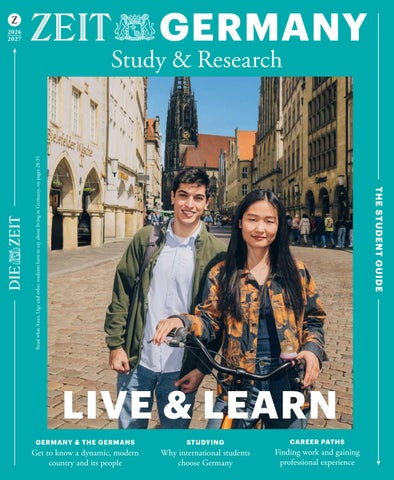
Read what Anar, Lige and other students have to say about living in Germany, on pages 28-35
S tudy & Research STUDY & RESEARCH
LIVE & LEARN GERMANY & THE GERMANS
STUDYING
CAREER PATHS
Get to know a dynamic, modern country and its people
Why international students choose Germany
Finding work and gaining professional experience
At the University of Cologne, you earn more than a degree. Studying here will have a lasting impact on your life, your well-being and your view of the world. Together, through excellent, inspiring research and education, we foster your knowledge, competencies and curiosity to shape a better future. Join us on our campus and become part of our open, diverse community zu Köln.
Start your future
Z E D I TO R I A L
WHAT ARE YOU WAITING FOR?
Cover photo: Dominik Asbach [M]; photo: Inez Sharp
Christiane Schäffner, Judith Gilbert, Elke Latinovic (back), Sarah Gough, Rachel Preece, Richard Mote
If you are interested in coming to Germany to study or do research, we are here to help you on your way. Most of us came to Germany as international students, and we were all so impressed by the opportunities we found here that we stayed. There’s much to be said for a country with such a rich history in scientific innovation, culture and the arts. Students benefit from educational excellence, academic freedom and independent thinking. It’s a safe place to live, there are job opportunities during and after your studies and, for many, it’s an affordable place to get your degree. So, what are you waiting for? Discover what Germany has to offer you! The ZEIT Germany Team ZEIT, a German weekly newspaper, covers politics, education, business and more. ZEIT Germany’s print edition is distributed mainly through the network of the German Academic Exchange Service (DAAD), the Goethe-Institut and Germany‘s Federal Foreign Office. We thank them for their support. The entire issue is available digitally at www.zeit.de/germany
3
Z CONTENTS
18 STUDYING IN GERMANY
6
GERMANY AND THE GERMANS
Top universities, low costs and strong career prospects — why Germany is an attractive destination to study abroad 26 FOOD FOR THOUGHTS
You can’t study on an empty stomach! German university cafeterias offer nutritious food that’s quick and cheap, and they are great places to meet people
Hello from the team at ZEIT Germany 6 GERMANY AND THE GERMANS
In the heart of Europe, Germany is a modern country shaped by culture, innovation and history. Find out why it is an exciting place to study, work and live 14 LAND UP!
A map and geographical overview to help you get to know Germany and its major cities 16 WATCH AND READ
Films, series and books to help you better understand Germany 4
18
STUDYING IN GERMANY
28 MY STUDENT LIFE
International and German students explain why they chose to study here, how they spend their free time and what they love about living in Europe 36 QUIRKS & CUSTOMS
A guide to help you settle in and navigate university and daily life 38 A PLACE FOR RESEARCH
Three international researchers in North Rhine-Westphalia share their experiences and reasons for choosing Germany 42 CULTURE SHIFT
An American research associate teaching in Munich reflects on academic culture, work-life balance and making a career here
Photos: Stefan Volk/laif: Regensburg and the Danube, mauritius-images/Alamy, Dominik Asbach
3 WHAT ARE YOU WAITING FOR?
CONTENTS
28
MY STUDENT LIFE
44 ON A CAREER PATH
58 PAPERWORK PARADISE
Working in Germany has advantages and looks great on a résumé. International students on how they got a job — and what not to do
How to navigate appointments, paperwork and rules to ensure that bureaucracy doesn’t get the better of you
48 SAY WHAT?!
60 CHECKLIST
A reference guide to German university-related vocabulary
Wondering where to start? Here’s a useful timeline to help you tick off what needs to be done and when
52 GETTING READY
What and where to study? And do I qualify? We tell you here how to find the answers 54 HIT THE ROAD
From cycling like a local to making the most of trains, trams and student travel deals — this practical guide will help you get around Germany with confidence 56 MONEY TALKS
The key cost factors you’ll need to consider
63 ZEIT GERMANY
The fine print: who we are and how to contact us 64 FACTS & FIGURES
Test your knowledge of fun facts and stats about German culture and universities 66 USEFUL LINKS
Our links help you prepare for your great German adventure
Z GERMANY
GERMANY AND THE GERMANS In the heart of Europe, Germany is a modern, diverse country shaped by culture, innovation and history. Find out why it is an exciting place to study, work and live. BY ANA MARIA MÄRZ
6
Photo: Frank Siemers/laif
A view of Hamburg’s harbor and the Elbphilharmonie 7
Modern life with a backdrop of history — here, at the statue of Goethe and Schiller in Weimar
Photos: Dagmar Schwelle/laif, mauritius-images/Alamy
GERMANY
GERMANY
Ask people around the world how they picture Germans, and most will probably have a clear idea in their head. Punctuality, reliability, seriousness, orderliness, efficiency are often considered typical qualities. The Germans’ style of communication is also considered distinctive. They are said to be direct, to get to the point quickly and have a dry sense of humor. While there is some truth to that, Germany has a population of 83.5 million, and includes many different people and personalities with varying backgrounds, lifestyles and perspectives. The cliché of a man in lederhosen or a woman in a dirndl — the traditional folk costume from the state of Bavaria, which hosts the world-famous Oktoberfest in Munich — has little to do with everyday clothing. Jeans, T-shirts, sweaters and sneakers are far more common on German streets, and communication isn’t as stiff and formal as it once was. Internationalization and digital connectivity, which bring people around the world closer together, have introduced a greater sense of casualness. This is most evident in Germany’s major cities, particularly in the capital, Berlin, home to almost four million people, as well as in Hamburg, Frankfurt, Munich and Cologne. Even in many smaller towns, you can see how colorful and diverse the Germans are — after all, around 30 percent of the population has an immigration background. In cities, international restaurants, supermarkets and multilingual cultural events are part of everyday life. A multitude of languages can be heard on the streets, on public transport, in cafés or lecture halls, where you can almost always get by with English. THE FUTURE HAS ALWAYS BEEN NOW
For foreign students in Germany, or those interested in coming here, the fields of engineering and the natural sciences are particularly attractive. This comes as no surprise, since Germany is well known for its innovative strength in the fields of technology and science — and that has a long tradition. For example, the automobile was invented in Germany: Carl Benz filed a patent for his “vehicle powered by a gas engine” in 1886. To this day, the automotive industry remains important — it’s the largest industrial sector in the country in terms of turnover. In other
Albert Einstein, from Ulm. Who says German scientists don’t have a sense of humor?
Many languages can be heard on the streets, on public transport, in cafés and lecture halls
fields, too, scientists from Germany have set major milestones. The very first Nobel Prize was awarded, in 1901, to two Germans: physicist Wilhelm Conrad Röntgen for his discovery of X-rays, and physician Emil von Behring for developing a serum against diphtheria. Other famous winners of this prestigious prize include Max Planck and Albert Einstein. German researchers continue to be recognized for their achievements. It’s no wonder that, given its successful scientific history, the country invests heavily in research and development — in industry, but also in areas such as medicine, digitalization and artificial intelligence, sustainability and renewable energy, through wind and solar farms that shape the landscape in some regions. But Germany also has the future in mind, developing hydrogen technology and promoting electric mobility, including autonomous vehicles, which are being tested in some cities in public transit, for example with driverless buses. The country does a great deal to remain successful and future-ready, and to address the challenges of 9
GERMANY
FROM POETS TO PARTIES
This presents great opportunities for those from abroad to live and work in Germany
Old town centers are great places to meet up with friends. Read what students Hanna and Julian have to say about studying in Heidelberg, on pages 34–35 10
Philosophers such as Immanuel Kant, Friedrich Nietzsche, Theodor W. Adorno and Hannah Arendt each made a name for themselves internationally through their work. The country is known as the land of poets and thinkers for good reason. The poet Johann Wolfgang von Goethe wrote his world-famous classics here, such as The Sorrows of Young Werther and Faust. Along with the works of Friedrich Schiller, these are still part of the school curriculum today. Schiller wrote the poem Ode to Joy in 1785. It was later set to music by Ludwig van Beethoven and, 200 years after it was written, it became the official anthem of the European Union. Artists from Germany have produced significant musical works. One need only think of great classical composers such as Beethoven and Johann Sebastian Bach. But there are also modern musical success stories. The band Kraftwerk, for example, pioneered electronic music in the 1970s, a genre for which German DJs are still celebrated internationally. And the music scene has more to offer: From the hard rock Scorpions, or the punk rock bands Die Toten Hosen or Die Ärzte, all founded decades ago but who are still popular today, to younger stars such as Apache 207, probably Germany’s most successful rapper, pop-rock’s AnnenMayKantereit or pop’s Helene Fischer — there is a genre catering to every taste. When it comes to celebrations, every region has special traditions. In the Rhineland, in the west, Carnival is a major event — often called the “fifth season,” alongside spring, summer, fall and winter. In the Carnival strongholds of Cologne and Düsseldorf, hundreds of thousands of people in costumes take to the streets at the height of the festivities. Across Germany, Christian holidays such as Easter and Christmas are important — about 38 million residents are Christians — and, for many people, these holidays are occasions when the whole family comes together. Friends and colleagues meet up in December at Christmas parties or at the cozy Christmas markets, which are especially beautiful in the romantic old town centers of Heidelberg, Lübeck, Bamberg and many other places. Visitors and new arrivals in Germany are often surprised to find that most shops and businesses close on Sundays and public holidays. These are viewed as moments to slow down and spend time with family or friends, or as a chance to enjoy something cultural. Concert lovers, for example, should visit Hamburg’s amazing Elbphilharmonie, which opened in 2017. Alongside classical music, pop and rock concerts take place there. The building’s striking glass structure sits directly on the harbor and is well worth a visit
Photos: Anne Ackermann, mauritius-images / imageBROKER
our time, such as climate change, in modern ways. This is also visible in everyday life here — through bottle-return machines in supermarkets, reusable coffee cups and recycling bins, to name just a few examples. In urban areas, more space and greater safety are being created on the roads for cyclists — bicycles and e-scooters available for rent offer an option for short trips, and car-sharing services help make it convenient to travel flexibly without needing to own a car. Innovations for the future are being driven not only by established companies and research/educational institutions, but also by lots of start-ups. They, too, contribute to greater growth by creating new business models and jobs. More than 77 percent of people in Germany are employed; and in many sectors, such as IT, healthcare and skilled trades, more workers are being sought — partly due to demographic change and labor shortages. This presents great opportunities for those from abroad to live and work in Germany.
GERMANY
not only for its outstanding acoustics, but also for its architecture. Contemporary music acts perform regularly in major cities, and there are countless ways to go out, meet new people, simply enjoy the time or experience something special. Germany has a vibrant festival culture with some 1,800 music festivals happening around the country each year. The best known of these are the twin festivals Rock am Ring, in the Eifel region, and Rock im Park, in Nuremberg, which boast big international stars. A COUNTRY WITH HISTORY
If you prefer art, Berlin’s Museum Island is an ensemble of five museums on an island in the Spree River, which, since 2009, has been a UNESCO World Heritage Site. A visit to the Städel Museum, in Frankfurt, or the Old Masters Picture Gallery, in Dresden, come highly recommended. Germany has more than 7,000 exhibition venues and museums. Among the most popular, however, is a place dedicated entirely to the history of technology: the Deutsches Museum in Munich. Museums that deal with Germany’s turbulent past — including its darkest chapters — play an important role in society. Remembrance of the victims of the Holocaust is kept alive, for example, at the Topography of Terror Documentation Centre, in Berlin, about the crimes committed during the National Socialist era, from 1933 to 1945. The capital Berlin, the capital, is a city of contrasts — here, the Reichstag and the Paul Löbe Building, which houses parliamentary committees
Selfmade. Made by EBS. A strong personality helps others to reach their full potential. Gülsah Wilke embraces this mission. Since graduating from EBS Universität, she has held various positions at leading companies and is now an investor at DN Capital. At 2hearts, she now helps people with a migrant background to take advantage of their opportunities in Germany and fully exploit their potential. Learn more about her success story and the EBS Universität study programmes.
www.ebs.edu
PART OF SRH
GERMANY
The country’s 16 states — each with its own unique characteristics — are heavily involved in the creation of new laws. Discussions and debates also take place among the general population, of course — on social media, in podcasts, on television, at public events, in the office, within families and among friends. Issues such as democracy, the environment, digitalization, immigration and the rising cost of living weigh on people’s minds. While Germany offers a high quality of life, things are far from perfect for everyone. As a result, there’s hardly a topic on which everyone agrees. It’s no coincidence that people speak of Germany’s “80 million national soccer coaches.” Sport is, of course, a topic that almost everyone has something to say about.
The south offers outdoor activities such as hiking in the Alps
also offers opportunities to learn about other periods of Germany’s long history. The Berlin Wall Memorial is a reminder that the city was once divided into two parts — as was the whole country, until reunification on October 3, 1990. This Day of German Unity is now celebrated as a national holiday. At the same time, Germany continues to grapple with the deep marks left by decades of division between East and West. Germany’s federal parliament, the Bundestag, is one of Berlin’s most distinctive landmarks, thanks to its glass dome, through which visitors can look down into the plenary chamber. It’s even possible to attend a session of the Bundestag (you must register in advance) and witness a parliamentary debate firsthand. And there’s much to talk about in a democracy like Germany’s, in which freedom of expression is a cherished value protected by the constitution. 12
There’s much to talk about in a democracy, in which freedom of expression is a cherished value
Photo: mauritius-images / imageBROKER / Moritz Wolf
FITNESS, FUN AND FOOD
Soccer is Germany’s most popular sport. People follow not only the men’s and women’s national teams, but also the Bundesliga. On weekends, it’s common to see (and hear) groups of soccer fans dressed in the colors of their favorite team, singing and cheering. Many people also do sports themselves, either just for fun or in clubs. In total, there are around 86,000 sports clubs, each with an average of 300 members. Whether it’s cycling, tennis, yoga or swimming — there’s something for everyone. Around 2.5 million students across Germany engage in sports at their universities. Winter in Germany can be cold and snowy. Particularly in the south, close to the Alps, skiing and snowboarding are popular activities. When the weather is right, however, spending time outdoors is important — walking, hiking or cycling. In summer, some days can get hot, but there are lots of places to cool off — in one of Germany’s countless lakes or at one of the beautiful beaches along the North Sea or Baltic Sea coasts. For those interested in history and culture, a trip to one of the country’s many palaces or castles is always a highlight. Neuschwanstein Castle, in Bavaria, or Hohenzollern Castle, in Baden-Württemberg, are two of the most famous ones. There’s also a wide variety of food to try — including regional dishes like roast meat, dumplings and sauerkraut, or Black Forest cake, along with a great many international, vegetarian and vegan dishes. Even on your plate, the diversity of the country is on full display. Germany is full of contrasts and surprises on many levels. It is a land of living history and forward thinking all at once — and this perhaps paradoxical combination makes it a fascinating place to study, to work and to live.
Knowledge made in Germany
SRH Fernhochschule The Distance Learning University
Study wherever life happens. Study at SRH Distance Learning University — Education without limits. Since 1996. German quality. Global access. — State-recognised German university degree — 100% online flexibility — English & German programmes available — Personal support throughout your journey
Start your journey to a German degree today. Scan & explore your programme options
Z MAP OF GERMANY
LAND UP! Arts, politics, science and technology — Germany is famous for its rich intellectual and cultural history. Here, we introduce some of the country’s landmarks and give you a geographical overview. BY RACHEL PREECE
BERLIN
COLOGNE
Founded in Roman times on the banks of the Rhine, Cologne’s skyline is dominated by the UNESCO-listed Gothic cathedral, which took over six centuries to build. Carnival in Cologne is world-famous — locals call it the “fifth season.” Fun fact: Cologne is from… Cologne! Eau de cologne resulted from experiments by Italian Giovanni Maria Farina in the city in 1709. His perfume factory there is the oldest in the world. FRANKFURT
On the banks of the Main River, Frankfurt is Germany’s financial center, and its many skyscrapers make it unlike any other German city. It’s also the seat of the European Central Bank. Fun fact: The city is the home of the hot dog, first invented over 500 years ago. HAMBURG
Called the “Gateway to the World,” Hamburg has Europe’s third-largest port. The city’s architecture fuses old and new, with redbrick maritime warehouses and the strikingly modern Elbphilharmonie concert hall. Germany’s second-largest 14
city, Hamburg is also one of Europe’s greenest. Fun fact: The Elbphilharmonie features 1,000 hand-blown glass lamps and 10,000 uniquely carved acoustic panels. HEIDELBERG
Founded in 1386, Heidelberg University is one of the world’s oldest surviving universities. It’s a quaint town centered around academia, and the surrounding forests are said to have inspired the German Romantics. Fun fact: The Bunsen burner was invented in Heidelberg, in 1855 — by Robert Bunsen. MUNICH
Munich, the capital of Bavaria and Germany’s third-largest city, is known for its outdoor lifestyle, being close to lakes and mountains. It’s also known for its breweries and traditions revolving around beer, rustic cuisine and folk festivals. Fun fact: The “B” in BMW, headquartered in Munich, stands for “Bavarian.” The BMW Welt museum is popular among visitors, with a roof designed to look like a floating cloud. STUTTGART
Famous for its iconic, minimalist cube library, Stuttgart has a thriving automobile industry, plenty of parks and excellent art galleries. The Black Forest is a stone’s throw away, the setting for many of the Grimm fairy tales, including Hansel and Gretel. Fun fact: Stuttgart has the largest deposit of spring mineral water in Germany.
Illustration: Jörn Kaspuhl
Germany’s capital carries its history in plain sight. The Berlin Wall once divided not only politics but whole ways of life, and its traces still shape the city’s character today. Home to around four million people from more than 190 nations, Berlin is one of Europe’s most diverse capitals. Fun fact: Berlin’s TV Tower is the tallest free-standing structure in Germany (368 meters).
15
Z MEDIA
WATCH AND READ Here’s a selection of entertaining films, series and books that will help you better understand Germany’s past and present. BY RACHEL PREECE
VICTORIA
BABYLON BERLIN
Director: Sebastian Schipper
Directors: Tom Tykwer, Achim von Borries and Henk Handloegten
GOOD BYE, LENIN!
Director: Wolfgang Becker A humorous and moving film, Good Bye, Lenin! (2003) helps explain Germany’s recent past through one family’s story in East Berlin in 1990. When Alex’s mother wakes from a coma, she has missed the fall of the Berlin Wall and the end of the G.D.R. (East Germany). To spare her shock and stress, Alex tries to recreate the old socialist world inside their apartment, creating fake news broadcasts and hunting for vanished East German products. As his “little G.D.R.” becomes harder to maintain, the film shows how fast politics, identity and daily life can change. It’s a great introduction to reunification and the emotional complexity behind the fall of the wall. 16
Babylon Berlin (2017–2026) is a stylish noir drama set during the Weimar Republic, a time of political violence, economic instability and cultural experimentation. Between nightclubs, street unrest and backroom deals, the series shows how modern Berlin was being invented — and how fragile the political system was. It’s a vivid window into German history before 1933 and shows how this era influenced Germany’s development. PAGAN PEAK
Directors: Cyrill Boss and Philipp Stennert Adapted from the Swedish-Danish series Bron/Broen (The Bridge), Pagan Peak (2019–2023) begins when a body is discovered on the border between Austria and Germany, forcing investigators from both sides to work together. In the first season, the case is full of Alpine folklore and occult imagery, giving the series a distinctive sense of place. Beyond the crime plot, it takes viewers into a world where rugged landscapes, strong local identities and old traditions still shape everyday life. It’s an atmospheric way of showing a side of German-speaking culture that’s not often seen. Photos: pr
One of few movies filmed in one continuous take, Victoria (2015) tells the story of a young Spanish musician who has recently moved to Berlin. She finds herself in a dangerous situation after she befriends four locals on a night out and gets mixed up in a bank robbery. Based on a 12-page script, much of the dialogue is improvised, making the story all the more intense. This thriller is set in contemporary Berlin, showing its cultural facets, from Spätis (convenience stores) to techno clubs. In a triumph of timing, its glorious finale features a sunrise over the city.
MEDIA
liva b lea n dlo v a b le : U n ive rsityo fS ie g e n
THE SHORTEST HISTORY OF GEMRANY
Author: James Hawes Historian James Hawes consolidates 2,000 years of sweeping German history into under 250 pages. It’s an entertaining introduction to Germany, with maps and visual aids, making the country’s complex past easy to understand. From the Holy Roman Empire to Prussia, the world wars, division and reunification, the book highlights how Germans have frequently rebuilt institutions after a rupture. WHERE YOU COME FROM
Author: Saša Stanišić Winner of the 2019 German Book Prize, Where You Come From tells Saša Stanišić’s story, which begins in a small Bosnian village and follows his life as an immigrant in Germany. He weaves together his grandmother’s fading memory with his own shifting recollections, alongside experiences of war and starting over. Despite the heavy themes, the book is often deeply funny, warm and sharp. It’s a moving reflection on how identity is shaped by the places we come from, the languages we speak, and the people and environment around us.
Fre etu itio na n daw id era n g eo fstu d yp ro g ra m s inag re e ncityw ithsm a ll-to w nch a rm ,cre a tin g a ne xtra o rd in a rystu d ye xp e rie n ce .
V isito u rw e b site
R e cru itin ge xce lle n tstu d e n tsinA Ia n dse n so rs a t: h ttp s://w w w .u n i-sie g e n .d e /n t/e x ce ls
ADDRESS UNKNOWN
Author: Kathrine Kressmann Taylor First published in 1938, Kressmann Taylor’s novel has fewer than 100 pages, but packs a punch. Written in the form of a series of letters, it presents intense, detailed first-person stories of life under the Nazi regime in its early days, and hauntingly anticipates the horror of what was to come.
17
Photo: mauritius-images / Alamy Stock Photos / Oleksandr Prykhodko
German universities offer excellent facilities. Here, the library at Berlin’s Humboldt University
Z S T U DY I N G
STUDYING IN GERMANY Top universities, low costs and strong career prospects – Germany has become one of the most attractive destinations to study abroad. BY VINCENT SUPPÉ
Universities as cathedrals of learning — here, the innovative architecture of the University of Leipzig (right) in the city center
20
Germany: “Jena is called the City of Light for a reason,” he says. “It’s the place to study photonics.” With its research institutions and long-established companies, such as ZEISS and SCHOTT, the city is considered to be one of the world’s centers for optics and photonics. For Gupta, it was a logical step. “In Germany, I was offered the best educational and internship opportunities.” WHAT GERMANY OFFERS
“Going to university is not only informa tive, but also per sonally rewarding” Tanmay Gupta
As a place to study, Germany enjoys an excellent in ternational reputation. Engineering and the natural sciences are especially popular among the more than 400,000 international students currently enrolled at German universities — according to figures from the German Academic Exchange Service (DAAD). More than half of them study in one of the STEM fields. It was this reputation that prompted İlayda Öz kan to move to Germany from Turkey. “I wanted to study engineering — Germany is famous for that, with its automotive companies and its industry,” the 23-year-old says. Since she wanted to combine a technical mechanical-engineering degree with business-related content, Özkan chose industrial engineering at RWTH Aachen University. “That gives me the greatest possible flexibility in my later career.” Another factor is that studying in Germany is relatively affordable compared with many other countries.
Photos: iStock.com, Hannes Jung/laif, privat
Successful physicists have long been associated with the city of Jena. Nobel Prize winner Herbert Kroe mer studied there. Ernst Abbe, Carl Zeiss and Otto Schott laid the foundations of modern optics. And Erwin Schrödinger worked in Jena in 1920. Per haps, one day, the name Tanmay Gupta will join this prestigious list. His career may still be young but it’s already highly impressive. The 24-year-old was born in India but he’s lived in ten different countries, including Indonesia, Ga bon and Mexico. Gupta has lived the longest time in Malaysia. “Today, the country feels like home to me,” he says. It was there that Gupta developed a fascination with space — something that has stayed with him, along with one of his notebooks about space from third grade. Gupta earned his bachelor’s degree in physics and aerospace engineering at the California Institute of Technology. He also spent a semester in Cambridge, in the U.K., and later worked for NASA and at two aerospace start-ups: in San Francisco and in Toulouse, France. He has helped develop about 30 satellites that are now in space. Today, he studies in Jena, a university town in Thuringia, in eastern Germany, with just over 100,000 inhabitants. As part of a European master’s program, Gup ta is studying photonics — a field of physics con cerned with using light waves to transmit, process and store information. After periods of study in the U.S., France and Italy, Gupta was drawn to
S T U DY I N G
But for Özkan, the decision to come to Germany was not only a rational career move. “I’ve been interested in languages and new cultures all my life,” Özkan says. Studying abroad allowed her to fully indulge her curiosity. And Germany has a lot to offer beyond its universities, with its long history, cultural institutions and varied geography in which vibrant cities such as Berlin, Leipzig and Hamburg alternate with rural regions, picturesque coastline and mountains. In addition, there’s a lot to discover in Germany’s nine neighboring countries and beyond. If you travel a few hours by train or bus in any direction, you’ll find yourself in a new country with a different language and culture. Since Gupta has been studying in Europe — sometimes called “the continent of short distances” — he has made full use of this location advantage. He finds time to travel, in part because Germany’s education system offers quite a lot of flexibility. In many other countries, degree courses are largely predetermined but, in Germany, Gupta had a long list of topics from which to choose the ones that best matched his interests — and his schedule. “Like this, going to university is not only informative, but also personally rewarding,” he says. THE GERMAN SYSTEM
Strictly speaking, there is no one type of German university. The country’s higher-education system is diverse and includes a broad range of institutions: universities, universities of applied sciences as well as specialized schools for artistic degree programs, such as film, art, acting and music. Traditional universities are the most common type of higher-education
Bulletin boards are a common sight at German universities and help students to find housing, study partners and social activities
“Studying abroad isn’t only about a degree, but also about personal maturity and life skills” İlayda Özkan
institution. They’re geared toward academic work with a focus on theoretical foundations, analytical thinking and research, which in STEM subjects can be quite hands-on. With a wide range of subjects, universities aim to provide students with a broad and in-depth understanding of their field. Alongside these, there are also more specialized institutions — such as technical universities, which concentrate on particular disciplines. Universities of applied sciences have a different profile, in which practical relevance is key. Degree programs are often tailored to specific professional fields, for example in engineering, business, social work or media. Typical features include integrated practical phases, cooperation with companies and application-oriented teaching formats that make it easier to enter working life directly.
Lies Deutschland, wie es wirklich ist! Deutsch perfekt – the eMagazine for German learners
ONE FREE ISSUE
✓ From A2-C1: Learn at your level ✓ Understand tricky vocabulary ✓ Practise with native speaker audio
Get your free issue www.deutsch-perfekt.com/germany
S T U DY I N G
As far as degrees are concerned, bachelor’s and master’s programs dominate in Germany today. In some fields, however, such as medicine or law, the state examination (Staatsexamen) is still the decisive qualification. In addition, the dual-study model, in which academic education and real-world work in a company are closely interlinked, is well established. While universities in many countries are coming under increasing pressure and affected by financial cutbacks, Germany’s state and federal governments have been promoting top-level research since 2016 through what’s called the Excellence Initiative. This is achieved through two central elements: Universities of Excellence are strengthened in their overall research performance, while Excellence Clusters fund projects in specific subject areas and enable cooperation between universities and other research institutions — including non-university organizations such as the Max Planck Society, the Helmholtz Centers, the Fraunhofer Society and the Leibniz Association. It was recently decided that ten of the 11 currently funded Universities of Excellence will receive financial support for another seven years. The number of Excellence Clusters continues to grow, with the 45 existing projects being joined by 25 new initiatives. The aim is to help German universities 22
“Good language skills are a decisive success factor in professional life” Johannes Ebert
gain greater international visibility and strengthen their competitiveness. In the small town of Heilbronn, the new Innovation Park Artificial Intelligence (IPAI) campus is being developed with cutting-edge research and development that’s focused on the digital future of Germany (and internationally). This region in the north of Baden-Württemberg is quietly growing into Germany’s Silicon Valley. “Germany is an internationally attractive place to study — not least because of its high-quality education system, the absence of tuition fees and the variety of German and English-language degree programs,” confirms Johannes Ebert, the secretary general and chairman of the executive board of the Goethe-Institut. Its tasks include promoting the German language abroad and strengthening intercultural cooperation. Ebert strongly recommends that international students learn German: “Good language skills enable participation in society and are a decisive success factor in professional life in many industries.” GETTING SETTLED
Gupta and Özkan confirm this. In order to learn German and familiarize herself with the culture, Özkan completed a one-year preparatory course
Photos: Getty Images, Goethe-Institut e.V.Bernhard Ludewig, privat
Campus life is rich and relaxing, as seen here at the University of Bonn
S T U DY I N G
in her home country. She also traveled to Germany several times. “I saw it as a kind of trial phase for my later studies.” Even so, not everything went smoothly after the move. “My first weeks in Germany felt like a honeymoon phase,” she says. For the first time, Özkan was living alone, could use her language skills, visit restaurants and cultural events and meet new people. She enjoyed student life and her new freedom. Then, a kind of culture shock followed: “I missed my parents and my home, had motivation problems and struggled with doubts about whether studying abroad was really the right decision,” she explains. Germans seemed more reserved than she was used to and, despite her C1 language certificate, she found communication with banks and public authorities complicated. “Today, I know that this is normal and part of the integration process.” Özkan was not discouraged. She attended workshops and dance classes. At her university’s International Office, she found a student job that required communicating a lot with new people. “That forced me to leave my comfort zone,” she says. “That was an important step for me. Studying abroad isn’t only
“Universities in Germany give their students a lot of freedom” İlayda Özkan
about a degree, but also about personal maturity and life skills.” Many universities support international students in this process: They organize meetups with other students, offer mentoring and run job boards. Sport can also help with integration. The German University Sports Federation (adh) offers a wide variety of sports programs, through which students can meet each other and compete in athletic events. In Özkan’s experience, personal initiative plays an important role both in integration and in selforganization in everyday life and studies. “Universities in Germany give their students a lot of freedom,” she says. Due to the demands of the high academic level, students have to find their own learning rhythm: “That teaches you effective time management.” Özkan doesn’t regret choosing Germany as a place to study — in fact, she’s planning to do her master’s degree here. FREEDOMS AND CHALLENGES
Both Gupta and Özkan draw a positive conclusion about student life in Germany, but they also faced challenges. Affordable housing is scarce in many
S T U DY I N G
Uni-pedia
Degrees
Bachelor’s and master’s degrees are the standard for most university programs. However, if you study medicine or law, for example, your program will likely end with state board examinations (Staatsexamen). Germany is renowned for its STEM programs
university cities, and many student dormitories lack space. And while urban residents in particular tend to hold liberal views, right-wing populist parties are gaining votes. Gupta says he had experienced isolated incidents of discrimination. He was also surprised by inefficient bureaucracy: “I didn’t expect having to mail documents in paper or paying in cash only,” he says. Despite these difficulties, Gupta and Özkan would come to Germany again at any time to study. Alongside the high quality of education, they see quality of life — including a wide range of cultural offerings and diverse cuisine — as a big attraction. Also, since the towns and cities generally have bicycle lanes and extensive public-transport networks, there’s often no need to drive or own a car. Financially, that can be a significant plus. Finally, studying in Germany can open up career opportunities. More and more universities do not just provide a degree, but also offer support in founding a business. “The incubator programs are amazing,” says Gupta. These services are part of a larger network, supported by both public and private funds, with the aim of converting theoretical ideas and research results into start-ups. He has taken advantage of this and started his own company. The contacts, advice and funding that he receives through the university, the Digital Innovation Hub Photonics and JENAINNOVATION are a tremendous help. “I want to make a real impact in the world with my ideas,” he says. “I feel very much encouraged.” 24
Dual studies
A distinctive feature of Germany’s education system, dual-study programs combine practical training in companies with studies at a university to integrate practical experience with theoretical learning. Expected study duration
The German word Regelstudienzeit refers to the recommended length of a degree program. It’s a guideline of how many semesters students should need to complete their studies. The actual time that’s necessary depends on individual circumstances. Preparatory college
For those whose school qualifications aren’t equivalent to the German university entrance qualification, a preparatory college (Studienkolleg) prepares them academically and linguistically for student life at a university in Germany. Private universities
Alongside the many public highereducation institutions, there are more than 100 private universities and colleges in Germany. Some are affiliated with religious organizations, foundations or corporations. As they receive no state funding, they charge tuition fees – typically ranging from €5,000
to €20,000 per year – or are supported through alternative sources of funding, such as donations. Be aware that, in some countries, private brokers and agencies may falsely claim affiliation with a German university. It is always safer and recommendable to use official channels such as the DAAD, HeyStudium or a German embassy or consulate. State universities
Most of the more than 270 public universities and colleges are financed by the federal states. With a few exceptions, such as in Baden-Württemberg and Bavaria, students do not pay tuition fees at these institutions. However, they are generally required to pay semester contributions, typically ranging from €100 to €500 per term. Student discounts
Many businesses, services and cultural institutions offer discounts to students who have a valid student ID. A semester ticket, usually included in the semester fee, allows unlimited travel in a specific region or transport network for the duration of one semester. Technical universities (TUs)
Germany’s technical universities focus on education and research in science, technology, engineering and mathematics (STEM). Their programs are especially strong in fields such as engineering, physics and architecture. Universities of applied sciences
Universities of applied sciences (Hochschulen für angewandte Wissenschaften, or Fachhochschulen) focus on practical training and real-world application. They tend to specialize in areas such as engineering, business, social sciences and media. Internships and handson learning are core elements of the degree.
Photo: mauritius-images / imageBROKER / Olaf Döring
Art colleges
Film, music and art colleges specialize in the creative arts. They combine theoretical studies with practical training in fields such as the visual arts, music and the performing arts.
ANZEIGE
As applied research becomes central to tackling global challenges, Germany’s academic landscape is evolving. Trier University of Applied Sciences can now award doctorates in three key fields. (Photo: © Jannik Scheer)
Applied Research, Independent Doctorates: Trier University of Applied Sciences For many years, universities of applied sciences in Germany could award doctorates only in cooperation with research universities. That model is changing. As global challenges increasingly call for practical, evidence-based solutions, Germany’s academic landscape is adapting. Building on its sustained research performance, the state of Rhineland-Palatinate has granted Trier University of Applied Sciences the indep e n d e n t r i g h t to aw a rd doctorates in selected research clusters. This structural milestone opens a new academic pathway centred on three doctoral programmes. In the “Applied Com-
puter Science” cluster, led by Trier University of Applied Sciences, researchers develop data-driven software and intelligent systems. The “Sustainable Technology and Natural Sciences” programme focuses on engineering the green transition and closing resource cycles. Concurrently, the “Medical and Environmental Life Sciences” centre explores links between human health and ecological systems. Rather than working in theoretical isolation, doctoral candidates and researchers joining these programmes are embedded in strong interdisciplinary networks of applied research. This reframes doctoral educa-
CONTACT AND FURTHER INFORMATION Trier University of Applied Sciences Schneidershof | 54293 Trier, Germany Tel.: +49 651 8103 0 Email: j.tatarinov@hochschule-trier.de | hochschule-trier.de
tion: from purely foundational research towards application-oriented innovation with tangible impact across the university’s locations. At Trier University of Applied Sciences, doctoral candidates benefit from close supervision, strong research environments and collaboration across institutional and disciplinary boundaries. This dynamic academic ecosystem shows how modern applied sciences can bridge rigorous academic research and practical implementation.
AT A GLANCE Doctoral Clusters: Applied Computer Science (lead institution), Sustainable Technology and Natural Sciences, Medical and Environmental Life Sciences Strategic Focus: Sustainability, digitalisation and health Campus Locations: Main Campus Trier, Campus for Art and Design in Trier and Idar-Oberstein, Environmental Campus Birkenfeld Academic Status: Independent right to award doctorates, granted in February 2026 Research Environment: More than 100 ongoing funded projects, supported by strong industry and regional networks Admission Requirements: Relevant master’s degree or equivalent qualification, and a passion for applied research
Photo: plainpicture/Angela Franke
FOOD FOR THOUGHTS
Z MENSA
You can’t study on an empty stomach. At universities all over Germany, student-run cafeterias and cafés not only offer nutritious food that’s quick and cheap, but are also great places to meet people. BY RICHARD MOTE
Studying makes students hungry. Between seminars, lectures and sessions in the library, there may be little time to get something nutritious to eat and help students keep going through the afternoons. Luckily, there is a place that offers good meals that are also quick and cheap — the Mensa (“cafeteria”). Named after the Latin word for “table,” the Mensa is an essential part of student life in Germany, and it’s much more than just a place to get lunch. Munich has 20, Hamburg about 35 and Berlin more than 40 student cafeterias and cafés. Throughout Germany, there are nearly 900 university catering facilities that are run by student services. Every day, they serve about 1.5 million meals to hungry students, based on 2024 data — in that year, the total turnover of these operations was more than €410 million. Generally, the biggest universities also have the biggest cafeterias. One of the largest and most modern in Germany can be found at the Technical University of Munich: With around 5,000 square meters of space, spread over two floors, it can seat about 1,700 people and serve up to 7,300 meals a day. HEALTHIER, GREENER AND WITH MORE CHOICE
A lot of the student-run cafeterias in Germany work hard to provide nutritious meals that use fresh ingredients, while also creating a varied menu that offers something for every dietary need. A decade ago, the most popular dish in the university Mensa, by far, was currywurst with French fries. Since those days, however, growing awareness of health and environmental concerns has led to a clear shift toward healthier food with less meat, more meat alternatives as well as more international cuisine. While the German classics, such as roast pork and
spaetzle, are still available, students today also have the choice of Asian and Middle Eastern dishes, for example, along with vegetarian and vegan options. Sometimes, the meals might be unexpectedly exotic — early in 2026, the university cafeteria in Erlangen served kangaroo chili with basmati rice. The price for students was just €3.79. QUALITY AND VALUE FOR MONEY
When it comes to price, the Mensa is practically unbeatable. For students, most of the meals in Berlin’s cafeterias, for example, cost between €1.50 and €3.50 — faculty staff and nonstudent visitors have to pay more. And nearly every cafeteria accepts cashless payments, either with a student ID or a regular bank card. At the same time, however, the student cafeterias, along with canteens more generally, in Germany have experienced a certain level of inflation in recent years. Although they’re still excellent value for money, cafeteria prices have been rising, primarily due to the higher costs energy, food and labor. Given the benefits of quality and economy, Germany’s cafeterias are popular with students and generally rated highly — nationwide, the average rating is 4.04 out of five stars, according to a 2026 survey by the careers platform JobMeHappy, based on around 60,000 Google reviews covering 280 student cafeterias and cafés. Beyond getting a bite to eat, however, the Mensa is a social focal point at any university — a place where students from various disciplines get together to socialize or study groups meet to discuss their seminars, since there’s no need to be quiet as there is in a library. The Mensa is a great place to meet friends and make new ones, and that’s especially useful for international students and anyone who is new at a university.
EAT AT THE MENSA
80% of students use their Mensa 59% of the meals are eaten at lunch Most common reasons for eating at the Mensa: • close to campus • high quality of food • reasonable price • saves time SOURCE: Deutsches Studierendenwerk
FINEST FOOD?
Highest average ratings among the big university towns 1. Heidelberg: 4.16 2. Dresden: 4.15 3. Leipzig: 4.14 4. Cologne: 4.12 5. Hamburg: 4.05 SOURCE: JobMeHappy, 2026
27
Z STUDENTS
MY STUDENT LIFE
STUDENTS
From Lüneburg to Münster, Chemnitz and Heidelberg — all around Germany, young people are pursuing their education and planning their future. Here, eight students tell you why they chose their universities, how they enjoy spending their time and what they love about living in the heart of Europe.
Photo: Enver Hirsch
INTERVIEWS BY BENJAMIN HINDRICHS
Beatriz Buccioli, 26 Brazil
Pin-Chen Chen, 24 Taiwan
Sustainability Science: Governance and Law (M.A.), Lüneburg
Sustainability Science: Ecosystems, Biodiversity and Society (M.Sc.), Lüneburg
It sounds dramatic, but I basically gave up everything I’d built in Brazil to start over in Europe. I was 12 when I decided I wanted to be a lawyer and I’ve always had a strong sense of wanting to “do the right thing.” While I was studying law in Brazil, everyone was talking about plastic pollution and, since I grew up going to the coast a lot, it affected me personally. So, I’ve combined my interest in the environment with law. I researched how legal frameworks can reduce plastic waste and cofounded a sustainability initiative. After graduating, I moved to Amsterdam as an au pair to improve my English. That meant leaving my job, my projects and my Instagram platform where I’d been sharing sustainability content for years. Then, I got accepted to a fellowship in Germany and moved to Berlin for a year, working on a project about reusable packaging systems. When it came to choosing a master’s, Lüneburg stood out as one of the few places that combine sustainability with policy and law, which is exactly
where my background fits in. Although I was nervous about moving to a much smaller city, Lüneburg surprised me. It feels like a fairytale with its historic architecture and calm atmosphere. I live on campus, which makes life easy — everything is within walking distance. In my shared apartment, we’re four girls from different backgrounds, and we’re like a small family. Especially at difficult moments, like when my grandfather passed away, they’ve been there for me. That kind of support is something you can’t plan but it changes your experience. Building a social life as an international student isn’t always easy. Language plays a big role. I’m still learning German, and although people switch to English when necessary, you notice how naturally groups form around a shared language. It helps to be well prepared and have a plan B. Germany is organized but also offers less room for flexibility. Most importantly: Know why you’re doing this. Moving abroad can be tough but it also makes you grow in ways you don’t expect.
My journey to Germany started during my undergraduate studies in geography. I spent a year as an exchange student in Hamburg and got to know the country. I was drawn to the way environmental topics are approached here. There’s a strong connection between research and real-world sustainability. That’s why I chose to return for a master’s in sustainability science, with a focus on biodiversity and ecosystems. I discovered Lüneburg during a visit while I was in Hamburg and immediately liked it. Having lived in large cities, I wanted to experience something more intimate, where student life feels more connected. That’s exactly what I found here. It’s easy to meet people, and daily life feels calm and more manageable. Before my program started, I joined an intensive German course and welcome events, including campus and city tours. That’s where I met most of my friends, both international students and classmates. Academically, I had to adjust. In my previous studies, the focus was on absorbing knowledge. Here,
I’m expected to participate, think critically and contribute ideas. That’s hard at first, but I really value it. It’s changed how I experience learning. The most challenging part of living here has been the winter. I hadn’t expected it to be so cold and dark. Snow basically doesn’t exist in Taipei, so my first winter in northern Germany was a completely new experience. The days are short, the temperature drops and even simple things like getting around on public transport can be complicated. But I found a way to adapt. I made my room feel warmer and more personal, decorating it, lighting candles and inviting friends over to cook together. Those small routines make a big difference. Instead of focusing on what I missed, I made a space that felt comforting and social. In general, it’s advisable to apply for accommodation early. And be open: to new people, new ways of studying, even new weather! Coming here was about more than academics. It’s given me a sense of independence and confidence. 29
STUDENTS
Anar Abdullayev, 24 Azerbaijan Mathematics (M.Sc.), Münster
30
newspaper announcement. So, always bear in mind there are different ways to find housing. Before coming to Germany, I had heard certain stereotypes, for example that people might be distant or unfriendly. But my experience has been very different. I would describe Germans as “direct” rather than “rude.” And I actually appreciate that. It means that when someone gives you positive feedback, you know it is sincere.
Photos: Dominik Asbach
I always knew I would end up studying mathematics. My father is a mathematician and, growing up in Baku, I was surrounded by his work. I remember the papers filled with formulas and late nights spent thinking through problems — a quiet dedication that’s stayed with me. I didn’t understand then what he was doing but I remember being fascinated. At some point, it became clear that this is what I want to do. That path took me first to Ankara, where I studied mathematics as an undergraduate. After that, I had plans to continue in the U.K. or the U.S. but, without a scholarship, those options weren’t realistic. Germany turned out to be the better choice — financially and academically, with its strong tradition in mathematics. I got a Mathematics Münster Full Grant Scholarship and, later, a Wübben Foundation Student Grant Scholarship. That’s how I ended up in Münster. I’m currently finishing my master’s thesis, which sometimes means long nights without sleep, but that’s part of the process. Mathematics at this level is very different from what many people imagine. Often, it’s just a few students in a course and, after that, everyone works on their own. That means my daily life is quite structured and quiet. I spend a lot of time at home reading, watching films or working on problems and writing code. I wouldn’t say I have a big social circle, but that doesn’t bother me. This way of living fits the kind of work I do. At the same time, there are small routines that help me stay balanced, such as going to the Aasee, a lake in Münster where people relax and spend their free time. Whenever I feel stuck on a problem or need to clear my head, I go there for a walk. It’s a simple thing, but it works. I often come back with a new idea or perspective. Münster itself is calm, green and beautiful. Compared to bigger cities, everything feels more manageable. I live on the outskirts of the city, in a shared house with three flatmates. I found my room through a
STUDENTS
Lige Zhao, 26 China Information Systems (M.Sc.), Münster Ever since I was a child, I’ve been fascinated by languages. I grew up in Luoyang, a relatively small city in central China. At one point, I even considered studying languages. During my bachelor’s in information systems, I started learning German. This is how I became curi ous about Germany, its culture and the idea of studying abroad. My subject, information systems, is a mix of computer science and business, which I like because it keeps different career paths open. Münster is beautiful, full of students and shaped by a very active cycling culture. When I arrived, in 2023, I was lucky to have already secured a place in a student dorm through connections in the local Chinese community. That made the transition easier. Recently, I moved in with my German boyfriend. It’s funny — we study the same program, but met online. We hadn’t noticed each other attending class, because he’s always the first to arrive and I’m the last. When we started to look for an apartment, I contacted the owner of one I found on Kleinanzeigen, a popular local online marketplace. She later told us that hundreds of people had contacted her, so we were pretty lucky. Socially, adjusting to life in Germany has been more complex. I would describe myself as quite introverted. While in China friendships often developed naturally through shared study routines, I realized that building deeper connections here requires more effort. I know a lot of people, but truly close friendships are harder to form for me. Maybe that’s also the case because I spend quite a lot of time with my boyfriend. Looking back, I think I could have pushed myself more to join activities and meet people. That’s why I recommend being active. In your social life or career, nothing really happens unless you take the first step. Still, I value the experiences I’ve had. I spent a semester in Madrid through the Erasmus+ program, which has added an international layer to my studies. I’ve been supported fi nancially by my parents but also worked as a
student assistant for a professor, which gave me an interesting insight into academic work and helped shape my master’s thesis. Now, I’ve just submitted my thesis and I’m entering a new phase. My goal is to stay in Germany — ideally, in Münster. I would real ly like to find a job, possibly in data science or a related field. 31
Ayush Raina, 25 India
Emad Shahbazi, 31 Iran
Advanced Manufacturing (M.Sc.), Chemnitz
Advanced Manufacturing (M.Sc.), Chemnitz
I can honestly say that I love Chemnitz. It’s a city that doesn’t overwhelm you but reveals itself slowly. There’s always something happening: cultural events, festivals, student initiatives. Chemnitz might seem quiet on the surface, but underneath, it’s surprisingly vibrant. So far, it’s given me much more than just a degree. It’s given me a new passion, a strong community and the confidence to build a life from scratch in a new place. A big part of my life revolves around dancing, especially salsa. I discovered it in Chemnitz. I’d never really found the time or the right place to dance back home. I joined a university course and, from that moment on, I never stopped. Now, I even teach salsa as part of a community project for people with a migrant background. There’s a strong and welcoming dance scene in Chemnitz, through which I’ve met people from all over the world. I also organize karaoke nights, which bring together a completely different crowd. So, I’ve built several circles of friends, and my weekends 32
are often fully booked. I even celebrate my birthday more than once because my different groups don’t know each other yet. Another thing that’s shaped my experience is learning German. When I arrived, I barely spoke the language, but I took university courses, private classes and intensive programs. Today, I speak German with confidence, and it’s changed my experience of daily life. It opens doors, makes conversations easier and helps you connect with people on a deeper level. There’s a stereotype that Germans are distant but, in my experience, that’s not true. It can take time to break into social circles but, once you do, people are open, helpful and genuine. I’ve had countless spontaneous conversations on the tram or the train, and some of them turned into deeper connections. Talking to people, joining activities and being curious is really important. Even small things, like starting a conversation in the Mensa (“cafeteria”) or greeting someone on the train, can lead to something bigger.
What I’d tell others who are considering coming here is: Don’t rely too much on what you hear from a distance. Before moving from Tehran to Chemnitz, I heard many concerns, especially about the far-right in eastern Germany. Friends and family were worried. But I quickly realized how different reality can be from reputation. I found a supportive and international environment. I’m currently pursuing a master’s in advanced manufacturing, having previously studied mechanical engineering and completing a master’s in mechatronics. My goal is to move further into research, and Chemnitz is perfect for that. Soon after arriving, I was involved in multiple research projects at the university, which allowed me to apply my previous knowledge and grow academically. Beyond my studies, my life is simple. If you’re looking for me, I’ll probably be in the Mensa. It’s one of my favorite places on campus, as it’s lively and a natural meeting point. I don’t go out a lot; I prefer to focus on my research and spend time in
familiar spaces, and the Mensa combines both: I can work but never feel isolated. Over time, we’ve built a strong, international community. One of my favorite moments was organizing a Christmas celebration for our department. Around 100 people came together, which shows how open and diverse the environment is. Life in Chemnitz also has practical advantages. Compared to bigger cities, it’s very affordable. Finding accommodation was easy, which removes a lot of the stress many students face. Of course, there were small challenges. The bureaucracy for my residence permit took longer than expected, but, culturally, adapting to Germany was easier than I’d imagined. People communicate more directly, which, once you understand it, makes life simpler. Learning German was also part of that. I took courses at the university and practiced with classmates. Now, I’m at the B2 level. It makes a big difference in everyday life, and that’s why I’m planning to stay. My goal is to continue with a Ph.D. here and keep building upon what I’ve started.
Photo: Thomas Victor
STUDENTS
GERMANY
33
STUDENTS
Hanna Nassar, 21 Egypt
Purpose is important to me. Growing up in Cairo, I was always interested in understanding people. I wanted to do something that would allow me to sup port others, whether on an individual or societal level. When I found a degree
34
that combines political science and psy chology, it felt like the perfect fit. I came to Heidelberg in September 2023. Before that, I went to a German school in Egypt, graduating with the Abitur, so academically and linguis
tically, the transition was relatively smooth. Still, living here is very dif ferent from visiting or learning about Germany from afar. I love Heidelberg: the architecture, the vibe, the old city. It’s beautiful. The city is much smaller than Cairo, and that changes everyday life a lot. Everything is more accessible, you can walk or ride a bike almost any where. However, I also had to get used to the quietness. In Cairo, cafés and cinemas, for example, are open until past midnight. Here, there’s not much to do after 8 p.m., other than going to a bar or to a party. And that’s not really my vibe. Anyone thinking of coming here should be open to having new experi ences. Go everywhere, to all the meet ups, city walks or events. Wherever you are invited, go. In the beginning, no body knows anybody. So, even though you’re insecure, just go out and it’s not going to be as bad as you think it will be. Doing this helped me settle in quick ly. Early on, I joined regular meetups where I met other international students from Egypt. I participate in initiatives such as the Model United Nations or the polical science student council. I’m also part of the university’s buddy program, which helps new international students learn their way around. It’s nice to be on the other side now and support others in their first weeks. The biggest challenge, by far, was finding accommodation. Applying from abroad made it difficult to judge offers or attend viewings, and the housing market is very competitive. I was lucky to re ceive a dorm place just before arriving, but the uncertainty was very stressful. Apply to multiple places as early as possible, ideally even before receiving your university acceptance.
Photos: Anne Ackermann
Political Science and Psychology (B.A.), Heidelberg
STUDENTS
Julian Wendel, 24 Germany Physics (M.Sc.), Heidelberg For a long time, I had no clear idea of what I wanted to study. I tried out different things, did an internship in IT, but nothing felt right. It was only toward the end of school that physics started to stand out, not just because of the con-
tent, but also the bigger picture. There are still open questions, things that haven’t been fully explored yet. That fascinated me and ultimately drew me in. Today, I’m studying physics for my master’s at Heidelberg University, where
I also completed my bachelor’s degree. My current focus is on particle physics, and I’m working on a neutrino detector. It’s research that aims to better understand fundamental properties such as the mass and interactions of neutrinos, which are still not fully known. Originally, I chose Heidelberg for practical reasons. It’s within commuting distance of my hometown, Odenwald, and the university has a strong reputation in physics. For the first few years, I commuted and only moved to Heidelberg for my master’s. Living here has given me a different perspective on the city. Heidelberg is known for its beautiful old town, but what I appreciate most is the overall atmosphere. It’s not a big city, and life feels very relaxed. Walking along the Neckar River in the morning or spending time on the fields of the Neckarwiese in summer are small routines that make you feel at home. Outside of my program, I’m active in university sports, playing volleyball and table tennis, and going to the gym. It’s a nice way to balance the intensity of studying and to meet people. Especially because I started my studies during the pandemic, building a social circle was challenging, and these activities became even more important. I like that Heidelberg never feels anonymous. You often run into familiar faces, and there’s enough going on to keep things interesting. If I had to give advice to international students, it would be: Don’t rely on the usual recommendations, be curious and discover the city on your own. That’s where some of the best experiences come from. As for what comes next, I’m still figuring it out. A Ph.D. is an option, but so is moving into industry. One of the advantages of physics is that there are opportunities in different fields. And that’s something I really value. 35
Z SOCIETY
QUIRKS & CUSTOMS From table knocking to house burping, here’s a list of what to do and what not to do in Germany. BY RACHEL PREECE
Daily life comes with social rules and habits that can be surprising, confusing or even funny to newcomers. For international students, these details can show up right away: in lectures, in shared apartments,
on public transport, at the supermarket or when dealing with German bureaucracy. Knowing the most important unwritten norms of everyday life in advance can make settling in much easier.
SOCIETY
KNOCKING ON TABLES
QUIET TIME
BYOB (bring your own bag)
Tempted to end a lecture with a round of applause? Not so fast. In German lecture halls, students show appreciation by knocking on their desks instead. Supposedly, this started because everyone wanted to clap but also wanted to continue taking notes.
Germans take quiet hours (Ruhezeiten) very seriously, especially at night and on Sundays or public holidays. This means no loud music or nocturnal vacuuming, for example. And Sunday is not the day to put up those shelves. Most shops, including supermarkets, are closed on Sundays and holidays, as this is considered time to spend with family or just to relax.
Most people at German supermarkets take their own bags, as plastic bags cost extra (and are bad for the environment). Also, be prepared to bag your own groceries.
BOTTLE DEPOSITS
TITLES MATTER
German has two forms of “you”: Sie (formal) and du (informal). At German universities, you are expected to speak to a member of faculty using the Sie form of address and their official title and surname — not first names. For example, when writing an email, “Sehr geehrte Frau Professor X” is the standard way to address a professor.
A QUARTER PAST
Photo: Hanka Steidle/plainpicture
At German universities, lectures often begin at a quarter past the hour, rather than on the dot. This is known as c.t. (cum tempore). If a lecture is set for 10:00 c.t., it will actually begin at 10:15. This was traditionally to give students and lecturers time to cross campuses. If a lecture is set for 10:00 s.t. (sine tempore), however, it will start at ten o’clock.
UNDERSTANDING GRADES
Grades in Germany are given on a scale of 1.0 (very good) to 5.0 (fail). 1.0–1.5 are considered “very good” grades, and 1.6–2.5 are “good.” A 1.0 is very rare and difficult to achieve.
LET THE AIR IN
The word Lüften refers to the practice of opening the windows for a short time each day to let in fresh air. In 2026, TikTok users discovered this idea and Americans started calling it “house burping.” The aim is to get stale air and humidity out, which helps to prevent mould forming on the walls. And in the winter, a blast of cold morning air helps wake you up. Some people even air duvets by hanging them out the window.
CASH IS STILL KING
Card payments are becoming more common, but plenty of bakeries and cafés still prefer cash. Some businesses accept payment by card only for a minimum amount. And, occasionally, it has to be a card from a European bank, rather than a credit card.
Many glass bottles and canned drinks have deposits on them — up to 25 cents. Once you get used to it, returning empties to supermarkets starts to feel less like a chore and more like a little pocket money for doing a good deed.
SORTING TRASH
Germans are prolific sorters of waste, carefully dividing their garbage into dedicated bins for paper, glass and plastic recycling as well as organic waste and regular trash. It may not always be obvious in which container a certain item belongs — if you’re unsure, ask a friend or a neighbor. If you have a lot of stuff to get rid of, or large items such as furniture, you’ll need to take a trip to a centralized recycling center (Wertstoffhof ) to avoid overfilling the residential trash containers.
SPLIT THE BILL
When meeting friends for a coffee or dinner, it is perfectly normal in Germany to split the bill. Nobody is awkward about this. Each person simply pays for what they had. It’s delightfully practical. 37
Z RESEARCH
A PLACE FOR RESEARCH International researchers make up one in six of Germany’s researchers. Substantial spending on R&D, together with Germany’s central location in Europe, enhances the country’s appeal as a hub for research careers.
BY CHIPONDA CHIMBELU
North Rhine-Westphalia, in the west of Germany, is the most populous state and attracts more international researchers than anywhere else in the country. Among them is Australian scientist Jane Reznick, who set up a lab at the University of Cologne’s Cluster of Excellence for Aging Research after securing funding from a European Research Council grant worth €1.5 million. “Getting the grant before I had even started my lab was incredibly exciting because it allowed me to build the lab from a strong foundation, setting up the infrastructure, hiring researchers and launching the projects I wanted to pursue,” Reznick told ZEIT Germany. In 2020, she moved from Berlin to Cologne, the country’s fourth‑largest city, to begin work exploring evolutionary strategies for health and regeneration, as part of broader aging research. Relocating is a fact of life for many researchers — something Togolese engineer Kouroumlakiwé Yoma knows well. The doctoral student, who grew up in a village in central Togo, moved five times over five years. In 2024, he relocated to Jülich, about an hour’s drive west of Cologne, close to the Dutch border. It’s a region he was familiar with. 38
Yoma first came to Germany to study at RWTH Aachen University through the International Masters Programme in Energy and Green Hydrogen, which is funded by the German Federal Ministry of Research, Technology and Space (BMFTR). During that time, he worked as a research assistant at the Jülich Forschungszentrum, where he has now returned to do his Ph.D. “I contacted some colleagues from Jülich to let them know I was returning, and they were very supportive throughout the process.” Thanks to his network in Aachen and Jülich, Yoma says his return was smoother than it might have been. A SPECIALIZED FIELD
For Spanish mathematician María Inés de Frutos-Fernández, the move to Bonn in the heart of Germany’s Rhineland — about an hour’s drive from both Cologne and Jülich — marked her return to Europe. After completing her master’s and Ph.D. in the United States, she chose to come back to be closer to her family in Madrid. Initially, she was worried about securing a postdoc in Europe. “There’s so much competition for these positions that it’s important to make yourself and
your work known, and that can be harder if you haven’t studied in [the same] country or region,” she says. Despite that, de Frutos-Fernández got two research positions, in Spain and in the U.K., before beginning her current postdoc at the Max Planck Institute at the University of Bonn, where she does research in the field of mathematical formalization. She describes it as taking mathematical theories and proofs from natural language and converting them into a language that computers can read and verify — so, it involves interactions with artificial intelligence. There are only a handful of institutions that offer research positions in mathematical formalization, so de Frutos-Fernández considers herself fortunate. Particularly since her fears about being disadvantaged by a limited network in Europe aren’t entirely misplaced. In another field, researcher Jane Reznick says that many of her peers in regeneration research completed both their Ph.D.s and postdocs in the labs they now work in. “I’m a little bit of a black sheep, because the lab I worked in during my postdoc didn’t focus on regeneration, so I couldn’t use my advisor’s network,” she explains.
Photo: Dominik Asbach
RESEARCH
Kouroumlakiwé Yoma
39
RESEARCH
However, both Reznick and de FrutosFernández show that while networks can shape an academic career, they don’t necessarily determine its trajectory — and it’s even possible to switch to a different track. “Changing topics isn’t so bad because that means you can also bring a more interdisciplinary perspective to the research and look at it from other ways,” says Reznick. After more than a decade researching the metabolism of mole rats at the Berlin‑based Max Delbrück Center, Reznick has recently shifted her focus slightly. She hopes that her work will improve our understanding of aging and benefit humans one day. She believes her interdisciplinary nature played a key role in securing the huge European
Research Council grant that allowed her to launch a lab. “When you have an interdisciplinary approach, you can connect two separate ideas that nobody ever thinks about, and that is what can potentially lead to something groundbreaking,” she explains. GREEN EXPERTISE
In nearby Jülich, engineer Yoma wants to improve an existing technology, the photovoltaic systems with which solar panels convert light into electricity. He is developing a new generation of materials that could produce solar power more cheaply and efficiently than silicon, which is the most widely used material in photovoltaic cells. “I want
Jane Reznick
to contribute to increasing access to electricity in my country and across Africa,” he explains, noting that nearly two in five people in Togo had no access to electricity in 2021. In Germany, Yoma has access to state-of-the-art equipment for his research. Europe’s biggest economy is one of the biggest spenders on research in the E.U. In 2024, it spent 3.1 percent of its GDP on R&D, higher than the E.U. average, of 2.2 percent. That makes the country an attractive place to work as a researcher. About one in six researchers working in Germany is from abroad, according to the German Academic Exchange Service (DAAD) — and this number rose 32 percent from 2018 to 2023. “The collaboration and international environment is one of the strengths of German science,” Yoma says. “It’s very motivating and exciting for me to work here.” Mathematician de Frutos-Fernández has three collaborators — at universities in Munich, Paris and SaintÉtienne, in eastern-central France. Apart from regular virtual meetings, they also sometimes visit each other or meet at conferences. Sharing borders with nine other countries in total, Germany is a convenient base from which researchers can travel to meet their peers across Europe. “The first thing that I noticed is how quickly research moves here,” Reznick says. “I mean even, like, ordering an antibody in Australia, you know, you would order something in and it would take a week, if not longer, because it would usually have to come from the U.S. or Europe.” Another difference Reznick noticed after moving to Berlin was about lab culture. She observed, for example, that everyone kept to their rank in the canteen: “The Ph.D.s were not talking to the postdocs — it was all very divided,” she explains. “In Australia, everybody is your buddy, and everybody is friends. I’m trying to make my lab culture a little bit mixed and open.”
RESEARCH
PROGRAMMES IN INTERNATIONAL BUSINESS at the #1 Business School in Germany European Business Schools Ranking 2025
Bachelor in Management María Inés de Frutos-Fernández
Photos: Dominik Asbach
Master in Management As the head of the lab, Reznick found herself facing a long list of unanswered questions and had fewer peers she could turn to for guidance. Most researchers rely on colleagues, technicians or advisors who have dealt with similar hurdles before. “There’s bureaucracy involved in all places,” says de Frutos-Fernández. “But you also have people who can help you navigate it.” That’s something Reznick misses now. As a principal investigator, she carries the responsibility herself. “Research is not a straightforward journey. It’s not about finding complete and final answers but getting closer to better ones,” says Yoma, who admits that the process can be frustrating. For researchers, there’s always the question of what comes next. Research-job contracts are regularly extended for one or two years, which the Germans call “chain contracts” (Kettenverträge). This makes long-term planning tricky, particularly as the visas of non-E.U. citizens are generally tied to their workplace. Reznick has two years left on her contract. As she has a family here, she’d obviously like to stay. Meanwhile, de Frutos-Fernández would like to stay, if not in Germany, then in another European country. “In Europe, I’m pretty flexible about moving anywhere,” she says. And Yoma hopes to be able to work in Germany for a while before going back to his home country. “I strongly believe in technology transfer and partnerships, so I would like to be a contact person between Germany and my region in Africa,” he says.
SALES 4.0 | MSc in International Sales Management MSc in Strategy and Digital Business MSc in International Sustainability Management
Multi-accredited
plus 6 national recognitions in Germany, France, Spain, the UK, Italy, and Poland
Z C U LT U R E
Marguerite Batta
C U LT U R E
CULTURE SHIFT Epidemiologist Marguerite Batta found both opportunity and a new pace of life in Europe. Here, she reflects on academic culture, worklife balance and building a career in Germany. INTERVIEW BY RACHEL PREECE
Marguerite Batta is an epidemiologist from the United States. She studied biology at the University of North Carolina in Greensboro (UNCG) before doing her master’s in epidemiology at the Swiss Tropical and Public Health Institute in Basel, Switzerland. Since 2023, she’s been a research associate at the Technical University of Munich (TUM). CHOOSING EUROPE
I was mostly interested in a change of pace, to be honest. I’d lived all my life in the United States and was interested in opportunities that exceeded academia, and enjoying international experiences. I finished my master’s in Switzerland and was looking for a reason to stay in Europe. I got extremely lucky finding one at TUM.
Photo: privat
UNIVERSITY LIFE IN GERMANY
Here in Germany, there’s less centralized university life. In the U.S., I was used to having a large campus and everyone more or less living on the campus, like a little neighborhood. In Switzerland and Germany, you don’t live on one campus. You have your own life elsewhere that’s completely separate from academia. Culturally, I found that a lot of professors didn’t really care if you addressed them by their first name in the U.S. Many introduced themselves with their first names. Here, it’s much more hierarchical, especially when speaking to professors — they like to be referred to by their title. There’s a greater delineation between professors and students. I do think that it’s changing. For younger professors, it’s normal for them to be addressed by their first names. And probably much more so in international environments. I would say that the academic system in the U.S. is more rigorous. I recall the process of
applying to multiple universities, needing to demonstrate decent grades, as well as extracurricular activities. In the U.S., quite a lot of emphasis is placed on testing and scores — as is the case at many universities in Germany as well — but this alone is not sufficient. Beyond this, the academic process in the U.S. often takes longer, and (depending on the degree program or the university) does not allow for much flexibility. The classes are also much smaller here compared to what I experienced as a student in the U.S. As a result, they’re much more personal. GETTING A JOB
I found the job posting on the TUM academic site and applied with my CV and cover letter. I had only one interview, in Munich. I was interviewed by a professor and a senior doctoral student. We chatted, I shared my experience, they told me the expectations of the job and then tested my German a little. SPEAKING GERMAN
Yes, but I think it was clear to them that my German level was quite low at the time! I teach primarily in English, but much of my communication is in German. Our meetings are often in German. It’s certainly important to have some level of German, even if you’re not teaching in German. You need to be able to follow emails or speak to students more comfortable emailing in German. You don’t need to be perfect immediately, but you can take advantage of language courses — which for me as a lecturer are free. WORK-LIFE BALANCE
I think it’s far better here. I work from home often; you’ll be lucky if you see anyone on a Friday. I have a lot of flexibility here that I
wouldn’t have in the U.S. I teach three times a week for about six hours in total. I’m usually in my office three times a week. MORE INDEPENDENCE
I do feel there is more independence for students and research staff here. But, as with everything, this is also dependent on the research environment. I find that as long as I meet my deadlines, remain communicative and deliver my deliverables, I can “chase my own threads” in my research. I still clear my methods generally with my supervisor in the beginning, but as far as my doctoral work goes, I am not being tagged about every step in the process. This allows me to discuss more freely with colleagues on my project, move forward with this and simultaneously allows me to critically think about why research is being conducted in a particular way. This extends, as well, to my teaching tasks. Provided that I have adequately prepared and can explain why certain decisions were made, I have quite a lot of independence in the kinds of exercises I want to describe in the lectures I prepare, or which guest lecturers I would like to invite. THE NEGATIVES
I wasn’t used to being the center of attention. It was nerve-racking to be in front of so many people demanding their attention. And the bureaucracy is a big one. It was really challenging. ADVICE
It’s important to reach out to people who are already in Germany. A lot of us are eager to provide our experiences or give advice because we had varying struggles when it came to moving here. Germany is fantastic when it comes to research, but there are peculiarities to the German system that don’t exist elsewhere. 43
Z WORK
ON A CAREER PATH Working in Germany has many advantages and it looks good on your résumé. International students share how they got a job – and what not to do.
A good salary, guaranteed vacation entitlement, work-life balance and paid sick leave: There are many reasons why Germany is an appealing place to work. At the same time, the economy has a growing need for labor. Estimates suggest the country will need more than 400,000 additional workers in the coming years. Demand is especially high among skilled professionals in STEM fields, and this opens up opportunities for people coming from abroad. International students who studied in Germany have extra advantages: They’re familiar with the country and culture, have started building a professional network and learning the language. Many companies actively recruit from this group. “In addition to strong professional qualifications, international students often bring soft skills such as communication abilities and intercultural competence,” says Lisa Shroyer, head of talent and university services at Baden-Württemberg International. Her organization helps connect companies based in the region with suitable applicants. “Because many of these students are highly motivated and eager to take on responsibility, they are in great demand,” Shroyer says. What expectations do employers have? And what do you need to know about the application process? We speak to international students in Germany who have successfully made the transition from the classroom to the workplace. FROM INTERN TO WORKING STUDENT
Ira Terpollari works in the automotive industry. “Recently, I completed an internship at Mercedes-Benz in Sindelfing en as an engineer in research and development,” says the 23-year-old. She had heard from fellow students that 44
Mercedes-Benz was looking for interns. Terpollari applied, and since then, she’s been working for the automaker on climate-control systems and automation solutions. “My responsibilities include analyzing technical issues, supporting tests and validations, and evaluating measurement data,” she explains. “I enjoy the fact that I’m not micromanaged and can work independently while still knowing that I have support when I need it.” Her employer appreciates her commitment: “I will continue as a working student in the same team,” she says. Terpollari was born in Albania and has been living in Germany for five years. After high school, she began learning German to prepare for her move. She studied chemical and biological engineering at the University of Stuttgart. At the same time, she worked in retail to improve her language skills and finance her studies. Terpollari did her bachelor’s in German and worked as a student assistant at the university, followed by her internship at Mercedes. She even spent a semester abroad, in South Korea, and has now enrolled in a master’s program. For students, internships and part-time jobs are a chance to gain experience. “As a student assistant at the Institute of Chemical Process Engineering, I wanted to better understand how the theory I was learning could be applied in practice,” Terpollari says. The work strengthened both her self-confidence and her grades. “At Mercedes, I learned how to work in a practical environment and implement solutions as part of a team.” Her supervisors at the company supported her as she got started, and she learned to better understand the corporate culture and language used in large companies.
Photo: Verena Müller
BY VINCENT SUPPÉ
Devaji Patil
WORK
Devaji Patil, from India, has discovered that finding the right job isn’t always easy. He had professional experience, for example at Mercedes-Benz in India and as a working student in Germany, and began his job search while studying. Even so, it took him five months to find a full-time position. Today, he works as a software engineer
“I wanted to understand how the theory could be applied in practice” Ira Terpollari
Laura Manoliu
at ARENA2036, a research factory where science and industry work together on the mobility and production of the future. Patil develops web applications intended to advance digitalization. “A typical day includes coding, reviewing pull requests, attending team meetings and solving technical problems.” He enjoys the fact that his work has a direct impact on the real world. “Don’t wait until graduation,” says the 28-year-old. “You may need to apply to many positions.” It’s important to keep improving your résumé and stay on top of job postings. Patil used his university’s career services but says his persistence and initiative made the difference. “Consistency can beat luck.”
SUPPORT AND OPPORTUNITIES
46
Ira Terpollari
Photos: Verena Müller
International students are supported throughout their course of study, says Maira Camacho van den Hurk, who works at the International Office at the University of Stuttgart. She helps international talent integrate into academic life and the job market. Early on, the focus is on language and preparatory courses, and there’s an intercultural mentoring program in which experienced students help newcomers. During their studies, there are information sessions on topics such as finding a part-time job and preparing for a careers fair. “At the career days, students meet companies and have the opportunity to get extensive information and network with young professionals,” she says. Universities also offer advice on work permits, taxes, social security and insurance. For example, those who are not from an E.U. country cannot work more than 140 full days or 280 half days a year. Mandatory internships and student university jobs such as Ira Terpollari’s are not covered by this rule. Nevertheless, these exceptions can create uncertainty among students. Different rules apply to self-employment and freelance work. Students need approval for this from the relevant immigration authority. The work should be related to their studies, the time commitment must not be too great and the activity must be registered with the tax office.
WORK
Maira Camacho van den Hurk says it is always important to start planning early. “After completing their studies, [most non-E.U.] students have up to 18 months to find a job that matches their qualifications.” To do so, they must apply for a specific residence permit for jobseeking. Since visa processing can take time, students should submit applications as early as possible. This also applies to a residence permit and an E.U. Blue Card. HIGHER LEARNING
Germany offers another advantage: Those who pursue a doctorate after completing a master’s often get a paid position, says Laura Manoliu. The 33-year-old Romanian completed her international master’s and her doctorate at the University of Stuttgart and, since this year, she’s been entitled to use the title Dr.-Ing. Today, Manoliu works full-time as a systems engineer in satellite communications at the Airbus subsidiary TESAT. “I make sure that the signals are properly sent from the satellite to earth.” She simulates various scenarios and finds technical solutions to customers’ needs. “I enjoy my job because it allows me to work on advanced communication systems while keeping an overview of the technology chain, from system concepts to real-world implementation.” This international field uses English, especially the technical terminology, but Manoliu says learning German is an important step: “You can live a good life here with only basic German, but many of the best opportunities come through speaking the language.” Manoliu feels this is particularly important for communicating with colleagues. Another option to build upon undergraduate studies opens doors in management. Germany also allows you to take your next career step by adding a master of business studies (M.Sc.) or master of business administration (MBA) to a completely different degree program — such as one in a STEM subject. Terpollari, Patil and Manoliu studied different subjects and have had different experiences. And yet, all three found their path in Germany, got an excellent education and found work. Also, their intercultural experience helps their employers. “I’m used to collaborating with people from different cultural and professional backgrounds, which improves communication and teamwork,” Patil says. Manoliu explains: “It helps me look at situations from another perspective and be more empathic.” Mastering unfamiliar situations has helped them move forward. “I believe international experience teaches much more than just language skills or cultural knowledge,” Terpollari says.
Your future in Bavaria Tips for finding work in Germany
starts in Augsburg!
1. UNIVERSITY PROGRAMS
Find out more about programs such as FIT and Profi plus at universities, designed to help international talents integrate into the German job market. 2. JOB PORTALS
Online platforms such as Indeed, LinkedIn, Stepstone and Jobmensa (the latter is specifically for students) are worth browsing, as is EURES (EURopean Employment Services). 3. ADAPT YOUR RÉSUMÉ
Many universities offer courses on writing a German-style application, which may need to include a professional portrait photograph of you. 4. MAKE IT IN GERMANY
This government website offers practical tips on visa requirements and career development: www.make-it-in-germany.com/en
The University of Augsburg offers excellent conditions for study and research. Set in green parkland with its own lake, the campus is the perfect place to recharge between lectures or to meet friends. Augsburg is one of Germany’s oldest cities and home to a UNESCO World Heritage Site, with a welcoming atmosphere for both students and researchers. Find your degree programme:
www.uni-augsburg.de/study
Z L AN G UAG E
SAY WHAT?! Certain words will be tossed around at you frequently if you come here to study or do research. It’s good to know what they mean. BY JAMES ROBERTS
48
L AN G UAG E
A
ABSOLVENT(IN)
A graduate — someone who has successfully completed a degree program. Note: German nouns that designate people are gendered, often using the ending “-in.” In this case, Absolvent refers to a man, while Absolventin refers to a woman. AKADEMISCHES AUSLANDSAMT
International Office: It offers practical advice, visa and residency-permit assistance, and helps international students connect. AULA
An auditorium or large hall at a university where events, lectures, meetings or even concerts take place. Regular lectures are held in a lecture hall (Hörsaal), while seminars and similar classes usually happen in smaller rooms (Seminarräume).
B
BAFÖG
The Bundesausbildungsförderungsgesetz is the German Federal Training Assistance Act, which regulates state financial aid for students in higher education. In general, half of this financial support is a grant, while the other half is an interest-free loan, which is repaid in installments (to a maximum of €10,010) after completion of studies.
Photo: Rob and Julia Campbell / Stocksy United
BIBLIOTHEK
This is a library, where students read, study or borrow books. Many departments of large universities have their own specialized libraries.
C
D
DEKAN(IN)
The head of a faculty or department at a university. DEUTSCHER AKADEMISCHER AUSTAUSCHDIENST (DAAD)
The German Academic Exchange Service is a large self-governing organization funded by the German federal government and the E.U. to support international academic cooperation. It’s the best source of information for anyone interested in studying, research or internships in Germany, and it provides scholarship funding and research grants for foreign students and researchers. DOZENT(IN)
A general term for a teacher or lecturer at university level.
E
ERASMUS+
The E.U.-funded exchange program for students and doctoral candidates covers all E.U. countries as well as several European countries that are not E.U. members. EUROPEAN CREDIT TRANSFER SYSTEM (ECTS)
The ECTS is a points system that helps universities compare classes and courses. This makes it easier for students, including international students, to get credit for any studies done in another European country.
F
Living and working in Germany What opportunities does Germany offer scientists and researchers? What factors must be kept in mind when looking for a job? Where is the best place to live in Germany and what visa requirements must be fulfilled?
FACHSCHAFT
A student organization that provides support to other students from the same department.
C.T. (CUM TEMPORE)
FORSCHUNG
The Latin phrase for “with time,” which is also known as the “academic quarter,” indicates that a lecture or class actually begins 15 minutes past the hour. If you see the letters s.t. (sine tempore), the class will start at the stated time.
This may refer to “research” in general or to professional academic research carried out at a research institute, typically outside the university system. The top four German institutes are the Fraunhofer Society, the Helmholtz A ssociation, the Max Planck Society and the Leibniz Association.
Discover academics!
L AN G UAG E
G
GEISTESWISSENSCHAFTEN
LEHRBEAUFTRAGTE(R)
The humanities include academic subjects such as history, literature and philosophy.
Someone who has a contract to teach at a university or college for a certain period of time, usually one or two semesters. Note: This is also a gendered noun, but with a different ending: Lehrbeauftragter refers to a man; Lehrbeauftragte to a woman.
H
HABILITATION
Postdoctoral studies and Germany’s highest academic qualification. A postdoctoral degree is necessary for a full professorship at most German universities and requires defense of a major work of independent scholarship. HAUPTFACH/NEBENFACH
Your Hauptfach is your major — the subject that is your chosen field of specialization. A Nebenfach is your minor, a secondary academic focus that forms part of your degree.
I
IMMATRIKULATION
The process of enrolling at a university or similar institution. Exmatrikulation is the opposite, the process of disenrollment.
K
KOMMILITONE / KOMMILITONIN
A fellow student in the same university, program or class as you are.
L
LABOR
A laboratory — a room with special equipment for carrying out scientific experiments or research.
M
MITBEWOHNER(IN)
A person you share accommodation with — in other words, your roommate or housemate.
N
NATURWISSENSCHAFTEN
The natural sciences include many of the sciences, such as physics, chemistry, geology or biology.
P
PRIVATDOZENT(IN)
This type of teacher has the qualifications to be a full professor but does not have a full-time professorship at a university. Similar to an associate professor in the U.S., or a senior lecturer in the U.K., they can set the curriculum, and teach and assess students independently.
R
RECHENZENTRUM
Usually translated as “computer center” or “IT services,” the Rechenzentrum helps students and staff with all matters concerning computers, the internet and university email accounts. REFERAT
A presentation on a particular subject held in front of a class. Referent(in) is the word that designates a public speaker or someone making a presentation.
50
S
SCHWARZES BRETT
While the phrase literally means “blackboard,” this is actually a noticeboard. Often found in the corridors of university buildings, it may contain official notifications or messages from other students. SEKRETARIAT
The Registrar’s Office, where students can ask questions, get documents, etc. STUDIERENDENWERK
The Student Services help students with a wide range of issues outside their actual studies, such as housing, financial advice or support in matters of mental health. STUDIERENDENWOHNHEIM
A student dormitory or residence hall. Many are publicly funded and generally the cheapest form of housing for students.
W
WOHNGEMEINSCHAFT (WG)
Shared housing — generally, a shared apartment or house.
Z
ZULASSUNG
Admission — a Zulassung entitles you to study at an institution or join a particular class.
Your link to o Germany! Y o u w a n tt o b e u p t o d a t e w it h G e r m a n d e v e lo p m e n t s in p o lit ic s ,b u s in e s s , s c ie n c e a n d c u lt u r e ? D e u t s c h la n d . d e is y o u rs o u r c e f o r n e w s a n d in s ig h t s f r o m G e r m a n y !
Z P R E PA R AT I O N
GETTING READY With so many programs available, it may not be easy to decide what and where to study. There’s one platform that can help you find the university and course that’s right for you. And we tell you how to qualify.
When deciding what and where to study, you will be spoiled for choice. To narrow down your search, use HeyStudium, a ZEIT platform in German that works with CHE, the Centre for Higher Education, and features their detailed, comprehensive ranking tool of German colleges and universities. The results are personalized according to your input — your academic and professional goals, and where you’d like to study. 52
WHAT SHOULD I STUDY?
HeyStudium gives you a step-by-step guide to choosing your degree program. The search engine for courses, with more than 22,000 options, lets you filter programs and universities to find the best option, with all the information you’ll need for your application. Take the 15-minute test that asks about your interests. Do you want to develop soft-
ware? Are you interested in languages and communication or project management? The test suggests suitable fields of study, and the results are matched to your profile instantly. WHERE SHOULD I STUDY?
The search tool covers all of Germany, so you can filter whether you’d prefer to be in a big city or in a smaller town.
Illustration: Jörn Kaspuhl
BY JAMES ROBERTS
P R E PA R AT I O N
Jetzt anhören! WHICH UNIVERSITY?
If you are still unsure about which university is right for you, HeyStudium’s CHE Ranking lets you compare over 300 universities in Germany. Choose the subject and the universities that interest you. You can further refine the search with up to four additional criteria, including the size of the faculty or cost of a dorm room. CHE Ranking includes facts and ratings by over 120,000 students and 3,000 professors. DO I NEED A PREPARATORY COURSE?
As national education systems differ, not every foreign student in Germany can go directly to university. If your school qualifications aren’t fully recognized, a preparatory course (Studien kolleg) prepares you for study in Germany. Use the following link from the German Academic Exchange Service (DAAD) to see if you need to complete a preparatory course:
WHAT DOES A PREPARATORY COURSE DO?
A preparatory course typically takes two semesters and provides the university entrance qualification (called the Hochschulzu gangsberechtigung, or HZB, in German). A state-approved course allows graduates to study at any German university, but different courses have a slightly
different academic focus. You should know what type of degree you want to pursue before choosing a course. To graduate, students must pass the final assessment test (Feststellungs prüfung). HOW CAN I APPLY?
For state-run courses, apply either via the university you want to attend or the platform uni-assist. Beware of private agencies that claim to be affiliated with uni-assist. Official information, including deadlines and FAQs, can be accessed from the universities or uni-assist, via this link:
WHAT DOES IT COST?
No tuition fees are charged to attend the public preparatory courses, but students do need to pay the semester-enrollment fee. The fee varies among the states and, sometimes, even within states, but it’s usually between €100 and €500. SHOULD I ATTEND A PUBLIC OR PRIVATE COURSE?
Many universities operate a state-approved preparatory course, which are officially recognized. Private institutions also offer courses, but not all of them provide a recognized qualification — the final test may have to be taken externally. Private institutions also charge tuition fees but may offer certain advantages, such as smaller classes. To apply, you can contact private institutions directly.
Woher weißt du das?
Reportagen, Recherchehintergrund und Gespräche über Wissenschaft, Alltag und Gesellschaft – jetzt 2x im Monat im ZEIT WISSEN-Podcast.
www.zeit.de/zw-podcast
ZEIT.DE
ZEIT AUDIO Apple Podcasts
Spotify
Google Podcasts
Z T R A N S P O R TAT I O N
HIT THE ROAD From cycling like a local to making the most of trains, trams and student travel deals — this practical guide will help you get around Germany with confidence.
Once you’re in Germany, you’ll find lots to discover. Whether you are exploring your new city or traveling further afield, there are many options to get where you want to go. Germany is a nation of cyclists — with an estimated 80 million bicycles for a population of 83 million. Many people here cycle daily to work, to school or just to the supermarket. Most German cities are well equipped for cyclists, and the federal government invests more than €350 million a year in maintaining and expanding cycle paths. If you’re 54
planning to get on a bike, there are a few things to keep in mind. Always ride on the right-hand side of cycle paths and roads. Avoid overtaking on the right or riding against the flow of traffic. Cycling on the sidewalk is prohibited, and your bike must have lights if you ride after dark. If cycling is not your thing, public transit in Germany is extensive and generally convenient. In cities, trams, buses, S-Bahns (suburban trains) and U-Bahns (underground trains) make it easy to get around. For longer journeys, regional trains and ICEs
(high-speed InterCity Express trains) connect destinations across the country. The ICE can do the journey between Munich and Berlin in under four hours, for example. However, Germany’s reputation for punctual trains doesn’t always hold true. In early 2026, about one in three ICE trains was delayed. Despite this, trains are often good value for money thanks to the Deutschlandticket, a monthly travel pass that covers local and regional public-transit services across Germany (not ICEs) for €63 a month. Students can often
Photo: mauritius-images / Alamy Stock Photos / Jochen Tack
BY RACHEL PREECE
T R A N S P O R TAT I O N
travel for less: A semester ticket typically costs between €29 and €43 a month, so it’s worth checking with your university before you arrive. Many new arrivals are surprised to find that public transport generally works on a proof-of-payment system, meaning there are no ticket barriers at stations. This doesn’t mean travel is free, however. Passengers are expected to buy a valid ticket before starting their journey and keep it with them throughout. Ticket inspectors carry out frequent checks, and traveling without a valid ticket can lead to an on-the-spot fine. Another detail that can catch newcomers out is ticket validation. In some cities and on some regional services, buying a paper ticket is only the first step: before traveling,
the ticket must be stamped in a small validation machine, usually found on the platform or inside the vehicle. A paper ticket that hasn’t been validated may be treated as invalid, even if it’s been paid for. To make everyday travel easier, it is worth downloading a few apps. DB Navigator is the main app for planning train journeys across Germany and checking delays, platform changes and cancellations. Most cities and regions also have their own public transport apps, which are useful for buying local tickets and finding the quickest route from A to B using the best combination of buses, trams, the U-Bahn or S-Bahn. On top of that, there are bike-sharing and car-sharing apps with navigation features to help you get around easily.
Understand tod today. day. Shape tomorrow tomorrow. w. Study in Berlin with peers from over 80 countries Master of
International Affairs Public Policy Data Science and AI for Public Policy Executive Master of
Public Administration
WHERE CAN I BUY A SECOND-HAND BIKE IN GERMANY?
Second-hand bikes are available at online marketplaces such as Kleinanzeigen, at flea markets, in bike shops or through university noticeboards and student groups. WHERE DO I REGISTER FOR THE DEUTSCHLANDTICKET?
Check with your university to see if you can get a discount. Otherwise, you can buy the Deutschlandticket through the websites of local public-transit providers. As the ticket is often sold as a monthly subscription, it’s important to check the cancellation terms before you sign up.
Z FINANCES
MONEY TALKS The cost of studying as an international student is lower in Germany than it is in many other countries. However, while Germany is affordable, it’s still important to know how much you’ll need before you apply for a program. BY SARAH EVANS
56
FINANCES
UPFRONT COSTS
Students face some significant costs even before their studies begin. Many non-E.U. students must show proof that they can support themselves financially while in Germany. This is often done through a blocked account (Sperrkonto), which contains a set amount of money. As of January 2025, students must show that they have at least €992 per month available to them for the first twelve months. They should also expect to set aside enough funds to cover several months of basic living costs. On top of that, there are onetime expenses for things such as visas, university application fees, certified copies and translations of documents, language certificates, transport tickets and a deposit for accommodation (usually three months’ rent). MONTHLY LIVING COSTS
Photo: Gemma Can Fly / Stocksy United
Monthly costs typically include rent, health insurance, food, transportation, phone contracts, study materials and personal expenses. For many students, a realistic monthly budget falls somewhere between €900 and €1,500, depending on the city and personal needs. Students in smaller towns can expect to have lower costs than those in Munich, Hamburg and other large cities. It is wise to plan conservatively rather than optimistically, and costs may be higher in the first few months while you’re settling in.
• Food and daily living expenses add up quickly. A reasonable monthly grocery budget may range from €180 to €300 for a student who cooks regularly at home. • Transportation costs depend on the university and region. Many universities charge a semester contribution that often includes a discounted semester ticket for public transport. However, most German cities are very bicycle-friendly. • Tuition fees are generally far more affordable than in many other countries. At most state universities, undergraduate and many postgraduate programs do not charge high tuition fees. Instead, the semester contribution ranges from €100 to €500. Specific federal states, such as Baden-Württemberg and Bavaria, may charge extra fees of up to several thousand euros per semester for nonE.U. students. Private universities can charge substantial fees, up to several thousand euros per year or even per semester, regardless of nationality. Scholarships are available via the DAAD, helping to ease the financial burden for international students coming to Germany. The Deutschlandstipendium offers €300 per month to high-achieving students and can be applied for via university websites directly. E.U. citizens can also apply for BAföG, a state-funded financial-aid program comprised of a 50 percent non-repayable grant and 50 percent interest-free government loan. WORK
• Accommodation is likely the biggest monthly expense. Rent varies widely, depending on location and type of housing. It’s recommended to start searching early. A room in a shared apartment may cost €350–€700 per month in many cities, while student dorms, if available, often range from €250 to €500. However, dormitory places are limited and waiting lists can be long. Private one-room flats cost significantly more, up to €1,200 or more in large cities.
Working part-time is a useful way to support one’s studies in Germany. International students from non-E.U. countries are allowed to work 140 full days or 280 half days per year (capped at 20 hours per week during lecture periods — this limit is lifted during semester breaks). Students from E.U. countries are subject to the same rights as German students (with no 140-day limit). With a “minijob,” students can earn up to €603 per month tax-free.
• Health insurance is another essential cost. Public student health insurance is generally a good choice and can cost €120–€150 per month — the exact amount depends on age.
Money is a daunting topic for students at the best of times. In times of emergency, Student Services (Studierendenwerke) can help students facing unexpected financial difficulties.
Links and resources DAAD —
costs of education and living:
DAAD —
scholarship database:
FOREIGN OFFICE —
opening a blocked account:
The basics APPLYING TO STUDY
€992 per month proof of financial resources TUITION FEES
€70–€3,000 per semester COST OF LIVING
€900–€1,500 per month BANK ACCOUNTS
free (it costs a fee to set up a blocked account) WORK
20 hours per week HEALTH INSURANCE
€120–€150 per month 57
Z ADMIN
PAPERWORK PARADISE Here’s how to navigate appointments, paperwork and rules to ensure that bureaucracy doesn’t get the better of you. BY SARAH EVANS
ADMIN
Germany is notorious for its bureaucracy. In spring 2024, Berlin even opened a popup Bureaucracy Museum, poking fun at the country’s love of admin. Some things are different in Germany than in other countries, and it’s worth being aware of the country’s bureaucratic idiosyncracies to ensure smooth sailing. REGISTER YOUR ADDRESS
Germany requires all its residents to register their address. Within two weeks of your arrival, you’ll need to register your place of residence at the citizens’ office (Bürgeramt, Meldeamt or Einwohnermeldeamt, depending on the city) — either online or in-person. This important formality is necessary for many other steps, such as applying for a residence permit, and failure to register your address can result in a fine. Once you have your registration certificate (Meldebescheinigung), you’ll receive a tax ID number by mail — this is important if you want to work part-time while studying. MATRICULATION
Photo: Duet Postscriptum / Stocksy United
The most important document you’ll need to matriculate is your university entrance qualification (Hochschulzugangsberechtigung). You’ll need to get documents officially translated into German, and for German-taught courses, you’ll also need proof of your language proficiency via official certifications such as the TestDaF, DSH or Goethe-Zertifikat. Many international applications are processed through the centralized university application service called uni-assist (www. uni-assist.de). Alternatively, some universities handle international applications through their own online portals.
ODDS AND ENDS
Households in Germany (including many student apartments) have to pay the mandatory broadcasting fee (Rundfunkbeitrag), costing around €20 per month per household. A local SIM card makes life easier (especially when it comes to receiving Transaction Authentication Numbers, or TANs, for online banking), and data plans in Germany can be very reasonable. Finally, sometimes the biggest hurdle isn’t the paperwork itself, but getting an appointment. Whenever possible, register for appointments well in advance — several months is often realistic. DAY-TO-DAY BUREAUCRACY: KEEP IT UNDER CONTROL
• Keep all key documents organized and accessible • Monitor visa and residence expiry dates and add these to your calendar app to ensure you update them in time • Update your address with the citizens’ office whenever you move • Book official appointments early using online portals • Expect decentralized bureaucracy: You may have to visit more than one office to get what you need
Links and resources
Start your Journey! Find your ideal German university and study programme in our big study database.
DAAD —
applying to a university
BUREAUCRACY NEVER ENDS
The paperwork doesn’t end when you arrive, alas. And often, documents are not digital — so, expect an onslaught of paper in the post. Buy a folder with dividers and organize from day one. Residence permits need updating at least 6–8 weeks before they expire, and often you’ll need confirmation from your university that your studies are ongoing.
UNI-ASSIST
Discover it now!
www.zeit.de/studypaths
Z TO D O
CHECKLIST Wondering where to start? Here’s a useful timeline to help you tick off what needs to be done.
ONE YEAR BEFORE STUDIES START
Research study opportunities via the German Academic Exchange Service (DAAD) website. Once you’ve selected your dream course, find out whether you have to do a language test or need to apply for a preparatory course (an intensive program that teaches students general, specialized and linguistic competencies). The Goethe-Institut provides comprehensive information on German-language learning. At www.gast.de, you can find out the language level required for a university degree program. You can take the German as a Foreign Language Test (TestDaF) in your home country in preparation for your studies. 60
Some degree programs require students to have completed an internship before admission (mostly at universities of applied sciences). Find out if this is necessary for your chosen path. Clarify how you will finance your studies and whether you might be eligible for a scholarship. If you’re thinking about doing a doctorate, the website research-in-germany.org provides comprehensive information on how to apply. WHAT’S NEXT?
Make a shortlist of possible degree programs and universities. Contact the International Office of each university on your list to request relevant information.
Illustration: Jörn Kaspuhl
BY RACHEL PREECE
TO D O
Get a certified German translation of your own higher-education certificate (including grades). Photocopy your passport (name and photograph), get biometric passport photos taken and make sure you have copies of language certificates. Contact your country’s German embassy to find out what financial proof (Finanzierungsnachweis) is required for you to study in Germany. SIX MONTHS TO GO
Submit your applications of admission. Review specific deadlines on university websites! Apply for accommodation at a hall of residence or join online platforms to find a room in a shared apartment. In some locations, this can take time.
ONE MONTH TO GO
Ensure you have all the necessary documents (see the DAAD’s website, p. 66, for a list). Open a German bank account online. Consider taking out personal-liability insurance (Haftpflichtversicherung) for peace of mind. Plan where you’ll spend the first nights in Germany. USEFUL INFORMATION
For more detailed information on what to do when, check the website of the German Academic Exchange Service:
AFTER NOTIFICATION OF ACCEPTANCE
Apply for a visa, if required. See the Federal Foreign Office (Auswärtiges Amt) website for details (p. 66). If your health insurance policy is recognized in Germany, request an official statement confirming coverage.
AROUND
20,000 STUDENTS
UNIVERSITY OF POTSDAM WHERE KNOWLEDGE IS BROUGHT TO LIFE The University of Potsdam is proud to be ranked among the world’s top 20 young universities. Just 35 years old, we are not held back by convention. We break new ground in education, research and knowledge transfer every day. Since 2019, the University of Potsdam has been leading the EDUC (European Digital UniverCity) consortium, one of Europe’s first university alliances. With its digital, connected, inclusive, and sustainable initiatives, EDUC is shaping the university landscape of tomorrow. Set in one of Germany’s most beautiful cities, the University of Potsdam attracts top talent from all over the world. We aim to unlock the full potential of our students and staff, so they will use their knowledge and skills to make a positive difference to the world. OUR FLAGSHIP AREAS OF EDUCATION AND RESEARCH ARE SCIENCE AND INFORMATICS | HUMANITIES AND HEALTH ARTS AND SOCIAL SCIENCES | BUSINESS AND LAW | EDUCATION
Foto: Ernst Kaczynski
“We play an active role among Germany’s leading research universities, while at the same time promoting start-ups and expanding our interfaces to society as a whole.” Prof. Oliver Günther, Ph.D., President of the University of Potsdam
30
ENGLISH-LANGUAGE DEGREE PROGRAMS
WORKING WITH
40
RESEARCH INSTITUTES IN POTSDAM ALONE, THUS CREATING THE HIGHEST DENSITY OF SCIENTISTS NATIONWIDE
1ST
PLACE AMONG NONTECHNICAL UNIVERSITIES IN THE NATIONAL TECHNOLOGY TRANSFER RANKING POTSDAM, A UNESCO WORLD HERITAGE SITE IS ONLY A
30
MIN TRAIN RIDE FROM THE VIBRANT GERMAN CAPITAL OF BERLIN
uni-potsdam.de | uni-potsdam.de/educ
A scholarship tailored to you! e-fellows.net supports and connects bright minds. Benefits for your studies and career: Exclusive career events like IT Day, Master Day and Consulting Day Connections to 170 companies like BMW, CHECK24 and McKinsey Access to over 500 job listings Online networking with scholars and alumni 50 valuable perks, including free access to „Die ZEIT“ and more
Apply now: www.e-fellows.net/scholarship
40,000 hip s r a l o h sc holders
Z MASTHEAD
Z E IT G E R M A N Y Editor-in-Chief Judith Gilbert Production Managers Thorsten Mansch, Stephanie Noll Editors Richard Mote, Rachel Preece Photo Editors Sarah Gough, Elke Latinovic Graphic Designers Georg Lechner, Christiane Schäffner (fr.) Copy Editor, Fact-Checker Michele Tilgner (fr.) Contributing Writers Chiponda Chimbelu, Sarah Evans, Benjamin Hindrichs, Ana Maria März, Richard Mote, Rachel Preece, James Roberts, Vincent Suppé Contributing Photographers Anne Ackermann, Dominik Asbach, Enver Hirsch, Verena Müller, Thomas Victor
Contributing Illustrator Jörn Kaspuhl Editorial Team ZEIT SPRACHEN Kistlerhofstrasse 172 81379 Munich, Germany zeit-germany@zeit-sprachen.de
CPO Magazines & New Business Sandra Kreft Director Magazines Malte Winter Head of New Business ZEIT Magazines Stefan Wilke Marketing Elke Deleker Distribution Sarah Reinbacher Corporate Communications Silvie Rundel Media Sales Alexandra Lion alexandra.lion@zeit.de https://advise.zeit.de/marken/zeit-germany
Production Torsten Bastian (in charge), Oliver Nagel Repro and Printing Mohn Media Mohndruck GmbH, Gütersloh
Publishing House Zeitverlag Gerd Bucerius GmbH & Co. KG Buceriusstrasse Entrance Speersort 1 20095 Hamburg, Germany Tel.: +49 40 32 80-0 Fax: +49 40 32 71 11 Email: germany@zeit.de Contact address in accordance with the EU General Product Safety Regulation (GPSR): produktsicherheit@zeit.de
Start your Journey! Find your ideal German university and study programme in our big study database.
ZEIT Germany is available digitally in its entirety at www.zeit.de/germany
ZEIT Germany’s print edition is distributed mainly through the network of the German Academic Exchange Service (DAAD), the Goethe-Institut and Germany‘s Federal Foreign Office. We thank them for their support.
Discover it now!
www.zeit.de/studypaths
Z QUIZ
FACTS & FIGURES If you’ve ever wondered if Germany could be a fun place, remember: It gave the world Christmas trees and gummy bears. Now, test your knowledge of Germany and its culture. BY RICHARD MOTE
1. W hich is Germany’s “happiest city,” according to the SKL Happiness Atlas 2026? a) Erfurt b) Düsseldorf c) Augsburg d) Hamburg 2. W hat public holiday do Germans celebrate on October 3? a) Labor Day b) Day of German Unity c) Halloween d) Oktoberfest Opening Day 3. W hat percentage of people in Germany ride a bicycle? a) 50% b) 60% c) 70% d) 80%
64
4. W hat percentage of Germany’s population rents their home? a) 23% b) 33% c) 43% d) 53% 5. W hich vegetable is grown more than any other in Germany? a) potato b) onion c) asparagus d) lettuce 6. Germany shares a land border with nine other countries. Which is the longest? a) Austria b) France c) Czech Republic d) Poland
QUIZ
ANSWERS
7. Which is the most popular field of study at German universities? a) business management b) engineering c) medicine d) law 8. W hat percentage of professors at German universities are women? a) 10% b) 30% c) 50% d) 60% 9. Spezi is the name of a popular drink in Germany. It is a mix of which two ingredients? a) apple juice and mineral water b) cola and orange soda c) lager beer and lemonade d) wheat beer and lemonade 10. What do about 27 million people in Germany regularly do? a) volunteer their time b) go to church c) play sport d) listen to the radio
A.I.-assisted illustration: Georg Lechner
11. The colors of the German flag (top to bottom) are: _____, red and gold. a) green b) blue c) black d) white 12. Which is NOT the name of a German dialect? a) Platt b) Kölsch c) Fränkisch d) Scanian 13. What should you expect to eat if you order a Berliner? a) an apple b) a fish c) a jam-filled donut d) a sausage sandwich
14. If you go out to celebrate your birthday German-style, who should pay the bill? a) you b) your friends 15. What’s the most common cause of stress for students in Germany? a) exams b) money c) social life d) parents 16. Germany is thought to have about 25,000 _____. a) breweries b) billionaires c) lakes d) castles 17. Most students in Germany study at a university of applied science (UAS). a) true b) false 18. About 58% of Germany’s energy comes from renewable power. Which is the largest contributor? a) wind b) solar c) hydro d) biomass 19. The world’s longest-running TV show comes from Germany. a) true b) false 20. Who has more political power in Germany? a) Bundespresident(in) b) Bundeskanzler(in) c) Bundestrainer(in) d) Bundesaußenminister(in)
1. a) Augsburg is second in the 2026 ranking; Düsseldorf third; Hamburg tenth. 2. b) Despite the name, Munich’s Oktoberfest actually begins in September. 3. d) And more than half (55%) of Germans say having a bicycle is “essential.” 4. d) It’s the highest proportion in the E.U. 5. c) Measured by area. Onions are second, followed by carrots. Asparagus season (Spargelzeit) is traditionally from mid-April to June 24. 6. a) & c) Both land borders are 817 kilometres long — however, the border with Austria includes part of Lake Constance. 7. a) Just among international students, however, the most popular subject is engineering. 8. b) In 2024 — back in 2004, it was only 14%. 9. b) a) is an Apfelschorle, and c) is known as a Radler; d) is called a Russ or Russ’n in Bavaria. 10. a) That’s more than a third of the population over 14 years of age. Over half the population plays a sport and listens to the radio; fewer than 10% of people go to church regularly. 11. c) The colors are associated with pro-democracy and pro-unification movements in Germany during the 19th century. 12. d) Scanian is a Swedish dialect. It’s not easy to define what counts as a dialect, so it’s hard to agree on how many there are. Most experts say there are about 20 large dialect groups in Germany, each of which includes a lot of regional variation. 13. c) It depends on where you are, however. In much of northern and western Germany, they’re called Berliner. The common name in the south is Krapfen, and there are a few other regional names for them. They taste good everywhere, though! 14. a) Traditionally, people celebrate their birthday by inviting friends or coworkers and paying at least for a round of drinks. 15. a) A study in 2026 found that 49% of students find exams stressful; 24% feel stressed about money. 16. d) There are about 1,450 breweries in Germany (in 2024) and just over 150 billionaires (2025). Germany’s environment ministry estimates that there are about 300,000 bodies of water — around 800 of which are larger than 0.5 square kilometers. 17. b) There are 209 UASs in Germany, but nearly 58% of students study at one of the country’s 109 full universities (data from the winter semester 2024–2025). 18. a) Wind power: 25.8%; solar power: 19.9%; biomass: 8.3%; hydropower 2.7% (data from 2026). 19. a) With more than 22,000 episodes, the children’s bedtime television program Unser Sandmännchen (Our Little Sandman) has been broadcast daily since November 1959. 20. b) In Germany, the role of federal president (Bundespräsident(in)) is largely symbolic. The federal government is run by the chancellor (Bundeskanzler(in)). The Bundesaußenminister(in) is the (federal) foreign minister (or secretary of state), and the Bundestrainer(in) is the coach of the national soccer team.
65
Z SITES
USEFUL LINKS To send you on your way, we’ve collected some addresses for you so you’ve got them all in one place. What are you waiting for? Start your journey to Germany!
FEDERAL FOREIGN OFFICE
GOETHEINSTITUT MAKE IT IN GERMANY
HEYSTUDIUM
UNI-ASSIST DEUTSCH PERFEKT 66
A.I.-assisted illustration: Georg Lechner
GERMAN ACADEMIC EXCHANGE SERVICE (DAAD)
PRACTISE GERMAN FOR FREE
SCAN ME