3 minute read
PROJECT 1A- FRAMEWORK

What is Transit-Oriented Development?
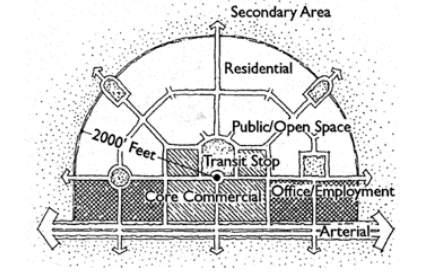
defined as “walkable, compact, mixed-use, higher-density development within walking distance of a transit facility.” provides a mix of residential and commercial uses and is designed to make public transit successful, enhance the convenience and safety of walking and cycling, and provide for a vibrant, livable community.
Advertisement
Universal, relational and regional definitions of TOD
The Transit on Demand (TOD) concept aims to maximise the efficiency of existing public transport services by focusing development around stations, stops, and exchanges. Many studies have focussed on the three Ds of the concept - density, diversity and design - but there are many different ways to conceptualise TOD.
It includes public transport accessibility level, net residential density, net employment density, land use mix, intersection density, and cul-desac density.
A relational understanding of TOD means that it tries to create a built environment that is generally more supportive to public transport, cycling and walking.
Walking distance and catchment area definitions
A walking distance to a public transport station is often defined as being within 400 –600 metres (2000 feet) of a station. In Copenhagen the 'station proximity principle' is a key concept for integrating public transport and land use planning (Pettersson and Sørensen, 2019).
Bike access could increase the catchment areas of public transport stations in the range of 1,6 km up to 10 km. For time based definitions of how long people are willing to bike they also found a variation ranging from 7 minutes up to 25 minutes. { msp of TM stations to the sites }
Universal, relational and regional definitions of TOD
The Transit on Demand (TOD) concept aims to maximise the efficiency of existing public transport services by focusing development around stations, stops, and exchanges. Many studies have focussed on the three Ds of the concept - density, diversity and design - but there are many different ways to conceptualise TOD.
It includes public transport accessibility level, net residential density, net employment density, land use mix, intersection density, and cul-desac density.
A relational understanding of TOD means that it tries to create a built environment that is generally more supportive to public transport, cycling and walking.
Universal density definitions
Density is another indicator frequently used to define TOD areas. Calthorpe (1993) argued that a lower threshold for residential zones outside of the primary areas should remain in the range of 25–62 units per hectare.
Relational density definitions
In the US the urban pattern is related with sprawl, in the sense of low density, car dependent, monofunctional residential development. In Europe, the urban pattern has followed the form of territories-in-between, mixed open and urban land of varying density, intersected by infrastructure including public transport. In Europe urban development has tended to be less monofunctional with mixed uses, especially at the regional scale.
In other words, TOD, is a more typical planning approach across regions in Europe, whereas in North America it marks a very significant departure from typical land use patterns (territories-in-between is a concept developed to better match the prevailing land use structures characterised by being neither fully urban, nor rural).
TOD as a planning concept
Ideas for how to ramp up the three Ds (density, diversity and design) can be applied at both a regional and local level. Regional approaches to TOD are bound to include station areas in minor suburbs, small towns or rural areas where the principles for local TOD may be less relevant. { TM already has 1 station, ( check other public transportation, cycling lane, good sidewalks ) and respond to it by ART work ) } .
TOD as an a spatial strategy for economic development
Transport-oriented urban development (TOD) is a concept for creating more sustainable and livable urban environments. It is also seen as a spatial planning strategy for promoting economic development, at a national and regional scale. By concentrating jobs and economic activities around public transport nodes,
It Is Seen As Crucial Building Block For High Performing Urban Agglomeration Economies
.
In a world of increasing spatial obility, transportation nodes become strategic locations since these are places where the knowledge economy and leisure economy exchange takes place. TOD is seen as an urban development concept more suited to postindustrial , service-based economies.
Summary
As a planning and development concept, TOD firstly aim to both reduce the need for transport, and to increase the modal shares of public transport, cycling and walking at the expense of transportation by car. Secondly, TOD seeks to generate more livable neighbourhoods with high urban design quality. Thirdly, TOD is understood to be a driver of, or even a tool for economic development.
TOD can improve public health.
