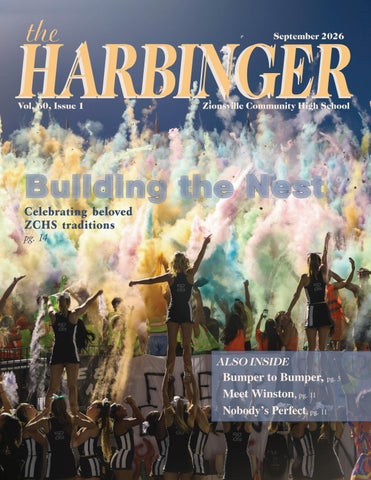
the
HARBINGER HARBINGER Vol. 60, Issue 1
September 2026
Zionsville Community High School
Buil Bu ilding ding the Nest
Celebrating beloved ZCHS traditions pg. 14
ALSO INSIDE Bumper to Bumper, pg. 5 Meet Winston, pg. 11 Nobody’s Perfect, pg. 11
table of
CONTENTS
ZCHS Student section celebrates after powder toss during halftime at Zionsville's first home game of the season against Lawrence Central on Aug. 28. Photo by Lexi Kern
Students make their way to the west entrance on Sept. 2 after parking their cars. Photo by Colin Adam
14
05
04 Stay Put, Stay Safe
07
Classes disrupted following bomb threat
05 Bumper to Bumper
New drivers learn how to navigate parking, traffic after license age lowered to 16
06 Upgraded Spaces
Locker rooms, a gym and a renovated auditorium: A look inside the ZCHS construction
07 Chasing Goals
Checking in on our Eagles Soccer team
08 Capture the Moments
As Zionsville Sports Media enters a new year of rapid growth, the program is expanding its creative reach
09 Outside the Ordinary Students are finding community through unconventional sports
10 Charting Your Course Changes in MAP gear towards a more productive period
11 Meet Winston
What’s really happening in Harbinger?
12 Academic Alterations ZCHS staff discuss how class offerings have changed over time
13 The Path After High School Graduates look back on the bends in the road
2
The varsity men's soccer team's starting lineup stands while being announced to the crowd before their game against Fort Wayne Southside on Aug 22. Photo by Colin Adam
14 Building the Nest
Celebrating beloved ZCHS traditions
15 No One's Perfect
It’s okay to settle with the average
16 The Doom of Scrolling When social media is too much
17 So Fetch, So Accurate
Comparing the world of “Mean Girls” to ZCHS
18 The Rise and Fall of Phones in School
Flip phones to Tiktok, teachers say student attention spans have dramatically changed in the classroom
Editorial
Harbinger
More teacher consistency needed in MAP
T
he format of the Mentor Access Period (MAP) has changed, but it feels like enforcement of the new standard is based on the disposition of your MAP teacher. In the FAQs on the ZCHS website, it says, “Students will not play games, have access to their phones, or watch videos on their school-issued devices. Students should be working quietly once the Academic Period begins.” Though many of the changes happening this school year were discussed at the PAC lectures or in early classes, MAP was not one of them. So when students arrived in their first MAP of the year, they were given a subjective standard for MAP that could be entirely different from their friends.
Enforcement ranges from allowing phones, games, and videos to limiting bathroom breaks and refusing study music. This wide range of experiences in MAP was not intended when the new rules were put in place. The goal is to encourage using time wisely because it is hard to stay focused in a 90 minute period. Students do need some guidelines to accomplish that, but it would be more effective for every teacher to simply enforce the phone rule than to try to keep track of a host of regulations about what counts as “productive work.” MAP should provide a consistent environment for students to take responsibility for their work, but all teachers need to apply the new MAP rules in the same way.
Staff Editors-in-Chief Colin Adam Ariana Spence
Assistant Editor Clara Vasey
Copy Editor Dhani Miller
Social Media Editor Addy Cieciek
Letter from the Editors
Photo Editor Izzie Paino
Reporters
Dear ZCHS, As a ‘good’ student, I have to say I’m excited for the eight months left of the school year. As a stressed-out teenager, I want to say that next summer couldn’t come faster. I enjoy most of my classes, extracurriculars and clubs, but often wish to be anywhere else, a feeling many other high school students can relate to. For freshmen, the stress of high school may not have hit yet, and for juniors, the panic may just be setting in. We’ve all felt overwhelmed by schoolwork, by sports, by clubs or peers, and in the moment the pressure of it all can seem stiflingly never-ending. But those moments pass, and when May finally does roll around, we’ll look back and realize how miniscule they seem in the grand scheme of the year. We won’t remember the note cards to that English presentation we were so worried about, or each question of the science final we studied hours for, or the frantic practice sessions before performing in that concert. We will remember the pride we felt after receiving an A in English, the laughter with our friends when we walked out of the exam room after the last final of the semester, and the standing ovation of the crowd after the last note of the performance. So push through the stress and look out for this year’s moments to remember.
Follow us on Instagram! @zchsharb
Ariana Spence, Editor-in-Chief Cover: On Aug. 28, the annual powder toss took place at halftime of the varsity football game home opener. Photo by Ren Cronin
Reese Adam Ren Cronin Lexi Kern Andrew McLemore Cole Meyer Bridget Scheidler Alaina Shields Paige Smithka Nate Waters
The mission of the Harbinger is to provide timely, relevant and interesting content, while handling topics with respect, objectivity and accuracy. Harbinger aims to reflect the diverse nature of the student body of ZCHS by including those of all walks of life in the publication. The Harbinger is student-run and opinions in the magazine do not necessarily represent those of ZCHS or Zionsville Community Schools.
3
Stay Put, Stay Safe
ZCS faces disruption following bomb threat
By Dhani Miller, Copy Editor
Z
ionsville Police Department received a threatening phone call, prompting police response and a shelter-in-place order at ZCHS on Aug. 6, only the third day of school. ZCHS remained in shelter-in-place for more than an hour while law enforcement searched the campus. Teachers were told to check their emails via the public address (PA) system in the school shortly before 10 a.m., and the cause of the shelter-in-place order was later shared with students, a bomb threat. Assistant principal Jared Williams said a shelter-in-place order ensures the safety of students and staff by letting authorities assess the situation. “Keeping people in classrooms allows us to make sure that the hallways, different common places, and the exterior of the building is safe,” Williams said. Teachers were asked to search their classrooms for anything that looked out of place or suspicious. The shelter-in-place order was in effect for nearly 90 minutes, but administration said classroom instruction was to continue as normal. Although first period ended during the shelter-in-place, students had to remain in their classrooms until the all-clear was given, causing students to miss most of mentor access period. Regular updates were shared to students and staff via the PA system as authorities swept the campus along with the assistance of trained K9s. Parents were also informed and updated through Parent Square. “Communication in those types of situations is important,” Williams said. “There ends up being a large team of people here that are brought together to not only work on assessing the immediate threat, but then also making sure that information is communicated appropriately to everyone involved.” Police and staff coordinate for updates and Design by Colin Adam
4 - News Graphic by Colin Adam
response during these types of situations. “Our school resource officers work closely with school administration, along with Zionsville Police Department to ensure information is shared and appropriate response is coordinated,” Frost said. The all-clear order was given via the PA system shortly before 11:30 a.m. after authorities completed the sweep of the building, finding nothing concerning. Students were released from first period and went to their MAP classroom for attendance. New Indiana State Law bans the use of personal electronic devices for the duration of the school day, but there are exceptions mentioned in the law. Exceptions include during emergency situations such as this, which is why students were given permission to access cell phones to communicate with parents during a shortened MAP immediately after the all-clear was given. A similar threat was made May 1, 2026, prompting a shelter-in-place order at ZCHS. Despite neither threat being credible, SRO Lt. Frost said protocol is largely remaining the same. “Our mission as a SRO is the same,” Frost said. “Anytime we have a threat to our community, we’ll gather as many resources as we need to ensure the safety of those in our community. We continually evaluate responses to every incident and work with our school and public safety partners to identify opportunities to improve safety.” The incident only lasted about 90 minutes, but the investigation into the source of the threat is still active. Details will not be publicly shared at this time.
“The investigation in the call is ongoing and we won’t comment on it to protect the integrity of the case,” Frost said. Frost wanted to remind students of the resources available to them. “Always remember, if you see something, say something,” Frost said. “Through our Stop It (digital reporting tool), you can anonymously report school safety issues as well as reach out for help if you’re in a personal crisis.” Frost expressed her appreciation for the partners that support the SROs and their mission. “We want to thank ZCS and all of our public safety partners who make the safety of our students and staff a top priority,” Frost said. “Cooperation and communication between our schools, law enforcement and public safety partners are essential in maintaining a safe community.”
See something? Report it. Submit anonymous safety tips through STOPit so concerns can reach school officers.
Bumper to Bumper Cars enter and exit ZCHS’s parking lot on Sept. 2, as students ready themselves before first period. Photo by Colin Adam
New drivers learn how to navigate parking, traffic after license age lowered to 16 By Lexi Kern, Reporter
T
he morning of sophomore Cecilia Warlond’s sixteenth birthday started like any other. As she walked out of the BMV, she had a newfound freedom that every teen waits years for; she had the ability to drive herself to school without having to worry about finding a ride. Indiana House Bill 1200 allows teens to get their licenses three months earlier than the previous law. The law was officially signed on March 12 by Governor Mike Braun and took effect on July 1. There are still requirements like holding a learners permit for 180 days, completing a driver’s education course and obtaining 50 hours of driving with an adult. This change could mean more students at ZCHS will begin driving earlier in the school year, but assistant principal Matt Walter said the school has not yet noticed a major increase in student drivers yet. “Instead of getting more drivers in February or March, we may start seeing more drivers added in maybe October or November,” Walter said. While more and more students begin to get their licenses, Walter said the school has not come close to running out of parking spaces. Parking pass sales have stayed consistent over the years, and the school is expected to have enough on-campus parking available throughout this school year. “We’ve never been in jeopardy of running out or having more students that wanted to park on campus than we have had parking spots,” Walter said. When students arrive at school can greatly impact where they are able to park. Warlond
said finding a closer parking spot depends on how early she gets to school and where she wants to park for the day. “If you get to school late, really the only spots are going to be farther away from the school, like in the stadium or far west,” Warlond said. Construction around the outside of the school has also made a lot of changes to how students enter and leave the parking lots. “The biggest thing is now no drop-off traffic cuts through there anymore because it all turns before you get to that lot,” Walter said. With students arriving at different times and more drivers potentially being added earlier on in the school year, traffic can become another challenge for new drivers. “The intensity of traffic definitely picks up the closer you get to the bell,” Walter said. If you have somewhere to be after school, for example a practice or a job, where you park can play a big role in how quickly you can leave. “I think just being able to get to my car after school and leaving quickly is the hardest part,” Kasey Layton, a junior who works at The Scoop, said. Walter recommends new drivers to get to school early and start learning to be patient with traffic before and after school. He also suggests that students should think strategically about where they park, whether it’s closer to your first class or further away to leave quickly after the bell rings. “Get here early,” Walter said.
“The afternoon when everybody’s leaving, that kind of is what it is. It just requires a lot of patience.” Getting to school earlier can help students try and avoid some heavy morning traffic, but new drivers may need time to adjust and be comfortable with driving around the school. “If you’re a new or nervous driver I recommend waiting for the traffic to go down a little before heading home,” Warlond said. Waiting a few extra minutes can give drivers time to feel ready before getting into heavy traffic. It can also help students avoid feeling rushed with all the cars leaving the school all at once. Getting familiar with the school’s parking lot and traffic patterns can make the new and exciting experience of driving to school easier. “My advice would be to remember where you park and try to get to your car quickly,” Layton said. “Don’t be on your phone in the parking lot because there’s a lot going on.” On Sept. 2, students make their way through the busy ZCHS parking lot as the growing number of student drivers creates an increased demand for parking. Photo by Colin Adam
Design by Lexi Kern
News - 5
Upgraded Spaces Locker rooms, a gym and a renovated auditorium: A look inside the ZCHS construction
By Cole Meyer, Reporter tudents at ZCHS have dealt with closed off parking lots and hallways for years, but that might be coming to an end as the construction on the auditorium, locker room spaces and gym enters its final stages. The $54 million dollar project that started in January aims to combat the aging athletic facilities and the need for more locker rooms. The first phase of the construction is the athletic training facility and the volleyball locker rooms that were fast tracked for the team, opening on Aug. 18. The athletic trainers have been assessing and treating athletes in a converted classroom while the construction has been underway. The second phase is the new construction that sits in front of the original basketball locker rooms constructed in 1967, the upstairs gym and various other spaces that Athletic Director Greg Schellhase hopes the school can gain access to by Labor Day. The last phase of the athletic area is the basketball locker rooms that have been gutted and redone. They will be done on Oct. 18, that includes the construction areas outside the south area of the building. Under the new configuration boys and girls volleyball, basketball, wrestling and cheerleading will get locker rooms, as well
S
The new gym under construction. Photo submitted by Board of Trustees construction update
6 - News Designed by Cole Meyer
as flexible spaces for visiting teams and extracurricular activities. Schellhase said that the project addresses problems that have been affecting the school for years. “With our programs growing, number of sports growing, participation growing, we haven’t grown our facility to meet the demands of the student athletes,” Schellhase said. “If you look at our school after school, especially during the winter, you see backpacks and stuff just scattered all over school. There’s definitely a need for more locker room spaces.” These spaces were originally considered during the construction of the lunch room and the north hallway, but did not make the cut at the time. In addition, the traditional idea of a sports season is disappearing, “With sports being a kind of year-round endeavor, the days of fall teams and winter teams and spring teams are long gone,” Schellhase said. As well as sports teams, the new gym will be available for music groups and will be fitted with mirrors and bars for use by the dance team and cheerleaders. The athletic spaces are not the only thing under construction, as the auditorium and PAC are also getting a long awaited renovation. Every couple of years, the district does a study to identify the ZCS facilities that are the most damaged and dated. “The auditorium was
Rendering of the new auditorium. Photo submitted by Fanning Howey
one of the areas that was identified on the facility study at the time,” he said. It identified broken seats, malfunctioning light fixtures, worn out stage floors, inadequate dressing rooms and issues with the HVAC system according to Spillman. According to Spillman, the auditorium construction is ahead of schedule, with a projected finish in June 2027, which includes the blocked 100 hallway. The construction in the auditorium includes nearly quadrupling the number of dressing rooms from around 30 to 111. The original locker rooms were built in 2003 when the performing arts program was a lot smaller. The construction in the Performing Arts Center is minor; the majority of the lights are switching to LED and the stage is getting replaced. “The old stage floor is very old, and is so rubbed down and slippery that we have students trip and slip on it all the time,” Spillman said. Even though the auditorium isn’t projected to be fully finished until next summer, other largely important spaces are starting to be available to student athletes. “The locker room project is big for us, just to address the needs that we’ve had for a long time.” Schellhase said.
Chasing Goals
Checking in on our Eagles soccer team
By Nate Waters, Reporter
T
he United States was the recent host of the World Cup, drawing an estimated 5 to 10 million soccer fans from overseas. With soccer on everyone’s mind, let’s see how the Zionsville Men’s team is doing so far. Last year, the Zionsville Men’s Soccer team had eight wins, six loses and four ties with a second-round playoff loss to Carmel, but the team returned multiple varsity and JV players. “[The players] are ready to fight for varsity reps and are prepared to make an impact on the pitch,” varsity assistant coach Jason Donkersloot said. They practiced multiple times per week throughout the summer and into the start of the school year in preparation for their season. “To start off the season, the main thing we focus on is getting the guys to play together, to know each other’s style of play as a team,” Donkersloot said. “We’re through those ideas of formation and things like that.” Donkersloot in his 10th year of coaching soccer at Zionsville and his 21st year coaching overall. He said he likes to see students grow into better people, not just as athletes but also
in the classroom as students. He thinks that into reps against each other. I think it prepares the varsity for games and gives the JV a chance a big part of coaching is finding the team’s to prove themselves and gives them a chalidentity. lenge.” “What’s going to be our identity?” Donkersloot said,” On Aug. 22 the varsity men’s soccer team breaks it down as We always have one they prepare to face Fort Wayne Southside, which ends in a 4 going in that we like to 4 tie. Photo by Colin Adam to play as coaches, but sometimes it doesn’t work with who we have as athletes on the field.” He also noted how a lot of winning games and coaching the kids is adjusting to the players and working with the other coaches on how to get the most potential out of the A normal practice starts with two laps players. He wants a fast paced style of play out of his players so he can force teams into around the 875, the field where they play, then they pass the ball around a little bit and get mistakes and turnovers. “We have to control the tempo of games,” into drills. In the game against McCutcheon, they Donkersloot said. “In the games that we control the tempo, we win; in games we don’t, came together as a team and rallied from a we lose. We can’t let them deficit early in the game. At halftime, they score a goal and then shell were down one goal to none, but they rallied and scored two goals, making the full time up. We have to push the score 2-1 Zionsville to make the team’s record pace and force the other 1-1 going into a pivotal game against Fort teams into mistakes.” Dayson Alford and Bro- Wayne Southside at the 875 Sports Comdy Arnold are sophomores plex. It was a 4-4 shoot out with six total goals on the junior varsity team. “I’m excited to see how after halftime which made the team’s record 1-1-1 leading into their next game at Fishers well we can do,” Arnold on Aug. 25 which they won 2-1 to improve said. “I think it’s a good group of guys and I think their record to 2-1-1. On Aug. 29the team had a convincing win we can win a decent against Whiteland, 5-0, shutting out the Waramount of games.” “It kind of just depends riors. The upcoming games include Noblesville on Sep. 15 and Avon on Sep. 19, then a on what the day is, but pivotal conference game against the Hamilton there’s certain drills Southeastern Royals on Sep. 22 we do,” Alford said. “I “The team is a family,” Arnold said. “One personally like getting up and down and getting live of my favorite parts of the sport is getting out reps in because it simulates on the pitch and playing with my boys, getting goals, making new friends and of course a real game where the JV winning some games.” team and the varsity get Designed by Nate Waters Graphics by Colin Adam
Sports - 7
Capture the Moment
Zionsville Sports Media enters new year of rapid growth, expands creative reach By Andrew McLemore, Reporter
Z
ionsville Sports Media is now capturing the new school year with both a bigger and bolder role than before. For starters with their video team they started last year they’re now going to regularly post new highlight reels on their Instagram and post new hype videos for teams taken on media days. ZSM also started a new special projects team that is going to be working on the behind-the-scenes stories of athletes, and will take a more sports reporting and interviewing approach, as compared to some of their other works. “We’ll be doing even more of that towards the end of the fall season,” ZSM co-teacher Lauren Wagner said. “Looking ahead to winter, there are a lot less sports to cover, so we have an opportunity to really expand on what we can offer.” Another thing they added in the spring was sponsorships, where ZSM reaches out to community businesses and they will pay to have their business in some of the graphics and weekly schedules. This year there is a full team dedicated for sponsorships throughout the year, this will help ZSM get more funds for more equipment to be shared to their now around 70 members. Zionsville Sports Media is a student run class with two class periods, with both a G1 class and G3 class, both being co-taught by Lauren Wagner and Brenda Jalaie, however, they are mainly student run by one executive director in each class, with G1 being run by senior Orla Schleppi, and G3 being run by senior Sam Black. ZSM is significant because it serves as the community’s central storyteller for local athletics by posting weekly schedules, graphics of teams, scores, and takes pictures of all the sports teams. It also serves as an extension of athletic marketing for ZCHS. When it was first founded, ZSM was a club with around seven to 10 people, fast forward three years, and it is now two classes with around 70 people total. “It’s definitely a challenge adjusting from doing it with so little to so many,” football team lead Lydia Kenworthy, senior, said.
by Andrew McLemore 8 - Sports Designed Graphics by Clara Vasey
“But it’s really fun and it’s a good experience to be able to teach people how to do everything that we’ve done for a while and get them more experience. It’s a lot more enjoyable to have 70 people in ZSM student, Josh Rexing (12), takes photos of the it because home men’s soccer game against Fort Wayne South there’s just so Side on Aug. 22 at the ZCHS soccer stadium, with the much more to game ending in a 4-4 tie. Photo By Colin Adam. look forward to.” teach lessons before class, plan out the week, ZSM currently covers every sport in the and meet with the social media managers school and tries to give equal coverage to each and staff managers. ZSM also has quite a few team through various unique formats on challenges. “How we spread ourselves across social media. all the varsity sports is a challenge,” athletic “It’s a class built to bring together a bunch director and ZSM sponsor /co-founder Josh of creative ideas to be able to promote ZionsLarsh said. “You go in the spring and fall ville sports,” Kenworthy said. when you have several varsity sports, to the More specifically ZSM is a student-run winter when there aren’t as many. How do we sports media class that posts graphics for give equal coverage to the teams, given that various teams and post scores. They also take they have different schedules. Some play 30 photos of games, post highlights of players, events a year, some play nine.” and they do media days for various teams. Other challenges include how to accuYou can find all of these on the main athmulate the equipment needed for all the letics Instagram account, @zchseagles or the students, the new cell phone ban, keeping individual team accounts. the large number of students in unison and ZSM’s student run structured format inunder the same style and teaching such a cludes: one executive director per class, then large group now. staff managers, and then team leads, and then Despite these challenges, ZSM manages to creatives (reporters). Team leads are assigned a persevere and provide a unique experience for specific role with their group of creatives and students. they serve as the social media manager for “If you have any thought in your head of that sport. joining it, I think you should,” Black said. “Right now in each class period there are “It’s a fun class. Orla and I try to make it as about like five or six teams,” ZSM student fun as possible. There is a lot of work, but it’s executive director Sam Black said. fun, especially when you grow that passion Each executive director oversees each team for it throughout the year.” in their class period and manages them. They make sure that everything is getting posted,
Outside the Ordinary Students find community through unconventional sports
By Ant Farrar, Guest Reporter or junior Naman Vyas, badminton just started at a sleepover, when he and his friends had the idea to head to a basketball court with a few rackets. Nobody really knew what they were doing, and there wasn’t even a net, it was just an estimate of the height. “It was a blast,” Vyas said. “I was like, ‘this game is awesome, let’s start a team.’” With a few emails, Vyas secured $500 sponsorship for nets and rackets, and built a space where anyone, experienced or not, could show up and play badminton. Early practices didn’t look anything like traditional badminton. Six players on each side, three hits like volleyball and improvised rules. “What I really love about badminton is that it is so easy to pick up,” Vyas said. “You can just come one day and be able to play the full game.” The simplicity of the sport has turned into something a lot more meaningful for the athletes playing it. It’s a place where students who might have never tried out for a regular team can still experience what it means to be part of one. “My goal is to get recognized by the IHSAA (Indiana High School Athletic Association) as an official sport,” Vyas said. “So we can compete with other schools.” Even without that recognition, badminton is already doing something really powerful; it’s giving people a reason to show up and connect. “If you like it, you found something new! If you don’t, don’t even worry about it,” Vyas said. “Low risk, high potential return, no harm in trying.”
F
I
n a different space, esports became more than just a hobby for Ilgar Demir, when he heard junior Colin Adam was starting a school e-sports team. While normal online gaming felt focused on individual progression for each person, esports created an environment centered around teamwork which he found far more rewarding. “I enjoy the competitive environment more than the actual game,” Demir said. “esports is a great way to fulfill that.” Esports practices look different than normal athletics, as they don’t involve physical demand, but the preparation seems just as taxing. Still, esports struggles to be viewed the same way as traditional sports. “Gaming and sports is often seen as a binary,” Demir said. “Calling esports a sport almost seems ironic.” With smaller teams and a lot of communication,personal performance carries weight and one mistake can impact everyone. Esports exists outside the traditional image of high school athletics, and it challenges the assumption that competition only matters when it happens under stadium lights.
F
or sophomore Lauren Pederson, horseback riding began with a simple love for animals. “I’ve always been interested in animals,” Pederson said. “When I was little, I just wanted to be around them.” Unlike many traditional sports based on individual performance, horseback riding created a close community built on trust and responsibility, not just with teammates, but with the animals themselves. “Having a relationship with animals is also a really special thing,” Pederson said. Riders are not only responsible for their own performance, but also for the care and wellbeing of another living thing. The sport demands patience and discipline in many ways other athletes have never seen before. “It’s definitely taught me a lot of responsibility,” Pederson said. “You’re in charge of yourself and the animal’s welfare.” Horseback riding reveals that sometimes the most meaningful communities are found in the places, or animals, that people least expect. “A lot of people assume it’s an easy sport because it’s supposed to look flawless,” Pederson said. “But having such a good community is nice, since we’re all so interconnected with each other and the animals.” Designed by Ant Farrar and Colin Adam
Feature - 9
Charting Your Course X Changes in MAP gear towards a more productive period By Colin Adam, Editor-in-Chief
M
AP is a whole new experience for incoming freshmen and different for returning students, so it’s a good time to retrain ourselves to be intentional with our time in it. With MAP now being geared more towards a productive period than previous years, we should remind ourselves of great ways to use this time. In the past, activities like playing games or watching movies were what the majority of students chose to do. With the new changes in schedules and the recent phone ban, this isn’t an option to spend your time now. So what are some ways to use it?
O
ne of the first things that comes to mind for most is homework or studying. These can help you keep up with a hard class or give you extra time after a long school day. “If there’s a class I’m struggling on, I’d use MAP as a continuation of class time for that class,” Senior Colton VanZee said. “Meaning getting my work done and studying specifically for that class.” Although ZCHS doesn’t offer a study hall class anymore, this period serves as a substitute to an extent, so don’t check out. Creating a game plan can help you stay on track and help you get all your work done before the deadline. “Start a to-do list, don’t just keep it in your head each week,” science teacher Trevor Chapman said. “If you don’t have anything to do, make it a habit of ‘I’m going to look back over notes.’”
A
nother option to use this time could be to meet with teachers or to retake old tests. Meeting with your teachers can be a great way to gain confidence in the course and answer questions about homework you may have to avoid falling behind. “Use your MAP time to go to other classes and seek help from your teachers,” VanZee said. “If you’re not the person who likes doing that, use your MAP time to catch up on homework.” Wanting to retake that Algebra test from last Monday? MAP could be a great period to knock that out. This gives you more free time later in the week to avoid staying before or after school to retake.
by Colin Adam 10 - Feature Designed Graphics by Colin Adam
Y
ou feel that you need extra help in a specific subject? Groups like NHS can provide you with a student tutor to assist you during MAP. “I try to match them based on who wants them and then who has the ability to help them,” NHS sponsor Ann Bender said. These students chose to help others out and wish to see you succeed.
I
f you have no school work but still want to be productive, you could look toward the future and browse and apply for jobs or look at colleges that fit your interests. “I always tell my kids you need to have a plan and then a back up plan and sometimes a back up to the back up,” personal finance teacher Alyssa Neal said. “Students need to have dreams and set goals and then go after them. Attack life or life will attack you!” Even if you’re an underclassman, taking a look could be a productive way to spend your MAP time if you want a little break. “A young teen doesn’t need to have their entire future figured out already,” Neal said. “Plans change obviously. However, failure to plan is planning to fail. Some structured intentional time would be helpful for these kids.”
F
inding an environment that you can ensure your productivity in is key. For everyone it’s different, whether that be listening to music, a quiet room or even outside in the sun. If your MAP class is on the west side of the school and close to the courtyard, feel free to ask your teacher if you can go visit. A quick break in the midday sun can’t go wrong. Chapman has his classroom connected to the courtyard and sees the amount of students outside each week. “It’s a nice place to be if you truly don’t have anything to do,” Chapman said. “We do have a lot of people that work out here to get some sun and work done at the same time.” With MAP changing in many ways, being able to understand your own needs during this time can prove to be a useful skill. “Don’t let yourself get distracted at the start,” VanZee said. “It’s much easier to remain focused if you’re working instead of on your phone or talking with friends.”
Meet Winston
Behind the scenes of Harbinger, new mascot! By Alaina Shields, Reporter arbinger gives opportunities in journalism and photography. Harbinger is a class that turns ideas into stories. It captures the little moments and shares students’ perspectives. Harbinger is more than the stories that go onto the page. It’s about the moments, people and thoughts behind them. By asking questions, students can understand all the different perspectives around them. Through journalism, stories are given their own voices. But every single story has a capturing process that puts the story together and allows it to flow.
H
Similarly, photography is more than simply pressing the shutter. It’s about students looking for perspectives and adding details to help tell the whole story. Readers only see the finished stories and photography. But what they don’t see is the work behind the finished product. Behind each story are students planning and creating, putting all their thoughts and work together.
R
E
ach person in Harbinger has a different role. Lexi Kern practices taking photos in the hallways on Aug. 21 as new staff members learn photography. Some students are drawn to journalism, while others may be drawn to photography, interviewing, or social media. While each of these strengths is different, they are more similar than you might think. They all help staff members collect information. Students may have different strengths, but by combining them, they can create and tell a story. Yes, interviews can be intimidating, but they allow reporters to hear directly from people’s perspectives and tell their stories.
eporter Paige Smithka, freshman, interviews Betsey Kline, senior, about homecoming and other school traditions to help turn a draft into a story. If that sounds fun, here are a few things Harbinger staff members recommend to get started. Many students thinking of joining Harbinger start with the one-semester Journalism course. It helps students find a story and learn what makes a story interesting and worth sharing. Journalism also helps with photography by teaching students how to communicate through photography. Some people joined the class simply because it was the last class they could get into. However, when they showed up, they ended up liking it and continued with the program. Staff also said the best part was seeing their friends every morning, making it a great way to start the day.
C
olin Adam, editor in chief, gives directions on what to work on for staff members’ drafts on Aug. 21. Adam taught the staff because they needed more information to help develop their stories.
Fun fact: Winston, the stuffed tabby cat, is the Harbinger mascot! His name was voted on by the staff.
Designed by Colin Adam Photos by Alaina Shields
Photo Essay - 11
Academic Alterations ZCHS staff discuss how class offerings have changed over time By Dhani, Miller, Copy Editor
A
griculture. Typing. Wood shop. Drafting. Home economics. Being taught decades ago, these classes reflected the needs of a smaller, more rural Zionsville community. Over time, they have been phased out of the curriculum as they have become less relevant. Nowadays, students are more likely to fill schedules with dual credit classes, advanced classes and off campus opportunities. As diploma requirements and relevance of information change, courses are added and removed from the curriculum. Assistant Principal Matt Walter has been a staff member since 1997, seeing the progression of ZCHS. “[The school] is probably three times bigger than it was when I first started teaching here,” Walter said, “20 years ago, we may have not had enough kids to [attend] a new class.” In the 1970s, before Zionsville was a sprawling suburban area, class offerings were tailored to the practical needs of a smaller, rural community. At the time, agricultural and other practical skill based courses were more relevant to students whose daily lives involved farming and agriculture. “When this was a very rural area, you probably had a lot of kids who lived on farms,” Walter said. “So taking agriculture [classes] was a thing.” In recent times, beyond AP and dual credit offerings, elective courses have also shifted to reflect changing student interests and career paths. Programs such as Project Lead the Way (PLTW), business electives and digital media courses have become increasingly popular as students look for hands-on
Designed by Colin Adam
12 - Feature Graphics by Colin Adam
services and helps look at potential new courses for the curriculum. She says that the decision to add new classes begins with changing diploma requirements. “It starts with a conversation of the needs of students based on diploma [requirements], what is needed for graduation,” Borto said. Recently, the focus has been on the new diploma going into effect for the class of 2029 and beyond. These changes influence how schools evaluate course offerings to better meet the needs of students. Students work on analyzing a document in Ms. “These last few years, we’ve been Anthonys AP Seminar Class on Sept. 2. The 26-27 preparing for the new diploma in the school year marks the first time AP Seminar has been offered at ZCHS. Photo by Colin Adam state of Indiana, so we use that as a lens through which we look at the experience connected to future careers. As current courses we have,” Borto said. technology and workforce demands evolve, “And see, does that help meet our student’s schools have expanded opportunities in areas needs? Or is there anything we’re missing?” that may not have existed decades ago. Ultimately, decisions are made with “Recently, the biggest change has probably the success of students in mind. Whether been Advanced Placement (AP) and dual through career focused electives, dual credit credit,” Walter said. “We’ve always had a lot opportunities, specialized programs or traof AP classes, but we’re adding to that and ditional classes, the curriculum continues to then dual credit classes became [more comchange alongside students. mon] over the years. That’s a newer trend in “We want to help students get where they education, partnering with a college and then want to go, and that involves getting a high getting the credit from that college.” school diploma,” Borto said. The growing variety of electives also gives students more opportunities to explore specific interests before college. With a larger student body, the school is often able to support more classes in niche subjects that may not have attracted enough enrollment years ago. “It’s just kind of neat to watch and see what kids’ interests are and be able to offer those [classes] that are interesting,” Walter said. Maureen Borto works with academic
The Path After
High School
Graduates look back on the bends in the road
By Ren Cronin, Reporter
F
rom the minute students start freshman year, they’re told how quickly high school will go by. When college application season comes around junior year, anxiety is one of the strongest emotions students feel when applying. ”It was honestly really stressful at first,” ZCHS alumnus Sadie Makinson said. She said the process was exciting but that not knowing how everything was going to unfold worried her. Most students feel that touring a variety of different schools is a good way to familiarize themselves with different schools, and touring ended up being one of the ways Makinson chose Indiana University. “It’s such a great school,” Makinson said. “And then when I toured that’s when I really knew that I wanted to go there.” However, choosing your future school isn’t typically as simple as touring or being sent an offer. The school students choose needs to reflect their individual needs such as field of study, convenience and comfort. According to Kaylee Miller, a ZCHS counselor, one of the most important things for students during application season is deadlines. Early action deadlines are typically Sep. 15 for the majority of east and west coast schools, but may vary depending on where students apply. Early action application doesn’t require you to go to the school, unlike early decision applications. Early action lets students get ahead with their applications without having to commit to the school they applied early to. Makinson is starting her sophomore year at IU this fall in her sorority Alpha Ki
Omega and is excited to get back to campus. Miller said only 9% of graduates leave the beaten path and go straight into the workforce, military, or a gap year. The other 91% go to two or four colleges like Makinson. But within that 91% that go to college, the application process is varied depending on what you will focus on in college, and for students going into a division one proYale gymnast Ella Hargreaves, a 2025 Zionsville gram, the graduate, competes in a Division One gymnastics meet. process is photo submitted by Hargreaves more intense. Scouts look into an Hargreaves said. When asked about how beathlete’s current competing ing an athlete in college was different from level, come to games or compe- a typical college experience, she mentioned titions and may invite them to a how important it was for her to consider tour. That was the experience for how she was spending her time outside of Ella Hargreaves, a 2025 Zionspractice and classes. ville graduate and a current Yale While all of the steps to get launched student competing on their D1 after high school may be overwhelming, gymnastics team. students like Makinson and Hargreaves “I was feeling a little bit nervous, just try- prove that it is worth it to be successful in ing to find a school that would fit me athyour next chapter. letics wise and academics wise,” Hargreaves said. Ivy league schools are extremely competitive, with Yale having only a 4.62% acceptance rate according to Yale News. Her process was even more challenging due to her sport, with only 61 schools in the United States offering D1 gymnastics programs. After watching her at competitions her junior year and inviting her on an official tour, scouts from Yale sent her an offer requesting her application. “They were actually the first school to send me an offer, which was really cool,” Designed by Clara Vasey Graphics by Clara Vasey
Feature - 13
Building the Nest By Paige Smithka, Reporter
-
Celebrating beloved ZCHS traditions
M
r. Zionsville is a tradition at ZCHS that has been around since 1987. It is a talent show for senior boys according to Whitaker. “The whole show is a spoof of a beauty pageant where the roles are reversed,” Whitaker said. It has recently turned into more of a charity based event, with the people’s choice award money now being donated to American Foundation For Suicide Prevention in honor of Tate Eugenio, a contestant from Mr. Z who tragically took his life in 2021. “A lot of people I know have been touched in positive ways in the past handful of years, which has been great to bring that honor to Tate’s name since he passed away.” Whitaker said. Mr. Z starts off with a choreographed dance made by the boys. Then the talent portion is next, where each contestant takes the spotlight, displaying either raw talent or just silliness. Then they do a question and answer portion where each contestant impersonates a celebrity of their choice, and finally the awards are given out. “I think it’s a great way to showcase the talents we have in our senior class and to just celebrate their last year, do something fun and light-hearted,” Whitaker said.
Will Weber, Elijah Weaver, Maxwell Sproull and Truett Weber, perform at Mr Z. Photo by Macy Adams
T
Students in the student section cheering on their football team on Aug. 28 neon nights game. Photo by Lexi Kern
O
he student section has been around for about 15 years. The student section is where students can watch the game with friends, and only other students. Camryn Bader, a teacher at ZCHS is the current leader of the student section. The student section is a section at football games for students to be, but Bader runs it. Each year, there are many different traditions that take place through the student section. For example, the powder through for the first home game. “The powder toss is classic,” said Bader. Along with the powder toss, she says another beloved tradition is the pushup board. “That’s always super fun, anytime we score, whether a field goal or a touchdown, one of the members of the student section will come down and do as many pushups as we have points on the board, so it’s really fun,” Bader said. Bader’s favorite nights in the student section are neon night (Aug. 28) and USA night (Sept. 11).
n the other side of winter, Senior Assassin starts after February break. Senior assassin is a game of water guns and eliminations. Orla Schleppi is the head of senior assassins this year. Schleppi got into this because she was the senior girl at Kern Bro Shoes, and will lead with someone from the boys rugby team (undecided). A basic breakdown of senior assassins is that you are in a team of two, and you have another team of two to get out. You get them out by using water guns and spraying them. A rule to make sure you actually got your opponent out is you must have the whole thing on video. The goggle rule in Senior Assassin is a way for students to stay safe if they get sprayed with a water gun, but this year, Schleppi plans to take the rule away so the game won’t take a long time because last year it went until after prom, the longest she can remember.
by 14 - Feature Designed Paige Smithka, Clara Vasey
H
omecoming is another annual tradition organized by the student council. “I think going into it with a positive mindset [is important] because I know a lot of people tend to leave homecoming early, but I think just making the most out of it. Here will be like a DJ, and just not worrying what people think and having fun with your friends, talking to different people,” Betsey Kline, senior and student council member said. At Homecoming, the mosh pit is a crowded part of the dance floor at homecoming, where students jump up and down and dance to the song, but students might not know to go in or not. “I think the mosh pit is pretty fun,” Kline said. “I would recommend taking off your shoes because my heels have broken in the mosh pit before. It’s hot, but it’s really fun.”
Perfect
Nobody is Perfikt It’s ok to try new things
By Reese Adam, Reporter obody is perfect. Yet, students are taught to aim for perfection, get good grades, do well in sports and, in their parent’s eyes, be the best student. That’s not what students need; they need to learn that it is okay to not fit the standard and that it’s okay to be bad at something. ZCHS students, myself included, are worried about trying new things like clubs and sports because they fear they won’t be good enough. Believing that because they didn’t start years prior, they shouldn’t start now, but that’s not always the case. ZCHS offers not only a wide variety of sports but close to 100 different clubs. So just because you play one sport or have one main hobby doesn’t mean you can’t add another. Clubs offered at ZCHS are a great way to stay active and to step out of your comfort zone. Having everything from Art Club to Hammock Club, there is an
N
activity for everyone. Michael Kelly, a history teacher here at ZCHS, runs all the intramural sports, the recreational sports offered at the high school. IM sports are a way for students to have fun with their friends, rather than the traditional competitive school sport aspect. “IM is a good place to play a sport or to learn a sport,” Kelly said. Kelly said IM sports promote a fun and inclusive environment for all groups of people. Basketball, volleyball, pickleball, flag football, and soccer are just a few of the sports offered. Finding an activity you like is a good thing but so is balance. Athletes tend to stick to sports they know they are good at rather than potentially risking not being “good enough” at something new. Part of this idea of “perfect” comes from the effect social media has on our lives, and how we are thought to believe that we need to fit every social standard. Most influencers remove their flaws when creating content, whether on their literal faces or their everyday lives. Making teens think that because they don’t match what they see online, then they aren’t good enough. Because reality is blown out of proportion online, teens feel unaccomplished when
they’re the average. This makes students believe that they have to go above and beyond for everything, when in reality you can settle for the okay. Everything you do in life doesn’t have to be amazing and highlight worthy. When you think of the most accomplished person you know you don’t just think about their best side, you see the things they went through to get there. You aren’t perfect from the start, you have to experience the bad to learn from your mistakes to become a better version of yourself. You can’t make this change as a person if you don’t grow the things you do. By going out and trying new extracurriculars you’re opening yourself up to new groups of people, who can inspire you to do great things. Why would you limit yourself into a box of what society deems perfect when you’re capable of doing way more?
“IM is a good place to play a sport or to learn a sport.” -Michael Kelly, Social Studies teacher
Club interest forms: scan now to start a new hobby! Designed by Clara Vasey Graphics by Colin Adam
Feature - 15
The Do om of Scrolling When social media is too much
By Bridget Scheidler, Reporter
S
ocial media has drastically grown from 1997 when the first social media website came to light: SixDegrees with around 3.5 million young adult users. Currently there are roughly 5.79 billion people who use various social media apps according to Data Reportal. This has drastically altered our society to how it is today. Social media has many amazing perks. It’s a way for many people to express and learn more about themselves whilst sharing it with family and friends, even across the world. On the other hand that doesn’t mean social media doesn’t have its many negative effects. Don’t get me wrong, I love scrolling through Instagram, Tik-Tok or Pinterest looking and watching all my favorite influencers and getting inspiration. Social media is an amazing way to connect with others, get inspirations, create or just learn new things. However, social media has numerous downsides. When I tell myself “okay only five more minutes then I need to clean my room,” the five minutes go by and it ends up being 15 minutes, and the cycle repeats. I get distracted or end up procrastinating the basket of laundry I was supposed to fold, or the homework I needed to get done. Psychology teacher Bryan Hall says of social media and its harsh side. “Personally, I find it to be horrible, Hall said. “It impacts all sorts of instant gratification centers in the brain, in the reward center, such as the release of dopamine, which gives you a feeling of satisfaction, the same kind you get when you accomplish something. So when this feeling is repeated over and over again, it leads to addiction. This is why now we are seeing higher levels of anxiety, ADHD, depression and eating disorders.”
16 - Perspectives
Designed by Bridget Scheidler Graphics by Colin Adam
Another downside of social media is the fact that around 90-95% of teens have it according to the National Library of Medicine. Therefore, a teen not having it when most of their peers do can make them feel strongly excluded, especially considering the amount of users. “Technology and social media hit society faster than we were ready for, which explains why we have all these problems,” Hall said. 4.8 hours on average is how many in a day a teen spends on social media according to the American Psychological Association. That means 33.6 hours or 1.4 days per week, meaning around 67.2 days out of a year are spent scrolling on Tik-Tok or Instagram alone. This really makes me strongly think about the time I’m spending on social media. It’s okay to spend downtime catching up with your favorite influencers, but it crosses a line when you’re staying up two hours later than you should because you got distracted scrolling Tik-Tok. That should not be happening. We’re all guilty of it, but start thinking more about what you could
be doing to prevent doomscrolling or rather what you could be doing to better pass that time. Look, we all have things in our lives we could improve or work upon, whether that’s our grades or spending a little bit more time studying or our hobbies and sports, we all have something.
The new phone rule is a pain, believe me I know. But reading these facts now almost makes me reconsider how it’s not the end of the world to get the whole school day to be off your phone. In moderation, social media can be a good way to express and learn more about yourself, connect with others or a way to spend your free time. But too much of anything isn’t good for your brain. It’s a rewarding system according to Dr. Steven Resnick, a neurologist in Florida. Something that can help is setting a time limit that is actually realistic for you. Or once you get home from school, instead of getting right scrolling maybe take some time to yourself like going for a peaceful walk or doing a hobby you enjoy. Even get that load of laundry folded, tidy up your space or get a homework assignment done. It’s going to be hard at first, but once you get into a good habit of it, your brain will adapt and reset. There are numerous ways to spend your time rather than scrolling, we all have something we can get better at or accomplish instead of scrolling.
So Fetch, So Accurate? A conversation comparing the world of “Mean Girls” to ZCHS
By Ari Spence and Colin Adam, Editors-in-Chief ri: A friend brought up an interesting joke. In the movie, they used rumors, social analogy comparing the consistencies exclusion, and humiliation in the Burn Book of liquids to the high schools. They to destroy reputations. You see a little bit of compared Zionsville to water and the school that at Zionsville, particularly within isolated in Mean Girls to Oobleck. groups where people try to bring others Colin: That makes sense. Mean Girls feels down, but I rarely hear widespread rumors more solidified and put together, whereas in here. Zionsville people just move around and do Colin: The school in Mean Girls is much their own thing. smaller, so everyone knows each other. In Ari: Exactly. Social circles work that way Zionsville, in the smaller friend groups, you too. In Mean Girls, the social circles had a lot always have inside jokes, but in Mean Girls, of pressure to stay rigid in the beginning, but it’s emphasized that one rumor spreads fast. they became more fluid by the end, which Ari: I do hear a lot of rumors because I is why it’s like Oobleck. At Zionsville, those know a lot of people, but nonwe of them are tight circles aren’t as noticeable. No one is to the extent of the ones in Mean Girls. I going to bully you for being also don’t think a real teenager would have a “band nerd” or tell you to the capacity to create a book that shames go back to band, because the entire school and falsely nobody actually cares. accuses teachers of dealColin: In terms of the ing drugs just to bring classes, in Mean Girls, everyone down. Mean there was always a Girls didn’t heavily focus specific kid you didn’t on seniors being superiwant to sit next to. I or to freshmen, though don’t really see that Regina and Gretchen and at Zionsville. For the Karen were clearly above most part, everyone everyone else and on top of is just in the same the pyramid. We don’t even class to learn. explicitly know what grade Ari: I agree for they are in. the most part, but Colin: Yeah, I definitely agree on occasion there are definitely with that. I feel like one thing certain kids in that class I avoid sitting next that I’ve personally seen in to. But generally, everyone just coexists. Zionsville a lot myself is where I feel like Colin: I feel like in every class, you have the seniors and upperclassmen are above me your friends that you hang out with and the because I’m an underclassman, but in reality, people you don’t know very well, but it’s all I have a lot of the same classes they do, and just what comes with school. once you get to know them more, they’re Ari: A funny point. I actually got a mini kind of just seem like a normal person to replica of the Burn Book for Christmas and you, like a friend…especially in Mean Girls, I put my family members’ names in it as a feel like their hierarchy was…more based on
A
their social status. Ari: In Mean Girls, Ms. Norbury constantly pushed Cady to join the math team, but in reality, a teacher rarely asks you to join a club. It’s more on your own initiative to join the stuff you want to do. Colin: Exactly. When Cady was purposely failing math tests so Aaron could tutor her, Ms. Norbury actively stepped in to push her. While Zionsville teachers will offer test retakes, it’s ultimately up to the student to ask for help or join a club. Ari: Another thing is how The Plastics had their own strict uniform rules, like wearing pink on Wednesdays. I feel like a lot of people have pressure to dress a certain way at school so they don’t look stupid or weird to others, but the movie’s restrictions were definitely just Regina’s control issues. Colin: I definitely agree with that. I feel like in Mean Girls, like they were doing weird stuff, like counting their calories on butter and trying to figure out if it was dairy or carb. I feel like it’s definitely normal to feel like you want to dress a certain way or do something to be seen as something different, but…at the end of the day, the school is so big in Zionsville that you can’t communicate to everybody how you want to be seen yourself. Ari: Yeah. Also, I think that Cady tricking Regina into eating Kälteen bars to gain weight was a really interesting and big part of the movie, but a terrible thing to do. A person’s body image directly impacts their confidence, so [even though] the movie plays it off as comedy, if someone did that to someone else in real life, that would be awful. I feel like everything in the movie was exaggerated greatly, especially like the way the Plastics treated others, and I think the entire movie was just one big melting pot of hyperbole.
Designed by Clara Vasey Graphics by Clara Vasey
Perspectives -17
The Rise and Fall of Phones in School By Gia Villarrubia, Guest Reporter
N
otifications buzz during class, students glance down at their screens and teachers repeat the same reminder to put the phones away. As Indiana schools begin enforcing stricter cellphone restrictions, many teachers at ZCHS say the battle over phones in the classroom has been building for decades. “The intention of the rule is good. Phones can be a distraction that hurts a student’s ability to learn,” business teacher Braden Hall said.
B
y the mid-1990s, cell phones were not yet a common issue in schools. While some students occasionally brought items like portable CD players or pagers, technology distractions were far less common and rules about electronics were usually left up to individual teachers. According to art teacher Brenda Jalaie, students were also generally more willing to put distractions away when asked. “I started teaching in 1995; no one had phones,” art teacher Brenda Jalaie said.
F
lip phones became increasingly common in schools during the early 2000s, but teachers said distractions grew even more after Apple released the first iPhone in 2007. At first, only a few students had phones, but teachers said even those devices could distract students around them. Over time, schools still mostly left phone rules up to individual teachers, though many struggled to keep students off their devices during class. “When kids started getting iphones, phones got distracting,” Jalaie said
by Ariana Spence 18 - Perspectives Designed Comics by Noelle Brooking
Flip phones to Tiktok, teachers say student attention spans have dramatically changed in the classroom
T
eachers said the shift has changed more than just classroom focus. Many believe phones have also affected students’ social interactions, attention spans and communication skills. Still, some teachers hope the upcoming Indiana restrictions could help students become more engaged in school. “There will be short-term pushback, but long term gain, and this will result in better focus and stronger in-person interactions,” Krause said.
B
y the early 2010s, after smartphones and iPhones became more common among teenagers, teachers said phones were no longer just a distraction. Social media apps became more popular, notifications became constant and teachers saw students struggle to stay focused for long periods of time. Some teachers also began changing the way they taught to keep students engaged in class. “From 2008 to 2012, phones were used as tools. By 2013-2016, they shaped the students’ identity,” science teacher David Krause said.
I
n recent years, schools have moved toward stricter cellphone policies as teachers say students have become increasingly attached to their devices. Many classrooms now use phone pockets or school wide restrictions in an attempt to reduce distractions. The push for tighter rules also expanded at the state level when Indiana lawmakers passed Indiana Senate Bill 78 in 2026, which requires school districts to create policies limiting cellphone use during instructional time. Teachers also said the COVID-19 pandemic increased students’ reliance on phones and devices as they became a primary way to communicate during isolation. “Since 2018, their use is constant; students live through their phone,” Krause said. Designed by Ariana Spence Comics by Noelle Brooking
Perspectives - 19
Harb Highlights S
ophomore Brooke Hines cheers during the varsity football home opener against Lawrence Central following Eagle Fest on Aug. 28. The Eagles won, 24-12. During halftime, ZCHS’s marching band gave its first public performance of “Seismic,” followed by a powder toss in the student section.
Photo by Lexi Kern
T
D
Photo by Bridget Scheidler
Photo by Alaina Shields
ance marathon organizers work at their fundraising table at the 42nd annual Eagle Fest on Aug. 28. Eagle Fest brought together students, families and faculty to support Zionsville’s middle and high school athletic programs. Attendees enjoyed food trucks, bounce houses, musical performances and activities before the football game later that night.
he girls varsity volleyball had their home opener against Pike on Aug. 19. The varsity team won, 3-0. Following the game against Pike the varsity team won their next three games against Northview, Terre Haute North Vigo, and Fishers to start their season 5-0.
Group Spotlight Marching Band
T
he Marching Eagles not only perform at varsity football games but also compete in competitions, most recently winning the 2025 Scholastic A State Champion title. The marching band practices multiple times a week in the mornings and afternoons to achieve the precision displayed in its performances. Photos by Nate Waters
What’s next? Dates, times, and locations are subject to change.
Sept.
19
Homecoming Dance
When: 7-10 p.m. Where: Fieldhouse
Sept.
24
V/JV Girls Volleyball
VS. HSE When: 6/7:30 p.m. Where: Varsity Gym
Sept.
28
V/JV Boys Tennis
VS. North Central When: 4:30 p.m. Where: Stadium 875
Oct.
6
PSAT Testing 12th Grade Eday