the
HARBINGER HARBINGER Vol. 60, Issue 2
Spooky Stories pg. 10
October 2026
Zionsville Community High School
ALSO INSIDE Funding the Future, pg. 4 Paddles Up, pg. 9 Yay or Nay, pg. 14
ZCHS students contribute to retellings of local ghost stories at Zionsville Ghost Walk
table of
CONTENTS A group of Zionsville teens perform a skit of children disappearing in a haunted graveyard for the annual Ghost Walk, in downtown Zionsville on Oct. 9. Photo by Reese Adam
05
Students make their way to ZCHS’s west entrance on Sept. 2 after parking their cars. Photo by Colin Adam
Back Cover
Club sponsor Cornelia Gray, Parthiv Nadikattu (11) and Daksh Vyas (11) discuss plans at a robotics practice on Oct. 8. Photo by Colin Adam
14
07
09 04 Funding the Future
10 Spooky Stories
05 Step into 'A Chorus Line'
11 New Faces in the Office
ZCS operating referendum renewal proposed this November to continue funding one in three district teachers ZCHS musical cast and crew prepare for upcoming performances on November 12-15
ZCHS students contribute to retellings of local ghost stories at Zionsville Ghost Walk
An introduction to four new front office staff members
06 School Board Candidates
12 Spreading Gratitude
08 Flagging Down a New Sport
13 Hey Barbie
09 Paddles Up
14 Yay or Nay
Community members run for school board as elections approach
Girls flag football popularity growing at local, state, national levels
Cricket Club introduces popular sport as new hobby for students
2
A Cricket Club member prepares to swing their paddle at a January practice. Photo submitted by Sohan Bograppu
Zionsville students share what they're thankful for
Barbie nearing 70 years of culture shifting to empower girls ZCHS students, staff talk about new policies
Harbinger
Editorial
Staff
We've forgotten how to disagree
"I
hate The Summer I Turned Pretty.” If someone told you that in a conversation, what would you say? “Oh my gosh, thank you, it is genuinely the worst thing I've ever seen!” “I’m offended that you hate it. It’s like the best show ever, and you're just trying to be different.” Opinions today are increasingly polar, and agreeing to disagree is unheard of. In the age of hot takes over informed views, disagreeing well is a lost art. It used to be that people were invested in long-term friendships, so when they disagreed on something, there was an incentive to maintain closeness with that person. Friends worked it out or learned to respect opinions different from their own. With social media as a staple of friendships and relationships, friending someone or blocking them takes just a tap. There are more ways to share opinions, and one can easily broadcast their opinions to the world online. However, the people who see your opinions are not invested in you, so there is far less at stake when disagreeing. This lack of commitment frees people to go all out on criticism, especially in the comment section. There, people you've never heard of and will never meet are swearing at you for your
entertainment preferences, appearance, or political stance. This flippancy in disagreement has carried over to real life, and that is a whole other ballgame. Like the TV show example, extremes are said about trivial things. Finding out who to trust is hard because someone could decide you are a “chud” simply because they disagree with one of your opinions. And that’s just TV. With elections coming up, political arguments are coming to a head, and the best way to win votes seems to be to slander your opponents. It's as if a candidate’s merits alone are not enough; there has to be the contrast of how the other candidate’s policies are going to ruin the world. Social media is not the only problem because politicians have been throwing insults for a couple hundred years, but a timeless solution is to listen and value the person behind the viewpoint. Candidates can look away from their teleprompters, and teens can look up from their phones to find that they are disagreeing with people. We as high school students should fight to regain the ability to hold different opinions from one another without hating or labeling.
Follow us on Instagram! @zchsharb
Editors-in-Chief Colin Adam Ariana Spence Assistant Editor Clara Vasey Copy Editor Dhani Miller Social Media Editor Addy Cieciwek Photo Editor Izzie Paino Reporters Reese Adam Ren Cronin Lexi Kern Andrew McLemore Cole Meyer Bridget Scheidler Alaina Shields Paige Smithka Nate Waters
The mission of the Harbinger is to provide timely, relevant and interesting content, while handling topics with respect, objectivity and accuracy. Harbinger aims to reflect the diverse nature of the student body of ZCHS by including those of all walks of life in the publication. The Harbinger is student-run and opinions in the magazine do not necessarily represent those of ZCHS or Zionsville Community Schools.
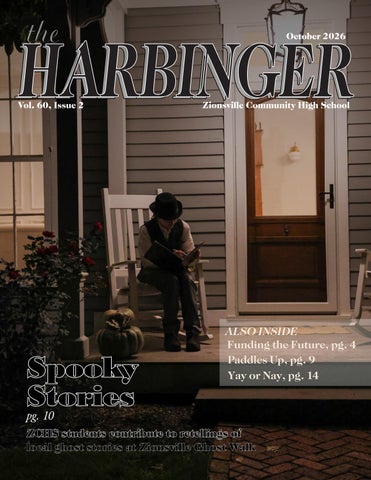
Cover: On Oct. 3, a ZCHS student acts a role at the annual Zionsville Ghost walk. Photo by Reese Adam
3
Funding the Future
ZCS operating referendum renewal proposed this November to continue funding one in three district teachers By Clara Vasey, Assistant Editor
W
hile While “Yes for ZCS” signs are staked in many yards across town, many high schoolers may not know what the referendum means. Why is a referendum, a public vote on an issue, needed for ZCS? According to data on the ZCS Strong School Finance page, our district is the lowest-funded school district in the state of Indiana based on the funding the school receives for each enrolled student. The website says that ZCS receives $7,026.21 per student, while the average in Indiana is $7,557.17. Typically, local property taxes would make up the deficit, but Senate Enrolled Act No. 1, passed in April 2025, reduced the amount of property taxes charged to homeowners. Therefore, local property tax funding going into schools is less than before SEA 1. There is a gap between the funding received and what is needed for schools to provide the education their communities expect. According to a school funding video by the Central Indiana Educational Service Center, the gap can manifest in one of three major funding buckets: education, operation and debt service. The CIESC video goes on to say that operating referendums assure quality in how a district runs day-to-day. They supplement the education bucket, funding teacher salaries, academic programs and classroom materials. This type of referendum is what will be on the ballot for renewal this November. Local homeowner Lauren Kirk initially wondered how there was not enough funding
by Clara Vasey 4 - News Designed Graphic submitted by Coffman
for schools. But when she saw that the referendum would only raise her taxes by $10 and the benefits the extra tax will provide, Kirk reconsidered. “Looking beyond the numbers at what experiences we get by living here, rigorous academics, high literacy rate, numerous extracurriculars, the actual cost to our taxes is so minimal for the return,” Kirk said. Kirk said that extra property taxes for teachers are a “no-brainer” because it is worth it to support teachers and assure that students, like her daughter, have teachers to nurture them. “The referendum pays for one in three teachers in the district, and it helps protect all of the programs that we value, keeps our class sizes low and protects the property values in the community,” ZCS Superintendent Dr. Rebecca Coffman said. Coffman said the ZCS positions supported by the referendum include elementary “specials” teachers, world language teachers and school counselors. “What I hope our high schoolers know is that without those dollars, our offerings that we can make available to students would look drastically different,” Coffman said. The first time ZCS posed a referendum to the public in 2010, it was turned down. Coffman said that because all the funding for teachers of non-core subjects was removed, volunteers took some of the positions so that students could still receive those services. “There wasn’t PE at the elementary level, so we had volunteers that came in and did different activities with students,” Coffman said. She remembers that when her older son was in elementary school, he always did yoga in gym class because that was the strong suit of that volunteer. He complained because his friend got to do soccer all the time because his PE teacher was a collegiate soccer player.
But in 2012, an operating referendum was passed, and ZCS has had one in place ever since. Coffman said the question on the ballot is only to renew the referendum with a few modifications to adapt to new state requirements. This renewal would last eight years before having to be voted on again. “We’re not asking for anything different,” Coffman said. “We just want to maintain our class sizes and maintain all the programs that we have.” Before SEA 1, about 10 districts might have referendums on the ballot during a typical election, but according to the Department of Local Finance website, 37 Indiana school districts will seek voter approval this November to continue or begin operating referendums. Coffman said that not just teachers and students, but anyone who owns property in ZCS will be affected if the operating referendum does not pass. “Our community is strong because of the strength of our schools,” Coffman said. “They really go hand in hand. And so if our school district were to be viewed as being in decline by eliminating programs and eliminating these strong positions, what’s at risk are the property values for all of the homeowners.” Senior Ian Meyers, who will be voting in this election, thinks that Zionsville is well equipped to pay the referendum and fund teachers. “I would probably vote yes for it just because it’s Zionsville,” Meyers said. “There’s a lot of upper-class families here, and we’re able to afford the property tax that goes along with it.” Coffman said that high schoolers casting a ballot in this election have been invested in by teachers throughout their academic journey. “I would encourage seniors to reflect on all of those experiences that they had through school,” Coffman said. ‘What did I benefit from ZCS and how can I play a role in making sure it’s available to my younger siblings, my neighbors, those children that are in the community now? I can do that by voting, yes.”
Step into ‘A CHORUS LINE’ Fall musical cast, crew prepare for upcoming performances on Nov. 12-15 By Tammy Zheng, Guest Reporter
T
ickets are on sale now for “A Chorus Line,” a production featuring a collaboration between the cast, crew and a live professional orchestra, which will debut Nov. 12-15. In selecting a musical for this fall, director Sam Chenoweth said he chose something “complementary or different” from past shows so that every performer can leave with diverse experiences. For this production, the deciding factor came down to the choreography. “We haven’t done a dance-heavy show in years,” Chenoweth said. “And we just felt like we had a good group of students to put it together.” Due to this change, the costume department shifted away from the standard garment arrangements that allow the cast to source their own attire, a move that brings both a challenge and convenience factor for sophomore costume manager Olivia Duke. “Sometimes, you have to have that heart-to-heart conversation, like, ‘hey, this is not working, so we need to pivot,’” Duke said. The lower cost of costumes and the set in this production allowed Chenoweth to go big on a complicated score by expanding the pit orchestra, which he will be conducting for the first time. “I’m choosing to invest in a larger
Callahan said that this musical specifically has been her most cherished despite the burden of stabilizing all components and that getting chosen to play this role was “the best experience ever.” “It’s always been my grandma’s and my favorite musical,” Callahan said. “I’m really close with my grandma, so when I got cast as Cassie, she cried.” While that personal connection continues to fuel Callahan’s performance, Chenoweth hopes the production helps spark a similar Musical cast members practice emotional perception for the entire parts of the musical at a audience, aiming to leave a lasting dance rehearsal on Oct. 8. impression on the viewers. Photo by Izzie Paino “I think just an overall impressive production value is always one of professional pit orchestra, which will my goals,” Chenoweth said. “Just the be the biggest group we’ve had down appreciation for some characters that there,” Chenoweth said. “That’s an have deep content that’s thought-proinvestment, but it’s something that I voking and some others that are fun think will be really worth it.” and silly.” With production expectations risAs Duke said, making sure that ing, lead actress Maddie Callahan said everything runs smoothly is an entire the sheer volume of script and song process of its own. Costume changes, memorization, along with the pressure background props and communication that this role comes with, can feel all reflect on the hours upon hours of overwhelming at times. She added that work that went on behind the scenes. balancing these performance demands “There are always people running with other technical aspects can feel around backstage trying to find items daunting. for you,” Duke said. “It’s definitely a “Right now, it’s just stress,” Callalittle more chaotic than it seems, but han said. “It’s still in the early stages, we try to make it not seem like that so but I’m sure it will eventually become that the audience can enjoy the show.” excitement.” Designed by Colin Adam Graphics by Colin Adam
News - 5
School Board Candidates
Community members run for school board as elections approach By Dhani Miller, Copy Editor and Andrew McLemore, Reporter
S
erving ZCS, the Board of Trustees (school board) is in charge of tasks such as making strategic investments, planning school buildings, making financial decisions, advocating for the district and creating a welcoming community. This includes construction budgets and field trip spending. They also hire, manage and supervise the superintendent. Members are elected every four years and attend monthly school board meetings, where they learn about classes and areas for improvement to help students learn better. They also brainstorm new ideas to improve and plan for the future of the district. General elections will take place on Nov. 3, 2026, and one of the elections taking place is for the school board. Three challengers, Rachel Brandli, Tom Trupe and Melissa Waters, will run against three incumbents, Jennifer Valentine, Michael Berg and Christy Wessel-Powell.
Michael Berg Photo provided by Michael Berg
Michael Berg has lived in the school district for 15 years. He has three children and is a mental health therapist. He is wrapping up his second term on the school board and is running again as an Eagle Township candidate. Berg would like to be reelected because he feels it takes experience to play the best role on the board. “I feel like there’s a lot to learn when you become a school board member,” Berg said. “It’s kind of a unique position. I think often it takes you a first term to really feel like you have a good sense for what is going on.” While there aren’t any specific issues Berg is looking to resolve, the school board is always looking for ways to get better. “I think there are always things we can improve on,” Berg said. Berg also said he is seeking reelection because of the community aspect that comes along with being a school board member. “It’s important to serve your community,” Berg said. “This is one of the ways that I’ve chosen to do it. I think it’s an important way that I can give back to the community and people that I care about.”
Rachel Brandli is running as a challenger candidate for school board member of Union Township. Brandli is a mom of three kids in school at Zionsville, a high schooler, middle schooler and elementary student. She also works as an event planner for a nonprofit in the Indianapolis area. “I love the Zionsville community,” Brandli said. “People move here because the schools are so great, and I want to be a part of that.” According to Brandli, the biggest challenge ZCHS faces as a whole is figuring out where everyone fits and as the school grows, equipping everyone with everything they need for success. One change she would implement to help with this issue is for increased support of teachers. “I would like to support the teachers in a way that provides additional professional development,” Brandli said. “So things that they need to help them succeed in the classrooms with their students is important to me, so you know with professional development and training I’d like to see things that would set them up for success, but not necessarily mandated professional development.”
Thomas Trupe Photo by Andrew McLemore
Rachel Brandli Photo by Andrew McLemore
Thomas Trupe is a challenger candidate running for the school board at-large seat. He has lived in Zionsville with his wife for 11 years. They have three children. He is an engineer, with an undergrad degree from Penn State and a master’s degree in engineering from Purdue. Trupe works for a consumer goods company. Trupe believes that the school board should be doing their best to prepare students for successful careers or whatever their end goals may be. According to Trupe, the biggest challenge the high school and its students face is rapid technological changes, so preparing students and developing their ability to adapt and think through whatever comes their way is important. If Trupe gets elected he plans to ensure that the schools are being governed in a way that the community wants, and specifically that finances are being used wisely. “One of my goals is to ensure our finances are supporting our teachers and our classrooms, and that everything goes directly towards supporting students,” Trupe said.
by Andrew McLemore, Dhani Miller 6 - News Designed Photos by McLemore, Miller, submitted
Jennifer Valentine has lived in the school district for 13 years, running as an incumbent Union Township candidate. Each of her four children has attended ZCHS. Valentine enjoys being part of the school board because of the community involvement. “I really enjoy being in environments where kids are learning, and I get to meet parents,” Valentine said. “I just find a lot of joy in helping the community in a lot of different ways.” Going forward, Valentine said she would like to see more parent engagement and an old program called Eagle Ambassadors return. Eagle Ambassadors took place once per month throughout the school year, parents and community members would ride a bus to different schools within the district in the evening during a 90 minute session. “Discussions included finances, daily operations, instructional strategies, programs, safety and technology that make ZCS a top performing public school,” Valentine said. Although it was time consuming and took planning, Valentine thinks it was worth the effort, highlighting issues within the schools that community members may not think about, such as bus maintenance or playground equipment upkeep. “I just think it’s really important for the community to come into the schools in a structured way to learn and understand all the different things that happen within the schools,” Valentine said.
Melissa Waters Photo by Andrew McLemore
Jennifer Valentine Photo by Andrew McLemore
Melissa Waters is running as an Eagle Township candidate. She’s lived in Zionsville for seven years, and is married with two sons, a middle school student and a high school student. She was a public school teacher for nine years, substituting for Zionsville schools as well as for two other school systems, and teaching preschool. Waters graduated from Purdue University, and has also volunteered with various parent teacher organizations in the district. “I believe in public schools,” Waters said. “My children go here, I’m very passionate about education and advocating for children, and I want to continue to improve upon the excellent school system that we already have.” Some changes Waters proposes to bring about are primarily directed to younger children. Two of these proposed changes are middle schoolers getting more recess time and a better balance of technology and traditional textbooks at the middle school and elementary school level. “I would like to see more of a focus on the fundamentals in our curriculum, and as a school board member, I would take the time to really pour over the different curriculum that is brought to us to be approved.” Waters said.
Christina Wessel-Powell is a professor of Literacy and Language Education in the College of Education at Purdue University. She has two kids in ZCS. She’s running for the at-large seat as an incumbent candidate. Wessel-Powell would like to be reelected because she enjoys working with other members and reaching decisions to benefit the district. “I think we’ve accomplished a lot of really good things together,” Wessel-Powell said. “I like being able to use my experience in education to help ZCS with those kinds of things.” Wessel-Powell emphasized the importance of school funding and why that matters for the school board and district as a whole. “It’s really important that the state of Indiana funds public schools adequately so that we don’t have to worry about funding for teacher salaries or resources that students need,” Wessel-Powell said. Wessel-Powell wanted readers to know that school board meetings are open to everyone. “We have monthly meetings that if [students] want to bring an issue to the school board, they can attend,” Wessel-Powell said. “They’re at 6 p.m. in the Educational Services Center. You can contact the school board if you have any issues, also by email. Anybody is allowed to speak at the board meetings and bring up issues. We always love to hear from students.”
Christina Wessel-Powell
Photo provided by Christina Wessel-Powell
I
ndiana’s general election voter registration deadline was Oct. 5, 2026. The early voting window takes place from Oct. 6 to noon Nov. 2. The deadline for an absentee-by-mail request was Oct. 22 at 11:59 p.m. Election Day voting is open from 6 a.m. to 6 p.m. The next general election will take place in two years on Nov. 7, 2028, with other school board seats available. Registration for that election will have the same requirements: having a valid Indiana driver’s license or Indiana State Identification Card and United States citizenship, being 18 years of age on or before the next general election, having lived in your precinct for at least 30 days before the next general election, and not being currently imprisoned after being convicted of a crime. Voters can register online at Indiana.Voters.in.gov or in person at BMV license branches, county voter registration offices, public assistance offices, military recruitment centers and public libraries that offer forms. Designed by Andrew McLemore, Dhani Miller Photos by McLemore, Miller, submitted
News - 7
Flagging Down a New Sport Girls flag football popularity growing at local, state, national levels By William Jin, Guest Reporter
T
he popularity of girls flag football has been rising steadily in Indiana, leading the Indiana High School Athletic Association to vote on sanctioning the sport. In response to growing interest, the Zionsville Youth Football League created a girls flag program in spring 2025, and ZCHS has offered it as an intramural sport. Intramural administrator Mike Kelly has had issues with recruiting the number of players needed to run flag football. Sophomore Ella Sproull was one of the girls who played on the intramural team last year. When they didn’t have enough players to field two teams, the girls spent time practicing and learning to play the sport. “The reason it didn’t work so well is because people were already so involved in other sports,” Sproull said. “We had a lot of girls that were in soccer, so they had their club sport going on.” The youth level has not had the same problems as the high school level. Youth girls flag football had around 300 girls in the program in 2026, according to Kaylee Miller, girls flag football supervisor, tripling in size from the inaugural 2025 season. “It’s been awesome,” Miller said. Girls flag football programs in Indiana have been promoted through the Indianapolis Colts’ girls flag football program. The program offers money to assist schools in creating their first flag teams and helps to grow girls flag football in Indiana. According to the Colts’ website, the number of high schools nationally with girls flag football teams has increased from eight in 2023 to 108 in 2026. The increase in the number of school teams moved the sport from the IHSAA’s 20-school threshold for an emerging sport to the 100 or more needed for it to be considered for a sanctioning vote. by Colin Adam 8- Sports Designed Graphic from nfhs.org
FLAG FOOTBALL **Membership Update** As of August 20, 2026
Sanctioned (20)
-District of Columbia (2027) -Kentucky (2027) -Louisiana (2027) -New Jersey (2027) -Rhode Island (2027)
Independent / Pilot Programs (17) Voting in 2026 (1) Voting in 2027 (2) Interest Shown (5) Not Yet Considering (6)
“It’s not sanctioned yet, but IHSAA will meet in May,” Kelly said. “At that point, they can sanction it and become a school sport.” According to the National Federation of State High School Associations, the popularity of girls flag football has also been growing throughout the U.S., and 37 states currently have programs. Three states that haven’t sanctioned girls flag football will vote to sanction it: two in 2026 and one in 2027. The growth of national interest in flag football has led the 2028 Olympics to debut flag football, according to the official Olympics website. If the sport is sanctioned, official high school-level teams will compete against each other within the school’s athletic conference. “It’s a lot harder to build an intramural program than an actual varsity team,” Miller said, because of the number of girls needed to play intramurals within one school. Growing the sport at the high school level is currently difficult because female athletes
are already committed to other sports they like, making it difficult for students like Sproull who would like to continue playing. “If I know there will be other people there so that attendance is better, I could see myself playing it,” Sproull said. “That was definitely the hardest part about last year.” At the youth level, athletes aren’t as committed to one sport just yet. “It’s growing so much at a youth level because it’s an even playing field for everybody,” Miller said. “It’s brand new. You can come out and be on the same level as everybody else.” According to Miller, the girls currently in the youth program will likely continue the sport into high school and contribute to a future team. “My daughter’s age group in fourth grade and our fifth graders are definitely our biggest group,” Miller said. “Once they get here, it’ll be huge.”
Paddles Up Cricket Club introduces popular sport as new hobby for students By Nate Waters, Reporter
C
ricket is the second-most popular sport worldwide, with an estimated 2.5 billion fans and 200 million players across the world. Cricket is similar to baseball in the respect that there are fielders, hitters and bowlers, like pitchers. The main difference is the fact that cricket uses paddle-shaped bats, and instead of running bases, the batter runs in a straight line back and forth between two bases called creases. Cricket originated in England and is most popular in India and Pakistan today. Sohan Bograppu, a sophomore and one of the vice presidents of Cricket Club, said the group’s goal is to offer cricket as an intramural sport once they get enough members to have multiple 11-on-11 teams. He mentioned that they play other schools like Fishers and Carmel. The team practices on Fridays after school. Games start in the fall when they have a few scrimmages against Carmel and Fishers. They play some of their games at home outside the football stadium, but also have others that are played away at other schools in the area. Club leaders say students don’t need previous experience to join. They say it’s a more casual club, but they still like to see participation and students making it to the scheduled practices. Akshat Jha, previous president of the club and current captain of the group team for fielding, said that attending practice is the way to get better. “If you show up, we’re going to just teach
“If you show up, we’re going to just teach you how to do it.” -Akshat Jha, Cricket Club captain
how to play or help them improve their skills based on what they already know.” Although they had trouble finding a club sponsor, they eventually got business and entrepreneurship teacher Kent London to sponsor the club. He attends all of the practices and games. For Bograppu, one of the best parts of the club is seeing new members develop their skills and become more invested in the sport. “My favorite part of the club is seeing the newer members fall in love with the sport and learn the ins and outs of the club,” Bograppu said. Anurag Asswal, the club president, said he enjoys the social aspect of playing with the team as well as the competition. “My favorite part is getting to know the guys and hitting sixes [similar to a home run in baseSashank Karki bats at cricket practice. Photo ball],” Asswal said. submitted by Sohan Bograppu They had problems getting people to join the club at first, but you how to do it,” Jha said. “You’re going to now the club is growing faster and they have get the experience that way.” plenty of people on the team. The team practices in three different Asswal said the team is a family and they groups: bowling, fielding and batting. In spend time as a team outside of cricket. bowling, similar to pitching in baseball, they “Not only is the club fun, but it’s a bondare taught the grips, how to hold the ball and ing experience and it’s definitely something how to throw it properly. They all work drills everyone should try out,” Asswal said. and even bring in a bowling machine that Jha also encourages students to join, emfires the ball at them to work on hitting. phasizing the experience they can gain from They sometimes have interteam being part of the club. Students can find out mini-scrimmages with the people on the team more information on the club’s Instragram during practices to simulate an actual match. page @zchs_cricket_club. “It’s informal, but it really helps getting “Everyone can and should join the club. live reps,” Bograppu said. “It makes it easier It’s a lot of fun, and it’s overall a great experifor the newer players to progress quickly. ence,” Jha said. Usually, we teach the people that don’t know
Designed by Nate Waters
Sports- 9
Spooky Stories ZCHS students contribute to retellings of local ghost stories at Zionsville Ghost Walk in early October By Reese Adam, Reporter
D
uring the dark of night, the runners line up on the yard. Boom, boom, boom! A gun fires and heads turn. As the crowd frantically looks around to see where the noise came from, one of the runners drops to the ground while the others dramatically huddle around her. It wasn’t just an accident; it was the Zionsville Ghost Walk. The annual Zionsville Ghost Walk took place on Oct. 2 and Oct. 3. Participants walked around the village of Zionsville and were entertained by live-action retellings of stories from our town’s history. Going from one historical house to the next, walkers learned about the people and stories that shaped the town. With many stories being about murders, haunted graveyards and paranormal activity in Zionsville, there was also a fair share of stories meant for laughter and to showcase the talents of the local volunteers. “My favorite part was just watching, especially the younger players in it, the children that did the scenes,” tour guide Tammy Zeller said. When passing by the Hussy-Mayfield Memorial Public Library, you could see the
Maya Shafer and Claire Evans act in front of a historical house. Photo by Reese Adam
10 - Feature Designed by Reese Adam
Village Dance Studio perform, showing how young talent can be brought into a big event. The Sullivan Munce Cultural Center volunteers start the process in February to make sure the production weekend in October runs smoothly. “We have all sorts of jobs. Volunteers write the scripts, build sets, gather props, set up the lighting and sound, do costuming and, of course, acting,” Sullivan Munce Director Erin Effner said. The 60 volunteers range from eight years old all the way into retirement, with roughly 10 being local high schoolers, according to Effner. Starting with the scripts, the crew works together to turn the spooky parts of Zionsville’s past into fun ghost stories. Most of the stories take place in Zionsville, ranging from the 1820s to the present day, with only a few occurring in neighboring towns in the Boone County area. And then comes the acting, having people from all stages in life helping out. Some do it for fun, while others do it for the purpose of volunteering for the community. ZCHS students play a big role in the Ghost Walk, with some being actors, helping with costumes and working behind the scenes. Senior Hannah Lang helps out every year, mainly designing costumes, but also contributes to other aspects of the event to help it run smoothly. Lang wants to connect everyone back to Zionsville history. “Zionsville has a very rich and interesting history, and it can sometimes be lost,” Lang said. Maya Shafer, senior, also enjoys the acting aspect of the Ghost Walk. Participating in the Ghost Walk ever since she moved here eight years ago, Shafer said she loves to make it a group activity and do it with her friends. “My favorite part is getting to hang out with my friends while I’m doing it, in be-
Tour guide Tammy Zeller thanks participants for coming to the Ghost Walk. Photo by Reese Adam
tween sketches or in between skits while we’re waiting for the next tour group to show up,” Shafer said. Not only can you help volunteer for Zionsville, but you don’t have to do it alone. Kirk and Carly Bryan are a local father-daughter pair. Kirk said, going into his second year participating, he loves doing it for the acting. Carly was convinced by her father to try it, and said she really enjoys it. The Ghost Walk doesn’t just have volunteer opportunities for students; anyone in the community can join, with no qualifications needed. The Sullivan Munce Center also hosted plenty of activities before and after the walk, such as a psychic, gift store, snacks and cider. Making it a fun and memorable experience for everyone, it leaves people thinking: How did all of this happen in a small town like Zionsville?
New Faces T in the Office An introduction to four new front office staff members By Paige Smithka, Reporter
E
lizabeth Schamel is new to the school staff, but not to the district. Although she hasn’t worked in 17 years, Schamel is very involved with the PTO and is currently running the social media page for the high school PTO. Before moving to Zionsville, she lived in Tennessee for 15 years. She also has a law degree. Schamel wanted to find a job that wouldn’t be too demanding on her schedule. When she saw a job opening to work as Principal Karen McDaniel’s executive assistant, she decided to apply for it. “I just do whatever Mrs. McDaniel needs me to do, which could be a different thing each day,” Schamel said. As an executive assistant, she sets up meetings, orders lunch for the principal, handles the ParentSquare announcements, and newsletter and the digital signage announcements. “I love everyone here, everyone’s great, and it’s been really fun,” Schamel said. “It’s been really nice to get to know new people.”
Elizabeth Schamel
L
iz Otto wants to be around her kids when they get to high school, so when she saw the job opportunity as a school administrative assistant, she applied for it immediately. “My job is to make sure everybody’s records, which include your transcripts and your grades, and any other sensitive information, are kept safe and are ready for the next step of your life, whether it’s graduating college or going straight into the workforce,” Otto said. Also, if you move into or out of the school district, she makes sure that your records move with you. Although Otto has not lived in Zionsville for long, she says it is by far the best place she’s lived, because of the welcoming people and her new job in the school district. “I’ve lived in California, Utah, Washington, Minnesota, and here,” Otto said. “[But] I have loved being here the most.”
Liz Otto
wo years ago, Janaya King moved to Zionsville from California. After moving, she worked remotely as a college instructor mainly teaching English for economics. King felt that even though she was working, she was home too much and wanted to get involved with the school district. “I just had a lot of open time, and have been trying to get into the school district to have something that was local, and easily accessible, and the high school seemed like a good fit for that,” King said. As a school administrative assistant; she edits and writes the MAP announcements and birthday shoutouts, handles Senior Privileges, writes detentions and monitors attendance. King looks forward to becoming involved with the school. “Ms. Schamel and I are planning to start a Mahjong club probably,” King said. “It’ll be a good way for us to get involved with the students.” Although most of King’s interactions with students have been writing detentions, she says the kids are always super great. “This school district has been great, and there have been some juniors and seniors that I’ve gotten to know that kind of know how it goes here, and are really easygoing and funny,” King said.
Janaya King
K
irsty Eilers is the new school administrative treasurer. She has two kids at Pleasant View Elementary School and moved to Zionsville a year ago from Chicago. As a treasurer, she does a lot of data entry and follows money. Eilers previously worked as an office manager for a company that and did work like what she is doing now. “I used to work for a company that managed interest rate risk,” Eilers said. “So when you get a loan from the bank, the bank will charge you money to borrow that money. My company would handle large, multi-million dollar loans, and I was an office manager for them.” She says that being a treasurer for the school, rather than another company, gives her the opportunity to be more involved in the school district, and allows her to have the same schedule as her children for breaks. “I feel much more a part of the community than I was before, and have gone to more events, like football games. I am just much more a part of the school than I was before,” Eilers said. Before she lived in Chicago, she had lived in Australia for her husband’s work and had also lived there until 1998 as a child. Eilers says that the staff working here have been super nice, and it’s been great working here. “Everybody is really welcoming and helpful,” Eilers said.
Kirsty Eilers
Designed by Clara Vasey Photos submitted by Eilers, King, Otto, and Schamel
Feature - 11
Zionsville students share what they are thankful for
By Bridget Scheidler, Reporter
S
o often in life, we take simple things for granted: having a home, somewhere to sleep, siblings, parents, our sports and activities, or our friends. Frequently, as a society, we look for the next thing, what’s ahead. We focus so much on what we don’t have and lack the ability to see what we do have already. It’s harder to recognize the individual growth we have made in our lives and compare it to others. We’ve all heard this, but comparison is truly the thief of joy. When we compare ourselves to others, we forget to appreciate the growth we have made ourselves. Everyone is in a different place in life; we aren’t all meant to have the same experiences or be in the same place.With Thanksgiving just around the corner, pivoting your vision toward the things you have already accomplished in life and the things that you have been blessed with is definitely a better outlook.
Tyson McCann
Sam Calibo “My parents and family because they really support me in what I want to do, and they provide me with many important things. I’m thankful for my friends and how loyal, supportive and how they have always been there for me.”
“My family because even if I’m down or not feeling my best, they’re always going to be there to support me, I’m forever grateful for that. I’m also thankful for the opportunity to play sports. I’ve played football since second grade and lacrosse since sophomore year. For football I like that I’ve been playing with the same people for a long time, and I love the community surrounding both sports.”
Evan Hubbard “I’m grateful for football and baseball and for the school athletic system and all the opportunities. Mr. Vasvary, I met him last year, he is a great coach. I love getting close with my friends through these sports. Matthew Anderson is a great influence and he’s a good player. I’m also thankful for my dad. He’s always been a good influence on me and has helped me with anything I need.”
Khairi Slater “I’m grateful for the people in the school, my friends and to be in such a great place with such great people. They make me who I am.”
Evie Benitas “Friends and family because they make me happy and help make my day better. I also am grateful for the weather right now, I love fall.”
Alonso Carrillo Kate LaRue “My family because they are always there for me. We have a lot of traditions, especially around the holidays. For Christmas, we come together at my grandma’s house and we have dinner, then brunch in the morning.”
“I’m grateful for being here, having friends,, and everything. It’s a really nice place. My friend Kaysen, my friend in cross country, has helped me since the first day.”
TRANSPORTATION TEACHERS SUNLIGHT LIFE
PARENTS PHONES HOME HEALTH FRIENDS EDUCATION SAFETY PETS
Spreading Gratitude
12 Perspectives Designed by Colin Adam
MUSIC COUSINS CLOTHING NATURE FAITH BOOKS FREEDOM A BED
VIDEO GAMES COMMUNITY VACATION SLEEP FOOD
Hey
Barbie nearing 70 years of culture shifting to empower girls
By Ren Cronin, Reporter
F
rom a gymnast to a doctor, Barbie has had over 250 careers throughout her 68 years of life. She first appeared in a strapless striped bikini, big gold hoops and a high ponytail, a contrast to the baby dolls that had come before her. Barbie’s existence helped push the narrative of giving young girls the choice to do anything they wanted in their future. Because she was an adult and not a baby doll, girls didn’t have to play family; they could imagine Barbie as anything they wanted her to be. During World War II, women had begun entering the workforce to keep up with product demand and production to help soldiers fighting. Once the war ended, women fought to keep working. This made the release of Barbie in 1959 even more impactful, according to Smithsonian’s “A Cultural History of Barbie” article. At nine years old, my mom’s vintage Barbie fashion doll was my favorite. Her leopard print coat, big gold hoop earrings and poodle were so cool to me, and I decided one day I wanted to be as cool as her. My mom also gave me an Irish princess doll with long red hair. I hadn’t seen very many princess dolls with hair the same color as mine, and I loved having a Barbie who did. Having dolls and representation of how you look as a kid is so important for young girls because it helps develop confidence. Every time I find the Barbies again, I think
about how they shaped the ways I think about myself and how Barbie has never been limited to just a girl with blonde hair and blue eyes. She was always intended to be more than just a doll. In 1962, the year Alan Shepard, the second man to go to space, a girl named Linda Halpern wrote to NASA asking if she would see a woman in space. Their answer was no. When Mattel heard, they released their “Miss Astronaut” Barbie, 18 years before NASA allowed women to join. By releasing a toy to a young audience that displayed a female astronaut, Mattel was opening a door for young girls to believe they could go into that field. This is extremely important, especially in aerospace engineering and the work NASA is doing. Women have drastically improved the work being done, especially Katherine Johnson, who helped with the Apollo 11 landing. The Handlers designed Barbie as a symbol for young girls to be anything they wanted to be. Due to her continued breakthrough into new careers and jobs, Barbie has stayed relevant and progressive. She has adapted to the current generation of kids and their most recent market while keeping the same message: to show kids they’re able to do anything.
Even though Barbie has faced controversy around her feminine appearance because of each of her different careers, her femininity serves as a reminder that women in male-dominated fields don’t need to lose their personal style or views to be successful. This is extremely impactful for young girls, including myself, who may have been viewed as unintelligent because their favorite color happens to be pink or because they enjoy makeup. In a world that views femininity as a flaw, Barbie has always served as my reminder that I don’t have to give up the things that make me who I am to be successful and taken seriously. Barbie also strengthens connections between people. Junior Layna Philips talked about the impact of receiving her mom’s collection of Barbies from the ’90s. “Part of it was a connection with her and her childhood interlacing with mine,” Philips said. Her childhood with such an influential part of her mom’s life and her own. Philips’ experience with Barbie shows how Barbie’s existence has influenced and helped shape the lives of young girls for over 60 years.
1980
Barbie runs in the presidential election
First black Barbie
1992
1959
Miss astronaut Barbie is released
Barbie is created
1965
2012
Inspiring women collection released
First chemo Barbie Designed by Ren Cronin Barbie photo from Sentintospace
2018 Perspectives - 13
Yay or Nay ZCHS Students, staff and talk about new policies
We pulled three students, a teacher and the principal to discuss the new policies in the school. Johan Bejoy represented the freshman, Adam Morgan represented the sophomores, Lily Plawecki represented the juniors, Grace Fletcher (Visual arts and wellness department chair) represented the teachers, and Karen McDaniel represented the administration. We touched on the new block schedule, the phasing in of Chromebook computers, and the new phone policies. This is an edited transcript of that conversation.
By Cole Meyer, Reporter
Block Schedule
Cole: Students, has the new schedule affected how you manage your time or your workload? Lily: With the transition to the block schedule and the removal of study hall, I had made a four-year plan before my freshman year, so it kind of threw it off a little bit, but I was able to adjust. Adam: I think it’s actually a really great thing that we’re doing because you really aren’t rushed in any of your classes. They really take their time and thoroughly explain the topic. Nothing is because “Oh we’ve got 45 minutes, we’ve got to get this done, we’ve got to move on.” They can take their time. Cole: Do you think the mandatory MAP has helped you with your work? Lily: I would have taken a study hall even
if MAP wasn’t mandatory, but having that block to have effectively a study hall is definitely helpful. Johan: I think having MAP is a good thing, but I feel like if it was near the beginning or end of the day, it would be better because then you can prep for your classes or you can finish your homework before you go to after school practice. Cole: Mrs. Fletcher, how has the new schedule affected how you teach or your lesson plans? Mrs. Fletcher: Yeah. So we’re a very studio-based art class. And so it’s been really nice because you have to take so much time to prep and then so much time to clean up. So removing that gives the students more time to actually spend on their artwork and
less of that preparatory stuff. Cole: Mrs. McDaniel, can you kind of explain the benefits that you have seen or heard throughout the school? Mrs. McDaniel: The purpose was to go deeper into that knowledge while they have you. Our studio classes, our lab classes, the ability to dig deeper in those labs and make those science labs easy. Before, or if you wanted to take a study hall, you could only get six credits a semester. Now everyone can get seven credits and you have that study time every other day. So yeah, I think that the goal was to also mimic a little bit more of the class structure you’ll have when you go to your next level, whether it be trade school, college or whatever that is.
Computers Cole: Do you think that the new computer policies have affected your productivity during class? Lily: Honestly, the only thing that affects my productivity in class with a new computer is just not really knowing how to work it. Like it’s a Chromebook, but I’m used to my, HP laptop that I used the other two years. But then like with GoGuardian, I fully understand it and it’s like I appreciate it. But then when my teacher has me turn my desk around so she can still see it just feels redundant. Like either use it or don’t. Adam: I like the new computers because it really keeps you off all like the restricted sites and everything that you shouldn’t be on. But with GoGuardian, I feel like some teachers can kind of go a bit over the top with it. Like I have stuff open for another class and
14 - Perspectives Designed by Cole Meyer
then they just turn it off and I’m not doing anything with it and they have me close it and I’m trying to keep it open because I’m going to do it another time. Johan: For me, I never had the experience of having a personal laptop, because throughout middle school, we’ve always been given a Chromebook, and we had GoGuardian for the past two years. So I mean, it’s not a big change for me. I think like last year, especially in middle school, not all the teachers were strict on GoGuardian. Like they’d be like, I trust that you’re doing your work, but especially this year, you can tell like almost every single of my classes, all the teachers are using GoGuardian. I mean, I don’t really mind it, but eventually it does reach a point, like Adam said.
Cole: Mrs. Fletcher, have you experienced an improvement in the students’ productivity and engagement during the class when not using their devices? Mrs. Fletcher: Yeah, I would say it’s the biggest change in my room because we don’t use computers that often. I do pull up GoGuardian because it’s a timed, hey, I need you to get this research done so we can move on type thing. But I think in the art rooms, somehow it became very normal for kids to start watching movies and TV shows while working. And it just became this hard challenge of, well, you are working and it’s actually keeping you focused. So do I allow it? Do I not allow it? So it is a lot easier from my point of view to just be like, no, sorry, it’s blocked.
Computers (Continued) But I do allow listening to music and things like that because I do think a lot of people need that sound just stimulating them while they’re working. But I’ve appreciated it. I like the consistency of it and how I can pull it up when I need to, and it just helps keep some students that really do struggle with that more on task. Cole: For me I had a personal computer 7th grade and then I was shifted away from it in 8th grade. Can you explain the motivations behind the phasing in of the Chromebooks specifically? Mrs. McDaniel: Yeah, absolutely. So the state law is no electronic devices outside of what school issued, but they realize that not every school could afford it if you had not implemented a one-to-one. So our seniors can still bring their own devic-
es because we didn’t have the money to buy all seniors’ Chromebooks this year but we have been phasing in Chromebooks. So the whole point of it is you can’t use personal devices, the school is responsible for providing you that Chromebook or whatever the school uses. Some schools use iPads and different things, but for us it’s Chromebooks and so again it goes back to reducing distractions and the teacher being able to kind of lock you out of things that aren’t on task. I also understand a teacher’s perspective when they lock you out of doing another class work for another class because they need you to do that work in front of them, so they know what you’re doing, right? They need to know if they need to make any tweaks in the instructions. So as frustrating as it is to be like, well, I need to get this done, the time that you’re in that
class with that teacher, that teacher actually needs to know what you know, what you don’t know, how can they help. So when a teacher says, hey, I need you to put that away and work on the work for this class, that’s why they’re doing it. As I think about what the state is doing and why we’re trying, I’m trying to find positives, is that we want to teach you the difference between- you can have that personal home device and I love my little HP at home. But then when I come here, I’m like, okay, I have to get used to what this system is. And just navigating that I think is a good life lesson because you will go to a job and they will issue you a device and you just need to be mindful of what that looks like and how you use it.
every day because I am fascinated with the conversations and the movement and the behaviors of teenagers at lunch. And what we saw last year is that there were a lot of, especially with the guy tables, there were a lot of using the phones, but playing a game together. And it wasn’t a distraction in a bad way. And then at some of the girl tables, it wasn’t quite as much, there wasn’t as much phone use, but what there would be, if there was, it would be, looking at social media stuff or shopping or just little things like that where you were sharing an experience of things that happened. You were showing photos of each other, concerts and things like that. So I didn’t hate the phones at lunch. The whole purpose of the caddies with the card games in them and encouraging kids to bring their own games to lunch was to have that replacement activity of the games that you would do on your phone because I know it’s different. I’ve noticed that the cafeteria is a lot louder but in a good way. And we extended lunch by 5 minutes this year, not knowing we would not have phones at lunch. So we did, we intentionally kept all the different puzzles, like I’m gonna rotate them out every quarter. You were engaging with your phones differently. You were either playing games or you were just doing various things that shifted your brain into a different kind of way of thinking. So that was the whole intention of the caddies
and the puzzles were just to give yourself something to do. I’ll be honest with you, it was also for kids who may be sitting alone or just to have something that occupies your time to, do a word search or a Sudoku. So that was kind of the intention behind it, but I don’t, I didn’t mind phones at lunch. That didn’t really bother me. I didn’t see our kids misusing it. Cole: Have you seen an improvement socially like more people talking to each other during passing periods? Mrs. Fletcher: Oh yeah. I stand at the end of the long connecting hallway there and there’s just so much more talking. I don’t see many phones. I am impressed with how many people are not carrying them when they come past us. Everything is a little bit more social, a little more loud. But it’s because everybody’s talking to each other. So that transfers into the class. Adam: There were a ton of headphones in the hall. Mrs. McDaniel: Yes, everyone would kind of zone out, right? And I’m not mad about it, but at the same time as somebody who’s safety focused, I caution people all the time of wearing noise canceling headphones in a public space because you just don’t know. Johan: Like in middle school, we got to use our phones, even in the hallways, I didn’t see that much being on your phone. I saw more like you were listening to music, or walking and talking with your friends.
Phones Cole: Students, do you think the ban on phones, especially during lunch, has improved how you interact with people? Lily: I think it definitely depends on your personal lunch experience. Because if you’re sitting with one other friend, but then they’re sick, then you’re alone. You’re just sitting by yourself doing nothing. Because I mean, I’ve already done all the sudokus. But I will notice on my silver days, I sit with my swimmers, and it’s really fun. It’s fun to be present with them. Adam: Like last year, a lot of what we would do is we’d be playing a game that we all can do together. So it’s a way to really not be class related, get a little break. And so we were being socially engaged with each other with the phones. But like she said, I do like talking to my friends and everything. Johan: I think I agree with the overall perspective. Like last year, we had our phones during lunch, and there was definitely less restriction on it. And people would play together, play online games together. And sometimes people wouldn’t even use their phones willingly, because they’re like, let’s just talk. And even this year I see it, because this year everyone’s like, no phones whatsoever. But I think if phones came into play, we’d like more interaction overall. Mrs. McDaniel: I love lunch because it’s a study in human behavior. And that’s why I’m in almost every lunch
Designed by Cole Meyer
Perspectives -15
Harb Highlights Group Spotlight Robotics
R
obotics is a club here at Zionsville where groups of students form teams to design, build, code and document their whole process of creating their own unique robot. Each year students are challenged with a new game where they have to analyze and find the best way to maximize their points. In addition to working on their own robots, students have to work with others in each game as they are paired with a different “alliance partner” or teammate in each match.
Liam Shipman (10) practices driving after making adjustments to the robot at practice on Sept. 22. Photo by Colin Adam
Harrison Prifogle (11) helps build the teams’ robots by following design plans on the computer at practice on Sept. 22. Photo by Colin Adam Bodie Williams (11) adjusts robot before scrimmage match at Zionsville on Sept. 12. Photo by Colin Adam
O
ROBOTICS EXPERT
Colin Zheng (11), builds his team’s robot at practice on Sept. 22. Photo by Colin Adam
Owen Gesse
What’s next?
wen Gesse (11) is competing in his eighth year of robotics and is currently on team 7701Z with friends Alek Baloski (11), Naman Vyas (11), Callum Weber (11) and Bodie Williams (11). They have worked as a team for three years, qualifying for state each year and even qualifying for the world championship in 2025, as well as winning awards in excellence and design. “Having good communication makes sure that all of the team members know what the plan is every day and keeps everyone informed on team activities,” Gesse said. Robotics runs the full school year, and students participate at their own pace, working in their teams while gaining feedback from fellow teams to help each other succeed. “I would recommend stopping by our robotics room on Tuesdays or Thursdays after school to see what we do and the work that goes into us being as successful as we are,” Gesse said.
Dates, times, and locations are subject to change.
Nov.
10
V/JV Girls Basketball VS. Warren Central When: 6 p.m. Where: Varsity Gym
Nov.
12
Fall Musical Debut When: 4 p.m. Where: PAC
Nov.
18
V/JV Boys Wrestling
VS. Carmel When: 6 p.m. Where: Fieldhouse
Nov.
19
V Boys Basketball
VS. Lawrence North When: 6 p.m. Where: Varsity Gym