HARBINGER HARBINGER
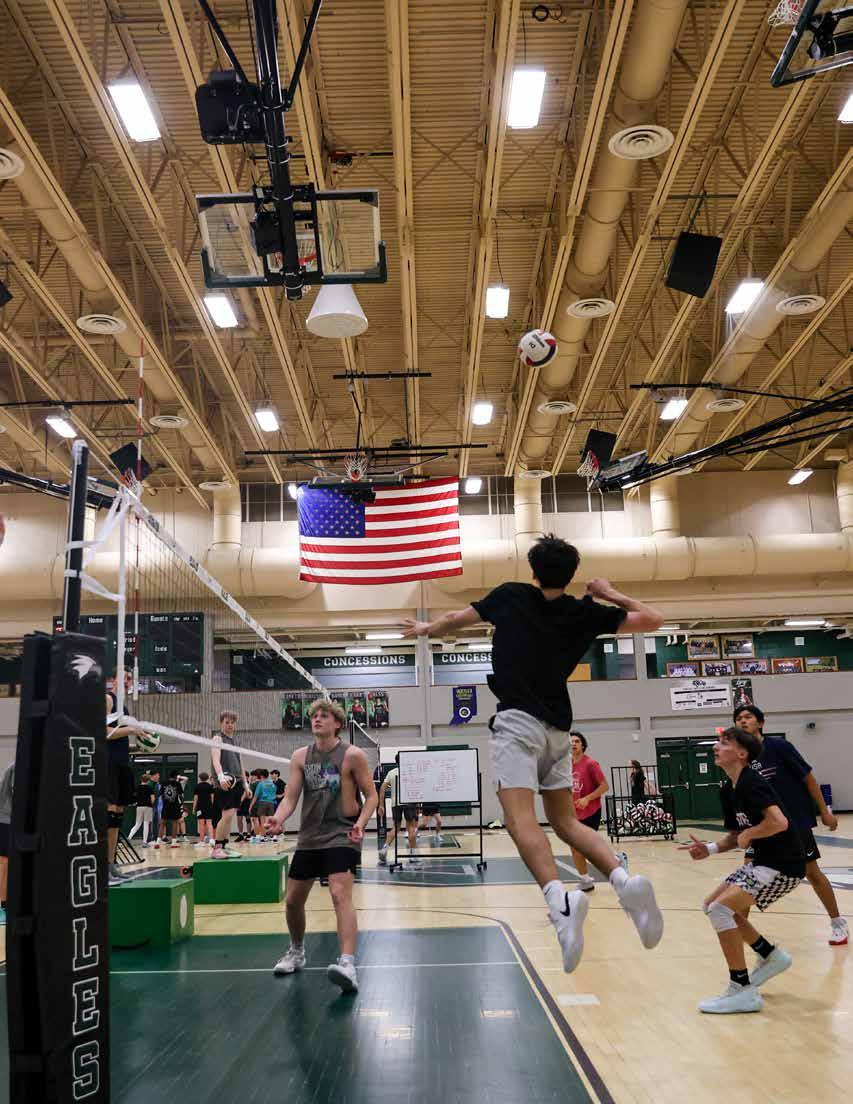
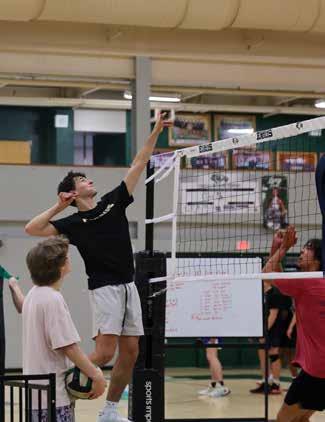
JT Norris, senior, hits downballs during practice on March 11 while the team works on defense. Photo by Lilly Steele
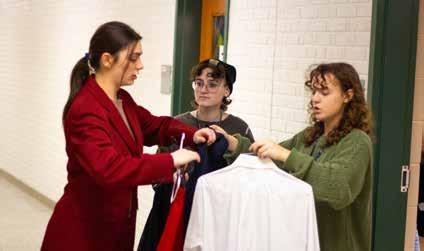
Actor Lydia Ertle talks to costume designers about her Ms. Peacock costume on March 4 outside the costume closet.
Photo by Luke Kouns
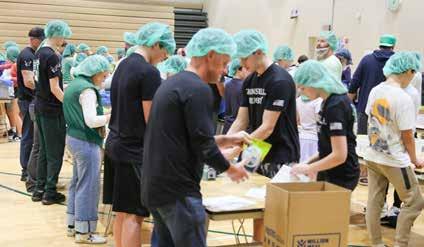
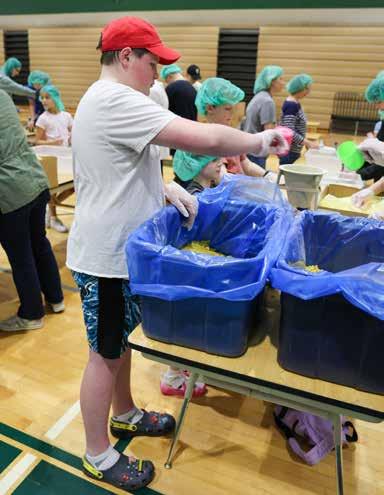
Students join community members to pack meals for the Million Meals Movement during Do-Days on March 6 at ZMS. Photo by Dhani Miller
Social media restrictions set to impact teens
The internet is amazing for doing everything from communication to entertainment to connecting people, but as children gain access to it at a younger age, its regulation should evolve in order to adapt.
Social media presents many challenges for younger users, especially with privacy and overexposure. However, restricting access entirely ignores how important these platforms are, especially for teenagers. Platforms should focus on teaching responsible use and strengthening protections for very young users.
One of the biggest concerns surrounding social media is how easily teenagers can become overexposed online. It's easy for many users to share personal information like photos, locations, and private information without fully understanding how permanent the internet can be.
Once something is posted on the internet, it can be very difficult or impossible to remove. This creates long-term privacy risks, especially when companies collect data about their users.
Excessive social media
use can also contribute to negative effects like anxiety, comparison, and cyberbullying.
Additionally, online predatory behavior is growing as people can now communicate with others of various ages while hiding their real identity, making it easier for someone to pretend to be someone else and creating risks for young users who may not recognize the danger.
These dangers can be seen even in our own community, with the recent tragic death of Hailey Busbee from Fishers.
However, social media also provides many benefits. Teens use it to communicate about school clubs, sports teams, and organizations that often share announcements and updates online.
Teens also use it to share about their lives and connect with their peers.
Removing social media would make it harder for students to stay connected with one another and participate in activities outside of school.
Additionally, banning specific platforms is not very effective. The internet constantly evolves, and when one
app goes away, another one appears to replace it.
These strict bans simply push users to different apps instead of actually addressing the problem.
Some countries have already begun considering stricter rules. For example, Australia has passed new legislation banning social media for kids under 16, with fines of up to tens of millions of dollars for companies that violate the rule.
Rather than restricting access entirely, Harbinger staff believes it is more beneficial to teach digital responsibility.
Teaching students how to use social media responsibly can better prepare them for a world where digital communication is unavoidable.
Social media is not going away, and neither are the challenges that come with it. Instead of attempting to eliminate and restrict these platforms from teenagers’ lives, we should focus on creating safer environments and adapting to the increasing presence of younger users online.

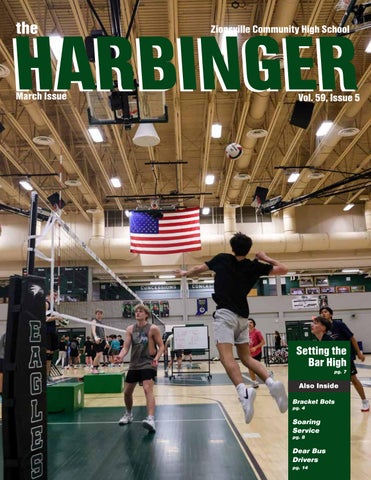
Cover: Senior Jack Miller swings on the outside during
drill at practice on March 11. Photo by Lilly Steele
Bracket Bots
AI prediction advances, Harbinger staff puts its abilities to the test
By Ariana Spence, News Editor
Artificial Intelligence has already far surpassed the abilities of the human mind, and while it may not always give perfect responses, its accuracy when it comes to predictions is rapidly improving and becoming more precise than ever before.
Several popular AI models, including OpenAI’s ChatGPT, Anthropic’s Claude, and Google’s Gemini, have been used by millions of people globally for anything from writing school essays to creating and building complex apps. These AI models, and similar platforms, have been regarded as some of the most advanced and intelligent free AI software commercially available to the public. Even without paying extra to upgrade chatbot models, this technology is already significantly more intelligent and human-like than anything before.
As traditional AI models become more advanced, their ability to predict future results and outcomes improves as well.
As an experiment to test AI’s prediction accuracy, the Harbinger staff has asked ChatGPT, Gemini, and Claude to predict the outcomes and final standings of the 2026 Winter Olympics and the NCAA Division I Men’s Basketball Tournament known as March Madness.

According to the Stanford University Human-Centered Artificial Intelligence Research and Development (HAI) group, beyond benchmarks, AI systems [in 2025] made major strides in generating high-quality content, and in almost all settings, language model agents outperformed humans in every task. The response given by ChatGPT demonstrates AI’s advancement in prediction generation.
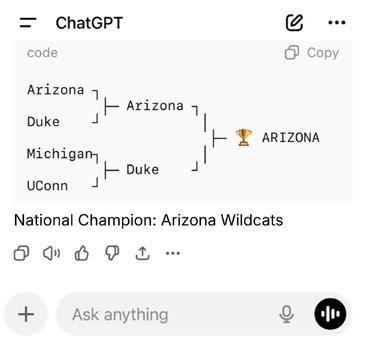
On Feb. 9, before the start of the NCAA March Madness, ChatGPT was asked to predict and create a bracket, shown below, of the results. Never in the history of the NCAA March Madness for both the men’s and women’s teams has there been a verified perfect bracket, but some AI platforms, for the 2024 NCAA March Madness, have predicted brackets more accurate than any produced by humans, according to the HAI.
Oneof the top AI competitors, Anthropic’s Claude, was named the number one most advanced AI of 2025 by the National Institute of Standards and Technology and continues to improve at high rates. Anthropic deems Claude to be almost four times as powerful as ChatGPT, regarding both response generation quality and output speed.
On Feb. 3, before the official commencement of the games, Claude’s Sonnet 4.6 Model was tasked with predicting the outcomes of the 2026 Winter Olympics, shown to the left. Looking at the final standings and medal table at the end of the games, Claude was accurate on Norway, the United States, the Netherlands and Germany heading up the top five.
The presence of AI throughout the world, including in both the NCAA March Madness tournament and the 2026 Winter Olympics, is becoming more and more prominent. As its abilities continue to advance and its responses improve, the gap between where AI’s split-second intelligence surpasses the human mind continues to grow.
Restricted Access
As concerns
grow over safety online,
governments are introducing new rules that could reshape how teens use social media
By Gia Villarrubia, Reporter
Scrolling through TikTok between classes or checking Snapchat after school has become part of everyday life for many high school students, but governments around the world are starting to push back and pass new laws and restrictions that could change how teens use social media. Several countries including Australia, France, Britain and the United States are introducing bans, age restrictions and strict parental controls all targeted to protect minors from online risks like cyberbullying and harassment.
France took action, approving legislation that would ban children under 15 from using social media. The law, passed by the national assembly in January, aims to reduce online bullying and protect teens’ mental health. It still needs to pass through the senate before becoming final. If enacted, it would require platforms to enforce stricter age verification for minors. Meanwhile, Britain is consider ing a similar measure for users under 16. The proposals in both countries reflect a growing concern across Europe about the impact of social media on young people, particularly regarding mental health, online harassment and excessive screen time.
United States
On the other hand, in the United States, social media is still unrestricted to millions of kids, but restrictions are increasing. Federal law under the Children’s Online Privacy Protection Act already prevents companies from col lecting personal data from children under 13 without parental consent. Despite this, many kids bypass rules by entering false birthdates. Some states have tried to pass stricter requirements for teens though these efforts have faced legal challenges.


Oneexample of action at the state level is Indiana’s newly approved law targeting teen social media use. The legislation requires certain social media companies to obtain “verifiable parental consent” before allowing Indiana residents under 16 to create an account. The restrictions apply only to large platforms that generate at least 1 billion in annual global revenue, and rely on algorithmic content recommendations. For approved teen accounts platforms must disable algorithm recommendations, targeted advertising and direct messages from unapproved users. Parents who grant consent must also be given tools to monitor the minor’s usage. The law also requires ongoing age verification and accounts that fail to verify age or obtain parental consent may be removed.
ustralia made one of the biggest changes yet. In December 2025, Australia passed a law requiring major social media platforms to restrict users under 16. Companies that fail to comply could face fines of up to $35 million USD. The law, described by Reuters as one of the strictest in the world, could set an example for other countries.
Students themselves also see both sides of the debate. While some agree that restrictions could help issues like cyberbullying and mental health struggles, others say social media plays a major role in how teenagers communicate and stay connected with friends. These new laws reflect growing concern among parents and lawmakers about how social media affects teenagers. While social media can help teens stay connected and express themselves, many worry about its impact on mental health, self-esteem and teenagers’ daily life.
Girls lacrosse team looks to build on success of last season Mentorship Mentality
By Addison Prieshoff, Reporter
Fourteen games played — and only three losses on the record. The ZCHS girls lacrosse team was on a roll, having worked tirelessly for months to get to this point. Everything looked in place for the team to make a triumphant run to the state finals. But all of that changed with an unexpected double overtime loss to Bishop Chatard in the state quarterfinals for the 2025 season, 13-14.
For the girls lacrosse team, last year’s season was defined by three words: “Handle hard better”. This was the team’s motto for the year, a tradition that they have where each season is defined by a certain set of words. It acted as their guiding principle as they navigated a new head coach, the loss of several key seniors, and their high hopes of winning the state competition.
“We had to recreate our identity,” new head coach Lindsey Goane said. “We had a lot of growing pains, but the girls really stepped up to the challenge.”
However, an untimely loss meant that their postseason run was cut short, leaving many players wondering what their future would hold in the 2026 spring season.
As one of the four senior captains of the team, senior Alexa DeHart is a big proponent of setting the tone of the new season early on.
“We still have a chip on our shoulder,” DeHart said. “I still have more left to give.”
Having grown up playing lacrosse in the Zionsville Youth Lacrosse (ZLAX) programs, middle school, as well as the varsity team all four years of high school, DeHart is no stranger to an athlete’s mentality. Being on the varsity team as an underclassman led her to develop strong bonds with many of the older girls and look up to them for advice. Now, as a senior and a leader on the team, she is prioritizing being a role model for the younger players.
Sophomore Maret Childers defined the ‘24-’25 season as successful, fun, and full of teamwork. Her goals for this upcoming season include, “getting closer with the team by bonding with the other players, coaches, and mentors.” During her freshman season, she experienced the ups and downs of the success of the JV team while supporting and forming
bonds with the varsity girls.
“Girls need female role models to look up to, they want to see girls who are reaching the goals they want to reach,” Goane said. “They want to learn from and build encouraging relationships with strong female athletes.”
A few times each year the girls team will host youth nights that range from actual lacrosse skill sessions to fun crafts and bonding activities. They also host youth camps, officiating games, teaching lessons and their annual K-6 Girls Night Out.
“We want the sport to be as fun as it can, and for them to build friendships because that’s what it’s all about,” DeHart said.
With the majority of the players, like Childers and DeHart, having come through the youth ZLAX program, it is a community that is close to their hearts. By forming such a close relationship with the youth coaches and players, the high school girls are able to give back to their lacrosse community in meaningful ways. This year they are planning to do a multischool fundraiser for the Violet Foundation which researches and helps kids with pediatric brain cancer.
“I think this gives our girls an opportunity to be role models within our community,” Goane said. “They get to do things that are bigger than lacrosse as a team.”
The team’s new word of the season is “Finish”, which DeHart described as finishing every small thing, whether that’s in a practice, game or fun activities within the community. It’s a key
principle that she and the other captains are bringing into this spring season.
This year the varsity team is made up of a majority of returning players, with only two new players joining the team.
“You’d think it isn’t very different, however, our team seems extremely different,” Goane said. “Our confidence has grown.”
Playing in the 2A conference, their schedule this season features teams like Westfield, Noblesville, and rivals Bishop Chatard. Both the JV and varsity teams will have games starting in March and lasting until the beginning of May.
“We are excited for the year ahead,” Goane said. “Come out and watch a game!”
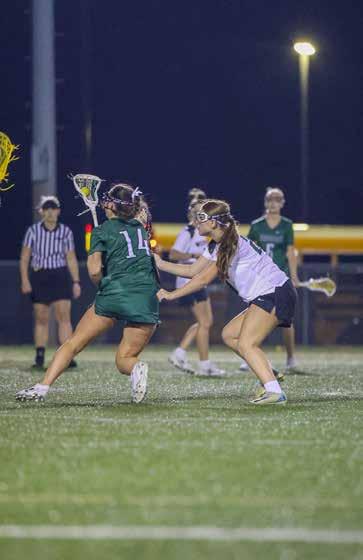
Alexa DeHart attacking the defense in the varsity season opener against Westfield on March 9. Photo by Lydia Kenworthy
Setting the Bar High
By Ant Farrar, Sports Editor
The ZCHS Boys volleyball program is still growing its reputation, but inside the gym, the expectations are high and hard work is being done. With strong leadership and coaching on the team, they are working to compete with some of the best teams in the state to help shape their team.
Seniors Jack Miller and JT Norris are helping to lead that by bringing intensity and leadership into the gym every single day. For Norris, volleyball has always been a huge part of life. Starting in seventh grade and competing in travel volleyball early on gave him the experience he needed for the school team.
“I wasn’t very nervous coming into high school because I had some experience playing travel volleyball,” Norris said. “But I think that some younger guys are nervous because they have no idea what to expect from a newer program.”
Now playing the position of right side/ opposite hitter, Norris mainly plays a key part in both offensive and defensive roles, as he plays one of the positions responsible
Senior leadership, a new coaching vision help push boys volleyball team toward a new era of success
for blocking the other team’s top hitter while also getting kills during rallies.
“Volleyball is a game of mistakes,” Norris said. “The team that makes the least mistakes wins.”
As the program continues to grow and build at Zionsville, Norris thinks that one challenge is keeping consistent numbers and commitment over time.
Miller has been a part of the pro gram since his freshman year, and what kept him there was the environment and the fun he was having playing alongside his friends. As an outside hitter and defensive specialist, which gives him opportunities to do something every play, passing and attacking.
Miller believes that men’s volleyball has key traits of athleticism that go unnoticed and most people generally overlook.
“Physically, volleyball takes more explosiveness and reaction time than almost any other sport I’ve played, depending on the position you play.” Miller said. “I wish more people knew how hard it actually is and how much fun it is to watch.”
Together, Norris and Miller reflect the competitive mindset and leadership that the ZCHS team is building.
Head Coach Tyler Beeman stepped into the role after previously coaching JV at another school. While he was familiar with many of the athletes through club volleyball, he saw strong potential in the team.
“The athletes at Zionsville are hardworking, competitive, and bring great energy to the gym,” Beeman said. “It made the decision an easy one.”
Since taking over the team, his focus has been on building structure and consistency in the squad.
“A major focus has been building a cohesive coaching staff that complements one
another and brings strong knowledge to the program,” Beeman said.
The results have already shown, since this year, they won a sectional title for the first time in 10 years. It was also the first year boys volleyball was recognized as an official IHSAA sport.
When it comes to player development on the team, priorities and requirements are pretty clear for Beeman.
“The first three qualities we look for are attitude, coachability, and effort,” Beeman said. “Skills can be developed, but those traits are foundational.”
Together, with strong senior leadership and a positive coaching vision, ZCHS men’s volleyball has been positioned for continuous growth and development, and possibly more titles in the future.
“Our athletes work extremely hard and are building something special, and we would love to see more people in the stands.” Beeman said.
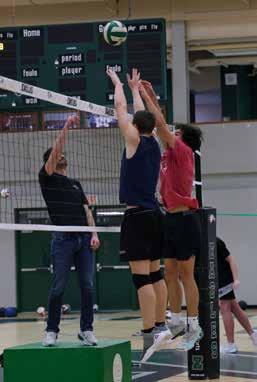
Seniors JT Norris and Anderson Vestal block coach Beeman’s swing from the outside during practice on March 11. Photo by Lilly Steele
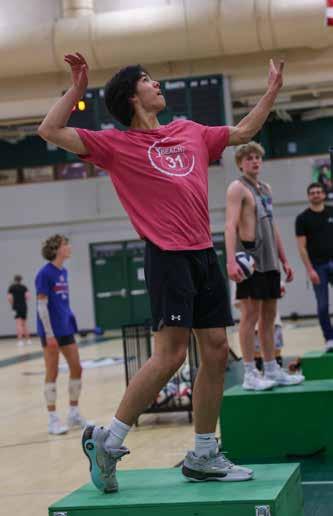
Jack Miller, senior, swings off of a box on the outside during a drill at practice to work on defense on March 11. Photo by Lilly Steele
Soaring Service
Students encouraged to volunteer, participate in service learning during eighth annual “Do-Days” on March 5 through 7
By Dhani Miller, Reporter
Helping others through volunteering gives everyone the opportunity to make a difference. “Do-Days” were created to give Zionsville students a way to do just that. It’s a chance to turn a regular week into something meaningful. Whether lending a helping hand in the broader community, in their school, or in their own backyard, students are encouraged to use these three special days to make a difference in Zionsville.
The eighth annual “Do-Days” took place Mar. 5 through 7. Many ZCS students took part in community service throughout Zionsville. With March 5 being a no assignment e-day for middle school students, freshmen,
sophomores and seniors (with the exception being juniors taking the SAT that morning), the day was focused on encouraging students to participate in volunteering and community service.
“We choose to put the school-day SAT on one of our ‘Do-Days’ because we want students to be engaged in service learning [because most students don’t have in person classes],” ZCHS principal Karen McDaniel said. “It doesn’t have to be organized, just [think] ‘What can I do to give back to my community?’”
ZCS created this initiative to not only help the community, but to help students develop key values.
“‘Do-Days’ build empathy, [they] strengthen our community,” McDaniel said.
During the Million Meals Movement on Mar. 6, participants packaged shelf-stable meals for the Crooked Creek Food Pantry in Indianapolis in the Zionsville Middle School south gym. One ZMS student said that he enjoys helping because he likes taking advantage of the opportunity to make a difference.
“I like being able to help out the community and just do a good thing [for the community],” eighth grader Reed Gesse said.
Scheduling “DoDays” and raising awareness isn’t always easy, and that’s
where athletic director and organizer Kelly Antcliff comes in. She enjoys helping because she recognizes the value of service learning for students.
“I think there is always an importance of service learning and it is great for even our youngest of learners to know that they can give back and contribute to our community,” Antcliff said. “Even if everyone did their part and contributed in a small way, it would make such a difference!”
“Do-Days” are always scheduled in the early spring to help neaten up outdoor areas so they’re ready for use as the weather warms up.
“We always schedule Do-Days in March because that is when so many outdoor projects need to be accomplished,” Antcliff said. “We send several groups out to parks to help pick up trash, sticks and to assist with mulching in hopes of sprucing up everything prior to spring. It is also a time when food pantries and other entities need items collected, so it is great to be able to assist in those places as well!”
Some clubs and sports have planned events to participate in “Do-Days”, but students do not have to be involved in a school activity to find opportunities to participate.
“Even if you’re not in a club or in an athletic program, where you’re scheduled to do these big things, [students can do] something small like visiting a nursing home or writing kind, positive, thoughtful [letters], then delivering those cards to nursing homes,” McDaniel said.
Helping in these ways can help participants think outside of the bubble that we live in as we go about our daily lives.
“We’re so busy going about our day and thinking about ourselves and our family, but just stopping to think about how your actions could impact someone else who didn’t expect it or ask for it is just the best thing,” McDaniel said.
Mrs. McDaniel is delighted to see students involved and making a difference.
“I’m really proud when I see our young adults, our students, doing things for others in our community,” McDaniel said.
Designed by Luke Kouns
Zionsville Middle School Eighth grader Reed Gesse pours macaroni noodles into a funnel during the Million Meals Movement on March 6. Photo by Dhani Miller
Finding Your Niche
No Single Path After Graduation
By Colin Adam, Perspectives Editor
“What are you doing after graduation?”
For seniors preparing life after high school, this is a question that feels a lot heavier than it might sound.
For many seniors, pressure is felt about graduation, a place where many feel they have to have life all planned out. The truth is, no senior is alone, and choosing where to spend the next few years is an important decision. With all these decisions, many seniors have different plans.
Each student is different and has their own goals and values they want to achieve. Senior Connor Byrum, for example, knows he wants to be an architect and sees college as the natural pathway.
“For the job that I want in the future, you have to have a degree,” Byrum said.
Students feel pressured or rushed to make a decision, which only adds to the stress of the decision. From writing essays for colleges to peers getting accepted, it adds to the demands of senior year.

“As you get closer to all the deadlines and whatnot, the pressure grows and grows,” senior August Oakley said. “You gotta make sure you’re getting everything done before deadlines, making sure you have enough time to really decide what you want and what you need to do.”
ZCHS Psychology teacher April Wideman has noticed this pressure amongst students and wants to help make sure every student knows it’s okay not to have life figured out.
“I think there’s beauty in correcting yourself and failing, being able to see where you can grow and improve. Going into college undecided is actually okay,” Wideman said. “I don’t think a lot of kids realize this is something you are potentially doing for the rest of your life. So if you need to change it, then that’s just something that needs to happen.”
Although college is a popular decision for seniors after graduation, there are many other pathways, such as trade schools or the military. Senior Kellen Baker found his pathway in the Navy, along with the unique challenges it brings.
“I feel like there’s a lot of pressure, especially at Zionsville, because it’s not like a lot of people going
to the military,” Baker said. “Everybody’s talking about getting accepted to college and that pressure, but I have my own pressure going into the Navy.
Decisions like these at a young age aren’t comparable to anything most have experienced so far in life.
“When aspects of your brain are not fully developed, and you’re making these decisions, it can have effects on you as an adult,” Wideman said. “If it takes someone a little bit longer to make those decisions, it can make people feel like they are failures from the beginning, which is not true.”
With all this pressure and stress about post graduation plans, many students become blinded by the decision and often disconnect with stuff they actually enjoy in life.
“Pick things that you’re actually interested in. Not necessarily things that will get you a lot of money,” Byrum said.
While Byrum values passion over monetary aspects, Oakley emphasizes commitment.
“Do something you like, and if you’re going to do something, actually commit to it,” Oakley said.
For Baker, entering the military is the next step after graduation, and he sees excitement in that.
“My friends think it’s cool that I’m in the military. They think I’ll have fun, and I believe I’ll have fun as well,” Baker said.
Seniors described that it’s more difficult to make a decision when trying to meet others’ expectations. Some described choosing what makes you happy is more important than what others want you to do.
Wideman understands that this decision about your career is made at a young age.
“The breadth of it and the palpability of that decision is going to be influential, but it’s okay to take your time,” Wideman said.
Golden Glam, Silver Screen
All about April 25 prom and after prom plans
By: Alexis Kern, Guest Reporter
The prom committee members are planning the “Written in Gold” prom from 8-11p.m. April 25 at the Scottish Rite Cathedral with a focus on student enjoyment.
As many upperclassmen are starting to prepare for prom, the committee has been working since October to create a magical night for many. Chloe Hull, a junior prom committee member, said their first meeting was in October.
“The committee has thought a lot more about the student experience this,” Hull said. “I think it will be an enjoyable experience for students.”
Hull said the theme was chosen after the committee looked through magazines of pre-suggested ideas and discussed them together as a group before finalizing their decisions.
“We just kind of sit in a circle and talk about it,” Hull said, “Ms. Keller gives us these magazines and we flip through them. They have a bunch of proposed themes, but ours was a little original and that’s what we landed on.”
Hull had said the committee wanted the theme they chose to match the elegance of the venue. They decided on the theme during their first meeting.
“Our initial thought was a red carpet theme,” Hull said. “But we wanted something more regal to go with the location.”
Students that have only attended homecoming will see that prom feels very different, Hull said.
“Prom is definitely a lot more upscale than homecoming,” Hull said. “Homecoming is a little more laid back. Prom, you get dressed up all fancy and the location and the vibe this year make it feel more elegant.”
Hull said the committee also made it their main focus of this year is to improve the layout of the event so students can move easily throughout the venue.
“Last year, the DJ and dance floor were in the middle and you had to push your way
through the dance floor to get anywhere,” Hull said. “This year the DJ will be on one side and the tables and food will be on the other side so people don’t have to push through a crowd.”
Juniors and seniors can continue their celebration at after prom later that night at the school. This event is planned by a different group than the prom committee and has a different theme and activities.
“The whole goal (of after prom) is to provide a safe environment for you guys to continue your celebration after the prom,” Susie McKenna, communications chair for after prom said.
After prom will be from 11:30 p.m.-3 a.m. following Prom, and students can expect the school to be transformed. “It’s a big celebration,” McKenna said. “Hallways will not look like hallways.”
This year students can see a “Hollywood Nights,” theme which will have decorations inspired by a variety of different movies.
“We like themes like movies where it’s an overarching theme, but we can customize it to what’s popular with the students,” McKenna said.
The event will have many different activities like silent disco, inflatable games, casino style games and many themed
decorations. Students can also expect snacks and food like Chick-fil-A, pizza and many other options.
“We work really hard to listen to what the students want,” McKenna said. “Last year we doubled the size of silent disco because it was really popular, so we’ll be doing that again.”
After prom is free for all juniors and seniors, even if they did not attend prom.
“Traditionally we have more people at after prom than we do at prom,” McKenna said.
Students attending after prom can also participate in games to win prizes such as gift cards and other small prizes. Seniors also have the opportunity to win scholarships up to $500.
“They are awarded at the end of the evening.” McKenna said. “You don’t have to write an essay or do anything. You just have to be there.”
After prom takes months of planning and involves more than 100 people, parents, and volunteers who help decorate the school and run the activities throughout the night.
“It’s a really fun way to see all the kids come and enjoy themselves in a nice and safe environment,” McKenna said.

Basireddy
Blocking Out A Murder
The behind the scenes of spring play, ‘Clue’

By: Owen Toloday, Guest Reporter
The spring play cast and crew is preparing for their production of “Clue”, a show known for its moving parts, physical comedy and on stage deaths, at the Star Bank Performing Arts Center on April 16-18.
“Clue” is a popular play, meaning the students and staff involved are ready for higher expectations. The show is based on the well-known board game, which was then adapted to a movie and a play.
“It’s very high stakes because the audience is going to know the play, people are going to be more likely to come.” Theatre director Katie Morario said. “So the general vibe is a little more high stakes, that’s a little more stressful.”
The fame of this show also shows up throughout the design of the play.
Actors and crew alike have found a real challenge with the show being “technically difficult”, Kai Hallam, a senior playing the role of Mrs Peacock, said. That is merely the first challenge that the cast and crew must conquer before their show in April. The story is set in the 1950s, and to get the rights to the show, the production team agreed to keep some things traditional.
“That can be challenging because you’re expected to find a costume that could be set in the 1950s and feel very real, but you have to take fabric and styles from 2026, which can be a really
challenging gap,” Hannah Lang, junior costume director, said.
While these challenges may present problems, the students remain ready to tackle those headfirst with creativity. With plenty of examples of professional showings, cast and crew alike are ready to take that inspiration and put their own twist on it. Morario specifically noted on pushing students to “have their own spin” on their performance.
“Before I play a character, I like to do a lot of character deep dives,” Hallam, Mrs Peacock, said. “So I’ll watch other productions. I’ll watch the source material, with ‘Clue’, there’s so many different schools that have put it on. So it’s helpful because I can look at how other people have played the character, and I can change the way that I act based on that.”
The inspirations from other shows do not stop at the actor portrayals however. The design of the show also takes inspiration from both the theme and other showings. This popularity gives the students many options to choose from in terms of set design, but there are
still many decisions to make.
“We’ll see what the students decide in terms of set design, but what I selfishly want to do is like a lot of doors on wheels,” Morario said. “People are moving around and they’re going through doors, running back and forth. It’s a lot of physical humor, so that’ll be engaging.”
Overall, the students and teachers involved are excited to present this show to their audience.
“You’d never regret seeing something and watching something that so many people have put so much love and time and effort into,” Hallam said. “Because if you go and you see the show, it really comes across just how much time everything takes, especially considering how technically difficult this show is in comparison to shows in the past.”
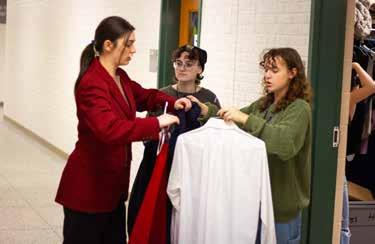
Costume designers work with actress Lydia Ertel, senior, on March 4 near the costume closet. Photo by Luke Kouns
Costume designer looks through the costume closet on March 4, trying to find clothing pieces. Photo by Luke Kouns
The Waiting Game
The traffic jams of the parking lot and what to do about them
By Brody Brown, Copy Editor
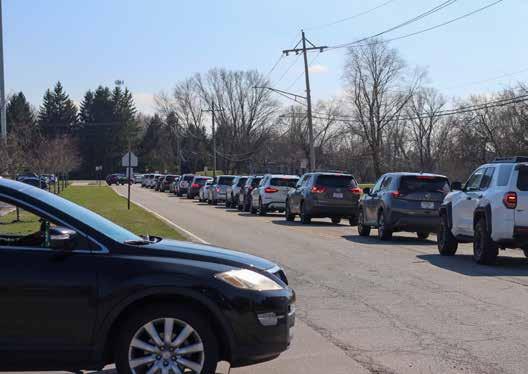
The parking lot is a disaster. Lines of cars loitering a half hour after school, complete disregard for a zipper merge, parents coming while students are leaving, the list goes on. Most recently, Friday, Mar. 6, there was a car accident at the corner of Bloor and Hal Sharpe between a student and a parent.
The problem lies partially in the sheer number of students that drive, especially in the spring semester after more and more sophomores get their driver’s licenses.
With three out of the four grades having or getting their license, the parking lot can just barely house all of our cars.
You would think that with over half of the student body driving themselves to school that the ideal plan of action would be to streamline the process of leaving school as much as possible. We’re all trying to leave the same place, so how about some common courtesy?
But leaving the parking lot takes what feels like years longer than it actually should.
There’s a severe lack of that common courtesy on the roads, especially at the end of the day. People are cut off, and the elusive “zipper merge” that wades in and out of the collective consciousness of other drivers would prevent some of this.
People tend to think about themselves, and wherever they’re going is going to be top priority at that moment, but everyone has a place to be. The effect on one’s own progression from cutting someone off is minuscule compared to the effect of being the one
getting cut off, sometimes repeatedly before a person can even get into a lane.
Then it’s the parents. The parent drivers have seemingly little to no understanding of the way the parking lot works, with some pulling up on the west end with their hazard lights on, pulling up after school is out and the traffic has commenced or just cutting off students every which way.
The buses exist for a purpose, they leave first and will, for the most part, get students home on time. So, why wouldn’t a student just take the bus as opposed to getting caught in the web of traffic.
There’s no reason that leaving the parking lot should be the trudge that it is. Between parents and students, there should be agreement that some of these problems are fixable.
Traffic building up outside of the school after school on March 9.
Photos By Brody Brown
Advanced Pressure
The struggle to balance weighted and elective classes
By Luke Kouns, Feature Editor
Fun fact: there is a well-established strategy at ZCHS to get a 5.0 GPA junior year. If you take Precalculus Honors, AP Literature, AP US History, AP Chemistry or AP Biology (both two-period classes when I was a junior), study hall and one other AP class, then you can get a 5.0 with only five actual grades.
When I first heard about this, my only thought was “only in Zionsville could something so ridiculous be possible.” And sadly enough, that’s true. Zionsville is known for its absurd academic rigor, resulting in an environment that almost expects students to be far above average. An environment where AP and honors classes can be seen not as an option, but a requirement.
On a surface level, this could seem like a rather unimportant problem. Students are often encouraged to push themselves in school, doesn’t this culture just embrace that ideology? And while that is partially true (Zi-

“In the course of my high school years, I learned that doing what I love did not hold me back academically; instead, it helped me flourish during my time in high school and ultimately led me to the college of my dreams, where I can continue doing what I love.”
-
Emma Phipps, Zionsville Alumni and dance major
onsville does do noticeably well on AP exams compared to most schools), this perspective ignores the problems caused by the constant need to chase perfection
Beyond stress, focusing only on trying to get the highest possible GPA forces students out of opportunities to explore other, non-traditional academic areas through electives.
One thing you might not know about me is that I am the feature editor of the Harbinger, which is not a weighted class. Deciding to give journalism and the Harbinger a shot was actually a fairly tough decision for me, because it meant that I had to have a non-weighted class mixed into my AP’s. Making that decision, however, ultimately taught me an important lesson about our school system, and how in the pursuit of a larger GPA, we can often forget that high school isn’t just about getting into the best college.
As I am finishing up my senior year and get to reflect back on my high school journey,

“For electives, again I say take what you want. For me, what I wanted to do was take AP classes. Only you know your limits and what you want out of your education, so it’s important to listen to yourself and take into consideration your schedule and required classes.”
-
Caroline Cox, Eli Lily Scholarship Winner
I realize now that I only really started to enjoy school when I stopped trying to chase the highest possible GPA. I was so obsessed with the plan I made in eighth grade to become the valedictorian that I never really took the chance to explore what I really wanted to do in life. It was only after realizing that I don’t have to strive for a perfect GPA that I started taking more classes that actually made me want to be in school.
At the end of the day, we are at ZCHS to learn, but learning will not be nearly as effective if you are not willing to give it your all every day. I still enjoy taking AP classes in the subjects I am interested in, but I’ve realized that a mentality of perfection and pure rigor won’t result in a good high school experience, no matter how high the numbers of your final transcript are. Aim for classes that not only challenge you, but make you want to learn, whether they are a 5.0 or not.

“Ultimately, balance looks different for each student. A well-rounded transcript reflects both academic challenge and authentic interests. When students feel both challenged and inspired, they are far more likely to succeed and to enjoy the journey.”
- Ellen Shertzer, ZCHS Counselor
Photo provided by Phipps
Dear Bus Drivers,
By Clara Vasey, Reporter
Thank you for getting us all to school and back home. Many of us students would be stranded without you. Specifically, thanks a million to my bus driver, Mr. White, for your reliable ride and smile.
You always have the rock and roll radio station playing, and on Aug. 5, 2025, “Another One Bites the Dust” happened to be on. I laughed off my first day nervousness as the song played. Not that lyrics about people biffing it were uplifting, but it just made me think that each person on that bus was figuring out how to stay out of the dust, myself included.
Classic rock greets me every morning at 7:42 a.m. when I walk to my third row seat. I’m barely awake and usually haven’t eaten breakfast, but I know you will drive us all safely into the sunrise, even if only another school day is at the end of the trip.
The day I really came to trust your driving skills was that morning in December when everything was covered in ice. You said, “I’ve been driving buses for 17 years, and it’s never been this bad.” That is a lot of commitment, and you followed through that day by not sliding off the road.
You know the rowdy group of boys in the back well and always have an eye out for trouble. One day the only seat left was in the very back, and one poor girl declared she was cooked as she made her way back. You got on the intercom and looked through the mirror at those boys. “You treat her well,” you said.
Other students are also thankful for the thoughtfulness of their bus drivers. Freshman M.J. Robinson rides bus 63 and appreciates her driver’s little courtesies like gifts at Christmas. Once her driver did something especially for her.
“One time I lost my favorite bracelet,” Robinson said. “It was on the floor in the back of the bus, and I was hopping off the bus and my bus driver recognized that it was my bracelet, and she gave it to me, and she was like, ‘Oh you forgot your bracelet’.”
You bus drivers are so committed to not only your job but also the students you serve, and we aspire to act like you as we grow up. Sophomore Sophia Steenburg watched one of you go through a trial with joy.
“Early last semester, our bus driver Sandy was gone fairly consistently. I found out from my mom and our family friends that
she had recently developed cancer and was undergoing chemotherapy,” Steenburg said. “Despite this, Sandy did her best to show up for us as often as she could, even while going through chemo. She said ‘good morning’ and ‘good evening’ to every single one of us as we got on and off the bus and was always optimistic and upbeat.”
Sandy has returned to a regular schedule this semester and continues her positive outlook on life. Her response to a crushing circumstance inspired Steenburg.
“I often marvel at the dedication and grit she has to keep showing up even while going through all that,” Steenburg said. “I am extremely grateful to have her as my bus driver and wish her the best!”
Adulting is hard, but bus drivers, you do it well. Thank you for getting us to school on time while making us feel loved.
Your grateful passengers,
Clara Vasey and ZCHS Bus Riders
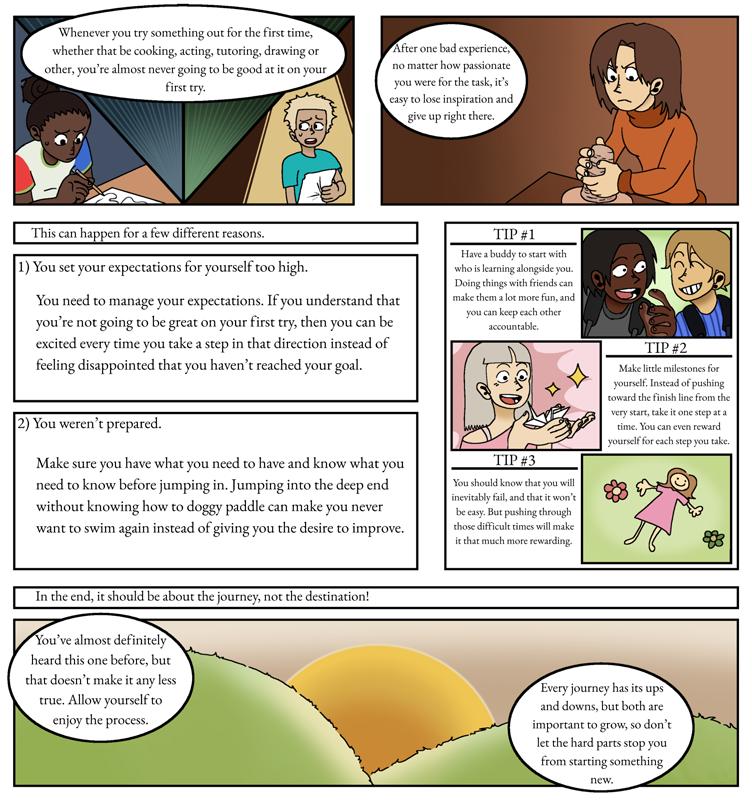
TwoStepsForward One Step Back
By Noelle Brooking, Comic Artist
An annual fundraiser for the ZCHS choir program, the Winter Choral Concert took place in the Performing Arts Center on March 10. It showcased the talents of the Chamber Choir, Sound Check, Bella Voce, Choralaires and Royalaires. “The concerts are really fun. My favorite part is to learn how to make myself sound better,” Bella Voce vocalist Juniper Berger said. Photos by Clara Vasey


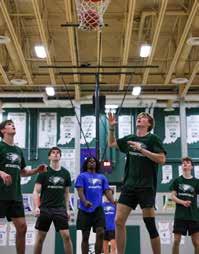
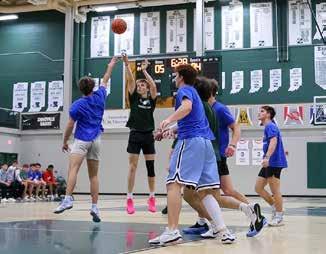
The intramural basketball championship took place on March 11 during MAP. The halftime show included different contests that gave the winning team extra points. Students were able to watch in the stands and cheer on the different teams with signs and chants. Photos by Lilly Steele