
Лектор
Уредник
Главни
CIP - Каталогизација
CIP - Каталогизација у публикацији Народна
37.016:811.111(075.3)
37.016:811.111(075.3)
МАРКОВИЋ, Гордана, 1951-
Improving English 4 : енглески језик за четврти разред
МАРКОВИЋ, Гордана, 1951Improving English 4 : енглески језик за четврти разред гимназије и средњих стручних школа : дванаеста година учења : уџбеник са радном свеском / Гордана Марковић, Катарина Ковачевић. - 2. изд. - Београд : Завод за уџбенике, 2021 (Земун : АМД Систем). - 179 стр. : илустр. ; 27 cm
гимназије и средњих стручних школа : дванаеста година учења : уџбеник са радном свеском / Гордана Марковић, Катарина Ковачевић. - 3. изд. - Београд : Завод за уџбенике, 2023 (Београд : Дунав). - 179 стр. : илустр. ; 27 cm
Тираж 3.000. - List of Irregular Verbs: стр. 170-172. - List of phrasal verbs: стр. 173-174. - Word List: стр. 175-178.
Тираж 4.000.
ISBN 978-86-17-20676-3
ISBN 978-86-17-20932-0
1. Ковачевић, Катарина, 1942- [аутор]
1. Ковачевић, Катарина, 1942- [аутор]
COBISS.SR-ID 122844937
COBISS.SR-ID 54479113
ISBN 978-86-17-20676-3
Cover page: Opera House in Sidney Harbour (Depositphotos)
Cover page: Carrickarade Rope Bridge, Northern Ireland (Depositphotos)
Unit 1
DIFFERENT CULTURES –THE SAME LANGUAGE
THE EMERALD ISLE THE PARADISE OF THE PACIFIC
Unit 2 THE NATURAL WORLD THE MIGHTY RIVER GOING HOME FOR REPRODUCTION
Unit 3 BOOKS and PRIZES
THE MOST IMPORTANT LITERARY PRIZES FIRST PRIZE
Unit 4 THE
Unit 5
APPENDIX KEY TO SELF-ASSESSMENT TESTS KEY TO MINI QUIZ WRITING
LISTENING COMPREHENSION TEXTS
LIST OF IRREGULAR VERBS
LIST OF PHRASAL VERBS WORD LIST PRONUNCIATION OF PROPER NAMES

Unit 1
page 6–19
Reading: A The Emerald Isle
B The paradise of the Pacific
Vocabulary Compound nouns; phrasal verbs with stand and keep
Grammar Review of tenses; the use of articles
Speaking Traditional or modern music?
Listening Irish dancing
Writing A short composition about Ireland or Hawaii
Communication Expressing sympathy and encouragement
Unit 2
page 20–31
Reading: A The mighty river
B Going home for reproduction
Vocabulary Phrasal verbs with out; verbs used without prepositions; animal words
Grammar The use of the present perfect and present perfect continuous tenses; plural of nouns
Speaking Endangered species
Listening A canoe safari
Writing Describing places
Communication Asking а favour
Unit 3
page 32–45
and PRIZES
Reading: A The most important literary prizes
B First prize
Vocabulary Phrasal verbs with call; words related to books; phrases with ordinal numbers
Grammar The use of future perfect and future perfect continuous tenses; ways of expressing the future; the past simple and past perfect tenses; reported speech
Speaking Books and reading
Listening Ernest Hemingway
Writing A survey report
Communication
Unit 4
page 46–61
Reading preferences
Reading: A The 3D printing revolution
B Accidental scientific discoveries
Vocabulary Verbs used with prepositions at and for; phrases with account
Grammar Inversion used for emphasis; the past perfect continuous tense; the use of modal verbs for past deductions
Speaking 3D printing – the pros and cons
Listening Useful inventions
Writing An invention you can’t do without
Communication Speculating and predicting

Reading: A Living in extreme conditions
B Weird traditions
Vocabulary Phrasal verbs with up; forming verbs with the prefix and suffix en
Grammar Conditional sentences; the passive voice
Speaking The effect of the sun on our lives; the pros and cons of bull-running
Listening Saving people in need
Writing Modern heroes
Communication Expressing warnings
Reading: A Against gender discrimination
B Gender differences
Vocabulary Word formation: using suffixes
Grammar Expressing wishes and regrets; the present and perfect participles
Speaking Class debates
Listening Women doing ‘men’s work’
Writing 1. Gender stereotypes 2.What causes inequality between women and men?
Communication Expressing lack of understanding and asking for clarification
Reading: A Shopping, a fun pastime
B Is advertising necessary?
Vocabulary Strong and base adjectives; intensifying adverbs; phrases related to shopping
Grammar The gerund; the infinitive; the infinitive of purpose
Speaking Famous malls and department stores
Listening 1. Do you enjoy shopping? 2. On advertising
Writing A letter of complaint
Communication Useful shopping phrases
Reading: A Multiple intelligences
B Memory and learning
Vocabulary Negative prefixes; linking words
Grammar Reporting structures; passive constructions
Speaking Discussing questions related to intelligence
Listening A child prodigy
Writing Write your CV
Communication Using clichés
APPENDIX
▪ Key to exercises
▪ Writing
▪ List of phrasal verbs page 62–73 page 74–87 page 88–107 page 108–117
Additional reading – Poetry
▪ Texts for listening comprehension
▪ List of irregular verbs
▪ Word list
▪ Pronunciation of proper names
In this unit, you will READ, LISTEN AND TALK ABOUT
Ireland
Irish music and dance
Hawaii
PRACTISE
the use of tenses
articles
compound nouns
phrasal verbs with stand and keep
expressing sympathy and encouragement

How good are you at geography?
Decide which answer (a or b) is true for Ireland and which for Hawaii. Write the letter (a or b) in the correct box.
1. The entire country is situated on a. an archipelago b. an island


2. It is situated in a. the Atlantic Ocean b. the Pacific Ocean
3. This country is a. a republic b. a state
4. The first people who settled there were a. the Celts b. the Polynesians
5. The capital city is a. Honolulu b. Dublin
6. The best-known traditional dance is a. Hula dancing b. step dancing

Read the text once and complete the sentences.
1. The river which runs through Ireland is _____________.
2. A great number of the Irish emigrated because of ________________.
3. Irish national music was recorded for the first time in ________________.
4. The famous Irish national instrument is _______________.
READING Track 1
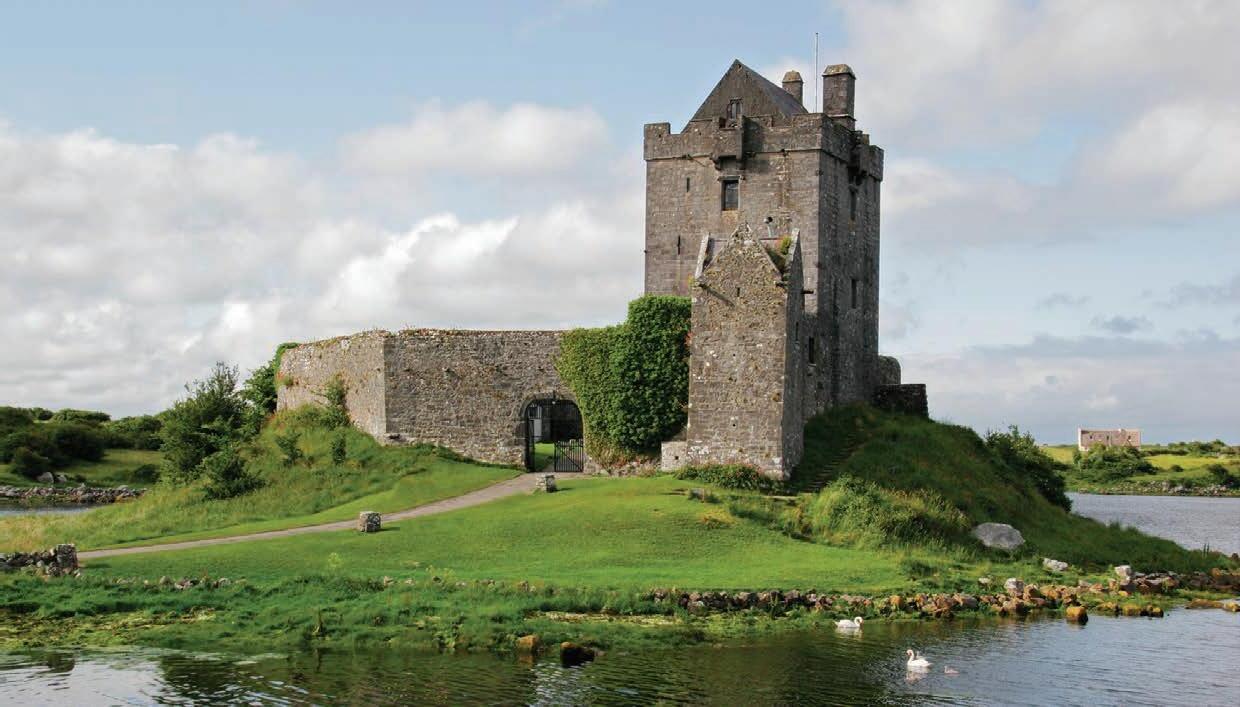
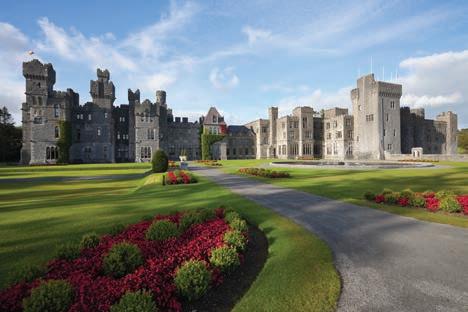
It is amazing how much this green island can offer to tourists. People from all over the world go to Ireland to see its amazing landscape, fabulous coastline and green hills with lush vegetation, magnificent castles and the river Shannon. They will meet kind-hearted and hospitable people, imaginative storytellers who involve mystery and magic in their tales. Irish people are also extraordinary musicians who play traditional music in numerous pubs throughout the country.
The Republic of Ireland covers five-sixths of the island, while the remaining area belongs to the United Kingdom and is known as Northern Ireland.
Two main languages are spoken in Ireland: Irish and English. In the 19th century, Irish or Gaelic, now a minority but official language of the Republic of Ireland, was replaced by English as the first language for the vast majority of the population.
Every traveller to Ireland will discover that music is one of the main passions of Irish people. Their traditional music includes many different types of songs and instrumental music from Irish history. Its origin can be traced back to almost two thousand years ago, when the Celtic tribes arrived in Ireland. It was orally passed on from one generation to another by listening and playing by ear.
Irish music has spread all over the world thanks to its long history of emigration. No event in Irish history had a deeper effect on the Irish nation than the Great Famine, which struck in the 1840’s. One million people died and many traditional songs and tales vanished with them. In subsequent years, another million people emigrated to the USA bringing their music with them. The Irish population was concentrated in big cities and many
musicians began recording Irish traditional music for the first time. Their records made their way back to Ireland, where they had a great impact on traditional music. As a result, musicians in Ireland began to speed up the tempo of the tunes and also used the piano as an accompanying instrument to fiddles and pipes, the traditional Irish instruments. Other popular instruments are the flute and drums and, in particular, the Irish harp, which became Ireland’s national symbol.
Up to the 1960’s, Irish music was performed in houses and pubs in rural areas and was played mainly to be danced to. The 1970’s saw the revival of music in terms of popularity and innovation. Old melodies were adapted to modern forms. The styles and rhythms of Irish folk songs found their way into almost every style of contemporary music – heavy metal, rock, even jazz – influencing the best-known artists, such as Sinead O’Connor, U2, Snow Patrol and many others. It can be concluded that now traditional Irish music has gained international recognition.

emerald – a bright green colour; a precious green stone often used in jewellery isle – island
lush – growing well and thickly (plants)
famine – a serious shortage of food in a country which may cause many deaths
tribe – a group of people of the same race, language or religion
revival – a process when something began to be active again
recognition – a favourable public opinion given to somebody because of their achievements
Evidence of Gaelic is still found in:
a. the names of people:
Answer the following questions.
1. What are the characteristics of the Irish landscape?
2. What can you say about Irish people?
3. Which language is spoken by the majority of people?
4. Irish music spread to other continents. How did it find its way to the USA?
5. What do you know about the origin of Irish music?
6. What are the best-known Irish instruments?
7. How did traditional music change in the last decades of the 20th century?
8. In which musical genres can we find Irish music incorporated?
Sean /SO:n/ – is the same as John Liam /li@m/ – is the same as William Seamus /SeIm@s/ – the same as James
b. Irish surnames beginning with O’ (meaning from the family of) and Fitz or Mc (meaning the son of).
E.g. O’Neill, Fitzgerald, McHugh

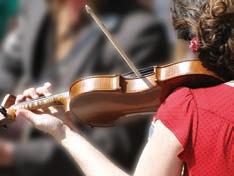
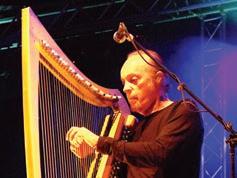
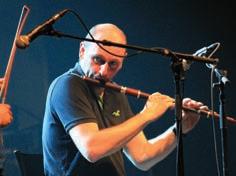
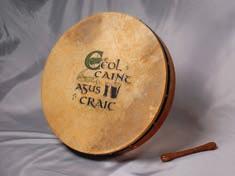
The main traditional instruments are: the fiddle - a traditional violin the Celtic harp - mostly small and can be played on the knee the Irish flute the Bodhrán - a goatskin circular drum

Match the highlighted words in the text to their explanations.
1. _____________ to find out how or when something started in the past; to discover the origin of something
2. _____________ an effect
3. _____________ happening now
4. _____________ happening at a later time than something else
5. _____________ to cease to exist; disappear suddenly
6. _____________ to move away from each other; covering a large area
7. _____________ welcoming, friendly

2 Use the words from Exercise 1 to complete the sentences.
1. It was expected from ______________ generations to finish the building of the Pyramids.
2. The origin of Michael’s family can be _______________ to the 17th century.
3. I am more interested in the writing of _______________ authors than of those from the past.
4. Lack of sleep can have a bad _______________ on a student’s learning.
5. We decided to ________________ in the woods looking for the missing child.
Forming nouns from verbs by adding a suffix
Make nouns from the verbs in bold to complete the sentences. Use the suffixes in the box.
Example: Our project is nearing its completion. /complete
1. Michael gained the ________________for promoting traditional dance. /recognize 2. Kate Winslet won an Oscar for her ________________ in The Reader. /perform

Find in the text the words kind-hearted, storyteller, breathtaking and say which part of speech these compound words are. Which parts of speech are the words they are made of?
Join words from columns A and B to make new compounds. Some words can go into more than one combination.
3. Every year the government talks about the ________________ of agriculture. /revive 4. In some countries five percent of the ________________ is illiterate. /populate 5. They asked us to send a ________________ for the assistant who was ill. /replace 6. The ____________ of a great amount of money in the basement started the gossip. /discover under paper easy tea play hair show fire eye over runner book keeper ground paid back alarm witness weight room cup going cut up
Note:
Compound words are written as one word, two words or with a hyphen. Compound adjectives are often joined by a hyphen. If you don’t know how they are written, look them up in a dictionary. You have to be careful with compound words, e.g. a greenhouse means – a place where young plants are grown; a green house means – a house which has been painted green.
Use the following questions to talk about traditional and modern music in Serbia / Ireland.
How much do you know about the traditional music of your country?
What instruments are usually used if people want to play Serbian folk music?
Are they the same as the Irish instruments?
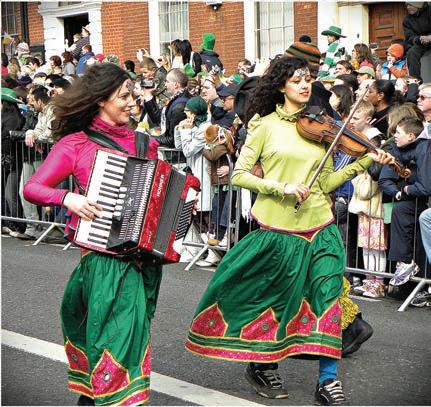
What did you learn about Irish traditional music? Are there any similarities to Serbian music?
What is the influence of Serbian / Irish traditional music on pop music?
What kind of music do you usually listen to?


Read the text paying attention to the underlined verbs. Name the tense for each example and then match them to the explanations (a - g) to show that you understand the use of tenses. An example (2 b) is given.
One of my schoolmates, Kate, used to work (1) in a shoe factory. For a year she would get up (2) early in the morning and ride on a bus to get to work. She didn’t even have a very good salary so she decided (3) to give up the job. I came across her a few days ago as I was going (4) to work. She told me the news: ‘I have been working (5) in the fashion industry for a year now and I’m quite happy. I’ve even saved (6) enough money to rent a decent flat.’ I was glad that she had left (7) the shoe factory.
Past simple tense ( )
Past continuous tense ( )
Would + an infinitive without to (2 b)
Used to + an infinitive ( )
The ... tense is used to talk about

Present perfect simple tense ( )
Present perfect continuous tense ( )
Past perfect tense ( )
a. an action that began in the past and continued up to the present moment.
b. repeated actions in the past which no longer happen.
c. activities which were in progress for some time in the past or for a longer activity which was interrupted by another, shorter action.
d. past habits (actions and states) which are now finished or different.
e. finished actions or situations in the past.
f. actions that happened before another action in the past.
g. a present result of a past event that is important now.
2

3
Complete the rules (A and B) with the expressions from the list below. Some of the expressions can go into both boxes.
A We use the present perfect with expressions which refer to any time up to now:
B We use the past simple with expressions which refer to a finished time:
never, last year, then, up to now, when, already, in 2012, recently, often, yet, the other day, ago, so far, this week, by the time...
Complete the sentences by using the correct form of the verbs in brackets. (Past simple, past continuous, present perfect, and past perfect tenses)
1. Where _________________ (the driver / look) when he ____________ (hit) a car in front?
2. Luckily, he _______________ (not / work) directly underneath the branch when it ____________ (fall).
3. I ______________ (never / fly) in such a luxurious plane before.
4. When I first ______________ (meet) her, she ______________ (sell) clothes in a store. Now she’s a star.
5. They ______________ (notice) that the bag was missing only after Dorothy______________ (leave).
6. Since their quarrel, Joan ________________ (never / say) a word to John.
7. Alice told us that she ________________ (never / smoke) before.

Track 2
1 2 3
Listen to the text and then say whether the statements are true or false.
1. It is important that the body should be relaxed and graceful.
2. The dancers wear modern dresses.
3. The women wear copies of clothes from the past.
4. The kilts worn by the men are rather simple.
5. Soft shoes are used when dancers want to make a loud sound.
6. The harp accompanies the dancers.
7. Figure dancers take part in competitions.
8. The Riverdance show has made Irish dance popular all over the world.
Listen to the text again and check your answers.
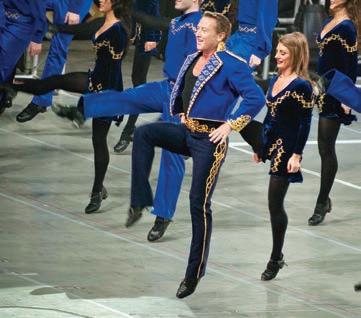
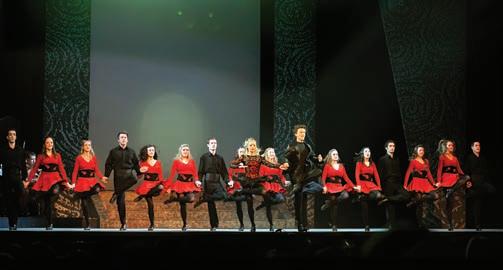
Look at the pictures. Try to describe the clothes and dancers in the pictures with the words used in the text.

Ireland has widely contributed to the world literature, particularly with works written in English. In the 20th century, Ireland produced four winners of the Nobel Prize for Literature: George Bernard Shaw, William Butler Yeats, Samuel Beckett and Seamus Heaney. Although not a Nobel Prize winner, James Joyce is widely considered to be one of the most significant writers of the 20th century. Another writer, Oscar Wilde, is best-known for his novel The Portrait of Dorian Grey, as well as for his often quoted witticisms.
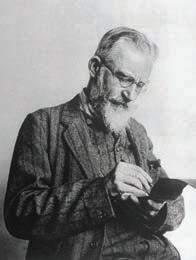
Bernard Shaw (1856-1950)
Irish-born writer and a Nobel laureate, Shaw is regarded as one of the most important British dramatists since Shakespeare. He was also well-known for his wit. Here is a selection of anecdotes about him.
Shaw was standing alone in a corner at a cocktail party. ‘Are you enjoying yourself, Mr Shaw?’ his hostess anxiously asked him. ‘Certainly,’ he replied. ‘There is nothing else here to enjoy.’
‘Oh, Mr Shaw, what made you ask me to dance?’ said a woman to him while they were dancing. –‘This is a charity ball, isn’t it?’ Shaw replied.
‘Take care to get what you like, or you will be forced to like what you get.’
Here is a selection of anecdotes about Oscar Wilde.
‘There is one thing worse than being talked about, and that is not being talked about.’
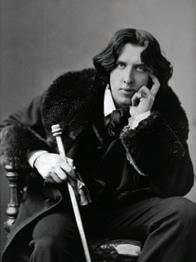
Oscar Wilde was once asked to complete a list of the world’s 100 best books. ‘I fear that would be impossible,’ he said. ‘I have written only five.’
Members of Wilde’s London club knew that his latest play had failed, but tried to appear ignorant of the fact when the writer arrived that evening.
‘Oscar, how did your play go tonight,’ asked one member, though.
‘Oh,’ Wilde replied arrogantly, ‘the play was a great success, but I’m afraid the audience was a failure.’
If you know any other anecdotes about Irish writers, read them to your classmates.
You are going to listen to one of the Irish favourite songs ‘Oh Danny Boy’. Before listening, study the following words:
(bag)pipes – a musical instrument bide – stay glen – a narrow valley hushed – quiet, calm
While listening to the song, complete the missing words in the verses.
Oh Danny boy, the pipes, the pipes are
From glen to glen, and down the mountain
The summer’s gone, and all the
falling It's you, it's you must go and I must bide.
But come ye _______ when summer’s in the meadow Or when the valley’s hushed and white with _______ It's I'll be there in sunshine or in _________
Oh Danny boy, oh Danny boy, I love you so.



Read the text to get the general idea. Then read the statements (1-4) and decide whether they are true or not. Read the text again and check your answers.
1. The Hawaiians make lovely necklaces of flowers which they give to people as a welcoming gift.
2. The Hawaiian language is not in use today.
3. Mauna Kea is an active volcano.
4. Pearl Harbour’s port was attacked by the Japanese in World War II.
HTrack 4
awaii is a group of volcanic islands in the central Pacific Ocean. It became the 50th state of the USA in 1959.
Hawaiians are descendants of the ancient Polynesians who crossed the vast ocean and settled on the islands. Nowadays, Hawaii is the most diverse state in the United States and only 10% are native Polynesians. The rest have their ancestors among Asian, European and LatinAmerican immigrants. Some families can trace their heritage 300 generations back.

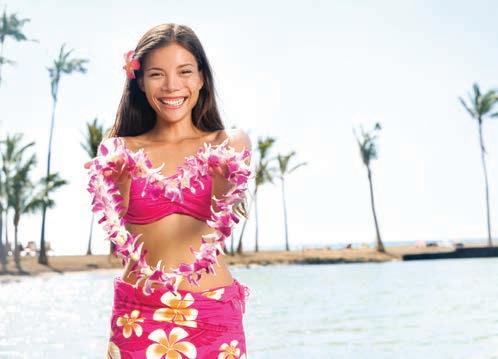
The Hawaiian language was banned for almost a century, but in 1978 English and Hawaiian were listed as ‘official languages’ by the constitution. Hawaiians are proud of their multicultural heritage, but they also try to maintain their own identity.
All the islands are rich in Hawaiian culture, but two symbols stand out. One of the most important ways the ancient Hawaiians showed respect for their gods and goddesses was through hula dancing. Today hula is still performed both as an entertainment and as a prayer. Another symbol is a necklace of flowers, used as a welcoming gift; the art of making it goes from generation to generation.
The Hawaiian Islands are renowned for their spectacular beauty: abundant sunshine, expanses of lush green fields, coral reefs, sand beaches, and cloud-covered volcanic peaks rising to majestic heights. Some of the world’s largest active and inactive volcanoes are found on Hawaii.
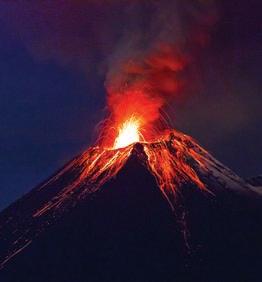
Hawaii Island (the Big Island) is the largest of the islands and is dominated by two volcanoes. One of them is Kilauea, whose eruptions provide spectacular displays of flowing molten lava, which occasionally cause great property damage. The results are large fields of petrified lava. The sleeping volcano, Mauna Kea, is considered to be the tallest mountain in the world. If measured from the bottom of the Pacific Ocean to the peak, it rises about 10,000 metres.

descendant – a person who lives after you, such as your child or grandchild ancestor – a person related to you and who lived long ago constitution – the set of political principles by which a state is governed expanse – a large, open area of land, water or sky reef – a line of rocks just above or below the surface of the sea propel – to cause someone to do an activity
Discuss the following questions giving detailed answers.
1. Who were the ancestors of today’s Hawaiians?
2. How far in the past can some of the families find traces of their origin?
3. How many languages are officially used on the islands?
4. What are the two most important symbols of Hawaiian culture?
5. What are the fields of petrified lava a result of?
6. What attractions does Maui Island offer?
7. Which of the islands is the most visited?
8. What did you learn about the volcanoes on the Big Island?
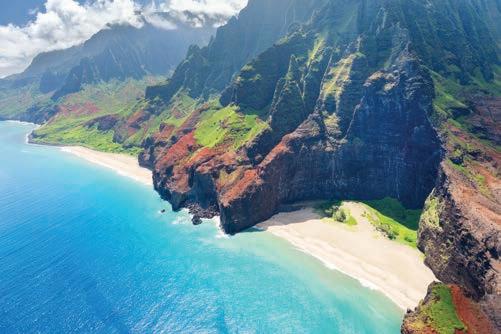
The second largest island is Maui. It is a water sports paradise. Brave surfers ride the 20 m high waves. The best surfers are uncrowned kings of the island. Maui bays offer another tourist attraction between November and April. Whales, coming from a long distance, choose these bays to give birth to their young.
Oahu, politically the most important island with its capital Honolulu, is different from the other islands because it keeps up with modern time. Six million tourists visit this island every year. Most of them come for surfing on the famous Waikiki beach.
Another well-known site is Pearl Harbour, a port near Honolulu. On the morning of December 7, 1941, Japanese fighter planes attacked Pearl Harbour destroying American war ships and killing soldiers, which propelled the United States immediately into World War II.
The Hawaii experience begins and ends with aloha, a word that includes love, affection and mercy, and has become a salutation for hello and good-bye. It means to live with love and respect for self and others.


Match the words (1- 8) to the definitions (a – h).
1. ban
2. ancient
3. diverse
4. peak
5. petrified
6. heritage
7. necklace
8. molten

Use some of the words from Exercise 1 to complete the sentences.

a. rock or metal turned into a liquid state because of great heat
b. a piece of jewellery worn around the neck
c. tradition, all features of life that have passed on from one generation to another
d. to forbid something
e. the highest point
f. from a long time ago
g. having changed to a substance like stone; frightened
h. different types of people or things
1. John is a man of _______________ talents.
2. This film should be ________________ because it contains scenes of violence.
3. We have to climb two more hours to the _______________ of the mountain.
4. He bought a very expensive _______________ for his fiancée, but she didn’t like it.
5. When John saw a huge dog running towards him, he stood _______________.
3
Complete the sentences by using the correct form of the words in bold. Change the form of the word so that a noun becomes an adjective or an adjective becomes a noun.
Examples: Volcanic peaks are often covered in clouds. /volcano She took advantage of our hospitality and stayed a whole month. /hospitable
1. I have never before seen such a _____________ volcanic eruption. /spectacle
2. I was surprised to see so much _____________ at that time of day. /active
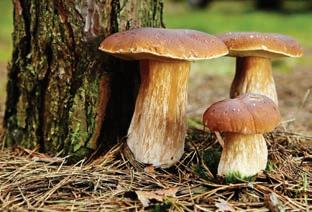
3. We went to the forest for a walk and were surprised to see the _____________ of mushrooms. /abundant
4. National parks offer a remarkable _____________ of scenery. /diverse
5. Whales came from _____________ shores to give birth to their young. /distance
2 4 1
Which word doesn’t collocate with the given word? Cross out the odd word.
1. VAST– ocean, field, majority, bench
2. BAN – film, office, language, book
3. OFFICIAL – recognition, truth, language, visit
4. MAINTAIN – peace, identity, answer, central heating
5. HIGH – tree, mountain, fence, man
5 Study the phrasal verbs with STAND and KEEP and then do the exercise below.
stand by – help, support stand for – be the abbreviation of stand for – represent something stand out – be the best, be easily seen stand up (to) – to resist; confront bravely stand up for – speak for someone / something; support stand in for – take somebody’s place (if they are ill)
keep up with – try to do the same as someone else, go at the same speed keep off – prevent from touching, not walk on keep on – continue keep out – not allow to enter keep away – not allow to come near keep something up – to maintain standards, appearances, to continue keep to – remain steady or faithful to something keep back – not tell (information)
Complete the sentences with the correct form of the phrasal verbs with stand and keep.
1. I believe you are innocent and I’d ______________ you anyway.
2. Ann’s voice really ______________ from the rest of the choir.
3. In spite of the warning, they ______________ looking for him.
4. Did Helen tell you everything? I think she _________a few things _________.
5. He wanted to ______________ his neighbours, who were all richer than him.
6. I’m not afraid to _________________ my rights.
7. Look! It says clearly: ‘______________the rails!’
8. There are too many people waiting to enter the concert hall. How can we ______ them ____?
9. They didn’t expect me to ________________ someone as powerful as our boss.
10. You'll be fine as long as you _____________the map. Don’t leave the road.
Review the use of the definite article with geographical names and then do the exercises (1 and 2).
Do not use the before the names of:
• continents, countries and towns: South America, Brazil, Liverpool (but: the Hague, the Netherlands)
• streets/avenues: First Avenue, Oxford Street
• lakes: Lake Ontario (but: the lake of Ontario)
• individual mountains and volcanoes: Mount Fuji
• single islands: Cyprus

Use the before the names of:
• countries whose names describe their political organization: the Czech Republic
• rivers, oceans and seas: the Tisa, the Atlantic, the Red sea
• deserts, peninsulas and points on the globe: the Gobi, the Apennine Peninsula, the Equator
• mountain groups: the Andes
• island groups: the Shetland Islands
Which of these place names are written with the?
1. Philippines
2. Indian Ocean
3. Pyrenees
4. Sahara
5. Black Sea
6. South Pole
7. Seine
8. Lake Ohrid
9. Kilauea

Put the where necessary.
1. There are many volcanic islands in ____ Pacific Ocean.
2. ____ Shannon runs through ____ Ireland.
3. ____ Pennines is a group of mountains in England.
4. _____ Republic of Serbia is situated in _____ Balkans.
5. How many states are there in _____ USA?
6. ____Vesuvius is the only active volcano on the mainland of ____ Europe.
7. ____ Jersey is a British island in ____ English Channel.
8. When we went to Egypt, we swam in ____ Red Sea.
Complete the second sentence so that it means the same as the first by using the given word.
1. Tom was taller than his friends, so he was easily seen in the crowd. /STAND Tom ______________________________________________________.
2. Though Mary was shorter, she tried to walk at the same speed as me. /KEEP Though _____________________________________________________________.
3. I was attacked by a bunch of hooligans, but I confronted them bravely. /STAND I was _____________________________________________________.
4. Chris was the first ever to climb the eastern side of the mountain. /HAD Before Chris _____________________________________________.
5. I expected skydiving to be more frightening than it actually was. /NOT Skydiving ______________________________________ as I had expected.
6. When I was young, I went to a lot of dances. /USED When I was young, I ______________________ to a lot of dances.
Choose either Ireland or Hawaii to write about. Write a short composition of about 150 words. Layout of the composition
Paragraph 1: Introduction

Introduce the topic. Say why you have chosen that particular country. Paragraph 2: Write about its interesting geographical features, people and culture. Provide examples where possible.
Paragraph 3: Mention what impression the country made on you. Paragraph 4: Conclusion
Give your own personal opinion about the country and say if you would like to visit it.
Look up in the Appendix and study the instructions for writing.

When somebody is annoyed by something unpleasant or hears bad news, you can show how you sympathize with him/her by using some of the following words and phrases:
I’m sorry to hear that. How upsetting / annoying to ... Bad luck! Hard luck! Terrible!
What a shame! / What a pity! That’s dreadful! Awful!
1




Don’t take it so badly, it... Never mind. Better luck next time. Don’t worry; it’ll turn out all right. Can I help you in any way?
Note: The word ‘sympathy’ means compassion, feeling pity. симпатија’.
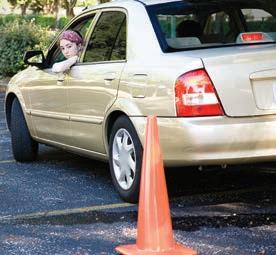
A friend tells you that he has failed his driving test. Your sister comes home and tells you that she has You ring up a friend to invite her to your party.
2 Complete this dialogue. Try to use words and phrases from the table above.
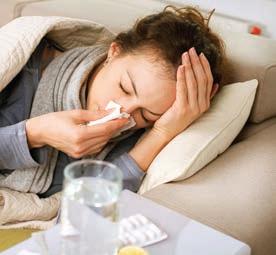
A: How are you getting on with your plans for going to Ireland?
B: Not very well, I’m afraid. I’ve failed to organize a big enough group and the agency wouldn’t give us a discount.
A: _____________________. But I’m sure you’ll do it next time. I’m miserable myself. My car was stolen yesterday.
B: _____________________. Perhaps the police will find it somewhere.
A: I hope so. And my sister’s cat has disappeared.
B: ____________________. I’m sure it will come back.
A: I do hope it will. Alice is very sad. See you later.
B: It’s been nice talking to you.

3. ____Cyprus is an island in _____ Mediterranean Sea. 1 2 3 4
Complete the sentences with the correct form of the words in the List. (4 pts.)
1. Celtic ________ arrived on the island between 600 and 150 B.C.
2. I don’t know much about my _______________ who lived on this land 200 years ago.
3. John isn’t interested in the past, that’s why he only reads books by ______________writers.
4. During the Irish _____________ of the mid-19th century, the population of the island dropped by one third due to the starvation and emigration.
Find words in the List which mean: (5 pts.)
1. a strong effect _________________
2. disappear _________________
3. plentiful ___________________
4. forbid ___________________
5. various ___________________
Complete the sentences with the correct form of the verbs in brackets. (5 pts.)
1. We _______________ (wait) on the platform when the train arrived.
2. Is this the second time you __________________ (be) here?
3. As we ______________ (visit/not) Ireland before, we decided to go there.
4. I ______________ (think) about that problem for some time. Do you think I should complain to the manager?
5. I ________________ (clean) her room since morning.
Put in an article where necessary. (6 pts.)
1. ____ English people are always complaining about ____ weather.
2. ____ Lake Bled is in ____Slovenia.
test 1

Verbs vanish petrify gain ban
Nouns famine tribe recognition impact ancestor descendant
Adjectives contemporary abundant diverse molten subsequent Phrases spread out trace (back) stand up for stand up (to) stand out keep up with keep off keep out keep back

In this unit, you will READ, LISTEN AND TALK ABOUT
the Zambezi basin and its animals
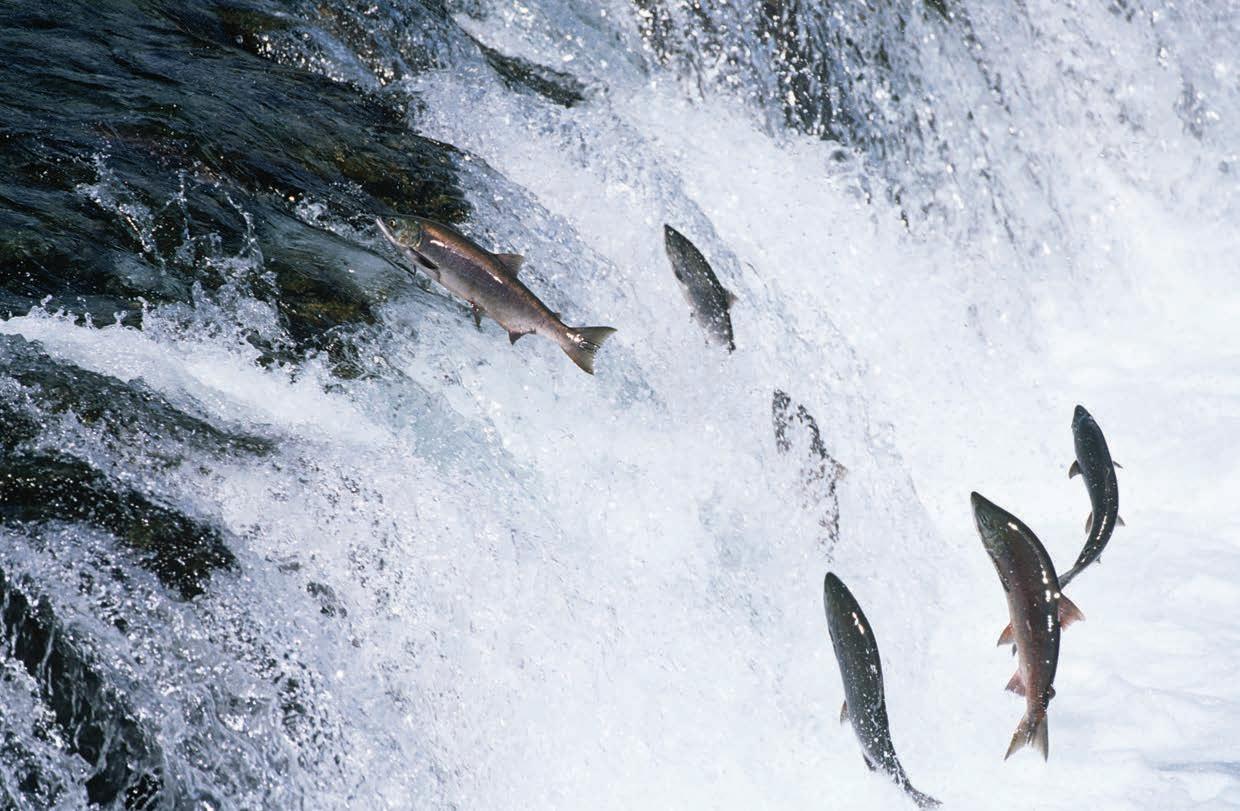
the reproduction of the salmon
endangered species
PRACTISE
the use of the present perfect and present perfect continuous tenses
plural of nouns
phrasal verbs with out
asking a favour
LEAD-IN
How much do you know about animals?
Match these kinds of animals to the definitions below. Write at least four examples for each kind on the appropriate line.
MAMMALS _____________________________________________________
REPTILES ______________________________________________________
BIRDS ______________________________________________________
INSECTS ______________________________________________________
FISH _______________________________________________________
They have 6 legs, 3 body sections and most are small air-breathing animals.
They have scales and most have gills instead of lungs. They are found in rivers, lakes, and oceans.
They have two legs, a backbone, a body covered by feathers and they lay eggs.
They are warm-blooded animals which have a backbone and a body covered by hair or fur. They produce milk.
They are cold-blooded animals whose bodies are covered by scales. Most of them lay hard-shelled eggs on land.
You are going to read about the Zambezi River. Which paragraph talks about…
1. the wildlife living in the plains along the river?
2. the changes that make some species endangered?
3. the course of the river from its source to the mouth?
4. the shift of seasons?

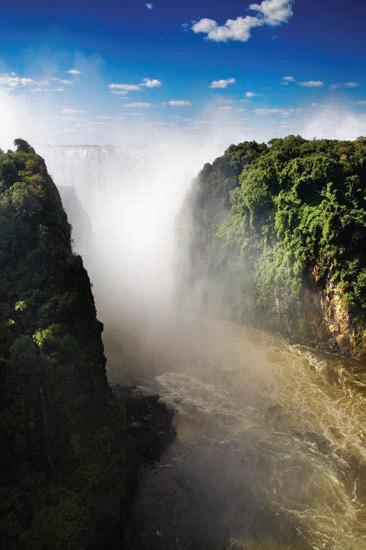
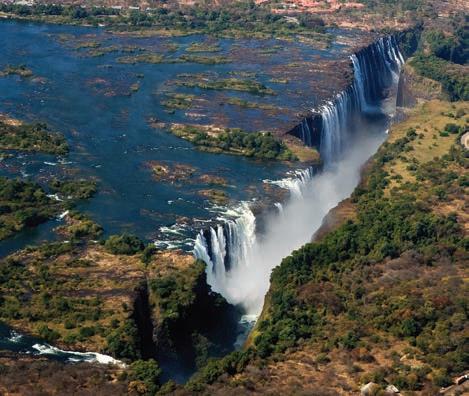
A The Zambezi, which means ‘Great River’ in the language of the local inhabitants, flows 2,700 km from its source in the heart of Africa to its mouth in the Indian Ocean, crossing six countries. It meets many tributaries on its course, enters broad valleys and spreads out over a large area. Victoria Falls, one of the world’s greatest wonders, mark the end of the upper course of the Zambezi. There the river plunges into a gorge with the thunderous roar, making an enormous cloud of spray. The locals gave it the name ‘the smoke that thunders’. The river’s journey comes to an end as it approaches its mouth, divides into a maze of channels which form a wide delta before it merges with salty waters of the Indian Ocean.
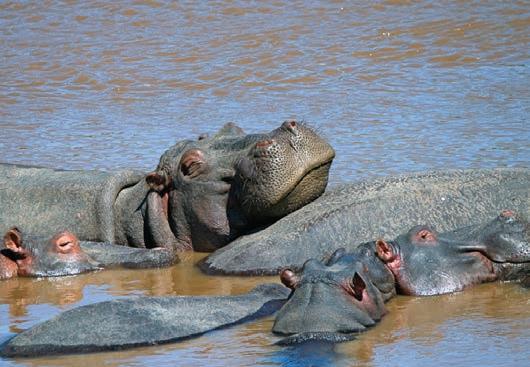
B The Zambezi basin holds many natural resources that are of exceptional value. It also contains a high diversity of habitats, which is reflected in an abundance of mammals and birds. The grasslands are home to many species of plants and animals, including hippos, elephants, black rhinos, buffalos, baboons, etc. Large predators found in the eco-region include lions, leopards, cheetahs, and spotted hyenas. Crocodiles, lizards and pythons are amongst the more common larger reptiles of the region.
C For millions of years, the Zambezi River has flowed with floods and droughts, supporting wildlife, plants and local people. During the dry season, water and food become scarce, animals leave their habitats and head to better-watered grasslands. However, the rainy season, which starts in November, brings great relief to all of them when a great number of streams join together to form the mighty river.
D Unfortunately, growing human populations and poverty force local people to turn wild lands into farmland and also drive them into poaching important species, such as the black rhino, elephant and leopard. Thus they disrupt wildlife patterns in the Zambezi region. Since the river influences the life of millions of people, animals and plants, environmentalists should make an effort to prevent the degradation of its ecosystem. It is necessary to monitor, protect and secure habitats for these animals, however difficult this is to carry out. If they fail, the river may no longer be called the ‘river of life'.

plunge – to fall a long way down into something; drop gorge – a deep narrow valley with steep sides, usually formed by a river
merge – to join together scarce – not easy to find or get disrupt – to prevent a system, event or process from proceeding poach – to catch or kill animals without permission
Find parts in the text which give the information…
1. why Victoria Falls are called ‘the smoke that thunders’.
2. that many rivers flow into the Zambezi.
3. about the species that live on the grasslands.
4. about the delta that the Zambezi forms at its mouth.
5. why the rainy season brings relief.
6. about poachers and their victims.
Share your information with your partner or with other students in the class.
1 2
Which highlighted word from the text means...

1. a complicated system of passages where you can get easily lost? ______________
2. the natural environment in which an animal or plant usually lives? ______________
3. a stream or river that flows into a larger river? ______________
4. a valuable possession of a country, organization, person? ______________
5. an animal that hunts, kills, and eats other animals? ______________
6. the condition of being very poor? ______________
Use the words from Exercise 1 and the Glossary in their correct form to complete these sentences.
1. A great number of elephants have lost their natural ____________ because of civil wars.
2. We have exploited all our ____________ and now the company cannot go on working.
3. In some parts of Africa food is scarce and people live in _________.
4. They decided to ____________ their two companies into one.
5. If we don’t take good care, clean water will soon become ____________ on this planet.
6. A heavy storm ____________ travelling on the main road into the town.
7. The Robinsons have built an incredible ____________ of green walls on their land. I had a problem of finding the way out.
VERB + PREPOSITION
2 3
Review the use of prepositions. Fill in the gaps with one of these prepositions: on, to, into, in, with, or for. The first sentence has been done as an example.
1. A high diversity of habitats is reflected in an abundance of animals.
2. Lois divided an apple ______ halves and gave one half to me.
3. To save the business, the owners decided to merge it ______ one of their competitor’s.
4. She was complimented ______ her appearance.
5. I couldn’t agree ______ the conditions they insisted ______.
6. I am leaving ______the Zambezi basin tomorrow.
7. Who does this cat belong _______?
5 4
Verbs used without a preposition
Verbs such as reach, enter, approach, discuss, marry, resemble, enjoy, etc. do not use prepositions before a noun. The verbs which do not use a preposition are normally followed by a direct object.
Examples:
1. Has the jury reached the verdict yet?
2. Jane entered the classroom feeling very nervous.
Do the exercise in the Workbook.
Use the verbs in the box in the correct form to complete the sentences below.

turn break sort make spread carry wear stand
1. The police officer ordered his men to __________ out and search the fields.
2. These papers are in a dreadful mess. Do you have time to __________them out?
3. The generals were determined to __________ out their plan to defeat the enemy.
4. Oxford University ___________out among other universities in the world.
5. The coach made the team practise until he __________________ them out.
6. Fighting _____________ out between rival groups of fans.
7. I’m pleased that the play ____________ out to be a great success.
8. It is too dark; I can’t _____out the number on this house.
Work in groups of four. Read the questions and decide how to express your opinion on this topic by answering them.
1. In your opinion, which animals are most endangered?
2. Why are they killed?
3. What is poaching?
4. How growing cities and pollution can destroy wildlife habitats?
5. What do you think about such sports as hunting?
6. Are there endangered species in this country? Can you name some of them?
7. Do you know where rare birds and animals live in this country?
8. What measures should be taken for animal protection?
Track 6

snort – a loud sudden noise of disapproval slide (slid, slid) – to move easily over a surface
Answer the following questions.
1. What did the canoeists have to avoid?
2. Why is the Zambezi flood plain important for a great number of animals?
3. Where did they see groups of hippos?
4. Why did the canoeists paddle close to the bank?
5. What were the crocodiles looking for?
Which words in the list match the explanations?

1. move a boat through the water using a pole
2. a large African animal which lives in rivers, lakes, etc.
3. a part of a river where the water flows very fast
4. a steep, high face of rock
5. the mouth, including the teeth
Look at the examples (1-9) and match them to the explanations (a-i).
1. Jack has been a tennis player for 6 years.
2. John has had a terrible crash and is now in hospital.
3. I’ve been here all morning.
4. Please do not smoke until you have gone outside.
5. Have you ever played chess?
The present perfect is used
a. for an action which began in the past and is still going on.
b. to emphasize the result of an action in the present.
c. when we want to mention how many times something happened.
d. to talk about the future after when, after, as soon as and until.
e. for experiences that happened at some time in our lives.

6. This is the first time that I have ridden on a rollercoaster.
7. Liam has been ill since last weekend.
8. Jason has rung up four times today already.
9. I haven’t been to the seaside recently.
f. for our first, second, only, etc. experience of something.
g. to talk about things that have or haven’t happened in the recent past.
h. with for to say how long an action has gone on.
i. with since to say when an action started.
Look at the examples (1-3) and match them to the explanations (a-c).
1. ‘We’ve been paddling for three hours now, but we haven’t seen any hippos or crocodiles yet.’
2. I’ve been studying since 5 o’clock and I’m planning to study for two more hours.
3. ‘Why are you so out of breath?’ – ‘I’ve been running.’
2 3 4
The present perfect continuous tense is used

a. for an activity that has just stopped, but you can still see its result.
b. to show how long something has been happening.
c. for an action which began in the past and is still continuing.
Note: The present perfect continuous tense is often used with: all week, over the last few months, for or since
Complete the sentences by using the correct form of the verbs in brackets.
1. Jason __________________ (drive) his car for years and _________________ (never / take) it to the mechanic.
2. Stella ________________ (read) many books on meteorology.
3. Helen needs a holiday. She _________________ (work) too hard since her last summer holiday.
4. Megan ______________ (not make) any progress yet, though she __________________ (study) mathematics for months.
5. My parents usually go to the theatre once a month. They __________________ (do) that for more than 20 years.
6. I __________________ (write) invitations for my sister’s wedding ever since I got up and I only ________________ (write) ten letters.
7. I__________________ (eat) all day because I am bored. I __________________ (also/drink) six cans of lemonade.
Complete these sentences using the verbs from the list in the present perfect simple or continuous. Sometimes you need a negative form.
find (2) tear analyze receive lose search
1. The police ________________ the area for the missing girl, but they ____________ her yet.
2. I _____________________ accidentally ___________________ the important page.
3. Scientists ____________ the data for several days now, but they __________ nothing so far.
4. The solicitor wrote to Kate a fortnight ago, but he ____________________ a reply yet.
5. I am afraid we ______________ your application. Will you fill in the form again, please?
Answer the questions with no and a full sentence. Use the present perfect continuous and the present perfect tense as in the example.
Example: Have you started the report? (think about it / some time / not start) No, I’ve been thinking about it for some time, but I haven’t started it yet.
1. Has Nancy found her ring? (look for it / several days / not find)
2. Has Lois returned the library book? (plan to do it / two weeks / not return)
3. Have the Bonds sold their house? (advertize it / six months / not get a good offer)
4. Have the Thompsons hired a housekeeper? (consider it / a while / not decide)
Read the text quickly and circle the correct alternative.
1. Salmon are born in salty / fresh water.
2. Adult / Young salmon travel back to the stream they were born in.
3. The female / male fertilizes the eggs.
4. This species has a short / long life-cycle.
5. Both young and adult / Only young salmon are easy prey for predators.
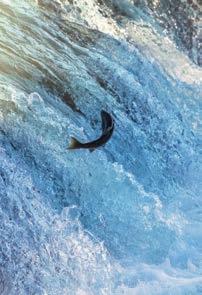
The Pacific salmon is one of the species that has intrigued many researchers all over the world because it is difficult to understand why adult salmon swim thousands of miles to get to the stream where they were born. They live in the ocean, but they reproduce in fresh water. There is evidence to support the conclusion that salmon have a number of senses which lead them back to their native stream to spawn.
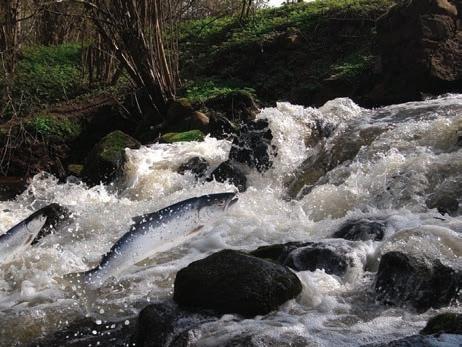
This journey may be only a few hundred yards or over two thousand miles long, depending on the species and the stream. They usually reach their spawning grounds between July and early September. Swimming long distances is exhausting, and only the fittest ones finish the journey. They also become easy catch for predators such as bears and eagles in their spawning grounds as the streams are shallow.
When the female reaches the place where she will lay her eggs, she digs a depression in the gravel with her tail and then deposits her eggs in there. She waits for her mate to fertilize the eggs and then covers them with gravel. The process is repeated several times and thousands of eggs are laid. Shortly after completing spawning, both male and female die.
After being born in fresh water, salmon travel hundreds of miles carried by strong currents to the ocean where they feed on fish, shrimp, squid and anything they can catch. It is important to survive the first few weeks since they often encounter deep water predators. The time spent in the ocean varies, but it is normally one to five years. Then the process of reproduction continues. Salmon complete their life-cycle when they return home to spawn.
intrigue − to interest someone a lot; to make someone curious fertilize – to cause an egg/seed to start developing into a new animal or plant by joining it with a male spawn − to produce eggs spawning ground − a place where fish leave their eggs for fertilization

depression – a hole, a part of a surface that is lower than the surrounding area accuracy – the ability to perform a task without making a mistake vaguely – not clearly expressed, known or described

The phenomenon of salmon’s migration and their amazing ability to navigate great distances with perfect accuracy is still only vaguely understood.
Complete the sentences in your own words using information from the text.
1. Scientists are interested in __________________________________________________.
2. Salmon swim a long way from the ___________ to _____________ to reproduce.
3. Without special senses salmon couldn’t ______________________________________.
4. The role of the female is to __________________ and of the male to _____________.
5. At the spawning grounds their lives are endangered by ________________________.
6. Both parents ______________ after having finished the spawning.
7. In the salty waters salmon feed______________________________________________.
8. They return to the place where they _______________ navigating accurately.
Complete the sentences with the words from the text. The first two letters are given.
1. I’m so ex ______________ because I’ve been digging in the garden the whole day.
2. They are easy catch for bears because the streams are sh ______________.
3. I’ve been in______________ by his plans for the next expedition to the Amazon.
4. I va_______________remember meeting him in Paris years ago.
5. Salmon use this part of the lake as their sp______________ ground.
Complete the sentences with the correct form of the words in bold.
1. We have finished the experiment with a high degree of ______________. /accurate

2. Before I _____________ this speech, I’d like to thank my colleagues who had helped me in this research. /conclusion
3. All my relatives live in ___________ countries. /distance
4. The_____________ of lions in this part of the grasslands is part of my research. /reproduce
5. _____________ through the rapids had to be done with great care. /navigate
6. The date of _____________ of the road works will be known soon. /complete
COLLOCATIONS
1 2 2 3
Which word doesn’t collocate with the given word in capital letters?
DEEP sea, depression, distance, feelings, blue, breath
STRONG argument, winter, current, coffee, smell, resistance
PERFECT accuracy, time, example, mistake, moment, life
FRESH water, air, memory, bread, flavour, place
HEAVY smoker, rain, puddle, fog, traffic, metal
Choose five collocations from the box and use them in appropriate sentences.
Plural of nouns of foreign origin

belongings (the things you own) 1 2 3 4
Some words of Latin or Greek origin make their plurals according to the rules of these languages:
phenomenon – phenomena, crisis – crises /kraIsIs – kraIsi:z/, oasis /@U"eIsis/ – oases /@U"eIsi:z/, datum – data, medium – media, fungus /"fVNg@s/– fungi /"fVNgaI, "fVNgi:/.
Some nouns follow the English rules: gymnasium – gymnasiums, formula – formulas (though formulae is used by scientists).
Plural of compound nouns
Compound nouns form their plural in different ways:
a. With most compound nouns, only the second part becomes plural: teacups, storytellers, spoonfuls, take-offs, etc.
b. Compounds containing man or woman make both elements plural as well as those consisting of two words linked by and. E.g. women doctors, ups-and-downs
c. If compounds are made up of a noun followed by an adjective, a prepositional phrase, or an adverb only the noun becomes plural: sons-in-law, men-of-war, runners-up, passers-by.
Singular forms for both singular and plural
Names of certain creatures do not change in the plural: fish, deer, sheep, bison, etc.
Some types of fish do not normally change in the plural: salmon, trout, squid, cod, carp, but sharks, sardines, crabs, lobsters, etc. have a regular plural.
Plural nouns
Certain nouns are always plural and take a plural verb when they are used with a particular meaning.
greens (vegetables)
arms (weapons)
spirits (alcohol)
goods (things for sale)
savings – (money you save)
conditions (factors that influence someone’s living or working environment)
customs (the place at a border where people declare goods from foreign countries)
refreshments (drinks and a small amount of food)
surroundings (the environment)

Complete the sentences with the words in bold in their plural forms.
1. Scientists have noticed a number of strange _____________ in the water recently. /phenomenon
2. The company has been faced with a number of ____________ lately. /crisis
3. We have different judgements of the matter, that’s why we have different __________. /criterion
4. Our boss keeps sending us a few ____________ every day, which irritates us./memorandum
5. A large number of _________ and a flock of ___________ fled in fear when a hunter fired the gun. / deer, goose
6. We have opened two new ____________ for shooting films in which all the __________ die in the end. /studio, hero
7. How many ___________ do you see on the street? /passer-by
Complete the second sentence so that it has a similar meaning to the first one, using the word in bold.
1. I haven’t enjoyed myself so much for years. /been
It _______________________________________________________ so much.
2. The last time Harry came here was in 2001. /since Harry___________________________________________________________.
3. This is my first visit to Hawaii. /time
This is the first _____________________________________________________.
4. The guest performers are all here now. /already
The guest performers _________________________________________________.
Some English friends of yours are planning a short holiday in a part of the country near where you live. Write an e-mail to your friends, giving them some useful information.
First choose a place you think is worth seeing. It can be a mountain, lake, river, woods, dam, gorge, etc.

Describe the attractions of the place. Say what makes it distinctive. Explain to your friends what they can do and see there (hiking, fishing, bird watching, rafting, boating, etc.). Mention animals and plants which can be seen there.
You can use some of these words in your writing: stunning, outstanding, fascinating, breathtaking, historic, spacious, lush green, favourite destination, refreshing, etc.
When asking somebody to do you a favour, you can use some of the following words and expressions:
Can you …
Will you…
Would you (please) . . .
Could you possibly…
Would you be so kind as to…

Can you open the door for me?
Will you hand me that book?
Would you please turn down the music?
Could you possibly give me a ride to school?
Would you be so kind as to lend me your mobile phone?

Practise asking your classmates to do you a favour. To get someone’s attention you can use the following phrases:
Sorry to bother you, but ... Pardon me, ... Excuse me, ...
Note:
Using longer sentence structures you tend to be very polite: I was wondering if I could ask you to do me a favour?
Examples

1. Can you help me with my essay?
2. Could you bring me some coffee?
3. Could you help me move these tables?
4. Could I ask you to do me a favour?

1. Sure. What’s the problem?
2. I’d be glad to. How do you like it?
3. No problem. I’d be glad to.
4. It depends. What is it?

Don’t forget to thank your friend for offering to do you a favour!
Thank you very much . You saved my life. I’ll return the favour sometime. I really owe you.
test 2
1 Complete the sentences by using the correct form of the words from the List. (6 pts.)
1. We’re very unhappy because our firm decided to ___________with a much bigger one.
2. The heavy rain _____________ our plans for a concert in the open.
3. Antelopes rely on good senses of hearing and smell to avoid dangerous ____________.
4. Our forests are natural ____________ of great value.
5. The ____________, with which she did the project, was amazing.
6. Scientists have been studying several natural _______________ of recent climate changes.
Complete the sentences by using the present perfect or the present perfect continuous tense of the verbs in brackets. (5 pts.)
1. ‘Why are you out of breath?’ - ‘___________________ (do) work-outs.’
2. Somebody _________________ (steal) my bag. I can’t see it anywhere.
3. Your cat __________________ (lie) on my chair since morning.
4. What ____________________ (you/buy) for the party?
5. Nobody ___________________ (ask) us yet what we want.
Choose the correct plural forms (a or b). (5 pts.)
1. Helen asked us to be her _____ at the wedding. Will you accept? a. maids-of-honour b. maids-of-honours
2. Will you put the ____ into the car boot? a. luggages b. luggage
3. They saw several ____ in the national park. a. bison b. bisons
4. You need five____ of sugar for that cake. a. spoonfuls b. spoonsful
5. Travelling through the desert, we came upon two _____. a. oasis b. oases
Complete the sentences with the correct form of one of the phrasal verbs from the List. (4 pts.)
1. I was looking at the address, but I couldn’t ___________ the name.
2. Will you check if the reviews of last night’s play _____________?
4. These jeans are really ____________. I can’t wear them anymore. 1 2 3 4
3. The main hero of the book _____________ to be a negative character.
Verbs plunge merge disrupt poach fertilize intrigue spawn
Nouns gorge habitat poverty predator resource phenomenon accuracy
Adjectives scarce exhausting
Adverbs shortly vaguely
Phrasal verbs come out spread out carry out wear out make out turn out

In this unit, you will READ, LISTEN AND TALK ABOUT
the most prestigious literary prizes
an extract from D.H. Lawrence’s novel Sons and Lovers
Ernest Hemingway
the use of the future perfect and future perfect continuous tenses
the past simple and past perfect tenses
reported speech
phrasal verbs with call
expressing your attitude to reading

Choose the best alternative to complete each sentence.
1. A book about imaginary people and events is a a. romance b. novel c. soap opera
2. Poetry is written in ________. a. lines b. prose c. verse
3. Most novels are divided into several_________. a. chapters b. units c. sections
4. You can find the titles of the sections in the book by looking at the ________. a. appendix b. glossary c. table of contents
5. A great novel has a good plot and a ________. a. message b. meaning c. importance
6. Even the_________ characters in the book are really interesting. a. less b. minor c. small
7. A play is divided into _________. a. chapters b. acts c. characters
What are the most important literary awards in your country?
Do you know of any prestigious literary prizes in the world that are awarded annually?
Do you think that these prizes are always awarded to the best authors?
What do they mean to the winners?
Do they promote books and reading?
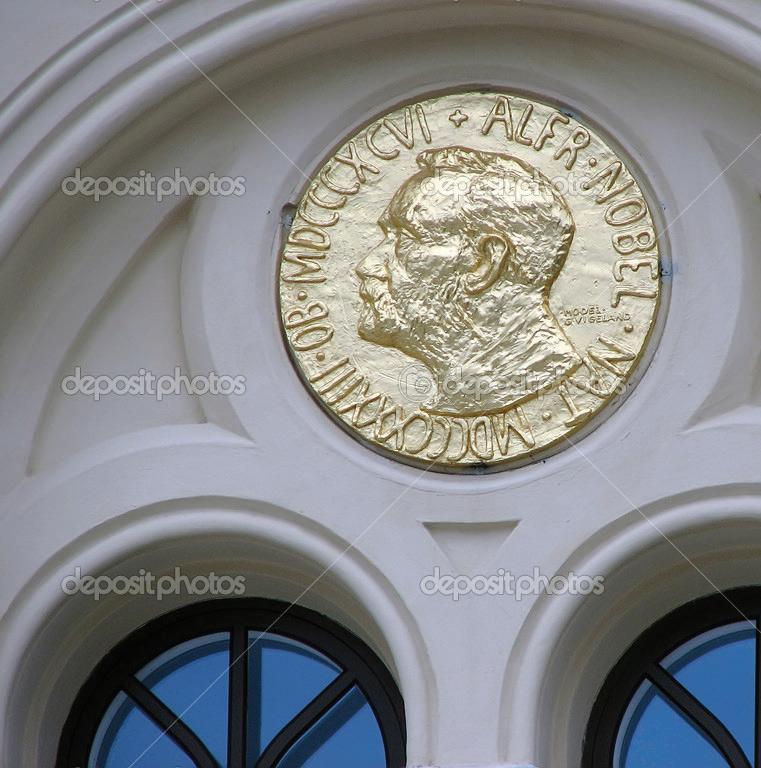
The Nobel Prize is granted annually to people or institutions for outstanding contributions during the previous year in the fields of physics, chemistry, physiology or medicine, literature, international peace, and economic science. The first award was given on December 10, 1901 in Stockholm.
The Swedish chemist, inventor, and philanthropist Alfred Nobel instituted a fund and according to his will, ‘the money shall be distributed in the form of prizes to those who, during the preceding year, shall have given the greatest benefit on mankind. It is my express wish that in awarding the prizes, no consideration whatever shall be given to the nationality of the candidates, but that the most worthy shall receive the prize, whether he be a Scandinavian or not.’

The Booker Prize is Britain’s most esteemed literary prize, and one of the most important literary awards in the English-speaking world. Books that win the Booker Prize, as well as those that are selected for the shortlist, usually stimulate a fivefold increase in their sales. Previous winners include Julian Barnes, Kazuo Ishiguro, William Golding, and Salman Rushdie.
In a tradition dating back to 1917, each April America’s most prestigious awards, the Pulitzer prizes, are given for distinguished work in the areas of drama, letters, music, and journalism by Columbia University.
This series of 21 awards for outstanding achievements was established in the will of Joseph Pulitzer (1847-1911), a newspaper magnate. Born in Hungary, he emigrated to the United States in 1864 and became an American citizen. After receiving a law degree and working as a correspondent, at the age of 25, he became a publisher. In the latter years of the 19th century, Joseph Pulitzer stood out as the very embodiment of American journalism.

He was the first to call for the training of journalists at university level in a school of journalism. In his will Pulitzer gave a donation of $2,000,000 to Columbia University for the establishment of a School of Journalism. In doing so, he stated: ‘I am deeply interested in the progress and elevation of journalism, having spent my life in that profession, regarding it as a noble profession and one of unequalled importance for its influence upon the minds and morals of people.’
grant – give or allow someone something, usually in an official way
contribution – something that you do or give to make it successful philanthropist – a person who helps people in need, especially by giving them money constitute – to form something from a number of elements

shortlist – a list of people who are the most suitable for a job or prize, made from a longer list magnate – a wealthy and influential businessman embodiment − someone or something that represents a quality or idea to a high degree elevation − the act of raising someone to a position of greater importance

2
Complete the sentences using information from the texts.
1. The prizes are granted annually to _____________________________________________.
2. Nobel explicitly wished that the prizes should be given __________________________.
3. Books that win the Booker Prize usually stimulate _______________________________.
4. Pulitzer established a school for journalism to ___________________________________.
5. Pulitzer wanted to help his young colleagues____________________________________.
1. Name some of the writers who were awarded the Nobel Prize for Literature.
2. Summarize the contents of Nobel’s will.
1
3. Do you agree that journalism is a profession that has a great influence upon the minds and morals of people?
1 Use these words from the texts to complete the sentences.
1. The school set up a special ______________ to buy new books for the library.
2. Mankind has had great ______________ from Tesla’s inventions.
3. The fund for Jack’s studies was ______________ by his grandfather’s will.
4. James Joyce is considered to be the most ________________ writer of the 20th century.
5. We had to take into ______________ the money John had spent on repairing the house.
6. By inventing the telephone, Bell made a major ______________ to communication.
7. Everybody admired James because he was a man of ______________ character.
8. A report on the company’s profits is published ______________.
4. How would you define the aim of these three awards? contribution elevate fund outstanding annually established noble benefit consideration
9. The mother tried to______________ her son’s interest in art.
2
Find pairs of words in the box which are similar in meanings.


renowned noble convinced donation previous contribution distinguished certain preceding dignified
Write sentences using these words.
Choose an adjective from column A and a noun from column B to make appropriate collocations. There may be more than one combination. Choose four combinations to make sentences. 3 4 5

great medical outstanding noble prestigious preceding distinguished literary

contribution award achievement prize degree profession benefit year work
1 2
Study the following list of the phrasal verbs with call. You will find explanations for all of them in the List of phrasal verbs at the end of the book. call by call for call in call on call out call off call up
Use some of the phrasal verbs from the list to complete the sentences.
1. I’ll ___________ you on my way to the bank.
2. The commander __________ his men ________ when he realized that the search was hopeless.
3. Jane has just left. She wants you to ________ her _______ in the evening.
4. Yesterday the union __________ the workers _______.
5. Getting a driving licence ___________ a celebration.


Read the example sentences (1-5). The following tenses are used to express the future: the future simple, future continuous, present simple, present continuous and be going to form.
a. Identify the tenses in italics in the example sentences (1-5).
b. Match the tense with the meaning it expresses (a-e).
1. The conference starts at 10 a.m.
2. We are spending a holiday in Italy this year.
3. This time next week we’ll be lying on the beach in Greece.
4. It’s raining. I’ll give you an umbrella.
5. We’re going to walk up the hill tomorrow.
THE FUTURE PERFECT SIMPLE TENSE
a. an intention
b. an action in progress at a definite time in the future
c. a definite arrangement
d. an event on a timetable
e. a decision which has just been made
Read the text and pay attention to the underlined verbs. They are all in the future perfect tense.
My friend Sonia is now busy writing her second novel. She will have finished it by September this year because her publisher wants to exhibit it at the Belgrade Book Fair in October. It is a prestigious fair and if the book is displayed there, it will increase its sale fivefold. The same publishing house will have published the complete works of the Nobel Prize winner, Ivo Andrić, by the time the Fair opens.
FORM USE

We use the future perfect to predict actions or events which will be already completed by (not later than) a certain time in the future. By this time tomorrow Helen will have finished her project.
Subject + will + have + past participle
I will have received my degree by the end of the year. Will you have got all the answers by 6 o’clock? We won’t have finished the match before dark.
• This tense is often used with time expressions:
a. beginning with by (by then, by 2030)
b. not…till/until + time
c. with verbs which point to completion: build, finish, complete, etc.
Note: Look at this sentence: The award will be given to the persons who shall have made the most important discovery.
Shall in the third persons is used to express an obligation. This construction is chiefly used in regulations or legal documents.
The future perfect continuous can be used instead of the future perfect to show that the action is continuous. It is also used with a time expression beginning with by.
I will have been teaching here for 3 years by the end of this year. Before my Mum comes, I will have been cleaning the house for 3 hours.

Complete the following sentences with the correct form of the future perfect or the future perfect continuous tense.
1. We’ll still be here next winter, but the O’Connors _________________ (leave).
2. By the time I get back home, I hope you _________________ (cook) the meal.
3. By the end of this month, Peter ________________ (train) in this gym for two years.
4. Sarah will be here at 8 o’clock. By the time she gets here, we _______________ (wait) for her for two hours.
5. By 2040, all women _________________ (get) a robot for household chores.
6. New inventions _________________ (replace) television by 2025.
7. By the time we get to Belgrade this evening, I _____________________ (drive) more than 700 km.
8. When I go to London next year, I ______________________ (study) English for ten years.
2 Think about things you a) will be doing at this time tomorrow b) will have done by the end of the day. Write sentences using the prompts.
E.g. spend/money – I will have spent 1,000 dinars.
1. send/text messages
2. do/my exercises
3. eat/some chocolate
3
4. do/the test
5. ride/my bike
Complete the sentences using the correct tense of the verbs in brackets to express future time.
1. Life _______________ (be) very different in 30 years.
2. By May next year, we __________________ (finish) all the projects mentioned in this report.
3. I promise I ________________ (lend) you the book after I have read it.
4. I’m afraid, John __________________ (do) the same boring job in ten years’ time.
5. ‘Have you made any arrangements for a holiday?’- ‘We _____________ (visit) my parents in July.’
American Nobel Prize and Pulitzer Prize-winning novelist
Before listening to the text, read the titles of Hemingway’s books to get familiar with them. Then listen once and do Exercise 2.

The Old Man and the Sea (1952)
Listen again and check your answers. Then do Exercise 4. 1 2 3 4
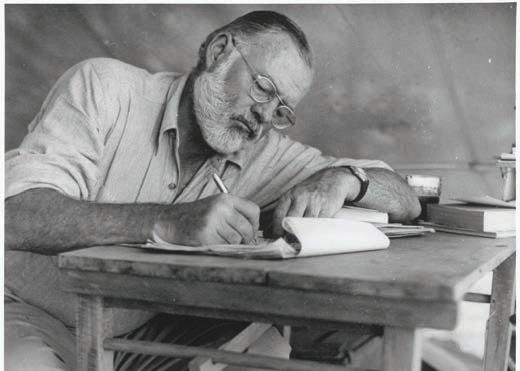
A MAN CAN BE DESTROYED BUT NOT DEFEATED
- Ernest Hemingway in The Old Man and the Sea
Match the name of the novel and the place Hemingway drew an experience from.
The Snows of Kilimanjaro (1952)
A Farewell to Arms (1929)
For Whom the Bell Tolls (1940)
The Sun also Rises (1926)

Talk about
Hemingway’s assignment during World War I
the purpose of Hemingway’s presence in Spain in 1936
how he got the idea for his prize-winning novel
the cause of Hemingway’s death

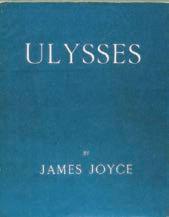
Ulysses –James Joyce
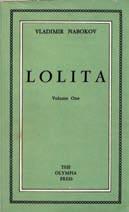
Lolita –Vladimir Nabokov

The Great Gatsby –F. Scott Fitzgerald
Brave New World –Aldous Huxley
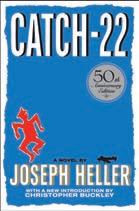
Catch-22 –Joseph Heller
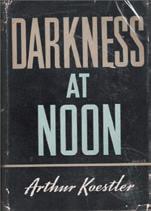
Darkness at Noon –Arthur Koestler
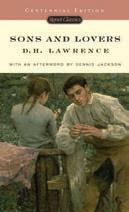
Sons and Lovers – D.H. Lawrence 1 4 7 10 2 5 8 3 6 9
The Grapes of Wrath –John Steinbeck
A Portrait of the Artist as a Young Man –James Joyce
James Joyce’s Ulysses, the epic story about one man’s journey during a single day in Dublin, Ireland, has been unanimously selected by a panel of scholars and writers as the best Englishlanguage novel of the 20th century.
The most recently published books on the list included Midnight’s Children by Salman Rushdie and Sophie’s Choice by Styron.
Only eight women authors were represented, including Virginia Woolf, Muriel Spark and Iris Murdoch.
This is an extract from the novel Sons and Lovers by D. H. Lawrence. It is about the Morel family. Mr Morel is an uneducated miner while his wife comes from a more refined family. Their son, Paul takes after his mother and is close to her. He has sent one of his paintings to a local exhibition and has won first prize.
One morning the postman came just as Paul was washing in the scullery. Suddenly he heard a wild noise from his mother. Rushing into the kitchen, he found her standing on the hearthrug wildly waving a letter and crying. ‘Hurrah!’ as if she had gone mad. He was shocked and frightened.
‘Why, Mother!’ he exclaimed.
She flew to him, flung her arms round him for a moment, then waved the letter crying.
‘Hurrah, my boy! I knew we should do it.’
He was afraid of her – a small, severe woman with greying hair suddenly bursting out in such frenzy. The postman came running back, afraid something had happened.
‘His picture’s got first prize, Fred,’ she cried, ‘and is sold for 20 pounds. And Major Morton has bought it’.
The postman was glad to have brought such a lucky letter. Mrs Morel went indoors and sat down, trembling. Paul was afraid that she might have misread the letter and might be disappointed after all. He scrutinized it once, twice. Yes, he became convinced it was true. Then he sat down, his heart beating with joy.
unanimously – to vote unanimously means that everybody in a group agrees to a decision
scullery – a small room next to the kitchen, often used for washing the dishes
‘Didn’t I say we should do it!’ she said pretending she was not crying.
‘Twenty pounds, mother! That’s just what you needed. Now you needn’t borrow any. It’ll just do.’
‘I won’t take it all,’ she said. She wanted to take only the five pounds she needed. He would not hear of it. So they got over the stress of emotion by quarrelling.
Morel came home at night from the pit, saying:
‘They tell me Paul’s got first prize for his picture, and sold it to Lord Henry Bently for fifty pounds.’
‘Oh, what stories people do tell!’ she cried.
‘Ha!’ he answered. ‘I said I was sure it was a lie.
But they said you had told Fred.’
‘As if I would tell him such stuff!’
‘Ha!’ agreed the miner. But he was disappointed nevertheless.
‘It’s true he has got first prize,’ said Mrs Morel. He stared across the room fixedly
‘But as for fifty pounds – such nonsense! Major Morton bought it for twenty pounds, that’s true.’
‘Twenty pounds!’ exclaimed Morel surprised.
‘Yes, and it was worth it.’
‘Ay!’ he said. ‘I don’t doubt it. But twenty pounds for a bit of painting which he painted for an hour or two!’
hearthrug – a small thick piece of carpet
frenzy – uncontrolled and excited emotion or behaviour
fling – to throw something or someone with a lot of force


scrutinize – to examine something very carefully in order to discover information pit – a large hole in the ground, a coal mine
Answer the following questions.
1. What was the cause of Paul’s shock?
2. Why did Paul scrutinize the letter twice?
3. Whose disappointment was he afraid of?
4. What did Mrs Morel and her son quarrel about? Why?
5. What story had Mr Morel been told before he came home?
6. Read the last sentence of the extract. What is implied in Mr Morel’s remark?
1 2 3
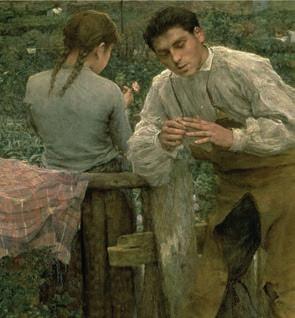

Read the sentences with the highlighted words in the text and try to guess their meanings from the context. Then match the words with their explanations and write them down.
1. _________________ – polite, having knowledge of social rules
2. _________________ – to shake slightly with cold
3. _________________ – to look continuously at one thing
4. _________________ – to behave as if something is true when it is not
5. _________________ – substance, things
6. _________________ – to make someone believe that something is true
Use the highlighted words or the words from the Glossary in the correct form to complete the sentences.
1. She managed to _____________ me of her innocence.
2. Will you bring all the _____________ from the shelf?
3. I was _____________ to be interested in her story, though it was boring.
4. The miners were coming out of the _____________ weary and covered in black dust.
5. She stayed too long in the water and when she got out, she started ____________.
6. She stared _____________ at the clock as if she expected someone.
7. Though Susan isn’t highly educated, I admire her ______________ manners.
Make phrases with first, second, third, sixth, seventh and eleventh and the given nouns to make sense. Make sentences with these phrases. E.g. the eleventh hour – the last possible moment before something happens. aid heaven class sense thoughts hour night hand rate
4
Match the phrases you have made with their explanations below.
1. not new
2. developing countries
3. top quality
4. the wife of the president
5. the opening of the play or film
6. extreme happiness
7. emergency medical help
8. poor quality
9. extra-sensory perception
10. reconsidering decision
1

Which tense is used to emphasize that an action in the past finished before another action in the past started?
Greg knew Dublin so well because he had visited the city several times.
If the past perfect action happened at a specific time, the past simple can be used instead of the past perfect when ‘before’ or ‘after’ is used in the sentence. The words ‘before’ and ‘after’ actually tell you what happens first, so the past perfect is optional.
Both sentences are correct in these examples:
She had visited us once in 2013 before she went to the USA in 2014. She visited us once in 2013 before she went to the USA in 2014.
Remember:
The past perfect tense is also used in reported speech, third conditional sentences, or to show dissatisfaction with the past.
Jane said: ‘I have eaten too much.’ Jane said that she had eaten too much. If I had seen John, I would have warned him of the danger. I regret that I hadn’t bought that dress last week.
The past simple or the past perfect tense?
Complete the sentences with the correct tense of the verbs in brackets.
1. I ___________________ (never/see) such a beautiful bay before I _______ (go) to Maui.
2. ______________________ (Maggie/study) French before she _________ (move) to France?
3. The Maya civilization ________________ (disappear) by the time Europeans first _____________ (arrive) in the New World.
4. The farmers _________ (collect) the hazelnuts that ____________ (fall) from the tree.
5. We went to the exhibition and ____________ (admire) the pictures that Nadežda Petrović ______________ (paint).
6. Yesterday I ____________ (listen) to an old song which I ___________________ (not/hear) in years and it ________ (bring) back some sad memories.
2 Answer the questions using the past perfect according to the situation. Example:
Why did they water the tree? /plant before Because they had planted it before.
1. Why did you eat in the restaurant last night? / not / cook / dinner
2. Why was Helen angry with Jason? / not / buy / the tickets / for the concert
3. Why was it cold in the house? / we /not /close/ the window/ before going out
4. Why was your mother in hospital? / have / problems /with her heart
5. Why did you buy a new car? / break down 1 1 2

There are many reporting verbs, such as: say, tell, wonder, etc. and more formal such as: state, declare, reply, etc. used in English to report what someone has said. When the reporting verb is a past tense, the rule of sequence of tenses is applied.
She told me that she hadn’t been to any parties for ages.
I wondered whether Stella would come to the meeting.
Some reporting verbs give extra information about the purpose of what was said: e.g. complain, admit, boast, etc.
He boasted he had never lost a game of tennis.
After some reporting verbs, particularly those which report intentions, advice, requests or orders (ask, beg, advise, command, invite, persuade, remind, warn, etc.), the reporting verb is followed by a person as an object and an infinitive.
He advised me to stop smoking.
Reporting verbs such as suggest, apologize (for), recommend, insist (on), are followed by an -ing form or that + clause.
They suggested going to the cinema after dinner.
He insisted that he should pick her up at the station.
Put the following sentences from the text First Prize into indirect speech.
1. ‘It’s true he has got first prize.’ Mrs Morel confirmed ____________________________________________
2. ‘They tell me Paul’s got first prize for his picture, and sold it to Lord Henry Bently for fifty pounds.’ Mr Morel said ________________________________________________________________________________
3. ‘I won’t take it all.’ She wouldn’t hear _______________________________________.
4. ‘I don’t doubt it.’ He said___________________________________________________.
5. ‘I’ll take only the five pounds I need.’ She wanted _______________________________.

Report what these people said by using some of the reporting verbs. There may be more than one possibility.
1. ‘Let me help you carry your bag.’
2. ‘Yes, I stole that money,’ the man said in court.
3. ‘I’m sorry, I didn’t mean to frighten you’.
4. ‘My doctor has absolutely forbidden me to drink champagne.’
5. ‘Don’t come back or I’ll call the police.’
6. ‘Would you like to go sailing at the weekend?’
Complete the second sentence so that it means the same as the first by using the given word.
1. I will clean the house before the guests arrive. /have I _______________________ by the time the guests arrive.
2. ‘The trees will be in bloom in April’, she said. /told She ________________________________ in April.
3. Before I joined the sports club, I read all about it on their website. /already When I joined the club, ____________________all about it on their website.
4. The students became quiet, and then the teacher handed the tests out. /when __________________________________ the teacher handed the tests out.
5. ‘Let’s go to the swimming pool’, she said. /suggested She _________________________________the swimming pool.
First, work in pairs and find out about your partner’s reading habits. Use the questions below and make some notes. Try to elicit detailed answers, more than just the title of the book.
1. Which book are you reading now?
2. When is your favourite time to read?
3. Which author do you most admire?
4. Who is your favourite character?
5. What is your favourite poem?
6. What is your favourite play?
7. What is the most difficult book you have ever read?
8. What is the funniest book?
9. What is your favourite children’s book?
10. Which books would you like to see filmed?


Do you have anything in common with your partner? What do you think about your partner’s reading habits? Now look at the results of two other pairs. Using your notes, write a short comment on reading habits within your group.

A survey report is a formal piece of writing based on research. The language of reports should be formal and should sound objective. You have been asked to write a report on the reading habits among students. Here are some guidelines to help you write it.
State the purpose/ aim of the report, when and how the information was gathered.
Examples: The purpose/ aim of this report is…, As requested…, This survey was carried out/ conducted by means of…, the questionnaire consisted of…, etc.
All the information collected and analyzed is presented clearly and in detail.
Use a variety of reporting verbs such as claim, state, report, agree, complain, suggest, etc. When reporting the results of a survey, the figures gathered should be given in the form of percentages and proportions. Expressions such as one in four or a significant number of, etc. can be used.
Sum up the points mentioned above. If necessary, a recommendation can be included, too. One way of summing up is making some general comments. Examples: To conclude/summarize…, In conclusion…, All things considered…, All in all..., It is not easy to reach any definitive conclusions…, If any conclusions may be drawn from the data…, The survey shows/ indicates/demonstrates…, etc.

Complete the unfinished sentences in this dialogue with the questions that fit the answers that are given. You may talk about the book you are reading or have just read. The first is done for you as an example.
A: What kind of books do you enjoy reading?
B: Books which are exciting and easy to read.
A: Who____________________________________________________?
B: Oh, Steven King, Ludlum, Grisham – writers like that.
A: Do_____________________________________________________?
B: No, not only spy stories. I do read other kinds of books, too.
A: And what ________________________________________________?
B: At the moment? I’m on the very last chapter of a book by__________.
A: What ___________________________________________________?
B: It’s about ________________________________________________.
A: Where __________________________________________________?
B: In _____________________________________________________.
A: Is it ____________________________________________________?
B: Yes, it’s very exciting and it’s well-written too.
A: Would __________________________________ me to read?
B: Yes, I certainly would. I think you’d enjoy it.
A: Will ____________________________________________________?
B: Yes, sure. I’ll try to remember to bring it along.
1 2 3 4
Complete the sentences with the correct form of the words/phrasal verbs in the List. (5pts)
1. They had to __________ the concert in Central Park because of the bad weather forecast.
2. Aunt Jane died unexpectedly and left me some money in her ______.
3. Mark was such a good actor that he ____________ me to believe in his innocence.
4. It is a great honour to be on the ___________ for the Booker Prize.
5. The invention of safety belts made a great __________to road safety.
Find words in the List which mean: (5 pts.)
1. ____________– an amount of money provided for a particular purpose
2. ____________– happening before someone or something
3. ____________– attention to a particular subject or fact
4. ____________– moral in an honest, brave, and kind way
5. ____________– the whole of the human race (men and women)
Complete the sentences with the correct form of the verbs in brackets. (6 pts)
1. By the time I get back home, my mother _______________ (cook) the meal.
2. He __________________ (study) for at least two weeks by the time he sits for his exam.
3. This time next week we __________________ (ski) on Kopaonik.
4. They ________________ (discuss) the problem for over an hour by the time Jack arrives.
5. By the end of the century we _________________ (use) up all oil and gas resources.
6. Cameron and Megan _______________ (get married) at noon tomorrow.
Report the following sentences using the words in bold. (4 pts.)
1. ‘Could you bring my book to the meeting tonight?’/to He asked ______________________________________________________.
2. ‘I have broken the vase,’ the child said. /that The child admitted _____________________________________________.
3. ‘Don’t come near me!’/not She warned him _______________________________________________.
4. ‘Are you coming to the board meeting?’/if He inquired ___________________________________________________. test 3
Verbs grant fling convince constitute wave Nouns frenzy embodiment contribution consideration shortlist will fund mankind elevation
Adjectives outstanding prestigious preceding fivefold distinguished refined noble Phrases take off burst out call out call off call on


In this unit, you will READ, LISTEN AND TALK ABOUT
3D printing
useful inventions
accidental scientific discoveries
PRACTISE
inversion used for emphasis
the past perfect continuous tense
the use of modal verbs for past deductions
speculations about the present
making predictions

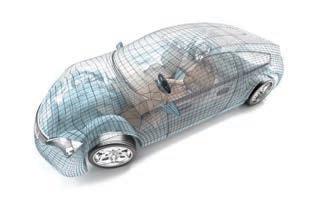

Which of the following technological inventions has had the greatest effect on people’s everyday life – the television, the computer, the car, the plane or the mobile phone?
If you have an opinion, explain why you chose that particular invention. If you think that another invention has been of greater importance, name it.
Get into groups with others who share your point of view. Together, write two or three ideas of how the invention affected people’s lives. Mention the positive and negative effects and use arguments to support your opinion.
Read the introductory paragraph to the main text and discuss questions 1-5. Compare your answers.
How does 3D printing work?
For those who haven’t seen it, 3D printing sounds futuristic, but it has revolutionized the way we make things. The process starts with a creation of a digital 3D model of an object we want to make. A special software ‘slices’ the model into hundreds or thousands of horizontal layers. The 3D file is then sent to a 3D printer. It prints the design layer by layer, binds all the layers together with no visible joints and forms a real object. This is called 3D printing.
1. What kind of objects do you think a 3D printer can make?
2. What in your opinion can’t be printed?
3. Which industries might benefit most from this technology?
4. Do you think that 3D printing will be available for personal use in the near future?
5. Are there any potential negative consequences in the use of 3D printers? If so, can you assume what they might be?
Read the whole article and see how many of your answers correspond to the facts and opinions expressed in the text.
Track 13

When Gutenberg first introduced his printing press in 1439, it might have been used only by a few people, but the resulting changes were later shared by nearly everyone.
Similarly, the personal computer and the Internet first existed only in military and college research facilities, but their availability quickly spread.
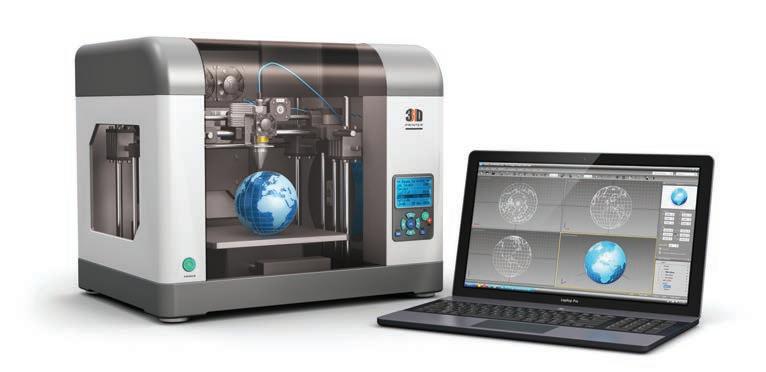
This very well might be the story of 3D printing. The first 3D printers were bulky, expensive and impractical. Constant innovations and improvements have led to the development of new models which are more efficient and now capable of creating objects of any shape, with a variety of materials. Recent advancements have also drastically improved the quality of printed objects, while also lowering costs.


Although this technology has been around for many years, it is still in its infancy. 3D printing has a seemingly infinite capacity for growth and will pave the way for countless innovations. The majority of companies, however, are still using it for experimenting with new ideas: in the manufacture of many kinds of plastic and metal objects, in architecture, medicine, the entertainment industry, such as the games and film industry, or in the arts. However, as with any new technology, the potential negative consequences must be seriously considered. On no account should they be ignored and measures must be taken to prevent them.
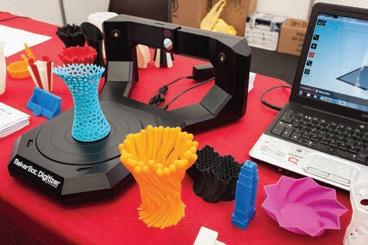
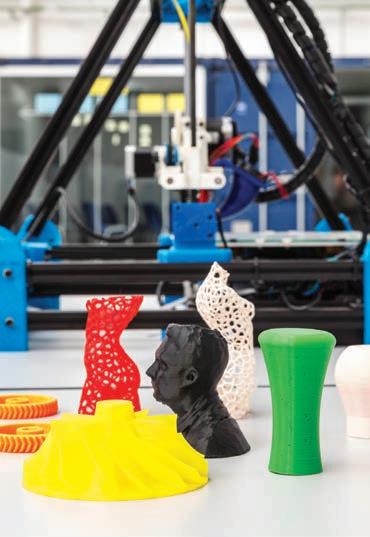
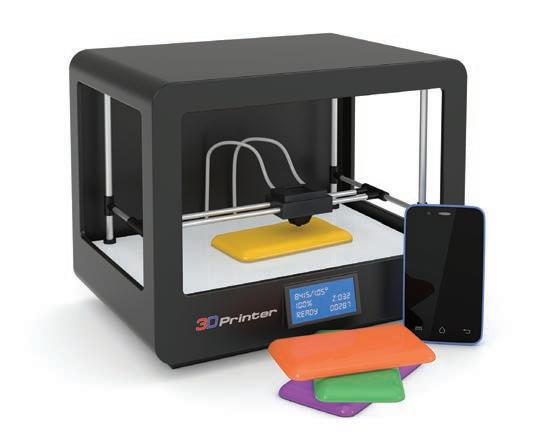
Not only can 3D printers make small, practical objects, but they can create replacement organs for the human body as well. This is known as bioprinting and is an area of rapid development. This application in the medical industry may be one of the important uses of 3D printers.
At home, with your 3D printer, you can create and print your own designs or make a simple tool or a part for a machine which may not be available. When a small plastic part on something breaks, you will have the possibility of making it, instead of ordering that replacement part or throwing the object away.
The point is that if you need something special, it can be created. 3D printing provides designers with exciting new opportunities and we are just beginning to see the true potential of this technology. However, a drawback for the individual home user is still the high cost of 3D printers, but the prices are expected to come down with time.

bind – to cause to stick together; to fasten together bulky – too big and taking up too much space facility – a place, especially buildings, where a particular activity happens; a piece of equipment provided for a particular purpose infinite – endless; unlimited manufacture (n) – production; creation manufacture (v) – to produce (with machines); construct slice – to cut into thin pieces ignore – to take no notice of

1 2
Complete these definitions by using the highlighted words in the text.
1. The _____________ of one thing by another means that the second thing takes the place of the first.
2. A _____________is a disadvantage or an unwanted feature.
3. If someone is _____________, he is able to do tasks successfully, without wasting time or energy.
4. The word ______________refers to how things seem.
Use the words from Exercise 1 and the Glossary in their correct form to complete these sentences.
1. A new sports ____________ is being built in the neighbourhood.
2. George was ____________ calm when he came to take the test.
3. The equipment was ____________ and I couldn’t carry it.
4. Scientists claim that the universe is theoretically _____________.
5. I find it very difficult to _______________ his bad manners.
3
Explain the meaning of the following words and phrases and make sentences using them: remarkably, consequences, tool, pave the way, take measures


Compare these pairs of sentences (a and b). What is the effect of starting sentences with negative words/phrases? What is the word order then?
a. Never have I heard such a dreadful speech.
b. I have never heard such a dreadful speech.
a. Not only can you make small objects, but also human tissue.
b. You can make small objects and also human tissue.
Inversion means putting the verb before the subject. It is used when we want to emphasize a sentence. It happens when we begin a sentence with…
a negative adverb or an adverb phrase: never; never before; not only...but also; on no account; under no circumstances, etc.
Under no circumstances must you leave the luggage unattended.
an adverb or adverbial phrase used in a negative sense: rarely, seldom, hardly, scarcely, only when/after, only then, etc. Note that hardly, scarcely and barely are followed by when.
Hardly had I got into bed when the telephone rang.
1 2
Underline the correct phrase in italics in each sentence.
1. Nowhere have I had / I have had such bad service.
2. Jim promised that he would never / never would he tell anyone else.
3. Never had she seen / she had seen such a beautiful sight before.
4. Not until it was too late I remembered / did I remember to call Susan.
5. Only after checking three times I was / was I certain of the answer.
6. On no account you should / should you do anything without asking me first.
Complete each sentence by using the phrases from the box.
Never before has Not only did Rarely have Hardly had I got On no account
1. _____________a minister been faced with such a problem.
2. _____________he forget to write a report, but also blamed me for not writing it.
3. _____________must they leave the building.
4. _____________I heard a weaker excuse!
5. _____________onto the motorway when I saw two police cars following me.
1
2
The following verbs are commonly used with AT and FOR. Study the examples and make new sentences using these verbs.
glance at something
hint at something
marvel at something
account for something
blame someone for (doing) something
charge someone for (doing) something
- Can I glance at this document for a moment?
- My manager didn’t hint at anything about the purpose of the meeting.
- I marvel at his scientific discoveries.
- That innovation accounts for his success.
- I blame Janet for breaking the pottery.
- The accountant charged him $100 for his advice.
The uses of account account for (v) – a. to be the reason why something exists or happens b. to give an explanation of one’s conduct, reasons or motive account (n) – a. an arrangement with a bank to keep your money there
b. a description of something that has happened
c. an arrangement you have with an Internet provider to use their service
on account of – for the sake of; because of something on no account – under no circumstances take into account – to take into consideration
Read the examples and translate the sentences into your language to show that you understand the use of phrases with account
He opened a new account at a bank last week. / Do you have an email account?
She gave a thrilling account of her life abroad.
She didn’t account for the extra costs. That’s why she had to borrow money.
How do you account for your success?
He doesn’t exercise on account of his poor health.
Work with a partner. Complete the text 3D Printing - the pros and cons by choosing the correct answer A or B.

1. A creating B setting up
2. A effect B impact
3. A limited B narrow
4. A infinite B numerous
3D printing will open up a world of new possibilities for all industries, although the initial cost of (1) ____ a 3D printing facility may be high. It is predicted that it will particularly (2) ____ on consumer-product industries since 3D printers will be able to ‘manufacture’ any object customers want. There is still a (3) ____ choice of materials that can be used, though, and the speed of the overall process is rather long, but the technology is improving.
However, apart from (4) ____ advantages, there are also a number of disadvantages that are associated with 3D printing. It will pose serious concerns for many industries that heavily rely upon branding to sell their products. Then, it may lead to the (5) ____ of jobs. Moreover, issues involving intellectual (6) ____, the creation of dangerous (7) ____, such as guns, or other potential problems may (8) ____ in the near future.
5. A decrease B reduction
6. A possession B property
7. A issues B items
8. A arise B begin
2
Match the words in bold from the text with their explanations.
1. to cause something, especially a problem or difficulty
2. ____________ happening at the beginning of a process
3. ____________ including everything; general
3
4
Study different collocations with the words in bold (a-c) and use some of these combinations to make sentences.
a. overall process /impression/amount/effect
b. to pose a concern /threat/problem/danger
c. initial cost /response/reaction/stage
Example:
This invention can pose a threat to jobs in the automobile industry.
Discuss the following questions. Compare your answers and justify your opinions.
1. Why would 3D printing affect consumer-product industries most?
2. What would you make using 3D printing if you had an opportunity?
3. Which of the advantages would you mention as most beneficial?
4. Which of the potential disadvantages do you think might prove most challenging?
5
Read the dictionary definitions of gadgets and appliances and answer the questions.
gadget – a small mechanical device or tool appliance – a piece of equipment for a particular purpose in the house, esp. an electric or gas powered one
What gadgets and appliances do you have at home, which you couldn’t do without? What are they for?
Have you or a member of your family ever bought a gadget that didn’t live up to your expectations, or one that was particularly useless? What was it and why was it disappointing?

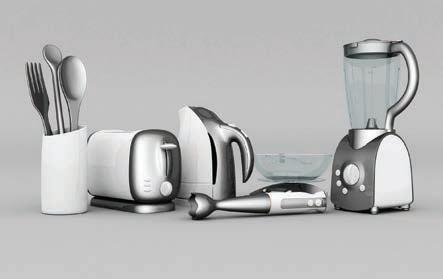

Track 14
There are many things around us that we take for granted, and we never think of them as inventions. You are going to listen to a few interesting stories of how certain products came to be invented.
1
Before you start listening, look at the meanings of the following words. pop top – (of a can) having a top with a ring that can be pulled up or off; a ring pull
kola nuts – the fruits of an African rainforest tree brewing – business of producing beer beverage – drink (as beer, tea or coffee) shrewd – smart; sharp-witted
2 3
While listening, write down the key words under each heading. You will use these words later to retell the stories. There is an example for each story.

pop top can opener a can opener



a pharmacist
Look at these extracts from the recording. Underline the correct alternative in italic.
1. It was well known of/for its delicious…
2. It crossed/occurred his mind that it was…
3. To/On the chef’s surprise…
Retell the stories. Potato chips a cook
4. He was attending a/the picnic when he realized he forgot/had forgotten…
5. He decided to find a solution to/for it.
4
Listen again and check. Compare the key words you have written with those that other students have chosen.
5
15

ome inventions have made the most tremendous changes in the development of civilizations throughout history and consequently greatly changed the lives of people. There are also numerous other useful inventions of simple products which make our everyday lives easier.
Most inventions or scientific discoveries take a long time to develop and arrive after years of painstaking work. However, they were sometimes stumbled upon by chance or occurred while the inventors were trying to discover something else. Here are just a few examples of inventions that owe a lot to chance.

Alexander Fleming’s discovery of penicillin is the most famous example. Fleming had been experimenting with the influenza virus for some time when he decided to go on a two-week vacation. He accidentally left one of the glass culture dishes with its lid ajar. Upon his return to the lab, he found a strange fungus had started to grow in the glass and that the mould had contaminated his staphylococcus cultures. But more importantly, he realized that the fungus, Penicillium, had killed all the surrounding bacteria in the culture. Over the next two decades the drug Penicillin was developed.
In 1895, German physicist Wilhelm Roentgen had been studying electron beams in a vacuum tube when he noticed something strange: when the electron beam was switched on, a fluorescent screen one metre away would glow, even though the tube was shielded in opaque cardboard. It was the proof that particles of light were passing through solid objects. Amazed, he placed his hand in front of the tube, and could see his bones in the image that was projected on the screen. He replaced the tube with a photographic plate to capture the image, creating the first X-rays.

painstaking – characterized by extreme care and great effort
ajar – partly open fungus (plural fungi) – a plant (such as mushrooms) that has no flowers or leaves. Some are edible, but most are poisonous to humans mould (Botany) – any of the fungi that cause this growth
glow – to shine with low light or heat; to have a reddish colour from emotion shielded – protected by a shield to prevent injury or damage
opaque – an object or substance you can’t see through cardboard – a thick paper used to make boxes
In 1945 Percy Spencer, an American engineer, was working on a radar-related project. While testing a new vacuum tube used to generate microwaves, he discovered that a chocolate bar he had in his pocket melted.
He became intrigued and started experimenting by aiming the tube at other items, such as eggs and popcorn kernels. He concluded that the heat the objects experienced was from the microwave energy. Soon after this discovery, Spencer filed a patent for the first microwave.

Say whether the following statements are true or false. Find sentences in the text to justify your opinion.
1. Fleming left the lid ajar in order to see what would happen.
2. Fleming was soon able to make the drug out of the fungus.
3. W. Roentgen experimented with electron beams because he knew that particles of light could pass through solid objects.
4. Percy Spencer started experimenting with microwave energy out of curiosity.
5. He didn’t know beforehand that microwaves could melt objects.
Find words or phrases in the text which mean the following. The paragraph number is given.
1. as a result (1) _____________
2. to come upon accidentally or unexpectedly (1) _____________
3. to pollute (2) _____________
4. firm or compact in substance; not liquid or gaseous (3) _____________
5. to produce as a result of a chemical or physical process (4) _____________
6. interested, curious (4) _____________
2 3
Use the words from Exercise 1 and the Glossary in their correct form to complete these sentences.
1. The children ____________ with excitement when they heard the news.
2. Tina left the door____________ when she left the room.
3. Without the ____________ work and assistance of Mr Brown, we would never have succeeded in finishing the project.
4. I was ____________ by his answer and decided to check the data.
5. Pesticides ____________ the river and we didn’t want to go fishing.
Match adjectives 1-5 with nouns a-e to form the collocations found in the text.
1. tremendous
2. scientific
3. painstaking
4. solid
5. opaque

a. work
b. cardboard
c. objects
d. discoveries
e. changes
4 Decide which of the following nouns below can also collocate with adjectives 1-5.
Use some of the collocations in example sentences.
evidence / accuracy / job / method / glass

Study the sentence and say how the tense in bold is formed. Fleming had been experimenting with the influenza virus for some time.
The past perfect continuous is used:
1. to describe an action that started in the past and continued up until another past action. It is often used with time expressions: by the time, for, since, all day/morning, before, after, when or already.
By the time Roger got to the office, the client had been waiting for an hour.
2. before another action in the past to show cause and effect.
I was so tired. I had been revising my lessons since morning.
3. when reporting things said in the past.
John said, ‘We were travelling by train for two days.’
John said they had been travelling by train for two days.
Note: We use the past perfect simple to emphasize the completion of an event. We use the past perfect continuous to emphasize the duration of an activity.
He had drunk two beers before he left the bar.
He had been drinking all afternoon before he left the bar.
1 What is the difference in meaning?
1 2 3 not listen wait for an hour train for months rain for a week play computer games
1. I looked out of the window. It was snowing.
2. I looked out of the window. It had been snowing.
Work with a partner. Complete the sentences with the phrases from the box. Use the past perfect continuous.
1. He had a headache because he_____________________________________ for hours.
2. She was confused because she______________________ carefully to our conversation.
3. They were furious when she arrived because they _____________________________.
4. The town was flooded because it _____________________________.
5. We won the match because we _______________________________.
Put the verbs in brackets into the past perfect simple or the past perfect continuous.
1. They __________________ (sunbathe) for an hour when it started to rain.
2. He showed us the place where he __________________ (hurt) his leg.
3. The doctor asked me how long I___________________ (have) the symptoms.

4. They spent their honeymoon in Paris where they (meet) ________________two years before.
5. After she died, it was discovered that she __________________ (make) secret donations to his firm for years.
6. Helen _________________ (work) at that company for a year when she met James.
7. We _________________ (grow) grapes for ten years before we decided to open a winery.
8. __________________ (you/drive) long before the accident happened?
4
Put the verbs in brackets into the past perfect simple, the past perfect continuous, the past simple or the past continuous tense.
1. Sonia _____________ (paint) the walls all day before she_____________ (finish) them.
2. I ______________ (know) that he______________ (contact) Jimmy earlier that week.
3. James ______________ (be) late for school yesterday. He ______________ (forget) to set his alarm clock and when he______________ (come) into the classroom, the students ______________ (write) the test for almost 20 minutes.
4. They ______________ (drive) for 3 hours when a storm suddenly ______________ (break).
that science can’t explain
Read the text and answer these three questions. Pay attention to the use of modal verbs of deduction or speculation. Then read the grammar review and do the exercises which follow.
1. Why did the archaeologists first assume the artefacts must have been regular pots?
2. When did the archaeologists conclude that the pots might have been used for something else?
3. Why couldn’t ancient science have grasped the principles of electricity?
There are various discoveries throughout the past century that have baffled our scientists.
In 1936, while excavating ruins of an ancient village near Baghdad, workers discovered a series of bright yellow clay pots dating from the early centuries AD. The archaeologists first assumed the artefacts must have been just regular pots for storage. However, they were baffled when a copper rod that showed evidence of acid corrosion was found in each pot. They concluded that the pots probably contained a liquid that would interact with the copper and produce an electrical charge. This meant that pots might have been used for something else.

After further analysis, most archaeologists agreed that the devices were batteries. This seemed incredible, considering that it wasn’t until 1660 when a machine which generated static electricity was invented.
There has been much speculation as to what they were used for and how ancient Persian science could have grasped the principles of electricity and how people had the knowledge to make such items.
1

assume – to believe to be true; suppose clay – an earthy material used for making bricks, pottery, etc.
baffled – confused; to be unable to understand or explain something rod – a thin straight piece of material, such as metal or wood
grasp – a) to understand something, especially something difficult b) to take something quickly in your hand (s) and hold it firmly artefact – an object of cultural or historical interest made by a human being electrical charge – an amount of electricity that is obtained by something device – an object; a mechanism; a piece of equipment

Complete the following sentences using the words from the Glossary.
1. I think I managed to ___________ the main points of the lecture.
2. The secretary was completely ___________ by the manager’s strange behaviour.
3. The man proved his strength by bending an iron ___________.
4. The National Museum has rich collections of historical and cultural ____________.
Decide which answer (A, B or C) fits best each gap. 2
1. A new expedition is again _______ the site, in the hope of finding more ancient pots.
A testing B excavating C investigating
2. My ______ intention was to resign, but then I changed my mind.
A ancient B firstly C initial
3. I need to ______ the importance of meeting the deadline.
A emphasize B grasp C assume
4. I believe that it is reasonable to _______ that such changes will have significant social effects.
A ignore B conjecture C assume
5. The telephone and computer are no longer the only ______ in my office.
A devices B tools C gadget

1 2


We use modal verbs must, can’t, might and could to make guesses about events in the past. We choose the verb depending on how sure we are. Look at the underlined past modals in sentences 1-4 and match them to explanations a-d. The first sentence has been done for you. 1/a
1. Your guest must’ve been very hungry. He ate everything I gave him.
2. Tim can’t have taken Tom’s book. He was with me.
3. John might have forgotten to come or he could have gone to another party.
4. You could’ve finished the report on time. The boss will be angry now.
a. You are almost certain that something happened (and have evidence for it).
b. You think it’s possible that something happened, but you are less certain.
c. You are almost certain that something did not happen.
d. You think that something was possible, but did not happen.
Complete the sentences using the modals must, can’t, might or could.
1. The manager is not here. He ____________ have left the office early.
2. He ___________have bought a new car. He doesn’t have any money.
3. Richard is celebrating. He ___________have won the match.
4. I___________ have taken those photos in India, but I’m not sure.
5. She speaks excellent French. She___________ have lived in Paris for a long time.
6. He __________ have escaped through this window – it’s too small.
7. I’m glad you didn’t say anything. You __________ have upset her by mentioning it.
8. I__________ have made a mistake. It’s possible because I didn’t check.
Rewrite the following sentences, keeping the meaning the same. Use modal verbs of speculation and the words in bold.
1. She is so scared of dogs that a dog certainly bit her when she was little. /must She ________________________________________ when she was little.
2. I know David wasn’t in Belgrade on Saturday because he returned from London on Sunday. /have David _____________________________________ he returned from London on Sunday.
3. Look in the car for your glasses. I’m sure you left them there. /must Look in the car for your glasses. You __________________________________.
4. The audience didn’t think much of the show since they left after only 20 minutes! /can’t The audience ________________________________________________.
5. It’s possible that the witness lied about the incident. /might The witness __________________________________________________.

Work in pairs. Study the phrases used to make speculations/predictions about the present/future situations.
It
could be... It can’t / might / must be...

It
/ they / he / she looks as if ...
They appear to be... I’d imagine that they
are...
An invention you can’t do without 1 2 3 4 5
I'm
As
fairly / absolutely certain they are...
far as I can see, they are...

I
suppose they are... They are definitely...
Role play. Use the phrases to make dialogues. Student A makes a statement and student B expresses his/her predictions related to it. Example:
A: Rita and Henry are always together. He has eyes only for her.
B: I’m absolutely certain he is very much in love with her.
In pairs, complete the table by putting the phrases from the box into the category they belong to (1-6). The first phrase has been done as an example.
1. definitely won’t happen not a hope of, sure not to,
2. almost certainly won’t happen it’s highly improbable,
3. probably won’t happen I shouldn’t think, I doubt if/whether,
4. will probably happen may happen, it’s possible,
5. will almost certainly happen in all probability,
6. will definitely happen bound to, it’s inevitable, no doubt,
Complete the sentences by using the phrases from the table.
There may be more than one possibility.
1. _____________ that pretty soon robots with special skills will be created.

sure not to it’s extremely doubtful there’s a very faint chance I’m convinced there’s no way there’s a good chance there isn’t much chance it’s likely to
2. There’s a _____________ that scientists will find a cure for cancer in the next twenty years.
3. It’s _____________ that we will ever meet aliens.
4. She is_____________ become famous one day. She is an excellent actress.
5. ________________ he can win. His opponent is much better than him.
Role play. Make dialogues similar to these in Exercise 2, but this time expressing doubt or certainty related to the statement. Use the phrases from the box in Exercise 3.
Think of an invention that is very important to you. Write a composition of 100-120 words about what your life would be like without it. Use some phrases from Exercises 1 and 3 given in the Communication section.
1 2 3 4
Choose the word from the Word list with the closest meaning to the words in the following sentences. (5 pts.)
1. The main disadvantage of the plan is that it involves a lot of risks.
2. She was confused, because she didn’t expect him to react so violently.
3. He found it difficult to understand the main point.
4. The door to her bedroom was slightly open and I knocked.
5. The total costs of medical care will be higher than we expected.
Find words in the Word list which are antonyms to the words below. (4 pts.)
a. notice b. hollow c. original d. different
Underline the correct phrases in italic in each sentence. (7 pts.)
1. Timothy must have left/can’t have left the office. His computer is turned off.
2. When we arrived at the match, they had already been playing/were playing for 15 minutes.
3. She went back to the dentist because her tooth had been hurting/has hurt
4. His father must have been/must be furious when he lost the watch. He didn’t speak to him for days.
5. He could have won/must have won the match. He played better, but he just wasn’t lucky.
6. David may have taken/had to take your books by mistake.
7. It isn’t likely/doubtful that the boss will have to interview all of them.
Rewrite the sentences putting the words in bold at the beginning and making any other necessary changes. (4 pts.)
1. He had hardly entered the house when the police arrested him.
2. I had never for one moment thought the consequences would be so serious.
3. You must on no account lift heavy weights like that again.
4. Tom has not only broken his leg, but he has also injured his shoulder.
Verbs baffle excavate generate glow grasp ignore manufacture pose slice Nouns artefact drawback device replacement facility clay item rod
Adjectives ajar alike bulky efficient initial infinite overall painstaking seemingly shielded solid shrewd Phrases come up on no account on account of stumble upon
In this unit, you will READ, LISTEN AND TALK ABOUT
places with extreme conditions of living
weird traditions
heroes who saved other people’s lives

PRACTISE
conditional sentences
the passive voice
phrasal verbs with up
expressing warnings
Take a look at the pictures of five places where people live in extreme conditions.
A Match the names (1-5) to the explanations (a–e) to get full information.
B Answer the following questions.
Name the continents where these places are situated.
Do you know anything else about them?
C Talk about the conditions you could / you couldn’t live in.
1. Longyearbyen, Norway, is
2. Dallol, Ethiopia, is
3. Puerto Toro, Chile, is
4. La Rinconada, Peru, is
5. Oymyakon, Russia,
Check the Appendix for the answers.
a. the southernmost village on Earth.
b. the hottest place year-round on the planet.
c. regarded as the highest place on Earth.
d. experiences temperatures averaging minus 50 in the winter.
e. the northernmost settlement with a population of over 1,000.

Read the text once and say which of these is NOT mentioned in the texts.
1. The locations of Viganella and Yuma
2. The Indian graveyards in the desert
3. The place where the mirror was installed
Track 16
4. The number of sunny days in Yuma
5. The dimensions of the mirror
6. The place where the solar plant was built
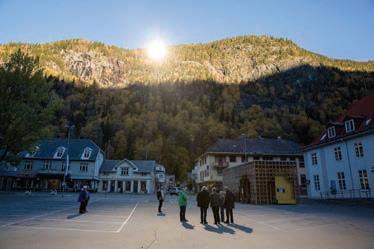
Viganella is a small village in Italy which is located at the bottom of a deep valley in the Alps. The surrounding mountains cast a long shadow over the entire village, completely blocking the sun, and people were condemned to live without sunshine most of the winter. They suffered from severe winter depression and had a negative attitude to life. For centuries, villagers accepted their fate and celebrated with joy the return of the sun’s rays on the 2nd of February.
If a local architect had not come up with the brilliant idea of using a mirror to reflect sunlight into the village, it would still be in the dark for three months a year. The mayor of Viganella managed to raise enough money necessary for the construction of the mirror and the problem was solved. A giant mirror was installed on the slopes of the mountain above Viganella at an altitude of 1,100 metres. Since the mirror was too small to light up the whole village, the main square in front of the church was chosen to be flooded with sunshine. The mirror is computer-operated and it can follow the sun’s path throughout the day reflecting sunlight onto the square for at least six hours a day. After the mirror was installed, a positive change came over the mood and behaviour of the inhabitants. It is truly wonderful when technology is used in such innovative ways to make people’s lives better.

If you lived in Yuma, you would enjoy 340 days of sunlight a year or at least so the Guinness Book of World Records reports. Yuma is located in western Arizona near the borders with Mexico and California and it probably owes its title ‘the sunniest spot on Earth’ to the desert Devil's Valley which is nearby. The estimated population of Yuma is about 200 thousand, though a lot of retired people from all over the USA make Yuma their winter residence.
Yuma’s sunniest month is June, when it is sunny for 97 percent of the time from sunrise to sunset, which amounts to 415 hours of sunshine.
To make use of the sunlight energy, a huge solar plant was built in the Arizona desert and it can power 230,000 houses when used at full capacity. At the time it was completed, in 2012, it was officially the largest working solar panel array in the world, including more than 5 million solar panels.

Solar power is the fastest-growing energy sector. It is a highly competitive energy resource because of clean-energy technology and production. Provided that solar energy continues growing, it will help the decrease of gas emissions and prevent the rise in global temperatures.
2 3 1 2
Find evidence in the text about Viganella which says
1. why Viganella didn’t have sunny days in the winter time.
2. the villagers are in a bad mood during the winter months.
3. where the mirror was installed.
4. that only a part of the village could have been lit.
5. that the architect was from Viganella.
6. that life in the village changed for the better.
7. how the whole system worked.

condemn – force someone to live in an unpleasant way; punish attitude – an opinion or feeling about someone or something altitude – height above sea level amount to – add up to array (n) – a large group of things or people arranged in a particular way plant – a place where power is generated, a factory
Can you complete the sentences without looking back at the text about Yuma?
1. Yuma is situated ______________________________________________________________.
2. It is hot and sunny in Yuma because ____________________________________________.
3. The population grows _________________________________________________________.
4. The houses in Yuma use solar energy thanks to _________________________________.
5. With the help of solar energy, the rise in global temperatures ____________________.

Complete the sentences with the correct form of the highlighted words from the texts.
1. Tennis is a highly sport.
2. We were looking forward to skiing down a very steep ______________.
3. The best way to go through the is to hire a few camels.
4. Over an eight-year period, there has been a in number of students by twenty percent.
5. Tom thought he would never see Emma again, but _____________brought them back together.
6. From this spot we have a magnificent view over the mountains.
Match these words from the text with their definitions.
1. growth –
2. retired –
3. power (v) –___________
4. estimate –____________
5. block –
6. bottom –_____________
7. cast –


a. provide energy –______________
b. rough calculation –_____________
c. throw –
d. no longer working –____________
e. the lowest part –
f. expansion –
g. obstruct, prevent –_____________
There are many things you can do to a problem; you can: cause, face, solve, reduce, discuss, handle, consider, overcome, ignore or deal with it.
3 4 5
Complete the sentences by using some of the words and expressions from the list making your own choice.
1. You have to the problem; there is no running away from the facts.
2. We didn’t the problem, but at least we will it, to make things easier.
3. Megan thinks that if she the problem, it will disappear.
4. No use telling John how to the problem because he doesn’t want to try.
5. The committee decided to the problem at the next meeting.
Complete the sentences with these prepositions: for, from, to, over. The first sentence has been done as an example.
1. Lisa suffers from severe headaches every spring.
2. The tree cast a long shadow the playground.
3. Our electricity bill amounted $200 last month.
4. I like Bill because he has a positive attitude education.
5. We all hope a better life.
6. It took me several minutes to recover the shock.
7. Ben can’t blame you______ somebody else’s mistakes.
Complete the sentences using one of the verbs from the list in the correct tense (positive or negative) and the particle up.
1. Mr Hastings with a proposal on how to build a new playground for children.
2. She promised to come, but so far she ____________.
3. She ________recently astrology.
4. I hope you _________me at the meeting tomorrow.
5. Jane and Martin decided to their quarrel.
6. He is generous, kind and honest and everyone to him.
7. They want to ______________the sportsmen at the best hotel in town.
8. I with your rude behaviour anymore.
9. It takes a lot of money to with people in the neighbourhood.
8. I think you should prevent him making silly mistakes. take turn make look back put (2) keep come

Read the questions and choose some of them to express your opinion to the class.
1. Do you prefer sunny weather to rainy weather?
2. Does bad weather have a bad effect on your mood?
3. What effect does the sun have on people’s health?

4. In your opinion, is being over-exposed to the sun a benefit or a disaster?
5. Would you like to live in a place near the North Pole? Why? / Why not?
6. What about a hot place in Africa?
Read sentences 1−3.

1. If the mechanic repairs my car, I’ll give you a lift.
2. If I earned enough money, I would go to Hawaii.
3. If I hadn’t lost my phone, I’d have rung you up.

Which sentence a-c talks about
a. an unreal or impossible situation in the present or future?
b. a real situation in the future which we think will probably happen?
c. an imaginary situation that didn’t happen in the past?
Conjunctions sometimes used instead of ‘if’
We can use conjunctions which do not always have exactly the same meaning as if, for example: assuming (that), on condition (that), provided (or providing) that, even if, as long as, suppose and supposing
Provided that solar energy continues growing, it will help the decrease of gas emissions.
Children can play in this room as long as they don’t make a mess.
Type 1
1 In the subordinate (if) clause, we can use all present tenses as well as the imperative.
If I have finished my work by six o’clock, we will have time for a cup of coffee. Do that and you will never see me again!
2 We use will in the main clause to express certainty, and other modals to say what is possible, necessary or desirable.
If you don’t feel well, you must stay at home.


We can use could and might instead of would in the main clauses. She might be angry if I didn’t buy her a present. They could have prevented the disaster if they had known about the coming storm.
Note: Inversion is an alternative to the if clause in third conditionals. Had I known you weren’t coming, I wouldn’t have bought so much food. (= if I had known)
Mixed tenses in conditional sentences
For past events which have a result continuing in the present, it is possible to mix Conditionals 2 and 3.
If you had saved some money, you wouldn’t be so poor now. If a local architect hadn’t come up with a brilliant idea, the village would still be in the dark for three months a year.
1 2 3
Complete the sentences using the correct conjunctions.
1. I’ll lend you some money you return it next month.
2. What difference would it have made I had told her about my love?
3. Write down the telephone number you forget it.
4. I could borrow my father’s car I put some petrol in the tank.
5. When would he arrive in Novi Sad he left immediately?
Answer the following questions. What would the situation be now
1. if you hadn’t finished the previous grade?
2. if the telephone hadn’t been invented?
3. if you had won the lottery?
supposing in case even if on condition (that) provided (that)

Put the verbs in brackets into the correct tense. Pay attention to the verbs in the conditional sentences.
Once a farmer was given a young apple tree by his friend to take it home and plant it. The farmer wondered where to plant it. ‘If I___________(plant) the tree near the road, strangers will steal the fruit. On the other hand, if I _____________(plant) it in one of my fields, my neighbours would come at night and pick the fruit.’
Finally he (decide) to plant it deep in the woods where nobody___________ (can) see it. But without sunlight, the tree soon (die).
Later, the friend asked the farmer why he (plant) the tree in such a poor place.
‘What’s the difference,’ the farmer said angrily.’ ‘If I______________ (plant) the tree near the road, strangers (steal) the fruit. If I (plant) it in the fields, my neighbours (come) and (pick up) some of the apples.’
‘Yes,’ said the friend. ‘But at least someone could (enjoy) the fruit. Now you have robbed everyone of the fruit and you have also destroyed a good tree.
Some people have saved millions of lives through medical advances. Some invented devices that have changed the way we live today for the better. But there are also stories when the animals saved people’s lives.
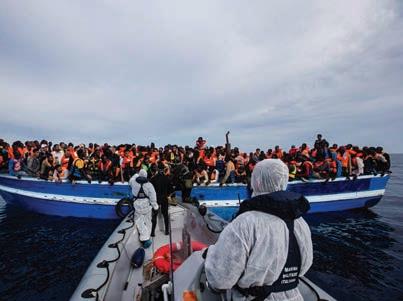
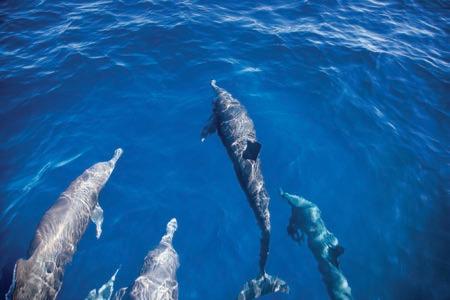
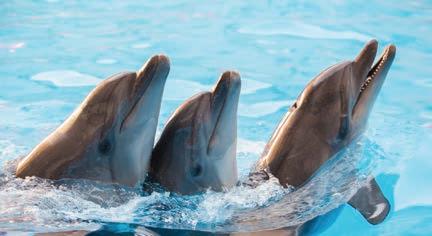
1 2 3 in need
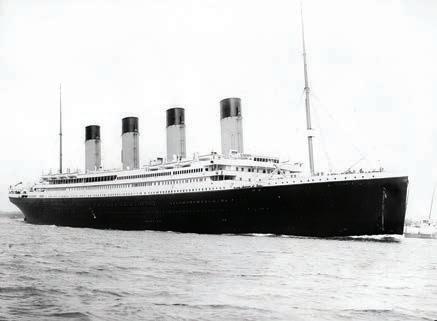
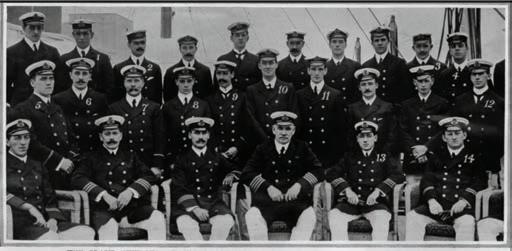
First listen to three incredible stories and then answer the following questions.
1. What was the mission of the engineers when the Titanic started to sink?
2. What happened to them in the end?
3. Why did the immigrants take risky journeys by sea?
4. How did an Italian family save a lot of lives?
5. Was Rob Howard first to sense the shark or the dolphins?
6. Why did the shark lose interest and swim away?
Listen again to the third story and fill in the gaps with the missing words.
Rob Howard took his daughter and two of her friends for a in New Zealand. Suddenly a group of started pushing all four of them together by making a tight circle around them and didn’t let them swim __________. Suddenly
Rob noticed a big shark heading towards the group. The shark swam in around them for forty minutes until it lost interest and swam away. It was clear that the dolphins had made a circle to them.
Listen to all three stories and check your answers.
Festivals can be surprising, amazing or funny, and sometimes may even seem awkward to people who know little about them. You may have heard of the running of the bulls in Pamplona, Spain, or the Halloween tradition involving children going door-to-door asking for candy with the words: ‘Trick or treat!’. However, there are others, less famous but equally unusual, adopted as a part of local cultural traditions, like the ‘tomato fight’ in Spain or the ‘sausage tossing’ in Switzerland! Here are a few of them.
A The celebration of San Fermin takes place in Pamplona every year from the 6th to the 14th of July. It is internationally known as the running of the bulls.
B Thousands of people from all over the world congregate in the square of Pamplona waiting for the rocket to launch the Bull Run. Many of them are in traditional white shirts and pants with red neckerchiefs, armed only with a rolled-up newspaper. The bulls are led through the streets of the old quarter by runners, as far as the bullring. The run usually lasts between three and four minutes. It is a highly risky adventure, which requires cool nerves, quick reflexes and good physical fitness.
C Spanish tradition says the true origin of the run comes from the need to transport bulls from the fields outside the city to the bullring. During this process, men tried to speed up the bulls using tactics of fear and excitement. After years of this practice, the transportation turned into a competition, as some young daredevils would race in front of the bulls as they were being driven to the bullring. When the popularity of this practice increased, a tradition was created and stands to this day.
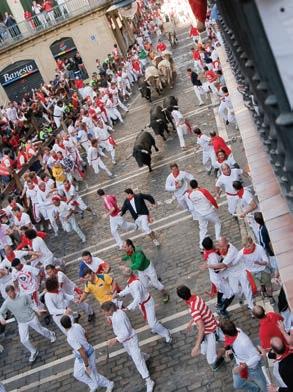

D Nowadays it is a great spectacle for both runners and spectators and also a time for partying, fun and joy.
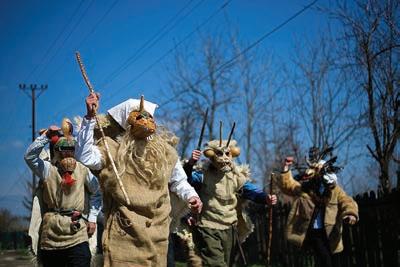
E This is a unique Serbian custom which marks the beginning of the Christian celebration of the fasting period before Easter. In the past, the tradition was widespread and practised throughout the country, but nowadays it is restricted mostly to some villages. Dancers appear wearing fantastic masks, decorated at the top with birds’ feathers or the heads of animals. Covered with sheepskins and armed with long clubs and wooden swords, they jump over bonfires to the deafening sound of drums and the cattle bells on their belts. They perform carnival dances to drive out evil winter demons and ensure good health and good crops.
F This is a g reat festivity for children too, because they have an opportunity to show their creativity by making odd masks and wearing them. This celebration is a promotion of an old folk tradition and has become a great tourist attraction.
awkward – embarrassing congregate – to gather together to form a group of people neckerchief – a piece of cloth in the form of a triangle which people sometimes wear around their necks

1 2
fast – to avoid eating certain kinds of food for a period of time, especially for a religious reason
club – a thick heavy stick ensure – to make certain that something happens
According to the text about the Bull Run,
3
Read the first article again and say which paragraph talks about
how the bulls were sped up from the fields in old times.
how often the Bull Run takes place.
the fun people have in Pamplona.
what some of the runners look like.
1. Pamplona is a place where people can have fun and excitement.
2. the runners are usually armed to protect themselves from the bulls.
3. the need for a faster transport of the bulls turned into a competition.
4. anybody can take part in the run.
5. the run is quite long, sometimes it takes up all morning.
Work with a partner. Ask and answer the questions about the White Week.
1. What does the White Week celebrate?
2. Is it a widespread festival in Serbia today?
3. What do the carnival participants look like?
4. What do they perform?
5. What is the main purpose of the dance?
6. How can children play their role in the festivities?
1
Some people approve of bull fighting and bull-running. What do you think? Make notes of your ideas. To show your approval or disapproval, you can use some of the following phrases:
I’m very much in favour of... I don’t see anything wrong in... I think it’s amusing... I don’t approve of... It’s wrong to... I really think they shouldn’t... I’m not in favour of...

Complete the sentences using the words from the list in the correct form. There are two extra words.
1. The peacock’s body is covered by of different colours.
2. The stadium was full of noisy who expected a spectacular match.
3. A great number of rockets were to take satellites into orbit.
4. Yesterday I was awakened by a noise coming from the street.
5. Tom is a real ______________. He goes in for very dangerous sky-diving.
6. The film was about the conflict between good and _____________.

deafening evil restrict feather spectator launch risky daredevil
Which word in the articles means…?
1. strange, unusual (F)
2. necessity (C)
3. district, area (B)
4. chance, occasion (F)_____________
5. evil spirit (E)
6. support, advertising (F)___________
7. strategy (C)
8. carry out (E)

The prefix en- is added to adjectives or nouns to form verbs which describe putting someone into one of these conditions.
E.g. ensure, enable, enlarge, enrich, enchant, encircle, endanger, enjoy
The suffix -en is added to adjectives to form verbs. E.g. wide – widen, sweet – sweeten, flat – flatten If you are deafened by the noise, it is so loud that you can’t hear anything else.
Write four sentences with the words built with the prefix en-, and four sentences with the verbs made with the suffix -en.
Do Exercise 2 in the Workbook.

The passive voice is used when we want to emphasize the action (the verb) and the object of a sentence rather than the subject. This means that the subject is either less important than the action itself or that we don’t know who or what the subject is. The passive voice is formed by using the appropriate form of the verb to be and the past participle of the main verb.
Example: The bulls are led through the streets./The bulls were being driven to the bullring.
When rewriting active sentences in the passive voice, note the following:
the object of the active sentence becomes the subject of the passive sentence.
the main verb is changed.
the subject of the active sentence becomes the object of the passive sentence (or is dropped).
Example: They practised the tradition throughout the country. The tradition was practised throughout the country.
Rewrite the sentences using the passive form in the second sentence. The first one has been done as an example.
1. They have washed your clothes. Your clothes have been washed
2. Nobody should do such things. Such things ____________________________________.
3. We expect students to study hard. Students ____________________________________.
4. You mustn’t touch this wire fence. This wire fence ______________________________.
5. They are still checking the plane. The plane____________________________________.
6. The mayor will organize a festivity for children. A festivity________________________.
7. The secretary sent the report yesterday. The report ______________________________.
Complete the second sentence so that it means the same as the first by using the given word/s.
1. Joan will stay on at school if she doesn’t find a good job. /Unless _________________________, she will stay on at school.
2. I didn’t answer the phone because I didn’t know it was you. /If ________________________, I would have answered the phone.
3. Poachers kill elephants for ivory. /by Elephants for ivory.
4. Nothing will happen to you if you tell the truth. /on condition Nothing will happen to you _____________________________.
5. I didn’t use that opportunity. I am not very rich now. /If _____________________________________be very rich now.
6. The bus was delayed for an hour due to heavy traffic. /up The bus heavy traffic.
We often read or hear about people who either save other people’s lives or help them go through life easier. You’ve probably heard of such stories.
If you browse on the Internet, you will find a lot of data about such people. Choose one of these heroes to write about in a short composition of about 150 words.
First make a rough plan of what you want to write in each paragraph.

When you are aware of a danger and want to warn other people about it, you can use some of the following words and expressions:
Look out! Watch out! (warning of immediate danger)
Mind those glasses.
Be careful not to sit on this freshly painted bench.
The suitcase is heavy. I’m warning you.
Whatever you do, don’t go near the edge of the cliff.
Make sure you don’t burn yourself.
Beware of pickpockets.

1. You think that the brakes in your father’s car don’t work. He wants to drive it.
2. Your friend wants to repair an old lamp in your bedroom, but he didn’t switch it off.
3. Your friend wants to smoke in the classroom while the teacher is out.
1 2 3 4
Complete the sentences by using the correct form of the words from the List. (5 pts.)
1. The cost of the clothes that you’ve bought $100.
2. I can’t hear you; the band is producing a sound.
3. The lamp light over my desk and I was ready to write.
4. I heard that Jack you a lot of money.
5. What is the of the hill on which the mirror was constructed?
Complete the sentences using the correct form of the verbs in brackets. (5 pts.)
1. He (believe) you if you hadn’t started laughing.
2. If you had bought the tickets, we (be) at the concert now.
3. They wouldn’t have lost their way if they (not/forget) to bring the map.
4. If I were you, I (go) there in winter.
5. If I (meet) him in the street, I wouldn’t recognize him.
Use some of these conjunctions to complete the sentences. (6 pts.) assuming (that), on (the) condition (that), provided/providing (that), even if, unless, in case (of)
1. The job is attractive, I don’t work on Saturdays.
2. He will get a good job he fails his exam.
3. I would help him he didn’t appreciate it.
4. Write down the telephone number you forget.
5. Can I borrow the car, I fill it up?
6. I’ll give you the book you return it in four days.
Rewrite the following sentences in the passive voice. (4 pts.)
1. They had to call out the army to help with rescue work.
2. They don’t serve wine to teenagers with meals here.
3. He must pay the bill before the first of the month.
4. Nobody keeps dogs on leads in this park.
Verbs amount (to) congregate cast ensure owe Nouns attitude altitude array plant slope
Adjectives surrounding competitive deafening Phrases come up with light up hold up put up with drive out
1 2 3
In this unit, you will READ, LISTEN AND TALK ABOUT
equality between men and women
gender dif ferences
women doing ‘men’s work’
PRACTISE
expressing wishes and reg rets
the present and perfect par ticiples
the use of suffixes
asking for clarification
Discuss these questions in class.
1. What do you want to do when you graduate?
2. Do you think it matters if you are a boy or a girl when you choose what job you want to do?
3. Do you think there are some jobs that men are better at and others that women are better at?
Look at the photographs and describe the work these people do.
In pairs, discuss which of the jobs are…
a. more suitable for men.
b. more suitable for women.
c. difficult for both men and women.
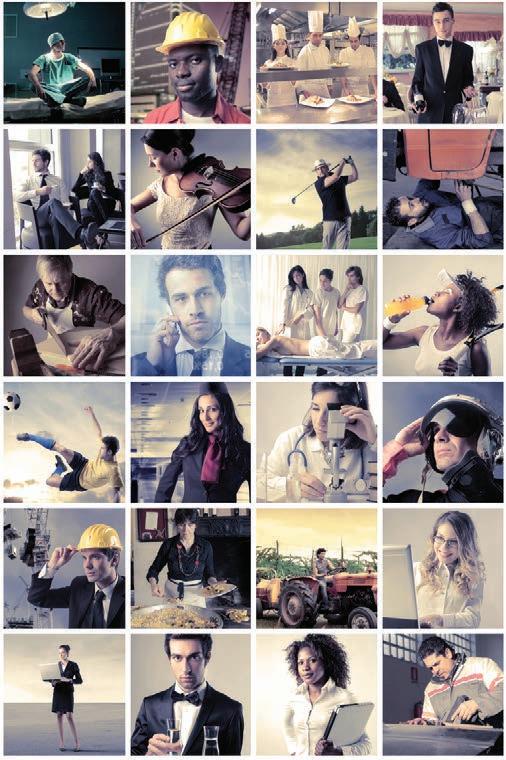
Read the questions and underline the key words in them. Scan the text for the information you need. As you are reading, underline parts of the text which are related to the questions. When you finish reading, go back to the questions and answer them.
1. Has anything changed over the past decades related to gender equality in Europe?
2. Are there cases of gender discrimination?
3. Why aren’t there more women reaching top jobs in sciences?
4. What do both Rachel and Martin agree on?
5. What other aspects related to the topic does William introduce?
6. When would a man be considered a wimp?
The talk show host


Gender equality does not imply that women and men are the same, but that they have equal value and should have equal treatment. The United Nations regards equality between women and men as a human right. However, there is still a strong gender bias in the types of jobs men and women do. The EU has made significant progress over the last decades to ensure equal pay for women and men for work of equal value. As a result, women are nowadays far more economically independent and socially autonomous. But are they really equal or do they still have a long way to go to reach equality? It’s your turn to say.
Although we do have the same rights as men, traditional gender roles are still at play. If only stereotypes about women didn’t exist and evaluations were based on quality alone! Women in science, as in so many other fields, are paid significantly less than men on average. In most companies, it is men who become plant managers and women who are responsible for secretarial duties. What makes a woman better suited to be a secretary or receptionist? Why shouldn’t a man fill that position? I wish there weren’t such cases of discriminations.
Gender inequality is a form of social discrimination. We can still hear the opinion that a woman’s place is in the home. Girls are often discouraged from studying at certain universities because engineering and politics are considered ‘jobs for boys’.
Generally, I think that there should be more free choice on the job market in terms of women and men. I have read about female fire fighters and they seemed to be emotionally stronger and more selfdisciplined than their male colleagues. On the other hand, a man should not feel ashamed to do a certain job because he might be considered a wimp. The measure of a person is not in the job they do, it is how they do it.


imply – to suggest (something) without saying or showing it plainly gender bias – unequal treatment in employment opportunity (such as pay or promotion)
bias – prejudice
wimp – a person who is scared, weak or unadvanturous

It is a fact that many women are either in low-paid jobs or are paid less than men for doing the same job. They are also less likely to be in charge or work as executives. But the reasons are not necessarily gender-biased. Maybe they choose such jobs. Perhaps they are less interested in becoming executives. They may have different goals and make lifestyle choices that lead them away from leadership positions.

Discuss the questions.
Work in pairs. Summarize in three or four sentences the issues related to gender inequality expressed in the text. 2 3
1. To what extent do you agree with the opinions expressed?
2. Is there any view you disagree with?
3. Is there any other point on this issue that you would like to add?

WORD FORMATION REVIEW 1 2 3 4 COLLOCATIONS
Use the words/phrases from the Glossary in the correct form to complete the sentences.
1. Our teacher said that she had not experienced ____________ in her profession.
2. There was clear evidence of the judges’ strong ____________ against her.
3. Her fine clothes ____________ that she was wealthy.
4. He was considered to be a ____________ and not a leader among his colleagues.
a. Match the words in column A with nouns in column B to make the collocations found in the text. Use the collocations in new sentences.
b. Think of other possible collocations with the words (1-5) and write them in box C. An example is given.
A
1. equal 2. significant
3. major
4. social 5. lifestyle
B
a. progress
b. choices
c. discrimination
d. treatment
e. issues
C equal amount
Suffixes which form nouns referring to people
verb + -er/-or/-ar (writer/actor/liar)
verb/noun/adjective + -ist (typist/artist/specialist)
verb + -ent/-ant (accountant/correspondent)
noun + -an/-ian (Italian/librarian)
verb + -ee (referee)
Complete each sentence with a noun formed from the word in bold.
1. The police finally arrested the _______________who broke into the houses in our neighbourhood. /burgle
2. This nice coastal town has about 90,000 _______________. /inhabit
3. All ______________ in our company are satisfied with the working conditions. /employ
4. She works as a _____________ in the best hotel in our town. /reception
5 6
Work in groups (4-5). Each group chooses two professions from box A and writes sentences explaining why they think people need certain qualities or skills to do these jobs well. Use the words and phrases listed in box B and add any other adjectives of your own. Then compare your ideas with the other students in the group. Did you agree or disagree about the qualities needed?


▪ sociable ▪ know foreign languages promoter actor web designer
▪ creative ▪ good communication skills
▪ computer-literate
▪ patient ▪ well-educated
▪ organization skills ▪ physically fit
▪ talented ▪ general business knowledge
▪ good looking ▪ have a passion for detail
▪ leadership abilities ▪ good memory

If you had the necessary skills/qualifications, which of these jobs:
a. might you be interested in? Why?
b. would you definitely not be interested in? Why?
Students are divided into debate teams. Each team member prepares to defend either a ‘pro’ or ‘con’ view on one of debate questions (1-4). The debate begins with each team making an opening statement of no longer than 2 minutes, and then arguments for the pro and con sides are presented.
Suggested topics:
1. Should men still do such things as open doors for women, stand until a woman is seated, and walk on the outside of the pavement?
2. Is feminism out of date?
3. Should women retain their birth names upon marriage?
4. Why does gender inequality persist?
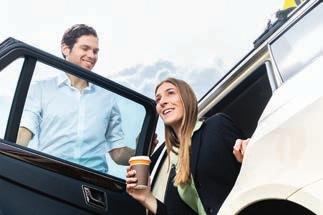
You are going to listen to the experiences of two women who work in professions heavily dominated by men. They tell us what it’s really like.

1
Work in pairs. Read the sentences from the recording and try to work out the meanings of the words in bold.
1. I felt really intimidated. I was the only girl.
2. The first time I sat behind the wheel was terrifying.
3. A lot of teasing goes on where I work.
4. Being a surgeon is tough.
5. Some female students think that being a surgeon is incompatible with having a family.
2 3 4
Match the words in bold with their explanations.
a. not able to be used together; unable to exist together in harmony
b. to make someone afraid; frightened
c. horrible; frightening
d. difficult; strong; strict
e. to make fun of; attempt to provoke in a playful way
Listen to the text and check your answers. Listen again and say whether the following statements are true. Correct the false statements.
1. Sandra became a lorry driver because she didn’t have any qualifications.
2. She felt relaxed before the exam.
3. Her first experience as a driver was terrifying.
4. Women are not allowed to pursue surgery.
5. Surgery is extremely competitive, but not rewarding.
6. Jessica doesn’t want to have a family.
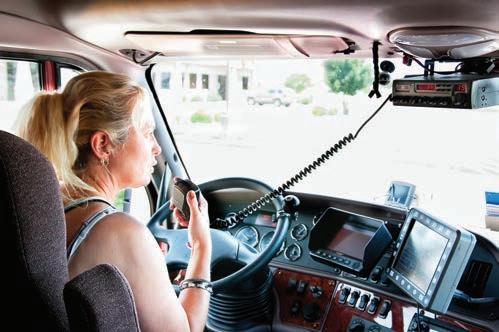
Study the collocations with these adjectives. Add more nouns that collocate with these words. Use some of them to make sentences.
1. tough choice / game / time / judge / competition / day /decision
2. terrifying prospect / experience / act / moment / situation
3. competitive game / market / sport / spirit
Example: She lacks the competitive spirit and will never become a top player.



2 3
Look at these two sentences and explain what happens to the verb form when you move from a real situation to a hypothetical one. Then read the grammar review and see if your answer was correct.
1. There are a lot of cases of discrimination. I wish there weren’t.
2. I didn’t apply for that job last week. If only I had applied.
After I wish and If only the verbs tense in the following clause ’moves back’ one tense.
1. We use the past tense or the past continuous tense to say that we would like a situation in the present to be different. I wish you were here. / If only he wasn’t/ weren’t talking so loudly.
2. We use the past perfect to talk about situations in the past that we are not happy about or actions that we regret doing. He wishes he hadn’t bought that car. .
3. We use would (could for the first person) to refer to future, and describe a situation we would like to change. I wish the rain would stop. / If only I could understand him.
4. Expressions I’d rather/sooner + object, it’s (high) time and as if also refer to unreal situations and are followed only by the past tense forms. Examples: I would rather/sooner you didn’t smoke in here. She behaves as if she were the Queen. (were is considered more appropriate/formal than was.) It’s (high) time I went home.
Note:
We can also use ‘should (not) have’ + the past participle to express regrets about the past actions. I shouldn’t have said those awful things. / I should have taken the situation more seriously.
Study these sentences and explain the difference. When are the past forms of the verbs used and why?
a. He’d rather we went to a tennis match.
b. He’d rather go to a tennis match.
Which sentence says what the subject wants to do?
Which one says what the subject wants someone else to do?
Study these two sentences and explain the difference.
a. It’s time to go. I don’t want to be late.
b. It’s time we went. We are already late.
Explain the difference in meaning between these two sentences.
a. She looks as if she’s going to cry.
b. She looks as if she had seen a ghost!
4 5 6 I wish my friends would ... If only I were…
Complete the following sentences using the verbs in brackets.
1. If you still hope to catch the last bus, it’s high time you ____________. (leave)
2. I know our daughter is enjoying herself, but I’d rather she _____________ (be) here than abroad.
3. If only we ______________ (not accept) their offer.
4. He behaves as if he ____________ (see) all these cities, but he’s never been abroad.
5. It’s very hot today. I wish it____________ (be) cooler.
6. If I ____________ (know) earlier, I would have sent you an urgent message.
7. It’s time she ____________ (stop) waiting for him.
8. I wish all nations ____________ (live) in peace.
Rewrite these sentences making a comment, as in the example. Example: He is lazy. – I wish he were more hard-working.
1. He never comes to our meetings on time. He drives me crazy. I wish_________________________________.
2. It’s not a good idea to go sailing in this weather. I’d rather you __________________________.
3. You always use my toothbrush and I don’t like it. I’d ____________________________________.
4. I’m sorry I didn’t book a room. I should ______________________________________.
5. John and Julie should get married. They have been engaged now for over ten years. It’s high time ________________________________.
6. He really regrets sacking Andy. He was the most creative person on their team. He shouldn’t __________________________________.
Complete the sentences so that they are true for you. I wish I hadn’t ... If only I had…
Write a short composition on one of the following topics:
Gender stereotypes
What causes inequality between women and men?
Mention
what you think of gender inequality.
what determines men’s and women’s roles and positions in society.
if you expect traditional gender roles will change in the future.

True or not? – What do you think?
Discuss these statements in class and compare your answers.
The brains of men and women are different.
The differences between men and women are mostly socially defined.
Women are equal with men when it comes to their mental abilities.
Men can think more logically under pressure than women.
Women are generally better at communication.
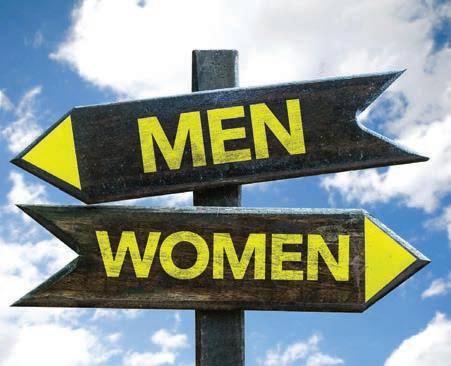
Read the text and choose the word (A or B) which best fits in the gap in the text.
1. A clear B obvious
2. A alike B different
3. A occur B show
4. A done B achieved
5. A to use B using
6. A economical B efficient
7. A whereas B though
8. A based B constructed
Psychological differences between men and women are less (1) ______ than the physical ones. Their brains are more (2) _____ than not, but they are definitely not the same – in size, sense or sensibilities. It is true that some functions (3) _____ in one or the other side of the brain, and men and women may use their brains differently to get the tasks (4) _____. There are indications, but not real evidence, that males tend (5) _____ more the left side of the brain, while females, although they have more (6) _____ access to both sides of their brain, use the right side more. The left side of the brain is said to be logical and analytical, (7) _____ the right side is artistic and creative. Although science has never really proved this theory, myriad personality assessment tests and team-building exercises are (8) _____ on that notion.
Here is a list of some of the differences between genders, based on research studies of the brain done up to now. Read them and answer the following questions.
a. Do you agree that such differences really exist?
b. Do you recognize any of the mentioned qualities in yourself?
Men tend to be better at learning and performing a single task, like cycling or navigating, and women are better at multitasking.
Women are better at social thinking and interactions than men, while men are more abstract and task-orientated. This is why women are better at communication.
Women tend to perceive pain more intensely than men and are generally better at learning languages.
Women tend to be better at reading the emotions of other people. They are usually more empathic, but their emotions can sometimes influence decisions. Men focus on specific issues and think more logically.
Men are generally better when it comes to coordination and reactions and tend to have a better sense of direction.
Men focus more on their visual sense, among other senses of perception, while women tend to use multiple senses.
Complete the sentences by using the words from the Glossary.

indication – a suggestion; sign myriad – an extremely great number of people or things notion – a belief or idea multitasking – a person’s ability to do more than one thing at a time perceive – to become aware of (something); notice something that is obvious

1. Women are often very good at ____________.
2. He was quick to _____________ that there was someone in the corridor.
3. I have only a vague ___________ of what she does for a living.
4. ____________ of restaurants and hotels are opening up along the coast.
5. There was an ______________ that he was thinking of changing jobs.
Complete the sentences using the personality adjectives in the box. There is an extra word.
1. If she hadn't been so determined and ________________ she might not have got the job.
2. Mr Higgins was not only very _______________ about his work, but he was a good manager as well, always mindful of our needs.
3. We must admit that Alex is a ________________leader. He’s good at finding ways to solve our problems.
4. Rita’s colleagues say she has an________________ personality. It is true. She is really friendly and open in her behaviour.
5. I admire her for being so ________________. It’s good when people let you know what they are thinking.
6. Mrs Morel shows a great deal of fondness for her son. She is a very _____________ mother.
Complete the sentences using the correct prepositions.
1. We don’t have access ______ the Internet here.
2. He’s now focused ______ getting the documents.

1 2 3 straight-forward conscientious affectionate resourceful outgoing merciful persistent

3. They posted warnings ______their websites in order to discourage people ______ dealing with these companies.
4. He watches three films a week ______ average.
5. He wants to make decisions based ______ scientific facts.

Match the word pairs from the box with their definitions. The male comes first!
Example: the ruler of an empire emperor/empress
1. a person who presides at the meetings of an organization _______________
2. a noble person of high rank ________________
3. a child of your brother or sister ________________
4. a person living in a monastery/nunnery and devoting himself to prayers
5. a person who invites guests to a social event or a party in his/her home
6. a person who has never been married ________________
7. a participant at his/her own marriage ceremony ________________

monk/nun bridegroom/bride host/hostess nephew/niece chairman/chairwoman duke/duchess bachelor/spinster
Use these suffixes to make adjectives of the words below. Write them in the correct column. Some words can have two suffixes. pain, joy, break, meaning, accept, terrify, endure, laugh, mercy, faith, excuse, rely, adventure, law, thought, poison, power, need, comfort, autonomy, artist, danger, courage - less - ful -able -ic -ous

1 The present participle can be used in the same way as an active relative clause. The man driving the car is a friend of mine. (= The man who is driving the car is...).
2 Participial clauses are often used to express condition, reason, cause, result or time instead of adverbial clauses. Compare the following: Not knowing what to do, I waited patiently. (= Because I didn’t know ...reason) It rained every day for two weeks, completely ruining our holiday. (result) Before leaving the house, I remembered to leave her a message. (time)
3 Participle clauses can describe actions that are going on simultaneously or happening consecutively. I found her at the table, reading a book and sipping coffee. Opening the bag, he took out a purse.
Note: If it is important to show that the first action has finished before the second begins, the perfect participle (having + the past participle) is used. Having finished her studies, she started working. (After she had finished studies….)
The passive structure can also be used in participle clauses as an alternative to a since-clause. Having been invited to the ceremony by the manager himself, she could hardly refuse to go. (= Since she had been invited…)
1 2 3 4 5
Complete the text by using the phrases with the participles from the box.
not knowing having always worked colleague working looking back having left having spent (1)_______________ university with a degree in geography, I got a job with the police as a strategic analyst. However, a nine-to-five office job definitely didn’t suit me. I was bored. The (2) _______________ with me suggested changing the job. _______________ (3) where else to go, I moved on to social work. _______________ (4) several years there, I made a big change in my life when I began to drive trains. _______________ (5), going from social work to train driving does seem a big jump, but I’m so glad I did it. _______________ (6) in male-dominated areas, I didn’t find it difficult to adapt. I like the variety of the job, as I get to drive different types of trains. The shift patterns were a shock at first, but I got used to them.
Say which uses of the present or perfect participle you can find in Exercise 1.
Match the beginning from the left box with an ending from the right to make a meaningful sentence.
1. Having been to London before,
2. Not having met Susan,
3. Throwing the rope over the wall,
4. Not wanting to quarrel with her,
5. Pretending to make a call on his mobile phone,
a. I apologized immediately.
b. he looked carefully around.
c. I could recommend a hotel there.
d. he climbed up and dropped into the garden.
e. I couldn’t tell him what she was like.
Rewrite each sentence in an alternative way, as in the example, making all necessary changes.
Example: Not recollecting the man’s face, Martin said nothing. Because Martin didn’t recollect the man’s face, he said nothing.
1. Since he hadn’t seen him for over twenty years, he didn’t recognize him.
2. Settling into his seat, he felt tired.
3. After he had heard the whole story, my brother was embarrassed.
4. He threw his arms around him and hugged him.
5. Not knowing what else to do, we called the police.
Complete the following sentences with suitable present or perfect participles. Add any other words if necessary.
___________________ a bus the other day, I met an interesting girl.
___________________ all his money on clothes, he had nothing left to buy food with.
___________________ the ambulance, I thought there had been an accident.
___________________ the news, she burst into tears.
Sometimes we don’t hear or understand what the speaker has said. When this happens, we need to ask for repetition or clarification. To clarify means to make something clear by giving more details or a simpler explanation.
1 2 3
Here are some useful English phrases you can use.
How to express lack of understanding
I beg your pardon, but I don’t quite understand/see what you’re getting at.
I’m not quite sure I know what you mean.
Sorry, I didn’t quite hear what you said/I didn’t get your point.
How to ask for clarification
What do you mean by...?
Could you clarify that, please?
Would you elaborate on that, please?
Could you be more explicit?
Could you explain what you mean by...?
Clarifying one’s point or idea
Let me explain that (in more detail...)
Let me put it another way...
In other words...
To say/put it differently...
Complete the dialogue using the phrases from the box. There is usually more than one possibility.
A: I signed the contract with our new business partner.
B: Sorry, __________________________________.
A: I said that I had a meeting and we clarified the terms.
B: I’m not sure _____________________________. Which terms?
A: Let me __________________. We agreed that the length of the contract would be one year, but it can be cancelled.
B: Would you ______________________________?
A: What I mean is that either side could cancel the contract after six months. However, you can change the terms if you like.
B: How can I do it if you already signed? Could you________________________________?
A: Well, I told him that you might not agree and that….
Role play - Students should think of situations where one student misunderstands the other and make short dialogues using the phrases from the box. Suggested role plays:
Customer and a service representative on the phone
Fast food worker and a customer
Business negotiations
5
Use the words from the List in the correct form to complete the sentences. (6 pts.)
1. The police said there were no ____________ that the men were armed.
2. I do not wish to ____________ that she is lazy, but her work is often late and of poor quality.
3. We will not be____________ and we will not live in fear.
4. My experience was far worse; it was painful and ____________.
5. Are kids at school doing a lot of ____________ these days?
6. Those two versions were apparently ____________ and had to be changed.
Make nouns from the following words. (3 pts.)
type ____________correspond ___________ edit _________
Replace the underlined words in the sentences with a word from the Word list which is opposite in meaning. (3 pts.)
1. He was a brave man and refused to jump off.
2. A small number of similar trees were found in the neighbourhood.
3. After some weak bargaining, we finally agreed on a deal.
Complete the following sentences with suitable present or perfect participles. (3 pts.)
1. ______________ what present to buy, I decided to make you this.
2. ____________ the street yesterday, I nearly got knocked down by a bus.
3. ____________ for ten years in a bank, she decided to look for a new job.
Complete the second sentences including the word in bold. Don’t change the meaning of the original sentence. (5 pts.)
1. I wish I had kept in touch with my friends from school./regret I really __________________ in touch with my friends from school.
2. We can’t play tennis because it’s raining./was If ______________________, we could play tennis.
3. I think you should sell this old car and buy a new one./were If _________________ you, I would sell this old car and buy a new one.
4. Oh, I forgot to pay the electricity bill./remembered I wish_______________________________ the electricity bill.
5. Because she didn’t want to quarrel with him, she apologized./wanting ________________________ quarrel with him, she apologized. 1 2 3 4
Verbs imply intimidate perceive clarify tease Nouns bias indication notion wimp multitasking bachelor spinster monk nun
Adjectives myriad competitive incompatible terrifying tough Phrases gender bias
In this unit, you will READ, LISTEN AND TALK ABOUT
shopping and people’s attitude to shopping
famous malls and department stores
the importance of advertising
PRACTISE
the gerund
the infinitive
the infinitive of purpose
strong and base adjectives
intensifying adverbs
useful shopping phrases

Discuss the following questions.
1. Do all people like going shopping? / What about you?
2. How do you decide whether to go shopping or stay at home?
3. Do you tend to buy more than you planned when you shop?
4. Is online shopping better than shopping in a store?
5. Do you prefer shopping in big malls to shopping in traditional shops? / Why?
6. What things would you advise a tourist to buy in your town?
READING Track 21

ecent research shows that people spend up to 25% of their time in activities related to shopping, whether on buying products or choosing them by reading adverts or browsing the Internet. However, they do not go shopping only to meet basic needs for food, clothes, furniture or household gadgets.
People often feel the urge to buy trendy new items in order to impress or fit in with their friends. Since styles continually change, they must keep buying new things because everyone else around them is doing it and they don’t want to miss out! It’s the keeping-up-with-the-Joneses mentality.

However, apart from a genuine need for something new, people can decide to go shopping for different reasons: when they are bored, when they are angry, depressed or lonely. Some refer to shopping as a kind of ‘emotional therapy’. Shopping provides a sense of excitement which may be missing in their life; it uplifts their mood and takes their minds away from things that bother them, at least temporarily. Just the simple experience of being in a mall or store is exciting, as there are bright lights, colourful displays, uplifting music, and lots of treats for the senses.
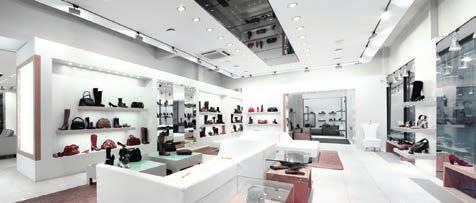
Shopping has become a favourite leisure-time activity for many people, especially the young. For most women it is much more than an enjoyable pastime. They will say that those who refer to shopping as an ‘expensive pastime’, ‘a waste of time’ or ‘unnecessary’ just don’t know anything about shopping and what satisfaction people can get out of it.
The motivation for visiting a mall or shopping centre varies for different people and is based upon the trip’s purpose. Regardless of the reason, consumers prefer going shopping to nice places where they can also hang out with friends, get entertained or eat.
This is the reason why malls include cinemas, theatres, restaurants, bars, etc. They provide a diversion or relief from usual day-to-day activities, trying to give the consumer a full leisure experience.

fit in – to be accepted by a group of people because you are similar to them miss out (on something) – to lose an opportunity to do or have something diversion – distraction; something that takes your attention away from something else browse – to scan through a text or website to gain an impression of the context uplift – raise; improve; boost
Finish these sentences according to the information from the text.
1. People don’t buy only things….
2. The reasons for going shopping ….
3. Women think that shopping …
4. Consumers prefer going shopping to nice places because …
5. Malls provide a …
Answer the following questions.
1. What does the phrase ‘keep-up-with-theJoneses’ mean?
2. How do you understand the statement that shopping is a kind of ‘emotional therapy’?
3. Why does this kind of ‘therapy’ have only a temporary effect?

Explain the meanings of words in bold and make example sentences. Example: related - means connected or having something to do with something else - I think her behaviour is related to her problems at home.
Use the words from the Glossary and the words in bold in the text to complete the sentences.
1. He spent the time _____________ through the sports pages.
2. I’ll do that of the consequences.
3. The authorities were satisfied with the situation.
4. The news of their safe arrival came as a great .
5. Tests proved that the letter was , and not a forgery.
6. Don’t on the fantastic bargains in our summer sale.
1 2 1 3 4 2
Here is a small selection of phrasal verbs that use ‘out’. Match the phrasal verbs (1-6) with their explanations (a-f).
1. hang out
2. hand out
3. stand out
4. sort something out
5. figure out
6. turn out
a. find the answer to a problem (informal)
b. produce an unexpected result
c. distribute
d. organize, resolve a problem
e. be easily distinguishable
f. spend time socially in a relaxed and informal way (informal)
Complete the sentences using the correct form of the phrasal verbs from Exercise 3.
1. With the way she dresses, she always manages to ___________!
2. Did you ___________ why your computer wasn’t working last night?
3. We need to ____________these files before the manager returns.
4. The professor ___________ the exam papers to the students.
5. It ___________ that I actually didn’t need to write that report at all.
6. I don’t really like the people my son is ___________ with.
Talking about prices
Complete the sentences by using the words/expressions in the box. overpriced rip-off inexpensive a steal (= bargain) good deal
1. Designer T-shirts are a____________. Who wants to pay $90 for a simple T-shirt?
2. Don’t buy that couch here, it’s way ____________. I think you can find a cheaper couch elsewhere.
3. I'd like ______________ seats, if possible.
4. She paid $5,000 for her car. That’s a really ____________, don’t you think?
5. A: ‘Look! This dress is only $10.’
B: ‘That’s so cheap. That dress is __________! You should buy it.’
Talking about shopping
Use these words/phrases either to make sentences or explain their meanings. The first one has been done as an example.

shopping spree to bargain a stall end of season sale a flea market window-shopping a garage/yard sale
Shopping spree means spending a lot of money without counting how much money you spend.
Complete the texts by using the words from the boxes inserted in the photos. Check the meanings of the words in the Glossary before doing the exercise.
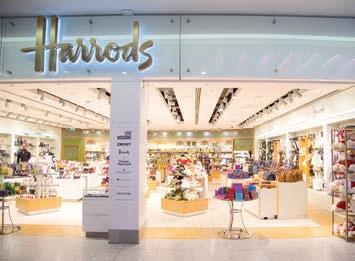
illuminated distinguished itineraries established
Harrods, Britain’s most (1) ____________ department store is on all tourists’ (2) ____________, and for a good reason. People come there to admire the magnificent interior: the impressive central escalator or the Egyptian Hall, the most dazzling sight in Harrods. (3)___________ in 1849 as a humble grocery store, today Harrods has seven floors and 330 departments with a phenomenal range of products, from cooking pans and pianos to fashion, perfumery and fine arts, plus 20 restaurants. At night, the store is (4) ____________ by 11,500 light bulbs.
New York City has more than a few (5) ____________ shopping malls to offer. Located in the heart of Manhattan, Time Warner Center contains luxury shops and restaurants, which make it a great place not only to do some shopping and unwind, but also to dine, live, work and be (6)____________. The soaring 2.8 million-square-foot (7) ____________ has transformed Columbus Circle into a thriving urban neighbourhood.
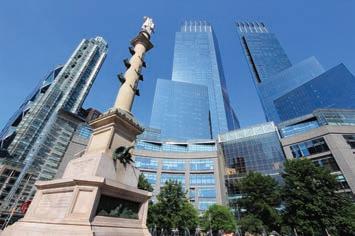
entertained amazing landmark
One of the most distinctive shopping centres in the world, Dubai’s WAFI MALL is known for its rich décor as well as its range of shops and restaurants. Shaped like an Egyptian pyramid, Wafi is just one example of how extravagant the world’s malls can be. Not only does it (8)____________ 1,200 shops, with 70 of those (9)____________ exclusively to haute couture, 120 restaurants, a 22-screen Cineplex complex, indoor theme park, aquarium, ski (10)____________ and a variety of other entertainment possibilities, this complex is more like a mid-sized city.

dazzling – stunning; impressive thrive – prosper; do well unwind – to relax and let your mind be free from anxiety
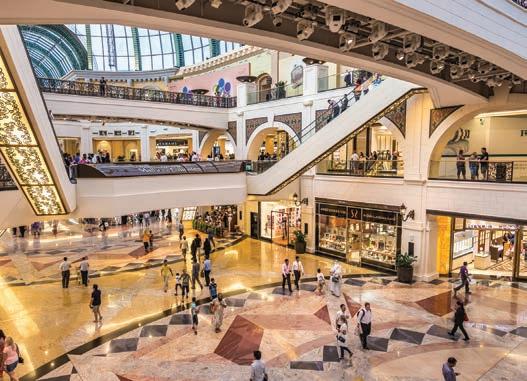
3 slopes boast dedicated
Discuss in class. Which of these statements would you choose as most relevant when deciding whether to shop in malls? Justify your choice.
1. You can find a wide variety of shops in a small area.
2. The food court has lots of options.
3. Malls offer concerts and other events.
4. There is Wi-Fi everywhere.
5. You can always find somewhere to sit down if your feel tired.
6. Malls are usually totally indoors so people can go shopping even if the weather is bad.
7. The temperature is always perfect.
8. Malls provide shoppers with numerous and secure parking areas.
9. Malls involve crowds and typically higher prices.
Match the words (1-5) with their explanations (a-e). Then use these words to complete the sentences (1-5).
1. humble
2. illuminate
3. available
4. soaring
5. distinctive
a. to show clearly; to light up
b. can be bought or obtained
c. increasing quickly in value, level or number
d. characteristic; easy to recognize because it is different
e. not proud; not thinking of yourself as better than other people
1. One of her most___________ features was her voice.
2. The school plans to ___________ the sports field so that games can be played after dark.
3. Despite all his achievements, he has remained ___________.
4. Microsoft’s new operating system will not be ___________ until the beginning of September.
5. The price of higher education started ___________ decades ago.
Complete the table. Verb Noun Adjective impress depress dedicated illuminate tempt resist abound
If you were shopping in a British town, where would you go to buy …?
Now say why you go to the following places. Think of as many reasons as possible. apples carrots biscuits a joint of beef sardines newspapers books furniture clothes supermarket newsagent’s chemist’s baker’s tobacconist’s butcher’s greengrocer’s filling/petrol station grocer’s
E.g. huge = very big 4 5 6
Base adjectives don’t have the idea of ‘very’. Strong adjectives, however, are extreme adjectives that have the idea of ‘very’. They collocate with adverbs such as utterly, absolutely or totally.
Match the adjectives (1-8) with their more emphatic equivalents (a-h).
a. thrilled/delighted/ ecstatic b. fantastic/superb/ wonderful c. terrified d. tiny
e. awful/terrible/horrible
f. furious/outraged
interesting
g. hilarious
h. fascinating
Students work in pairs or small groups. Act out dialogues using the prompts and strong adjectives from Exercise 1. Look at the example.
(buy) a new tablet – good?
(fail) the test – angry?
(go) on holiday – exciting?
(have) a row – bad?
(pass) the exam – happy?
(see) a comedy – funny?
E.g. (watch) that horror film – frightened?
A: You know, I watched that horror film yesterday.
B: Really? Were you frightened?
A: Oh, I was absolutely terrified!
LISTENING Track 22
You are going to listen to three people talking about shopping. Check the meanings of the following words before listening. off-chance, treat, essential, temptation, pursuit, trinket
1 1 2 2 3 4 temptation treat pursuit essential off-chance

Listen to the recording and decide whether these statements are true or false according to the speakers. If false, give the correct answer.
1. Morgan enjoys shopping.
2. Morgan never goes to shops to see what’s there on the off-chance.
3. Erica likes going shopping because she finds pleasure in buying things.
4. Erica has never experienced an uncontrollable impulse to hit the shops.
5. Mike spends a lot of time in shops.
6. Mike can afford to buy whatever he likes.
Complete the sentences by putting one word from the box in each gap. Listen again to check your answers.
1. I don’t head to the stores just to see what’s there on the ____________.
2. We all like to ____________ ourselves to new items.
3. In order to resist the ____________, I leave my credit cards at home.
4. For many young people it has become a popular leisure ____________.
5. When I need to go shopping for ______________ items, I make a shopping list.
Use the words from Exercise 3 to make your own examples.
STUDY POINT
Study the sentences with different uses of the word TREAT.
She treated herself to a nice leather bag.
My brother treated us all to dinner at an expensive restaurant.
We treated our guests with great respect.
Patients are treated with a combination of medication and exercise.
Match the expressions (1-4) with their definitions (a-d). Then make your own examples.
1. treat yourself to something
2. treat someone to something
3. treat someone with kindness/contempt
4. treat someone with something
a. to pay for the food or drink
b. to use medicine to cure a patient
c. to do or to buy something special for yourself
d. to behave in a specified way toward
1. The gerund can be a noun:

a. Shopping is my mother’s favourite pastime. (the gerund=subject of the sentence)
b. Do men like shopping more than women? (the gerund=object)
2. The gerund is used after certain verbs and phrases: avoid, admit, enjoy, miss, finish, imagine, mind, risk, suggest, keep, can’t help, it’s no use, (not) worth, there’s no point in, etc.
These farmers avoid using chemicals on the vegetables they grow.
3. The gerund is used after verbs with prepositions and phrasal verbs: succeed in, prevent from, insist on, object to, complain of, give up, etc. I insist on talking to you before going to lunch. / He will never give up trying.
4. The gerund is used after adjectives with prepositions: to be used to, to be fed up with, to be fond of, to be accustomed to, to be capable of, etc.
Read the text Shopping, a fun pastime again and find examples of the gerund.
The verbs in italics in sentences 1-10 are followed by a gerund. Fill in the gaps by using the verbs from the box.
talk do be move play wait deal sing leave stay
1. They kept on _________until I interrupted them.
2. We discussed ___________to another place.
3. You recommended ___________ until tomorrow.
4. He recalled ___________there once when he was small.
5. She practises ___________ those drums all the time.
6. The job involves ____________ with dangerous materials.
7. Brian mentioned ____________ up late.
8. I suggested ____________ the luggage at the airport.
9. We all enjoy ____________with the band during rehearsals.
10. I finished __________my homework.
Use these adjectives to make true statements about yourself.
Example: I’m worried about… - I’m worried about making mistakes.
1. I’m responsible for...
2. I’m excited about…
3. I’m bored with...
4. I’m fond of…
5. I’m interested in…
6. I’m keen on…
7. I’m proud of…
8. I’m good/bad at…


Advertising is of great importance for any business activity and has been around for a long time. However, it has evolved dramatically in the past decades. Its aim is to call the attention of the public to a service or product available on the market or let them know why the product stands out from the rest. Marketing has become a huge business and will only keep growing.
In groups, discuss the following statements. Say whether you agree/disagree with them and justify your opinion. Then read the text and compare your discussions with the opinions expressed in the article.
An advertisement is a very important marketing tool, which shows which products are available on the market.
Advertisements help increase the sale of goods.
Advertisements help people make the right choice.
Advertising plays a very important role in today’s age of competition.
Explain in your own words the following quotation. ‘Doing business without advertising is like winking at a girl in the dark. You know what you’re doing, but nobody else does.’ (Stewart H. Britt)

Today every company uses advertisements in order to inform customers about its products, increase sales, gain a reputation in the industry and so distinguish itself from other competitors. Some companies, like Coke, still spend billions of dollars on advertising in order to keep their name in the minds of the consumers.


Advertisements are everywhere around us and are almost impossible to escape. Advertisers use various types of media, different techniques and methods to visually and verbally express the importance and benefits of their products. Apart from traditional media, they try all sorts of new approaches to advertising in order to grab our attention. Television is still considered to be the most effective medium, despite the Internet’s steady rise in popularity over the last few years. Ads are supposed to be designed as catchy, attractive and funny and should convey a strong message to the public. They are certainly useful if they give us honest information about products. The fact is that without ads it would be rather difficult for consumers to find the things they need. However, some people consider that their effects are often harmful because they show us images of perfection and make us feel inadequate. Besides, there are ads which try to mislead customers when they claim that their product is more effective or beneficial compared to similar products on the market or that it can make us healthy, more beautiful, etc.
Most people agree that the amount of advertising and marketing they are exposed to is ‘out of control’. Today all TV serials, movies and radio programs have fillers called ads. That is the reason why television viewers often tend to skip adverts by changing the channel when long commercials begin because they find them boring, annoying or even intrusive. However, there are those who actually don’t mind watching commercials if they are witty, funny and relevant. Regardless of whether we like advertising or not, it has become an inevitable part of our everyday life because it is important for both consumers and businesses.

expose someone to something – put in a situation which might affect them
intrusive – causing disruption or annoyance
Say whether the following statements are true or false. Find sentences in the text to justify your opinion.
1. Not every company uses advertisements to promote itself.
2. Companies use advertising only to inform consumers about new products.
3. Advertisers always tell the truth about the quality of their products.
4. Advertisers are looking for new ways of promoting products.
5. TV viewers always watch commercials.
6. Advertisements are always useful.
Circle the two words/phrases which are explanations of these words/phrases in bold from the text.
1. They want to distinguish themselves as dedicated social workers.
A cause (oneself) to be respected
B make (oneself) brave C make (oneself) noteworthy
2. Did it cross your mind that he might find your questions intrusive?
A interesting B disturbing C upsetting
3. I was misled to the wrong conclusion because he wasn’t honest with me.
A misinformed B forced C deceived
4. It’s not a good idea to skip breakfast.
A consume B omit C avoid
5. The expression on his face conveyed far more than words. A suggested B hid C communicated ideas or feelings indirectly
6. It is inevitable that mistakes will occasionally occur.
A unavoidable B sure/bound to happen C irresistible


Here is a list of persuasive words/phrases that may be used in advertising. Which of them are most likely to catch the attention of consumers? Choose some of them and make sentences to illustrate their usage. Example: This is a sensational offer. improvement amazing sensational remarkable magic best offer challenge don’t miss important bargain last chance revolutionary product
Make nouns of the following verbs: assume ___________; assess ___________; evolve___________; consume____________
4
Think of nouns that collocate with these four verbs and make example sentences. Example: It is necessary to assess the damage as soon as possible.
1 2 3
Discuss the first sentence of these ads. Do you find any of them misleading/effective? Which of them can be used for different products?
• New age crème will make your day!

• Stay healthy all month long! Get the monthly box of our vitamins.
• Shop for the brands you love. Shop in SHOPPOMANIA!
• Think globally, buy locally. Our Daily News!
• Almost everybody has got one! What about you?
Can you think of an additional sentence to each of them to make a complete ad?
In groups, discuss the questions below.


Use the phrases in the box which express two different points of view.
Well, on the one hand ... but on the other ...
There’s no doubt that ... but ...
Although it is a common belief that ... I don’t ...
Of course, I’d like to think ...but I’m not sure if ...
I agree with this point of view, but ...
4
Group work – a presentation


1. How do you think advertising can benefit/harm the consumer?
2. How successful do you think adverts are in attracting attention?
3. Do advertisements make people buy things they don’t need?
Students should prepare a presentation about different aspects and types of advertising.
Each group chooses one type (television, newspapers, radio, the Internet, brochures or flyers, etc.) and talk about the techniques and methods used in persuasive advertising.
The students should also express their opinions, whether the particular type appeals/doesn’t appeal to them, or if advertising in general influences them.
Finally, they should try to think of an advert themselves.

Intensifying adverbs are used to modify adjectives and other adverbs.
Most adjectives are gradable; they have comparative or superlative forms and you can modify them with adverbs such as very, rather, more, less, fairly, really, extremely, etc.
E.g. Peter is really interested in sports.
Some adjectives are already ‘extreme’ or ‘absolute’ (brilliant, impossible). They express a quality which cannot really have differing degrees and you can’t usually apply intensifying adverbs such as really or very to them, but absolutely, totally, utterly, highly, etc.
E.g. It was absolutely fantastic!
1 2 3
We cannot use every adverb with every adjective. Here is a list of common collocations. Study it and do the exercises which follow.
highly unlikely, unusual, successful, competitive, profitable, effective
bitterly disappointing, disappointed, cold, hostile, conscious deeply ashamed, concerned, shocked, moved, affected, unhappy, distressed, worried absolutely/utterly ridiculous, stupid, impossible, wrong, alone, appalled, convinced, capable, incompatible, helpless, hopeless, dependent, inadequate
A Choose an adverb from the box to replace very in the expressions below. very convinced / very stupid / very successful / very disappointing / very opposed / very concerned / very ashamed
B Make sentences using the collocations you have made.
Example: Very convinced – absolutely/utterly convinced He was absolutely convinced that his theory was correct.
In each of these phrases (1-5), one is not a correct collocation. Which one is it?
1. utterly incapable utterly useless utterly effective
2. highly educated highly profitable highly appalled
3. bitterly cold bitterly wrong bitterly disappointed
4. absolutely convinced absolutely tired absolutely alone
5. deeply unhappy deeply religious deeply successful
1 2 3 4
Two people are expressing their views on advertising. Before listening, check the meanings of the words in bold in the sentences below. Match them with their definitions (a-c).
1. He earns more money endorsing sports clothes than playing tennis.
2. The advertisers did a tremendous job.
3. Tickets must be purchased two days in advance.
a. to buy something
b. extremely good or impressive; excellent; amazing
c. to recommend (a product) in an advertisement
Listen to the recording and answer these questions.
1. Why does Roger dislike advertising?
2. Why does Roger think celebrities shouldn’t be engaged in promoting products?
3. Why does Bill say that adverts should be simple and effective?
4. What are the effects of advertising?
Complete the sentences with the words from the box. Think of all possible combinations. Then listen to the recording again and check your answers.
1. Why I don’t like it is _______________obvious.
2. Most adverts are _______________irritating.
3. Advertising is _______________necessary.
4. The effect of advertising is tremendous and it is _______________amazing.
Summarize the speakers’ opinions in a sentence or two.
Examples: They managed to fix the problem. / He helped his flat-mate to wash the dishes. I decided to see her tonight. / I can’t afford to go to the pub. 1 extremely pretty rather really absolutely

Here are some common verbs which are normally followed by the infinitive form: afford | agree | appear | arrange | ask | attempt | care | choose | claim | come | dare | decide | demand | deserve | determine | expect | fail | get | help | hesitate | hope | hurry | learn | manage | mean | offer | plan | prepare | pretend | promise | refuse | seem | tend | threaten | want


The infinitive with ‘to’ is also used...
a. after question words: how, when, where, what, whom, why I don’t know how to write that word. / Do you know which direction to take?
b. after certain expressions: to be likely, to be bound, to be supposed, to be expected, to be willing, etc.
He is bound to succeed because he is so ambitious.
c. after superlatives: Do you know the best shop to buy shoes in? / He was the first to leave.
Put the verbs in brackets into either the gerund or the infinitive with ‘to’.
1. Do you mind _____________ (give) me a hand?
2. She kept_____________ (talk) during the film.
3. I would like _____________ (come) to the party with you.
4. I promised _____________ (help) Diana to collect data for her assignment.
5. Laura suggested _____________ (go) to the exhibition instead of the cinema.
6. We hope _____________ (visit) Amsterdam next month.
Finish these sentences so that they are true for you.
1. I don’t take any interest in… 2. I don’t expect my friends…
3. I can’t imagine…
To express purpose, we can use…
7. I’m not likely to … 1 2 2 1 2
7. She agreed _____________ (bring) the document tomorrow morning.
8. I don’t recommend _____________ (take) the bus − it takes forever.
9. She avoided _____________ (tell) him about her plans.
10. I’ve finished _____________ (cook) − come and eat!
4. I’ll never risk… 5. I don’t really enjoy…
a. the to-infinitive - He bought some flowers to give to his wife.
6. I’m tired of…
b. in order (not) to - They spoke quietly in order not to wake their parents.
c. so as (not) to - We set off early so as to avoid the traffic.
The uses of the verb seem
a. We can use seem with a to-infinitive.
He seems to be the only person who hasn’t heard the news.
b. We can use seem as a linking verb (like be).
She seems very young to be a teacher.
It seems strange that no one noticed George was missing. (+ adjective)
c. We can use the impersonal construction it seems/seemed with a that-clause, or with a to-infinitive. It seems that the village shop will have to close down. They can’t find a buyer for it. Everybody seemed to be ready, so we set off.
The old man seems *to have mistaken us for some people he knew years ago. (*The perfect infinitive is used for past situations.)
Use the phrases from the box to complete the sentences.
in order to so as to have in order not to so as not to be to take out 1 2 3 4 5
1. I went to the cash machine ________________ some money.
2. We got there early _________________ get a good seat.
3. I always put wine in the fridge___________________ a chilled bottle ready.
1. We avoided mentioning Tom________________ upset them.
2. My father closed the door________________ disturbed.
Rewrite these sentences using the correct infinitive construction. The first one has been done as an example.
1. It seems that they returned the presents. They seem to have returned the presents.
2. It seems that we all agree on one thing. We all seem________________________________.
3. At first, it didn’t seem that you minded. At first, you didn’t seem _____________________.
4. It seemed that she had copied all the answers. She seemed__________________________.
5. It seems that she has met Rex before. She seems ___________________________________.
Rewrite these sentences using an infinitive and making any other necessary changes.
Study the example: How can I send an e-mail? My colleague asked how to send an e-mail.
1. He’s taking this exam in June. He decided _______________________________.
2. This is how you play this computer game. My brother showed me ______________________.
3. They are meeting tomorrow to discuss the problem. They arranged _____________________________.
4. Where can I find good memory tests? I explained to her where ______________________.
5. It’s easy to learn English. She said English was _________________________.
The infinitive or present participle after verbs of perception
The pattern for this usage is verb + object + infinitive or present participle. There is a difference in meaning when such a sentence contains a bare infinitive rather than a participle. The infinitive refers to a complete action while the present participle refers to an ongoing action.
Examples:
• I heard her sing that song at the concert. / I heard someone singing.
• I saw him enter the building. / He saw his friend walking along the road.
• I saw the car crash into a tree. / I saw him driving fast past me.
Complete the sentences any way you like.
1. I heard my boss…
2. We watched the children…
3. I felt … 4. I saw a man …
Letters of complaint usually include the following stages:
background – describes the situation (e.g. I am writing to inform you of my dissatisfaction with…/to complain about a TV I bought from your shop…)
problem – (e.g. The goods I ordered arrived yesterday, but contained only...) solution – (e.g. Could I please ask you to look into this matter / send the missing parts...?)
Use these notes to write a letter of complaint. Name the product and add all necessary details.
Name and address (of the Customer Service Department)
Date
Dear Sirs,
I’m afraid that the enclosed (X) product doesn’t work...
I bought it from... on (date)
I followed the instructions for use... but...
I’d be grateful if you could... replace... refund my postage (state amount)
I would really appreciate your help...
Yours faithfully,
Signature



Can I pay by cheque? / Do you take credit cards?
Complete the dialogue by using the phrases/sentences from the box.
Helga wants to buy a dress
Helga: Excuse me, (1) ___________________?
Shop assistant: Yes of course, what can I do for you?
Helga: (2) ___________________a dress for my sister.
Shop assistant: Let me see. What about this one?

Helga: Oh, that’s a little over my budget. (3)___________________?
Shop assistant: Well, this red one is less expensive. How do you like it?
Helga: This one is perfect, I’ll take it, thanks. (4)___________________?
Shop assistant: Sorry, we don’t give discounts.
Helga: One more thing, (5) ___________________?

Shop assistant: Yes, of course. You can bring any clothing items back up to three weeks after purchase, but you must keep the receipt.
Helga: I see. Thanks again. (6)___________________?
Shop assistant: Yes, of course. It will be a nice present. I’ll take this to the check-out for you.
test 7
Find synonyms in the List for these words/phrases. (4 pts.)
1. disadvantage ___________ 2. surf _____________
3. to express ___________ 4. for the time being _________
Complete the sentences by using the word/phrasal verb from the List in the correct form. (6 pts.)
1. Please don’t ___________ me as a guest.
2. Delicate plants can’t ___________ in such a severe climate.
3. Is this dress ______________ in a larger size?
4. She can never resist the ______________ to buy something.
5. He felt a ______________ pressure to win the race.
6. You can always ____________ an advert if you don’t like it.
Rewrite the following sentences using the word in bold. (6 pts.)
1. You needn’t wait for him. He won’t come back. /point There’s _____________________ for him. He won’t come back.
2. I don’t like cooking very much. /keen I ______________________________ cooking.
3. I feel certain that he will succeed in life. /bound In my opinion, he ____________________succeed in life.
4. It’s probable that the headmaster will be re-elected. /likely The headmaster________________________ re-elected.
5. It seems that the houses are deserted. /seem The houses _____________________________.
6. Jogging every morning seems to be natural for him. /used He seems ___________________ jogging every morning.
Circle the correct answer. (4 pts.)
1. If there _____ no advertisements in our newspapers, the paper _____ much more expensive.
A is/will be B are/is C was/were D were/would be
2. One of the students ________ having a picnic in his garden as it was such beautiful weather that day.
A advised B insisted C asked D suggested
3. I don’t mind your friend _______ along with us.
A will come B coming C came D comes
4. It’s not worth ________ a fine by parking the car here even for minute. A to risk to get B risking to get C risking getting D to risk getting 1 2 3 4
Verbs browse convey endorse evolve skip thrive treat Nouns diversion downside itinerary pursuit temptation treat
Adjectives available genuine distinctive dazzling intrusive humble temporarily soaring tremendous Phrases distinguish itself regardless of miss out stand out hang out off-chance
In this unit, you will READ, LISTEN AND TALK ABOUT
multiple intelligences
emotional intelligence
memory and learning
PRACTISE
linking words
reporting structures
passive constructions
negative prefixes
using clichés

LEAD-IN
1
What do you think? Discuss these questions and compare your answers. Then read the text and check if your answers were correct.
1. Do you think that intelligence is only based on genetics?
2. Can our IQs determine our achievements?
3. What else can determine people’s success in life?
4. Are people with high IQs always successful?
5. Is there more than one kind of intelligence?
Our IQ is a number; it neither defines nor limits us. Scientists have different definitions of human intelligence because it is a complex, multi-dimensional phenomenon. Experts commonly define intelligence as a general mental ability for reasoning, problem-solving and learning. The Intelligence Quotient (IQ) doesn’t measure what we know, but our intellectual potential.
People often wish they had better mental powers because they assume that those with high IQs are naturally more successful. Undoubtedly, intelligence is an important component, but a high IQ alone is no guarantee of success in work or other areas of life. It can, though, predict future educational achievements or job performances.
On average, children with higher IQ scores do better on achievement tests. They have higher school grades and complete more years of education. However, for a variety of reasons, some students with high IQs don’t perform well in the classroom, while some other students achieve more than we would predict from their IQ scores. Apparently, success is not based on genius alone; self-confidence, motivation, perseverance, emotional maturity or the desire to excel are important factors too.
Through new ways of exploring the workings of the brain, research has proved that human intelligence, like memory, is not confined to a single area in the brain. Consequently, they began to consider ‘additional intelligence factors’, such as personality traits or interpersonal relationships. That’s how the new theory of multiple intelligences was developed.
According to this theory, proposed by Dr Howard Gardiner of Harvard University, we have not one, but seven or eight different intelligences or ways in which we express our intelligence. He claims that each individual possesses a unique blend of all these intelligences and has a different intelligence profile. However, over the years each person develops one area more than others. For this reason, it is important to encourage children to explore and exercise all of their intelligences. Admittedly, the quality of instruction, environment or family resources and their support can also determine whether the young will develop their potentials.

multi-dimensional – having many different features trait – a particular quality in someone’s character perseverance – continued effort and determination interpersonal – involving relations between persons excel – to do something extremely well confined – limited or restricted valid – convincing; acceptable according to the law
The idea of multiple intelligences is attractive to many, due to the suggestion that everyone can be smart in some way. The theory has its critics too, since no valid measurement tool is available and it is difficult to prove. However, it has provided an opportunity to look at the various ways in which we can express our different talents, abilities and preferences.
In pairs or groups, discuss how you understand the following statements.
1. A high IQ alone is no guarantee of success in life.
2. The desire to excel and perseverance are important factors for our success.
3. The theory of multiple intelligences suggests that everyone can be smart in some way.
4. The environment also plays a role in our development.
1
Use the words from the Glossary in the correct form to complete the sentences below.
1. Excellent marks are the result of hard work and ______________.

2. We made an effort to give every student an opportunity to_____________.
3. Arrogance is a very unattractive personality ______________.
4. Martha’s problem is that she gets uncomfortable in ______________ spaces.
2
Find a word in box A which most closely matches one of the pairs of synonyms in box B.
1. excel 2. determine
3. undoubtedly 4. maturity 5. apparently 6. consequently
3
Find the words in the text which collocate with these words. Think of at least one more collocating word you can use with the given words.

a. without doubt/definitely
b. obviously/evidently
c. as a result/accordingly d. adulthood/coming of age e. decide/conclude f. surpass/outdo
1. character/personality _________
2. _____________a mission/task/goal
3. _____________capacities/space/opportunities
4. _____________contract/method/measurement
Here are several types of intelligences. Complete the definitions by using the correct type from the box and adding other necessary words.
4 visual/spatial bodily-kinesthetic linguistic emotional intelligence musical
1. People with high ___________________ intelligence display a facility with words and languages.
2. People with high ___________________are sensitive to rhythm, pitch, tone and melody.
3. ___________________ includes the ability to relate to others, get along with them, communicate with them, and empathize with them.
4. ___________________involves physical coordination.
5. ___________________involves visual perception of the environment and the ability to create, imagine and draw 2D and 3D images.
WORD FORMATION
Forming abstract nouns
Make nouns from the words in bold to complete the sentences. Use the suffixes in the box. The first sentence has been done as an example.
1. In the UK, young people officially reach adulthood at the age of eighteen. /adult
2. The voters of that town gave the ________________to his opponent, who had more experience. /prefer
3. Emotional ________________allows you to express your feelings. /mature
4. He was often praised for his ________________ and dedication. /determine
5. His rise to the top of the baseball world has been paved with hard work and _____________. /persist
6. The instruments can’t provide accurate _______________of intelligence. /measure
In pairs, discuss these questions.
1. Do you agree with Dr Gardiner’s theory of multiple intelligences? Why? / Why not?
2. Which intelligences do you think are your strongest/weakest intelligence and why?
3. Which type of intelligence would you consider important for the following professions: a writer / footballer / pianist / manager / designer / psychologist?
POINT
Study the table. Add a prefix from the box to the words below to make new words. Then use some of these words to make example sentences.
Example: considerate inconsiderate = It is inconsiderate to make a noise when people are trying to study.
meaning un- not, opposite of co- together; jointly in-, im-, ir-, il- not inter- between, among re- again multi- having many dis- not, opposite of over- too much mis- wrongly under- not enough ___appropriate, ___acceptable, ___literacy, ___moral, ___relevant, ___advantage, ___valuable, ___paint, ___pronounce, ___operation, ___personal -hood -ence -ance -ity -ment -ation
1
Track 27
Before you listen to the recording, discuss the following questions.
1. What makes a child prodigy (wunderkind)? What can they usually do?
2. What may be some common problems that child prodigies face in their childhood?

A major downside of being a child prodigy is that everyone expects he/she will grow up to become a genius and parents push the child hard to achieve fame. Listen to Adam’s story and say
1. why Adam’s mother didn’t tell him the truth.
2. how right/wrong his parents’ decision was.
3. why she didn’t let him skip more grades.
4. if you would behave differently.
5. how different his childhood might have been.
6. if he was angry with his mother for hiding the truth from him.
Find a synonym in the box for each underlined word/phrase in sentences 1-4.
Listen again and tick the word that was actually used in the recording. There is an extra word. 3
1. I came to the conclusion that one could compensate for average intelligence by reading a lot and working hard.
2. Once when I was with my parents, the subject of IQ was mentioned.
3. My academic potential had to be balanced by my whole well-being.
4. When I was ten years old, she gave in and told me.
rise overall came up concluded finally agreed make up for


Report the sentences using the verbs in the box. Look at the examples first. ‘OK, it’s true. I have lied.’ - She admitted lying (or that she’d lied). ‘I’ll help you.’ - He offered to help me.
blame claim suggest advise recommend
1. ‘Students should learn how to identify their own feelings’. The professor _______________________________________________________.
2. ‘I know the reason for their failure,’ the professor said. The professor _______________________________________________________.
3. ‘Why don’t we teach students emotional intelligence?’ He _________________________________________________________________.
4. ‘I think you should use a different toothbrush.’ The dentist _________________________________________________________.
5. ‘We lost the game because of the coach’, says Henry. Henry ______________________________________________________________.
Study the table with the linking words and use them to complete the sentences.
Firstly/Finally
In addition/Moreover/Furthermore
In conclusion
To summarize
As a result/Consequently
Admittedly
Otherwise
Therefore/Thus
Due to

Undoubtedly
Obviously
Particularly/In particular
Especially
However
Nevertheless/Nonetheless
Although/Even though
Despite/In spite of
While/Whereas
On the other hand
Similarly/Likewise
Similar to
Compare(d) to/with
Not only...but also
Decide which answer A, B or C can best complete the sentences below.
1. Your essays must be handed in by Monday, _____________they will not be marked.
A as a result
B obviously
C otherwise
2. There are some beautiful forests in this region. ______________, you may find a lot of dangerous animals there.
A Though B However
C Despite
3. _____________ the high risk involved, they decided to go.
A But
B Though
C Despite
4. ______________ television can be educational, I think it’s better to read a book.
A On the other hand
B Even though
C However
5. ____________the rain and the high winds, they never went camping.
A Because
B Due to C Despite
6. The house is beautiful. ____________________, it’s in a great location.
A Furthermore
B However
C Nevertheless
How much do you know about memory? Read these statements and decide whether they are true or false. Then read the article to see if you were right.
1. Memory is essential for everything we do.
2. There is a limit to how much people can remember.
3. Memory depends on brain activity.
4. Our capacity for memory is determined by our genes and can’t be improved.
5. In order to remember a text, it is enough to read it.

MTrack 28
emory is said to be one of the most fundamental mental processes. Learning new things would be meaningless unless we can remember them. Without memory we wouldn’t be able to recognize faces, remember words or recall precious moments that occurred in the past.

A strong memory depends on the health and vitality of our brain. You can boost your brain power at any age. There are lots of things you can do to improve your mental performance. The probability of remembering something depends on how often it has been called to mind and reinforced. The more you exercise your brain, the better you’ll be able to process and remember information.
However, not all activities are considered to be equally beneficial. Psychologists criticize the way most students learn new material. The majority of them study by rereading notes and textbooks, which is not an effective way to remember information. Students are advised to use active learning strategies — like visualization and association.

In order to get the full benefit of these tips, you have to practise. You can’t expect to change your learning habits quickly, but when your brain becomes trained to create helpful association, it will become easier. Practice makes perfect.
Instead of just reading and skimming, read once and then check how well you understand the material. You will make studying more effective in that way since your answers will show what you know and what you should revise.
Try to relate new information in the text to something you already know. Information for which you have few associations and little background knowledge is harder to remember. An association can be a word or a picture.
For more complex material, focus more on understanding basic ideas rather than memorizing details.
The beginning and the end of material is best remembered, so pay close attention to the middle which is likely to be forgotten. Repeat what you’ve learned at intervals later on.
Get enough sleep and exercise regularly. When you exercise the body, you exercise the brain.
relate – to find or make a connection between reinforce – make something stronger skim – to read or consider something quickly in order to understand the main points

Complete the sentences according to the information in the text.
1. Memory is important because _____________________________________.
2. Not all activities for boosting memory ______________________________.
3. The majority of students study without _____________________________.
4. Studying will be more effective if __________________________________.
Complete the text by using the words in the box in their correct form. The first one has been done for you.
adolescence reason apply design

improve regard
add
No one can deny that intelligence is hereditary, but numerous studies show that IQ can change. This happens especially during your childhood and (1) adolescent years. (2)____________ of the level of intelligence you are born with, it is absolutely possible to get smarter and improve your (3) ____________. Education plays an important part since every year of education (4) ____________ from two to three points to a student’s IQ.
There are also special games which can help achieve that. The most popular mental exercise programmes are (5) ____________ to exercise the working memory and control of attention, because they are considered to be key components of general intelligence. Long-term (6) ____________ requires long-term effort. Weight-lifting for one day won’t do much for your body and neither will tasks for one day do much for your brain. The expression ‘the more you train, the more you gain’, can be (7) ____________ here as well.
They can both mean believe or think of somebody or something in a particular way.
Consider can be followed by that-clause, -ing form or object + to be. I don’t consider that I’m to blame. They consider him to be the best teacher in the country.
We often use regard in the phrase: regard (+ object) + as + noun phrase or adjective phrase. The United Nations regards equality between women and men as a human right.
Complete the sentences using the correct form of consider or regard.
1. We ______________ this to be a very serious issue.
2. I ______________creativity both as a gift and as a skill.
3. The president ______________ the economy as our main priority.
4. We’re______________buying a house.
5
Our brain can store more than the average computer. But humans, unlike computers, also forget – phone numbers, birthdays, names and appointments.
Do the test first and then answer the questions.

6
A Review the following lists for 30 seconds each, then write down as many words as you can recall from each list
B Answer the following questions.
a. Which list did you remember more easily?
b. Can you explain why?
c. Are words that can be visualized easier to recall?
d. Do you use the technique of visualization or association while studying?
e. Did you use any of these techniques while doing the test? If so, which one? Give an example.

ring leisure scissors pleasure problem design quick sharp opinion duty nature voluntary adjust

Note: You can also use logical pairings wherever possible, especially when shopping: bread and butter, coffee and sugar, cheese and crackers, chicken and eggs, etc.
Discuss these questions.
1. How good is your memory?
2. Are there things that you find more difficult to memorize?
3. Have you ever been embarrassed because you’ve forgotten to do something?
4. Why do you think some people remember the same events differently?
5. Are computers making our ability to remember better or worse? Give some examples.
6. Would you try any of the techniques for boosting memory? Give reasons.



Study these sentences. It is known (that) she works hard. She is known to work hard.
The two passive constructions above are synonymous and are mainly used in newspaper reporting or when the statement is speculative (the information is not confirmed). These constructions are usually used after the verbs such as say, think, believe, consider, report, know, claim, etc. Examples:
Memory is said to be one of the most fundamental mental processes. It is said that memory is one of the most fundamental mental processes.
The perfect infinitive is used if we refer to a past activity.
George is believed to have made a successful career in America. (Personal construction) It is believed that George made a successful career in America. (Impersonal passive)
Rewrite these sentences using both constructions.
1. People say that Norman can’t memorize song lyrics at all.
a. It _______________________________________________.
b. Norman __________________________________________.
2. Experts consider memory and control of attention to be key components of general intelligence.
a. It is__________________________________________________________.
b. Memory and control of attention ______________________________.
3. They expect that they will give her the prize.
a. It ____________________________________________.
b. She __________________________________________.
4. People think he left the country last night.
a. It is thought____________________________________.
b. He is thought __________________________________.
Curriculum Vitae (CV) means ‘course of life’ in Latin. It is a concise document which summarizes your past, existing professional skills and experiences. The layout should always be well structured. There are some common sections you should cover. These include:
personal data (your name, address, date of birth, telephone number and email)
education and qualifications
previous related work experience or voluntary engagements
relevant skills to the job in question
own interests, achievements or hobbies
2
Use the passive infinitive to rewrite these headlines as complete passive sentences.
Example: Many consider mobile phones essential
Mobile phones are considered by many to be essential.
1. Missing child reported alive and well
2. Shoppers consider CDs too expensive
3. Fishing boat sunk in storm
some references (These must usually be the people you have worked with.)
Imagine you have already completed secondary school and that you have to write your CV. Don’t forget to mention all your skills. They can include: communication skills; computer skills (e.g. good working knowledge of MS Access and Excel); languages you speak (e.g. good conversational English, basic Spanish). Include anything that shows how diverse, interested and skilled you are.
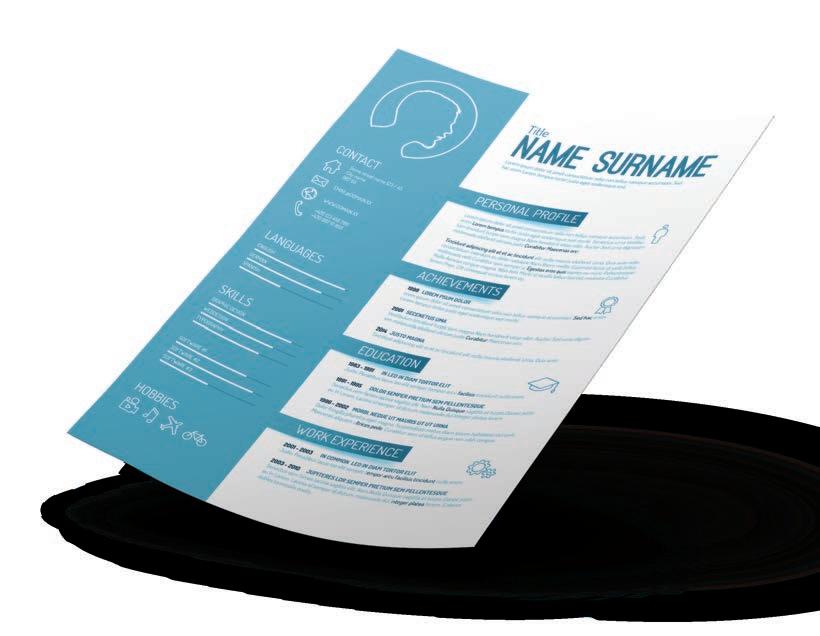
A cliché is stereotyped expression that has lost originality and impact by long overuse. Clichés are often idioms. They can be literal or figurative in meaning. Examples: opposites attract; all for one, and one for all; raining cats and dogs, etc.

1
Which of the expressions in the box means the following?
not the worst thing that could happen
it is much more difficult than it sounds
everything is going well for you
achievements require some sort of sacrifice
the way you treat others will eventually be the way you are treated
so good that it is hard to believe
2
Complete the sentences using the expressions from Exercise 1.

Easier said than done On top of the world Too good to be true Not the end of the world What goes around comes around No pain, no gain
1. I’m not surprised the offer wasn’t genuine; it sounded ________________.
2. How did you feel when you won the prize? ________________________.
3. I know you failed the exam, but it’s______________________; so stop crying.
4. Unfortunately, he will finally see the results of his activities. __________________.
5. This exercise is difficult but it will help you lose weight. Don’t you know the saying _________________?
6. Avoiding stress is ___________________.
In describing time, the following expressions have turned into clichés. Match the expressions (1-5) with their explanations (a-e). 3


4
Complete the sentences using the expressions from the box.
1. I suppose ________________ which one of us is right.
2. The ability to move information around the globe ________________ is improving daily.
3. We manage to get to her _________________, fortunately.
4. I returned late. I was having so much fun, I just ________________.
5. The investigators claimed it was only________________ when they would catch a thief.
5
Pair work. Think of situations when you can use these clichés. Act them out as dialogues.
Read between the lines
Laughter is the best medicine
Waking up on the wrong side of the bed


He has nerves of steel
All’s well that ends well
Time heals all wounds
Example: A: Mary feels terrible after her father’s accident. B: All pain and suffering will get better over time. Time heals all wounds.
Complete the sentences using the words from the List. (6 pts.)
1. Stubbornness is a ____________ that is sometimes positive and sometimes negative.
2. He __________ the pages quickly, then read them again more carefully.
3. Readers prefer stories and characters they can _____________ to pretty directly.
4. It takes planning and _______________ to be successful.
5. Fortunately, she is no longer ______________ to bed.
6. Is your passport still ______________? I’d like to go to Greece.
Find the words in the List which are the opposites of these words. (3 pts.)
1. weaken_________ 2. confuse_________ 3. fall behind__________
Complete the sentences using the correct linking words. (6 pts.)
1. She got the job _______________ the fact that she had very little experience.
2. Children need something to occupy their time; _______________, they get bored.
5. She left work early in order to be at home with the children. /so She left work early _______________ with the children. 1 2 3 4
3. He has always done well on exams. This time, _______________, he failed.
4. There is_______________ a great deal of truth in what he says.
5. He came first in the race ______________ his brother came last.
6. The service was improved and _____________ there were fewer complaints.
Rewrite these sentences using the words in bold. (5 pts)
1. Everybody considers him to be a leading scientist. /regard He _____________________________________.
2. It is believed that his father discovered those artefacts. /to His father ________________________________.
3. He is expected to return in a week. /will We______________________________________.
4. It was reported that a beggar broke into his bungalow last Friday. /have A beggar____________________________________.
KEY- page 163 20 pts.
Verbs excel clarify relate skim reinforce Nouns perseverance prodigy trait
Adjectives confined interpersonal multi-dimensional valid Adverbs admittedly apparently undoubtedly otherwise nonetheless whereas Phrasal verbs come up make up for
Rudyard Kipling (1865-1936) was born in Bombay. He is best-known for his short stories dealing with India, the sea, the jungle and its beasts and many other subjects. His best-known works are The Jungle Book, Kim, Rewards and Fairies. He was awarded the Nobel Prize for Literature in 1907.

If you can keep your head when all about you Are losing theirs and blaming it on you; If you can trust yourself when all men doubt you, But make allowance for their doubting too; If you can wait and not be tired by waiting, Or being lied about, don't deal in lies, Or being hated, don't give way to hating, And yet don't look too good, nor talk too wise;
If you can talk with crowds and keep your virtue, Or walk with Kings—nor lose the common touch, If neither foes nor loving friends can hurt you, If all men count with you, but none too much;
Yours is the Earth and everything that's in it, And—which is more—you'll be a Man, my son!
Edward Thomas (1876-1917) was an AngloWelsh writer of prose and poetry. He is considered a war poet, although few of his poems deal directly with his war experiences. Already an accomplished writer, Thomas turned to poetry only in 1914. He enlisted in the army in 1915 and was killed in action in 1917, in France.
Look up the words you don’t know in the Word list or in a dictionary.
William Butler Yeats (1865-1939) is a wellknown Irish poet and dramatist. His work is considered to be the most important in the revival of Irish literature. He was awarded the Nobel Prize for Literature in 1923.

The trees are in their autumn beauty, The woodland paths are dry, Under the October twilight the water Mirrors a still sky; Upon the brimming water among the stones Are nine and fifty swans.
The nineteenth autumn has come upon me Since I first made my count; I saw, before I had well finished, All suddenly mount And scatter wheeling in great broken rings Upon their glamorous wings. ….
But now they drift on the still water Mysterious, beautiful; Among what rushes will they build, By what lake’s edge or pool Delight men’s eyes, when I awake some day To find they have flown away?
Like the touch of rain she was On a man’s flesh and hair and eyes When the joy of walking thus Has taken him by surprise.
With the love of storms he burns, He sings, he laughs, well I know how, But forgets when he returns As I shall not forget her “Go now.”
Those two words shut a door Between me and the blessed rain That was never shut before And will not open again.



Read this Irish traditional story and fill in the gaps with the words from the box.

living shoot throw teach cornfield advice bending danger part
One day the old crow took a young one out into the field to __________ him how to fly.
When the young crow had learned how to fly and could go to any _________ of Ireland, the old crow said, ‘I think that you are able to fly anywhere now and make your _________ by yourself. Before you go, I want to give you some advice that will protect you from _________, as it has protected me.’
‘Tell me,’ said the young crow.
‘If you are ever in a potato field or __________and see a man coming towards you with something under his arm or in his hand, fly off immediately, for he may have a gun and may_________ you.’
‘I understand,’ said the young crow.
‘Another bit of ___________to you,’ said the old crow. ‘If you see a man ___________down as he comes toward you in a field, fly off as fast as you can, for he may pick up a stone to ___________at you. If he has nothing under his arm and if he doesn’t bend down, you’re safe.’
‘That’s all very well,’ said the young crow, ‘but what if he has a stone in his pocket?’
‘Off you go,’ said the old crow. ‘You know more than me!’
Match the words from the two lists to form compound nouns or adjectives.
master home ozone absent meeting world wheel steering window made piece wide point shopping chair minded layer wheel
Note: The most common compound nouns tend to be written as single words. If you are not sure, you should look them up in a dictionary.
What do we call these?
E.g. 1. a teacup
1. a cup that we drink tea from 2. a box for matches
3. paste for cleaning teeth
4. money that parents usually give their children to spend
5. a shop that sells sweets
6. a bag for sleeping in
7. a place where you buy tickets for the cinema
8. traffic which is too busy
4 5 6
Replace the underlined words with the correct form of the phrasal verbs with stand and keep.
1. Jack supported his friend when everybody was against him.
2. This tent is good and it will prevent the rain.
3. Sue continued making the same mistakes.
4. They maintain their reputation by working very hard.
5. I know he would confront absolutely anyone if he believed he was right about something.
The past simple tense is commonly used to tell stories. In the following legends, all irregular verbs are taken out. Read the text and fill in the gaps with the correct form of the following verbs. take shake give come put fall throw hurt make
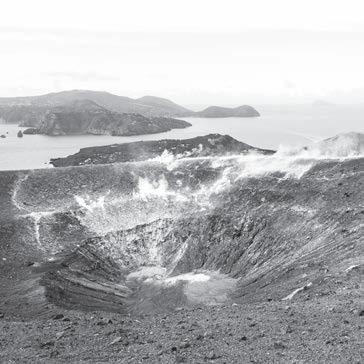
Long ago, the Roman God Jupiter and his wife Juno _______ birth to an ugly son, Vulcan. Once when Juno argued with Jupiter, Vulcan _______ the side of his mother. This angered his father, and Jupiter ________ Vulcan out of their home. Vulcan ________ to earth. His hard landing ________ his legs. He _______ his home deep inside the small island near Sicily. Deep in his mountain, Vulcan worked at his forge making things such as braces for his legs, cups, plates and jewellery. The huge mountain called Vulcano (Vulcan’s mountain) acted as his chimney. From the top of the mountain lava, clouds and dust _______ out.
Today the modern word ‘volcano’ describes all mountains that throw out lava, ash and gas.
Hawaiian natives believed the anger of the beautiful goddess Pele caused volcanic eruptions. When she stamped her feet, earthquakes ________ the earth and when she _______ her magic stick into the earth, volcanoes erupted.
Fill in the gaps with the correct form of the verbs in the list.
1. All the shops ________________ already by the time we ________________ there.
2. While we ________________ home last night, we ________________ of petrol.
3. I ________________ to get hold of you for ages. Where have you been?
4. I ________________ most of my homework, but I am stuck on the last bit.
5. I am terribly sorry, but I ________________ your name.
run out close arrive try drive forget do
State verbs are not normally used in the continuous tenses. These verbs are grouped as follows: verbs of the senses: see, verbs which express feelings and emotions: respect, verbs of mental activity: understand, verbs of possession: own,
Add more examples to each group.
Note: Some verbs can be used in the continuous tenses, but there is a difference in meaning.
1. a. I think Jane is a nice person. (expressing opinion – I believe…)
b. Tom is thinking of leaving the country. (considering)
2. Have / Have got
a. Henry has two cars. (possess)
b. I’m having a wonderful holiday. (enjoy)
Have is also often used in expressions to denote actions: have a bath, have a swim, have a party, etc.
Choose the correct alternative.
1. This wine is tasting / tastes a bit strange.
2. I’m agreeing / I agree with you on all those matters.
3. What do you think / are you thinking of Helen?
4. I’m thinking / I think of going on holiday.
5. She’s having / She has a bath and she can’t talk to you.
6. I’m remembering / I remember how happy we were as children.
7. I’m understanding / I understand what you want to tell me.
8. How much am I owing / do I owe you?
We often use the to refer to things that are unique. We use the with the names of:
a. documents – the Constitution
b. organizations – the United Nations
c. political parties – the Conservatives
d. official titles – the Mayor (if not immediately followed by a name)
e. historical events – the Battle of Hastings
f. ships, as well as special names of aeroplanes and trains – the Titanic
Put in an article if necessary.
1. ____ Labour Party hasn’t been successful recently.
2. ____ Mona Lisa has already been stolen from ____ Louvre once.
3. South of ____ Equator we see ____ Southern Cross.
4. ____ Orient Express is never late.
5. In many countries ____head of state is called ____ President.
6. Every year they celebrate the anniversary of ____ French Revolution in France.
Read the e-mail below and find 5 spelling and 4 grammar mistakes and correct them.
Hi Rhonda,
I’m writing this e-mail in hopes that you and your family are well. This is the first time that I visited these paradize islands. The best way to see Hawaii’s Big Island is to drive around it. You are soon be deep in a varied landscape unlike any other in the United States. You encounter active lava flows, jungle, farmland, warm beeches, cool highlands, and views of soaring mountains. And everywhere, you feels the aura of mysterous Polynesians who landed here more than a tousand years ago and named the island Hawaii. Will you promise me that next year we sit together on one of these marvelous beaches and watch the surfers? I’ll bring a lot of photoes. I’m looking forward to seeing you soon.
Love, Maggie
The use of articles in set expressions
Fill in the gaps in the following sentences with an appropriate article if necessary.
1. I am not in ____ mood for socializing. I’d rather stay at home.
2. Mr O’Neill will be with you in ____ while.
3. This medicine is no good! It’s out of____ date.
4. Get out of ____way. I’ll drop the box.
5. I’m sure that crime is on ____ increase in big cities.
6. I’d love to speak in ____ public.
7. You have to hand in your essay by Friday at ____ latest.
8. I’m trying to lose weight. I’ve gone on ____ diet.
9. Why don’t we go for a walk for ____ change? 10 11 12
Match the expressions in italics (1-5) to the explanations (a – e).
1. When they told me about my promotion, it was music to my ear.
2. He can play any songs by ear.
3. He resigned because he was tired of playing second fiddle to his boss.
4. She was critical of her husband, but now she has changed her tune and agrees with everything he does.
5. When I failed two exams, I had to face the music.
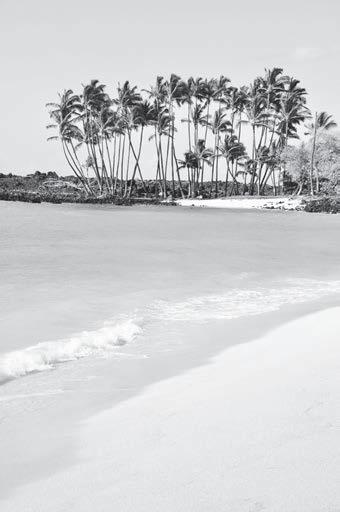
a. to change one’s opinion
b. to accept punishment or criticism for one’s actions
c. without looking at the note
d. good news which makes people happy
e. to be subordinate to someone
The answers are on page 163.
Complete this passage with the words from the box. They are all connected with a river and most of them you have learnt before. On completing the passage, listen to the text and check your answers. The river Danube has its ____________ (1) in Germany, in the mountainous part called the Black Forest. On its way to the Black Sea, it flows through several capitals and it has many _____________ (2), the most significant one is the Sava River. At Belgrade, there is a _____________ (3) of these two rivers.

In its middle course, the Danube flows through _________ (4). It looks like a flatland river with its low ________ (5) and a bed that reaches a width of more than one mile.
At the Iron Gate, the Danube flows through a ___________ (6). One of the largest hydroelectric projects was built there: the Ðerdap High _________ (7) and the Iron Gate power station. The project didn’t only help produce hydroelectricity, but it also made the river navigable.
Downstream from the Iron Gate, the river is free – flowing all the way to its ________ (8) in the Black Sea. Some 80 km from the sea, the river begins to spread out into its large __________. (9)
2 Read the text and complete the sentences with the correct form of the words in bold.
Adult marine turtles migrate a long ____________ for reproduction.
Their primary ____________ sites are on beaches located on remote islands. They often encounter danger. Some are ____________ caught in nets, others are caught for food or____________, some are killed by man’s _____________, and many die of ____________ and ____________ disasters. Habitat____________ is another problem. We might help their population ____________ by bringing in protective laws and ____________ programmes. distant reproduce accident produce pollute / starve nature / destruct recover rehabilitate Dam valleys gorge tributaries confluence banks delta mouth source
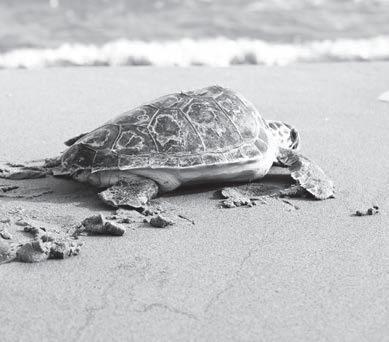
Find the four sentences which contain the wrong phrasal verb and correct them by using the correct form of the phrasal verbs with set, keep, sort and carry.
1. We would like to eat out tonight.
2. The closed windows didn’t put out the rain from coming in.
3. My sister broke out her threat and told my girlfriend that I had gone out the previous night.
4. She spread out her papers all over the desk and started reading them.
5. I have to make out the books in my bookshelf.
6. We decided to turn out early tomorrow morning because a long journey was ahead of us.
4 5
Complete the sentences with the correct tense of the verbs in brackets. (The present perfect simple and continuous tenses, active or passive)
1. Marine turtle population numbers ________________________ (decrease) these days. Turtles and their eggs _____________________________ (use) for food for centuries. Turtle soup _______________________ (be) important in many tropical cultures. Local people _____________________________ (also rely) on turtle eggs for protein.
2. Tom _________________________ (fish) for the last two hours, but he________________________ (not catch) any fish yet.
3. What ____________________________________ (you/do) since I last saw you?
4. I’m tired because I __________________________________ (work) in the garden all afternoon.
5. I _____________________________________________ (try) to phone you the whole week.
6. Susan _______________________________ (play) the piano since 4 o’clock.
7. Your sister _____________________________ (wear) ten different pairs of shoes this week!
Put each verb in brackets into the correct tense.
1. The reaction of local people to today’s news _______________ (be) strange so far.
2. Tom realized that the machine he________________ (buy) a few days earlier was broken.
3. When I opened the door to the office, I saw that the boss________________ (interview) a young woman.
4. It __________________ (rain) all day! Why won’t it stop?!
5. I’ll join you as soon as I ____________________ (read) this letter from my sister.
6. Please wait until I __________________ (sort) these documents correctly.
6
Underline the correct form of the noun.
1. We felt better as soon as we went through the Custom / Customs, though we had nothing to declare.
2. They wanted to store their good / goods safely in the storage room.
3. We all know that it is bad manner / manners to stare at people.
4. There are some lovely picnic spots in the surroundings / surrounding.
5. We got some useful information / informations about the film at the box office.
Put the nouns in brackets in their plural forms.
7. The news we received yesterday was/were very good. 7 8
1. They roasted two _________ (goose) and three_________ (turkey) for their guests.
2. The _________ (thief) broke into the shop without attracting the attention of ___________ (passer-by).
3. They agree that these were strange ___________ (phenomenon).
4. He insisted that all the books were put in the _____________ (bookshelf).
5. How many _______________ (brother-in-law) do you have?
6. There are several good _______________ (woman doctor) in this hospital.
7. Bob brought me a few___________ (handful) of flowers yesterday.
Choose the correct verb.
1. Cattle was/were raised on this farm and sold in the town at a high price.
2. The United States consists/consist of 50 states.
3. Politics is/are a complicated business.
4. Fine leather goods is/are sold in this shop.
5. There is/are some refreshments over there. Help yourselves.
6. The police was/were not able to find any clue to the crime.
9 10
Read the instructions and examples and add more examples for each item.
1. Collective nouns (team, family, etc.) can take either a singular or plural verb. Give some example sentences and explain the difference.
2. Certain nouns are always plural and take a plural verb: police, clothes, etc.
3. Garments, tools and instruments consisting of two parts: pants, pliers, etc.
4. Twelve nouns ending in f or fe drop the f or fe and add –ves. Complete the list: sheaf, calf,
5. Nouns ending in o add –s or –es: a. photos; b. tomatoes. a._________________________________________ b. ______________________________________________
Complete the sentences by using the verbs in the list in the correct form. Add a preposition if necessary.
1. Lucy ___________ my brother. The wedding was last Sunday.
2. We have a good relationship in the firm. I can ____________ my partners.
3. We must _____________ your plans for changing schools.
4. The train _______________ Belgrade now. Mary ______________ us on platform 6.
5. They are twin sisters, but they _________________ each other at all.
6. They __________________ two groups to play volleyball.
7. When Jack _____________ the room, everybody stopped talking and looked at him.
discuss enter divide rely marry resemble (not) approach wait
Read the text and fill in the gap with the correct preposition (a, b or c).
Then listen to the text and check your answers.
1. a. in b. from c. to 2. a. to b. from c. at
3. a. for b. about c. on
4. a. to b. at c. on
5. a. of b. by c. about
6. a. in b. of c. after
7. a. about b. from c. for
8. a. across b. over c. on
9. a. to b. over c. into
10. a. until b. on c. from
Scottish missionary and famous explorer of Africa, David Livingstone, was the first European who discovered this awe-inspiring waterfall in 1855, during his journey _____ (1) the upper Zambezi _____ (2) the mouth of the river.
Livingstone had been told _____ (3) the falls before he reached them from upriver and paddled across _____ (4) one of two land masses in the middle of the river, which is now called Livingstone Island. He had previously been impressed _____ (5) another falls further upstream, but found the new falls much more impressive, and gave them their English name _____ (6) honour of Queen Victoria.
Columns of spray can be seen _____(7) miles away as more than five hundred million cubic metres of water per minute fall_____ (8) the edge which is nearly two kilometres wide, ____ (9) a gorge over one hundred metres below. The waterfall was rarely visited by people ______ (10) 1905, when a railway was constructed.
There are different names for the groups in which some animals live.
For example: A lot of cows together make a herd. Wild dogs live in packs.
Look at the pictures and complete these sentences.
1. The __________ are big animals. They eat with the help of their long trunks. They live in __________.
2. The ________ are big cats. They are predators that live in savannahs in ____________.
3. Many ________ species migrate to warmer climates during the winter. They fly in _______.
4. The _________ live in forests and are very dangerous animals, especially when they appear in _________.
5. __________ can be found in fresh and salt waters. You can see a _________ of them in clear water.
The answers are on page 163.
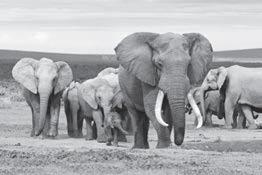
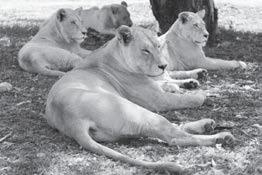
Circle the correct answer. (12pts.)
1. I ______ attention to the road when I ______ into a hole in the ground.
A didn’t pay / fall
B wasn’t paying / fell C hadn’t paid / has fallen
2. Ferdinand Magellan was the first European who______ through the strait that ______ ever since then as the Strait of Magellan.
A was sailing / will be known B had sailed / had known C sailed / has been known
3. While I _______ in London during the 1990s, I _____ surprised to hear how many languages were spoken there.
A lived / have been B was living / was C working / had been
4. Joan ______ many bestsellers since her first book was published in 2002.
A wrote
B had written
C has written
5. Worldwide, animals have to ________ the climate change.
A adopt to
B adapt at
C adapt to
6. Swimming long distances is very _______ even for a fit swimmer.
A exhausting
B exhausted
7. Entering the valley, the river ______ over a large area.
A flows out
B spreads out
8. The native tribes played their music ______.
A by tune
B by heart
C exhaustful
C runs out
C by ear
9. The necklace and hula are two Hawaiian symbols that ______.
A stand up
B stand out
C stand at
10. We were getting ready for a picnic, but the day ______to be very rainy.
A turned out
B turned up
C turned in
11. He couldn’t _____ with other students because he hadn’t learned English before.
A keep in
B keep on
C keep up
12. They were very skilful and ______the problem in five minutes.
A worked out
B worked up
C worked off
1 and 2
Fill in the gaps with an article where necessary. (7pts.)
5. He gave me some advice/advices though I wanted to do it my way. 2 3 4
1. Who will win ____ election this year? I think ____ Conservatives.
2. ____ Mallorca is the largest island in ____ Balearic Islands.
3. ____ Etna is the most active volcano in ____ Europe.
4. I like to read newspapers like _____Times.
5. A lot of people object to attempts to bring up ____Titanic.
6. They are planning to climb _____ Mt Blanc as a team.
7. I think he lives in _____ Chestnut Street.
8. _____ sun is very strong over _____ Equator.
9. _____ United Nations building is situated on ______First Avenue.
Complete the sentences using the correct form of the nouns in bold. (6pts.)
1. I need a lot of _________ for my project. /datum
2. You should put 5 _________ of sugar in the cake. /spoonful
3. In the 18th century, many households kept a few ___________. /manservant
4. In some competitions, many people can be ___________. /runner-up
5. Will you buy two ___________ of bread at the baker’s? /loaf
6. Are there many ______________ in your town? /woman driver
Choose the correct form of the verbs or nouns. (5pts.)
1. The surroundings of the town is/are rather dull.
2. I’ll feel better as soon as I get some refreshment/refreshments.
3. His jeans is/are quite old-fashioned.
4. Mathematics is/are difficult for some people.
rights author genres hits defence publishers best-selling novel publication reputation 1 2
Read the text and complete the sentences by using the correct word from the list.
A legal thriller is the kind of writing that made John Grisham the __________ (1) author of the last decade of the 20th century. After graduating from law school, Grisham went on to practise law for nearly a decade, specializing in criminal __________ (2). But then he started writing as a hobby. He had to get up at 5 a.m. every day to write for several hours before heading off to work. Grisham spent three years on A Time to Kill and finished it in 1987. Initially rejected by many __________ (3), it was eventually published and sold 5,000 copies.
Grisham’s hobby turned into a full-time career. After the __________ (4) of his second novel, The Firm, which was the best-selling novel of 1991, he became a celebrity __________ (5). When he sold the film __________ (6) to Paramount Pictures, the best publishers wanted to buy his book rights.
The Client confirmed Grisham’s __________ (7) as the master of the legal thriller. His success has made the legal thriller one of the most popular __________ (8). ‘It’s high-quality, professional entertainment,’ Grisham says of his writing.
Since first publishing A Time to Kill in 1988, Grisham has written one __________ (9) a year and his books have been translated into 29 languages. Nine of his novels have been made into films and were huge__________ (10) at the time.
Complete the sentences using the words in the list.
1. Michael’s father set up a shelter for homeless people. I think he is a real __________________.
2. Women _____________70 percent of the workers in this factory.
3. James was _____________ an award for research in biology.
4. Mrs Fraser was very rich. What did she leave in her __________ to her relatives?
5. It is really hard to be a miner in the ___________.
6. Do you know the names of the authors selected for the NIN __________?
7. Did he _______________ you that he was in a real need of money? granted convince pit constitute shortlist will philanthropist
VERBS 3 4 5 6
Say whether the phrasal verbs are correctly used according to the meaning of the sentences.
1. The fans are happy when a match is called off because of rain.
2. When someone calls you up, he/she needs to have your phone number.
3. When a girl is given the same name as another person, she’s called for that person.
4. I’ll call on my brother to see how he is.
5. When the teacher called out my name, I had to stand up.
Use the verbs from the box in the future perfect tense to complete these sentences.
1. I ____________________ the work by the time you get here.
2. She __________________ in Brighton for 10 years by next June.
3. This happy couple ____________________ for 20 years next May.
4. By the end of the century, we _______________10 new factories.
marry build not/finish live rise
5. In twelve months’ time, the average income of our citizens _______________ by 10%.
Complete the following sentences with the correct form of the future perfect simple or the future perfect continuous tense.
1. Let’s hurry. The film __________________ (start) by the time we get to the cinema.
2. By the end of this school year, I __________________ (not/do) all the exercises in this book.
3. By the time I get back home, my mother __________________ (cook) the meal.
4. Jason __________________ (teach) at the university for more than a year by the time he leaves for another post in Africa.
5. How long ________________ (you/study) physics when you graduate?
6. There’s no point in phoning her at the office. She __________________ (go) by now.
7. Don’t go so early. You__________________ (wait) for more than two hours when her plane finally arrives.
Look at the situations and complete the sentences with the future perfect or the future continuous form of the verbs. Use the words in bold.
1. I’m reading the last chapter of Sons and Lovers at the moment. /read the book By this evening ____________________________________________.
2. Tomorrow I’ll finish my work at the office at 6 o’clock. /still work At 5 p.m. __________________________________________________.
3. The marathon will start at 10 a.m. /not run At 9 a.m. the participants _______________________________________.
4. We are building new schools in this area. /three schools By the end of the year, _________________________________________.
5. The film will start at 8 o’clock. /watch
At 9 o’clock I _________________________, so don’t call me then.
THE PAST PERFECT OR THE PAST SIMPLE TENSE 7 8 9
Complete the sentences with the correct form of the verbs in brackets.
1. I had to clean the floor because my cat ____________________ (knock) over a vase.
2. We ____________________ (decide) to make changes to the project which we ____________________ (finish) the day before.
3. When I ____________________ (come) home last night, I ____________________ (find) the door open because I ____________________ (not/lock) it.
4. Mary ____________________ (never/see) a bear before she ____________________ (move) to Alaska.
5. We wondered what he ____________________ (tell) her about the accident.
6. By the time we reached home, the rain ____________________ (stop).
INDIRECT → DIRECT SPEECH
Rewrite the reported conversation below in direct speech using the exact words of each speaker. The beginning has been done for you.
Example:
The police officer: Where were you on the night of the robbery? Jack: I was out for the evening with some friends.
The police officer asked Jack where he had been on the night of the robbery. Jack replied that he had been out for the evening with some friends. Jack told him that they had been to see a film and that then they had gone to a nearby pub for a drink.
Then he wanted to know what time Jack had arrived home, but Jack couldn’t remember exactly. The police officer enquired whether any of the neighbours had heard Jack coming home, but Jack was sure that they hadn’t because he had been very quiet. He hadn’t wanted to wake up his father because he had to get up very early in the morning to go to work.
Jack apologized for not being able to prove his story since his friends had all gone away on holiday.
Complete the sentences with the correct form of say, tell, speak and talk, as required.
1. The students __________ highly of their teacher.
2. She ______________ that her name was Mary.
3. Do you know how to __________ ‘thank you’ in Spanish?
4. I’m very good at ___________ jokes.
5. Many people _______________more than one language.
6. His look _______________me to leave the room immediately.
7. Jane’s throat was so sore that she couldn’t ___________.
8. Last night Henry ______________ on TV about the book he had written.
Remember: to say (something to somebody) to express (a thought) in words; make a statement to speak to utter words to tell (somebody something) − to give information to talk to speak (usually to someone who is listening)
Here are some idioms that relate to books. Match the idioms to their explanations.
1. Turn over a new leaf
2. Read someone like a book
3. Read between the lines
4. You can’t tell a book by its cover
5. By the book
6. Have one’s nose in a book
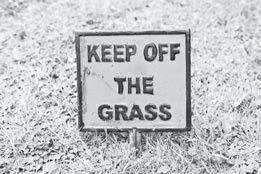
VOCABULARY 12 11 10
a. to understand someone very well
b. to forget about the past and start again with the intention of doing better
c. to see what is really meant by what is written or said
d. to read books all the time
e. you can’t tell what a person is like from his/ her outward appearance
f. according to the rules
Study the following phrases with the verb read. Make one sentence for each phrase and explain its meaning.
read somebody’s mind/thoughts/lips
read somebody’s fortune in the cards
read instruments
The sign reads: ‘Keep off the grass’
There are many compounds with the word ‘book’ (or variations of it), e.g. bookshop.
Find them among the explanations given below. Use one of these words: keeper, stall, worm, office, mark and maker. If you don’t know the meaning of some of them, look them up in your dictionary.
1. A person who is very fond of reading books.
2. A thing put in a book to mark a place.
3. A small shop with an open front, usually in the streets or railway stations, where books and magazines are sold. _________________
4. A person who makes a living by taking bets on horse-races. ________________
5. A person who keeps business accounts.
6. Tickets are sold there. _______________
The answers are on page 163.



1 2 3
Complete the text with the correct form of the words in brackets. The first one has been done for you.
Drones or (0) flying (fly) apparatuses are already revolutionizing the world around us. Like most tools, the (1) ______________ (use) of a drone depends on who’s in control.
They have become infamous1 for their surveillance2 capabilities or possible military use, but they have more potential than that. Here are just a few examples that show how drones can be useful tools.
Since drones can fly much lower than a helicopter, they are used for the aerial photography of sports or other events with interesting activities going on.
Drones can be built to endure extreme temperatures and (2) ___________ (radiate) and aerial cameras can provide better perspectives when searching for victims in areas of low (3) (visible). They can provide live video feeds of train crashes or natural disasters, spot3 wildfires and monitor the situation. They are also used to gather4 (4) __________ (value) information on the environment. In Italy, for example, drones have been spying on illegal dumping5 for years. Police departments use them for surveillance, to fight crime, guard borders and other related activities. Moreover, some companies are working on a drone (5) ___________ (deliver) system. It can be used to deliver packages, medicine, vaccines or a transplant organ from one hospital to another. There’s no doubt that drones are entering our lives. There will be good and bad (6) ___________ (apply), just as with any new technology.
Which two words (a, b or c) in (1-5) can be synonyms for the words in bold in the text? Use a dictionary to help you.
1. a. ill-famed b. common c. disreputable
2. a. examination b. observation c. inspection
3. a. notice b. see c. find
4. a. collect b. assemble c. connect
5. a. disposal b. throwing away c. leaving
In groups of three, discuss other possible uses of drones you can think of. Present your ideas to the class.
4 5 6 7
Read the text quickly to get the general idea. Look at each gap. Decide what part of speech is required (an article, preposition, verb, conjunction, etc.). Use only ONE word in each gap. There is an example (0) at the beginning. (0) dates
The Antikythera mechanism is an ancient, sophisticated machine found in a shipwreck near Greece. It (0) dates back to about 100 BC. The extraordinary mechanism astonished (1) ________ whole international community of experts on the ancient world. It contains gears and structures that were not found in devices again (2) _________ 1000 years. (3)_________ the time this thing was made, no one had yet discovered the laws of gravity or (4)_________ heavenly bodies moved. Nothing (5) _________ complex as this would (6) _________ developed again until the Middle (7) _________.
No one has (8) _________ able to figure out what it is as no one can agree on where the Antikythera mechanism was made or (9) _________ designed it. The mechanism resembles a computer and (10) _________ supposedly used to calculate astronomical positions.
Explain the meanings of the underlined words in these sentences.
1. My initial surprise was soon replaced by delight.
2. The school’s facilities have been improved recently with a library and media centre.
3. The doctors were baffled by the patient’s results.
4. Can someone please return this equipment to the cupboard?
5. He has the potential to be a professional soccer player.
Complete the sentences by using the words in the box, either in the singular or plural form. issue item tool layer drawback
1. A fresh ___________ of snow covered the streets.
2. During the sale we’re offering 20% off selected ____________.
3. We met on several occasions to discuss these important environmental _________.
4. The only___________ in having computers in the classroom is that students might play games.
5. Early humans shaped ______________ out of stone.
Decide which verb from the box (1-6) best collocates with the underlined noun in the phrases (a-f) so that the meaning remains similar. Use the new collocations to write example sentences. The first one has been done for you. 1/a
1. grasp
2. maintain
3. carry out
4. conduct
5. develop
6. come up with
a. understand the meaning
b. do some experiments
c. have an idea
d. design a prototype
e. do a search
f. keep in order
I can’t grasp the meaning of this quote.
Verbs sometimes confused
arouse (aroused) – to stir to action; to stimulate; wake up
E.g. She aroused the children from their nap. / Don’t arouse my anger. arise (arose) – to move upward; to appear; to result or issue
E.g. New problems arise daily. / We discuss the consequences arising from the action. raise (raised) / rise (rose)
E.g. The discussion raised my interest. (increased the level)
There’s one point I’d like to raise. (put forward)
Food costs rose sharply. (increased)
Work with a partner. Complete the sentences using the words from Exercise 8 in the correct form.
1. An obstacle ____________ at the last minute, causing delay.
2. ____________ your hand if you want to ask a question.
3. Her series of misfortunes ____________ my sympathy.
4. During the meeting we discussed points ____________ from the discussion.
5. His interest had first been ____________ by a trip to the local museum.
6. The river ______________ by several metres since yesterday.
Look at the pictures and try to match a tool with its name.
Do you know the names of these tools in your language? Consult a dictionary if necessary. arise rise arouse raise
1. hammer 2. nail 3. pliers 4. drill 5. saw 6. screwdriver 7. bolt 8. monkey wrench 9. tape measure 10. tool box
11
Choose the correct alternative.
1. Jane said she had been gardening/was gardening all afternoon.
2. By the time I came back from my journey, a lot of things had changed/changed.
3. Jason’s face was red because he had been jogging/had jogged.
4. When we arrived at the football match, they had already been playing/had played for 15 minutes.
5. How long had you been driving/were you driving when the car broke down?
Put the verbs in brackets into the past perfect simple or the past perfect continuous, the past simple tense or the past continuous tense.
1. I looked at the photos that he ______________ (send).
2. We ______________ (think) about buying an electric car even before the price of gas went up.
3. He ______________ (only/drive) for half an hour when he ______________ (remember) that he ______________ (leave) his briefcase at home.
4. When I arrived at the cinema, George______________ (already/buy) the tickets and ______________ (wait) for me.
5. When the kids ______________ (come) into the room, it was quite clear from their dirty clothes that they ______________ (play) in the garden.
Complete the gaps with the words/phrases from the box. There is one extra word.
1. _________ before have I felt so humiliated.
2. _________ had he entered the house when he heard someone screaming outside.
3. Not __________it was too late did I remember where I had seen it.
4. ____________was he good looking, but he was also a very successful businessman.
5. was a replacement to be found.
Finish the second sentences so that they mean the same as the original ones.
1. I’ve failed the exam and have been given the lowest mark in the class. Not only ________________________________________.
2. He would never stay up studying all night again. Never __________________________________________.
3. The alarm went off immediately after he closed his eyes. Hardly ___________________________________________.
4. You must not talk during the exam under any circumstances. Under ____________________________________________.
Finish the following sentences.
1. Under no circumstances will she...
2. Never have I...
3. Never before has it...
4. On no account must you...
5. Scarcely had I... when... 12 13 14 15 16 when until never not only nowhere hardly
Choose the most suitable response (1 or 2).
1 A: Why did you worry about me? I didn’t take any risks.
B: 1. You must have been injured.
2. You could have been injured.
2 A: We had a terrible crossing on the boat in a storm.
B: 1. That didn’t have to be very pleasant!
2. That can’t have been very pleasant!
3 A: Where were you yesterday? You didn’t turn up!
B: 1. I had to go to London.
2. I must have gone to London.
Circle the correct answer. (10 pts.)
1. It was 10 p.m. and we were exhausted because we______ hard all day.
A were working B have been working C had been working
2. ‘Can I _____you a call tomorrow?’ – ‘Sure, but I ______shopping in the morning, so call me after lunch.’
A give/going to B give/will be going C make/will go
3. By next month my husband _________ the mayor for two years.
A has been B will have been C will be
4. ‘It’s strange I haven’t heard from Lora yet.’ – ‘She ______ left a message on your voice mail.’
A might B can have C might have
5. ‘How did the boss find out about our plans?’ – ‘Alex _______ him; I didn’t!’
A must tell B must have told C might have been telling
6. If I had applied when you advised me, I _______ participated in this show, too.
A could B might have C could be
7. My computer doesn’t work. It _______ during production.
A can be damaged B might have damaged C must have been damaged
8. I’m sure I didn’t sign the document. The signature _______ forged.
A might be B must have been C could have
9. The inspector inquired where _________ the money.
A did they hide B had they hidden C they had hidden
10. Scarcely _______ when there was an alarm warning.
A they had taken off B did they take off C had they taken off
Put the verbs in brackets into the correct form. (8 pts.)
1. She said she ______________ (not realize) Tom______________(accomplish) so much.
2. He put off the match because it__________________ (rain) cats and dogs for the last couple of hours.
3. By the time Jeremy_______________ (finish) his essay, most of the pupils _________________ (leave) the classroom.
4. By the time the train arrives, we _______________ (complete) the crossword puzzle.
5. When we ______________ (turn up) at the concert, the band _______________ (play) for at least one hour.
Rewrite the sentences so that they mean the same, using the words in capital letters. (6 pts.)
1. It’s possible that John didn’t understand what he should do. /might John ________________________________________.
2. Business hasn’t been so bad for a long time. /has Rarely________________________________ been so bad.
3. There is a chance that my secretary took the order book away. /may My secretary______________________________________.
4. It was lucky that I didn’t hurt myself in that crash. /have I _________________________________.
5. I have never been so frightened in all my life. /before Never __________________________________.
6. Under no circumstances should you repeat this to anyone. /account ____________________ must you repeat this to anyone.
Choose the word (A, B or C) that has the same meaning as the word in bold. (6 pts.)
1. My parents always emphasize the importance of studying hard. A assume B require C stress
2. The overall situation is good, despite a few minor problems. A major B initial C general
3. The car was manufactured in Italy until the 1980s. A gathered B merchandized C produced
4. Archaeologists are excavating sites carefully, hoping to find new artefacts. A digging out B looking out C wiping out
5. The workers threatened to go on strike, but called it off at the last minute. A cancelled B put off C refused
6. She felt nervous in the moments which preceded the earthquake. A pay the way B came after C came before
Complete the text by using the words from the box.
The British are often accused of being reserved and having a stiff upper lip, but there are a surprising lot of crazy British _________ that prove otherwise.
3 broken annual rolling traditions participants part reason ridiculous
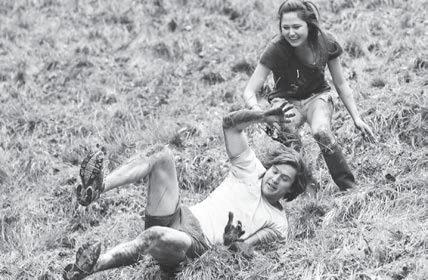
The __________ event which is held on the Spring Bank Holiday at Coopers Hill features a number of young people _________ down a hill chasing cheese off a cliff. It was traditionally held for local people from the village, but now people from all over the world take ________in it. Due to the steepness and uneven surface of the hill, ___________usually suffer a number of injuries, ranging from sprained ankles to _________ bones and concussion. They rarely give a _________why they take part in what seems to be the most ___________tradition and tumble 200 yards to the bottom!
1 2
Complete the sentences by adding either the correct prefix or suffix.
1. Many countries have brought in regulations for protecting ____ dangered species.
2. The computer system ____ables students to read class materials online.
3. She went to the dentist to white____ her teeth.
4. They discussed the increasing depend_____ on computers.
5. His business was a complete fail_____.
6. I think he will have speedy accept____ in our community.
7. She saves money on every item she buys; she is very economic____.
8. If you want to work in a team, you have to ____operate.
9. The construct____ of the mirror must have cost a fortune.
10. We didn’t see any danger ____ animals in this area yesterday.
Put in a phrasal verb + preposition from the box which means the same as the expression in the brackets.
1. I’m afraid an apology alone can’t ___________________ all the inconvenience we have suffered. (compensate for)
2. Why do you think I should ________________ this nonsense? (tolerate)
3. He’s trying to _________________ the amount of chocolate he eats. (reduce)
4. Tina likes to __________________ beauty contests. (enter)
5. I’m afraid we’ve ________________ a serious problem. (be faced by)
6. You go ahead. I’ll soon __________________ you. (get to the same level)
go in for cut down on make up for catch up with put up with come up against
4 5 6
Complete the sentences with the correct form of the verbs in brackets to get conditional sentences. (Types 1, 2 or 3)
1. You would feel better if you _______________ (smoke) less.
2. If I could repair my own car, I ______________ (save) a lot of money.
3. If he _________________ (post) the letter now, she’ll get it tomorrow morning.
4. If you had used the computer, you ______________________ (save) time.
5. If he _______________ (not eat) so much, he would be healthier.
6. I would climb this hill if I ______________ (be) younger.
7. If I_______________ (earn) enough money, I’d have gone to Egypt with them.
8. I won’t go to her party unless she ________________ (invite) me.
9. If I ____________ (pay) for it, I’d have asked for the receipt.
10. I would break the promise I gave to Jim if I _____________ (answer) that question.
Rewrite the two sentences to make one ‘unreal’ conditional sentence.
Example: I lost my passport. I didn’t go to Spain with my friends. If I hadn’t lost my passport, I would have gone to Spain with my friends.
1. She was upset very much. You lied to her.
2. He got into trouble. He borrowed a lot of money from different people.
3. I missed two goals. My team didn’t win the match.
4. Jack ate too much at the party. He became sick.
5. They didn’t show up at the concert. I wasted a lot of money on the tickets.
Complete the sentences using the expressions from the list.
as far as supposing considering unless as long as
1. _________________ you lost your job, what would you do?
2. Where is he going to stay? – At his old cottage, _________________ I know.
3. Don’t spend that money _________________ it is absolutely necessary.
4. You can keep the book _________________ you like. I don’t need it any more.
5. _________________ how much he earns, I’m surprised he dresses so badly.
5. In Britain nowadays, birds ____________ (heavily/ protect). Nobody __________ (allow) to kill them or take their eggs. 7 8 9
Complete the dialogues. Put the verbs in brackets into the passive voice. Choose the correct tense.
1. A: Have you seen Kate’s new piano?
B: Not yet. It __________________ (bring) in only yesterday.
2. A: Are we about to have lunch now?
B: Yes, it ________________________ (serve) in the dining room now.
3. A: Why are we waiting here so long?
B: All luggage must _______________ (check) before departure.
4. A: We are still looking for our lost luggage.
B: _________ it ___________ (find) yet?
5. A: Are you ready for the interview?
B: Yes. I’m sure I ________________ (ask) a lot of questions.
Work in pairs
Student A asks questions beginning with why.
Student B replies with a passive sentence using the cue phrases.
E.g. spend all their money on clothes / invest all their money in stocks
A: Why did they spend all their money on clothes?
B: On the contrary, all their money was invested in stocks.
1. cancel today’s game / postpone today’s game
2. type those formal invitations / write the formal invitations by hand
3. throw away all the old books / sell all the old books
4. shoot the bears / put the bears to sleep
Put the verbs into the correct tense. (Active or passive)
1. In 1964 Martin Luther King ____________ (win) the Nobel Prize. In 1968 he ___________ (kill) in Memphis.
2. You ________________ (ask) a lot of questions at the interview tomorrow. You should ______________ (prepare) to answer them quickly and correctly.
3. The company _____________ (produce) new telephones every year and most of them _________________. (export)
4. ________________________________ (their house/sell) yet?
Put the words from boxes A, B, C, D and E into the correct boxes below to get well-known phrases.
sight, rights, name, accident, chance, heart debt, difficulties, case, brief, fact, general, need, public, tears
first, work, war, sea, length, rest, present, hand, least
work, stock, reach, sight, place, danger, date, order sale, time, duty, business, fire, holiday, display, average
out of in on at by
Complete the sentences using the correct phrases.
1. I feel ______________ because I am casually dressed.
2. I met him _______________ ten years ago in the USA.
3. I know that family ______________. I never spoke to them.
4. I’ll go to the store to see if the dress I like is _______________ this week.
5. I’ll take a taxi ________________ I’m late.
6. I’d prefer not to be ________________to the banks.
7. Mothers like their children to be _________________.
8. I’m afraid our car is ______________, I can’t give you a lift.
9. One floor of the building was ________________ and people tried to escape by the staircase.
10. I don’t like it when Jim starts telling stories _________________.
The answers are on page 163. MINI QUIZ
Match the expressions with colours to their explanations.
1. wave a red flag to a bull
2. feeling blue
3. black sheep
4. white elephant
5. a blue ribbon
6. rose-coloured glasses
7. roll out the red carpet
a. a person who causes shame in the family
b. optimistic view of the things
c. to make someone very angry or upset
d. melancholy
e. to greet a person with great respect and a warm welcome
f. to be of superior quality or distinction
g. something unwanted, but difficult to dispose of
CLOZE 1 2 3 support affected brought pursue strictly created take turned
Complete the text by using the words from the box.
Are men and women’s roles
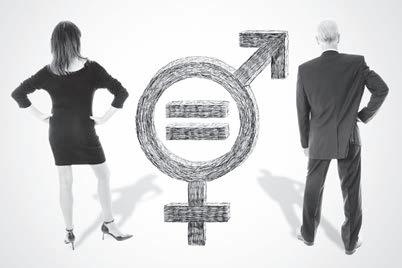
Even though we started out equal, opinions throughout early history (1) _________ a society in which men were ‘chosen’ to be stronger and superior and women weaker and more gentle. That’s how it was for centuries. However, over time, some changes slowly (2) ________ people’s attitudes towards women and their rights.
The Second World War (3) _________ a real revolution – since the men went to war, the women had to (4) _________over jobs in factories and companies. Amazingly, they (5)_______ out to be efficient workers.
There’s no doubt that over the last decades men and women’s roles have become less (6) ___________ defined when it comes to jobs, housework and childcare. Nowadays, women work not only because men sometimes do not earn enough to (7) ____________ the family, but to (8) _________ their own ambitions and develop their talents. If people are equally treated, everyone will have the same chance in life.
Complete the text by filling the gaps with ONE word.
The first one has been done as an example. (0) a
My name is Jane and I’m a mechanic. I have always had (0) a fascination with cars. When I finished school, I began to work (1) ______ an apprentice one day a week. I did feel like an outsider. Some of the guys would make horrible comments, but there were drivers (2) ______ wanted to talk to me.
It’s a typical male environment, but I plan to change that. There is (3) ______ reason why women can’t repair cars. It’s not about brute strength. There is a tool for everything. I often tell girls that this is actually quite a cool (4) ______. The more I speak (5) ______ them, the more women will see it as an option. I have plenty of women customers who say to me, ‘I wish I could (6) ______ done this when I was younger’.
Complete the sentences using the words from the texts in UNIT 6. The first letter has been given.
1. Authorities are hoping they will be able to i us.
2. Two witnesses described it as a t_____________ scene.
3. He is one of the most eligible b among actors.
4. We have different n___________ about our role in the campaign.
5. This situation will certainly provoke a m____________ of reactions.
6. Gender inequality is a form of social d_______________.
Look at these verbs and adjectives in the box. Which of them collocate with these pairs of words below (1-5). Add at least one more collocating word you can use with the given words.
1. ____________a goal/hobby/career
2. ____________a programme/someone’s work
3. ____________experience/career
4. ____________progress/improvement
5. ____________class/height
to evaluate to pursue rewarding average significant
Use some of the collocations from Exercise 4 to make sentences. Examples: They will pursue their own interests. / We need to evaluate our options.
Which prefixes are used to make the opposites of these words? ___legal; ___responsible; ___honest; ___mature; ___dependent; ___healthy
Complete the sentences by using the phrases with take in the correct form. take up • take after • take on • take in • take over
1. She ___________ the responsibility of caring for the animals.
2. John is such a funny person. He ___________ his grandfather, who was a comedian.
3. The instructor spoke so fast that I couldn’t ___________ all the information.
4. Do you have time to ____________ a new project?
5. These books ___________ all the space in my room.
Complete the sentences. Make new words from the words in bold.
1. His parents were _____________of his attempts to be a writer. /support
2. The policeman asked me if I understood the _____________of a red traffic light. /significant
3. I’m sure that the minister’s resignation had political ______________. /imply
4. Both incidents affected the public’s _______________of the government’s capacities. /perceive
Look at some wishes about the present events. Rewrite the sentences using If only and I’d rather. Example: She is so sad. If only I could help her!
1. It’s a pity your brother isn’t here.
2. Why don’t I live in London?
6. I don’t speak French and can’t help you. 4 5 6 7 8 9
3. I’d prefer you to come with us, and not Jane.
4. Oh no! It’s raining.
5. I don’t approve of your smoking.
10 11 12 13 14
Put the verbs in brackets into the correct tense (the past tense or the past perfect).
1. I wish I _____________ (change) my job earlier. I would be happy now.
2. It’s time you ____________ (wash) those trousers.
3. When I told her the news, she acted as though it ______________ (be) my fault.
4. It’s about time you ____________ (go) to bed.
5. If only you _____________ (not/make) rude remarks about me. It makes me sad.
Complete the sentences to make them true for you.
1. I wish I’d never...
2. It’s about time I started...
3. I’d rather my parents…
4. If only I knew how to…
Complete the sentences with the correct participle from the box.
having finished • turning on • having studied • playing • having read
1. ___________________the instructions, she decided to try to make it.
2. ___________________the light, she could see a stranger standing in front of her.
3. ___________________for two weeks, Mike felt prepared for the exam.
4. While______________tennis, I hurt my ankle.
5. __________________her homework, she decided to go out.
Complete these sentences using an appropriate present or perfect participle.
1. ___________hungry, he went into the kitchen and opened the fridge.
2. ___________poor, he didn’t spend much on clothes.
3. ___________that his mother was coming, he cleaned the flat.
4. ___________the performance, she was unable to tell her friends anything about it.
5. ___________a game the previous day, she was nervous before the match.
Participle clauses can be introduced by while, when, after, by, on, and since. Use one of these words to complete the sentences.
1. __________studying abroad, he met a girl he later married.
2. __________leaving the plane, check if you have taken your belongings with you.
3. ___________saying goodbye, he ran to catch the train.
4. I solved my financial problem ___________taking on another job.
15 Rewrite the following sentences by changing the participle into a finite verb.
Example: Hearing a loud noise, we rushed into the room. When we heard a loud noise, we rushed into the room.
1. Not realizing how dangerous it was, he started skiing down the steep slope.
2. Seeing the accident, I called the police.
3. Having lost my ticket, I bought another.
4. Being illiterate, he couldn’t read the instructions.
5. Having learnt his lesson, Jim went out to play with his friends.
For each of the sentences write a new sentence as similar as possible in meaning to the original sentence.
1. He was sorry he had asked his uncle to lend him the money. He wished ___________________ his uncle to lend him the money.
2. I don’t really want to go out. I’d rather ____________________________ home.
3. He is always forgetting to take his keys with him. I wish __________________________________.
4. I really ought to start looking for a job. It’s time __________________________________________.
5. He looked like somebody who hadn’t eaten anything for days. He looked as _______________________________________.
Study the meaning of the idiomatic expressions in A and match them with their explanations in B.
1. to have a finger in too many pies
2. to kill two birds with one stone
3. to make a mountain out of a molehill
4. Don’t look a gift-horse in the mouth.
5. Let sleeping dogs lie.
a. to accomplish two things with one action
b. Don’t rouse somebody who could harm you.
c. Don’t be ungrateful when something good is being offered.
d. to make a small difficulty seem like a serious problem
e. to be involved in too many activities
Translate these idioms using adequate idiomatic expressions in your language.
Circle the correct answer. (10 pts.)
1. It’s high time you ______ something exciting. You are so predictable. A did B have done C do
2. If only I _______ how difficult the work would be before I started it.
A knew B had known C know
3. They wish they _______so much money ______their shopping trip.
A didn’t spend/on B hadn’t spent/on C wouldn’t/for
4. ________ a lot of money, he couldn’t afford ____ a house.
A Not having/to buy B Having not/buying C Not having/buying
5. If the train had come on time, we ________ now.
A will not wait B would not be waiting C would not have waited
6. I only asked him to tell me ________.
A what’s the time B what was the time C what the time was
7. The goods ________ into the hall when I entered _______ the building.
A was been carried/at B were being carried/- C were carrying/to
8. __________ you happen to see Diana, tell her to ring me.
A Should B Unless C Providing
9. If she _________ born in the USA, she _________ a visa to work here.
A was/wouldn’t need B had been/wouldn’t need C is/doesn’t need
10. If he _______Russian, he _______ for a translator at the meeting yesterday. A had known/wouldn’t have asked B spoke/wouldn’t have asked C knows/wouldn’t ask
Rewrite the sentences so that they mean the same, using the words in bold. (10 pts.)
1. Richard is in prison because a neigbour recognized him from the picture. /wouldn’t If a neigbour _____________________________________
2. I’d prefer you not to wear jeans to the office. /rather I’d__________________________________ jeans to the office.
3. Peter regrets having moved to another flat. /wishes Peter ______________________________.
4. Why didn’t I work harder for the exams? /only If ____________________________ for the exams.
3 4
5. You never wash the dishes after lunch! /wish I ________________________ the dishes after lunch.
6. They all believed that an employee had given away the information. /is An employee ___________________________________________.
7. If you hadn’t been so rude, it’s possible that she would have forgiven you. /might If you hadn’t been so rude, ___________________________.
8. I’m sorry that I don’t live in a city. /could I ____________________________ in a city.
9. The place was almost definitely built as a fortress against invaders. /must The place____________________________________ against invaders.
10. The ceremony obviously didn’t take place here because there is no heating in the building. /can’t
The ceremony ________________________________________________.
Put the verbs in brackets into the correct form. (5 pts.)
1. I’d rather you _________________ (not travel) there tomorrow.
2. She is looking at Elizabeth as if she _______________ (see) a ghost.
3. Sorry I can’t help you. If I _________________ (not visit) my grandmother tomorrow, I _______________ (help) you study.
4. _______________ (hear) the radio announcement, she ordered the children to stay at home.
Choose the word from the alternatives that has the same meaning as the word in bold in the following sentences. (5 pts.)
1. A significant number of children are still illiterate in that country.
A comparable B considerable C insincere
2. Although he didn’t actually say it, he implied that I was involved.
A suggested
B assumed C refused
3. The store offers a bewildering array of garden tools.
A item
B disposal C collection
4. Both captains congregated their team members for some consultations.
A separated
B assembled C sent
5. His colleagues tried to intimidate him into signing a confession.
A frighten
B comfort C upset
Read the text and try to explain the meanings of the words in bold according to how they are used in the text. Don’t look at their explanations. Then match these words with their synonyms in the box (1-6).
Black Friday, the post-Thanksgiving shopping event, takes place across the globe offering pretty amazing discounts. It is a public holiday in some states, while many people take the day off to hunt for special offers and lower prices. Although a recently new phenomenon in the UK, sales on Black Friday now surpass those in the traditional Boxing Day sales.
We’ve all seen the news footage – hordes of shoppers pushing their way through the store doors into aisles filled with the season’s hottest products. Most of shoppers on Black Friday arrive at a civilized time, but a lot of them arrive hours before opening time. For many of them, Black Friday is an indispensable element of the holiday season, a matter of tradition.
1. material/film
2. essential/vital
3. newest/most up-to-date
4. fail to benefit/miss a chance
5. unrest/disturbance
6. be greater than/exceed

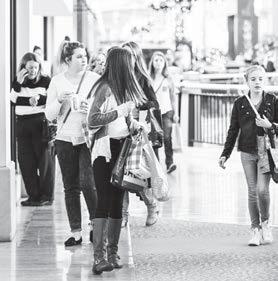

Usually the best deals are available only in limited quantities. If you’re not one of the very first shoppers, you’re likely to miss out. Even if you manage to get your hands on the product you want, you’ll need to push your way through the crowd to come to the cash registers, where you’ll stand in some extremely long lines. In rare cases, riots or deadly stampedes have even broken out among shoppers in order to get a certain deal or a particular product.
Answer the following.
1. What are the main reasons for shopping on Black Friday?
2. Why do shoppers come hours before opening time?
3. Are there any unpleasant situations during Black Friday shopping?
Match a word from A with a noun from B to make the collocation from the text. Are any other combinations possible?
1. amazing
2. indispensable
3. public
4. news
5. opening
6. limited
a. footage
b. quantities
c. holiday
d. discounts
e. time
f. element
Complete the sentences using the words/phrases from the texts in Unit 7. The first letter has been given.
1. You can take part in the meeting r_____________ of your age.
2. Lora had to return to the place which was her t_____________ home.
3. The main road is now closed and d______________ are in operation.
4. I must admit that they all look a__________ to me.
5. Diana knew all the clubs where her boyfriend usually h_______________.
Make nouns from the following verbs. Then use some of these nouns to complete the sentences below (1-4).
divert ______________; weigh_____________; consider____________ ; perceive_____________; imply _____________; indicate ____________.
1. The problem is that Richard shows little ______________for anyone but his wife.
2. There was no _____________ on Lara’s face what she was thinking.
3. You really lost some ____________since the last time I saw you. Congratulations!
4. Holmes was a man of extraordinary __________________. That’s why he was so successful.
Study these expressions (A and B) and make sentences using them.
A Expressions with GO
have a go at something – attempt to do something
give something a go – try something for the first time
on the go – very busy and active
B Constructions with LIKELY
It is likely that he will stay. They are less likely to fight. 6 5 4 3
It is likely + that-clause be + likely + infinitive
8 7
Household gadgets and appliances
Look at the pictures. Identify these objects and say what we use them for. You may find verbs in the box useful. Use a dictionary if necessary.
blend, heat, boil, cook, vacuum-clean, keep cold, iron
Example: A blender is used to blend/mix food.
Complete the dialogue. Use the words/phrases from the box. Then listen and check.
Salesperson
on
sale fitting do you take stock offer something in particular
Salesperson: Hello, can I help you?
Customer: I ______________ for a pair of jeans.
Customer I am looking I’m try them on They don’t fit that’s not exactly what I’m looking for Have you got
Salesperson: Are you looking for ____________? What size _______?
Customer: ________ size twenty-nine.
Salesperson: We have some very nice blue jeans here. They’re ___________this week.
Customer: Well, _______________________ . _____________this in black?
Salesperson: Yes. How about one of these? A special__________. Buy two for the price of one.
Customer: Where can I ______________?
Salesperson: The _____________ room is over there.
The customer tries the jeans on.
Customer: They’re too small. _____________me. Do you have these in a bigger size?
Salesperson: Sorry, we are out of____________. Would another colour do?
Customer: No, thanks.
In pairs, sort out these mixed-up sentences which are part of two different dialogues.
1. A: Have you seen this advert? It looks fun.
2. B: You’re right. If I go, I’ll get a new hairstyle… and a day out in London.
3. A: Hey, Sis. Look at this ad. There is a job in London.
4. B: I wouldn’t go anywhere unless they paid me a really good salary and a return fare!
5. A: Oh, but you’ve got beautiful hair. You don’t know what they might do.
6. B: It’s slave labour, isn’t it? Five kids and one evening off a week!
7. A: Yes, but the money might be very good.
8. B: I’d love to apply, but it’s a waste of time. My hair isn’t long enough.
9. A: Why not? You wanted a job in London.
10. B: Yes, I’ve seen it. I wouldn’t dream of applying for it.
Make the sentences more emphatic by replacing the adverb and adjective with a stronger version. More than one answer is possible.
1. I was very happy to see his exhibition.
2. The manager is extremely angry because the adverts were really bad.
3. The food in that restaurant was really good
4. The special effects in the film were really interesting.
6. It was a _____________ written report and it needed a lot of corrections. 11 10 9
Look at these intensifying adverbs and then do the exercise. completely, terribly, absolutely, entirely, highly badly, greatly, deeply quite, rather, partly, slightly barely, scarcely, hardly
Choose one adverb from the appropriate column in the table to fill the gap in each sentence. In some cases, there may be more than one possibility.
1. I’m afraid she’s still _____________ obsessed with the idea of buying that car.
2. She’s _____________ dedicated to her family.
3. They were _____________ impressed by her acting. They hadn’t expected her to be so good.
4. That’s _____________ ridiculous. You can’t offer him money for something like that.
5. He was only _____________ responsible. I am also to be blamed.
Make a few sentences using adverbs from each box. Examples: It’s a highly advertized product. / He was deeply hurt by Martha’s comment.
Which of the verbs in the box
1. take an infinitive?
2. take an -ing form?
3. take either, with no difference in meaning?
4. take either, but with a difference in meaning?
postpone / claim / fail / remember stop / refuse / begin / encourage hate / risk / try / demand / miss guarantee
Note: Verb patterns can include the passive forms of the infinitive or -ing form, when the focus is on the action.
Examples: I don’t expect to be told the truth by advertisers. She dislikes being criticized.
Some verbs, such as regret, remember, stop, or try, slightly change in meaning when followed by a gerund or an infinitive. What is the difference in meaning between these pairs of sentences?
1. a. I regret to tell you that you should leave.
b. I regret not keeping in touch with my old school friends.
2. a. We stopped to rest
b. Will you please stop making such a lot of noise?
3. a. I definitely remember closing the window before we left.
b. Can you remember to feed the cat while we’re away?
4. a. I tried to climb the tree, but I couldn’t get up.
b. Have you ever tried driving in London?
Complete the sentences using an appropriate gerund or infinitive.
1. She postponed _____________ home after shopping.
2. They considered ____________ to the capital after marriage.
3. We can’t afford _____________on holiday.
4. Tom recalled ____________ with his credit card at the store.
5. The guard refused ___________ them enter the building.
6. He demanded ______________to the manager.
7. We regret _______________ that the Flight 246 to Paris has been cancelled.
Complete the sentences with the correct passive form (gerund or infinitive) of the verbs in brackets.
1. I really don’t mind _______________________ (drive) by someone else.
2. He risked _______________________ (catch). It was a really brave act.
3. He expects _______________________ (invite) to the meeting.
4. I enjoy _______________________ (entertain) by his friends.
5. I don’t want _______________________ (tell) the truth.
Complete the sentences to make them true for you.
1. I find it difficult…
2. I usually avoid eating ... because...
3. … makes me nervous.
4. My parents have always encouraged me...
5. I’ll never get used to...
6. I’ve always dreamt about...
Your friend Marko asks you to help him translate his conversation with a salesperson in a department store. You should translate his questions into English and the salesperson’s answers into Serbian
M:
S: May I ask why he’s returning them?
S: Do you have the receipt? M:
S: I’m sorry. These jeans were on sale. There are no refunds on sale items. You can exchange them for something else.
M:
S: Of course. Here you are.
Study the idioms and use them in the correct form to complete the sentences.
take (your) hat off to (someone) = admire someone
have/keep something up (your) sleeve = to have a secret
hot under the collar = upset or angry about something
in (someone’s) shoes = in another person’s place or position
on a shoestring = on a very low budget, with very little money
dress up = to wear one’s best clothes
1. He gets really _________________ when he remembers that incident.
2. I could tell by her secretive look that she ____________________.
3. I decided to _______________ for dinner on Saturday night.
4. I would not like to be ________________ now that he has lost his job.
5. We went to Europe __________________ and we enjoyed it very much.
6. I really _________________ people who work full-time and study at the same time!
3 2 1
Read the text and decide which of the alternatives (A or B) best fits each gap.
Working memory is what you might call immediate memory. It’s your capacity to (1) _____ several images and sounds in your head at the same time. It is a bit like the brain’s notepad, where new information (2) _____ temporarily. When you learn someone’s name or hear the address of a place you’re going to, you (3) _____ those details in working memory for a while. If they’re not useful anymore, you let go of them (4) _____. For most adults, the maximum we can hold in our working memory is about seven items.
1. A store B supply
2. A is held B holds
3. A keep B hang on
4. A wholly B entirely
5. A innovations B connections
6. A space B capacity
7. A examine B check
8. A place B feature
9. A mind B memory
10. A reminded B recalled
Science is continually finding new (5) _____ between simple things we can do every day and an improvement in our general memory (6) _____. Many people have trouble remembering faces or names. How to remember things is only a technique that you need to develop. For example, to remember a face you just need to (7) _____ a person’s face discreetly when you are introduced. Try to find an unusual (8) _____, eyebrows, eyes, nose, chin, etc. Create an association between that characteristic, the face, and the name in your (9) _____. In that way, you will commit that detail to your long-term memory where it can be strengthened and (10) _____ later.
Replace the underlined words/phrases with word/s of similar meanings given in the Word list of Unit 8.
1. Could you explain more precisely the first point please? I don’t understand it.
2. He brought a lot of food, while I had just a sandwich.
3. His persistence was rewarded and he finally found a job.
4. Is the contract legally acceptable?
5. It is absolutely necessary to make our troop stronger.
What are the nouns made from the following verbs? correlate ________________ reinforce ________________ determine ________________ persevere ________________ confine ________________ introduce ________________
4 5 7 approximately • thus • accordingly • nevertheless • moreover
Match the expressions from the box (1-6) with their explanations (a-f) and use them to make sentences.
1. on the whole
2. on the one hand
3. on average
4. on behalf of
5. on schedule
6. on no account
a. usually; normally
b. taking everything into consideration
c. used to introduce one side of an argument
d. absolutely not
e. at the correct time; as planned
f. for; in the interests of
Example: On behalf of my colleagues and myself, I want to thank you for your support.
Use the words from the box to complete the sentences. Consult a dictionary if necessary.
1. Our plan is to reduce staff and ______________ to cut costs.
2. There are ______________ 350 students in the high school. I’m not sure of the exact number.
3. Those are the rules of the school and I expect you to behave ______________.
4. You have not really answered the question. ______________, there is no conclusion to your writing.
5. There is still a long way to go. ______________, I admit that some progress has been made.
Add a prefix from the box to a word in the brackets to complete the sentences. 6
1. If you want to join our team, you have to ______________well. (operate)
2. The problem is that he has never participated in any _______________ sports competition. (national)
3. We are going to park our car in a ______________ car park downtown. (storey)
4. Her black dress was _________________ for the casual atmosphere, but we had to admit that she looked dashing. (appropriate)
5. What he said was true, but it was absolutely _________________now. (relevant)
6. His demands appeared to be ________________ to the majority of the employees. (acceptable) in- ir- multi- co- inter- un-
Make these sentences more emphatic by replacing the adverb and adjective with a stronger version. More than one answer is possible.
1. Your student’s use of drawings is pretty interesting.
2. The actor’s last performance received very bad reviews from the critics. He was really sad.
3. The paintings were really good, but I was very tired after I’d seen them all.
4. I was very happy to win the race.
Abstract nouns derived from adjectives + -ness
E.g. worthiness, stillness, wellness, business
Note: Many adjectives ending in –ful and –less form abstract nouns adding –ness. Think of more examples: helplessness, thoughtfulness…
Transform these sentences using in spite of as shown in the example. Examples: a. Although he was friendly, I didn’t trust him.
b. In spite of his friendliness, I didn’t trust him.
1. Although he was careful, he made too many mistakes.
2. Although they’re sad, they never stop smiling.
3. Although he was nervous, his performance was excellent.
4. Although he looked helpless, nobody offered to help him.
Types of personality traits
Here is a list of some positive and negative personality traits. Choose a few from each box and try to explain why a particular trait is considered good or bad.
Positive personality traits
discreet
fair
patient
conscientious
helpful
optimistic
persistent
reliable
honest
responsible
Example: He is reliable because he is highly responsible and discreet. 8 9 10 11
Negative personality traits
lazy
dishonest
sarcastic
arrogant
rude
The passive – infinitive construction (personal or impersonal)
Rewrite these sentences using both passive constructions.
Example:
People say that he has lost his job.
It is said (that) he has lost his job. (Impersonal passive)
He is said to have lost his job. (Personal construction)
1. People think that the driver is responsible for the incident. It ___________________________________________________. The driver ____________________________________________.
quarrelsome
impulsive • unfriendly • thoughtless
• conceited

2. A journalist has reported that the world leaders have reached an agreement. It __________________________________________________________. The world leaders _____________________________________________.
3. We expect that this group of students will get the prize. It ___________________________________________________. This group of students ___________________________________.
4. Everyone believes he left the company because he found a better job. It is ___________________________________________________. He is __________________________________________________.
Using clichés
Translate this dialogue. The parts in italic should be translated using clichés or proverbs. There is a selection of expressions in the box to help you translate them. For those you don’t use in the dialogue, find an adequate expression in your language. А:
No pain, no gain
Out of sight, out of mind
All is fair in love and war
To be honest
Easy come, easy go
Nothing ventured, nothing gained
Every cloud has a silver lining
Time heals all wounds
Everything happens for a reason It is what it is It’s just wishful thinking
Underline the clichés in the following dialogue. Translate them using adequate clichés in your language.
Q: What’s the matter?
A: My head. It’s splitting.
Q: Have you taken anything?
A: I’ve taken everything but nothing seems to do me any good. It may be something serious. I’m frightened to death.
Q: Maybe you’re only coming down with a cold.
A: Oh, I always have a cold. I’m subject to colds.
Q: There are certainly quite a lot of them around. When are you leaving tomorrow?
A: At the crack of dawn.
Circle the correct answer. (12 pts.)
1. ________ she liked the house, she prevented him ________ it.
A Despite/from buying B Although/not to buy C Even though/from buying
2. ‘Did you really do everything you could? ’ - ‘_______, I could have consulted other experts.’
A I am admitting B Admittedly C That I admit
3. She seems _______very much in love with her new boyfriend.
A being B to be C that she is
4. He is thought a lot of money last year.
A to have earned B to make C is making
5. He felt ________that he was free at last and fell into a deep sleep.
A resigned B relieved C terrified
6. _________, Joe didn’t have his homework.
A To one’s surprise B On our surprise C To everyone’s surprise
7. ______ to the weather forecast, temperatures will drop to -20°C tonight.
A Related B According C As regards
8. The students ______ educated in Canada.
A are believed to be B are believed to have been C are believed were
9. I’d like to welcome you ______ the class.
A in behalf of B for behalf on C on behalf of
10. It is difficult to imagine ______ life without _____ telephone.
A a/a B the/the C __ /the
11. I need to sit by the fire. I’m ________ freezing!
A very B wholly C absolutely
12. The teacher recommended ________ additional material he had given us.
A to read B reading C on reading
Rewrite the sentences so that they mean the same, using the words in capital letters. (8 pts.)
1. Apologize to him or it’s possible that you’ll lose the job. /RISK Apologize to him or ______________________________.
2. I haven’t got enough money to go on holiday this year. /AFFORD I wish __________________________ on holiday this year.
3. Sara regrets forgetting to send Tom an invitation for her wedding. /REMEMBER Sara wishes ______________________ an invitation for her wedding.
3
4
4. I don’t think we should even consider other possibilities. /WORTH Other possibilities __________________________________.
5. My mother said ‘Well done’ when I passed my driving test. /CONGRATULATE My mother _______________________________ my driving test.
6. You shouldn’t eat so much late at night. /LESS I suggest __________________________________.
7. Whenever you come to Belgrade, don’t forget to call me. /IF Remember __________________________________.
8. People think that the burglar was responsible for the fire. /THOUGHT The burglar____________________________________________.
Choose the synonymous word (A, B or C) which can replace the word in bold in the following sentences. (6 pts.)
1. These devices may be purchased in all department stores in the capital.
A bought B delivered C held
2. It’s better to say nothing than give me false directions.
A misleading B distrustful C irregular
3. Roger said he was on holiday when the murder occurred
A committed B happened C proved
4. I recognized his voice because it was rather distinctive.
A astonishing B complex C characteristic
5. Their constant shouting disrupted the debate several times.
A interrupted B misused C provoked
6. Their relationship was short lived as they were clearly incompatible.
A unsuited B similar C in harmony
Complete the sentences using ONE word only. (4 pts.)
1. According _______ the salesman my new car will be delivered next Wednesday.
2. I have always regarded you ________ my friend.
3. Apart _________jogging occasionally in the park, my sister gets no exercise.
4. Time _________all wounds. You have to be patient.
Unit 5 Key to the exercise Lead-in: 1e 2b 3a 4c 5d
TEST 1
1 1. tribes 2. ancestors 3. contemporary 4. famine
2 1.impact 2. vanish 3. abundant 4. ban 5. diverse
3 1. were waiting 2. have been 3. hadn’t visited 4. I have been thinking 5. have been cleaning
4 1. - / the 2. - / - 3. - / the
TEST 2
1 1. merge 2. disrupted 3. predators 4. resources 5. accuracy 6. phenomena
2 1. I’ve been doing 2. has stolen 3. has been lying 4. have you bought 5. has asked
3 1. a 2. b 3. a 4. a 5. b
4 1. make out 2. have come out 3. (has) turned out 4. worn out
TEST 3
1 1. call off 2. will 3. convinced 4. shortlist 5. contribution
2 1. fund 2. preceding 3. consideration 4. noble 5. mankind
3 1. will have cooked 2. will have been studying 3. will be skiing 4. will have been discussing 5. will have used 6. will be getting married
4
1. He asked me to bring him his book to the meeting that night / tonight.
2. The child admitted that she/he had broken the vase.
3. She warned him not to come near her.
4. He inquired if I was coming to the board meeting.
TEST 4
1 1. drawback 2. baffled 3. grasp 4. ajar 5. overall
2 a. ignore b. solid c. replacement d. alike
3 1. must have left 2. had already been playing 3. had been hurting 4. must have been 5. could have won 6. may have taken 7. likely
4 1. Hardly had he entered the house when the police arrested him.
2. Never had I for one moment thought the consequences would be so serious.
3. On no account must you lift heavy weights like that again.
4. Not only has Tom broken his leg but he has also injured his shoulder.
TEST 5
1 1. amount to 2. deafening 3. cast 4. owed 5. altitude
2 1. would have believed 2. would be 3. hadn’t forgotten 4. would go 5. met
3 1. assuming 2. unless 3. even if 4. in case 5. provided 6. on the condition that 4 1. The army had to be called out to help with rescue work.
2. Wine isn’t served to teenagers with meals here.
3. The bill must be paid before the first of the month.
4. Dogs aren’t kept on leads in this park.
1 1. indications 2. imply 3. intimidated 4. terrifying 5. teasing 6. incompatible
2 1. typing 2. correspondence 3. edition
3 1. wimp 2. myriad 3. tough
4 1. Not knowing what present to buy, I decided to make you this. 2. While crossing the street yesterday, I nearly got knocked down by a bus. 3. Having worked for ten years in a bank, she decided to look for a new job.
5 1. I really regret not keeping in touch with my friends from school. 2. If it wasn’t raining, we could play tennis. 3. If I were you, I would sell this old car and buy a new one. 4. I wish I had remembered to pay the electricity bill. 5. Not wanting to quarrel with him, she apologized.
1. 1. downside 2. browse 3. convey 4. temporarily 2. 1. treat 2. thrive 3. available 4. temptation 5. tremendous 6. skip
3. 1. There’s no point in waiting for him. He won’t come back. 2. I am not keen on cooking.
3. In my opinion, he is bound to succeed in life. 4. The headmaster is likely to be re-elected. 5. The houses seem to be deserted. 6. He seems to be used to jogging every morning.
4 1/D 2/D 3/B 4/C
1 1. trait 2. skimmed 3. relate 4. perseverance 5. confined 6.valid 2 1. reinforce 2. clarify 3. excel
3 1. despite 2. otherwise 3. however 4. undoubtedly 5. whereas 6. consequently 4 1. He is regarded as a leading scientist. 2. His father is believed to have discovered those artefacts. 3. We expect he will return in a week. 4. A beggar is reported to have broken into his bungalow last Friday. 5. She left work early so that she could be/so as to be with the children.
Unit 1 1d 2c 3e 4a 5b
Unit 2 The elephants ... /...live in herds. 2. The lions .... /...live in prides. 3. ... bird species ... /in flocks 4. The wolves... /...in packs 5. Fish ..../...a school
Unit 3 1. bookworm 2. bookmark 3. bookstall 4. bookmaker 5. bookkeeper 6. booking office
Unit 5 1c 2d 3a 4g 5f 6b 7e
In each composition there must be a theme or a single idea which dominates the work. Present your ideas clearly depending on the kind of essay (narrative, opinion, for and against, etc.)
Read the title carefully. Spend 5 or 10 minutes planning your composition. It isn’t a waste of time, it is better if you know in advance what you want to write about.
Arrange the ideas in your plan so that they fit into four to six paragraphs. Your main aim is to give all the facts in the right order. The introduction and conclusion should always be given their own paragraphs.
The introductory paragraph should define the aim of the composition and what it hopes to achieve, while also giving general facts about the topic.
You can have 2 – 4 paragraphs with main ideas giving details or examples.
Successive paragraphs should be linked by the ideas they contain. Use the correct linking words. For listing arguments or points use: firstly, first of all, secondly, next, thirdly, finally, last of all. A new paragraph is also used each time you are contrasting two points or presenting each side of an argument.
Try to show as much skill in ending your composition as you do in starting it. First and last impressions are important. The concluding paragraph provides a summary of the information and arguments contained in the composition. Do not introduce new ideas. Finish the composition by bringing it to the point of greatest interest. Use a sentence which will show the reader that your account has finished. For concluding you can use one of these phrases: in brief, in short, in conclusion, to conclude, to summarize.
Try to write clear, simple sentences that express exactly what you want to say.
Don’t forget to check your grammar, spelling and punctuation.
E-mails, whether for business or social reasons, are usually written in a more informal style than letters.
You should always give your e-mail a subject, which should summarize its purpose in a few words.
If you are including any attachments, make sure to mention it in the text of your e-mail.
You can start your e-mail by using the words Dear or Hi, followed by the first name of the person you’re writing to.
You can use some of these expressions in your e-mail:
Sorry it’s taken me so long to write.
I hope you’re well.
Look forward to seeing you soon.
To close a personal e-mail, you can use the expressions: Best wishes / Kind regards. If writing to a family member, partner, or close friend, you can finish with the following: Love, sign your first name.
The conventions for starting business e-mails vary, although it is quite common to use first names for both business and personal e-mails if you know the recipient.
It is not necessary to use ‘Dear’, although some people prefer to do this.
The content of business e-mails should be brief and to the point.
For closing business emails, the following phrases are appropriate:
Regards/Kind regards/Best regards.
In business emails, you should also include your full name, organization, and contact details at the end.
Irish dance or step dance is known for its quick and precise leg and foot movements. The body should be upright and relaxed. The arms and hands should be kept flat against the side.
Dancers are taught to show control and the grace of their bodies.
The costumes worn by Irish dancers today reflect the clothing of the past. Each school of dancing has its own distinct dance costume. The dresses worn by women are copies of Irish traditional dresses. A brooch is worn on the shoulder holding a shawl which falls down over the back. The men wear a kilt and jacket, with a cloak hanging from the shoulder. The dancers wear hard or soft shoes. The hard shoes are used to produce a stamping sound.
The dancing traditions of Ireland are in close association with traditional Irish music. The pipe and flute are the main accompanying instruments. There are two distinctive forms of Irish dancing: solo dances and figure dances. Solo dances, performed nowadays mainly in exhibitions or competitions, require a great deal of skill and years of practice. Figure dances are simple and easy to learn. They can be performed in a square, circle or line formation and require only an elementary knowledge of seven basic steps.
Irish step dancing was popularized in 1994 by the world-famous show Riverdance which consists mainly of traditional Irish music and dance. The success of Riverdance and more recently Lord of the Dance has placed Irish dance on the international stage.
H: Good evening. This is the Helen Robinson’s radio talk show – Great Adventurers. Tonight we would like to welcome Tom Harris, a photographer, who has recently returned from a canoe safari on the Zambezi River. Tom, have you brought a lot of photographs of the great river?
T: Of course, I have. I took hundreds of photos of the wildest and most beautiful scenery in the world. I’ve been trying to sort them out since I returned, but unfortunately, I haven’t managed to do it yet.
H: Where did you start your journey?
T: After Victoria Falls we followed the river through a deep gorge, with steep cliffs above. There the river flowed swiftly and we paddled carefully, avoiding the rocks of the rapids. Then the landscape changed and we found ourselves in the Zambezi flood plain, which is the habitat of a great number of amazing animals.
H: Did you have any encounter with dangerous animals?
T: Yes, but only with those living in the water, hippos and crocodiles. There, where the river widened, we saw a large group of hippos floating in the muddy water. They watched us approach and then snorted before disappearing beneath the water. We were very careful and paddled close to the banks because one bite from those jaws could have put an end to our safari. Then we noticed crocodiles sunbathing on the sandbanks. As we drew closer, they slid silently into the water. They cruised past us looking for an easy meal.
H: What is your next great adventure?
T: I’ve been planning an expedition to the Amazon for years, but I haven’t raised enough money yet. However, I’m not giving up the idea.
H: Thank you, Tom, for being with us tonight.
Track 6 Track 11
American Nobel Prize and Pulitzer Prize-winning novelist
Hemingway was a reporter, soldier, short-story writer, novelist, deep-sea fisherman, but first of all a man whose unique art of writing influenced the style of an entire generation of writers.
His novels came out of his own life experiences. As a 19 year-old, during World War I, he was accepted as an ambulance driver in Italy where he was badly wounded and had to spend some time in hospital. This experience would provide material for his future novel A Farewell to Arms
After the war, he spent years in Paris as a correspondent. The publication of The Sun Also Rises established his reputation as a novelist.
From his home in Florida he made many trips, including several safaris to Africa. As a result, he wrote his best short story, The Snows of Kilimanjaro.
In 1936 he went to Spain as a war correspondent. For Whom the Bell Tolls is his longest novel and it came out of his experiences in the Spanish Civil War.
Hemingway was again in the role of a war correspondent in World War II. After the war he settled in Cuba. There he spent a lot of time with fishermen and their stories gave him the idea to write a short novel, The Old Man and the Sea. The novel brought him the Pulitzer Prize for distinguished American fiction.
In 1954 the Swedish Academy awarded him the Nobel Prize for Literature for ‘his powerful modern narration, as most recently revealed in The Old Man and the Sea.’
In 1961 writing was becoming impossible because of his illness and this literary genius committed suicide.
14
In 1853, George Crum worked as a cook in New York, in a restaurant which was well known for its delicious, thick-sliced fried potatoes. One day a customer, not being satisfied with the taste of potatoes, kept sending back his plate to the cook. Whenever he returned the plate, he complained that chips were not fried enough and that they should be sliced a little thinner. Crum finally lost his temper. He cut paper-thin slices of potatoes, fried them until they were hard as a rock and salted them heavily. To the chef’s surprise, the customer loved them and wanted more! The rest of the story is... as they say... history. Today, this accidental invention is a popular snack food all over the world.
A picnic lunch in 1959 inspired a man to invent the pop top. Ernie Fraze, the owner of a successful engineering company, was attending a picnic when he realized he’d forgotten to bring a can opener for the drinks. It crossed his mind that it was a problem that other people must have encountered as well and decided to find a solution to it. Fraze designed a new kind of can, often referred to as a pop top, that could be easily opened with a removable tab. Eventually, his company began to manufacture such cans and sell them to soft drink producers and beer brewing companies.
The inventor of Coca-Cola wasn’t a shrewd scientist who wanted to strike it rich in the beverage business. John Pemberton, a pharmacist by profession, just wanted to cure his headache. He used two main ingredients: coca leaves and kola nuts. When his lab assistant accidentally mixed the two with carbonated water, the world’s first Coke was the result. But sadly, Pemberton died two years
later and never saw his simple mixtures give birth to a soft drink empire.
Track 17
When the Titanic went down in 1912, she took with her the lives of many brave people including her entire crew of engineers. It was their duty to keep on pumping the water from the flooding compartments, which delayed the sinking by many minutes. The pumping and electrical lighting had to be maintained as long as possible giving people more minutes of light so that they could find their way out. All the engineers stayed at their tasks until the very end and in that way a lot of people had a better chance to survive. When the order to abandon the ship came, it was too late for them.
During the summer of 2014, the illegal immigration of people from countries in Africa and the Middle East into European countries became better controlled than ever before. As a result, migrants were taking far more risky journeys by boat, which led to hundreds of them drowning. During that summer, the Italian family Caltrambone bought a boat to help save migrants who were in trouble at sea. Around 3,000 men, women and children were safely transported to Italy and Malta. If they had not been rescued, they might not have survived.
Rob Howard took his daughter and two of her friends for a swim in New Zealand. Suddenly a group of dolphins started pushing all four of them together by making a tight circle around them and didn’t let them swim away. Rob soon noticed a big shark heading towards the group. The shark
swam in circles around them for some time until it lost interest and swam away. It was clear that the dolphins had made a circle to protect them.
Sandra
I left college with a full qualification to work with young children, but decided it wasn’t for me. My brother gave me the idea to get a licence and work with him as a lorry driver. When I walked into the classroom to do the first of my practical exams, I felt really intimidated. I was the only girl. I passed the tests easily, but the first time I sat behind the wheel was terrifying. Fortunately I got used to it pretty quickly and now I really enjoy driving. A lot of teasing goes on where I work. It’s always going to be seen as a man’s world. However, I don’t think that there are jobs that only boys or girls could do. It’s what they want to do that matters.
Jessica
I’m studying to become a surgeon. Women are not prevented from pursuing surgery as a career, but it is generally seen as a men’s profession. Being a surgeon is tough; but then, most things in life that are worth doing require hard work. Surgery is extremely rewarding and competitive. I know I am lucky to do a job I love, but I would be insincere if I said I’ve enjoyed every minute. There have been some very difficult times. Some female medical students tell me they don’t want to do surgery because it’s incompatible with having a family. That maybe so, but I have no intention of giving it all up if I start a family. I believe that eventually I will have both.
Morgan
I rarely enter a store unless I am actually in need of something... like a new pair of pants. But I don’t head to the stores just to see what’s there on the off-chance, or if something I don’t need might catch my eye. Besides, I find malls hot and crowded and I quickly become bored. However, a lot of my friends seem to actually enjoy the activity. And it baffles me. The whole concept of wandering around a bunch of stores without any real need or purpose is pointless.
Shopping is fun, and we all like to treat ourselves to new items. I shop because I find pleasure in buying things, even when I don’t need them. I’ve struggled a lot with controlling my shopping addiction. When I’m dealing with an unpleasant situation or have a challenging task in front of me, I often experience an uncontrollable impulse to hit the shops.
In order to resist the temptation, now, when I need to go shopping for essential items, I calculate how much money I need and I leave my credit cards at home or make a shopping list.
For me, shopping is just shopping; it means some new clothes for work or a small trinket for a friend. I go, buy what I need and leave. I don’t look upon it as an enjoyable social pastime, since I often feel a frustration when I see goods that I can’t afford. However, I know that shopping is for many people a popular leisure pursuit. They say that treating themselves to something nice at the shops has a ‘positive impact on their mood’. That might be true, but the effect of such satisfaction doesn’t last long and then they’re back where they started, only a bit poorer.
Roger
Track 25
Well, the first reason I can mention why I don’t like it is pretty obvious. Most adverts are rather irritating. I don’t like commercials breaking up my TV shows or seeing adverts while playing a game on my computer.
Besides, lots of money is spent on a single advertisement by paying celebrities to endorse a product, which does not really help increase the value of the product. If that amount of money is spent on improving the quality of the product, it will be more beneficial both for the producer and the consumer.
Bill
To be honest, I don’t mind watching commercials when they are really effective and relevant. However, most advertising is generally disappointing. Open up any newspaper or magazine and you’ll find that most advertisers lack inspiration; there are so many old ideas repeated, only for different products.
I hear mixed reactions from my friends when we happen to talk about ads. Nevertheless, we all agree that the effect of advertising is tremendous and it is absolutely amazing how a good ad can help any product or service become popular in almost no time!
27
When I was just two years old, I could do 200 piece jigsaws and read newspapers and books. At three, I was calculating using long division. I was given many IQ tests at schools and teachers tried to advance me several grades. My parents wisely refused, but did allow a single grade skip. I often asked my mother what my IQ score was since I knew that I had taken many IQ tests. She insisted it was not important. Eventually, when I was 10, she gave in and told me it was 120. I was disappointed and thought, ’Well, I am not so smart after all.’ My school success was explained by my good memory and the fact that I had read most of the material for any class years before. I concluded that one could make up for average intelligence by reading a lot and working hard.
I became a professor at a top university before I was 30. Once when I was with my parents and the subject of IQ came up, I happened to mention how much I achieved although I had a barely aboveaverage IQ. My mother laughed and said that she just gave me that number because I kept pestering her and she thought it was a bad idea for me to think I was exceptionally smart. Actually, I had the highest score the testers had ever seen. By that time in my life, it meant absolutely nothing to me. I was only aware that she had made exactly the right decision to tell me I was neither average nor particularly smart. My academic potential had to be balanced by my overall well-being. She didn’t want me to grow up under the pressure of being a child prodigy, but to enjoy my childhood.
Infinitive Past Tense Past Participle be /bi:/ beat /bi:t/ become /bI"kVm/ begin /bi"gin/ bend /bend/ bind /baInd/ bite /baIt/ blow /bl@U/ break /breik/ bring /brIN/ build /bild / burn* /b3:n/ burst /b3:st/ buy /baI/ cast /kA:st/ catch /k&tS/ choose /tSu:z/ come /kVm/ cost /kQst/ cut /kVt/ deal /di:l/ do /du:/ draw /drO:/ dream* /dri:m/ drink /driNk/ drive /draIv/ eat /i:t/ fall /fO:l/ feed /fi:d/ feel /fi:l/ fight /faIt/ find /faind/ fly /flai/ forbid /f@"bId/ forget /f@"get/
was,were /wQz, w3:/ beat /bi:t/ became /bI"keIm/ began /bi"g&n/ bent /bent/ bound /baUnd/ bit /bIt/ blew /blu:/ broke /br@Uk/ brought /brO:t/ built /bilt/ burnt /b3:nt/ burst /b3:st/ bought /bO:t/ cast /kA:st/ caught /kO:t/ chose /tS@uz/ came /keim/ cost /kQst/ cut /kVt / dealt /delt/ did /dId/ drew /dru:/ dreamt /dremt/ drank /dr&Nk/ drove/dr@Uv/ ate /et/ or /eIt/ fell /fel/ fed /fed/ felt /felt/ fought /fO:t/ found /faund/ flew /flu:/ forbade/f@"beId/ forgot /f@"gQt/
been /bi:n/ beaten /bi:tn/ become /bI"kVm/ begun /bi"gVn/ bent /bent/ bound /baUnd/ bitten /bItn/ blown /bl@Un/ broken /br@Ukn/ brought /brO:t/ built /bilt/ burnt /b3:nt/ burst /b3:st/ bought /bO:t/ cast /kA:st/ caught /kO:t/ chosen /tS@uzn/ come /kVm/ cost /kQst/ cut /kVt / dealt /delt/ done /dVn/ drawn /drO:n/ dreamt /dremt / drunk /drVNk/ driven /drIvn/ eaten /i:tn/ fallen /fO:ln/ fed /fed/ felt /felt/ fought /fO:t/ found / faund / flown /fl@un/ forbidden/f@"bIdn/ forgotten /f@"gQtn/
бити
ударити
постати
почети
савијати се
везати, повезати
загристи
дувати
поломити
донети
градити
горети
прснути
купити
бацити
ухватити
изабрати
доћи
коштати
сећи
поделити
чинити, радити
цртати, вући
сањати
пити
возити
јести
пасти
хранити
осећати
борити се
наћи
летети
забранити
заборавити
Infinitive Past Tense Past Participle forgive /f@"gIv/ freeze /fri:z/ get /get/ give /giv/ go /g@u/ grow /gr@u/ hang* /h&N/ have /h&v/ hear /hi@/ hide /haId/ hit /hit/ hold /h@Uld/ hurt /h3:t/ keep /ki:p/ know /n@U/ lay /leI/ lead /li:d/ learn*/l3:n/ leave /li:v/ lend /lend/ let /let/ lie /laI/ light /laIt/ lose /lu:z/ make /meik/ mean /mi:n/ meet /mi:t/ pay /pei/ put /put/ read /ri:d/ ride /raid/ ring /rIN/ rise /raiz/ run /rVn/ say /sei/ see /si:/ seek /si:k/
forgave /f@"geIv/ froze /fr@uz/ got /gQt/ gave /geiv/ went /went/ grew /gru:/ hung /hVN/ had /h&d/ heard /h3:d/ hid /hId/ hit /hit / held /held/ hurt /h3:t / kept /kept/ knew /nju:/ laid /leId/ led /led/ learnt /l3:nt/ left /left / lent /lent/ let /let/ lay /leI/ lit /lIt/ lost /lQst/ made /meid/ meant /ment/ met /met/ paid /peid/ put /put// read /red/ rode /r@ud/ rang /r&N/ rose /r@uz/ ran /r&n/ said /sed/ saw /sO:/ sought /sO:t/
forgiven /f@"gIvn/ frozen /fr@uzn/ got /gQt/ given /givn/ gone /gQn/ grown /gr@un/ hung / hVN / had /h&d/ heard /h3:d/ hidden /hIdn/ hit /hit / held /held / hurt /h3:t / kept /kept / known /n@Un/ laid /leId / led /led / learnt /l3:nt/ left/left / lent /lent / let /let / lain /leIn/ lit /lIt / lost /lQst / made /meid / meant /ment/ met /met/ paid /peid / put /put/ read /red / ridden /ridn/ rung /rVN/ risen /rizn/ run /rVn/ said /sed/ seen /si:n/ sought /sO:t/
опростити
замрзнути
добити
дати
ићи
расти
окачити
имати
чути
сакрити
ударити
држати,
повредити
чувати, држати
знати
положити
водити
учити
оставити, отићи
позајмити некоме
дозволити
лежати
упалити
изгубити
направити
значити
срести
платити
ставити
читати
јахати, возити се
позвонити
подићи се
трчати
рећи
видети
тражити
Infinitive Past Tense
Past Participle sell /sel/ send /send/ set /set/ shake /SeIk/ shine /SaIn/ shoot /Su:t/ show /S@U/ shut /SVt/ sing /siN/ sink /siNk/ sit /sit/ sleep /sli:p/ slide /slaId/ smell*/smel/ speak /spi:k/ spell*/spel/ spend /spend/ spoil*/spOIl/ spread /spred/ spring /sprIN/ stand /st&nd/ steal /sti:l/ sweep /swi:p/ swim /swim/ take /teik/ teach /ti:tS/ tear /te@/ tell /tel/ think /TiNk/ throw /Tr@u/ understand /Vnd@"st&nd/ wake /weIk/ wear /we@/ win /win/ write /rait/
sold /s@uld/ sent /sent/ set /set/ shook /SUk/ shone/SQn/ shot /SQt/ showed /S@Ud/ shut /SVt/ sang /s&N/ sank /s&Nk/ sat /s&t/ slept /slept/ slid /slId/ smelt /smelt/ spoke /sp@uk/ spelt /spelt/ spent /spent/ spoilt /spOIlt/ spread /spred/ sprang /spr&N/ stood /stud/ stole /st@Ul/ swept /swept/ swam /sw&m/ took /tuk/ taught /tO:t/ tore /tO:/ told /t@uld/ thought /TO:t/ threw /Tru:/ understood /Vnd@"stud/ woke /w@Uk/ wore /wO:/ won /wVn/ wrote /r@ut/
*The verb also has a regular form.
sold /s@uld/ sent /sent/ set /set/ shaken /SeIkn/ shone/SQn/ shot /SQt / shown /S@Un/ shut /SVt/ sung /sVN/ sunk /sVNk/ sat /s&t/ slept /slept/ slid /slId/ smelt /smelt/ spoken /sp@ukn/ spelt /spelt/ spent /spent/ spoilt /spOIlt/ spread /spred/ sprung /sprVN/ stood /stud/ stolen /st@Ul@n/ swept /swept/ swum /swVm/ taken /teikn/ taught /tO:t/ torn /tO:rn/ told /t@uld/ thought /TO:t/ thrown /Tr@un/ understood /Vnd@"stud/ woken /w@Ukn/ worn /wO:n/ won /wVn/ written /ritn/
продати
послати
ставити
трести
сијати
бацити, пуцати
показати
затворити
певати
потонути
седети
спавати
клизнути
мирисати
говорити
срицати
потрошити
упропастити
раширити
искочити
стајати
украсти
почистити
пливати
узети
учити некога
поцепати
рећи
мислити
бацити
разумети
пробудити
носити (одећу)
победити
писати
back up – give someone support break down – stop working
break in – enter using force
break into – enter to steal something
break out – start, begin suddenly and sometimes violently
bring in – introduce a new law, rule or system
bring up – raise children, look after them
bring along – bring someone or something with you bring back – think about the past events, return something bring down – reduce, make something smaller
call after – give the same name as call for – require
call in – stop at a place while on a way to somewhere else
call off – cancel
call on – visit
call out – speak in a loud voice; tell workers to go on strike
call up – phone
carry away – make enthusiastic carry on – continue
carry out – conduct, perform a task
carry through – accomplish
catch up with – get to the same standard as the others
come up against – be faced by, be stopped by
come across – find by chance come into – inherit
come out – become known publicly; be issued
come up with – think of, invent, produce
come up – be mentioned, discussed, arise
cut down on – reduce
cut off – disconnect a phone call
get along/on – have a good relationship with
get on – enter a bus/train
get off – leave a bus/train
get away with – escape the consequences of
get over – recover from an illness/ loss; overcome
get down to – give one’s attention to something
get through – succeed in making contact; reach
get rid of – eliminate, throw away give away (something) – reveal information that you should keep secret, give something old to someone else as a gift
give out – distribute
give in – stop competing or arguing and accept you can’t win give up – stop doing something that you do regularly
give off – send (light, energy, smell etc.) out from a source
go in for – do something regularly as a hobby; take part in a competition
go off – become bad/rotten
go on – continue
go out (light) – stop giving out light
go through – experience
go up – rise
hold up – delay
keep up with – try to do the same as someone else, go at the same speed
keep off – prevent from touching, not walk on
keep on – continue
keep out – not allow to enter
keep away – not allow to come near
keep something up – maintain a standard/appearances; continue
keep to – remain steady or faithful to something
keep back – not tell (information) look after – take care of look for – try to find
look down on – have a poor opinion of (somebody), consider inferior / think less of look up to – respect someone look into something – investigate
look something up – find information in a reference book
look forward to – be excited about the future
look out – be careful, mind make for – go in the direction of make off (with) – run away, escape
make out – manage to see or hear clearly
make up – invent (a story)
make up for – compensate for put out – cause something to stop burning
put up – give hospitality to someone overnight
put up – increase prices or taxes
put up with – tolerate
put forward – propose for consideration; suggest a new plan
put through – connect someone by phone
put on – gain weight; wear put off – postpone
set something aside – keep something (money/time) for a special purpose
set off – start to go somewhere set something off – cause an explosion; make an alarm start ringing
set out (on) – begin a journey/ drive/voyage
set up – start a company/ organization; establish run after – chase
run down – feel weak due to overwork
run down/over – hit by a vehicle
run out of – not have any more, use up
run into – meet by chance
run up against – meet with difficulties
sort out – deal successfully with a problem; organize
spread out – open something and put it on a surface
stand by – help, support
stand for – be the abbreviation of stand for – represent something stand out – be the best, be easily seen
stand up (to) – to resist; confront bravely
stand up for – speak for someone /something; support
stand in for – take somebody’s place (if they are ill)
take somebody in – deceive, trick take something in – understand take after somebody – resemble in looks
take off – leave the ground and start flying; remove clothing/shoes take off – suddenly become successful/popular
take over – take control of something
take to – begin to like take up – begin doing something as a hobby
turn down – reject; refuse an offer turn down – lower the volume turn off – switch off turn on – switch on turn up – appear suddenly turn out – end up being; result turn into – transform turn to – ask someone for help; address
wear out – wear something so much that it becomes unusable
work out – think about the problem and find the answer
abundant /@bVnd@nt / adj −
изобилан
accuracy /&kjUr@si/ n −
прецизност
admittedly / @dmItIdli/ adv
– по општем признању, општеприхваћено
ajar /@dZA:/ adv – полуотворено, одшкринуто
altitude /<Itju;d/ n − надморска
висина
ancestor /&nsest@/ n – предак
apparently / @p&r@ntli/ adv –
очигледно
approximately /@prQksIm@tli/ adv
– приближно
arise /@raIz/ v – настати, појавити се
arms /A:mz/ n − оружје array /@reI/ n − највећи низ, ред, распоред, поредак
artefact /A:tIf&kt/ n –рукотворина, артефакт
assume / @sju:m/ v –претпоставити
attitude /&tItju:d/ n − став available /@veIl@bl/ adj – доступан
bachelor /b&tS@l@/ n – нежења
baffled /b&fld/ adj – збуњен
ban /b&n/ v – забранити
bank (river) /b&Nk/ n – обала
bed (river) /bed/ n – корито
behaviour /bIheIvj@/ n −
понашање
beverage / bev@rIdZ/ n – пиће
bias /baI@s/ n – пристрасност, предрасуда
bind /baInd/ v – повезати
blessed /blesId/ adj – благословен
brewing /bru:IN/ n – пиће, врење, прављење пива
brimming /brImIN/ adj – препун, који се прелива
brooch /br@UtS/ n − брош
browse /braUz/ v – претраживати
bulky /bVlki/ adj – кабаст, масиван
cardboard /kA:dbO:d/ n – картон
carp /kA:p/ n − шаран
cast /kA:st/ v − бацати
clarify /kl&rIfaI/ v – разјаснити
clay /kleI/ n – иловача
cloak /kl@Uk/ n огртач
club /klVb/ n – батина, штап
cod /kQd/ n − бакалар
come up /kVm Vp/– појавити се, искрснути
confined /k@nfaInd/ adj –
ограничен
confluence /kQnflu@ns/ n – спој двеју река, ушће
congregate /kQNgrIgeIt/ v –
скупити се
consequently /kQnsIkw@ntli/adv –
према томе, због тога
consideration /k@nsId@reIS@n/ n –
обзир, разматрање
constitute /’kQnstItju:t/ v –
конституисати, установити
constitution /kQnstItju:Sn/ n –
устав
contemporary /k@ntemp@r@ri/ adj
− савремен
contribution /kQntrIbju:S@n/ n –
допринос
convey /k@nveI/ v – пренетити, саопштити
convince /k@nvIns/ v − убедити
crab /kr&b/ n − рак
dam /d&m/ n – брана
dazzling /d&zlIN/ adj – блештав, диван, заслепљујући
depression /dIpreS@n/ n − удубљење
descendant /dI’sendnt/ n –
потомак
device /dIvaIs/ n – направа, уређај
dig /dIg/ v − копати
disrupt /disrVpt/ v – пореметити,
прекинути
distinctive /dIstINktIv/ adj –
карактеристичан, особен
distinguish (oneself) /dIstINgwIS/ v – истаћи се
diverse /daIv3:s/ adj −
разноврстан, различит
diversion /daIv3:S@n/ n –
дигресија, разонода, одвраћање
downside /daUn.saId/ adj – лоша (негативна) страна
drawback /drO:b&k/ n –
недостатак, мана
drift /drIft/ v – кретати се споро
dumping /dVmpIN/ n – бацање
отпада
edge /edZ/ n – ивица
efficient /IfIS@nt / adj – ефикасан
elevation /elIveIS@n/ n −
уздизање
embodiment /ImbQdIm@nt/ n −
оличење, отелотворење
emerald /em@r@ld/ n/adj −
смарагд(ни)
endorse /IndO:s/ v –
промовисати, одобрити
ensure /InSO:/ v − осигурати
establish /Ist&blIS/ v −
установити
evolve /IvQlv / v – развити се
excavate /eksk@veIt/ v – ископати
excel /Iksel/ v – истицати се,
надмашити
expanse /Iksp&ns/ n –
пространство
facilities /f@sIl@ti:z/ n – објекти, установе, средства
famine /f&mIn/ n – глад
fast /fa:st/ n – пост
fertilize /f3:tIlaIz/ v − оплодити
fixedly /fIksIdli/ adv – упорно,
нетремице
flesh /fleS/ n – тело, месо (људско)
fling /flIN/ v – бацити
flock /flQk/ n – јато (птица)
frenzy /frenzi/ n – помама
fund /fVnd/ n – фонд
fungus /fVNg@s/ n – гљива
gain /geIn/ v − добити
generate /dZen@reIt/ v –
произвести, створити
genuine /dZenjuIn/ adj –
истински, прави
gill /gIl/ n − шкрга
glamorous /gl&m@r@s/ adj –раскошан, чаробан
glow /gl@U/ v – сијати
goods /gUdz/ n − роба
gorge /gO:dZ/ n – клисура
grant /grA:nt/ v – доделити
grasp /grA:sp/ v – схватити, зграбити
gravel /gr&v@l/ n − шљунак
habitat /h&bIt&t/ n – станиште
herd /h3:d/ n – стадо
heritage /herItIdZ/ n − наслеђе
humble /hVmbl/ adj – скроман
ignore /IgnO:/ v – игнорисати impact /Imp&kt/ n − утицај
imply /ImplaI/ v – сугерисати, циљати, подразумевати
incompatible /Ink@mp&t@bl/ adj – неодговарајући, неспојив, инкомпатибилан
indication / IndIkeIS@n/ n – знак, индикација
indispensable /IndIspens@bl/ adj –неопходан, нужан infamous /Inf@m@s/ adj –озлоглашен
infinite /InfIn@t/ adj – бесконачан
initial /InIS@l/ adj – почетни
interpersonal /Int@p3:s@n@l / adj –међуљудски
intrigue /In ’tri:g/ v − побудити интересовање
intrusive /Intru:sIv/ adj –наметљив
item /aIt@m/ n – предмет, ставка
itinerary /aItIn@r@ri / n –маршрута, итинерер lobster /lQbst@/ n − јастог lush /lVS/ adj – бујан
majority /m@dZQr@ti/ n – већина make an allowance for (something) – узимати у обзир manufacture /m&nj@f&ktS@/ v –производити
mate /meIt/ v − парити се
merge /m3:dZ/ v – стопити се, интегрисати се
minority /maInQr@ti/ n − мањина miss out (on something) v –пропустити, изоставити
molten /m@Ultn/ adj − истопљен
monk /mVNk/ n – калуђер mould /m@Uld/ n – буђ
multitasking /mVltitA:skIN/ n –
способност да се уради више
ствари истовремено
myriad /mIrI@d/ adj – безброј
neckerchief /nek@tSIf/ n – марама за око
врата
necklace /nekl@s/ n − огрлица noble /n@Ubl/ adj − племенит
notion /n@US@n/ n – осећај, појам, утисак
nun /nVn/ n – калуђерица
on account of /@kaUnt/– због on no account – нипошто
opaque /@UpeIk/ adj –
непрозиран
overall /@Uv@rO:l/ adj – укупан, свеобухватан, глобалан
owe /@U/ v – дуговати
pack /p&k/ n – чопор (вукова)
painstaking /peInzteIkIN/ adj –
неуморан, мукотрпан, радан, марљив
passer-by /pA:s@baI/ n −
пролазник
peak /pi:k/ n − врх
perceive /p@si:v/ v – опазити
perseverance /p3:sIvI@ns / n –
истрајност
petrified /petr@faId/ adj –
запањен, скамењен
philanthropist /fIl&nTr@pIst/ n –филантроп, човекољубац
pit /pIt/ n − рударска јама
plant /plA:nt/ n − фабрика
plunge /plVndZ/ v – стропоштати се; удубити се
poach /p@UtS/ v – ловити бесправно, криволовити
pose /p@Uz/ v – поставити poverty /pQv@ti/ n − сиромаштво
prayer /pre@/ n − молитва preceding /pri:si:dIN/ adj –претходан
predator /pred@t@/ n − крволочна звер, грабљивица
pretend /prItend/ v − претварати се
pride /praId/ n – чопор (лавова)
prodigy /prQdIdZi/ n – чудо (од
детета)
propel /pr@pel/ v − покренути pursuit /p@sju:t/ n – тежња
recognition /rek@gnIS@n/ n −
признање
reef /ri:f/ n – гребен
refined /rIfaInd/ adj − префињен, отмен
regardless (of) /rIgA:dl@s/ – без обзира на
reinforce /ri:InfO:s / v – појачати
relate /rIleIt/ v – односити се
replacement /rIpleIsm@nt/ n –замена
resource /rIzO:s/ n − извор, богатство
revival /rIvaIv@l/ n – препород, буђење,
riot /raI@t/ n – метеж, побуна
rod /rQd/ n – шипка
runner-up /rVn@Vp / n − такмичар иза победника
rush /rVsh/ n – рогоз
salmon /s&m@n/ n − лосос
scales (of fish) /skeIlz/ n − крљушт scarce /ske@s/ adj – оскудан
school /sku:l/ n – јато (риба)
scrutinize /skru:tInaIz/ v –проучити, испитати
scullery /skVl@ri/ n – кухињска перионица
seemingly /si:mINli/ adv –
наизглед
shallow /S&l@U/ adj − плитак
shark /SA:k/ n − ајкула
shielded /Si:ldId/ adj –
прекривен, заштићен
shortlist /SO:tlIst/ n − ужи избор
shrewd /Sru:d/ adj – лукав
shrimp /SrImp/ n − рачић
skim /skIm/ v – брзо прегледати
skip /skIp/ v – прескочити
slope /sl@Up/ n − падина
snort /snO:t/ v − фрктати
soaring /sO:rIN/ adj – високо се уздизати
solid /sQlId/ adj – чврст, поуздан
spawn /spO:n/ v − мрестити се
spinster /spInst@/ n – уседелица
squid /skwId/ n − лигња
stamp /st&mp/ v − ударити, лупкати
stuff /stVf/ n − ствари
stumble upon /stVmbl/ v –
набасати, случајно наићи на
subsequent /sVbsIkw@nt/ adj −
следећи
surpass /s@pA:s/ v – надмашити
surrounding /s@raUndIN/ adj −
околни
surveillance /s3:veIl@ns/ n –
присмотра, надзор
swan /swQn/ n – лабуд
take into account – узети у обзир
tease /ti:z/ v – задиркивати,
задевати
temporarily /temp@r@rIli/ adv –
привремено
temptation /tempteIS@n/ n –
искушење
terrifying /ter@faIN/ adj –
застрашујући
thrive /TraIv/ v – напредовати, успевати
tough /tVf/ adj – напоран, тежак
trait /treIt/ n – црта, особина
treat /tri:t/ n – чашћење, уживање
treat /tri:t/ v – почастити, поступати, лечити
tremble /trembl/ v − дрхтати
tremendous /trImend@s/ adj –сјајан, изванредан, огроман
tribe /traIb/ n – племе
tributary /trIbj@t@ri/ n – притока
trinket /trINkIt/ n – тричарија, накит
trout /traUt/ n − пастрмка
unwind /VnwaInd/ v – опустити се, релаксирати се
uplift /VplIft/ v – подићи, побољшати
vaguely /veIgli/ adv − нејасно
valid /v&lId/ adj – важећи
will /wIl/ n − тестамент
wimp /wImp/ n – слабић
Alfred Nobel /&lfrId n@Ubel/ Iris Murdoch /aI@rIs m3:dQk/
Julian Barnes /dZu:li@n bA:nz/
Kazuo Ishiguro /ISIgU@r@U/
Kilauea /kI:laU@I@/
Kilimanjaro /kIlIm@ndZA:r@U/
Maui /maUi/
Mauna Kea /mO:n@"keI@/
Morel /mQrel/
Oahu /@UA:hu:/
Pearl Harbour /p3:l hA:b@/
Pulitzer /pUlIts@/
Salman Rushdie /s&lm&n rUSdi/ Shannon /S&n@n/
Sinead O’Connor /SIneId, @UkQn@/
Waikiki /waIkiki:/
Wilhelm Roentgen /wIlhem r3:ng@n/
Zambezi /z&mbi:zi/
Катарина Ковачевић Гордана Марковић
IMPROVING ENGLISH 4
Енглески језик за 4. разред гимназије и средњих стручних школа
Друго издање, 2021. година
Треће издање, 2023. година
Издавач Завод за уџбенике, Београд, Обилићев
5 www.zavod.co.rs
Издавач Завод за уџбенике Београд, Обилићев венац 5 www.zavod.co.rs
Ликовни уредник Аида Спасић
Ликовни уредник мр Бранислав Николић
Корице Аида Спасић
Корице
Аида Спасић
Фотографије Depositphotos
Фотографије Depositphotos
Графички уредник Борис Поповић
Графички уредник Борис Поповић
Дизајн и прелом Tатјана Вукмировић
Горана Раичевић
Дизајн и прелом Tатјана Вукмировић Горана Раичевић
Обим: 22½ штампарских табака
Формат: 20,5 × 26,5 cm
Обим: 22½ штампарских табака
Тираж: 3000 примерака
Формат: 20,5 × 26,5 cm
Тираж: 4.000 примерака
Рукопис предат у штампу децембра 2021. године
Рукопис предат у штампу августа 2023. године.
Штампање завршено августа 2023. године.
Штампање завршено децембра 2021. године Штампа „АМД СИСТЕМ“, Земун
Штампа „Дунав“, Београд