How to Handle "I Can't Do It": Building a Growth Mindset in Children
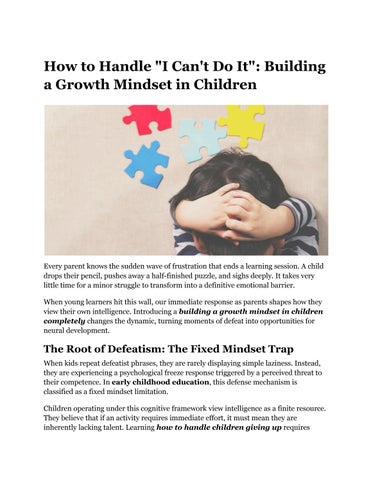
Every parent knows the sudden wave of frustration that ends a learning session. A child drops their pencil, pushes away a half-finished puzzle, and sighs deeply. It takes very little time for a minor struggle to transform into a definitive emotional barrier.
When young learners hit this wall, our immediate response as parents shapes how they view their own intelligence. Introducing a building a growth mindset in children completely changes the dynamic, turning moments of defeat into opportunities for neural development.
The Root of Defeatism: The Fixed Mindset Trap
When kids repeat defeatist phrases, they are rarely displaying simple laziness. Instead, they are experiencing a psychological freeze response triggered by a perceived threat to their competence. In early childhood education, this defense mechanism is classified as a fixed mindset limitation.
Children operating under this cognitive framework view intelligence as a finite resource. They believe that if an activity requires immediate effort, it must mean they are inherently lacking talent. Learning how to handle children giving up requires
shifting focus away from flawless final scores toward incremental performance improvements.
The Warning Signals of Task Avoidance
● Immediate Deflection: Choosing to entirely ignore a challenging assignment to avoid potential failure.
● Somatic Complaints: Experiencing sudden physiological symptoms like stomach aches when study sessions approach.
● Aggressive Resignation: Destroying or tearing up materials to physically remove the source of mental tension.
Overcoming the "I Can't Do It" Attitude
To rewrite deep-seated defeatist habits, parents must completely reframe the vocabulary used around academic success. Using specialized child growth mindset activities can actively replace counterproductive language with resilient verbal strategies during daily challenges:
The Child Says... Instead of Saying... Teach Them to Use... Behavioral Impact
"I'm not smart enough to do this math."
"Don't worry, you are incredibly smart!"
"You haven't mastered this specific formula yet."
"I give up, this drawing looks terrible."
"This game is way too hard to play."
"Let me finish the details for you."
"It's okay, we can just play something else."
"Look how much straighter your lines are today."
Normalizes temporary failure as a necessary step.
Emphasizes personal growth over arbitrary comparisons.
"Your brain is growing stronger as you practice." Promotes active problem-solving during moments of stress.
Gamifying Perseverance via Modern EdTech
Overcoming overcoming learning frustration in toddlers requires a careful balance of structure and engagement. Integrating a premium kids learning app into your routine completely changes the dynamics of skill development. Rather than relying on monotonous drills, advanced platforms leverage immersive software ecosystems to guide children safely through complex tasks.
By breaking extensive goals into short, gamified milestones, responsive platforms keep engagement levels high. This delicate balance ensures that young minds view mistakes not as permanent failures, but as useful clues to solve a larger puzzle.
Balancing Focus and Tech in Modern Early Education
Recent cognitive data collected through child development trials underscores the massive difference between passive media and interactive learning apps. Evaluating performance metrics across foundational age groups clearly illustrates how structured play directly influences focus windows.
This massive variance demonstrates that utilizing targeted educational games for kids significantly boosts cognitive endurance. When interactive elements award
micro-rewards for creative troubleshooting, children build the mental stamina required for advanced problem-solving, maximizing the power of yet for kids.
Practical At-Home Steps for Cognitive Adaptability
While advanced software offers an exceptional learning foundation, parents can apply several high-impact mistake positive parenting strategies to reinforce these behaviors offline.
1. Normalize Adult Error Tracking
Children often assume adults perform tasks flawlessly on their first try. Explicitly point out your own minor everyday mistakes—such as mismeasuring a cooking ingredient—and vocalize your troubleshooting process calmly. Showing that you can laugh off an error teaches them that mistakes are completely normal.
2. Move Toward Process-Based Praise
Praising a child's raw intelligence builds a fragile ego that fears challenges. Transition entirely toward praising the process vs product. Highlighting specific actions, strategies, and focus levels teaches them to value their determination over a flawless first draft.
Unlocking Academic Confidence
Cultivating lifelong mental resilience does not mean fighting exhausting nightly battles at the kitchen table. By replacing a fraction of standard passive screen time for kids with highly intentional, expert-calibrated digital environments, you can empower your child to embrace challenges with enthusiasm.
Provide your child with a personalized academic framework designed by top developmental experts by introducing them to the Zape Learning App today—the ultimate ad-free, secure sanctuary for modern gamified milestones and cognitive breakthroughs.