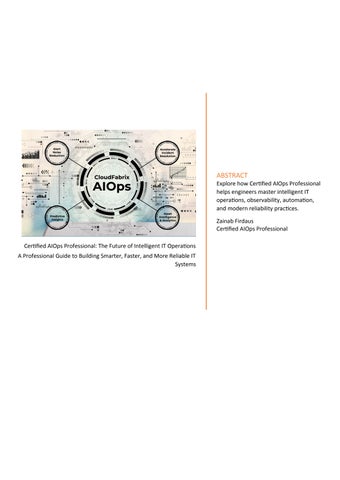
Certified AIOps Professional: The Future of Intelligent IT Operations
A Professional Guide to Building Smarter, Faster, and More Reliable IT Systems
ABSTRACT
Explore how Certified AIOps Professional helps engineers master intelligent IT operations, observability, automation, and modern reliability practices.
Zainab Firdaus
Certified AIOps Professional
Certified AIOps Professional: Why Intelligent IT Operations Are Becoming Essential for Modern Engineering Teams
Introduction: The Growing Importance of AIOps in Modern Engineering
Technology infrastructure has evolved rapidly over the last few years. Organizations no longer operate simple applications running on predictable environments. Modern software systems are highly distributed and often depend on cloud-native platforms, APIs, containers, microservices, automation workflows, and interconnected services working together in real time.
This shift has undoubtedly improved innovation and scalability. Teams can now release software faster, scale applications more efficiently, and support users globally. However, the growing complexity of these environments has also introduced a major operational challenge. Engineering teams are managing more systems, more data, and more dependencies than ever before.
Every second, production environments generate large volumes of logs, traces, metrics, alerts, dashboards, and monitoring signals. While visibility has improved, troubleshooting has become harder. During incidents, engineers frequently face a familiar problem: there is too much information available, but very little clarity about what actually caused the issue.
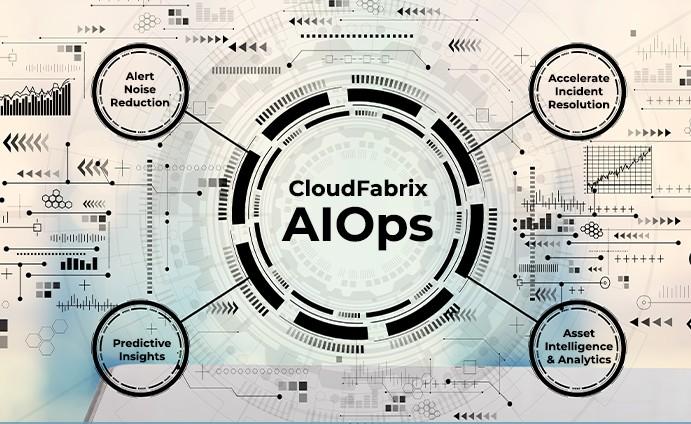
This is exactly why AIOps (Artificial Intelligence for IT Operations) has emerged as one of the most important developments in modern IT operations. AIOps helps engineering teams improve observability, identify anomalies, reduce alert fatigue, and make smarter operational decisions using machine learning, automation, and intelligent analytics.
For software engineers, DevOps practitioners, cloud professionals, Site Reliability Engineers (SREs), technical managers, and operations teams, understanding AIOps is becoming increasingly relevant.
The Certified AIOps Professional course offered by AIOpsSchool provides structured learning for professionals who want practical understanding of intelligent IT operations and modern operational practices. Professionals interested in exploring the certification can learn more through the official course page here: https://aiopsschool.com/certifications/certifiedaiops-professional.html.
Why AIOps Matters More Than Ever
Modern software systems rarely function independently. A customer-facing application today may depend on databases, APIs, distributed services, cloud platforms, orchestration systems, observability tools, and external integrations. As systems become more connected, failures also become more complicated.
A small issue in one infrastructure component can quickly impact several dependent systems. Increased latency, unexpected outages, failed requests, and service disruptions often spread across environments before teams can identify what actually happened.
Traditional monitoring systems are still important, but many engineering teams now face a common challenge: information overload.
During incidents, engineers may receive hundreds of alerts simultaneously. Teams spend valuable time switching between dashboards, logs, observability platforms, and incident tools trying to identify root causes. This often slows troubleshooting and increases operational stress.
AIOps improves this experience by introducing intelligence into IT operations.
Instead of treating alerts as separate problems, AIOps systems help teams identify relationships between incidents, recognize unusual behavior, prioritize operational signals, and reduce unnecessary noise. This creates a smarter approach to operations where teams can focus on solving real problems rather than manually sorting through endless alerts.
Organizations increasingly view AIOps as an operational advantage because it helps improve uptime, strengthen reliability, and support faster decision-making in highly dynamic environments.
What Does the Certified AIOps Professional Course Cover?
The Certified AIOps Professional course is designed for working professionals who want a practical understanding of how intelligent operational systems support modern software environments.
Rather than focusing only on technical theory, the course introduces real-world operational concepts that explain how AI-powered systems improve monitoring, observability, troubleshooting, automation, and reliability.
Participants learn how modern engineering teams use intelligent systems to improve operational awareness and reduce complexity in distributed environments.
The learning journey includes several important operational areas:
Learning Area
What Participants Learn
AIOps Fundamentals Core concepts behind intelligent IT operations
Event Correlation Understanding relationships between incidents and alerts
Anomaly Detection Identifying unusual system behavior early
These concepts are especially relevant for organizations operating cloud-native systems where traditional monitoring approaches alone are often insufficient.
Understanding the Practical Benefits of Certified AIOps Professional
A common misconception among engineering teams is that simply adding more monitoring tools improves reliability.
In practice, organizations often experience the opposite.
As monitoring environments grow, engineering teams become overwhelmed with alerts, dashboards, and disconnected operational data. Engineers spend increasing amounts of time manually correlating information instead of solving problems efficiently.
AIOps helps reduce this operational burden.
By combining analytics, observability, and intelligent event processing, AIOps systems help engineering teams understand which signals deserve attention and which are simply noise.
In practical environments, this often results in faster incident detection, better operational visibility, stronger troubleshooting workflows, and improved system resilience.
Teams managing production systems benefit because intelligent operational analysis can help surface patterns that manual monitoring might miss.
Professionals who understand AIOps also gain stronger awareness of how modern systems behave under real-world conditions. This operational awareness becomes increasingly valuable in environments where uptime, reliability, and performance directly affect customer experience.
About AIOpsSchool and Why Structured Learning Matters
AIOpsSchool focuses on helping technical professionals understand emerging operational disciplines including AIOps, observability, Site Reliability Engineering (SRE), DevOps, automation, and cloud operations.
For working professionals, structured learning can often provide significantly more value than fragmented tutorials, scattered documentation, or disconnected technical content.
AIOps is a broad discipline that requires understanding both technical systems and operational thinking.
Simply learning tools is not enough.
Professionals must also understand how telemetry works, how incidents evolve, how observability supports reliability, and how intelligent operational systems improve troubleshooting.
The Certified AIOps Professional course focuses on helping learners build this broader understanding in a practical and structured way aligned with modern engineering environments.
Career Benefits and Real-World Value of Certified AIOps
Professional
The technology landscape is changing rapidly, and engineering roles continue evolving alongside it.
Organizations increasingly want professionals who understand not only software development but also system reliability, incident management, operational resilience, and intelligent troubleshooting.
This shift has increased demand for professionals with stronger operational intelligence.
For software engineers, understanding AIOps improves production awareness and system thinking. DevOps professionals benefit from stronger understanding of observability and automation. Site Reliability Engineers improve reliability management and incident analysis, while cloud engineers strengthen their understanding of distributed environments.
Managers and technical leaders also benefit because operational visibility improves decisionmaking during incidents and performance challenges.
Some practical professional advantages include:
Better understanding of intelligent IT operations
Improved operational troubleshooting awareness
Stronger observability knowledge
Better alignment with DevOps and SRE practices
Increased relevance in cloud-native environments
As enterprises increasingly adopt AI-powered operational models, professionals who understand AIOps continue becoming more valuable across industries.
Common Mistakes Professionals Make While Learning AIOps
Many professionals approach AIOps with unrealistic expectations.
One of the most common mistakes is assuming AIOps is simply another automation platform. In reality, AIOps combines several disciplines including observability, telemetry analysis, anomaly detection, automation, incident intelligence, and machine learning.
Another common mistake is focusing entirely on tools while ignoring foundational operational concepts.
Without understanding monitoring systems, telemetry quality, dependencies, incident workflows, and operational patterns, professionals often struggle to apply advanced concepts effectively.
Some common mistakes include:
Treating AIOps as only automation
Ignoring observability fundamentals
Learning tools without operational understanding
Expecting immediate operational transformation
Overlooking telemetry and incident quality
A structured learning path often helps professionals build stronger practical understanding and avoid unnecessary confusion.
Who Should Enroll in Certified AIOps Professional?
The Certified AIOps Professional course is suitable for professionals involved in software delivery, cloud operations, infrastructure management, reliability engineering, and technical leadership.
Software engineers who want stronger production awareness can benefit from learning how intelligent systems support reliability. DevOps engineers looking to improve automation and observability knowledge may also find the course highly valuable.
Similarly, Site Reliability Engineers, cloud engineers, platform teams, IT operations professionals, infrastructure specialists, technical architects, and engineering managers can all benefit from understanding how intelligent operations improve reliability and decisionmaking.
Whether someone works in software engineering, cloud infrastructure, automation, or operational leadership, understanding AIOps can improve both technical awareness and practical problem-solving.
Frequently Asked Questions (FAQs)
What is Certified AIOps Professional?
Certified AIOps Professional is a certification designed to help professionals understand how artificial intelligence improves IT operations, observability, automation, and incident management.
Do I need prior AI or machine learning experience?
No. The course is designed for working professionals and does not require previous experience in machine learning or artificial intelligence.
Is the course useful for software engineers?
Yes. Modern software engineering increasingly requires stronger understanding of production systems, operational awareness, and system reliability.
Does AIOps replace DevOps or SRE?
No. AIOps complements DevOps and Site Reliability Engineering by improving observability, automation, and operational intelligence.
Final Thoughts: Why Certified AIOps Professional Matters
Modern engineering systems are becoming increasingly dynamic, distributed, and difficult to manage manually.
Traditional monitoring approaches alone are often no longer sufficient to maintain reliability in highly complex environments.
AIOps represents an important evolution in IT operations because it helps teams move beyond reactive troubleshooting toward intelligent operational decision-making.
For professionals looking to remain relevant in modern software engineering, DevOps, cloud operations, and reliability-focused roles, the Certified AIOps Professional course offers a structured pathway for understanding how intelligent operations are shaping the future of modern IT environments.